George Monbiot, about Syria…
By Tim Hayward | April 28, 2017
I write this open letter, George, because you have been using your public platform to defend claims about Syria that I fear may be damaging for its people.
Most recently, you blogged a note about the 4th April chemical incident in Khan Sheikhoun, Syria, and you related this to the more general issue of competing narratives.
Professor Postol of MIT criticised the NATO/Gulf State account of the incident, and you say his claims ‘should be treated with great caution’. That’s fair enough. Shouldn’t we apply a similar standard of scrutiny to claims made on both sides?[1] You replied to the Media Lens article reporting Postol’s claims without acknowledging that it also mentioned that ‘former and current UN weapons inspectors Hans Blix, Scott Ritter and Jerry Smith, as well as former CIA counterterrorism official Philip Giraldi, had all questioned the official narrative of what happened on April 4.’
We can be cautious about what they all say, of course, but I hope we may avoid the hubris of just dismissing their concerns.
There are serious unsettled questions about every aspect of the incident, not only the anomalies concerning time of incident, identity of victims, causes of death, role of White Helmets, and about whose interests it served, but also concerning the forensic evidence itself. Regarding the latest claim made by France, a very elementary issue is chain of custody: with no French representatives on the ground, the test samples appear to have come from Al Qaeda by way of Turkey. Must we simply trust the testimony of a terrorist organisation in collaboration with a major conduit and supplier of anti-government forces in Syria? Do we find any corroboration? Western powers, you might be aware, have blocked the independent investigation sought by Russia.
The reported results themselves are opaque. The French reports are no clearer on the science than the earlier UK ones (and I note that the UK has since gone rather silent about those rather than address questions about them). Moreover, the French claims rely on the veracity of claims relating to a 2013 incident, which are highly questionable.[2]
Still, even aside from the facts around the Khan Sheikhoun incident, you are confident that there is a mountain of compelling evidence that is disregarded by ‘a few contrarians’. In tweets, too, you seem to be impressed by the sheer quantity of evidence purporting to establish President Assad’s complicity in war crimes and crimes against humanity.
Yet you surely realise that what actually matters is the quality of evidence?
I therefore ask you: what evidence are you referring to? Whose evidence? In your note you link to a Guardian article by an Egyptian, raised in Dubai and living in Lebanon, who conveys reports from an Al Qaeda base; you also link to another Guardian article, by the same author, reporting claims from Turkey – one of the chief supporters of anti-government forces. Meanwhile, on twitter, you respond to ‘contrarians’ with the advice to read a lengthy thread authored by Kuwaiti activist Iyad El-Baghdadi who is renowned for talking up the “Arab Spring”. Based in Norway, he cites evidence from sources like the New York Times.
Why should utterances from your recommended sources inspire less caution than those of MIT professors and professional weapons inspectors? You seem to think that anyone who questions the official narrative is a conspiracy nut, or an ‘Assadist’. I personally find a little condescending your reference to ‘an element on the left that seems determined to produce a mirror image of the Washington Consensus … and denies the crimes of the West’s official enemies.’ [3]
At any rate, that begs the question: what crimes have been demonstrated? We have had mountains of allegations from organisations like Amnesty International since the “Arab Spring”, but what credible evidence have they ever produced?
I earnestly invite you to cite some. Having looked at their reports over the past ten years myself, I have not found it. Instead, I have found very clear traces of a narrative produced in Washington. And not just a narrative, but a strategy for getting the liberal intelligentsia on board with the hawks.
I think we need to look very closely at who is being misled by whom. Wouldn’t you agree?
Meanwhile, with the upcoming UK election to think about – and the imperative of removing this warmongering government – I will understand if you direct your focus and energies towards areas of public life where you have a strong intellectual and political contribution to make.
Best wishes,
Tim
In memory of all Syrian children, taken by violence.
[1] You might start by taking a more dispassionate look at the people you imagine have ‘debunked’ criticism of the mainstream narrative. Your link to Louis Proyect’s attack on Postol, for instance, betrays what I would regard as some want of judgement. In an update to your note, you add a link to further ‘debunkers’ who turn out to rely on the same Guardian evidence you are claiming they offer further support for! Incidentally, when the Guardian tells readers it is ‘the first western media organisation to visit the site of the attack’ it should really be careful what it boasts about, given that the area is controlled by Al Qaeda.
[2] I understand from scientists that the unanswered questions include these:
- Did the Porton Down analysis of samples collected from the alleged attacks on 19 March 2013 support the finding of the Russian Laboratory for Chemical and Analytical Control that the material contained diisopropyl fluorophosphate and that the sarin had been produced under “cottage industry” conditions?
- What were the findings with respect to the synthetic pathway by which the sarin was produced? Specifically, did this synthesis start from trimethyl phosphite (which the Foreign Secretary stated had been sold to the Syrian government by UK companies) or from phosphorus trichloride or elemental phosphorus (which Turkish prosecutors stated was on the procurement list of the Nusra Front members arrested in Adana, Turkey in May 2013)?
- What efforts have been made by the UK government to establish whether or not the sarin used in alleged chemical attacks in Syria originated from Syrian military stocks, based on comparison of the chemical profiles of the environmental samples analysed at DSTL with the stocks of the sarin precursor methylphosphonyl difluoride that were profiled by mass spectrometry under the supervison of OPCW inspectors before they were destroyed on the MV Cape Ray in 2014?
Those of us who struggle even to understand questions like these can very easily be bamboozled by bullshit responses from government spokespersons. But when scientists put such questions, I think they merit answer rather than dismissive tweets bidding us trust the word of foreign activists. I am grateful to Professor Paul McKeigue for the formulation of these questions.
[3] For a more considered view of disagreement on the left, see, e.g., the recent short talk by Jay Tharappel on ‘Syria and the Confusion of the Western Left’: https://www.facebook.com/Chacko.TJ/videos/10158536910055697/
At Reuters, ‘Not Refuting’ Is the Same as ‘Seeing’
By Jim Naureckas | FAIR | April 26, 2017
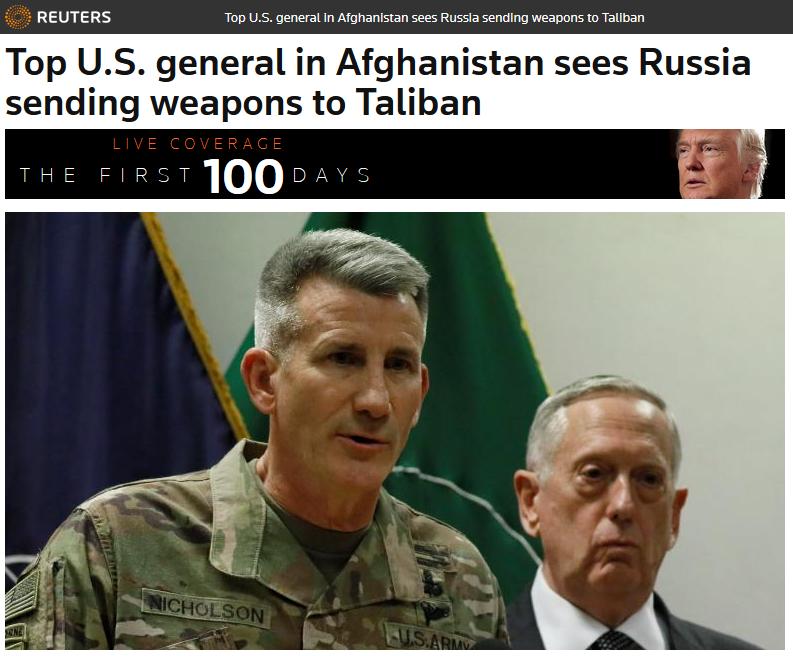
US general in Afghanistan does not say what Reuters headline says he said
“Top US General in Afghanistan Sees Russia Sending Weapons to Taliban” was Reuters’ headline over a April 25 story.
Well, that sounds like news! Tell me more, Reuters’ Idrees Ali:
The head of US and international forces in Afghanistan said on Monday he was “not refuting” reports that Russia was providing support, including weapons, to the Taliban…
Asked about reports that Russia was providing a range of help, including weapons, to the Taliban, who control large areas of Afghanistan, [Gen. John] Nicholson replied: “Oh no, I am not refuting that.”
“I am not refuting that”? How does that translate into “General… Sees Russia Sending Weapons to Taliban”? If NASA tells Reuters that they can’t refute speculation that there might be life on Mars, will Reuters run a story headlined “NASA Sees Life on Mars”? That would be a scoop!
Ali writes that Nicholson’s no-comment comments “are among the strongest suggestions yet that Moscow is providing arms to the Taliban.” Maybe next time Reuters could wait for a somewhat stronger suggestion—involving actual evidence, perhaps—before running a story that could inflame the new Cold War.
The Guardian Takes Aim at Venezuela’s Democracy
By Joe Emersberger | teleSUR | April 26, 2017
From 2006 to 2012, The Guardian’s output on Venezuela was dominated by its Caracas-based reporter, Rory Carroll, who tirelessly demonized, ridiculed and lied about the government of former president Hugo Chavez as it made rapid progress on reducing poverty.
The Guardian recently published an editorial saying that President Nicolas Maduro’s government must be threatened with “pariah status” by the “international community“ if it does not hold presidential elections by the end of 2018. This comes from a newspaper that continually attempts to rehabilitate former British prime minister Tony Blair, a man who played a key role in launching a war of aggression that killed hundreds of thousands of Iraqis. But no pariah status for him.
The imperial hypocrisy on display is stunning.
The Guardian editors cited the New York Times editorial board to back up their stance on Venezuela. In 2002, the New York Times editorial applauded a U.S.-backed military coup that ousted Chavez for two days.
“With yesterday’s resignation of President Hugo Chavez, Venezuelan democracy is no longer threatened by a would-be dictator. Mr. Chavez, a ruinous demagogue, stepped down after the military intervened and handed power to a respected business leader, Pedro Carmona,” wrote the morally challenged “paper of record.”
In fact, two of the opposition leaders The Guardian mentioned in its editorial, Leopoldo Lopez and Henrique Capriles, not only supported but participated in that coup. They led the kidnapping of government officials on behalf of Pedro Carmona. The Guardian, however, made no mention of the 2002 coup at all.
That coup continues to hover over Venezuela because so many of the opposition’s most prominent leaders either supported or participated in it. Julio Borges, head of the opposition-led Nation Assembly, supported the 2002 coup and routinely makes very thinly veiled appeals for the military to oust Maduro. Borges just did so in the pages of El Universal, one of the country’s largest newspapers, where he regularly publishes op-eds.
The other day, a news report on Venezuela’s largest TV network, Venevision, featured opposition politician Marialbert Barrios making a very similar appeal to the military.
The Guardian editors regurgitate a talking point that has been common in the western media: that Venezuela was “once South America’s richest country.” That’s true if the measure one uses is gross domestic product, GDP, per capita adjusted by purchasing power parity, PPP. But that measure says nothing about distribution.
Venezuela had a poverty rate of 50 percent in 1998 when Chavez was first elected even though it was second in South America at the time by GDP per capita. By the United Nation’s Human Development Index, HDI, a composite measure that takes into account life expectancy, education and national income, Venezuela ranked below several Latin American countries in 1998. Its HDI ranking then improved drastically until 2013, the year Chavez died. Using the U.N.’s most recent data and taking full account of the recent devastating recession it has experienced, Venezuela continues to rank above most countries in South America by HDI despite ongoing economic hardships.
There certainly are avoidable child deaths in Venezuela as The Guardian editors said. There always have been, but such deaths are more prevalent throughout the rest of the region, including Peru, whose right-wing government has loudly demanded that Venezuela deal with its “humanitarian crisis.”
Then there is Colombia, a country that has millions of internally displaced people, rivaling Syria. Colombia is also a country with a military that is being investigated by the International Criminal Court for murdering thousands of innocent people. In The Guardian’s universe, this arms client state of the U.S. and U.K. is just another “respectable” member of the “international community” that must straighten out Venezuela.
The Guardian is inexcusably sloppy in other claims.
It says inflation is at 800 percent. Torino Capital, a source that is very critical of the Maduro government, said inflation averaged 299 percent last year and projects it will average 434 percent next year. Unemployment was at 7.3 percent last year. Torino also projects a very small contraction of real GDP (-0.5 percent) next year and a return to growth by 2018. It has also commissioned polls from Datanalisis, an opposition-aligned pollster. Incidentally, the president of Datanalisis, Luis Vicente Leon, also criticizes the government in the pages of El Universal on a regular basis. As of March, according to Datanalisis, Maduro’s approval rating was 24.1 percent and has been steadily increasing in 2017. At the same time, the approval ratings of the most popular opposition leaders have fallen to 40 percent. These facts have been blacked out by the international press.
The Maduro government has not dealt with the root cause of the economic crisis, but, through direct deliveries of supplies to the poor (where its political support is concentrated) it has clearly alleviated the suffering of the poorest to a significant extent. Rachael Boothroyd-Rojas, and independent journalist based in Caracas for many years, noted that “there is a government store just below where I live and I haven’t seen queues there for months! Last year they were awful.”
Boothroyd-Rojas reports that there are still queues outside stores in Caracas but that they are nothing like they were months ago, and that government direct deliveries to the poor “have made a big difference to those who receive them.”
It should be noted that in December 2015, Datanalisis said Maduro’s approval rating was 32 percent just before his allies won 41 percent of the vote in National Assembly elections. It is not hard to see why opposition leaders have decided to “up their game” in terms of economic and political sabotage. Opposition leaders have openly boasted of working to block the government’s access to external financing.
Boothroyd-Rojas, who lives in a poor Caracas neighborhood, has noted the contradictions the international press has embraced to put the best face it can on the opposition’s violence. Vandalism of public property, including hospitals in poor neighborhoods, is dishonestly pointed to as evidence that the poor are starting to turn on the government: a claim The Guardian editors make. But when the middle and upper-class nature of the protests is too obvious to deny, it is alleged that the poor are simply “too hungry” to join in.
The opposition has resorted to widespread vandalism, including the torching of a Supreme Court office, and marching into areas where they have not been issued authorization — precisely to prevent a repeat of the 2002 coup — to provoke confrontation which it then points to as “repression.”
Honest, informed reporting would quickly expose those cynical tactics which are the same ones used in 2002 and again in 2014, but that’s clearly beyond what The Guardian editors are willing or able to do. We can only hope they won’t run an op-ed about Venezuela written by Blair any time soon.
French ‘Proof’ That Assad Used Sarin in Khan Sheikhoun Turns out to Be Complete BS
Russia-Insider | April 26, 2017
For over a week now France has claimed it has irrefutable evidence that Syrian military used gas against civilians earlier this month and would present it shortly.
It has now done so. It says it has determined that sarin used in the 2017 Khan Sheikhoun attack came from the same stock used in an earlier 2013 attack.
This is it. This is the extent of its super-duper evidence.
Because Paris “knows” the Syrian army used sarin in 2013, which Syria denies and was never proven, France now “knows” Syria also used sarin in 2017.
Anywhere else that would be called circular logic.
If anything, if samples from Khan Sheikhoun match sarin used in 2013 that makes it all the more likely that it came from rebel stock. The same stock they ultimately used to stage the East Ghouta false flag.
As Protests Rage in Venezuela, US Media Silent on Pro-Government Movements
Sputnik – April 26, 2017
As clashes between the Maduro government in Venezuela and the opposition are getting more and more fierce, the US media is openly calling for an economic war against the Bolivarian Revolution government, blaming it for casualties on both sides of the conflict.
Speaking to Radio Sputnik’s Brian Becker, author, journalist and lecturer Arnold August noted that the US media has a very clear stance: that Maduro and his Bolivarian Revolution government are responsible for everything bad that is happening in the country. Those who do not blame Maduro directly nonetheless report on the issue in such a way as to create the impression that Maduro is responsible, August said.
For example, an April 24 opinion piece by the Washington Times is entitled “Venezuela’s coming civil war: Maduro is arming his thugs to crush the democratic hopes of his desperate people.”
Reuters took a more subtle approach, reporting casualties among civilians without naming who fired the shots, on April 25.
“A 42-year-old man who worked for local government in the Andean state of Merida died from a gunshot in the neck at a rally in favor of president Nicolas Maduro’s government, the state ombudsman and prosecutor’s office said,” the report reads.
“Another 54-year-old man was shot dead in the chest during a protest in the western agricultural state of Barinas, the state prosecutor’s office added without specifying the circumstances,” it continues.
Major media, such as the Miami Herald and CNN, reported in the last few days that the US will have to consider imposing “serious sanctions” on Venezuela, should Maduro fail to host “free and fair” elections, allowing opposition leaders to campaign, August recalled. The US media also purposefully omits reports of demonstrations by the Chavistas — the supporters of the acting government.
The Green Left news website, on the other hand, reported “tens of thousands” of pro-government activists. Deutsche Welle carefully refrained from separating the sides, giving an overall estimate of 6 million people protesting on April 19. August claimed there were 3 million pro-government protesters across the whole country. All agree that these demonstrations have been the largest in the history of the nation.
August mentioned an opinion piece written for CNN by Jose Miguel Vivanco and Tamara Taraciuk Broner, “high-ranking members” of Human Rights Watch, August explained. Human Rights Watch is heavily financed by George Soros, who is known to be a big proponent of regime change around the world.
Vivanco and Taraciuk’s piece promotes the narrative that all of the deaths and violence in the country are “rightfully” blamed on Maduro, and that international pressure is needed to restore “human rights and democracy in Venezuela.”
“This is one big lie, if I may be quite frank,” August commented.
The US may be up to more than just harsh words in the media, August noted. On April 24, the Maduro government seized a General Motors factory in Venezuela, forcing the company to flee the country, leaving 2,700 people without jobs.
Officially, GM did not pay its taxes and refused to conform to “basic economic and financial rules,” August explains.
But he speculates that GM could have been involved in a darker scheme, similar to what happened in Chile in the 1973 coup d’état against Salvador Allende government.
“Main enterprises in Venezuela — General Motors, but there are others as well — were specifically organizing to hoard goods, to keep it away from the people, in order to create problems, to create a situation where people are starving, etc.,” August told Becker, adding that US companies also cut flights to Venezuela in an attempt to harm its income from tourism.
“It is undeniable that there are internal problems and weaknesses in the economy under the Bolivarian Revolution, but the main feature of the problem at this time is what has been induced and still being induced by the US and its allies,” he said.
The Pro-War Twist of the ‘Resistance’
By James W Carden | Consortium News | April 24, 2017
The Resistance, a self-aggrandizing term for what amounts to a relatively small but still powerful claque of embittered Clinton surrogates, has been keeping itself busy of late, fanning the flames of McCarthyite recriminations against anyone who dares question the rather flimsy public evidence that Russia influenced the results of the 2016 election, all the while cheering on President Trump’s expansion of the war in Syria.
Hillary Clinton on March 21, 2016 (Photo: AIPAC)
Like its approach to the question of Russia and the election, the Resistance will brook no dissent over whether or not President Trump did the “right thing” in unleashing 59 Tomahawk missiles on a country which we are not at war with and which has never attacked us.
As with their hysterical claims that Russia stole the election from Hillary Clinton, the Resistance is loathe to allow facts, logic or evidence to get in the way of its view that Donald Trump acted in the security interests of the United States by bombing the Syrian military which (with air support from the Russians) is currently in the process in routing ISIS and Al Qaeda.
Neoliberal Clinton partisan Ruth Marcus of the Washington Post wrote that in her view “Trump is, if not behaving normally, at least adopting normal positions.” Bombing Syria, in the absence of a legal mandate from the United Nations or with expressed authorization of Congress – both legal requirements if the U.S. Constitution and American treaty obligations are to be respected – is, to Marcus anyway, evidence of “Trump’s good judgment.”
Nor was Marcus alone. Clinton herself endorsed Trump’s decision to use force just hours before the attack, telling a crowd of well-heeled Resisters in New York that “I really believe that we should have and still should take out [Assad’s] air fields and prevent him from being able to use them to bomb innocent people and drop sarin gas on them.”
Former high-ranking Obama State Department officials Antony Blinken and Anne Marie Slaughter – he in the pages of the New York Times, she on Twitter – also praised Trump’s bombing of Syria as “the right thing” to do. The New Yorker’s Ryan Lizza declared, “The moral case for President Trump’s strike on Syria is uncontroversial.”
Punishing Anti-War Democrats
In the days following the Tomahawk missile attack on Syria, it became obvious that antiwar voices need not apply to the Resistance, which clearly remains in thrall to the 25-year-old interventionist orthodoxy begun under President Bill Clinton and which continues to be treated as unassailable dogma within the Democratic Party to this day. Those few who had the temerity to dissent from the Resistance party line were to be given no quarter.
One of the few prominent elected officials in Washington to voice skepticism of the Trump administration’s case for military action against Syria was Hawaii’s Rep. Tulsi Gabbard, who condemned the attack in a statement which accused the administration of having “acted recklessly without care or consideration of the dire consequences of the United States attack on Syria without waiting for the collection of evidence from the scene of the chemical poisoning.”
The knives came out for Gabbard even before the proverbial ink on the statement was dry. To no one’s surprise, The Washington Post quickly ran a smear job by Elise Vieback titled “What is Tulsi Gabbard thinking on Syria?” In it, Viebeck declared that “Gabbard has dug herself into a hole in recent weeks with her bizarre but insistent views about Syrian President Bashar al-Assad and his country’s bloody six years of civil war.”
But what really seemed to offended Vieback – and by extension, her employers at the Post – was Gabbard’s effrontery in committing an act of lese majeste against that which all right-thinking people in Washington “know” or, as Vieback put it: “her striking departure from the consensus that Assad’s government launched the attack.”
Vieback chronicled the Resistance’s disgust with the Congresswoman’s penchant for independent, critical thinking. No less a Resistance figure than MSNBC’s Joy Reid tweeted that “People who have insisted Gabbard is the future of the Democratic Party may need to consider her outré views on issues like Assad.” Other Resistance leaders piled on, too: The Daily Kos ; Center for American Progress president and close Clinton adviser Neeera Tanden; and former Vermont Governor and ex-Democratic National Committee Chairman Howard Dean all voiced their opinion that Gabbard should face a primary challenge in 2018. Indeed, according to Dean, the heath insurance lobbyist, “Gabbard should not be in Congress.”
Of course, all the handwringing over Gabbard’s comments were simply another opportunity for the right-minded to double down on their criticism of Gabbard’s controversial meeting with Syria’s Bashar al-Assad in January. Then as now, the Washington Post was at the forefront of the character attacks, running a piece by Josh Rogin titled “How Tulsi Gabbard became Assad’s mouthpiece in Washington” on Jan. 29. Yet Rogin’s piece was so sloppy and error-ridden that the Post had to append a humiliating paragraph long correction to it after it was published.
Ignoring Syrian Reality
Nevertheless, the Resistance’s cry of “what about Assad?” is a case of Democratic luminaries polishing up their reputations for virtue and signaling their commitments to career advancement, nothing more. It leaves out the fact that the Syrian opposition also bears responsibility for the start of the violence in 2011.
As Father Frans van der Lugt, a Dutch missionary to Syria who was murdered by rebel forces in 2014, put it: “From the start, the protest movements were not purely peaceful. From the start I saw armed demonstrators marching along in the protests, who began to shoot at the police first. Very often the violence of the security forces has been a reaction to the brutal violence of the armed rebels.”
The murdered Dutch priest also observed as early as 2011, that “The opposition of the street is much stronger than any other opposition. And this opposition is armed and frequently employs brutality and violence, only in order then to blame the government.”
The “what about Assad?” line also begs us to ignore what the likely consequences of his removal from power would actually mean: Who exactly do they think would fill the vacuum? The obsession with Assad also willfully ignores the immorality of U.S. policy, which involves repeatedly bombing Syria while funding and training violent extremists who seek to overthrow a sovereign government.
U.S. policy, wholeheartedly supported by the Resistance, tramples international law and makes a mockery of the tenets of Just War Theory. It results in violence, death and destruction abroad and sets the stage for retaliatory acts of violence upon our own people at home.
And so, in order to elide these considerations, the neoliberal left returns to the eternal, tiresome: “But what about Assad?” To which there is a pretty straightforward answer: Assad is fighting (quite successfully at present) the same enemies who attacked us on 9/11 in an attempt to stave off the wholesale takeover of Syria by Saudi-sponsored Salafists who would, as they promised in the early days of the uprising, drive “Christians to Beirut, Alawites to the grave.” Never mind what they would do to women, Shia and other apostates should they topple Assad and gain power.
Anti-interventionist and pro-peace Democrats object to this joint Saudi-Turkish project of turning Syria, which under Assad had been a secular, multi-confessional police state, into a theocratic Sunnistan, thereby carving out a state for our worst enemies.
Backing the Terrorists
The Resistance may need reminding that international politics, like domestic politics, is about choosing, and the choice that pro-war Democrats (the vast majority of whom are die-hard Clinton supporters who still have not been able to reconcile themselves to her defeat) have made is clear: they’ve thrown their support behind radical Islamist terror groups in Syria because they have bought into the tedious fiction about the existence of “moderate” Syrian rebels.
But the Resistance would be better off leaving the fantasy of peace-loving moderate Syrian rebels to the hipsters at VICE and the neocons and neoliberal war hawks comfortably ensconced at Brookings, the Center for American Progress, CNN, The Daily Beast, The Atlantic magazine, and The Atlantic Council.
Another trend among the self-fashioned “Resisters” these days is towards an unthinking acceptance of U.S. government talking points, particularly with regard to Russian hacking and the Trump administration’s declassified four-page report on the Syrian chemical weapons attack.
Yet given the less than inspiring record of American interventions based on faulty, distorted or simply fabricated intelligence, as in the cases of Iraq (2003) and Libya (2011), the question isn’t why someone like Gabbard is out there questioning the Trump administration’s story, the question is: why aren’t more doing so? And wouldn’t questioning Trump’s unilateral, illegal decision to bomb Syria seem to be the right and proper role of something which bills itself as “The Resistance”?
But no. As a friend and colleague of mine recently put it, if they were honest, the Resistance’s motto really ought to be: “Long live the Cold War with Russia. Long live neoliberal Wahhabism and chaos in the Middle East.”
Yet the Resistance drones on, drowning out anti-war, anti-Wahhabi, pro-detente voices all in a bid to reinforce the neoliberal foreign policy orthodoxy within the Democratic Party in the vain hope of solidifying their positions of power and influence within it.
James W Carden is a contributing writer for The Nation and editor of The American Committee for East-West Accord’s eastwestaccord.com. He previously served as an advisor on Russia to the Special Representative for Global Inter-governmental Affairs at the US State Department.
Western media ‘inflate’ Syria death toll to justify intervention – Assad
RT | April 21, 2017
The Western media deliberately exaggerate the number of people killed in the Syrian conflict to create a “humanitarian pretext” for a possible intervention in the war-torn country, Syrian President Bashar Assad told Sputnik in an exclusive interview.
The official death toll of the Syrian war is much lower than the numbers presented by the Western media and amounts to “tens of thousands, not… hundreds of thousands,” Assad told Sputnik.
He went on to say that the West adds the number of terrorists and foreign mercenaries killed to the official death toll, to make it higher and create an image of a humanitarian catastrophe of an unprecedented scale.
“So, the numbers that we’ve been hearing in the Western media during the last six years were not precise, [they were used] only to inflate the number just to show how horrible the situation is, to use it as humanitarian pretext to intervene in Syria,” the president said.
Speaking about chemical weapons allegedly possessed by terrorist groups, Assad said that he is “100 percent” sure that the extremists receive them “directly from Turkey.” He added that “there was evidence regarding this” and “many parties and parliament members in Turkey… questioned the government regarding those allegations.”
He went on to say that Turkey is in fact “the only route for the terrorists to get money, armaments, every logistic support, recruits, and this kind of material” as they “don’t have any other way to come from the north.”
He also reiterated his belief that Turkey’s actions in Syria, as well as those of the US, are an “invasion.” He said that such actions violate Syrian sovereignty, and that Damascus cannot simply tell them “they can stay” or “let’s negotiate” after they have entered Syria without official invitation.
“It is your land, you have to defend it, you have to go and fight,” Assad said, adding at the same time that “the priority now is to defeat the terrorists.”
He also emphasized the importance of Syria’s territorial integrity by saying that all issues regarding local self-government and “confederation” should be resolved within the framework of the Syrian legal system after the end of the conflict, and should be based on a broad social consensus.
“Syria is a melting pot of different cultures, different ethnicities, religions, sects, and so on. So, a single part of this social fabric cannot define the future of Syria; it needs consensus. So, … it’s better to wait and discuss the next constitution” together with all sections of Syrian society, he said.
Claims Russia’s Strategic Studies Institute Meddled in US Elections ‘Baseless’
Sputnik – 20.04.2017
MOSCOW – Accusations against the Russian Institute for Strategic Studies (RISS) of election interference in the United States are unfounded, Russian Senator Oleg Morozov told Sputnik on Thursday.
“This is an attempt to give away normal analytical work as subversive activity. An absolutely worthless story in terms of logic that has no basis in reality,” Morozov said.
Morozov went on to point out that dozens of similar think tanks operate in Europe and the United States and analyze the political situation, which, according to the senator, is not considered to be interference in the election process.
His comments came a day after the Reuters news service cited three current and four former US officials alleging that RISS circulated two “confidential documents” ahead of the November 2016 vote. The June and October documents were described as a “plan to swing” the US presidential election. US intelligence officials were said to have acquired the RISS-drafted documents.
According to the media outlet, the first document allegedly recommended that the Kremlin initiate a propaganda campaign on social media, and that Russia’s state-run media persuade US citizens to vote for a candidate less critical to Russia than former US President Barack Obama.
The second document reportedly said that Democratic presidential candidate Hillary Clinton had greater chances to win the election. As such, the paper allegedly called on the Kremlin to change the course of the campaign and intensify the information flow to undermine the US electoral system’s legitimacy and damage Clinton’s image and reputation, the media outlet reported citing US officials.
According to the publication, the Obama administration’s conclusion that Russia meddled in the election process and accusations of cyber attacks against Clinton’s campaign staff were mainly based on these documents.
On March 20, Federal Bureau of Investigation (FBI) Director James Comey confirmed that the institution was conducting a probe into Russia’s alleged interference in the 2016 US presidential elections.
Russian officials have repeatedly denied Washington’s accusations. Kremlin spokesman Dmitry Peskov refuted any allegations about Russia’s alleged involvement in US election process and said that Russia did not cooperate with US President Donald Trump’s staff during the election campaign.
Rachel Maddow Is Lost in Her Cold War Conspiracies
By Eoin Higgins | Paste | April 13, 2017
On MSNBC’s Sirius XM promos, Rachel Maddow tells the listener that the network—and by extension, herself as well—presents the news without “fear or favor.”
But a review of the month of March by Paste suggests that fear sells. With a single exception, Maddow led off every episode of her show in March with an extended, conspiratorial update for her viewers on the alleged connections between Russia and the Trump administration. Maddow’s monologues focused on the Russian oligarchic state and the authoritarian rule of President Vladimir Putin.
This obsession with Russia has had a palpable effect on the national conversation. Maddow is one of the most influential and popular voices for American liberals, and her theorizing on the Russia/Trump connection is part of a larger theory connecting the alleged collusion between the two to every world and national event.
As Aaron Mate points out in The Intercept, Maddow’s concentration on Trump is predicated on the idea that the President is a Russian pawn. It’s hardly a sure thing, and the focus may be more damaging than constructive for the “resistance.”
Maddow and likeminded influential liberals will have led their audience on a fruitless quest, all the while helping foment anti-Russia sentiment, channeling Democratic Party energy away from productive self-critique, and diverting focus from the White House’s actual policies. Trump would be handed a further gift via the damaged credibility of his “enemy”: the media responsible for holding him to account.
Look no further than the reactions to Trump’s bombing of a Syrian government airfield on April 6 for proof of that—despite the fact that Bashar al-Assad is openly backed by Russia, some liberal commentators refuse to see the missile strike as at all possibly opposed to Russian interests. “Donald Trump, Who’s Totally Not Vladimir Putin’s Puppet, Warned Russia Before Airstrikes on Syria,” was Salon’s sarcastic headline.
This is in large part because Maddow presents Russia as an outlier on the world stage, involved in activity and behavior that is incompatible with the American way of life. Yet her examples from the last month are hardly convincing.
In Russia, Maddow says, there is a “corrupt, elite class of connected thieves at the top who have been siphoning money out of that country.” Though she acknowledges that the US has massive income inequality and corruption, in Russia it’s different, because
the politically connected class at the top that is stealing is much smaller… and is much more traceable now, in the short amount of time, in terms of the way they have yanked money out of that country, and the way they have spread it all over the world to hide it and to disguise its origins.
Let’s hope nobody shatters Maddow’s image of America by pointing out that 400 Americans own as much wealth as the bottom 61 percent of the population. Or that, according to the World Bank, the United States and Russia have almost exactly the same GINI index—the standard measure of inequality.
Not only is Russia a unique kleptocracy, Maddow says, but it (along with China and North Korea) is also an abnormally bellicose nation, consumed by the need to show off its military prowess and power. This kind of behavior, Maddow argues, is antithetical to the American way of life (emphasis added).
There’s no law against parading your military, whether or not it’s an important anniversary. But through American eyes, this is a little weird, right? If this gives you the willies to look at, it`s because it`s supposed to. This is an unabashed, uncomplicated, undisguised display of military threat, military prowess or national insecurity, depending on how you look at it. I mean, this is not something that we do here in the United States.
It’s hard to know how Maddow would describe the constant flyovers by Air Force jets at football games, the honoring of fully dressed Marines at baseball games, or the numerous holidays the United States has that involve the strutting of US military machines, personnel and paraphernalia. One way to describe it, of course, would be as an unabashed, uncomplicated, undisguised display of military threat, military prowess or national insecurity—depending on how you look at it.
Instead of policy discussions, analysis of domestic issues or digging into the backgrounds of administration personnel, Maddow’s program spent March with a spotlight aimed at the new administration’s as-yet-unsubstantiated ties with Russian government intelligence services and the allegedly Russian-led hack of the DNC emails.
It paid off. Maddow’s program is the only non-Fox News program in the ten top-rated cable news programs for the first quarter of 2017, and the highest-ranked non-Fox program in the lucrative 25-54 demographic, according to AdWeek. Yet this success came with an obsession with Russia twinned with overblown dot-connecting, speculative reasoning stated as fact and an emphasis on a wide ranging, insidious conspiracy.
Maddow referenced Russia repeatedly in March. The highest number of mentions we found was 105 on March 9, the lowest was days earlier on March 6, when it came up only eight times. On average, the country was mentioned around 53 times a show—or over once a minute, once you subtract commercials from the airtime—and Maddow did not let a single opening segment go by for the entire month without at least a mention of Russia’s alleged ties to Trump.
The entire list is below, but here are three telling examples of Maddow’s obsessive attention to Russia at the expense of anything else going on in the news.
— March 7, 2017: “Russia” or “Russians” mentioned 71 times. Maddow acknowledged news about ACA and immigration, but chose to lead instead with a study of the Russian embassy, promising to cover the breaking domestic news later.
— March 14, 2017: “Russia” or “Russians” mentioned 19 times. The show led with the infamous tax return document that Maddow introduced with a winding 20-minute monologue that touched on a number of conspiracy theories for which she provided no proof.
— March 17, 2017: “Russia” or “Russians” mentioned 51 times. The show led with Tom Price, then moves to the Gorsuch hearings as a pretext for a long discussion on hypothetical discoveries about Russia in House hearings.
It was on the latter date that Maddow laid out the justification for her unrelenting focus—a thesis grounded on flimsy evidence, hyperbolic rhetoric and unsubstantiated allegations:
The Russian attack on our election last year, the unexplained connections between the Trump campaign and Russia during that time, during the time of the attack, the strangeness, particularly, the strangeness of the FBI in its treatment of this matter, it’s unsettling. It’s unsettling not just because this is one scandal among so many scandals for this young administration. So many scandals that some are being ignored because they’re not big enough to warrant attention amid other scandals, right?
This is unsettling not just because it’s one scandal among many. This is unsettling because if the worst is true, if the presidency is effectively a Russian op, right, if the American presidency right now is the product of collusion between the Russian intelligence services and an American campaign—I mean, that is so profoundly big. We not only need to stay focused on figuring it out, we need to start preparing for what the consequences are going to be if it proves to be true. We need to start thinking about how we’re going to deal with the worst revelations if they do come to light, if they are proved true.
Maddow could have just looked over reporting from the last four months to see that the allegations that Russia “attacked” the presidential election are questionable. But instead, she spent the entire month of March pushing an ever-escalating conspiracy theory to explain the Trump presidency, based on speculative hyperbole describing a mass web of collusion between the president, the Russian government and other actors.
“WikiLeaks got all inextricably bound up in our new national nightmare about Russia hacking our presidential election,” Maddow said (3/6/17), and “Russian intelligence was mounting an operation against us, against our election to try to affect the outcome” (3/9/17). Yet despite the fact that the MSNBC host had “been following this [with] pretty intense attention” (3/2/17), she conceded she didn’t “know what`s going on in terms of the law enforcement and intelligence investigations” (3/3/17).
That didn’t stop Maddow from speculating about what those investigations could find out about possible Trump/Russia collusion.
“We’ve had it confirmed today that what they are also investigating is whether, once again, the Russians had help from inside the United States when it came time to humble America and show our country what they are capable of,” Maddow said (3/20/17), elaborating remarkably on the testimony of FBI Director James Comey, who had said only that the agency was investigating potential ties between the campaign and the Russian government.
Maddow’s viewers wouldn’t have known that from her. Instead, they would have been treated to more accusations of an intelligence operation that used the internet and Bernie Sanders supporters to defeat Hillary Clinton.
“Russian forces were operating inside something very high-profile,” Maddow said (3/31/17). “They were operating inside the U.S. presidential election.”
“This is not part of American politics,” she said earlier in the month (3/21/17). “This is not, you know, partisan warfare between Republicans and Democrats. This is international warfare against our country and it did not end on election day. We are still in it.”
Trump’s finances came in for scrutiny as well—understandable, given that the president has refused to release his tax returns. But even a major scoop in mid-March fell prey to a rambling monologue that tried to hit all the marks of the Russian conspiracy theory before landing on a rather deflated two-page nothingburger.
“Has [Trump] received money from foreign sources? Has he received loans from foreign sources?” Maddow asked, before revealing two pages of a 2005 tax return that indicated nothing of the sort.
She added the next day that there were questions on why Trump would make public statements on the benefits of investing in Russia in 2006, trying to tie in the widely panned exposé from the night before:
Why did he think so? Were there financial ties with Russia that would give him such confidence about that pronouncement which he made very shortly after he signed this tax return?
There are no negative consequences for the liberal commentator for trafficking in these sorts of conspiracy theories, as long as they’re aimed at the “right” target—look no further than Fairness and Accuracy’s recent reporting on Louise Mensch to see how the most discredited, illogical ideas can gain credence on the centrist liberal media circuit as long as they are aimed at Russia. And in Maddow’s case, these theories have an added bonus: higher ratings and corresponding higher ad revenue.
Maddow presents herself as a fair but tough liberal commentator. Her show is based on her presentation of the news that her audience wants and needs to hear. For her to spend so much time on a Cold War enemy at the expense of real domestic policies, and for her to do so with such speculative reasoning and logical leaps and bounds makes it clear that it’s ratings, not truth, that she’s really after.
Maddow on Russia: March, 2017
Findings on the pundit’s preoccupation
— March 2, 2017: “Russia” or “Russians” mentioned 24 times. Show leads with Attorney Jeff Sessions’ conversations with Kislyak.
— March 3, 2017: “Russia” or “Russians” mentioned 68 times. Show leads with profile of Russian opposition to Putin.
— March 6, 2017: “Russia” or “Russians” mentioned 8 times. Show leads with Trump family ties to central Asian nation Azerbijain.
— March 7, 2017: “Russia” or “Russians” mentioned 71 times. Maddow acknowledges news about ACA and immigration but chooses to lead instead with a study of the Russian embassy, promising to cover the domestic breaking news later.
— March 8, 2017: “Russia” or “Russians” mentioned 103 times. Show leads with the GOP platform on Russia and Ukraine.
— March 9, 2017: “Russia” or “Russians” mentioned 105 times. Show leads with sanctions and mentions the unsubstantiated dossier on Trump written by retired British intelligence officer Christopher Steele Buzzfeed published, acknowledges its content has not been verified, and then quotes from it at length.
— March 10, 2017: “Russia” or “Russians” mentioned 47 times. Show leads with Mike Flynn’s ties to the country and his dinner with RT.
— March 13, 2017: “Russia” or “Russians” mentioned 50 times. Show leads with Russian money laundering after Maddow lets the audience know the GOP healthcare bill has problems, but she’ll get to them later.
— March 14, 2017: “Russia” or “Russians” mentioned 19 times. Show leads with the infamous tax return document that Maddow introduced with a winding 20-minute monologue touching on a number of conspiracy theories for which she had zero proof.
— March 15, 2017: “Russia” or “Russians” mentioned 31 times. Show leads with Geert Wilders and the Russian investigation in Congress; Maddow tries to tie an FSB agent’s prosecution in Russia to Trump.
— March 16, 2017: “Russia” or “Russians” mentioned 65 times. Show leads with the 2014 Sochi Olympics.
— March 17, 2017: “Russia” or “Russians” mentioned 51 times. Show leads with Tom Price, then moves to the Gorsuch hearings as a pretext for a long discussion on hypothetical discoveries about Russia in House hearings.
— March 20, 2017: “Russia” or “Russians” mentioned 86 times. Show leads with Russian nuclear capabilities.
— March 21, 2017: “Russia” or “Russians” mentioned 52 times. Show leads with Bernie Sanders’ online supporters were Russian agents.
— March 22, 2017: “Russia” or “Russians” mentioned 54 times. Show leads with Paul Manafort’s connections to an unnamed Russian billionaire.
— March 23, 2017: “Russia” or “Russians” mentioned 57 times. Show leads with health care repeal (Russia and Ukraine are a segment later on).
— March 24, 2017: “Russia” or “Russians” mentioned 33 times. Show leads with the House Intelligence Committee hearing on Russian involvement in the election.
— March 27, 2017: “Russia” or “Russians” mentioned 50 times. Show leads with the FSB and Russian banks conspiring to get Trump elected.
— March 28, 2017: “Russia” or “Russians” mentioned 39 times. Show leads with Maddow declaring that Russia and China’s displays of military power during national holidays are unique to those countries.
— March 29, 2017: “Russia” or “Russians” mentioned 50 times. Show leads with alleged Russian involvement in the upcoming French elections.
— March 30, 2017: “Russia” or “Russians” mentioned 33 times. Show leads with Mike Flynn’s request for immunity, which Maddow ties to Russia.
— March 31, 2017: “Russia” or “Russians” mentioned 80 times. Show leads with the House investigation.
You can follow Eoin Higgins on Twitter and find him at Patreon.
Featured Video

Death Spikes & Rising Cancer In Our Youth Explained
or go to
Aletho News Archives – Video-Images
From the Archives
Politicians lie
By Mazin Qumsiyeh | Popular Resistance | August 18, 2013
There is no way to say this truth nicely: Politicians lie. That includes Japanese, American, Egyptian, Israeli, and Palestinian politicians! Is there something more common sense than that? Yet, so many citizens around the world believe their own politicians or wistfully acknowledge lies but think it is part of the job needed to run things. They believe even when politicians contradict themselves blatantly. This phenomenon is rather remarkable. It is a dissonance and disconnect from reality that many seem oblivious to. It is very dangerous because it can lead to accepting rationales for going to war. These can be deadly wars that lead to millions of lives lost as happened in what was called World War 1 and WW2. Even when incredible and declassified evidence abound, politicians continue to lie and old mythologies refuse to die. Here are just a few of the countless lies told to us over the past few decades… continue
Blog Roll
 Aletho News
- Turkish parliament to review Saudi-Pakistan defense pact next month
- DEATH SPIKES & RISING CANCER IN OUR YOUTH EXPLAINED
- Iran offers Trump deal before US election
- Merz regime wants ‘secret police’ – opposition
- Israeli settlers terrorize West Bank Palestinians with state-provided drones: Report
- They see them, then kill them: Israeli quadcopters track, deliberately target civilians in Gaza
- Debunked: Trump’s egregious UNGA claims on war against Iran crumble under scrutiny
- Europe was part of the infrastructure of US aggression against Iran: Deputy FM
- New evidence on the Bucha Massacre
- Italy and France debunk reports CIA issued ‘Russian drone threat’ warning
- If Americans Knew
- An error has occurred; the feed is probably down. Try again later.
- No Tricks Zone
- New Study: Earth And Venus Surface Warmth Largely Explained By Convection And Lapse Rate, Not CO2 Or Radiation
- 2025 Nature Paper Claiming Worsening Global Drought Gets RETRACTED …Heavily Flawed
- New Study: ‘Global Drought Shows No Detectable Recent Acceleration Under Climate Warming’
- Economic Masterminds: German Socialists Suggest Taxing Productivity Gains Stemming From Using AI
- The South China Sea Has Not Been Cooperating With The Climate Change Narrative
- Energy Crisis: Germany Enters Heating Season With Historically Low Gas Reserve Fill Levels
- New Study: The Antarctic Ice Sheet Gained Mass From 2020-2024 Due To Staggering Snow And Ice Accumulation
- Study: Ocean Heating Rates From Thousands Of Years Ago ‘Dwarf’ Modern Ocean Heating Rates
- Climate Extremists Target, Attack Large-Scale Power Grid Infrastructure In Germany!
- New Study: Antarctic Ice Melt Has Contributed Less Than 1 Centimeter To Sea Level Rise In The Last 30 Years

