Claims Russia’s Strategic Studies Institute Meddled in US Elections ‘Baseless’
Sputnik – 20.04.2017
MOSCOW – Accusations against the Russian Institute for Strategic Studies (RISS) of election interference in the United States are unfounded, Russian Senator Oleg Morozov told Sputnik on Thursday.
“This is an attempt to give away normal analytical work as subversive activity. An absolutely worthless story in terms of logic that has no basis in reality,” Morozov said.
Morozov went on to point out that dozens of similar think tanks operate in Europe and the United States and analyze the political situation, which, according to the senator, is not considered to be interference in the election process.
His comments came a day after the Reuters news service cited three current and four former US officials alleging that RISS circulated two “confidential documents” ahead of the November 2016 vote. The June and October documents were described as a “plan to swing” the US presidential election. US intelligence officials were said to have acquired the RISS-drafted documents.
According to the media outlet, the first document allegedly recommended that the Kremlin initiate a propaganda campaign on social media, and that Russia’s state-run media persuade US citizens to vote for a candidate less critical to Russia than former US President Barack Obama.
The second document reportedly said that Democratic presidential candidate Hillary Clinton had greater chances to win the election. As such, the paper allegedly called on the Kremlin to change the course of the campaign and intensify the information flow to undermine the US electoral system’s legitimacy and damage Clinton’s image and reputation, the media outlet reported citing US officials.
According to the publication, the Obama administration’s conclusion that Russia meddled in the election process and accusations of cyber attacks against Clinton’s campaign staff were mainly based on these documents.
On March 20, Federal Bureau of Investigation (FBI) Director James Comey confirmed that the institution was conducting a probe into Russia’s alleged interference in the 2016 US presidential elections.
Russian officials have repeatedly denied Washington’s accusations. Kremlin spokesman Dmitry Peskov refuted any allegations about Russia’s alleged involvement in US election process and said that Russia did not cooperate with US President Donald Trump’s staff during the election campaign.
Rachel Maddow Is Lost in Her Cold War Conspiracies
By Eoin Higgins | Paste | April 13, 2017
On MSNBC’s Sirius XM promos, Rachel Maddow tells the listener that the network—and by extension, herself as well—presents the news without “fear or favor.”
But a review of the month of March by Paste suggests that fear sells. With a single exception, Maddow led off every episode of her show in March with an extended, conspiratorial update for her viewers on the alleged connections between Russia and the Trump administration. Maddow’s monologues focused on the Russian oligarchic state and the authoritarian rule of President Vladimir Putin.
This obsession with Russia has had a palpable effect on the national conversation. Maddow is one of the most influential and popular voices for American liberals, and her theorizing on the Russia/Trump connection is part of a larger theory connecting the alleged collusion between the two to every world and national event.
As Aaron Mate points out in The Intercept, Maddow’s concentration on Trump is predicated on the idea that the President is a Russian pawn. It’s hardly a sure thing, and the focus may be more damaging than constructive for the “resistance.”
Maddow and likeminded influential liberals will have led their audience on a fruitless quest, all the while helping foment anti-Russia sentiment, channeling Democratic Party energy away from productive self-critique, and diverting focus from the White House’s actual policies. Trump would be handed a further gift via the damaged credibility of his “enemy”: the media responsible for holding him to account.
Look no further than the reactions to Trump’s bombing of a Syrian government airfield on April 6 for proof of that—despite the fact that Bashar al-Assad is openly backed by Russia, some liberal commentators refuse to see the missile strike as at all possibly opposed to Russian interests. “Donald Trump, Who’s Totally Not Vladimir Putin’s Puppet, Warned Russia Before Airstrikes on Syria,” was Salon’s sarcastic headline.
This is in large part because Maddow presents Russia as an outlier on the world stage, involved in activity and behavior that is incompatible with the American way of life. Yet her examples from the last month are hardly convincing.
In Russia, Maddow says, there is a “corrupt, elite class of connected thieves at the top who have been siphoning money out of that country.” Though she acknowledges that the US has massive income inequality and corruption, in Russia it’s different, because
the politically connected class at the top that is stealing is much smaller… and is much more traceable now, in the short amount of time, in terms of the way they have yanked money out of that country, and the way they have spread it all over the world to hide it and to disguise its origins.
Let’s hope nobody shatters Maddow’s image of America by pointing out that 400 Americans own as much wealth as the bottom 61 percent of the population. Or that, according to the World Bank, the United States and Russia have almost exactly the same GINI index—the standard measure of inequality.
Not only is Russia a unique kleptocracy, Maddow says, but it (along with China and North Korea) is also an abnormally bellicose nation, consumed by the need to show off its military prowess and power. This kind of behavior, Maddow argues, is antithetical to the American way of life (emphasis added).
There’s no law against parading your military, whether or not it’s an important anniversary. But through American eyes, this is a little weird, right? If this gives you the willies to look at, it`s because it`s supposed to. This is an unabashed, uncomplicated, undisguised display of military threat, military prowess or national insecurity, depending on how you look at it. I mean, this is not something that we do here in the United States.
It’s hard to know how Maddow would describe the constant flyovers by Air Force jets at football games, the honoring of fully dressed Marines at baseball games, or the numerous holidays the United States has that involve the strutting of US military machines, personnel and paraphernalia. One way to describe it, of course, would be as an unabashed, uncomplicated, undisguised display of military threat, military prowess or national insecurity—depending on how you look at it.
Instead of policy discussions, analysis of domestic issues or digging into the backgrounds of administration personnel, Maddow’s program spent March with a spotlight aimed at the new administration’s as-yet-unsubstantiated ties with Russian government intelligence services and the allegedly Russian-led hack of the DNC emails.
It paid off. Maddow’s program is the only non-Fox News program in the ten top-rated cable news programs for the first quarter of 2017, and the highest-ranked non-Fox program in the lucrative 25-54 demographic, according to AdWeek. Yet this success came with an obsession with Russia twinned with overblown dot-connecting, speculative reasoning stated as fact and an emphasis on a wide ranging, insidious conspiracy.
Maddow referenced Russia repeatedly in March. The highest number of mentions we found was 105 on March 9, the lowest was days earlier on March 6, when it came up only eight times. On average, the country was mentioned around 53 times a show—or over once a minute, once you subtract commercials from the airtime—and Maddow did not let a single opening segment go by for the entire month without at least a mention of Russia’s alleged ties to Trump.
The entire list is below, but here are three telling examples of Maddow’s obsessive attention to Russia at the expense of anything else going on in the news.
— March 7, 2017: “Russia” or “Russians” mentioned 71 times. Maddow acknowledged news about ACA and immigration, but chose to lead instead with a study of the Russian embassy, promising to cover the breaking domestic news later.
— March 14, 2017: “Russia” or “Russians” mentioned 19 times. The show led with the infamous tax return document that Maddow introduced with a winding 20-minute monologue that touched on a number of conspiracy theories for which she provided no proof.
— March 17, 2017: “Russia” or “Russians” mentioned 51 times. The show led with Tom Price, then moves to the Gorsuch hearings as a pretext for a long discussion on hypothetical discoveries about Russia in House hearings.
It was on the latter date that Maddow laid out the justification for her unrelenting focus—a thesis grounded on flimsy evidence, hyperbolic rhetoric and unsubstantiated allegations:
The Russian attack on our election last year, the unexplained connections between the Trump campaign and Russia during that time, during the time of the attack, the strangeness, particularly, the strangeness of the FBI in its treatment of this matter, it’s unsettling. It’s unsettling not just because this is one scandal among so many scandals for this young administration. So many scandals that some are being ignored because they’re not big enough to warrant attention amid other scandals, right?
This is unsettling not just because it’s one scandal among many. This is unsettling because if the worst is true, if the presidency is effectively a Russian op, right, if the American presidency right now is the product of collusion between the Russian intelligence services and an American campaign—I mean, that is so profoundly big. We not only need to stay focused on figuring it out, we need to start preparing for what the consequences are going to be if it proves to be true. We need to start thinking about how we’re going to deal with the worst revelations if they do come to light, if they are proved true.
Maddow could have just looked over reporting from the last four months to see that the allegations that Russia “attacked” the presidential election are questionable. But instead, she spent the entire month of March pushing an ever-escalating conspiracy theory to explain the Trump presidency, based on speculative hyperbole describing a mass web of collusion between the president, the Russian government and other actors.
“WikiLeaks got all inextricably bound up in our new national nightmare about Russia hacking our presidential election,” Maddow said (3/6/17), and “Russian intelligence was mounting an operation against us, against our election to try to affect the outcome” (3/9/17). Yet despite the fact that the MSNBC host had “been following this [with] pretty intense attention” (3/2/17), she conceded she didn’t “know what`s going on in terms of the law enforcement and intelligence investigations” (3/3/17).
That didn’t stop Maddow from speculating about what those investigations could find out about possible Trump/Russia collusion.
“We’ve had it confirmed today that what they are also investigating is whether, once again, the Russians had help from inside the United States when it came time to humble America and show our country what they are capable of,” Maddow said (3/20/17), elaborating remarkably on the testimony of FBI Director James Comey, who had said only that the agency was investigating potential ties between the campaign and the Russian government.
Maddow’s viewers wouldn’t have known that from her. Instead, they would have been treated to more accusations of an intelligence operation that used the internet and Bernie Sanders supporters to defeat Hillary Clinton.
“Russian forces were operating inside something very high-profile,” Maddow said (3/31/17). “They were operating inside the U.S. presidential election.”
“This is not part of American politics,” she said earlier in the month (3/21/17). “This is not, you know, partisan warfare between Republicans and Democrats. This is international warfare against our country and it did not end on election day. We are still in it.”
Trump’s finances came in for scrutiny as well—understandable, given that the president has refused to release his tax returns. But even a major scoop in mid-March fell prey to a rambling monologue that tried to hit all the marks of the Russian conspiracy theory before landing on a rather deflated two-page nothingburger.
“Has [Trump] received money from foreign sources? Has he received loans from foreign sources?” Maddow asked, before revealing two pages of a 2005 tax return that indicated nothing of the sort.
She added the next day that there were questions on why Trump would make public statements on the benefits of investing in Russia in 2006, trying to tie in the widely panned exposé from the night before:
Why did he think so? Were there financial ties with Russia that would give him such confidence about that pronouncement which he made very shortly after he signed this tax return?
There are no negative consequences for the liberal commentator for trafficking in these sorts of conspiracy theories, as long as they’re aimed at the “right” target—look no further than Fairness and Accuracy’s recent reporting on Louise Mensch to see how the most discredited, illogical ideas can gain credence on the centrist liberal media circuit as long as they are aimed at Russia. And in Maddow’s case, these theories have an added bonus: higher ratings and corresponding higher ad revenue.
Maddow presents herself as a fair but tough liberal commentator. Her show is based on her presentation of the news that her audience wants and needs to hear. For her to spend so much time on a Cold War enemy at the expense of real domestic policies, and for her to do so with such speculative reasoning and logical leaps and bounds makes it clear that it’s ratings, not truth, that she’s really after.
Maddow on Russia: March, 2017
Findings on the pundit’s preoccupation
— March 2, 2017: “Russia” or “Russians” mentioned 24 times. Show leads with Attorney Jeff Sessions’ conversations with Kislyak.
— March 3, 2017: “Russia” or “Russians” mentioned 68 times. Show leads with profile of Russian opposition to Putin.
— March 6, 2017: “Russia” or “Russians” mentioned 8 times. Show leads with Trump family ties to central Asian nation Azerbijain.
— March 7, 2017: “Russia” or “Russians” mentioned 71 times. Maddow acknowledges news about ACA and immigration but chooses to lead instead with a study of the Russian embassy, promising to cover the domestic breaking news later.
— March 8, 2017: “Russia” or “Russians” mentioned 103 times. Show leads with the GOP platform on Russia and Ukraine.
— March 9, 2017: “Russia” or “Russians” mentioned 105 times. Show leads with sanctions and mentions the unsubstantiated dossier on Trump written by retired British intelligence officer Christopher Steele Buzzfeed published, acknowledges its content has not been verified, and then quotes from it at length.
— March 10, 2017: “Russia” or “Russians” mentioned 47 times. Show leads with Mike Flynn’s ties to the country and his dinner with RT.
— March 13, 2017: “Russia” or “Russians” mentioned 50 times. Show leads with Russian money laundering after Maddow lets the audience know the GOP healthcare bill has problems, but she’ll get to them later.
— March 14, 2017: “Russia” or “Russians” mentioned 19 times. Show leads with the infamous tax return document that Maddow introduced with a winding 20-minute monologue touching on a number of conspiracy theories for which she had zero proof.
— March 15, 2017: “Russia” or “Russians” mentioned 31 times. Show leads with Geert Wilders and the Russian investigation in Congress; Maddow tries to tie an FSB agent’s prosecution in Russia to Trump.
— March 16, 2017: “Russia” or “Russians” mentioned 65 times. Show leads with the 2014 Sochi Olympics.
— March 17, 2017: “Russia” or “Russians” mentioned 51 times. Show leads with Tom Price, then moves to the Gorsuch hearings as a pretext for a long discussion on hypothetical discoveries about Russia in House hearings.
— March 20, 2017: “Russia” or “Russians” mentioned 86 times. Show leads with Russian nuclear capabilities.
— March 21, 2017: “Russia” or “Russians” mentioned 52 times. Show leads with Bernie Sanders’ online supporters were Russian agents.
— March 22, 2017: “Russia” or “Russians” mentioned 54 times. Show leads with Paul Manafort’s connections to an unnamed Russian billionaire.
— March 23, 2017: “Russia” or “Russians” mentioned 57 times. Show leads with health care repeal (Russia and Ukraine are a segment later on).
— March 24, 2017: “Russia” or “Russians” mentioned 33 times. Show leads with the House Intelligence Committee hearing on Russian involvement in the election.
— March 27, 2017: “Russia” or “Russians” mentioned 50 times. Show leads with the FSB and Russian banks conspiring to get Trump elected.
— March 28, 2017: “Russia” or “Russians” mentioned 39 times. Show leads with Maddow declaring that Russia and China’s displays of military power during national holidays are unique to those countries.
— March 29, 2017: “Russia” or “Russians” mentioned 50 times. Show leads with alleged Russian involvement in the upcoming French elections.
— March 30, 2017: “Russia” or “Russians” mentioned 33 times. Show leads with Mike Flynn’s request for immunity, which Maddow ties to Russia.
— March 31, 2017: “Russia” or “Russians” mentioned 80 times. Show leads with the House investigation.
You can follow Eoin Higgins on Twitter and find him at Patreon.
What Russia-gate Has Wrought
By Robert Parry | Consortium News | April 16, 2017
Democrats, liberals and some progressives might be feeling a little perplexed over what has happened to Russia-gate, the story that pounded Donald Trump every day since his election last November – until April 4, that is.
On April 4, Trump fully capitulated to the neoconservative bash-Russia narrative amid dubious claims about a chemical attack in Syria. On April 6, Trump fired off 59 Tomahawk missiles at a Syrian airbase; he also restored the neocon demand for “regime change” in Syria; and he alleged that Russia was possibly complicit in the supposed chemical attack.
Since Trump took those actions – in accordance with the neocon desires for more “regime change” in the Middle East and a costly New Cold War with Russia – Russia-gate has almost vanished from the news.
I did find a little story in the lower right-hand corner of page A12 of Saturday’s New York Times about a still-eager Democratic congressman, Mike Quigley of Illinois, who spent a couple of days in Cyprus which attracted his interest because it is a known site for Russian money-laundering, but he seemed to leave more baffled than when he arrived.
“The more I learn, the more complex, layered and textured I see the Russia issue is – and that reinforces the need for professional full-time investigators,” Quigley said, suggesting that the investigation’s failure to strike oil is not that the holes are dry but that he needs better drill bits.
Yet, given all the hype and hullabaloo over Russia-gate, the folks who were led to believe that the vague and amorphous allegations were “bigger than Watergate” might now be feeling a little used. It appears they may have been sucked into a conspiracy frenzy in which the Establishment exploited their enthusiasm over the “scandal” in a clever maneuver to bludgeon an out-of-step new President back into line.
If that’s indeed the case, perhaps the most significant success of the Russia-gate ploy was the ouster of Trump’s original National Security Adviser Michael Flynn, who was seen as a key proponent of a New Détente with Russia, and his replacement by General H.R. McMaster, a protégé of neocon favorite, retired Gen. David Petraeus.
McMaster was viewed as the key player in arranging the April 6 missile strike on Syria and in preparing a questionable “intelligence assessment” on April 11 to justify the rush to judgment. Although McMaster’s four-page white paper has been accepted as gospel by the mainstream U.S. news media, its many weaknesses have been noted by actual experts, such as MIT national security and technology professor Theodore Postol.
How Washington Works
But the way Official Washington works is that Trump was made to look weak when he argued for a more cooperative and peaceful relationship with Russia. Hillary Clinton dubbed him Vladimir Putin’s “puppet” and “Saturday Night Live” portrayed Trump as in thrall to a bare-chested Putin. More significantly, front-page stories every morning and cable news segments every night created the impression of a compromised U.S. President in Putin’s pocket.
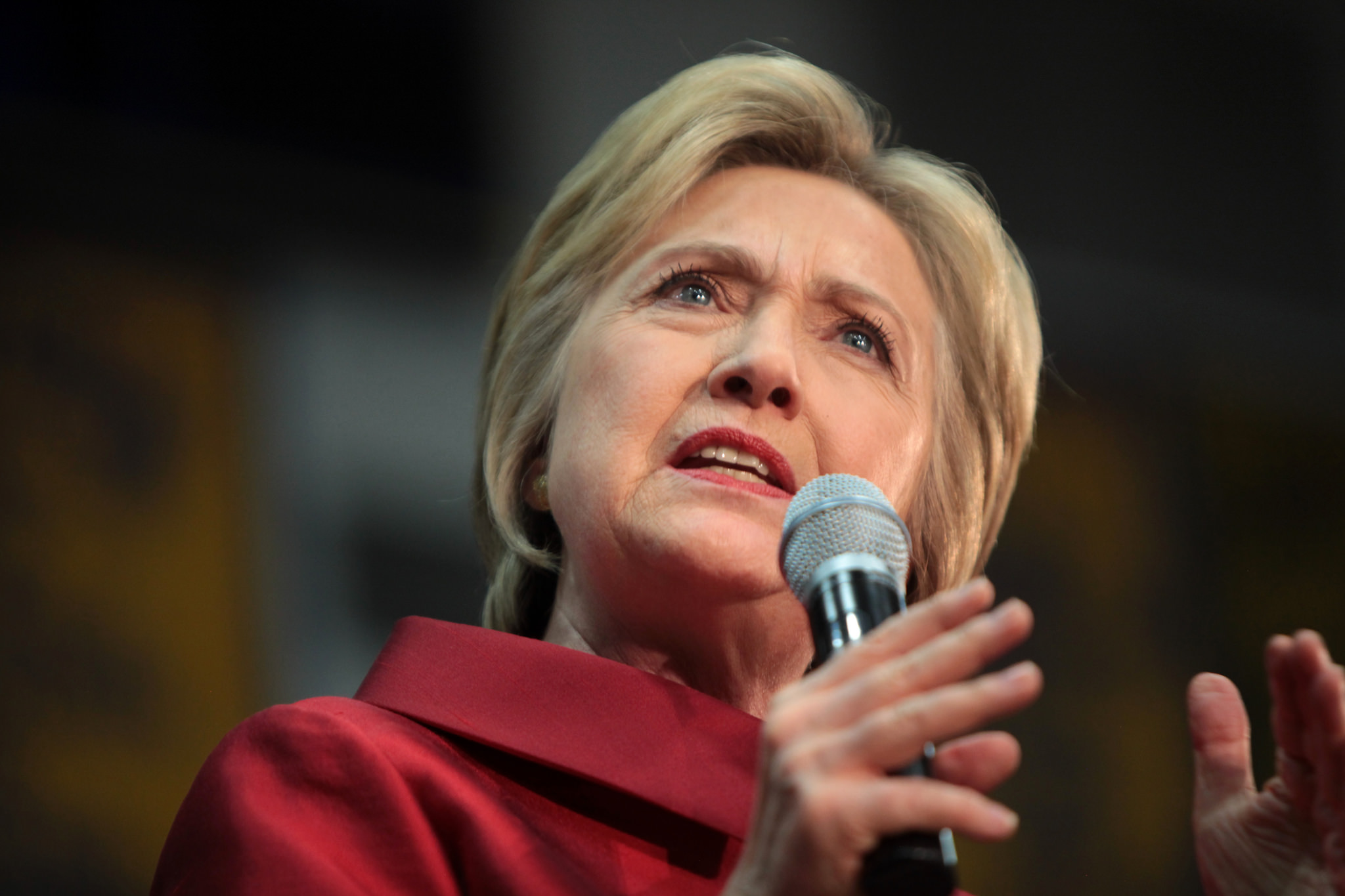
Former Secretary of State Hillary Clinton (Photo – Gage Skidmore)
Conversely, Trump was made to look strong when he fired off missiles against a Syrian airbase and talked tough about Russian guilt. Neocon commentator Charles Krauthammer praised Trump’s shift as demonstrating that “America is back.”
Trump further enhanced his image for toughness when his military dropped the GBU-43/B Massive Ordnance Air Blast Bomb (MOAB), nicknamed the “mother of all bombs,” on some caves in Afghanistan. While the number of casualties inflicted by the blast was unclear, Trump benefited from the admiring TV and op-ed commentaries about him finally acting “presidential.”
But the real test of political courage is to go against the grain on a policy that may be unpopular in the short term but is in the best interests of the United States and the world community in the longer term.
In that sense, Trump seeking peaceful cooperation with Russia – amid the intense anti-Russian propaganda of the past several years – required actual courage, while launching missiles and dropping bombs might win praise but actually make the U.S. position in the world weaker.
Trump, however, saw his fledgling presidency crumbling under the daily barrage of Russia-gate, even though there was no evidence that his campaign colluded with Russia to interfere with the U.S. election and there wasn’t even clear evidence that Russia was behind the disclosure of Democratic emails, via WikiLeaks, during the campaign.
Still, the combined assault from the Democrats, the neocons and the mainstream media forced Trump to surrender his campaign goal of achieving a more positive relationship with Russia and greater big-power collaboration in the fight against terrorism.
For Trump, the incessant chatter about Russia-gate was like a dripping water torture. The thin-skinned Trump fumed at his staff and twittered messages aimed at changing the narrative, such as accusing President Obama of “wiretapping” Trump Tower. But nothing worked.
However, once Trump waved the white flag by placing his foreign policy under the preferred banner of the neoconservatives, the Russia-gate pressure stopped. The op-ed pages suddenly were hailing his “decisiveness.” If you were a neocon, you might say about Russia-gate: Mission accomplished!
Russia-gate’s Achievements
Besides whipping Trump into becoming a more compliant politician, Russia-gate could claim some other notable achievements: it spared the national Democrats from having to confront their own failures in Campaign 2016 by diverting responsibility for the calamity of Trump’s election.
Instead of Democratic leaders taking responsibility for picking a dreadful candidate, ignoring the nation’s anti-establishment mood, and failing to offer any kind of inspiring message, the national Democrats could palm off the blame on “Russia! Russia! Russia!”
Thus, rather than looking in the mirror and trying to figure out how to correct their deep-seated problems, the national Democrats could instead focus on a quixotic tilting at Trump’s impeachment.
Many on the Left joined in this fantasy because they have been so long without a Movement that the huge post-inaugural “pussy hat” marches were a temptation that they couldn’t resist. Russia-gate became the fuel to keep the “Movement” bandwagon rolling. #Resistance!
It didn’t matter that the “scandal” – the belief that Russia somehow conspired with Trump to rig the U.S. presidential election – amounted to a bunch of informational dots that didn’t connect.
Russia-gate also taught the American “left” to learn to love McCarthyism since “proof” of guilt pretty much amounted to having had contact with a Russian — and anyone who questioned the dubious factual basis of the “scandal” was dismissed as a “Russian propagandist” or a “Moscow stooge” or a purveyor of “fake news.”
Another Russia-gate winner was the mainstream news media which got a lot of mileage – and loads of new subscription money – by pushing the convoluted conspiracy. The New York Times positioned itself as the great protector of “truth” and The Washington Post adopted a melodramatic new slogan: “Democracy Dies in Darkness.”
On Thanksgiving Day, the Post ran a front-page article touting an anonymous Internet group called PropOrNot that identified some 200 Internet news sites, including Consortiumnews.com and other major sources of independent journalism, as guilty of “Russian propaganda.” Facts weren’t needed; no chance for rebuttal; the accusers even got to hide in the shadows; the smear was the thing.
The Post and the Times also conflated complaints against news outlets that dared to express skepticism toward claims from the U.S. State Department and some entrepreneurial sites that trafficked in intentionally made-up stories or “fake news” to make money.
To the Post and Times, there appeared to be no difference between questioning the official U.S. narrative on, say, the Ukraine crisis and knowingly fabricating pretend news articles to get lots of clicks. Behind the smokescreen of Russia-gate, the mainstream U.S. news media took the position that there was only one side to a story, what Official Washington chose to believe.
While it’s likely that there will be some revival of Russia-gate to avoid the appearance of a completely manufactured scandal, the conspiracy theory’s more significant near-term consequence could be that it has taught Donald Trump a dangerous lesson.
If he finds himself in a tight spot, the way out is to start bombing some “enemy” halfway around the world. The next time, however, the target might not be so willing to turn the other cheek. If, say, Trump launches a preemptive strike against North Korea, the result could be a retaliatory nuclear attack against South Korea or Japan.
Or, if the neocons push ahead with their ultimate “regime change” strategy of staging a “color revolution” in Moscow to overthrow Putin, the outcome might be – not the pliable new leader that the neocons would want – but an unstable Russian nationalist who might see a nuclear attack on the U.S. as the only way to protect the honor of Mother Russia.
For all his faults, Trump did offer a more temperate approach toward U.S.-Russian relations, which also could have tamped down spending for nuclear and other strategic weapons and freed up some of that money for infrastructure and other needs at home. But that was before Russia-gate.
Investigative reporter Robert Parry broke many of the Iran-Contra stories for The Associated Press and Newsweek in the 1980s.
Journalist Accuses Moscow of Alleged Meddling in Mexican Politics
Sputnik – April 13, 2017
Mexican journalist and columnist for the El Financiero newspaper Fernando Garcia Ramirez has accused Russia of meddling in Mexican politics. According to him, “the dark hand” of Russian President Vladimir Putin has already reached Mexico, with Moscow trying to influence the presidential election in the country that is to take place next year.
In his article titled “The Russian Threat to Mexico” (“La amenaza rusa en México”), the journalist accused the Kremlin of allegedly attempting “to appoint its man” as the head of the country, referring to the opposition leader Andres Manuel López Obrador whom he called “an authoritarian populist.”
According to the journalist, Moscow’s ability to “influence” politics in any corner of the planet has been demonstrated many times. The examples, according to Ramirez, are the victory of Donald Trump in the United States, Brexit in Britain, and the recent defeat of former Italian Prime Minister Matteo Renzi in a referendum on constitutional reform.
Explaining the reasons why it might be beneficial for Russia to influence the election in Mexico, the newspaper columnist wrote that it would be “convenient” for Moscow to have an “anti-American” politician on this post.
The journalist also believes that the Kremlin will use the RT TV channel as “its favorite weapon” as well as “a key instrument of Russian propaganda.” According to him, the media source already has its agent in Mexico, referring to Mexican analyst John Ackerman, who published several critical articles about the Mexican authorities on the RT website.
Meanwhile, the article caused a wave of ridicule in social networks.”I have not seen such a frightening title and such an empty content for long time,” a man named Hugo Ortega Romero wrote.
“Ha-ha-ha, of course, Russia is to blame for absolutely everything,” Leonardo Guzmán Vázquez continued.
Mexican journalist Gabriel Infante Carrillo confessed in an interview with Sputnik Mundo that he also “almost died of laughter” when he read the article.
According to him, the article is part of a slander campaign against Lopez Obrador, leader of the left opposition, whose support in the country is growing. However, this has nothing to do with “external factors” and Russian media, Carillo argued.
“The article in the El Financiero is directed not so much against Russia but rather against the opposition leader Lopez Obrador, a leftist candidate in the upcoming presidential election. The fact is that his popularity has been growing, which is why the probability that he will win is quite high. That is why the media supporting the authorities do everything to discredit him. And thus, they decided to follow the example of their American colleagues, who never stop talking about the alleged Russian contribution to the victory of Donald Trump. Thus, we see another example of how artificial anti-Russian hysteria has been used for political purposes,” the journalist stated.
Related:
CIA Shows ‘No Single Piece of Evidence’ of Russia’s Alleged Involvement in US Election
CNN uses anonymous source to push Syria/Russia ‘chemical attack’ conspiracy
RT | April 13, 2017
An anonymous senior US official told CNN that, while the US allegedly has proof that Damascus is responsible for the chemical incident in Idlib, Syria, it has uncovered no such evidence implicating Moscow, because Russia is wilier in scrambling its communications.
The anonymous official reportedly told the American news channel that the US intelligence community had intercepted communications “featuring Syrian military and chemical experts talking about preparations for the sarin attack in Idlib last week.” While the source failed to provide any concrete details about the alleged communication – such as when it was intercepted or what names or other information it contained – they did note that the US “did not know prior to the attack it was going to happen.”
CNN speculated that the communication had been sent prior to the incident, but was not processed until the US began investigating it.
The source added that “there are no intelligence intercepts that have been found directly confirming that Russian military or intelligence officials communicated about the attack,” but noted “the likelihood is the Russians are more careful in their communications to avoid being intercepted.”
The most specific proof the source could come up with was his observation that Russia has a surveillance drone, which he claimed “flew over the hospital that was treating people injured in the attack.”
CNN suggested that even if the US had evidence of Russia’s involvement, it might not go public with it, as “the US feels right now that it has made the case that Russian support for [Syrian President Bashar] Assad must end.”
The report is the latest in a long series based on anonymous sources – with undisclosed agendas citing vague evidence which is never submitted to public scrutiny – that the mainstream media has deployed to level accusations against Russia. The story that Russia allegedly meddled in the US election has become a dominant narrative for opponents of Donald Trump, who are still trying to explain his surprise victory.
The major media outlets’ eagerness to blame Russia for everything occasionally leads to embarrassment, however. A fairly spectacular example came in January, when the Washington Post was forced to backtrack on a story that falsely claimed Russia had hacked into Vermont’s power grid. The newspaper also sparked outrage in December by touting a list of “Russian propaganda” websites, which turned out to include many respected independent media sources.
The alarming trend is not limited to the US media, however. Last year, the Guardian failed to accurately report on an Italian newspaper’s interview with Julian Assange. The British newspaper falsely painted WikiLeaks’ founder as a Trump supporter who would not criticize Moscow because he was presumably in league with the Russian government.
Some examples go back years. In 2014, the New York Times published photos of armed men, claiming that they were Russian troops on a clandestine mission in Ukraine. The newspaper had taken the images from the US State Department, and both had failed to properly verify them.
Will ‘Big Lies’ About Syria’s Chemical Weapons Spark a New US War?

«Sentence first, verdict afterwards», cries out the MSM Queen of Hearts: «Off with his head!»
By Michael Jabara CARLEY | Strategic Culture Foundation | 12.04.2017
In late February 2017, the Russian Federation and China vetoed a joint, US, French and British resolution to impose sanctions on Syria over allegations of chemical weapons use. I wondered at the time why this issue was coming back. In 2014, on Russian initiative the Syrian government agreed to give up its chemical weapons stocks under international observation and with international assistance. Subsequently, the UN confirmed, and the United States accepted, that the Syrian government had no further chemical weapons stocks or facilities for producing them. The Syrian government has always denied using chemical weapons in the proxy war being waged against it by the US-led western and regional coalition consisting most importantly of Britain, France, Turkey, Saudi Arabia, Qatar, Jordan, and Apartheid Israel. The only entities using chemical weapons, sometimes as false flag operations, were and are the foreign backed Jihadist mercenaries operating in Syria.
Nevertheless, Jihadist use of chemical weapons has been largely ignored, or the responsibility for using them, in an Orwellian turnabout, has been foisted upon the Syrian government in Damascus. The issue keeps coming up, and is used by the United States and its European and regional vassals as an implicit threat or means of pressure against the Damascus government. In fact, according to Seymour Hersh, the muckraking American journalist, the US State Department and the CIA facilitated, or were complicit in the shipping of chemical weapons from Libya to Syria through Turkey for the use of their Salafist allies.
If you search Google, you will find numerous stories in the western Mainstream Media (MSM) about alleged Syrian war crimes or chemical weapons use intended, apparently, to set up that Anglo-French-US sponsored resolution at the end of February. In early February, for example, the MSM published dramatic stories about the Syrian government hanging 13,000 victims in a prison «slaughterhouse». The story originated with Amnesty International, a well-known NGO and propaganda agency in the service of the US State Department. This US inspired canard nevertheless did not gain traction. On 10 February, Global Research in Canada, amongst others, dismissed the Syrian «slaughterhouse» story as bogus American propaganda intended to justify US military intervention in Syria.
Within a week this «fake news» gave way to renewed accusations against the Syrian government of chemical weapons use. On 13 February Human Rights Watch, another well-known US propaganda agency, accused the Syrian government of «chemical attacks in opposition-controlled parts of Aleppo during the final month of the battle for the city». It called on the UN Security Council to impose sanctions. Tass and Sputnik responded on the following day dismissing the allegations. «Such reports prepared by laymen with reference to the data of social networks and stories by unknown anonymous witnesses over the phone are destroying further the already ambiguous reputation of Human Rights Watch», said the Russian defence department spokesman, Maj. Gen. Igor Konashenkov. Sputnik also quoted Konashenkov’s statement. Predictably, as if by cue the MSM immediately ran with the new allegations, accepting them as a given. Amongst these western sources were the Los Angeles Times, Washington Post, Voice of America and various other US overt and covert propaganda outlets.
A competing story about the US use of depleted uranium bombs in Syria was pushed into the background and disappeared. On 14 February the French government without any attempt at verification of the new accusations immediately demanded a UN Security Council meeting to discuss the imposition of sanctions on the Syrian government. «Syrian artists call for Assad’s prosecution for war crimes» ran another headline. Already, in mid-February the MSM was whipping up hysteria about Syrian chemical weapons. The big story in the last week of February was the Russian and Chinese veto of the Security Council resolution calling for sanctions on the Syrian government. «Russia breaks with Trump in the UN», said the LA Times. Russia was the real spoiler; China received less attention. Seven times, complained BBC, Russia «has vetoed a UN Security Council resolution to protect the Syrian government». China only six times, added BBC. The British and French were indignant, forgetting how many times the United States has used its veto to block resolutions condemning Apartheid Israel or Apartheid South Africa. French Foreign Minister Jean-Marc Ayrault declared that Russia bore a «heavy responsibility towards the Syrian people and humanity as a whole». Oh my, «humanity», he said. Does that mean that the Jihadist terrorists rampaging in Syria, backed by France, are on the side of «humanity»?
The west’s indignation did not end with the Sino-Russian veto at the end of February. As if mysteriously directed, the MSM campaign of «false news» mounted in intensity during March. All the while, the Russian government was working to get peace talks moving toward a negotiated end of the war. The Turkish and Syrian presidents were supposed to meet in Moscow. Was the MSM campaign intended to block a negotiated settlement to the US-led proxy war against Syria? «Russia sides with chemical weapons», accused the New York Times on 1 March. «Ignoring UN», Fox News declared on 6 March, «Russia and Assad continue Syrian chemical weapons and bombing attacks labeled war crimes». Even lowly, US compliant Sweden jumped on Russia’s back. «France will go on fighting chemical weapons use», declared the French foreign minister. Oh, how brave of France.
Aliens from another planet deciphering MSM headlines in March might logically conclude that the Jihadist terrorists and mercenaries destroying Syria were the real heroes of the conflict. In March, accusation after accusation was hurled at Syria and especially against President Bashar al Assad, but as far as I can see, no credible evidence was ever presented which could indict the Syrian government. There is of course evidence of the western-backed Salafists using chemical weapons, though the MSM almost never notices it. On 20 March the EU sanctioned four Syrian military officials for alleged use of chemical weapons against civilians.
Underlining western double standards, this headline on 17 March went almost unnoticed: «US Military Bombs Syrian Mosque during Evening Prayers, Killing Dozens». That’s the way it is in the western MSM, Pot calls Kettle black. One set of rules for the west and one set of rules for everyone else. The US-led sanctions against Iraq in the 1990s caused the deaths of over 500,000 Iraqi children. «We think the price was worth it», declared the sententious former Secretary of State Albright. How many Iraqi civilians died in the Anglo-American war of aggression of 2003? The estimates are more than a million dead.
If actions speak louder than words, one would have to reckon that the United States doesn’t give a damn about dead civilians—you know, «collateral damage» — except as bad publicity. And Washington can always count on the MSM to bury stories that tarnish the US image. Just look at the coverage of «collateral damage» around Mosul in Iraq.
And still the MSM’s invective spewed out against Assad and the Syrian government and against Russia, as though the Jihadist terrorists represent the most noble of causes. It’s true that Assad and Syria have fought back denying any use of chemical weapons. So did the dignified Russian Foreign Minister Sergei Lavrov and the MID spox, the eloquent Maria Zakharova, with her rapier-like sallies against US and western hypocrisy and double standards. And of course the truth-telling Vladimir Putin has repeatedly attempted to talk common sense and reason to the stone deaf west, only to be vilified for his efforts. Reason, logic and truth make little headway in the west against the cyclone of MSM invective and unsubstantiated accusations against Assad.
«Sentence first, verdict afterwards», cries out the MSM Queen of Hearts: «Off with his head!»
Then, on Tuesday, 4 April, Salafists in the Syrian town of Khan Shaykoun, long an Al Qaeda stronghold in north-western Syria, claimed that more than 50 people had been killed by a Syrian gas attack. The Syrian Arab Army denied any use of chemical weapons, though it confirmed an air raid on a Salafist arms dump where, unbeknownst to them, chemical weapons may have been stored. Outside of Khan Shaykoun, no one knows what really happened on 4 April, or whether the Salafists had launched yet another false flag attack to lay blame on the Syrian government, or indeed whether the alleged attack was staged by Al Qaeda and its «white helmets», subsidised by the United States and Britain. In the west no one wants to know. The United States did a U-turn after declaring only a day or two before that the Syrian people could decide who would govern them. Oh, how very decent of the United States, but then the Americans suddenly changed their minds.
The Khan Shaykoun gassing, or whatever it was, changed everything. The MSM cyclone, as if by cue, erupted once again to blow down Russian suggestions of a UN directed investigation. «Bashar el-Assad just gassed his own people», blared one typical headline. «Syria’s ‘barbaric’ regime» has to go, opined the British Foreign Secretary. The US ambassador at the UN, Nikki Haley, threatened US unilateral action, if the Security Council did not comply with American wishes. Khan Shaykoun looks like a set-up, the deus ex machina, the providential event, of a US orchestrated campaign to sabotage Russian-led peace talks and to justify US military aggression. Already some of Trump’s advisors are calling for a «full-scale war» against Syria.
There are a few voices of prudence in the United States, like former Congressman Ron Paul. «It makes no sense, even if you were totally separate from this and take no sides… and you were just an analyst, it doesn’t make sense for Assad under these conditions to all of the sudden use poison gasses», Paul commented: «I think it’s a zero chance that he would have done this deliberately». But no one in the US government was listening to people like Ron Paul, least of all President Donald Trump, who approved an attack in the early morning of 6 April on a Syrian airbase used in the fight against Al Qaeda and its Salafist allies. Fifty-nine cruise missiles were launched and 23 hit the airbase doing little damage apparently. What happened to the other 36 missiles? No one is saying for certain. The base was returned to operations within 24 hours, but the damage to the Russian-US relations is far more severe. How can Putin, Lavrov, or any Russian government official trust anything US «partners» say? They can’t. Dealing, negotiating, accepting the United States at its word is like trusting a rattlesnake. But the rattlesnake at least warns when it is about to strike.
After the sneak attack on Syria, President Putin was scathing, and accused the US of aggression, which of course it was, unless you believe the United States has special rights to attack any state it wants, if only it decides to do so. The accusations against the Syrian government, Putin said plainly, are «bullshit» or less colloquially, «utter nonsense» (дурь несусветная). Like the Tonkin Gulf, the Kosovo «genocide», the Kuwaiti incubator babies, the weapons of mass destruction in Iraq, the Libyan government «mass rapes» and «massacres», the US accusations against Assad are canards to justify military aggression. «Will we ever learn?» the brave Bolivian ambassador asked in so many words in the Security Council: «When is enough going to be enough?» When will Europeans wake up and say enough is enough? The European powers, most importantly France, Germany, Italy and Spain, are the only ones capable of saying to the United States, we won’t support your wars any more, stop. Stop before you drag us into World War III. Stop. Only the European powers, if they have the courage and determination to reassert their national independence, can restrain the United States without war. I dare to hope that they will take their courage in their two hands and act before it is too late. Time is running out.
Fake News AP article claims “anonymous” source says Russia “knew in advance about Syria chemical attack”
By Alex Christoforou | The Duran | April 11, 2017
More fake news from the AP. Easy to spot, meant to push the war in Syria agenda further.
The recipe for this AP fake news propaganda is simple to call out…
- First paragraph says US made a “preliminary conclusion”…but has no proof.
- Fourth paragraph says “the official wasn’t authorized to speak publicly on intelligence matters.”
- The official “demanded anonymity.”
- The official could not provide details for the military and intelligence information.
- The article makes the claim, as fact, that Syria or Russia is behind the chemical attack, with no investigation ever taking place. Judge and jury….and sentence is already handed down.
- Last paragraphs bring in the military official to add weight to the story (Col. John J. Thomas).
Classic AP propaganda, and complete fake news.
The AP story has already been dismissed by the White House. Via The Hill…
The Associated Press reported Monday that the United States determined that Russia knew about last week’s chemical attack on a town in Syria beforehand.
But in a Monday evening statement, a senior administration official disputed that report.
“At this time, there is no U.S. Intelligence Community consensus that Russia had foreknowledge of the Syrian chemical attack,” the official said.
This has not stopped all major western mainstream media outlets from disseminating this AP fake news post.
Via Google News Search…
John McCain, itching for war with Syria and Russia was also quick to jump on the AP fake news (perhaps he was tipped off in advance, given the speed of his response). Via ABC news…
U.S. Senator John McCain accused Russia on Monday of having cooperated with Syrian government forces in a chemical weapons attack that has killed more than 80 people, including more than a dozen children.
The Republican senator said at a press conference in Belgrade that he believes “the Russians knew about chemical weapons because they were operating exactly from the same base.”
He said the U.S. launched cruise missile strikes last week against the Syrian base “in a response of a chemical attack.”
“I hope that this behavior by Syria, in what clearly is cooperation with Russia and Syria together, will never happen again,” he said.
McCain said the U.S. should take out Syria’s air force as part of stopping Syrian President Bashar Assad from repeating such attacks in the future.
“I would prevent Bashar Assad from flying from his airfields if he doesn’t renounce the use of these weapons,” the former American airman said. “The United States should first tell Russia that this kind of a war crime is unacceptable in the world today.”
Here is the dangerous propaganda piece published by the AP…
The United States has made a preliminary conclusion that Russia knew in advance of Syria’s chemical weapons attack last week, but has no proof of Moscow’s involvement, a senior U.S. official said Monday.
The official said that a drone operated by Russians was flying over a hospital as victims of the attack were rushing to get treatment. Hours after the drone left, a Russian-made fighter jet bombed the hospital in what American officials believe was an attempt to cover up the usage of chemical weapons.
The U.S. official said the presence of the surveillance drone over the hospital couldn’t have been a coincidence, and that Russia must have known the chemical weapons attack was coming and that victims were seeking treatment.
The official, who wasn’t authorized to speak publicly on intelligence matters and demanded anonymity, didn’t give precise timing for when the drone was in the area, where more than 80 people were killed. The official also didn’t provide details for the military and intelligence information that form the basis of what the Pentagon now believes.
Another U.S. official cautioned that no final American determination has been made that Russia knew ahead of time that chemical weapons would be used. That official wasn’t authorized to speak about internal administration deliberations and spoke on condition of anonymity.
The allegation of Russian foreknowledge is grave, even by the standards of the currently dismal U.S.-Russian relations.
Although Russia has steadfastly supported Syrian President Bashar Assad’s government, and they’ve coordinated military attacks together, Washington has never previously asserted that Moscow was complicit in any attack that involved the gassing of innocent civilians, including children. The former Cold War foes even worked together in 2013 to remove and destroy more than 1,300 tons of Syrian chemical weapons and agents.
Until Monday, U.S. officials had said they weren’t sure whether Russia or Syria operated the drone. The official said the U.S. is now convinced Russia controlled the drone. The official said it still isn’t clear who was flying the jet that bombed the hospital, because the Syrians also fly Russian-made aircraft.
U.S. officials previously have said Russians routinely work with Syrians at the Shayrat air base where the attack is supposed to have originated. U.S. officials say the chemical weapons were stored there and that those elements add to the conclusion that Russia was involved.
Last Thursday 59 Tomahawk missiles were fired on the government-controlled base in the United States’ first direct military action against Assad’s forces.
The U.S. has been focusing its military action in Syria on defeating the Islamic State group.
On Monday, Col. John J. Thomas, a U.S. military spokesman, said the U.S. has taken extra defensive precautions in Syria in case of possible retaliation against American forces for the cruise missile attack.
Thomas told reporters at the Pentagon that the increased emphasis on defensive measures to protect U.S. troops on the ground in Syria led to a slight and temporary decline in offensive U.S. airstrikes against IS in Syria.
There has been no Syrian retaliation so far for the cruise missile attack, which destroyed or rendered inoperable more than 20 Syria air force planes, he said.
Thomas said the U.S. intends to return to full offensive air operations against IS as soon as possible.

Featured Video
Racist Seinfeld Dances for Joy as Bibi Unveils His New Map
or go to
Aletho News Archives – Video-Images
TV Drama Review
Japanese drama projects Japan’s wartime atrocities onto Chinese characters

Global Times | October 25, 2026
By portraying Chinese characters as perpetrators of ruthless violence while casting Japanese Self-Defense Forces (SDF) intelligence operatives as defenders, the season 2 of the Japanese drama Vivant has recently drawn criticism from Chinese netizens, who argue that its depiction turns historical reality on its head while ignoring Japan’s wartime atrocities.
The TBS drama series – a spy suspense story in which an alleged unofficial intelligence unit of the SDF operates across the globe — has attracted a passionate fanbase. Its currently airing season 2 opened with a household rating of 18.8 percent, the highest for a TV drama this year, according toa commentary article by Japanese media Toyo Keizai.
What draws attention is the portrayal of the enemies in the series, the article noted. Scenes in which the Chinese organization subjects kidnapped members of the SDF unit to brutal torture are repeated with unrelenting intensity.
It is rare for Japanese TV dramas to explicitly portray a real-life country as the enemy, the article noted.
Japanese Prime Minister Sanae Takaichi also made a reference to the drama, saying that she has been recording Vivant and hopes to binge-watch it over the year-end and New Year holidays, according to Japanese media outlets.
China’s CCTV News report on Sunday revealed that the drama features scenes in which Chinese personnel cut off the fingers of and stab Japanese intelligence operatives in the abdomen. Such acts bear striking similarities to the torture inflicted on Chinese nationals by invading Japanese troops during the World War II.
The drama distorts the truth by attributing these atrocities to modern Chinese characters. Beneath the surface, it subtly glorifies Japan’s cross-border overseas operations, blurs the functional boundaries of the SDF and implicitly promotes an expansionist narrative, per CCTV News. … continue
Blog Roll
 Aletho News
- EU facing trillion-euro debt hole while seeking more cash for Kiev
- How US, Europe, Persian Gulf states exhausted missile stockpiles, splurged billions to defend Israel
- Up in arms… Koreans reject U.S. empire’s plan to make South Korea the next Ukraine
- Iran, Turkey, Pakistan, Saudi Arabia could advance region-led security framework in Tehran: FM spox
- Netizens condemn Japanese drama for projecting Japan’s wartime atrocities onto Chinese characters
- Racist Seinfeld Dances for Joy as Bibi Unveils His New Map
- A West Bank War for Netanyahu’s Election Campaign, Could It Backfire?
- Yemen denounces European Parliament’s ‘hypocritical’ push to blacklist Ansarullah
- Qalibaf: UAE’s UN bid aims to ‘clear the runway’ for ‘Greater Israel’, whitewash genocide
- Pakistan reopens Iran border after boosting security: Report
- If Americans Knew
- An error has occurred; the feed is probably down. Try again later.
- No Tricks Zone
- Sudden Stratospheric Warming, Powerful El Niño Combination May Lead To Extreme Europe Cold, Energy Crisis!
- Two New Studies Find Thwaites Glacier Melt Cannot Be Driven By Human Activity Or A Warming Ocean
- E-Cars Reduce CO2 Emissions By Only 41% Compared To Internal Combustion Engine Vehicles
- Predictions Made By Renowned Climate Professor Over Past Decades Have Been Proven To Be Poor
- New Study Suggests Large Regions Of The Pacific Ocean Have Been Cooling For The Last 80 Years
- Germany’s Green Energy Debacle: High Energy Costs Force Kahla Porzellan to Close After 182 Years!
- New Study: 50 Years Of The Most Aggressive ‘Net Zero’ Policies Can Only Affect The Global Climate By 0.03°C
- US September “Heat” Was No Record…Many Records Set Decades Ago
- Latest European Green Energy Debacle; Portugal’s Largest Flagship Solar Park Insolvent!
- Green Energy Debacle: German Expert Professor Fritz Vahrenholt Warns Of Severe Economic And Social Consequences

