Forbes Blames Global Warming for Record Cold – Science Disagrees
By James Taylor | ClimateRealism | February 17, 2021
In a major victory for Newspeak, the propaganda language in George Orwell’s novel “1984,” Forbes.com published an article yesterday blaming global warming for the record cold pummeling much of the nation. Google News, moreover, promoted the Forbes article by placing it at the top of search results for “climate change.”
The title of the Forbes article is “Blackouts In Texas and California Teach A Hard Lesson: Climate Change Is Costly.” The author writes, “These grid failures are wake-up calls and provide further proof that the impacts of climate change are not geographically constrained, nor do they take aim at one political party. One way or another, the cost of climate change on each of us will make itself known: in this both California and Texas can now agree.”
The author does not, however, explain how or why global warming causes record cold temperatures. Climate activists have occasionally, and when politically convenient, claimed climate change causes more polar-vortex extreme cold events. However, the scientific data strongly contradict Forbes’ assertion that global warming is to blame for the cold outbreak in Texas. Indeed, National Oceanic and Atmospheric Administration (NOAA) data show the number days each year with below-freezing temperatures in Texas is neither unusually high nor unusually low so far this century.
Similarly, NOAA data for neighboring Oklahoma – which is also getting walloped right now by cold weather – show a decline in the frequency of very cold weather events in recent decades.
So, there clearly is no recent increase in the frequency of severe cold events in Texas and Oklahoma. So, by what logic does Forbes blame the current very cold conditions on global warming? Well, the author of the Forbes article is Chief Science Officer and Chief Commercial Officer at New Energy Risk, which is comprised of “climate-conscience venture capitalists” seeking to make money promoting “green” energy.
Forbes clearly has no conflict-of-interest standards for its authors and articles, nor does it attempt to investigate what the scientific data show regarding its articles’ claims.
No, NY Times, Climate Change Does Not Threaten Power Grids
By H. Sterling Burnett | ClimateRealism | February 19, 2021
The New York Times published a February 16 article claiming climate change is making America’s power grid more vulnerable due to an increase in extreme weather events. However, objective data from the United Nations Intergovernmental Panel on Climate Change and the U.S. National Oceanic and Atmospheric Administration (NOAA) show the Times’ claim that extreme weather is becoming more common is false. The evidence indicates it is policies promoting wind and solar power to fight climate change, rather than climate change itself, that is putting the most pressure on power grids.
The Times story, “A Glimpse of America’s Future: Climate Change Means Trouble for Power Grids,” claims, “Systems are designed to handle spikes in demand, but the wild and unpredictable weather linked to global warming will very likely push grids beyond their limits.” The story continues saying “as climate change accelerates, many electric grids will face extreme weather events that go far beyond the historical conditions those systems were designed for, putting them at risk of catastrophic failure … it is clear that global warming poses a barrage of additional threats to power systems nationwide, including fiercer heat waves….”
This Times’ claims are convincingly refuted by objective climate data. Let’s examine them, one at a time.
The Times says climate change is making heatwaves worse, yet, as shown in Climate at a Glance: Heatwaves, data from NOAA demonstrates heatwaves have become far less frequent and severe in recent decades than they were in the early part of the 20th century (See the graph).
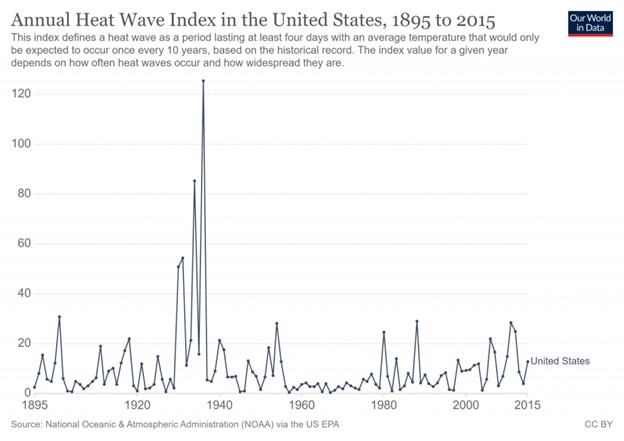
Indeed, temperature records show, the vast majority of each state’s all-time high temperatures were set during the first half of the 20th century – approximately 100 years of global warming ago. In fact, 40 states’ record-high temperatures were set before 1960, with 25 of the record highs being set or tied in the 1930s alone. That is three times more than have been set in the 33 years since 1988, when NASA’s James Hansen first pronounced humans were causing dangerous global warming. Only two states have set new record highs since 2000, fewer than the number of temperature records set in the 1890s alone, 130 years of global warming ago.
In addition, the most accurate nationwide temperature station network, implemented in 2005, shows no sustained increase in daily high temperatures in the United States since at least 2005.
Similarly, objective data destroy allegations that climate change is to blame for record cold that struck Texas, Oklahoma, and elsewhere this past week. NOAA data show the number days each year with below-freezing temperatures in Texas is neither unusually high nor unusually low so far this century. Similarly, NOAA data for neighboring Oklahoma show a decline in the frequency of very cold weather events in recent decades. The assertion that climate change makes extreme temperatures more frequent on both ends of the temperature spectrum is destroyed by science – on both ends of the temperature spectrum.
Data from NOAA and the IPCC make it equally clear other extreme weather events that might be thought to cause power failures, like cold spells, floods, hurricanes, or tornados, have not increased in number or in severity as the earth has modestly warmed. You can see the evidence for yourself via the links in this paragraph.
While weather extremes aren’t increasing, policies enacted with an intent to prevent climate change are making the grid less reliable and flexible in response to peaks in power demand. In particular, state mandates to incorporate ever-greater amounts of intermittent wind and solar power, and federal and state subsidies for the same purpose, have resulted in the premature retirements of tens of thousands of megawatts of baseload coal power plants over the past decade. These power plants have been replaced by wind and solar industrial facilities which cannot be relied upon to provide a consistent flow of power to the grid because they are dependent on weather conditions. Nor can they be relied upon to provide on-demand power or peaking power during emergencies.
Even if the Times was right that climate change is making extreme weather events more common and severe, relying on increasing amounts of intermittent power can only worsen the problems of grid reliability, both during normal operation and during extreme weather events. Wind turbines don’t work if the temperature is too cold or if winds die down. Solar panels don’t provide energy at night, on cloudy days, or if covered by ice, snow, dust, or dirt.
Texas’s recent power emergency came as thousands of megawatts of wind power went off-line when the weather turned unusually cold, even before any ice and snow hit. Meanwhile, California has experienced repeated rolling blackouts during the summer months. What these two states have in common is they have both come to rely on increasing amounts of intermittent electric generating sources to power their respective grids. The evidence shows replacing reliable sources of electric power, like coal, natural gas, and nuclear with ever more intermittent power makes power failures more likely, whatever the weather. That’s the fact the New York Times should report.
Trend in Global Fires
By Zoe Phin | February 17, 2021
Climate alarmists claim that an increase in man-made greenhouse gas emission will cause more fires. For example …
Human-induced climate change promotes the conditions on which wildfires depend, increasing their likelihood …
Funk … says there is very well documented scientific evidence that climate change has been increasing the length of the fire season, the size of the area burned each year and the number of wildfires.
— DW
The clearest connection between global warming and worsening wildfires occurs through increasing evapotranspiration and the vapor-pressure deficit. In simple terms, vegetation and soil dry out, creating more fuel for fires to expand further and faster.
… Global warming will keep worsening wildfires …
Sounds serious. Is it true?
We show that fire weather seasons have lengthened across 29.6 million km2 (25.3%) of the Earth’s vegetated surface, resulting in an 18.7% increase in global mean fire weather season length. We also show a doubling (108.1% increase) of global burnable area affected by long fire weather seasons and an increased global frequency of long fire weather seasons across 62.4 million km2 (53.4%) during the second half of the study period.
— Nature: Climate-induced variations in global wildfire danger from 1979 to 2013
This is just about the most scientific paper I could find on the issue. Why are they obsessed with the length of the fire season? Why can’t they just answer the simple question: Is there more or less fire?
NASA has collected daily data on Active Fires since 2000.
I downloaded and analyzed all of their Active Fires data. Here’s the result:
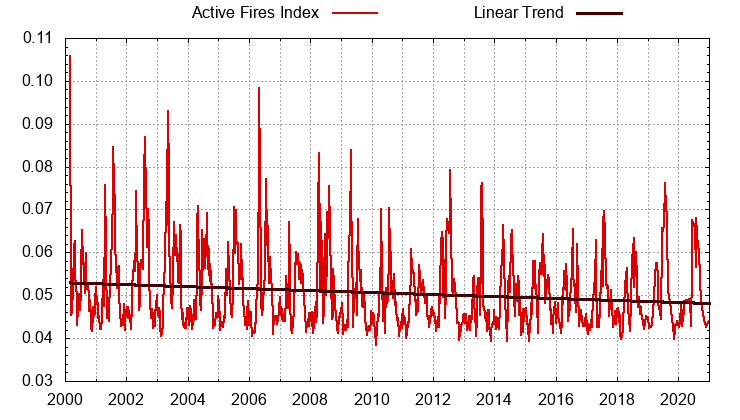
Active Fires, March 2000 [Source]
Now it all makes sense. Climate scammers need to cherrypick locations and seasons in order to distract from the empirical truth that global fires have been decreasing. Disgusting.
WSJ Magazine Promotes False Tuvalu Myth in Bill Gates Climate Change Article
By James Taylor | ClimateRealism | February 16, 2021
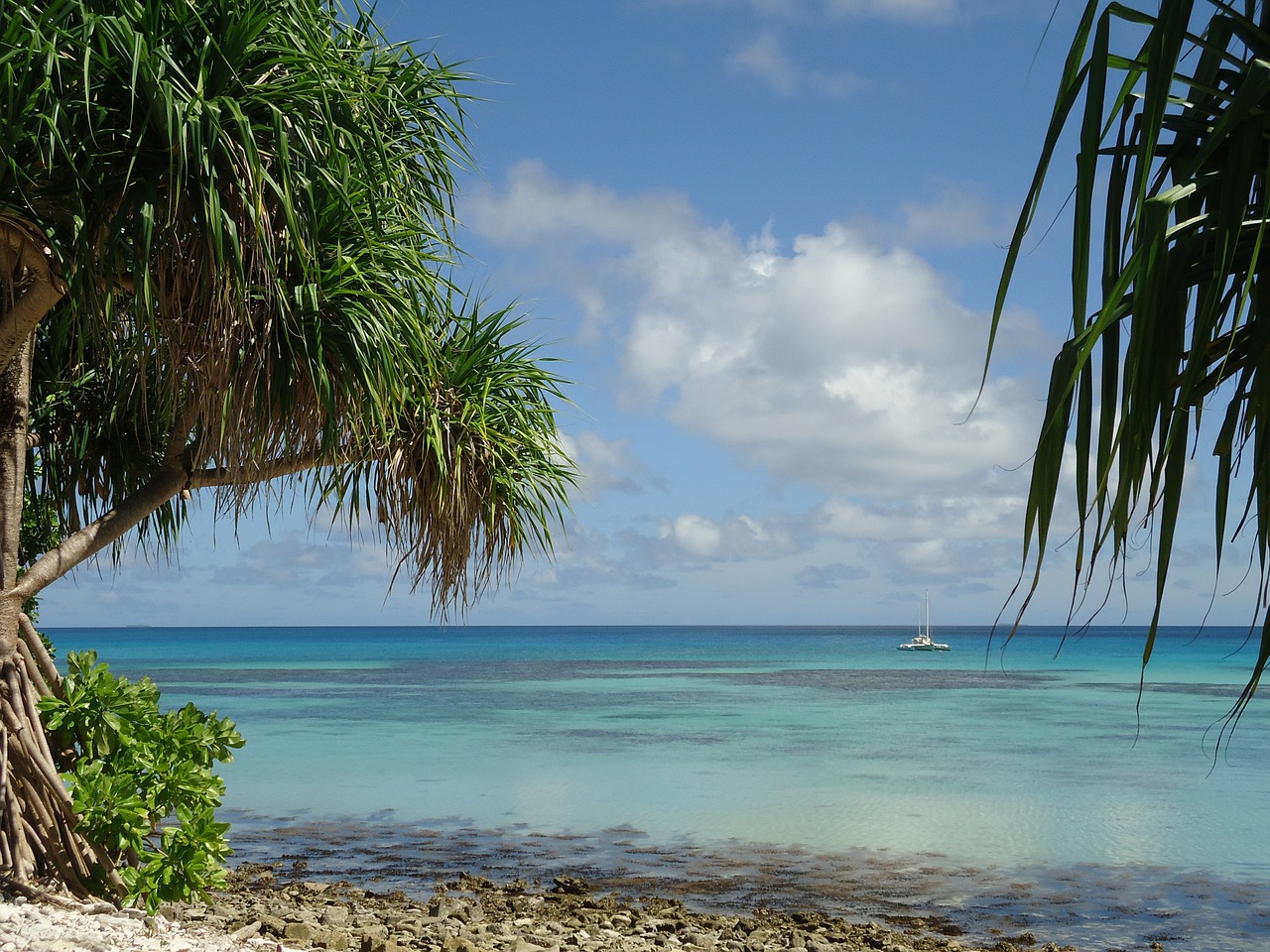
WSJ Magazine, a product of the Wall Street Journal, told an outlandish climate change falsehood about Tuvalu and sea-level rise yesterday in an article about Bill Gates. In the article, titled “Bill Gates Has a Master Plan for Battling Climate Change,” WSJ Magazine claims, “Residents of Tuvalu, an island nation in the South Pacific, are jockeying for space as their archipelago is swallowed by rising seas.” The truth is exactly the opposite.
For background, climate activists have made Tuvalu – a nation of coral reefs and small islands in the South Pacific – a poster child for climate change. Activists claim rising seas are swallowing the nation and its islands. However, as documented by Climate Realism here and here, the majority of Tuvalu’s islands are growing in size, not shrinking.
While seas are modestly rising, modestly rising seas bring new sediment and allow for new coral to grow. The result is net land growth for islands like those in Tuvalu.
For example, a recent peer-reviewed study found eight out of Tuvalu’s nine coral atolls have grown in size during recent decades, and 3/4ths of Tuvalu’s 101 reef islands have similarly grown in size. Also, Tuvalu is experiencing net immigration rather than net emigration. There are 20% more people living in Tuvalu now than 30 years ago. Tuvalu’s population has doubled since 1970. Far from “jockeying for position” on an island being swallowed, people are flocking to Tuvalu, instead.
Additional peer-reviewed studies (see here, here, and here) confirm the same processes are allowing – and will continue to allow – other Pacific islands to keep up with rising seas.
The lesson to be learned at WSJ Magazine’s expense is that just because “everybody knows” or “Al Gore says” that some asserted climate harm is happening, that does not make it so. Trust scientific data, not the propaganda of climate activists and their messengers.
Climate Realism hopes to address other aspects of WSJ Magazine’s Bill Gates article in the days to come, although there are so many daily media climate falsehoods to debunk….
Wind Power Did Cause The Texas Blackouts!
By Paul Homewood | Not A Lot Of People Know That | February 22, 2021
There has been a marked lack of data made public about last week’s blackouts in Texas, which has allowed all sorts of misinformation to fly around. I suspect this is quite deliberate.
I have however found hourly data on the US EIA website. This is what happened on those crucial couple of days:

https://www.eia.gov/beta/electricity/gridmonitor/expanded-view/electric_overview/US48/US48/GenerationByEnergySource-4/edit
The chart is interactive, and below are the actual numbers from Sunday evening to Monday morning:
| MW | Wind | Gas | Total Generation |
| Sunday 18.00 | 9015 | 41042 | 66449 |
| Sunday 22.00 | 7083 | 43720 | 66804 |
| Monday 02.00 | 5205 | 40405 | 62198 |
| Monday 03.00 | 5154 | 33096 | 52952 |
So, consider this.
Between 6 pm and 10 pm on the Sunday, wind power suddenly lost 2 GW, about a quarter of its load. Fortunately, gas power was quickly ramped up to fully compensate for this.
Wind power continued to be shed, with another 2 GW disappearing by 2.00 am on the Monday morning. As demand was also declining, gas power was reduced accordingly.
However, it was between 2.00 and 3.00 am that gas power too fell off the cliff.
It must be fairly evident that this had nothing to do with weather conditions, which could not possibly have had such a sudden impact. (In this respect, gas power was perfectly stable after 3 am for the rest of the day and week).
So what did cause that sudden drop in generation, something we also see with coal at exactly the same time, which dropped from 11 GW to 9 GW in that hour?
There is only one possible conclusion, and it is that the grid itself has become totally unstable, as wind power fell away. The evidence points to massive tripping out at gas and coal power stations as generation and demand got out of balance.
I would guess that just one gas plant tripping out in this fashion would have a cascading effect.
Whilst it has been evident from the start that the sudden shedding of wind power played a major part in the blackouts, the establishment media have been quick to close ranks by putting most of the blame on gas power stations, which having much greater capacity naturally suffered bigger drops in generation.
They have done so without publishing any of the detailed data, which I have done above. All they are interested in, of course, is deflecting the blame from renewable energy.
If they had done so, it would have been obvious that the real culprit was unreliable wind power.
Health Staff Injured By Covid Jab Are “Imagining It” – Telegraph
By Richie Allen | February 22, 2021
Writing in the Telegraph today, Ambrose Evans-Pritchard claims that German health workers who reported feeling ill after receiving their Covid jab, were in fact imagining it. It’s an example of the Nocebo effect according to Evans-Pritchard. He says that exposure to fake news about the vaccine, can lead to some recipients believing that the dose has harmed them in some way, even when it hasn’t.
Evans-Pritchard claims that people have been primed to believe that the vaccines will make them ill, by exposure to disinformation. He writes:
Europe has succumbed to the nocebo effect. If people are primed to believe that something makes them ill, they discover illness. It is the reverse placebo.
Tens of millions have received the AstraZeneca jab in the UK and India without meaningful side-effects beyond minor – and desirable – signs of an immune reaction. Yet frontline health workers in Germany, Austria, France, and Spain have convinced themselves that it is doing them real harm, and that it is also ineffective.
The Nocebo Effect is a known pathology in medical science. It has been well-documented following false reporting on statins. One clinical trial studying headaches from electric currents found that two-thirds of the volunteers in the harmless control group also had headaches. Nocebo responses can be powerful and physiological. The symptoms are real.
37 out of 88 staff at Braunschweig’s Herzogin-Elisabeth hospital became ill after having the jab and dozens of ambulance drivers in Dortmund reported that they’d had a bad reaction to the vaccine. According to Ambrose Evans-Pritchard, they’re all imagining it. He blames fake news about the AstraZeneca jab:
That is probably what has been happening with AstraZeneca In Germany where fake news has run rampant, to the point of mass hysteria.
Astonishing isn’t it? Twenty-two seniors died in a care home in Basingstoke, after they’d received the vaccine. 23 died in a Norwegian home. Reports have come in from the US of people dropping dead within minutes of having a jab. A woman in Wisconsin was declared brain dead after having her second dose. I wonder if Ambrose Evans-Pritchard blames fake news in those cases?
The worst of it, is that Ambrose Evans-Pritchard and his pals in the media KNOW that this vaccine is causing harm. They know and they choose to ignore it. How do they sleep at night? Nocebo effect? They’re getting desperate now. It seems to me that someone somewhere knows that soon enough it’ll be impossible to hide the extent to which these vaccines are causing harm. Are they really going to claim that vaccine injured people are imagining it, that they were “primed” to believe the vaccine would hurt them, because they read something on Facebook?
Imagine the scenario. “Mrs. Johnson your kidneys are shutting down, you may need a transplant.”
“I was fine, until I had the vaccines!”
“Yes Mrs. Johnson. We don’t believe it’s the vaccines though. We think you were reading too much fake news and convinced yourself that the vaccines are harmful.”
“Are you saying that I’m responsible for my kidney failure and not the vaccines?”
“Yes Mrs. Johnson, it’s obvious this is what is happening…”
Irish “Journalist” Calls For Martial Law To Achieve Zero Covid
By Richie Allen | February 22, 2021
Sunday Times columnist David Quinn Tweeted last night that Martial Law may be needed in Ireland, to achieve zero Covid. Quinn said;
Watching the very large numbers out and about and hearing anecdotal evidence of people starting to meet again in each other’s houses, I see no way short of martial law of us achieving zero-Covid.
Just to be clear, Quinn is suggesting that a military government may need to be imposed in Ireland and the law suspended in order to keep people in their homes. Yes, a journalist is mooting the idea of stationing troops on Ireland’s highways and byways, to force people into their homes and ensure they remain inside.
As of this morning, Ireland’s National Public Health Emergency Team (Nphet) says that Ireland has had a total of 215,000 coronavirus cases and 4,136 deaths. Three weeks ago (Friday January 29th), The Irish Times reported that:
… more than eight out of 10 people who have died as a result of Covid-19 have had an underlying condition, most commonly chronic heart disease…..
The most common underlying condition was chronic heart disease which accounted for 43 per cent of those fatalities or 967 cases in total.
This was followed by chronic neurological disease such as dementia (771), hypertension (520), chronic respiratory disease (450), chronic kidney disease (281), diabetes (389), chronic liver disease (46) and obesity (body-mass index above 40) 47…
Of those who died with an underlying condition, 66 per cent had one, 678 had two and 355 had three or more co-morbidities.
The mortality statistics underline the importance of vaccinating vulnerable cohorts in the population. More than 63 per cent of all deaths (1,720) were in people over 80.
The average age of someone dying with Covid in Ireland is somewhere between 83 and 86, depending on which newspaper you read. And of course we should never forget that dying with doesn’t mean dying of. This is a scam. There is no pandemic. It has been thoroughly debunked, using our collective governments own data.
Rather than eviscerate the Irish government and the medical goons advising it, David Quinn, who claims to be a journalist, would rather call for Martial Law. And the beat goes on.
The Arab Spring – A Personal Story
By Finian Cunningham | Strategic Culture Foundation | February 21, 2021
This week marks the 10th anniversary of the Arab Spring uprisings. Two previous commentaries this week have dealt with the geopolitics of those momentous events. This third part below is a personal reflection by the author who found himself unexpectedly embroiled in the maelstrom. It was life-changing…
I had been living in Bahrain for two years before the tumultuous events of the Arab Spring exploded in early 2011. Before that turmoil ignited, I was working as an editor on a glossy business magazine covering the Gulf region and its oil-rich Arab monarchies. But in many ways, I hadn’t a clue about the real social and political nature of Bahrain, a tiny island state nestled between Saudi Arabia and the other big Gulf oil and gas sheikhdoms of Kuwait, Qatar, United Arab Emirates and Oman.
During my corporate media employment I enjoyed a charmed life: a hefty tax-free salary, and a swanky apartment with rooftop swimming pool, jacuzzi and gym, which overlooked the sparkling Gulf sea and other glittering buildings that seemed to sprout up from reclaimed spits of land off the coast.
It was all weirdly artificial, if not hedonistically enjoyable. The luxury and glamor, the opulence. Unlike the other Gulf states, Bahrain had a distinctly more liberal social scene – at least for the wealthy expats. There were endless restaurants offering cuisine from all over the world. There were bars that freely sold alcohol which is “haram” in the other strictly-run Gulf Islamic monarchies. There were loads of nightclubs and loads of pretty hookers, most of them from Thailand and the Philippines. It all had the atmosphere of Sin City and forbidden fruit for the picking.
I later realized that Bahrain was not “cosmopolitan” as the business magazines and advertisements would gush about. That was just a euphemism for a vast system of human trafficking. All the service businesses were worked with menial people from Asia and Africa who were cheap and indentured labor. Where were the ordinary Bahrainis? What did they do for a living? In the cocooned expat life, the ordinary Bahrainis didn’t exist. Rich expats were there to enjoy tax-free salaries, glamorous glass towers, loads of booze and, if desired, loads of cheap sex.
My wake-up call came when my so-called professional contract was terminated after two years. That was in June 2010. Like a lot of other expats, my job came a cropper because of the global economic downturn that hit after the Wall Street crash during 2008. Advertising revenue failed to materialize for the magazine I was employed on. The British owners of the publishing house – Bahrain is a former British colony – told me, “Sorry old chap, but we can employ two Indians on half your salary.”
So that was it. I was out on the street. Going back to Ireland was not a realistic option. The economy was crap there too and job prospects dim. So I decided to hang in there in the Gulf and apply for jobs across the region. I downsized to a more modest apartment and lived off some savings. The job hunting was the usual wearying, self-debasing grind. “There’s nothing more that I would desire than to work as editor on your prestigious oil and gas trade magazine in Dubai.” Copy and paste as required for countless emailed job applications.
Then came the Arab Spring. The entire region of North Africa and Middle East erupted at the end of 2010, first in Tunisia then in the new year spilling over to Egypt and beyond. Watching TV news was like watching a satellite map of a cyclone sweeping across countries. It was an unstoppable force of nature. There were protests flaring up in Saudi Arabia, Yemen, Oman, the Emirates, and they soon arrived in Bahrain. The rallying call among the masses was for more democratic governance, for free and fair elections, for economic equity.
Little did I know during my earlier charmed expat existence, but Bahrain was a particularly explosive powder-keg. Later, however, I was an unemployed journalist who suddenly found himself in the middle of a storm. It was only then that I began to really understand what Bahrain was all about. I mean the ugly, brutish nature of this “kingdom”.
To be honest, I wasn’t looking for work as a freelance reporter. I had done that in a previous life in Ireland. I was still a journalist, but reporting on political news wasn’t appealing anymore.
During my fruitless job-hunting period for a “dream number” in Dubai, I filled in my time and tried to earn a bit extra by hawking around bars in Bahrain with a guitar and microphone. I had done a bit of that in my previous life in Ireland, not very successfully mind you. But I thought I’d give it a go in Bahrain. On February 14, 2011, I was doing a gig at Mansouri Mansions hotel in the Adliya district of Manama, the capital. It was Valentine’s night. There’s me singing cheesy love songs – Elvis’ ‘I Can’t Help Falling in Love With You’ – and there were hardly any customers. The place was dead.
Then the word came around. “We’re closing early. There’s trouble on the streets.” The whole city was eerily quiet. The Bahrain uprising had begun, not in the capital, but in the outlying towns and villages. On February 14, a young Bahraini man Ali Mushaima was shot dead by state security forces during protests. I was still oblivious to the extent of what was happening.
Overnight the atmosphere in Bahrain was changing to a much more menacing, volcanic one. There was immense popular anger over the young man’s killing.
I was in a taxi in the Juffair area of Manama going to enquire about doing a music gig at another bar. My petty concerns were shattered by the young taxi man who was animated about the protests and the death of Ali Mushaima the night before. The taxi man – Yousef, who I got to know – explained to me about Bahrain’s history. About how the majority of the people are Shia muslims who have lived for centuries under a despotic Sunni monarchy. The Al Khalifa royals were originally from the Arabian Peninsula, a clan of raiders and bandits. They invaded Bahrain as pirates in the 18th century and were made the rulers over the island by the British who wanted a strong-arm regime to look after their colonial possession and sea routes to India, the so-called jewel in the British imperial crown. The Khalifa clan would later become obscenely wealthy after oil was discovered in Bahrain in the 1930s, the first such discovery of oil in the Gulf, predating that of Saudi Arabia. Over the decades, the Bahraini majority would be marginalized and impoverished by their British-backed rulers.
I asked Yousef, the young taxi man, “So what do you make of all these wealthy high-rise buildings and the glamor of Bahrain?” He replied, “It means nothing to us – the Shia people of Bahrain. We are strangers in our own land.”
Yousef appealed to me to attend a protest that night. It was at the Pearl Roundabout, a major intersection and landmark sculpture in Manama. The protesters were taking their grievances right to the very capital, not confining themselves to the outlying squalid towns and villages where the Shia majority were forced to live in ghettoes by the Khalifa regime.
What I encountered was a revelation. Suddenly I felt I was finally meeting the people of Bahrain. Tens of thousands were chanting for the regime to fall. The atmosphere was electric but not at all intimidating for me. People were eager to explain to this foreigner what life was really like in Bahrain, as opposed to the artificial images that plaster business magazines and Western media advertisements for rich investors.
Then I knew right there that there was a story to be told. And there I was ready and willing to tell it.
The protests were quickly met with more violence from the Bahraini so-called Defense Forces. “Defense Forces”, that is, for the royal family and their despotic entourage. The protesters were unarmed and non-violent, albeit passionate in their demands for democracy.
The Pearl Roundabout became a permanent encampment for the protesters. Tents were set up for families to rest in. Food stalls were teeming. A media center was operated by young Bahraini men and women. There was an exhilarating sense of freedom and of people standing up for their historic rights.
For the next three weeks, the Khalifa regime was on the ropes. The police and army were overwhelmed by the sheer number of protesters. At rallies there were easily 200,000-300,000 people at a time. For an island of only one million, there was a palpable sense that the long-oppressed majority had awakened to demand their historic rights against the imposter Khalifa regime. People were openly declaring, “the Republic of Bahrain”. This was a revolution.
In a lucky break, I was filing reports for the Irish Times and other Western media. The money was much appreciated, but more importantly there was an edifying, inspirational story to be told. A story about people overcoming tyranny and injustice.
All that would change horribly on March 14 when the Saudi and Emirati troops invaded Bahrain. The invasion had the support of the United States and Britain. What followed in the next few days was brutal repression and killing of peaceful protesters. The Pearl Roundabout was routed by indiscriminate state violence. Its sculpted monument was demolished to erase the “vile” memory of uprising. Men, women, medics, opposition thinkers and clerics were rounded up in mass detention centers. People were tortured and framed up in royal courts, sentenced to draconian prison terms. To this day, 10 years on, many of the Bahraini protest leaders – many of whom like Hassan Mushaimi and Abduljalil al-Singace I interviewed – remain languishing in jail.
However, a strange thing happened. Just when the story was becoming even more interesting – if not heinous – I found the Western media outlets were no longer open for reports. Some of my reports to the Irish Times on the repression were being heavily censored or even spiked. The editors back in Dublin were telling me that the news agenda was shifting to “bigger events” in Libya and Syria.
The corporate news media were shifting their focus to places where Western governments had a geopolitical agenda. Genuine journalistic principles and public interest didn’t matter. It was government agendas that mattered. The Irish Times and myriad other derivative media outlets were following the agenda set by the “majors” like the New York Times, CNN, the Guardian, the BBC and so on, who were in turn following the agendas set by their governments.
For Washington and London and other Western governments, the Arab Spring became an opportunity to foment regime change in Libya and Syria. The protests in those countries were orchestrated vehicles to oust leaders whom Western imperial states wanted rid off. Muammar Gaddafi in Libya was murdered in October 2011 by NATO-backed jihadists. Syrian President Bashar Al Assad nearly succumbed but in the end managed to defeat the Western covert war in his country thanks to the allied intervention of Russia and Iran.
All the while, the Western media were telling their consumers that Libya and Syria were witnessing pro-democracy movements, rather than the reality of NATO-sponsored covert aggression for regime change.
A person might be skeptical of claims that Western media are so pliable and propagandist. I know it for a fact because when I was reporting on the seismic events in Bahrain – which were truly about people bravely and peacefully fighting for democracy – the Western media closed their doors. They weren’t interested because there were “bigger events elsewhere”. Bahrain, like Yemen, would be ignored by the Western media because those countries didn’t serve the Western geopolitical objectives. Whereas Libya and Syria would receive saturation coverage, saturated that is with Western imperial propaganda.
Bahrain was and continues to be ignored by Western media because it is an integral part of the Saudi-led Gulf monarchial system which serves Washington and London’s imperial objectives of profiteering from oil, propping up the petrodollar and sustaining massive weapons sales. Democracy in Bahrain or in any other of the Gulf regimes would simply not be tolerated, not just by the despotic rulers therein but by their ultimate patrons in Washington and London.
I continued to report on the regime’s atrocities in Bahrain. My reports would be taken by alternative media sites like Global Research in Canada and indie radio talk shows in the United States. The money wasn’t great, but at least I could try to get the story out. In June 2011, four months after the Arab Spring began in Bahrain, the regime copped my critical reporting. I was summoned over a “visa irregularity” to the immigration department but instead was met by surly military police officers who told me I was “no longer welcome in the kingdom of Bahrain”. I was given 24 hours to leave “for my own safety”.
I returned to Ireland where after a few months I would relocate to Ethiopia in September 2011 to work as a freelance journalist for Global Research, initially. Later I began to work for Iran’s Press TV and Russian media. I first started working for this online journal, Strategic Culture Foundation, in late 2012. And my best move? I married an Ethiopian woman whom I had met in Bahrain during the Arab Spring.
Witnessing the struggle for democracy and justice in Bahrain was a privilege, one that I hardly expected or even wanted initially. But it fell to me. I witnessed such bravery and kindness among long-suffering Bahraini people who shared their grievances with generosity and graciousness despite the horror and oppression around them. Their struggle continues in spite of the lying, conniving Western governments and their media lackeys.
Biden adviser threatens to punish Russia with ‘tools seen & unseen’ for SolarWinds hack
RT | February 21, 2021
The Biden administration will soon deliver a sweeping response to SolarWinds breach, so that the usual suspect, Russia, understands where Washington draws the line on cyberattacks, US national security adviser Jake Sullivan said.
During his appearance on CBS’s Face The Nation program on Sunday, Sullivan was asked about what the team of new US President Joe Biden was going to do about the SolarWinds hack, given that sanctions have proven to be ineffective against Moscow.
The adviser replied by saying that the American “response will include a mix of tools seen and unseen.” He didn’t specify what those ‘tools’ might be.
And it will not simply be sanctions because, as you say, a response to a set of activities like this require a more comprehensive set of tools, and that is what the administration intends to do.
“It will be weeks, not months” before the US prepares retaliatory measures against Russia, Sullivan stated.
We will ensure that Russia understands where the US draws the line on this kind of activity.
SolarWinds breach was reported in December, becoming one of the largest and most sophisticated cyberattacks to date. The hackers were able to insert software backdoors into a widely used network-management program, distributed by Texas-based SolarWinds company. This allowed them to compromise the systems of more than a hundred commercial firms globally, as well as nine US government agencies, with the breach only discovered eight or nine months later.
Washington insists that such an operation could not have possibly been carried out without a foreign government support, while US intelligence and security agencies declared that the hack was ‘likely Russian in origin,’ echoing evidence-free mainstream media claims as well as their own language in the ‘assessments’ about the 2016 election. Moscow has denied any involvement in the SolarWinds breach, calling it “yet another unsubstantiated attempt” by the US to scapegoat Russia.
Navalny and Treason
By Patrick Armstrong | Strategic Culture Foundation | February 8, 2021
Collaborating with foreign intelligence structures to create a poisoning narrative would appear to fit the definition of treason. How about writing a letter to a foreign head of state asking him to sanction your country?
(Thanks to John Helmer who, as far as I know, was the first to suggest that Moscow is preparing a treason accusation against him.)
On 1 February RT published a video taken by the FSB of a meeting between Second Secretary Ford of the British Embassy in Moscow, identified by the FSB as an SIS officer, and Vladimir Ashurkov at a restaurant in Moscow. The video was filmed some time in 2012. Ashurkov is the Executive Director of Navalny’s Anti-Corruption Foundation; he is presently living in the UK where he sought refuge after being charged with embezzlement. In the video he is making a pitch for financial support to the tune of “10, 20 million dollars a year” not, he assures Ford, “a big amount of money for people who have billions at stake”. In short, invest in us us and, when we take over, we’ll pay you back. With interest. Big interest. In the meantime, perhaps Ford could get him some kompromat for use inside Russia. In a word, he’s trying to sell Russia to a foreign power. Which, by any standards, is treason. Ford is non-committal and merely suggests that Ashurkov look to one of the foreign NGOs that the British fund. (It should be understood that the “N” in “NGO”, is silent like the “p” in “pseudo”.). But, given that the video was made six or seven years ago, we don’t know whether the British or others took up Ashurkov on his offer. But we can be reasonably sure that the FSB knows the answer to the question.
I believe that the publication of this video marks a major step towards the Russian government charging Navalny and his organisation with treason. Note that RT attached to its report a discussion of the famous “spy rock”. Utter nonsense: “alleged… allegedly… allegations”, a “fabrication”, more “pressure against Russian NGOs” RFE/RL assured us in 2006; “they had us bang to rights” admitted a British official in 2012. The FSB has cleverly disarmed the expected cries of fake! setup! lies! and other denials from the West by reminding everyone that it was the FSB that told the truth that time.
Security services hate revealing anything. Their unvarying intention is to hang onto information because a little bit of information can be nursed into a lot of information: a seed revealed is just a seed, but a seed kept and nurtured can grow into a forest. I recommend Spies: The Rise and Fall of the KGB in America to show how the ancestors of Russia’s security organisations nurtured every little seed until they grew so big a network in the American government that they were probably better informed than the White House. So, to get them to give up a seed is a big step. It doesn’t happen, as they say, by accident.
Consider what seeds and seedlings the FSB gave up with this video.
The video exposed a man the FSB had identified as British intelligence. They could have marked him, followed his career, noticed with whom he associated, where he went, whom he met. Fed him false information, exposed his network, found others, followed them and, who knows, turned or compromised some. Now, he’s blown and probably won’t go anywhere near the Russian world again. The British will be back-checking his contacts and network and making a damage assessment and probably shutting things down. So, the FSB gave up years of exposure and mapping of networks.
The video also reveals the degree to which the FSB is following Navalny’s organisation. Everyone assumed that it was, of course, but it appears that the surveillance team was waiting in the restaurant. So that gives away another part of the FSB’s modus operandi. For all we know, the restaurant was a favourite place of the Navalny organisation; not any more: they won’t be going there again.
Note how good the sound recording is. That would presumably reveal something about the technology and trade-craft the FSB possesses. I’m sure that, to those who know these things, other details of trade-craft and equipment were revealed as well.
It is an easy deduction that the FSB has more information that it has not revealed: for example whether Ashurkov’s pitch resulted in a sale. (Note that Navalny’s organisation receives a certain amount of funds via the anonymous Bitcoin). Neither has it revealed any other videos of similar sales pitches that one must assume it has. One can only assume that the FSB already has a good case and can trace the money.
As everyone knows, Navalny fell sick on a flight inside Russia and a few days later, wound up in a hospital in Germany saying he had been poisoned with novichok. While the ever-changing story requires the reader to completely suspend disbelief, as usual in the information war against Russia, new variants are rolled out, confident that its targets aren’t paying attention past the headlines that Putin has poisoned someone again. Thanks to John Helmer’s reporting, we know that the doctors at the Charité Hospital found many health problems when it examined Navalny but no evidence of novichok. The novichok “evidence” comes from German and Swedish military facilities which have declined to publish their findings. Navalny, for his part, has several times asserted that Putin attempted to kill him with novichok. So, we have evidence from two civilian hospitals that show no novichok; there are assertions that it was novichok, but they’re secret and come from military sources; Navalny says it was novichok. Does this look like prima facie evidence that Navalny collaborated with foreign intelligence agencies against his country?
Where did Navalny get the illustrations for his video on Putin’s supposed palace? We know that the building is very far from finished because people went to see it. So somebody supplied the faked-up interiors (complete with Putin himself). A Germany-USA production? “in early December, the [German] studio received a request from the United States about whether it had free production capacity. In strict secrecy, work began on Navalny’s film”. Perhaps there’s another charge here, given the expected importance of this “proof” of Putin’s supposed corruption for Navalny’s campaign. (Another silly story for the gullible, by the way: where would he keep his loot and when does he have time to enjoy it?)
The entire Western propaganda structure leapt on the story. I’ll just quote this one thing from the NYT’s resident sage, Thomas Friedman, because of its amusement value:
Putin is not very important to us at all. He’s a Moscow mafia don who had his agents try to kill an anti-corruption activist, Aleksei Navalny, by sprinkling a Soviet-era nerve agent, Novichok, in the crotch of his underwear. I’m not making that up! Russia once gave the world Tolstoy, Tchaikovsky, Rachmaninoff, Dostoyevsky, Sakharov and Solzhenitsyn. Putin’s Russia will be remembered for giving the world poisoned underwear.
“Poisoned underwear”, “mafia don”, “he keeps stalking us”. Plenty more where that came from: if it’s Putin or Russia, the accusation is the proof. Vide Biden’s demand that “He should be released immediately and without condition“. Suspiciously like a coordinated operation; perhaps the FSB can actually show connections.
Navalny is the latest in a long line of Western anti-Putin heroes. I’ve been in this business for three decades and I’ve forgotten half of them. Reports on protests that carefully avoid mentioning people who would spoil the narritive. Putin is a “moral idiot“. Lots of poisonings of opponents (is the absence from that list of the long-recovered and now-discarded Yushchenko significant?) and even non-poisonings; but no explanations for why the (almost invariably ineffective) poisons change: dioxin, thallium polonium and now novichok. Protests are always about to bring him down. Endless endless nonsense about Putin himself – too much to catalogue. Russophrenia. And so on and on; the people change – Browder and Khodorkovskiy fade to the background, Berezovskiy gives up, begs to be allowed home, kills himself (they say) – but the story never changes. Pussy Riot was huge until it wasn’t. Pavlenskiy does something in Russia, he’s a hero, same thing in France, he’s arrested. Always a fraudulent election in Russia (Moscow should take a leaf out of Washington’s book and call all such claims “conspiracy theories” and block discussion.) Washington says it had the MH17 shootdown on film, but you can’t see it. Nothing is ever proven but it never stops. The audience is assumed to have the IQ and attention span of gnats: Moscow hacked the U.S. election system in 2016 but in 2020 the system was watertight while Russia was hacking everything else. It’s information war; most of it nonsense from proven liars. Maybe Moscow has had enough. The Biden Administration is full of Russia-baiters all fully invested in the Trump/Putin conspiracy theory; there will be no change; it’s time for Moscow to give up expecting anything else.
Maybe Moscow is going to make an example of the latest Western favourite and charge him with treason and prove it. Maybe that’s why this video was released. It would appear to be a case of “providing financial, technical, advisory or other assistance to a foreign state or international organization . . . directed at harming Russia’s security” as the treason law puts it. A revision of the law that came into effect, as it happens, in the year the video was recorded. Collaborating with foreign intelligence structures to create a poisoning narrative would appear to fit the definition too. How about writing a letter to a foreign head of state asking him to sanction your country?
And more hints of evaporated patience: Moscow handed over to the OSCE videos of Western police beating up protesters – Austria, the Netherlands, Poland, the USA, Finland, France and the Czech Republic – helpfully pointing out “For doubters, we have shown a contrasting model. How they do it and how we do it. Feel the difference”. The message is clear: motes and beams; or, as they like to say in the West, “whataboutism“. Moscow then expelled diplomats from three countries, accusing them of participating in protests.
Washington, London et alia will protest in the usual way with all the usual statements about human rights that they themselves are pretty casual about at home (“Почувствуйте разницу”), but I suspect that Moscow doesn’t care much what its enemies say. In this matter it may well be that the idiotic Navalny poisoning story, coming after all the other evidence-free accusations, was the last straw. And perhaps Beijing’s success in shutting down the equally foreign-inspired troubles in Hong Kong was an encouraging example.
We will see, but it’s another indication that Moscow has had enough. After all, there’s an audience out there that isn’t glued to CNN and the NYT. There’s no chance of changing minds in Washington or London; it might still be possible in Berlin and Paris – Nord Stream II is probably the test – but there are hundreds of millions out there who are listening. Zone B, the Saker calls it.
Featured Video

When Israel Is Mighty
or go to
Aletho News Archives – Video-Images
From the Archives
US murdering 1 million Iraqis is democracy, Iran giving yogurt to Iraq is “domination”
By Ali Salaam | American Herald Tribune | July 31, 2017
The New York Times, owned by the Zionist Jewish supremacist Ochs-Sulzberger family, has no problem with Iraqi suffering as long as Iran is not the one behind it.
The Iraq War was a genocide of the Iraqi people by Zionist supremacists in the Bush administration. Over 1 million innocent people were killed based on a lie. American soldiers died in an Israeli war and now an average of 22 soldiers commit suicide every day because their consciences cannot cope with the fact they committed crimes in an illegal war that served no purpose other than to benefit Israel, not America.
Benjamin Netanyahu, Prime Minister of the Zionist regime, once said “We are benefiting from one thing, and that is the attack on the Twin Towers and Pentagon, and the American struggle in Iraq.”
Paul Wolfowitz had his sights on Iraq since his time in the first Bush administration. Former Israeli official and Bush administration official Richard Perle had his eyes on Iraq since at least his authorship of the Clean Break white paper. The Zionist regime had their eyes on Iraq since the 1980s when strategist Oded Yinon wrote his white paper in support of dividing the Arab-Muslim world along ethnic and sectarian lines. The global Zionist lobby has had their eyes on Iraq since Theodor Herzl stated that Eretz Israel’s true borders go from the Nile River in Egypt to the Euphrates River in Iraq. … continue
Blog Roll
 Aletho News
- When Will This White House Madness End?
- Huckabee aide goes to ‘unusual lengths’ to portray ‘Israel’ positively
- Trump Announces Diesel Supply Deal With Putin Following Phone Call
- MEP blasts ‘Euro-Gestapo’ for lecturing Russia on democracy
- Syria May Send Troops to Saudi Arabia Amid War with Ansar Allah
- UK whines about losing billions to ‘Putin tax’
- Baghaei to Rubio: Distorted narratives cannot erase US record of broken commitments
- Houthis Don’t Have to Conquer Saudi Arabia to Make It Pay
- MOE: Nearly 22,000 Students and Education Workers Killed
- Guterres in Islamabad: Genocide, cowardice, and the cage of Imran Khan
- If Americans Knew
- Gaza ceasefire exists in name only, say more than 100 organizations
- Nearly 2 Million in Gaza Need Urgent Shelter Assistance as Winter Looms: IOM Chief Warns
- Suppressing Palestinian resistance: US charity under fire for AI monitoring of Gaza classrooms
- Thousands Are Held in Israeli Torture Camps. This Is What Happens Inside
- Israel puts Gaza’s sick, injured, newborn in peril – Daily Update
- Report claimed Mark Levin used by Israeli government to influence Trump
- Over 2,000 Gazans have died awaiting medical evacuation amid Israel’s continued siege
- How a U.S. Diplomat Suppressed and Altered Reports Critical of Israel
- 5 Palestinians Die from Israeli Strikes in Gaza as Relentless Attacks Continue
- Report: Ceasefire Slows Killing but Leaves Devastation Intact
- No Tricks Zone
- New Study: 50 Years Of The Most Aggressive ‘Net Zero’ Policies Can Only Affect The Global Climate By 0.03°C
- US September “Heat” Was No Record…Many Records Set Decades Ago
- Latest European Green Energy Debacle; Portugal’s Largest Flagship Solar Park Insolvent!
- Green Energy Debacle: German Expert Professor Fritz Vahrenholt Warns Of Severe Economic And Social Consequences
- Two More Paleo Reconstructions Affirm Meters-Higher Sea Levels Across Ireland, Brazil 7000-6000 Years Ago
- New Study: Earth And Venus Surface Warmth Largely Explained By Convection And Lapse Rate, Not CO2 Or Radiation
- 2025 Nature Paper Claiming Worsening Global Drought Gets RETRACTED …Heavily Flawed
- New Study: ‘Global Drought Shows No Detectable Recent Acceleration Under Climate Warming’
- Economic Masterminds: German Socialists Suggest Taxing Productivity Gains Stemming From Using AI
- The South China Sea Has Not Been Cooperating With The Climate Change Narrative

