Vladimir Putin’s 17 years in power: the scorecard
By Alex Krainer | The Naked Hedgie | June 7, 2017
Mr. Putin can’t seem to get a break in the western media. I watched his recent interview with CBS’s Megyn Kelly with her tiresome, boring questions like, “did Russia interfere in our election,” “did your ambassador meet with Trump’s election officials,” “isn’t it true that you’re a corrupt murderous thug,” etc. Only in response to Kelly’s last question did Mr. Putin get to name a handful of his achievements in Russia. But someone ought to better prepare his talking points on this score. The below excerpt from my upcoming book summarizes how Russia has changed during the 17 years since Mr. Putin has been at helm.
On 26th July 2014 British magazine “The Economist” published an article titled “A web of lies,” opening with the following two sentences: “In 1991, when Soviet Communism collapsed, it seemed as if the Russian people might at last have the chance to become citizens of a normal Western democracy. Vladimir Putin’s disastrous contribution to Russia’s history has been to set his country on a different path.” Well, we have already seen how Russia fared in the 1990s after Soviet communism collapsed. For some reason, the bright minds at The Economist thought this path was so promising, it was a real shame – a disaster, no less – that Vladimir Putin took Russia on a different one. Let’s take a closer look, shall we, at Mr. Putin’s “disastrous contribution.”
To start with, Putin played the pivotal role in keeping the country from disintegrating. When he came to power, Russia’s regional governors were writing their own laws, disregarded presidential instructions and were not even returning their republics’ tax receipts to the Federation’s purse. Mikhail Gorbachev stated that Putin “saved Russia from the beginning of a collapse. A lot of the regions did not recognize our constitution.” [1] But this historical feat was only the starting point of the subsequent renaissance of the nation. Its economy returned to growth and became more vibrant and diverse than it had been perhaps since the reforms of Pyotr Stolypin of the early 1900s.
Economic reforms
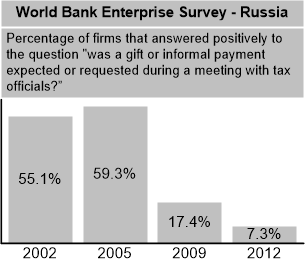
In 2000, Russia was one of the most corrupt countries in the world. Without instituting draconian purges Putin took on the oligarchs and steadily curtailed their power, gradually returning Russia to the rule of law. By 2016 his government reduced corruption to about the same level as that of the United States. That was the empirical result of the annual study on corruption published in 2016 by Ernst & Young.[2] The global auditing consultancy asked respondents around the world whether in their experience, corruption is widespread in the business sector. Their survey, which was conducted in 2014, indicated that only 34% of their Russian respondents thought so, the same proportion as in the United States, and below the world average of 39%. Things have probably improved further since then as Vladimir Putin stepped up a high-profile anti-corruption campaign that led to investigations and prosecution of a number of high level politicians around Russia. Even highly ranked members of Putin’s own political party were not spared.[3] The unmistakable message of such campaigns was that corruption would not be tolerated and that it would be aggressively investigated and prosecuted. Some of the best evidence that Putin’s various anti-corruption measures have had effect can be found in World Bank’s Enterprise Surveys which ask businessmen the question, “was a gift or informal payment expected or requested during a meeting with tax officials?” In 2005, nearly 60% of respondents answered affirmatively. By 2009 this number was 17.4% and by 2012 it had dropped to only 7.3%.
Putin’s government also made impressive advances in making it easier for entrepreneurs and small businesses to set up shop, raise capital and operate in Russia. According to World Bank’s annual “Doing Business” report, which ranks 190 world economies on a set of attributes such as the ease of starting a business, obtaining construction permits, obtaining electricity, raising credit, and enforcing contracts. On all the metrics combined, Russia managed to climb from 124th place in the world in 2012 to 40th in 2017.[4] Thus, within only five years, Russia had vaulted an impressive 84 positions in World Bank’s ranking. This was not a random achievement but the result of President Putin’s explicit 2012 directive that by 2018 Russia should be among the top 20 nations in the world for ease of doing business.
One of the strategically important sectors where Russia has made striking progress is its agricultural industry. After the disastrous 1990s when she found herself dependent on food imports, Russia again became self-sufficient in food production and a net food exporter. By 2014, Russian exports of agricultural products reached nearly $20 billion, almost a full third of her revenues from oil and gas exports. Not only is Russia now producing abundant food for its own needs, the government is explicitly favoring production of healthy foods, a strategy which includes a ban on the cultivation of genetically modified (GMO) crops, introduced by the State Duma in February of 2014. According to official Russian statistics, the share of GMO foods sold in Russia declined from 12% in 2004 to just 0.1% by 2014.
These and many other constructive reforms have had a very substantial impact on Russia’s economic aggregates as the following examples show:
- Between 1999 and 2013, Russia’s gross domestic product (GDP) leaped nearly 12-fold from $1,330 per capita to more than $15,560 in 2013, outpacing even China’s remarkable economic growth.
- Russia reduced its debt as a percentage of GDP by over 90%, from 144% in 1998 to less than 14% in 2015!
- Gross national income per capita rose from $1,710 in 2000 to $14,810 in 2013.
- Unemployment fell from 13% in 1999 to below 5% in 2014. Among the working population (those aged 15-64), 69% have a paid job (74% of men).
- Only 0.2% of Russians work very long hours, compared to 13% OECD average
- Poverty rate fell from 40% in the 1990s to 12.5% in 2013 – better than U.S. or German poverty rates (15.6% and 15.7%, respectively)
- Average monthly income rose from around 1,500 rubles in 1999 to nearly 30,000 rubles in 2013.
- Average monthly pensions rose from less than 500 rubles to 10,000 rubles.
Social and demographic improvements
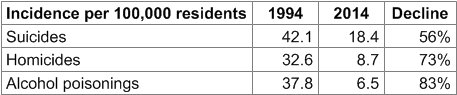
Putin’s economic reforms included also a more equitable distribution of wealth. As hopelessness faded and standard of living improved, Russian society started to heal: suicides, homicides, and alcohol poisonings declined dramatically. Over the twenty-year period between 1994 and 2014, suicides declined by 56%, homicide rate by 73%, and alcohol poisonings by 83%!
The chart below shows the evolution of these improvements over time:
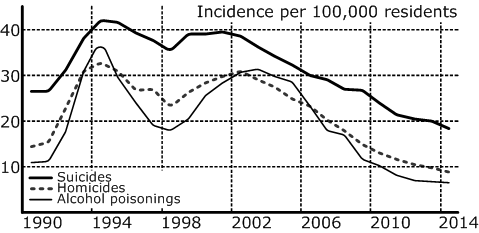
As we can see, these misery statistics rapidly deteriorated with the introduction of shock therapy in 1992, but the trend sharply reversed soon after Putin took charge. By 2014, these figures reached their lowest values since even before 1992. Along with these improvements, the nation’s demographic trends also experienced a dramatic turnaround. Russian life expectancy, which sunk to an average of barely 64 years (57 for men), rose steadily from the early 2000s to reach almost 72 in 2016, the highest it has ever been in Russia’s history.
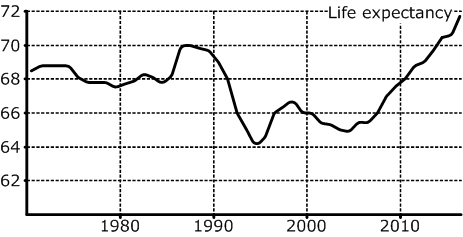
Looking at the way life expectancy in Russia changed over time, we see again that it had collapsed in the early 1990s but the trend turned around sharply under Vladimir Putin’s leadership of the country. Similarly fertility rate, which dropped to 1.16 babies per woman in 1999, increased by almost 50% to 1.7 babies by 2012, comparing favorably to European Union’s average of 1.55 babies per woman of childbearing age. Abortions declined 88% from a harrowing 250% of live births in 1993 to 31% in 2013.

Not only are Russians living longer than ever before and enjoying much better quality of life, they also feel freer and happier. In 2014, Gallup Analytics reported that 65% of Russians, more than ever before, answered “Yes” when asked, “are you satisfied … with your freedom to choose what you do with your life?” Meanwhile, Russia’s happiness index rose more than tenfold, from 6 in 1992 to 70 in 2015. Happiness index, compiled by VCIOM[5] adds the proportion of the respondents reporting that they feel decidedly happy or generally happy and deducts those that report feeling generally unhappy or decidedly unhappy.
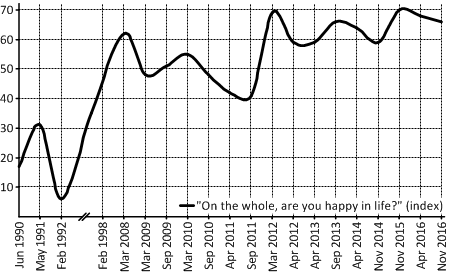
The next chart further corroborates the idea that under Putin’s leadership, Russia has been developing as a sane and prosperous society, not only for the benefit of a narrow ruling class and at everyone else’s expense, but for the vast majority of ordinary Russians.

By 2014, the great majority of Russians felt satisfied with their lives and believed that things in Russia were moving in the right direction. These figures only tapered off after the 2014 western-sponsored coup in Ukraine and the subsequent economic sanctions imposed on Russia. At the same time, the price of oil – still one of Russia’s largest export – collapsed from over $100 per barrel to under $40. Economic sanctions and the oil price collapse triggered a significant crisis in Russia’s economy. However, in spite of the continuing sanctions regime imposed on the country, its economy started improving again in 2016, thanks to its diverse industrial base that includes a developed commercial and consumer automotive industry, advanced aircraft and helicopter construction based largely on domestic technologies, world’s leading aerospace industry building satellites and top class rocket engines, and advanced industries in pharmaceutical, food processing, optical device, machine tools, tractors, software and numerous other branches. Indeed, Russia is far from being just the “Nigeria with missiles,” or a “gas station with an army,” as many western leaders like to characterize it.
Insofar as a population’s sentiment is a valid measure of its leadership’s performance, Russia’s development under Vladimir Putin stands in sharp contrast with the weak performance of most other developed nations, including those that most vehemently criticize Russia and its president. According to polls conducted by Ipsos Public Affairs in 25 different countries in November 2016 and published by the World Economic Forum, almost two thirds of the people in the world believed that their countries were moving in the wrong direction. The leading western nations scored just as badly, while some among them did flat out dismally.
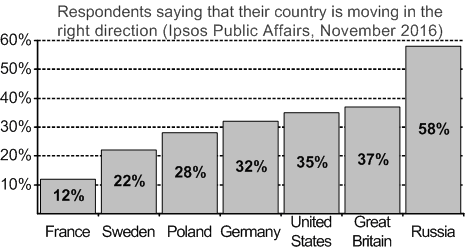
Evidently, Russians feel much better about the way their nation is shaping up than do constituents of many western nations[6] whose sanctimonious leaders like to lecture their Russian counterparts about prosperity, freedom, democracy and other exalted values they purport to cherish.[7] It may thus only surprise the most credulous consumers of western propaganda that a high proportion of Russian people trust Vladimir Putin and approve his job performance. In the early 2017, Putin’s job approval stood between 80% and 90% and has averaged 74% over the eleven years from 2006. During this period, no western leader has come even close to measuring up with Vladimir Putin.

Over the years, I’ve heard depressingly many intellectuals attempt to dismiss Putin’s achievements and Russian people’s contentment as the product of Russian government propaganda. Putin the autocrat, you see, keeps such tight control over the media that he can deceive his people into believing that things in the country are much better than they really are. But the idea that government propaganda can influence public opinion in this way is just silly. If the majority of people thought their lives were miserable, state propaganda could not persuade them that everything is great. On the contrary, most people would conclude that the media is deceiving them and might feel even less positive about things as a result.[8] It is sillier still to think that western intellectuals should have a better appreciation of what it is like to live in Russia than the Russian people themselves. Rather than buying the truth from their media, such intellectuals would do well to take a trip and visit Russia, speak to ordinary people there, and reach their own conclusions. My own travels in Russia, as well as reports from other visitors largely agree with the positive picture that emerges from the statistics we’ve just examined.
Notes:
[1] (Gorbachev: Putin saved Russia from disintegration 2014)
[2] (Stulb 2016)
[3] Some of the names arrested in 2016 surprised even the Russian public as they included such high caliber individual as the Mayor of Vladivostok, Igor Pushkarev; Governor of the Kirov region, Nikita Belykh; Governor of the Sakhalin region, Alexander Khoroshavin, Deputy Minister of Culture Grigory Pirumov and Minister for Economic Development, Aleksey Ulyukaev.
[4] (Romer 2016)
[5] ВЦИОМ – Russian Center for Research on Public Opinion
[6] A different, Associated Press – GfK poll in July of 2016 uncovered an even darker public sentiment in the United States: “A stunning 79 percent of Americans now believe the country is heading in the wrong direction, a 15-point spike in the past year…” (J. Pace 2016)
[7] VCIOM’s figures for November 2016 are somewhat higher than those of Ipsos (62% vs. 58%).
[8] This, for instance, was the situation in the late 1990s when only 5 to 10 percent of Russians thought that the country was heading in the right direction in spite of the ruling elite’s nearly total control of the media.

Facebook Reportedly Removes Russia References From Report on Election Influence
Sputnik – 06.10.2017
Despite its recently released report claiming that Russia-linked entities allegedly bought $100,000 worth of political ads before and after the US presidential election, Facebook has decided to omit Russia references from its April 2017 white paper covering the influence on the public opinion, the Wall Street Journal reported.
Facebook staff were debating on whether to include references to Russia in a public report on “false news” spread via the social network and eventually decided against it, so the white paper issued in April makes no mention of it, according to the Wall Street Journal newspaper.
Some people working in the company insisted that Russia should not be mentioned in the report on the attempt to influence the US presidential campaign in 2016 as Facebook had no proof of subversive activities, the WSJ reported on Thursday, citing sources familiar with the situation.
The April report said that “malicious actors” were involved in an attempt to compromise certain political targets and to push certain narratives, but stressed that it could not say with any certainty who was sponsoring these activities. Facebook said in April that it would add new technologies to weed out fake accounts and improve security.
The media report comes after Facebook said in early September that supposedly Russia-linked entities bought $100,000 worth of political ads linked to inauthentic pages in a two-year period up to May of this year. According to the company, these pages were found to be linked and were “likely operated” out of Russia. Most of the ads did not reference the US presidential election, but focused on amplifying divisive social and political messages.
Kremlin spokesman Dmitry Peskov said that Moscow was not behind the ads or even aware of them.
According to media reports, the US Senate Intelligence Committee has asked senior managers from Facebook, Google and Twitter to testify in front of the US Congress at a public hearing scheduled for October as part of the probe into Russia’s alleged attempts to use social media to influence the election. Russia has faced persistent allegations of having interfered in the 2016 US election, many of them suggesting that an information campaign took place on social media. Russian officials have denied meddling in other states’ domestic affairs.
Russian election meddling probe will show media ran untrue stories – head of US investigation
RT | October 6, 2017
The investigation into alleged Russian meddling in the 2016 US presidential election will ultimately show that “quite a few” news outlets ran stories that were not factual, the chairman of the Senate Intelligence Committee told Politico.
Intelligence Committee Chairman Richard Burr said that although his committee will not be investigating news organizations, it does plan on providing the public with the information needed to hold them responsible for what they reported.
“We’re not going to investigate news organizations, but we will use the findings of our report to let the American people hold every news organization accountable for what they portrayed as fact, in many cases without sources — at least, no sources that would admit to it,” Burr told Politico on Thursday.
“And I think, when we finish our report, we will find that quite a few news organizations ran stories that were not factual,” he added.
He went on to state that some incorrect news stories had also emerged since Wednesday’s news conference held by himself and Senator Mark Warner, which was aimed at providing an update on the status of the investigation into alleged Russian meddling.
Burr’s comments come after US President Donald Trump questioned why the Senate Intelligence Committee fails to investigate so-called “fake news.”
Trump has often criticized the mainstream media for its reporting of alleged Russian meddling in the presidential election, and has referred to the Senate Intelligence Committee’s investigation into the matter as a “hoax” and a “witch hunt.”
Russia, for its part, has consistently denied any interference in the election.
Iran Rejects Reuters Report, Says Missile Program Non-negotiable
Al-Manar | October 6, 2017
Iranian Foreign Ministry Spokesman Bahram Qassemi says the Islamic Republic’s missile program is for defensive purposes and is not open to any negotiations.
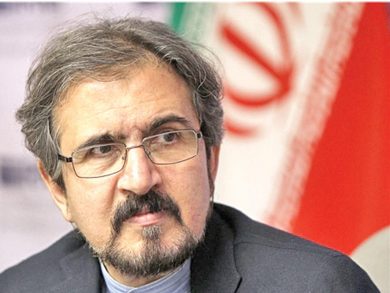 Qassemi on Friday firmly rejected a Reuters report quoting unnamed Iranian and Western officials as saying that Iran has signaled to the six world powers with which it signed the historic nuclear agreement in 2015 that it is open to talks about its ballistic missile arsenal.
“Iran regards defensive missile programs as its absolute right and will definitely continue them within the framework of its defensive, conventional and specified plans and strategies,” the Iranian spokesperson said.
He added that Iran “has repeatedly in diplomatic meetings with foreign officials” emphasized that its “defensive missile program is not negotiable” and that Tehran “does not regard it as inconsistent with [UN Security Council] Resolution 2231.”
In all his meetings and interviews with international media on the sidelines of last month’s 72th session of the United Nations General Assembly in New York, Iranian Foreign Minister Mohammad Javad Zarif reiterated the non-negotiable nature of the Islamic Republic’s defensive missile program.
According to the Reuters report, the sources said that given US President Donald Trump’s threats to ditch the nuclear agreement, known as the Joint Comprehensive Plan of Action (JCPOA), reached under his predecessor Barack Obama, Tehran had approached the powers recently about possible talks on some “dimensions” of its missile program.
KPFA’s Antiwar Voice
By Daniel Borgström | Dissident Voice | October 5, 2017
When people ask me why I joined the Marine Corps (at age 18, back in 1959), I tell them, “Because where I grew up there was no KPFA or Pacifica Radio affiliate.” There was just the constant corporate drumbeat of anti-Communism which took many forms, often pretending to advocate world peace, but always in one way or another campaigning against China and Russia.
I’m told that KPFA bravely exposed Cold War propaganda during the McCarthy era. But in recent years our station has been backsliding, subtly but increasingly echoing the corporate media’s calls for “humanitarian” interventions around the world. Some KPFA hosts feature guests from NGOs aligned with the U.S. State Department, giving them airtime, presenting them as though they were doing good work abroad, and not asking them hard questions or revealing where they get their funding.
Since Trump’s election, KPFA has taken a sharp turn for the worse, presenting itself as a voice of “resistance” — a resistance that does not resist war. While vigorously bashing Trump (who does deserve bashing), the station often functions as a pseudo-progressive voice of the Deep State, echoing the mainstream media and the neoliberals and neocons.
Children and impressionable teenage listeners (potential future military recruits such as I once was) could get the perception from some KPFA programs that America’s proper mission in today’s world should be to sally forth to find and slay monsters.
Once upon a time it was KPFA’s mission to expose such propaganda, and that’s what KPFA needs to get back to doing, to find its soul and once again become an antiwar voice.
Daniel Borgström is an ex-Marine against the war, a veteran occupier. He can be reached at: danielfortyone@gmail.com.
Israeli ambassador pushes potential war to elite U.S. powerbrokers

Israeli Ambassador to the U.S. Ron Dermer gives address Sept. 12, 2017 to Washington D.C. movers and shakers: Wolf Blitzer and other journalists, government officials, think tank heads, philanthropists – almost all with significant ties to Israel (see list below).
By Alison Weir and Kathryn Shihadah | If Americans Knew | October 5, 2017
A select assembly of Washington D.C. heavy hitters recently attended a Rosh Hashanah event at which Israeli Ambassador to the U.S. spoke. Ron Dermer discussed alleged dangers posed by Iran, Syria, and Russia. In some places Dermer appeared to be laying out a rationale for another Israeli war.
According to JTA (Jewish Telegraphic Agency), the event is an annual affair “to which the embassy invites the U.S. Jewish leadership.” Dermer’s speeches typically seem intended to create a feeling of shared concern for Israel, saying, for example, “Let us all raise a glass and toast the fact that the Jewish people are voiceless no more. Israel has provided us with a shofar, with a sovereign voice among the nations.” Dermer himself was born and raised in the U.S.
Among those attending the invitation-only gathering this year were approximately 20 journalists, many connected to top U.S. print and broadcast media (including Wolf Blitzer, Eli Lake, Cliff May); numerous government officials and politicians (Congressmen, diplomats, White House insiders, senior staff, political operatives); and heads of major U.S. national organizations, philanthropists, and influential religious leaders (see list with biographical details below).
Dermer’s speech began on a convivial note – “Remember, on Rosh Hashana, you’re allowed to eat, drink and even laugh”– but soon became serious as he gave dire warnings about alleged dangers Israel faces, and the need for Americans to help.
Iran was the main villain to be protected against, with Syria and Russia allegedly dangerous abettors that also need to be addressed.
“The past year has posed many critical challenges for Israel,” Dermer intoned. “Foremost among those challenges has been the rising power of Iran.”
(This is very much in line with Israeli thinking; Israel’s Jerusalem Post newspaper recently reported: “Iran is the primary target of the Mossad’s actions, which number in the hundreds and thousands each year.” Netanyahu reportedly calls the Mossad Israel’s “synchronized fist.”)
Dermer claimed that the Iran deal had been a “double jackpot” for Iran (many U.S. analysts disagree, including some Israel partisans and top U.S. generals). Dermer charged that the deal had enabled Iran to spend “much of the past year consolidating its power across the Middle East.”
Next came the not-so-subtle call to action.
“Israel hopes that the coming weeks will bring about a dramatic change in the trajectory of that deal that will ultimately either fix it or cancel it,” Dermer said, making clear what was required of Americans who care about Israel.

Dermer and Debbie Wasserman Schultz at 2014 Israel Embassy Rosh Hashanah event; Dermer also warned about Iran at that event.
Dermer also focused on Syria, speaking of a potential Iranian “terror front against Israel” being established in Syria.
“Iran has been feverishly working to win the spoils of the imminent defeat of ISIS,” Dermer said, suggesting that such a defeat could be harmful to Israel.
Dermer’s statements reflect Israeli concern about U.S. efforts to end the war in Syria, leaving Russia, Assad – and by extension Hezbollah – in place. As JTA explains:
The Netanyahu government has been wary of what the end-game could be of U.S. efforts to end the war in Syria. There is a concern among Israelis — articulated most often by the defense minister, Avigdor Liberman — that the Trump administration might defer to Russia, which is allied with the Assad regime. Russia’s Assad alliance means it is in a de facto alliance with Iran and its Lebanese ally, Hezbollah, because they also are allied with the Assad regime.
Recent ongoing efforts in the U.S. to force the Trump administration to avoid diplomatic ties with Russia (despite the paucity of evidence for the accusations) may help remove that obstacle to keeping the U.S. in Syria.
Dermer said that Netanyahu had set “red lines” regarding Syria and that Israel will enforce them: “Israel will act to prevent Iran from supplying game changing weapons to Hezbollah. And Israel will act to prevent Iran from establishing another terror front against Israel in Syria.”
Israel has been stating these red lines for several years, and its escalating sabre rattling suggests that it may be planning another of its wars. Israel analyst Larry Derfner recently published an article entitled “A plea to Israel: Don’t start the third Lebanon War.”
Derfner states: “By continuing to bomb Syrian arms destined for Hezbollah – which Israel has admittedly done nearly 100 times in the last five years – as well as periodically killing Hezbollah and other pro-Syrian fighters along with the occasional Iranian general, Israel is making the next very, very ugly war in the north a self-fulfilling prophecy.”
A recent article in the very pro-Israel Atlantic (editor Jeffrey Goldberg served in the Israeli army) states: “for nearly two years now, Israeli military and intelligence officials have been warning every American official who comes through Tel Aviv and Jerusalem that the next war is coming. Israel has methodically prepared its allies—and most especially the Americans— for a very, very ugly war on the horizon.”
These wars have created massive carnage and suffering. even the Atlantic acknowledges that the 2006 Israeli assault “leveled entire neighborhoods in Beirut.”

Beirut, August 20, 2006. 1,100 Lebanese civilians died, 4,000 were injured, and over one million were temporarily displaced; 116 Israeli soldiers & 43 civilians died. Researchers found pro-Israel bias in U.S. media coverage of the war.
While Dermer tried to sell his audience on the claim that Israel is at existential risk, Derfner points out: “The idea that Hezbollah, Iran and Syria are itching for a war with Israel, that they’re just waiting to attack, is a delusion. Absent Israeli provocation, such an attack would have no parallel in the world or in history.”
Nevertheless, some influential media reports largely purvey Israeli spin, and it’s likely that Dermer’s speech was intended to influence the many journalists at his reception to take a similar line. As a Foreign Policy article reports: “When it comes to Washington, Israel’s task is to locate or induce a more coherent American strategy to counter advance of the Iranians in the Levant.”
This is particularly important, since some Trump officials don’t always march to the Israeli tune. U.S. National Security Advisor General H.R. McMaster recently told Israeli officials that Hezbollah was not a terrorist group. (Other reports claim he has called Israel an occupying power.)
Another point Dermer made to his audience was the value of U.S. strategies to help Israel bring some Arab countries into an alliance against Iran.
Dermer called the new allignment a “silver lining” and said he was “deeply grateful” to the current administration for “methodically working to advance a serious process that can move the entire region forward” – i.e. in Israel’s direction.
Dermer is no doubt pleased that, as in the past, the U.S. negotiator for Israel-Palestine is an Israel partisan; he called for applause for Jason Greenblatt, who he noted was present – one of the many “senior officials from all three branches of the U.S. government” attending the event.
Attendees
Jewish Insider provided a list of opinion makers spotted at the event, which included both liberals and conservatives, members of both political parties, and representatives of diverse positions along the pro-Israel spectrum. Below is the list, with added information on each.
We have listed each individual under one category below, although in many cases they would fit into several sectors given the revolving door that often exists between media, government, and pro-Israel organizations.
Journalists/Media Pundit
Wolf Blitzer, CNN lead political anchor, anchor of The Situation Room and Wolf. Blitzer began his career in 1972 with Reuters in Tel Aviv, before becoming a Washington DC correspondent for Israel’s Jerusalem Post. He also worked as editor of AIPAC’s monthly newsletter and edited “Myths and Facts 1976, A Concise Record of the Arab-Israeli Conflict” (Near East Research, AIPAC’s monthly publication), a volume described by Mondoweiss as “one piece of Zionist propaganda after another [that] denounced Palestinian views of [events surrounding the 1948 war] as ‘spurious myths.’”
Blitzer authored Between Washington and Jerusalem: A Reporter’s Notebook (Oxford University Press, 1985) and Territory of Lies (Harper and Row, 1989), about Israeli spy Jonathan Pollard, of which reviewer Robert I. Friedman wrote in the New York Review of books that Blitzer played down the damage caused by Pollard. Friedman stated: “Senior Israeli Defense Department officials are understandably pleased with Blitzer’s book about Pollard.” Friedman reported: “Currently, he travels the American TV talk show circuit as the ‘voice of Israel.’ Territory of Lies is a slick piece of damage control that would make his former employers at AIPAC (not to mention Israel’s Defense Ministry) proud.”
In 1990 Blitzer went to CNN, where his career skyrocketed. During Israel’s 2014 invasion of Gaza, Blitzer covered the conflict by embedding with the Israeli army. As part of “the most trusted name in news,” he maintains a pro-Israel bias (see this and this, for example). In 1989 he took part in a debate in which he largely repeated Israel’s talking points.
Sam Feist, CNN Washington Bureau Chief and senior vice-president. He oversees daily operations, leads all newsgathering and Washington-based programming, as well as campaign and election coverage. Feist was the founding executive producer of Wolf Blitzer’s The Situation Room, and has produced and managed CNN political programming including Crossfire, The Capital Gang, and State of the Union. He has been with CNN since 1991.
Danielle Heyman Feist, wife of Sam Feist. Director of Camp Rodef Shalom, a Virginia day camp that has a number of activities related to Israel, including a program in which scouts from Israel “run their own specialty area during camp, playing Israeli games, teaching a few Hebrew words, and helping bring their Israeli culture all the way to Virginia!”

Howard Friedman is director of Sinclair Media, the nation’s largest owner of local TV stations. He has served on the board of pro-Israel lobbying organizations such as AIPAC.
Howard Friedman has served on boards for many foundations, including the American Israel Public Affairs Committee (AIPAC) and the Union of Orthodox Jewish Congregations of America (which advocates for Israel and brought “tens of thousands” of its members and “hundreds of rabbis” to lobby Congress against the Iran deal). He was twice named by Washington Life Magazine as one of the 100 most powerful people in Washington DC. Formerly he was President of JTA – The Global News Service of the Jewish People.
Perhaps most significantly, Friedman is currently Director of the Sinclair Broadcast Group, the nation’s largest owner of local TV stations, and likely to become even larger, as it is in the process of buying Tribune Media for $3.9 billion.
Sinclair insists on conservative content on its local news programs, and even produces its own commentary pieces as “must-run” segments on every one of its stations . These include a daily “Terror Alert Desk” segment, which was recently exposed by political humorist John Oliver as an occasional vehicle for conflating terrorism with Islam. The “newscasters” include regulars from the Fox News Channel (like Sara Carter), contributors to conservative publications like the Washington Examiner (like Mark Hyman), and at least one former Trump staffer (Boris Epshteyn – see below).
Sinclair already owns 170 TV stations, which gives it access to 38% of American households—just shy of the cap of 39% put in place by Congress in 2004. Tribune Media is set to hand over another 42 stations (which includes stations in New York City, Chicago, Los Angeles), which would give Sinclair access to a full 72% of US households—nearly double what is allowed by law. This was made possible thanks to a move by Trump-appointed FCC Chairman Ajit Pai. Pai, heir apparent to the chair of the FCC, was wooed by Sinclair starting right after Trump’s election. Soon after his appointment, Pai unexpectedly revived an outdated regulatory loophole. About two weeks later, Sinclair announced its acquisition of Tribune.
Norman Eisen currently works with think tank Brookings Institution, does political commentary on CNN, and chairs Citizens for Responsibility and Ethics in Washington (CREW), a Democratic Party leaning nonprofit he co-founded in 2003 with Louis Mayberg, a financier who donates to Jewish causes (his wife says: “I invest in Jewish people” and partners with the Israeli Ministry of the Diaspora to bring thousands of women from 25 countries on visits to Israel). Previously, Eisen served as special council for ethics and government reform to President Obama. From 1985 to 1988, he was Assistant Director of the ADL’s Los Angeles office, where he investigated anti-semitism and other civil rights issues, promoted Holocaust education, “and advanced US-Israel relations.” He backed Tom Perez over Keith Ellison for Democratic National Committee chair, citing Perez’ “warm feelings for Israel.” As a student he had worked for Israel partisan Alan Dershowitz, who once said: “Our union was made in heaven. He was a natural guy for me to hire because he was brilliant and shared many of the same liberal democratic, pro-Israel values that I did and that he still represents.”
Eisen has also served as U.S. Ambassador to the Czech Republic, during which time bilateral trade between the U.S. and the Czech Republic almost doubled. Earlier in his career he was a partner in the Zuckerman Spaeder law firm, where he worked on cases such as Enron and Whitewater. Washingtonian Magazine listed Eisen as one of Washington’s top lawyers.

Talk show host Tom Rose (right) volunteered for the Israeli military during the first Gulf War. In 2014 he travelled to Israel with his longtime friend Mike Pence (left), in the company of Ambassador Dermer.
Tom Rose, journalist and unofficial Vice Presidential surrogate. Formerly editor/publisher of the Jerusalem Post, during which he and his family lived in Israel. Although he is an American citizen, during the Gulf War he volunteered for service in the IDF. More recently, he has co-hosted a Sunday morning satellite radio program with conservative Christian Gary Bauer. Their show, The Bauer & Rose Show, is known for its “robust defense of Judeo-Christian civilization, the US/Israel alliance, and the need for a strong America in the world.” The show ended in April 2017 when Rose took a position as assistant and advisor to Vice President Mike Pence, Rose’s “closest personal friend for 25 years.” In 2014, Rose and Pence visited Israel together, in the company of Israel’s Ambassador to the US, Ron Dermer.
Kenneth Weinstein, President and CEO of the Hudson Institute, which honored PM Benjamin Netanyahu with the Herman Kahn Award (see Roger Hertog entry below)—which is conferred on “leading public servants who exemplify a commitment to Western alliances as the bedrock of global security, prosperity, and freedom.” Hudson “seeks to guide public policy makers and global leaders in government and business.” It frequently holds conferences on topics such as defense, international relations, and economics (dozens of which have been pro-Israel) and disseminates research and analysis articles (hundreds of which have been pro-Israel). Weinstein is President and CEO of the Broadcasting Board of Governors (BBG), whose mission is “to inform, engage, and connect people around the world in support of freedom and democracy.” BBG oversees U.S. government civilian international media: Voice of America, Radio Free Europe, Office of Cuba Broadcasting, Radio Free Asia, Middle East Broadcasting Networks.

AP reporter Josh Lederman began his journalism career working in Israel, where he had spent a year as a child. He credits that year and his attendance at Tucson Hebrew Academy, whose core values include “supporting Israel,” with informing his reporting.
Josh Lederman, Associated Press reporter; started his journalism career in the AP Jerusalem bureau; he had previously lived in Israel in seventh grade (it is unknown whether he has Israeli citizenship). Lederman credits that year, combined with his education as student at Tucscon Hebrew Academy (among its “Core Values” is “Supporting Israel: We support Israel and foster close relationships with Israeli students and educators”) with helping him “connect the dots” as he reported on Israel. Now based in Washington DC, Lederman covers foreign affairs, national security and U.S. diplomacy for AP ; appears frequently on television and radio, including on MSNBC, Fox News, NPR and others. He covered 2012 presidential campaign for The Hill newspaper in Washington. From 2013 to 2017, Lederman was a White House reporter for AP. He also writes for the Times of Israel.

Media pundit Cliff May founded Foundation for Defense of Democracies (FDD), a neoconservative organization created “to enhance Israel’s image in North America.”
Clifford D. May, weekly “Foreign Desk” columnist of The Washington Times, and frequent analyst on diverse TV and radio news programs. His articles have appeared in the Wall Street Journal, National Review, Commentary, USA Today, The Atlantic and other publications. May is the founder of the Foundation for Defense of Democracies (FDD), a pro-Israel neoconservative organization – May said its purpose was “to enhance Israel’s image in North America.” Some suggested it was the new Project for a New American Century. Right Web reports:
FDD grew out of a right-wing pro-Israel initiative launched in early 2001 called EMET. Reports Slate: “On April 24, 2001, three major pro-Israel donors incorporated an organization called EMET (Hebrew for ‘truth’). In an application to the Internal Revenue Service for tax-exempt status, [FDD president Clifford May] explained that the group ‘was to provide education to enhance Israel’s image in North America and the public’s understanding of issues affecting Israeli-Arab relations.’”[3]
“… Shortly after its founding, FDD quickly became a prominent member of a group of neoconservative think tanks and advocacy groups—including the American Enterprise Institute and the Hudson Institute—that were influential in shaping the early foreign policy priorities of the George W. Bush administration. At the height of the “war on terror,” FDD also absorbed the Committee on the Present Danger, a Cold War-era anticommunist group that been reconstituted to push for hardline policies in the Middle East.”
“FDD’s president, Clifford May, is a former writer for the New York Times who once served as director of communications for the Republican National Committee. May is also a former editor of the party’s official magazine (Rising Tide), a former vice chair of the Republican Jewish Coalition, and a member of the Committee on the Present Danger.”
“FDD has been a vocal advocate of confrontational policies on Iran.”
Slate reports that FDD runs tours of Israel for American academics (with most of their expenses paid) similar to those run for journalists and politicians by AIPAC and other groups.”
May was an advisor to the Iraq Study Group; served on the Advisory Committee on Democracy Promotion (2007-2009), reporting to Secretary of State Condoleezza Rice; served on the Broadcasting Board of Governors, the entity responsible for all U.S. government and government sponsored, non-military, international broadcasting; and on the U.S. Commission on International Religious Freedom (2016).
Evan May, bio is unavailable, probably relative of Cliff May.
Boris Epshteyn, an investment banker; born in Russia and came to the U.S. in 1993 at the age of 11. Previously, he worked on Sen. John McCain’s 2008 presidential campaign. He was a top communications aide for Donald Trump’s campaign; appeared as a Trump surrogate over 100 times on major TV networks between the election and the inauguration. In April, Epshteyn left the White House and became chief political analyst for Sinclair Broadcast Group (see Howard Friedman, above), a conservative company that owns a multitude of local TV stations.
Lauren Gorlin Tanick, wife of Boris Epshteyn, a strategy executive at Google.

Journalist Eli Lake speaks at event organized by the Foundation for Defense of Democracies, Aug. 13, 2014. Observers describe him as a neoconservative “pro-Israel” ideologue.”
Eli Lake, Bloomberg journalist, former senior national security correspondent for The Daily Beast and Newsweek. He worked for a range of news outlets, including The Daily Beast, Newsweek, The Washington Times, The New Republic, New York Sun. Lake has often worked with and shared bylines with Josh Rogin (see entry below); known as extremely pro-Israel. Below are exerpts from Right Web:
Eli Lake is a well-known writer and columnist whose track record on U.S. foreign policy has led some observers to describe him as a neoconservative and “pro-Israel” ideologue. …
His writings focus on national security issues, particularly with respect to the Middle East, and he has a lengthy record of advocating for aggressive U.S. foreign policies in the region. One commentator has quipped that Lake has a “career pattern of credulously planting dubious stories from sources with strong political agendas.”
A frequent subject of Lake’s writings is U.S. policy on Iran. Generally hawkish in his critiques of U.S. engagement with Tehran… most observers agree [that his analysis] is really intended to kill negotiations…
After a nuclear agreement was reached between Iran and the P5+1 in July 2015, Lake went on the attack…. In a March 2015 commentary, Lake criticized Iran’s foreign minister Javad Zarif, a Western educated diplomat widely regarded as a moderate within Iran’s establishment… Former British diplomat Peter Jenkins criticized Lake’s article on Zarif as taking “many liberties with the truth.”
… Lake was “an open and ardent promoter of the Iraq War and the various myths trotted out to justify it, contributing to the media drumbeat that helped the Bush Administration sell the war to the public and to Congress.” Leading up to the 2003 U.S.-led invasion of Iraq, Lake reported extensively on Saddam Hussein’s alleged weapons mass destruction and ties to Al-Qaeda…
After the war and the subsequent failure to discover any weapons of mass destruction in Iraq, Lake contended that the weapons had been moved to Syria…
In a December 2001 article for the National Review, Lake argued that with its invasion of Afghanistan completed, the United States should move on to take military action against Iraq, Yemen, and Somalia. “There are very good arguments why all three should be the next target,” he opined. “Iraq after all has been developing nuclear and biological weapons …
In 2009, Lake gained notoriety for his role stirring up opposition to the nomination of Chas Freeman, a veteran diplomat and former U.S. ambassador to Saudi Arabia, to be the chairman of the National Intelligence Council. Freeman ultimately withdrew his name from consideration and blamed the controversy over his nomination on the “Israel lobby.”… [See Freeman’s statement.]
Josh Rogin, Journalist who often works closely with Eli Lake, sharing bylines on news articles. He is a CNN political analyst and columnist on foreign policy and national security for Bloomberg View. Previously, Rogin covered foreign policy and national security for Newsweek, The Daily Beast, Foreign Policy, The Washington Post, Federal Computer Week and Japan’s Asahi Shimbun. His work has been featured on CNN, FOX, MSNBC, ABC, NBC, NPR, PBS, and several other outlets. He is married to Ali Weinberg (see below); their wedding guests included journalists Eli Lake, CNN’s Wolf Blitzer, CNN’s Jake Tapper, NPR’s Michael Goldfarb, NBC News Political Director and Meet the Press host Chuck Todd, Jamie Kirchick, Jonathan Karl, and NBC’s Alex Moe.
Ali Rogin (aka Ali Weinberg), ABC journalist, married to Josh Rogin. She is the daughter of Max Weinberg (see below). Her Linkedin entry reports that she covers the State Department for ABC News, producing pieces for broadcast and reporting for ABCNews.com and ABC News Radio. She formerly worked at NBC.
Max Weinberg, Drummer for Bruce Springstein and on Conan O’Brian show, father of journalist Ali Rogin (see above). His net worth is reportedly $35 million.
Joel Mowbray, Fellow, Foundation for Defense of Democracies, 2005-2014; formerly syndicated columnist with articles in Wall Street Journal, Washington Times, NY Post, The New Republic, L.A. Times, Philadelphia Inquirer, Atlanta Journal-Constitution, San Diego Union Tribune, Las Vegas Review Journal, Sacramento Bee, Pittsburgh Post-Gazette, Investors Business Daily, Arizona Republic, San Francisco Chronicle, and FoxNews.com. In 2002, Mowbray founded Fourth Factor Consulting, LLC: “Fourth Factor advises Silicon Valley tech companies and pro-Israel and national security-oriented think tanks. The bulk of the work is strategic government affairs, which supplements lobbying efforts by being proactive instead of reactive.” He was a Hudson Institute Adjunct Fellow from 2003 – 2005, where he “conducted research into terror networks and Islamic radicalization, investigated Saudi influence in America, and scrutinized State Department’s handling of national security.” Mowbray is the author of Dangerous Diplomacy: How the State Department Threatens America’s Security.” His Linkdin bio lists AIPAC as one of his interests.

Rabbi Shmuley Boteach at the 2012 “Christians United for Israel” conference. Newsweek lists Boteach as one of America’s “most influential rabbis.”
Rabbi Shmuley Boteach, founder of The World Values Network, “the leading organization spreading universal Jewish values and defending Israel in American media” (see video); frequent guest on CNN, Fox News, MSNBC, the BBC, NBC, CBS, as well as The New York Times, The Wall Street Journal, Time Magazine, Breitbart News, and The Washington Post. Rabbi Boteach’s personal site pictures him with his book: “The Israel Warrior: Fighting Back for the Jewish State from Campus to Street Corner.” Newsweek has repeatedly listed him in “The 50 Most Influential Rabbis in America. He ran for Congress in New Jersey, receiving an endorsement from House Majority Leader Eric Cantor. His site states:
“Rabbi Shmuley Boteach, “America’s Rabbi,” whom is for many the very face of Judaism in global media.
“The international best-selling author of 31 books, Rabbi Shmuley’s works have been translated into 20 languages. A world-renowned relationships expert, his book Kosher Sex is regarded as a modern classic and he has won numerous awards including The London Times Preacher of the Year Competition, The National Fatherhood Award, and The American Jewish Press Association’s Highest Award for Excellence in Commentary…
“Labeled ‘a cultural phenomenon’ by Newsweek and a man with ‘his scholarly finger on the pulse of the nation’ by Slate, Rabbi Shmuley is revolutionizing the place of Judaism and spirituality in modern culture and politics, and is one of the world’s most accomplished defenders of the State of Israel.”
At the 2015 Israel Day Concert In New York City Boteach said, to loud applause: “We are connected to Israel because it’s Jewish… we love Israel because Israel is good. We love Israel because it is the foremost protector of human rights in the world’s most troubled region. There is a war going on. There is a battle for the future of the Jewish state and each and every one of you is a soldier in that fight.”
Noah Pollak, Pollak’s bio describes him as a “political writer on foreign policy, Israel, and the Jewish people.” Pollak has written for Commentary, the Weekly Standard, National Review, the Wall Street Journal, Politico, and appeared on Fox News, PBS Newshour, and CNN. He is executive director of the Emergency Committee for Israel, a neoconservative political advocacy organization whose board members include neocons William Kristol and Rachel Abrams, wife of Elliott Abrams. Pollak helped promote the Taylor Force Act.
Ron Kampeas’ Linkedin entry reports: “Ron Kampeas is JTA’s [Jewish Telegraphic Agency ] Washington bureau chief, responsible for coordinating coverage in the U.S. capital and analyzing political developments that affect the Jewish world. He comes to JTA from The Associated Press, where he worked for more than a decade in its bureaus in Jerusalem, New York, London and, most recently, Washington. He has reported from Northern Ireland, Afghanistan, Bosnia and West Africa. While living in Israel, he also worked for the Jerusalem Post and several Jewish organizations.” Kampeas graduated from Hebrew University of Jerusalem.
Nathan Guttman, the Forward’s Washington bureau chief. He joined the staff in 2006 after serving for five years as Washington correspondent for the Israeli dailies Ha’aretz and The Jerusalem Post. Guttman was born in Canada and grew up in Israel. He is a graduate of Hebrew University.
Government, Politics
Congressman Eliot Engel has been in Congress since 1988 as a Democrat representing the Bronx. He has traveled to Israel many times, and says, “I remain committed to the unbreakable bond between the United States and Israel.” On another occasion, he opined, “We don’t want one party to be pro-Israel; we want both parties to be pro-Israel” because the state is “our best friend in the Middle East, and – I’d even argue – in the world.” Engel favors recognition of Jerusalem as the undivided capital of Israel, and is uncritical in his support.

Congressman Lee Zeldin (right), member of the House Foreign Affairs Committee and Co-Chair of the House Republican Israel Caucus, meets in his Washington, DC office with Yoav Kisch, member of the Israeli Knesset, Feb. 1, 2017.
Congressman Lee Zeldin previously served in the New York State Senate, and is now in the U.S. House of Representatives. As Co-Chair of the House Republican Israel Caucus, he spoke on the issue of the U.N. “anti-Israel resolution” of December 2016: “Pro-Palestinian, anti-Israel nations are continuing their fanatical efforts at the United Nations to delegitimize [Israel]… Their disparaging, divisive and dangerous tactics will be met with zero tolerance. Continued unilateral concessions by Israel in exchange for no promises or follow through towards peace on the part of others would be as ill-advised as it is unfeasible.” Zeldin also wrote, regarding the U.N. resolution, that it “further cements President Obama’s legacy as one of the worst presidents in the history of the United States… [He] chose to embrace a pro-Palestinian attempt to ethnically cleanse East Jerusalem and Judea and Samaria.” Zeldin is also passionately in favor of moving Israel’s capital to Jerusalem.
Congressman Henry Waxman, Democratic Congressman from southern California, 1975 – 2015. The Forward calls him “one of the most influential liberals, and one of the most skilled legislators, of his generation.” In the Times of Israel report, “Jewish lawmaker, who maintains close ties to Israel, has represented Los Angeles district for 40 years,” Waxman was named “the dean of Jewish lawmakers in the U.S. House of Representatives.”
Waxman said that he had “worked throughout my career to strengthen the US-Israel relationship. I have traveled to Israel on numerous occasions…” Waxman once stated: “…it is with pride that I have seen my daughter thrive in Israel and my grandchildren serve in the Israeli army.”
Janet Kessler, Waxman’s wife; founder of Congressional Wives for Soviet Jewry.
Jason Greenblatt, formerly executive vice president and chief legal officer to Trump and the Trump Organization, and his advisor on Israel; currently special envoy to the Israeli-Palestinian peace process for President Trump, charged with facilitating “the ultimate deal.” According to NPR, Greenblatt once studied in a yeshiva – a Jewish religious seminary – in a West Bank settlement. He has recently met with senior settler leadership in preparation for negotiations. In fact, Greenblatt and Trump’s administration are more sympathetic toward settlements than any previous administration, much to the delight of Israel. The Palestinian Authority, on the other hand, is not optimistic: Greenblatt has yet to even commit to helping create a Palestinian state.

U.S. Secretary of Veterans Affairs David Shulkin (left) meets with Israeli Deputy Defense Minister Eli Ben-Dahan, March 2017. The Israeli government has used Shulkin to build a closer relationship between Israel and the U.S. After the meeting, the VA purchased medical equipment from an Israeli company.
David Shulkin, current U.S. Secretary of Veteran Affairs; he was recommended to President Trump by U.S. Ambassador to Israel David Friedman, even though Shulkin is not a veteran. (Veterans had wanted the position to be filled by a military veteran, the normal procedure; some lobbied for then VA Secretary Robert McDonald to be named.) Israel sees veterans affairs as a new means of bringing the U.S. and Israel closer together, as JNS (Jewish News Service) reports: “While US-Israeli military ties have long focused on foreign aid packages, intelligence-sharing and jointly developed missile defense technology, veterans affairs could become a major new frontier in that relationship.” JNS writes that the selection of Shulkin, “a Jewish doctor and administrator,” for Secretary of veterans affairs, was an important development in the process. Within weeks of Shulkin’s confirmation, the Israeli Deputy Defense Minister asked Shulkin for a meeting. The meeting was the first of its kind between American and Israeli officials responsible for the care of injured and released soldiers. After the meeting, Veterans Affairs purchased Israeli medical equipment. U.S. officials sometimes provide Israelis the opportunity “to make presentations during international conferences at which Israel is not yet participating.” JNS notes: “Such opportunities will allow the Israelis to showcase their knowledge on a world stage to which they have, until now, largely been denied access.’
Shulkin and his wife Merle Bari (below) are currently under investigation for taxpayer funding of a recent trip to Europe.
Merle Bari, wife of David Shulkin, physician specializing in general and cosmetic dermatology. Recently she has been criticized for reports that “the government covered the cost of Bari’s airfare and gave her a per diem for meals” when she accompanied her husband on a trip to Europe. She seems to have close ties to Israel. In 1977 Bari was a youth participant in Israel’s Maccabiah Games, and in 2013 her daughter similarly participated in the Games during a year she spent in Israel, and was a delegate to the AIPAC national convention.
Aaron David Miller worked at the State Department for 25 years as a Middle East negotiator and adviser on Arab-Israeli affairs. He is currently a vice president at the Wilson Center; he says he believes “in the importance of a strong U.S.-Israeli relationship.” In an article for the Washington Post Miller admitted that he and other U.S. mediators had actually like “Israel’s lawyer.”
“With the best of motives and intentions, we listened to and followed Israel’s lead without critically examining what that would mean for our own interests, for those on the Arab side, and for the overall success of the negotiations. The “no surprises” policy, under which we had to run everything by Israel first, stripped our policy of the independence and flexibility required for serious peacemaking.”
“What we ended up doing was advocating Israel’s positions before, during and after the summit.”
Matt Nosanchuk was Jewish Liaison under Obama; said he had very strong relationships with pro-Israel organizations across the political spectrum. He has worked in the White House, Congress, the State Department, Justice Department, and Homeland Security on a range of domestic and foreign issues arising at the intersection of policy, law, advocacy, legislation, strategic communications, and outreach and engagement. He described President Obama’s views (and said he agreed with them):
“The president [Obama] said he wouldn’t be where he is today without the support of the Jewish community in Chicago. He believes in Zionism. He believes we have shared values. He shows strong, unwavering support for Israel. He says he did the Iran deal partially to protect Israel’s security, that it would be a ‘moral failing’ not to protect Israel’s security.”

(L-R) Aaron Keyak, William Daroff and Steve Rabinowitz at the launch of Bluelight Strategies, a consulting group at the “nexus of political Washington and the Jewish and pro-Israel world.” Keyak was previously a senior Congressional staffer and executive director of the National Jewish Democratic Council.”
Aaron Keyak, Co-owner of a Washington DC PR firm; he was a senior staffer for some Congressional representatives and communications director and interim executive director for the National Jewish Democratic Council. Keyak has said that strengthening the U.S.-Israel relationship is one of the values he most cares about. Washington Jewish Week reported about the 2015 launch of Keyak’s public relations firm:
“The official announcement was made at the “Latkes & Vodkas” party at their swanky downtown office on Dec. 15. Steve Rabinowitz, founder and president of the mostly progressive and Judeocentric Washington, D.C.-based political public relations firm, Rabinowitz Communications – the former Clinton White House staffer who produced the famed photograph of Israeli Prime Minister Yitzhak Rabin and PLO leader Yasser Arafat shaking hands on the White House South Lawn – would no longer be flying solo. Aaron Keyak, 29, would become his partner in a new PR company called “Bluelight Strategies.”
“… recently, communications director and senior Middle East policy advisor for Jewish Rep. Jerry Nadler (D-N.Y.), who represents one of the most heavily Jewish districts in the country. He previously served in a similar role with Rep. Steve Rothman (D-N.J.).
“According to Keyak, the idea for the partnership arose out of the successful working relationship he and Rabinowitz enjoyed during the 2012 presidential election, when the two collaborated on a venture they called the “Hub,” an effort aimed to organize Jewish voters for Democratic candidates.”
Avi Goldgraber, wife of Aaron Keyak, is manager at Accenture; previously she was confidential secretary to Deputy Secretary, Department of Health and Human Services. Goldgraber attended Israel’s Hebrew University of Jerusalem, received her B.A. from Washington University in Political Science and Jewish, Islamic, and Near Eastern Studies. She is the daughter of Moshe B. Goldgraber who endowed a fellowship for Israeli physicians.
Josh Raffel currently leads the communications team for Jared Kushner and is his principal spokesman. Raffel is “often the primary route for delivering Mr. Kushner’s message to the news media, and he also handles communications on issues like Israeli-Palestinian negotiations.” He was formerly a publicist, whose clients included Hollywood horror films, Glenn Beck, and Jared Kushner’s family business.

Top Democratic strategist Ann Lewis declared that “the role of the president of the United States is to support the decisions that are made by the people of Israel.”
Ann Lewis, leading Democratic Party strategist and communicator. In one public meeting of Jewish leaders before the 2008 election, Lewis declared that “the role of the president of the United States is to support the decisions that are made by the people of Israel. It is not up to us to pick and choose from among the political parties.” This was after some discussion that “there’s something wrong with Senator Obama’s views about Jews, about Israel” – referring to Obama’s pastor, Rev. Jeremiah Wright’s, preaching that Israel is committing “state terrorism against the Palestinians,” as well as Obama’s apparent sympathy for Palestinians. Lewis’ pro-Israel clout as leading Democratic Party strategist and communicator is clear in how she was able to change the Israel policy of the Center for American Progress, a powerful progressive research and advocacy organization. She made it clear that criticism of Israel, AIPAC, and American Jewish groups is forbidden. CAP was quick to self-censor, removing or cleaning up tweets and articles.
David Milstein, Research Analyst for Senator Ted Cruz (R-TX), primarily focusing on issues related to Israel. “He played a leadership role with an organization called Young Jewish Conservatives whose mission is to build a community of politically conservative young Jews who strongly support Israel; co-organized its annual Shabbat Event at the Conservative Political Action Conference (CPAC), the largest annual gathering of conservative activists.”
ThinkTanks, NGOs, Funders
Morton Klein has been national president of the Zionist Organization of America for 24 years. When President Obama abstained from voting in the U.N. Security Council resolution condemning Israeli settlements, Klein opined, “Obama has made it clear that he’s a Jew-hating anti-Semite.” He agreed with candidate Trump’s plan for profiling Muslims: “We should adopt the same profiling policies as Israel and be more thorough in vetting Muslims,” adding, “it’s not the worst thing to do.” Klein criticized Secretary of State Rex Tillerson for using the word “Palestine,” claiming that it sends a message to the Arab world that “this administration is biased to their side.” Going even further, Klein called for Tillerson to be fired when the State Department published its annual terror report, which suggested (as it had the previous year) that Israeli settlements and Palestinian hopelessness are factors contributing to Palestinian terrorism. Klein indicated that the State Department had “put out reports that give excuses for Palestinian murder of Jews.” The ZOA organized a letter opposing the Iran deal.

Abe Foxman worked at the Anti-Defamation League (ADL) for 50 years. After retiring he joined Israel’s Institute for National Security Studies (INSS).
Abe Foxman, former National Director of the Anti-Defamation League; currently ADL National Director Emeritus and fellow at Israel’s Institute for National Security Studies (INSS), a Tel Aviv-based think tank for issues of security and Middle East policy. He is also head of the Center for the Study of Anti-Semitism at the Museum of Jewish Heritage in New York City. Foxman is known as the “Jewish Pope” thanks to his 28-year leadership of the Anti-Defamation League. INSS director Amos Yadlin called him “an undeclared leader of the American Jewish community and a leading global figure on matters of human dignity and moral conduct.” Foxman believes that the BDS movement is anti-Semitic “99% of the time.”
Stacy Burdett, Vice President, Government Relations, Advocacy & Community Engagement at Anti-Defamation League. He has participated in the international campaign to change the definition of anti-Semitism to include many statements about Israel.
Loribeth Weinstein, CEO of Jewish Women International (JWI) for over 15 years. JWI works to “end violence, ensure economic security, and spotlight leadership and mentoring.” She has also served American Jewish World Service, dedicated to “ending poverty and promoting human rights in the developing world.” Weinstein has also been on the Regional Council of the New Israel Fund, which includes as its mission statement, achievement of “equality for all the citizens of the state… protection of Palestinian citizens… opposition to all forms of discrimination and bigotry… a just society at peace with itself and its neighbors.” The New Israel Fund has supported B’tselem to the tune of $2.2 million over the last ten years.

Howard Kohr, executive director of the American Israel Public Affairs Committee (AIPAC). Analysts write: “AIPAC, which is a de facto agent for a foreign government, has a stranglehold on the U.S. Congress.”
Howard Kohr, executive director of AIPAC since 1996. Under his supervision, Congresspeople have been given all-expenses-paid trips to Israel to “discover their own personal connection to the land…and to understand the issues more clearly.” Kohr has turned AIPAC into “the most influential foreign policy lobbying organization” in Washington, and promises to keep it that way with the help of 4,000 pro-Israel student leaders across the country. “Mr. Kohr [representing AIPAC] has helped to navigate congressional passage of the annual U.S. Foreign Aid bill by historic, record-breaking margins — accomplishments achieved often in the midst of a hostile, budget-cutting environment.”
In his testimony to Congress in April 2017, as Kohr requested $3.1 billion in foreign military aid, he reminisced about the “close strategic relationship between the United States and Israel” that began with sharing of key intelligence in 1967 – the same year that Israel attacked the USS Liberty with napalm, gunfire, and missiles, even machine-gunning three lifeboats. The Moorer Commission found that the attack constituted “an act of war against the United States.” Professors John Mearsheimer of the University of Chicago and Stephen Walt of Harvard state: “AIPAC, which is a de facto agent for a foreign government, has a stranglehold on the U.S. Congress.”
Fortune magazine has ranked AIPAC the number two most powerful lobbying group in Washington D.C., after the American Association of Retired Persons (AARP)
Bob Cohen, Chairman of the Board of Directors of AIPAC (American Israel Political Affairs Committee), former President of AIPAC (2014). Cohen is considered one of AIPAC’s six key leaders.

Jason Isaacson of the American Jewish Committee (AJC) speaks at the National Leadership Assembly for Israel at the National Press Club, July 28, 2014. (Video here.)
Jason Isaacson, Director of Government and International Affairs at the American Jewish Committee (AJC). The AJC website announces:
“Around the world—from the hallways of the U.N. in New York, to the corridors of the European Union in Brussels, and to the countries of Asia—AJC advocates for Israel at the highest levels. And when Israel is under assault, whether from the terrorist organizations on her doorstep or the global BDS movement, AJC helps bring the world the truth about Israel.”
The AJC is an American nonprofit organization. Donations to it are tax-deductible.
Daniel S. Mariaschin, CEO of B’nai B’rith International, “a national and global leader in…Israel advocacy.” His B’nai B’rith bio reports: “Mr. Mariaschin has met with countless heads of state, prime ministers, foreign ministers, opposition leaders, influential members of the media and clerical leaders. Each time, his goal has been to advance human rights, help protect the rights of Jewish communities worldwide and promote better relations with the state of Israel.” Mr. Mariaschin represented the organization at numerous international conferences, many of which helped to establish a new, Israel-centric definition of anti-Semitism, including the International Conference on Holocaust Education, Remembrance and Research; and the State Department’s 1998 Washington Conference on Holocaust-Era Assets. Mariaschin served as part of the U.S. delegation to the Organization for Security and Co-operation in Europe (OSCE) conference on anti-Semitism in Vienna in 2003; was public advisor to the U.S. delegation at the 2004 conference in Berlin, the 2005 conference in Cordoba, Spain, and the 2007 meeting in Bucharest, Romania. In 2009 he was a member of the U.S. delegation to the Warsaw Human Dimension Implementation meeting of the OSCE.
Mariaschin began his professional Jewish life in 1973 as community relations associate for the Jewish Community Council of Boston. Two years later, he became director of the New England office of the American Zionist Federation and Zionist House in Boston. In 1977, he joined the Anti Defamation League (ADL) of B’nai B’rith as director of its Middle East Affairs Department. From 1979 to 1986, he served as assistant to ADL’s national director, the late Nathan Perlmutter, and as director of its National Leadership division, responsible for ADL’s nationwide program of leadership development. He then became director of the Political Affairs Department of the American Israel Public Affairs Committee (AIPAC), where he supervised political action activities and grassroots organization programs.
Prior to joining B’nai B’rith, Mr. Mariaschin served as director of communications and principal spokesman for former Secretary of State Alexander M. Haig, Jr. during his 1987-88 presidential campaign.
Mariaschin has written numerous articles for such publications as The New York Times, The Wall Street Journal, Los Angeles Times, Chicago Tribune, The Washington Times and Newsday, and appears frequently as a foreign affairs analyst on television and radio programs. He has lectured on foreign and defense affairs at the U.S. State Department’s Foreign Service Institute, the Marine Corps Command and Staff College, and at other military installations across the country. He has also worked as a radio announcer and news commentator and has lectured widely in the U.S. and abroad.
Rabbi Levi Shemtov, Shemtov has been called “the rabbi of Capitol Hill.” The Washingtonian states: “Rabbi Levi Shemtov is a Washington institution.” It reports that Shemtov
“is among the country’s best-connected and most politically savvy rabbis. Shemtov has supervised the koshering of the White House kitchen, lit the National Menorah alongside Vice President Joe Biden, and for more than two decades has run American Friends of Lubavitch (AFL), the Washington arm of the world’s most successful Jewish outreach organization.”
“It’s hard for me to think of any political Jewish person in Washington that doesn’t have a relationship with him,” says Steve Rabinowitz, a PR executive and longtime friend of the rabbi’s.”
His bio on the Rabbinical Council of Greater Washington reports:
“Rabbi Shemtov is also the Executive Vice President of American Friends of Lubavitch (Chabad) and serves the daily governmental and diplomatic needs of the international Chabad-Lubavitch movement, the world’s largest and fastest growing Jewish network of educational and social service institutions, with over 3,500 centers in 49 states and over 80 countries. He maintains close relationships with numerous members of the United States Congress, senior Administration officials and leaders in the international community, including a number of heads of state and government. Rabbi Shemtov chairs the organizing committee of the International Chabad-Lubavitch Conference – Living Legacy, which facilitates high-level interaction between rabbis and communal leadership from around the globe and prominent US and international figures in the arenas of government, diplomacy, academia and the arts.
“Programs he organizes include several signature events such as the annual lighting ceremony of the National Chanukah Menorah drawing thousands to The Ellipse (across from the White House) every year, and seen by millions more via various media and the internet. In addition, he founded and directs the Capitol Jewish Forum, which is the largest (apolitical) Jewish group on Capitol Hill, designed to “create and enhance a sense of identity and community among Jewish Congressional staffers and members of Congress” and which enjoys strong support of the Leadership and members of both parties in the US Senate and House of Representatives. Rabbi Shemtov is often at the White House, Pentagon, United States Department of State and other venues in official Washington, seen by many as an effective, bipartisan unifier and premier Jewish resource.”
Shemtov is a passionate Israel defender who used the national menorah lighting awhile ago to complain about a U.N. resolution saying that Israeli settlements are illegal. In 2014 he gave a speech at a Stand With Us rally in Washington DC:
(Jared Kushner and Ivanka attend his synagogue.)
Nathan Diament previously served on President Obama’s Faith Advisory Council; his writing has appeared in The Washington Post, The Forward, and other publications, he has appeared on CNN, FOX News, NPR, and other broadcasts. Currently he is Executive Director for the Orthodox Union Advocacy Center, “public policy arm of the nation’s largest Orthodox Jewish organization‚ representing nearly 1,000 congregations nationwide.” One of its main issues is “supporting Israel.” The Orthodox Union website never uses the word Palestine when referring to the modern-day state, without using quotation marks (i.e. “Palestine”); it states that “historically, there was never an indigenous Palestinian people”; its Newsroom and Campus Life sections are anti-Palestine; and it features a Birthright travel agency. Diament himself is a strong advocate of an “undivided Jerusalem” as capital of Israel.

Roger Hertog, “strategic philanthropist” and chairman of the Tikvah Fund, with Israeli Prime Minister Netanyahu at a gala ceremony at Manhattan’s Plaza Hotel where Netanyahu received an reward from the Hudson Institute.
Roger Hertog, vice-chair emeritus of Alliance-Bernstein L.P., an investment firm which was reportedly valued in 2002 at $100 billion that was investigated for “improper trading moves.” Hertog practices what he calls “strategic philanthropy.” He has funded many pro-Israel organizations: the Anti-Defamation League; American Friends of Shalva; Tikvah (he is chairman); in 2005, gave $5 million to Taglit-Birthright Israel; he founded Israel’s Shalem Center; is on the boards of Commentary magazine and the American Enterprise Institute; and is a member of what Ha’aretz called Netanyahu’s “billionaire’s club.” Inside Philanthropy reports:
“involved in philanthropy for decades. Hertog was previously chairman of New York Historical Society and the Manhattan Institute, each of which has received large support. As well, the couple has given tens of millions to the New York Public Library over the years. The Hertog Foundation has given away around $10 million annually in recent years, mainly toward Jewish causes, conservative policy issues, education (both higher education, and school reform), and arts and culture. The Hertog Foundation also runs educational programs for students in areas such as politics, war, and economics…
“served as chairman emeritus of the conservative think tank Manhattan Institute, as well as served on the board of the American Enterprise Institute (AEI). He was also a backer of the right-leaning New York Sun newspaper. Hertog and Susan have also supported outfits like the Thomas Jefferson Foundation, the Alexander Hamilton Society, the Brookings Institution, the Hudson Institute, the Claremont Institute, the Washington Institute, and the Institute for the Study of War.
Involved in Israeli archaeology projects (for info on their agenda see this); funded an excavation by Israeli archaeologist Eilat Mazar and provided resources for multi-volume scholarship to interpret and publish the Temple Mount Excavation.
Hertog has also been involved in media ventures: he was co-owner of The New Republic for a period; supplied the seed money for the now-defunct New York Sun, and guaranteed the $2 million bail for pro-Israel media baron Conrad Black when he was charged for defrauding shareholders.
Lindsay Kaplan, wife of Norman Eisen, Georgetown University English Department.
Sander Gerber was a low profile New York hedge fund CEO and AIPAC national board member who heard about the death of American Taylor Force in Israel and investigated the Palestinian Authority’s budget with the help of a top intelligence Israeli general and an Israeli research institute. Gerber and his associates discovered the Palestinian Authority’s social safety net program which provides a stipend for families of men who have been injured, killed, or imprisoned by Israel. He dubbed the program “pay to slay,” and began to lobby Congress and the media to stop the practice. The Taylor Force Act would slash aid to the PA unless it stops the stipend program for widows and children.
Israelis & Israeli media
Danny Ayalon, Israeli Deputy Foreign Minister of Foreign Affairs; formerly Israeli ambassador to the U.S. In 2005 Ayalon received the Brandeis award from the Jewish Community in Baltimore. He is the founder of “Truth About Israel,” an Israeli organization known for its short videos, which is registered as a nonprofit, tax-deductible organization in the U.S., and is also present in Singapore. (We have not yet been able to find the organization’s 990 tax form, which suggests that it’s registered under a different name.)
Yarden Golan, Chief of Staff at the Israeli Embassy.
Ron Prosor, former Israeli ambassador to the UN.
Sarah Abonyi, Special Projects Manager for the Ambassador of Israel. From New Mexico.
Miriam Smallman, Director of Media Relations at Israeli embassy.
Michael Wilner, A native New Yorker who is the Washington bureau chief and White House correspondent for Israel’s The Jerusalem Post.
Alison Weir is executive director of If Americans Knew, president of the Council for the National Interest, and author of Against Our Better Judgment: The Hidden History of How the U.S. Was Used to Create Israel. Her upcoming book talks are listed here. Kathryn Shihadah is a staff writer for If Americans Knew. She recently wrote “How Israel Weaponizes Archeology.”
Canada’s House of Commons Passes Magnitsky-Style Law
Sputnik – October 5, 2017
Canada’s House of Commons passed a Magnitsky-style law that aims to impose restrictive economic measures on foreign nationals responsible for alleged human rights violations.
The House of Commons passed the measure by a vote of 277 to 0 on Wednesday.
Earlier, Russian Foreign Ministry expressed deep disappointment in Canada’s plans to adopt the law.
“In many ways, it was simply copied from an odious US bill named after Magnitsky and leads to further deterioration of Russia-Canada ties,” — the ministry’s spokesperson Maria Zakharova said. “It will not be left without an appropriate response”, she added.
Russia has repeatedly warned Canada against the adoption of the law. Earlier, the head of the commission on state sovereignty protection of the Russian Federation Council, Andrei Klimov said that the possible adoption by the Canadian parliament of such act will be an “unfriendly step” toward Russia leading to a response by Moscow.
The United States was the first country to introduce the so-called Magnitsky Act, imposing travel bans and financial sanctions on Russian officials and other individuals believed to have been involved in the death of lawyer Sergei Magnistky, who had been arrested in Moscow in 2008 on tax evasion charges and later died of heart failure while in prison.
In 2015, the US Senate expanded Russia-specific human rights and corruption sanctions to other countries by adopting the so-called Global Magnitsky Act.
The Mystery of the Russia-gate Puppies
By Robert Parry | Consortium News | October 4, 2017
What is perhaps most unprofessional, unethical and even immoral about the U.S. mainstream media’s coverage of Russia-gate is how all the stories start with the conclusion – “Russia bad” – and then make whatever shards of information exist fit the preordained narrative.
For instance, we’re told that Facebook executives, who were sent back three times by Democratic lawmakers to find something to pin on Russia, finally detected $100,000 worth of ads spread out over three years from accounts “suspected of links to Russia” or similar hazy wording.
These Facebook ads and 201 related Twitter accounts, we’re told, represent the long-missing proof about Russian “meddling” in the U.S. presidential election after earlier claims faltered or fell apart under even minimal scrutiny.
In the old days, journalists might have expressed some concern that Facebook “found” the ads only under extraordinary pressure from powerful politicians, such as Sen. Mark Warner, D-Virginia, the vice chairman of the Senate Intelligence Committee and a leading legislator on the tech industry. But today’s mainstream reporters took Warner’s side and made it look like Facebook had been dragging its heels and that there must be much more out there.
However, it doesn’t really seem to matter how little evidence there is. Anything will do.
Even the paltry $100,000 is not put in any perspective (Facebook has annual revenue of $27 billion), nor the 201 Twitter accounts (compared to Twitter’s 328 million monthly users). Nor are the hazy allegations of “suspected … links to Russia” subjected to serious inspection. Although Russia is a nation of 144 million people and many divergent interests, it’s assumed that everything must be personally ordered by President Vladimir Putin.
Yet, if you look at some of the details about these $100,000 in ads, you learn the case is even flimsier than you might have thought. The sum was spread out over 2015, 2016 and 2017 – and thus represented a very tiny pebble in a very large lake of Facebook activity.
But more recently we learned that only 44 percent of the ads appeared before Americans went to the polls last November, according to Facebook; that would mean that 56 percent appeared afterwards.
Facebook added that “roughly 25% of the ads were never shown to anyone. … For 50% of the ads, less than $3 was spent; for 99% of the ads, less than $1,000 was spent.”
So, as miniscule as the $100,000 in ad buys over three years may have seemed, the tiny pebble turns out really to be only a fraction of a tiny pebble if the Russians indeed did toss it into the 2016 campaign.
What About the Puppies?
We further have learned that most ads weren’t for or against a specific candidate, but rather addressed supposedly controversial issues that the mainstream media insists were meant to divide the United States and thus somehow undermine American democracy.
Except, it turns out that one of the issues was puppies.
As Mike Isaac and Scott Shane of The New York Times reported in Tuesday’s editions, “The Russians who posed as Americans on Facebook last year tried on quite an array of disguises. … There was even a Facebook group for animal lovers with memes of adorable puppies that spread across the site with the help of paid ads.”
Now, there are a lot of controversial issues in America, but I don’t think any of us would put puppies near the top of the list. Isaac and Shane reported that there were also supposedly Russia-linked groups advocating gay rights, gun rights and black civil rights, although precisely how these divergent groups were “linked” to Russia or the Kremlin was never fully explained. (Facebook declined to offer details.)
At this point, a professional journalist might begin to pose some very hard questions to the sources, who presumably include many partisan Democrats and their political allies hyping the evil-Russia narrative. It would be time for some lectures to the sources about the consequences for taking reporters on a wild ride in conspiracy land.
Yet, instead of starting to question the overall premise of this “scandal,” journalists at The New York Times, The Washington Post, CNN, etc. keep making excuses for the nuttiness. The explanation for the puppy ads was that the nefarious Russians might be probing to discover Americans who might later be susceptible to propaganda.
“The goal of the dog lovers’ page was more obscure,” Isaac and Shane acknowledged. “But some analysts suggested a possible motive: to build a large following before gradually introducing political content. Without viewing the entire feed from the page, now closed by Facebook, it is impossible to say whether the Russian operators tried such tactics.”
The Joe McCarthy of Russia-gate
The Times then turned to Clinton Watts, a former FBI agent and a top promoter of the New McCarthyism that has swept Official Washington. Watts has testified before Congress that almost anything that appears on social media these days criticizing a politician may well be traceable to the Russians.
For instance, last March, Watts testified in conspiratorial terms before the Senate Intelligence Committee about “social media accounts discrediting U.S. Speaker of the House Paul Ryan.” At the time, Ryan was under criticism for his ham-handed handling of a plan to “repeal and replace” Obamacare, but Watts saw possible Russian fingerprints.
Watts also claimed that Sen. Marco Rubio’s presidential bid “anecdotally suffered” from an online Russian campaign against him, though many of you may have thought Rubio flamed out because he was a wet-behind-the-ears candidate who performed robotically in the debates and received the devastating nickname “Little Marco” from Donald Trump.
Watts explained that these nefarious Russian schemes left no discernible earmarks or detectable predictability. Russians attack “people on both sides of the aisle … solely based on what they [the Russians] want to achieve in their own landscape, whatever the Russian foreign policy objectives are,” Watts complained.
Watts’s vague allegations appear to have been the impetus behind Sen. Warner’s repeated demands that Facebook find some evidence to support the suspicions. After Facebook came up empty twice, Warner flew to Silicon Valley to personally confront Facebook executives who then found what Warner wanted them to find, the $100,000 in suspected Russia-linked ad buys.
So, it perhaps made sense that the Times would turn to Watts to explain the rather inexplicable Russian exploitation of puppies. According to Isaac and Shane, Watts “said Russia had been entrepreneurial in trying to develop diverse channels of influence. Some, like the dogs page, may have been created without a specific goal and held in reserve for future use. ‘They were creating many audiences on social media to try to influence around,’ said Mr. Watts, who has traced suspected Russian accounts since 2015.”
In other words, if you start with the need to prove Russian guilt, there are no alternative explanations besides Russian guilt. If some fact, like the puppies page, doesn’t seem to fit the sinister conspiracy theory, you simply pound it into place until it does.
Yes, of course, Russian intelligence operatives must be so sneaky that they are spending money (but not much) on Facebook puppy ads so they might sometime in the future slip in a few other ideological messages. It can’t be that perhaps the ads were not part of some Russian government intelligence operation.
The Russ-kie Plot
But even if we want to believe that these ads are a Russ-kie plot and were somehow intended to sow dissension in the U.S., the totals are insignificant, a subset of a subset of a subset of $100,000 in ad buys over three years that, as far as anyone can tell, had no real impact on the 2016 election – and surely much, much, much less than the political influence from, say, Israel.
If we apply Facebook’s 44 percent figure, that would suggest the total spending in the two years before the election was around $44,000 and much of that focused on a diverse set of issues, not specific candidates. So, if some Russians did spend money to promote gay rights and to push gun rights, any negligible impact on the 2016 election would more or less have been canceled out between Clinton and Trump.
Yet, over these still unproven and speculative allegations of Russian “links” to these Facebook ads, the national Democrats and their mainstream media allies are stoking a dangerous and expensive New Cold War with nuclear-armed Russia.
I realize that lots of Democrats were upset about Hillary Clinton’s humiliating defeat and don’t want to believe that she could have lost fairly to a buffoon like Donald Trump. So, they are looking for any excuses rather than looking in the mirror.
The major U.S. news outlets also have joined the anti-Trump Resistance, rather than upholding the journalistic principles of objectivity and fairness. The Post even came up with a new melodramatic slogan for the moment: “Democracy Dies in Darkness.”
But yellow journalism is not the way to shed light into darkness; it only blinds Democrats from seeing the real reasons behind Trump’s appeal to many working-class whites who feel disaffected from a Democratic Party that seems disinterested in their suffering.
Yes, I know that some Democrats are still hoping against hope that they can ride Russia-gate all the way to Trump’s impeachment and get him ridden out of Washington D.C. on a rail, but the political risk to Democrats is that they will harden the animosity that many in the white working class already feel toward the party.
That could do more to strengthen Trump’s appeal to these voters than to weaken him, while hollowing out Democratic support among millions of peace voters who may simply declare a plague on both parties.
Investigative reporter Robert Parry broke many of the Iran-Contra stories for The Associated Press and Newsweek in the 1980s.
The Skewed Depiction of Colonialism in “Victoria and Abdul”

By Kate Harveston | American Herald Tribune | October 3, 2017
Some will tell you that we should no longer be obligated to bear the sins of our nation’s past, playing the masochistic martyr and ignoring any spatiotemporal context. However, what they don’t understand is that it’s less about bearing responsibility for something in the past and more about being balanced when portraying it and bringing it back to life. The real issue comes into play when a past contentious issue is exploited and monetized with bias. Colonialism in today’s supposedly civilized society is a caricature of inequality and what progressive culture is against.
The movie Victoria and Abdul was recently released. In it, Stephen Frears tells the story of Queen Victoria, who is played by Dame Judi Dench, and her unlikely friendship with Abdul, who is played by Ali Fazal. What follows is an intentionally romanticized version of an otherwise unsettling story within tragic circumstances.
The Matter of the Movie
Queen Victoria is introduced to Abdul, an Indian servant who is shipped from India without any choice, to gift the queen with a coin. The queen is characterized as an exceptionally enlightened monarch and, ironically, almost as an egalitarian. In one scene, she accuses her court of being racialists, therefore doubtlessly endearing the character to a 21st-century audience.
Abdul, on the other hand, has barely any character at all. He’s objectified as a mere prop to only reflect the wonder of the queen and the glory of the Empress of India. Treated as some sort of bright and sparkly new toy or exotic pet, Abdul is portrayed as eternally grateful for having been brought to England for the great privilege of being part of this glorious people.
What is even more peculiar is that Frears’ Abdul seems to absolve any wrongdoing by the Queen — even when his fellow Indian servant dies as an ill-treated slave to the British. This all culminates in the final shot which epitomizes everything absolutely ill-considered and just frankly wrong about the film. It shows Abdul, having returned to India, kissing the feet of Queen Victoria’s statue in front of the Taj Mahal.
The overriding issue with period dramas such as Victoria and Abdul is that they romanticize colonialism and sell it to the masses as light entertainment. This is a direct insult against the historic abuse and injustices that colonized countries faced at the hands of the ruling empire of the time. Unfortunately, it’s not only the media. Even the royals, to this day, should be more cautious of how they represent their past link with India.
The Darker Reality
The reality was that the Victorian era was accountable for horrific atrocities in India, both on a humanitarian and an economic level. Shashi Tharoor has been particularly vocal about how Britain furthered its own industrial revolution by decimating India’s accrued share of the world economy. The nature of this profiteering had appalling and disastrous consequences.
Through Britain’s exploitation of India’s agricultural products like grain, the Indian people found themselves in unimaginable poverty — an epidemic of poverty in which 20 million people are thought to have died. The Great Famine and the Indian Famine, however, are rarely talked about.
Furthermore, the evils that India suffered under the British Raj were not only confined to tragedies that resulted from consequences of otherwise economically motivated actions, but also through direct aggression and violence driven by racism. The Amritsar massacre in 1919 saw a major murder spree of peaceful, nonviolent protestors. Over 1,000 Indians perished by gunfire at the hands of the British army.
How, then, can the film and television world and British media in general so easily gloss over such unimaginable injustices with nostalgia, romanticism and even comedy? Well, the problem goes slightly deeper than just monetization. Even though Frears knew what he was doing and will doubtless enjoy a profit from appealing to the audience via this whitewashed and jewel-encrusted version of colonialism, far too few people will even identify a problem with it. This is due to Britain’s own brand of causal propaganda.
British history — where Britain institutionalized pain and suffering of seemingly lesser peoples — has barely been featured in the country’s history books. It wasn’t only injustices in India that have been ignored in both media as well as education. Britain invented the world’s first concentration camps in South Africa, where Boer settlers were incarcerated, raped and worked to death. When referring to the deaths of over 25,000 Boer women and children, Lloyd George, future Prime Minister of Great Britain, said, “We are simply ranging the deepest passions of the human heart against British rule in Africa.” However, today’s generation only hears of how Britain stood against the Afrikaners during Apartheid.
Given that it’s now 2017, and that Britain is one of the forerunners in the international fight against illiberal governing, surely admitting your own nation’s past and bearing your mistakes by way of example is the more inclusive route to encouraging true democracies. In that way, producers, writers and directors of British film and television have a real responsibility here, and need to examine the racist injustices Britain has built itself upon. The victims of the past, current and future would be less offended, and healing and peace processes could begin to be brokered.
What Did Washington Achieve in its Six Year War on Syria?
By Ron Paul | October 2, 2017
Now that the defeat of ISIS in Syria appears imminent, with the Syrian army clearing out some of the last ISIS strongholds in the east, Washington’s interventionists are searching for new excuses to maintain the illegal US military presence in the country. Their original rationale for intervention has long been exposed as another lie.
Remember that President Obama initially involved the US military in Iraq and Syria to “prevent genocide” of the Yazidis and promised the operation would not drift into US “boots on the ground.” That was three years ago and the US military became steadily more involved while Congress continued to dodge its Constitutional obligations. The US even built military bases in Syria despite having no permission to do so! Imagine if Syria started building military bases here in the US against our wishes.
After six years of war the Syrian government has nearly defeated ISIS and al-Qaeda and the US-backed “moderates” turned out to be either Islamist extremists or Kurdish soldiers for hire. According to a recent report, the US has shipped two billion dollars worth of weapons to fighters in Syria via eastern Europe. Much of these weapons ended up in the hands of ISIS directly, or indirectly through “moderates” taking their weapons with them while joining ISIS or al-Qaeda.
“Assad must go,” proclaimed President Obama back in 2011, as he claimed that the Syrian leader was committing genocide against his own people and that regime change was the only way to save Syrians. Then earlier this year, when eastern Aleppo was about to be liberated by the Syrian government, the neocons warned that Assad would move in and kill all the inhabitants. They warned that the population of eastern Aleppo would flee from the Syrian army. But something very different happened. According to the UN’s International Organization for Migration, 600,000 refugees returned to Syria by August. Half of the returnees went back to Aleppo, where we were told Assad was waiting to kill them.
What happened? The neocons and “humanitarian interventionists” lied. Just as they lied about Libya, Iraq, and so on.
While it was mostly ignored by the mainstream media, just this week a Christian was elected speaker of the Syrian parliament. The new speaker is a 58-year-old Orthodox Christian law graduate and member of President Assad’s Baath party.
How many Christians does our “ally” Saudi Arabia have in its parliament? Oh I forgot, Saudi Arabia has no elected parliament.
Why does it seem that US policy in the Middle East always hurts Christians the most? In Iraq, Christians suffered disproportionately from the 2003 US invasion. In fact there are hardly any Christians left. Why aren’t more US Christian groups demanding that the US get out of the Middle East?
The US is not about to leave on its own. With ISIS all but defeated in Syria, many in Washington are calling for the US military to continue its illegal occupation of parts of the country to protect against Iranian influence! Of course before the US military actions in Iraq and Syria there was far less Iranian influence in the region! So US foreign interventionism is producing new problems that can only be solved by more US interventionism? The military industrial complex could not have dreamed of a better scheme to rob the American people while enriching themselves!
What have we achieved in Syria? Nothing good.
Featured Video
Why Hamas Really Attacked Israel on Oct. 7
or go to
Aletho News Archives – Video-Images
From the Archives
Confronting the Threat of Ethnic Bioweapons
By Tony Cartalucci – New Eastern Outlook – 29.11.2017
The United States Air Force’s 59th Medical Wing’s molecular biology branch recently was revealed to have been collecting specifically Russian RNA and synovial (connective) tissue samples, prompting fears in Russia of a possible US directed ethnic-specific bioweapons program. … continue
Blog Roll
 Aletho News
- Bombs for Tel Aviv, Promises for Riyadh
- Israeli ad agency conducted vast global espionage campaign using online ads: Report
- Oct. 7 Forever Marks The Big Reveal: ‘We See You, Israel, We Revile You, We Reject You!’
- Meet the US generals and admirals advancing Israeli policy
- Israel’s Straw Widow Protocol: The Kill Zones Where Civilians Were Labelled ‘Terrorists’
- Leading Israeli Think Tank Publishes Psychotic Israeli ‘National Security’ Doctrine
- Are the United States and Israel in Decline-and-Fall Mode?
- Why Hamas Really Attacked Israel on Oct. 7
- Declassified UK exposes British man who fought for ‘Israel’ in Gaza
- West’s death cult in a theater near you
- If Americans Knew
- Hundreds of IDF investigations into killings still have no public outcome, BBC Verify finds
- After Ashley Moody Epstein Probe, Donors Linked to Him Poured Money Into her Senate Campaign
- Worried about Russian meddling in UK politics? Wait till you see what Israel is up to
- Israeli settlers attack West Bank center for disabled children, church leader calls for int’l action
- Pulling Out Teeth Just to Live: How Israel Has Devastated Dental Care in Gaza
- Gaza’s “ceasefire” death toll passes 1,500 – Daily Update
- Activists Abused By Israel Return to New Freedom Flotilla Mission
- 60 Minutes won’t tell the full truth about Israeli settler violence
- Nearly 50,000 women, girls killed or severely injured in Gaza since October 2023: UN Women
- ADL is working with AI companies to suppress alleged ‘antisemitism’
- No Tricks Zone
- New Study Suggests Large Regions Of The Pacific Ocean Have Been Cooling For The Last 80 Years
- Germany’s Green Energy Debacle: High Energy Costs Force Kahla Porzellan to Close After 182 Years!
- New Study: 50 Years Of The Most Aggressive ‘Net Zero’ Policies Can Only Affect The Global Climate By 0.03°C
- US September “Heat” Was No Record…Many Records Set Decades Ago
- Latest European Green Energy Debacle; Portugal’s Largest Flagship Solar Park Insolvent!
- Green Energy Debacle: German Expert Professor Fritz Vahrenholt Warns Of Severe Economic And Social Consequences
- Two More Paleo Reconstructions Affirm Meters-Higher Sea Levels Across Ireland, Brazil 7000-6000 Years Ago
- New Study: Earth And Venus Surface Warmth Largely Explained By Convection And Lapse Rate, Not CO2 Or Radiation
- 2025 Nature Paper Claiming Worsening Global Drought Gets RETRACTED …Heavily Flawed
- New Study: ‘Global Drought Shows No Detectable Recent Acceleration Under Climate Warming’

