Human Rights: The Latest Weapon Against Venezuela
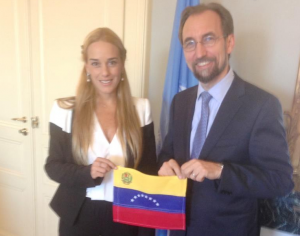
UN High Commissioner for Human Rights and Lilian Tintori, wife of opposition leader Leopoldo López who is currently serving a 13 year sentence (in house arrest) for his responsibility in the deadly violence of the 2014 guarimbas.
By Ricardo Vaz | Investig’Action | September 21, 2017
The mainstream media have a crucial role to play in the war against Venezuela, creating a distorted narrative and a constant frenzy that are crucial for any regime-change operation. With violent protests having failed to topple the government and to stop the Constituent Assembly, the plan switched to military threats and economic sanctions. But these come directly from an unpopular US administration, and a more impartial-looking figure was needed. The High Commissioner for Human Rights, Jordanian Prince Zeid bin Ra’ad al Hussein, stepped up to the plate with the backing of more than 100 NGOs. We tackle the manipulation of human rights for imperial purposes, but first we examine how the term “NGO” is woefully inadequate to describe these organisations.
*****
So much more than NGOs
On occasion of the 36th Session of the UN Human Rights Council, 116 “NGOs”1 signed a letter demanding that Venezuela be a priority for the Office of the High Commissioner for Human Rights (OHCHR). The effort was spearheaded by none other than Human Rights Watch (HRW). HRW has a long and documented history of bias and outright lies in their reports on Venezuela, which is no surprise given their blatant revolving door with the US government. Among the signatories are several usual suspects such as Provea or Foro Penal, whose president Alfredo Romero was a recent speaker in a “US Democracy Support” forum.
Another organisation on the list is Transparencia Venezuela, which includes as sources of funding the EU, several embassies and the parent organisation Transparency International. And although Transparency International is much shadier than it sounds, at least we can laud their transparency in listing their backers. The list includes the US State Department, the National Endowment for Democracy (NED), George Soros’ Open Society, even corporations such as Shell. One more that stands out, and is quoted regularly by the media, is the International Commission of Jurists, which sounds very noble and independent until you discover that they were initially funded by the CIA.
The issue here is with the term “non-governmental organisation”, which are always presented by the media as faultless, impartial actors. While there are many scenarios in which independent organisations can step in and provide invaluable services, this is hardly the case of groups funded by the NED (or USAID, or similar agencies) to “promote democracy” or “defend human rights” in countries like Venezuela. These are merely extensions of the US and western foreign policy apparatus, working as the local infrastructure that is necessary in regime change operations as well as a source for the media to build its biased narrative.
At the end of the day, it is the term “non-governmental organisation” that falls very short of describing the nature and activities of these groups. If an organisation in Venezuela, or anywhere else, is funded by the US government, in what world is it a “non-governmental organisation”? One cannot prove that all the “NGOs” standing with HRW are western-funded, but advancing western interests is very much advancing corporate interests, and it is doubtful that anyone would do that for free.
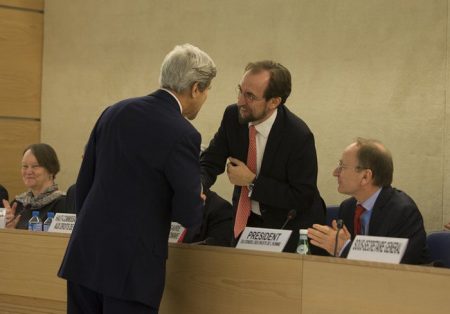
UN High Commissioner for HR shaking hands with former US Secretary of State John Kerry. (If by accident their speeches were switched nobody would notice!)
Weaponizing human rights
While one should not judge a book by the cover, it might be useful to consider the background of the UN High Commissioner for Human Rights, Prince Zeid bin Ra’ad al Hussein. A member of the royal family of Jordan, he comes from a Hashemite dynasty whose calling card has been its pliancy to imperial interests in the Middle East. And having served as ambassador to the US and permanent representative to the UN, he is, much like Jordan, someone the US can rely upon.
His most recent statement, which could just as well have been written by the US State Department, was delivered during the 36th Session of the Human Rights Council. It takes aim at every inconvenient country, from Iran to North Korea, while important US allies like Bahrain or Egypt are invited to “engage more productively” with his office. Israel is treated with kid gloves, and somehow the blame for the humanitarian crisis in Gaza is supposed to be shared between Israeli and Palestinian authorities. And there is no mention whatsoever of Saudi Arabia, where surely there are no human rights issues… Even when addressing the catastrophe in Yemen there is only a passing mention to “coalition airstrikes”.
And then the High Commissioner gets to Venezuela, sounding like any opposition leader or US official on “human rights violations” during anti-government protests or the “crushing [of] democratic institutions”, and suggesting an investigation into possible “crimes against humanity”. Never mind Colombia, where for years the army killed thousands of civilians and dressed them as rebels to collect rewards. Never mind Saudi Arabia, conducting double tap strikes2 against funerals in Yemen, or the US “torturing some folks,” or Israeli soldiers killing children because they were “running like terrorists.” The High Commissioner is worried that crimes against humanity have been committed in Venezuela!
This statement comes on the heels of a OHCHR report about Venezuela that Joe Emersberger described as “embarrassingly shoddy and biased.” It barely mentions any violence coming from the opposition ranks, and while offering a tally of deaths allegedly caused by government forces and the bogeyman colectivos, there is no detailed breakdown to be compared with other accounts such as the one by Venezuelanalysis. Remarkably, given the importance of the issue and the damning verdict that the OHCHR wishes to pass, no investigators from the UN body set foot in Venezuela. Instead the report relies on carefully selected testimonies and the “NGOs” we just discussed.
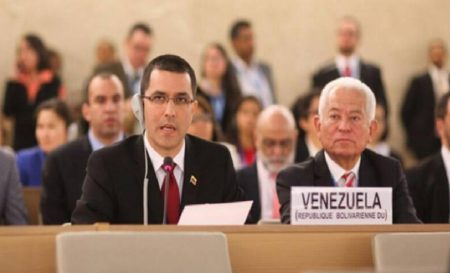
Venezuelan Foreign Minister Jorge Arreaza condemned the manipulation of human rights to attack Venezuela and the lies in the recent OHCHR report.
True NGOs strike back
While the amenable High Commissioner and the poorly-named “NGOs” put on their show to further the regime-change operation in Venezuela, others were not about to take it sitting down. True NGOs, independent organisations that are not pawns in imperialist machinations, and which are truly committed to human rights, condemned foreign meddling in Venezuela and the politicisation of human rights. One example was Swiss-based CETIM, an organisation focused on supporting social movements in the Global South. Concerning Venezuela, it released a statement that said:
[…] we declare ourselves for an immediate return to calm and to dialog, for the respect of Venezuelan peoples’ right to self-determination and the deepening of the process of democratic transformation that they have freely and courageously undertaken for two decades […]
Another organisation that reacted to the recent actions of the OHCHR was the International Association of Democratic Lawyers (IADL), through its representative at the UN, Micòl Savia, during one of the plenary meetings of the 36th Session of the Human Rights Council (intervention #35 in this link)
The IADL expresses its most profound dismay at the recent OHCHR report […]. Given its severity, we are particularly concerned by the High Commissioner’s mention of […] crimes against humanity, which lacks any legal grounds or sense of proportion. […]
The report is selective and biased, and represents a further example of the unfortunate politicisation that affects the work of the OHCHR, undermining its credibility and standing. Use of firearms, explosives, setting up barricades, people burned alive, attacks against hospitals, […], is this the model of “peaceful protests” that this council wants to promote?
Judge, jury and executioner
In the end the bias and lack of standards, or outright falsehood, of these claims and reports does not matter, because if the target is Venezuela they only have to look credible. The media will then do the rest, creating a background by repeating that “Venezuela has been accused by the UN of human rights abuses”, regardless of the shoddiness of the accusations, and this will be the basis to justify future escalations and aggressions as the empire pulls out all the stops to get rid of the biggest threat in its “backyard”.3
This is a good time to stress that legal systems are not moral or just by definition, but a reflection of who holds power, and this is especially true of international law. Though the struggle for an arena where all countries have the same weight is imperative, we are fooling ourselves if we are counting on international bodies to be impartial upholders of justice (just look at Palestine). Recent international tribunals have only served to reinforce the US/western narrative, either as a posteriori justification for past wars such as the one in Yugoslavia, or to justify upcoming ones against troublesome leaders like Gaddafi.
We should clarify that our argument is not some kind of moral relativism, whereby we defend that the alleged crime A should not be investigated until justice is served for (the much worse) crime B. We are not arguing that nobody can be guilty of crimes against humanity until Henry Kissinger is tried, although it is hard to take any international tribunal seriously if the most blatant crimes are immune from prosecution. But what is definitely absurd and unacceptable is to have the US empire, either directly or through its proxies, be the judge trying other people and countries.
Notes
- The HRW statement, and all pieces about it, refer to 116 NGOs; however, the organisations listed only total 115…
- Double tap strikes comprise an initial strike on a target followed by another one targeting first responders.
- In its article about this issue, the Guardian refers to a high-profile jailed opposition leader called Leonardo López (his name is Leopoldo López). Given the overall bias and lack of standards, this is probably fitting.
UK Surgeon David Nott, Takes Sides While Saving Lives in East Aleppo

By Steven Sahiounie | American Herald Tribune | September 21, 2017
David Nott is a British surgeon who has received numerous awards and accolades for his medical volunteerism in East Aleppo, Syria in 2013 and 2014. He was hosted by the Aleppo City Medical Council, which was founded in 2012 by medical professionals committed to the armed revolution in Syria, which sought to overthrow the Syrian government of Pres. Bashar Assad.
The Aleppo City Medical Council served and existed in only one neighborhood in Aleppo: that of occupied East Aleppo. On the Western side of Aleppo lived 1.5 million persons, who were living under the Syrian government, as were the majority of the highly populated areas across Syria. On the Eastern side of Aleppo lived 250,000 civilians, who went to sleep one night, and woke up occupied by armed rebels. The unarmed civilians of East Aleppo didn’t vote to accept occupation by armed militias. In some cases they may have been willing to work with the rebels, but the majority of the civilian population of Aleppo did not want to participate in the revolution. Even though they did not choose war, the war came to their neighborhood, and took away their freedom. No longer were they able to visit relatives, shop, go to University, or visit a doctor in Western Aleppo. They were made prisoners in their own homes and neighborhoods.
The armed opposition, the so called ‘rebels’ of Syria, are the armed militia known as Free Syrian Army. This group began as a US supported armed group, but lacked the man-power to sustain a viable armed opposition to the very large Syrian Arab Army, which prior to the war had ranked as the 16th strongest Army in the world. From the outset in 2011 the FSA began an outreach invitation to Al Qaeda and other Radical terrorist groups, in order to bulk-up the numbers in the armed opposition on the ground, with the hope of providing enough man-power and weapons in order to topple the Syrian government.
Dr. David Nott was seduced by the romantic notion of rebels fighting against a brutal regime. Apparently, he was not aware of the true beginning of the Syrian conflict, which began in March 2011.
When Dr. Nott writes about his time in Syria he takes sides, while saving lives in East Aleppo. He was not a neutral humanitarian.
CNN journalist Christiane Amanpour has said “I learned a long, long time ago, when I was covering genocide and ethnic cleansing in Bosnia, never to equate victim and aggressor, never to create a false moral or factual equivalence, because then, if you do, particularly in situations like that, you are party and accomplice to the most unspeakable crimes and consequences, so I believe in being truthful, not neutral.”
Dr. David Nott does not acknowledge the Doctors in the hospitals in Western Aleppo who were treating patients injured, or dying, from missile attacks on their neighborhoods by the rebels Dr. Nott worked for. He glorifies the position of his rebel friends, while demonizing the Syrian Arab Army, who were defending the lives and property of the unarmed civilians in Western Aleppo. He seems unaware that the ‘regime’ forces are made up of Syrian males over the age of 18 who are able bodied and not enrolled in University. In other words, they are drafted in a compulsory national service during the conflict, and are not from any one particular sect, but are from every Christian and Muslim sect, including atheists. The Syrian Arab Army were Syrian citizens, however the rebels in Eastern Aleppo were from various countries, and included various Radical Islamic terrorist groups, including ISIS, and Dr. Nott acknowledges their presence.
In fact, Dr. Nott was well aware of the presence of ISIS within the area he worked, even to the point of going through ISIS check points. He pretended to be afraid of them, and acknowledged that they had executed other British humanitarians, but this did not prevent him from leaving the area for his own personal safety. His calculated choice to remain in a specific area known to have ISIS presence must only mean that his ‘minders’, the FSA, had made special provisions with ISIS for Dr. Nott’s services. Dr. Nott was ‘off-limits’ to ISIS. In fact, Dr. Nott performed surgery on an ISIS terrorist in Eastern Aleppo. The hospital operating room was not attacked by ISIS, and he was not forced to perform surgery, but rather this was an FSA controlled Hospital which was allied with ISIS, and thus the ISIS injured were received as normal course of duty.
Dr. Nott recalls being taken to a Priest in Western Aleppo by his ‘minders’ in an effort to portray the conflict as non-sectarian. He should have asked his friends, “Where are the Christians and Priests who support the revolution here in Eastern Aleppo?” He doesn’t seem to be aware that the Syrian Christians have been targeted from the outset by the ‘rebels’.
Robin Harris in 2013 wrote: “Many Iraqi refugees left to join the two million indigenous Christians of Syria. They now share their hosts’ lot — persecution by the western-supported, Saudi-financed, Islamist-dominated Syrian rebels. Priests are special targets. This is where a Syrian Catholic priest, Father François Murad, was murdered last month.”
Dr. Nott wrote an impassioned plea concerning the photo-gone-viral of young Omran, bloodied and sitting in the back of an ambulance in Eastern Aleppo. Dr. Nott was not there at the time, but one of his colleagues from the Hospital in Eastern Aleppo contacted him concerning the tragic photo. Based only on the second-hand information coming to him, Dr. Nott was certain this little boy, saved by the famous WHITE HEMETS of Eastern Aleppo, was the victim of the brutal Syrian regime. Dr. Nott wrote: “The picture of Omran epitomises the horror that can be broadcast on our television screens.” “The sticking point is whether Assad stays or goes. He has to go. The refugees who have left the country will not return unless he has gone. There is no alternative.”
Dr. Nott did not ask all the refugees who left Syria if they left because of Pres. Assad, or whether they would be willing to come back to Syria if there was peace, even though Pres. Assad might remain. Yet, Dr. Nott would have you to believe there is no other reason for leaving Syria. In fact, many Syrian refugees left from peaceful areas, like the Syrian coast, which had never had battles or destruction, and which had remained peaceful and stable. Many Syrian refugees would tell you that they left for the chance to have an income, while living in a peaceful place. There are as many reasons to leave Syria as there are refugees: each has their own story. It is untruthful to portray all the Syrian refugees in a blanket statement.
Now that Western Aleppo and Eastern Aleppo are reunited in peace and stability, the true stories pour out from the actual eye witnesses. The father of the little boy Omran has now told the full details to both Syrian and Western journalists. The details given to Dr. Nott by the treating physician in Eastern Aleppo do not ring true. It was Omran’s father who saved the boy from the rubble, and it was the WHITE HELMETS who seized the boy, without medical treatment first, and staged the photo which then went viral. The colleague of Dr. Nott from the Aleppo Medical Council was present, but only gave treatment after the photo was finished. The WHITE HELMETS even offered to pay a bribe to the father, but were refused, and they have since admitted so.
The father of Omran, Mohammed Kheir Daqneesh stated: “The truth is one thing and they used him in a way that was not truthful and this really bothered me. The armed militia and their media used him in a way that was excessive.”
Once the rebels and their allies were driven out of Eastern Aleppo, the residents were able to run to freedom in Western Aleppo. Another British citizen was present as the Syrian refugees came pouring in. Rev. Andrew Ashdown is a Church of England priest studying Christian-Muslim relations in Syria. He wrote: “They said that they had been living in fear. They reported that the fighters have been telling everyone that the Syrian Army would kill anyone who fled to the West, but had killed many themselves who tried to leave – men, women and children.”
“The refugees said that the ‘rebels’ told them that only those who support them are “true Muslims”, and that everyone else are ‘infidels’ and deserve to die.”
“Likewise, most had been given no medical treatment. (A doctor who has been working with the refugees for weeks told me last night that in an area recently liberated, a warehouse filled with brand new internationally branded medicines had been discovered.)”
“One old man in a wheelchair who was being given free treatment in the Russian Field Hospital said he had been given no treatment for three years despite asking.”
The British Priest who personally interviewed the actual survivors of 3 years of occupation in Eastern Aleppo is shedding light on the true picture of life in Eastern Aleppo under the occupation of the rebels. Why is the story that Dr. Nott is telling us so very different? Maybe the difference is that Dr. David Nott was not a neutral observer, but was firmly on the side of the rebels. His minders may have carefully kept him away from civilians, and knowing he could not understand Arabic, the language barrier kept Dr. Nott in the dark as to the true picture of life under occupation of the FSA rebels, and their allies like ISIS and Al Qaeda. Dr. Nott was kept constantly busy treating the injured and saving lives.
The Syrian conflict seems to be winding down to an end. Dr. David Nott and other western humanitarians may begin the long and thoughtful process of asking themselves why they backed the rebels and their allies in a bloody and impossible fight. The US-UK-NATO war machine, fueled by western mainstream media sold many seemingly intelligent people on the idea of a Syrian revolution which would be fought for freedom and democracy. Perhaps one day Dr. Nott will come back to Aleppo and meet some actual residents and survivors of Western and Eastern Aleppo. Perhaps then he can understand the role he played in support of the rebels and their political ideology.
SYRIA: Game Over for Macron after Shameful UNGA Performance
By Bruno Guigue | 21st Century Wire | September 20, 2017
Before the UN General Assembly, you treated President Bashar al Assad as a criminal and declared that he should be held accountable to “international justice”. You have betrayed those who believed in a turn-around in your politics and you have brought this serious accusation against the legitimate leader of a UN member state.
Exactly what jurisdiction has empowered you, Mr Macron, to issue arrest warrants for foreign heads of state, who, by the way, could teach you a thing or two?
Who gives you the right, as a European head of state, representing the former colonial power in Syria (1920 – 1946), to hand out certificates for good or bad behaviour to your Middle Eastern counterparts?
This intervention is made all the more disturbing by the fact that you, like your predecessors, persevere with your complacency towards the petro-monarchies, to whom you sell arms that are used to massacre the courageous people of Yemen. You denounce the crimes you have attributed to the Syrian president, but you turn a blind eye to the head-choppers, the West’s beloved mercenaries. The 10,000 deaths in Yemen, the 500,000 children suffering from malnutrition, the terrifying cholera epidemic brought on by the Saudi bombardment, don’t trouble you, trigger no remorse and yet, you seriously want us to take notice of your indignation over Syria?
Everybody is aware that the Syrian conflict has caused tens of thousands of deaths, that the bloodbath gone on too long and that a political solution must be found, once the terrorist hordes are eliminated. As you speak, the Russians, Iranians and Turks are gathered in Astana to work towards this end. When you fling such accusations at Pres. Assad, what are you really talking about? From the very beginning of the “Arab Spring” in 2011, the anti-government protests were polluted by armed insurgents who opened fire on the security forces. The Arab Observer Mission was present from 24th December 2011 to 18th January 2012, at the behest of the Arab League. Despite Saudi pressure, their report denounces violence carried out by both sides. The myth of the peaceful uprising has long since evaporated Mr Macron, it’s time to bid farewell to this romantic fairytale.
This war was pre-fabricated by the sponsors of the “opposition”, in an attempt to destabilize the Syrian state. The Baathist government may have had shortcomings, but Syria was debt-free, a productive, multi-ethnic country where people of different faiths, lived, peacefully, side by side. The biggest demonstrations in 2011 were in favour of the Syrian government and the proposed reforms. To blame this government for the war that was started by a foreign-backed, armed uprising, is a distortion of reality. You pervert the facts to serve the narrative you wish to uphold. Mr Macron stop selectively determining the facts as you do, also, with the victims. Wars are cruel, this one is no exception. But who should bear responsibility, other than those who wanted to subjugate Damascus to Wahhabi Sharia law with the help of the US, France, Great Britain and the oil kingdoms.
Even in the statistics of the SOHR, an opposition-partisan organisation, 40% of the victims – since 2011 – were from the Syrian Arab Army, 35% the armed groups and 25% civilians caught in the crossfire of war. If a war could spare civilians, we would know about it. The war, supported by France in Yemen certainly doesn’t, neither does the US coalition bombing of Mosul or Raqqa. But accusing the Syrian Arab Army of deliberately committing crimes against its own people is an insult to common sense. This army is an army of conscripts, who defend their homeland against the tsunami of extremist militants. While you are safe at the UN, Mr Macron, “Assad’s soldiers” cross the Euphrates to settle his account with DAESH.
Of course, in this game of illusionists, you still hold the joker, you still have the chemical weapon “false flag” with which to feed the propaganda mill. Sticking to the CIA script of this novel, you even pretend to set a “red line”. The fact that an MIT (Massachusetts Institute of Technology) expert showed you that the August 2013 attack could only have come from terrorist held areas, is of no consequence to you. When the same US experts have denounced the Khan Sheikhoun (April 2017) alleged CW attack, blamed upon Damascus, you remain resolute. Have you even read the report by eminent American journalist, Seymour Hersch, which dismantles the western narrative of Syrian Arab Army chemical attacks?
Beware Mr Macron, this chemical weapon farce, the western propaganda mantra, is wearing thin. It even steals the crown from the lies of State, uttered by Colin Powell, brandishing his file at the UN Security Council. With each passing day, the chemical weapon lie loses its power to enchant. Those who still believe it are those who want to believe it, or who believe their own governments in the west would never lie to them. But the majority of the Syrian people don’t believe it, and that is what matters. When an area is liberated by the Syrian Arab Army, the refugees are returning home, life begins again and hope resurfaces. Making windmills with your insignificant arms at the UN wont change anything, and your inane chatter is already being drowned out by the media hubbub. Your so called “contact group”, Mr Macron, is already dead in the water and will disappear from our consciousness in under a week.
Who is still paying any attention to the French presidency? This presidency, regardless of who is in power, has demonized the Syrian government, brought traitors into Syria disguised as opposition, has condoned the brutality of the armed “moderates”, encouraged the influx of terrorists into Syria – terrorists who forced the French Lycee in Damascus to close its doors. This presidency has refused cooperation with Syrian forces & allies, it has delivered arms to the extremist groups, it has refused to fight DAESH when DAESH was threatening Damascus, it has called for the murder of a legitimate head of state, it has imposed an embargo on medicines for the Syrian people – this presidency has flouted international law and allied itself with the worst aspects of neo-colonialism. Nobody is listening to you.
By choosing to interfere in the affairs of sovereign states, France has relinquished its part in the game. Give up Mr Macron, you too are “out.”
Translation from the French, by Vanessa Beeley for 21st Century Wire.
***
Bruno Guigue is a French author and political analyst born in Toulouse 1962. Professor of philosophy and lecturer in international relations for higher education.
Morgan Freeman Declares War on Russia at Rob Reiner’s Behest
Sputnik – September 20, 2017
Social media is awash with outrage after Hollywood megastar Morgan Freeman appeared in a propaganda video issued by a newly-established anti-Russian non-profit group, in which he declares Washington is at war with Moscow.
Morgan Freeman is an almost universally beloved figure in the West, and his famed golden voice almost universally beloved across the West, so it’s understandable why the newly-established Committee to Investigate Russia might choose him to front its propaganda campaign.
However, initial reactions to the clip on social media suggest the move might’ve been a titanic misfire, as even supporters of the #TheRussiansDidIt hypothesis are criticizing the group, and slamming the video’s incendiary tone.
In the two-minute-long video, the Shawshank Redemption star issues a dire warning, “We have been attacked. We are at war.”
“My fellow Americans, during this past election, we came under attack by the Russian government. I’ve called on Congress and our intelligence community to use every resource available to conduct a thorough investigation to determine exactly how this happened. We need our president to speak directly to us and tell us the truth,” Freeman says.
No Experience Required
The Committee to Investigate Russia aims to help US citizens “understand and recognize the scope and scale of Russia’s continuing attacks on our democracy” — a lofty ambition, but given the weight of the group’s advisory board, one it will surely have little trouble achieving.
The five-strong board is led by Rob Reiner, director of “This Is Spinal Tap” and “When Harry Met Sally”; James Clapper, former Director of National Intelligence, who committed perjury in 2013 when he told a Senate Select Committee on Intelligence the NSA did not “wittingly” collect data on US citizens; Max Boot, a neoconservative blogger; Norman Ornstein, an obscure political scientist with no discernible history of research into Russia; Charles Sykes, a right-wing radio talk show host.
To promote the launch, board members appeared on numerous mainstream US news channels — Reiner, a consistent Trump critic who has called for “all out war” against the president, told CNN he was moved to found the group as he felt Americans didn’t understand the “gravity of what the Russians were able to do.”
“They’re trying to undermine our democracy. And for some reason we are not understanding the gravity of this. And I think a big part of that is because the president of the United States is not saying, in the Oval Office, “my fellow Americans, we’ve been attacked.” So I started reaching out to people who are patriots,” the director said.
Clapper likewise has a record of making controversial statements about Trump and Russia alike. He has previously suggested the president is secretly working for the Kremlin, and claimed Russians are “genetically” predisposed to manipulate and infiltrate.
Boot, an avowed Republican, has also been consistently condemnatory of Trump, and caused consternation in some conservative circles by announcing “real” Republicans should vote for Hillary Clinton in the Presidential election.
In the meantime, despite suggestions of Russian interference echoing since before the November 2016 presidential election, no evidence of Kremlin-backed covert interventions have been publicly offered, despite the House and Senate Intelligence committees launching investigations into the matter.
Fact checking Benjamin Netanyahu’s General Assembly speech

By Adam Garrie | The Duran | September 20, 2017
Yesterday, Israeli leader Benjamin Netanyahu spoke before the United Nations in a speech that served as a kind of appendix to Donald Trump’s controversial, bellicose declaration that was delivered hours earlier.
Both speeches predictably focused on Iran and both leaders told a great deal of untruths and half-truths about the situation. Here are some of the most glaring untruths, followed by a factual explanation of the situation.
1. Iran is “devouring nations”.
The full quote from Netanyahu is as follows:
“Well as you know, I strongly disagreed. I warned that when the sanctions on Iran would be removed, Iran would behave like a hungry tiger unleashed, not joining the community of nations, but devouring nations, one after the other. And that’s precisely what Iran is doing today.
From the Caspian Sea to the Mediterranean, from Tehran to Tartus, an Iranian curtain is descending across the Middle East. Iran spreads this curtain of tyranny and terror over Iraq, Syria, Lebanon and elsewhere, and it pledges to extinguish the light of Israel”.
In reality, Iran occupies zero countries and has not occupied any country in its modern history. By contrast, Israel has occupied part of Syria, the Golan Heights, since 1967. This occupation is condemned by the United Nations and all five permanent members of the Security Council, including the United States.
The other country on Netanyahu’s list that has been occupied by Israel and not Iran is Lebanon. After invading Lebanon in 1982, Israel set up a permanent occupying force in southern Lebanon between 1985 and the year 2000. Israel maintained a presence in the country until 2006, when Israeli forces retreated in the face of strong Hezbollah defences.
Israel continues to occupy Palestine according to the UN and most impartial observers. It previously occupied Egypt, the Jordanian West Bank and in 1981, illegally bombed Iraq.
Iran by contrast has done no such things. The Iranian assistance provided to Syria during the conflict in the country has been done under a legal agreement with Damascus based on mutual friendship and a common cause against Salafist terrorism. Iran’s training of some Iraqi volunteers has been conducted on a similar basis.
By no logical stretch of the English language, could this been seen as “devouring nations”.
2. “We will act to prevent Iran from establishing permanent military bases in Syria for its air, sea and ground forces”
This statement while designed to sound like a defensive measure is actually an admission of a premeditated war crime. No foreign country can use the threat of force to blackmail its neighbours or anyone else when it comes to internal affairs.
If Syria invites Iran to establish some sort of permanent presence in the country, that is a matter which is strictly between Syria and Iran. To use this as a pretext for an act of war, is put simply, a war crime.
3. “Syria has barrel-bombed, starved, gassed and murdered hundreds of thousands of its own citizens and wounded millions more, while Israel has provided lifesaving medical care to thousands of Syrian victims of that very same carnage. Yet who does the World Health Organization criticize? Israel”.
This one is full of outright lies. First of all, prior to the conflict, not only were all Syrians fed, but food prices were subsidised by the government, making nutritious foodstuffs more affordable in Syria than in most parts of the region.
Even today, Syrians are not starving, but due to western backed sanctions, food is more expensive and medicine is both more expensive and more scarce than they were prior to the conflict with Salafist terrorism. None of this has to do with the Syrian government nor its partners who continue to deliver aid.
Syria has not possessed any chemical weapons since 2013. In a joint effort by both Russia and the US, the Organisation for the Prohibition of Chemical Weapons certified that by early 2014, there were no chemical weapons left in the Syrian governments hands.
Syria did develop a chemical weapons program in the 1970s in response to intelligence about Israel’s secretive nuclear weapons program.
In spite of this, Syria has never used chemical weapons, not on a foreign power and not internally.
The only chemical weapons in Syria today, are those in the hands of terrorists who are fighting Syria.
In respect of the Israeli hospital program. These hospitals have not been open to ordinary Syrians, let alone to the Syrian soldiers fighting ISIS and al-Qaeda.
Instead, the hospitals have perversely been used to give medical treatment to al-Qaeda and ISIS fighters who are known as some of the most violent terrorists in the world.
4. “Two years ago, I stood here and explained why the Iranian nuclear deal not only doesn’t block Iran’s path to the bomb, Iran’s nuclear program has what’s called a sunset clause”.
Not only does the JCPOA (aka Iran nuclear deal) prevent Iran from developing nuclear weapons, but Barack Obama’s administration admitted this openly. The EU and Russia continue to express their support of the deal and the US State Department, EU and UN have all agreed that Iran is in full compliance with the deal.
The only country in the Middle East to develop and maintain nuclear weapons is Israel. Furthermore, Israel obtained its nuclear weapons without international sanction and to this day, refuses to admit to having nuclear weapons. Israel is not a signatory to the Treaty on the Non-Proliferation of Nuclear Weapons. Israel is one of only four nations in the world to have never signed the treaty.
Israeli historian Avner Cohen as well as the award-winning US journalist Seymour Hersh have confirmed the existence of the so-called ‘Samson Option’, wherein Israel will deploy its nuclear weapons if it feels its security is threatened.
During his speech at the UN, Netanyahu alluded to the ‘Samson Option’ in saying,
“Those who threaten us with annihilation put themselves in mortal peril. Israel will defend itself with the full force of our arms and the full power of our convictions”.
In this sense, Iran has much more to fear form Israel than Israel has to fear from Iran, yet ironically it is Israel that continually protests about its own fears.
CONCLUSION
While Iran hasn’t invaded another country in its modern history, nor has it occupied a single country, Israel has occupied five: Syria, Egypt, Palestine, Lebanon and Jordan. Unlike Iran, Israel has nuclear bombs, unlike every other country in the Middle East.
With this record, it becomes clear who should be afraid of whom.
The Bana Alabed Psy-Op Proves The West Is Saturated In War Propaganda
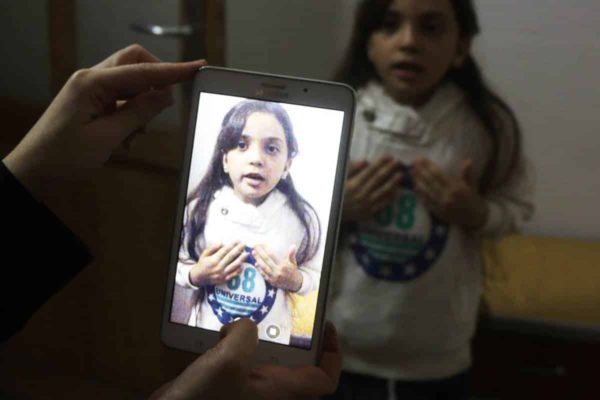
By Caitlin Johnstone | The Last American Vagabond | September 18, 2017
If I could have everyone in the English-speaking world watch only one video on Youtube, it would without a doubt be a comedy bit performed by a funny-looking professional goofball on RT. I say in all seriousness that it could change the trajectory of our species on this planet.
The above segment is presented for an audience who showed up for a comedy show, but it also contains video evidence that should forever change the way they think about the media, their government, their nation, and everything they’ve been taught growing up about what their society is and how it works. So far this is probably the closest thing to mainstream coverage that the depravity of the Bana Alabed psy-op has received.
In the segment, Redacted Tonight’s John F. O’Donnell shows video footage of a seven year-old Syrian girl being “interviewed” by CNN’s conscience-free Alisyn Camerota, who as a side note recently had the gall to complain that she was suffering from “Russia fatigue” as a result of all the bogus Russia conspiracy theories with which her network has been relentlessly brutalizing the American psyche. O’Donnell then shows a clip illustrating that Bana does not in fact understand even the most rudimentary English, let alone the capacity for the geopolitical analysis demonstrated in the Camerota interview. It was scripted, and Bana was phonetically sounding out words that she did not understand in order to manufacture public support for more US interventionism in Syria.
The interview was scripted, and what for me is most shocking is that Alisyn Camerota necessarily had the other half of the script. Bana wouldn’t have been able to improvise answers to unscripted questions, so Camerota was necessarily knowingly acting out a staged, scripted scene and deceiving her audience about its nature. She lied to the American people for the most despicable reason imaginable, and exploited a little child to do it.
Here it is in full:
O’Donnell then goes on to describe how this despicable psy-op has been promoted across multiple platforms throughout the mainstream media, from CNN’s Jake Tapper to Time Magazine to a Simon & Schuster book deal. The plutocrats who control these powerful media corporations plainly want eyes on this girl, just not the kind of eyes that look with any degree of healthy skepticism.
The reason for all of this, of course, is that US hegemony is fully dependent on its massive military power. Since the heavily-armed American people would grow upset if they were told that the oligarchs who rule their country are spending an unfathomable amount of the nation’s money and resources trying to depose Bashar al-Assad because Syria occupies a crucial strategic location in US world dominance (risking a direct confrontation with the nuclear-armed Russia in the process), they make it about saving children instead. In 1990 a teenager gave false testimony about hospitalized babies being removed from incubators and left to die to manufacture support for US military involvement in the oil-rich Kuwait, and we’re seeing something very similar with Syria today. As Bana so often says, “Save the children of Syria.”
BANA ALABED: A Lost Childhood and a Future Jeopardized by Ongoing Child Exploitation https://t.co/VMEuvkls4N via @21WIRE @KhaledIskef
— vanessa beeley (@VanessaBeeley) July 19, 2017
//platform.twitter.com/widgets.js
I’m very excited to see what appears to be an increased effort to push awareness of the Bana Alabed psy-op into mainstream consciousness. It’s not enough to have this undeniable act of deceitful war propaganda being discussed by a few Syrian activists and the occasional segment on RT; mainstream America needs to be told about this. If we all make a whole lot of noise pointing to the indisputable facts outlined in the Redacted Tonight segment at the beginning of this article, eventually mainstream outlets will be forced to comment on it. Alisyn Camerota will be forced to answer questions about her participation in the staged interview. They’ll be forced to overextend themselves and make even more mistakes. The true face of the mass media propaganda machine will swing into the full focus of everyday Americans. This can change the world.
Please help make this happen. Share the links I’ve placed in this article, make your own videos, podcasts, articles and tweets. The propaganda machine made a very foolish mistake using something so easily debunked in its war efforts, and we need to capitalize on that mistake while they’re vulnerable. Shove this thing as hard as you can into mainstream consciousness in every way you can think of. The machine is weaker than it seems. We can bring it down.
Google hiring 1,000 journalists in effort to control American news flow
It’s about controlling information offline and online
By Alex Christoforou | The Duran | September 19, 2017
Google is learning from its mistakes.
Not being able to place Hillary Clinton in office, the search monopoly has decided that online influence over what Americans think, say, and do is not enough to guarantee the right woman enters the White House.
Google is now embarking on a 5 year plan, where they will seed 1,000 aspiring, liberal left journalists into America’s local media markets.
Poynter reports that the Google News Lab will be working with Report For America (RFA) to hire 1,000 journalists all around the country.
Many local newsrooms have been cut to the bone so often that there’s hardly any bone left. But starting early next year, some may get the chance to rebuild, at least by one.
On Monday, a new project was announced at the Google News Lab Summit that aims to place 1,000 journalists in local newsrooms in the next five years. Report For America takes ideas from several existing organizations, including the Peace Corps, Americorps, Teach for America and public media.
Unlike foreign or domestic service programs or public media, however, RFA gets no government funding. But they are calling RFA a national service project. That might make some journalists uncomfortable – the idea of service and patriotism. But at its most fundamental, local journalism is about protecting democracy, said co-founder Charles Sennott, founder and CEO of the GroundTruth Project.
“I think journalism needs that kind of passion for public service to bring it back and to really address some of the ailments of the heart of journalism,” he said.
Here’s how RFA will work: On one end, emerging journalists will apply to be part of RFA. On the other, newsrooms will apply for a journalist. RFA will pay 50 percent of that journalist’s salary, with the newsroom paying 25 percent and local donors paying the other 25 percent. That reporter will work in the local newsroom for a year, with the opportunity to renew.
Zerohedge reports…
Of course, while the press release above tries to tout the shared financial responsibility of these 1,000 journalists, presumably as a testament to their ‘independence’, it took about 35 seconds to figure out that the primary funder of the journalists’ salaries, RFA, is funded by none other than Google News Lab.

Meanwhile, as a further testament to RFA’s ‘independence, we noticed that their Advisory Board is flooded with reputable, ‘impartial’ news organizations like the New York Times, NPR, CBS, ABC, etc….

We are sure that these 1,000 journalists will never be called upon by Google to report on the news in a way that benefits the giant search company.
Vladimir Putin and Russia versus Zionist Fairytales
By Phil Butler – New Eastern Outlook – 16.09.2017
Did you read the latest news that Vladimir Putin is rich and evil? Oh, you don’t read anymore, more power to you. Fake news has it that the Russian president has a new “secret” holiday mansion worth untold millions. Furthermore, some of the stories tell of Putin being the world’s richest and most evil man. For those of you who do not believe in fairytales, here’s a candid look at what Russians are really up against.
My initial reaction to reading “Drone footage shows Putin’s secret island mansion” at 9 News Australia was, “So what if the leader of Russia is rich?” I would have skimmed the article and moved on but for a familiar name popping up. I’ll get to the ousted industrialist shark Bill Browder in a minute, but first it’s important for readers to understand that Putin actually has little need of money in the traditional sense. Every financial magazine, every expert, and hordes of guessing investigators have tried for years to count Vladimir Putin’s gold, and to no avail. Some say he is worth more than Bill Gates and Jeff Bezos combined, but nobody can trace down this immense wealth. Amid all the speculation as to “why” the Panama Papers could not convict Putin, the pointedly obvious shines through. Nobody can trace Putin’s fortune because there isn’t one. But this is fodder for another story, let me move on to the latest Alexei Navalny fairytale and to this Browder character cited in the Australian piece.
I needn’t outline the role and the character of Alexei Navalny again here. The blogger who would be kind of Russian was last seen fueling up his drones for another flyby of Sergey Shoygu’s super secret space station home. Having attempted to label Russian Prime Minister Dmitry Medvedev a criminal for the places he’s vacationed at, Navalny seems unable to stop himself proving the insignificant. I think the best reason for Russians to ignore Putin’s biggest detractor is the simple fact he knows nothing of Russian people. Hey Navalny, heads up, Russians don’t care if Putin is rich, they only care if he does his job. Sorry, this western poster boy of change in Russia, he just sets me off. What an idiot. But let’s move on to another famous profiteer who Putin banished from Russia, the founder of Hermitage Capital Management, Bill Browder.
It’s amazing how western mainstream media and the politicians always turn to Putin haters to be experts or to get “proof” on the Russian leader. Haven’t you noticed yet how Russian mafia types like Yukos Oil oligarch Yukos Mikhail Khodorkovsky, and before him the now deceased Boris Berezovsky always pop up as “experts” on Putin? Isn’t it a bit strange that news media in the west never seem to cite people with a positive or moderate stance on Russia’s president? I am sure this coincidence is not because of the scarcity of pro-Putin experts. Whatever the reasoning, the Australian article fueled by Navalny’s drone footage dredges up another ousted financial crook who hates Putin’s guts. Most readers will identify Bill Broder with Hermitage Capital, but few will recall that the investment firm was also funded by one Beny Steimetz, the Israeli oligarch and financier just arrested (August 14) by Israeli and Swiss anti-corruption officials for wide scale fraud and money laundering. The Russian privatization shark who was once Israel’s richest man is a subject for another report. I only bring him up here to point at two facets of this war on Putin. First, the Jewish connection in all this is something that just needs to come out. Secondly, the ring of profiteers bent on Putin’s demise all have gigantic skeletons in their wardrobes. A story citing one Putin hater, when investigated, always leads to ten more. This is no coincidence.
Back to Browder, his Hermitage was at one time the largest foreign portfolio investor in Russia. That was before Vladimir Putin put a stop to the rape of Russia’s legacy and the theft of her assets. This is undeniable fact, and even the lowliest of Russian peasants know it by now. Browder, a Chicago Jew, set out to profit from Russian privatization after Yeltsin, but was thwarted like other sharks when Putin’s hammer fell on other mafiosos. RICO suits, libel cases, tax evasion charges, and ties to some of the seediest characters in world finance highlight the man who pushed the now famous Magnitsky Act into US foreign policy play. It’s no coincidence that Browder has emerged as a central player in the ongoing investigation of Russian interference in the 2016 elections. The privateer who made billions off Russian privatization turned into a human rights activist, and now he’s bent on seeing Donald Trump impeached!
The reader might be surprise to discover the source of the statement “Russia is more dangerous than ISIS” was actually Bill Browder, rather than rabid Arizona Senator John McCain. Or was McCain first? Both Russia haters told reporters of the grave danger to the US at the same time actually, back in May of 2017. Perhaps the narrative of US war hawk politicians and ousted financial henchmen has become just that convergent, but I somehow doubt the coincidence. Both Browder and McCain contend that Russian President Vladimir Putin used the country’s primary security agency, the Federal Security Service (FSB), to meddle in the U.S. presidential election, but neither has shown any proof of their claims. I mention this “coincidental” melding of message for obvious reasons. Or maybe McCain and Browder are now pals as this Browder Tweet on McCain returning to the Senate to do battle against Russia after his hospital stint suggests. What’s most amazing to me is the way FOX and other networks readily use Browder and other suspected criminals without searching out counter arguments for their stories. Maybe Rupert Murdoch can answer that one. And so on, and so on, and so on…
Every time I start researching for one of these stories I end up in a deep and dark rabbit hole of collusion and confusion. In each and every case I end up with Vladimir Putin stoically defending a position against wild assertions with no proof whatsoever. The big picture of the “game” by now is like watching a schoolyard name calling and finger pointing contest. The iconic bullies and thugs are on one end of the yard, while their target stands virtually alone looking as innocent as a lamb for a variety of reasons. It’s become ridiculous, but there’s always more.
A story by Kevin Alfred Strom at the National Vanguard, which was originally published back in 2004, adds light to a facet of the Russia privatization profiteering, and ties into some recent stories of my own here on NEO. “The Silent Coup: Putin vs. the Oligarchs” deals with these ousted oligarchs and the western investors intent on carving up Russia after the wall came down. But more importantly, the piece cites Putin on the case of Jewish mafiosos always seeming to play a role. The story of influence by Israel, AIPAC, and a cadre of Jewish billionaires converge when Strom cites Vladimir Putin in his story. Notable Jewish figures like Boris Berezovsky, Mikhail Friedman, Vladimir Gusinsky, Mikhail Khodorkovsky, and Alexander Smolensky are highlighted in the story alongside Putin’s lesser publicized views on Zionists in Russia at the time of privatization. The piece also points out the Russian people’s utter hatred for most of these Jewish oligarchs, a hatred that has absolutely nothing to do with anti-Semitism by the way. Since Putin seized the Rothschild/Khodorkovsky share of Yukos Oil, Russia has been divesting herself of the only Zionist plot that matters, the ending of Jewish mafia/oligarch control of the country. Not many readers will realize that Russia’s Central Bank (CBR) is a member of Rothschild BIS.
An article by Alexander Azadgan at KATEHON expands on the Jewish money component, and reiterates the possibility of Putin nationalizing the CBR. Given new sanctions by the US and Prime Minister Dmitry Medvedev describing them as “full scale economic war” waged on Russia, it’s important to observe Putin’s moves east and especially the new BRICS dealings. For Russians, it matters little if Vladimir Putin has 100 yachts and fifty mansions, as long as Russia is not raped and destroyed by the unscrupulous of the world. Putin’s job is clear, defend Russia – period. His compensation is of little consequence to his people. All we hear, read, and see about Putin’s Russia is from a London, Brussels, or Washington standpoint – never a Moscow one. The influence of Zionist bankers is well known to Russians, and almost unheard of by Americans. The enemy Russia really consists of Zionists and technocrats who do know the name of the game, and the public they use to do their bidding. In the same way the Jewish religion and Jewish people are used for the Zionist bankers’ purposes, the waiting public is leveraged through blind ignorance and propaganda against Russia. For those who believe alternative fairytales I can only say…
The (Criminal?) Subversion of the Academy in the Case Against Professor Anthony Hall
Power Against the Quest for Truth

Professor Anthony Hall. Image credit: The Lethbridge Herald
By Robin Mathews | American Herald Tribune | September 15, 2017
In “the civilized and democratic Western World” a huge battle is in process to control information, belief, understanding, ‘credible knowledge’, and the (real or contrived) ‘facts’ people hold to be true. The process involves a major activity of indoctrination – constant and on-going – towards the acceptance of an increasingly ‘top down’, undemocratic form of rule. The indoctrination does not just involve language as we (think we) know it but it involves a purposeful shaping and reshaping of language influenced by both action and inaction in the ‘public’ world.
The shaping of ‘the (apparently) real’ through language is darkly affected by action in society … and the failure of action. If Criminal Conspiracy – for instance – happens openly and observably and the State will not call it Criminal Conspiracy the real begins to become inauthentic and the language surrounding it begins to weaken. Criminal Conspiracy, just for instance, begins to possess a kind of non-existence although it really happens and really exists in law ….
In Canada (2015-2016), for instance, thirty-one criminal charges (put in place by the Canadian “Crown”) were levied against a controversial Senator in Canada’s “Upper Chamber” as part, many believe, of a huge campaign to indoctrinate Canadians about the (false) integrity of the people in power. The criminal charges were all (every last one!) thrown out by a judge of the Ontario Court of Justice with plain expression of his alarm at those conspiring to force actions upon the innocent Senator.
The judge gave every indication (without saying it outright) that Senator Duffy had been criminally conspired against. No criminal investigation, however, has been conducted against those conspiring and no criminal charges have been laid. None are expected. The Liberal government that has followed the Conservative government led by Stephen Harper (which undertook the unseemly set of actions against Senator Duffy) seems very clearly to be demonstrating that it doesn’t disapprove of criminal actions taken to indoctrinate the Canadian public.
The process of working at highest levels of government, of corporations, and the so-called Mainstream Press and Media to indoctrinate and condition the population to prescribed, false beliefs in a total or ‘totalitarian’ manner (‘as if exerted by a single force permitting no dissenting view’) is pervasive in almost all of ‘the civilized and democratic Western World’. The process is clearly intended to impose false views of reality upon whole, unsuspecting populations.
One of the significant, recent (in history) very successful (on-going) falsifications is described by Lance deHaven Smith in his book (2012) Conspiracy Theory in America. There deHaven Smith points out that the criticism of the Warren Commission inquiry into the assassination (1963) of John F. Kennedy was becoming so effective [the Commission and its ‘findings’ are now considered by many to be without any credibility] that the CIA set to work with surprising effectiveness to slander as “conspiracy theory” criticism of any spurious and/or fraudulent government or intelligence or police activity … and to designate that criticism as the product of cranks, imposters, and/or other wholly irresponsible rumour-mongers.
The CIA was so successful that the phrase “conspiracy theorist” has been lodged in the minds of a large population as a term indicating someone making fraudulent claims instead of someone pointing to possible unacceptable action taken by those in power. (Anthony Hall is accused – among other things – of being a conspiracy theorist.)
Since the Warren Commission (1963-1964) conspiracies against the “democratic” populations of the West have increased and grown in size. The falsification of evidence, supported by George W. Bush, U.S. president, and Tony Blair, British prime minister, in order to permit the invasions of Afghanistan and Iraq – just for instance – are now common knowledge (and both continue their lives untroubled by legal actions). Those wars, without naming related others, are resulting (still) in enormous destruction, death, and devastation of community.
Other egregious falsifications of actions and events by governments are not common knowledge – in fact are disputed by every device of modern misinformation. The Afghanistan and Iraq invasions (2001 and 2003) are both connected to the enormous (2001) alleged False Flag operation to destroy three Trade Tower buildings in New York – which operation had very quickly attached to it an official version which, today, lies in tatters but is still forcefully maintained by all the Western governments. [As I write, 79 year old, former CIA agent Malcolm Howard – given only weeks to live – has reported that he was involved in the “controlled demolition” of the building called World Trade Centre #7.]
The growing library of works rejecting the official version is becoming immense. Professor Anthony Hall – as a scholar seeking the truth about official allegations against non-white (so-called) terrorists in the matter – is named as a Conspiracy Theorist partly because he has engaged in denial of the official 9/11 accounts and has considered the allegation that Israeli interests may have been deeply involved in 9/11.
To entertain that possibility is not necessarily to be opposed to the State of Israel – and it is clearly not evidence of anti-Semitism. But those claiming or asking if the Israeli State had a part in 9/11 are immediately under threat of being charged with anti-Semitism. Part of the basis for naming Professor Hall an anti-Semite lies in his on-going concern, as a broadcaster, with The False Flag Weekly News and with the on-going researches being undertaken on the causes of what is called 9/11.
The nature of scholarly endeavour is very frequently to reconsider accepted explanations of events … to re-configure “history”, and/or to offer new analyses of forces at work. Anthony Hall does those things in his two large scholarly volumes dedicated to the history of the displacement and erasure of indigenous peoples … and the developing Imperial Globalization accompanying their (on-going) oppression since 1492.
A criminal conspiracy was almost certainly entered into in order to attempt the destruction of Senator Mike Duffy. A much wider conspiracy is, I believe, in play to destroy Professor Anthony Hall of the University of Lethbridge. In the briefest terms there seem to be four more-or-less invisible global forces at work (and in conflict) which very likely have shaped the personnel and the nature of (what I call) the conspiracy against Professor Hall.
One is the view of Germany from 1930 to 1945. Another is the shifting view of the State of Israel at the present. Another – which has already been referred to – is the problem of False Flag events, the dishonesty involved in them, and the official explanations of them. The fourth is the role of universities in the examination of truth and the conflicts engendered when questionable or fraudulent ideas are held and championed by powerful forces in or connected to the university which – almost of necessity – come into contact with ‘truth seekers’ in universities … working in the traditional environment of “academic freedom”: freedom to inquire, to seek clear answers, and to speak freely without fear of censure or repression about findings.
A generally held view of Germany from the 1930s to 1945 has been one that believes the emergence of Adolf Hitler and the Nazi Party took Germany on a path of increasing brutality and social violence, and that the path seemed to be approved by the larger population. The “SS State” is thought to have enslaved, starved, tortured, murdered and otherwise destroyed “enemy” people: Jews, Slavs, political dissidents, gypsies, gays, etc. Moreover, it is said to have conducted what is now called The Holocaust: the active process of exterminating all Jews – ‘the final solution’.
Over the years since 1945 voices have been raised to challenge that view or aspects of it. On a video made recently by the Committee for the Open Debate of the Holocaust Professor Hall is asked if he approves of the work of the Committee. He replies there that he approves of open debate on all subjects and accepted truths. He has said, also, that he has been reading more recent materials on Germany from 1930 to 1945 that are making him re-think some of his ideas.
In short, the ‘truth’ about Germany from 1930 to 1945 is being reviewed and reassessed. Many Germans – often children and grandchildren of the adult members of the German community in those years – are seeking a re-examination and a reassessment of the “accepted” view, to provide, perhaps, a view of a much less brutal and single-minded State and population. Where the truth lies is in contest.
The accepted view of Israel in the West is of an unfairly punished people who have gained a homeland and are building a new society on sovereign territory. It is a people viewed not only as having been brutally oppressed and punished for their identity by Nazi power, but rejected and demeaned by many so-called democratic populations. That view has never been globally consented to partly because of the dispute about Israel’s legitimacy (“on Palestinian land”) held in parts of the Middle East.
As the State of Israel appears to become more warlike, oppressive of Palestinians, and greedy for the possession of territory, (the last condemned by the United Nations), the feeling for brutally mistreated Jewish people of the past does not diminish. But alarm at what is thought by some to be oppressive policies and actions of the Israeli State has created a body of people sharply critical of that State’s policies and actions – especially in relation to Palestine and the Palestinians.
That sentiment comes into sharp conflict with the efforts of at least a part of the Israeli State to equate itself with Jewish identity – and so with the attempt to equate criticism of the actions of the Israeli State with anti-Semitism.
Needless to say, in that context, any mitigation of the view of a ruthless, inhumane, and anti-Semitic Germany from 1930 to 1945 probably offends some in the State of Israel and its closest supporting organizations outside Israel. They seem to see the necessity of a consenting global community about the persecution of the Jews in order to have the global community accept Israeli State policies, however offensive. If the Nazi regime was not as viciously brutal to Jews as some sources wish it to be seen to have been, (and as it may have been) then sympathy for the State of Israel might diminish.
In the playing out of the astonishing (and growing) scholarship concerning what might be called the (alleged) false information disseminated by governments to explain extraordinary, violent, and/or visibly brutal events in the community, claims are made that ‘government’ and/or related forces create many of the violent events to condition the population to be fearful and so to accept increasingly fascist rule, and/or to believe the government-created violence is the act of the enemy (whichever ‘foreigners’, religion, or State the government wishes the people of the country to learn to hate). The work undertaken by serious and reputable investigators to reveal and to prove that governments (or their proxies) create random terrorist acts – or what are called “False Flag Events” – has grown to sizable and convincing proportions. Indeed, the growing “False Flag Investigative Industry” suggests a growing field of government criminal acts disguised as the random, insane, or purposefully effected acts of “enemies” (or those that governments wish to convince their populations are enemies).
Professor Hall has engaged actively in “False Flag” inquiry and is a co-host of the weekly program (on the net) called The False Flag Weekly News in which recent (and suspected) manifestations of False Flag activity are tabled and discussed. Among the False Flag theories in play, one concerns the truth of the collapsed Trade Towers of 9/11 and who (if the official story is incorrect) was responsible for the attack. One theory (not by any means the only one) is that a major participant in the event may have represented the interests of the State of Israel or may have been, in fact, an arm of the State of Israel.
Professor Anthony Hall has encouraged open questioning of the standard view of Germany between 1930 and 1945 (without saying he believes the standard view is wrong). He has engaged in open discussion of the False Flag phenomenon and its relation to government and government policy. He has been willing to consider the possibility of Israeli involvement in 9/11 – the destruction of the Trade Towers in New York on September 11, 2001. He has exercised academic freedom and democratic ‘freedom of speech’ in those matters as well as others that have fallen within the scope of his research.
On August 26, 2016 a vicious anti-Semitic cartoon was posted on Professor Hall’s Facebook page when he was not in Canada. He was unaware of the posting, and of its removal – all happening in a period of several hours. And he was unaware of actions being taken over the next days against him as a guilty party wishing to defame and asperse Jews … by means of what (the posted cartoon, used as evidence) can easily be called Hate Literature.
He was unaware of all that went on … because he didn’t post the obnoxious cartoon and didn’t even know of its posting … and because the President of the University of Lethbridge, Mike Mahon, who was informed as soon as the next day and who entered into discussion with accusers of Professor Hall (and with others) over succeeding days did nothing whatever to make contact with Professor Hall, his colleague, and to test Hall’s reactions to news of the posting.
In the minds of many people the behaviour of president Mahon may well suggest he wanted to believe the accusers of Professor Hall and did not want to have to entertain the possibility that his senior colleague and twenty-six year member of the scholarly community of University of Lethbridge did not post … and had nothing to do with the posting … of the slanderous and hateful cartoon.
Some observations may be made about the conduct of President Mahon. One I derive from my own wide experience on every major campus in Canada (see “Canadianization Movement”,Wikipedia) where I consulted, variously, with student, faculty, and administrative personnel. The first observation is to note the failure of the President of the University of Lethbridge to respect collegial relations and to consult early with Professor Hall, simply as a colleague – and to gain absolutely necessary information about the incident. Secondly, one must observe President Mahon’s rejection of the demands of natural justice which would require him as President to consult and to inform (at the earliest possible moment) anyone at U. of Lethbridge whose reputation and livelihood were in peril by growing accusations (untested). Failing grossly on those two matters suggests, to me, that President Mahon might well appear to fair-minded people to have been astonishingly incompetent as a professional and as a human being in his treatment of the very serious allegations brought against Professor Hall.
An even more serious allegation may lie in another observation: President Mahon (growing evidence reveals) apparently consulted with some of the false accusers of Professor Hall, sat with committees of so-called investigators, and formulated punitive measures to take against Professor Hall without having asked to meet and speak with Professor Hall. That behaviour on the President’s part may well point to his participation in a Conspiracy to do irreparable harm to Professor Hall. A Conspiracy very strongly appears to have been undertaken against Senator Mike Duffy … as I have said … but a worse one may well have been undertaken against Professor Anthony Hall.
Though Professor Hall knew nothing about the vile cartoon posted on his Facebook Page, B’nai Brith Canada personnel and sympathizers knew about it very quickly. In very short order they – or a collaborator – informed the president of the University of Lethbridge, the Premier of the province of Alberta, the Solicitor General, and the Minister of Education of the province. Replies were returned to the person giving false information with what I call astonishing speed. In my experience of writing to top government figures I can provide witness that the average Canadian is not responded to with that alacrity. Who, then, could write to the Premier of Alberta and members of cabinet (conveying false information to them) and receive such speedy and sympathetic response? The name of that person is being (for some inexplicable reason) kept from inquirers by the Alberta government. What is the Alberta government hiding … what does the government of Alberta fear??
In a truly astonishing letter written to President Mike Mahon and sent to others like Premier Rachel Notley on September 1, 2016, Bert Raphael, Q.C., LSM, President of the Canadian Jewish Rights Association quotes the whole of the unsavoury text posted on Professor Hall’s Facebook Page. And he finishes his letter (a Queen’s Counsel assuming guilt with the rashness of a school boy) with the following paragraph:
“I trust you agree that such a statement has no place in Canada and most certainly from the lips of a university professor. I would respectfully suggest that such an odious pronouncement would warrant Professor Hall’s dismissal from your University. I would be interested in your response which I undertake to share with the members of my organization whose names appear on the reverse side of this stationery.”
President Mahon waited weeks without seeking a meeting with Professor Hall, then sought one (October 3) almost immediately – and when Professor Hall, otherwise committed, couldn’t comply, President Mahon announced the next day (October 4) (in a letter to Hall) that he was immediately “suspended, without pay from all duties and privileges as a member of the academic staff at the University of Lethbridge, including any and all duties and privileges associated with teaching, research, and community service.” Professor Hall was, in addition, told he could not “attend” at any University of Lethbridge campus.
Having thus, summarily effected in fact (and surely in the public mind) a punishment for wholly unproved (and, in fact, a false allegation against Professor Hall), President Mahon finished his letter by saying that the suspension was “being implemented as a precautionary, not disciplinary, measure… “
Receiving what was libellous, wholly incorrect information (and accepting it as truth without engaging in a word of consultation with his accused colleague) President Mahon wrote to the university community the following about the order that Professor Hall remain off campus, cease his on-going teaching there, and no longer receive his professional salary.
“This action is not focused on Dr. Hall’s published scholarship, driven by complaints of students, or the demands of external advocacy groups. It is focused on his You Tube based videos and comments in social media that have been characterized as being anti-Semitic, supportive of holocaust denial and engagement in conspiracy theories.” [Notice President Mahon uses the term ”conspiracy theories” in the way the CIA shaped the phrase in order to slander and make ineffective substantial criticism and research about government(s) (and others’) misuse of power.]
The questions that arise out of President Mahon’s strange statement are obvious: if president Mahon did not answer the demands of an external advocacy group, how did he come to know of the posting on Professor Hall’s Facebook Page? The President nowhere says he discovered it for himself in the brief few hours the posting was available. Moreover, he had to learn that the posting had been there by the (so far) anonymous writer and then by other writers plainly sympathetic to B’nai Brith … such as Bert Raphael QC whose astonishing accusation I have quoted above.
In addition, President Mahon is reported to have spoken personally on September 1, 2016 to the president of B’nai Brith Canada (but he did not speak to Professor Hall). The university, moreover, has refused to release for examination most of the records of its activities and communications involved in the actions against Professor Hall.
That, alone, is simply astounding – that a university (the bastion of free and open inquiry) would conspire to keep secret its actions and communications relating to what is almost certainly the most serious (and dubious) disciplinary matter in its history.
In addition, President Mahon writes not that he, the President, holds Anthony Hall’s (falsely alleged) comments to be “anti-Semitic” but that they “have been characterized as being anti-Semitic….” If that is the case, someone must have characterized them for President Mahon as the negative things he mentions; some “external advocacy” group or groups must have conveyed that impression to him. The President of the University of Lethbridge appears to be tripping embarrassingly over his own feet in an attempt to disguise the truth about his alleged knowledge and its sources. He has the knowledge of falsely alleged evil done by Professor Hall, “characterized as being anti-Semitic” but he doesn’t characterize it as that himself … and he appears to claim no one else does either!
Ken Rubin, contracted by the Canadian Association of University Teachers, reports further behaviour of the University of Lethbridge which points to a (criminal?) conspiracy to harm Professor Hall. I quote Ken Rubin:
“Incredibly, the records show President Mahon invited the 4 external groups (B’nai Brith et. al.) to consult with Robert Thompson, the university’s external lawyer investigating the Hall case where they could have their legal counsels present. Yet it appears Hall was never consulted or approached or at least there’s no record to that effect.” [Professor Hall reports he knew nothing of the meeting(s).]
The evidence convinces me that there is at least the likelihood that an intricate group of conspirators worked together to insult, to misrepresent, and to harm in character, reputation, and professional standing Professor Anthony Hall. President Mike Mahon of the University of Lethbridge, I believe, must be considered a possible central agent in such a concerted action. I may, of course, be wrong. The case being taken by Professor Hall against the University of Lethbridge should provide answers to most of the questions that the falsely attributed posting on Professor Hall’s Facebook have engendered.
At some time – quite early in this barbaric saga – the University of Lethbridge began and (apparently) completed a secret investigation of Professor Hall – an action repugnant in every way to the most basic principles of fairness held in university communities. In addition, it filed against him (without permitting him any participation) a complaint to the Alberta Human Rights Commission. The complaint was dismissed, but President Mahon’s team persisted, appealed the dismissal, apparently reformulated their materials, and had a complaint against Professor Hall accepted.
From the small part of it I have been able to examine, I judge I am reading a presentation that would be a delight to the CIA. Every statement of, for instance, “Islamic terrorism” or of a similar idea is accepted without murmur. Criticism of such easy acceptance is apparently a violation of someone’s Human Rights. That has to be a very peculiar state of mind in Canada. Especially since in July of 2016, Madam Justice Catherine Bruce of the B.C. Supreme court wrote a 217 page judgement making crystal clear that a so-called Islamic Terror Event staged at the British Columbia Legislature grounds (on July 1, 2013) was wholly undertaken by more than 200 RCMP employees, entrapping two socially challenged converts to Islam, spending millions of dollars of unknowing taxpayers money, and working with and through Ottawa Headquarters in relation to the action in British Columbia.
Other Islamic terror event shams have almost certainly occurred (probably frequently) in other places. Not to question those events may, indeed, contribute to the violation of the Human Rights of innocent people.
Anthony Hall – a wide-ranging, openly inquiring, continually scrutinizing Canadian – appears to have dared to ask questions and to be sympathetic to analyses that – while unproved – are in no way alien to discussion in democratic society … analyses that some forces in Canada wish to censor, to deny, and to erase from the attention of Canadians.
The seriousness of the attack on Professor Hall cannot be downplayed. Its perpetrators undertook to go around all established University of Lethbridge procedures built and agreed to by the faculty and administration there to manage such issues. The perpetrators undertook to ram into place a clause in a highly aberrant Alberta Education Law that permits university presidents to remove at will anyone they choose to remove. That strikes me as a plainly fascist initiative which President Mahon should have rejected openly and vigorously but which he seized upon to use against Professor Hall.
The size and the intensity of the conspiracy to destroy and defame Professor Anthony Hall can be glimpsed when one realizes it appears to want (A) to close down discussion of German history between 1930 and 1945. It appears to want (B) to close down discussion of False Flag (government and/or Deep State presentations of violent) events created apparently with the intention of placing blame for them upon whatever source those in power wish to defame and make ‘enemy’. It appears to want (C) to close down some perfectly legitimate considerations of the role of the State of Israel in Middle Eastern and global affairs. It wants (D) to keep secret almost all of its activities to inculpate Professor Hall. And, finally, (E), the conspirators appear to want to wipe out the idea of Academic Freedom – which is essentially what Canadians think of when they speak of “freedom of speech”. Canadians mean the right to inquire, to observe, to debate, to formulate and discuss ideas in public about public matters without fear of intimidation or punishment.
The (criminal?) conspirators (if that is what they are) acting against Professor Hall want, I believe, to decide what ideas Canadians in all walks of life are free to hold and to express. To name – as I think we must name – one university President as an actor among such alleged conspirators must be a wake-up call to all Canadians – and especially to those in the community of scholars – to make sure no one in the Academy can destroy its most fundamental and noble tradition: the open and unimpeded search for truth.
Robin Mathews is a retired professor who taught English literature at Carleton University in Ottawa Ontario and at Simon Fraser University in Vancouver BC. He is well known for his campaign to Canadianize the faculty and curricula of Canadian universities.
Featured Video
Why Hamas Really Attacked Israel on Oct. 7
or go to
Aletho News Archives – Video-Images
From the Archives
Confronting the Threat of Ethnic Bioweapons
By Tony Cartalucci – New Eastern Outlook – 29.11.2017
The United States Air Force’s 59th Medical Wing’s molecular biology branch recently was revealed to have been collecting specifically Russian RNA and synovial (connective) tissue samples, prompting fears in Russia of a possible US directed ethnic-specific bioweapons program. … continue
Blog Roll
 Aletho News
- Why Yemen Is Bombing Saudi Arabia’s Airports: The War Behind the Headlines
- Sally Rooney’s books pulled from UK over support for Palestine Action
- Bombs for Tel Aviv, Promises for Riyadh
- Israeli ad agency conducted vast global espionage campaign using online ads: Report
- Oct. 7 Forever Marks The Big Reveal: ‘We See You, Israel, We Revile You, We Reject You!’
- Meet the US generals and admirals advancing Israeli policy
- Israel’s Straw Widow Protocol: The Kill Zones Where Civilians Were Labelled ‘Terrorists’
- Leading Israeli Think Tank Publishes Psychotic Israeli ‘National Security’ Doctrine
- Are the United States and Israel in Decline-and-Fall Mode?
- Why Hamas Really Attacked Israel on Oct. 7
- If Americans Knew
- Israeli firm used online ads to run vast spy operation, researchers say
- No, the world zionist movement is not an antisemitic conspiracy theory
- Hundreds of IDF investigations into killings still have no public outcome, BBC Verify finds
- After Ashley Moody Epstein Probe, Donors Linked to Him Poured Money Into her Senate Campaign
- Worried about Russian meddling in UK politics? Wait till you see what Israel is up to
- Israeli settlers attack West Bank center for disabled children, church leader calls for int’l action
- Pulling Out Teeth Just to Live: How Israel Has Devastated Dental Care in Gaza
- Gaza’s “ceasefire” death toll passes 1,500 – Daily Update
- Activists Abused By Israel Return to New Freedom Flotilla Mission
- 60 Minutes won’t tell the full truth about Israeli settler violence
- No Tricks Zone
- New Study Suggests Large Regions Of The Pacific Ocean Have Been Cooling For The Last 80 Years
- Germany’s Green Energy Debacle: High Energy Costs Force Kahla Porzellan to Close After 182 Years!
- New Study: 50 Years Of The Most Aggressive ‘Net Zero’ Policies Can Only Affect The Global Climate By 0.03°C
- US September “Heat” Was No Record…Many Records Set Decades Ago
- Latest European Green Energy Debacle; Portugal’s Largest Flagship Solar Park Insolvent!
- Green Energy Debacle: German Expert Professor Fritz Vahrenholt Warns Of Severe Economic And Social Consequences
- Two More Paleo Reconstructions Affirm Meters-Higher Sea Levels Across Ireland, Brazil 7000-6000 Years Ago
- New Study: Earth And Venus Surface Warmth Largely Explained By Convection And Lapse Rate, Not CO2 Or Radiation
- 2025 Nature Paper Claiming Worsening Global Drought Gets RETRACTED …Heavily Flawed
- New Study: ‘Global Drought Shows No Detectable Recent Acceleration Under Climate Warming’

