‘Eco-fascism’ Troubles Climate Alarmists

By Robert Bradley Jr. | MasterResource | April 14, 2020
“We’re the virus.’ How eco-fascism hurts climate action,” rang the title of a ClimateWire piece by Jennifer Hijazi of April 8, 2020.
Her article begins:
Sharp declines in emissions from the coronavirus pandemic are a vivid illustration of the challenge of addressing climate change, rather than a silver lining, according to experts.
As the health crisis drags on, there’s a growing effort to recast the downward trajectory of carbon dioxide as a warning about the depth of action that’s needed to slow global temperature increases. It comes as extreme reactions to the pandemic, like grounded airplanes and empty streets, have been widely interpreted as a beneficial side effect that’s resulted in less pollution.
And ends:
A parade of stories emerged in the early days of the pandemic pointing to the virus’s seemingly positive impact on the environment — some of which were fake.
Celebrating the environmental benefits of the pandemic’s response comes dangerously close to rooting for a virus that could kill 1 million people or more, some experts caution.
Others say it resembles eco-fascism.
She then describes eco-fascism, which surely includes Paul Ehrlich and John Holdren; Al Gore in Earth in the Balance; and scary-eyed Bill McKibben (and a lot of others, including Thomas Friedman, and Paul Krugman, on their angry days). [1]
Eco-fascism is a totalitarian ideology that advocates for authoritarian governance for the greater environmental good. Some who ascribe to the philosophy sometimes say that human population control — often in the most marginalized communities — is needed to preserve the planet.
Climate activist group Extinction Rebellion had to disavow fake flyers bearing its logo that read, “Corona is the cure humans are the disease.” One tweet that gained attention on social media said: “Earth is recovering. We’re the virus.”
Falling emissions are often wed to difficult times. Dale Jamieson, professor of environmental studies at New York University, noted that periods of suffering, like the Great Recession of 2008, usually result in temporary pollution dips.
“But of course, it’s not anywhere along the lines of the solution path,” he said, referring to climate change.
Extreme narratives that celebrate the environmental benefits of the pandemic can damage efforts to address rising temperatures, even if they’re not prevalent. That’s especially true if it creates the impression that environmentalists are seen as “anti-people,” Klopp said.
“It is important for people to speak out at this moment, but they should not be framing this as the pandemic is our [climate] policy response,” she said. “They should be framing this as the pandemic is teaching us why our policy responses as a planet are inadequate.”
The Progressive Left is at war with itself. Instead of incrementally getting to where they want to go in a period of general prosperity, the Pandemic has offered up a destination that deep ecologists have celebrated. It is, rightfully, a PR disaster for climate alarmism.
—————–
[1] Jeff Sparrow, author of the book Fascists Among Us (2019), also described the environmental civil war: “It’s not difficult to imagine ‘eco-authoritarianism’ or what Naomi Klein calls ‘climate barbarism’: a politics centred on the state making “our way of life” sustainable as the environment disintegrates. Future governments committed to this project will be able to draw upon the vast array of coercive powers they’ve acquired over the past decades: draconian anti-protest laws; secret trials and imprisonment; the deployment of the army to quell civil disturbances; and so on.”
While you’re terrified of Covid-19, some climate alarmists are overjoyed because, for them, fear is… an OPPORTUNITY

Climate Strike protestor. March 13, 2020 in Cardiff, Wales. © Matthew Horwood/Getty Images
By Frank Furedi | RT | April 1, 2020
Many hardline environmentalists are overjoyed at the atmosphere of fear that Covid-19 has created; for them, it is an instrument for realising the dream of a society that runs according to climate alarmists’ dogma.
“Some believe the pandemic is a once-in-a-generation chance to remake society and build a better future,” argues one advocate of climate alarmism.
So, in case you thought that Covid-19 is a global pandemic of catastrophic proportions, think again!
In the West, hardline environmentalists are working overtime to portray Covid-19 as payback for all the miseries that humans have inflicted on the planet. They claim that global warming, species extinction, the emergence of superbugs and the eating of meat are somehow directly or indirectly linked to the outbreak of the current pandemic. They regard the fears and anxiety generated by the current public health emergency as an opportunity to promote the message that, unless we accept their dogma, humanity will become extinct.
Some of them are positively overjoyed at the opportunity created by the climate of fear that’s all-pervasive across the world. “We’ve been trying for years to get people out of normal mode and into emergency mode,” enthused Margaret Klein Salamon, who heads the advocacy group The Climate Mobilization. She added that “what is possible politically is fundamentally different when lots of people get into emergency mode – when they fundamentally accept that there’s danger, and that if we want to be safe we need to do everything we can.”
Keeping people in a state of fear of what they euphemistically describe as ‘emergency mode’ is the objective of Klein Salamon. As she stated, “now the challenge is to keep emergency mode activated about climate.”
That’s another way of saying that perpetuating –indeed, institutionalising– a climate of fear is the main objective of this movement. From this perspective Covid-19 is not so much a tragic public health issue but an instrument for realising the dream of a society that runs according to the environmentalist dogma of misanthropic miserabilism.
What green fear entrepreneurs really hate is the spirit of human ambition, that refuses to defer to the dictates of nature. This is a spirit that is open to taking risks in order to transform the world through the use of science and technology. From the time when humans stepped out of their caves to taking the risk of travelling to space, there were always those who decided to do what was necessary to conquer their fears. The refusal not to give in to fears is always the first step towards looking for solutions that will allow us to assume greater control over our lives.
It is precisely this aspiration to take control and harness the power of nature and science that climate alarmists despise. They despise it so much that they have coined the term ‘human impact’ to suggest that what people have done to the planet is by definition wholly destructive. They hate humans’ impact on the world so much that many of them want to dramatically decrease the number of babies that are born.
According to the climate alarmist narrative, being scared for your life is the desirable state to be in. As Klein Salamon indicated, “we need to learn to be scared together, to agree on what we’re terrified about”! Why? Because collective fears will force governments to act!
Back in the 17th century, the English philosopher Thomas Hobbes anticipated the green politics of fear in his classic text, The Leviathan. Hobbes claimed that it is good when people are scared and frightened. Why? Because in their state of fear people will readily subject themselves to an absolutist ruler in exchange for his protection. One does not need a PhD in philosophy to understand that climate alarmist politics leads straight to the doorstep of the Leviathan.
‘Zero Carbon Is A Crime Against Humanity’
By David Wojick, Ph.D. | PA Pundits – International | March 21, 2020
I recently got an intriguing email from Professor Guus Berkhout, president of the Climate Intelligence Foundation or CLINTEL. It contained this striking paragraph and the last sentence really got me thinking:
“The past 150 years show that affordable and reliable energy is the key to prosperity. The past 150 years also show that more CO2 is beneficial for nature, greening the Earth and increasing the yields of crops. Why do governments ignore these hard facts? Why do they do the opposite and lower the quality of life by forcing high-cost, dubious low-carbon energy technologies upon their citizens? The zero-emission act is a crime against humanity.”
So I looked into the law on crimes against humanity and Professor Berkhout may have a strong case. At its simplest, a crime against humanity is a government policy that systematically and knowingly harms a specific group of innocent people.
Zero carbon emission laws like the Green New Deal in the EU and the US will deprive poor people of affordable energy worldwide. This fact has been well established by numerous studies. Thus these policies knowingly harm a specific group of innocent people. And as CLINTEL points out in its World Climate Declaration, there is no climate emergency that might justify this harm. What we have are governments deliberately harming their citizens.
But look also at the latest developments in climate science. There is new insight that has to do with a review of carbon budgets. A carbon budget indicates the amount of CO2 that may still be emitted before a certain warm-up limit is exceeded. IPCC climate scientists that authored the SR15 report of 2018 took another close look at the calculations of the carbon budgets in IPCC’s AR5 report of 2014 and concluded that they had been too pessimistic in the past. And not so slightly. In the SR15 report those carbon budgets have been increased spectacularly.
By way of illustration, the carbon budget for the 1.5 degree limit has increased by no less than a factor of 5! It therefore takes considerably longer for the carbon budgets to be exhausted, which means that the strict emission requirements based on AR5 can be significantly relaxed. So this is very good news for all people concerned about the climate. It fully confirms CLINTEL’s message: ‘ There is NO climate emergency.’
Unfortunately, the good news has been snowed under by the increasing ‘gloom and doom’ actions and stories about the ‘dangerous climate change’, ironically fed by the same SR15 report. Actually, the reader should realize that the good news is even better because on top of the computational error in AR5 we still deal with IPCC’s continuing exaggerated climate sensitivity for CO2. When will that be corrected?
Note that – despite the strong scientific and moral arguments – it is now the stated goal of the UN alarmists that all countries should adopt zero carbon laws, preferably in time for the Climate Summit in Glasgow this November. Given that the harm is proportional to poverty, such precipitous actions would be especially harmful to the poorest. And, for heaven’s sake, why?
Zero carbon laws are prohibitions against those forms of energy that presently supply about 80% of human need. A well recognized definition of crimes against humanity is “inhumane acts intentionally causing great suffering”. Deliberately depriving poor people of affordable energy certainly fits this definition.
My colleague Paul Driessen have written extensively about this issue, albeit not from the perspective of crimes against humanity. See for example here.
Mind you we were just talking about the tragedy of so-called development banks refusing to fund affordable energy development. Laws that prohibit the use of fossil fuels are infinitely worse. Imagine not being allowed to use a kerosene light or a gasoline scooter, on top of not having electricity.
But we do not have to go to poor Africa to find energy poverty. It is being documented throughout Europe, especially in those countries where misguided governments have forced renewable energy on their people. Yet the UK and EU are both adopting draconian zero carbon policies. The energy poor here also probably have a good case of crimes against humanity.
In the U.S. it is estimated that millions of households live in what is defined as “energy poverty” due in large part to the forced shift to renewable power. Energy poverty is reported to be the second leading cause of homelessness in America. The proposed Green New Deal will make this suffering dramatically worse.
In short, CLINTEL president Guus Berkhout is right. Zero-carbon laws are not only scientifically utterly silly, they are crimes against humanity.
Crickets! Finland’s Insect Food Boom Goes Bust

Swedish ‘Sustainable Food’ Project Teaches Kids to Eat Insects, Garbage © CC BY-SA 3.0 / Guttorm Flatabø / Grilled maggots for human consumption
Sputnik – February 27, 2020
Despite the media’s preoccupation with insect food and massive campaigns touting crickets and larvae as a sustainable and climate-responsible alternative to meat, the excitement has waned in a matter of several years, the Finnish broadcaster Yle reported, concluding that Finns are “not yet ready to eat crickets”.
Finland’s cricket breeding business took off in September 2017, when the country’s Ministry of Agriculture allowed breeding and selling insects as food, a decision made possible by a revision of the EU’s food standards.
After that the number of insect breeding facilities spiked, as revenues in the billions of euros were predicted. In 2018, Europe’s largest cricket farm emerged in Loviisa, which began to produce hundreds of tonnes of insect powder.
However, in the following years, the buzz subsided, and insect breeders suffered major setbacks amid dwindling demand and stiff competition.
According Lauri Jyllilä of the Finsect company, which promotes insect food, there were over 70 companies in the insect food business at the peak of the enthusiasm. Now, there are about 50 left, with no new companies being founded.
The price of frozen crickets reached as much as 100 euros per kilogram, Jyllilä explained, which was way too expensive even for sympathetic and ecologically-minded consumers.
“The cost of freshly frozen crickets should be 10-15 euros per kilogram”, Jyllilä ventured.
Kurikka resident Panu Ollikkala, one of Finland’s first cricket breeding specialists, dropped out of the competition in the autumn of 2019.
“Demand was inadequate. The price has fallen so much that my business didn’t pay off”, a despondent Olikkala mused.
The Kouvola farm, touted as Europe’s largest, followed suit. Entrepreneur Vesa-Matti Rajamäki admitted that he no longer believed in the success of cricket production. Numerous unsuccessful insect breeders complained that the massive support of the traditional meat industry makes competition virtually impossible.
“A lot of beautiful words were said about the insect business. Many farms were opened, and bank loans were taken” cricket farm owners Kirsi and Jouko Siikoine said. They intend to close down their business in March 2020. “The onterest in eating insects and the insect processing sector has plummeted”, the couple explained.
In the city of Kurikka, which is now considered the centre of insect production, crickets are still being bred, but a downward trend is visible.
“This is a sort of cricket breeding bank, thanks to which you can quickly restore your production if you want”, Jyllilä explained.
The University of Turku, the Finnish Institute of Natural Resources, and the Finnish Safety and Chemicals Agency ran a project named “Insects in the food chain” and concluded that the main difficulty is getting the approval of bulk consumers. Even people who opt out of meat for the sake of the carbon footprint or perceived health benefits largely prefer vegetable sources of protein.
Crickets are often grounded into powder and added to bread, protein bars and chocolate. However, after large-scale promotion, many products gradually left the market.
The main selling point of the bug diet is the reduced environmental footprint. According to Finnish insect producers, a single kilogram of crickets only requires a single litre of water, as opposed to 2,500 litres for a kilogram of rice and a whopping 15,400 litres for a kilogram of beef. Insect food is also claimed to be rich in protein.
Many are still averse to eating insects for reasons of ideology and aesthetics. This opposition has resulted in a common web mantra: “I will not eat bugs and I will not live a pod”.
Climate Alarmism and Malthusianism (rebuttal to Taylor)
By Robert Bradley Jr. – Master Resource – February 25, 2020
“The pseudo-intellectual right loves to compare climate concern and action with Malthusianism. I’ve never quite understood what the heck these things have in common.” (Jerry Taylor, October 13, 2019)
“What environmentalists mainly say … is not that we are running out of energy but that we are running out of environment–that is, running out of the capacity of air, water, soil and biota to absorb, without intolerable consequences for human well-being, the effects of energy extraction, transport, transformation and use.” (John Holdren, April 2002)
Jerry Taylor, please read the literature before opining on such matters as energy and the environment. Climate change is the latest Malthusian scare, per John Holdren. And the common denominator of the Malthusian worldview is overpopulation, as Pierre Desrochers and Joanna Szurmak document in Population Bombed! Exploding the Link Between Overpopulation and Climate Change (2018).
Some quotations from Population Bombed cement the tie-in:
- Numerous population control advocates have linked anthropogenic climate change to population growth, or tried to revive interest in invoking anthropogenic climate change as the key negative outcome of continued economic growth linked to, foremost among causes, an increasing population.
- … population Bomber” himself, Paul Ehrlich … during a conference in 1968 identified anthropogenic carbon dioxide emissions as a “serious limiting factor” to economic growth.
- By the 1970s, Ehrlich, his wife Anne and his collaborator John Holdren raised fears that carbon dioxide “produced by combustion of fossil fuels in quantities too large to contain” may “already be influencing climate” and, as such, constituted one of the “gravest threats to human well-being. . . [i.e.] the loss of natural services now provided by biogeochemical processes.”
- [Julian] Simon then summarized the position of most environmentalists as follows: “But isn’t obvious. . . that additional people and additional economic growth will cause us to use more energy and hence emit more greenhouse gases? Therefore, even if we can’t be sure of the greenhouse effect, wouldn’t it be prudent to cut back on growth?”
- The economist Jacqueline Kasun similarly believed at the time that “by the 1990s the doomsayers had shifted their attack” as they could no longer invoke resource depletion as the key growth-limiting issue. As she wrote, “the alarmists didn’t miss a step. The problem, they now said, was that people were using too much energy and were causing Global Warming.”
- Canadian academic Michael Hart has commented that “for alarmists, climate mitigation policy is as much a means of achieving their larger goals as it is a matter of addressing a possibly serious issue.”
- Canadian academic, historical climatologist Tim Ball, has long argued, the climate change policy agenda is based on certain assumptions ultimately related to a fear of reaching another terrestrial set of limits through overpopulation.
- Maurice Strong (1929–2015), who was described by business journalist Peter Foster as “[m]ore than any other individual. . . responsible for promoting the [UN] climate agenda,” … [stated] “with a growing global population, we will have to recognise that having children is not just a personal issue but a societal issue and at a certain point we may be faced with a need to have a permit to have a child.”
- [Strong] also referred to the need for “national population policies” in his opening speech at the 1972 Stockholm Conference. Strong reportedly stated the following Malthusian prediction at the 1992 Earth Summit: “Either we reduce the world’s population voluntarily or nature will do this for us, but brutally.”
- The first chairman of the IPCC (1988-1997), Bert Bolin, was not only an early convert to the alleged catastrophic impact of CO2 emissions, but also a pessimist on population and resources issues, as evidenced in his stance on the controversy surrounding the 2001 publication of The Skeptical Environmentalist by the Danish political scientist Bjorn Lomborg.
- John Holdren contradicted many of his earlier warnings of imminent resource depletion by arguing that while the word was not “running out of energy,” it was “running out of environment,” by which he meant “running out of the capacity of air, water, soil and biota to absorb, without intolerable consequences for human well-being, the effects of energy extraction, transport, transformation and use.”
- The second chairman of the IPCC (1997–2002), Robert Watson, would later go on the record with the following line of reasoning: “The more people we have on the Earth and the richer they are, the more they can demand resources. There’s more demand for food, more demand for water, more demand for energy. . . So, there’s no question the threats on the Earth today are far more than, say, 50 years ago and in 50 years’ time, there will even be more threats.”
- The third chairman of the IPCC (2002-2015), Rajendra K. Pachauri … was “not going to rest easy until [he has] articulated in every possible forum the need to bring about major structural changes in economic growth and development. That’s the real issue. Climate change is just a part of it.”
- … Timothy E. Wirth, one of the main organizers of the 1988 James Hansen hearing on climate change, and from 1998 to 2013 president of the (hardcore Malthusian) … is on the record as stating in 1993: “We’ve got to ride this global warming issue. Even if the theory of global warming is wrong, we will be doing the right thing in terms of economic and environmental policy.
Other documentation from Desrochers and Szurmak includes the views of Christine Stewart, then Canadian Minister of the Environment; Connie Hedegaard, European Commissioner for Climate Action (2010–2014); Executive Secretary of the United Nations Framework Convention on Climate Change, Christiana Figueres ; Professor Hans Joachim Schellnhuber, the director of the Potsdam Institute for Climate Impact Research; researchers associated with the Population Reference Bureau and the Worldwatch Institute; Canadian climate scientist Andrew Weaver of the British Columbia Green Party; and the late climatologist Stephen Schneider
So what are the climate Malthusians missing? The same thing as before: human ingenuity. Desrochers and Szurmak note:
… there is ample evidence of a passionate commitment towards the protection of the planet, but there is no sign of recognition that humanity can do, and has done, more than simply consume resources. At no point do neo-Malthusians admit the possibility that technological innovations and human creativity have a place among the things that deserve a place on Earth. What pessimist activists desire is a consensus on the classification of humanity as out of control and inherently driven by destructive greed, thus in need of top-down regulation by the few remaining clear-thinking and benign autocrats – that is, functionaries – of the global government.
Buyer beware of climate alarmism and Malthusianism.
No Airports, No Imports–Welcome To Year Zero!
By Paul Homewood | Not A Lot Of People Know That | February 21, 2020
I took a quick look at this story the other day, but have now had time to read the report it was based on:
To many people, “saving the planet” means little more than building wind farms, planting trees and using less plastic. However it is gradually beginning to dawn on the public that the impact on their lives will be substantial.
Even then though, things like scrapping gas boilers and moving to electric cars have been something that “won’t happen for decades, so why worry now?”
However a new study, sponsored by the UK Government, has warned that huge changes to our lifestyles will be necessary, and much sooner than we think, if zero emission targets are to be met.
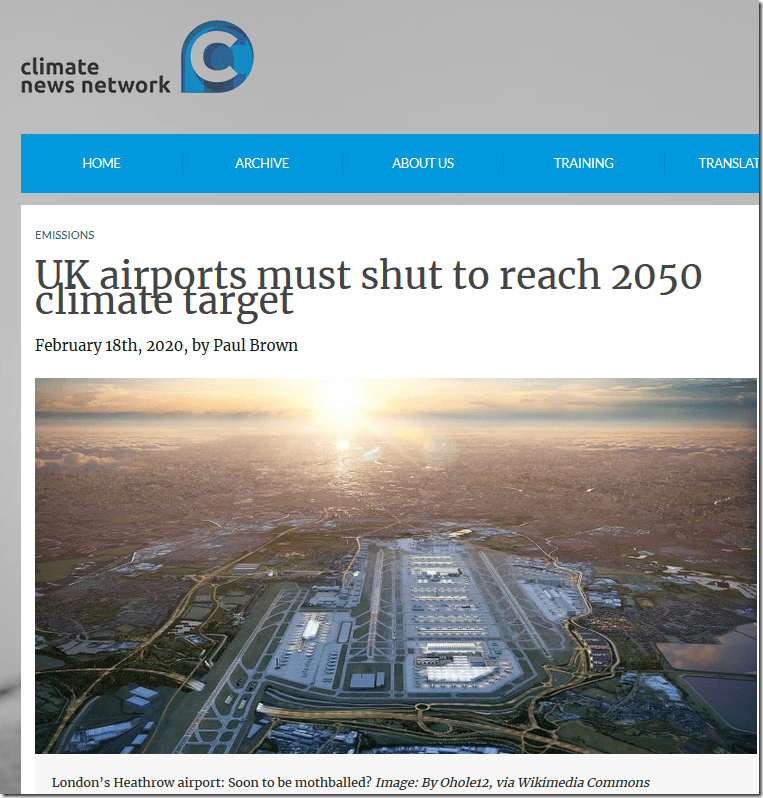
The report by UK FIRES, called Absolute Zero, calls for all UK airports to be shut by 2050, because there are no practical alternatives for zero emission flight. But as part of this timetable, all airports other than Heathrow, Glasgow and Belfast must shut by 2030.
In a stroke, air travel will be effectively banned for most of the country, as Heathrow simply would not have the capacity to handle more than a small proportion of demand. (Heathrow currently carries a quarter of UK passengers).
But that is just one item on a long list of changes to be forced on the British public. The report concludes that we cannot bank on technological innovations coming to our rescue.
If you thought that we could simply rely on renewable energy, forget it. As UK FIRES points out, even with rapid growth of renewables, we will still need to cut our energy use by 40%, even before air travel and shipping are factored in. And all of this without accounting for the projected population increase.
So forget about electric cars being the solution, because we will not have enough electricity to power them. The recommendation from UK FIRES – have 40% less cars on the road. Their suggestion – use the train more, ignoring the sky high prices, the fact that railways offer very limited routes and how you are supposed to travel around when you get to your destination. The idea that we will all willingly give up our cars to travel by rail or bus is utterly naive.
The report also conveniently ignores the high carbon dioxide footprint in building electric cars in the first place.
Heating is another area where we must cut emissions. UK FIRES expect us to buy heat pumps, seemingly oblivious to the fact they will cost each household a good £10k more than our conventional boilers. They also don’t appear to realise that heat pumps are incapable of supplying the heat we need in the middle of winter, or that the power grid simply could not cope with that sort of spike in demand even if they could.
Or maybe they do! Their guidance includes using heating for less time, in fewer rooms and wearing warm clothes in winter.
Our diet does not escape either, as we will have to give up eating beef and lamb, not to mention frozen ready meals. While we are expected to rely on arable farming instead, they also want fertiliser use to be drastically reduced.
Meanwhile the construction industry is likely to grind to a halt, as cement is phased out. Unfortunately the actual making of cement releases emissions, regardless of the source of the energy used.
Forget about housebuilding, new hospitals and infrastructure, they want us to concentrate on retrofit and adaptation of existing buildings.
Ironically, as even the report admits, we don’t know how to install new renewables or make new energy efficient buildings without cement.
If all of this was not bad enough, they want to ban all imports by 2050, unless they can come via rail, which might be a problem given that we are an island! Of course, we don’t have zero emission freight ships at the moment, and are unlikely to in the foreseeable future.
Quite how we are expected to feed ourselves without importing food is a mystery, unless we return to 1940s style rationing. And you can forget about all of those other things we get from abroad now.
What about, for instance, computers and electronics? We will quickly become an international backwater, without access to the latest technology. It would be like the country returning to 1990s style Nokia phones, VHS and floppy discs!
Some may be substituted by UK made goods, but it is hard to see how industrial capacity could be built back up with the restrictions planned on construction, energy use and industrial emissions.
But it is not only the emissions from shipping which concerns the authors. They also say we must be responsible for all emissions from the production of imported goods.
So how, you might ask, are we supposed to live in this glorious, emission free future?
UK FIRES says we must not worry! We can apparently carry on doing the things we enjoy most, totally emission free. Things like sports, social life, eating, hobbies, games,computing, reading, TV, radio, volunteering and sleeping! According to the report, “we can all do more of these without any impact on emissions.”
Indeed, with the economy and industry destroyed, most of us will have much more time on our hands for these pursuits! (Climate scientists and bureaucrats excluded, naturally).
Nowhere in this dismal little report is there any acknowledgement of the fact that the UK only generates 1% of global emissions. The report starts by stating:
We have to cut our greenhouse gas emissions to zero by 2050: that’s what climate scientists tell us, it’s what social protesters are asking for and it’s now the law in the UK.
Wrecking the economy is not something we should do, just because a few eco-loon protestors are asking for it. And laws can, of course, be changed.
We must however thank the authors of this report for bringing home the very real and damaging effect that the mad rush to decarbonise will have on peoples’ lives.
And, as they have rightly stated, these changes will have to start being put into practice very soon, certainly during this decade.
For too long, the impact and cost of the Climate Change Act has been deliberately hidden from the public. Partly this has been the result of a political conspiracy between all of the major political parties and establishment in general. It has also been aided and abetted by all of the media, with a handful of notable exceptions.
But their dirty little secret cannot be covered up for much longer.
Sins of emission
By Christopher Monckton of Brenchley | Watts Up With That? | February 19, 2020
Much has been made of the alleged standstill in global CO2 emissions, which are asserted to have been about the same in 2019 as in 2018, at 33.3 gigatonnes of CO2:

Obsession over transient phenomena such as this is commonplace among the climate genociders, whose cruel, dangerous and expensive global-warming abatement policies are killing tens of millions annually through the coordinated refusal of most of the world’s leading merchant, central and intergovernmental banks to lend to developing countries to install the one kind of electricity they can afford and can maintain and are desperate for – coal-fired generation.
Nothing lifts a poor nation faster, more surely and more permanently out of poverty, misery, disease and death than the universal availability of universal, affordable, continuous, base-load, coal-fired electricity.
Were it not for the genocidal emissions-abatement policies driven by the totalitarian fanatics and extremists of the far Left in the West, the whole world would by now be electrified, prosperity in the developing countries would have increased no less dramatically than it has in the electrified advanced economies, and the net benefit to the environment in the consequent stabilization of population would have been overwhelming.
Almost two centuries of official demographic statistics have demonstrated that, by a long chalk, the most effective method of stabilizing a previously-burgeoning population is to increase the general prosperity of that population. Frankly, nothing else works. The fastest way to displace poverty with prosperity is to give the people electricity. We should make this moral case against the genociders daily until they are compelled to pay heed.
The genociders’ trumpeting of the supposed standstill in global CO2 emissions is – as usual – misplaced. As the IEA’s graph shows, the imagined level of global emissions remained static for five years from 1990-1995. In Their terms, we were doing “better” then than now, for no increase in our sins of emission was reported over that period.
Their “our policies are at last working” meme is misplaced for a second reason. The emissions data are inaccurate. As with temperature, so with emissions, we are incapable of determining global data to a precision of a tenth of a unit. We know that the emissions data are inaccurate because if they were accurate – and if the link between emissions and concentration were as direct as They tell us it is – then the stabilization of emissions would have been matched by at least some diminution in the rate at which CO2 concentration is accumulating in the atmosphere.
However, the CO2 concentration at Mauna Loa shows a continuing and undiminished rate of increase over the past four or five years:

Since the trend in global temperatures has been generally downward over the past five years, additional outgassing of CO2 from the oceans does not account for the continuing increase in CO2 concentration.
Nor can it legitimately be argued (though some genociders have tried) that the terrestrial CO2 sink is failing. If it were failing, the rapid growth in the total plant biomass on the planet – the net primary productivity of trees and plants – would not have been as spectacular as it has been.
The question arises whether the decades of hot air generated by the climate genociders’ intergovernmental conferences, at vast expense in treasure as well as in common sense, have reduced global CO2 emissions below the business-as-usual prediction made by IPCC in its First Assessment Report in 1990.
The answer is No. The annual, official, peer-reviewed estimate of global CO2 emissions from all sources, Friedlingstein et al. (2019), who used the same wider measure of emissions as IPCC, shows that emissions are above the business-as-usual trajectory predicted by IPCC in 1990:

The 11.5 givatonnes of carbon estimated by Friedlingstein et al. is equivalent to 42.2 gigatonnes of CO2.
In short, the quintupling of electricity prices compared with what they would be without global warming abatement policies, the doubling of gasoline prices, the destruction of heavy industries such as coal, steel, aluminum, coal-fired power generation and motor manufacture throughout the Western world, the trashing of the countryside and the killing of billions of bees, birds and bats by windmills, the slowing of storms and the consequent flooding caused by those same windmills, and all the deaths that the genociders are inflicting upon our less fortunate cousins in the developing world with their refusal to countenance the immediate electrification of the one-sixth of the planet whose population subsists in enforced and involuntary darkness, have achieved precisely nothing.
Featured Video

Seyed M. Marandi: Toward Total War in the Middle East
or go to
Aletho News Archives – Video-Images
From the Archives
The Geopolitics behind the War in Yemen (I)
By Mahdi Darius NAZEMROAYA | Strategic Culture Foundation | 30.03.2015
The United States and the Kingdom of Saudi Arabia became very uneasy when the Yemenese or Yemenite movement of the Houthi or Ansarallah (meaning the supporters of God in Arabic) gained control of Yemen’s capital, Sanaa/Sana, in September 2014. The US-supported Yemenite President Abd-Rabbuh Manṣour Al-Hadi was humiliatingly forced to share power with the Houthis and the coalition of northern Yemenese tribes that had helped them enter Sana. Al-Hadi declared that negotiations for a Yemeni national unity government would take place and his allies the US and Saudi Arabia tried to use a new national dialogue and mediated talks to co-opt and pacify the Houthis.
The truth has been turned on its head about the war in Yemen. The war and ousting of President Abd-Rabbuh Manṣour Al-Hadi in Yemen are not the results of «Houthi coup» in Yemen. It is the opposite. Al-Hadi was ousted, because with Saudi and US support he tried to backtrack on the power sharing agreements he had made and return Yemen to authoritarian rule. The ousting of President Al-Hadi by the Houthis and their political allies was an unexpected reaction to the takeover Al-Hadi was planning with Washington and the House of Saudi. … continue
Blog Roll
 Aletho News
- Pakistan-Iran talks secure LNG shipment to Islamabad through Hormuz
- Black Sea grain crisis puts global wheat supplies under pressure
- IRGC air defenses destroy another US MQ-1 drone over Strait of Hormuz
- Imran Khan’s entire immediate family detained in Pakistan ahead of mass protest demanding his release
- EU nation detains former presidential frontrunner
- Leaked: Britain’s Sham Conviction Of Hashim Thaci
- Seyed M. Marandi: U.S. Strike Imminent – Toward Total War in the Middle East
- Russia Voted Under Fire. Washington Is Loading the Tankers.
- 12 Things Your Oncologist Was Trained Not to Tell You
- Anthrax Attacks Paved Way for COVID-Era ‘Junk Drugs and Vaccines’
- If Americans Knew
- Israeli Attacks in Gaza Kill at Least Seven Palestinians Over Three Days, including Woman and Child
- Trump’s militarization of Washington DC as he pursues Israel’s war against Iran
- Why Israel Fears This Searing New Documentary
- Huckabee aide solicited cash gifts from Israelis
- This isn’t sci-fi, AI is already killing people
- ‘The Most Brutal Thing’: Investigation Reveals Execution of Elderly Woman in Rafah
- Inside Israel’s ‘soft’ ethnic cleansing plan for Gaza through the eyes of its victims
- New online database tracks pro-Israel political donations in the United States
- Israeli president pardons soldier convicted for killing wounded Palestinian
- Singer Ed Sheeran says his ‘heart broken’ by Gaza devastation, addresses Macklemore controversy
- No Tricks Zone
- 2025 Nature Paper Claiming Worsening Global Drought Gets RETRACTED …Heavily Flawed
- New Study: ‘Global Drought Shows No Detectable Recent Acceleration Under Climate Warming’
- Economic Masterminds: German Socialists Suggest Taxing Productivity Gains Stemming From Using AI
- The South China Sea Has Not Been Cooperating With The Climate Change Narrative
- Energy Crisis: Germany Enters Heating Season With Historically Low Gas Reserve Fill Levels
- New Study: The Antarctic Ice Sheet Gained Mass From 2020-2024 Due To Staggering Snow And Ice Accumulation
- Study: Ocean Heating Rates From Thousands Of Years Ago ‘Dwarf’ Modern Ocean Heating Rates
- Climate Extremists Target, Attack Large-Scale Power Grid Infrastructure In Germany!
- New Study: Antarctic Ice Melt Has Contributed Less Than 1 Centimeter To Sea Level Rise In The Last 30 Years
- Fear Of Debate: Alarmist German Climate Scientist Calls On Mainstream Media To Discredit Skeptic Voices
 Aletho News
