Dmitriy Polyanskiy: US-Russia Talks Can Transform Relations
Dmitriy Polyanskiy and Glenn Diesen
Glenn Diesen | June 12, 2025
Dmitry Polyanskiy is the First Deputy Permanent Representative of the Russian Federation to the United Nations. Polyanskiy outlines that talks with the US, which have been moving slowly after many difficult years, can potentially transform relations.
Iran calls on UN Security Council to hold Israeli regime accountable for its crimes
Press TV – June 13, 2025
Iran’s Permanent Representative of to the United Nations, Amir Saeed Iravani, addressed an emergency session of the UN Security Council on Saturday
Iran’s Permanent Representative to the United Nations, Amir Saeed Iravani, addressed an emergency session of the UN Security Council on Saturday following the Israeli military aggression against the Islamic Republic.
He called on the UN Security Council to “strongly condemn” the “illegal aggression” by the Israeli regime and demanded urgent and concrete measures by the world body to hold the regime accountable and prevent further destabilization of international peace and security.
Israel launched a series of premeditated and coordinated attacks early on Friday, targeting multiple Iranian cities, including nuclear facilities and vital civilian infrastructure.
The envoy described the Natanz nuclear site in central Iran’s Isfahan province – under full International Atomic Energy Agency (IAEA) safeguards – as a primary target.
“These criminal and savage attacks have killed at least 78 people, including senior military officials and innocent civilians, among them women and children, with over 320 wounded,” he told the gathering.
Iravani described the latest strikes as deliberate massacres and acts of terrorism, violating international law and human conscience.
The ambassador criticized the UN Security Council and UN nuclear agency for their inaction in response to Iran’s repeated warnings about Israeli threats to its nuclear facilities, accusing them of emboldening the regime to escalate aggression and cross red lines.
Iravani emphasized the potential catastrophic radiological consequences of attacks on safeguarded nuclear sites, warning that the effects could extend far beyond Iran’s borders.
He said Israel’s aggression also violated the sovereignty of Iraq, whose airspace was used for the aggression, with the Iraqi permanent mission to the UN formally protesting the breach.
The ambassador held the United States responsible for enabling the Israeli strikes, citing Washington’s intelligence, political support, and weapons transfers.
“The complicity of the United States in these terrorist acts is undeniable,” he said.
Iran reaffirmed its inherent right to self-defense under Article 51 of the UN Charter.
Recalling Security Council Resolution 487 (1981), which condemned Israel’s previous attack on Iraq’s Osirak nuclear reactor, Iravani called on the council to enforce international law and hold Israel accountable. He stressed that decades of inaction and double standards have emboldened Israel’s aggressive conduct.
“Any failure to act now,” he warned, “would signify the collapse of the international system and invite chaos.”
Iran becomes first country to shoot down fifth-gen F-35 fighter jets belonging to Israel
Press TV – June 13, 2025
Iran has earned the distinction of being the first country in the world to successfully shoot down fifth-generation fighter jets by targeting two stealth F-35 fighters belonging to the Zionist regime.
The regime deployed these advanced aircraft in its early Friday morning aggression against the Islamic Republic on Friday, which resulted in the assassination of several high-ranking Iranian military commanders, nuclear scientists, and civilians, including women and children.
In an official statement, the Iranian Army’s Public Relations Office announced that its air defense forces had successfully struck and destroyed two F-35 fighter jets along with multiple drones belonging to the Zionist regime.
The report noted that the fate of the pilots remains unknown and is currently under investigation. Further information will be released in due course.
The F-35 fighters used by the Zionist regime are considered the most advanced in their class.
Israel acquired these jets primarily from the United States, with the F-35 Lightning II being produced by Lockheed Martin, an American aerospace manufacturer. Israel is one of the few countries authorized by the U.S. to operate this cutting-edge fifth-generation stealth fighter.
Delivered under the US Foreign Military Sales (FMS) program, the first jets arrived in the occupied territories around 2016.
The F-35I, Israel’s customized variant of the stealth fighter, is designed to evade radar detection, allowing the Israeli occupation military to conduct deep penetration missions with a lower risk of interception or tracking.
However, in a significant setback for the Tel Aviv regime and its American backers, the Iranian Army managed to down two of these advanced jets during Friday’s confrontation.
Putin holds phone conversations with Israeli PM and Iranian president
RT | June 13, 2025
Russian President Vladimir Putin has held phone conversations with his Iranian counterpart, Masoud Pezeshkian, and Israeli Prime Minister Benjamin Netanyahu to discuss the escalation in the Middle East following the Israeli strike against Iran.
Israel launched a major attack on Iran overnight targeting nuclear facilities and various military installations. The strikes continued into the day, inflicting considerable material damage and casualties on Iran’s top military leadership and, reportedly, high-profile nuclear scientists.
“The Russian president expressed his condolences to the leadership and people of the Islamic Republic of Iran in connection with the numerous human casualties, including civilians, resulting from the Israeli strikes,” the Kremlin press service said in a statement on Friday.
Russia “condemns Israel’s actions, which violate the UN Charter and international law,” Putin stressed, according to the statement. At the same time, the Russian leader expressed a readiness to mediate and to “continue to contribute to the de-escalation of the conflict between Iran and Israel.”
Putin also underscored the importance of “returning to the negotiation process and resolving all issues related to the Iranian nuclear program exclusively through political and diplomatic means.” The ongoing escalation “is fraught with the most disastrous consequences for the entire region,” he warned.
The Israeli attack comes after five rounds of US-Iranian talks about Tehran’s nuclear program that effectively stalled and failed to produce any tangible result. The sixth round of negotiations was expected to take place in Oman on Sunday.
Iran has vowed to retaliate for the attack, insisting that it “cannot have been carried out without the coordination and authorization of the United States.” US President Donald Trump claimed he knew about the impending strikes beforehand, describing them as “very successful.” Trump also suggested Tehran brought the attack upon itself through its alleged reluctance to strike a nuclear deal.
“We gave them a chance and they didn’t take it. They got hit hard, very hard. They got hit about as hard as you’re going to get hit. And there’s more to come. A lot more,” he said, commenting on the attack.
Western hypocrisy: ‘Israel’ bombs Iran, Tehran told not to retaliate
Al Mayadeen | June 13, 2025
Top Western leaders have called for restraint in the wake of the ongoing Israeli aggression on Iranian territory. Brutal strikes targeted military, nuclear, and civilian infrastructure and led to multiple casualties. Yet, while urging de-escalation, these leaders have largely avoided condemning “Israel’s” violation of international law, choosing instead to direct their diplomatic pressure on Tehran not to retaliate.
The double standard is stark: while Iran has consistently operated within the framework of international law and the UN Charter, the Israeli entity has carried out cross-border aggression with impunity. Under Article 51 of the UN Charter, Iran has a recognized legal right to self-defense, a point conspicuously absent from most Western statements.
Europe avoids accountability for ‘Israel’
EU foreign policy chief Kaja Kallas called the situation, not Israeli attacks, “dangerous” and appealed for restraint from “all sides”, despite Iran being the target of the aggression. Kallas, who reportedly spoke with Israeli Foreign Minister Gideon Sa’ar shortly after the attack, did not denounce the strikes or the violations of Iranian sovereignty.
European Commission President Ursula von der Leyen echoed the vague language, urging parties to “exercise maximum restraint, de-escalate immediately, and refrain from retaliation.” The call placed the burden on Iran to avoid a response, while the Israeli entity’s unlawful actions were met with silence.
On his part, French Foreign Minister Jean-Noel Barrot and Italian Foreign Minister Antonio Tajani both stressed the need for “diplomacy”, but neither condemned the unilateral Israeli aggression. Tajani stated, “There is no solution but a diplomatic one. Actions and reactions are dangerous,” drawing false parity between attacker and victim.
Meanwhile, French President Emmanuel Macron convened a special defense meeting but offered no criticism of “Israel’s” blatant breach of international norms.
Australia and NATO echo the US line
Australian Prime Minister Anthony Albanese, speaking from Fiji, framed the issue around Iran’s nuclear program rather than the illegal nature of the Israeli strike. “We are very conscious of the threat that Iran becoming a nuclear state would represent,” he said, further aligning with Washington’s narrative. Australia’s Department of Foreign Affairs updated travel advisories, urging Australians to leave “Israel” and the occupied Palestinian territories.
NATO Secretary-General Mark Rutte, while warning of escalation, also avoided assigning blame, waving the “de-escalation” card for vague purposes.
“De-escalation is now the first order of the day,” he said, reflecting a Western consensus that implicitly tolerates Israeli militarism while expecting Iranian restraint.
Walking a delicate line
Former US President Donald Trump confirmed that he had been briefed ahead of the strikes and stated, “Iran cannot have a nuclear bomb. We are hoping to get back to the negotiating table,” again shifting the narrative away from Israeli accountability.
Secretary of State Marco Rubio claimed that the United States had no involvement in the strikes but issued a warning to Tehran, “Israel took unilateral action against Iran,” and any retaliation must not target US interests.
“We are not involved in strikes against Iran, and our top priority is protecting American forces in the region,” Rubio said in an official statement. “Israel advised us that they believe this action was necessary for its self-defense, Rubio added, although it was “Israel” that always initiated attacks against the Islamic Republic.
“Let me be clear: Iran should not target US interests or personnel,” Rubio said, without addressing whether Washington would defend “Israel” in the event of Iranian retaliation, departing from traditional US messaging that often emphasizes unwavering support for the Israeli regime. This support came directly from the US president himself, who rushed to “Israel’s” rescue.
‘Both sides’ should avoid further destabilization
UK Prime Minister Keir Starmer labeled the attacks “concerning” but urged all sides to reduce tensions, stopping short of condemning the aggression.
German Chancellor Friedrich Merz, who received a direct call from Netanyahu, affirmed “Israel’s” so-called right to “self-defense” and echoed longstanding Western concerns over Iran’s nuclear program. He, too, urged both sides to avoid further destabilization, without acknowledging who initiated the escalation.
Tehran maintains right to self-defense
Iranian officials have underscored that the Islamic Republic has not initiated the war and that its actions have consistently adhered to international law. Tehran has emphasized that its right to respond is enshrined in Article 51 of the UN Charter, asserting that “Israel’s” continued violations of international law, coupled with Western silence, further undermine the credibility of global institutions.
The widespread Western calls for restraint, directed almost exclusively at Iran, highlight a longstanding hypocrisy: that Israeli violations of international law are tolerated, while Iranian sovereignty and legal rights are dismissed or ignored.
It is worth noting that this is happening as Oman was planning to host the sixth round of US‑Iran nuclear talks this Sunday in Muscat.
Tehran and Washington have held five rounds of talks since April to carve a new nuclear deal to replace the 2015 accord that Trump unilaterally withdrew from during his first term in 2018.
Iran has always reiterated its commitment to diplomacy while upholding its commitments under the Non-Proliferation Treaty (NPT) and the Comprehensive Safeguards Agreement, while the West has manipulated the agency to serve geopolitical goals.
It is worth noting that Iranian media outlets on Thursday published a series of documents that reveal covert coordination between IAEA Director General Rafael Grossi and “Israel”, a collaboration Iranian officials say was designed to politicize the agency’s oversight of Iran’s peaceful nuclear program.
Israel publicly confirms its military involvement in Ukraine
By Lucas Leiroz | Strategic Culture Foundation | June 13, 2025
While global attention remains focused on the rising tensions between Israel and Iran, a significant development has been largely ignored by Western media in recent days: the revelation of Israel’s involvement in the arming campaign for Ukraine.
Despite publicly maintaining an appearance of military neutrality in the conflict between Moscow and Kiev, the State of Israel has quietly deepened its collaboration with Western military interests in Ukraine. Recent statements from Israeli diplomatic representatives make it clear that Tel Aviv not only politically supports Kiev but also directly participates in the military effort against Russia.
In an interview with Ukrainian media, the Israeli ambassador in Kiev confirmed that air defense systems originally supplied by the United States to Israel were transferred to Ukraine. According to him, the delivery was deliberately kept secret and away from international headlines, demonstrating Israel’s attempt to participate in the conflict without attracting negative consequences.
The omission of logistical details about the delivery reveals a clear attempt to preserve an appearance of neutrality before the public. It remains unclear whether the equipment was sent directly by Israel or through third parties, suggesting an internationally coordinated operation to avoid diplomatic friction with Moscow.
Until recently, Tel Aviv claimed a stance of non-involvement in the Ukraine conflict, citing concerns about potential Russian retaliation—particularly in Syria, where Russian forces maintain a strategic presence. However, this justification is becoming increasingly obsolete in light of Israel’s actual behavior.
Historically, Russia has acted as a stabilizer in Syria, preventing clashes between Israel and anti-Zionist groups from escalating into a broader regional war. However, the regime change in Damascus — with the new government composed of former Al-Qaeda members — shifted the balance of power in the region, favoring Israeli interests. In a sense, this change emboldened Israel to take more provocative military actions, not only regionally, but also in conflicts outside its immediate sphere of interest.
The recent neutralization of Shiite militias in Syria, which were aligned with Tehran, and the rapprochement between the new Syrian government and Israel have created a more favorable environment for Tel Aviv’s foreign military maneuvers. Feeling less vulnerable to indirect retaliation, Israel now appears more willing to expand its involvement in conflicts beyond the Middle East, such as the one in Ukraine.
It’s important to recall that the first signs of Israeli military involvement in Ukraine emerged after U.S. missiles were withdrawn from Israeli territory and transferred to bases in Eastern Europe — specifically Poland, from where they were expected to be sent to Ukraine. At the time, some newspapers reported the story, but the absence of official confirmation left the issue unresolved and debatable. Now, with official admission, it is evident that Israel’s collaboration in the Western military campaign in Ukraine is a consolidated reality.
In the face of this hostile posture from Tel Aviv, Russia is likely to strengthen its regional alliances as a way to counterbalance Israeli actions. The partnership between Moscow and Tehran — recently reinforced through security and defense cooperation agreements — represents a strategic response to Western provocations against both countries and may also serve as a way to rein in Israel’s increasing “boldness,” both in the Middle East and abroad.
While Israel ignores the risks of regional destabilization by engaging in NATO-sponsored conflicts, Moscow has chosen to solidify ties with regional powers that share a multipolar vision of world order. Russian support for Iranian military development could serve as a clear warning that Israel’s involvement in proxy wars might carry a high price.
Israel’s decision to more openly support the Kiev regime marks a significant shift in its foreign policy, abandoning previous caution in favor of a stance more aligned with the interests of the Collective West. However, this move may bring unforeseen consequences — not only at the regional level but also in the structure of its bilateral relationship with Moscow.
Rather than seeking to preserve diplomatic channels with a major power like Russia, Israel appears willing to sacrifice this strategic relationship to appease its Western allies. In the long run, this gamble could prove to be a major geopolitical miscalculation — especially if Russia responds by deepening its military support for Tel Aviv’s most feared regional adversary: the Islamic Republic of Iran, which is also the political and military brain behind Hezbollah, the Houthis, and key Palestinian Resistance movements.
The U.S. is on the Brink of War with Iran… Why and for Whom?
If Americans Knew | June 12, 2025
Excerpted from original URL:  • “Millions would die and that’s exactly wha…
Col. Douglas Macgregor is a decorated combat veteran, author of five books, a PhD, and a defense and foreign policy consultant. In 2020 he was appointed Senior Advisor to the Secretary of Defense by President Trump. In 28 years of service Macgregor taught at West Point; commanded the 1st Squadron, 4th Cavalry; served as the Director of the Joint Operations Center at SHAPE in 1999; and was awarded the Defense Superior Service medal. – https://www.douglasmacgregor.com/about
For more information regarding war with Iran, visit: https://www.IAKN.org/IRAN
Secret British plans to ‘defeat entire Russian Black Fleet’ revealed in leaks
By Kit Klarenberg · The Grayzone · June 11, 2025
Leaked files reviewed by The Grayzone expose the covert war waged by British intelligence against Russia in the Black Sea, outlining Ukrainian “honey trap” plots along with blueprints for blowing up the Kerch Bridge.
Sensitive documents reviewed by The Grayzone indicate that the United Kingdom is the central architect behind Ukrainian military operations targeting Russia’s Black Sea Fleet. Among other explosive findings, the files reveal high-ranking British military and intelligence figures drew up detailed plans to “maximize attrition of [Moscow’s] Black Sea Fleet,” plotted to blow up the Kerch Bridge connecting Crimea to mainland Russia with fertilizer bombs, and even devised blueprints for a series of submersibles which would allow Ukrainian divers to plant mines on Russian ships and infrastructure.
Further machinations include an explicit “honey trap” plan which called for establishing a brothel secretly run by British intelligence in Crimea. There, Russian-speaking female Ukrainian agents would ply “drunken sailors” from the Russian navy for information.
The schemes were assembled by Project Alchemy, a secret British military planning cell whose existence was first exposed by The Grayzone.
Alchemy’s intelligence-aligned director, Dominic Morris, once embedded with British special forces in Afghanistan while serving as a “political officer” for the UK embassy. The first of the relevant files was sent on April 14, 2022 — the same day Ukraine achieved its most spectacular naval success of the war when it sank Russia’s flagship in the region, the Moskva.
That feat was cheered by Western media, with the New York Times heralding the ship’s destruction as a “signal triumph – a display of Ukrainian skill and Russian ineptitude.” As the previously-unpublished files show, admirers of the operation also included Project Alchemy’s Dominic Morris, who saw an opportunity to “defeat the entire Russian Black Sea Fleet” and immediately began crafting plans to sink the rest of Moscow’s warships.
The destruction of the Moskva purportedly both surprised and panicked the Biden administration, as they apparently didn’t believe Ukraine possessed missiles capable of striking such a target and, according to one mainstream report, “hadn’t intended to enable the Ukrainians to attack such a potent symbol of Russian power.” But the attack apparently convinced the White House and Pentagon to double down on their military support for Kiev – and as the documents show, it had the same effect across the pond.
In response to an April 23, 2022 brief authored by a fellow cell member on the importance of Western powers supporting Ukrainian “land” operations, Morris declared “the sinking of Moskva” meant Kiev should focus predominantly on “maritime” operations instead. After complaining that “apart from a little bit of moving tanks and planes around a peaceful Europe,” NATO was “not doing any fighting,” Morris wrote that he saw a chance for the UK to eliminate every Russian vessel in the region without even going to war.
“You could defeat the entire Russian Black Sea Fleet” with “subthreshold options,” he wrote, referring to gray zone tactics which the British military has officially defined as “all activity up to, but not crossing, the legal definition of armed conflict.” Morris specifically proposed “commando raids” as “a fab subthreshold activity that will scare the shit out of” Russian President Vladimir Putin.

The attack on the Moskva appeared to serve as a catalyst for Alchemy’s “Black Sea Operations,” which were already being assembled within a few hours of the news breaking. In a document dated the same day as the ship sank, Morris boasted that the “current situation in Ukraine gives the West an ideal opportunity to degrade Russian military capability by destroying as much Russian equipment as possible,” and went on to outline a series of multi-pronged and phased operations targeting Russia across the Black Sea. “Inflicting a high casualty rate must continue,” because “lots of dead soldiers returning to the mainland will have a big impact on public opinion” in Russia, Alchemy’s Morris declared.

Project Alchemy also proposed a joint UK-Ukrainian intelligence operation in which “female agents” were surreptitiously inserted into Russian navy “admin posts.” In phase one of the operation, Morris proposed “setting up a bar and brothel” in Crimea to “gain intelligence from drunken sailors,” and serve as a “honey trap” for military and intelligence officers. “The agents must be Russian speakers and attractive, able to manipulate, playing to the weakness of the average Russian male,” he stressed.

In the second phase, Morris proposed an “unconventional option” for blowing up Kerch Bridge, in which “a hijacked Russian flagged bulk carrier loaded with fertiliser rigged with explosives” would be parked under the Bridge and detonated. Morris “assessed this will be a significant kinetic event that will be able to blast four – six pillars on the bridge, rendering it unusable for a long period of time.” Given Kerch Bridge “was Putin’s crowning glory after taking Crimea,” he suggested its total destruction had the potential to foment a palace coup in the Kremlin.

The Kerch Bridge’s collapse, and the infiltration of spies into Crimea, would lay foundations for the third phase: the “main offensive” of seizing the peninsula. Alchemy’s previously established “honey traps” could establish covert “safe houses and weapon stores” in advance of the mission, Morris suggested. Next, “a direct attack against Sevastopol using a tanker fully laden with fuel into Strilets Bay.” This would be “in essence a fire ship creating further panic” and “sending a strong signal to the Russian Navy [that] nowhere is safe in the region.”

Finally, Morris advocated that Ukraine pursue a strategy of “containment” by seeking to “disrupt” and “capture/reflag the [Black Sea Fleet.]” The idea, the Alchemy chief explained, was “to target the Black Sea Fleet with the aim of destroying as many ships as possible,” as Moscow’s warships were “trapped with little places to hide” there. He urged the “use of civilian vessels retrofitted” with British-supplied weaponry, and proposed “ambushes using hijacked Russian ships to lure in a warship to be attacked by portable anti-ship missiles.”

While no such operation ever materialized, Sevastopol has been a consistent target of Kiev’s drone and missile blitzes throughout the conflict. In fact, the “Black Sea Operations” memo identified the Nakhimov Naval Academy in the Crimean capital as an ideal target for such attacks. The institution has been repeatedly rocked by Ukrainian strikes during this period. An incendiary strike on Kerch Bridge did come to pass in October 2022 – and as The Grayzone revealed at the time, it was almost certainly the outcome of blueprints prepared by Project Alchemy.
In a secret memo one month later, Alchemy leader Dominic Morris stated approvingly that the “attack on Kerch” had “hurt” the Russians. Noting that a relatively high-ranking Russian politician was personally dispatched to oversee the Bridge’s reconstruction, Morris claimed this underlined the attack’s political significance to the Kremlin, and added: “It is not an easy repair, they need to replace road [sic] in each direction (ie the one that wasn’t hit) and bad weather is slowing them.”
On April 16, just two days after the Moskva went under, Alchemy’s plans had already morphed into a “CONOPS” – military jargon which the US Department of Defense defines as a “statement that clearly and concisely expresses what the joint force commander intends to accomplish and how it will be done using available resources.” The document, which is entitled “Building Ukraine [sic] Maritime Raiding Capability” and closely matches a secret British presentation previously exposed by The Grayzone, describes the Moskva’s sinking as “a significant blow to Russian naval capability” that left the rest of the Black Sea Fleet “vulnerable to missile attack.”

According to Alchemy, the sinking of more ships would “force the Russian navy farther away from the Ukraine coast or into port, opening the potential for the Ukrainian Navy to launch littoral, inshore, coastal and riverine raiding operations.” The cell noted “the exploitable sea area” was “relatively small” – “just 160 nautical miles from Odessa to Sevastopol as an example,” which was “well within the range of small assault crafts.”
Ukrainian marines and naval forces were to be equipped and trained by the British to allow for “ambushing… Russian engineer and Spetsnaz reconnaissance teams” and “harassing Russian forces in hit and run operations from the waterways.” These teams would also be charged with “[taking] out coastal radar stations,” and thus “blinding Russian forces.” As these stations were “likely to be well defended,” such attacks would “have to be well planned and hit at lightning speed to ensure success and escape,” Alchemy wrote, insisting that “agent[s] already inserted into Crimea” from mainland Russia would “provide intelligence for the naval commandos.”

The battle plans specifically called for Ukrainian commandos to “Hunt and destroy any Russian patrol craft operating in Dniprovska Gulf and conduct beach reconnaissance from Kilburn [sic] Spit to Yahorlyk Bay to identify good landing locations for a larger assault force for a future counter attack.”
The Kinburn spit, a narrow sandbar which comprises the far western end of the Crimean peninsula, has been a frequent target of Ukrainian raids since Russia’s seizure of the territory.
In the document, Alchemy suggested “specialist training for chosen men” who spoke Russian to carry out “covert undercover missions.” They would also receive training in the use of small arms, sabotage “to disrupt civil installations such as electrical substations, railways, cyber, hacking skills, locksmith training, advanced unarmed combat,” and how “to identify high ranking military officers for assignation while off duty in Crimea.”

Ukraine trained in planting limpet mines
A leaked Project Alchemy proposal from September 2022 outlined an elaborate scheme based on input from three unnamed British companies to target Russia’s Black Sea Fleet while harbored in Sevastopol, strike “civilian vessels” used by Russia to move troops and equipment in the Dnipro River, and carry out night-time raids on “other maritime environment [sic] being used” by Russian forces. The planned military campaign was known as “The Tauris Project.”
The document noted that Russia’s Navy “need to refuel and reprovision in-between deployments,” and Sevastopol “is the primary port” for this purpose. According to Alchemy, Sevastopol was the one place Moscow’s Kilo Class submarines were “vulnerable to attack,” because in other areas the crafts were “able to operate with impunity as Ukraine does not possess the subsurface capability to counter the threat.”
In Sevastopol, however, the Black Sea Fleet could “easily be destroyed by combat swimmers delivered covertly” via crewed submersibles that allow divers to deploy underwater covertly, which are known in military parlance as Swimmer Delivery Vehicles (SDVs). As Alchemy explained, “Once the combat swimmers are in the port they can attach limpet mines to [Russian] ships and submarines before slipping silently back to Chornomorsk.”

Alchemy and its unnamed confederates thus designed an SDV “specifically for operating in the coastal area of Ukraine,” with “a superior range to reach Sevastopol from Chornomorsk.” The file suggested these vehicles could also be deployed along riverbanks to “destroy shipping and hit targets out of range of conventional weapon systems” and “provide intelligence on enemy movements.” Dubbed the Tauris 1, it purportedly boasted “state of the art” technology, and was “capable of operating surfaced or submerged.”
The Tauris 1 would reportedly transport “one pilot and navigator plus four combat swimmers to remote locations on covert missions to include, surveillance, infiltration, mine clearance & mine laying,” with a system “designed to be fast when operating on the surface” – at up to 30 knots – and “ultra-quiet when submerged… with a very low radar signature when operating sub-surface at snorkeling depth.” Meanwhile, it could be parked on sea and riverbeds, or automatically surfaced via “a coded ping sequence.”
“We believe that the SDVs will give the Ukrainian Navy a huge advantage in disrupting, destroying key [Russian] assets and wider forces deployed in the south,” the document bragged. It foresaw 24 – 48 Ukrainian Marines and naval personnel being trained over “an eight-week course in a secret location in the UK,” overseen by a technical team and instructors comprising “former SDV pilots and navigators who served in the UK Special Forces community.” This would include “tactical training and limpet mine training.”

Britain exploits Ukraine for Black Sea control
The document predicted it would take a year to construct the Tauris 1 SDVs, at an eye-popping price of £6 – 8 million per vehicle. While there is no evidence that Kiev took Alchemy and its partners up on the proposition, there have been numerous examples of kamikaze Ukrainian commando raids on Russian-held territory, often using jet skis. In addition to the Kinburn Spit, the Tendra Spit, which sits 20 kilometers to its south, has also been a repeat target.
A typically ill-fated raid which took place on February 28, 2024 saw five Ukrainian assault boats immediately come under intensive Russian fire as they approached the Tendra Spit, leaving dozens dead and just one watercraft able to escape the scene.
Even doggedly anti-Russian news outlets in Britain were forced to acknowledge the debacle, with The Telegraph lambasting the operation as a “failure” and noting that it was “not clear what the Ukrainian forces were attempting to achieve.” The suicidal raids have drawn comparisons to Kiev’s calamitous attempt to capture Krynky, which as The Grayzone revealed, was planned and directed by Project Alchemy.
Elsewhere, British-backed attacks on Russia’s forces in the Black Sea have been more successful. In March 2024, following a series of well-publicized sinkings of Russian warships, the UK’s then-Defence Minister Grant Shapps boasted that drones and missiles supplied by London had helped Kiev “lay waste to nearly 30 per cent” of the Russian Navy stationed there. On top of weaponry, it’s likely the Ukrainian strikes relied heavily on targeting intelligence provided by Britain’s RC-135 spy planes, which ramped up surveillance of Russia assets in the Black Sea following the proxy war’s outbreak.
Today, London remains determined to neutralize Russia’s presence in the Black Sea. In January 2025, a defense contractor and British government-funded think tank known as the Council on Geostrategy floated the idea of deploying a British naval task force to the region, to “reshape” its “geopolitics.” The Ministry of Defence then invited “industry partners from NATO, Ukraine, and Five-Eyes countries” to submit designs and plans for “the development of a versatile, fast, and low-observable maritime system designed for operations in Ukraine and beyond.”
Before the month was over, a UK minister confirmed in parliament that in an attempt “to support Ukraine,” the Ministry of Defence had developed two “new uncrewed maritime [systems]” that were “undergoing final testing,” which it dubbed ‘Snapper’ and ‘Wasp.’ The uniquely British obsession with exploiting the proxy war to obliterate Russia’s Black Sea Fleet may seem peculiar, given its relative lack of impact on the battlefield.
However, the true motivation was clearly spelled out in a March 2022 Council on Geostrategy report, which declared that the hostilities in Ukraine meant London’s “stake in the Black Sea region has been elevated.” The paper detailed how control of the region was essential for Britain’s intended “tilt” to the Indo-Pacific, which was laid out in the official July 2021 “integrated review” of UK security and defense strategy. As the Council on Geostrategy explained, “any power controlling the Black Sea would be able to exert significant pressure on the key maritime communication lines from Europe to the Indo-Pacific.”
This February, a spate of explosions was reported on tankers in the Mediterranean which had recently stopped at Russian ports. Italian investigators suspect Kiev was responsible for carrying out at least one of these incidents using limpet mines — the same weapon they were trained to use by British intelligence.
Three years after the Moskva’s sinking, Russia still maintains several naval assets in the Black Sea. However, its fleet is unable to leave the confines of Moscow-controlled waters in the east. Just how much responsibility Britain bears for this feat remains unclear, but Project Alchemy’s files demonstrate a substantial role for the UK since the onset of the war.
Kit Klarenberg is an investigative journalist exploring the role of intelligence services in shaping politics and perceptions.
Kiev’s Mendacious Pretext to Disown Its Fallen Soldiers
By Arnaud Develay | 21st Century Wire | June 12, 2025
Commentators are wont to pin the proverbial ‘turning point” of any given conflict on the outcome of a particular battle, the advent of a new weapon system, or even some palace coup which sees the new authorities realizing that the time to negotiate in good faith has finally come to ensure there’s a country left for them to rule over.
What has transpired these past few weeks in the Russia-Ukraine conflict, in relation to questions bearing on humanitarian law, might just swell into a tidal wave which will ultimately see the obliteration of the clique hunkered down in Kiev.
Istanbul 2.0
Against the backdrop of drug-induced contradictory statements on the need for an unconditional thirty-day ceasefire, the green camouflage-clad Ukrainian delegation finally showed up, with a fresh new memorandum in hand, which on its face demonstrated a complete disconnect from reality in relation to the current military situation.
To make a long story short, the parties stand miles apart on almost every point, be it territories, NATO membership, NATO troops deployment, post-war army size, respect for Russian-speaking minorities etc.
As a way to ingratiate themselves to Donald Trump, the Ukrainian delegation agreed to at least engage in discussions bearing on prisoner swaps. To that effect, Russia offered a 3 day lull in the fighting so as to be able to retrieve the countless bodies that have littered the battlefield.
The Graveyard on Wheels
As per discussions held in ISTANBUL on June 2nd, Ukraine relented on the basic premise to negotiate with Russia on issues pertaining to humanitarian law.
MOSCOW proceeded to provide KIEV with a list of names referring to UKRAINE’s fallen soldiers. KIEV then refrained from making any statement – a deafening silence, but a tacit approval (as is usually the case in ALL TYPES of legal matters).
MOSCOW then proceeded to inform KIEV that it could retrieve its dead at an agreed-upon rendez-vous point near the border where an estimated 1200 bodies would be awaiting in refrigerated motorized storing units.
On June 8th, the agreed-upon date for the retrieval as suggested by MOSCOW (again with tacit silent approval from KIEV), four eighteen-wheelers were parked waiting to deliver their grisly cargo…. except that KIEV never sent anyone!
Eventually, Kiril BUDANOV, UKRAINE’s all-powerful intelligence chief lamely conceded that the retrieval would occurr sometimes “next week”.
As of this writing, RUSSIA has gone on record saying it holds an estimated 6,000 corpses.
At the rate of attrition and based on testimonies from volunteers (from Ukraine) whose job was to collect the bodies, it could be more.
The Worst-Kept Secret This Side of the Dnieper
Many have wondered aloud about the reasons behind KIEV’s stubborn refusal to even communicate on the matter.
One reason is that KIEV fundamentally feels that these exchanges would dramatically contradict the official version that UKRAINE has lost a grand total of just 43,000 troops, and only 370,000 wounded, when numerous reports clearly exhibit a whoppingly disproportionate ratio of attrition.
Another reason has to do with the potential for social unrest if the Ukrainian population was to be informed via word of mouth that a substantial cargo of their loved ones is inside the country.
Would KIEV risk facing popular discontent at the collection centers? Not likely if one understands that ZELENSKY has completely cut off the country from outside news sources and predicated his political survival on complete control of the narrative.
Last but not least, KIEV is simply not able and/or willing to pay compensation to the families of soldiers killed in action. If the government ever pays out compensation to the families, the total amount for just this 6,000 dead Ukrainians, in US dollars would be in the hundreds of millions, or billions. Likewise, if the true total of dead soldiers throughout the conflict is ever calculated, the financial numbers would be staggering, and easily enough to bankrupt the state for decades to come.
Undoubtedly for KIEV, suppressing its conflict’s casualty count is essential in order to keep much of the Ukrainian public on board with the war effort. By the same token, promises of large payouts to families of dead and injured soldiers is a strong recruiting tool in order for families to evaluate the risks of offering up their young men to the frontlines. This means that the ZELENSKY government is heavily incentivized, both politically and financially, not to immediately verify all dead Ukrainian soldiers from the battlefield. Suffice to say, this issue would require a major public inquiry or tribunal in order to ascertain all the facts.
UKRAINE is notorious for its corruption and to the extent some monies were initially allocated to cover these types of expenses, it is likely that most of it has simply vanished in luxury purchases cars, jewellery and swanky homes abroad. This could easily evolve into one of the biggest scandals of this conflict, and certainly a public relations nightmare for Zelensky and his inner circle.
The Tacit Complicity of the ICRC
As of this writing, 21st CenturyWire has solicited the Ukrainian branch of the International Red Cross Committee for a statement of condemnation of the blatant violations by KIEV of its own obligations to abide by the provisions of the Geneva Convention and customary Humanitarian law, including preserving the “dignity of the dead” and “informing the families about the fate of their loved ones”. So far, we have been met with a wall of silence.
Update: On Wednesday June 11th, the transfer of 1,212 Ukrainian dead soldiers took place. In exchange, the Russian Federation recovered a total 27 of its own fallen. The ICRC was present during the exchange. From this, one may note the incredible disparity in the ratio of dead Ukrainian and Russia soldiers is no less than 45 to 1, lending further credence to the probability that there are in fact many more underreported battlefield losses on the Ukrainian side – which could amount to one of the largest political cover-ups in the history of modern conflict.
***
Author Arnaud Develay is a lawyer specializing in international criminal law. He began his career in 2005 under the mentorship of former US Attorney General RAMSEY CLARK, representing former Iraqi President SADDAM HUSSEIN and his companions before the Tribunal set by the US Occupation of the country. He went on to part in the defense of ILITCH RAMIREZ SANCHEZ (AKA CARLOS), former Moldovian Vice-Prime Minister Iurie ROSCA and certain figures in the YELLOW VEST movement. He finally spent over two years in the Syrian Arab Republic, reporting on the deleterious effects of the sanctions regime imposed on this country following the publication of the so-called CESAR “report” in the USA, and the insertion of a provision in the National Defense Authorization Act of 2020. See his archive here.
Pentagon Puts AUKUS on Ice, Leaving Allies Rattled
By Svetlana Ekimenko – Sputnik – 12.06.2025
The US Defense department is reviewing the 2021 AUKUS submarine deal with the UK and Australia, the Financial Times reported earlier. The review is being led by Elbridge Colby, a senior defense official known for his past skepticism of the pact.
The Pentagon is taking a hard look at its role in the AUKUS alliance to make sure it fits squarely within the Trump administration’s “America First” agenda, according to a Department of Defense spokesperson.
“We’re reassessing AUKUS to ensure this carryover from the last administration aligns with the president’s priorities,” the spokesperson said.
Australia has rushed to say it’s still on board with US defense cooperation, but according to The Australian, the Pentagon’s review is a “major blow” to Canberra.
The Financial Times earlier reported that Washington is weighing a full exit from the AUKUS pact with Australia and the UK.
Announced on September 15, 2021, the AUKUS trilateral partnership between the United States, United Kingdom, and Australia promised to bolster Australia’s fleet with nuclear-powered submarines and increase defense cooperation among countries in the Asia-Pacific region. The deal led to a diplomatic rift between Australia and France after Canberra reneged on a $66 billion contract with Paris to develop 12 advanced conventionally powered attack submarines.
Russia has criticized the trilateral security pact, which focuses on military cooperation and countering China in the Indo-Pacific, as undermining the Nuclear Non-Proliferation Treaty (NPT) by transferring nuclear submarine technology to Australia, a non-nuclear-weapon state.
A Message to Georgians: America Will Not Protect You
No offense, but Georgia’s interests are just none of my affair. It’s such a long way from here.
I know my government has been messing around there since the 1990s, picking winners and losers, making big promises and causing lots of trouble.
Keeping Russia out of their former sphere of influence was thought by Washington to be its most important goal.
Under the Bill Clinton administration, it was decided that building the BTC Pipeline across Georgia was the highest priority – to prevent Azeri gas from flowing north through Russia or south through Iran.
Under George W. Bush, it was decided that the government of Edward Shevardnadze was too close to Russia, compromising with them over Abkhazia, making deals with Gazprom, and joining the CIS, and had to go.
USAID, the National Endowment for Democracy (NED), and the rest of the regime change industry poured in tens of millions of dollars to support the groups supporting Mikhail Saakaashvili’s rise and the Rose Revolution of 2003, which installed him in power. This included a Soros front called the Liberty Institute – not to be confused with the Libertarian Institute, I assure you.
As I’m sure you all know, former President Salome Zourabichvili was born in France, not Georgia, and was just parachuted in by the new regime to take over as Finance Minister after the overthrow of 2003. She later explained that:
“These institutions were the cradle of democratization, notably the Soros Foundation. … The NGOs which gravitate around the Soros Foundation undeniably carried the revolution. However, one cannot end one’s analysis with the revolution and one clearly sees that, afterwards, the Soros Foundation and the NGOs were integrated into power.”
Soros’s business partner Kaka Bendukidze became the new economy minister. Alexander Lomaia, the director of Open Society Georgia, was made education minister. At the same time, Giga Bokeria, co-founder of the Liberty Institute, became the leader of the National Movement party in the parliament. In the name of fighting against corruption, they stayed on Soros’s payroll. Saakashvili too.
“I’m delighted by what happened in Georgia, and I take great pride in having contributed to it,” Soros told the Commission on Security and Cooperation in Europe.
How y’all let her become the president of the country is a mystery. Oh yeah. All the foreign money.
I sure hope that Mr. Saakashvili’s trial was more fair than his opponents received while he was in power. And that Saakashvili is not being tortured in prison the way his regime tortured people. No human deserves to be treated in such a barbarian fashion.
Do I believe Georgia country is better off under the domination of Russia or any other significant power?
Of course not. But I do mean that American intervention is not in the interest of either country.
I’ve read that current Georgian leaders have expressed frustration that they have not been able to reach the new Trump administration to see if they can get a reset in America’s Georgia policy. Be careful what you wish for. Georgians are more likely to be better off when America does not have a Georgia policy at all than even a favorable one, with strings attached.
As far as the difficulties Georgia may face in maintaining full independence as a small country in a world of major competing powers and Georgia’s advantageous or disadvantageous geographic position relative to important resources, I could not say what your best solution must be.
I could say that at the end of the day, America will not guarantee Georgia’s independence, which is why there is no major U.S. troop presence there, and why NATO membership has not moved forward since W. Bush’s foolish declaration at Bucharest in April 2008.
Perhaps maintaining Tbilisi’s neutrality in these major contests could be the path to maintaining independence from outright control.
Even after Russia intervened to reverse Saakashvili’s attempt to forcefully reintegrate South Ossetia in 2008, Moscow did not sever the BTC, nor roll its tanks into Tblisi, thank goodness. Though Putin and Medvedev had plenty of counter-incentives, they certainly had the pretext to go that far if they had chosen to do so.
President Bush, in his lame-duck year, had already chosen not to intervene, despite the protests of then-Vice President Cheney, who insisted on strikes against Russian forces coming through the Roki tunnel, risking World War III.
Thank goodness the cool, patient wisdom of George W. Bush, relative to Cheney anyway, prevailed that day.
Surely Russia would have escalated in kind, and Tbilisi would have lost its independence to the Federation after Bush had inevitably backed down. Thank goodness it did not come to that.
Making sure the Russians continue to feel like such a move would be unnecessary and unreasonably costly would probably be the best course of action.
Of course, USAID, NED, IRI, NDI, and all the usual suspected Soros-backed groups have spent a ton to keep the current ruling party out of power. I’m sure the permanent professional protestors — analyst Brad Pearce calls their rallies an “organized labor protest by the foreign influence industry” — have some real concerns, just as I’m sure that any protestor receiving the backing of a foreign regime can only be taken so seriously by anyone else.
Again, ultimately, America is too far away and has too little to lose if Tbilisi’s status were to truly change to truly be motivated to do anything about it. When Russia came across the mountains in 2008, many Americans were terrified – they thought that our Georgia was under attack, the state between South Carolina and Florida. They either had never heard of your country, or they could not fathom why it being invaded should be top news in Colorado or Illinois. That Russia would attack America out of the blue seemed to them more plausible, at first glance, at least.
That being the case, Georgians are almost certainly better off choosing the proper course forward for their country with that in mind. Because chances are that if worse comes to worst, no one over here is coming to intervene over there.
Long live Georgia and its independence, good luck.
And may liberty always remain your highest political goal.
Thank you.
France can’t afford military spending splurge – FT
RT | June 10, 2025
French President Emmanuel Macron and Chief of the Defense Staff General Thierry Burkhard at the VE Day parade, Paris, France, May 08, 2025. © Getty Images / Pierre Suu
France may not be able to afford to ramp up defense spending under a broader EU militarization drive, the Financial Times reported on Saturday, citing experts. The country’s growing national debt and large budget deficit present major obstacles to its rearmament goals, the newspaper noted.
President Emmanuel Macron earlier proposed raising defense spending to 3-3.5% of GDP by 2030 – nearly double the current level – which would require an extra €30 billion ($34 billion) annually. However, experts told the FT that France’s fiscal position is too precarious to go through with the plan. They noted that debt-to-GDP ratio hit 113% in 2024, one of the highest in the EU, while the budget deficit reached 5.8%, almost twice the EU’s 3% cap. Interest payments on debt totaled €59 billion last year and are expected to reach €62 billion in 2025 – roughly the combined annual cost of defense and education.
Experts also noted that the government is struggling to pass a deficit-reduction package, which reportedly features unpopular moves such as cuts to social spending, including pension tax breaks and healthcare subsidies.
“In France, and this is probably different than elsewhere, we cannot go back on our deficit reduction goals, nor can we raise taxes since they are already very high,” Clement Beaune, a former minister for Europe and Macron ally, who heads a government think tank, the told FT.
Experts said France could apply for the EU’s “escape clause,” which allows countries to exceed deficit caps to boost defense budgets by 1.5% of GDP. However, they warned that the move is unlikely, as it could spook bond markets and drive up borrowing costs. Paris could also join another EU scheme offering loans for joint arms purchases. Experts, however, said that rising costs and inflation could mean France would end up with fewer weapons even if it boosts spending. Some described it as a “bonsai army” – broad in scope, but limited in scale.
France’s rearmament plans come as the EU pushes for more spending and less reliance on US weapons, citing a supposed Russian threat. Moscow has repeatedly dismissed the claims as “nonsense,” accusing the West of using fear to justify funneling public funds into arms. Russian officials have warned the EU’s buildup risks wider conflict. Foreign Ministry spokeswoman Maria Zakharova recently said the bloc “has degraded into an openly militarized entity.”
Featured Video
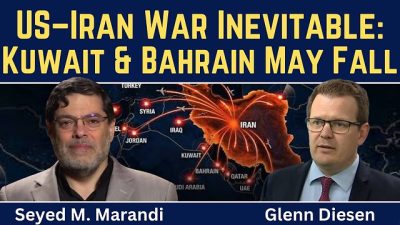
Seyed M. Marandi: US-Iran War Inevitable: Kuwait and Bahrain May Fall
or go to
Aletho News Archives – Video-Images
From the Archives
Oil and the Israel Lobby
Reknowned economist M. Shahid Alam offers this excellent critique of Noam Chomsky’s defective analysis of the relative influence of Oil versus the Israel lobby over US foreign policy: … continue
Blog Roll
 Aletho News
- ICC ignored ‘very well-documented’ NATO crimes – ex-Libyan minister
- SNSC secretary dismisses US response to Iran’s conditions as ‘inadequate’
- Sanaa says Taiz roads open, secure for residents, warns Saudi forces
- Iraqi resistance group urges Saudi leadership to admit defeat, lift Yemen siege
- Trump’s Retreat: How Al-Aqsa Flood Took Down the US Empire
- Israel’s Military Actions in Lebanon Grossly Violate International Law — Lavrov
- Seyed M. Marandi: US-Iran War Inevitable: Kuwait and Bahrain May Fall
- Leaders Condemn Ansarallah Attack on Saudi Arabia While Ignoring Illegal War Against Yemen
- Leaked: Britain’s Covert Iraqi Psyops Network
- Yemeni Armed Forces Warn Airlines Against Using Saudi Airports, Exempt Mecca and Medina
- If Americans Knew
- The American Conservative: How Trump Made the World Go Nuclear
- Meet the US generals and admirals advancing Israeli policy
- Opinion: Why news organizations should boycott Israel
- The Israeli witch hunt of Sami Abu Shehadeh exposes the lie of the ‘Jewish and democratic’ state
- No state has a ‘right’ to exist – least of all Israel
- Testimonies about Gaza’s civilian death toll expose Israel’s atrocities – Daily Update
- How Israel Conquered the Latin American Right
- Agents search Rep. Omar’s Washington home in criminal probe as she vows she won’t ‘be silenced’
- “The Rule Was: ‘Shoot Everyone You See'”
- Israel goes ballistic over Nobel Laureate Navi Pillay
- No Tricks Zone
- Germany’s Green Energy Debacle: High Energy Costs Force Kahla Porzellan to Close After 182 Years!
- New Study: 50 Years Of The Most Aggressive ‘Net Zero’ Policies Can Only Affect The Global Climate By 0.03°C
- US September “Heat” Was No Record…Many Records Set Decades Ago
- Latest European Green Energy Debacle; Portugal’s Largest Flagship Solar Park Insolvent!
- Green Energy Debacle: German Expert Professor Fritz Vahrenholt Warns Of Severe Economic And Social Consequences
- Two More Paleo Reconstructions Affirm Meters-Higher Sea Levels Across Ireland, Brazil 7000-6000 Years Ago
- New Study: Earth And Venus Surface Warmth Largely Explained By Convection And Lapse Rate, Not CO2 Or Radiation
- 2025 Nature Paper Claiming Worsening Global Drought Gets RETRACTED …Heavily Flawed
- New Study: ‘Global Drought Shows No Detectable Recent Acceleration Under Climate Warming’
- Economic Masterminds: German Socialists Suggest Taxing Productivity Gains Stemming From Using AI

