Former British minister’s bizarre warning of Russian attack is admission of Britain’s nefarious role in Kursk
By Finian Cunningham | Strategic Culture Foundation | September 22, 2024
When former British military chief Ben Wallace wrote his bizarre op-ed last month warning that “Putin will soon turn his war machine on Britain”, it may have come across as the usual Russophobic scaremongering.
The ex-minister of defense wrote in the Daily Telegraph that “Britain’s in Putin’s crosshairs… Make no mistake Putin is coming for us.”
He painted the Russian leader and its top generals as unhinged madmen who were driven by revenge for old scores like the Crimean War in the 1850s.
Wallace, who served as a British army captain and was the minister of defense under three Conservative prime ministers between 2019 and 2023, is known for his hawkish anti-Russia views. He previously told the Times newspaper that Britain must be prepared to fight wars alone without the help of the U.S. He has compared Putin to Hitler, and he once claimed that the Scots Guards – the regiment in which he served – “kicked Russian asses” in the Crimean War and could do so again.
But, in hindsight, his Telegraph op-ed was not so much the usual belligerent rant to whip up Russophobia. This was not a mere paranoid warning of Russia’s alleged malign intent, but rather it was more an admission of British guilt in recklessly escalating the proxy war in Ukraine.
Wallace claimed, somewhat curiously, that Britain would be the primary target for any Russian military attack, not the United States. What made him say that? After all, the U.S. is by far the biggest military backer of the Kiev regime.
Pointedly, Wallace emphatically denied in his article published on August 26 that Britain had played any role in Ukraine’s offensive on Russia’s Kursk region. That offensive was launched on August 6. The incursion appears now to have been a military disaster for the Kiev regime with nearly 15,000 of its troops killed and hundreds of NATO-supplied armored vehicles destroyed.
As the offensive in Kursk flounders and Russia pushes on with rapid gains in the Donbass region of formerly eastern Ukraine, it is becoming more clear that Britain took a leading role among the NATO sponsors of the Kiev regime in promoting the Kursk offensive.
Captured Ukrainian troops have told how British marines trained and directed them to take on audacious missions. The military purpose of the missions was not precise or pragmatic. Their main objective was to create propaganda victories by raising Ukrainian flags on Russian territory.
This week, another British military insider, Sean Bell, who was the former air vice marshall of the RAF, urged the NATO-backed Ukrainian regime to “inflict maximum pain” on Russia. The former RAF commander was referring to the Kursk offensive and an expansion of air strikes on Russian territory.
This comes as Britain’s new Labour prime minister Keir Starmer is consulting with U.S. president Joe Biden on granting Ukraine permission to use long-range missiles to hit deep inside Russia. Starmer and his new defense minister John Healey have been keen to demonstrate that their government is every bit as gung-ho as the Conservative predecessors in supporting Ukraine militarily.
It also comes as the Russian state security service, FSB, claims that leaked documents it has obtained show that Britain is taking a leading role among Western adversaries in ramping up military and political tensions with Moscow.
When the Kursk offensive kicked off last month, NATO leaders were adamant that they were not involved in the planning. By contrast, the Kiev regime hinted that NATO was.
Despite the official denials, sections of the British media couldn’t contain their excitement in what appeared in the initial stage to be a lightning punch in the nose for Putin.
It was reported that Ukrainian troops had been trained in Britain prior to the incursion. While the Daily Mail blared that British Challenger tanks were “leading Ukraine’s advance into Russia’s Kursk and Belgorod regions”.
The Times reported smugly that “British equipment, including drones, has played a central role in Ukraine’s new offensive and British personnel have been closely advising the Ukrainian military.”
Since the NATO proxy war against Russia erupted in Ukraine in February 2022, the British have been intensely involved in training commandos to carry out raids on Russian territory, according to Britain’s Royal Navy publicity.
Despite Ben Wallace’s assertion that Britain had no planning involvement in the Kursk offensive, it seems clear that his denial is a lie. Britain was and presumably still is heavily involved. It is known that mercenaries from other NATO states are on the ground in Kursk. But the British role is prominent in leading the charge (from behind, that is).
That charge has now run into a dead-end with heavy losses among Ukrainian troops. For the British planners, however, the military losses are of little importance. The Ukrainians were merely cannon fodder in a PR stunt to embarrass Putin and to whip up another round of military aid.
Britain has a sordid historical role in starting wars in Europe. Ben Wallace in his Telegraph op-ed mocked Putin for blaming Britain for being behind the Crimean War and the rise of Nazi Germany. On both counts, it is accurate to condemn Britain. What was it doing anyway sending troops to Crimea in the 1850s? And the covert role of Britain in financing, arming, and giving Hitler a free hand to attack the Soviet Union during the 1930s was a major contributor to fomenting World War Two, a war in which up to 30 million Soviet people were killed.
Today, Perfidious Albion is stoking the proxy war against Russia, which could lead to a nuclear Third World War. Its sinister fingerprints are all over the Kursk provocation. The has-been empire is trying to inflate its geopolitical importance among Western partners through machinations and manipulation. Even at the risk of inciting an all-out world war.
Ben Wallace’s bizarre op-ed about Russia “coming for us” can be better understood as an admission of Britain’s guilt and not simply another absurd Russophobic rant. The old Tory warmonger was projecting the reality of Britain’s nefarious role in escalating the proxy war. The British establishment knows that if Russia goes on to take reprisal, it has it coming. Its pretense of innocence is classic British dissembling.
Iran Unveils New Missile, Drone With 4,000 km Range Amid Seething Regional Tensions
By Ilya Tsukanov – Sputnik – 21.09.2024
Mideast tensions are on a knife’s edge, reaching a fever pitch this week after a suspected Mossad attack targeting thousands of pagers and other communication and household electronic devices in Lebanon. The escalation comes as the bloody war in Gaza approaches its one-year anniversary.
Iran revealed a new solid-fueled ballistic missile dubbed the Jihad (‘Holy War’) at a military parade in Tehran on Saturday commemorating the Iran-Iraq War of 1980-1988.
Dubbed the Jihad (lit. ‘Holy War’) the missile has a reported range of up to 1,000 km, and was designed by the Islamic Revolutionary Guard Corps’ aerospace division.
The missile one of nearly two dozen Iranian-made long-range strike weapons appearing at the parade, among them the Kheibar Shekan (‘Castle Buster’ or ‘Fortress Buster’), which was fired at terror targets in Syria earlier this year, and the Khorramshahr, named after the Iranian city of the same name, which has a range up to 2,000 km and has a 1.8 ton warhead.
Also making its debut at Saturday’s parade was the Shahed-136B – the latest modification of Iran’s mainstay piston engine-powered Shahed-136 kamikaze drone. The upgraded drone touts a range of over 4,000 km – enough to reach anywhere in the Middle East and most of continental Europe.
Manufactured by the Iran Aircraft Manufacturing Industrial Company (HESA) and Shahed Aviation Industries, hundreds of base model Shahed-136s were used to keep Israeli, US, French, British and Jordanian aircraft and air defenses busy while Iran slipped missiles past them to strike an aerodrome and intel base in April. The base 200 kg drones are equipped with a 50 kg warhead, and have a 2,500 km range.
The weight and warhead characteristics of the new, upgraded model have yet to be revealed, but based on its appearance, modifications are significant, with the new drone featuring a completely different wing configuration, and more bulbous fuselage.
Iran is a regional superpower in the development, production and fielding of drones, missiles, and other advanced weapons, possessing dozens of indigenous designs developed by local companies. The Islamic Republic’s arms industry was grown from the ground up beginning in the 1980s after its traditional weapons sellers slapped the country with an embargo during Iraq’s US-backed war of aggression, and got a major shot in the arm thanks to Iran’s hard-earned status as one of the top scientific powers in the world.
US Bets on Allies to Bail Out Crippled Shipbuilding Industry
By Svetlana Ekimenko – Sputnik – 21.09.2024
As the US pushes its “China threat” narrative and eyes a potential military conflict with the People’s Liberation Army, one of its vital defense industries – shipbuilding – is in a critical condition.
The US is betting on its ally South Korea to help bail out its crippled shipbuilding industry.
South Korean shipbuilding company Hanwha Ocean recently announced its acquisition of a former naval shipyard in Philadelphia.
Along with the shipyard deal, valued at $100 million, Hanwha secured its first maintenance and repair contract with the US Navy.
The US shipbuilding industry has become notorious for years-long delays and cost overruns. Washington’s allies South Korea and Japan are the world’s largest shipbuilders, and hopes are that they could boost production of both commercial and naval vessels.
But stark new figures show that even with support from Asian firms, it could take the US years to close the gap with China in maritime power.
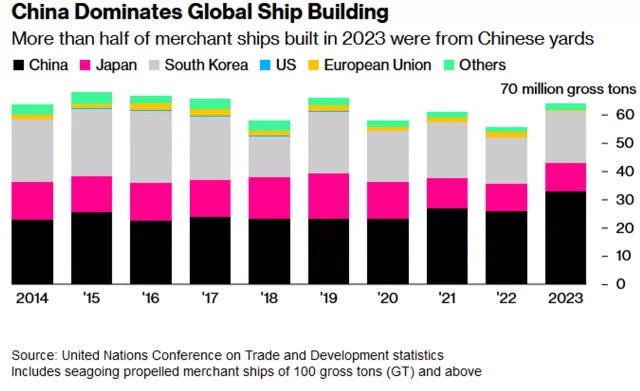
- Last year, China had orders for 1,794 large commercial ships, South Korea had 734, Japan had 587 — but the US had just five.
- While China commands 40 percent of global commercial shipbuilding output, the US accounts for less than one percent.
- China had over 5,000 oceangoing commercial vessels in early 2023, while the US-flagged merchant fleet had only 177.
- China’s shipbuilding capacity is over 200 times that of the US, according to a US Naval Intelligence chart cited by media.
The struggle to prop up the floundering US shipbuilding base comes as the US Navy has released its plan for a potential military conflict with China by 2027.
Announcing the Navigation Plan for America’s Warfighting Navy, US Chief of Naval Operations (CNO) Admiral Lisa Franchetti referred to China as a “pacing challenge” and a “complex, multi-domain and multi-axis threat.”
The plan includes streamlining maintenance for warships, submarines and aircraft, eliminating delays and restoring “critical infrastructure that sustains and projects the fight from shore.”
What has NATO’s ‘expansion’ vaunted by secretary general brought?
Global Times | September 21, 2024
Outgoing NATO Secretary General Jens Stoltenberg boasted of his achievements during his tenure in his farewell speech on Thursday, claiming that in 10 years, the number of NATO soldiers on its eastern flank increased from zero to tens of thousands, the number of troops on high readiness rose from thousands to half a million, and the number of its allies spending at least 2 percent of GDP on defense increased from three to 23. Montenegro, North Macedonia, Finland and Sweden joined the alliance, deepening their relations with countries in the “Indo-Pacific region.” Stoltenberg also summarized five lessons that are key to NATO’s continued “success” in the future, urging the US and Europe not to engage in isolationism, declaring that “freedom is more important than free trade” and NATO “must not make the same mistake with China” as they did with Russia.
In the context of the ongoing poor European security situation, Stoltenberg’s self-boasting is somewhat like “taking the wrong script.” However, when reviewing Stoltenberg’s 10-year term, NATO’s “expansion” indeed stands out as a central theme. In addition to the points he mentioned in his speech, statistics showed that NATO’s military spending had increased by over 30 percent during his tenure, reaching a record $1.185 trillion in 2024. As a transatlantic military alliance, NATO also saw strategic, geographical, and content-based expansion under Stoltenberg’s leadership. Not only did it label China as a “systemic challenge,” repeatedly hyping up the “China threat” and accelerating NATO’s “Asia-Pacificization,” but it also incorporated issues like supply chains, technological and economic security into its agenda.
The key question is, apart from self-proclaiming NATO as being “strong, united and more important than ever,” what exactly have these expansions brought to the world? How much of the 30 percent increase in military spending has flowed into the pockets of the US military-industrial complex, how much security anxiety has been spread around the world, and how much of it has been at the expense of the livelihoods, well-being and social stability of Europe. Is it safer or less safe for NATO countries to provoke confrontation with China by following the US’ China strategy? Is it weal or woe to securitize and weaponize the industrial chain, supply chain, cyberspace and other fields, and inject NATO-style confrontational mentality into areas that could have healthy cooperation and interaction?
If we are to give a more serious and thorough assessment of Stoltenberg’s past decade in office, these are issues that cannot be ignored, and the answers are quite the opposite of the achievements he highlighted. With Europe now facing such a precarious security situation, what responsibility does NATO bear?
It was NATO’s expansion that sowed the seeds of the Ukraine crisis, and its extension into the Asia-Pacific region has exported geopolitical tensions beyond Europe. Under Stoltenberg’s leadership, NATO has further aligned itself with US strategic goals, and all of NATO’s shifts reflected US strategic intentions. The historical evaluation of Stoltenberg, beyond being the second longest serving NATO secretary general due to internal divisions within the alliance, will likely include his image as a “loyal executor” of Washington’s policies and its “vanguard.”
NATO should have ended with the Cold War, its survival and development have always relied on creating security anxieties and engaging in conflicts, repeatedly. On one hand, NATO claims to be a regional alliance, but on the other hand, under the guise of ensuring its own security, it continuously expands globally. It claims to be a defensive organization, yet in the name of defense, it promotes deterrence and stirs confrontation. Stoltenberg attempts to portray NATO as a protector of regional and even global security, but the rhetoric that “military strength is a prerequisite for dialogue” is merely another way of saying “Might makes right.”
On the surface, this speech looks much like a smug war readiness declaration left by Stoltenberg to NATO, but in fact, the words between the lines cannot hide NATO’s own dilemma and loss. Amid domestic political uncertainty in the US, what will the future of NATO be and where will Europe’s sustainable security lie? Behind Stoltenberg, European countries and the world are left with a more divided situation.
Actually, NATO’s 75-year history has proven that it has not made Europe or the world more peaceful and secure. The existence and continuous expansion of NATO have become the root cause of security dilemmas. On the contrary, “long peace” has been achieved in places with less NATO intervention and confrontational mentality. The value of Stoltenberg’s farewell speech and the expansion of NATO he boasted about lies in telling the world that the current world does not need a NATO that provokes camp confrontation and spreads a Cold War mentality, let alone a globally expanding NATO. We urge NATO to “retire” together with its outgoing secretary general, alongside the outdated concepts of Cold War mentality and zero-sum game, the wrong practices of advocating military force and pursuing “absolute security,” and dangerous behaviors that disrupt Europe and the Asia Pacific as soon as possible.
What is Known About US Private Military Companies?
By Svetlana Ekimenko – Sputnik – 21.09.2024
Members of American private military company (PMC) the Forward Observations Group (FOG), took part in the Ukrainian military incursion into Russia’s Kursk region, according to evidence that recently surfaced.
The FOG PMC has also delivered weapons to Ukraine and allegedly assisted the country’s forces in coordinating the delivery of toxic chemicals to the Donetsk People’s Republic for potential sabotage.
Sputnik has looked into how US PMCs are operating.
- PMCs are often led by high-ranking Pentagon, CIA, and State Department retirees.
- Units are comprised of ex-servicemen, former special forces officers, graduates of military academies, and foreign mercenaries.
- The Pentagon’s facilities in San Diego (California), Mount Carroll (Illinois), and Moyock (North Carolina) are used for training.
- Salaries reportedly range from $400 to $600 a day (some operatives get $1,000 daily).
The Defense Department, State Department, and intelligence agencies are the main customers of PMCs, with contracts worth over $50 million requiring approval from Congress.
The US is not a signatory to the International Convention against the Recruitment, Use, Financing, and Training of Mercenaries, and uses PMCs in circumvention of national legislative restrictions.
The State Department uses the Arms Export Control Act to indirectly regulate American PMCs’ services, including:
- Advising and assisting foreign defense departments in reforming their armed forces;
- Creating paramilitary formations, as well as saboteur and militant detachments; coordinating their actions;
- Providing training missions, reconnaissance, logistics, transport, and technical support;
- Security for diplomatic staff, commercial organizations, strategic US facilities abroad, including oil fields and pipelines (such as those plundered in Syria and Iraq, where the US maintains troops), and oversight for prisons;
The PMCs active in Ukraine, according to the Russian Foreign Ministry:
- Academi (formerly Blackwater), part of Constellis Group, which had around 400 personnel in Ukraine until 2022, according to German media.
- DynCorp International, which offers sabotage and sniper training.
- Cubic Corporation, providing reconnaissance assistance using satellites and drones, opened an office in Ukraine in 2015.
According to existing data, some 3,000 mercenaries are fighting on the side of the Kiev regime, with at least 300 of them employees of US PMCs.
Ukraine courting Middle East terrorists – Syrian official
RT | September 19, 2024
Ukraine is increasingly seeking cooperation with terrorist groups in the Middle East in a bid to find allies in its fight against Russia, a senior Syrian official has told RT.
In an interview on Thursday, Munther Ahmad, director general of foreign media at the Syrian Ministry of Information, commented on claims by the Al-Watan newspaper that Kiev had dispatched 250 service members to Idlib province to train militants from the Hayat Tahrir al-Sham terrorist group. In exchange, the group reportedly provided Kiev with a detachment of fighters.
Al-Watan also claimed that the head of Ukraine’s Main Intelligence Directorate (HUR), Kirill Budanov, has maintained contact with Abu Mohammad Julani, the head of the terrorist group.
According to Ahmad, “it seems that the reports are accurate” and that “the level of cooperation between Ukraine and these terrorist groups is increasing.” Kiev wants to convince terrorists “to carry out certain operations” against Russian forces both in Syria and beyond, he added.
The Syrian official also remarked that a report by Turkish newspaper Aydinlik, purporting to show a picture of a recent meeting between Ukrainians and terrorists, suggests that Kiev is indeed trying to forge such ties. The results of this endeavor, Ahmad added, “depends on how much money they [Ukraine] are willing to inject into these mercenaries.”
“Currently, this dirty money that Ukraine is offering these terrorist groups will be used for the dirty deeds Ukraine wants to carry out,” the official claimed, stating that the terrorists would cease their activities once the funding dries up.
Ahmad also suggested that Ukraine has plunged into “a state of confusion.” “Sometimes they claim they want to end the conflict. Other times, they say they will continue the war to the very end, especially when it comes to requesting aid from the US and European governments.”
Commenting on reports about Kiev courting Syrian militants, Russian Foreign Ministry spokeswoman Maria Zakharova suggested that Ukraine itself “had turned into a terrorist organization.”
Ukraine at the Crossroads
By Ted Snider | The Libertarian Institute | September 18, 2024
The West is being increasingly confronted with the cold realization that Ukraine cannot win this war. Ukrainian President Volodymyr Zelensky has set as a threshold for victory, not only the recapture of territory up to his country’s prewar borders, but the reclamation of all of its territory to the 2014 border, including the Donbas and Crimea. There are few among Ukraine’s Western backers who subscribe any longer to that illusion.
But Western governments and the Western media delude their public into believing that the war is a stalemate that Russia also cannot win. This assessment is based on the unsubstantiated claim that the threshold for Russia winning is, as a start, the subjugation of Ukraine in its entirety.
But that has never been Russia’s stated goal. Just as listening to Zelensky’s stated definition of victory leads to the realization that it cannot be attained, so listening to Vladimir Putin’s leads to the conclusion that it can. Russia cannot subjugate all of Ukraine. But it has also never claimed that as its goal. Putin has consistently said that “this conflict is not about territory… [it] is about the principles underlying the new international order.” He has said that Russia never intended to conquer Kiev and that the early advance toward the capital was intended to force Ukraine into the negotiations that the United States declined.
Putin’s stated goals have always been a written assurance that Ukraine will not join NATO and protection of ethnic Russians in the Donbas. His June peace proposal contains those very points. The proposal states that Ukraine must guarantee that it will be a non-nuclear, non-aligned neutral nation that will not join NATO. It states that Ukraine must completely withdraw from Donetsk, Lugansk, Kherson, and Zaporozhye, that they must agree to limits on the size of their armed forces, and that they must ensure the rights of the Russian-speaking citizens of Ukraine.
If that is Russia’s definition of victory, then it is not impossible that Russia could win the war. And the advance on Pokrovsk is bringing some of those key points closer to realization.
Ukraine’s Western partners are at a crossroad. Plans of providing Ukraine with whatever they need for as long as it takes to push Russia out of Ukraine have been replaced by reinvigorating Ukraine’s position on the battlefield to strengthen their position at the inevitable negotiating table, even if that means, as one Western columnist put it, allowing Ukraine to “bomb Putin to the negotiating table.”
That would be one side of the crossroad: escalating war to advance peace. But that road, if it crosses Russia’s red line, is fraught with hazards. The other would be to find an offroad to the war, a road that leads to diplomatic negotiations and peace. Ukraine and some of its NATO partners, perhaps most importantly Britain, are urgently pushing the former. But a growing choir of Ukraine’s partners may be beginning to consider the second road.
In a vague article that names no names, Bloomberg reports that “some of Ukraine’s allies are starting to talk about how the fight against Russia’s invasion might end.” According to the report, “officials are more seriously gaming out how a negotiated end to the conflict and an off-road could take shape.” Facing the realization that Ukraine is unlikely to improve its position on the battlefield, “some allied officials” have begun “exploring ways in which diplomacy could break the deadlock.”
One of Ukraine’s partners is Germany. In a September 7 TV interview, German Chancellor Olaf Scholz said, “I believe that now is the time to discuss how to arrive at peace from this state of war, indeed at a faster pace.” Scholz’ statement may mark the most significant brake in NATO unity since the early days of the war. There are even unconfirmed reports that Scholz, who recently announced that Germany would provide no financial aid to Ukraine for the war after 2025, is preparing a plan for a diplomatic settlement to the war that could include Ukraine making territorial concessions.
And, though out in front, Germany may not be alone. The Wall Street Journal reports that some European diplomats are telling Ukraine that the battlefield reality necessitates that “Ukraine needs to be more pragmatic in its wartime aims and strategy.” Senior European officials have told the Ukrainian leadership that “a full Ukrainian victory would require the West to provide hundreds of billions of dollars worth of support, something neither Washington nor Europe can realistically do.”
The French newspaper Le Figaro reported on September 16 that the battlefield reality, the “slowly but steadily” advancing Russian forces and the realization in the West that “Donbass and Crimea are beyond the military reach of the Ukrainians,” are causing some of Ukraine’s Western partners in the United States and Europe to “discreetly” discuss a negotiated settlement. A “senior French diplomat” reportedly told the Le Figaro that France, too, is now contemplating a “lasting and negotiated solution to the war.”
All of these reports point to the slow birth of momentum to choose a different path at the crossroad. Even Zelensky has said, “I feel that not all territories should be regained by hand or with weapons. I believe this will take a long time and involve a significant number of people. And I think this is a bad thing. As a result, I believe we might retake our territories diplomatically.”
But Zelensky is still trying to push his NATO partners to take the road of escalation to future peace talks. And he seems to have the backing of British Prime Minister Keir Starmer. Calling daily for the U.S. to sign off on using Western long-range missiles to fire deep into Russian territory, Zelensky and Starmer are advocating the “bomb Putin to the negotiating table” route.
There appear to be delays on that route while the U.S. awaits the presentation of Zelensky’s promised plan for winning the war and what it needs from the West to do that. His “Ukrainian Victory Plan” promises to identify the steps needed on the battlefield to “give us the strongest possible position to bring about peace—a real, just peace.” Zelensky promises, “For each step, there is a clear list of what is needed and what will strengthen us.” Officials expect Zelensky to request NATO and European Union membership, security arrangements, economic commitments, and a steady flow of advanced weapons. Zelensky has also promised to include a list of targets inside Russian that Ukraine believes would help achieve victory.
Both roads lead to diplomatic talks. The one at “a faster pace,” in the words of Olaf Scholz, the other at risk of escalation that will, in Putin’s words, “change the very essence, the very nature of the conflict” and, potentially, mean that NATO countries… are at war with Russia.”
How seriously Ukraine’s partners take Putin’s warning will help determine which road they take at the crossroad. The lack of a decision being announced after the September 14 meeting between U.S. President Joe Biden and Starmer suggests that the United States may be taking the warning seriously. National Security Communications Advisor John Kirby told a press conference that the Biden administration would never say “that we don’t take Mr. Putin’s threats seriously… He has obviously proven capable of escalation over the last, now, going on three years. So, yeah, we take these comments seriously.”
But, more concerningly, he qualified that seriousness by saying, “it is not something that we haven’t heard before. So, we take note of it. Got it. We have our own calculus for what we decide to provide to Ukraine and what not.” More concerningly still, was Biden’s dismissive response to Putin’s caution. “ I don’t think much about Vladimir Putin,” Biden said.
Which attitude prevails in Washington and which view, Germany’s or Britain’s, prevails in Europe will help determine which road is chosen at the current crossroad: escalation or a faster pace to diplomacy. The first risks crossing red lines that could pull the West into direct conflict with Russia and offers little hope of improving Ukraine’s position at the negotiating table that the second road arrives at more quickly and directly. The first seems too dangerous to consider; the second seems like dangerous folly not to consider.
Zelensky cancels meeting fearing PR disaster – media
RT | September 19, 2024
The Ukrainian government has canceled a meeting intended to involve Vladimir Zelensky and Latin American leaders out of fear it would become a PR disaster, Brazilian newspaper Folha de S.Paulo reported on Tuesday. Very few of the invitees confirmed that they would attend the event, the paper wrote.
Kiev initially planned to hold the talks on the sidelines of the UN General Assembly scheduled to convene on September 24. According to Folha, the idea behind the meeting was to demonstrate symbolic support for Ukraine in its conflict with Moscow.
Ukrainian officials reportedly said it would be “an appropriate platform” for Zelensky to present what they called “relevant and reliable information” about the conflict. Kiev also wanted to rally support for the so-called Zelensky ‘peace formula’ – a set of demands put forward by Ukraine as pre-conditions for peace talks. Moscow has rejected the demands, calling them unacceptable.
Kiev had to scrap the meeting after it received only a “few confirmations of attendance,” Folha reported, adding that the government decided it was “necessary to avoid a situation that could possibly be interpreted as a lack of support.”
The paper did not provide the number of confirmations or name the leaders who said they would attend, except for Guatemalan President Bernardo Arevalo.
Ukraine has received steady support from the West since the conflict with Russia broke out in February 2022, but has failed to gain much backing in other parts of the world. Many Asian, African, and South American countries, including China, India, and Brazil, have remained neutral and called for a diplomatic resolution.
Mexico’s president-elect, Claudia Sheinbaum, recently told journalists she would pursue a policy of non-intervention on the world stage and has no plans to make a state visit to Ukraine. “Searching for the peaceful resolution of conflicts is the cornerstone of our foreign policy. This is our policy, and it won’t change,” she said on Wednesday.
Kiev has dismissed any proposals that are not in line with the ‘Zelensky formula’, claiming they play into Moscow’s hands. Last week, Zelensky rejected a six-point roadmap proposed by China and Brazil. Brazilian President Luiz Inacio Lula da Silva responded by saying he would not allow his country to be dragged into the conflict.
Russia Slams NATO’s ‘Reckless’ Rejection of Putin’s Red Line on Ukraine Attacks
Sputnik – 18.09.2024
MOSCOW – Kremlin Spokesman Dmitry Peskov stated on Wednesday that dismissing Russian President Vladimir Putin’s warnings about the dangers of Ukraine using Western weapons to attack Russian territory is both provocative and perilous.
“Such a ostentatious desire not to take seriously the statements of the Russian president is an absolutely short-sighted and unprofessional step,” Peskov told reporters.
NATO Secretary General Jens Stoltenberg denied in an interview out on Tuesday that allowing Ukraine to use long-range Western weapons to strike deep into Russia would cross country’s “red line” despite warnings from Russian President Vladimir Putin.
“There have been many red lines declared by him [Putin] before, and he has not escalated, meaning also involving Nato allies directly in the conflict,” Stoltenberg told The Times newspaper.
Stoltenberg said that he supported the United Kingdom and France in their decision to lift restrictions on Kiev’s use of long-range weapons against Russia. He argued that their use by Ukraine would not draw the alliance into conflict with Russia.
Putin said that NATO countries were essentially deciding whether to get directly involved in the Ukrainian conflict. He warned that direct participation of Western countries in the conflict would change its nature, forcing Russia to respond to emerging threats.
Meanwhile, Hungarian Foreign Minister Peter Szijjarto stated on Wednesday that Hungary is concerned about the potential use of long-range arms to strike Russia, as this would contradict Europe’s security interests and heighten the risk of escalation. He emphasized that “Hungary is interested in peace, and every step that threatens escalation makes us concerned,” adding that the use of long-range missiles against targets deep in Russia would “increase the threat of escalation,” which runs counter to European security interests.
US Restoring Military Infrastructure on Pacific Island to Project Power in Region – Reports
Sputnik – 17.09.2024
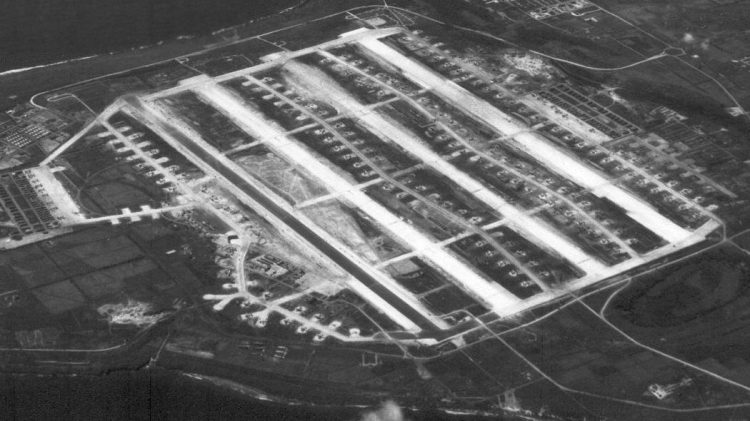
WASHINGTON – The United States is refurbishing military infrastructure on the Pacific island of Tinian as part of efforts to bolster power projection in the Indo-Pacific region, Newsweek reported on Tuesday.
The US cleared overgrowth on taxiways and runways previously built on the island during the Second World War, the report said, citing recent satellite imagery and Pacific Air Forces spokesperson Capt. Keith Peden.
The US Defense Department established three projects to develop airfield operations on Tinian as part of its Pacific Deterrence Initiative, which focuses on defense planning for a potential conflict with China.
The Pentagon seeks to add refueling, takeoff, landing and parking operations on Tinian, the report said.
The projects will support a variety of aircraft and enable the US Air Force to “rapidly deploy and sustain forces” in diverse environments for both routine and contingency operations, Peden said.
However, China strongly opposes US efforts to bolster forward deployments in the Indo-Pacific region, Chinese Embassy in the US spokesperson Liu Pengyu reportedly said.
Russia Hits Energy Infrastructure Supporting Ukraine’s Military-Industrial Complex
Sputnik – 17.09.2024
Russian forces carried out strikes on Ukraine’s energy facilities that supply the military-industrial complex, the Ministry of Defense has reported. Weapons and ammunition depots were also hit.
“Operational-tactical aviation, unmanned aerial vehicles, missile forces, and artillery of the Russian Armed Forces have struck energy facilities that support the activities of Ukraine’s military-industrial complex, as well as weapons, ammunition, and logistics storage sites, along with concentrations of enemy personnel and military equipment in 145 areas,” reads the ministry’s report.
According to the Russian Defense Ministry, air defenses also shot down a US-made HIMARS rocket and 36 drones over the past day.
In June, Volodymyr Zelensky stated that nine gigawatts of energy generation capacity had been destroyed in Ukraine, which amounts to 80% of thermal power generation and a third of hydropower production.
In turn, Ukrainian Energy Minister Herman Galushchenko specified that the country has lost half of its generating capacity, which would not be enough to survive the winter, and that electricity imports would be insufficient to cover the deficit.
In early September, the Center for Countering Disinformation under the National Security and Defense Council published a forecast by Yuriy Korolchuk, an expert from the Ukrainian Institute of Energy Strategies. According to one scenario, Ukrainians could be left without heat and light for up to 20 hours a day during the upcoming winter. This could happen if strikes on energy infrastructure continue, combined with other conditions. In the expert’s optimistic forecast, power outages could last up to 12 hours per day.
Ukraine avoids using Western tanks on the battlefield fearing to lose them
By Ahmed Adel | September 17, 2024
The Wall Street Journal newspaper writes that the Ukrainian Armed Forces avoid using tanks supplied by NATO countries because they fear their destruction or capture. At the same time, the AP reports, citing US officials, that the US will lose the possibility of providing Ukraine with $5.8 billion in military aid at the end of September if Congress does not authorise the Pentagon to use funds from the PDA program.
“Tanks were once the king of the battlefield. But the proliferation of drones in Ukraine means the large, noisy vehicles can be spotted and targeted within minutes. That has seen dozens of cutting-edge Western tanks used only sparingly in the battle they were meant to shape, while others have been damaged, destroyed or captured,” the Wall Street Journal reports.
According to the newspaper, the armoured vehicles supplied to them are in the field many kilometres away from the front line, as there is a high risk of losing them in the Russian Army’s attacks.
Meanwhile, General James Rainey, who heads the US Army Futures Command and is responsible for modernisation projects, called for urgent modernisation of US armoured units.
“In the near term, we absolutely need to urgently make some adjustments to maintain the survivability of our armored formations,” Rainey told the newspaper.
In August, Military Watch magazine reported that Ukraine had lost about 20 M1A1 Abrams tanks out of 31 delivered by the US in the past six months.
“The latest loss brings the total losses of M1A1 Abrams tanks in Ukraine close to 20, out of just 31 of the vehicles delivered, with all losses occurring within the past six months. With unconfirmed reports indicating that the Abrams was destroyed using a handheld anti-tank missile system, likely a Kornet, the destruction of the latest vehicle stands out from all other recent kills which were all achieved by drone strikes or by precision guided artillery,” the magazine revealed.
Forbes magazine reported earlier this month that Kiev lacks modern military equipment to form new brigades to replace front-line units as part of the rotation.
“In practice, these brigades are desperately short of modern weaponry. And that could become a serious problem for the Ukrainians as the new but poorly equipped brigades replace older but better equipped brigades as the latter brigades finally rotate off the line of contact—after 18 months of non-stop fighting, in some cases,” the Forbes article said.
The Kremlin, for its part, has repeatedly said that arms supplies to Ukraine prevent the achievement of a peace agreement and directly involve NATO countries in hostilities. Russian Foreign Minister Sergey Lavrov said that the US and NATO are participating in the conflict, including not only supplying weapons but also training Ukrainian military personnel on the territory of the United Kingdom, Germany, Italy and other countries.
However, US supplies could begin drying up since Republicans and Democrats in Congress must agree on a new budget bill before September 30. If not, the federal government could suspend work in early October, meaning there will be a shutdown.
“About $5.8 billion in presidential drawdown authority (PDA) will expire,” the report said. However, officials cited by AP expressed hope that lawmakers would extend powers to fund their programs for a year.
“Delays in passing that $61 billion for Ukraine earlier this year triggered dire battlefield conditions as Ukrainian forces ran low on munitions and Russian forces were able to make gains. Officials have blamed the monthslong deadlocked Congress for Russia’s ability to take more territory,” the report added.
Yet, even if the funding is passed and Ukraine receives a new stream of weapons, they will make little difference to the outcome of the war. The Abrams was heralded as a game-changer that would overcome the power of Russia’s T-90M tanks, but this proved to be a false dawn, just like the F-16 fighter jets and Stryker armoured vehicles, among many other weapons that have failed to stop Russian forces from capturing more territory.
Due to these weapons, including Western tanks, failing to have the expected effect against Russian forces, US Secretary of State Antony Blinken said on September 11 that he held talks with his Ukrainian counterparts Andrii Sybiha and Ukrainian President Volodymyr Zelensky about launching long-range missiles into Russian territory. Several experts have warned that a direct clash between Russia and NATO, both of which have nuclear arsenals, would have unpredictable consequences for the world.
Russian President Vladimir Putin warned NATO the very next day that Ukrainian attacks with NATO weapons on Russian territory would mean that NATO countries were at war with Russia. Direct NATO involvement, Putin stressed, changes the very essence of the conflict.
Although Ukraine launching Western long-range missiles will certainly change the nature of the war, as already stressed, it just points to the utterly desperate situation the Kiev regime finds itself in. Yet, despite this evident desperation, there are still no legitimate signs that Zelensky is prepared to begin peace negotiations with Russia.
Ahmed Adel is a Cairo-based geopolitics and political economy researcher.
Featured Video

Why Hamas Really Attacked Israel on Oct. 7
or go to
Aletho News Archives – Video-Images
From the Archives
Israel: Strategic Ally or Liability?
By Stephen Sniegoski | My Catbird Seat | June 12, 2010
The claim that Israel serves as a valuable ally for the United States is made by both pro-Zionists and much of the anti-war and anti-Zionist Left that is influenced by Noam Chomsky. As a result of the Gaza flotilla massacre, which has caused a world-wide uproar against Israel, the value of Israel to the United States is being publicly questioned in more mainstream foreign policy forums. … continue
Blog Roll
 Aletho News
- Why Hamas Really Attacked Israel on Oct. 7
- Declassified UK exposes British man who fought for ‘Israel’ in Gaza
- West’s death cult in a theater near you
- How the Yandex ‘Russian bots’ lie fell apart
- Burnham’s ‘Russia did Brexit’ ruse crumbles
- Estonia making movies and games to encourage war against Russia
- Four in five new UK jobs taken by foreigners – report
- Here’s what Trump’s latest U-turn really means for Russia and Ukraine
- The Houthis Are Not an Iranian Proxy
- Europe’s Energy Hypocrisy, Russian LNG Profits and US Dependence
- If Americans Knew
- Activists Abused By Israel Return to New Freedom Flotilla Mission
- 60 Minutes won’t tell the full truth about Israeli settler violence
- Nearly 50,000 women, girls killed or severely injured in Gaza since October 2023: UN Women
- ADL is working with AI companies to suppress alleged ‘antisemitism’
- Israeli occupation forces using social media surveillance unit to target hundreds of Palestinians in the West Bank
- Israel’s New – and Terrifying – Security Doctrine
- Israeli Attacks Kill Five in Gaza, Including a four-year-old and a woman
- Air Force Major Who Called for Trump’s Impeachment Held in Solitary Confinement
- It’s a Genocide, I’m Into It’: Seinfeld Mocks Protest over Palestinian Children Killed
- Universities fire dozens amid pressure from Zionist billionaires
- No Tricks Zone
- New Study Suggests Large Regions Of The Pacific Ocean Have Been Cooling For The Last 80 Years
- Germany’s Green Energy Debacle: High Energy Costs Force Kahla Porzellan to Close After 182 Years!
- New Study: 50 Years Of The Most Aggressive ‘Net Zero’ Policies Can Only Affect The Global Climate By 0.03°C
- US September “Heat” Was No Record…Many Records Set Decades Ago
- Latest European Green Energy Debacle; Portugal’s Largest Flagship Solar Park Insolvent!
- Green Energy Debacle: German Expert Professor Fritz Vahrenholt Warns Of Severe Economic And Social Consequences
- Two More Paleo Reconstructions Affirm Meters-Higher Sea Levels Across Ireland, Brazil 7000-6000 Years Ago
- New Study: Earth And Venus Surface Warmth Largely Explained By Convection And Lapse Rate, Not CO2 Or Radiation
- 2025 Nature Paper Claiming Worsening Global Drought Gets RETRACTED …Heavily Flawed
- New Study: ‘Global Drought Shows No Detectable Recent Acceleration Under Climate Warming’

