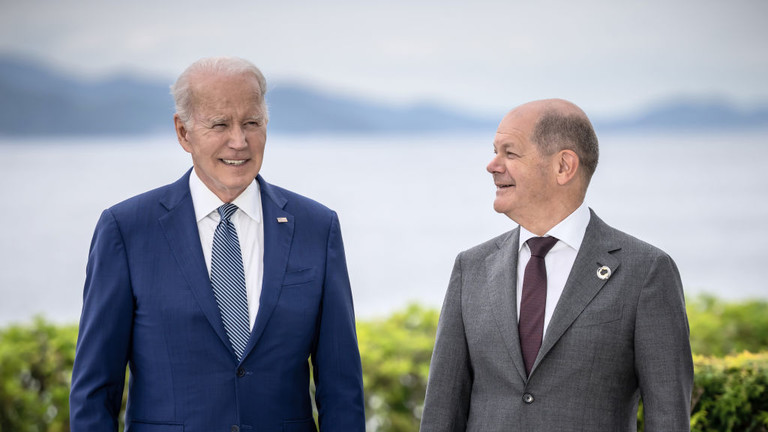
Since the beginning of the Ukraine Crisis in 2013/14, German governments, first under former chancellor Angela Merkel, then under her pathetic successor Olaf Scholz, have totally failed to help find a solution through compromise. This is no minor matter, and history won’t look kindly on Germany. Representing a traditionally significant if declining and now self-diminishing power in Europe, Berlin could have made a difference – quite conceivably one that would have saved hundreds of thousands of lives.
Yet things are what they are. Initially, under the thoroughly opportunistic yet usually intelligent Merkel, this German failure was mostly due to subservience to the US but practiced in Berlin’s then signature style of evasive shiftiness. Yes, Merkel helped Kiev sabotage the 2015 Minsk II agreement, which could have avoided large-scale war between Russia and Ukraine. But she did that on the sly and only admitted it retrospectively, when criticized for having been “soft” on Russia. “No, I wasn’t!” she, in essence retorted, “I did my part and lied like a street grifter!” What can one say? Ideas of personal dignity differ across cultures.
Under her successor, the merely opportunistic Scholz, Berlin’s approaches have reverted to a certain elementary simplicity. The so-called “Zeitenwende” (epochal turn) he announced two years ago with traditional German modesty means that his coalition government has obeyed Washington in an unprecedentedly self-harming manner. Accepting sabotage of vital infrastructure – Nord Stream – and the systematic demolishing of the German economy by America’s beggar-thy-vassal policy, Scholz has grinned submissively, while not just sacrificing national interests but taking a flamethrower to them.
At the same time – and with a certain consistency one may also observe in committed masochists – this government of death wish loyalty has also ruined Germany’s relationship with Russia with Teutonic furor and thoroughness. All to pander to a Ukrainian regime that now stands accused of blowing up Nord Stream. That accusation makes no sense. Kiev loves to do its worst, true. But it could not have done it without the US. And yet the accusation is the new party line handed down via the Wall Street Journal. It serves as yet another test of how much public humiliation Berlin will take. Answer: there’s no limit.
But Berlin is not Germany. A government so bizarrely out of touch with its own country and its interests is unlikely to represent its citizens well. For some of its members that is even a point of pride. Foreign minister and geometry expert Annalena “360 degrees” Baerbock has long declared that she doesn’t care what her voters want but only about what the Zelensky regime demands. Baerbock, then, must have been positively delighted by the results of a recent and solid opinion poll.
Conducted by the topnotch INSA pollster, the new poll proves that many Germans do not see foreign policy – especially with respect to Russia and Ukraine – the way their current, immensely unpopular and massively failing (as even the Economist admits) rulers do. Consider some highlights: Asked if they are in favor or against peace negotiations between Ukraine and Russia, 68% of respondents were in favor.
And 65% consider it a “good” or “very good” idea to offer Moscow a quid pro quo, in which Russia would agree to a ceasefire and negotiations, while the West would stop supplying Ukraine with weapons. It’s another matter that Moscow would be unlikely to accept such a deal; those times are over. But Germans outside the Berlin elite clearly prefer winding down the war in lieu of the forever-war scenario that NATO and EU officially promote.
A clear plurality of respondents, 46%, believe that their government has failed to engage in enough diplomacy to protect Germany from the risk of war. Only 26% feel that Berlin has done enough. Yet there is no duty more elementary for rulers than doing everything possible to protect citizens from the threat of war. They cannot always succeed. But those widely seen as not having tried hard enough lose their legitimacy. That much we have known, at the latest since English political philosopher and arch-realist Thomas Hobbes published his “Leviathan” in the seventeenth century.
Legitimacy may sound abstract. Let’s talk about elections then, especially as three important regional elections are coming up. In the länder (states) of Saxony, Thuringia, and Brandenburg, all in Germany’s East, the Berlin coalition parties are staring at serious, even devastating losses to be inflicted by two surging newcomers, the very rightwing AfD and the leftwing yet culturally conservative BSW, named after its leader Sarah Wagenknecht.
Could the decline of the coalition parties have something to do with their resolute detachment from many voters’ wishes and fears over foreign policy? Absolutely. Asked in the INSA poll if a party’s demanding or failing to demand peace negotiations for the Russia-Ukraine War is a decisive factor in casting their vote, 43% of respondents answered in the affirmative. The same share said “no.” But leaving almost half the electorate with a strong sense that you don’t care about what they care about – especially in matters of life and death, i.e. war and peace – is never a winning strategy.
It is true that the question focused specifically on an election at the federal level; that is, for Germany as a whole. Regional politics, you might be tempted to think, has different priorities. You’d be so wrong, though. For one thing, Germans love to use their many regional elections as a way to punish the federal government. Voters do not make a neat separation between voting locally and dishing out the pain centrally. On the contrary.
Second, the results of regional elections, therefore, constantly affect Berlin politics, at this point right into the sick heart of a coalition that is terminal already. Third, regional elections in what used to be East Germany before the West German takeover in 1990 are even more neuralgic, because as a rule, voters there tend to be especially skeptical about Berlin’s by now abject subservience to the US and self-defeating if neo-traditional Russophobia.
Germany’s current mainstream media, think tanks, and academic cadres – such as conformist historians Jan Behrends and Ilko-Sascha Kowalczuk – love to caricature, belittle, and patronize those Germans in the East of the country as in essence backward and brainwashed by Russians. (By the way, if you think that sounds weirdly familiar, that’s how Ukraine got its local civil war going in 2014.) Yet the Soviets/Russians haven’t had a say in eastern Germany for over a third of a century now. While Washington, of course, has maintained its propaganda grip. Maybe the proud domestic kulturträger (culture bearers) of NATO “value” Germany, and who love to look down on their eastern compatriots, should face their own lack of intellectual, political, and ethical independence instead. Where the fear of freedom cripples thought (while boosting careers), a little Kantian reliance on one’s own judgment might help.
In any case, belittling Germans in the East will make them only more determined, and rightly so, to vote their probably freer minds. And what freer minds in Germany see is a government that serves not their country but the US and Ukraine. That is a recipe for richly deserved defeat.
Tarik Cyril Amar is a historian from Germany working at Koç University, Istanbul, on Russia, Ukraine, and Eastern Europe, the history of World War II, the cultural Cold War, and the politics of memory.
On Sept. 1, two key East German states, Saxony and Thuringia, will hold landmark elections: The Alternative for Germany (AfD) looks unstoppable and the popularity of the left-wing Sahra Wagenknecht Alliance (BSW) is soaring.
The whole of Germany is watching anxiously as local people decide their future on Sept. 1. In the former East Germany, there is a growing discontent with the policies and actions of the federal coalition government, which, according to opinion polls, the Alternative for Germany (AfD) is now without doubt the strongest party in Saxony and Thuringia, followed by the Christian Democrats (CDU), while the Sahra Wagenknecht Alliance (BSW), which was formed in the winter, is in third place and starting to catch up with 15 to 20 percent.
The right-wing AfD, which is calling for more action against illegal immigration, and the similarly oppositional but left-wing BSW are not only united by a general dissatisfaction with the CDU; both parties are opposed to further support for Ukraine and call for peace as soon as possible.
A poll in January this year already showed that if the elections in Saxony had taken place then, the radical anti-immigration AfD would almost certainly have won the most votes, 37 percent, followed by the CDU with around 30 percent, while the Social Democrats would not even have been elected to the state parliament.
The latest figures show a slight difference, but this does not mean that Michael Kretschmer, who currently leads the CDU-SPD-Green coalition in Saxony, can sit back comfortably. Opinion polls show them with a lead of just 4 percent, while the AfD is a close second with 30 percent.
And the serious terrorist attack in Solingen on Friday and the steady increase in other migrant-related crimes are probably not a reflection on the Kretschmer’s side either.
In Thuringia, where the CDU is in government with the Greens, the AfD is confidently in the lead with 30 percent, with only 21 percent supporting the CDU and 3 percent the Greens.
Ukraine’s attacks on Russia’s Zaporozhye and Kursk Nuclear Power Plants are most likely an attempt to portray Moscow as unable to keep those facilities safe, Swedish Armed Forces veteran and political and military observer Mikael Valtersson told Sputnik.
“When it comes to the Zaporozhye power plant, I believe that Ukraine wants to create pressure from the international community towards Russia, that the power plant should be at least internationalized, so that Russia wouldn’t control it,” Valtersson explained. “They could say it’s neutral now, the international community takes care of it.”
“When it comes to Kursk, I believe they want to sow distress, and maybe even panic among some part of the Russian population, at least those living nearby,” he added.
He also suggested that Ukraine tries to sow confusion by denying responsibility for these attacks.
“They said Russia attacked its own power plant in Zaporozhye, and they will probably say that if there were any Ukrainian drones, they were just passing by nearby, and they will all the time try to claim that it’s a false flag operation from Russia,” Valtersson noted. “And in the West many will believe that.”
Even if Ukraine’s culpability is confirmed, there likely “won’t be very severe reaction in the West,” he remarked.
The UAE has allocated $10 billion for direct investment in the Zionist entity in compliance with its obligations under the US-guided Abraham Accords.
The UAE’s deep involvement in Zionist militarism is barely noticed in the shadow of the Gaza genocide.
A deal was signed in 2021 between state-owned UAE arms firm, Edge Group, and weapons manufacturer, Israel Aerospace Industries, to design unmanned surface vessels with a range of military applications.
The UAE has also initiated a partnership between G42 and the Zionist entity-owned arms firm, Rafael Advanced Defense Systems. G42 is run by Tahnoun bin Zayed Al Nahyan, the UAE’s National Security Advisor who is the controlling shareholder and chairs the company.
Dorian Barak, co-president of the UAE-Israel Business Councilو expects to see about 1000 Israeli-owned companies operating in the Persian Gulf state very soon.
One such example could be Elbit Systems, which has set up a subsidiary in the UAE known as Elbit Systems Emirates. The branch produces weapons for both the UAE military and Israel.
The UAE state-owned firm, Mubadala, has an 11% participating interest in the Tamar and Dalit leases, which includes the bountiful Tamar gas field.
Mubadala has also invested in the Israeli venture capital firm, Pintango Venture Partners. Originally named Polaris Venture Capital, it was founded in 1993 by Chemi Perez, the son of the late Israeli president, Shimon Peres.
The UAE has also invested in the tech firm Synaptech, which is closely linked to the Israeli military. The chairman of Synaptech is the former war minister and the military chief of staff, Moshe Ya’alon.
The UAE is deeply integrated, economically, with the Zionist entity.
Taiwan’s local authorities proposed increasing the island’s defense spending to a record NT$647 billion ($20.2 billion) next year, an increase of 7.7% from 2023 that accounts for 2.45% of estimated GDP in 2025.
The defense spending hike, proposed by the island’s local leader, Lai Ching Te, is the continuation of a trend set by his predecessor, Tsai Ing-wen. During her tenure between 2016 and 2024, Tsai pushed through seven consecutive increases, almost doubling the island’s defense budget.
The US is forcing the island to step up its military spending, citing an alleged “threat” of China’s “invasion.” China considers the island as its inalienable territory.
While the US had stayed deliberately ambiguous in its vows to defend the island since 1979, the Trump and Biden administrations appeared to voice nothing short of clear deterrence commitments.
The Taiwan Enhancement Resilience Act (TERA), signed by President Biden on 23 December 2022, authorized $2 billion of annual military grant assistance to the island from 2023 to 2027. The US even attempted to designate the island a “major non-NATO ally.”
In April 2024, the US authorized another $8 billion in military aid for Taiwan and other allies and partners in the Indo-Pacific. US weapons are now directly transferred from the Pentagon stockpiles to the island under the Presidential Drawdown Authority.
Over the past several years, Taiwan has, in particular, acquired 108 General Dynamics’ M1A2T Abrams tanks ($2.2 billion), 66 Lockheed Martin’s F-16V fighter jets ($8 billion) and 29 M142 HIMARS systems ($1.06 billion) from the US. US Big Five arm-makers have boasted of increased profits stemming from the US-driven tensions in Europe, Middle East and Asia-Pacific.
China strongly opposes Washington’s push for Taiwan’s militarization, saying this “sends a wrong signal to the Taiwan separatist forces.”
Robert F. Kennedy Jr. has announced he would back Republican candidate Donald Trump and end his independent run for president, but only in swing US states.
The son of Senator Robert Kennedy and nephew of President John F. Kennedy first tried to challenge President Joe Biden for the Democratic nomination last April. Faced with obstruction within the party, he announced a third-party bid last October.
“Many months ago I promised the American people I would withdraw from the race if I became a spoiler,” Kennedy said on Friday afternoon. “In my heart, I no longer believe I have a realistic path to electoral victory.”
Kennedy said that three major issues led him to leave the Democrats: “free speech, the war in Ukraine, and the war on our children.” Trump, he explained, has “adopted these issues as his own to the point where he has asked to enlist me in his administration.”
The party two of his grandfathers helped build has become “the party of war, censorship, corruption, big pharma, big tech, big money,” Kennedy said.
He also accused the US government – led by Democrats on both occasions – of staging a coup in Ukraine in 2014 and rejecting a peace plan in 2019, pushing Kiev into a conflict with Moscow that, according to Kennedy, has cost over 600,000 Ukrainian lives so far.
“Ukraine is a victim of this war, and it’s a victim of the West,” he said.
Kennedy also criticized Vice President Kamala Harris for not having won “a single delegate” during the 2020 race, avoiding interviews, and not having a policy platform but a campaign focused entirely on opposing Trump.
Democrats have filed lawsuits to keep Kennedy off the ballot in many states, forcing his campaign to spend millions on ballot access challenges, according to NBC News.
In practical terms, Kennedy explained, he would be removing his name from the ballot in swing states while continuing to run in solidly “red” or “blue” states so his supporters can still cast a ballot without “harming or helping” anyone. His campaign has reportedly already filed petitions to that effect in Arizona and Pennsylvania.
Robert F. Kennedy Jr. today suspended his campaign for president of the United States as an independent, telling the media he no longer saw a path forward to victory “in the face of relentless censorship.”
Kennedy said that following discussions with former President Donald Trump, he has agreed to join forces with Trump in a unity party, which will allow the two to work together on “existential issues,” including ending the war on Ukraine, censorship and the childhood chronic disease epidemic.
“I believe I have a moral obligation to use this opportunity to save millions of children,” Kennedy said.
Kennedy, founder and chairman on leave from Children’s Health Defense — whose campaign defied the odds by gathering more than 1 million signatures in a drive to get on the ballot in all 50 states — said he will remain on the ballot except in a handful of battleground states.
Kennedy delivered a scathing rebuke to the Democratic Party and the DNC, which he said “dragged us into court, state after state after state” in a campaign of “legal warfare” to keep him off the ballot.
He promised that if Trump is elected, in addition to ending chronic disease in children, he will work with Trump to clean up corrupt agencies and the “corrupt food system.”
Kennedy said he reached out to the Harris campaign in an attempt to engage them on issues he believes are critical to the country’s future, but the campaign didn’t respond.
Calling it a difficult choice to join the Trump campaign Kennedy said, “I have the certainty that this is what I’m meant to do. … Ultimately the only thing that will save our country and our children is if we choose to love our kids more than we hate each other.”
Kennedy launched his campaign on April 20, 2023, with a nearly two-hour speech in Boston, during which he vowed to reduce chronic disease in children.
He reminded the audience of the obligation America’s leaders have to protect children — from toxic pesticides, from dangerous pharmaceuticals and from the “corrupt merger of state and corporate power” that robs future generations of their health and of their ability to achieve financial security.
On Oct. 9, 2023, Kennedy said he would no longer challenge President Joe Biden for the Democratic nomination for U.S. president, announcing that he instead would run for president as an independent.
He told a crowd in Philadelphia that most Americans are tired of divisive politics and that they agree more than they disagree when it comes to issues like the environment, education and the economy.
“We agree that we want a clean environment and wholesome communities for our kids,” Kennedy said.
He accused both parties of being beholden to corporate donors.
Has the thin line between proxy war and direct war now been eliminated? I spoke with Colonel Douglas Macgregor as NATO’s direct involvement in the war is evident with its involvement in the invasion of Russia.
Russia has restrained itself to a large extent as retaliating against NATO could trigger another world war and possible nuclear exchange, although the failure to retaliate emboldens NATO and results in subsequent escalations. Even Zelensky referred to the failure of Russia to respond to the invasion of Kursk as a reason for why NATO should not fear stepping over more Russian red lines. Colonel Macgregor suggests that the assumption of the US and NATO being all-powerful will continue to contribute to reckless escalations in the war against Russia – but also in the Middle East, and against China.
Most Ukrainian, Western and Russian observers seemed to recognise during the first days of the invasion of Kursk that it was a mistake. Ukrainian troops emerged out of well-defended frontlines and could be easily targeted in the open and with poor supply lines. As this is a war of attrition, it is likely a huge mistake to throw away Ukraine’s best soldiers and NATO’s military equipment on territory that is not strategic and cannot be held. However, the propaganda machine has since been turned on and the war is now sold to the Western public as a great opportunity to improve negotiation power, to develop a buffer zone, and to humiliate Putin – although none of these arguments can stand up to scrutiny.
The Ukrainian and NATO invasion of Kursk has changed the war completely as the Ukrainian causalities have increased dramatically, the Ukrainian defensive lines in Donbas are now collapsing even faster, and NATO’s role in the war is no longer ambiguous. This is all happening as internal divisions in NATO are surfacing, and the US/Israel will likely trigger a regional war in the Middle East.
Retired Ukrainian Army Major Igor Lapin said in an interview with former Ukrainian parliament deputy Boryslav Bereza that the Ukrainian Armed Forces will be defeated in the Kursk region if they decide to hold their positions. Ukraine’s expected defeat comes despite the involvement of the intelligence services of the United States, the United Kingdom, and Poland in the invasion of the Kursk region.
“Some people thought that now we would get somewhere and start entrenching ourselves. Well, I have already said, from the point of view of a special forces officer, that as soon as the front becomes static, that will be the end of us,” Lapin said.
He noted that the Russian military has an advantage in terms of air force, artillery, and troop numbers. In his opinion, the commander-in-chief of the Ukrainian Armed Forces, Oleksandr Syrsky, is responsible for the attack on the Kursk region.
According to the retired major, Ukrainian troops cannot “add 300 km to the defence line and try to hold back the pressure of Russian troops,” thus, he believes that a static front line creates problems for Ukraine.
“There is the commander-in-chief’s intention. That is his responsibility. By the way, what is the strategic intention? Nobody knows,” the major added.
On August 6, Ukrainian troops launched an attack on the Kursk region of Russia. The invasion marked Ukraine’s most significant aggression against Russia since February 2022. Commenting on the attack, Russian President Vladimir Putin said Ukraine had carried out another large-scale provocation by indiscriminately firing at civilian targets, adding that the enemy would receive an adequate response.
Despite the rapid advancement of Ukrainian forces in the first days of the invasion, Chief of the General Staff of the Russian Armed Forces Valery Gerasimov said the advance had been halted. He stressed that the operation in the Kursk region would be completed with the defeat of the enemy and access to the state border.
However, the initial success of Ukrainian forces in the Kursk region is due to the involvement of the intelligence services of the US, the UK, and Poland.
“According to available data, the operation of the Armed Forces of Ukraine in the Kursk region was prepared with the participation of the intelligence services of the United States, the United Kingdom and Poland. The units involved underwent combat coordination at training centres in the United Kingdom and Germany. Military advisers from NATO states are providing assistance in managing the units of the Armed Forces of Ukraine that invaded Russian territory,” the Russian Intelligence Service said on August 20 to the Izvestia newspaper.
NATO countries also provided the Ukrainian military with satellite intelligence data on the deployment of Russian troops in the area of operation. The intelligence service further stated that due to the deterioration of Ukrainian troops’ situation in several sections of the combat contact line in the Northern Military District zone, the West has been pressuring Kiev to transfer military operations to Russian territory in the false belief that it will provoke the rise of anti-government sentiments and shaking up the internal political situation in Russia.
Washington’s involvement in Ukraine’s invasion of Kursk is not limited to the support from intelligence services. US private military group Forward Observations Group boasted about its involvement by posting a photo titled “The boys in Kursk” and geotagging Kursk. In response to the American mercenaries fighting in Kursk, the Russian Foreign Ministry summoned US Chargé d’Affaires Stephanie Holmes on August 20 to lodge a protest.
It is recalled that in March, the Russian Ministry of Defense said that 13,387 mercenaries had arrived in Ukraine since the start of the Russian special military operation. At that time, up to 5,962 mercenaries were reported to have been eliminated. It is only normal that this number will skyrocket since Ukrainian forces are not only relying on the Forward Observations Group but a host of other mercenary groups, including the Georgian Legion, to invade Russian territory.
Nonetheless, as supply lines become stretched and Ukraine struggles to rotate soldiers, it is expected that their advances will quickly stall, which will inevitably lead to a rapid collapse and Ukrainian soldiers being driven out of Russia, especially as Russian forces continue to close in on the key supply hub town of Pokrovsk in Donbass.
As expected, Western media is glorifying Ukraine’s assault in Kursk while ignoring that Ukrainian front lines in Donbass are collapsing, which will see even more territory fall into the hands of Russia. In effect, for Ukraine’s daring attack on Kursk to occur, troops had to be withdrawn from Donbass, which has only benefited Russia on the eastern front, and once the Ukrainian assault stalls, it can be expected that it will be Russian forces pouring into Ukraine’s Sumy Oblast in response.
Ahmed Adel is a Cairo-based geopolitics and political economy researcher.
Washington’s fear-mongering over China’s nuclear arsenal is completely unfounded, Chinese Foreign Ministry spokeswoman Mao Ning has said. Her comment came after the New York Times reported on Tuesday that US President Joe Biden had quietly updated the Nuclear Employment Guidance, refocusing its aim against China.
Speaking to journalists on Wednesday, Mao said that Beijing was “gravely concerned” with the report. “The US has called China a ‘nuclear threat’ and used it as a convenient pretext for the US to shirk its obligation of nuclear disarmament,” she said.
Mao added that the size of China’s nuclear arsenal was “by no means on the same level with the US,” stressing that Beijing “follows a policy of ‘no first use’ of nuclear weapons and always keeps its nuclear capabilities at the minimum level required by national security.” China has “no intention to engage in any form of arms race” with other states, she stated.
“It is the US who is the primary source of nuclear threats and strategic risks in the world,” the spokeswoman argued.
In 2023, the Pentagon estimated that China will double its stockpile of operational nuclear warheads to over 1,000 by 2030. The US currently has 5,550 warheads, while Russia has 6,255, according to estimates by the Stockholm International Peace Research Institute.
The White House has downplayed China’s concerns, with spokesman Sean Savett describing the change in nuclear strategy as a routine update that was “not a response to any single entity, country, nor threat.” US officials, however, have repeatedly described Beijing as “a challenge” to world peace and accused it of economic and military coercion in the Indo-Pacific. Beijing, in turn, blamed the US for the ongoing tensions, urging Washington to abandon the “Cold-War mentality.”
The largest party in the Swiss parliament, the Democratic Union of the Centre (UDC), accused President Viola Amherd and the government of undermining Switzerland’s neutrality by seeking to join the EU’s Military Mobility project.
On Wednesday, the Swiss government said that it intends to join the EU’s Military Mobility project, which aims to facilitate the movement of troops and military equipment across European territory.
“The UDC resolutely opposes Switzerland’s participation in the EU military pact PESCO [Permanent Structured Cooperation]. The Federal Council is thus frivolously abandoning the neutrality and sovereignty of our country. By participating in the EU military pact, the Federal Council, through gross negligence, is also endangering the security of the Swiss population. The UDC demands that the Federal Council bring this issue before parliament without fail,” the party said in a statement on Wednesday.
The UDC also accused the European Union of pursuing an expansionist policy in Ukraine, Georgia and Moldova.
“The goals of Switzerland as a neutral and sovereign state do not coincide at all with the goals of the EU. Especially since the EU considers itself a geopolitical player and pursues an obvious expansionist policy towards Ukraine, Georgia and the Republic of Moldova,” the party added.
Switzerland is not a member of the European Union or NATO. However, the Swiss Foreign Ministry’s 2022 foreign policy report announced the country’s intention to strengthen security cooperation with the alliance. In 2024 the Swiss military are expected to take part in 20 military drills beyond the country’s territory and in four drills within its soil, all of which involve NATO states.
French and Spanish radars installed by UNIFIL in the south of Lebanon are being used to target the resistance on behalf of Israel, Lebanese daily Al-Akhbar reported on 15 August.
“A week ago, an Israeli drone targeted two Hezbollah fighters in Naqoura. Eyewitnesses said the drone was not noticed or heard before the surprise attack, which directed attention to the new French radar that was raised above the UNIFIL base in Mount Naqoura, and whether it was used to monitor the movements of the resistance,” Al-Akhbar wrote.
The French radar, the “marine radar” as the daily refers to it, was installed in the south two weeks ago at the request of UNIFIL Chief of Staff, Frenchman Cédric du Gardin, it says.
“Before the end of his term at the end of last July, the former French Chief of Staff sent a letter ‘reprimanding his officers because of their failure to detect any drone, air defense missile or rocket’ launched by the resistance,” the report adds.
Prior to this, a Spanish radar was installed in the Blat Plain in southern Lebanon’s Marjayoun.
Israel “asked the current UNIFIL commander, the Spaniard Arludo Lazarro, to install the radar immediately after his appointment two years ago. However, local Lebanese pressures postponed the decision until Army Commander Joseph Aoun and the government expressed their approval of it, with Defense Minister Maurice Slim refusing,” sources told the newspaper.
The Spanish radar monitors the occupied Shebaa Farms and Kfar Shuba hills on the Lebanese border.
The two radars “complement the French radar system installed since after the July 2006 aggression on Lebanon” in the vicinity of Bint Jbeil, the daily reported.
According to the report, UNIFIL’s navy has also joined the intelligence campaign to make up for the blind spot created by Hezbollah’s attacks on Israeli surveillance sites and equipment.
“A German warship, which has been in command of UNIFIL’s naval forces since 2001, is stationed off the coast of Naqoura. No one knows who is boarding or disembarking off of it or using it for reconnaissance, especially in the area extending from Tyre to Naqoura, which has witnessed several assassinations,” field sources told the newspaper.
UNIFIL has been operating in Lebanon since the first Israeli invasion of 1978. Despite this, their forces failed to end an 18-year occupation and have attempted to expand their areas of influence without proper authorization.
Many in Lebanon have for years accused UNIFIL of acting to suppress resistance in the south on behalf of Israel.
Last year, Washington and London had been trying, on behalf of Israel, to secure Lebanon’s approval for a UN Security Council resolution ensuring freedom of movement for UNIFIL across the country, without accompaniment from the Lebanese army as is the law.
“The US and Israel were unable to implement the freedom of movement clause despite the enormous pressure on Lebanon,” Munir Shehadeh, Lebanon’s former government coordinator for UNIFIL, told Al-Akhbar.
The bold and surprising incursion across the border into the Kursk region of Russia has won Ukraine the temporary possession of several Russian villages and a few hundred square miles of Russian territory. But the strategically cheap Russian land may have been bought at a very costly price. The Ukrainian armed forces managed a lightning advance through largely undefended territory. But that territory is defended now, and the advance seems already to have been slowed. And though it seems to have lost momentum well short of its goals, Ukraine may still have to pay the full price.
Ukraine’s decision to take the war across the border may have been made out of the desperate realization that the war is lost. The Russian advance in Donbas is slow but inexorable. It moves forward at a horrible cost of Ukrainian lives, military equipment, and ammunition. It now threatens the city of Pokrovsk, a strategic location whose fall could cut off Ukraine’s ability to supply its forces in the east and facilitate Russia’s capture of Donbas.
Ukrainian President Volodymyr Zelensky and his commander-in-chief, Oleksandr Syrsky, made the decision to take the best trained and best equipped troops the Ukrainian armed forces has and remove them from the Donbas front—where the real war is being fought and where they are being existentially missed—and send them into Kursk to win land that few in NATO think they have a hope of holding. What calculation makes sense of that strategic decision, unless Zelensky and Syrsky know that the end is near?
Perhaps the calculation was that Ukraine’s best troops could be sent to the Donbas front to defend against the Russian invasion or they could be sent to Kursk to invade Russia. In the first case, they would inevitably fail to halt the overwhelming Russian advance; in the second case, they might change the facts on the ground. In either scenario, Ukraine’s best troops will be defeated and their Western equipment lost, but in the first they will be killed while achieving nothing but a short delay in defeat. In the second, they will be killed with the hope of assisting military and political objectives.
The military objective may have been to create a crisis in Kursk that would force Russia to divert troops from Ukrainian territory to Russian territory and relieve the pressure on the Donbas front. The political objective may have been to seize Russian territory that could be bargained back in exchange for occupied Ukrainian territory and improve Ukraine’s position at a negotiating table at which Ukraine now realizes it has to take a seat, since there is no longer a hope that their political objectives can be won militarily.
Though Ukraine considered several options for some time, the risky decision may have been catalyzed, not only by national desperation, but also by personal desperation by Ukraine’s commander-in-chief. Sources familiar with the decision-making by Syrsky toldThe Economist that the general “was under pressure.” Russia was irreversibly on the offensive, Ukraine was running out of weapons and, even more seriously, out of people. Avdiivka had fallen, the Russian front was advancing, the Ukrainian front was crumbling and the pivotal hub of Pokrovsk was in danger. He was even hearing rumours that he “was on the verge of being dismissed.”
So Syrsky secretly set his plan. Ukraine would invade Russia at a place that was little defended because it was of little value. Russia would not expect it. Highly trained and well equipped and supported Ukrainian troops would advance quickly, seize territory, and perhaps even capture the Kursk nuclear power plant. Russia would be forced to divert troops from Ukraine, relieving the desperate situation in Donbas, and Ukraine would hold a better hand at the negotiating table. Russia would have to negotiate land to secure the return of their land and, especially, of a nuclear plant that would be hazardous to win back militarily.
But the advance ran out of momentum well short of the nuclear plant. Russia has moved in defenses without moving significant forces out of Ukraine, and Ukraine is now losing troops and equipment in Russia the way it is in Ukraine. Exposed troops, tanks, mobile air defense missile launchers and supply lines have come under massive air strikes.
If the Ukrainian offensive fails, the spectacular ephemeral gains will have come at a great cost. Costs could include more rapid and painful losses in Donbas, loss of the opportunity to negotiate an end to the war, and loss of trust when those negotiations are forced upon Ukraine.
The most immediate cost of diverting elite troops and Western equipment from Donbas to Kursk is the further deterioration and weakening of Ukraine’s defences along the Donbas front. Russia’s military is taking advantage of that costly decision. Though Ukraine had counted on the invasion pulling Russian troops out of Donbas, so far, that does not seem to have happened. The Ukrainian armed forces say that the “relatively small” number of Russian forces that have been drawn out of Ukraine is “not…enough to indicate any differences or weakening in… hostilities.”
Russian President Vladimir Putin says both that, far from relieving pressure on the Donbas front, “on the contrary,” Russian offensive operations will increase and that, far from expediting negotiations, the incursion into Russia has made negotiations less likely.
Both claims appear to be true. The Ukrainian General Staff reports that the number of Russian assaults in the area of Pokrovsk have roughly doubled since the Kursk offensive and that they are increasing every day. On August 19, as Russian forces advanced to within six miles of Pokrovsk, Ukraine ordered the evacuation of families with children.
As for negotiations, there is not only the possibility that the Ukrainian offensive could derail future negotiations but the actuality that it already has. The Washington Postreports that Russia and Ukraine had both “signaled their readiness to accept the arrangement in [a] lead-up to the summit” in Qatar that would have seen both sides agree to cease strikes on the other’s energy and power infrastructure. The negotiations would have been the first since the peace talks and grain deal in Istanbul in the first months of the war. There were “just minor details left to be worked out” when the Qatar talks “were derailed by Ukraine’s surprise incursion into Russia’s western Kursk region.” Russia has not completely killed the talks but has put them on pause.
Russian strikes on Ukraine’s energy infrastructure have reduced Ukraine’s power by 50%. One Ukrainian official said that Ukraine has “one chance to get through this winter, and that’s if the Russians won’t launch any new attacks on the grid.” A very cold winter could be an additional painful cost of the Kursk offensive.
And, as if trust could be hurt any further, a final cost of the Kursk offensive could be the continued erosion of trust. Russia was already distrustful of talks of peace since the recent revelations that Germany, France, and Ukraine were just using the 2014-2015 Minsk process to lull Russia into a ceasefire with the promise of a peace settlement in order to buy time for the Ukrainian armed forces to build up for a military solution. That distrust has now been fed by the Kursk offensive. Recent statements by Zelensky about the preparedness of Ukraine to negotiate, and even to negotiate territory, may be seen by Russia, rightly or wrongly, as once again anesthetizing Russia with promises of peace while preparing for war. As The New York Timesreports, “Even as Ukraine was signaling its readiness to talk, its military was preparing for one of its most daring attacks since Mr. Putin’s invasion began in February 2022.” The Times suggests that “[t]he flurry of Ukrainian talk about peace may have served in part as strategic deception, encouraging Russia’s leadership to see meekness and let down its guard.”
Barring a sudden reversal and a spectacular success, the Kursk offensive brings the risk of ephemeral gain at enormous cost. Those costs might include accelerated defeat in Donbas, a reduced likelihood of future negotiations, a lost opportunity for current negotiations, a very cold winter for Ukraine, and further loss of trust that erodes the chance for peace.
By Stephen Sniegoski | My Catbird Seat | June 12, 2010
The claim that Israel serves as a valuable ally for the United States is made by both pro-Zionists and much of the anti-war and anti-Zionist Left that is influenced by Noam Chomsky. As a result of the Gaza flotilla massacre, which has caused a world-wide uproar against Israel, the value of Israel to the United States is being publicly questioned in more mainstream foreign policy forums. … continue
This site is provided as a research and reference tool. Although we make every reasonable effort to ensure that the information and data provided at this site are useful, accurate, and current, we cannot guarantee that the information and data provided here will be error-free. By using this site, you assume all responsibility for and risk arising from your use of and reliance upon the contents of this site.
This site and the information available through it do not, and are not intended to constitute legal advice. Should you require legal advice, you should consult your own attorney.
Nothing within this site or linked to by this site constitutes investment advice or medical advice.
Materials accessible from or added to this site by third parties, such as comments posted, are strictly the responsibility of the third party who added such materials or made them accessible and we neither endorse nor undertake to control, monitor, edit or assume responsibility for any such third-party material.
The posting of stories, commentaries, reports, documents and links (embedded or otherwise) on this site does not in any way, shape or form, implied or otherwise, necessarily express or suggest endorsement or support of any of such posted material or parts therein.
The word “alleged” is deemed to occur before the word “fraud.” Since the rule of law still applies. To peasants, at least.
Fair Use
This site contains copyrighted material the use of which has not always been specifically authorized by the copyright owner. We are making such material available in our efforts to advance understanding of environmental, political, human rights, economic, democracy, scientific, and social justice issues, etc. We believe this constitutes a ‘fair use’ of any such copyrighted material as provided for in section 107 of the US Copyright Law. In accordance with Title 17 U.S.C. Section 107, the material on this site is distributed without profit to those who have expressed a prior interest in receiving the included information for research and educational purposes. For more info go to: http://www.law.cornell.edu/uscode/17/107.shtml. If you wish to use copyrighted material from this site for purposes of your own that go beyond ‘fair use’, you must obtain permission from the copyright owner.
DMCA Contact
This is information for anyone that wishes to challenge our “fair use” of copyrighted material.
If you are a legal copyright holder or a designated agent for such and you believe that content residing on or accessible through our website infringes a copyright and falls outside the boundaries of “Fair Use”, please send a notice of infringement by contacting atheonews@gmail.com.
We will respond and take necessary action immediately.
If notice is given of an alleged copyright violation we will act expeditiously to remove or disable access to the material(s) in question.
All 3rd party material posted on this website is copyright the respective owners / authors. Aletho News makes no claim of copyright on such material.