Ukraine: Russia won’t escalate, US will
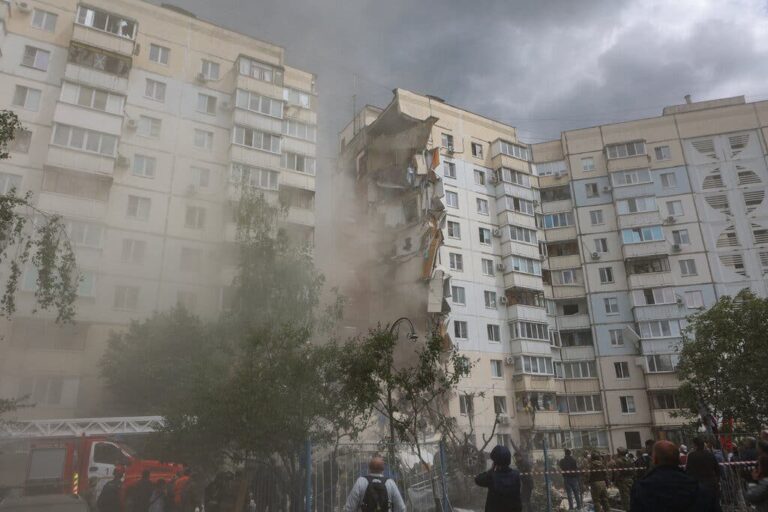
The aftermath of a Ukrainian attack on Belgorod, Russia, in May
BY M. K. BHADRAKUMAR | INDIAN PUNCHLINE | MAY 31, 2024
The United States’ proxy war with Russia is at another inflection point. The battleground is shifting dramatically to Russian territory — something without precedent even in the Cold War. How this pans out will be a momentous event in 21st century politics.
There are three defining issues here. One, the NATO strategy going forward, given the realisation in the West that there is no question of Russia being defeated in Ukraine; two, the constitutional crisis in Kiev with the presidential term of Vladimir Zelensky having run out on May 21; and, three, germane to all this, Russia’s intentions.
To be sure, the NATO and the EU are revamping their strategy while Russia hopes to remain “one foot ahead” of the West, as President Vladimir Putin put it.
Russia is not interested in an escalation as it is doing well in the war of attrition with Ukraine. Russia has effectively countered the US’ Mission Creep so far to push through all of its self-imposed limitations on aid to Ukraine and eventually breach those limits.
The big question today is how one could take the Biden Administration’s affirmation — stated by the White House National Security Council, the state department and the Pentagon — that it disfavours the use of western weaponry by Kiev to attack pre-war Russian territory.
An established pattern has set in whereby when Washington says some advanced weapon system is off limits for Ukraine, it actually turns out that Kiev just has to sit out for a few months so that Biden can cross the self-imposed red line.
Therefore, Russia will not take this as Washington’s final word. Curiously, the ground is being prepared to jettison the taboo, with both congressional Republicans and Secretary of State Blinken urging the White House to give the green light and both New York Times and Washington Post reporting that it is only a matter of time before the administration yields to formal American blessing to accelerate strikes on prewar Russia. (here and here)
The New York Times and Guardian reported on Thursday, in fact, a shift already in the US position that now allows Ukrainian US-supplied artillery to fire back at Russian batteries over the Russian border from Kharkov region and also to target concentrations of Russian forces massing on the border in Russia’s Belgorod region.
Meanwhile, a new phase is about to begin to conclude the Battle of Donbass, which, even after two years remains unfinished business. The entrenched Ukrainian military hubs in the region — Pokrovsk, Kramatorsk and Slovyansk — still threaten southern Donetsk Oblast.
Similarly, Volchansk on the Russian border facing Belgorod city and Kupyansk, also an important logistical point and railway node (almost 20 rail lines intersect in the town with about half track straight into Russia) are a thorn in the flesh for Russia’s border region.
Russians have openly stated that repeated raids into Belgorod city and its environs from the Kharkov Region needed to be countered with the creation of a “security zone”. Putin himself had spoken about this as early as in March.
From present indications, Russian operations are directed on two Ukrainian towns close to the border — Volchansk and Lypsti. Russia may stretch the front with a foray into Sumy oblast but any serious effort to capture either Sumy or Kharkov seems unlikely at this stage.
In an incisive analysis, the well-known Russia watcher Big Serge wrote last week, “The main purpose of these fronts will be to fix Ukrainian reserves in place and denude Ukraine’s ability to react on other fronts. This war will not be won or lost in Kharkov, but in the Donbas, which remains the decisive theatre.
“We currently appear to be solidly in the preparatory/shaping phase of a Russian summer offensive in the Donbas, which (likely among other things) will feature a Russian drive on the city of Konstyantinivka. This is the last major urban area shielding the advance towards Kramatorsk-Slovyansk from the south (remembering that these twin cities form the ultimate objective of Russia’s campaign in the Donbas.)”

Expected Russian summer offensive
Putin has strongly reacted to the recent proxy attacks on Russia’s strategic assets with western weaponry inside its territory. Putin warned that “this unending escalation can lead to serious consequences.”
As he put it, “long-range precision weapons cannot be used without space-based reconnaissance… the final target selection and what is known as launch mission can only be made by highly skilled specialists who rely on this reconnaissance data, technical reconnaissance data.
“For some attack systems, such as Storm Shadow, these launch missions can be put in automatically, without the need to use Ukrainian military… Launching other systems, such as ATACMS, for example, also relies on space reconnaissance data, targets are identified and automatically communicated to the relevant crews that may not even realise what exactly they are putting in. A crew, maybe even a Ukrainian crew, then puts in the corresponding launch mission. However, the mission is put together by representatives of NATO countries, not the Ukrainian military.
“So, these officials from NATO countries, especially the ones based in Europe, particularly in small European countries, should… keep in mind that theirs are small and densely populated countries, which is a factor to reckon with before they start talking about striking deep into the Russian territory. It is a serious matter and, without a doubt, we are watching this very carefully.”
Importantly, Putin underscored, “If Europe were to face those serious consequences, what will the United States do, considering our strategic arms parity? It is hard to tell. Are they looking for a global conflict? I think they wanted to agree upon strategic arms…We will wait and see what happens next.”
However, there are growing signs that the Biden administration may have simply mothballed the idea of western long-range weaponry being used to destroy Russia’s strategic assets deep inside its territory until the NATO summit gets over in Washington (9-11 July) so as to keep the flock together.
Equally, Biden may calculate that it is expedient to drum up tensions with Russia rather than leave the foreign policy turf to Israeli Prime Minister Benjamin Netanyahu who may land in DC to address the lawmakers. The Israeli National Security Advisor Tzachi Hanegbi told Israel’s Kan public broadcaster on Wednesday, “we are expecting another seven months of fighting” in Gaza. The Republicans are already flagging Middle East as the single biggest foreign policy goof-up by Biden. This is where the real risk lies.
There is a remarkable consistency in the Russian words that the depth of its proposed buffer security zone along the western borders will entirely depend on security considerations. The deputy chairman of Russia’s security council Dmitry Medvedev had explicitly stated recently that the security zone may not only include Kiev but also extend as far as the Polish border if the West sends Kiev long-range weapons. Significantly, on Tuesday, Putin called into question the legitimacy of Zelensky remaining in power in Kiev after his presidential term ended on May 21.
The ball is in Biden’s court. But the signs are not good. Germany, which is the US’s closest European ally, is apparently switching tack and now says that Ukraine’s “defensive action is not limited to one’s own territory, but [can] also be expanded to the territory of the aggressor.”
The chancellor’s spokesman said Berlin’s previous stance that Ukraine wouldn’t use German weapons on Russian soil had been “a statement of facts” that was true at that moment but did not necessarily apply to the future. He refused to reveal Berlin’s precise agreements with Kiev on using German weapons.
Almost half of Hungarians oppose any aid for Ukraine, only 16% support sending weapons
BY DÉNES ALBERT | REMIX NEWS | MAY 31, 2024
A new poll in Hungary shows that 46 percent of Hungarians believe that the European Union should not support Ukraine at any level, which was attacked by the Russians more than two years ago.
According to the poll conducted by Závecz Research on behalf of 24.hu, 32 percent of those polled are more permissive and would support EU assistance through financial, economic and humanitarian means, while only 16 percent of the population would also send arms and other military equipment to Ukraine.
The poll reveals that Orbán’s stance of supporting humanitarian aid for Ukraine while rejecting sending weapons is generally in line with what the population is willing to support, while there are still many Hungarians who want to take the step of cutting off support entirely.
Women back Orbán’s pro-peace position
Fifty-four percent of women are in favor of staying out of the war altogether, compared with only 38 percent of men. At the same time, a higher proportion of men (26 percent) would send weapons than women (10 percent).
In a breakdown by age groups, young and middle-aged people are more likely to be unwilling to provide any support (47 and 51 percent, respectively), while among those aged 60 and over, more people would definitely send some help, and only 41 percent are completely against doing so, the paper noted.
The survey also found that 40 percent in Budapest, 47 percent in cities, and 49 percent in towns and villages said they would not give any aid to Ukraine.
By level of education, 54 percent of those with primary education support a complete withdrawal from the war, while 43 percent support this position among those with secondary education. Among those with higher education, the proportion who support cutting all aid to Ukraine is only 34 percent, while 26 percent of this demographic would also support Ukraine with weapons.
US Weapons Already Used in Attempts to Strike Russian Territory – Kremlin
Sputnik – 31.05.2024
Attempts to strike Russian territory with US weapons are already being made, clearly indicating Washington’s involvement in the Ukraine conflict, Dmitry Peskov, press secretary of the Russian president, said on Friday.
“We are aware that attempts to strike Russian territory with American-made weapons are already being made. This is sufficient for us, and it clearly demonstrates the extent of the United States’ involvement in this conflict,” he told journalists.
Earlier, a US State Department representative told Sputnik that President Joe Biden had authorized Ukraine to use American weapons for counter-battery operations against targets on Russian territory that threaten the Kharkov region, while maintaining the ban on the use of ATACMS tactical missiles and other long-range strike systems.
The Kremlin agrees with Hungarian Prime Minister Viktor Orban’s opinion that Europe has entered an intermediate stage of preparing for war with Russia.
“We agree. There is absolute inflaming of pro-war sentiments and a deliberate stirring up of pre-war hysteria. And all of this, of course, cannot but have the most negative impact on the overall situation. The escalation of tensions continues,” Peskov said in response to journalists’ questions about whether the Kremlin agrees with Hungarian Prime Minister Viktor Orban’s statement that the longer the range of weapons that the West provides to Kiev, the further the Russian Army will advance.
Hungarian Foreign Minister Peter Szijjarto previously said that NATO wants to increase its coordination role in supplying weapons to Ukraine and training its soldiers. Thirty-one countries support this decision, but Hungary does not want to and will not participate. Prime Minister Viktor Orban said that in this manner, NATO is “sliding” into the conflict.
Meanwhile, NATO Secretary General Jens Stoltenberg said that allies expect Ukraine to act “in a responsible way” when using Western-supplied weapons to hit targets inside Russia.
“So many Allies have made it clear that they, of course, accept that Ukraine is using the weapons they have received to defend themselves, including by striking military targets inside Russia. Especially when those military facilities are used in attacking, directing attacks from Russian soil. Then, we all expect that this is done according to international law, and in a responsible way,” he said ahead of a NATO foreign ministers’ meeting in Prague.
Stoltenberg said this week that he favored lifting restrictions on the use of long-range Western weapons against “legitimate targets” inside Russian territory. The Kremlin said NATO allies were now directly involved in a military confrontation with Russia.
Why Israeli Military-Industrial Complex’s Dizzying Gaza War Profits Won’t Last
By Ilya Tsukanov – Sputnik – 30.05.2024
Israel’s defense sector has been making money hand over fist supplying weapons to the military for the war in Gaza, with profits going into the double digits, and order backlogs soaring to more than $50 billion. International affairs and security analysts told Sputnik what will stop Israel from sustaining this bonanza over the long run.
Israeli defense giants have been fruitful in multiplying their profits on the eve of the eight-month anniversary of the war in Gaza, with Israel Aerospace Industries (IAI), Rafael Advanced Defense Systems and Elbit Systems enjoying record bumps in stock prices and profits, nearly $15 billion in combined revenues in 2023, and an order backlog worth a whopping $52.4 billion.
The companies – which manufacture everything from drones and armored vehicles to the offensive and defensive missiles the IDF has used against Gaza fighters, Hezbollah in Lebanon and Yemen’s Houthi militia, expect the good times to continue to roll through 2024, with Elbit reporting Q1 profits of $1.55 billion in an earnings call this week – surpassing in quarterly terms the $6 billion the company raked in last year.
Israel is among the top ten weapons exporters in the world, accounting for nearly 2.5 percent of the global arms market between 2019 and 2023. Top clients include the United States, Britain, continental Europe, Azerbaijan, India and Vietnam, with sophisticated Israeli drones and missiles constituting among the top most sought after export articles.
Tel Aviv scaled back exports abroad from the fourth quarter of 2023 onward as the defense sector reoriented toward domestic needs – buoyed by US military assistance – which enables the Israeli government to spend part of its multibillion dollar American aid packages on weapons made in Israel, and supports joint air and missile defense research (preferences Washington doesn’t extend to any other major ally).
The Gaza campaign is a mixed blessing for Israel’s arms industry, observers have told Sputnik, pointing out that while Israeli defense giants may benefit over the short term from the present spike in orders, Tel Aviv’s diplomatic reputation coming out of the crisis may not be what it was when it entered it.
“I don’t think it’s been the most illustrious military weapons show,” veteran international and military affairs observer and former US Army Lieutenant Colonel Earl Rasmussen told Sputnik, when asked whether Israel’s defense industry has benefited or been damaged by the IDF’s Gaza operations.
“I would think some of their demand may diminish,” Rasmussen said, pointing out that besides the reputation of Israeli weapons, there is the country’s international political reputation to account for.
“In the political sense, Israel has isolated themselves due to what’s going on in Gaza. And also you see that what should have been a very quick entrance in and exit out has now dragged on for seven months, and I don’t know if there’s any end in sight until they level the entire Gaza Strip,” the veteran soldier said.
“Ukraine may still engage with them for military sales…but I would not be surprised if a lot of other foreign militaries and countries interested [in some of Israel’s] really good technology may be more hesitant and may look at other opportunities or competing technology,” given what can only be described as the “genocide” and “ethnic cleansing” taking place in Gaza, Rasmussen said.
Veteran Italian former diplomat and prime ministerial foreign policy advisor Dr. Marco Carnelos concurs with this assessment, telling Sputnik that while militarily, the Gaza campaign may have brought Israel’s military establishment some benefits, politically it has been suicidal.
“Politically speaking I do not see any way in which Israel has been benefiting from waging the war in Gaza. Its top leaders received arrest warrants from the International Criminal Court and a judgement for genocide is pending against Israel at the International Court of Justice,” Carnelos said.
“Militarily speaking [Israel’s] armed forces gained further knowledge and expertise in carrying out urban warfare in Gaza in the [past] seven months, maybe testing new techniques and weapons. It is the same for its foes – who after widespread destruction are still capable of engaging Israeli forces,” the observer said. “The real question remains: was it worth this political debacle to get better military experience? I strongly doubt it. Israel’s deterrent power is probably over and the political and strategic consequences could be huge,” Carnelos added.
Israel’s deterrent capabilities and reputation in the eyes of the world have taken a beating over the course of the Gaza crisis, with Hamas proving able to hold its own through seven plus months of intense Israeli bombardment and ground operations across the bombed out ruins of the 365 square kilometer strip of land, the IDF and its US and European allies proving unable to stop Yemen’s Houthi militia from essentially shutting down the Red Sea to Israeli-linked shipping, and Israel and Hezbollah engaging in months of deadly skirmishes along the Lebanese border.
But perhaps nowhere were the limits of Israeli (and by extension NATO) power demonstrated more thoroughly than during Iran’s April 14 drone and missile barrage targeting Israel. The Islamic Republic managed to land multiple projectiles at the Negev Desert air base the IDF used to strike Iran’s Embassy compound in Damascus on April 1, as well as an intelligence collection facility in northern Israel, despite advance warning and Israeli defenses being shored up by military assets belonging to the US, the UK and Jordan. For the first time since the 1973 Yom Kippur War, Israel’s adversaries were able to demonstrate that the Jewish state – while a regional military powerhouse, is certainly not invincible.
For a Fistful of Shekels: Israeli Defense Contractors’ Profits Boom as Economy Takes a Beating

By Ilya Tsukanov – Sputnik – 30.05.2024
With the world watching in horror as the raging Palestinian-Israeli conflict approaches its eight month anniversary, arms makers continue to quietly make a tidy profit from the war. Israel’s domestic defense sector is no exception.
US business media has warned of the “haunting parallels” between Israel’s ballooning military expenditures amid the Gaza War and the country’s 1970s ‘lost decade’ of surging inflation, out of control budget deficits, stagnant growth and faltering investor confidence.
Israel’s Central Bank expects the war in Gaza to cost a whopping 250 billion shekels ($67.4 billion US) through 2025, as defense spending as a share of GDP jumps from 5.3% to 9%. That’s amid increasingly dour circumstances in the civilian economy, with Q4 of 2023 seeing Israel’s GDP drop by over 20%, while consumption dropped 27% and investment by 70%.
Most worrying of all for Tel Aviv is the potential loss of investment flows – particularly in the tech sector. “We can’t even begin to measure how many people have decided not to invest in Israel in the short term, let alone on a permanent basis,” Shoresh Institute economist Dan Ben-David told Bloomberg in a report published Thursday.
But as the civilian economy suffers, Israel’s arms makers have no complaints, boasting record profits, buoyed by Washington’s nod to an unprecedented $17 billion in new military aid (more than five times the $3 billion+ Tel Aviv has been getting from the US annually since the early 1980s). A portion of the funds can be spent on Israeli-made weapons – a privilege not granted to other US allies, with roughly half a billion dollars also typically slated for Israeli-US joint research in missile defense.
Israel’s top three defense giants – Israel Aerospace Industries (IAI), Rafael Advanced Defense Systems and Elbit Systems have enjoyed surging stock prices and orders growing at a pace beyond their ability to keep up.
- IAI reported a 7% growth in sales to $5.3 billion in 2023, a 49% jump in net profit, with production ranging from drones, missiles, bombs, radars and electronic warfare articles to space-based defenses. Its order backlog has soared to $18 billion.
- Rafael – makers of Tamir missiles for the Iron Dome and an array of other air defense and anti-tank missiles and drones, saw a record 21% increase in sales and a whopping 85% increase in order volume, with net profits hitting $158 million – a 17% jump from 2022, and the backlog of orders reaching over $14 billion.
- Elbit, makers of much of the “guts” of Israeli weapons, plus drones, communications equipment, small arms, cluster munitions and armored vehicles, saw profits jump 8% in 2023, with revenues reaching nearly $6 billion, and Q1 2024 results this week showing $1.6 billion in revenues, and a $20.4 billion order backlog.
The US is the World Leader with No Pier

By Bill Buppert | The Libertarian Institute | May 30, 2024
Yet another existential chaos avalanche in American foreign policy.
The pier took two months and $350m to build, lasted 12 days, and delivered less than 60 trucks’ worth of food (most of which was stolen after it reached Gaza) before it broke and had to be towed away for repairs. Think through the process: ships provide a mass delivery mechanism for cargo and the draft of a ship prevents it from getting close to shore hence the need for pier structures for off-loading and the US spends a third of of billion dollars for a temporary structure to facilitate the off-loading. Weather conditions and sea states are not a mystery and for those keen enough to observe, the facilitators of this disaster had access to all the historical data to know what to do and whether to proceed ahead with the project.
And, remember, this is the same US foreign policy that provides military aid, even now, that necessitated the need for the temporary pier in the first place.
This debacle is a demonstration project of the American experience in the Middle East.
France plans to send military instructors to Ukraine – Reuters
RT | May 30, 2024
France could announce that it will send military instructors to the country during a visit to Paris by Ukraine’s Vladimir Zelensky, despite widespread concerns from some allies and criticism from Russia, Reuters has reported, citing diplomatic sources.
Zelensky, whose presidency expired on May 20, visited Paris for talks with French President Emmanuel Macron two weeks ago, and will return next week to attend a ceremony marking 80 years since D-Day, the start of a large-scale operation by the Allies against Nazi Germany during World War Two.
The unnamed diplomats told Reuters that Paris hoped to forge and lead a coalition of countries that would offer training assistance to Kiev. France reportedly would initially send a limited number of personnel to assess the modalities of a mission before dispatching several hundred trainers.
Training would focus on demining, equipment and warplane maintenance, to be provided by the West. Paris would also finance, arm, and train a Ukrainian motorized brigade, Reuters added.
“The arrangements are very advanced, and we could expect something next week,” the agency cited one of its sources.
Ukraine’s top general Aleksandr Syrsky said earlier this week that he had signed papers allowing French personnel to visit training centers in Ukraine “soon,” to familiarize themselves with infrastructure and staff.
Over the past few months President Macron has repeatedly insisted he would not rule out the possibility of NATO member states sending troops to Ukraine. According to the French leader, his policy of “strategic ambiguity” is intended to keep Moscow guessing about the US-led bloc’s intentions and the lengths it is willing to go to in support of Kiev.
Some of France’s NATO partners fear that the bloc’s boots on the ground in Ukraine could make a direct conflict with Russia more likely. German Chancellor Olaf Scholz has said that Berlin will not do anything that places it in direct conflict with Russia. German Defense Minister Boris Pistorius has also spoken out against German instructors training Ukrainian soldiers in the country.
The US remains publicly opposed to sending instructors to Ukraine while Hungarian Foreign Minister Peter Szijjarto has described statements about sending troops to Ukraine as “crazy”.
Russian President Vladimir Putin said on Tuesday that Western military instructors “have long been present” in Ukraine. Acting as mercenaries, they service high-precision weapons sent by NATO countries and are suffering losses, Putin stated.
The Russian Foreign Ministry said earlier this month that the French leadership’s “belligerent rhetoric” and provocative statements around Ukraine are escalating the conflict.
Top Hungarian Diplomat Criticizes NATO Plans to Let Ukraine Strike Inside Russia
Sputnik – 30.05.2024
Hungarian Foreign Minister Peter Szijjarto decried NATO plans to let Ukraine use Western-supplied weapons to hit targets in Russia as “insane,” warning that Russia’s response would be multifold.
“I think it is an insane idea because, as we have seen before, Russia will respond. There is no lack of munitions or equipment in Russia. Its response will be multifold,” Szijjarto told Hungarian reporters in Brussels.
The Hungarian minister called for an end to “this madness” before it spiraled out of control.
Szijjarto also criticized a proposal made by NATO chief Jens Stoltenberg that NATO take over the coordination of military aid to Ukraine, giving the alliance a more active role in the conflict. Szijjarto argued that NATO was wiping out its own red lines.
Earlier in the week, NATO Secretary General Jens Stoltenberg confirmed he was in favor of lifting restrictions on the use of Western weapons on “legitimate targets” on Russian territory.
Over 500,000 people expected to attend largest pro-peace march ever in Hungary

A photo from the last peace march in Budapest in 2022, which saw nearly half a million take to the streets calling for an end to war in Europe.
BY DÉNES ALBERT | REMIX NEWS | MAY 30, 2024
Hungary is gearing up for the largest pro-peace march in the nation’s post-communist history on June 1, with over half a million people expected to attend in Budapest. Among the attendees will be Prime Minister Viktor Orbán, who will deliver a speech at the event calling for peace in Europe, a message he has continually promoted since the war broke out in Ukraine.
“This time we are preparing for the biggest peace march ever, we have never received so many messages from Hungarians in Hungary and abroad,” Zoltán Lomnici Jr., spokesman of the Civil Union Forum (CÖF) and the Civil Union Public Benefit Foundation (CÖKA), told Magyar Nemzet.
The constitutional lawyer noted that this year, on June 1, the peace march, which was first launched in 2012 by CÖF-CÖKA and its intellectual defenders, will be organized for the tenth time. The peace marches are the largest civil initiatives following regime change in Hungary in 1989 and have seen the largest crowds gather for any political or social mobilization.
In a country of nearly 9.7 million, if the protest actually manages to attract a crowd of 500,000, it would equal a crowd of 4 million in Germany proportionally speaking.
“The organization of a pre-election peace rally is an excellent opportunity for the courageous civilian supporters of peace to voice their firm commitment to peace, thus legitimizing the line taken by the civilian-national government on the issue of war and potentially contributing to the advance of the pro-peace forces that have long been the hallmark of genuine civil society in the EU,” said Lomnici.
At the last peace march in 2022, nearly half a million people took part, according to CÖF-CÖKA President László Csizmadia. The first peace march was organized in 2012 in support of Viktor Orbán’s government standing up to what he called EU blackmail.
Hungarians overwhelmingly support a ceasefire in the conflict in Ukraine, according to numerous polls. Despite the left’s history of anti-war stances, the left-liberal parties in power in Europe are now the biggest promoters of continued war in Ukraine, while Hungarian Prime Minister Viktor Orbán is now the only leader calling for a ceasefire besides Slovak Prime Minister Robert Fico, who remains in the hospital with severe wounds after an assassin shot him numerous times over his stance on Ukraine.
The peace march in Hungary is expected to be a show of force in support of peace in the country, a point reaffirmed by Lomnici. The constitutional lawyer said that such a mass event demonstrates social power and is undeniable proof of the will of a people, which, in Hungary’s case, is a desire for peace.
According to Lomnici, the importance of the event and the cause it represents — a stand for peace — is supported by the fact that Prime Minister Viktor Orbán will be present and will speak at 3 p.m.
First, this shows that the government considers the cause of peace to be of strategic importance. Second, people can see and hear the prime minister in person, which strengthens trust and a sense of direct political involvement in the cause for peace.
Third, it represents a guarantee that the people who voted for the prime minister know he remains dedicated to pursuing peace in Europe despite enormous pressure, including potential threats on his life. This guarantee means that Hungary will not allow itself to be dragged into a war that is still escalating rapidly right at Hungary’s doorstep, which also affects Hungary’s fellow citizens in Transcarpathia, home to 150,000 ethnic Hungarians, many of whom have already lost their lives at the frontlines in Ukraine.
According to Lomnici, Hungary’s sovereign pro-peace position must be respected by all decision-makers in Europe and in the Western alliance systems.
Minsk Forced to Suspend CFE Treaty to Ensure National Security – Foreign Ministry
Sputnik – 29.05.2024
MINSK – The decision of Belarus to suspend the Treaty on Conventional Armed Forces in Europe (CFE) is a forces response step aimed at ensuring the country’s national security, the Belarusian Foreign Ministry said on Wednesday.
On Tuesday, Belarusian President Alexander Lukashenko signed a bill to suspend the CFE Treaty into law, according to the country’s legal portal.
“The decision of the NATO member states to suspend the CFE Treaty left us no choice. The suspension of the CFE Treaty by Belarus is a forced response step aimed at ensuring the country’s national security against the backdrop of the destruction of the existing conventional arms control regime in Europe and the continuing escalation of military-political tensions in the region,” the ministry said in a statement.
Minsk was ready to implement the CFE Treaty, even despite the unfriendly steps of some countries, the ministry said, adding that Belarus will be ready to resume the agreement provided that NATO countries return to its implementation as well.
Belarus remains committed to conventional arms control to ensure security and is ready for dialogue with all interested countries, the statement read.
Ukraine striking targets deep inside Russia with Western weapons – AFP
RT | May 29, 2024
Ukraine has used Western weapons against targets inside what it recognizes as Russian territory on multiple occasions, Agence France Presse (AFP) has claimed.
Some senior Western officials have urged nations that donate longer-range munitions to Ukraine not to ban their use deep inside Russia, while others have publicly objected to the idea. A restriction against such strikes has notably been imposed by the US, the main supplier of arms to Kiev. Washington has said the ban is meant to prevent an escalation of the conflict, and has made no indication that it will be lifted.
On Tuesday, the news agency cited several experts, who believe that donors should not be concerned, because several other Russian red lines have supposedly been crossed without consequence.
”Western weapons have already been used on several occasions against Russia’s territory, most recently against the southern town of Krasnodar, several Western sources said,” the report claimed.
AFP offered no details on those incidents or the weapons involved. British Foreign Secretary David Cameron has publicly stated that Ukraine “has the right” to hit targets in Russia with UK-made arms.
Last week, a Ukrainian intelligence source claimed that the country had targeted an early warning radar station based in Russia’s Krasnodar Region on May 22, and later another site in Orenburg Region.
Both locations have roles in nuclear deterrence. Their primary task is to detect an incoming missile and give the military enough time to launch a retaliation before nuclear weapons hit Russian territory.
The claim was given some credence by Dmitry Rogozin, a former senior Russian military official and now a lawmaker. He said it could be false, but if true, it means that Washington “has hired a reckless bandit, who is trying to damage… a key element of our system of strategic nuclear forces combat control.”
According to public statements by the Russian leadership, the country does retaliate when its red lines are crossed in the Ukraine conflict. After Kiev damaged the Crimean Bridge with a truck loaded with explosives in 2022, Moscow added Ukraine’s power grid to its list of military targets.
This year’s campaign of Ukrainian kamikaze drone raids on Russian oil facilities resulted in retaliatory missile strikes against Ukrainian thermal power stations. As of this week, all of them were either destroyed or damaged, according to Yury Boyko, a senior Ukrainian energy official.
US is Flirting With Idea of ‘Limited’ Nuclear Conflict With Russia and China
By Ekaterina Blinova – Sputnik – 29.05.2024
Washington is considering the deployment of nuclear-armed cruise missiles on Virginia-class attack submarines to deter China and Russia, according to the Asia Times.
US lawmakers have recently focused on how to modify Virginia-class attack submarines (SSN) to install nuclear-armed sea-launched cruise missiles (SLCM-N). Last week they summoned Vice Adm. Johnny Wolfe to discuss the complexities and uncertainties concerning arming attack submarines with SLCM-N. The discussion revolved around enhancing their nuclear deterrence against China and Russia, according to the Asia Times.
The SLCM-N is a cruise missile with a low-yield nuclear warhead launched from surface ships or attack submarines (SSNs). It was first proposed in 2018 alongside the low-yield version (with less than 10 kilotons of explosive power) of the W76 warhead to arm long-range ballistic missile submarines.
What are the SLCM-N program’s merits in the eyes of American lawmakers, military, and scholars?
First of all, US military experts argue that SLCM-Ns would allow the US to engage in a “limited” nuclear exchange in contrast to “massive retaliation”.
“If conflict crosses the nuclear threshold, lower yields would signal a clear interest in limiting its intensity,” wrote Lieutenant Commander Alan Cummings, US Navy Reserve, for US Naval Institute in April 2024.
In addition, using theater-based nuclear-armed sea-launched cruise missiles might not be seen as “legitimizing” a nuclear retaliatory strike on the American homeland, according to US military experts. They suggest that it would make it hard for American adversaries to immediately identify the origin of the strike after an attack.
Placing SLCM-Ns on US attack submarines will allow the Pentagon to maintain a widespread and enduring presence in the North Atlantic, Arctic Ocean, and Asia-Pacific, according to Kyle Balzer of the American Enterprise Institute.
“Due to the low observability of undersea launchers, Beijing and Moscow will have to assume it is loitering on site,” wrote Balzer for Breaking Defense on February 28. “If deployed on select surface ships, as well as submarines, the deterrent effect could be even greater.”
Balzer pointed out that the deployment of SLCM-Ns on attack subs and surface ships would create an atmosphere of ambiguity: Russia and China wouldn’t be sure if the vessels are nuclear-armed or not, thus complicating decision-making and creating additional deterrence.
“China and Russia would have to assume SLCM-N’s presence — whether or not it is deployed, in great numbers, to forward areas. In this sense, there is considerable deterrence value and cost-effectiveness in ambiguity,” argued the scholar.
American lawmakers have been pushing ahead with the program for the last several years. While the United States has not deployed a nuclear-armed sea-launched cruise missile since 1991, the Trump administration argued in 2018 that the SLCM-N would “provide a needed non-strategic regional presence” in Europe and Asia and contribute “to deterrence and assurance of allies, especially in Asia.”
The SLCM-N program was reversed by President Joe Biden in 2022 as an excessive and costly solution. Nonetheless, after a heated debate, the initiative was passed within the framework of the National Defense Authorization Act for fiscal year 2024 under the pretext of Russia’s special military operation and China’s alleged plans to “invade” Taiwan. It became law in December 2023 with instructions to achieve operational capability of the SLCM-N by 2034.
Is ‘Limited’ Nuclear Conflict Possible?
Russia has repeatedly warned the US against lowering the nuclear threshold and hypothesizing a possibility of a limited nuclear exchange. According to Moscow, the “limited” use of nuclear weapons by no means reduces the risk of an all-out nuclear war, but rather invites it.
Commenting on Washington’s plans to deploy low-yield nuclear arms on its submarines or surface vessels in April 2020, Russian Foreign Ministry spokeswoman Maria Zakharova condemned the move as destabilizing.
“Those who like to theorize about the flexibility of American nuclear potential must understand that in line with the Russian military doctrine such actions are seen as warranting retaliatory use of nuclear weapons by Russia,” Zakharova said.
In May, the Russian Foreign Ministry warned NATO against delivering F-16 fighter jets to Ukraine, given that the war planes could carry low-yield nuclear B61-12 bombs. Moscow said it will treat F-16s in Ukraine as nuclear-capable weapon systems, regardless of their model, and will consider their deployment a deliberate provocation.
China has also repeatedly lambasted Washington for switching to low-yield nuclear arms as a return to the Cold War era. Beijing also raised the alarm over AUKUS (Australia, UK and US pact) plans to build nuclear-powered submarines in Australia as violating non-proliferation principles. Both Russia and China pursue a no-first-use nuclear doctrine.
Featured Video

Benoit Paré: OSCE Whistleblower: The Ukraine War – Narratives vs. Reality
or go to
Aletho News Archives – Video-Images
New Book
The Food Book — First Edition, 2026, Paperback
Lies are Unbekoming | November 18, 2026
 Traditional food was food. Not organic food. Not slow food. Not wellness food. Food. Bone broth was food. Raw milk was food. Fermented vegetables were food. Butter was food. Eggs were food. Honey was food. Liver was food.
Weston Price travelled from 1931 to 1936 across fourteen populations — Swiss villagers in the Lötschental valley, Gaelic communities in the Outer Hebrides, Inuit in Alaska, Native Americans in northern Canada, Māori in New Zealand, Masai in Kenya, Melanesians in the South Pacific, Peruvian Indians in the Andes. He photographed their faces. He measured their dental arches. He weighed their vitamin and mineral intake. He published the results in 1939 in Nutrition and Physical Degeneration. The pattern was consistent across every population. The generation raised on ancestral foods had broad faces, straight teeth, strong bone structure, and virtually no chronic disease. The generation raised on refined flour, refined sugar, and canned goods did not.
What has not been treated at book length, until now, is the whole shelf — the twenty works that, taken together, describe what the traditional kitchen was, what industrial food replaced it with, and what the body does when the replacement runs for a century.
The Food Book reads twenty of those works as a single library: Weston Price and Sally Fallon on the tradition that was lost; Francis Pottenger on what cooking does to a species over four generations; Sandor Katz on fermentation as an ecology; William Dufty on the two-and-a-half-century history of refined sugar; William Campbell Douglass on raw milk; James DiNicolantonio on the inversion of the salt argument; Max Gerson on cancer; Ulric Williams on medicine as a cartel; William Engdahl on seed sovereignty; Stephen Harrod Buhner on what plants do, chemically, that pharmaceuticals disrupt. … continue
Blog Roll
 Aletho News
- Tom Friedman’s Deceptive Attempt to Lure Democrats to Escalate the Iran war
- Russia Warns of Response if Nuclear Deployment Limits Near Its Borders Are Lifted
- Putin is Partly Right on NATO
- The trillion-dollar question: Why can’t machines replace soldiers?
- UK Military Admits Carrying Out Cyberattacks Against Russia
- The Food Book — First Edition, 2026, Paperback
- Benoit Paré: OSCE Whistleblower: The Ukraine War — Narratives vs. Reality
- UK forced to admit ordering backdoor access to Apple users’ data
- It’s not about China or national security. It’s about which foreign entity is allowed to spy on Americans
- Banning Palestine activists from the West will not save Israel’s image
- If Americans Knew
- An error has occurred; the feed is probably down. Try again later.
- No Tricks Zone
- Argentina’s Perito Moreno Glacier Joins Antarctica and Arctic In Defying Doomsday Melt Claims
- New Study: Barents Sea Temperatures Were Warmer And Sea Ice Less Extensive In The 1700s Than Today
- German Authorities Start Initiative To Evaluate Public Register For Climate “Disinformation” Spreaders!
- Zonal Asymmetry of Temperature Change in the Antarctic Circumpolar Current
- New Study: The Net Fossil Fuel Contribution To Rising Atmospheric CO2 Has Been Zero For 500 Years
- Germany’s Green Energy Transition Becoming Increasingly Expensive…Another 6 Trillion Euros!
- Sudden Stratospheric Warming, Powerful El Niño Combination May Lead To Extreme Europe Cold, Energy Crisis!
- Two New Studies Find Thwaites Glacier Melt Cannot Be Driven By Human Activity Or A Warming Ocean
- E-Cars Reduce CO2 Emissions By Only 41% Compared To Internal Combustion Engine Vehicles
- Predictions Made By Renowned Climate Professor Over Past Decades Have Been Proven To Be Poor

