US to Allocate $40Mln in Defense Aid to Argentina Wishing to Be NATO’s Partner – Embassy
Sputnik – 19.04.2024
The United States will allocate $40 million to support defense modernization of Argentina, which has declared its intention to become NATO’s global partner, the US Embassy in Buenos Aires said.
On Thursday, Argentine Defense Minister Luis Alfonso Petri said that Buenos Aires wanted to become NATO’s global partner and had already submitted a corresponding request. NATO Deputy Secretary General Mircea Geoana welcomed the request, saying that closer political and practical cooperation could benefit both parties.
“The United States is proud to announce that it is providing $40 million in Foreign Military Financing (FMF) to support Argentina’s defense modernization,” the embassy said in a statement released on Thursday.
The diplomatic mission noted that such support is provided only to the US’s important partners.
Argentina will be able to purchase defense products, training services, and improve interaction thanks to US military aid. The funds will also contribute to Argentina’s purchase of F-16 fighter jets, the statement read.
In November 2023, Javier Milei won the runoff presidential election in Argentina. During the presidential campaign, Milei spoke against joining BRICS and cooperating with China, Brazil and Russia, and advocated a foreign policy oriented toward Israel and the United States.
Iran’s air defenses down drones over Isfahan, Tabriz
Al Mayadeen | April 19, 2024
No external aggression on Iran occurred after Friday midnight, Iranian sources informed on the matter told Al Mayadeen.
Following circulating news on Western-based media outlets, regarding a supposed Israeli attack on Iran, sources told Al Mayadeen that such an event did not occur. Instead, Iranian air defenses repelled a relatively small drone attack in Tabriz and Isfahan, which were likely launched domestically.
What is being circulated about an Israeli attack on Iran are lies and are part of a misinformation war, according to our sources.
Iranian sources also added that complicit United States media outlets are waging a proxy war of disinformation on behalf of the Israeli occupation.
This comes after Iran’s Space Agency confirmed that several drones, of unspecified origin, were downed over Iranian airspace. The agency said that no missile attack on Iran occurred on Friday.
The Islamic Republic News Agency (IRNA) said that short-range and medium-range Iranian air defense batteries repelled the attack.
Earlier, Iran’s Mehr News Agency, citing the Director General of the Iran Airports and Air Navigation Company, said that all air traffic was suspended in Isfahan, Shiraz, and Tehran. Iranian media outlets reported that air defense systems were activated in Isfahan, as explosions of an unknown cause were heard.
Al Mayadeen’s correspondent, citing the spokesperson of the Iranian Space Agency, said that air defense batteries responded to three targets over Isfahan. He added that reports indicate that air defenses responded to threats in Qahjavarestan, northeast of Isfahan, as no aerial objects hit ground targets.
Our correspondent stressed that all of the explosions heard on Friday were a result of air defense interceptions.
The Islamic Republic News Agency reports that air defenses were activated in Tabriz, in northern Iran, resulting in a series of explosions. The agency added that no aerial objects hit ground targets in Tabriz and that all loud sounds were a result of interceptors exploding over Tabriz’s sky.
Wheels Within Wheels: Complexity is Real in War
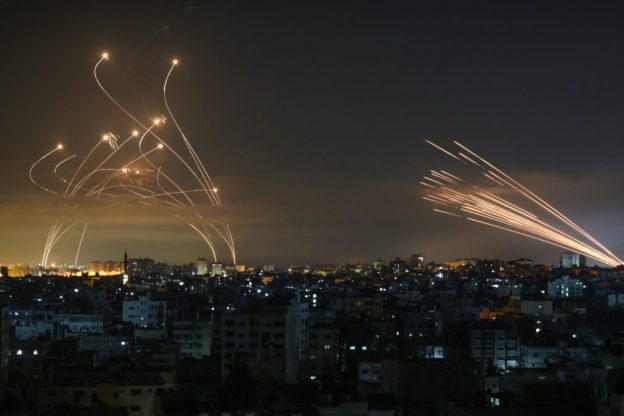
By Bill Buppert | The Libertarian Institute | April 18, 2024
Sober observers may find another reason for the Iranian attack against Israel this month in retaliation for the Israeli bombing of the Iranian consulate annex building adjacent to the Iranian embassy in Damascus, Syria on April Fools Day.
May I suggest it is more important in this case to exhaust the kinetic Israeli/US air defense assets and accuracy doesn’t matter as long as exquisite munitions are exhausted; whether shoot/shoot/look or shoot/look/shoot which is a slight permutation on dynamic retasking, controlled pairs or more of air defense munitions are launched as a matter of course to service incoming ordnance. If the object here is to empty the western magazine cupboards by sending your older and less effective munitions aloft (Iran), mission accomplished and you have a very sufficient intelligence mapping of Israeli Anti-Access Air Defense (A2AD) dispositions and tactics, techniques and procedures (TTP) for follow-on responses.
Nations and regions do stumble into war precipitously but there are conflicts in history where the weaker opponents plan and shape the conditions to prevail before the conflict is started; Vietnam is the best example in recent history of reading the tea leaves and setting the stage for success against superior forces.
The west has a manufacturing crisis right now that is existential in restocking and reconstituting the emptying stocks of war materiel. One can either favor or oppose doing that but the fact remains the manufacturing base and capability is an open question for America and its allies.The chaos avalanche of the competency crisis, the reproducibility problems in STEM research & application and the very real infrastructure failures increasing in frequency year by year doesn’t bode well for those wishing to replenish the diminished war stocks potentially reconstituting with stuff that simply doesn’t work.
The second 155mm artillery shell manufacturing plant in the west just went up in flames in the UK in less than a week. One in Scranton Army Ammunition Plant in PA and the BAE Systems Glascoed Plant in Monmouthshire, UK.
In war, there is a lot to be said for how to leverage shaping the conflict left of bang.
I’m fond of saying that many people are in charge but no one is in control.
Ukrainian soldiers threaten to go AWOL if they are not demobilised
By Ahmed Adel | April 18, 2024
According to the Ukrainian portal Strana, Kiev is facing problems in increasing the number of military personnel as a new mobilisation law will take at least eight months to be imposed. Worsening the situation, military personnel in Odessa are threatening to abandon their positions and even kill if the new law does not allow them to demobilise.
On April 11, Ukraine’s Verkhovna Rada (Parliament) approved a bill on expanding mobilisation for the military. The National Security and Defence Committee removed the provision on demobilisation from the bill on the eve of its presentation to the Verkhovna Rada for its second reading. Dmitry Lazutkin, a representative of the Ukrainian Ministry of Defence, later said that a separate bill on demobilisation was planned, which would take eight months.
Ukrainian journalists in Odessa questioned military personnel about their thoughts towards the government’s decision to exclude demobilisation from the bill on military conscription.
In that case, “I will leave the unit without permission,” one of the soldiers told the Ukrainian portal Strana.
Another Ukrainian serviceman said that the deputies of the Verkhovna Rada should go to the front on an equal footing with them, whilst another believes that changes are necessary in the country and that it is not possible to fight with the same soldiers all the time, making demobilisation necessary.
“I’ll shoot them all. They don’t have such a right… So now I get up and go back to the war whilst they have grown their bellies and will sit in the Verkhovna Rada? This shouldn’t happen,” said another soldier.
“There is the expression ‘Servant of the People.’ It is not we who must serve them, but they who must serve us,” added another, in reference to the name of the ruling party founded by Ukrainian president Volodymyr Zelensky.
These threats to go AWOL come as the New York Times reported that since the start of Russia’s special military operation, thousands of Ukrainian men have attempted to flee across the Tisza River from mandatory conscription. According to Romanian authorities cited by the American newspaper, approximately 6,000 men have arrived in their country across the river since February 2022.
“That thousands of Ukrainian men have chosen to risk the swim rather than face the dangers as soldiers on the eastern front highlights the challenge for President Volodymyr Zelensky as he seeks to mobilize fresh troops after more than two years of bruising, bloody trench warfare with Russia,” noted The New York Times.
The new law toughens penalties for attempting to evade military conscription and aims to increase the number of troops on the frontline. The newspaper also highlights that many of the Ukrainians who rushed to volunteer have fought continuously since 2022, with only two weeks of annual leave.
“Soldiers are enlisted until the end of hostilities, with no defined date for release from their obligation to serve. With casualty rates high, being drafted, soldiers say, is like getting a one-way ticket to the front,” the New York Times reported.
The escape of Ukrainians from the country has allowed human trafficking to flourish. In 2023, for example, the Mukachevo Border Guard dismantled 56 criminal gangs involved in this activity.
According to Lieutenant Lesya Fedorova, spokesperson for the Mukachevo Border Guard unit, and whom the newspaper cited, the cost to be taken to the other side of the Ukrainian border currently amounts to $10,000. This is incredibly expensive when considering that the average monthly salary is about $500.
Crossing to the Romanian side via the Tisza River also carries dangers, with Fedorova reporting that at least 22 bodies have been found on the river’s banks, with many more likely having drowned but never found. Yet, this is a risk Ukrainians are evidently willing to take since deployment to the frontlines all but guarantees death or permanent injuries.
It is evident that the new mobilisation law will struggle to recruit the 450,000-500,000 men the Kiev regime is believed to want since there is no morale among the general population and because all those who are motivated to fight have already volunteered. Failure to mobilise enough men will also lead to active soldiers abandoning their posts or even mutiny, a scenario which will be devastating for the country once Russia launches its offensive, expected at the end of spring or summer, and the Ukrainian military is driven back with high casualty numbers.
Ahmed Adel is a Cairo-based geopolitics and political economy researcher.
NATO member explains why it will bar Ukraine from joining
RT | April 17, 2024
The risks of a global war will only increase if Ukraine becomes part of NATO, Slovakian Prime Minister Robert Fico said on Tuesday, promising to block Kiev’s accession.
Accepting new countries into the US-led military alliance requires unanimous consent from all of its 32 current members. If Ukraine gets invited to join NATO, Slovakia’s parliament will not ratify the accession treaty, Fico said.
“Slovakia needs a neutral Ukraine. Our interests will be threatened if it becomes a NATO member state because that is the basis of a large world conflict,” the prime minister explained, as quoted by the news website Noviny.sk.
Fico stressed that he will not bow down to any outside pressure. “Our partners abroad have been taught that whatever they ask and request from Slovakia, they will automatically get it. But we are a sovereign and self-confident country,” he said.
Slovakia, together with neighboring Hungary, has warned that the EU should not be dragged into the conflict between Russia and Ukraine and has insisted on a diplomatic resolution. After becoming prime minister in October 2023, Fico reversed the previous government’s decision to send weapons to Kiev. He also fiercely opposes sending NATO troops to Ukraine.
Ukraine formally applied to join NATO in September 2022. Although US Secretary of State Antony Blinken reiterated this month that Ukraine “will become a member of NATO” sometime in the future, the alliance has so far refused to commit to a specific timetable or provide a clear pathway for Kiev’s accession. US President Joe Biden and NATO Secretary General Jens Stoltenberg have ruled out Ukraine’s membership until the fighting ends.
Russia has repeatedly stressed that it views NATO’s continuing expansion eastward as a national security threat. Moscow cited the alliance’s military cooperation with Ukraine as one of the root causes of the current conflict and described Ukraine’s potential accession as a “red line.”
US Navy Depletes $1Bln Worth of Weapons in Middle East in 6 Months – Secretary Del Toro
Sputnik – 16.04.2024
WASHINGTON – The US Navy needs to replace about $1 billion worth of munitions that it used to combat attacks on Red Sea shipping and defend Israel over the last six months, Navy Secretary Carlos Del Toro said in testimony to the Senate Appropriations Committee on Tuesday.
“Over the course of the last six months we have actually countered over 130 direct attacks on US Navy ships and merchant ships,” Del Toro said. “We currently are approaching $1 billion in munitions that we need to replenish at some point in time.”
Del Toro emphasized that it would be “critical” for Congress to pass a national security supplemental in order to replace the weapons, which include SM-2, SM-3 and SM-6 missiles.
The national security supplemental passed by the US Senate includes $2 billion in funds for the US Navy that would be used to replenish the weapons, he added.
“Mobilisation has turned into a real nightmare for Ukrainians” – former PM Mykola Azarov

By Ahmed Adel | April 16, 2024
Former Ukrainian Prime Minister Mykola Azarov (2010-2014) has described the Kiev regime’s forcible conscription of civilians into the military as “a real nightmare for Ukrainians.” His comments come as the New York Times said that Ukrainian soldiers are being battered and exhausted by Russian forces.
“Territorial recruitment centres in Ukraine (…) began to use weapons against those who try to resist the anarchy and permissiveness they are perpetrating,” Azarov wrote on his Telegram channel.
As Azarov revealed, Anton Kudrich, an ordinary Ukrainian citizen, was driving to his village in the Transcarpathian region when recruitment officers stopped his car at a checkpoint and tried to conscript him. Even though Kudrich stated that he had the right to be exempt from military service according to the law “since his brother died in the war,” the officers ignored this and attempted to put him in their vehicle forcibly.
“Kudrich managed to escape, ran into the forest, but they opened fire on him. He was wounded in the arm and leg,” said the former Prime Minister of Ukraine, adding that the young man’s father is sure that the case will be hushed up since the Ukrainian authorities are covering for each other.
On April 11, the Verkhovna Rada (Parliament) of Ukraine adopted a law toughening the conditions for the mobilisation of military personnel. According to Ukrainian media, the clause stipulating the demobilisation of military personnel after 36 months of service was removed from the bill. The regulations give reservists a period of 60 days after mobilisation is decreed to appear before a military registration and enlistment office and update their personal data.
Likewise, the new law allows summons to be sent to electronic accounts and obliges male citizens aged 18 to 60 to carry military registration papers and present them at the request of military registration and enlistment officials, police officers, and border guards.
In another Telegram post, Azarov said that the Kiev regime is using former prisoners “to catch as much of the population as possible” since mobilisation has been “virtually exhausted,” in addition to civilians “fleeing the country in all possible ways.”
In Ukraine, the reserves are depleted, and at the front, the military is asking for rotation, which cannot be done due to a shortage in the Armed Forces of Ukraine. Thus, “while the Ukrainian authorities use force against their own people, fewer and fewer supporters remain in the country, and fewer and fewer volunteers appear in the ranks of the Ukrainian forces. This means that with such sentiments in society, Ukraine has a catastrophically small chance of holding out,” the former prime minister stressed.
It is recalled that Azarov has previously accused the Kiev regime of embezzling billions of dollars from the state budget through the procurement of overpriced and subpar equipment, such as ammunition and air defence weapons. In September 2023, Azarov revealed how the Kiev regime signed a contract for four air defence missiles, but only three were procured. Deepening the embezzling in this particular case, Azarov said that all four missiles were written off following a Russian attack, benefiting someone who allegedly used the funds to purchase a new apartment in Paris.
Azarov has been a consistent critic of the Kiev regime and continues to highlight the deeply ingrained corruption and authoritarianism, such as the forced and illegal conscription of civilians. However, he is no longer a rare voice, with more criticism of Ukrainian President Volodymyr Zelensky and the conscription process emerging in the Verkhovna Rada.
“After voting in favour of the mobilisation bill, the Ukrainian people will become not an opponent, but a verdict for [Zelensky] and the Government’s deputies,” independent deputy Dmytro Razumkov wrote on his Telegram channel. “You cannot play with the life of Ukrainians.”
He asked deputies from the ruling Servant of the People party if they would be able to look into the eyes of the soldiers they visited at the front after they removed the clause on demobilisation and rotation of soldiers from the bill.
Alarmingly, much of the bill remains confidential, including the number of Ukrainians who will be mobilised. In recent months, Ukrainian generals and Zelensky have said that between 450,000 and 500,000 people are needed for conscription. This will be difficult to achieve, especially since an article published by The New York Times highlighted that Ukraine has faced a drastic reduction in its population. The military now has very few young men to conscript, while those fighting on the front lines are battered and exhausted.
According to the outlet, it is not clear how quickly Ukraine will recruit and train the additional troops it requires or whether they will be ready before the Russian offensive, which is expected between spring and summer. Despite this reality, the Kiev regime is still preparing for an offensive in 2025 instead of seeking to preserve the lives of thousands of Ukrainians by achieving a peace deal with Moscow.
Ahmed Adel is a Cairo-based geopolitics and political economy researcher.
Iran’s strike on Israel was much more successful than it seems. Here’s why
By Abbas Juma | RT | April 16, 2024
On the night of April 14, Iran and its proxy forces launched a series of cruise missile and kamikaze drone strikes on Israeli territory. The attacks did not come as a surprise. Tehran had warned that it would respond to the Israeli airstrike on Iran’s consulate in Damascus, Syria, on April 1, which killed several high-ranking officers of the Islamic Revolutionary Guard Corps (IRGC), including two generals. The retaliatory strike was called Operation True Promise.
There is still much debate on whether Iran’s retaliatory strike was successful. Most military experts agree that there was nothing unusual about Tehran’s actions, except that this was Iran’s first direct attack on Israel. From a technical point of view, the strategy was simple and correct: Iran first suppressed the enemy’s air defense systems with drones and then launched hypersonic missiles which the Israelis and Americans were not able to intercept. Incidentally, in light of this, Ukraine’s statements about shooting down Russian Kinzhal hypersonic missiles sound ridiculous.
Do not jump to conclusions
Many experts were skeptical about Iran’s strike and hastened to say that the retaliation did not live up to expectations. Given the clip thinking of most commentators, this reaction is hardly surprising. Their reasoning resembles a Hollywood blockbuster stuffed with special effects, where the end of the world and its miraculous salvation fit into 90-120 minutes, with a love scene in the middle. In real life, things are different. As Sun Tzu wrote in ancient times, to fight 100 battles and win 100 battles is not the height of skill. The best way to win is not to fight at all. This is Iran’s strategy. Its strike against Israel was not so much a military response as a grandmaster’s move in a big chess game. And the game is not over yet.
After the attack on the Iranian consulate in Syria’s capital, Tehran found itself in a tough situation. It had to respond in a way that would look convincing and would achieve specific military goals, but would not start World War III.
To achieve the first point, Iran had to carry out a direct strike without resorting exclusively to proxy forces – and that is indeed how it acted. Regarding the second point, even though most of the missiles and drones were indeed shot down, some managed to penetrate Israeli air space and hit military targets. The Chief of Staff of the Iranian Armed Forces, Mohammad Bagheri, said that the information center on the Israeli-Syrian border and Israel’s Nevatim air base were hit. And finally, as to the third point – war didn’t happen. This resembled the situation in 2020, when the Iranians hit US bases in Iraq in response to the assassination of General Soleimani.
However, it is still too early to speculate as to whether Iran’s attack was a success or not. The big question now is how Israel will respond.
What Iran has accomplished
It’s important to emphasize that Iran’s operation carried more political than military weight. In this sense, it was carried out subtly and was a success. Obviously, the Iranians did not want to start a war which would involve the US, even though that is what Netanyahu wanted. In other words, Israel didn’t manage to provoke Iran.
It is also obvious that the Islamic Republic possesses more powerful drones and missiles than those used in the attack on April 14. However, even the less advanced drones and missiles were able to penetrate Israeli air space and inflict economic damage, since Israel spent much more money on shooting down the missiles and drones than Iran spent on launching them.
Tehran has once again demonstrated that Israel is not invulnerable, and it is possible to attack it. As for the degree of inflicted damage, which some commentators were unsatisfied with, it largely depends on the type of missiles and drones used in the attack – and Iran has a lot of military equipment.
Finally, Iran’s main achievement is that it has managed to confuse Israel in the same way that it was confused after the October 7 Hamas attack. The country has to respond. But how? Should Israel strike Iranian proxy forces? This is possible, but Israel does it all the time without much result. Should it hit Iran directly? But that would start a war which no one is prepared for, including the US.
Conclusion
The ball is now in Israel’s court, and the country faces the same challenges that the Islamic Republic did after April 1. But will Israel be able to solve these challenges as efficiently?
It is noteworthy that IRGC Commander-in-Chief, Hossein Salami, said that from now on, if Israel attacks the interests of Iran and Iranian citizens, Tehran will strike it again.
This is an important statement. Essentially, the attack carried out by Iran on April 14 was not just a retaliatory strike, but established a new order. Iran demonstrated that it is ready to resort to new means of influence in a situation where words are not sufficient. It attacked Israel directly not in order to start a war, but to demonstrate what could happen if all other methods of pressure on Israel fail.
A new option has been put forward. Israel may be deprived of its most important advantage – absolute impunity, which until recently had been guaranteed by the US.
‘Nothing You Can Do to Stop Us’: Iran’s Strikes on Israeli Bases Establish Deterrence
By John Miles – Sputnik – 15.04.2024
Former US Marine Corps intelligence officer Scott Ritter urged observers to look beyond Israel and the United States’ framing of Iran’s retaliatory strike, noting Tehran was able to successfully deal damage to Israeli military assets.
Former United Nations weapons inspector Scott Ritter stressed that Iran is playing the long game in its dealings with Israel, carefully calibrating its actions to restore deterrence against the country rather than concerning itself with world opinion.
The former US Marine Corps intelligence officer offered the analysis on Sputnik’s Fault Lines program Monday, challenging the perception that Israel is in a stronger position after intercepting most of Iran’s retaliatory strikes over the weekend.
“The point is prior to this Israel had established a dominance – I’ll call it deterrence dominance,” claimed Ritter. “Meaning that, from an Israeli perspective, nobody should ever dare attack Israel, that Israel has let it be known that if you attack Israel, there will be a ten-fold response, that your life would end, it would be horrible, you can’t do it. And, for the most part, people didn’t attack Israel.”
“And so Israel had become very arrogant, had become sort of the neighborhood bully writ large,” he explained. “And this is why Israel was bombing Syria with impunity, striking targets in Lebanon with impunity, striking targets in Iraq with impunity.”
Israel frequently bombs Syrian airports and other infrastructure and has been illegally occupying the country’s Golan Heights territory since 1967. In 1982 the Israeli military bombed the Lebanese capital of Beirut so aggressively the US President Ronald Reagan referred to the event as a “holocaust,” hurting the feelings of Israeli Prime Minister Menachem Begin.
Observers also suggest Zionist opposition to Iraqi President Saddam Hussein played a role in the United States’ decision to invade the country and remove him from power in 2003. “It’s very clear: Israel had the most influence in this and more so since we know how the Israelis were running into the Pentagon consulting with Rumsfeld and all those guys without even having to show any badge or anything,” former CIA Analyst Ray McGovern claimed on Sputnik’s The Critical Hour program recently.
“And then they struck the wrong target,” said Ritter, referring to Israel’s recent strike on Iran’s diplomatic compound in Syria earlier this month. “You see, Iran said, ‘we have a great latitude for pain because we’ll absorb that pain, because we recognize that in a broader sense of the word Iran is prevailing strategically against Israel, especially when it comes to Gaza and the Israeli defeat that is ongoing in Gaza.’”
“And so Iran delivered a blow, but remember, the purpose of the blow was not to destroy Israel or even bring harm to Israel,” he clarified. “The purpose of the blow was to establish Iranian deterrence precedent so that in the future Israel would know what the consequences of its actions would be. And this Iran did with extreme alacrity and extreme effectiveness.”
“The job wasn’t to say, ‘we’re going to hurt you.’ The job was to say, ‘hey, Israel, look around you. Right now you have America’s most sophisticated X-band radar to give you intelligence when we launch our missiles… you have the whole world coming to your assistance to protect you and you can’t stop our missiles from hitting your most important bases. That’s the future, if you dare attack us again.’”
Israel has claimed in public statements that it was allegedly able to intercept most of Iran’s strikes and prevent major damage. But the country has conspicuously forbidden journalists from observing the aftermath of the attack on Israel’s bases, notes former CIA analyst Larry Johnson. Video posted to social media appeared to show several hypersonic missiles striking Israel’s Ramon military airbase in the Negev desert.
Host Jamarl Thomas pushed back on Ritter’s analysis, asking, “At the point where their generals keep getting murdered, are you really projecting that level of strength if ultimately you are just choreographing in this way?… Is it really a projection of strength if you’re choreographing what you’re doing?”
“You’re referring to the Iranian attack on al-Assad airbase after the [US] assassination of Qasem Soleimani and the fact Iran telegraphed that so that they struck empty buildings and they didn’t kill Americans,” Ritter responded. “Let’s look at it this way. When Iran shot down a Global Hawk [US drone] and Donald Trump wanted to bomb Iranian air defense sites, did he? The answer’s no. Why? Because the Pentagon said they’ll kill everybody. They just set their deterrence. They showed us what they got, and we got nothing to defend against it.”
“When Iran said we’re going to strike Israel, what did the United States do?” he asked. “Say bring it on? We stand side by side with the Israelis? We will attack you? We will bomb your territory? The United States went ‘wow, we’ll defend Israel, but we’re not attacking you.’ Yeah, that’s called deterrence.”
“Iran doesn’t want a shooting match with the United States,” Ritter argued. “They wanted to avoid it, and they have done so. The United States is scared to death of bombing Iran, of creating a conflict because they know what Iran will do. Iran will flatten every single American military base within the range of their missiles. And if the United States takes its next step, Iran will shut down international oil supplies and the economy will crash, and Joe Biden will never get reelected.”
Ritter insisted that Iran attacked Israel in such a way that Israeli Prime Minister Benjamin Netanyahu could save face and back down while also revealing Tehran’s capabilities if Israel strikes it again.
“All those things that were shot down – understand those were designed to be shot down,” he claimed. “Iran put a program together with the United States that said, ‘we’re going to let you shoot all this stuff down so you feel good. But in the end our good stuff hit the bases, just so you know that we can do that anytime we want, and there’s nothing you can do to stop us.’”
Ritter also claimed Iran is focused on economic development rather than seeking military conflict with Tel Aviv.
“They’ve been focused on the Shanghai Cooperation Organization, they’ve been focused on BRICS, they’ve been focused on their strategic pivot to the East,” he noted. “So for them to come in and do this feel good thing to make you, me and everybody else feel good – because apparently that’s what this is about, making the larger audience that has nothing to do with Iran feel good about the Iranian response – they don’t care.
“The Iranians are focused strategically on maintaining that pivot to the East, building strong economic relations, normalizing relations with Saudi Arabia, and, more importantly since October 7th, facilitating the victory of Hamas over Israel which by Israel’s own admission Hamas is winning,” he claimed.
“Haaretz – I think a day before the Iranian retaliation – came out with a headline story that said ‘Israel’s lost this thing, it’s over.’ I mean, there’s nothing Israel could do to turn this around in Gaza. They’ve lost the world. They can’t defeat Hamas. Hamas is emerging still intact militarily, they’re stronger politically. And Iran’s like, ‘we want to sustain that, too. We don’t want to distract the world with this larger Israeli-Iranian conflict, we want to keep the focus on Palestinian statehood.’”
US-NATO: The Cost of War in Occupied Europe

By Manlio Dinucci | Global Research | April 15, 2024
NATO’s war against Russia in Ukraine involves increasing military spending. According to official data, Italy’s military spending has increased from 21 billion euros in 2019 to more than 30 billion euros in 2023, equivalent to an annual daily average of more than 80 million euros, in public money diverted from social spending. According to the NATO commitment, Italy will have to increase this spending to about 100 million euros per day. Since 2014, NATO-member Europe’s military spending has soared, exceeding the level of the last phase of the Cold War.
NATO Secretary General Stoltenberg emphasizes,
“The Allies are providing Ukraine with unprecedented military and financial aid. France will soon send more Caesar howitzers, and several Allies have joined the Czech Republic’s initiative to procure 800,000 additional artillery shells.”
Italy, which has already also supplied Kiev with heavy artillery pieces, is participating in the purchase of these additional 800,000 shells, with an additional outlay of public money paid by us citizens.
A further aggravation comes from the fact that Italy shares in the expenses of U.S.-NATO bases that, from Italian territory, play primary roles in supporting war operations, from Ukraine to the Middle East. Of particular importance is the role of Camp Darby, the largest U.S. arsenal outside U.S. territory. These days, new and more powerful armored vehicles are arriving from the United States at this base, located between Pisa and Livorno, which will be sent from Camp Darby, via the port of Livorno, to Ukraine.
The U.S. bases at Camp Darby, Sigonella and others on Italian soil also support war operations in the Middle East, where the United States continues to arm Israel under an agreement, entered into by President Obama and his deputy Biden, to supply Israel with $38 billion worth of weapons, including the bombs with which Israel is exterminating Palestinians in Gaza.
Iran’s drone strike busts a number of myths and strains Israel-U.S. relations
By Martin Jay | Strategic Culture Foundation | April 14, 2024
It is ironic to western analysts how invariably it is the East which keeps a cool head and doesn’t rise to the bait of escalation while it is the West which is reckless, foolhardy and careless with its provocations. In Ukraine we have seen nothing but this accompanied by miscalculation and poor decisions on the part of NATO. And now we are seeing this in Israel as remarkably, Joe Biden, has managed to be ensnared now in a regional war between Israel and Iran – a dream for the latter for well over 30 years.
Iran’s reaction to the bombing of its consulate in Damascus was very measured, well thought-out and pulled off with a certain sobriety which will not be matched by Israel and the U.S. Tehran did not want to kill civilians but simply send a message that Israel crossed a line and if it does this again, then there will be more attacks from Iran, perhaps intercontinental missiles with deeper impact than cheap drones. That is not to say that the drones were not effective. They were at the specific task which the Iranians wanted of them, knowing full well that most of them would be intercepted.
But the move by Tehran was still a shock to many western experts and no doubt the Netanyahu cabal as well, as it busted a number of myths in one evening. Firstly, that Iran would have the courage to bomb directly Israel, as many pundits dismissed this without a thought. The fact that Iran is prepared to use its missiles to potentially kill civilians on Israeli soil changes the dynamic now as Israel can no longer double guess what the payback will be if it continues its feral bombing of Iranian soldiers, even on Syrian soil.
Secondly, it also busts the myth that Israel has the capability to tackle war on more than one front. All during the night while its military was busy, Gazans were enjoying a peaceful night of no shelling at all and took to social media to celebrate the detente. Israel’s military does not have the capacity or strength to fight a war in Gaza as well as one from a second front, such as a massive drone attack, let alone a third one from Hezbollah in Lebanon, if need be.
And thirdly, the role of partners. Israel couldn’t have got through the night and got what it claims to be a 99 percent hit rate without the help of partners like British RAF fighter jets who helped, not to mention King Abdullah of Jordan whose air force also shot down the drones. If these relations, along with the U.S., are tested and pushed beyond their limits, Israel’s vulnerability becomes contentious to say the least.
And so how Netanyahu plays his cards in the coming days is crucial for Israel to stay on good terms with its western allies but also to realistically stay in the game. Iran’s drone attack has opened up a can of worms now which Biden would have preferred wouldn’t have been opened. According to some reports, it is believed that Biden told Netanyahu now to back down and leave the Iranians, fearing the situation spiralling out of control. Could Biden seriously go to the polls in December of this year with a foreign policy cheat sheet which listed pulling out of Afghanistan, starting a war in the Ukraine which will humiliate him and NATO when Russia inevitably wins and now start a world war with Iran? Seasoned analysts have ventured that he will not be able to hold himself back from upping the stakes and going for a revenge attack on Iran or its proxies. This of course would test the relationship with the U.S. and push it to its very limit – a stunt which Biden is hoping very much will not be carried out by Netanyahu. Given that this will almost certainly bring the relationship between Biden and Netanyahu to breaking point and will give Iran the victory either way, it’s hard to see how most western pundits failed to see the drone strike as a great victory for Tehran. Netanyahu’s gambit will be that Biden is weak and now lost in the maze of Middle Eastern warmongering. He will also think that Biden will need to present himself to the hawks in Washington as a victor and so is now in deeper more than ever before, as options run out and the window for rational thinking seems to now no longer be. Biden’s nightmare with Netanyahu is just starting.
What you need to know about the Iranian attack on Israel but will not find in mainstream news
By Gilbert Doctorow | April 15, 2024
Iran’s weekend massive drone, cruise missile and ballistic missile attack on Israel has now been covered in the global media, with the headlines announcing that 99% of the barrage was shot down by Israeli, U.S. and other friendly air defense systems. The question these media pose is what will be the Israeli response, as if that were a matter strictly to be decided by Prime Minister Netanyahu’s cabinet.
In fairness, I note that The Financial Times has also published a front page article setting out what it considers to be the Iranian perspective on the attack, namely that it was successful insofar as it demonstrated their country is not shying away from direct military confrontation with Israel and is confidently prepared to prosecute a full scale war if it comes to that. See “We’re crazier than you realize”: Iran delivers its message with attack on Israel. Tehran believes calibrated missile and drone barrage is enough to restore deterrent and bolster image.”
However, the Iranian position is much more nuanced and contains far greater threat not only to Israel but also to the entire United States presence in the region than the FT suggests. I say this on the basis of an analysis provided on last night’s edition of the Vladimir Solovyov talk show on Russian state television by a regular panelist, Semyon Arkadievich Bagdasarov, who is a leading Russian specialist on the region.
For those who wish to see and hear Bagdasarov’s 14 minutes on air in the original Russian, the link is https://all-make.su/22174-vecher-s-solovyovym-14-04-2024/ minutes: 27 – 41.
In what follows I offer a brief biographical sketch of Bagdasarov so that the seriousness of his remarks can be better appreciated. Then I will summarize what he said on air.
Aged 69, Bagdasarov was born in Central Asia in the Ferghana Valley, which passes through Uzbekistan, Tadjikistan and Kyrgyzstan. Accordingly, he has the proper birthright to his position since 2014 as director of the think tank called the Center for the Study of the Countries of the Near East and Central Asia. However, Bagdasarov reached this academic plateau after passing through a succession of military and civilian government posts, including the 5 years starting in 2007 as a Duma member from the ‘For a Just Russia opposition party of Sergei Mironov, which might be described as slightly to the Left of the ruling United Russia party.
Bagdasarov’s professional education was in a military academy and he ultimately retired with the rank of colonel. He then moved into government service first at the regional level and then as an expert to the Duma, to which, as I said above, he was later elected.
In line with what the FT article has said, Bagdasarov calls the Iranian attack on Israel a limited strike intended as a warning, but also yielding both specific tactical and strategic results.
On the tactical side, the swarming of drones was intended to activate the Iron Dome and other levels of Israeli air defense and to reveal the location of their component parts as well as to deplete the Israeli stock of relevant missiles.
Per Bagdasarov, Israeli claims to have shot down 99% of the incoming barrage should be taken with a grain of salt. The Iranians’ key targets in the attack were the Israeli air force base in the south of the country from which the Israeli strike on Iran’s consulate in Damascus was launched two weeks ago and a military intelligence compound which had prepared that deadly strike. The actual extent of damage from Iranian missiles remains to be evaluated.
Bagdasarov explains that the Iranian attack was ‘limited’ because it consisted of rather slow moving drones and of missiles with small warheads. These were not Iran’s most advanced and lethal attack materiel, which has been held in reserve for any possible Round Two.
How many drones, ballistic missiles and cruise missiles does Iran have? Bagdasarov says no one knows exactly but it may well be 10,000 or more and includes several hundred highly advanced missiles which also have multiple warheads and so are very difficult to defend against. Over the past 20 years, Iran has bet its defense budget on missiles and drones, and it has a large-scale serial production of both. Meanwhile, Iran’s regional allies also have large stocks of these weapons, some of which are also fairly sophisticated. In particular, Hizbollah in Lebanon may have 1500 high quality missiles in its arsenal.
At the strategic level, Iran demonstrated its ability to coordinate a missile and drone attack on Israel with its regional proxies so as to maximize the threat coming from all directions.
Iran used the attack to achieve a political and military objective that has long eluded it. Teheran has now issued threats against Persian Gulf states to bomb any and all that allow the Americans to use their air space or otherwise facilitate Israel’s possible revenge attack on Iran from their territories. These states all fear a war and have now agreed to Iran’s demand. In effect, this negates decades of U.S. unchallenged domination in the Gulf.
Iran has specifically threatened the U.S. regional command in Qatar and the base of the 5th fleet in Bahrain.
The latter point is reflected in Biden’s latest urging restraint on Israel. Washington has understood that its forces in the region are now hostage to whatever Netanyahu may do against Iran as follow-up to this weekend’s barrage.
Furthermore, at the threat level, Iran has a still unused but clearly visible ace in the hole: its ability at will to blockade the Straits of Hormuz and thereby cut off nearly all export shipments of gas and oil from the region. The Straits are just 50 km wide and are easily controlled by Iran’s anti-ship missiles ashore. Such a closure would create havoc on global energy markets. We were reminded of Iran’s dominant position there several days ago when they captured a container ship owned by an Israeli millionaire which was traveling through and directed it to their own coast.
And what about Israel’s alleged plans to attack Iran’s nuclear installations? Bagdasarov insists that this is an impossible objective. Firstly, because the Iranian nuclear program is distributed among 200 centers spread across the vast country and many of these locations are in desert areas buried under 40 meters of sand. The Israelis might only destroy a couple of the best known nuclear centers. Secondly, because to reach their targets in Iran, the Israeli jets would require in-air refueling by American tankers, and it is scarcely credible that Biden will give his consent considering how the U.S. regional bases are under threat.
Iran fired this time only on military objects, but if they use not 300 but 10,000 missiles and drones then Israel will be obliterated. Hizbollah alone have 1,500 advanced missiles. Iran surely has real missiles and drones that are still more powerful. No one knows exactly how many. Over the past 20 years Iran placed its bets on drones and missiles. In the assortment, they have some very sophisticated multi warhead missiles that are unstoppable.
Later in the program (at 1 hour 36 minutes) a military commentator who is a frequent panelist on the Solovyov show, Lt General (retired), Yevgeny Buzhinsky, head of the Center of Applied Military Research of Moscow State University, seconded the estimation of Bagdasarov that this was just a warning, a PR exercise by Iran. As for the shoot-down, he noted that with its S400 and other systems Russia has probably the best air defense in the world, and yet they strain to reach the 99% interception that Israel has blithely claimed.
As host Vladimir Solovyov commented at the opening of the program, the principal fact is that the Iranians did it. They spat on the U.S. and its allies, and they just did what they believed was necessary. In consequence the world ‘built on rules’ counts for nothing.
©Gilbert Doctorow, 2024
Featured Video

Matt Bracken: US Plans Massive MOAB Strike on Iran?
or go to
Aletho News Archives – Video-Images
From the Archives
Confronting the Threat of Ethnic Bioweapons
By Tony Cartalucci – New Eastern Outlook – 29.11.2017
The United States Air Force’s 59th Medical Wing’s molecular biology branch recently was revealed to have been collecting specifically Russian RNA and synovial (connective) tissue samples, prompting fears in Russia of a possible US directed ethnic-specific bioweapons program. … continue
Blog Roll
 Aletho News
- Matt Bracken: US Plans Massive MOAB Strike on Iran?
- Russia accuses France of ‘piracy’ over tanker seizure
- Why Yemen Is Bombing Saudi Arabia’s Airports: The War Behind the Headlines
- Sally Rooney’s books pulled from UK over support for Palestine Action
- Bombs for Tel Aviv, Promises for Riyadh
- Israeli ad agency conducted vast global espionage campaign using online ads: Report
- Oct. 7 Forever Marks The Big Reveal: ‘We See You, Israel, We Revile You, We Reject You!’
- Meet the US generals and admirals advancing Israeli policy
- Israel’s Straw Widow Protocol: The Kill Zones Where Civilians Were Labelled ‘Terrorists’
- Leading Israeli Think Tank Publishes Psychotic Israeli ‘National Security’ Doctrine
- If Americans Knew
- Israeli firm used online ads to run vast spy operation, researchers say
- No, the world zionist movement is not an antisemitic conspiracy theory
- Hundreds of IDF investigations into killings still have no public outcome, BBC Verify finds
- After Ashley Moody Epstein Probe, Donors Linked to Him Poured Money Into her Senate Campaign
- Worried about Russian meddling in UK politics? Wait till you see what Israel is up to
- Israeli settlers attack West Bank center for disabled children, church leader calls for int’l action
- Pulling Out Teeth Just to Live: How Israel Has Devastated Dental Care in Gaza
- Gaza’s “ceasefire” death toll passes 1,500 – Daily Update
- Activists Abused By Israel Return to New Freedom Flotilla Mission
- 60 Minutes won’t tell the full truth about Israeli settler violence
- No Tricks Zone
- New Study Suggests Large Regions Of The Pacific Ocean Have Been Cooling For The Last 80 Years
- Germany’s Green Energy Debacle: High Energy Costs Force Kahla Porzellan to Close After 182 Years!
- New Study: 50 Years Of The Most Aggressive ‘Net Zero’ Policies Can Only Affect The Global Climate By 0.03°C
- US September “Heat” Was No Record…Many Records Set Decades Ago
- Latest European Green Energy Debacle; Portugal’s Largest Flagship Solar Park Insolvent!
- Green Energy Debacle: German Expert Professor Fritz Vahrenholt Warns Of Severe Economic And Social Consequences
- Two More Paleo Reconstructions Affirm Meters-Higher Sea Levels Across Ireland, Brazil 7000-6000 Years Ago
- New Study: Earth And Venus Surface Warmth Largely Explained By Convection And Lapse Rate, Not CO2 Or Radiation
- 2025 Nature Paper Claiming Worsening Global Drought Gets RETRACTED …Heavily Flawed
- New Study: ‘Global Drought Shows No Detectable Recent Acceleration Under Climate Warming’

