Hmm… interesting! https://t.co/oXjpx1keHX
— Alex (Sasha) Krainer (@NakedHedgie) April 7, 2024
Switzerland’s Largest Party Calls for Return to Neutrality in All Conflicts – Statement
Sputnik – 11.04.2024
The Swiss People’s Party (UDC), which holds the majority in parliament, has said on Thursday that the country should return to holding neutrality in all conflicts.
“Switzerland must strictly return to its perpetual and armed neutrality,” the statement said.
Armed neutrality means that Switzerland must be able to protect and defend itself, while the perpetual neutrality means that the country will be credible only if it remains neutral without any exceptions, the UDC explained.
The UDC also demands that all sanctions that have not been adopted by the UN Security Council are lifted, the statement said.
Star wars coming – top US general
RT | April 9, 2024
The possibility of a conflict in space is no longer just theoretical, General Stephen Whiting, head of the US Space Command, said on Tuesday.
Speaking at the 39th Space Symposium at the command’s headquarters in Colorado Springs, Whiting painted an alarming picture of Russian and Chinese orbital capabilities.
China has built a “kill web over the Pacific Ocean to find, fix, track and, yes, target US and allied military capabilities,” Whiting said, describing Beijing’s efforts as moving at “breathtaking speed.”
Since 2018, Russia has doubled and China has tripled the number of their intelligence, surveillance and reconnaissance (ISR) satellites in orbit, while also testing and fielding anti-satellite weapons. Meanwhile, the US has “the world’s best space architectures,” but its military constellations are “optimized for a benign environment,” he said.
Russian and Chinese space weapons “hold at risk our modern way of life and how we defend this nation, and we must be able to deter and counter these threats when called upon to achieve space superiority,” the general said.
Whiting described a possible armed conflict in space as “economically and environmentally devastating, perhaps for decades,” and said the US wishes to keep things in the state of “enduring competition” instead.
The US is already working with Canada, Australia and the UK on Operation Olympic Defender, a program intended to “optimize space operations,” according to the Space Command. Whiting announced that Germany, France and New Zealand have been invited to join as well.
He also revealed that the command’s new Capability Assessment and Validation Environment (CAVE) has achieved “minimum viable capability.” The modeling and simulation laboratory will enable the US military to “derive better ways of deterring and planning to conduct operations for a war that’s never happened, and a war we don’t want to happen,” he said.
Washington recently accused Moscow of having undisclosed anti-satellite capabilities, possibly nuclear in nature. Russian President Vladimir Putin said the US claims were “unfounded” and a ploy to manipulate arms control talks. The Russian embassy in Washington has also accused the US of using “Russophobic slogans” to mask its own plans to militarize space.
UK and France Talk of Reviving WWI Alliance Over ‘Fear’ of Trump Return
Sputnik – 09.04.2024
In an op-ed penned on the 120th anniversary of the Entente Cordiale, a landmark agreement signed between the British Empire and France in 1904, British Foreign Secretary David Cameron and his French counterpart Stephane Sejourne penned an op-ed essentially calling for the revival of the alliance.
The two ministers argued that NATO must mobilize to deny Russia a victory in Ukraine, claiming that the UK and France, two of the military bloc’s founders and nuclear powers, “have a responsibility in driving the alliance to deal with the challenges before it.”
“We must do even more to ensure we defeat Russia. The world is watching – and will judge us if we fail,” they wrote in a piece published by The Telegraph.
Commenting on this development, Dr. John Laughland, a lecturer in politics and history at the Catholic Institute of the Vendée (ICES) in France and specialist in international affairs, observed that the UK and France are “two principal military powers in Europe” and do enjoy “quite a high level” of bilateral military cooperation.
He did point out, however, that though London and Paris “have indeed been strengthening that cooperation for some years now,” as Cameron and Sejourne wrote, he does not see “any substantial new initiatives” in the article, which he dismissed as “essentially just propaganda.”
Whereas the Entente managed to prevail in World War I in no small part due to the Russian Empire’s contribution to the cause, Dr. Laughland suggested that this new British-French axis would inevitably lean on the United States, “because everything that they say about the British-French Entente is in the context of NATO.”
“The current war is a NATO war. And so they are leaning on the Americans,” he remarked.
He suggested that France and the UK may be driven by the fear of Donald Trump’s reelection as the president of the United States.
“I think that the European powers, including France and Britain, are trying to pre-empt that outcome because whether rightly or wrongly, they fear that Trump would want to make peace in Ukraine, make peace with Russia,” the scholar mused. “But again, I regard this as just a piece of gesture politics, this article and this commemoration.”
Dr. Laughland also recalled a previous attempt by Cameron to partially revive the Entente in 2010 by signing military defense agreements with France during his premiership, with one of the outcomes of said deal being “the attack on Libya in 2011, which, as far as we understand, was a Franco-British initiative.”
“It was a French initiative which the British immediately supported. And the attack on Libya in 2011, which, of course, the Americans also supported, and then became a NATO attack, was an absolutely catastrophic war. It showed once again that NATO is an aggressive alliance,” he remarked. “I say once again, because, of course, NATO had attacked Yugoslavia in 1999. So unfortunately, it’s a very bad precedent, the 2010 agreement.”
Meanwhile, Mikael Valtersson, former officer of the Swedish Armed Forces and chief of staff of the Sweden Democrats political party, argued that the real reason for this talk about reviving the Entente Cordiale is the UK’s and France’s desire to “take a larger role in international politics” coupled with them realizing that they are not “big enough to do it on their own.”
“Both United Kingdom and France are also united in their nearly fanatical hard-line approach towards Russia. As they say in the article, Russia must lose and Ukraine must win,” he added.
According to Valtersson, this “hardline approach” towards Russia may be the reason why Germany was not included in this scheme as Berlin and Paris do not see eye to eye on how to deal with Moscow.
“The difference is that the French leader, President Macron in France, belongs to the belligerent anti-Russian camp, while the German leader Chancellor Scholz belongs to a more moderate grouping,” he explained. “These facts make a new Entante very fragile. Macron might be replaced as French president by a more nationalistic and pragmatic successor. Then the so-called alliance with the UK will be over and done with.”
Another reason for not including Germany might be the UK and France’s concerns that the German economic prowess would afford Berlin “too much influence” in such an alliance, not to mention London and Paris’ fears about Trump’s possible return to the White House, he noted.
“This talk about a revived Entente Cordiale might be an attempt from the UK and France to take over, or at least to prepare to take over, the leadership of the belligerent anti-Russian camp in the West. [It could be] Preparations in case the US abandons Ukraine,” Valtersson postulated. “But as I said earlier, it’s a weak alliance since a large part of the French population isn’t aboard.”
“But as long as the UK and France are united and work together with other belligerent states as the Netherlands, Poland, the Baltic and Nordic states, they probably can force Germany to slowly follow their lead in creating a prewar mentality in large part of Europe,” he added.
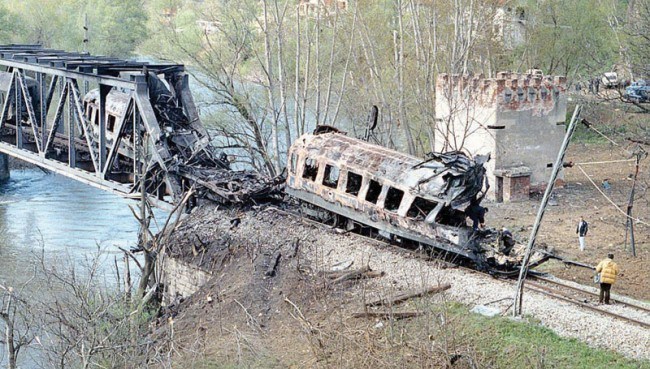
Why Did Washington Insist on the Kosovo War?
By James George Jatras | Ron Paul Institute | April 9, 2024
The following remarks were delivered at a conference marking the 25th anniversary of the NATO bombing of Serbia: “The 1999 Red-Green Bombing Terror against Serbia,” held on March 20, 2024, at the Bundestag in Berlin hosted by MdB Dr. Rainer Rothfuß and his Alternative for Germany parliamentary group.
In 2004, I appeared as the second defense witness called by Slobodan Milošević at his so-called “trial” before the so-called “International Criminal Tribunal for the former Yugoslavia” at The Hague My testimony was not as an expert witness but as a witness of fact concerning the formulation and implementation of US and western policy. I addressed one specific charge: that – beginning no later than October 1998 – Mr. Milošević was the initiator of a criminal conspiracy to drive the Albanians out of Kosovo and Metohija on the basis of their ethnicity.
There was one little problem with this accusation: there was absolutely zero direct evidence for it. No written order to this effect was ever produced. No person testified as to having received, transmitted, or even heard of such an instruction. Rather, the claim was based solely on circumstantial inferences of events starting from October 1998.
Thus, the heart of my testimony related to a paper I issued on August 12, 1998, as an analyst at the US Senate Republican Policy Committee, titled “Bosnia II: The Clinton Administration Sets Course for NATO Intervention in Kosovo.” In that paper, working solely from open sources, I detailed how, at that time – fully two months before the Milošević-led supposed “criminal conspiracy” came into effect —
“ … planning for a U.S.-led NATO intervention in Kosovo is now largely in place, …. The only missing element appears to be an event—with suitably vivid media coverage—that would make intervention politically salable, even imperative, in the same way that [the] Administration finally decided on intervention in Bosnia in 1995 after a series of ‘Serb mortar attacks’ took the lives of dozens of civilians—attacks, which, upon closer examination, may in fact have been the work of the Muslim regime in Sarajevo, the main beneficiary of the intervention. . . That the Administration is waiting for a similar ‘trigger’ in Kosovo is increasingly obvious: [As reported in the Washington Post, August 4, 1998], ‘A senior U.S. Defense Department official who briefed reporters on July 15 noted that “we’re not anywhere near making a decision for any kind of armed intervention in Kosovo right now, … [but] I think if some levels of atrocities were reached that would be intolerable, that would probably be a trigger”.’ ”
Now, if I was aware of this as early as August 1998, so were a lot of other people in Washington. I submitted to the “Tribunal” that in light of my paper, all interpretations of events would have to be drastically reevaluated. The issue wasn’t any longer whether Belgrade was planning an expulsion but that Washington was looking for a pretext for aggression.
(My cross-examination by prosecutor Geoffrey Nice (later Sir, based on his work at The Hague), asked me barely a word about my testimony. Rather, he interrogated me about my ethnic origins (Greek, from four Spartan grandparents), my religion (Orthodox Christian), and my opinions about the Islamic challenge to European, Christian civilization (negative).)
As we know, in due course the suitable “trigger” was found, with the so-called “Račak massacre” of January 1999. The key figure in “selling” Račak was William Walker. As described by Mark Ames and Matt Taibbi (now of Rolling Stone) in their article “Meet Mr. Massacre,” published in the now-defunct The Exile of February 10, 2000:
Years from now, when the war in Serbia is over and the dust has settled, historians will point to January 15, 1999 as the day the American Death Star became fully operational.
That was the date on which an American diplomat named William Walker brought his OSCE war crimes verification team to a tiny Kosovar village called Račak to investigate an alleged Serb massacre of ethnic Albanian peasants. After a brief review of the town’s 40-odd bullet-ridden corpses, Walker searched out the nearest television camera and essentially fired the starting gun for the war.
From what I saw, I do not hesitate to describe the crime as a massacre, a crime against humanity,’ he said. ‘Nor do I hesitate to accuse the government security forces of responsibility.’
We all know how Washington responded to Walker’s verdict; it quickly set its military machine in motion, and started sending out menacing invitations to its NATO friends to join the upcoming war party.
Focus on that phrase: “the American Death Star became fully operational.” Kosovo became the template that we then took on the road in one form or another in Afghanistan, Iraq, Libya, Syria, Yemen. Ukraine.
But the question still lingers: Why? Why was Washington so insistent that we and our NATO satelli– oops – “allies” needed to launch that war? Why did then-Secretary of State Madeleine Albright reveal in confidence, according to a reliable source, that at Rambouillet “We intentionally set the bar too high for the Serbs to comply. They need some bombing, and that’s what they are going to get”?
Some people will tell you it was about putting a NATO base, Camp Bondsteel, in a strategic location. Or that we wanted to clear the way for an East-West energy pipeline across the Balkans. Or that we coveted the mineral wealth of the Trepča mines. Or to secure the transit route for Afghan opium processed into heroin bound for Europe.
Certainly, all of our various interventions line a lot of a pockets, but in more than three decades of work in and around the Washington apparat, I never heard anyone point to such concrete and, frankly, normal if immoral imperial considerations.
Rather, answers must instead be sought within the larger perspective of American policy since the end of the first Cold War in 1991 and the development of the current one in the course of the 1990s: the American “unipolar moment,” as the bipartisan US policy nomenklatura sought to consolidate and perpetuate its hegemonic control over the entire planet, taking advantage of the vacuum left by the demise of the USSR. Perhaps the fullest expression of this was a 1996 Foreign Affairs article by neoconservative ideologists William Kristol and Robert Kagan (NOTE: Victoria Nuland’s husband), misleadingly titled “Toward a Neo-Reaganite Foreign Policy,” in which they called for the US to establish and maintain indefinitely “benevolent global hegemony” — in other words, perpetual American world domination.
Kristol and Kagan laid out virtually all of the elements that have guided US global policy during the ensuing years. It is no accident that Republican neoconservatives were enthusiastic supporters of Bill Clinton’s Balkan interventions of the 1990s, under the guidance of people like then-Secretary of State Madeleine Albright, who once opined regarding the sanctions-related deaths of a half million Iraqi children that “the price is worth it.” In the US establishment, there is little dissent on either side of the partisan aisle with Albright’s view that a militant United States has a special wisdom: “If we have to use force, it is because we are America; we are the indispensable nation. We stand tall and we see further than other countries into the future …”
The result is a kind of neo-Bolshevik ideology, where, as the vanguard of all progressive humanity, the US leadership class sees itself as the midwife of history. America took the path (as characterized by Russian Foreign Minister Sergey Lavrov) of the “replication of the experience of Bolshevism and Trotskyism”—morphing ourselves into a new Evil Empire in place of the old one. (Anyone familiar with the origins of America’s neoconservatives understands that the Trotskyite reference is not just rhetorical.)
Which brings us back to the “Why?” regarding Kosovo. When the dissolution of Yugoslavia kicked off in June 1991, largely at the initiative of Austria and Germany, official Washington was terrified that with the end of the Soviet bloc Europe might become “whole and free” – but without us. What then could be the future of Lord Hastings Lionel Ismay’s mission for NATO of keeping the Americans in Europe, the Russians out, and the Germans down? Europe, the crown jewel of the Global American Empire was slipping away.
Hence, as former Chairman of the Senate Foreign Relations Committee Richard Lugar (R-Indiana) indicated, NATO needed to go “out of area or out of business.” Starting in spring 1992, Washington moved swiftly to expand the conflict from Slovenia and Croatia (where it had been relatively contained) to Bosnia and Herzegovina. There the US became the vociferous champion of the Muslim faction, illegally shipping in al-Qaeda fighters and Iranian weapons via covert C-130 flights into Tuzla. We then engaged in a little demonstrative bombing of the Bosnian Serbs to set the stage for the Dayton Agreement. The arsonist sets the fire, so then he can be the hero rushing to the rescue: “See, you silly ‘dispensable’ European children? You just can’t get along without us …”
Following Dayton, Kosovo was the other shoe that needed to drop – with appropriate violence – to ensure that Europe was totally, abjectly, humiliatingly subservient to the United States through NATO, with the passive complicity of NATO’s concubine, the European Union. The corollary was that, just as the Serbs had no legitimate voice in determining post-Yugoslav structures, the Russians understood they had no legitimate voice in European security arrangements. These would be decided without them.
Now, of course, with defeat looming in Ukraine and with the broader Middle East on the edge of a regional conflagration, with many in Washington beating the drums for war with Iran or even China, the Global American Empire’s “unipolar” moment is coming to an end, one way or the other, either with a bang or with a whimper. Unfortunately, neither in Washington, nor in Berlin or other European capitals, with the exception of Budapest, are decisions made by people who can be regarded as mentally and morally healthy human beings, much less patriots.
The next few months and years promise to be a period of disorder and acute danger. The question is, can we – Americans and Europeans alike – find a path to governance that can secure a future for our peoples?
NATO kicks off Black Sea-Danube Delta exercise labeled Sea Shield 24
MAGYAR HÍRLAP | APRIL 9, 2024
NATO has launched its second major exercise this year in the vicinity of Ukraine, this time focusing on the Black Sea and the Danube Delta region.
The joint operation, Sea Shield 24, which runs until April 21, brings together more than 2,200 troops from Bulgaria, France, Greece, Italy, the U.K., Netherlands, Poland, Portugal, Romania, Turkey, the United States, Georgia and Moldova. The forces will include 27 river and naval warships, 17 aircraft, and 91 land-based military vehicles.
According to a Romanian Navy statement, Sea Shield is the most complex event of the 2024 training year, with scenarios focusing on missions to combat illegal activities, maritime and river control, the rescue of vessels in distress, and the protection of critical infrastructure in the Black Sea, along the coast, in the Danube, and in the Danube Delta.
The international exercise also aims to strengthen cooperation between the navies of the participating countries and with other forces.
The largest naval exercise organized by Romania was first held in 2015. Since then, Sea Shield scenarios have been continuously modified to enable the participating NATO forces to respond quickly and effectively to the full spectrum of threats to regional security and stability, according to the organizers.
In January, NATO launched “Steadfast Defender 2024,” a five-month exercise rehearsing the alliance’s response to a hypothetical aggression against a member state. All 32 NATO member states participated, with some 90,000 personnel, including the largest single contingent of 20,000 from the United Kingdom.
Israel Seeks to Sell Weapons Used in Gaza Slaughter
By Kyle Anzalone | The Libertarian Institute | April 8, 2024
Israeli weapons markers are selling some weapons platforms that have been utilized during the onslaught in Gaza. Tel Aviv’s arms industry has found buyers among several Asian countries as Washington tries to make allies in the region, preparing for a future war with China.
Last week, several Israeli arms markers hosted delegations from multiple Asian nations at their booth at the Singapore arms expo. Jon Ostrower, editor-in-chief of The Air Current, explained, “They’ve come to demonstrate their power.”
Axon Vision CEO Roy Riftin said in an interview with Asia Nikkei that his company was coordinating with the Israel Defense Forces in Gaza to refine its military AI tech and then export it abroad.
Some of the weapons platforms featured in Singapore have been used in Gaza. Over the past six months, Israel has killed at least 33,000 Palestinians. Most of the dead are women and children. Several international rights experts have warned that Israeli operations amount to genocide.
In coverage of the Singapore arms event, Haaretz notes that some of the drones touted by the Israeli arms dealers were used by Azerbaijan in Nargano-Karabash. Last year, the Azeris completed an ethnic cleansing of the region by forcing the enclave’s last 100,000 residents out of the Republic of Artsakh and into Armenia.
An Israeli official said it was primarily seeking clients who did not buy Chinese arms. “Ultimately all the countries in the region are threatened by the Chinese,” a senior figure in one of the Israeli defense companies on hand told Haaretz. “Here at the airshow they don’t buy fighter jets from China.”
According to the Stockholm International Peace Research Institute, Israel sells the most arms to India and the Philippines. The US has tried to include both New Delhi and Manila in its Asia-Pacific alliances, with the aim at fighting a future war with China. The US has frequently sanctioned other countries over alleged war crimes and human rights abuses while ignoring the rampant abuses committed by Israel in Gaza.
Israel withdrew from southern Gaza due to the resistance’s strikes, expert says

MEMO | April 8, 2024
World War II Didn’t End The Great Depression
Stark Realities with Brian McGlinchey | April 4, 2024
A principal goal of Stark Realities is to “expose fundamental myths across the political spectrum” — and few myths are as universally embraced as the notion that US participation in World War II (1941-1945) lifted the American economy out of the Great Depression.
This myth is dangerous not only because it leads citizens and politicians to see a bright side of war that doesn’t really exist, but also because it helps foster a belief that government spending is essential to countering economic downturns. That belief, in turn, has helped propel us to a point where the national debt now exceeds $34.6 trillion, with interest payments alone on pace to reach $1 trillion a year in 2026, inviting financial catastrophe.
In part, the wartime-prosperity myth springs from the fact that, during conflict on the scale of World War II, broad, macroeconomic measures like gross national product (GNP) and the unemployment rate are completely untethered from the economy’s most important facet: the standard of living enjoyed — or endured— by everyday people.
Between 1940 and 1944, real GNP rose at an unprecedented 13% annual clip. Using GNP alone, one would think the war delivered a major improvement in the standard of living, with Americans enjoying a greater abundance of goods, accompanied by a rise in quality, selection and affordability.

The reality was the exact opposite: Americans endured rationing, shortages, declining product quality, and the outright unavailability of many new goods, such as cars, trucks and stoves. This was the inevitable result of factories and raw materials being redirected from the creation of things consumers want to building things like tanks and fighter planes that do nothing whatsoever to improve people’s lives (setting aside the separate issue of the war’s justness).
In many respects, America experienced an outright economic devolution. In the preceding century, industrialization and the division of labor led to enormous increases in productivity. During World War II, however, shortages motivated people who’d contentedly relied on farmers to start growing their own food and canning it. The scarcity of new clothing led homemakers to redirect time and energy to sewing their own garments and resewing them to stretch as much use out them as possible.
“Those remaining on the home front were forced to produce for themselves what they had previously been able to purchase,” wrote Steven Horwitz and Michael J. McPhillips. “The household again became a center of production rather than consumption alone.”
GNP wasn’t the only measure falsely signaling wartime prosperity; employment numbers from the era were likewise misleading. The US unemployment rate plummeted from 17% in 1939 to 1.2% in 1944. Note, however, that military service members are not considered part of the labor force — which means that the draft extracted 11.5 million men from the denominator in the unemployment rate calculation.
Another 6.3 million volunteered, though many signed up because they preferred to secure a role they favored rather than face the chance of being drafted as an infantryman.
While it’s true that draftees and volunteers were “employed” by the armed forces, all these millions of men — no matter how noble their overseas missions may have been — weren’t doing anything to create prosperity at home.
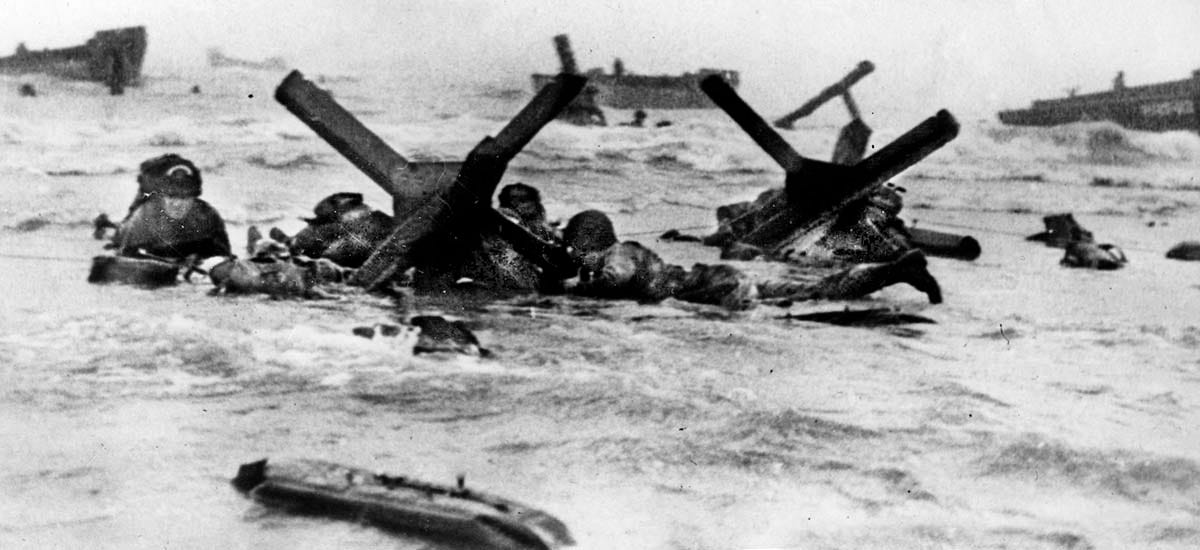
Not a prosperous path to full employment: Soldiers under withering fire on D-Day’s Omaha Beach
That’s not to say the war machine didn’t demand laborers. With so many able men taken out of the economy, the slack was taken up by teenagers, women and retirees, many who’d have preferred to be doing other things.
In a growing economy, more people are producing goods and services, and elevating standards of living in the process. That was far from the case during World War II. Factories were humming, but they were making bayonets, bombs and battleships. “Four-tenths of the total labor force was not being used to produce consumer goods or capital capable of yielding consumer goods in the future,” noted Robert Higgs.
Defying conventional wisdom about “wartime prosperity,” Americans’ standard of living suffered tremendously from their government’s entry into World War II. In The Reality of the Wartime Economy, Horwitz and McPhillips tapped some interesting source material to bring the grim economic realities of American life during World War II into sharp focus.
For example, a series of newspaper ads placed by Canton Electric Light & Power Company — a local New York State utility — present a vivid, time-lapse portrayal of rapidly declining conditions following the December 1941 declaration of war:
- Foreshadowing anticipated shortages, a March 17, 1942 ad for appliances is headlined “You Can Still Buy Them.” The ad includes a qualifier that’s upbeat while still signaling creeping scarcity: “We have a fairly good supply.”
- Just two months later, Canton Electric’s ad says “Now Is The Time” to buy various appliances and equipment, warning that “production of most of these items has stopped and only the supply in your dealers’ stock is available.”
- Another two months later, a July 1942 ad indicates that some items that were briefly not available are back in inventory.
- In November of that first year of America’s World War II participation, Canton Electric switched to warning consumers that, “due to the war emergency, it is quite impossible to get replacement motors for civilian use,” and urging them to ensure they’re properly maintaining their “stokers and oil burners.”
- Later that same month, Canton Electric punted on advancing its retail business altogether, instead using its ad space to encourage readers to grow their own food, eat everything on their plates and comply with ration-stamp rules.

Horwitz and McPhillips also drew on letters written between 1942 and 1945 by Saidee Leach to her son serving in the Pacific. Contrary to the image of prosperity supposedly indicated by leaping GNP or plummeting unemployment, she tells him of:
- Conserving scarce home-heating fuel during the coldest days by wearing fur coats indoors and residing only in their kitchen
- Having her typewriter seized by the government, and now using a lesser model she acquired from a Howard Johnson “which had to close due to the ban on pleasure driving.”
- Making an Easter dinner centered on fried Spam, because she “could not get fresh meat of any kind,” and later noting that “potatoes have entirely disappeared”
- Local farmers refusing to sell their turkey flocks for Thanksgiving meals at the prices set by the Office of Price Administration — illustrating the folly of government price controls.
That is not the picture of an economy delivered from the Great Depression. Rather, “World War II institutionalized the falling standards of living of the depression through wage and price controls, and extensive rationing of consumer goods and services,” wrote Peter Ferrara. “The economic deprivation, and reduced standards of living, continued, although people perceived it was now for a good cause.”
America’s postwar experience presents another pointed contradiction of the myth of wartime prosperity.
As the war’s end grew closer, Keynesian economists unanimously predicted peace would bring economic disaster. For example, Paul Samuelson said America would experience “the greatest period of unemployment and dislocation any economy has ever faced.”
Alvin Hansen warned that the economy must be kept on a centrally-controlled wartime footing, even in peacetime: “When the war is over, the government cannot just disband the Army, close down munitions factories, stop building ships, and remove all economic control.”

Nobel Prize winner Paul Samuelson, who predicted peace would bring economic disaster, taught Nobel Prize winner Paul Krugman, who predicted the internet’s impact would be akin to that of the fax machine
However, that’s pretty much what happened — and Hansen, Samuelson and their fellow economic flat-Earthers couldn’t have been more wrong about the consequences. “The year 1946, when civilian output increased by about 30 percent, was the most glorious single year in the entire history of the U.S. economy,” wrote Higgs.
This despite the fact that government purchases of goods and services collapsed by 68% between the second quarter of 1945 and the first quarter of 1946 — and upwards of a million civilian government employees were laid off and millions of service members discharged.
As war-fighting men poured back into civilian life, millions of women withdrew from the labor force, contentedly returning to duty as mothers and home managers. Rather than soaring as predicted by the “experts,” unemployment merely edged higher, from 1.9% in 1945 to 3.9% in 1947.
“Less than a year and a half after VJ-day,” crowed President Truman, “more than 10 million demobilized veterans and other millions of wartime workers have found employment in the swiftest and most gigantic change-over that any nation has ever made from war to peace.” (Note this happened despite — and in part because of — Truman’s failure to institute a higher minimum wage as the war ended.)
Having been proven enormously wrong about the economic implications of peace, Keynesians scrambled to credit the war with enabling the postwar boom, arguing that it was fueled by people drawing down savings accumulated while the supply of consumer goods was sharply restricted. However, as Higgs determined by studying the data of the time, “Holdings of liquid assets did not decline at all after the war. People financed their spending for consumer goods by reducing their saving rate.”

Once again an engine of real prosperity: In 1946, vehicles proceed along Ford’s first postwar assembly line
Contrary to the myth, it was only after World War II that — free from the government’s commandeering of factories, workers and resources, and saddled with fewer price controls and other federal market intrusions — America was finally able to emerge from the Great Depression.
You wouldn’t know that if you evaluated the economy’s health using Keynesians’ preferred measure. Just as the GNP gauge provided a 180-degree misreading of wartime economic realities, it failed in similarly spectacular fashion during the postwar boom: From 1945 to 1947, GNP plummeted 22%.
In addition to further illuminating the shortfalls of aggregate economic measures, America’s postwar economic experience delivered another broadside to the myth of World War II-fostered prosperity, and to the idea that government spending, central planning and market interventions are essential to economic achieving economic recovery.
Pellegrini’s Win in Slovakia’s Won’t Allow EU to Drag It Into Conflict Against Russia
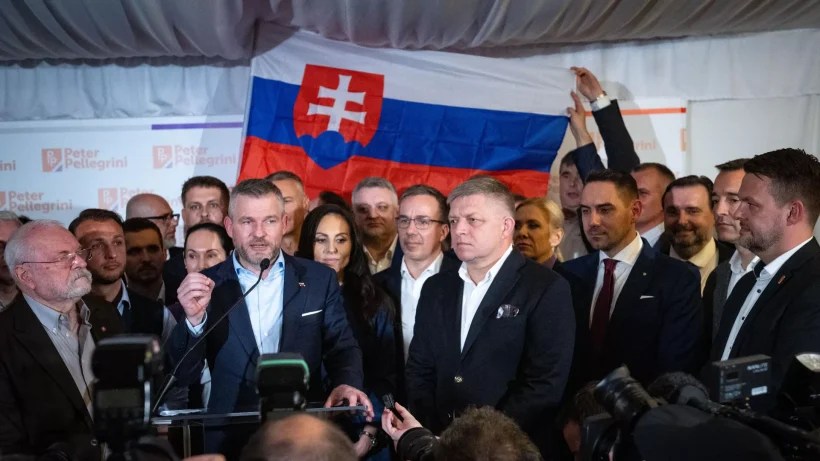
Peter Pellegrini (L) and Slovak Prime Minister Robert Fico (R) after the announcement of Pellegrini’s victory in the Slovak presidential elections, April 6, 2024.
By Svetlana Ekimenko – Sputnik – 07.04.2024
Slovak parliamentary speaker Peter Pellegrini, who shares prime minister Robert Fico’s staunch opposition to continued arms supplies to Ukraine, won the second round of Slovakia’s presidential election. Pellegrini and Fico’s left-wing opposition to the Russo-Ukraine war proved to be a winning formula.
In Peter Pellegrini Slovakia will finally have a president who does not support the pro-Western position and was not “installed by the Americans,” political observer Peter Marcek told Sputnik.
“There will be coordination between the government of the Slovak Republic [led by] Robert Fico and President Peter Pellegrini, because they have one program, one direction,” he remarked.
According to Marcek, “both Fico and Pellegrini share the idea that no Anglo-Saxons should be able to dictate to us what we should do.”
Washington pursued its own goals by pushing Pellegrini’s main rival, former foreign minister Ivan Korcok, for the presidency, argued the expert, in an effort “to subordinate our will exclusively to their hegemony.”
Pellegrini, an ally of Fico, won the presidential election with 53.26 percent of the vote versus Korcok’s 46.73 percent, following declarations from 99.66 percent of voting districts.
Pellegrini said his victory meant the government would not have to face an “opposition, opportunistic power centre.” He vowed that he would “be a president who will support the government in its efforts for improving people’s lives.”
Pellegrini, 48, has Italian ancestry. He previously served as Slovakia’s prime minister from 2018 to 2020 and Minister of Health from 2019 to 2020. He also had a two-year stint as speaker of the National Council from 2014 to 2016. Pellegrini, formerly a member of Direction – Social Democracy, left that party to found Voice – Social Democracy in 2020.
The politician returned to the position of Speaker of the National Council after the 2023 parliamentary election. His Voice – Social Democracy party came third and became part of the three-party ruling coalition with PM Robert Fico’s SMER-SSD (Direction-Slovak Social Democracy) and the Slovak National Party.
Pellegrini announced his intention to run for president in January. He came second in the first round of voting in March, with 37.03 percent, trailing former Korcok who won 42.52 percent of the vote. But Pellegrini scooped up the floating voters to clinch the second round.
Commenting on the Fico and Pellegrini long-standing political alliance, Marcek pointed out that “When the government passes laws and the president can veto them, it creates problems.” But now the president and the prime minister will be on the same page.
“Pelligrini will be a president who will work well with Fico. They said at a press conference after the elections that they would support each other. They will cooperate very well this way,” said the pundit.
In Slovakia, the government holds most of the executive powers, such as picking the prime minister after parliamentary elections, swearing in the new government, and appointing Constitutional Court judges. The role of president is largely ceremonial, but includes ratifying international treaties, appointing top judges and acting as commander-in-chief of the armed forces — and has the power to veto new laws.
Bratislava can no longer support the West’s anti-Russian course, noted Marcek, who welcomed the “clear victory of Pellegrini.”
“I think that many relations, for example, with the Russian Federation, can improve. We need to develop our mutual relations,” stated the former deputy of the Slovak parliament.
“I am grateful to Russia because it is not just fighting for itself, to prevent NATO from approaching the borders of the Russian Federation,” Marcek stressed. “Russia is fighting for us all, for the traditional family values, for improving the economic situation in the world. For good relations, and most importantly — for peace and justice.”
Fico’s government has been determined to chart an independent course against NATO’s proxy war against Russia in Ukraine.
Echoing his Hungarian counterpart Victor Orban’s stance, Fico has opposed confrontation with Russia, and urged an end to military aid to Kiev. Hungary and Slovakia are the only two EU and NATO members to refuse to send arms to Ukraine.
“Peter Pellegrini hails from Robert Fico’s party, he is a social democrat, and shares the PM’s ideas and views. This means that he is in favor of ending the conflict in Ukraine and starting negotiations between Kiev and Moscow,” Marcek said. “He is against sending weapons to Ukraine, opposes such vast quantities of EU aid being sent to Kiev.”
Pellegrini stated in an interview in March that the Slovak government had a realistic position on the conflict, and voiced surprise that some countries refuse to respect Slovakia’s approach. He added that Slovakia is ready to help the Ukrainian side in demining territories and implementing civilian projects.
The president-elect believes that the conflict in Ukraine has no military solution, advocates early peace negotiations and believes that arming Ukraine could ultimately lead to disaster.
Most Slovaks want “a president who will defend Slovakia’s national interests, who will not drag Slovakia into a war but will talk about peace, who… will put Slovakia’s interests first,” Pellegrini said.
In contrast, Pellegrini’s opponent Korcok, said: “I do not think Ukraine should give up part of its territory to achieve peace.” He told reporters that “Peace cannot mean capitulation,” and could only be achieved “immediately” on the condition that Russian troops withdraw.
Fico responded by calling Korcok a “warmonger” on video ahead of the run-off. He claimed Korcok “will support everything the West tells him without hesitation, including dragging Slovakia into the war.”
But both Pellegrini and Korcok have reiterated that they would not allow the Slovak military to be sent to Ukraine.
“Slovakia has made a decision that it will not send a single soldier to Ukraine in any event. And this is despite the criticism of this sovereign position of ours. On the contrary, we will insist that the only way to end the bloodshed is to have courage to begin peace talks between the warring parties,” Pellegrini said after a meeting with Orban.
On issues such as NATO membership for Ukraine, however, the two rivals took opposing stances. Korcok insisted that the final decision on Ukraine’s membership in NATO will be made by members of the alliance if the Ukrainian side meets the necessary requirements.
But Pellegrini was adamant that there is no place for Ukraine in NATO, giving an unequivocal “no” to the question during a pre-election debate on the Markiza TV channel.
“NATO, in my opinion, is the most aggressive group of armies, that only exist to foster wars all over the world, spearheaded by the United States. And Peter Pelligrini will absolutely not agree with this,” Marcek said.
Asked how Pellegrini’s victory could affect European Union policies and if Slovakia might use its veto on issues such as aid to the Kiev regime, the political analyst said that Slovakia now had “new opportunities.”
“We will not give up the veto power to anyone,” Marcek insisted. “This is our right, even though we are a small country. Together with Viktor Orban, 100 percent we will not cede this to anyone.”
Marcek slammed European governments that were “pro-American, pro-Brussels,” adding that “They are for war against Russia.”
“Macron still wants to send soldiers to Ukraine. The government in the Czech Republic wants to continue the war, but the citizens do not,” he said. “We say, ‘We shall have none of this’.”
US using Nordic countries’ NATO membership to advance Arctic militarization
By Lucas Leiroz | April 6, 2024
The US plans to use the NATO access of Nordic countries to increase its military presence in the Arctic. In a recent statement, an American official announced Washington’s plan to build a large weapons warehouse in the region, with Finnish and Swedish support. The measure will significantly increase the militarization of the Arctic and aims to help the US overcome Russian military superiority in the region.
The plan was announced by US Materiel Commander Christopher Mohan during an interview with the newspaper Breaking Defense. According to him, Finland and Sweden could help the US with the project, considering their strategic geography. He did not give any details about the possible location of the depot, but stated that NATO is jointly analyzing all possibilities. He also stated that the US and allies are discussing what would be the most appropriate equipment to deploy in the region.
“The addition of the NATO partners changes the security landscape and our responsibilities as part of NATO (…) [This project will] embrace and integrate Finland and Sweden into the NATO enterprise, and that’s going to drive some changes on the ground,” he said.
The measure is just one of several policies adopted by Washington and its allies in recent years to try to reverse Russian military superiority in the Arctic. For decades, the US has not had any special focus on the Arctic in its defense strategies. The main objective of American strategic plans has always been to “encircle” and “isolate” Russia. The US has focused for many years on achieving this goal through the militarization of Europe and the destabilization of Central Asia and the Middle East, but Americans have paid little attention to the Arctic – a region where the Russians have become very strong over the decades.
Now, however, the US is concerned about this weakness in the region. With the escalation of tensions with Russia, Washington is trying to improve its positions in the Arctic in order to reverse the current scenario of Russian advantage. In recent years, several escalatory policies have been promoted by the US – some of them even openly provocative and targeted at Russia.
For example, in 2022, Lawrence Melnicoff, commander of the European Special Operations Command, stated that the US should actually “provoke” Russia in the Arctic. According to him, Washington should seek joint strategies with Norway to increase its presence in the Arctic Circle and thus deter Russia in the region. He states that Russia has expansionist plans that will be prevented only through direct deterrence, which is why NATO should maintain strategic positions that allow it to neutralize Russian forces in the Arctic in a possible conflict scenario.
“We are intentionally trying to be provocative without being escalatory (…) We’re trying to deter Russian aggression, expansionist behavior, by showing enhanced capabilities of the allies (…) It complicates Russian decision-making because we know that they’re targeting very, very large specific aggregations of allied power, [such as] Ramstein Air Base, RAF Lakenheath, things like that (…) If worse comes to worst and somebody takes out these power hubs, we can forward-project precision artillery fire across the alliance with our partners”, he said at the time.
Obviously, this is a fallacious US narrative. The Arctic is a region traditionally occupied by the countries that have access to it. Russia has the Arctic as a vital point in its strategic environment and naturally seeks to maintain a strong military presence in the region to guarantee its national security. The US and NATO countries, however, do not use access to the Arctic to develop a defensive strategy. On the contrary, they are looking for the Arctic as a possible point of attack against Russia. The Western objective in the Arctic is simply to harm Russia, not to protect itself. If the West adopted a policy of diplomacy and peaceful dialogue with Moscow, there would be no military race in the Arctic, but clearly NATO’s intention is to hurt Russia as much as possible.
To achieve these provocative objectives, the US will use the strategic location of NATO’s new members as a tool of war. The Nordic countries will be induced to actively participate in the Arctic militarization process, co-leading with Washington an escalation of tensions with Russia. And this will be extremely harmful for them, because, if the crisis escalates into an open conflict in the future, these countries will be priority targets and will be in a much greater risk zone for Russian attacks than the US.
Once again, access to NATO appears to be a trap for Finland and Sweden, which are being used as mere war tools by the US.
Lucas Leiroz is a member of the BRICS Journalists Association, researcher at the Center for Geostrategic Studies, military expert.
You can follow Lucas on X (former Twitter) and Telegram.
US Diplomacy ‘Utterly Failed’ in Ukraine, Washington Should Seek Negotiations – Jeffrey Sachs
Sputnik – 05.04.2024
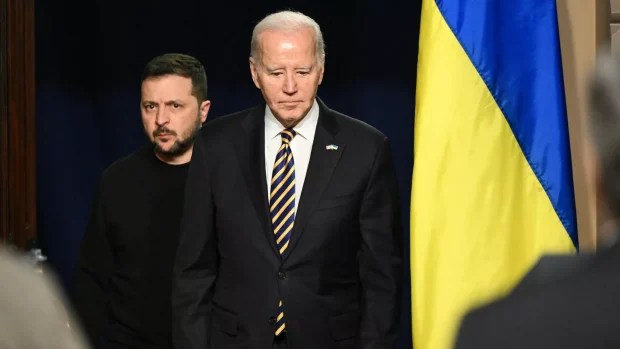
WASHINGTON – US policy in Ukraine has failed and instead of encouraging the country’s NATO membership bid Washington should seek peace negotiations with Russia, world-renowned economics professor Jeffrey Sachs told Sputnik.
While in Brussels, US Secretary of State Antony Blinken said Ukraine would become a member of NATO but did not specify a timeline. He added that the 2024 NATO summit in Washington will help build a bridge for Ukraine to join the alliance.
“Secretary Blinken’s statement is another disaster for Ukraine… American diplomacy has utterly failed and indeed collapsed,” said Sachs, Director of the Center for Sustainable Development at Columbia University. “Secretary Blinken should be sitting down in negotiations with his counterpart Foreign Minister Lavrov rather than reiterating the utterly failed foreign policy that has brought on this war.”
Russian President Vladimir Putin has said that NATO’s expansion to include Ukraine would create a direct national security threat to Russia and that Moscow considers the non-aligned status of Ukraine to be extremely important to put an end to the years-long conflict.
Featured Video

Matt Bracken: US Plans Massive MOAB Strike on Iran?
or go to
Aletho News Archives – Video-Images
From the Archives
Confronting the Threat of Ethnic Bioweapons
By Tony Cartalucci – New Eastern Outlook – 29.11.2017
The United States Air Force’s 59th Medical Wing’s molecular biology branch recently was revealed to have been collecting specifically Russian RNA and synovial (connective) tissue samples, prompting fears in Russia of a possible US directed ethnic-specific bioweapons program. … continue
Blog Roll
 Aletho News
- Matt Bracken: US Plans Massive MOAB Strike on Iran?
- Russia accuses France of ‘piracy’ over tanker seizure
- Why Yemen Is Bombing Saudi Arabia’s Airports: The War Behind the Headlines
- Sally Rooney’s books pulled from UK over support for Palestine Action
- Bombs for Tel Aviv, Promises for Riyadh
- Israeli ad agency conducted vast global espionage campaign using online ads: Report
- Oct. 7 Forever Marks The Big Reveal: ‘We See You, Israel, We Revile You, We Reject You!’
- Meet the US generals and admirals advancing Israeli policy
- Israel’s Straw Widow Protocol: The Kill Zones Where Civilians Were Labelled ‘Terrorists’
- Leading Israeli Think Tank Publishes Psychotic Israeli ‘National Security’ Doctrine
- If Americans Knew
- Israeli firm used online ads to run vast spy operation, researchers say
- No, the world zionist movement is not an antisemitic conspiracy theory
- Hundreds of IDF investigations into killings still have no public outcome, BBC Verify finds
- After Ashley Moody Epstein Probe, Donors Linked to Him Poured Money Into her Senate Campaign
- Worried about Russian meddling in UK politics? Wait till you see what Israel is up to
- Israeli settlers attack West Bank center for disabled children, church leader calls for int’l action
- Pulling Out Teeth Just to Live: How Israel Has Devastated Dental Care in Gaza
- Gaza’s “ceasefire” death toll passes 1,500 – Daily Update
- Activists Abused By Israel Return to New Freedom Flotilla Mission
- 60 Minutes won’t tell the full truth about Israeli settler violence
- No Tricks Zone
- New Study Suggests Large Regions Of The Pacific Ocean Have Been Cooling For The Last 80 Years
- Germany’s Green Energy Debacle: High Energy Costs Force Kahla Porzellan to Close After 182 Years!
- New Study: 50 Years Of The Most Aggressive ‘Net Zero’ Policies Can Only Affect The Global Climate By 0.03°C
- US September “Heat” Was No Record…Many Records Set Decades Ago
- Latest European Green Energy Debacle; Portugal’s Largest Flagship Solar Park Insolvent!
- Green Energy Debacle: German Expert Professor Fritz Vahrenholt Warns Of Severe Economic And Social Consequences
- Two More Paleo Reconstructions Affirm Meters-Higher Sea Levels Across Ireland, Brazil 7000-6000 Years Ago
- New Study: Earth And Venus Surface Warmth Largely Explained By Convection And Lapse Rate, Not CO2 Or Radiation
- 2025 Nature Paper Claiming Worsening Global Drought Gets RETRACTED …Heavily Flawed
- New Study: ‘Global Drought Shows No Detectable Recent Acceleration Under Climate Warming’

