NATO is in state of ‘war psychosis’ and must change course in bid for peace, warns Hungary FM Szijjártó
Mandiner | April 5, 2024
NATO is currently in a state of war psychosis, which poses a serious risk of escalation, and must change its strategy as soon as possible, Minister of Foreign Affairs and Trade Péter Szijjártó warned in Brussels on Thursday.
At a press conference following the NATO-Ukraine Council meeting, Szijjártó said that everything discussed at the meeting confirmed the need for peace as soon as possible, as the situation on the battlefield clearly shows that without a quick diplomatic solution, the number of dead and the destruction will increase dramatically.
“It is clear that hostilities are becoming more active and their consequences more serious, and that to save lives and prevent destruction, all efforts should now be focused on peacemaking,” he warned.
Szijjártó said it was bad news that Hungary’s view is currently only a minority position within NATO and cited an unnamed counterpart at the meeting who said, “The goal is not to find peace but to win the war.”
“This is pretty much the kind of war psychosis that characterizes NATO member states today. The vast majority of speeches today have been about how to increase arms supplies to Ukraine,” he said.
In this context, he pointed out that it is becoming increasingly difficult to assemble arms shipments, partly because a large number of the Allies have now almost completely surrendered the military equipment in their warehouses. Szijjártó recalled that Hungary is currently performing air policing tasks in Slovakia together with the Czech Republic because Bratislava has handed over all its aircraft to Kyiv and the new ones have not yet arrived.
He recalled that it was also said at the meeting that the munitions depots across Europe should be emptied, i.e., all existing equipment should be handed over to Ukraine, and this desperation clearly shows that arms deliveries are becoming increasingly difficult.
Trump warns: “lunatic” Biden could start World War III
By Ahmed Adel | April 5, 2024
Former US leader and current Republican Party presidential candidate Donald Trump warned in Michigan on April 2 that US President Joe Biden could trigger World War III. Trump’s comments come as he surges in the polls while Biden’s policy on Ukraine is continuously scrutinised. The former president also criticised the way his successor handled the nuclear issue, questioned his mental condition, and claimed that other foreign powers respected the US during his presidency.
“This guy has no clue,” the former president said about Biden. “He can’t put two sentences together, and he’s dealing with Putin, and he’s dealing with President Xi, and he’s dealing with Kim Jong-un. All people I know very well. We were under no threat from anybody until this guy got in office. Now they’re talking nuclear all the time. We didn’t talk nuclear.”
Trump recalled that, during his term, he rebuilt “nuclear power” to a level that “no one has” and that, in this context, it was “four safe years.”
“You were safe because they respected your president, and they respected the United States of America. And now you’re not safe. I will tell you we could end up in World War III with this lunatic,” he stressed.
According to a new Wall Street Journal poll published on April 3, Trump leads Biden in six of the seven closest swing states. Although Biden won Wisconsin, Michigan, and Pennsylvania in 2020, Trump now holds a two-point lead in Michigan and a three-point lead in Pennsylvania. Biden also won Georgia, Nevada, and Arizona in the last election, but now the three states have stronger support for Trump, with the former president leading Georgia by three points, Nevada by four points, and Arizona by five points.
In a recent statement to USA Today, Trump spokeswoman Karoline Leavitt said: “There are more than 100 polls showing President Trump crushing Joe Biden, including recent polling that has him leading in every key battleground state and winning independents by double digits.”
The prospect of Trump’s return has triggered an increase in debate among NATO allies about what Europe should do to ensure Washington continues to invest in transatlantic security. The Republican’s possible return also raised concerns among European officials that Trump could withdraw US aid to Ukraine because of comments that he would try to end the war in one day.
Reuters, citing five diplomats, reported on April 2 that NATO boss Jens Stoltenberg has proposed a $107 billion, five-year package of military aid to Ukraine so the Western alliance could have a more direct role in supporting Kiev. The NATO chief said the plan is in part “to shield against winds of political change,” but Trump is foremost on the minds of many, a senior NATO diplomat told the British agency.
The diplomats said that discussions were only at an early stage and that it was still unclear whether the $107 billion would be accepted by all 32 members—since a consensus must be reached—or how it would be financed.
“It goes some way to protecting in case of Trump. But it is impossible to create something Trump-proof,” said another diplomat. “A fund of 100 billion looks very optimistic, knowing how difficult it was to agree on a smaller amount at EU level.”
As part of the proposed package, NATO could also take over the operational functions of the Ukraine Defense Contact Group, which coordinates arms deliveries from around 50 countries to Kiev and is now led by the US. With NATO’s Europe Supreme Allied Commander, General Chris Cavoli, in office, such a move could protect the Group from any political changes after the November US elections.
In effect, NATO recognises that there is a high possibility that Trump could return to the White House and is already preparing for a post-Biden scenario. Biden has supported most initiatives for Ukraine, but as his cognitive decline deepens and his numbers suffer in the polls, a Trump victory would almost certainly result in the retraction of support and force Kiev to negotiate with Moscow.
As Trump highlighted, Biden is a “lunatic” who is fanning the flames of a Third World War. Although it is unlikely the US would escalate with Russia to the extent of World War III for the sake of Ukraine, the former president highlights that global tensions were not as intense as they have been since Biden came to power, and he aims to return to this scenario. This prospect frightens NATO and much of Europe.
Ahmed Adel is a Cairo-based geopolitics and political economy researcher.
Russia and NATO already in ‘direct confrontation’ – Kremlin
RT | April 4, 2024
The current state of relations between Russia and NATO can be described as a “direct confrontation,” Kremlin spokesman Dmitry Peskov has said. He claimed that the US-led military bloc has been a destabilizing force in Europe rather than ensuring the continent’s security.
He made his comment on Thursday, as the bloc marked 75 years since the signing of its founding document, the North Atlantic Treaty.
Since the start of the Ukraine conflict, NATO has provided Kiev with billions worth of military aid and weaponry, as well as sharing intelligence and helping to train Ukrainian troops.
“The bloc itself is already involved in the Ukraine conflict. NATO continues to move towards our borders, expanding its military infrastructure towards our borders… In fact, our relations have now descended to the level of direct confrontation,” Peskov said at a press-briefing.
He stated that the organization had been created as an “instrument of confrontation” in Europe, and is fulfilling its purpose to the detriment of the entire continent.
“NATO continues to fulfill its purpose, which currently, however, in no way contributes to security, predictability and stability on the continent, but on the contrary is a destabilizing factor,” Peskov explained.
Multiple Western leaders have warned that Russia may attack NATO once the Ukraine conflict is over. Moscow has repeatedly dismissed those claims.
Russian President Vladimir Putin said last month that talk of a potential Russian attack on NATO countries is simply propaganda by their governments aimed at scaring their own population to “beat the money out of them.”
Moscow has for years voiced concerns about NATO’s expansion toward its borders, viewing the US-led military bloc’s policies as an existential threat. However, it has also warned that NATO’s more pronounced involvement in the Ukraine conflict, in particular, the possibility of a troop deployment to the front lines, would be seen as an intervention. This, according to an earlier statement by Putin, would take the conflict “one step shy of a full-scale World War III.”
75th Anniversary: NATO Exists to Respond to Conflicts It Caused

NATO military exercise ‘Iron Wolf 2022-II’ at a training range in Pabrade, north of the capital Vilnius, Lithuania.
By Ekaterina Blinova – Sputnik – 04.04.2024
Over the last 30 years, NATO has lost its veneer of a “defensive” alliance, turning into an overtly expansionist and interventionist military bloc, Sputnik’s interlocutors say.
Exactly 75 years ago, the North Atlantic Treaty Organization was founded by the US, Canada, and several Western European nations, with the main aim of deterring and confronting the USSR, their former Second World War ally.
After the Soviet Union’s collapse in December 1991, the conditions for a new inclusive security architecture in Europe and beyond emerged, according to Glenn Diesen, professor of international relations at the University of South-Eastern Norway.
“After the Cold War, we developed the format for a new inclusive security system,” Diesen told Sputnik. “The Charter of Paris for a New Europe in 1990 and the establishment of the Organization for Security and Cooperation in Europe (OSCE) in 1994 were both based on the [1975] Helsinki Accords, and embraced the principles of sovereign equality, indivisible security, and ending the dividing lines in Europe.”
The Helsinki Accords, signed during the Cold War by the US, Soviet Union, and several European countries, led to greater cooperation between Eastern and Western Europe. Even though the agreements weren’t binding, they significantly contributed to the détente between the East and West.
Instead of building on that momentum, the US saw the end of the Cold War as the beginning of its unipolar moment, according to the professor: in 1992, George H.W. Bush proudly declared that the US had “won” the Cold War during his State of the Union address.
“The US also developed a security strategy based on hegemony, which required expanding NATO and thus cancelling the pan-European security architecture,” Diesen said. “NATO therefore transitioned from a status quo power to a revisionist power. NATO required a new purpose, which became ‘out-of-area’ military interventionism and expansionism.”
Overtly Aggressive Military Bloc
The next 30 years saw a string of NATO overseas military campaigns, neither of which has seen a comprehensive resolution, resulting in the creation of hotbeds of instability instead.
“During the 1990s, NATO turned from a conceptually defensive organization into an openly aggressive organization when it entered the Yugoslav wars and waged a massive bombing campaign there,” Gilbert Doctorow, an international relations and Russian affairs analyst, told Sputnik.
“More generally, the United States was at this time preparing NATO to move out of its core geography in Europe and to assist US plans for global domination in the Middle East in the succession of regime change operations and open invasions that the United States planned and led.”
Doctorow highlighted that these “out-of-region NATO operations were one disaster after another, ending in the withdrawal from Afghanistan after participation in a 20-year-long war directed by Washington.”
NATO’s Expansionism Led to Ukraine Conflict
Meanwhile, the alliance’s seven waves of post-Cold War eastward expansion accelerated tensions in Europe, according to Diesen.
“Reviving the bloc approach to security and competing over where to draw the new dividing lines has been the primary source of conflicts in Europe for the past three decades and eventually resulted in the Ukraine war,” Diesen said.
The academic pointed out that “by going along with NATO expansionism, the Europeans allowed their continent to be re-divided and remilitarized, which has predictably doomed Europe to greater irrelevance.” He projected that Europe “will undergo systemic economic decline and become painfully subordinated to the US.”
“We could exit this tragedy by reaching out to Russia to negotiate a new inclusive European security architecture devoted to reducing security competition instead of imposing hegemony,” the professor emphasized.
Is NATO Sustainable?
“NATO exists to respond to the conflicts caused by its own existence,” Diesen explained. “The problem now is that NATO is returning to great power conflicts with the same disastrous approach to security, based on hegemony rather than mitigating security competition.”
Despite the Western mainstream media claims that the North Atlantic Alliance is united like never before amid the Ukrainian conflict, it is in fact not true, according to the professor.
“There are great tensions within NATO that simmer below the surface, and I do not think the hatred of Russia is enough to ensure unity after the war is over,” he said.
“NATO victory in Ukraine is imperative as it had the stated objective of permanently weakening Russia and thus knocking it out from the ranks of great powers. This would revive the unipolar moment and collective hegemony of the West. Once NATO’s defeat is evident the cracks will emerge in the military bloc,” Diesen pointed out.
Doctorow believes that despite all its declared, might the North Atlantic Alliance is on thin ice.
“NATO is in treading water, waiting for the tsunami that will send it to the bottom. That tsunami will either take the shape of a [US presidential candidate Donald] Trump victory in November or it will take the shape of an imminent collapse of the Ukrainian army or both phenomena simultaneously,” the international relations analyst concluded.
World War III Isn’t Preordained (No Matter What They Say)
By Brad Pearce | The Libertarian Institute | April 4, 2024
A recent survey from YouGov found that 61% of Americans think a world war within the next five to ten years is “very likely” or “somewhat likely,” while only 21% say that such a scenario is “not very likely” or “not likely at all.”
It’s notable that Democrats, who are much more likely to view Russia as the source of the world’s evils, are less likely than Republicans to believe a world war is coming by a strong margin; although it is still only 28% of Democrats in the two “unlikely” categories. At the same time, Republicans who may want rapprochement with Russia mostly see this as a way to free up resources to fight China. The reality is that our ruling class has decided that a global conflict is inevitable and as such are doing nothing to stop it. Further, they are actively hostile to anything which could reduce hostilities with Russia while also proactively antagonizing China.
Our ruling class is far along in creating a simplistic good vs evil narrative which they hope to get into the history books—should anyone survive to write them—but for those of us living through it, it’s obvious the only cause would be the madness of today’s rulers. The most devastating of wars do not commonly arise out of unsolvable problems, but from rulers who refuse to solve them. Further, the drive towards oblivion is usually obvious to many observers, even if the rulers and much of the public are caught in a jingoistic mania. Things are just the same today.
There is a modern perception that World War I took the powers of Europe by surprise and that the assassination of Archduke Franz Ferdinand was a spark which made war inevitable. Perhaps this is believed because of the human need to understand the degree of devastation from a war which more than others lacks a clear meaning. However, author Rebecca West, in her landmark text Black Lamb and Grey Falcon, which was written in the 1930s, tells a different story. West explains that all of Europe expected that the Central Powers were preparing for an aggressive war, writing, “It is said that both France and Russia were for some reason convinced that Germany and Austria would not make war until 1916, and certainly that alone would explain the freedom with which Russia announced to various interested parties in the early months of 1914 that she herself was not ready to fight.”1
According to West’s account, Austria then worked quite hard to make the assassination their pretext although the plot had almost no connection to the Kingdom of Serbia. This isn’t a perfect parallel to our moment, but it’s notable that no one was trying to stop the war; they simply wanted time to arm themselves. Similarly, Germany and other countries in Europe have not hidden their current lack of preparedness, but made it clear their interest isn’t avoiding war, but fighting one. In the classic satirical antiwar novel The Good Soldier Svejk by Jaroslav Havec, the author repeatedly includes the line “an empire this stupid shouldn’t exist” in regards to the Austro-Hungarian ruling class; because of the war they, launched it soon wouldn’t.
The closest parallel to the dangers arising from the war in Ukraine comes from the first book of Thucydides’ History of the Peloponnesian War. The most immediate cause of the war was civil dissension within a colony leading to conflict with the mother city, and ultimately seeking the protection of that city’s enemy. However, what has gotten more notice recently about this text is one passage that is applied to China, which is now known as the Thucydides Trap. Thucydides wrote, “The real cause however, I consider to be the one which was formally most kept out of sight. The growth of the power of Athens, and the alarm which this inspired in Sparta, made war inevitable.” For all that people have commented on this, it is not that incisive to say that one country’s power growing would alarm another country. What is more commonly missed is that no one forced Athens to expand recklessly to the extent that it caused war with Sparta. It was an unforced error which caused them the briefest moment of greatness followed by utter devastation. On the other side, no one forced Sparta to respond with war, and Sparta’s post-war supremacy was also short-lived. Unfortunately the leaders on both sides chose conflict over co-existence, and in many ways Greece never recovered from that war and the ones which followed.
In America it is part of our founding mythology that War of Independence against the United Kingdom was inevitable because of conflicting interests between the Americans and the British. However, if one reads key British authors of the time, it is clear that the wiser men of the era knew that the British government was barreling towards a devastating and pointless war for no good reason. The reality is that the volume of trade in the British American colonies was growing so rapidly that peaceful reconciliation at any cost was in Britain’s self-interest; The Wealth of Nations was published in 1776 and contains some incredible statistics in this regard. Directly taxing the American public instead of levying taxes from their colonial governments was in no way a point worth proving, especially given the profitability of peace and trade.
Edmund Burke was a leader of the peace faction in the British Parliament and his timeless words about avoiding war should be remembered. Burke wrote, in March 1775, “The proposition is Peace. Not Peace through the medium of War; not Peace to be hunted through the labyrinth of intricate and endless negociations; not Peace to arise out of universal discord…not Peace to depend on the Juridical Determination of perplexing questions… it is simply Peace; sought in its natural course… laid in principles purely pacific”2 It is obvious in our current times that peace could be preserved with Russia and China if it was approached with this principle, but that is considered out of the question by our rulers.
The world is currently a tinderbox and every day we watch our rulers pour on more gasoline and throw out extinguishers. I have to wonder what our descendants will think of us and the war which seems to be coming. There is certainly no chance that they can create a clear World War II sort of narrative about this. I often think of the European Union Commission President Ursula von der Leyen saying, “Ukrainians are ready to die for the European perspective,” a statement which should only exist as a parody of the vapid state of Western “values.” They want us to believe Vladimir Putin is obsessed with rolling his tanks across Europe, but that makes no sense and clearly isn’t possible. They certainly can’t admit the lengths they went to in order to provoke Russia into war in Ukraine.
There is absolutely no justification for not doing the work necessary for a lasting and equitable peace with Russia and China. When all is said and done, if there are people left to comment on the causes of the Third World War that so many think we are about to experience, perhaps people will say the same as the famous character Captain Edmund Blackadder said of World War I, “the real reason for the whole thing was that it was too much effort not to have a war.” The majority of the American public thinks countless millions will die in a new world war, and if that comes to pass, it will be because our rulers found going to war easier than making peace.
US Congresswoman Greene Says CIA Running Conflict Against Russia in Ukraine
Sputnik – 03.04.2024
WASHINGTON – The CIA is directing the conflict against Russia on the ground in Ukraine, US Congresswoman Marjorie Taylor Greene said in an interview with journalist Tucker Carlson.
“To fund a war, to pay for it, to continue it, to advise it, to have our CIA on the ground over there running that war in Ukraine against Russia — nuclear-armed Russia… that is a complete departure from anything that is Christian,” Greene said on Wednesday.
It is contrary to Christian principles to fund wars all over the world, Greene added.
Fighting a “proxy war” in Ukraine against Russia does not protect the US or serve its national security interests, Greene said. People in the US want to see a peace deal between Russia and Ukraine, Greene said.
Officials and media lie every single day by claiming that Russia intends to take over Europe, Greene said. Such a claim contradicts statements made by Russian President Vladimir Putin, Greene said.
In February, US media reported that the CIA created a network of spy bases in Ukraine over the past eight years, including a dozen forward operating bases along the Russian border that engaged in operations against Russia. CIA Director William Burns has personally visited Ukraine at least 10 times since February 2022.
Samantha Power and the Power of a Word
BY DIANA JOHNSTONE • UNZ REVIEW • APRIL 3, 2024
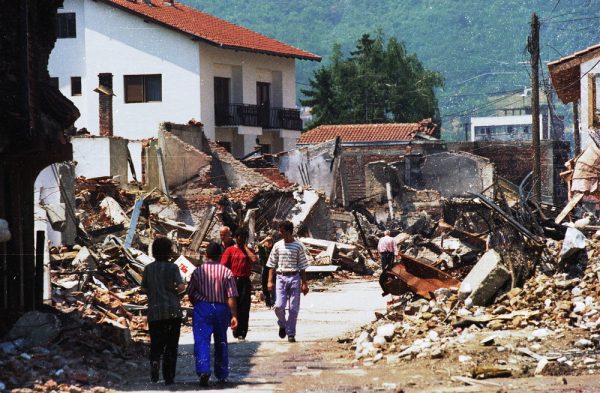
Twenty-five years ago, NATO was bombing Serbia as the first performance in its new role. The collapse of the Soviet Union had deprived the military alliance of its initial official role of defending its member states from a theoretical communist threat. Under no threat and devoid of UN Security Council approval, NATO assumed the self-ordained role of virtuous defender of allegedly oppressed minorities by bombing what was left of largely dismantled Yugoslavia in the spring of 1999 on behalf of Albanian rebels in the Serbian province of Kosovo.
NATO’s air attacks on the Balkan nation were the practical application of a new post-Cold War doctrine. To succeed, this doctrine relied on Western media to report on crisis areas with the appropriate mixture of exaggerations, omissions and outright lies to justify NATO’s virtuous interventions. The military industrial complex could breathe easy and a new generation of journalists began successful careers eagerly spinning their reports to serve the new humanitarian war ideology.
None was more successful than Dublin-born Samantha Power, whose novice reports from Bosnia in the mid-1990s provided the basis for her 2002 book on “genocide” which “quickly became an international sensation, glowingly reviewed almost everywhere, a huge bestseller that won her a Pulitzer Prize and launched her career as a leading figure in human rights doctrine.” She has gone on from one top governmental post to another, a Washington star, urging the United States to intervene on moral grounds.
Samantha Power owes her remarkable success to her talent as a writer, her ambition, her striking presence, but not least to the man at the origins of the whole humanitarian war policy.
That was none other than Morton Isaac Abramowitz, a highly influential member of the foreign policy establishment and the main inventor of what would become the “R2P” (Responsibility to Protect) doctrine. The crucial policy contribution of Abramowitz is explained at the start of my 2002 book, Fools’ Crusade, as follows:[1]
As president of the Carnegie Endowment for International Peace in the early 1990s, Abramowitz headed a project to develop a new U.S. foreign policy for the post-Cold War era. Rather than identifying “threats”, especially at a time when few threats could be seen, a successful new policy needed to combine promotion of U.S. interests with proclamation of U.S. “ideals”.
Theory and Practice
At the Carnegie Endowment in 1992, Abramowitz published the theory of the new U.S. “humanitarian intervention” policy as Self-Determination in the New World Order.
“The vision of a ‘new world order’ since 1990 has been a world with one superpower – the United States – in which the rule of law supplants the rule of the jungle, disputes are settled peacefully, aggression is firmly met by collective resistance, and all people are justly treated.”
That sounds very nice. But put into practice, “collective resistance” means NATO, and “all people are treated justly” depends on Washington’s preferences. The new rules-based order was not to be confused with traditional international law, based on national sovereignty. Globalization was making national sovereignty outdated (except for the United States). “Ideals” make rules more flexible.
The sovereign nation is being broken down subtly by the pressures of economic globalization. It may also be undermined from within, by domestic insurgencies. In the post-Cold War world, the Carnegie Endowment study noted, “groups within states are staking claims to independence, greater autonomy, or the overthrow of an existing government, all in the name of self-determination”. […] In the future, the authors announced, “humanitarian intervention will become increasingly unavoidable”. The United States will have the final word as to when and how to intervene.
Abramowitz subsequently helped put his theory into practice in crumbling Yugoslavia. He was the eminence grise behind U.S. diplomats, steering the events leading to the “Kosovo war” that split the province of Kosovo off from Serbia. He was advisor to the Kosovo Albanian delegation at the imitation “peace negotiations” staged at Rambouillet to provide an excuse for the bombing of Serbia. The moderate Albanian Kosovo leader Ibrahim Rugova was replaced by the armed gangster, Hashim Thaci. Secretary of State Madeleine Albright set terms no Serbian leader could accept, demanding the right to station NATO troops over the entire country, with full impunity. The Serb side was then blamed for the failure, and NATO began to bomb on March 24, 1999.
Samantha Steals her Way into Bosnia
Back in 1992, fresh out of Yale, 22-year-old Samantha Power was given a position as intern in the office of Abramowitz at the Carnegie Endowment. As a proofreader, she quickly absorbed the new official doctrine. At that time, her boss was obsessed with the conflicts in Bosnia as implicating the future of NATO. Determined to get to Bosnia where the action was, Samantha stole stationery from the neighboring office of Foreign Policy magazine and forged a letter from the editor to the head of the UN Press Office, asking that the UN provide her, as Foreign Policy’s “Balkan correspondent,” with “all necessary access.”[2]
From that time on, her work functioned precisely to advance the new “humanitarian intervention” policy of her mentor, Morton Abramowitz. She recalls that his influence helped her get increasingly important assignments – most crucially, writing about the Srebrenica massacre for The Washington Post.
With the Srebrenica reports, the term “genocide” emerged as the power word that could give NATO its new mission.
The Western press corps based in Sarajevo tended to become emotionally involved with the Muslim side which was its principal news source. Missing from their dispatches were reports on Muslim massacres of Serbs villages or on the well-armed Islamic fighters who joined the Muslim side from Afghanistan and Arab countries, some of them settling permanently in Bosnia.
When Bosnian Serb forces captured the Muslim base at Srebrenica in July 1995, they evacuated women, children and the aged to safety, while men fled, fearing retaliation. Many were killed in unclear circumstances.
Without reference to such context, Western media focused on reports of a massacre of 8,000 male prisoners as a unique event which branded the Serbs as the guilty party in the three-sided civil war. With the Srebrenica reports, the term “genocide” emerged as the power word that could give NATO its new mission.
Calling Srebrenica “genocide” provided the argument for NATO bombing: if Serbs committed genocide in Bosnia, it implied that Serbs were genocidal and risked committing genocide in Kosovo unless NATO intervened. This theory was supported by wildly inaccurate accusations voiced by leading Western politicians during the bombing campaign.
That was the story that was sold to the public by politicians and the media. From the start, the Serb majority in Yugoslavia had been portrayed as invaders in their own country, with everyone else as victims. Thus was destroyed the last semi-socialist, nonaligned country in Europe.
The Kosovo war indeed combined U.S. “interests and ideals”. The ideals were preventing a genocide that never would have taken place (and also, incidentally, preventing a negotiation that could have settled the whole conflict as well). The interests included the immediate construction by the Americans of a giant U.S. military base on the territory of Kosovo, once Serbian forces were obliged to leave.
Genocide and R2P
Samantha Power’s 2002 book was subtitled “America in the Age of Genocide”. To speak of the present as an “age of genocide” is wildly melodramatic, but the purpose is to place virtuous America in the center of drastic moral demands. America must save the world from its genocidal self. “Genocide” was thereby promoted as the most potent pretext for U.S. military intervention – precisely by deploring its absence, both in Bosnia and more convincingly, in Rwanda. The Clinton administration was certainly not going to intervene in Rwanda, because the bloody chaos was in fact favoring the conquest of Rwanda by Paul Kagame and his army, which had invaded Rwanda from Uganda in 1990. Kagame was a favored client of the United States. There was no reason for Washington to interfere with Kagame’s victory.
But the “failure to stop genocide” was an appeal to the liberal conscience to intervene later on, whenever the U.S. was in need a powerful argument to get rid of a someone it wanted to get rid of. Moammer Gaddafi had been on the U.S.-UK hit list for decades, but had made concessions to gain reconciliation. But when Gaddafi’s usual fundamentalist Islamic opponents in Tripoli used the 2011 “Arab spring” to raise protests, the “threat of genocide” alarm was raised on their behalf. In Washington, action to stop Gaddafi from “committing genocide” was urged by Hillary Clinton, Susan Rice and Samantha Power, while Bernard Henri Lévy raised the alarm in Paris. NATO rose to the challenge, destroyed the most economically successful country on the African continent and murdered its leader, creating a flood of refugees to Europe and other disasters. Most of the liberal left cheered.
Today it is widely recognized that the Irak war was based on deceit and ended in disaster. Other U.S. wars are mostly conceded to have been unfortunate mistakes. There are doubts about Libya, due mainly to the refugee flow. But the destruction of Yugoslavia, and in particular the 1999 “Kosovo war”, is still widely accepted in the West as what it was arranged to appear: NATO’s generous humanitarian intervention to prevent “genocide” by racist Serbs against the oppressed Albanian minority.
The distortions of the Bosnia conflict and the Kosovo war were precisely the practical application of the Abramowitz policy: promote minority rebellions to break down national sovereignty and change governments the U.S. doesn’t like, while supplying NATO with a new geographically unlimited mission of “humanitarian intervention”. Yugoslavia was the starting point of the whole aggressive post-Cold War U.S. policy as “single superpower” determining the world order, using the idealistic pretexts set out by Abramowitz. Young Samantha Power, who was very smart, got the point and ambitiously cheated her way into a supporting role as reporter in the Bosnia spectacle, which she eventually transformed into an astonishingly successful career.
I was in Kosovo on my own in months prior to the NATO bombardment and saw quite clearly that in that small province, the Serbs were a frightened minority while Albanians were already tasting their future triumph. There was absolutely no danger of a Serbian “genocide” of Albanians. But Western editors kept sending in ignorant young aspiring journalists, on the lookout for some “Serb atrocity” that could advance their budding career. Editors rejected any report that went in a different direction. It was at that time just plain impossible to publish an unbiased report. I know from experience.
Above all, breaking up Yugoslavia was an exercise in subsequent efforts to undermine the Russian Federation, by inciting the Federation’s ethnic minorities against the Russians. Ukraine was the crucial battering ram. I always used to think of Ukraine when studying the conflicts in the Krajina regions of Croatia and Bosnia, as both words have the same root (border land) and suffered from similar conflicts, notably in World War II. Western powers had revived the Nazi-supported Croatian nationalism against the Serbs to break up Yugoslavia. They would revive much more virulent Nazi-supported Ukrainian nationalism against Russian-speakers in Eastern Ukraine, in an effort to weaken and eventually even break up the Russian Federation.
And for the United States, the humanitarian “ideals” of supporting minorities would be compensated by the major strategic “interest” of eventually gaining control of Crimea, and with it, Russia’s main naval base in Sebastopol. Putin did what any Russian leader not brain-dead would have done: he headed off this disaster by mobilizing the Russian inhabitants of Crimea to vote to return to Russia, which they had never chosen to leave. This obvious act of self-determination is denounced in the West as an invasion.
The Ideological Backlash
Unfortunately, the blatantly tragic misuse of the “humanitarian intervention” or R2P doctrine in Libya has not managed to achieve its discredit. It is threatened now by the danger that it is changing sides in the very global conflicts it has stimulated.
The referendum in Crimea was a democratic measure of self-determination that fit the Abramowitz standards. The Russian “Special Military Operation” in Ukraine in 2022 was partially motivated by the sort of consideration featured in the Abramowitz doctrine: defense of the population of Donbas, under attack from an ultranationalist regime in Kiev. Of course, Western governments and media have simply totally ignored any Russia appeal to the ideals of human rights and self-determination, which they consider their own private property as self-declared unique “democracies”. Russia is classed as an “autocracy” whose interests must be malevolent and thus don’t count.
A greater threat to the West’s self-proclaimed monopoly on virtue is coming from Israel’s merciless attack on the people of Gaza. Most of the Global South and growing sections of Western populations are horrified by Israel’s destruction of hospitals, mass murder of children and efforts to starve the Palestinians. They see Israel, with full Western backing, committing Genocide – the real thing this time, out in the open, blatant and unrelenting.
The NATO war machine may have to conjure up a new set of moralizing pretexts for its aggressions.
Notes
[1] See Fools’ Crusade: Yugoslavia, NATO and Western Delusions, Pluto Press, 2002, pp 9-10; Monthly Review 2003
[2] Here, with William Burns, Samantha Power discusses her new autobiography The Education of an Idealist and recalls her short term working for Abramowitz at the Carnegie Endowment. https://carnegieendowment.org/2019/09/13/samantha-power-on-education-of-idealist-event-7178
Israel’s Attack on Iranian Consulate Highlights Netanyahu’s Pending Defeat in Gaza
Sputnik – 02.04.2024
Tel Aviv launched a strike against the Iranian diplomatic compound in the Syrian capital of Damascus this week, killing several Islamic Revolutionary Guard Corps officers in the process.
Israel’s attack on the Iranian consulate in Syria suggests that it is trying to “widen” the ongoing conflict in the Gaza Strip by drawing Iran into it, said Foad Izadi, an associate professor at the University of Tehran’s Department of American Studies.
“They have been trying to start a military confrontation between the United States and Iran for many years. And they think that they have an opportunity to have this done fighting Iran using American soldiers,” he told Sputnik, apparently suggesting that the US would be quick to leap to Israel’s defense if the latter were threatened by Tehran.
Izadi also remarked that Israel displayed a blatant disregard for international law by attacking a diplomatic compound, which is a violation of the Vienna Convention.
“That is what Israelis are trying to do. Netanyahu realizes that he has lost the war in Gaza. He has managed to kill more than 30,000, mostly women and children, without achieving any goals except killing these people and ruining their homes,” Izadi said.
“They say that they want to destroy Hamas, but that’s not a goal they can achieve. Obviously, they would have done that if they could. That’s why criminal acts and genocide in Gaza continue. And Netanyahu realizes that sooner or later this war needs to end. And that would be the end of his prime ministership. And so he’s trying to prolong the war, he’s trying to widen the war,” Izadi added.
Noting that Iran’s attempt to seek justice via the UN Security Council may be unsuccessful due to the likelihood of the US vetoing a resolution critical of Israel, Izadi suggested that Tehran may opt to “cause pain for the Israelis so that these types of actions are not repeated.”
“Because Iranian officials realize that if there is no pain in engaging in this type of activity, then they will continue,” he elaborated. “So I think Iran’s response would be two-fold in a manner that is not satisfying the Israeli aim of widening the war. I think that’s what Iranian leaders will do.”
NATO ‘de facto’ part of Ukraine conflict – Moscow
RT | April 2, 2024
NATO is aiming to retain control over Ukraine and turn it into an “anti-Russian” proxy, the secretary of the Russian Security Council, Nikolay Patrushev, claimed in an interview published on Tuesday.
The US-led military bloc has long been a “de facto” party to the conflict between Kiev and Moscow, as it controls Ukrainian arms supplies and helps to plan attacks on Russia, Patrushev told the Russian newspaper AiF.
Washington and its allies have been actively militarizing Ukraine ever since the 2014 Maidan coup in Kiev, the official said in an interview covering the US-led military bloc, ahead of its 75th anniversary. NATO now seeks to “keep Ukraine or at least a part of it, as a fully controlled anti-Russian territory,” he stated.
NATO collectively decides on the quantity and types of weapons its members provide to Ukrainian troops, the Russian official noted, adding that the range and technical characteristics of those arms are constantly increasing.
The bloc’s instructors also “train mercenaries and sabotage units on several nations’ territories to be used in anti-Russian operations,” Patrushev told the paper. Under such circumstances, the Kremlin’s goal of bringing about Ukraine’s “demilitarization” remains a priority, the Security Council secretary said.
Stirring up Russophobia and whipping up the perceived “Russian threat” has also turned into a “major policy” for the West, the official said, arguing that such tactics allow the US and its allies to draw public attention away from internal economic issues.
Anti-Russian hysteria ultimately benefits the US military industrial complex, Patrushev stated.
“The US is gaining profits through… dictating very specific arms purchasing conditions to its allies,” the official told AiF, adding that those arms are then produced by American manufacturers, and such contracts can become economic shackles for other NATO members.
Patrushev’s remarks come amid a historic low in Russia-NATO relations. The situation is now worse than during the Cold War, the head of Moscow’s delegation at the Vienna talks on military security and arms control, Konstantin Gavrilov, acknowledged on Monday.
Gavrilov stated that constant talk from Western politicians about Russia’s alleged plans to attack NATO after defeating Ukraine are aimed at diverting public attention from their own governments “pumping … money into the Ukrainian ‘corruption black hole’.”
Moscow has repeatedly stated that it has no plans to engage in a military confrontation with NATO or any of its members. President Vladimir Putin said earlier this year that Russia “has no interest … geopolitically, economically or militarily… in waging war against NATO.”
Update on the Crocus terror attack
By Gilbert Doctorow | April 1, 2024
Day by day, the Russian security officials are expanding upon their claims that Ukraine financed and directed the terror attack on the Crocus City Hall concert venue. Sunday evening’s edition of News of the Week hosted by Dmitry Kiselyov pointed to crypto currency payments and other financial channels which were used by the Ukrainians, as the latest results of interrogations and further arrests have revealed. A substantial success reward is said to have awaited the assailants upon arrival in Kiev.
Meanwhile various Western media outlets including Deutsche Welle tell us the Kremlin has demanded the hand-over of the head of Kiev’s Security Service (SSB), brigadier general Vasyl Malyuk on charges of directing terrorist attacks in Russia. To be sure, Malyuk himself has claimed responsibility for the 2022 bombing of the Kerch (Crimea) bridge. But we may now assume that the Russians have evidence to hold him to account for directing the Crocus City Hall atrocity.
There is speculation in social media that Kiev’s refusal to surrender its terror campaign leaders would allow Russia to declare Ukraine a terrorist state. This would open the possibility for ‘neutralizing’ top Ukrainian officials on justifiable grounds.
However, we need not speculate about what may come next. De facto, Russia’s current offensive against Ukraine has escalated to a new, vastly more threatening level. There are daily punishing aerial bombing and missile attacks on military command centers across Ukraine, on training centers, on concentrations of foreign mercenaries. And then there is a new dimension to the destruction of Ukraine’s electricity network.
In the winter of 2022-2023, all the Western media spoke of Russian attacks on the energy infrastructure, on how Russia was allegedly seeking to impose misery on the Ukrainian civilians by depriving them of heat and light in the midst of freezing cold. But back then the reality was that Russia only struck substations and other distribution points. Such destruction was meant to knock out power for tactical advantage over the Ukrainian armed forces. It was obvious that the substations and other gear could be replaced in a matter of weeks or months. By contrast what is now going on is Russian destruction of power generating stations. Replacing them will be a matter of years, not months.
Very much to the point, the mayor of Kharkiv yesterday remarked to the press that the city’s power supplies have been utterly destroyed. This development corresponds very nicely to the calls that were made on the Evening with Vladimir Solovyov talk show last week for Kharkiv’s inhabitants to be sent packing in their cars headed west ahead of the city being razed to the ground. The intent was to end once and for all the missiles and artillery shells that Kharkiv has been sending daily into the neighboring Belgorod region of Russia to kill civilians in the greatest numbers possible. Kharkiv may not yet be razed, but it certainly is on the way to becoming uninhabitable.
In the face of this massive and undeniable destruction by the Russians both on and off the battlefield, the bravado of Zelensky and his clique is fading. Indeed, the Ukrainian president has finally said publicly that it may be time for peace negotiations.
Let us hope that Russia’s post Crocus viciousness may bring the Ukrainians to their senses and end this awful war.
©Gilbert Doctorow, 2024
Senior IRGC commander, his deputy assassinated in Israeli attack on Iran Embassy’s consular section in Syria
Press TV – April 1, 2024
A commander of the Quds Force of Iran’s Islamic Revolution Guards Corps (IRGC) in Syria and Lebanon has been martyred in an Israeli attack on the Iranian consulate in the Syrian capital of Damascus.
Brigadier General Mohammad Reza Zahedi and his deputy, Mohammad Hadi Haji Rahimi, were killed in the Israeli attack on Monday on the Consular Section of the Embassy.
Syria’s official news agency, SANA, said the strikes were carried out by “the Israeli enemy” and targeted the Mezzeh neighborhood in Damascus on Monday afternoon.
Iran’s Ambassador to Damascus Hossein Akbari confirmed the reports of the Israeli attack and said the regime had targeted the consular building with six missiles.
Akbari said seven people were martyred in the Israeli aggression but the names and the exact number of martyrs have yet to be specified. He also noted that several Iranian military advisors and diplomats were also martyred in the missile attack, whose names would be announced later.
According to the ambassador, the Consular Section of the Embassy was targeted by F-35 fighter jets and six missiles.
Born in 1960, Zahedi joined the IRGC in 1980 and was a commander of the elite force during the Iraqi-imposed war in 1980-88.
He was the commander of the IRGC Air Force from 2005 to 2006. Later he served as the IRGC Ground Force Commander from 2006 to 2008.
Zahedi served as a commander of the IRGC Quds Force from 2008 to 2016.
Ukrainian counteroffensive ‘biggest debacle in modern military history’ – David Sacks
RT | April 1, 2024
The failure of Ukraine’s 2023 summer counteroffensive against Russia was “easily predictable,” according to US tech entrepreneur and venture capitalist David Sacks, who has suggested that the Washington elite should be held accountable for talking up the doomed operation.
Sacks’ comments came in response to a post on Saturday by Tesla and SpaceX CEO Elon Musk, who condemned the unnecessary loss of life suffered by Kiev’s forces as they attempted to “attack a larger army” that had superior defenses.
The failed Ukrainian counteroffensive was “one of the biggest debacles in the history of modern warfare,” Sacks said in agreement, adding that Kiev’s soldiers and tanks had effectively run “headlong into minefields while Russian artillery rained down on them from heavily fortified positions.”
“This should have been easily predictable,” the former PayPal COO and founder of the Yammer corporate social network stressed.
According to estimates released in March by the Russian Defense Ministry, the Ukrainian military saw over 166,000 casualties during last year’s failed counteroffensive. Kiev’s overall casualties since the outbreak of the conflict with Russia stand at 444,000, the ministry has claimed.
Sacks went on to suggest that US officials such as ex-CIA chief David Petraeus, former House Speaker Nancy Pelosi, and current US Secretary of State Antony Blinken should all be held responsible for encouraging the doomed operation.
“These people are fools who should have no credibility left. But of course the MSM never holds them accountable so we will get more of the same until Ukraine finally collapses,” Sacks surmised.
Musk, meanwhile, has called the counteroffensive “a tragic waste of life for Ukraine,” suggesting that Kiev should not have attacked Russian forces – which had deployed vast minefields and had stronger artillery – while Ukrainian forces lacked armor or air superiority.
“Any fool could have predicted that,” the billionaire said, recalling that one year ago he had recommended that Kiev’s forces entrench and apply all resources to defense.
Musk stated that Kiev would continue to have difficulty holding on to territory, but suggested that Russia was unlikely try to take over the entire country, arguing that it would face “extreme” local resistance in western regions of Ukraine.
He also warned that if the conflict “lasts long enough, Odessa will fall,” and advised Kiev to reach a negotiated settlement with Moscow as soon as possible, before Russia gains more territory and Ukraine loses all access to the Black Sea.
Moscow has stressed that it remains open to meaningful talks with Kiev, and has blamed the lack of a diplomatic breakthrough on the Ukrainian authorities, who refuse to accept the “reality on the ground.”
Featured Video

Matt Bracken: US Plans Massive MOAB Strike on Iran?
or go to
Aletho News Archives – Video-Images
From the Archives
Confronting the Threat of Ethnic Bioweapons
By Tony Cartalucci – New Eastern Outlook – 29.11.2017
The United States Air Force’s 59th Medical Wing’s molecular biology branch recently was revealed to have been collecting specifically Russian RNA and synovial (connective) tissue samples, prompting fears in Russia of a possible US directed ethnic-specific bioweapons program. … continue
Blog Roll
 Aletho News
- Matt Bracken: US Plans Massive MOAB Strike on Iran?
- Russia accuses France of ‘piracy’ over tanker seizure
- Why Yemen Is Bombing Saudi Arabia’s Airports: The War Behind the Headlines
- Sally Rooney’s books pulled from UK over support for Palestine Action
- Bombs for Tel Aviv, Promises for Riyadh
- Israeli ad agency conducted vast global espionage campaign using online ads: Report
- Oct. 7 Forever Marks The Big Reveal: ‘We See You, Israel, We Revile You, We Reject You!’
- Meet the US generals and admirals advancing Israeli policy
- Israel’s Straw Widow Protocol: The Kill Zones Where Civilians Were Labelled ‘Terrorists’
- Leading Israeli Think Tank Publishes Psychotic Israeli ‘National Security’ Doctrine
- If Americans Knew
- Israeli firm used online ads to run vast spy operation, researchers say
- No, the world zionist movement is not an antisemitic conspiracy theory
- Hundreds of IDF investigations into killings still have no public outcome, BBC Verify finds
- After Ashley Moody Epstein Probe, Donors Linked to Him Poured Money Into her Senate Campaign
- Worried about Russian meddling in UK politics? Wait till you see what Israel is up to
- Israeli settlers attack West Bank center for disabled children, church leader calls for int’l action
- Pulling Out Teeth Just to Live: How Israel Has Devastated Dental Care in Gaza
- Gaza’s “ceasefire” death toll passes 1,500 – Daily Update
- Activists Abused By Israel Return to New Freedom Flotilla Mission
- 60 Minutes won’t tell the full truth about Israeli settler violence
- No Tricks Zone
- New Study Suggests Large Regions Of The Pacific Ocean Have Been Cooling For The Last 80 Years
- Germany’s Green Energy Debacle: High Energy Costs Force Kahla Porzellan to Close After 182 Years!
- New Study: 50 Years Of The Most Aggressive ‘Net Zero’ Policies Can Only Affect The Global Climate By 0.03°C
- US September “Heat” Was No Record…Many Records Set Decades Ago
- Latest European Green Energy Debacle; Portugal’s Largest Flagship Solar Park Insolvent!
- Green Energy Debacle: German Expert Professor Fritz Vahrenholt Warns Of Severe Economic And Social Consequences
- Two More Paleo Reconstructions Affirm Meters-Higher Sea Levels Across Ireland, Brazil 7000-6000 Years Ago
- New Study: Earth And Venus Surface Warmth Largely Explained By Convection And Lapse Rate, Not CO2 Or Radiation
- 2025 Nature Paper Claiming Worsening Global Drought Gets RETRACTED …Heavily Flawed
- New Study: ‘Global Drought Shows No Detectable Recent Acceleration Under Climate Warming’

