The Pentagon’s Perpetual Crisis Machine

By Jacob G. Hornberger | FFF | January 26, 2023
Given President Biden’s decision to send 31 of its top-ranked M1 Abrams tanks to Ukraine, it is clear that the Pentagon has decided to escalate its war against Russia. Biden’s decision was followed by Germany’s decision to deliver 14 Leopard 2 A6 tanks to Ukraine. I’ll guarantee you there isn’t a Russian alive who doesn’t know about the time in the 1940s when Germany sent its tanks deep into Russia, killed millions of Russians, and almost succeeded in conquering the country.
If the increasing pressure that the Pentagon is putting on Russia does not result in a nuclear war between the United States and Russia, the advocates of this highly dangerous interventionist and escalatory strategy will later exclaim, “You see, we told you that there was never a risk of nuclear war.” But what’s interesting about the Pentagon’s strategy is that if it does result in nuclear war, there won’t be anyone around to point out how wrongheaded it was.
This is obviously no way to live. But this is what life is like under a national-security state form of governmental structure. The military-intelligence establishment needs a constant stream of crises to keep people agitated, hyped-up, afraid, anxious, and tense. In that way, they’ll look to the military-intelligence establishment to keep them “safe.” Without the constant stream of crises, people might be apt to ask, “Why do we need a national-security state? Why can’t we have our limited-government republic back?”
Moreover, a constant stream of crises ensures ever-increasing taxpayer-funded largess for the Pentagon, the CIA, and the NSA, which are the three principal components of the national-security establishment. That amount will soon reach $1 trillion per year. I’ll guarantee you that the manufacturers of tanks are uncorking the champagne bottles today. After all, those tanks being sent to Ukraine have to be replaced. Hard-pressed American taxpayers will pay for them, either directly through taxes or indirectly through more federal debt (now at $31.5 trillion and climbing every day) and inflation.
That’s what the entire Cold War racket was all about — keeping Americans agitated, hyped-up, afraid, anxious, and tense. Everyone was inculcated with the notion that the Russian Reds were coming to get us. Only the Pentagon, the CIA, and the NSA could save us from a communist takeover. The only president who has ever been willing to confront this scam was President Kennedy, and we all know what happened to him.
When the Cold War came to an end, unfortunately the Cold War racket didn’t. The national-security establishment kept their old Cold War dinosaur NATO in existence. Breaching their promise to Russia, the Pentagon began using NATO to absorb former members of the Warsaw Pact. The Pentagon knew precisely what it was doing — setting the stage for the continuation of its old Cold War racket, at least with respect to Russia.
When the Pentagon ultimately crossed what Russia had repeatedly emphasized was a “red line” by threatening to absorb Ukraine into NATO, the Pentagon achieved what it wanted — the continuation of its old Cold War racket, except for the part that the Reds were coming to get us.
But they’re still not willing to let go of the Red part of their Cold War racket. That’s why they’re now doing their best to gin up a crisis with China over Taiwan. That crisis will enable them to exclaim, “See, you need us to protect you from both Russia and the Chinese Reds.”
And don’t forget — they still have their perpetual war-on-terrorism racket. Sure, they’re not killing people en masse anymore in Afghanistan and Iraq, but they still are killing people in the Middle East and Africa. The potential terrorist retaliation from those continuous killings are enough to justify the continuation of their forever war-on-terrorism racket as well as the continuous destruction of our rights, liberties, and financial security here at home, as part of the process of keeping us “safe” from the terrorists who supposedly hate us for our “freedom and values.”
The important thing is that a life of permanent, perpetual crises is neither necessary nor inevitable. There is a way to restore normal life to America — one that isn’t based on a continuous stream of crises. That way is to dismantle the national-security state form of governmental structure and restore our founding governmental system of a limited-government republic. The only question is whether Americans have the will and the fortitude to do this. One thing is for sure: Our freedom, well-being, and possibly even our survival depend on it.
NATO member ‘secretly provided Ukraine with fighter jets’
RT | January 26, 2023
In spring 2022, Warsaw secretly delivered several of its MiG-29 fighter jets to Ukraine, despite the Polish government officially denying any such deals, a local paper has claimed, citing sources.
According to Dziennik Gazeta Prawna (DGP), the planes were sent over using a “combined” method, apparently meaning that they were delivered in a disassembled state and declared as spare parts.
“The fuselage and the wings are also spare parts,” DGP wrote Wednesday, citing sources within the Polish government.
Back in March, in the first months of Russia’s military operation in Ukraine, Washington rejected a plan to transfer Polish MiG-29 jets to Ukraine, stating the move was “too escalatory” and risked directly involving the US or a NATO ally in the conflict, potentially triggering a direct confrontation with Russia.
In April, however, the Pentagon stated that unnamed US allies had helped bolster Ukraine’s fleet of fighter jets by donating unspecified “spare parts” which were supposedly used to restore many of Kiev’s damaged planes.
The latest article by DGP now seems to suggest that that ally could have been Poland, which in late April was also revealed to have provided Ukraine with $7 billion worth of military aid, including half of its tanks, dozens of howitzers, Grad MRLS, and missiles for MiG-29 and Su-27 fighter jets, among other munitions.
In recent weeks the US seems to have abandoned some of its prior concerns about supplying heavy weapons to Ukraine, and now plans to deliver a number of its M1 Abrams tanks to Kiev, while Germany, Poland and Finland intend to send dozens of their Leopard 2 tanks.
Kremlin spokesperson Dmitry Peskov has responded to these planned deliveries as evidence that the West is becoming more directly involved in the conflict, despite European and American politicians claiming otherwise. That’s as Russia has repeatedly urged the West to stop “pumping” Ukraine with weaponry, arguing it would only prolong the conflict and lead to more bloodshed.
Weapon Manufacturers Record Skyrocketing Profits From US Arm Sales in 2022
By Ian DeMartino – Sputnik – 26.01.2023
War has always been big business in the United States. According to the seminal anti-war essay “War is a Racket,” gunpowder manufacturer Du Ponts saw their profits increase by more than 950% during The Great War.
US arms sales to other countries skyrocketed in 2022, providing a tidy sum of profits for weapon manufacturers, according to data released by the State Department on Wednesday.
US weapon sales to other countries, largely driven by NATO’s response to Russia’s special military operation in Ukraine and increased tensions in Asia, jumped from $35.8 billion in 2021 to $51.9 billion in 2022.
Direct weapon sales from US-based weapon manufacturers also saw a massive increase, jumping from $103.4 billion in 2021 to $153.7 billion in 2022.
In Europe, the largest purchasers include Germany, which ordered 35 F-35 Joint Strike Fighter airplanes for $8.4 billion, and Poland, which spent $6 billion on 250 M1 Abrams tanks.
The United Kingdom, Spain, and new NATO member Bulgaria also made significant purchases in 2022.
Meanwhile, tensions in Asia over Taiwan and competing claims in the South China Sea have also been a boon for weapon manufacturers. Significant weapon sales in the area include $13.9 billion from Indonesia for 36 F-15ID fighter jets and a $1.95 billion purchase from Australia for 40 Black Hawk helicopters and other equipment. South Korea and Japan also made significant military purchases, totaling $790 million and $588 million respectively.
The Biden administration also approved a $1.1 billion weapons package for Taiwan in an effort to deter China from militarily seizing the island.
The Middle East, always a reliable profit center for military contractors has continued to be so. The two countries pushing the brutal war in Yemen, Saudi Arabia and the United Arab Emirates, have asked for $3 billion and $2.2 billion in military weapons and equipment from the United States respectively.
During the 2020 campaign, the Biden administration pledged to stop sending weapons to Saudi Arabia because of its war in Yemen.
Unsurprisingly, this has led to significant revenue gains by weapon manufacturers.
Revenue for Lockheed Martin, which develops the F-16, F-22, and F-35 fighter jets rose 7.13% to $19 billion in the fourth quarter of 2022. Northrop Grumman, which also makes F-35 fighter jets, is expected to report 11.8% revenue growth compared to fourth quarter earnings when it issues its financial reports on Thursday.
Meanwhile, Raytheon, the maker of the Patriot Air Defense System the Biden administration recently announced it will supply Ukraine with, saw its Q4 profit rise of nearly 18% compared to last year.
Did Germany just officially declare war on Russia?
By Drago Bosnic | January 26, 2023
During a debate at the Parliamentary Assembly of the Council of Europe (PACE), German Foreign Minister Annalena Baerbock bluntly stated that Germany and its allies are at war with Russia. The unexpected admission, although essentially true, is quite shocking given the fact that many Western officials have been insisting they aren’t directly involved in the conflict with Moscow. Baerbock made the statement during a discussion over sending “Leopard 2” heavy tanks to the Kiev regime. Most mainstream media conveniently ignored her words, but numerous experts were alarmed and warned that Berlin just essentially declared war on Russia.
This stands in stark contrast to claims of other German officials who have been extremely careful with their statements for nearly a year, insisting that their country is not directly involved in the Ukrainian conflict and citing uncontrollable escalation as their primary concern. However, this official stance is now in serious question, as one of the country’s top officials just effectively nullified all of their efforts. Annalena Baerbock started her statement at PACE with the following:
“And therefore I’ve said already in the last days – yes, we have to do more to defend Ukraine. Yes, we have to do more also on tanks. But the most important and the crucial part is that we do it together and that we do not do the blame game in Europe, because we are fighting a war against Russia and not against each other.”
Ironically, Chancellor Olaf Scholz and his now former defense minister Christine Lambrecht have been accused of being “weak” on arming the Neo-Nazi junta. They have frequently insisted that it would be dangerous to get more directly involved in NATO’s proxy war against Russia. However, it seems that the much more hawkish Baerbock is willing to say the quiet part out loud. Moscow immediately reacted to the comments, with Russian Foreign Ministry spokeswoman Maria Zakharova saying this is yet another proof that the political West was planning a war on Russia for quite some time now.
“If we add this to Merkel’s revelations that they were strengthening Ukraine and did not count on the Minsk agreements, then we are talking about a war against Russia that was planned in advance. Don’t say later that we didn’t warn you,” Zakharova said.
Baerbock’s comments come on the heels of nearly a year of direct Russophobic narrative, including openly declared plans for war with Russia. In mid-November, Der Spiegel published leaked German Defense Ministry documents, revealing that the Bundeswehr is preparing for war with Russia. The secret draft titled “Operational guidelines for the Armed Forces” was authored by none other than the German Chief of Staff, General Eberhard Zorn himself. He stressed the need for a “mega-reform” of the German military and clearly identified Russia as an “immediate threat”.
The claim makes little sense, as Germany is now over 1,500 km away from Russia, with Belarus, Poland and Ukraine standing between the two countries. While such assertions made some sense at the height of the (First) Cold War, when the Soviet Union had over half a million soldiers stationed in East Germany alone (in addition to other Warsaw Pact member states), the situation is effectively reversed nowadays. NATO is the one encroaching on Russia’s western borders, with the crawling expansion including coups and other interventions in various Eastern European and post-Soviet states. After decades of this creeping aggression and Moscow’s futile attempts to build a comprehensive partnership with the political West, Russia was forced to launch its counteroffensive.
Back in early March, the German government announced a dramatic increase in defense spending, including a €100 billion budget for the Bundeswehr, essentially double in comparison to 2021. Although this will inevitably put additional pressure on the already struggling German economy, ravaged by the sanctions boomerang from its failed economic siege of Russia, Berlin’s suicidal subservience to Washington DC seems to take precedence. Much of Germany’s prosperity was based on access to cheap Russian energy, now a thing of the past thanks to Berlin’s resurgent Russophobia.
In addition, Germany also uniquely holds historical responsibility on a scale virtually no other country in the world does, especially towards Russia. During the Second World War, it launched a brutal invasion of the Soviet Union, killing nearly 30 million people and destroying virtually everything in its path. Worse yet, after approximately 80 years of denazification in the aftermath of its WWII defeat, Berlin still decided to support the Neo-Nazi junta in Kiev, effectively renouncing its own official postwar political position. This also includes German weapons that are killing Russians, both soldiers and civilians.
Alarmed by the dramatic shift in rhetoric, many in Germany are already pointing out the fact that the country is repeating the same historical mistake by antagonizing Russia. Petr Bystron, an AfD (Alternative for Germany) member of the German Parliament, reminded his colleagues in the Bundestag of the consequences of sending German tanks to fight Russia in Ukraine:
“It’s an interesting approach you’re taking here. German tanks against Russia in Ukraine. By the way, your grandfathers have already tried to do it then with the Melnyks and Banderas [Ukrainian Nazi collaborators during WWII] and what was the result? Untold suffering, millions of deaths on both sides, and in the end, Russian tanks here in Berlin. And two of them are still here, in front of the Bundestag. You should pass by them every morning and remember it!”
Drago Bosnic is an independent geopolitical and military analyst.
NATO’s best tanks are going to Ukraine, what will it mean on the battlefield?
By Mikhail Khodaryonok | RT | January 25, 2023
Tank supplies to Ukraine from NATO members is the top news story this week. Kiev has been calling for these weapons from its western sponsors since the beginning of the Russian offensive, and it looks like now, eleven months into the fighting, these demands are being met.
The US has announced it will send 31 Abrams main battle tanks. In a hastily scheduled speech on Wednesday, President Joe Biden noted that they are complicated to operate and maintain, so the US will provide Kiev with “parts and equipment necessary to effectively sustain these tanks on the battlefield.”
It was also confirmed, the same day, that the German government will send Leopard 2A6 tanks from its own stock and will allow other nations, such as Poland, to transfer German-made machines, to Ukraine. On January 14, London announced plans to ship its Challenger 2s to Kiev, while it now seems inevitable that Paris will supply AMX-56 Leclerc vehicles.
Russian experts and journalists have been locked in a heated debate over the differences between these western main battle tanks and the Russian T-90s, comparing their armor, guns, accuracy, active and passive protection systems, maneuverability, fire-control systems, ammunition, and many other attributes.
At the end of the day though, these discussions lack any practical value. The battlefield is the only litmus test for the advantages and drawbacks of any type of weapon or military equipment. Reliable statistics on combat use are all that is required for a comparative analysis of modern main battle tanks, if it is to be credible.
Another thing to remember is that all tanks are vulnerable to modern anti-tank systems.
How many tanks does Kiev need?
To simplify calculations, we’ll be using an armored division, the main structural and tactical unit of armored forces in the former Soviet republics, as our yardstick. According to Soviet manuals, an armored division must have 296 tanks, 230 infantry fighting vehicles, 54 self-propelled artillery systems, over 2,000 regular vehicles, and almost 12,000 soldiers and officers.
How many divisions does Kiev need? At least one per each of the three main fronts — in Lugansk, Donetsk, and Zaporozhye. The line of contact in the special military operation zone right now is 815 km long, making three divisions too modest an amount to make a difference, but let’s disregard this for the time being.
Three armored divisions combined would have a total of about 900 tanks. Apart from that, another armored division may be necessary on the Belarusian front, which could see some very heavy fighting. In case of an escalation there, an armored division or a similar unit in reserve is a must, which drives the number of required tanks up by 300 to 1,200.
Finally, no commander-in-chief can do without his own reserve, the so-called reserve of the supreme high command. Without at least one armored division, this reserve cannot really count as such, which means another 300 tanks for a required total of 1,500.
Another thing to consider is probable Ukrainian losses during offensive operations. The average daily losses of an armored unit in this case stand at 10 to 15%. About 15 to 20% of incapacitated tanks are typically irrecoverable losses, while the rest require repairs (general maintenance for 30 to 50%, medium-level repairs for 15 to 30%, and an overhaul for 10 to 20%).
Simply put, at least another 300 tanks are required to offset losses during combat operations. This gives us a figure of 1,800 tanks, which must be considered an absolute minimum.
These are very approximate and somewhat simplistic calculations, yet they give us ballpark figures.
How many tanks will Kiev get?
So far, NATO countries have earmarked tanks for Ukraine numbered in the dozens. This is only a fraction of the hypothetical minimum.
Great Britain and Poland have officially pledged an armored company each, respectively consisting of up to 14 tanks. Germany will supply a similar amount, while the US is preparing the supply of 31 Abrams heavy weapons.
At a recent meeting of the US-led Defense Contact Group at Ramstein Air Base in Germany, officials from 12 countries discussed sending a total of about 100 tanks to Kiev, if Berlin were to give the green light, which, according to an ABC report, it has done.
Rheinmetall could additionally supply a total of 139 tanks to Ukraine, including 88 Leopard 1s and 51 Leopard 2A4s, yet the German manufacturer concedes that only 29 of them could be shipped before the summer of 2023.
What impact will NATO’s tanks have?
Will all these tanks see combat any time soon? Let’s consider the example of the M1 Abrams, which is seen as one of the symbols of US military power.
A small number of these tanks manned by poorly trained crews and lacking full-scale maintenance and supply infrastructure support would most likely yield negative results. They will fail to change Ukraine’s fortunes on the battlefield, while images of burning American tanks will likely hurt US public opinion.
Thus, one of America’s premier weapons, the pride and joy of its defense industry, will be humiliated on the battlefield for a long time. This is something the Pentagon can’t allow to happen under any circumstances.
Therefore, before any actual fighting happens, evacuation teams, tank repair units, and spare part supplies must be in place, while crews must receive superior training to handle American tanks.
Last but not least, the first deployment of US main battle tanks in Ukraine must be accompanied by a significant Ukrainian army success, at least at the tactical level, which would necessitate no fewer than 200–300 (maybe even 400–500) tanks.
Otherwise, supplying the M1 Abrams to Ukraine makes neither military nor political sense. Transferring them one company (10 to 15 tanks) at a time would only mean that this equipment will burn on the battlefield without making any significant impact or even catching anyone’s attention.
So far, according to known data, Russia has not had any significant trouble dealing with enemy equipment. This is something on which both the Russian Ministry of Defense and most Western analysts seem to agree.
No room for complacency
It’s very likely that the first NATO tank companies will be used as training units for Ukrainian crews, while Poland will initially provide maintenance and repair capacity for servicing German or American tanks.
One shouldn’t think, however, that training will stretch over a very long time. It can take just weeks to do a full training program, while teaching T-64/84 crews to fight in the M1 Abrams or the Leopard 2A5 could be completed in a matter of days.
What matters in the reports about the West mulling tank supplies to Ukraine is not the tanks themselves as much as the breaking of a taboo, which, until recently, prevented the transfer of heavy western-made armored vehicles to Ukraine.
Once this taboo is broken, there is every reason to assume that, sooner or later, Kiev will receive not only the 1,800 western main battle tanks it badly needs, but much more than that.
At that point in time and maybe even earlier, Ukraine will be able to create a strike force on the Zaporozhye front for example. If a force like that succeeds in breaching Russian defenses, it could cover the 82 km to Melitopol in less than three days, which would dissect the whole depth of the Russian defense in this region.
With this in mind, the Russian armed forces must achieve tangible military and political results long before western arms supplies reach their full potential.
Mikhail Khodaryonok is a military observer, retired colonel, and air defense specialist.
90 Seconds to Midnight?
By Scott Ritter | January 24, 2023
The Russian guided missile frigate, the Admiral Gorshkov, is in the middle of the Atlantic Ocean, ostensibly heading toward the east coast of the United States, part of a planned journey which began on 4 January 2023 and is expected to transit the Atlantic and Indian Oceans, as well as the Mediterranean Sea. The Admiral Gorshkov is outfitted with 16 vertical launch tubes, each of which, in theory, could be armed with nuclear-capable Zircon hypersonic missiles capable of covering 1,000 kilometers in less than 10 minutes.
To put it bluntly, soon Russia will be in a position where a single ship could, in a matter of minutes, fire 16 nuclear armed hypersonic missiles at the United States which not only cannot be intercepted by anything in the US arsenal, but also would impact their respective targets before any meaningful evacuation could be conducted. It is, literally, a decapitation weapon.
Current Russian nuclear doctrine does not allow for a nuclear first strike; indeed, Russian President Vladimir Putin has made it clear that Russia would not be the first nation to use nuclear weapons in any future nuclear conflict. But he also emphasized that Russia would not be the second, either, meaning that Russia would release its nuclear arsenal without waiting for any US first strike to impact Russian soil.
The Admiral Gorshkov is sending a clear signal to the US leadership that there will be no survivors in any nuclear exchange between the US and Russia.
Amid this muscle flexing, the Science and Security Board of the Bulletin of the Atomic Scientists, a disarmament advocacy group founded in 1945 by Albert Einstein and University of Chicago scientists who helped develop the first atomic weapons in the Manhattan Project, and which currently maintains what is known as the “Doomsday Clock” that reflects the risk of nuclear conflict, decided to move the hands of the clock ten seconds forward from the current 100 seconds to midnight. In a statement announcing this decision, “A time of unprecedented danger: It is 90 seconds to midnight,” the board declared the following:
“The war in Ukraine may enter a second horrifying year, with both sides convinced they can win. Ukraine’s sovereignty and broader European security arrangements that have largely held since the end of World War II are at stake. Also, Russia’s war on Ukraine has raised profound questions about how states interact, eroding norms of international conduct that underpin successful responses to a variety of global risks.
“And worst of all, Russia’s thinly veiled threats to use nuclear weapons remind the world that escalation of the conflict—by accident, intention, or miscalculation—is a terrible risk. The possibility that the conflict could spin out of anyone’s control remains high.”
The ignorance of this statement is manifest. What the Board calls “Russia’s war on Ukraine” ignores the fact-based historical truth that the Ukraine conflict was, and is, solely the byproduct of a concerted plan by the United States and NATO to use Ukraine as a foil to generate conflict designed to bring down the government of Russian President Vladimir Putin.
This plan has been in place since at least 2008, when the former US Ambassador to Russia (and current Director of the CIA), William Burns, warned that any effort by NATO to bring Ukraine into its ranks would precipitate an eventual Russian military intervention. Despite this stark warning, NATO extended an invitation to Ukraine in November 2008, clearly initiating a known cause-effect relationship that defined NATO’s policy toward Russia as being one which sought a proxy conflict using Ukraine as a stand-in for NATO.
This policy as furthered by the US, EU and NATO all acting in concert to precipitate a coup in Ukraine in February 2014 designed to oust the constitutionally elected president, Victor Yanukovych, and replace him with a new, ultra-nationalist government dominated by adherents of the odious ideology of Stepan Bandera. The coup succeeded, and in April the new Ukrainian government declared war on the ethnic Russian population of the Donbas. This action triggered the Russian annexation of Crimea and the provision of military support by Russia to the Donbas, triggering the very military intervention William Burns had warned about six years prior.
Ukraine and its NATO allies then sued for peace, initiating negotiations that led to the adoption of the Minsk Agreement, which put in place a ceasefire in exchange for guarantees regarding Ukrainian sovereignty over the Donbas as well as relative autonomy for the ethnic Russians of the Donbas, protecting their language, religion, culture, and traditions.
The Minsk Accords floundered for eight years, with Ukraine failing to implement the required constitutional changes necessary to secure the rights of the ethnic Russians of the Donbas. The reasons for this delay are today well known, thanks to the public confessions of former Ukrainian President Petro Poroshenko, former German Chancellor Angela Merkel, and former French President Francois Hollande, all three signatories to the accords. These three national leaders have acknowledged that the Minsk Accords were simply a sham designed by Ukraine to buy time to build a NATO proxy military capable of reclaiming both the Donbas and Crimea.
Russia’s decision to invade Ukraine on February 24, 2022 was not an unprovoked act of aggression, but rather a legitimate exercise of its right, together with the newly independent republics of Lugansk and Donetsk, of preemptive collective self-defense in the face of the imminent threat of aggression by Ukraine’s newly trained army which was, by design, little more than a NATO proxy.
The fact that the esteemed members of the Bulletin of Atomic Scientists – which includes among its ranks ten Nobel laureates – seem ignorant of this history, colors their ability to comprehend the true nature of the threat facing the world today, and from whence that threat comes.
The United States, having deliberately provoked a pre-meditated conflict with Russia, is now trying to implement a two-tracked policy designed to trigger a Maidan-like moment in Moscow (named after Maidan Square, in Kiev, where US-backed neo-Nazi’s staged a violent coup against former Ukrainian President Victor Yanukovych) where the Russian population would rise up against the government of President Vadimir Putin, overthrowing him and installing a pro-western leader who would return Russia to the colonial-like existence of the 1990’s, when Boris Yeltsin allowed the collective west to rape Russia economically and dominate Russia politically.
The two-tracks of this policy involve the imposition of economic sanctions linked to Russia’s decision to militarily intervene in Ukraine, and the prosecution of a proxy conflict in Ukraine designed to bleed Russia white. The goal of this policy is to engender massive unrest among a demoralized Russian population which would in turn rise and remove President Putin from power.
The insanity of such a plan is incomprehensible. Imagine for a moment that Russia embarked on a plan of action designed to strip away Mexico from the US sphere of influence and, in doing so, promulgated a conflict the goal of which was to have Mexico re-take by force the territory encompassing the states of California, Arizona, New Mexico, and Texas. The idea that the United States would sit idly in the face of such a threat is ludicrous. So, too, is any concept that Russia should do the same.
A quick history lesson for the Bulletin of Atomic Scientists:
- It was the US, not Russia, that withdrew from the Anti-Ballistic Missile and Intermediate Nuclear Forces treaties.
- It is the US, not Russia, that has frozen talks on the extension of the New Strategic Arms Treaty.
- It is the US, not Russia, that has recently promulgated a nuclear posture policy which allows for the preemptive use of nuclear weapons in a non-nuclear scenario.
- It is the US, not Russia, that has deployed a low-yield (i.e., “usable) nuclear warhead (the W-76-2) on Trident submarine launched ballistic missiles, and conducted war games where the Secretary of Defense has practiced the communications procedures necessary to launch this weapon where Russia was the named target of the missile.
- It is the US, not Russia, that is building a Ukrainian proxy army designed by intent to be able to capture territory Russia claims as its own (the four former Ukrainian provinces annexed by Russia in September 2022, and Crimea), knowing full well that one of the triggers for release of Russian nuclear weapons is any conventional military force that threatens the existential survival of Russia.
The Bulletin of Atomic Scientists would have to be deaf, dumb, and blind not to know these underlying facts, and not to see them as truth.
Which means they are complicit in the nuclear terror being perpetrated by the United States, and indifferent to the consequences thereof.
The Bulletin of Atomic Scientists is therefore fundamentally wrong in its assessment of it being 90 seconds until midnight.
The truth is the world is one second to midnight, and the clock can strike at any time, something the presence of the Admiral Gorshkov off the coast of the United States proves only too well.
Will the Bundeswehr special fund be increased to 300 billion euros?
Free West Media | January 25, 2023
In the spring of 2022, in response to the war in Ukraine, the German government launched the so-called “Bundeswehr special fund”. For the sum of 100 billion euros, the Bundeswehr was going to be modernized and decades of neglect in equipping the troops would be corrected.
But months later there is still nothing happening. It was only at the beginning of January that the Federal Ministry of Defense announced that eight procurement and modernization projects had now been launched, but it will take years for them to be implemented.
At the same time, it has long been apparent that the 100 billion euros set by the government will not be nearly enough. The current Parliamentary Commissioner for the Armed Forces, Eva Högl (SPD), is therefore going all out: She wants the “special fund” to be increased from 100 to 300 billion euros. With revealing openness, Högl also let the Frankfurter Allgemeine Sonntagszeitung (FAS) know what the money should be used for: not for the modernization of the Bundeswehr, but for even more support for Ukraine, and which “cannot be done without new production capacities”.
Högl is thus passing on the official NATO course unfiltered to German taxpayers. Only recently, NATO Secretary General Stoltenberg emphasized that armaments production must increase “in order to replenish the Allies’ stocks and to ensure that we can continue to supply Ukraine for a long time”. The conflict “is consuming a tremendous amount of ammunition and devouring our stockpiles”.
German Leopard tanks to Ukraine
With its reserved position on the issue of German main battle tank deliveries to Ukraine, the German government under Chancellor Scholz has aroused the intense displeasure of its alleged NATO “partners”. In Washington, in particular, there is open indignation. According to one report, a meeting of the US Secretary of Defense at the Chancellery was “tense”.
During Lloyd Austin’s visit to Berlin and the US Air Force base in Ramstein on Thursday and Friday, US Secretary of Defense Lloyd Austin tried in vain to persuade Germany to at least grant export permits for third countries. This was reported by the Süddeutsche Zeitung, citing an internal report from American government circles. According to the report, Austin got into a heated argument with Chancellor Wolfgang Schmidt during his visit to the Federal Chancellery.
The meeting came about because the new Defense Minister, Pistorius, was only sworn in on Thursday and the arms export decision is being made in the Chancellery and by Chancellor Olaf Scholz anyway. The meeting between Schmidt and Austin was “tense”. The media report was denied by government circles. “We cannot confirm the report – neither in tone nor in content,” said Reuters information from Berlin.
Reports that the German government would only be willing to supply Leopard tanks to Ukraine if the US in turn supplied Abrams main battle tanks, are said to have been the last straw.
According to the report, Austin received this information on the way to Berlin. The White House then intervened with unusual severity: US Security Advisor Jake Sullivan called the Chancellery and spoke to Scholz’s foreign policy advisor, Jens Plötner. According to the Süddeutsche Zeitung, Sullivan read the Germans the riot act – a formulation that describes a particularly harsh confrontation in diplomatic circles.
The American side confirmed that there could be no joint delivery of Abrams and Leopard main battle tanks, citing a “delay”. Austin pointed out that moving and operating the Abrams would be too costly and time consuming. In this context, the US Secretary of Defense also emphasized that the US had already delivered far more armaments than Germany, including explosive devices that could hit Crimea.
Germany ‘at war’ with Russia – FM

RT | January 25, 2023
Arguing in favor of sending tanks to Kiev, German Foreign Minister Annalena Baerbock said EU countries were fighting a war against Russia. US and EU officials have previously gone out of their way to claim they were not a party to the conflict in Ukraine.
“And therefore I’ve said already in the last days – yes, we have to do more to defend Ukraine. Yes, we have to do more also on tanks,” Baerbock said during a debate at the Parliamentary Assembly of the Council of Europe (PACE) on Tuesday. “But the most important and the crucial part is that we do it together and that we do not do the blame game in Europe, because we are fighting a war against Russia and not against each other.”
While Chancellor Olaf Scholz has insisted that Germany ought to support Ukraine but avoid direct confrontation with Russia, his coalition partner Baerbock has taken a more hawkish position. According to German media, her Green Party has been in favor of sending Leopard 2 tanks to Kiev, and eventually managed to pressure Scholz into agreeing. Defense Minister Christine Lambrecht, who was reluctant to send tanks to Ukraine, was pushed to resign.
This is not the first time Baerbock has made waves with her position on the conflict. She told an EU gathering in Prague last August that she intends to deliver on her promises to Ukraine “no matter what my German voters think.”
Quoting Baerbock’s words on Wednesday, Russian Foreign Ministry spokeswoman Maria Zakharova said the West just keeps admitting that they had been planning the current conflict for years.
“If we add this to Merkel’s revelations that they were strengthening Ukraine and did not count on the Minsk agreements, then we are talking about a war against Russia that was planned in advance. Don’t say later that we didn’t warn you,” Zakharova said.
Former German chancellor Angela Merkel told German media in early December that the 2014 ceasefire brokered by Berlin and Paris was actually a ploy to “give Ukraine valuable time” for a military build-up. Former French president Francois Hollande has confirmed this, while Ukraine’s leader at that time, Pyotr Poroshenko, openly admitted it as well.
Russia’s operation in Ukraine was a “forced and last-resort response to preparations for aggression by the US and its satellites,” former Russian president Dmitry Medvedev said on Monday.
US ‘Not Prepared’ for War With China, Claims Think Tank Funded by Arms Industry
Sputnik – 24.01.2023
Surprise! One of the military-industrial complex’s favorite think tanks is once again calling to ramp up weapons production.
The US has so thoroughly depleted its military supply reserves that it’s “not adequately prepared” for a long-term war with China, a leading American military-industrial complex think tank claimed Monday.
A war games simulation conducted by the Center for Strategic and International Studies (CSIS) reportedly found that the US would be likely to deplete its supply of long-range, precision-guided missiles in under a week of “protracted conventional war” against China in the Taiwan Strait.
The study claims the Biden administration’s insistence on sending over 8,500 Javelin missile systems and at least 1,600 Stinger missile systems to Ukraine means the US military’s inventory is now running low.
“The bottom line is the defense industrial base, in my judgment, is not prepared for the security environment that now exists,” CSIS Vice President Seth Jones claimed in an interview with the Wall Street Journal.
“How do you effectively deter [China] if you don’t have sufficient stockpiles of the kinds of munitions you’re going to need for a China-Taiwan Strait kind of scenario?” Jones reportedly asked.
His assessment within the study was similarly glum.
“The main problem is that the US defense industrial base — including the munitions industrial base — is not currently equipped to support a protracted conventional war,” the researcher complained.
Jones claims his conclusions are based on “publicly available data on weapons systems and munitions, including data compiled by the [Department of Defense]… interviews with dozens of officials from the DoD, Congress, the defense industry, and subject matter experts,” and “the results of war games and other analyses.”
It’s unclear just how independent their assessments are, however, given that CSIS rakes in millions a year from multinational corporations, including some of the world’s most notorious weapons suppliers – like Northrop Grumman, Lockheed Martin, Boeing, and Raytheon.
‘Dishonest to the Point of Misinformation’: Federal Reserve Dragged for Odd Defense Spending Graph

By Fantine Gardinier – Sputnik – 23.01.2023
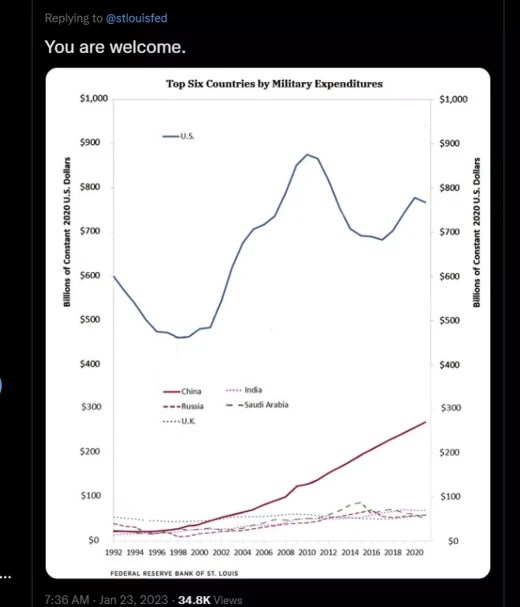
After the St. Louis Federal Reserve tweeted out a highly misleading line graph of several nations’ defense expenditures on Monday, users highlighted its ham-fisted and deceptive nature with both humor and facts.
The tweet linked to a January 3 article about the patterns of defense spending around the world in light of the conflict in Ukraine, highlighting the steady and rapid increase of China’s military budget since the early 1990s.
However, the graph accompanying it, which was included in the tweet, has been modified in an unconventional way: while the spending by five of the nations is measured on the Y-axis on the left side of the graph, as is traditionally the case, for the line representing the United States, the Fed used a bizarre separate Y-axis on the right side of the graph.
As a result, at a glance it seems China’s spending has rocketed far above every other nation’s, including the United States’, when in fact it remains barely one-third of the amount.
As replies poured in denouncing the Fed’s deception, a few users tweeted accurate versions of the graph, if the US’ line had been placed on the same Y-axis scale as the other five nations.
Others tore into the Fed in a more rhetorical way, or simply clowned on the absurdity of the graph.
“If a student made this graph for a statistics 101 class, the teacher would give them an F,” quipped journalist Ben Norton. “But because it involves Washington’s public enemy number one, Beijing, the ‘experts’ at the St. Louis Fed were awarded a Golden Star for service in the New Cold War.”
“Congrats on making the most misleading chart of 2023 so far!” said one user. “This is dishonest to the point of misinformation,” wrote another.
One person joked the situation was another example of “American exceptionalism.”
Someone even dropped an image of the cover of the 1954 book “How to Lie With Statistics” by former tobacco lobbyist Darrel Huff, with the message “I see you’ve read one of my favorite books.”

Some dropped other graphs that they felt better illustrated the drama of the difference between US defense spending and that of other nations.
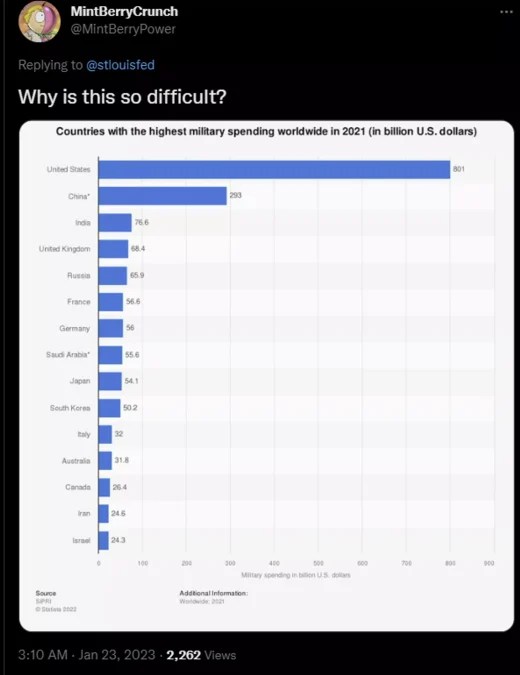
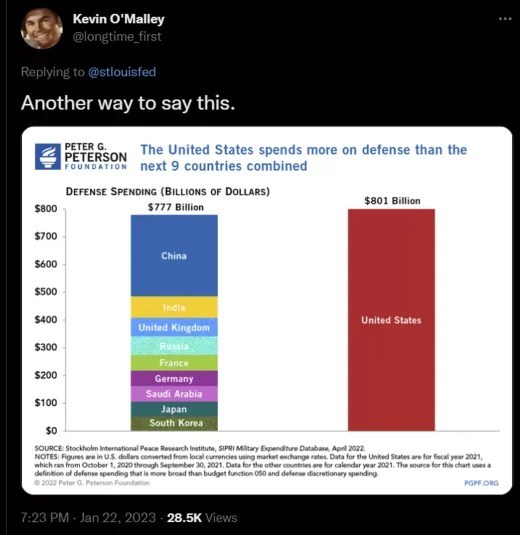
According to the Stockholm International Peace Research Institute (SIPRI), global military spending reached $2.1 trillion in 2021, with the US spending $804 billion of that by itself. By comparison, China spent $293 billion on its military that year. The US spent so much on its military, it spent more than the next nine countries combined, including China.
The most recent Pentagon budget, signed by US President Joe Biden last month, was a whopping $816.7 billion.
EU’s financial support for Ukraine now just shy of €50bn

By Jerome Hughes | Press TV | January 24, 2023
Brussels – Ukrainian officials took part in a meeting of EU foreign affairs ministers on Monday via video link. An additional €500m military aid package for Kiev was confirmed, but the EU is at pains to point out that’s just a drop in the ocean compared to what the bloc has already provided since last March.
Just a few days ago in the European Parliament, the strategy was condemned.
Workers have taken to the streets of Brussels to demand peace negotiations.
EU foreign ministers adopted a fresh round of sanctions against Iran on Monday over alleged human rights abuses. The grounds for such sanctions are vehemently rejected by Tehran. Critics say the West’s policy towards Russia and Iran is being driven by Washington.
Analysts say the EU’s access to markets in these countries is being hampered due to influence from the United States, and ultimately it is ordinary citizens who are paying the price.
Also on Monday, Palestinian Prime Minister Mohammad Shtayyeh updated EU foreign ministers on the appalling situation in the occupied territories. There was absolutely no discussion on the EU side regarding possible sanctions against Israel.
Featured Video

Trump asks Iran not to retaliate after he strikes Pickaxe Mountain
or go to
Aletho News Archives – Video-Images
Book Review
‘Why Fauci Must Rot in Prison’: A Tale of Two Diaries
By Jill Erzen | The Defender | October 13, 2026
Dr. Anthony Fauci’s private diary reveals a “mind-numbing” contradiction between what the former top U.S. infectious disease official knew about COVID-19 and what he told the public, senior White House adviser Peter Navarro, Ph.D., said last week on “American Thought Leaders.”
In his new book, “Why Fauci Must Rot in Prison,” due out Oct. 20, Navarro compares Fauci’s private entries to his own pandemic-era diary, and uses what he calls “a tale of two diaries” to argue that Fauci should face criminal prosecution.
“I show, actually, how a prosecution can and should happen … at the state level, most likely,” Navarro said. “He should wind up in prison, and we’ve got the receipts in this book to put him there.”
Navarro said Fauci repeatedly acknowledged important facts in private, then publicly pursued policies that contradicted those facts — with devastating consequences.
“What he says many times privately in his diary is so at odds with both his public behavior and public statements that it’s mind-numbing,” Navarro said.
Navarro examines the lasting damage caused by lockdowns and other pandemic policies, and the ongoing toll of long COVID.
His book also addresses questions about vaccine safety, including why healthy young people faced COVID-19 vaccination mandates despite concerns about myocarditis, and why women were not warned about miscarriage risks linked to the shots. … continue
Blog Roll
 Aletho News
- Trump asks Iran not to retaliate after he strikes Pickaxe Mountain – w/ Prof. Marandi
- Vice President J.D. Vance’s Deceptive ‘Antiwar’ Campaign Speech
- Iran: Palestinians’ rights must not be compromised in Gaza’s future; US, Israel to blame for Hormuz situation
- Ongoing tales of Syrian chemical weapons
- Moscow blasts UN for ignoring torture of Russian POWs
- Millions of Books Could Have Been Destroyed in Lebanon During Israeli Bombings
- Moscow warns of ‘hunt for Russians’
- Calling of an Angel: The True Story of Rene Caisse and an Indian Herbal Medicine Called Essiac (1988)
- South Korean Assistance to the U.S. in the War with Iran: Between Allied Duty and National Interests
- Pharma- and Gates-Funded GAVI Seeks to Assure Parents
- If Americans Knew
- Israeli soldiers debunk Israel’s talking points
- In West Bank, Israeli settlers are totally out of control – Daily Update
- NPR investigation finds evidence of widespread fraud at mall kiosks tied to Israeli skincare brand
- Tucker Carlson exposes Israeli Lies about the Oct 7th attack, Charlie Kirk, and the U.S.
- Israel has detained thousands of Palestinian children since Oct 7th – over half spent time in solitary, many uncharged
- Israeli Analysis: Is Netanyahu Planning an ‘October Surprise’ Attack Before Israel’s Election?
- Israeli settlers brutally attack Palestinians and Washington Post female photographer, 65
- Words Have Changed, Occupation Continues: The Reality of the Gaza Ceasefire
- Gaza’s child amputees are growing faster than their prosthetics allow
- Israel keeps Palestinians struggling just to survive–Daily Update
- No Tricks Zone
- New Study Suggests Large Regions Of The Pacific Ocean Have Been Cooling For The Last 80 Years
- Germany’s Green Energy Debacle: High Energy Costs Force Kahla Porzellan to Close After 182 Years!
- New Study: 50 Years Of The Most Aggressive ‘Net Zero’ Policies Can Only Affect The Global Climate By 0.03°C
- US September “Heat” Was No Record…Many Records Set Decades Ago
- Latest European Green Energy Debacle; Portugal’s Largest Flagship Solar Park Insolvent!
- Green Energy Debacle: German Expert Professor Fritz Vahrenholt Warns Of Severe Economic And Social Consequences
- Two More Paleo Reconstructions Affirm Meters-Higher Sea Levels Across Ireland, Brazil 7000-6000 Years Ago
- New Study: Earth And Venus Surface Warmth Largely Explained By Convection And Lapse Rate, Not CO2 Or Radiation
- 2025 Nature Paper Claiming Worsening Global Drought Gets RETRACTED …Heavily Flawed
- New Study: ‘Global Drought Shows No Detectable Recent Acceleration Under Climate Warming’

