Israel, US start week of military drills involving thousands of troops, nuclear bombers
RT | January 23, 2023
The US and Israeli militaries began their largest-ever joint exercise on Monday, seeking to hone seamless coordination of their forces and prove a point to Iran about their readiness to fight a conflict in the Middle East even as Washington juggles rising tensions with Russia and China.
“I do think that this scale of the exercise is relevant to a whole range of scenarios, and Iran may draw certain inferences from that,” a senior US defense official told reporters. “It would not surprise me if Iran, you know, sees the scale and the nature of these activities and understands what the two of us are capable of doing.”
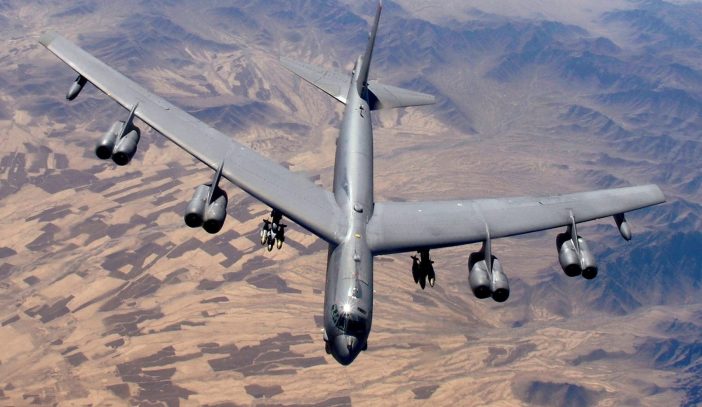
Dubbed Juniper Oak, the exercise will involve over 140 aircraft, including nuclear-capable bombers and F-35 fighter jets, as well as 12 warships and about 7,500 troops, according to US Central Command (CENTCOM). It’s designed to improve the “interoperability” of both forces.
“What we think this exercise demonstrates is, we can walk and chew gum at the same time,” the unidentified defense official told NBC News. Despite the Pentagon’s growing focus on China and its efforts to help Ukraine defeat Russian forces, he added, “We still have the excess capacity to be able to flex to another high-priority area of responsibility and conduct an exercise on this scale.”
Juniper Oak is an all-domain exercise, meaning it will include naval, land, air, space and electronic-warfare drills. It will run from Monday through Friday in Israel and the eastern Mediterranean Sea. The US will reportedly employ four HIMARS rocket launchers, laser-guided bombs and stealth cruise missiles. The event will culminate with the firing of 180,000 pounds of live munitions while simulating an electronic attack and suppressing enemy air defenses.
“This is a sign that we continue to have Israel’s back at a time when there’s lots of turbulence and instability across the region,” the defense official said. The source added, “If there’s a sense that Americans are distracted, or the Americans are going away from the Middle East, and therefore they have free rein for their malign activities, I think this will disabuse them.”
“I suspect Iran will take note of that, but not only Iran. China will take note of that, Russia will take note of that, other folks will take note of that.”
Are demands that Scholz green-light export of Leopard 2 tanks more about hurting Germany than helping Ukraine?

eugyppius: a plague chronicle | January 22, 2023
In 1952, Hastings Ismay famously remarked that the purpose of NATO is “to keep the Russians out, the Americans in and the Germans down,” and the war in Ukraine has made it very hard to doubt that he was wrong.
From the Neue Zürcher Zeitung:
The Ukraine needs battle tanks to defend itself against the Russian onslaught. But Chancellor Olaf Scholz has hesitated to provide them. For this reason, he’s come under massive pressure from many allies. [German Defence Minister Boris] Pistorius explained why Germany is still hesitating with two sentences: There are good reasons for delivering the tanks, and good reasons against doing so. All arguments have to be weighed carefully …
When American Defence Secretary Lloyd Austin appeared before the press in Ramstein shortly after Pistorius, he was asked whether Germany was doing its part as a leading European power. Austin couldn’t help smiling, but then he replied that Germany was doing enough and that it was a “reliable ally”. He ought to know exactly what Pistorius meant, in speaking of good reasons for and good reasons against providing tanks to Ukraine. The reasons in favour are military in nature: Without tanks, the Ukraine cannot defend itself.
The German government has been rather more evasive about the reasons against. The German defence industry is concerned that the Americans will replace the [German-manufactured European] Leopards with their own tanks. The war in Ukraine offers the United States the opportunity to displace German competition and secure a foothold in the European defence market by supplying its own armoured vehicles, as it has already done with helicopters, fighter jets and missiles.
Years of peace in Europe, an ageing population and a corresponding focus on expensive social programmes have caused Germany to put its defence industry into near-hibernation. Only a little over 2,000 Leopard 2s have ever seen the light of day. Each one is a hand-built machine that takes two years to make. If Germany permits the export of the European supply of Leopard 2s to Ukraine, the Russians will grind them to nothing within months, and then Europe will have no tanks except the tanks that the Americans sell them:
Defence industry representatives, who wish to remain anonymous, report that the Americans are offering their own used tanks as replacements to [European] countries able to supply Leopard 2s to Ukraine, together with a long-term industrial partnership. Any country that accepts the American offer would be hard to win back for the German tank industry. Berlin’s influence in armament policy would decrease correspondingly.
Tanks are driven by men, who have to be trained in the operation of specific models. Their use moreover requires a whole supply chain of munitions and especially spare parts, which the Americans are eager to offer. The upshot is that, once Europe opts into American armour, it will never switch back, and Germany will be out of the game for good. Nor should we lend much credence to the idea that our very few tanks will make any difference either way for Ukraine’s prospects. The insistence that Scholz release the Leopard 2s is simply an attempt to edge Germany further out of the European arms industry and into a position of lesser political and economic influence in Europe, so that the United States can fill the gap.
Noah Carl, over at the Daily Sceptic, drew attention last week to remarks by the French intellectual Emmanuel Todd that “this war is about Germany”:
After the collapse of the Soviet Union, Zbigniew Brzezinski called Eurasia the new “great chessboard” of world politics … The Russian nationalists and ideologues like Alexander Dugin indeed dream of Eurasia. It is on this “chessboard” that America must defend its supremacy – this is Brzezinski’s doctrine. In other words, it must prevent the rapprochement of Russia and China. The financial crisis of 2008 made it clear that with reunification Germany had become the leading power in Europe and thus also a rival of the United States. Until 1989, it had been a political dwarf. Now Berlin let it be known that it was willing to engage with the Russians. The fight against this rapprochement became a priority of American strategy. The United States had always made it clear that they wanted to torpedo [Nord Stream 2]. The expansion of NATO in Eastern Europe was not primarily directed against Russia, but against Germany. Germany, which had entrusted its security to America, became the Americans’ target [in the destruction of the pipeline]. I feel a great deal of sympathy for Germany. It suffers from this trauma of betrayal by its protective friend – who was also a liberator in 1945.
After the anti-Russian sanctions regime and its clear deindustrialising effects on the German economy, followed by the attack on the Baltic Nord Stream pipelines, and even smaller things, such as the high-profile anti-industry protests by the American-funded activist group Letzte Generation, I am willing to believe many conspiratorial things about the Ukraine war.
Still, I think Todd’s thesis is overdrawn. This war is about Russia primarily, and about Germany only secondarily. It’s an attempt of the Global American Empire to hem in Russia via an extended proxy campaign. In the longer term, this effort will require that Europe remain an American outpost, as it was during the Cold War, and this means the economic and political influence of Germany must be sharply curtailed. America – and not Germany – must dominate the Continent. The Scholz government has gone very far in making concessions to the Americans, but he appears to have finally drawn a line of sorts, at giving the Americans a pretence to sell their tanks in Europe. It will be important to see whether he can hold out.
JFK and America’s Destiny Betrayed
A Review of DiEugenio’s “Foreign Policy Coup” Theory
BY LAURENT GUYÉNOT • UNZ REVIEW • JANUARY 21, 2023
I have watched Oliver Stone’s documentary on the assassination of JFK, both the short version, JFK Revisited: Through the Looking Glass, and the long version in four episodes, JFK: Destiny Betrayed. I recommend the latter, which I will discuss here. Although the technical parts (the bullets, the autopsy, Oswald’s CIA handlers) are interesting and partly new, I will focus exclusively on the theory regarding the main culprits and their motive. And I will discuss the larger work of James DiEugenio, who wrote the film—and probably interviewed the different contributors, although Stone appears to be doing it.
James DiEugenio has been investigating the Kennedy presidency and the Kennedy assassination from the time of the Assassination Records Review Board (ARRB), which was largely a consequence of Oliver Stone’s Hollywood film JFK (1991). His first book was Destiny Betrayed: JFK, Cuba, and the Garrison Case (1992, newly edited in 2012). In 1993, he founded Citizens for Truth about the Kennedy Assassination (CTKA), and co-edited Probe Magazine, now replaced by the website KennedysandKing.com.
In 1997, DiEugenio published a powerful two-part book-length article, “the Posthumous Assassination of JFK” (1997). It is still essential reading for anyone interested in the controversies surrounding Kennedy’s presidency and assassination, or puzzled by the unending stream of bizarre Kennedy lore. This is the text you want to send to anyone telling you about the Kennedys’ mafia dealings and unrestrained sex life, their murder of Marilyn Monroe, or Bobby’s irresponsible assassination plots against Castro that backfired on his brother. These stories are so widespread, repeated in well-published and well-reviewed books, that millions of people assume them to be documented. Writing on the occasion of the release of Seymour Hersh’s The Dark Side of Camelot, DiEugenio exposed their fraudulent nature and their true motivation: the obsession to “smother any legacy that might linger,” for “assassination is futile if a man’s ideas live on through others.” This flow of defamation had started in the 70s, as a counter-fire to the Church Committee and the House Select Committee on Assassinations (HSCA), and intensified in the 1990s after the ARRB. It never dried up.
Character assassination is only one part of the propaganda unleashed against the Kennedy legacy. Another part has consisted in distorting the historical record of Kennedy’s presidency, and particularly the radical but short-lived innovations of his foreign policy. DiEugenio writes in “Dodd and Dulles vs. Kennedy in Africa” (1999, modified 2016):
a clear strategy of those who wish to smother any search for the truth about President Kennedy’s assassination is to distort and deny his achievements in office. Hersh and his ilk have toiled to distort who Kennedy really was, where he was going, what the world would have been like if he had lived, and who and what he represented.[1]
DiEugenio has provided insightful answers to these questions. A graduate in Contemporary American History, he is probably the best Kennedy historian among Warren Commission critics, and his work has opened the way for other revisionist historians like Monika Wiesak, author of the recent and excellent America’s Last President: What the World Lost When It Lost John F. Kennedy (read DiEugenio’s review here). According to DiEugenio, there has been, in addition to the cover-up about Kennedy’s death, a “cover-up about Kennedy’s foreign policy,”[2] so that even critics of the Warren Commission fairytale have largely failed to grasp the full extent of Kennedy’s changes from the foreign policy of his predecessors—dominated by the Dulles brothers; “by only chasing Vietnam and Cuba, to the neglect of everything else, we have missed the bigger picture.”[3] The bigger picture drawn by DiEugenio includes the Congo, Indonesia, Laos and the Middle East. DiEugenio’s most essential articles on these topics are:
- “Deconstructing JFK: A Coup d’État over Foreign Policy?” written for Covert-Operation magazine (2021)
- “Nasser, Kennedy, the Middle East, and Israel” (2020)
- “Introduction to JFK’s Foreign Policy: A Motive for Murder” (2014)
- “ Dodd and Dulles vs. Kennedy in Africa” (1999, modified 2016)
The three scholars who most contributed to DiEugenio’s understanding of the uniqueness of Kennedy’s foreign policy, and who are interviewed in the film JFK: Destiny Betrayed, are:
- Richard Mahoney, for JFK: Ordeal in Africa, Oxford University Press, 1983,
- Philip Muehlenbeck, for Betting on the Africans: John F. Kennedy’s Courting of African Nationalist Leaders, Oxford University Press, 2012,
- Robert Rakove, for Kennedy, Johnson, and the Nonaligned World, Cambridge University Press, 2012 (read DiEugenio’s review).
Although he praises James Douglass’s JFK and the Unspeakable (2008), DiEugenio rejects his mythical portrayal of JFK as a Cold Warrior converted to peacemaking during the 1962 Cuban Missile Crisis.[4] Despite the contrary impression he made during his televised debates with Nixon in 1960, Kennedy was never a Cold Warrior. The collection of statements published under the title The Strategy of Peace for his presidential campaign proves it.
DiEugenio traces Kennedy’s general ideas on foreign policy back to 1951, when Kennedy toured the Middle East and Asia. His meeting in Saigon with Edmund Gullion, whom he later brought into his cabinet, had convinced him that sending American troops to Indochina was a grave mistake.[5] He would never change his mind on that issue.[6]
By 1957, Kennedy was formulating a radical—by U.S. standard—foreign policy for the Arab world, which he outlined in a speech on the Senate floor denouncing French colonial occupation of Algeria:
In these days, we can help fulfill a great and promising opportunity to show the world that a new nation, with an Arab heritage, can establish itself in the Western tradition and successfully withstand both the pull toward Arab feudalism and fanaticism and the pull toward communist authoritarianism.[7]
Unlike his predecessors Truman and Eisenhower, and in defiance of the doctrine that prevailed in the CIA, the Pentagon and the State Department, Kennedy accepted and welcomed a multipolar world, the only way, in his view, to overcome the dangerous bi-polarization of the Cold War. Had he succeeded, he would have transformed the U.S. into something totally different from what it was starting to become since WWII, and has fully become since he died: an imperial bully feared but hated throughout the world. In “Deconstructing JFK: A Coup d’État over Foreign Policy?” DiEugenio makes the point that:
[Kennedy’s] speeches, correspondence and high-level meetings with emerging Third World leaders reveal his growing antipathy for colonialism, rejection of imperialism, toleration for the non-aligned movement—contrasting markedly with his predecessor—and promotion of nationalistic leaders, albeit ones that were considered to be “responsible” in their moderation.[8]
The first foreign policy reversal that Kennedy made once in office was on the Congo. Patrice Lumumba, Congo’s first democratically elected leader, was killed three days before Kennedy’s inauguration, victim of a coup supported by the CIA. Jacques Lowe’s shot of JFK getting the news of Lumumba’s death on February 13th is, to DiEugenio, the picture that best symbolizes Kennedy’s personal commitment to support the national independence of Third world countries, and the ordeal of his struggle against the CIA’s machinery of assassination and regime change. After U.N. Secretary-General Dag Hammarksjold was killed (likely murdered) in a plane crash in September 1961, Kennedy carried on his campaign for a free and independent Congo. Lyndon Johnson destroyed this first attempt at a democracy in post-colonial Africa, and backed Josef Mobutu, who turned into a corrupted dictator and allowed his country to be utilized by outside imperial interests.

Kennedy rejected the “with us or against us” mentality of the foreign policy establishment, and this was also demonstrated by his support for Indonesia’s nationalist leader Sukarno, who co-founded the Non-Aligned Movement. In 1958, Eisenhower had authorized the CIA’s attempt at overthrowing Sukarno, but when Kennedy assumed office, he reversed that policy, and helped Sukarno stabilize his country. Less than a year after Kennedy’s death, the CIA was planning again covert action against Sukarno, which led to the killing of at least 500,000 people suspected of communist sympathy. Sukarno was placed under house arrest and CIA-backed Suharto ruled for three decades, turning his people into low-wage workers for foreign companies.[9]
And then, of course, there is Cuba and Vietnam. The story of Kennedy’s resistance to the Pentagon and the CIA’s push for military confrontation and escalation in these countries has been told many times—most eloquently by James Douglass—, so that I do not need to tell it again. Authors of the dominant school of JFK assassination research—and that includes those interviewed in Stone’s documentary—assume that Cuba and Vietnam are, in that order, the most important reasons why Kennedy was killed. DiEugenio agrees, but brings a larger spectrum of motives.
DiEugenio writes in “Nasser, Kennedy, the Middle East, and Israel”:
For decades, the critical community overlooked areas of Kennedy’s foreign policy outside of Vietnam and Cuba. Kennedys and King has attempted to correct that oversight in recent years. We have tried to educate our readers on issues like Kennedy’s policies in Congo, Indonesia, Dominican Republic, and Laos. We have also tried to show how, after his murder, those policies—as well as his policy toward Vietnam and his attempts at detente with Moscow and Havana—were also altered.
But there is still another area of the world about which Kennedy’s reformist foreign policy is overlooked. That area is the Middle East. This is odd since many commentators justifiably perceive that the Middle East is one of the most important areas on the globe.[10]
He writes in his “Introduction to JFK’s Foreign Policy: A Motive for Murder”:
Why is the JFK case relevant today? Well, because the mess in the Middle East now dominates both our foreign policy and the headlines, much as the Cold War did several decades ago. And the roots of the current situation lie in Kennedy’s death, whereupon President Johnson began the long process which reversed his predecessor’s policy there.[11]
In other words, the Middle East is the region of the world where Kennedy’s foreign policy and Johnson’s reversal of that foreign policy have had the most dramatic and most lasting consequences. What was at stake was America’s involvement in the conflict between Israel and the Arab world, and that meant, essentially, between Ben-Gurion and Nasser.
So DiEugenio acknowledges that: 1. LBJ completely reversed JFK’s foreign policy, and 2. the most consequential reversal was in the Middle East, for the longtime benefit of Israel and to the detriment of Egypt. Yet he points, not to Johnson or Ben-Gurion, but to Allen Dulles as the most likely culprit for the Dallas coup. Does he document any evidence that Allen Dulles was interested in switching alliance from Egypt to Israel? None whatsoever. It is true that the Eastern Establishment generally favored Saudi Arabia over Egypt, but it is not the case that they wanted a closer relationship with Israel. So what is unique about Johnson’s pro-Israel policy is that it was not a return to a pre-Kennedy policy, but something new altogether. It was a radical break from all previous administrations. Recall Eisenhower’s resolute reaction to Israel’s invasion of the Sinai in 1956, and contrast it with what happened ten years later, when Johnson greenlighted Israel’s attack on Egypt and expansion, and covered up Israel’s false-flag attack on the USS Liberty designed to draw the U.S. into the war.
Allen Dulles’s major interest in foreign policy in the 1960s was over Cuba. Assassinating Castro and/or invading Cuba to restore an American colonial regime was his priority. Like the majority of JFK investigators, DiEugenio considers that Kennedy had so angered the CIA, and Dulles in particular, when he didn’t go along with their plan to invade Cuba—not once but twice, first with the Bay of Pigs landing in 1961, and secondly during the Cuban Missiles Crisis in 1962—that Dulles’s gang decided to assassinate him. But guess what: LBJ did not invade Cuba either. He didn’t give the CIA and Pentagon hawks the retaliatory invasion of Cuba that their plan was supposed to force upon him. He didn’t even try.
This is a major weakness of that semi-mainstream theory to which DiEugenio subscribes, and which he contributed to write. That weakness is partly compensated by the secondary focus on Vietnam. It is true that, in Vietnam, Johnson gave the National Security state what they wanted, and more. As author Peter Dale Scott wrote, Johnson “had been, since 1961, the ally of the Joint Chiefs (and in particular Air Force General Curtis LeMay) in their unrelenting efforts, against Kennedy’s repeated refusals, to introduce U.S. combat troops into Asia.”[12] Yet, that presentation ignores one aspect of the full story.
The strongest push for sending ground troops to Vietnam came from Walt Rostow (“the biggest Cold Warrior I’ve got,” Kennedy said). As deputy to the National Security Advisor McGeorge Bundy under Kennedy, Rostow had already weighted heavily on Kennedy’s decision to send military “advisors” to Vietnam. But Kennedy had grown weary of his bellicose advise (“Walt had ten ideas, nine of which would lead to disaster”).[13] Walt Rostow was promoted by Johnson as National Security Advisor, and found in the new president more enthusiasm for his war plans. Rostow was the main promoter of the lie that Johnson’s Vietnam policy was a continuation of Kennedy’s.[14]
Johnson named Walt’s brother Eugene Under-Secretary of State, “appointed precisely to support the coming Israeli war” according to Joan Mellen.[15] Walt and Eugene Rostow, sons of Jewish immigrants, had a good deal of control on U.S. Israeli policy. On June 8, 1967, the very day of the Israeli attack on the USS Liberty, Walt had recommended to Johnson that Israel be allowed to keep the captured territories.
Why did the Rostow brothers want a Vietnam War? In “Was Vietnam a Holocaust for Zion” I explained why the Vietnam War was good—even crucial—for Israel. But don’t take my word for it. Here is what French president Charles De Gaulle said during his November 27, 1967 press conference:
Without the tragedy of Vietnam, the conflict between Israel and the Arabs would not have become what it has become. And if South-East Asia could experience a renewal of peace, the Middle-East would also find its way to peace, in the climate of détente which would follow such an event.[16]
I am not implying that the shift in policy on Vietnam between Kennedy and Johnson does not support the theory that CIA and Pentagon killed Kennedy. It does. I am merely pointing out that Johnson’s pro-Israel cabinet members were at least as influential as Dulles and LeMay in Johnson’s reversal of Kennedy’s decision to withdraw from Vietnam, a fact which is also consistent with the theory that Israel was the prime mover.
In his JFK and the Unspeakable, James Douglass has documented JFK’s deep commitment to prevent nuclear proliferation and even abolish weapons of mass destruction “before they abolish us” (Kennedy’s speech at the UN General Assembly, September 25, 1961). But Douglass makes no mention of JFK’s bitter confrontation with Ben-Gurion and Eshkol on that very issue. In this way, Douglass has proven that the historical school of which he has become a standard bearer is involved in a cover-up. To be generous, I ascribe it to a case of “cognitive inhibition”. I imagine it works somewhat like this: “My work—that is, the truth—is too important to risk it being censored by saying something bad about Israel.” Personally, I prefer to stick to Peter Janney’s principle that “the truth takes no prisoners.”
To his credit, DiEugenio does not eschew the Dimona story. His website links to two articles by Avner Cohen, author of Israel and the Bomb (1998), and William Burr of the National Security Archive, accompanied by declassified documents (here and here).[17] DiEugenio himself writes about Israel’s effort to acquire nuclear weapons in “Nasser, Kennedy, the Middle East, and Israel” (2020):
Ben Gurion and the other Israeli leaders were so devoted to this aim that they resorted to two illicit means in order to secure the goal. First—there is no other way to say this—they involved themselves in a government-wide conspiracy to deceive Kennedy about the true nature of the Dimona reactor.
Israel’s second means to go nuclear was the theft of enriched Uranium from the U.S.:
Through [Roger] Mattson [author of Stealing the Atom Bomb], and also author Grant Smith [author of Big Israel], we know today that Israel had stolen hundreds of pounds of highly enriched uranium out of what was essentially their shell plant in Apollo, Pennsylvania, called NUMEC.[18]
Stone and DiEugenio mention the first of these Israeli deceptions in their film (the long version only, episode 3, 40:50). After a brief reminder of Kennedy’s decision to support the U.N. resolution for the return of Palestinian refugees, we are told:
The other problem Kennedy faced with Israel was the construction of the atomic reactor at Dimona. JFK was strongly against any proliferation of nuclear weaponry. He had been assured by Prime Minister David Ben-Gurion that Dimona was designed for peaceful uses of atomic energy. In the spring of 1963, Kennedy demanded full inspections by the US of the Dimona reactor, and threatened to place American aid for Israel in limbo if no agreement was reached. And at the time of his assassination, negotiations were in process for biannual inspections.
That is better than nothing. But since that story is only incidental to the thesis defended by Stone and DiEugenio, it seems to have been included only to immune the authors from the blame of covering it up, that Douglass deserves.
Interestingly, it is Stone who brings up this topic in this interview with Canadian journalist Éloïse Boies. At 34:20, DiEugenio states that “nobody was more anti-nuclear proliferation than John F. Kennedy. This was really a very important issue with him.” At this point, Stone interjects:
He took on Israel. He took on Ben-Gurion in Israel, because they were building a bomb that they’d stolen from us. And he really wanted to put a stop to that, but he, unfortunately died before, and Johnson carried through, knew about it and let it go, till Israel had the bomb by 1968. And even then, in 68, Johnson shut the Pentagon up. He said: “We are not going to announce this. The American people won’t know that Israel has the bomb.”
Notice Éloïse’s reaction: “Let’s talk about [something else].” The point is that, for Stone and DiEugenio, Dimona seems to be anecdotal and hardly relevant to solving the case. At the end (from 50:27), when asked “Who did it, and why?” they stick to the conclusion that Allen Dulles was the mastermind, with perhaps Curtis LeMay. But, they add as an afterthought, Dulles is only “the executioner” and “does get the OK from someone else. … You know who they are: the people with money” … like “David Rockefeller”. Éloïse gets it: “It’s all about money, at the end of the day.” It becomes absolutely ridiculous. When your theory implodes under its own hollowness, it’s time to change. But, as Stone says “once they’re locked in, it’s very hard for historians to go back” (19:10).
It might seem unfair for me to point to an interview rather than to the film itself. But the value of that interview is precisely to reveal the logical fallacies and confusions that are not apparent in the film.

In that same interview (from 40:30), Stone says: “I don’t think Johnson was involved in the murder.” DiEugenio adds: “Johnson fell for the CIA story coming out of Mexico City” (an Oswald impersonator visiting both the Soviet and the Cuban embassies in Mexico in October 1963). But then DiEugenio mentions that Edgar Hoover had told Johnson that the Mexico story was impossible, since neither the voice nor the photo provided by the Mexico CIA station fitted the real Oswald. So now “the question becomes: did Johnson really believe this?” This gets confusing. DiEugenio can’t seem to decide whether Johnson believed Oswald’s communist legend or not.
But DiEugenio’s dilemma has no reason to be. For not only Johnson knew the communist Oswald to be bogus; it was he who used this fake communist connection to block all investigations. DiEugenio is an admirer of the work of professor John M. Newman, whose books he reviewed (here, here, here, and here), and whom he interviewed for the film. One contribution of Newman, introduced in the 2008 edition of his book Oswald and the CIA and repeated in the first three volumes of his series The Assassination of President Kennedy, is, in his own words:
An essential element of the plot was a psychological operation to raise the specter of WWIII and the death of forty million Americans. This threat of a nuclear holocaust was then used by President Johnson to terrify Chief Justice Earl Warren and some of the other men who served on the Warren Commission to such an extent that they believed there was no alternative to writing a report stating Lee Oswald alone had assassinated the president.[19]
According to that theory, endorsed by DiEugenio in this review,[20] Oswald’s profile as a communist pro-Castro activist was inbuilt in the plan (by none other than James Jesus Angleton), not for the purpose of starting WWIII, but as a national security pretext that Johnson could use to impose the lone-nut theory, lest the discovery of a conspiracy would “kick us into a war that can kill forty million Americans in an hour,” as Johnson kept repeating.[21] One important implication is that “many of the post-assassination lies and cover-ups were carried out by people who had nothing to do with the pre-existing plot to assassinate the president” and who “thought that what they were doing was in the best interests of the country.”[22] This applies to thousands of people from the Dallas Police to TV networks. But can it apply to Johnson himself? Given Johnson’s quick and efficient mastery of this device, it is much more likely that it was fabricated by Angleton specifically for Johnson and with his foreknowledge.
Yet DiEugenio and other authors on his site are dismissive of investigators who incriminate Johnson, and especially of Phillip Nelson, author of LBJ: The Mastermind of JFK’s Assassination. A big book like that (730 pages) is bound to contain some weak arguments, but the reviews in KennedysandKing.com (here and here) do not do justice to the strong evidence accumulated by Nelson that Johnson was actively involved, not just in the cover-up, but in the preparation of the Dallas ambush.[23] (Read Nelson’s response to KennedysandKing.com here). DiEugenio concurs with Douglass that Johnson was unaware of the conspiracy against his president, but “chose to cover-up everything and surrender to Cold War prerogatives.”[24] He assumes that Johnson was a man who had no clear idea of his own in foreign policy and liked to be told what to do. That is at odds with everything we learn from Johnson’s biographers—especially Robert Caro.
From my viewpoint, which differs from Nelson’s, Johnson’s role in the assassination cannot be understood independently from Israel’s—nor can Angleton’s role. Johnson allowed, and probably planned, the Israeli attack on the USS Liberty in 1967, and he excused Israel when the operation failed (“Johnson did not break relations with Israel, and there were no trials held over this atrocity,” notes DiEugenio).[25] Not only that, but, as DiEugenio writes in “Nasser, Kennedy, the Middle East, and Israel”:
As Roger Mattson notes in his book on the subject, when the CIA alerted the new president that it appeared that Israel had now developed the atomic bomb, Johnson barely reacted. (Mattson, p. 97) There was no official investigation launched. In fact, Johnson told the CIA not to alert either State or Defense about the discovery.[26]
For those two acts, Johnson qualifies as a traitor to the country he had been sworn to serve. If Johnson was working for someone, it was not for the “Eastern Establishment,” of which he had never been part; it was for Israel. Johnson was the initiator of a pro-Israel policy that Truman, Eisenhower, the Dulles brothers or the Joint Chiefs of Staff under Kennedy would never have imagined in their worst nightmare. It is today widely known that Johnson is the US president who “firmly pointed American policy in a pro-Israel direction.”
In conclusion, I find several logical flaws in DiEugenio’s general theory, the basis for Stone’s documentary:
- DiEugenio recognizes that the change of foreign policy from JFK to LBJ was most consequential in the Middle East, yet he blames the CIA and the Pentagon (Dulles and LeMay) for the assassination, although neither the CIA nor the Pentagon ever advocated the pro-Israel policy that Johnson set up. Johnson’s unprecedented support for Israel, to the point of treason, went against the approach advocated by the CIA, the Pentagon or the State Department. But it was the best foreign policy that Ben-Gurion could dream of.
- According to DiEugenio and the dominant school, the CIA’s prime motive for eliminating Kennedy would have been to resume their favored foreign policy toward Cuba, which Kennedy had stubbornly opposed. But that didn’t happen after the assassination. Johnson kept Kennedy’s pledge to Khrushchev not to invade Cuba, which Dulles and LeMay considered pure treason.
- DiEugenio agrees that Kennedy was intensely worried about nuclear proliferation, and that Israel posed him the most difficult problem. He also knows that Johnson did nothing to stop Israel from going nuclear, and showed neither surprise nor displeasure when told that Israel made its first nuclear bomb in 1968, with bomb-grade uranium stolen from the U.S. Johnson tried to keep it secret—which obviously was what Israel wanted. Yet DiEugenio does not see Dimona as having been a motive in the assassination, and finds no reason to suspect either Israel or Johnson.
- DiEugenio believes that JFK’s assassination was a “coup d’État over foreign policy,” and I agree that this is the only way to make sense of it. But the purpose of a coup d’État is to replace one head of state by another. Therefore, it is self-contradictory for DiEugenio to minimize Johnson’s role and motive in the assassination.
Actually, I think DiEugenio’s notion of a “cover-up about JFK’s foreign policy” needs to be qualified. Not all areas of Kennedy’s foreign policy are equally covered up. The three teachers of DiEugenio—Richard Mahoney, Philip Muehlenbeck and Robert Rakove—are published by Oxford University Press and Cambridge University Press: not exactly fringe publishers. Rakove and Muehlenbeck are even included in the bibliography of the Wikipedia article on “Foreign policy of the John F. Kennedy administration” (so are James Douglass and John M. Newman). This Wikipedia article is quite accurate and detailed, with one exception for the section about “Israel and Arab States”—a fine hasbara job, probably by Bennett Naftali’s army of Zionist Wikipedia editors. See by yourself:

The real “cover-up about JFK’s foreign policy” is the cover-up about JFK’s Israeli policy. According to DiEugenio’s own logic, that points in the direction that DiEugenio is not looking.
Since DiEugenio sees a link between Kennedy’s assassination and his “posthumous assassination”, I also suggest that he gets a clue about Kennedy’s assassins by looking at the political profile of Kennedy’s “posthumous assassins”. The list includes, next to Seymour Hersh, authors who specialize in trashing the Kennedy family, like Ronald Kessler (The Sins of the Father, 1997), Edward Klein (The Kennedy Curse, 2004), or the incomparable C. David Heymann, the Mossad employee (by his own admission)[27] who wrote the salacious Bobby and Jackie: A Love Story (2009). Is there a pattern here?
What about Howard Zinn, Gar Alperovitz, Martin Peretz, and Noam Chomsky, that DiEugenio blames in “The Left and the Death of Kennedy” (1997) for their defense of the Warren Commission report and their participation in the orgy of Kennedy-bashing. Chomsky, whom DiEugenio sees as the most nefarious liar when it comes to Kennedy’s presidency or his assassination (here and here), has nothing in common with Allen Dulles or Curtis LeMay. He is an anti-imperialist, and as such he should make Kennedy his hero, his icon. But Chomsky has another agenda: one of his specialties is blaming America for the crimes of Israel. As for Martin Peretz, DiEugenio writes that his New Republic buried Kennedy’s death in 1979, then “tried to bury his life.”
It actually made a feature article out of a review of the tawdry Horowitz-Collier family biography The Kennedys. Who did that publication find suitable to review this National Enquirer version of the Kennedy clan? None other than Midge Decter, wife of neo-conservative godfather Norman Podhoretz, mother-in-law of Elliot Abrams.
The Podhoretzs are not Eastern Establishment, but they hate the Kennedys. Their hatred is transgenerational and inextinguishable. If you doubt it, read the piece below, written by Norman’s son a week after the tragic death of John F. Kennedy Jr. The author imagines Satan—or is it Yahweh?—teasing Joe Kennedy in hell and bragging to have killed his grandson—a particularly heinous version of the “Kennedy curse”.

Perhaps DiEugenio should give more serious consideration to the “who” and the “why” of Kennedy’s “posthumous assassination”. But that would take him on the road less traveled, a dangerous path—some say suicidal.
Strangely, though, many other well-trodden roads seem to now converge on the Israeli trail:
- Investigators tracking Johnson end up finding a snake pit of sayanim in his White House, as did Phillip Nelson in his second and third books (LBJ: From Mastermind to “The Colossus” and Remember the Liberty).
- Jefferson Morley, investigating Angleton, saw him in cahoots with the cream of the Mossad, who considered him “the biggest Zionist of the lot,” while Robert Amory, head of the CIA Directorate of Intelligence, called him a “co-opted Israeli agent” to his face.
- David Talbot concludes that RFK was assassinated by the same cabal as his brother, who now used for a patsy an anti-Zionist Palestinian, thereby presenting RFK’s assassination as motivated by “a visceral, irrational hatred of Israel” (but Talbot sees no Israeli fingerprint in there—another case of cognitive inhibition).
- No one investigating Jacob Rubenstein, known as Jack Ruby, can now ignore his work for the Irgun as a “gangster for Zion” and his repeated declarations that “I did it for the Jews”.[28]
- Clay Shaw, the only person (beside Oswald) to have been charged with having participated in the assassination, has been found a board member of Permindex, “a Mossad arms trading and money laundering venture” chaired by Louis Bloomfield, a devoted supporter of the Israeli cause and of the Mossad, as shown by Michael Collins Piper.[29]
- The word is out that Arlen “Magic Bullet” Specter was a dedicated Israel-firster, honored by the Israeli government as “an unswerving defender of the Jewish State,” and by AIPAC, as “a leading architect of the congressional bond between our country and Israel”.[30]
- It can’t be ignored that Abraham Zapruder, the man whose camera didn’t shiver when Kennedy’s head exploded, had his business office in one of the snipers’ nests, the Dal Tex Building overlooking Dealey Plaza, owned by B’nai B’rith financier David Weisblat.[31]
- Investigators interested in George DeMohrenschildt cannot fail to learn that, before being found dead with a bullet in his head, he had complained that “the Jewish mafia” was out to get him.[32]
And of course, we must add to the equation Israel’s criminal record for the last sixty years. Thanks to Ronen Bergman, author of Rise and Kill First: The Secret History of Israel’s Targeted Assassinations, we know that Israeli secret services has never had any inhibition against eliminating anyone perceived as a threat to Israel’s national security, especially when it comes to Israel’s nuclear hegemony in the Middle East. Bergman learned from the assassins themselves because, he writes, “acts that people in other countries might be ashamed to admit to are instead a source of pride for Israelis.”[33]
We now know so much more than Stone and DiEugenio could know when they first got involved in Kennedy assassination research. But those who understood Israel’s power back then already had a clue. In March 1992, commenting critically on Stone’s motion picture JFK, American Congressman Paul Findley noted in the Washington Report on Middle East Affairs:
It is interesting — but not surprising — to note that in all the words written and uttered about the Kennedy assassination, Israel’s intelligence agency, the Mossad, has never been mentioned. … on this question, as on almost all others, American reporters and commentators cannot bring themselves to cast Israel in an unfavorable light — despite the obvious fact that Mossad complicity is as plausible as any of the other theories.
Three years later, Mike Piper filled the gap with Final Judgment: The Missing Link in the JFK Assassination Conspiracy (expanded through five editions until 2005). His work has been ignored by most investigators, but in 2013, historian Martin Sandler (listen to him here) mentioned it in his precious edition of The Letters of John F. Kennedy, to introduce Kennedy’s letter to David Ben-Gurion dated May 18, 1963:
author Michael Collins Piper actually accused Israel of the crime. Of all the conspiracy theories, it remains one of the most intriguing. What is indisputable is that although it was kept out of the eye of both the press and the public, a bitter dispute had developed between Israeli prime minister David Ben-Gurion, who believed that his nation’s survival depended on its attaining nuclear capability, and Kennedy, who was vehemently opposed to it.[34]
In his previous letter to Kennedy, dated May 12, Ben-Gurion had assured Kennedy that the Egyptians “want to follow the Nazi example,” and begged: “Mr. President, my people have the right to exist… and this existence is in danger.”[35] He also made a bizarre digression about Jordanian King Hussein: “there is always a danger that one single bullet might put an end to his life and regime.”[36]
Notes
[1] DiEugenio, “Dodd and Dulles vs. Kennedy in Africa,” 15 February 1999, last modified 16 October 2016, www.kennedysandking.com/john-f-kennedy-articles/dodd-and-dulles-vs-kennedy-in-africa
[2] “DiEugenio at the VMI seminar,” 16 September 2017, www.kennedysandking.com/john-f-kennedy-articles/jim-dieugenio-at-the-vmi-seminar
[3] DiEugenio, “Introduction to JFK’s Foreign Policy: A Motive for Murder,” 22 December 2014, www.kennedysandking.com/john-f-kennedy-articles/introduction-to-jfk-s-foreign-policy-a-motive-for-murder
[4] “DiEugenio at the VMI seminar, 16 September 2017, www.kennedysandking.com/john-f-kennedy-articles/jim-dieugenio-at-the-vmi-seminar
[5] James Norwood, “Edmund Gullion, JFK, and the Shaping of a Foreign Policy in Vietnam,” 8 May 2018, www.kennedysandking.com/john-f-kennedy-articles/edmund-gullion-jfk-and-the-shaping-of-a-foreign-policy-in-vietnam
[6] James Douglass, JFK and the Unspeakable: Why He Died and Why It Matters, Touchstone, 2008, pp. 107, 102.
[7] Quoted in “DiEugenio at the VMI seminar,” 16 September 2017, www.kennedysandking.com/john-f-kennedy-articles/jim-dieugenio-at-the-vmi-seminar
[8] DiEugenio, “Deconstructing JFK: A Coup d’État over Foreign Policy?” January 14, 2021, covertactionmagazine.com/2021/01/14/deconstructing-jfk-a-coup-detat-over-foreign-policy/
[9] DiEugenio, “Deconstructing JFK: A Coup d’État over Foreign Policy?” January 14, 2021, covertactionmagazine.com/2021/01/14/deconstructing-jfk-a-coup-detat-over-foreign-policy/
[10] DiEugenio, “Nasser, Kennedy, the Middle East, and Israel,” 22 October 2020, www.kennedysandking.com/john-f-kennedy-articles/nasser-kennedy-the-middle-east-and-israel
[11] DiEugenio, “Introduction to JFK’s Foreign Policy: A Motive for Murder,” 22 December 2014, www.kennedysandking.com/john-f-kennedy-articles/introduction-to-jfk-s-foreign-policy-a-motive-for-murder
[12] Peter Dale Scott, Deep Politics and the Death of JFK, University of California Press, Berkeley, 1993, pp. 30-33.
[13] David Halberstam, The Best and the Brightest, Random House, 1972, pp. 156-162.
[14] John K. Galbraith, “Exit Strategy – In 1963, JFK ordered a complete withdrawal from Vietnam,” Oct/Nov 2003, www.bostonreview.net/articles/galbraith-exit-strategy-vietnam/
[15] Joan Mellen, Blood in the Water: How the US and Israel Conspired to Ambush the USS Liberty, Prometheus, 2018, p. 32.
[16] Film of De Gaulle’s press conference on fresques.ina.fr/de-gaulle/fiche-media/Gaulle00139/conference-de-presse-du-27-novembre-1967 at 41 min.
[17] Avner Cohen and William Burr, “ Concerned About Nuclear Weapons Potential, John F. Kennedy Pushed for Inspection of Israel Nuclear Facilities,” April 21, 2016, nsarchive.gwu.edu/briefing-book/nuclear-vault/2016-04-21/concerned-about-nuclear-weapons-potential-john-f-kennedy and “ The Battle of the Letters, 1963: John F. Kennedy, David Ben-Gurion, Levi Eshkol, and the U.S. Inspections of Dimona,” May 2, 2019, nsarchive.gwu.edu/briefing-book/nuclear-vault/2019-05-02/battle-letters-1963-john-f-kennedy-david-ben-gurion-levi-eshkol-us-inspections-dimona
[18] DiEugenio, “Nasser, Kennedy, the Middle East, and Israel,” 22 October 2020, www.kennedysandking.com/john-f-kennedy-articles/nasser-kennedy-the-middle-east-and-israel For more detail, read DiEugenio’s review of Roger Mattson’s book Stealing the Atom Bomb (2016), “How Israel Stole the Bomb”, September 11, 2016, on consortiumnews.com/2016/09/11/how-israel-stole-the-bomb/ Read also DiEugenio’s review of Monika Wiesak, America’s Last President.
[19] John Newman, Where Angels Tread Lightly: The Assassination of President Kennedy, volume 1, self-published, 2017, p. xx; repeated in vol. 2, Countdown to Darkness, and in vol. 3, Into the Storm.
[20] DiEugenio’s words: « In his new Epilogue for this 2008 edition, Newman explains why only someone who a.) Understood the inner workings of the national security state, and b.) Understood and controlled Oswald’s files, could have masterminded something as superhumanly complex as this scheme. One in which the conspiracy itself actually contained the seeds that would sprout the cover-up » (DiEugenio, “John Newman, Oswald and the CIA (re-issue),” 01 September 2008, on www.kennedysandking.com/john-f-kennedy-reviews/newman-john-oswald-and-the-cia-re-issue
[21] LBJ in a conversation to Senator Richard Russell on November 29, 1963, quoted in Douglass, JFK and the Unspeakable, op. cit., p. 83.
[22] John Newman, Where Angels Tread Lightly, op. cit., p. xx.
[23] Phillip Nelson, LBJ: The Mastermind of JFK’s Assassination, XLibris, 2010, p. 377-378
[24] Douglass, JFK and the Unspeakable, op. cit., p. 81.
[25] DiEugenio, “Deconstructing JFK: A Coup d’État over Foreign Policy?” January 14, 2021, covertactionmagazine.com/2021/01/14/deconstructing-jfk-a-coup-detat-over-foreign-policy/
[26] DiEugenio, “Nasser, Kennedy, the Middle East, and Israel,” 22 October 2020, www.kennedysandking.com/john-f-kennedy-articles/nasser-kennedy-the-middle-east-and-israel
[27] “C. David Heymann,” on spartacus-educational.com/JFKheymann.htm
[28] William Kunstler, My Life as a Radical Lawyer, Carol Publishing, 1994, p. 158.
[29] Michael Collins Piper, Final Judgment: The Missing Link in the JFK Assassination Conspiracy, American Free Press, 6th ed., 2005, chapter 15, pp. 247-269.
[30] Natasha Mozgovaya, “Prominent Jewish-American politician Arlen Specter dies at 82,” Haaretz, October 14, 2012, www.haaretz.com/jewish/arlen-specter-dies-at-82-1.5192779.
[31] That shots came from the Dal Tex was suggested by Jim Garrison in his October 1967 Playboy interview, p. 165-166, ia801307.us.archive.org/20/items/JimGarrisonPlayboyInterview/Jim-Garrison-Playboy-Interview.pdf.
[32] Police report on fr.scribd.com/document/258263723/Police-report-on-sucide-of-de-Mohrenschildt; His wife confirmed to Jim Marrs that her husband thought that “the Jewish Mafia and the FBI” were out to get him: Jim Marrs, Crossfire: The Plot that Killed Kennedy, Carroll and Graf, 1989, p. 285.
[33] Ronen Bergman, Rise and Kill First: The Secret History of Israel’s Targeted Assassinations, John Murray, 2019, p. xv.
[34] Martin Sandler, The Letters of John F. Kennedy, Bloomsbury Publishing, 2013, p. 333. Listen to Sandler here on this topic on www.c-span.org/video/?c4547313/user-clip-jfk-gurion-mossad-dimona
[35] Avner Cohen, Israel and the Bomb, Columbia UP, 1998, pp. 109 and 14.
[36] Quoted in Monika Wiesak, America’s Last President: What the World Lost When It Lost John F. Kennedy, self-published, 2022, p. 214.
A Taiwan bloodbath might suit US decision-makers just fine
Wargames point to heavy losses in a conflict with China, but that’s unlikely to discourage America’s war advocates
By Tony Cox | RT | January 21, 2023
Most sane human beings would shudder to think about the carnage that would result from a US-China war over Taiwan. For the warmongers and military-industrial-complex profiteers in Washington, the bloody prospects are something to contemplate and calculate with a mixture of anticipation and opportunism.
No matter how they run the various scripts, the computers and the human analysts spit out findings that ought to be sobering for policy makers and generals alike. Consider, for example, this month’s wargaming report by the Center for Strategic and International Studies (CSIS), a US think tank that considers its mission to be defining the “future of national security.”
CSIS studied 24 different scenarios for a US-China conflict following a Chinese invasion of Taiwan. The gist of its findings was that the invasion would fail, but at an enormous cost to all parties involved. The US and Japan would lose dozens of warships, including two American aircraft carriers, hundreds of planes and thousands of troops. Taiwan would be left in ruins, “without electricity and basic services.” The think tank sees the dust clearing with Beijing’s vaunted naval forces “in shambles,” hundreds of ships and aircraft lost, and tens of thousands of Chinese troops either dead or captured.
I would argue that the outcome would be worse for the US and its allies (more on that later), but even if we accept a Washington-centric, rose-colored view of the conflict for discussion’s sake, it would seem like the sort of catastrophe that would terrify leaders on all sides – and spur them to ease tensions in the region. However, the scary thing is that if we consider Washington’s tactics past and present, America’s real decision-makers might actually be encouraged and emboldened by the CSIS’s projections.
When there’s money to be made and more power to be secured, Washington’s rulers have no qualms about getting thousands – or even millions – of people killed or maimed. That’s especially true of the smaller allies that they vow to support. From the South Vietnamese to the Iraqi and Syrian Kurds to the Afghans who sided with the West against the Taliban, many a little brother can testify to how big brother emboldened him to fight, pledging to have his back, only to throw him under the bus when it came time to skedaddle.
As former South Vietnamese president Nguyen Van Thieu put it after being betrayed by the US, “It is so easy to be an enemy of the United States, but so difficult to be a friend.”
The CSIS report paints a grim picture of the heavy losses that Japan and especially Taiwan would suffer. But from a US perspective, the allies’ devastation would be a small price to pay for feeding the American war machine.
We’re seeing the same thing play out today in Ukraine, where US politicians have spoken openly of what a great deal it is for the Pentagon to help kill Russian forces without putting any of its own troops in harm’s way. Washington helped lay the groundwork for the conflict by pushing for the expansion of NATO up to Russia’s borders and helping to overthrow the elected government of Ukraine in 2014. Having achieved their desired proxy war, US leaders are trying to prolong it to weaken Russia’s military and generate more profits.
This isn’t altogether good news for the people who have to actually fight this bloody conflict. Big brother is happy to keep it going to the last Ukrainian. Little brother – the Ukrainian forces, for whom the US and its allies profess to care so deeply – just gets to die. Ukrainian Defense Minister Aleksey Reznikov admitted in a January 5 TV interview that Kiev’s forces are “shedding their blood” for NATO, which probably didn’t give much satisfaction to the troops whose bodies littered the streets in Soledar when Russian forces captured the strategic city a week later.
That doesn’t mean Washington is terribly reluctant to get its own forces killed. In fact, their deaths can sometimes be useful enough in advancing an agenda. In the early days of World War II, then-president Franklin D. Roosevelt faced strong public opposition to joining the fight. A Gallup poll in May 1940 showed that 93% of Americans opposed entering the war with troops. One week after Japanese forces attacked Pearl Harbor in December 1941, 91% said they agreed with the president’s decision to declare war on Germany and Japan.
Some historians argue that this catalyzing event, Roosevelt’s “day that will live in infamy,” didn’t happen by accident. In their view, which is considered a conspiracy theory by most other historians, Roosevelt’s administration sought to provoke Japan into attacking the US and to ensure that losses would be severe enough to make even isolationist Americans beg for war.
One of the leading advocates of this view, the late Robert Stinnett, author of ‘Day of Deceit’, described an October 1940 memo from the Office of Naval Intelligence (ONI) that detailed how the US would push Tokyo’s back against the wall. The plan included giving all possible aid to the Chinese national government led by Chiang Kai-shek; making arrangements with British and Dutch forces for use of their bases in Southeast Asia; deploying US destroyers and submarines to the Orient; keeping the main strength of the US naval fleet in Hawaii; insisting that the Dutch refuse all Japanese demands for economic concessions, especially oil; and embargoing all trade with Japan, in cooperation with the UK.
The memo was never publicly adopted, but Stinnett writes that Roosevelt and his cabinet saw and approved it (though the “presidential routing logs” he cites as evidence are not provided).
Unbeknownst to the Japanese, Stinnett and other supporters of the ‘Pearl Harbor advance-knowledge theory’ claim, the US broke their communications codes, so their hand was exposed as Washington’s policies pushed Emperor Hirohito’s empire closer and closer to an overt act of war against America. Ironically, the ONI memo’s author, Lieutenant Commander Arthur McCollum, oversaw the routing of communications intelligence to Roosevelt during the run-up to the Pearl Harbor attack.
According to Stinnett, key intelligence was withheld from the top US commanders in Hawaii, US Navy Admiral Husband Kimmel and US Army Lieutenant General Walter Short, even as the movements of Admiral Isoroku Yamamoto’s attack fleet were being monitored in the northern Pacific. When the bombs started dropping on a sleepy Sunday morning, US forces in Hawaii were caught off guard.
The attack killed 2,403 Americans, including 68 civilians, and destroyed or damaged 19 US Navy ships and hundreds of aircraft, but Roosevelt had his way. Congress voted the next day to declare war on Japan, which meant the US was essentially at war, too, with Tokyo’s ally, Nazi Germany. Adolf Hitler made it official three days later, declaring war on the US on December 11. And with US industry ramping up to build new warships, aircraft and other weaponry, the Great Depression was finally over.
While Stinnett and others like him are dubbed revisionists, and their claims are widely refuted citing questionable sourcing and factual errors, it’s not difficult to understand how US warmongers can salivate over a horrific and devastating event on the scale of Pearl Harbor.
Consider the Project for the New American Century (PNAC), a foreign policy think tank whose founding statement in 1997 was signed by such political heavyweights as Dick Cheney and Donald Rumsfeld. John Bolton, the future national security advisor, was among its directors. In a report written in September 2000, PNAC wrote that in order to create “tomorrow’s dominant force,” the necessary transformation of America’s military would take a long time, “absent some catastrophic and catalyzing event – like a new Pearl Harbor.”
One year later, by which time Cheney had become vice president and Rumsfeld was secretary of defense, America had its new Pearl Harbor: the September 11 terrorist attacks on Washington and the Pentagon. Even the casualty total was similar, with 2,977 victims killed.
Aided by a sudden outbreak of bipartisanship in Congress, President George W. Bush’s administration leaped into action, firing up the war machine and trampling civil liberties in the name of national security. The US also followed through with a regime-change war in Iraq, as contemplated in the PNAC document.
The CSIS report, titled ‘The First Battle of the Next War’, predicts that 3,200 US troops would be killed in a Taiwan Strait conflict with China in just three weeks, while thousands more would be wounded. And after decades of operating with dominant firepower, the US Navy and Air Force would be staggered by the losses they’d suffer against China’s powerful forces.
It’s easy to imagine how war profiteers would see opportunity in such a situation. Just replacing the lost weaponry would be a bonanza for defense contractors. The aircraft carriers alone would cost more than $13 billion each. But it wouldn’t stop there.
For years, some US lawmakers have complained that even as Washington spends more on defense than the nine next-biggest military budgets combined, the Pentagon isn’t working aggressively enough to expand its forces and develop new weaponry to counter China’s rise. Imagine the spending binge that would ensue with the US military reeling from a fierce battle with Beijing.
The CSIS also predicts that the Chinese Communist Party would be destabilized by a failed invasion of Taiwan – surely an encouraging prospect for US policy makers. However, the study seems to overlook how catastrophically wrong the war could go for the US and its allies. Just as Washington has shrugged off escalation risks in its Ukrainian proxy war with Moscow, the CSIS suggests that a battle over Taiwan could be contained to that region and finished relatively quickly.
China is a nuclear-armed superpower that has grown weary of Washington’s unipolar worldview. Its leaders think in terms of centuries, not two- or four-year election cycles, and they likely wouldn’t consider losing an option in Taiwan. Through trade sanctions alone, China could wreak havoc on the US. Beijing also has allies and nuclear weapons. What if nuclear-armed North Korea saw this as a good time to attack Japan or South Korea? Wars tend to be full of surprises and unforeseen consequences.
Unfortunately, with so much to potentially be gained, US decision-makers appear to be recklessly provoking China. Washington wouldn’t publicly proclaim a policy of trying to instigate war with Beijing, just as it didn’t announce a plan to trigger a Japanese attack. However, we need only watch US actions to guess at its intentions.
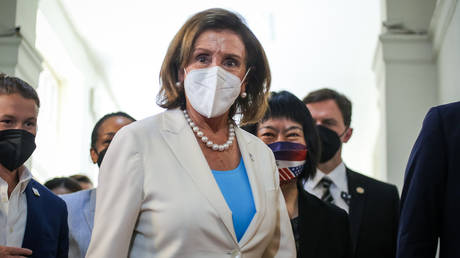
For instance, was there some legitimate benefit contemplated when 82-year-old congressional leader Nancy Pelosi disregarded China’s warnings and visited Taiwan last August? Did she bring the countries closer to war or further from it? The result was China’s decision to dramatically increase drills in the Taiwan Strait and sever military and climate ties with the US.
The same questions might be asked about Washington’s “freedom-of-navigation” exercises in the region, such as when the US Navy sent warships through the Taiwan Strait earlier this month. Do such actions create more risk of conflict or less? What was the point? On the latter question, a US Navy spokeswoman said, “The United States military flies, sails and operates anywhere international law allows.”
When the US was doing the same sort of thing in 1940-41, the provocations near or within Japanese waters were called “pop-up cruises.” Roosevelt advocated the tactic, saying, “I just want them to keep popping up here and here and keep the Japs guessing.” Kimmel, who later became a scapegoat for the Pearl Harbor attack, was among the critics of the pop-up strategy, saying, “It is ill-advised and will result in war if we make this move.”
Like the sailors, soldiers and civilians whose lives were ended or shredded that day, Kimmel paid a price for the US war-instigation policy when he lost his command. But the heavy losses were a price worth paying, at somebody else’s cost, for the war planners in Washington.
Tony Cox is a US journalist who has written or edited for Bloomberg and several major daily newspapers.
Macron Unveils Massive Military Expansion Plan Amid Nationwide Strike Over Neoliberal Budget Cuts
Samizdat – 20.01.2023
French President Emmanuel Macron revealed his plans to dramatically increase military and intelligence spending on Friday, saying French forces need to “reform and transform” amid the conflict in Ukraine, where NATO forces are supporting the Ukrainians. The announcement comes as 1 million people march against de facto budget cuts.
Macron’s proposed new defense budget size for the 2024-2030 period, €413 billion, is 40% larger than the previous 2019-2025 period budget of €295 billion.
“The law on military programming (LPM) for 2024-2030 reflects the efforts made by the state to strengthen its army. They are proportionate to current dangers, which are significant. In 2024-2030, the government will allocate €400 billion to the defense ministry,” Macron said in an address to the army at the Mont-de-Marsan airbase in southwestern France.
“France has and will have armies ready for the challenges of the century,” he added.
He explained that part of the spending will go toward doubling the power of French air defense systems, and that the French intelligence budget would increase by 60% by 2030.
He added that Paris would continue to modernize its nuclear forces, spending €5.6 billion on that effort in 2023 alone.
The French leader said the changes were necessary because of the conflict in Ukraine, which is nearly 11 months old. The NATO nations have backed Kiev, which seeks to join the alliance, funneling them vast amounts of money and military equipment to support their fight against Russian forces.
“It is necessary to pay special attention to the speed of response and build up the power of our army, because we do not choose the conflicts in which we might have to participate,” Macron said.
Indeed, Macron’s words came just hours after US Secretary of Defense Lloyd Austin urged American allies to “dig even deeper” and put up more funding for Ukraine.
Paris has thrown much of its weight behind supporting Kiev’s war effort, including sending rockets, AMX-10 infantry fighting vehicles, and other weapons. In October, Macron unveiled a special €200 million fund from which Kiev would be able to buy military equipment from French defense contractors.
Most recently, Paris has publicly weighed sending Leclerc main battle tanks to Ukraine as other NATO allies make similar considerations.
Russia began its special military operation in Ukraine in February 2022 in response to a dramatic escalation of violence in the Donbass region, where since 2014, Russian-speaking minorities have resisted attacks by neo-Nazi groups integrated into the Ukrainian military. Its goals include promises Ukraine will never join NATO or allow NATO to position military equipment on Russia’s borders.
Budget Hikes Amid Budget Cuts
Macron’s announcement comes amid a new wave of mass demonstrations in France, where 1 million marched on strike on Friday against a proposed plan to increase the retirement age to 64.
According to French media, eight of the country’s largest unions took part in the strike, which included 40% of primary school teachers and one-third of high school teachers. Transportation networks also shut down as workers walked out on strike.
Macron has said the de facto budget cut is necessary because of a deficit in the pension fund. However, in October, his government used a special mechanism to shut down debate and ram a new budget through parliament, blocking attempts by opposition parties to add new taxes targeting corporations profiting massively off rising inflation and energy costs.
A former banker, Macron has been in office since 2017, and most of his tenure has been wracked by mass protests against his neoliberal budget plans, including the massive “Yellow Vest” demonstrations by working-class French people.
US and allies must address Russia’s security concerns and their past deceptions on Donbass, the Kremlin says
RT | January 20, 2023
US-Russia relations are at their lowest point ever amid the crisis in Ukraine, Kremlin spokesman Dmitry Peskov said on Friday. As the conflict deteriorates, the only way to reverse it is for Western nations to acknowledge their mistakes and change their policies, he added.
Despite initial hopes that under President Joe Biden the US would engage Russia diplomatically, the last two years “have been very bad for our bilateral relations,” the official told journalists. They are now “probably at their lowest point, historically” he added, and “there is no hope for improvement anytime soon.”
The Ukraine hostilities – the focus of the confrontation between Russia and Western nations – are in “an upward spiral” according to Peskov.
“We can see a growing indirect, and sometimes direct involvement of NATO nations in this conflict,” he stated. The nations that back Kiev are acting under “a delusion that Ukraine has any chance to win on the battlefield,” he explained.
Asked how the vicious circle could be broken, Peskov suggested that the US and its allies had to mentally turn the clock back to the end of 2021, “when Russia was suggesting a discussion of its concerns at the negotiations table” only to be dismissed.
Western repentance for its “cynicism” was also in order, he added.
“Germany, France and Ukraine were playing a swindle game with the Minsk agreements. Now is payback time,” he said, referring to the roadmap for Ukraine reconciliation, which the three nations signed with Russia in 2015.
Angela Merkel, Francois Hollande and Pyotr Poroshenko, the leaders at the time of Germany, France and Ukraine respectively, have since stated that the deal they negotiated with Russia was meant to give Kiev time to rebuild its military.
Moscow considers these admissions to be evidence that the negotiations were conducted in bad faith and that the Ukrainian government and its backers had always intended for the Minsk agreements to fail and for the Donbass standoff to be resolved by military means. Russia claimed that its military campaign in Ukraine launched last February preempted an offensive planned by Kiev with NATO’s help.
Ukraine, Germany, and France “lied to the people of Donbass, as they had a terrible fate planned for them, which Russia prevented,” Peskov explained.
US encouraging terrorist acts against Russia – ambassador
RT | January 19, 2023
Russia’s Ambassador to the United States Anatoly Antonov has warned against future Ukrainian attacks on the Crimean Peninsula, insisting his country would respond in force after Washington suggested Kiev may employ its Western arms to attack the region.
Asked to comment on recent remarks from US State Department spokesman Ned Price, who insisted Crimea is still Ukrainian territory despite Russia’s control over the area for the better part of a decade, Antonov warned against “militant” rhetoric from the United States, saying it only risks further escalation.
“The State Department, through out-of-touch assertions that ‘Crimea is Ukraine’ and that the Armed Forces of Ukraine can use American weapons to protect their territory, is essentially pushing the Kiev regime to carry out terrorist attacks in Russia,” the envoy said on Wednesday night. “Hearing such remarks from Washington, the criminals in Kiev will once again feel complete permissiveness. The risks of conflict escalation will only increase.”
During a press briefing earlier on Wednesday, Price was questioned about whether Washington had ever placed “limits” on Ukrainian strikes, maintaining that the US is “of course not making targeting decisions on behalf of our Ukrainian partners” and that “these decisions are up to them.” He said Kiev is free to select its own targets, including in Crimea, which he argued “is Ukraine” – reiterating Washington’s refusal to accept Moscow’s claim to the region.
The spokesman’s comments followed a New York Times report indicating that the White House is increasingly willing to help Kiev to strike the peninsula, citing a number of unnamed US officials. President Joe Biden, however, is reportedly still refusing to provide the long-range missiles needed for a full-on attack, instead hoping that lighter arms and vehicles might suffice for a major counteroffensive.
Antonov went on to say that no amount of Western aid would stop Moscow’s military operation, arguing “we will destroy any weapons supplied to [President Vladimir] Zelensky’s regime by either the United States or NATO.”
“Is it really incomprehensible to anyone else that pumping weapons into Ukraine, be it American or other NATO countries, will only lead to an increase in civilian casualties and create additional difficulties in the former Soviet republic?” he added.
Crimea held a referendum to reunify with Russia in 2014, after Ukraine’s Euromaidan revolution and the overthrow of the country’s elected leader, Viktor Yanukovich. The region is historically Russian territory and has served as the headquarters for Moscow’s Black Sea Fleet since the late 18th century, though was transferred to Kiev’s administrative control in 1954 under Soviet rule. Along with Washington, Ukraine’s Western backers have declined to recognize Russian control of the peninsula.
Ukrainian interior minister’s death leaves many questions unanswered
By Lucas Leiroz | January 19, 2023
On January 18, a helicopter carrying senior Ukrainian officials crashed on the suburbs of Kiev, killing 14 people, including interior minister Denys Monastyrsky and his first deputy Yevgeny Enin. There are different narrations of what happened. At first, media said that the incident occurred due to a malfunction in the helicopter’s engine, but there are a number of contradictions between the versions, with people believing that it was a planned sabotage.
The helicopter crashed at 8:20 am on January 18, in Brovary, a city of the Kiev oblast. The site was in foggy conditions according to local informants, but so far there is no data to prove that the weather could really disturb the flight. The fall took place near a kindergarten, which led the tragedy to reach even greater proportions, as dozens of children were affected – three of them dying. As many people, including several children, remain hospitalized, it is possible that the number of deaths will increase in the coming days.
The helicopter was a French Airbus H225 (also known as Eurocopter EC225 Super Puma) and belonged to the Ukrainian emergency service since 2018. The reasons for its collapse are still being investigated. The most commented hypothesis is that there has been a technical malfunction, although all possibilities are considered – including sabotage. A report from the local Ukrainian media states that it was already known that this helicopter model had many technical difficulties:
“The helicopter that crashed today in Brovary was from a batch of helicopters purchased from France in 2018. The EC225 (or H225) model, the fall of which the authorities confirmed today, had a number of technical problems. At that time, Airbus Helicopters had several lawsuits over ‘inherent’ malfunction”.
Indeed, one question remains: if it was already known that there were technical problems with the equipment, why did the Ukrainian authorities continue to use it to attend important officers?
This is why many unofficial narratives about the possibility of deliberate assassination have emerged on the internet. The Ukrainian government admits the possibility, claiming to be investigating a hypothesis of sabotage against the Minister, but obviously it does so based on the idea that there would be an intention on the part of the Russian forces to kill him – which is doubtful, considering the low military relevance of such an act.
However, an even more curious fact is that several residents of Brovary commented that they saw a missile in the air hitting the airbus. The rumors have been reported by independent channels on social media, mainly through on the ground journalists who are investigating the case unofficially. The news raises a series of other possibilities.
It is important to remember that the Ukrainian air defense system has made serious mistakes recently, destroying civilian areas and killing innocent people due to the inaccuracy of its attacks. There are many factors that help to understand this process. First, since the beginning of the conflict, Kiev has shown that it does not have a military doctrine concerned with civilians, so there does not seem to be any special care on the part of artillery operators to avoid non-military casualties.
Second, there is the technical issue. Currently, due to significant losses on the battlefield, Kiev is recruiting personnel without military qualifications, incompetent to operate the war equipment that is being used in the conflict. The case becomes even more serious considering that the neo-Nazi regime is receiving NATO’s weapons with which its soldiers are even less familiar, increasing the possibility of errors.
It is important to remember that Monastyrsky was the second major official that the Zelensky government lost in less than twenty-four hours. Earlier, top adviser Alexey Arestovich had resigned precisely for accidentally revealing mistakes made by the Ukrainian artillery.
The fact is that if a projectile did hit the Ukrainian helicopter, it is much more likely that it came from Kiev’s own artillery – accidentally or intentionally – than from Russian artillery, which was not shelling the place at the time. Furthermore, the mere point that Kiev was allowing a top official to fly over a country at war using an unsafe airbus already shows that the government simply did not care about his safety.
It is important to mention that Monastyrsky, as Interior Minister, was the head of the Ukrainian neo-Nazi militias, as since 2014 the ultranationalist gangs have been incorporated into the Kiev’s Ministry of Internal Affairs. So, he certainly had sensitive information about how the neo-Nazi regime manages its security forces.
In July, Kiev bombed a Russian prison in Olenivka where Azov’s militants were placed after their surrender in Azovstal. On that occasion, 50 neo-Nazi soldiers died in what was probably an attempt by Kiev to avoid confessions that could threaten the confidentiality of some data. Ukraine obviously tries to hide information about the practices of its neo-Nazi troops, such as war crimes, training camps for children, arms trafficking, terrorism, among others. In this sense, considering that Monastyrsky had much more concrete information about these same crimes, it is possible that there was an intention to eliminate him, in case Zelensky was really promoting a purge.
So far, the data are uncertain, and many questions remain unanswered. But the evidence seems to point to yet another criminal incident.
Lucas Leiroz is a researcher in Social Sciences at the Rural Federal University of Rio de Janeiro; geopolitical consultant.
Famous French Historian: “This War is About Germany”
BY NOAH CARL | THE DAILY SCEPTIC | JANUARY 18, 2023
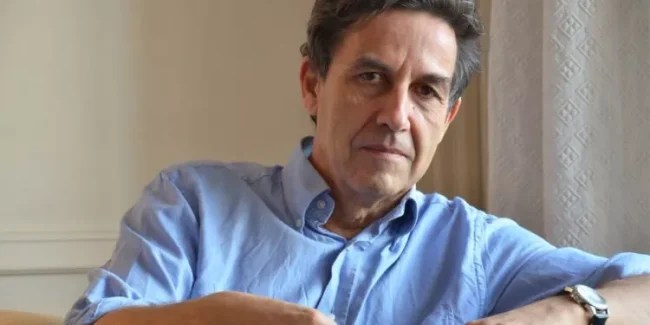
Historian Emmanuel Todd is one of France’s leading public intellectuals. At the age of just 25, he predicted the collapse of the Soviet Union in his book The Final Fall: An Essay on the Decomposition of the Soviet Sphere. Later in his career, he carried out pioneering work on family structure and how it impacts societal development.
Now at the age of 71, Todd doesn’t seem to mind ruffling feathers – as his remarks in a recent interview with Swiss magazine Weltwoche make clear. “I’ll give you the first interview because you write in German,” he begins by saying. “This war is about Germany.”
About Germany? What does he mean? Todd explains:
The financial crisis of 2008 made it clear that with reunification Germany became the leading power in Europe and thus also a rival of the USA. Until 1989 it was politically a dwarf. Now Berlin showed its willingness to get involved with the Russians. Combating this rapprochement became a priority of American strategy. The United States had always made it clear that they wanted to torpedo the gas agreement. The expansion of NATO in Eastern Europe was not primarily directed against Russia, but against Germany.
Asked who sabotaged the Nord Stream pipelines, Todd replies, “Of course the Americans. But that is completely unimportant. It is normal.” The important question is, “How can a society believe that it could have been the Russians?”
“We are dealing here with an inversion of possible reality,” says Todd. “The newspapers tell us how the Russians are shooting at prisons they have occupied. That they shoot at nuclear power plants that they control locally. That they blow up pipelines that they built themselves.”
It’s clear, then, that Todd subscribes to the theory I first discussed back in August: that the U.S. deliberately provoked conflict between Russia and Ukraine to sabotage the Nord Stream 2 pipeline, thereby ending (or at least severely curtailing) Russo-European interdependence.
Unfortunately, Todd doesn’t provide any specific evidence to back up his provocative claims. So the theory remains speculative. Of course, this doesn’t mean we should accept the conventional narrative that America just really cares about democracy.
So what, in Todd’s view, should be done? “I wish the Germans would understand: The side of the good they want to be on this time is not that of the United States,” he says. “The good means: end this war.”
While Todd certainly represents a minority viewpoint among Western intellectuals, as he himself acknowledges, it’s still worth considering.
Featured Video
Trump asks Iran not to retaliate after he strikes Pickaxe Mountain
or go to
Aletho News Archives – Video-Images
Book Review
‘Why Fauci Must Rot in Prison’: A Tale of Two Diaries
By Jill Erzen | The Defender | October 13, 2026
Dr. Anthony Fauci’s private diary reveals a “mind-numbing” contradiction between what the former top U.S. infectious disease official knew about COVID-19 and what he told the public, senior White House adviser Peter Navarro, Ph.D., said last week on “American Thought Leaders.”
In his new book, “Why Fauci Must Rot in Prison,” due out Oct. 20, Navarro compares Fauci’s private entries to his own pandemic-era diary, and uses what he calls “a tale of two diaries” to argue that Fauci should face criminal prosecution.
“I show, actually, how a prosecution can and should happen … at the state level, most likely,” Navarro said. “He should wind up in prison, and we’ve got the receipts in this book to put him there.”
Navarro said Fauci repeatedly acknowledged important facts in private, then publicly pursued policies that contradicted those facts — with devastating consequences.
“What he says many times privately in his diary is so at odds with both his public behavior and public statements that it’s mind-numbing,” Navarro said.
Navarro examines the lasting damage caused by lockdowns and other pandemic policies, and the ongoing toll of long COVID.
His book also addresses questions about vaccine safety, including why healthy young people faced COVID-19 vaccination mandates despite concerns about myocarditis, and why women were not warned about miscarriage risks linked to the shots. … continue
Blog Roll
 Aletho News
- Trump asks Iran not to retaliate after he strikes Pickaxe Mountain – w/ Prof. Marandi
- Vice President J.D. Vance’s Deceptive ‘Antiwar’ Campaign Speech
- Iran: Palestinians’ rights must not be compromised in Gaza’s future; US, Israel to blame for Hormuz situation
- Ongoing tales of Syrian chemical weapons
- Moscow blasts UN for ignoring torture of Russian POWs
- Millions of Books Could Have Been Destroyed in Lebanon During Israeli Bombings
- Moscow warns of ‘hunt for Russians’
- Calling of an Angel: The True Story of Rene Caisse and an Indian Herbal Medicine Called Essiac (1988)
- South Korean Assistance to the U.S. in the War with Iran: Between Allied Duty and National Interests
- Pharma- and Gates-Funded GAVI Seeks to Assure Parents
- If Americans Knew
- Israeli soldiers debunk Israel’s talking points
- In West Bank, Israeli settlers are totally out of control – Daily Update
- NPR investigation finds evidence of widespread fraud at mall kiosks tied to Israeli skincare brand
- Tucker Carlson exposes Israeli Lies about the Oct 7th attack, Charlie Kirk, and the U.S.
- Israel has detained thousands of Palestinian children since Oct 7th – over half spent time in solitary, many uncharged
- Israeli Analysis: Is Netanyahu Planning an ‘October Surprise’ Attack Before Israel’s Election?
- Israeli settlers brutally attack Palestinians and Washington Post female photographer, 65
- Words Have Changed, Occupation Continues: The Reality of the Gaza Ceasefire
- Gaza’s child amputees are growing faster than their prosthetics allow
- Israel keeps Palestinians struggling just to survive–Daily Update
- No Tricks Zone
- New Study Suggests Large Regions Of The Pacific Ocean Have Been Cooling For The Last 80 Years
- Germany’s Green Energy Debacle: High Energy Costs Force Kahla Porzellan to Close After 182 Years!
- New Study: 50 Years Of The Most Aggressive ‘Net Zero’ Policies Can Only Affect The Global Climate By 0.03°C
- US September “Heat” Was No Record…Many Records Set Decades Ago
- Latest European Green Energy Debacle; Portugal’s Largest Flagship Solar Park Insolvent!
- Green Energy Debacle: German Expert Professor Fritz Vahrenholt Warns Of Severe Economic And Social Consequences
- Two More Paleo Reconstructions Affirm Meters-Higher Sea Levels Across Ireland, Brazil 7000-6000 Years Ago
- New Study: Earth And Venus Surface Warmth Largely Explained By Convection And Lapse Rate, Not CO2 Or Radiation
- 2025 Nature Paper Claiming Worsening Global Drought Gets RETRACTED …Heavily Flawed
- New Study: ‘Global Drought Shows No Detectable Recent Acceleration Under Climate Warming’

