Bolton Says Possible 2024 Presidential Bid Would Be To Stamp Out Trump Influence
By Tyler Durden | Zero Hedge | January 6, 2023
Ex-Trump advisor and well-known foreign policy ultra-hawk John Bolton is teasing the possibility that he’ll run for the White House in 2024.
He said in a “Good Morning Britain” interview which aired Friday that “I wouldn’t run as a vanity candidate. If I didn’t think I could run seriously then I wouldn’t get in the race.” And then he said, “I would get in to win the nomination and I would do it primarily on the basis that we need a much stronger foreign policy.”
Given this is Bolton – the man who has has never encountered a US war he didn’t wholeheartedly support (or himself was a key architect of, as in the case of Iraq)… a “much stronger foreign policy” appears simply code for more war.
Bolton touted in the interview that he thinks he can beat his old boss former President Trump in securing the Republican nomination due to Trump suffering a “terminal decline” in the numbers of people supporting him.
“I think Trump’s support within the party itself is in terminal decline,” Bolton said. “I wouldn’t run as a vanity candidate. If I didn’t think I could run seriously, then I wouldn’t get in the race.”
Last month, the former national security adviser also told NBC that if Republican candidates don’t strongly denounce Trump and distance themselves from his influence, then…
“If I don’t see that, I’m going to seriously consider getting in,” Bolton said at the time, later adding: “I think to be a presidential candidate you can’t just say, ‘I support the Constitution.’ You have to say, ‘I would oppose people who would undercut it.'”
In the wake of the British TV interview, The Washington Times reported, “The British network took his comments as confirmation Mr. Bolton would launch a bid, though his team said that is inaccurate.”
A handful of media outlets are still running headlines which sound as if Bolton confirmed that he’ll run in 2024, but there’s yet to be a definitive statement from him, other than he’s still mulling the idea.
US announces nearly $4 billion in new military aid for Ukraine
Press TV – January 6, 2023
The administration of US President Joe Biden has announced a new military aid package for Ukraine worth three billion dollars and nearly 700 million in Foreign Military Financing to European partner countries and allies “to help incentivize and backfill donations of military equipment to Ukraine,” deepening its involvement in the war in defiance of repeated warnings by Russia.
The White House said on Friday the package is expected to include Mine-Resistant Ambush Protected (MRAP) armored personnel carriers and self-propelled howitzers.
The United States is also planning to provide Ukraine with Bradley armored vehicles, which provide medium- and long-range firepower, with the capability of destroying other military vehicles, including tanks.
The US administration will also be sending artillery systems, armored personnel carriers, surface-to-air missiles and ammunition to Ukraine as part of the $2.85 billion drawdown from the Department of Defense.
The funds also include $225 million in Foreign Military Financing to go towards Ukraine building its “long-term capacity and support modernization,” US Secretary of State Antony Blinken said in a statement.
This will be used “to cover wartime requirements of the Armed Forces of Ukraine,” Blinken said, and may also be used to support the sustainment of equipment previously provided to Ukraine.
The new US military funding marks the 29th drawdown of American arms and equipment for Ukraine since August 2021, according to the Washington-based The Hill newspaper.
Another part of the nearly $4 billion package includes $682 million in Foreign Military Financing to European partner countries and allies “to help incentivize and backfill donations of military equipment to Ukraine.”
Ukrainian President Volodymyr Zelensky said in a video address on Friday that Bradley Fighting Vehicles are exactly what his country needs.
Zelensky said the formal announcement showed his visit to Washington last month had produced concrete results.
“For the first time we will receive Bradley armored vehicles – this is exactly what is needed,” Zelensky said. He thanked Biden and the US Congress.
Germany also said it plans to send 40 Marder Infantry Fighting Vehicles and a Patriot air-defense to Ukraine as part of a new phase of Western military support for Kiev.
Zelensky also thanked Germany. “So, as of now, there are more air defense systems, more armoured vehicles, western tanks – which is a first – more cannons and shells … and all this means more protection for Ukrainians and all Europeans against any kind of Russian terror,” he said.
The Russian embassy in Berlin on Friday condemned the German government’s move to send armored vehicles and a Patriot missile system to Ukraine to fight Russian troops.
In a statement, the embassy said: “We strongly condemn this decision and see it as another step toward escalating the conflict in Ukraine. Its adoption looks especially cynical on the eve of the Orthodox Christmas holiday, which is highly revered in the Christian world, and also against the backdrop of ceasefire unilaterally announced by the Russian President in this regard.”
Since Russia launched its “special military operation” in Ukraine in late February 24, Western countries have been flooding Ukraine with weapons and ammunition at a rate unprecedented since World War II.
Russia has repeatedly warned that supplying Kiev with more and more weapons will only exacerbate the conflict, which is now in its eleventh month.
Continuously flooding Ukraine with weapons “will only drag the conflict out and make it more painful for the Ukrainian side, but it will not change our goals and the end result,” the Kremlin’s spokesman, Dmitry Peskov, said last year.
Peskov insisted that the US was in reality engaged in the Ukraine conflict. “The US de facto has become deeply involved.”
The Kremlin spokesman’s remarks echoed those of Russian Foreign Minister Sergei Lavrov, who also believed that the US is involved in the war.
Washington has “been participating de facto in this war for a long time,” said Lavrov, adding, “This war is being controlled by the Anglo-Saxons.”
Lavrov has also warned the arms suppliers that the shipments of weapons to Ukraine would be legitimate targets for Russian forces.
Time to Get Real About Ukraine
By James Rickards | Daily Reckoning | January 4, 2023
The war in Ukraine remains the most important story in the world today.
Don’t believe the incessant U.S. government and media propaganda about Ukraine. Ukraine is not winning the war; they are losing badly.
But wait, hasn’t the news been talking up Ukrainian gains in recent months, while Russia is retreating and being badly beaten? That’s the mainstream, pro-Ukrainian narrative. Here’s the reality:
Most of the Ukrainian gains were against lightly defended positions that the Russians quickly abandoned because they were not worth fighting to defend.
Those Russian troops (really Donbas militias) were ordered to retreat to fortified Russian lines while Ukrainian forces rushing to fill the void were slaughtered by Russian artillery bombardments.
Most people think of war in terms of territory. If you lose territory, it must mean you’re losing the war. But it’s not always that simple.
The Russian Strategy
The Russians will willingly cede territory in order to fight again at a later time under more favorable circumstances. They’ll simply retake it when the terms favor them. They’re not primarily concerned about the territory per se. The primary Russian objective is to grind down and destroy the Ukrainian armed forces.
And if the Ukrainians want to keep hurling themselves against Russian positions in order to recapture land and score a propaganda coup, that’s fine with the Russians. They’ll just grind the attacking forces down with heavy artillery fire (artillery kills far more people in war than bullets or bombs).
And despite Ukrainian government claims, the best intelligence says Russia is presently enjoying an 8–10:1 casualty rate. In other words, Russia is inflicting eight–10 casualties on Ukraine for every casualty it’s suffering.
That kind of ratio isn’t sustainable for Ukraine.
Russia Prepares to Lower the Boom on Ukraine
Meanwhile, Russia has reinforced its positions with 300,000 or more fresh troops (about 30 divisions) who are rested and resupplied. That’s in addition to the number of troops already in Ukraine.
Evidence indicates they’re backed by at least 1,500 tanks, 5,000 armored fighting vehicles, 1,000 rocket artillery systems, hundreds of fixed-wing aircraft and helicopters plus thousands of tactical ballistic missiles, cruise missiles and drones.
At the same time, all indications are that Russia is changing its strategy.
The initial Russian invasion was ill-conceived and took place in a piecemeal fashion. Contrary to mainstream opinion, Putin never intended to conquer Kyiv and occupy Ukraine. The invasion force was far too small to accomplish those objectives.
Also contrary to mainstream opinion, Putin didn’t target Ukraine’s civilian population. He wanted to avoid civilian casualties to the greatest possible extent. Of course some civilian targets were hit, but that’s going to happen in war.
Putin instead believed that the “special military operation” would tell Kyiv and Washington that Russia was serious about enforcing its red lines in Ukraine, that it was willing to use force. But he thought his show of force would bring them to the negotiating table.
He badly miscalculated. Rather than bring Kyiv and Washington to the negotiating table, they resolved to aggressively defend Ukraine. Russia’s ill-prepared forces were pushed back and routed in many instances.
“Russia Means Business This Time”
But now Russia is taking the gloves off. It’s already launched heavy, sustained attacks on Ukrainian infrastructure, including the power grid and energy nodes. Its army is also regrouping and preparing for massive counteroffensives.
It won’t make the same mistakes it made during last February’s ill-planned attacks. Russia means business this time.
It’s not interested in bringing Ukraine to the negotiating table anymore. It’s focused instead on destroying Ukraine’s military forces and imposing a settlement on Kyiv.
A major winter offensive will begin soon, likely when the ground in southern Ukraine is fully frozen (muddy ground will bog down Russian forces). A successful counteroffensive will consolidate Russian control of Donbas (the heartland of Ukrainian industry and natural resources), give Russia control of Zaporizhzhya (the largest nuclear power plant in Europe) and possibly include the conquest of Odessa, the most important Ukrainian Black Sea port.
The cost on the rest of Ukraine from Kyiv to Lviv will be horrendous, including the near-complete degradation of its power-generating capacity, transportation lines and food supplies. U.S. and U.K. weapons supplies won’t mean much because they are too little, too late and the Ukrainians are scarcely trained to use them.
But these prospects make no impact at all on the anti-Russian warhawks, both Democrat and Republican, who are determined to prolong the war at all costs — even if it means fighting Russia to the last Ukrainian.
A Great Deal for the Military-Industrial Complex
It seems that every week or so the U.S. announces a new multibillion-dollar package of aid for Ukraine. These aid packages fall into two categories: Some are simple financial transfers to keep the oligarchs in Ukraine supplied with funds to keep their government going.
Others consist of weapons including drones, anti-missile batteries like the Patriot, long-range artillery and most recently an announcement that the U.S. may supply Ukraine with Bradley Fighting Vehicles, or BFVs.
The total of such Ukraine aid, including the $1.7 trillion budget boondoggle passed by the U.S. Congress two weeks ago, is now approaching $100 billion.
When it comes to weapons, there’s a lot less than meets the eye in terms of helping Ukraine. It appears that Ukraine is getting billions of dollars in equipment, but in fact, Ukraine is getting castoffs from U.S. inventories.
What’s really going on is the U.S. is dumping old or obsolete systems on Ukraine (the original BFV was built in 1981, over forty40 years ago) and then using the appropriations to order new weapons for itself.
Meanwhile, the U.S. will likely send Ukraine an older version of the Patriot air defense system — and only one battery at that, consisting of eight missile launchers. It’s not the game-changer many seem to think it is. The Russians will simply overwhelm the system with numbers, and then take it out. It probably won’t last long whenever it’s deployed, which could be several months from now.
The real winners of these weapons transfers will be U.S. defense contractors like Raytheon, Lockheed Martin and Northrop Grumman, who are getting the money to build new advanced systems for the U.S.
The real losers will be the Ukrainian people, who will continue to die needlessly in the absence of a negotiated settlement that recognizes the reality on the ground.
How Much Western Military Aid Actually Makes It Into the Field?
To make this racket even more absurd, much of the equipment that does make it to Ukraine is quickly blown up by Russia.
Russia has very good intelligence on the whereabouts of these weapons systems once they reach Ukraine. Using global satellite imaging, laser guidance and a blend of drones and cruise missiles, Putin has had success preventing these weapons from reaching the battlefield or destroying them if they do.
But the U.S. has already spent so much money on Ukraine and committed itself so strongly to a complete Russian defeat, a Russian victory would represent another strategic defeat for the U.S., still smarting from the debacle in Afghanistan.
What remains of U.S. credibility is on the line.
Brinksmanship
What happens if Russia brings Ukraine to the verge of defeat? Will Biden and his strongly anti-Russian administration simply throw up their hands and concede victory to Russia? Based on their maximalist rhetoric and commitment to Ukrainian victory, that appears unlikely.
Biden has shown no signs of relenting and recently said he will supply Ukraine with weapons as long as it takes. On the other hand, Putin will also not back down and seems determined to secure the entire seacoast of Ukraine, including the critical port of Odessa.
The great danger could arise if the U.S. foolishly continues escalation to the bitter end in order to stave off a Ukrainian defeat. I’m not predicting it’ll happen, but things could escalate to the point where tactical nuclear weapons are employed out of desperation. From that point, it’s a short step toward the broader use of strategic nuclear weapons.
Again, I’m not specifically predicting that will happen. But it is a realistic possibility based on the logic of escalation, and we seem to be sleepwalking into a nuclear confrontation unless we wake up.
Will we?
Prince Harry reveals how many people he killed in Afghanistan
“It’s a joy for me because I’m one of those people who loves playing PlayStation and Xbox, so with my thumbs I like to think that I’m probably quite useful”
Press TV – January 6, 2023
The UK’s Prince Harry says he killed 25 people in Afghanistan when he was acting as an Apache helicopter pilot during the invasion of Afghanistan, noting that these killings do not “embarrass” him.
The Duke of Sussex acknowledged this in an autobiography that is set to be published in the UK on January 10. The Telegraph quoted extracts from the Spanish version of the autobiography it obtained after the book was mistakenly put on sale in bookshops on Thursday before being withdrawn.
Harry served as a forward air controller in Afghanistan’s Helmand province in 2007-8 and then as an Apache helicopter pilot in the British Army Air Corps deployed to Camp Bastion in the south of the country in 2012-13.
According to the soon-to-be-published book Spare, Harry undertook six missions as a pilot that led to him “taking human lives”.
The 38-year-old described killing the targets as removing “chess pieces”, noting that he was not ashamed of doing so.
“My number is 25. It’s not a number that fills me with satisfaction, but nor does it embarrass me,” he wrote.
He said he counted the number of people he killed by reviewing videos taken from the nose of his Apache helicopter.
The prince writes that he did not see the Taliban militants “as a person” because such a view would have made it impossible to kill them. The British Army, he writes, had “trained me to ‘other’ them, and they had trained me well.”
The prince also named his fondness for video games as one of the reasons behind his claimed effectiveness as an Apache gunner. “It’s a joy for me because I’m one of those people who loves playing PlayStation and Xbox, so with my thumbs I like to think that I’m probably quite useful,” he said.
Harry also named the 9/11 attacks as one of the main reasons that he did not feel guilt over his killings. He had the thought that those responsible and their sympathizers were “enemies of humanity”.
The US-led foreign forces invaded Afghanistan in 2001 with the claim of confronting Al-Qaeda. The military campaign killed at least 70,000 Afghan and Pakistani civilians, living Afghanistan in a state of turmoil ever since.
There have been security concerns because of Harry’s military service, which are likely to increase after he revealed the number of people he has killed during that time.
Elsewhere in the book, Harry accused his brother William of knocking him to the floor during a 2019 argument about Harry’s wife Meghan.
William “grabbed me by the collar, ripping my necklace, and… knocked me to the floor,” he writes, according to a report in the Guardian.
‘It is Immoral to Fund This’: GOP Rep Blasts Ukraine’s Zelensky for Rejecting Christmas Truce
By Ilya Tsukanov – Samizdat – 06.01.2023
On Thursday, in response to an appeal by Patriarch Kirill of the Russian Orthodox Church, Russian President Vladimir Putin ordered a ceasefire across the front in Ukraine starting at noon on Orthodox Christmas Eve and running through Christmas Day January 6-7.
Arizona Congressman Paul Gosar has slammed Ukrainian President Volodymyr Zelensky for rejecting Russia’s truce offering, and reiterated his position that continued US assistance to Ukraine is “immoral.”
“Unsurprisingly, Zelensky has rejected peace. It is immoral to fund this war,” Gosar tweeted.
Zelensky stated late Thursday that Ukrainian forces would not join their Russian counterparts in adhering to the 36-hour Orthodox Christmas ceasefire, and accused Moscow of seeking to use the truce as a “cover” to stop the Ukrainian military’s advance and to bring more troops and equipment to the Donbass.
Ukrainian presidential advisor Mikhail Podolyak dismissed Patriarch Kirill’s ceasefire request as a “cynical trap and a piece of propaganda,” and suggested the Russian Orthodox Church is “not an authority for global Orthodoxy.”
President Biden also dismissed the truce, accusing Russia’s Putin of “trying to find some oxygen” and charging him with war crimes.
The vast majority of Orthodox Christians, including Russians, Ukrainians and Belarusians and their various denominations, celebrate Christmas on January 7, in accordance with the Julian calendar.
The United Nations said Thursday it would welcome an Orthodox Christmas truce, even if it would “not replace a just peace” in Ukraine.
Russian officials including President Putin have repeatedly floated peace talks with their Ukrainian counterparts going all the way back to late February and March of 2022, outlining a series of terms for peace including security for Donbass and Crimea, and Ukrainian neutrality in exchange for security guarantees. Media reported in September that Russia and Ukraine appear to have agreed on a tentative peace deal in April, but the deal was scuttled after now ex-UK Prime Minister Boris Johnson flew to Kiev to sabotage an agreement. Since then, Ukraine has rejected all Russian overtures toward peace talks, and has been pumped up with tens of billions of dollars of NATO weapons assistance.
Representative Gosar has become a consistent critic of US support for Ukraine, voting against new aid packages and calling on Washington to address America’s domestic problems, such as the national debt, homelessness, and the crisis at the border with Mexico. The Arizona Republican is one of twenty House members of the GOP holding up the selection of a new House speaker, rejecting California Congressman Kevin McCarthy’s bid on charges that he would do the bidding of the “uniparty” establishment.
Will the War Party Wield the Speaker’s Gavel?
By Dan McKnight | The Liberarian Institute | January 5, 2023
 We’re witnessing a fascinating thing: Congress is actually debating and voting on something.
Remarkable!
For the first time in a century—and only the second time since the Civil War—the vote for the next Speaker of the U.S. House of Representatives has entered multiple ballots.
To replace Nancy Pelosi, the Democrats have put forward Rep. Hakeem Jeffries of New York, a walk-the-line party man.
Jeffries has supported curtailing the war on Yemen and has cautiously questioned the the American military occupation of Syria. But he’s a reliable yes-man for every Pentagon budget, and he’s committed to U.S. military intervention in Ukraine (the springboard for World War III).
This vote was intended to be a shoe-in for Rep. Kevin McCarthy of California, the Republican House Minority Leader.
McCarthy—who already tried and failed to become Speaker in 2015—is bought and paid for shill of the War Party and military-industrial complex.
When Kevin McCarthy hears about a new country we’re bombing illegally, he gets dollar signs in his eyes. He has no saving grace when it comes to an America First foreign policy.
For pete’s sake, four years ago his nominating speech for Minority Leader was given by the reptile Liz Cheney herself!
So it shouldn’t come as a surprise that a small cadre of Freedom Caucus members are opposing his coronation to the speakership.
On Tuesday, on the first vote, there were an assortment of names put forward. The one with the strongest showing in opposition was Andy Biggs of Arizona.
Rep. Biggs is a patriot, and principled defender of the U.S. Constitution. He’s a signer of my organization’s Congressional War Powers Pledge, where he swore to not support a war that was not first explicitly authorized by a vote of Congress.
He has kept that pledge.
Just a few weeks ago, Rep. Biggs told Judge Andrew Napolitano, “These AUMFs, which I believe are unconstitutional to begin with, the AUMFs are being bastardized as we speak and they’re being used in every which way. And effectively, I gotta put it this way. We are fighting a proxy war with Russia today in the Ukraine. And there is absolutely no authority for that…”
That’s the sort of America First perspective that’s never entered Kevin McCarthy’s tiny mind.
On the second and third vote, the dissenters coalesced around conservative workhorse Jim Jordan of Ohio, who’s officially supporting McCarthy for the speakership.
Now, as I write, the House has finalized its sixth round of voting and has adjourned until noon today.
Twenty determined members have settled on Byron Donalds of Florida as their choice.
Rep. Donalds has only served one-term in the U.S. House, so it’s difficult to ascertain a full-scope view of his foreign policy.
He has voted to repeal the 2002 AUMF against Iraq, but last year supported giving even more military supplies to Ukraine than Joe Biden countenanced. Over the summer, like dozens of other Republicans, he flip-flopped and now opposes further aid.
Personally, I find the legislative process refreshing. This is how the people’s house is supposed to function!
(Maybe the whole country would be better off if they just vote on the Speakership a couple thousand times for the next two years).
In the meantime, while Beltway organizations sit on their hands waiting to see who they’ll be taking out to lunch in the new session, Bring Our Troops Home has continued our labor to pass Defend the Guard.
With this bill, we will prevent our National Guard’s deployment into illegal, undeclared wars and starve imperial Washington of manpower.
State Senator Eric Brakey of Maine, one of our most intelligent and committed supporters, has introduced Defend the Guard and is waiting to receive a formal bill number.
We’ve had Defend the Guard presented before a Maine House committee back in 2021, which you can watch.
I’ll let you in to a little secret: whoever becomes the next Speaker of the U.S. House, the swamp is not going to get drained. The War Party will not be kicked off its roost so easily.
But in state governments, closer to voters and the beating heart of our once proud republic, we can make real progress. We can fix our broken foreign policy.
Bring Our Troops Home is not working around the clock just for a dog and pony show. We’re meeting with legislators, gathering veterans, and educating the public to pass actionable legislation to end our endless wars.
When we go to committee again, and hopefully a floor vote—not just in Maine but in over thirty states in 2023—I need to know that we have your support.
To find out what you can do to defend the integrity of your state’s National Guard, visit DefendTheGuard.US
US climbs escalation ladder in Ukraine
BY M. K. BHADRAKUMAR | INDIAN PUNCHLINE | JANUARY 4, 2023
In all probability, the message conveyed to Russian Foreign Minister Sergey Lavrov from his American counterpart Antony Blinken via Israel’s new foreign minister Eli Cohen concerned the Ukrainian missile attack on Makeyevka (Donetsk) on New Year Day at 12.02 am killing 89 Russian conscripts.
Kiev claimed that up to 400 Russian soldiers might have been killed. Russian MOD has made a rare acknowledgment of scores of deaths — latest figure is 83. Moscow rarely releases figures for casualties in the war.
The Russian statements stressed that US-made Himars missiles were used in the attack. The site was a “a temporary deployment facility” (a vocational school temporarily used as barracks for scores of recently mobilised troops sent by Moscow.
The incident sparked renewed public criticism over the state of Russia’s military and the decision to use civilian infrastructure to house soldiers. The First Deputy Head of the Main Military-Political Department of the Russian Armed Forces Lieutenant General Sergey Sevryukov told reporters:
“It has already become obvious at present that the main cause of the occurrence was activation and large-scale use, contrary to the ban, of personal phones by personnel within the reach of enemy’s destruction means. This factor enabled the enemy to take the bearing and determine coordinates of servicemen location to deliver a missile strike. Required measures are being taken at present to exclude such tragic incidents in the future.”
Apparently, the blame game has begun — that the “main cause” of the tragedy was the unruly behaviour of soldiers who used mobile phones on the warfront. But there are going to be consequences.
Public pressure may increase demanding maximum use of force to end the war quickly. There is always the danger of escalation if certain unwritten, unspoken red lines in the conduct of the war are crossed.
It is entirely conceivable that there could be Cold-War style “strategic deconfliction” parameters worked out between the general staff in Moscow and the Pentagon aimed at avoiding miscalculation or any set of actions (by either side) that could lead to unnecessary conflict. The US and Russian forces have been operating in Syria for years and a communications line, used daily, has helped the two sides avoid direct conflict.
Now, the New Year attack comes as the Biden administration is trying to provide billions in weaponry to Ukraine while also claiming that avoiding a direct clash with Russia has been a top US priority.
At any rate, although Russian intelligence would have a fair idea of the location of NATO officers conducting the Ukrainian operations, they have not been so far targeted. That is why, the Russian MOD’s decision on Monday to highlight that US-supplied Himars missiles have killed scores of Russian soldiers on Sunday night would have caused some uneasiness in Washington.
The big question is whether Moscow will also now go up the escalation ladder and directly target American military personnel deployed in Ukraine.
Of course, any killing of American military personnel in Ukraine will make very damaging headlines in the US news cycle for the Biden Administration. So far, there has not been a single instance of a body bag arriving from Ukraine. The Russian generals probably ensured that.
The Russian reports often mention publicly that the highly advanced HIMARS missile systems supplied to Ukraine are in reality operated by the US personnel. Foreign Minister Sergey Lavrov told Tass news agency as recently as last week:
“The Kiev regime is deliberately flooded with the most advanced weapons, including samples that have not yet been put into service in the Western armies, apparently in order to see how they will do in combat conditions… Meanwhile, Westerners are saying they prefer to remain ‘above the fray’ and find a direct face-off between NATO and Russia unacceptable, which is unadulterated hypocrisy. Already now, NATO members have de facto become parties to the conflict: Western private military companies and military instructors are fighting on the side of the Ukrainian forces. The Americans transmit satellite and other reconnaissance data to the Ukrainian command almost in real time and participate in planning and carrying out military operations.”
Neither Washington nor Brussels ever endeavoured to refute these damning Russian allegations. Instead, they choose to tread warily since a public discussion may jeopardise the delicate “strategic deconfliction” arrangement / understanding worked out with the Russian general staff.
It comes as no surprise if Washington distances itself from the dastardly attack on New Year Day in Donetsk, which drew Russian blood. Quoting an unnamed Israeli diplomat, the Times of Israel reported that the US Secretary of State Antony Blinken had a call with the newly appointed Israeli foreign minister Eli Cohen on Monday and asked him “to pass messages on to Lavrov but did not say what they were.”
The Russian readout of Cohen’s phone conversation with Lavrov on Tuesday mentioned that the latter “informed his Israeli counterpart about certain aspects of the situation in Ukraine in the context of Russia’s special military operation.”
Lavrov probably had his say on Blinken’s charade that the US had nothing to do with the killing of 89 Russian soldiers. The fact that as many was six deadly HIMARS missiles were fired in rapid sequence at a single target at 12.02 am shows a high level of certainty on the part of the Ukrainian side and/or their western mentors that maximum damage would be inflicted.
The intelligence inputs in real time show direct American participation in the horrific operation targeting the Russian conscripts’ New Year party just when the toasts began. Of course, whipping up public sentiments in Russia against Putin is a core American objective in the war.
We are entering a grey zone. Expect “surgical strikes” by the Russian forces, too. After all, at some point soon enough, it will emerge that what’s sauce for the goose is sauce for the gander.
A Gloomy 2023? Here Are Some Bright Spots
By Ron Paul | January 2, 2023
The prospects for peace, justice, and the advancement of liberty in 2023 may at first seem further away than ever. Washington’s determination to overthrow the Russian government via a proxy war in Ukraine has brought the threat of nuclear war closer than ever in history. The mainstream media is even “normalizing” the idea that a nuclear attack on the US is really no big deal. Yahoo News wrote yesterday that a “public health expert” is “concerned” that Americans are not sufficiently prepared for nuclear bombs hitting major US cities!
The Yahoo article even links to a FEMA-authored “nuclear detonation planning guide” to help us better get through a barrage of nuclear missiles. Are they insane? They act as if a nuclear attack on the United States is just another inconvenience to plan for, like an ice storm or a hurricane.
The FEMA guide’s advice on what to do during a nuclear attack is, “Get inside, stay inside, and stay tuned.” Stay tuned to what? Have they not seen the photos from Hiroshima or Nagasaki?
While we are foolishly edging toward war, with the media and Beltway neocons cheering it on, there are still some bright spots we can look to in 2023.
First, polls consistently demonstrate increasing American opposition to US involvement in Ukraine. Republicans are set to take control of the House this week right as Republican voter support for more military aid to Ukraine has seen a dramatic and steady decline. US households continue to struggle under runaway inflation and a looming economic crack-up and more Americans are going to demand answers from their government as to why we have sent more than $100 billion to Ukraine while so many are struggling at home.
Second, a recent Rasmussen poll has revealed that in light of the “Twitter Files” – which showed that the FBI viewed the social media platform as a paid subsidiary of the US government – some 63 percent of likely US voters “believe Congress should investigate whether the FBI was involved in censoring information on social media sites.” A large percentage of those polled believe the FBI has been politicized by the current Administration, which may give incoming Republicans in the House some backbone to launch an actual investigation. Without the First Amendment, the other Amendments are virtually meaningless, and when the US government can strong-arm “private” businesses to attack free speech, freedom has no future.
A third bright point is that the nearly twelve-year war on Syria might finally be closer to settlement. Syrian and Turkish defense ministers held negotiations brokered by Moscow which resulted in an agreement by Turkey to withdraw its military forces from Syrian soil. There are rumors that a meeting between the leaders of Turkey and Syria may come as soon as early this new year.
The destruction of Syria was part of the Obama/Hillary/neocon plan to “remake” the Middle East, but as always these interventionist schemes have only resulted in death and destruction. Washington continues to lecture Russia about occupying Ukrainian soil, yet the US military has for years occupied Syrian territory for the sole purpose of backing extremists and stealing Syrian oil. Turkey leaving Syria will add pressure for the US to leave Syria. That is a good thing.
The new year is upon us. It might be easy to feel dejected. But for we who promote peace, freedom, and justice, there is much to build on. Do not allow your voices to be silenced!
Copyright © 2023 by RonPaul Institute
The High Cost Of Blowing Up The World: Ukraine & The 2023 NDAA
By Matthew Ehret | Zero Hedge | January 2, 2022
Will Americans wake up to the reality that they’ve been walking on the wrong side of history for too long or has the point of no-return been crossed?
Bipartisan insanity was on display again this week as the U.S. congress responded to Biden’s requested $37 billion in additional aid to Ukraine by giving him $45 billion bringing the total U.S. support to its Davos-managed disposable ward up to $111 billion.
The aid was part of an overall omnibus spending bill passed by both houses of Congress was a gargantuan $1.7 trillion and included $858 billion in defense spending which far exceeds any sum ever spent by a U.S. government in history.
Of that $858 billion, $817 billion is allocated directly to the U.S. Department of Defense while the remaining $29 billion will be allocated to national security programs within the department of energy.
Continuing to Weaponize Taiwan
2023 NDAA Funds will be used to “strengthen” Taiwan in the Pacific with $12 billion authorized to assist Taiwan in purchasing weapons from the U.S. military industrial complex (with the $12 billion in ‘loans’ needing to be paid back over the course of the next five years of course). Of this fund, $100 million will be given directly to contractors to fill up a “contingency stockpile” to be used by Taiwan “in case of any future conflict”.
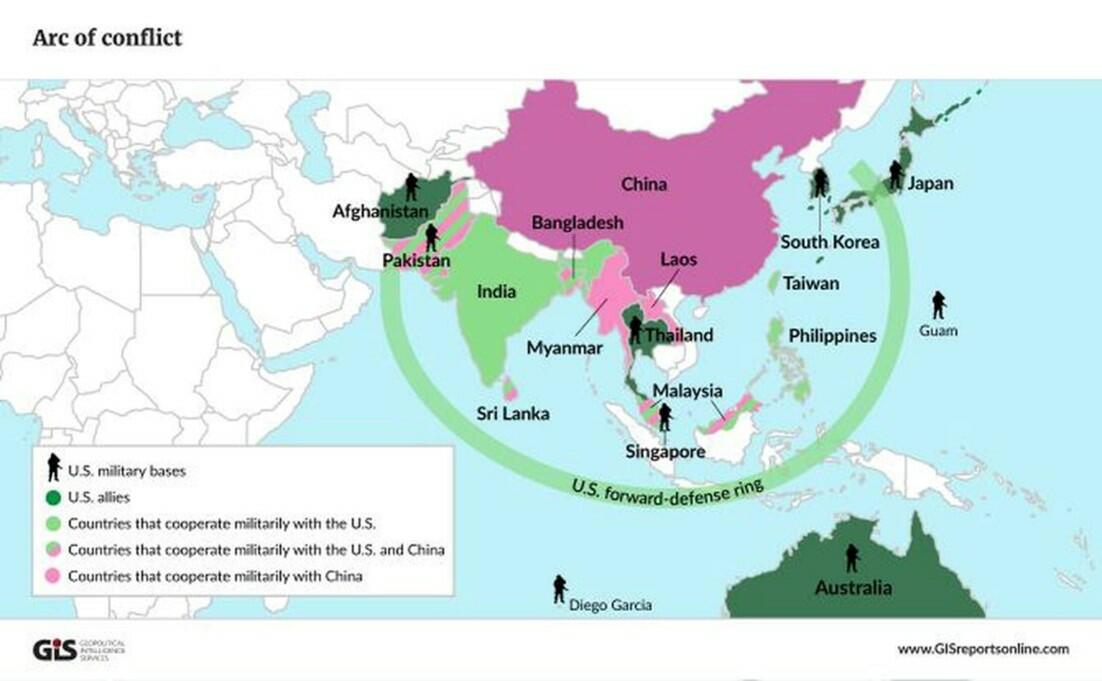
Additionally Taiwan will be invited to participate in the next U.S.-led Rim of the Pacific Military Exercise in 2024 and thus greater “Pacific NATO” strategy encircling mainland China. This exercise and broader Pacific NATO (aka Quad) anti-China arsenal of puppet colonies will be boosted by an additional $11.5 billion will be allocated to the Pacific Deterrence Initiative ‘to counter malign Chinese influence in the Pacific’.
Just as Ukraine has suffered U.S.-directed color revolutions in 2004 and 2014, so too has Taiwan been strung through a similar NED-funded ‘Sunflower Revolution’ regime change in 2014 which saw the Kuomintang Party taken out of power just as final stages of an economic integration agreement with mainland China were being finalized.
Billions have been tagged to purchase Lockheed Martin Corp’s (LMT.N) F-35 fighter jets and ships made by General Dynamics but beyond airforce, one of the biggest and most dangerous boosts in spending this year has been absorbed by a fixation on ‘space warfare’. $5.3 billion will be directed towards ‘space force’ and the ongoing effort to militarize space as a new dimension in war making in the 21st century (which was $333 million more than originally requested by military officials at space force’).
The recent U.S.-Canada-Australia joint ‘space warfare’ drills in order to prepare for an oncoming war over Europe took place at the start of December 2022 at the Schriever Space Force Base in Colorado- which [eliminates] the residues of any positive memory of ‘space diplomacy’ once seen under JFK’s leadership, the 1976 Apollo-Soyuz cooperation program or even the better aspects of President Trump’s Artemis Accord.
The 2000 RAD Origins of NDAA 2023’s Dark Age Doctrine
It would be a lie to say that this program for human extermination originated in 2022, or even under the previous presidencies of Trump or Obama.
If one wishes to grasp the germ seed of today’s policy doctrine, it would be necessary to revisit the Project for a New American Century Think Tank’s September 2000 Rebuilding America’s Defenses report where the end of history cultists then taking the helm of government stated:
“RAD” envisions a future in which the United States is in complete control of land, sea, air, space and cyberspace of planet Earth. It finds objectionable the limitations imposed by the ABM treaty and urges a newer rendition of Reagan’s ‘Star Wars’ defense shield program.
On top of calling for the USA’s exit from the ABM Treaty (which was promptly done in the wake of 911), the authors of RAD outline in clear detail the rationale behind the growth of the rise of a need for a new branch of the military known as space force. The authors stated that the USA must gain:
“CONTROL THE NEW ‘INTERNATIONAL COMMONS’ OF SPACE AND ‘CYBERSPACE,’ and pave the way for the creation of a new military service – U.S. Space Forces – with the mission of space control.”
Outlining the doctrine of ‘Full Spectrum Dominance’ the PNAC report outlined on page 51:
Global Missile Defenses — “A network against limited strikes, capable of protecting the United States, its allies and forward-deployed forces, must be constructed. This must be a layered system of land, sea, air and space-based components”.
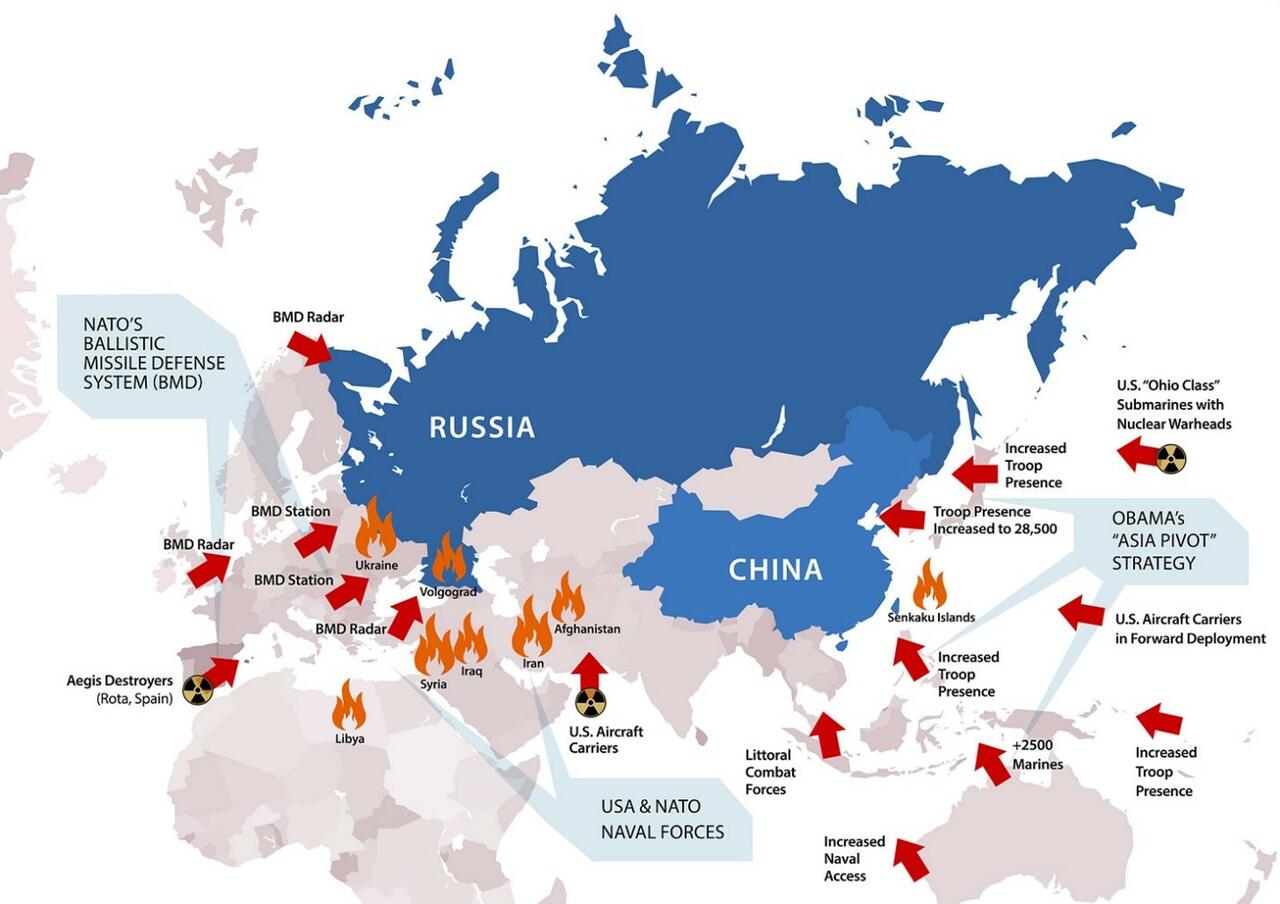
Looking towards the need to expand and modernize nuclear forces due to the possible danger of China, Russia, Iran, North Korea and Iraq, the RAD authors stated:
“Today’s strategic calculus encompasses more factors than just the balance of terror between the United States and Russia. U.S. nuclear force planning and related arms control policies must take account of a larger set of variables than in the past, including the growing number of small nuclear arsenals – from North Korea to Pakistan to, perhaps soon, Iran and Iraq – and a modernized and expanded Chinese nuclear force.”
Possibly one of the most dangerous and revealing aspects of RAD, was found on page 60, where the authors outline a program that soon grew into obscene proportions in the wake of the 2001 Anthrax attacks which justified the later passage of Cheney’s 2004 Bioshield Act as well as the growth of the 320+ international biolabs run by the pentagon. Describing the conversion of bioweapons from the realm of terror to “a politically useful tool”, the authors state:
“Although it may take several decades for the process of transformation to unfold, in time, the art of warfare on air, land, and sea will be vastly different than it is today, and ‘combat’ likely will take place in new dimensions: in space, ‘cyber-space,’ and perhaps the world of microbes… Space itself will become a theater of war, as nations gain access to space capabilities and come to rely on them; further, the distinction between military and commercial space systems – combatants and non-combatants – will become blurred. Information systems will become an important focus of attack, particularly for U.S. enemies seeking to short-circuit sophisticated American forces. And advanced forms of biological warfare that can target specific genotypes may transform biological warfare from the realm of terror to a politically useful tool”
Back to Ukraine
How will the $45 billion Ukraine money burning project be used? That’s not so easy to say exactly?
What we do know is that $22.9 billion will go towards what Kiev will be expected to use to buy more weapons from private U.S.-based defense contractors and much of the rest will be enjoyed by NGOs and Non Profits which will more often than not be run by figures closely tied to those same creatures in the Washington swamp who voted for these bills.
These uncomfortable facts were outlined repeatedly by the oft-slandered republican Senator Marjorie Taylor Greene whose multiple attempts to create some form of oversight and auditing of the handouts to Ukraine have been met with absurd levels of resistance since the special operation was launched in February. Even when such operations as the FTX crypto exchange (a major partner to Kiev and the World Economic Forum) was discovered to be simply a money laundering outfit infusing vast sums into the coffers of the DNC that were tied to Ukrainian operations, hardly a single western Mockingbird press outlet made a peep.
As the Pentagon Papers and Hunter Biden Laptop reminded us, not only has Ukraine been run by a coterie of money laundering grifting politicians enjoying endless skimming of foreign aid (Pandora Papers revealed that Zelensky and his billionaire handler Igor Kolomoskoi were both tied to offshore shell companies representing hundreds of millions of dollars of stolen loot), but also energy firms like Burisima which have been caught extracting revenue from the Ukrainian people the way silk worm farmers extract silk.
And what happens if you find yourself among that precious minority of republican or independent voices of resistance to this new plunge into world war? Just ask Representative Matt Gaetz who has been called out alongside other patriots such as Jim Jordan and Lauren Boebert for not applauding Zelensky’s pathetic speech in Congress this week. For the crime of keeping their hands from slapping in lock step with the rest of the congressional herd, NBC analysts like Michael Beschloss have attempted to stir up a McCarthyite witchhunt asking why these representatives refused to clap, asking:
“I’d like to know why that was for two reasons- Number one: You’re a public servant, we’re allowed to know those things. You’re supposed to tell us if you’re serving in Congress what the reason was. Do you love Putin, or are you just opposed to democracy, or is there something else?”
The fact that these figures even dared ask where graft was going probably touched a nerve too close to home with the Pentagon itself failing its fifth consecutive audit in November 2022 with over 65% of its assets and expenditures unaccounted for. That’s right, the government ‘lost track’ of $2 trillion in 2022.
Will enough Americans wake up to the reality that they have been walking on the wrong side of history for far too long or has the point of no-return already been crossed?
Featured Video

We Don’t Have to Live This Way
or go to
Aletho News Archives – Video-Images
From the Archives
9/11 Was an Israeli Job
How America was neoconned into World War IV
By Laurent Guyénot • Unz Review • September 10, 2018
… 9/11 was made possible by an alliance between secret worshippers of Israel and corrupted American elements. The question is: who, of the two, were the masterminds of this incredibly daring and complex operation, and for what “higher purpose”? … Read full article
Blog Roll
 Aletho News
- Araghchi: US acknowledgment of Bahrain damage exposes cost of Israel’s wars
- YAF secure Bab al-Mandab, advance toward Dhubab
- Ansar Allah’s Victory Is A U.S. Defeat
- Insider trading proves 9/11 foreknowledge
- Most Kids Can Fight Measles Naturally — and Having the Virus May Even Make Them Stronger
- We Don’t Have to Live This Way
- The Saudi cutout and the CIA shadow over 9/11
- US tanker strikes fail to deter Iran, drain interceptors: Bloomberg
- Yemeni Official Underlines Safety of Navigation after Expelling of Pro-Saudi Mercenaries from Coastal Areas
- Yemeni forces recapture strategic port city of Mokha from Saudi-backed troops
- If Americans Knew
- Secret systems used by Israel in mass killings of Gaza civilians revealed in new film
- Israel Bombs South Lebanon as Report Documents 23 White Phosphorus Attacks
- Nakba and Gaza: Zionism’s Century-Long History of Genocide
- ISRAELI MEDIA: ‘Baby, an Update: He’s Just Died’: Israeli Prison Guards’ Texts Expose a Routine of Abuse
- Three Major Revelations About The Gaza Holocaust In The Israeli Press
- Israel starved Gaza. Now doctors fear it has permanently damaged a generation.
- Swarming the battlefield: Elbit-FUSE reveals mass drone and robot armies as IDF plans new AI branch
- Out of Israel, stories of terror, thirst, takeover, torture, racism – Daily Update
- ISRAELI MEDIA: Revealed: Netanyahu Received an Explicit Warning Days Before Oct. 7. He Didn’t Brief Israel’s Security Chiefs
- “Israel is a wonderful, safe place,” according to this totally objective expert
- No Tricks Zone
- New Study: The Antarctic Ice Sheet Gained Mass From 2020-2024 Due To Staggering Snow And Ice Accumulation
- Study: Ocean Heating Rates From Thousands Of Years Ago ‘Dwarf’ Modern Ocean Heating Rates
- Climate Extremists Target, Attack Large-Scale Power Grid Infrastructure In Germany!
- New Study: Antarctic Ice Melt Has Contributed Less Than 1 Centimeter To Sea Level Rise In The Last 30 Years
- Fear Of Debate: Alarmist German Climate Scientist Calls On Mainstream Media To Discredit Skeptic Voices
- End-Of-August Arctic Sea Ice Extent Hasn’t Fallen In 20 Years, Official Data Show!
- News-Making Nepal Region Has Had As-Warm Or Warmer Periods Than The 2000s In The 1600s, 1700s, 1800s
- 2025 Study: ‘There Exists No Unequivocal Experimental Evidence For The CO2 Greenhouse Effect’
- 2026 Atlantic Cyclone Energy Index Running At 85% Below Normal!
- New Research Shows Soil Respiration And Temperature Drive CO2 Change, Not Humans
 Aletho News