Sarah Abed | August 7, 2019
In what would be Turkey’s third cross-border military operation in Syria since the war began, in as many years, Erdogan announced on Sunday that he would be launching a military operation east of the Euphrates river, to push back Kurdish militias on Turkey’s southern border.
Although Erdogan did not set a timeframe, preparations have been underway for well over a month. Increased deployment of Turkish military forces along with weaponry, and tanks, etc. have been reported by various sources, on the Turkish side of the southern border with Syria.
Preparations are also underway by Kurdish militias, to counter any possible Turkish aggression. Both sides have said that if the other attacks they will be ready to respond.
The same announcement, regarding a military operation east of the Euphrates, was made by Erdogan over nine months ago, but was then called off due to talks with US President Donald Trump who agreed to set up a safe zone on Turkey’s border to appease Erdogan. However, this never came into fruition, and a buffer zone was not created because of a difference of opinion on the depth. Erdogan now feels the US is stalling, and his latest threats seem to indicate that his patience is running thin.
Some believe that the chances of Erdogan carrying out his mission this time, are higher because he has notified Russia and the US, in advance of his plan.
However, if Turkey carries out this third operation, the outcome will most likely not be a swift defeat and take over by Turkish armed forces and their terrorist ally the Free Syrian Army (FSA) like we have seen in the past. The stakes are also much higher due to the presence of US troops, intelligence officers and US personnel stationed in northeastern Syria.
On Tuesday, U.S. Defense Secretary Mark Esper said that “the U.S. intends to prevent any unilateral invasion by Turkey into northern Syria, saying any such move by the Turks would be unacceptable.” Esper seemed hopeful that negotiations and talks would lead to some sort of agreement but did not disclose what that could be.
Some speculate that specific airstrikes targeting Kurdish militia installations are more likely to occur, than a unilateral land invasion. The demographics are such that all of the various ethnicities whether they be Syrian Muslims, Assyrians, Armenians, Kurds, Arameans, etc. would most likely bond together against any Turkish aggression.
The first cross-border Turkish operation Euphrates Shield in 2017, focused on targeting a “terror corridor” made up of Daesh and Kurdish fighters further east from Afrin along its southern frontier with Syria. After completing that operation, Turkey set up local systems of governance in the swath of land captured, stretching from the area around Azaz — located to the northeast of Afrin — to the Euphrates River and protected by Turkish forces present there.
The second, Operation Olive Branch, which began January 2018 and was completed in two months with Afrin being captured by the Turkish Armed Forces and their ally the Free Syrian Army. They quickly established control over Afrin and all of the villages that had remained under the control of Kurdish YPG (the People’s Protection Unit) north and northwest of the city. Many YPG fighters and their families fled to government-held parts of Aleppo.
In primarily the second operation, YPG fighters felt abandoned and betrayed by the US who stated that they would not get involved and seemingly allowed Turkey to carry out its operations without much objection. There was a noticeable silence from Russian and Syrian forces as well.
In order to understand Turkey’s contentions with the Kurdish militia’s it’s important to clarify the major players. The YPG is a Kurdish-majority militia that is the military wing of the Democratic Union Party (PYD), a Kurdish democratic confederalist political party in northeastern Syria. The YPG is the Syrian offshoot of the Kurdistan Workers Party (PKK), which is an organization based in Turkey and Iraq that has been engaged in armed conflicts with the Turkish state since 1984.
Turkey considers all these Kurdish organizations to be terrorists and has urged the United States for years to sever ties with them and has demanded a buffer zone. Both the United States and Turkey view the PKK as a terrorist organization.
The United States justified its military and economic support for the YPG by claiming they were the most reliable fighters in Syria against Daesh. Kurdish factions have been used throughout history to create chaos in the Middle East.
To disassociate the YPG from the PKK, General Raymond Thomas, the commander of the United States Special Operations Command (SOCOM), revealed — at a Security Forum on July 21, 2017 at the Aspen Institute — that he personally discussed the importance of changing its name with the YPG. As he states in this video, he was impressed that they included the word “democratic” in their rebranding: their new name, the Syrian Democratic Forces (SDF), would help them enter into political negotiations, where they had been excluded previously owing to their association with the PKK.
Recently tensions have been high between the United States and Turkey over the latter’s purchase of the S-400 missile defense system from Russia which the former disapproved of and then subsequently removed the latter from the F-35 fighter jet program. The United States has also threatened to impose sanctions if Turkey activates the S-400 system which Erdogan has stated they have every intention of doing by April 2020.
On Monday, an American military delegation met with Turkish officials in Ankara to continue negotiations and discuss an alternative Turkish military operation which wouldn’t threaten U.S. troops stationed in the area. The U.S. is urging Turkey not to carry out its proclaimed mission.
Sarah Abed is an independent journalist and analyst.
August 7, 2019
Posted by aletho |
Illegal Occupation, Militarism | Syria, Turkiye, United States |
Leave a comment

Justin Trudeau presents himself as “progressive” on foreign affairs. The Liberals claim to have brought Canada “back” after the disastrous Harper Conservatives. But their nuclear weapons policy demonstrates the emptiness of this rhetoric.
Reducing the chance nuclear weapons are used again should be a priority for any “progressive” government. But, powerful Canadian allies oppose nuclear arms controls so Trudeau’s government isn’t interested in the “international rules based order” needed to curb the existential threat nukes pose to humankind.
The Liberals have voted against UN nuclear disarmament efforts supported by most countries. At the behest of Washington, they voted against an important initiative designed to stigmatize and ultimately criminalize nuclear weapons. They refused to join 122 countries represented at the 2017 Conference to Negotiate a Legally Binding Instrument to Prohibit Nuclear Weapons, Leading Towards their Total Elimination.
Last month Swedish Foreign Minister Margot Wallström hosted a high-level meeting to reinvigorate nuclear disarmament commitments made by states party to the Nuclear Non-Proliferation Treaty (NPT). While most of the 16 countries were represented in Stockholm by their foreign ministers, Chrystia Freeland did not attend. Instead, the government dispatched Parliamentary Secretary for Consular Affairs Pamela Goldsmith-Jones.
Reducing or eliminating the threat of nuclear weapons isn’t mentioned in the Liberals 2017 defence policy statement (North Korean nukes receive one mention). Instead, Strong, Secure, Engaged: Canada’s Defence Policy makes two dozen references to Canada’s commitment (“unwavering”) to the North Atlantic Treaty Organization. Ghastly nuclear weapons are fundamental to NATO’s strategic planning. According to the official description, “nuclear weapons are a core component of the Alliance’s overall capabilities.”
Through NATO, Canada has effectively committed to fighting a nuclear war if any country breached its boundaries. Additionally, the alliance does not restrict its members from using nuclear weapons first. Canada participates in the NATO Nuclear Planning Group and contributes personnel and financial support to NATO’s Nuclear Policy Directorate.
While NATO maintains nuclear weapons in Turkey and various European countries, Canadian officials blame Russia for the arms control impasse and the recent demise of the Intermediate-Range Nuclear Forces (INF) Treaty, which banned an entire class of nuclear weapons. In April Director General of International Security Policy at Global Affairs Canada, Cindy Termorshuizen said, “we call on Russia to return to compliance with the INF Treaty.” But, it’s not clear Russia violated one of the most significant nuclear accords ever signed. The Trump administration, on the other hand, began to develop new ground-launched intermediate-range missiles prohibited under the pact long before it formally withdrew from the INF. US military planners want to deploy intermediate-range missiles against China, which is not party to the INF.
In December Canada voted against a UN General Assembly resolution for “Strengthening Russian-United States Compliance with Intermediate-Range Nuclear Forces Treaty.”
At that vote Canada’s representative said Moscow’s position on the INF reflects its “aggressive actions in neighbouring countries and beyond.” But, it is Washington that broke its word in expanding NATO into Eastern Europe, withdrew from the Anti-Ballistic Missile treaty in 2001 and established missile ‘defence’ systems near Russia. As part of NATO Canadian troops are stationed on Russia’s border in Latvia and Ukraine, which isn’t conducive to nuclear retrenchment.
A look elsewhere demonstrates the Liberals’ ambivalence to nuclear disarmament. They strengthened the Stephen Harper government’s agreement to export nuclear reactors to India, even though New Delhi has refused to sign the NPT (India developed atomic weapons with Canadian technology). The Trudeau government wouldn’t dare mention Israel’s 100+ nuclear bombs or endorse a nuclear free Middle East. While they’ve publicly stated their support for the Iran nuclear accord, they have not supported European efforts to save the Joint Comprehensive Plan of Action. (Or restarted diplomatic relations with Iran as promised.)
Despite some progressives claiming otherwise, Canada has never been an antinuclear country. In fact, if one were to rank the world’s 200 countries in order of their contribution to the nuclear arms race Canada would fall just behind the nine nuclear armed states. Among many examples of nuclear complicity, Canada spent tens of millions of dollars to help develop the first atomic bombs, CF-104 Starfighters stationed in Europe carried a nuclear weapon and various US nukes were stationed in Canada.
Still, governments from the 1970s through the 1990s expended some political capital on nuclear non-proliferation. While the follow-through was disappointing, Trudeau Père at least spoke about ”suffocating” the nuclear arms race.
His son, on the other hand, responded to a call to participate in a widely endorsed nuclear disarmament initiative by stating “there can be all sorts of people talking about nuclear disarmament, but if they do not actually have nuclear arms, it is sort of useless to have them around, talking.” Justin Trudeau also refused to congratulate Canadian campaigner Setsuko Thurlow, a survivor of the atomic bombing of Hiroshima, who accepted the 2017 Nobel Peace Prize on behalf of the International Campaign to Abolish Nuclear Weapons.
Justin Trudeau’s government does not even talk the talk, let alone walk the walk when it comes to ending the threat of nuclear annihilation.
As part of its 50th anniversary commemoration Black Rose Books – initially Our Generation Against Nuclear War – will host a conference on nuclear disarmament in Montréal on September 21, 2019.
August 6, 2019
Posted by aletho |
Militarism, Progressive Hypocrite, War Crimes | Canada, NATO |
Leave a comment

The “new trend in summertime fun” for Israeli schoolchildren is “military-themed summer camps and courses. (Photo: Twitter)
The “new trend in summertime fun” for Israeli schoolchildren is “military-themed summer camps and courses”, reported Israeli publication Calcalist on Friday.
In one center – “The Squadron” – a reservist brigadier general provides children with “briefing rooms” and flight simulators, where participants recreate the 1981 Israeli attack on an Iraqi nuclear reactor.
During week two, the children “have their first taste of air battles and air strikes”. One of the camp leaders told the paper:
“They are not here to pass the time, they are here to receive values.”
Another summer activity includes martial arts training – Krav Maga – for children as young as 12-years-old, with tasks named “preparation for operational fire” and “counterterrorism 101”.
A paintball company, meanwhile, offers daily activities based on the Israeli army’s “enlistment process and basic training”, moving children “through a military-style obstacle course and teaching them how to fire semi-automatic (paintball) weapons”.
One a recent day, Calcalist reported, “150 summer camp kids arrived here for Bootcamp training”. Older children “come for daily activities in a special set designed for urban warfare: densely-built houses burned vehicles, and sniper posts.”
Other centers offer courses in cyberwarfare for “tech-leaning kids”, with one child telling the reporter:
“I want to serve in Unit 8200 [the military unit which conducts surveillance of Palestinians in the occupied Palestinian territory].”
“I want to be a white hat, the one who stops the hackers with the black hats. White hats hack, say, for the Mossad, to find out things needed to protect the country, unlike black hats that are interested in criminal things like money or world domination,” he added.
According to Kobi Michael, a senior research fellow at Tel Aviv University’s Institute of National Security Studies (INSS), “these summer camps are an expression of the cultural militarism that characterizes Israeli society”.
August 5, 2019
Posted by aletho |
Ethnic Cleansing, Racism, Zionism, Militarism | Israel, Zionism |
Leave a comment
Tokyo has continually sought to widen the rift between Seoul and Pyongyang
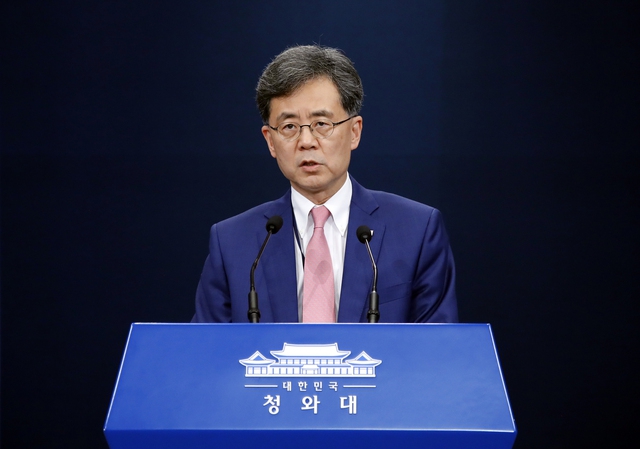
Kim Hyun-chong, second deputy director of the Blue House National Security Office, during a briefing at the Blue House on Aug. 2. (Yonhap News )
The Blue House recounted in detail how Japan has become an obstacle to setting the stage for peace on the Korean Peninsula and how it has rebuffed the US’ attempts to mediate in its dispute with South Korea. “Considering that our two countries have shared the values of liberal democracy and market economy for decades, Japan’s removal of South Korea from its white list on the pretext of security can be regarded as a public slap in the face,” said Kim Hyun-chong, second deputy director of the Blue House National Security Office.
“Rather than assisting South Korea in its efforts to get the peace process underway, Japan has thrown up roadblocks to that process. Japan opposed delaying the South Korea-US joint military exercises around the Pyeongchang Winter Olympics and maintained that sanctions and pressure were the only solution even while dialogue and cooperation with South Korea was underway. It also tried to raise tensions by calling for Japanese citizens residing in South Korea to rehearse a wartime evacuation,” Kim said during a briefing on the afternoon of Aug. 2.
It’s unusual for a figure at the Blue House to openly state that Japan presents an obstacle to the creation of peace on the Korean Peninsula. Such remarks indicate that Blue House officials are fuming over Japan’s removal of South Korea from its white list of countries who enjoy expedited export procedures. “We ought to give some serious thought to the meaning of the peace and prosperity of the ‘normal country’ that Japan seeks to become,” Kim added.
A senior official from the Blue House also went into the details of Japan’s rejection of the US’ attempted mediation. “On July 29, the US expressed its concerns [to us] about the ongoing dispute and suggested that we and Japan put a temporary freeze on the status quo while holding negotiations in an attempt to reach a diplomatic agreement. My understanding is that the same proposal was communicated to the Japanese on the same day. Based on the American proposal, therefore, we proposed high-level bilateral deliberations on the afternoon of July 30, but Japan rejected our proposal a few hours later,” the official said.
This official went on to speak of the need to seriously question the effectiveness of American mediation. “We need to carefully consider Japan’s rationale and motivations behind its removal of South Korea from the white list — are they economic, political, or both at the same time?”
“Given such considerations, we need to give some serious thought to the potential effectiveness of the US attempting to bring Japan around.”
In effect, this official said, South Korea still needs to figure out whether Prime Minister Shinzo Abe’s sudden export controls represent an attempt to contain South Korea’s growing economy, a request to give Japan a seat at the table in peace talks on the Korean Peninsula, or a call for a fundamental realignment of the cooperative relationship between South Korea, Japan, and the US that has been in place since South Korea and Japan settled their outstanding claims in 1965.
August 5, 2019
Posted by aletho |
Militarism | Japan, Korea |
Leave a comment
India defiantly responded to Trump’s mediation proposal by killing more Kashmiris and concocting yet another “politically convenient” conspiracy theory about so-called “Pakistani-backed terrorists” there in order to distract the world from its plan to unleash a wave of “Weapons of Mass Migration” that might forever change the demographic balance of this disputed territory to its long-term favor.
Modi’s Response To Trump
The situation in Indian-Occupied Kashmir (IOK) and along the Line of Control (LoC) is almost worse than it’s ever been before after New Delhi’s latest aggressive actions there that can be interpreted as an asymmetrical response to Trump’s recent mediation proposal. The US’ new military-strategic ally rejected the President’s earlier claims that Modi requested his assistance in mediating an end to the decades-long Kashmir Conflict, which coincided with increased shelling along the LoC that started during Pakistani Prime Minister Khan’s very successful visit to Washington last month and continues to this day. These provocations were shortly thereafter followed by the concocting of a “politically convenient” conspiracy theory about so-called “Pakistani-backed terrorists” there in order to distract the world from India’s egregious human rights abuses against the people of Kashmir and its illegal use of cluster bombs in targeting civilians on the Pakistani side of the LoC.
“Weapons Of Mass Migration”
While all of this might seem like a random flare-up of violence to the unaware observer, there’s actually a method behind the madness in that India is preparing to unleash a wave of “Weapons of Mass Migration” that might forever change the demographic balance of this disputed territory to its long-term favor. There were suspicions that the recent dispatch of over 20,000 more paramilitary forces to IOK wasn’t just to “protect Hindu pilgrims” like the Indian media alleged, but to reinforce the over half a million forces that are already there ahead of what turned out to be the repealing of constitutional clauses that guarantee a relative degree of “autonomy” for the region and prevented non-residents from purchasing property there. The implications of doing away with this special policy are enormous because they could lead to the large-scale influx of foreigners that would almost certainly provoke another wave of armed resistance from the desperate locals.
Machiavellian Perception Management
Anticipating this, India knew that it would inevitably have to dispatch more military forces to IOK, but it wanted to do so under the cover of a “publicly plausible” pretext in order to avoid international criticism, ergo the excuse of the latest reinforcement measures being due to what it claimed was the threat posed by “Pakistani-backed terrorists” to Hindu pilgrims. It then initiated a new round of shelling across the LoC, using cluster bombs in order to guarantee a response that it could then decontextualize and deceptively misportray as “Pakistani aggression”. This in turn led to New Delhi ordering non-Muslims to leave the region “in the interests of (their) safety and security” when the real reason that all of this is happening is so that they’re not caught up in the impending wave of violence that might soon be unleashed after the authorities revoked Kashmir’s “autonomous” status a little more than a week before India’s independence day later this month.
Exposing The Plot
This Machiavellian plot might very well backfire, though, because Pakistan is already preemptively exposing it in the international informational sphere and proving that there’s a reason why India can be regarded as a rogue state nowadays. Prime Minister Khan even tweeted about it too, thereby ensuring that the rest of the world pays more attention to Pakistan’s serious concerns about the deteriorating security situation along the LoC and the ever-worsening humanitarian one in IOK. In addition, India’s regional aggression is a personal affront to Trump’s peacemaking efforts, which might trigger him to double down on the game of “hardball” that he’s playing with it lately. The Democrats could also sense a self-interested political opportunity to put pressure on his administration by demanding that they cease further security cooperation with India until it stops its human rights violations in Kashmir, just as they’ve tried to do vis-a-vis Saudi Arabia and Yemen earlier this year.
Self-Inflicted Damage
Whichever way one looks at it, India’s recent aggression is counterproductive to its own interests. The country’s carefully crafted international image of supposedly being the peaceful land of Bollywood and yoga is shattered, and any revocation of Kashmir’s “autonomy” will return the region to being a global flash point, to say nothing of making it even more difficult for the military to indefinitely perpetuate its occupation in the face of heightened resistance from the locals. India had the chance to change history by admitting that it asked Trump to mediate in Kashmir and then taking his public disclosure of this secret as a signal to start that process, but it instead tried to make a fool out of him by pretending that no such request was ever made. Such strategic missteps as that one and the aforementioned risk isolating India even more in the international community and could even endanger its very existence in the event that they eventually lead to a hot war with Pakistan.
August 5, 2019
Posted by aletho |
Illegal Occupation, Militarism | Human rights, India, Kashmir, Pakistan |
Leave a comment
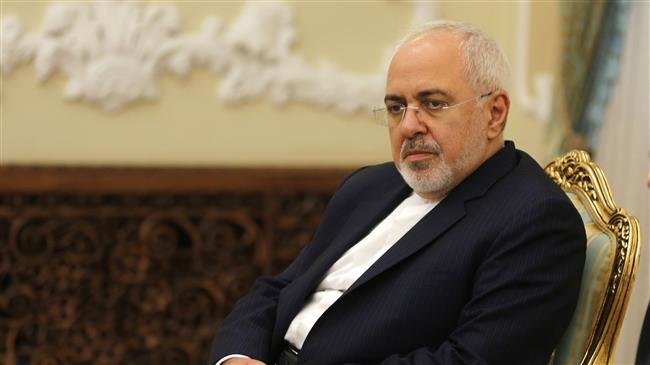
Iranian Foreign Minister Mohammad Javad Zarif said the United States is unable to build a naval coalition to escort tankers in the Gulf because its allies are too “ashamed” to join it.
In a press conference held on the occasion of the national journalists’ day, the top Iranian diplomat said that the B-team is shrinking in members, adding that Iran welcomes neighboring countries leaving the team of ‘wickedness’.
“Today the United States is alone in the world and cannot create a coalition. Countries that are its friends are too ashamed of being in a coalition with them,” Zarif told a news conference in Tehran.
“They brought this situation upon themselves, with lawbreaking, by creating tensions and crises.”
Talking further about US, Zarif said Washington “has never won,” noting that it has been forced out of Syria, Iraq, Afghanistan.
“US has lost all wars it had engaged in throughout 70 years except for its invasion of Grenada,” the top Iranian diplomat said, stressing: Era of the ‘greatest’ and ‘hegemonic’ power is over.”
Asked about reports that he had been invited to meet Trump in the White House, Zarif said he had turned it down despite the threat of sanctions against him.
“I was told in New York I would be sanctioned in two weeks unless I accepted that offer, which fortunately I did not,” said the Iranian minister.
“When I travel to New York I head for UN not the US,” he affirmed.
Zarif then talked about the B-team, a term popularized by Zarif and refers to a group of politicians who share an inclination toward potential war with Iran, and the letter “b” in their names. They include US National Security Adviser John Bolton, Israeli Prime Minister Benjamin Netanyahu, Saudi Crown Prince Mohammed bin Salman, and Abu Dhabi Crown Prince Mohammed bin Zayed Al Nahyan.
“The B-team is shrinking in members. We welcome our neighbors leaving the team,” Zarif said, adding “we have always been ready to hold talks with our neighbors. Iran, Iraq and the six countries of the Persian Gulf Cooperation Council need to have talks with one other and sign the non-aggression pact.”
August 5, 2019
Posted by aletho |
Militarism, Wars for Israel | Benjamin Netanyahu, Iran, United States |
Leave a comment
Australian Prime Minister Scott Morrison has announced that missiles belonging to the United States will not be deployed in Australia.
Morrison, who held talks with US officials over the weekend, said on Monday that Australia will not be hosting US intermediate-range missiles.
His comments came hours after US Defense Secretary Mark Esper and Secretary of State Mike Pompeo departed Sydney following US-Australia talks.
The talks ended with a joint statement in which the two sides agreed to create a stronger front against Chinese advancement in the Asia-Pacific region.
The US won’t “stand by idly” while China “attempts to reshape the region to its favor,” Esper was quoted by US media as saying.
However, in an interview on Saturday after pulling out of a landmark arms control treaty, the new Pentagon chief told reporters that he aimed to deploy ground-launched, intermediate-range missiles in the Asia-Pacific region in the coming months, raising serious concerns among the advocates of arms control.
China has described Beijing’s bilateral relationship with Australia as “unsatisfactory”.
After meeting his Australian counterpart last week, China’s top diplomat insisted that Beijing’s strained ties with Canberra needed to be ameliorated.
“During our diplomatic and strategic dialogue in Beijing last November, we agreed to calibrate and relaunch China-Australia relations, but the process of improving our ties has not been satisfactory,” said State Councilor, Wang Yi, after the Bangkok meeting which took place on the sidelines of a regional security forum.
Canberra claims the reason for severed ties was that Beijing had attempted to interfere in its internal affairs. Beijing rejects the claim, insisting it is does not, on principle, meddle in other countries’ domestic affairs.
August 5, 2019
Posted by aletho |
Militarism | Australia, United States |
Leave a comment
Rep. Tulsi Gabbard (D-HI), in a Thursday interview with host Chris Cuomo at CNN, reacted to criticism from fellow Democratic presidential candidate Sen Kamala Harris (D-CA), after the candidates’ dust-up in a debate the day before, by stating, “the only response that I have heard her and her campaign give is to push out smear attacks on me, claim that I am somehow some kind of foreign agent or a traitor to my country, the country that I love, the country that I put my life on the line to serve, the country that I still serve today as a soldier in the Army National Guard.”
This statement from Gabbard is nonsense. Soldiers serving in the National Guard and other parts of the United States military in military interventions as has Gabbard are not serving their country. They are serving the exertion of power by the US government. Indeed, Gabbard in the interview expresses her opposition to the sending of the US military members “to fight in these wasteful, counterproductive regime change wars.”
So, while Gabbard disparages a list of the US government’s military interventions overseas, she has nothing but praise for the carrying out of those wars by military members. In the interview she calls military members her “fellow brothers and sisters in uniform.” She set this tone clearly in her February speech announcing her campaign. Gabbard then proclaimed:
And our men and women in uniform, generation after generation, motivated by love for one another and for our country, have been willing to sacrifice everything for us. They don’t just raise their hand and volunteer to serve only to fight for one religion but not another, to fight for people of one race but not another, people of one political party but not another. No. When we raise our right hand and volunteer to serve, we set aside our own interests to serve our country, to fight for all Americans.
We serve as one, indivisible, united, unbreakable — united by this bond of love for each other and love for our country. It is this principle of service above self that is at the heart of every soldier, at the heart of every service member, and it is in this spirit that today I announce my candidacy for president of the United States of America.
What a load of hooey.
Gabbard had a special position for some of her time in the military including when she was deployed to Iraq during the Iraq War — being employed in a medical group. Ron Paul, another US House of Representatives member who ran for president years before, has explained a reason he chose to become a doctor was that he knew he could be drafted into the military and wanted to avoid being tasked with killing people. Medical workers in the military can even find themselves tasked with helping sick and injured civilians where the US is at war and even opposition fighters. Such actions, sometimes undertaken by military medical workers not supportive of the war, were well presented in the television series MASH that took place during the Korean War.
In calling herself a soldier to defend her patriotism bona fides and frequently referencing her “brothers and sisters in uniform,” Gabbard is obscuring any distinction between certain medical roles in the military she has had and the more common role of advancing killing and destruction.
There can be reason to praise the providing of medical serviced by US military members in conflicts overseas, especially when those services are readily provided to the victims of and opponents of the US government’s intervention in addition to the people implementing the intervention. But, where Gabbard crosses the line into nonsense is in heaping adulation on the people who operate the killing machine loosed abroad by the US government.
Some of the military people operating the killing machine are duped or ignorant, in need of education. Some want out but, unlike workers in most other occupations, are not allowed to quit their jobs. Others are far less sympathetic. But, contrary to Gabbard’s characterization, none of them are serving their country or putting their lives on the line for their country. They may be fighting for Boeing, Raytheon, a president’s quest for a legacy, an officer’s desire for a promotion, or a number of other purposes, but they are not fighting for their country. Their country, as Gabbard has pointed out in regard to some overseas military interventions, would be better off if they were never deployed.
August 4, 2019
Posted by aletho |
Militarism, Wars for Israel | United States |
Leave a comment
Imagine the spectacle. US Secretary of State Mike Pompeo sitting in Tehran and telling the Iranian people via a state media interview how “evil” their government is. No wonder tensions with Iran are reaching a flashpoint when Washington is so arrogant and delusional.
Last week, Pompeo told US media he was willing to go to Iran despite the Americans having no diplomatic relations with Tehran. Pompeo was not intending to suddenly meet with Iranian officials. Instead he wants a putative visit to Tehran to be an occasion to get on state media and address the Iranian people “directly”.
In response to a question about whether he was prepared to go to Tehran, the American top diplomat said: “Sure. If that’s the call, I’d happily go there… I would welcome the chance to speak directly to the Iranian people.”
“I’d like a chance to go [to Tehran], not do propaganda but speak the truth to the Iranian people about what it is their leadership has done and how it has harmed Iran,” he added.
That’s not diplomatic outreach. It is simply about seeking the chance to pontificate in Tehran. Despite claiming he would “not do propaganda”, the talking points that Pompeo would regurgitate on Iranian media would be the usual baseless slander that has become Washington’s standard depiction of Iran. A depiction that Pompeo as well as President Donald Trump have personally propagated.
Iran, according to Washington dogma, is an evil terrorist-sponsoring regime that ruthlessly represses its 80 million people, fueling conflict all over the Middle East, and secretly building nuclear weapons. Typically, the Americans never provide any evidence to substantiate their caricature of Iran. It’s merely a “truth” solidified by relentless repetition of hollow allegations. In short, propaganda.
And Pompeo wants to insult the intelligence of Iranians by being given a pulpit on Iranian state media.
By saying he wants to “speak directly” to the Iranian people, Pompeo is adverting to the real US agenda of fomenting regime change.
America’s official arrogance and hypocrisy are boundless. Every malign activity that Washington accuses Iran of can be thrown straight back at the US with manifold more accuracy of facts. The US has destroyed the Middle East with numerous criminal wars and covert regime-change operations, has sponsored terrorists as its proxies, and has fueled the danger of nuclear war by illegally arming Israel with hundreds of weapons of mass destruction.
President Trump has sinisterly alluded to potentially using WMD against Iran in recent weeks, threatening to deploy overwhelming force “to end the regime”.
Admittedly, the American president has at times said he is open to talks with the Iranian government. His “offer” is unconvincing of an intention for genuine dialogue. Trump expects Iran to come to the negotiating table in an act of surrender and self-debasement to accept his terms of “disarmament”. All the while using the threat of annihilation as a bargaining tool.
Moreover, Pompeo expressed his entitlement to lecture the Iranians and urge them to liberate themselves from a “theocratic tyranny” because, he said, the Iranian foreign minister Mohammad Javid Zarif is allowed “the freedoms of the United States to come here and spread malign propaganda”.
Pompeo was referring to an official visit to the US earlier this month by Zarif who was attending the United Nations in New York City for a diplomatic conference. All foreign diplomats have a sovereign right to attend the UN. Pompeo’s remarks indicate a presumption that the US government has dominion over the UN and international law.
The alleged “malign propaganda” that Pompeo accused Zarif of spreading was an interview he conducted with the NBC news channel at the Iranian ambassador’s residence. During that interview, Zarif did not unload on the litany of factually verifiable war crimes that the US is culpable of.
What Zarif said was a model of restraint and diplomacy. He said that if the US lifted crippling sanctions off Iran, then the “door is wide open” for future negotiations.
Calling for the avoidance of war, the Iranian diplomat pointed out that it was the United States, not Iran, that had undermined diplomacy by walking away from the 2015 nuclear agreement between Tehran and world powers, reported NBC.
“It is the United States that left the bargaining table. And they’re always welcome to return,” Zarif added.
What Pompeo calls “malign propaganda” many other people would view as an accurate, if restrained, telling by the Iranian diplomat of how it really is.
Given the unlawful aggression that the Trump administration is wielding against Iran in terms of economic warfare on the country’s vital oil trade and in terms of military force buildup in the Persian Gulf, including nuclear-capable B-52 bombers, what Iran is demonstrating is an immense discipline to maintain regional and world peace.
Iran’s conditions for possible negotiations are eminently reasonable. They include being respected as a sovereign nation and entering into dialogue as a mutual party where discussions can be held on the basis of facts and international law.
Pompeo’s supreme arrogance about America’s presumed exceptional entitlements and superiority are, unfortunately, a sign that Washington is incapable of being a normal state. The real “theocratic tyranny” is in Washington where it has the perverse belief that it has divine right to destroy other nations if they don’t grovel sufficiently at its feet. But those feet are made of the proverbial clay signifying a doomed power, as Iran’s dignity and defiance is revealing.
August 3, 2019
Posted by aletho |
Militarism | Iran, Sanctions against Iran, United States |
Leave a comment
Ever since Imran Khan became the 22nd Prime Minister of Pakistan in August 2018, the winds have changed. While his predecessors, though generally leaning eastwards, have often wavered between the US and the China orbit, Khan is in the process of clearly defining his alliances with the east, in particular China. This is for the good of his country, for the good of the Middle East, and eventually for the good of the world.
A few days ago, RT reported that China, in addition to the expansion of the new port in Gwadar, Balochistan, has entered into agreements with Pakistan to build a military/air base in Pakistan, a new Chinese city for some half a million people, as well as several road and railway improvement projects, including a highway connecting the cities of Karachi and Lahore, reconstruction of the Karakoram Highway, linking Hasan Abdal to the Chinese border, as well as upgrading the Karachi-Peshwar main railway to be completed by the end of 2019, for trains to travel up to 160km/hour.
This rehabilitation of dilapidated Pakistani transportation infrastructure is not only expected to contribute between 2% and 3% of Pakistan’s future GDP, but it offers also another outlet for Iranian gas/hydrocarbons, other than through the Strait of Hurmuz, for example, by rail to the new port of Gwadar which, by the way, is also a new Chinese naval base. From Gwadar Iranian hydrocarbon cargoes can be shipped everywhere, including to China, Africa and India. With the new China-built transportation infrastructure Iranian gas can also be shipped overland to China.
In fact, these infrastructure developments, plus several electric power production projects, still mostly fed by fossil fuel, to resolve Pakistani’s chronic energy shortage, are part of the Chinese Belt and Road Initiative (BRI), also called the New Silk Road. They are a central part of the new so-called China-Pakistan Economic Corridor (CPEC) which was first designed in 2015 during a visit by China’s President Xi Jinping, when some 51 Memorandums of Understanding (MoU) worth then some US$ 46 billion were signed. Pakistan is definitely out of the US orbit.
Today, in the CPEC implementation phase, the projects planned or under construction are estimated at over US$ 60 billion. An estimated 80% are direct investments with considerable Pakistani participation and 20% Chinese concessionary debt. Clearly, Pakistan has become a staunch ally of China and this to the detriment of the US role in the Middle East.
Washington’s wannabe hegemony over the Middle East is fading rapidly. See also Michel Chossudovsky’s detailed analysis “US Foreign Policy in Shambles: NATO and the Middle East. How Do You Wage War Without Allies?”
A few days ago, Germany refused Washington’s request to take part in a US-led maritime mission in the Strait of Hormuz, under the pretext to secure hydrocarbon shipments through this Iran-controlled narrow water way. In reality it is more like a new weaponizing of waterways, by controlling what ships do what to whom and applying “sanctions” by blocking or outright pirating of tankers destined for western ‘enemy’ territories.
Foreign Minister Heiko Maas announced last Wednesday in Warsaw, Poland, that there “cannot be a military solution” to the current crisis in the Persian Gulf and that Berlin will turn down Washington’s request to join the US, British and French operation “aimed at protecting sea traffic in the Strait of Hormuz, and combating so-called “Iranian aggression.”
This idea of the Washington war hawks was conceived after Iran’s totally legal seizure of the British-flagged Stena Impero oil tanker, after it rammed an Iranian fishing boat a couple of weeks ago. However, nothing is said about the totally illegal and US-ordered British piracy of the Iranian super tanker Grace I off the coast of Gibraltar in Spanish waters (another infraction of international law), weeks earlier. While Grace I’s crew in the meantime has been released, the tanker is still under British capture, but western media remain silent about it, but lambast Iran for seizing a British tanker in the Strait of Hormuz.
Germany remains committed to the 2015 Joint Comprehensive Plan of Action, JCPOA (the Iran nuclear deal), from which the United States unilaterally withdrew a year ago, and Germany will therefore not intervene on behalf of the US.
Add to this Turkey – a key NATO member both for her strategic location and NATO’s actual military might established in Turkey – moving ever closer to the east, and becoming a solid ally of Russia, after having ignored Washington’s warnings against Turkey’s purchasing of Russian S-400 cutting-edge air defense systems. For “sleeping with the enemy”; i.e., moving ever closer to Russia, the US has already punished Turkey’s economy by manipulating her currency to fall by about 40% since the beginning of 2018. Turkey is also a candidate to become a member of the Shanghai Cooperation Organization (SCO), and so is Iran.
Turkey has become a de facto lame duck as a NATO member and may soon officially exit NATO which would be a tremendous blow to the North Atlantic Alliance and may tempt other European NATO nations to do likewise. Probably not overnight, but the idea of an ever more defunct NATO is planted.
All indications are that the future, economically and security wise – is in the East. Even Europe may eventually ‘dare’ making the jump towards better relations with primarily Russia and Central Asia and eventually with China.
And that especially if and when Brexit happens, which is by no means a sure thing. However, just in case, the UK has already prepared bilateral trade relations with China, ready to be signed, if and when, the UK exits the EU.
Will the UK, another staunch US ally, jump ship? Unlikely. But dancing on two weddings simultaneously is a customary Anglo-Saxon game plan. The Brits must have learned it from their masters in Washington, who in turn took the lessons from the Brits as colonial power for centuries, across the Atlantic.
Western, US-led war on Iran is therefore unlikely. There is too much at stake, and especially, there are no longer any reliable allies in the region. Remember, allies — shall we call them puppets or peons — are normally doing the dirty work for Washington.
So, threatening, warning and annoying provocations by the US with some of its lasting western allies may continue for a while. It makes for good propaganda. After all, packing up and going home is not exactly Uncle Sam’s forte. The western alliance is no longer what it used to be. In fact, it is in shambles. And Iran knows it.
Peter Koenig is an economist and geopolitical analyst. He is also a former World Bank staff and worked extensively around the world in the fields of environment and water resources. He lectures at universities in the US, Europe and South America. He writes regularly for independent media. He is the author of Implosion – An Economic Thriller about War, Environmental Destruction and Corporate Greed – fiction based on facts and on 30 years of World Bank experience around the globe.
August 3, 2019
Posted by aletho |
Militarism | NATO, Pakistan, Sanctions against Iran, Turkiye |
Leave a comment
America, John Quincy Adams said in 1821, “goes not abroad, in search of monsters to destroy. She is the well-wisher to the freedom and independence of all. She is the champion and vindicator only of her own.” That’s as good a summary ever spoken of the non-interventionist position.
US Senator Lindsey Graham (R-SC) disagrees. He opposes President Trump’s quest for a peace agreement with the Taliban in Afghanistan as “reckless and dangerous,” entailing “severe risk to the homeland.”
Nearly 18 years into the US occupation of Afghanistan, at a cost of trillions of dollars, more than 4,000 Americans dead and more than 20,000 wounded, Graham and his fellow hawks clearly aren’t really looking for monsters to destroy. They want those monsters alive and at large, to justify both their own general misrule and the perpetual flow of American blood and treasure into foreign soil (read: into the bank accounts of US “defense” contractors).
The US invasion of Afghanistan was never militarily necessary. The Taliban offered to hand over Osama bin Laden upon presentation of evidence that he was the mastermind of the 9/11 attacks, an offer President George W. Bush arrogantly declined in favor of war.
The extended US occupation of, and “nation-building” project in, Afghanistan, was even less justifiable. Instead of relentlessly pursuing the supposed mission of apprehending bin Laden and liquidating al Qaeda, US forces focused on toppling the Taliban, installing a puppet regime, and setting themselves to the impossible task of turning Kabul into Kokomo.
It hasn’t worked. It’s not working now. It’s not going to start working. Ever. It should never have been attempted. Afghans don’t want Lindsey Graham running their affairs any more than you want him running yours. Can you blame them after as many as 360,000 Afghan civilian deaths?
Afghanistan is not and never has been a military threat to the United States, let alone the kind of existential threat that would justify 18 years of war. Yesterday isn’t soon enough to bring this fiasco to an end. But Graham and company would, given their way, drag it out forever.
They’re the kind of grifters H.L. Mencken had in mind when he noted that “[t]he whole aim of practical politics is to keep the populace alarmed (and hence clamorous to be led to safety) by menacing it with an endless series of hobgoblins, all of them imaginary.” But they’d rather keep old hobgoblins alive than have to manufacture new ones.
Thomas L. Knapp (Twitter: @thomaslknapp) is director and senior news analyst at the William Lloyd Garrison Center for Libertarian Advocacy Journalism (thegarrisoncenter.org)
August 2, 2019
Posted by aletho |
Illegal Occupation, Militarism | Afghanistan, United States |
Leave a comment
The Pentagon announced that the US intends to develop conventional ground-based missiles previously banned under the INF arms control treaty, on the very day it expired following Washington’s unilateral exit.
“Now that we have withdrawn, the Department of Defense will fully pursue the development of these ground-launched conventional missiles,” a Pentagon spokesman said in an emailed statement on Friday.
The US cited Russia’s alleged breach of the INF treaty as the pretext to withdraw from it in February, starting the six-month clock until the treaty officially ended on August 2.
According to the Pentagon, Russia was “producing and fielding an offensive capability that was prohibited” under the INF, thus endangering the US and its allies.
This accusation refers to the SSC-8, known in Russia as the 9M729, which Moscow says is perfectly compliant with the treaty and represents an upgrade of an older, also compliant, missile system.
Last month, the US mission to NATO tried to blame the demise of the INF on Russia, asserting once again that it was up to Moscow to save the treaty by destroying all the SSC-8 units.
The promotional video produced for the campaign, however, showed the perfectly legal Iskander-M missiles, instead of the 9M729.
Also on rt.com What’s INF & why does it matter?
US accusations about the 9M729 are based on media reports and unprovable intelligence community assessments of different cruise missiles – the air-launched Kh-101 and sea-launched Kalibr, neither of which were banned under the INF.
Months prior to Washington’s announcement it was exiting the INF, President Donald Trump’s national security adviser John Bolton visited Moscow and called the treaty a relic of the Cold War, ill-suited for the “new strategic reality” that included China, Iran and North Korea.
“The only reason for this to happen was that the US decided to untie itself from an arms control treaty that kept capabilities of the US in this area at zero-level for decades,” Russia’s Deputy Foreign Minister Sergey Ryabkov told RT.
He pointed out that Russia has demonstrated its ability to find “cost-effective answers” to any military challenges it faces, so if Washington intends to trigger a new arms race the effort is bound to backfire.
“No one will gain” from the collapse of the INF, Ryabkov said. “Everyone’s security will be in jeopardy.”
August 2, 2019
Posted by aletho |
Militarism | United States |
Leave a comment