US military to expand Europe presence over Russia
Press TV – November 9, 2015
US military officials have proposed plans to expand the American presence in Europe in a bid to counter Russia in the event of a crisis, a new report says.
Addressing the Reagan National Defense Forum over the weekend, senior US military leaders said the Pentagon needs to send more forces to Europe on a rotating basis, allowing the presence of multiple US brigades in the continent at any given time, the Wall Street Journal reported Sunday.
General Philip Breedlove, the supreme allied commander of the North Atlantic Treaty Organization (NATO), said he wants more forces committed to Europe in a rotational manner. He said the final decisions on the proposal will be made “in the next couple of months.”
It was also declared in the forum that the US is stepping up its military drills in various European countries, preparing to counter potential Russian interference with troop transfers, should a war break out between the two sides.
General Mark Milley, the chief of staff of the US Army, said the Army is adapting its training to make sure that the US military is able to face threats posed by Russian forces.
The American troops are preparing to counter hybrid war, a blend of regular and irregular forces with propaganda and unconventional tactics to spark confusion, Milley noted.
The defense leaders slammed Russian President Vladimir Putin’s “military aggression and threats” and warned that Washington must not allow Moscow to cooperate with the West in Syria.
They said Putin’s military support for Syrian President Bashar al-Assad against Daesh Takfiri terrorists is in fact a distraction designed to take away attention from the conflict in Ukraine.
Breedlove warned that cooperating with Russia on Syria means the West has accepted Moscow’s annexation of Crimea and support for pro-Russia forces in Ukraine’s Donbas region.
Ties between Moscow and Washington hit a new low after US-backed forces ousted Ukraine’s former president Viktor Yanukovych in February 2014.
US Defense Secretary Ashton Carter issued a warning against what he called the Russian “aggression” at the same forum, saying Saturday that Moscow seems “intent to play spoiler” by “throwing gasoline” on the fire of Syria. He then went on to criticize Russia’s “nuclear saber-rattling.”
Carter said NATO is in need of a “new playbook” to deter Russia.
The US has vowed to develop military training bases in six countries on or near Russian borders, including Latvia, Estonia and Lithuania, as well as Poland, Bulgaria and Romania.
It was announced last week that the US is poised to deploy 4,000 more troops in its European military bases.
The American military is pushing to include the new plan’s necessary funding in a budget request which will be sent to the US Capitol Hill early next year.
Russian officials say there is little difference between rotational forces and a permanent military buildup. They also say that the US and NATO are the true aggressors in Europe.
Henoko Takes on U.S. Imperialism
By Maya Evans | Dissident Voice | November 7, 2015
OKINAWA, JAPAN — Around one hundred and fifty Japanese protesters gathered to stop construction trucks from entering the U.S. base Camp Schwab, after the Ministry of Land over-ruled the local Governors’ decision to revoke permission for construction plans, criticizing the “mainland-centric” Japanese Government of compromising the environmental, health and safety interests of the Islanders.
Riot police poured out of buses at six a.m., out-numbering protesters four to one, with road sitters systematically picked off in less than an hour to make way for construction vehicles.
All the mayors and government representatives of Okinawa have objected to the construction of the new coastal base, which will landfill one hundred and sixty acres of Oura Bay, for a two hundred and five hectare construction plan which will be part of a military runway.
Marine biologists describe Oura Bay as a critical habitat for the endangered dugong (a species of manatee), which feeds in the area, as well as sea turtles and unique large coral communities.
The bay is particularly special for its extreme rich ecosystem which has developed due to six inland rivers converging into the bay, making the sea levels deep, and ideal from various types of porites coral and dependent creatures.
Camp Schwab is just one of 32 U.S. bases which occupy 17% of the Island, using various areas for military exercises from jungle training to Osprey helicopter training exercises. There are on average 50 Osprey take off and landings every day, many next to housing and built up residential areas, causing disruption to everyday life with extreme noise levels, heat and diesel smell from the engines.
Two days ago there were six arrests outside the base, as well as ‘Kayactivists’ in the sea trying to disrupt the construction. A formidable line of tethered red buoys mark out the area consigned for construction, running from the land to a group of offshore rocks, Nagashima and Hirashima, described by local shamans as the place where dragons (the source of wisdom) originated.
Protesters also have a number of speed boats which take to the waters around the cordoned area; the response of the coast guard is to use the tactic of trying to board these boats after ramming them off course.
 The overwhelming feeling of the local people is that the Government on the mainland is willing to sacrifice the wishes of Okinawans in order to pursue its military defense measures against China. Bound by Article 9, Japan has not had an army since world war two, though moves by the Government suggest a desire to scrap the Article and embark on a ‘special relationship’ with the U.S., who is already securing control of the area with over 200 bases, and thus tightening the Asia pivot with control over land and sea trade routes, particularly those routes used by China.
Meanwhile, Japan is footing 75% of the bill for accommodating the U.S., with each soldier costing the Japanese Government 200 million yen per year, that’s $4.4 billion a year for the 53,082 U.S. soldiers currently in Japan, with around half (26,460) based in Okinawa. The new base at Henoko is also expected to cost the Japanese Government a tidy sum with the current price tag calculated to be at least 5 trillion yen.
Okinawa suffered devastating losses during the Second World War, with a quarter of the population killed within the 3-month-long Battle of Okinawa which claimed 200,000 lives in total. Hilltops are said to have changed shape due to the sheer bombardment of ammunition.
Local activist Hiroshi Ashitomi has been protesting at Camp Schwab since the expansion was announced 11 years ago, he said: “We want an island of peace and the ability to make our own decisions, if this doesn’t happen then maybe we might need to start talking about independence.”
Maya Evans coordinates Voices for Creative Nonviolence UK.
Failed Syrian rebel training program cost US taxpayers $2 million per fighter – report
RT | November 6, 2015
Newly acquired documents show the Pentagon spent nearly $400 million, or $2 million per fighter, on its failed train-and-equip program, according to USA Today. The Pentagon claims the actual cost was $30,000 per trainee.
USA Today reported the train-and-equip program was abandoned after the department had already spent $384 million on it. “Of the 180 Syrians vetted, trained and equipped, 145 fighters [remained] in the program,” the report stated. Of those 145 fighters, 95 were in Syria.
When asked to comment on the findings, the Pentagon disputed that it had spent $2 million per fighter, saying the actual cost was far lower – $30,000 per trainee. They added that the “vast majority” of the funds had gone to buying weapons, equipment, and ammunition, of which some is still in storage.
“Our investment in the Syria train and equip program should not be viewed purely in fiscal terms,” Navy Commander Elissa Smith told the news outlet in an email. Smith said some of those trained fighters had been calling in air strikes, and that ammunition designated for trainees had been given to other forces fighting the Islamic State instead.
According to the documents outlining the program’s $501 billion budget, $204 million was supposed to be spent on ammunition, $77 million on weapons, $62 million on mobility, $47 million on services, $46 million on construction, $40 million on strategic lift/shipping, $13 million on equipment, $6 million on communications, and $6 million on facilities and maintenance.
The program was intended to graduate 3,000 trained and equipped New Syrian Forces fighters in 2015, and 5,000 annually afterwards, to combat Islamic State (IS, formerly ISIS/ISIL). However, President Barack Obama abandoned the program earlier this fall.
In documents and interviews, USA Today was able to confirm that two of the four training camps designed for the program never hosted even a single recruit.
In September, it was revealed that one group of trainees had surrendered one quarter of their US-supplied weapons, ammunition, and vehicles in exchange for safe passage through territory held by another rebel group, considered to be extremist.
While the training has stopped, the US will continue to give equipment and weapons to the leaders of ‘vetted’ groups of rebels who are already fighting IS “so that over time they continue to re-claim territory,” Smith told USA Today.
The rebel training program’s $500 million budget was in addition to the $42 million the Pentagon had already spent in 2014 to set it up.
The findings come as the Obama administration announced it was set to deploy up to 50 US special operations troops in northern Syria to assist in the fight against IS. It marked the first time the administration openly said it would send ground forces into Syria.
The Associated Press reported the White House has put no timetable on how long the American forces will stay in Syria, although Obama has previously said he expects the campaign against IS to last beyond his presidency.
Obama inherited two military conflicts and will hand off a third to his successor. He recently announced plans to maintain a troop presence in Afghanistan beyond 2015.
In July, the National Priorities Project, a non-profit, non-partisan federal budget research group, reported that America’s war in Afghanistan has cost taxpayers roughly $4 million an hour. Their research found more than $700 billion has been spent on the war since the George W. Bush administration authorized the invasion in 2001, including more than $35 billion in fiscal year 2015.
The initial budget for the Afghan war was over $20 billion for 2001/02. The budget dropped to $14 billion over the next two years as spending shifted to the war in Iraq. Expenditures on the Afghan war took a back seat to Iraq war spending before ballooning to more than $100 billion in 2010, when the cost of the Iraq war began to decline. Spending in Afghanistan continued to top $100 billion annually until 2013, when it began falling by increments of $10 billion, finally reaching its current budget of $35 billion.
Who Will Blink in Syria? Russia? Or the US?
By Paul Larudee | Dissident Voice | November 5, 2015
The first to die will be US troops. Russians will be made to appear as the killers, but the agents will probably be ISIS, Al-Qaeda (aka al-Nusra), Turks, or the Americans themselves. I’m not ruling out that the Russians might actually do the job, especially if the Americans order their 50 soldiers to the most likely Russian bombing targets and then dare the Russians to hit them. But most likely, the US will do the job itself and not take a chance that the Russians might miss.
Those dead American soldiers are needed as bargaining chips so as to up the ante. Next, Russians have to die, with or without a mutual secret agreement to that effect.
The strategy is based upon the assumption that if the stakes become high enough, the other side will back down. It is called brinkmanship, and its best known example was the 1962 Cuban missile crisis. One or both sides may believe that they are bluffing, but if their bluff is called are they really going to back down? Or are they going to up the ante so much that they end up in a real war, where they are required to respond to the other’s actions with ever-escalating effect?
I do not think the Russians will blink. They have had enough of American encroachment. They will not stand for further NATO poaching of their erstwhile Warsaw Pact allies, and certainly not in Ukraine, which is to Russia roughly as Canada is to the US. Similarly, the port of Tartus in Syria is Russia’s only Mediterranean naval base, and Syria is currently its only ally in the Arab world. Russia has much more at stake than the US, and is therefore much less likely to back down. In fact, Russia has clearly made a major commitment to the preservation of Syria, and waited a long time before doing so, which is another sign that they will not shrink soon from their decision to stay the course.
On the American side, the stakes are much less well defined. Syria is part of the post-USSR assertion of US global dominance, as advocated mainly by the neoconservative strategic movement, closely allied with Israeli and Zionist interests, which benefits from the Israel Lobby clout in the US. From its base in the Congress and the National Security Agency, this movement has made inroads into the intelligence services, the State Department and the Department of Defense, mainly at the top echelons. (Elected and appointed positions are the most vulnerable to lobbyist penetration.)
Following the dissolution of the Soviet Union, the neocons argued that the US should use its military might to mold the world into US-controlled fiefdoms. Plans for such domination have been variously described in the “Clean Break” proposal, the “Project for a New American Century”, and the “New Middle East”. They begin with the destruction (aka “regime change”) of seven Middle Eastern countries, of which Iraq and Libya are considered successfully catastrophic outcomes, and a model for what is to be done to Syria.
Part of the purpose is to remove “bad examples” of nations that refuse to open their economies to U.S. exploitation and to accept US direction of their foreign policy, regardless of their own national interests. Iran and Syria are current examples of such countries, as were Libya and Iraq prior to their destruction. If these objectives happen to coincide with the Israeli policy of destroying the countries in its neighborhood, we may be forgiven for thinking that this is not mere coincidence.
Also on the American side, the stakes are ruled to a greater extent by domestic politics. Having championed the cause of regime change in Syria, Barack Obama and Hillary Clinton are loathe to appear weak or indecisive, and thus vulnerable to Republican criticism. In any case, they rely heavily on the Israel Lobby, which appears willing to sacrifice America’s fortune and youth on the altar of Israeli interests.
Despite these considerations, the American motives are not as strong as those of Russia. The problem is, neither is American leadership. There is a clear way out of this confrontation, with a face-saving agreement, if only the US will allow it to happen. It is for Russia and the US to cooperate in eliminating ISIS, al-Qaeda and their allies, cutting off US support for these terrorist organizations, forcing US allies Turkey, Saudi Arabia, Qatar, and others to do the same, and jointly convening a peace conference that brings indigenous Syrian groups together to negotiate an agreement that allows all sides to claim victory (even if it is something of a charade, as are most such agreements).
Brinkmanship is unnecessary. It is dangerous, and it is not a solution. Vladimir Putin is ready to achieve a negotiated outcome that protects Russia’s interests and ends US encroachment. Assad has never been an enemy of the US, and he is the current choice of the vast majority of the Syrian people, whether enthusiastically or reluctantly (as in most countries). The United States will be able to claim victory over its terrorist enemies as well as a compromise over the form of government in Syria, and a new positive working relationship with Russia. The Israelis will be upset that we have not done enough killing for them, but they will get over it, in the same way that they are reluctantly learning to live with the US-Iran settlement on nuclear development.
It shouldn’t be a question of who blinks first, but of having the option to continue blinking at all.
Paul Larudee is one of the founders of the Free Gaza and Free Palestine Movements and an organizer in the International Solidarity Movement.
Americans oppose Obama’s plans for fighting ISIL: Poll
Press TV – November 5, 2015
Most Americans disapprove of US President Barack Obama’s approach in fighting the Daesh (ISIL) terrorist group, a new poll has found.
More than 6 in 10 people in the US reject Obama’s handling of the threat posed by the ISIL in Syria and Iraq, an Associated Press-GfK poll released on Thursday finds.
Support for his approach has dropped since Washington formed a military coalition against ISIL in late 2014. Last year, Americans were approximately even, but disapproval has risen 8 percent since January.
This is while two-thirds of the people surveyed in the poll described the threat posed by Daesh as a “very or extremely important issue.”
The poll also found that only 40 percent of Americans still approve of the president’s management of foreign policy.
Obama announced last week that 50 US special operations troops will head to northern Syria, marking the first time the US is openly sending forces into that war-torn country.
‘Afghanistan, a historic failure’
Concerns about Obama’s strategy overseas become more apparent when it comes to Afghanistan, where he has dropped his plan to pull US forces by the end of 2016. The new plan means that when he leaves office, the US will have at least 5,500 troops in Afghanistan.
The poll found that 71 percent of Americans believe history will judge the Afghanistan war as more of a failure than a success.
Roughly a third of Americans said they approve of Obama’s revamped plan in the country, while one-third opposed it.
‘No armed combatants, no fighting’: MSF issues Afghan hospital bombing report
RT | November 5, 2015
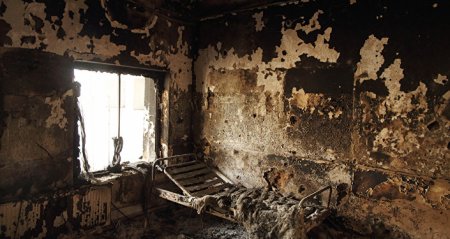
A Médecins Sans Frontières investigation into the Afghan hospital bombing by US forces has found that there were no armed combatants or weapons within the compound, and no fighting in the direct vicinity of the hospital at the time of the airstrikes.
In its report released on Thursday, Médecins Sans Frontières (MSF/Doctors Without Borders) addressed the “relentless and brutal aerial attack by US forces” which took place in Kunduz on October 3 and killed at least 30 people, including MSF staff.
“The MSF rules in the hospital were implemented and respected, including the ‘no weapon’ policy and MSF was in full control of the hospital at the time of the airstrikes,” the organization stated.
The document also said there were “no armed combatants within the hospital compound and there was no fighting from or in the direct vicinity” of the trauma center at the time of the strikes.
The hospital was “fully functioning” at the time of the airstrikes, with 105 patients admitted and surgeries taking place, according to the findings of the investigation.
In addition, MSF said the “agreement to respect the neutrality of our medical facility based on the applicable sections of International Humanitarian Law was fully in place and agreed with all parties to the conflict prior to the attack.”
Despite that neutrality, the hospital was still the target of a US airstrike, leading MSF to ask how such an attack was allowed to happen.
“The question remains as to whether our hospital lost its protected status in the eyes of the military forces engaged in this attack – and if so, why,” MSF said in its statement.
Presenting the report, MSF general director Christopher Stokes said: “From what we are seeing now, this action is illegal in the laws of war. There are still many unanswered questions, including who took the final decision, who gave the targeting instructions for the hospital.”
The MSF statement described the tragic situation at the hospital.
“Patients burned in their beds, medical staff were decapitated and lost limbs, and others were shot by the circling AC-130 gunship while fleeing the burning building. At least 30 MSF staff and patients were killed,” it states.
MSF says its demand is simple: “A functioning hospital caring for patients, such as the one in Kunduz, cannot simply lose its protection and be attacked; wounded combatants are patients and must be free from attack and treated without discrimination; medical staff should never be punished or attacked for providing treatment to wounded combatants.”
Following the aerial attack, the Pentagon initially attempted to shift responsibility onto Afghan security forces, claiming they had requested the airstrikes.
However, the commander of the US and NATO forces in Afghanistan, Gen. John Campbell, later admitted the attack was a “US decision made within the US chain of command.” He went on to say that Washington would “never intentionally target a protected medical facility.”
Read more:
US tank enters MSF hospital in Afghanistan’s Kunduz, ‘destroys potential evidence’ – reports
Israel seeks 60 percent increase in US military aid: US officials
Press TV – November 5, 2015
Israel is seeking a large increase in annual military assistance from the United States and has held preliminary talks with the Obama administration on a 10-year financial package that would provide up to $50 billion, American congressional sources say.
During unofficial talks in recent weeks, Israel has asked the US to increase its annual military assistance by 60 percent to an average of $5 billion a year over the 2018-2028 period, the congressional aides said on Wednesday, according to Reuters.
Under the existing agreement that was signed in 2007 and expires in 2017, annual military aid to Israel grew to about $3 billion a year. That deal was negotiated during the George W. Bush administration.
Israel says that it wants more money to counter threats that will arise as a result of the recent Iran nuclear agreement, which the Zionist regime has fiercely opposed.
US officials said that negotiations on the new aid package deal were still in the early stages and the proposal has not yet been formally presented to Congress, which must approve the funding.
“First they have to negotiate with the White House,” one senior congressional aide said of the Israeli regime.
Israeli Prime Minister Benjamin Netanyahu will visit Washington next week and hold talks with President Barack Obama on the aid package. Netanyahu and Obama are expected to reach an agreement on the aid deal’s broad outlines.
President Barack Obama and Prime Minister Benjamin Netanyahu of Israel hold a bilateral meeting in the Oval Office, Sept. 30, 2013.
Obama had reportedly agreed in principle with Netanyahu in a previous meeting to increase the aid package to between $4.2 billion and $4.5 billion.
The money is separate from the nearly $500 million in annual US funding for Israel’s missile system programs in recent years. It is also on top of the US warfighting material held in Israel, which is valued at $1.2 billion.
US annual aid to Israel has held steady despite cuts to a wide range of domestic and military programs in the United States, including reducing the size of the US Army to its lowest level since before World War Two.
The US government is pressured to serve Israel’s interests due to the influence of the powerful Zionist lobby in the United States. The pro-Israel pressure groups actively work to steer US foreign policy in favor of Israel.
Israel orders aircraft carrier as part of US military aid package
MEMO | November 4, 2015
Israel has provided the United States with a list of weapons that it would like to have available as part of the US aid package, Israel’s Yedioth Ahronoth revealed yesterday.
According to the newspaper the list included a modern aircraft carrier and a squadron of F-15 aircrafts as well as material assistance to support Israel’s anti-ballistic missile system, Arrow 3.
According to the newspaper Israeli officials have asked for these weapons during closed-door meetings with US officials attended by Defence Minister Moshe Ya’alon and US Secretary of Defence Ashton Carter in Washington.
The list of arms exceeded the maximum assistance provided by the United States each year, amounting to nearly $3 billion, therefore it has been referred to US President Barack Obama before Israeli Prime Minister Benjamin Netanyahu’s visit to the White House scheduled for next week, the paper reported.
America’s Non-representative War Government
By Sheldon Richman | Free Association | November 3, 2015
“The success of government…,” the late historian Edmund Morgan wrote, “requires the acceptance of fictions, requires the willing suspension of disbelief, requires us to believe that the emperor is clothed even though we can see that he is not.”
Representation is chief among those fictions.
“Just as the exaltation of the king could be a means of controlling him,” Morgan continued, “so the exaltation of the people can be a means of controlling them…. If the representative consented, his constituents had to make believe that they had done so.”
Questioning the authenticity of representative government may seem beyond the pale in America. But occasionally the veil slips, and we glimpse reality. If we really live under a representative government, how can a president take the country to war without even a show vote in Congress, much less a referendum? (The proposed Ludlow Amendment to the Constitution would have required a referendum on war.)
Barack Obama has announced he is sending special operations forces into Syria to help those fighting both the government of Bashar al-Assad and the Islamic State, just as last year he ordered airstrikes in Syria. He previously said he would not send ground forces, but you can forget about that now. After a Delta Force soldier was killed there while on a raid last month, Secretary of War Ash Carter acknowledged that Americans will be at risk. Deputy national security adviser Ben Rhodes said, “The norm is not going out in raids. I’m obviously not going to rule anything out.”
Note well: the U.S. Congress has not declared war on Syria (nor should it), so Obama’s moves are unconstitutional and illegal. Last year Obama asked Congress for an “authorization for the use of military force” (AUMF) — it went nowhere and is going nowhere — while insisting he did not need it. The administration (echoing George W. Bush) says any president has the inherent power under the Constitution to do what he’s doing in Syria. The administration first suggested the AUMFs of 2001 and 2002 were sufficient, but that claim was demolished. The 2001 AUMF said Bush could attack al-Qaeda and its associates. Neither Assad nor the Islamic State qualifies: al-Qaeda’s Syrian franchise, al-Nusra Front, is also trying to overthrow Assad, and the Islamic State emerged from a split in al-Qaeda. The 2002 AUMF was aimed at Iraqi president Saddam Hussein — it could hardly apply to Syria.
More fundamentally, an AUMF is not a declaration of war; it’s a blank-check, unconstitutional delegation of power from Congress to a president. Consider the 2002 AUMF. As I wrote back then:
The resolution would authorize Mr. Bush to “use the Armed Forces of the United States as he determines to be necessary and appropriate in order to 1) defend the national security interests of the United States against the continuing threat posed by Iraq and 2) to enforce all relevant United Nations Security Council resolutions regarding Iraq.” The key phrase is “as he determines to be necessary and appropriate.” It would be consistent with the resolution for Mr. Bush to decide that it was neither necessary nor appropriate to use force against Iraq at all.
In other words, the Congress is not declaring that a state of war exists between Iraq and the United States. On the contrary, the President will decide when and if a state of war exists. The resolution requires only that he “certify” that diplomatic efforts have failed before he uses force. Indeed, House Minority Leader Richard Gephardt confirmed that Congress will not be declaring war when he said, “we should deal with it [the Iraqi problem] diplomatically if we can, militarily if we must. And I think this resolution does that.”
Orwellian war-denial is nothing new for the Obama administration. Obama refused to call the 2011 regime-changing air campaign in Libya a war; thus he dismissed the War Powers Resolution as irrelevant. (That 1973 measure was Congress’s feeble attempt to rein in de facto presidential power to make war and rectify the constitutional usurpation that began with Harry Truman’s “police action” in Korea in 1950.)
Going to war is the most consequential step a government can take. If the people have nothing to say about war ex ante, the government can hardly be described as representative.
War in Syria? Where Is Speaker Ryan?
By Pat Buchanan • Unz Review • November 3, 2015
“The United States is being sucked into a new Middle East war,” says The New York Times. And the Times has it exactly right.
Despite repeated pledges not to put “boots on the ground” in Syria, President Obama is inserting 50 U.S. special ops troops into that country, with more to follow.
U.S. A-10 “warthog” attack planes have been moved into Incirlik Air Base in Turkey, close to Syria.
Hillary Clinton, who has called for arming Syrian rebels to bring down Bashar Assad, is urging Obama to establish a no-fly zone inside Syria.
Citing Clinton and Gen. David Petraeus, John McCain is calling for a no-fly zone and a safe zone in Syria, to be policed by U.S. air power.
“How many men, women and children,” McCain asks, “are we willing to watch being slaughtered by the Russians and Bashar al-Assad?”
Yet, if we put U.S. forces onto sovereign Syrian territory, against the will and resistance of that government, that is an act of war.
Would we tolerate Mexican troops in Texas to protect their citizens inside our country? Would we, in the Cold War, have tolerated Russians in Cuba telling us they were establishing a no-fly zone for all U.S. warplanes over the Florida Strait and Florida Keys?
Obama has begun an escalation into Syria’s civil war, and not only against ISIS and the al-Nusra Front, but against Syria’s armed forces.
Mission creep has begun. The tripwire is being put down. Yet, who authorized Obama to take us into this war? The Russians and Iranians are in Syria at the invitation of the government. But Obama has no authorization from Congress to put combat troops into Syria.
Neither the al-Nusra Front nor ISIS has an air force. Against whom, then, is this Clinton-McCain no fly-zone directed, if not Syrian and Russian warplanes and helicopters?
Is America really prepared to order the shooting down of Russian warplanes and the killing of Russian pilots operating inside Syria with the approval of the Syrian government?
In deepening America’s involvement and risking a clash with Syrian, Russian and Iranian forces, Obama is contemptuously ignoring a Congress that has never authorized the use of military force against the Damascus regime.
Congress’ meek acquiescence in being stripped of its war powers is astonishing. Weren’t these the Republicans who were going to Washington to “stand up to Obama”?
Coming after Congress voted for “fast track,” i.e., to surrender its constitutional right to amend trade treaties, the capitulations of 2015 rank as milestones in the long decline into irrelevance of the U.S. Congress. Yet in the Constitution, Congress is still the first branch of the U.S. government.
Has anyone thought through to where this U.S. intervention can lead?
This weekend, the Justice and Development Party, or AKP, of President Recep Tayyip Erdogan regained full control of the parliament in a “khaki election” it called after renewing its war on the Kurdish PKK in southeastern Turkey and northern Iraq.
Erdogan regards the PKK as a terror group. As do we. But Erdogan also considers Syria’s Kurdish fighters, the YPG, to be terrorists. And Ankara has warned that if the YPG occupies more territory along the Syrian-Turkish border, west of the Euphrates, Turkey will attack.
Why should this concern us?
Not only do we not regard the YPG as terrorists, they are the fighting allies we assisted in the recapture of Kobani. And the U.S. hopes Syria’s Kurds will serve as the spear point of the campaign to retake Raqqa, the ISIS capital in Syria, which is only a few dozen miles south of YPG lines.
Should the YPG help to defeat ISIS and become the dominant power in northern Syria, the more dangerous they will appear to Erdogan, and the more problems that will create between the Turkish president and his NATO ally, the United States.
Not only does a Congressional debate on an authorization to use military force appear constitutionally mandated before we intervene in Syria, but the debate itself on an AUMF might induce a measure of caution before we plunge into yet another Middle East quagmire.
When Saddam fell, we got civil war, ISIS in Anbar, and a fractured and failed state with hundreds dying every week.
And, as of today, no one knows with certitude who rises if Assad falls.
The leading candidates are Jabhat al-Nusra, the front for an al-Qaida that brought down the twin towers[sic], and the butchers of ISIS, who captured another town on the Damascus road this weekend.
Monday, The Wall Street Journal wrote that Erdogan’s regrettable victory is “a reminder of what happens when America’s refusal to act to stop chaos in places like Syria frightens allies into making unpalatable choices.”
Now there’s an argument for America’s plunging into Syria: Send our troops to fight and die in multisided civil war that has cost 250,000 lives, so Turks will feel reassured enough they won’t vote for “strongmen” like Erdogan.
America needs an America First movement.
Featured Video
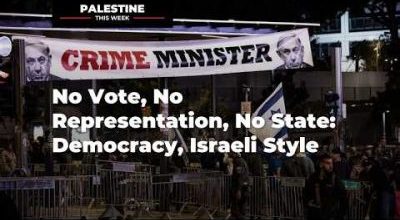
No Vote, No Representation, No State: Democracy, Israeli Style
or go to
Aletho News Archives – Video-Images
From the Archives
Sanctions, War and the Policy of Dual Containment
By SASAN FAYAZMANESH | March 17, 2008
It is now nearly three decades since the Unites States adopted the policy of dual containment of Iran and Iraq. While much has been written about the containment of Iraq, there has been very little in-depth analysis of this policy when it comes to Iran. In a book that is going to be released on March 31, 2008, entitled The United States and Iran: Sanctions, Wars and the Policy of Dual Containment (Routledge), I attempt to address this shortcoming by investigating when and why the US policy of containment of Iran came about, how it evolved, and where it stands today.[1] To the extent that Israel has been involved in US policy making, the study will also include the role that Israel has played in the containment of Iran. Also, since the fate of Iran has been inextricably linked to that of Iraq, occasionally the investigation will overlap with the containment of Iraq.
The policy of dual containment of Iran and Iraq originated during the Carter Administration, but it was not until the Clinton Administration that the expression “dual containment” became popular. … continue
Blog Roll
 Aletho News
- No Vote, No Representation, No State: Democracy, Israeli Style
- Zionist Bought Senate Blocks Information About American Citizens Killed By Israel
- While Gaza dominates the UN, these are the people keeping it alive
- New Report: “Scholasticide and Genocide in Gaza: Assessment, Testimonies and Legal Analysis”
- ‘THAAD Delusion’: Iran war exposes US missile shield limits – The Atlantic
- Moscow issues warning to NATO over Russian exclave
- Yes, the Iran war has destroyed Trump’s presidency
- The fallacy of US delusions about Iran’s economic collapse
- Hezbollah denies Syria cell link, warns of Israeli plan to sow discord
- The legacy of US sanctions, war, and occupation in Iraq
- If Americans Knew
- Mamdani releases plan to combat antisemitism and hate crimes in New York City
- Iran’s Revolutionary Guards Publish Letter to the American People
- DMFI launches $1 million ad campaign supporting Virginia’s Elaine Luria
- US Senate blocks resolution seeking report on Americans killed by Israel
- Israeli Attacks Kill Ten Palestinians in Gaza
- Massacre at Minab: The School That Became a Grave
- Israeli media: The IDF Shows It Doesn’t Turn a Blind Eye; It Actively Emboldens Settler Havoc
- As settlers ravage West Bank, Israeli forces kill 10 in Gaza – Daily Update
- New Report: “Scholasticide and Genocide in Gaza: Assessment, Testimonies and Legal Analysis”
- Ex-Biden officials are desperate for a Gaza scapegoat
- No Tricks Zone
- Green Energy Debacle: German Expert Professor Fritz Vahrenholt Warns Of Severe Economic And Social Consequences
- Two More Paleo Reconstructions Affirm Meters-Higher Sea Levels Across Ireland, Brazil 7000-6000 Years Ago
- New Study: Earth And Venus Surface Warmth Largely Explained By Convection And Lapse Rate, Not CO2 Or Radiation
- 2025 Nature Paper Claiming Worsening Global Drought Gets RETRACTED …Heavily Flawed
- New Study: ‘Global Drought Shows No Detectable Recent Acceleration Under Climate Warming’
- Economic Masterminds: German Socialists Suggest Taxing Productivity Gains Stemming From Using AI
- The South China Sea Has Not Been Cooperating With The Climate Change Narrative
- Energy Crisis: Germany Enters Heating Season With Historically Low Gas Reserve Fill Levels
- New Study: The Antarctic Ice Sheet Gained Mass From 2020-2024 Due To Staggering Snow And Ice Accumulation
- Study: Ocean Heating Rates From Thousands Of Years Ago ‘Dwarf’ Modern Ocean Heating Rates

