The Syrian Democratic Forces: Just an Invention by Washington to Save Face?
Sputnik – 03.11.2015
As America’s previous strategies for dealing with the Syrian crisis fell into disarray, the Pentagon scrambled to gather a ragtag band of militia groups under the banner of the Syrian Democratic Forces. But the new alliance is barely holding together, and may in fact have been dreamed up as an excuse to continue pumping weapons into the region.
Mere days after the Obama administration announced it was ending its controversial plan to train and equip so-called “moderate” Syrian rebels, a new player arrived on the scene.
“The sensitive state our country Syria is going through and rapid developments on the military and political front… require that there be a united national military force for all Syrians, joining Kurds, Arabs, Syriacs and other groups,” read a statement released by the newly formed Syrian Democratic Forces (SDF) last month.
The alliance consists of the Kurdish YPG militia, an Assyrian Christian group, and a number of various Arab groups collectively known as the Syrian Arab Coalition.
And according to a senior US military official speaking to the New York Times, the Syrian Arab Coalition was “an American invention.”
Washington’s new Syria strategy involves supporting this nebulous ground alliance in a fight against the self-proclaimed Islamic State terrorist group – in addition to sending between 30 and 50 US Special Forces as “advisers.”
But according to the government officials, the Syrian Arab Coalition consists of only 5,000 fighters. These are spread across various groups without any real central leadership, and approximately 20% of those forces said they had no interest in staging an offensive against IS.
If the SDF is to display any effectiveness, it will be from the 40,000-strong Kurdish militia – a fact which doesn’t exactly sit well with America’s Turkish allies. But by creating the Syrian Arab Coalition, the United States can indirectly arm the Kurds while maintaining plausible deniability.
“The YPG is a very effective fighting force, and it can do a lot. But these Arab groups are weak and just a fig leaf for the YPG,” Barak Barfi, of the New America Foundation, told the Times.
“There is no deep-rooted alliance between these groups; this is a shifting tactical alliance.”
The Syrian Arab Coalition is all but nonexistent, but even the broader SDF is in tatters. Despite the Pentagon’s dumping of 50 tons of ammunition into Syria last month, the alliance is in desperate need of heavy weapons, radios, infrastructure, leadership, and, yes, ammunition.
Visiting the frontlines in Syria, Ben Hubbard of the New York Times reported on just how ill-equipped the alliance is. Fighters wear old, worn-out boots and ragged fatigues. Security checkpoints are manned by teenagers armed with aging rifles. The only unifying factor at this time appears to be a yellow flag meant to represent the SDF, though it has no command posts to fly over.
“This is the state of our fighters: trying to fight ISIS with simple means,” one commander said, using an alternative acronym for the Islamic State.
The SDF is also in dire need of leadership. While the group is meant to be led by a six-person military council, that council currently consists of a single individual, who largely serves as little more than a spokesman.
Creating an illusory group to justify military actions in Syria isn’t exactly a new strategy for the Obama administration. When the US-led coalition first began airstrikes in Syria, Pentagon officials said they were targeting an al-Qaeda affiliate known as Khorasan.
“There are serious questions about whether the Khorasan Group even exists in any meaningful way or identifiable manner,” Glenn Greenwald and Murtaza Hussain wrote for the Intercept.
“What happened here is all-too-familiar. The Obama administration needed propagandistic and legal rationale for bombing yet another predominantly Muslim country.”
With the SDF, the administration can similarly deny arming Kurdish militias, and pretend it has an actual strategy in the region.
Reaping the Fruits of the War on Terror in Yemen
By Michael Horton | CounterPunch | November 3, 2015
Yemen was an early victim of the US led war on terror. The first targeted assassination by a US drone occurred there in November 2002. Yemen’s mountains and deserts were where the US developed and tested its flawed drone-centric counter-terrorism strategy. A combination of indifference, faulty intelligence, and incompetence has led to the deaths of hundreds of Yemeni civilians.
As tragic as these deaths are, they pale in comparison with the death and destruction unleashed by the current war in Yemen, a war that US foreign and counter-terrorism policies are partially responsible for.
As in most parts of the world where the US has waged its war on terror, the supposed targets—terrorist organizations like al-Qaeda and the Islamic State—are the primary beneficiaries.
These organizations exploit and feed off the chaotic and divisive environments that arise from short-sighted and uninformed “whack a mole” counter-terrorism strategies. Such an outcome is perfectly acceptable to the thriving military-industrial complex that drives and profits from US foreign policy.
Yemen is one of the countries where the disastrous consequences of the war on terror are most evident and potentially most consequential. Yemen’s strategic location across from the Bab al-Mandeb—a critical shipping corridor—and its long border with Saudi Arabia ensure that the chaos that has engulfed the country will not be easily contained.
The war has already spread across Saudi Arabia’s southern border where Houthi forces and elements of the Yemeni Army have repeatedly attacked military targets deep within Saudi territory. The same forces have reportedly launched anti-ship missiles—which the Yemeni Armed Forces have in their inventory—at ships belonging to the Saudi Navy.
Much of southern Yemen, which includes areas that Saudi Arabia and its allies claim to have “liberated,” is being infiltrated by al-Qaeda in the Arabian Peninsula (AQAP) and the Islamic State. Parts of Aden—Yemen’s major port city—are now under the control of AQAP and allied bands of militant Salafis who are enforcing their version of Sharia law on the once cosmopolitan and relatively liberal city.
Yemen’s internationally recognized government—most of whose members remain in their villas in Saudi Arabia—has been unable to assert its authority in the liberated areas. As one of the better organized forces in the country, AQAP is filling the void. This is undoubtedly being facilitated by Saudi Arabia and its allies who view AQAP and militant Salafis as useful proxies. Just as they view groups like al-Qaeda affiliate al-Nusra Front in Syria as allies in their war against the government of Bashar al-Assad.
So how have US foreign policy and its counter-terrorism strategies contributed to the chaos that has engulfed Yemen?
In the wake of September 11th, then Yemeni President Saleh—a wily political survivor—recognized that the US’ war on terror was going to be a gift to corrupt governments like his. Saleh promised to be an ally in what he knew would be a war without end against organizations that are easily manipulated by intelligence services.
Thanks to the generosity of US tax payers, weapons and US Special Forces trainers poured into Yemen. There was little effective oversight of how the weapons and newly trained soldiers would be used. Rather than targeting al-Qaeda—an organization that the security services of Saleh’s government had already thoroughly penetrated—Saleh used his US supplied and trained special and counter-terrorism forces against his real enemies: namely the Houthis and those in south Yemen who opposed Saleh’s corrupt northerner dominated government.
In exchange for weapons and training, Saleh also agreed to let US drones hunt down and kill Yemeni citizens. It mattered little to him that the strikes strengthened AQAP. AQAP benefited from the cycles of revenge that resulted from the deaths of what were most often civilians. The drone strikes also weakened and de-legitimized tribal authority, one of the few constraints on the growth of AQAP and Saleh’s corrupt government.
US policies in Yemen—which were narrowly focused on killing the “bad guys” in the parlance of George W. Bush—altered the balance of power and helped set in motion the country’s rapid descent into chaos. With support from the US, Saleh was emboldened and rather than falling back on negotiations and patronage, which are long-established traditions in Yemen, he pursued his enemies. However, he and his forces were not powerful enough to prevail. Saleh, who is a student of Yemeni history, forgot that there are few periods when one man or a government has exercised control over the entirety of the country.
Rather than being defeated, Yemen’s Houthi rebels fought back and in the aftermath of the “Arab Spring” in Yemen, they took over a large part of northwest Yemen. In the south, southern separatists, who were routinely imprisoned and disappeared by the security services and “counter-terrorism” forces, were further radicalized. Now, in southern Yemen, the flag of a unified Yemen is nowhere to be seen. It has been replaced by the flag of the formerly independent south Yemen and the black flags of al-Qaeda.
The US has spent billions of dollars—the actual amount is unknown—on its war on terror in Yemen. It is worth contemplating what the political situation in Yemen would look like if even a fraction of that money had been spent on programs that tackled the real issues that drive instability in Yemen like water shortages, government corruption, a lack of schools and medical facilities, and food insecurity. And what if this aid had been linked to meaningful reform within government institutions?
While it is of course unlikely that Yemen would be a bastion of stability and transparent government, it is just as unlikely that the country would be mired in a brutal civil war that has drawn in Saudi Arabia and the UAE.
Unfortunately, US policy makers have learned nothing from fourteen years of trillion dollar failures in Afghanistan and Iraq and now Libya, Syria, and Yemen. Rather than rethinking its policies in Yemen and pushing for a negotiated end to hostilities, the US is aiding and enabling Saudi Arabia’s involvement in the war in Yemen. This war has killed thousands, impoverished millions, and effectively ceded control of large parts of Yemen to AQAP and other militant Salafi organizations.
The US’ war on terror in Yemen has done nothing but increase instability, embolden terrorist organizations, and ensure years—likely decades—of healthy profits for the companies that make up the military-industrial complex. These companies—not the American or Yemeni people—are reaping the fruits of a war without end.
Cameron denies scrapping vote on Syria airstrikes after warning from MPs
RT | November 3, 2015
Prime Minister David Cameron has reportedly scrapped plans to call a House of Commons vote on approving airstrikes against Islamic State (formerly ISIS/ISIL) in Syria after failing to win over enough Labour MPs to counterbalance rebellious Tories.
Whitehall sources told The Guardian and The Times that Downing Street had unofficially decided not to extend Royal Air Force (RAF) bombing campaigns from Iraq to Syria over fears Cameron would be humiliated by a second defeat on the issue.
MPs previously voted down launching airstrikes against Syria, specifically targeting forces loyal to President Bashar Assad, in 2013.
Cameron had insisted he would only call a vote when he had achieved a clear, cross-party consensus.
However, the estimated number of Labour MPs expected to vote in favor of airstrikes – between 20 and 30 – would not counteract the number of Tories planning to rebel.
One Downing Street source denied the claims, saying Cameron will still call a vote when a consensus is reached.
“The prime minister’s position hasn’t changed,” the source said.
“He’s consistently said that we would only go back to the House [of Commons] on this issue if there was clear consensus and that remains the case.”
“Meanwhile, the government continues to work to bring the conflict to an end in Syria and we are working closely with our allies to inject greater momentum into efforts to find a political solution, which we’ve always said will be the way to bring this war to an end and give Syria hope for the future.”
In a further blow to Cameron’s campaign to extend British bombing to Syria, the Foreign Affairs Select Committee released a report saying they are “not yet persuaded” by the case for Syrian airstrikes.
The report expresses concerns that Royal Air Force airstrikes would only have a “marginal effect” and could prove a “distraction” from a diplomatic solution.
MPs agreed that the humanitarian catastrophe means there is a “powerful sense that something must be done.”
But they added that military action should not be used unless there is a “coherent international strategy.”
“We believe that there should be no extension of British military action into Syria unless there is a coherent international strategy that has a realistic chance of defeating ISIL and of ending the civil war in Syria.
“In the absence of such a strategy, taking action to meet the desire to do something is still incoherent,” they added.
However, one former Labour minister threatened to quit the party after suggestions Jeremy Corbyn’s leadership team would consult the Stop the War coalition over a government proposal to begin military action.
Tom Harris MP, a former transport minister, posted on Facebook it would be “goodbye” from him if the anti-war group was consulted.
The British government has already authorized drone strikes against ISIS targets in Syria without the backing of parliament. In September, it was revealed that two British nationals fighting for extremist organizations had been killed by RAF drones.
US Secretary of State John Kerry will visit London this week to discuss international relations, including the situation in Syria. The US is already carrying out airstrikes in the country.
“While in London, [Kerry] will meet with British Foreign Secretary [Philip] Hammond to discuss a range of bilateral and global issues, including Syria,” a spokesperson for Kerry said.
Exploding Radioactive Waste Warning: Keep it Above Ground
By John Laforge | CounterPunch | November 2, 2015
Early on Sunday Oct. 25, an underground fire caused an explosion in a low-level nuclear waste site in the desert 10 miles from Beatty, Nevada, and 115 miles northwest of Las Vegas. The explosion and fire followed flash flooding that shut down Beatty’s escape routes: US 95 and State Highway 373. The 80-acre dumping ground, closed since 1992, is run by — get this — “US Ecology.” The private dump consists of 22 trenches up to 800 feet long and 50 feet deep, and its older trenches have radioactive waste within three feet of the surface, the Las Vegas Sun reported.
Certain types of radioactive material are known to catch fire when in contact with water, so the flooding that struck prior to the explosion may have been its cause. Unfortunately authorities don’t know what sorts of radioactive isotopes are buried in the trenches there. Nor does anyone know either how the fire started or how much radioactive waste burned.
Rusty Harris-Bishop, spokesman for the US EPA’s Region 9 office in San Francisco said in a prepared statement, “No gamma radiation has been detected at this time.” This nuanced remark does not indicate that gamma radiation wasn’t detected. It also artfully dodges questions about alpha and beta radiation.
With the EPA, the Nevada National Guard, Nye County officials and Energy Department all involved, highly nuanced public safety assurances are guaranteed. “Radiation wasn’t immediately detected during fly-overs of a burned trench … state and federal officials said Monday,” Oct. 26. But radiation monitoring was initiated well after the plume of smoke and debris from the blast and fire had dispersed. Then, “The Nevada Department of Public Safety said tests of the area around the fire site near Beatty returned negative readings for radiation,” KVVU TV reported. Well, sure. But were any positive readings returned?
Buried Waste Theoretically and Literally Explosive
In February 2014, at a deep underground dump in New Mexico where the Pentagon is burying plutonium-contaminated wastes, at least one barrel “burst after it arrived at the dump, releasing radioactive uranium, plutonium and americium throughout the underground facility,” according to NPR. NPR’s March 26, 2015 update concerned the Energy Department’s 277-page report about the explosion. The report said in part, “Experiments showed that various combinations of nitrate salt, Swheat Scoop® [cat litter], nitric acid, and oxalate self-heat at temperatures below 100°C.” The DOE’s term-of-art for this “self-heat” explosion was “thermal runaway.” This runaway explosion contaminated 22 workers internally, and it has shut down the operation, possibly forever.
In May 1996, a welding spark caused a waste cask explosion at Wisconsin’s Point Beach reactor on Lake Michigan. The blast of hydrogen gas was “powerful enough to up-end the three-ton lid while it was atop a storage cask filled with high-level waste.” The reactor’s owner called that accident merely a “gaseous ignition event,” but was later fined $325,000.
Only 20 miles away from the Beatty Nevada explosion is the now-cancelled Yucca Mountain high-level dump project, where such waste explosions were forecast by expert investigators 20 years ago.
In 1995, government physicists Charles Bowman and Francesco Venneri at Los Alamos National Laboratory predicted that wastes might erupt in a nuclear explosion and scatter radioactivity to the winds or into groundwater, or both. (Washington Post, Dec. 15, 1998; New York Times, Mar. 5, 1995.) Bowman and Venneri found that the explosion dangers will arise thousands of years from now — after steel waste containers dissolve and plutonium begins to disperse into surrounding rock. Former Energy Dept. geologist Jerry Szymanski said, “You’re talking about an unimaginable catastrophe. Chernobyl would be small potatoes.” (Joby Warrick, “At Nevada Nuclear Waste Site: The Issue is One of Liquidity,” Washington Post, Dec. 15, 1998)
In expert hearings held in southern Ontario in Sept. 2014, Dr. Frank Greening made identical warnings about the potential explosiveness of Canadian radioactive waste if they were to be buried next to Lake Huron under plans made by Ontario Power Generation.
October’s waste explosion and fire shows we don’t have to wait thousands of years for disaster to strike. Nevada’s “self-heating” radioactive “thermal runaway” is just the latest warning not to bury radioactive waste. Putting the deadly stuff out-of-sight and out-of-mind won’t keep us (or the water) safe. For radioactive waste, only above-ground, monitored, hardened, retrievable storage can come close to that goal. Ceasing nuclear waste production is the only path to potential sustainable solutions.
Sicilians Stage Anti-NATO Military Drills Rally
Sputnik – 31.10.2015
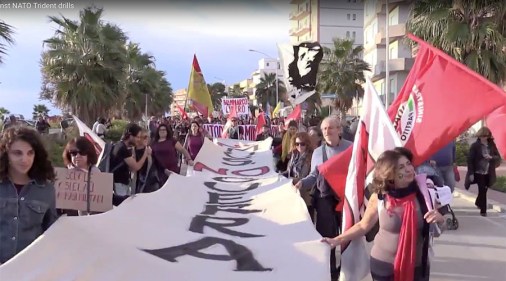 Protesters in the Italian island of Sicily demonstrated against the North Atlantic Treaty Organization’s (NATO) Trident Juncture-2015 exercises on Saturday less than 10 miles from a NATO base.
The military alliance’s largest exercises in over a decade involving over 36,000 troops from 30 NATO members and partner countries, Trident Juncture moved into an active phase across southwestern Europe in mid-October.
“We are against NATO, against war, against the enormous costs that go to the upkeep of military bases,” Chiara Paladino, one of the protest organizers, told RIA Novosti.
Paladino said around 1,000 people demonstrated in Marsala, south of the Vincenzo Florio Airport used as a NATO forward operating base. Anti-NATO protesters gathered from across the province of Trapani, including large Sicilian cities of Palermo, Catania, Messina and Ragusa, she said.
A similar anti-Trident Juncture and anti-NATO rally took place in the major Sicilian city of Palermo late on Friday.
The first phase of the Trident Juncture drills began October 3, running for two weeks in Canada, Norway, Germany, Belgium and the Netherlands. The second phase, which ends on November 6, is taking place in southern Europe – Spain, Italy, and Portugal – as well as in the Mediterranean Sea and the Atlantic Ocean.
Spanish and Portuguese demonstrators staged protests against NATO this month.
Photo © Ruptly
The U.S. Spends $35 Billion ‘Helping’ Out The World… But Where Does All this Money Really Go?
HowMuch.net | October 28, 2015
The United States provided approximately $35 billion in economic aid to over 140 countries* in fiscal year 2014. In the map below the relative size of each country is proportionate to the aid received from the United States and the color of each country indicates GDP per capita.
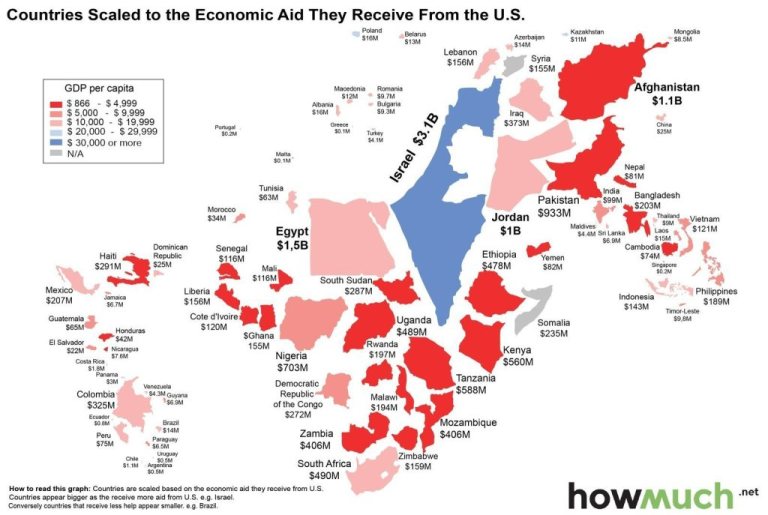
* For visualization purposes the map above reflects only 77 countries that received approximately $17 billion of the $35 billion in global aid. We chose top 40 by aid received and then manually selected different countries to illustrate geographic diversity.
‘Calculated to put American troops in danger’: Why US wants escalation in Syria
RT | October 31, 2015
Sending some 50 US advisers to Syria illegally to train the so-called ‘moderate rebels’ looks like a calculated move. If, or when, someone gets hurt, the US will have a pretext for boots on the ground, believes retired US Air Force Lieutenant Col Karen Kwiatkowski.
RT: Does this deployment mean Americans will be putting themselves in the direct line of fire in Syria?
Karen Kwiatkowski: I think there is a danger of that happening and I think that is part of why they are going there. I think they are looking for an excuse to up the ante, to send more troops and to have a crisis of some sort. Clearly the president has been lying, and so has Ash Carter, about what their real intentions are. So, in my opinion, I think this is provocative and I think it is calculated to put our troops in danger.
RT: How is that not a combat operation?
KK: Well, special forces are combat. And what the president said [is] they are going to be opportunistic. When you are training and advising, you do not use the word opportunistic. Training and advising is a more steady state situation. So they are using the word opportunistic, they are expecting to get involved in combat operations, and they have sent combat troops to do that. I do not care how they have used the term for non-combat. This is combat.
RT: They are going there to support the so-called moderate rebels. We know it hasn’t been terribly successful. Why should this make a huge difference?
KK: In terms of helping the moderate rebels – if there are any that we can identify – it is not going to make any difference in that regard. This is about US exercising some power, some limited power that it has, to kind of assert its relevance, particularly in the face of our allies who are asking how we are helping or not helping them.
RT: Sure, but do you think this is a game changer or, perhaps, this is a question of timing, because Russia has obviously taken on Islamic State?
KK: I don’t think it is a game changer in that regard. It is a gesture to kind of save face in some respects. But there is a real danger, that if our troops, even if it is a limited number, get killed, and if they get killed by, let’s say, Russian fire or something like that, than we have a big problem, that we are not able diplomatically or militarily able to deal with. So it is extremely foolhardy what they are doing. But yes, it is a gesture to show that the US is trying something. But it is a weak gesture and it is a dangerous gesture.
RT: And you mentioned the Russian airstrikes there and, presumably, Americans are saying we do need to speak with the Russians now to say where we are located so we don’t get into an incident like that?
KK: You would think that. You would think so.
RT: But you sound like that might not happen?
KK: If you believe what the president and Ash Carter say, they aren’t really seeking out any cooperation with the Russians. So perhaps behind the scenes they are. I would like to think that they care about the lives of our soldiers that they are sending over there and that they would coordinate, but their public rhetoric is that we will not coordinate. That is what I’ve heard unless something has changed. They are not really interested in coordinating with Russia, anything that Russia is doing in Syria. And by the way remember that it is an illegal act to send our troops into Syrian space, air space or ground space, without the permission of the government of Syria, which we do not have. So this is an act of war on top of everything else that makes this extremely stupid.
RT: Americans clearly don’t see that as a big issue, I mean it has been conducting airstrikes, despite it being against international law. It does not seem to matter in this case, at this stage anyway.
KK: It has not mattered in our policy in the Middle East for a long time. But I have pointed out that if our people killed, if we decide to make some sort of case about that, we are in the wrong totally in this, because we don’t have permission of the Syrian government to put those troops there at all. They are there illegitimately. So when they get killed or injured or harmed we have a problem in a diplomatic sense.
RT: A public opinion sense too, I mean what was the reaction when the US soldier did die on a special operations mission in Iraq. Was there a big public outcry in America?
KK: No. Two things that I have noticed about this: one is there is no public outcry, not a lot of concern. I haven’t seen a lot of attention given to this death. What surprised me was how much Ashton Carter and President Obama paid homage to this particular individual, called him a hero, and this is what we would like to see – some guy running into a fight and getting slaughtered in an illegitimate combat situation, because I think even in Iraq we still have some concerns there about what we are doing. They celebrated it. They tried to put a positive spin on it. American people aren’t listening. We have a lot of other different things on in general. The American people aren’t interested in what is going on in the Middle East. They don’t want to get involved in it. But they really tried to spin the death of this soldier in a very positive way. And, I’m sure, to see if it can be sold. And, as far as I can tell, it was sold. Americans aren’t interested, but they haven’t really pushed back at the death of this guy. I think we’ve become inert to it.
RT: Just looking into the future, you foresee a similar thing?
KK: I do. I mean if you go in the middle of a fire storm in an ill-planned situation, then certainly, you can’t say that anything the Pentagon is doing in the Middle East is well planned. They themselves admit this. So, yes, it is going to lead to the death of Americans. And given how they spun the death that happened last week we’ll see more spinning and, you know, more of Russia as a ‘bad guy’ in this situation, as they try to salvage what is left of their Middle East policy in this final year of the Obama administration, in these final months of the Obama administration… I hate to be cynical about this, but it is such a game that they are playing – no good results for our people, no good results for the Syrian people. It is not going to help the exodus of refugees at all. In fact, it will probably make it worse.
READ MORE: US ground ops in Syria ‘illegal’, may lead to ‘unpredictable’ consequences
Lockheed Replaces Chief of Beleaguered F-35 Program
Sputnik – 31.10.2015
Lockheed Martin’s F-35 has been an undeniable embarrassment for the US military. Perhaps, at last, the company is starting to realize its faults, as it adjusts the program’s management team.
After spending nearly $400 billion on its development, the F-35 has seen its share of problems, despite being the most expensive piece of military hardware ever created. In addition to concerns that the jet’s software was vulnerable to cyberattack, the F-35’s fundamental performance capabilities have also been called into question.
“The jet fighter lacks the sensors weapons and speed that allow a warplane to reliably detect and shoot down other planes in combat,” a report from War is Boring reads. “At least not compared to modern Chinese- and Russian-made jets – the planes the F035 is most likely to face in battle in some future war.”
Defense contracting giant Lockheed Martin was behind the jet, with the program being led by Lorraine Martin.
But on Friday, the company announced a shakeup. Lorraine Martin is out, to be replaced by her deputy, Jeff Babione.
“He brings a deep understanding of the F-35 program, strong customer relationships and a collaborative leadership style that will ensure we continue the positive momentum of the program,” Orlando Carvalho, executive vice president of Lockheed Aeronautics, said in a statement.
While the company didn’t elaborate on the reason for the change in management, Lockheed has experienced a couple of major setbacks in recent weeks.
Almost immediately after winning office earlier this month, Canadian Prime Minister designate Justin Trudeau announced that his administration would pull out of the US-led coalition over Iraq and Syria. That means the new Liberal government will also be abandoning the F-35 program.
During his campaign, Trudeau said he would launch a new contracting competition to update the military’s aging fleet.
Earlier this week, Lockheed also lost a major defense contract to rival Northrop Grumman. A joint-team of Boeing and Lockheed Martin were competing against Northrop for the Pentagon’s contract to develop the next generation Long Range Strike-Bomber. Needed to replace the US Air Force’s fleet of B-1 and B-52s, the contract is estimated to be worth over $100 billion.
Prior to the Pentagon’s announcement, Lockheed-Boeing was expected to win.
While military officials refused to specify what went into their decision making process, it’s hard to imagine that the ballooning costs of the F-35 program didn’t play some role.
Martin will move to a newly created position of deputy executive vice president for Mission Systems and Training, through which she will oversee the company’s acquisition of Sikorsky helicopters.
Is War Beautiful?
By David Swanson | Let’s Try Democracy | October 28, 2015
“War Is Beautiful” is the ironic title of a beautiful new book of photographs. The subtitle is “The New York Times Pictorial Guide to the Glamour of Armed Conflict.” There’s an asterisk after those words, and it leads to these: “(In which the author explains why he no longer reads The New York Times ).” The author never explains why he read the New York Times to begin with.

The author of this remarkable book, David Shields, has selected color war photographs published on the front page of the New York Times over the last 14 years. He’s organized them by themes, included epigrams with each section, and added a short introduction, plus an afterword by Dave Hickey.
Some of us have long opposed subscribing to or advertising in the New York Times, as even peace groups do. We read occasional articles without paying for them or accepting their worldview. We know that the impact of the Times lies primarily in how it influences television “news” reports.
But what about Times readers? The biggest impact that the paper has on them may not be in the words it chooses and omits, but rather in the images that the words frame. The photographs that Shields has selected and published in a large format, one on each page, are powerful and fantastic, straight out of a thrilling and mythical epic. One could no doubt insert them into the new Star Wars movie without too many people noticing.
The photos are also serene: a sunset on a beach lined with palm trees — actually the Euphrates river; a soldier’s face just visible amid a field of poppies.
We see soldiers policing a swimming pool — perhaps a sight that will someday arrive in the Homeland, as other sights first seen in images from foreign wars already have. We see collective military exercises and training, as at a desert summer camp, full of camaraderie in crises. There’s adventure, sports, and games. A soldier looks pleased by his trick as he holds a dummy head with a helmet on the end of a stick in front of a window to get it shot at.
War seems both a fun summer camp and a serious, solemn, and honorable tradition, as we see photos of elderly veterans, militaristic children, and U.S. flags back Home. Part of the seriousness is the caring and philanthropic work exhibited by photos of soldiers comforting the children they may have just orphaned. We see sacred U.S. troops protecting the people whose land they have been bombing and throwing into turmoil. We see our heroes’ love for their visiting Commander, George W. Bush.
Sometimes war can be awkward or difficult. There’s a bit of regrettable suffering. Occasionally it is tragically intense. But for the most part a rather boring and undignified death about which no one really cares comes to foreigners (outside the United States there are foreigners everywhere ) who are left in the gutter as people walk away.
The war itself, centrally, is a technological wonder bravely brought out of the goodness of our superior hearts to a backward region in which the locals have allowed their very homes to turn to rubble. An empty settlement is illustrated by a photo of a chair in a street. There are water bottles upright on the ground. It looks as though a board meeting just ended.
Still, for all war’s drawbacks, people are mostly happy. They give birth and get married. Troops return home from camp after a good job done. Handsome Marines innocently mingle with civilians. Spouses embrace their camouflaged demigods returned from the struggle. A little American boy, held by his smiling mother, grins gleefully at the grave of his Daddy who died (happily, one must imagine) in Afghanistan.
At least in this selection of powerful images, we do not see people born with gruesome birth defects caused by the poisons of U.S. weapons. We do not see people married at weddings struck by U.S. missiles. We do not see U.S. corpses lying in the gutter. We do not see nonviolent protests of the U.S. occupations. We do not see the torture and death camps. We do not see the trauma of those who live under the bombs. We do not see the terror when the doors are kicked in, the way we would if soldiers — like police — were asked to wear body cameras. We do not see the “MADE IN THE USA” label on the weapons on both sides of a war. We do not see the opportunities for peace that have been studiously avoided. We do not see the U.S. troops participating in their number one cause of death: suicide.
A few of those things may show up now and then in the New York Times, more likely on a page other than the front one. Some of those things you may not want to see with your breakfast cereal. But there can be no question that Shields has captured a portrait of a day in the life of a war propagandist, and that the photographers, editors, and designers involved have done as much to cause the past 14 years of mass dying, suffering, and horror in the Middle East as has any single New York Times reporter or text editor.
How soon until Justin Trudeau reveals his liberal imperialism?
By Yves Engler · October 30, 2015
Right-wing commentators are calling Justin Trudeau’s decision to withdraw fighter jets from Syria-Iraq “un Liberal” and unfortunately they’re right.
But, by citing the Liberal sponsored Responsibility to Protect (R2P) to justify Canadian participation in the US-led bombing, these pundits are revealing the essence of this “humanitarian imperialist” doctrine.
Last week senior Maclean‘s writer Michael Petrou called on Trudeau to rethink his commitment to stop Canadian bombing raids, writing “reasons for confronting Islamic State with force are decidedly Liberal. Your party pioneered the notion of ‘responsibility to protect’.” For his part, National Post columnist Matt Gurney bemoaned how “the Liberal Party of Canada once championed, at least with words, the so-called Responsibility to Protect doctrine.”
Ignored by the outgoing Conservative government, R2P was a showpiece of previous Liberal Party governments’ foreign-policy. In September 2000 Canada launched the International Commission on Intervention and State Sovereignty, which presented its final report, The Responsibility to Protect, to the UN in December 2001. At the organization’s 2005 World Summit, Canada advocated that world leaders endorse the new doctrine. It asserts that where gross human rights abuses are occurring, it is the duty of the international community to intervene, over and above considerations of state sovereignty. The doctrine asserts that “the principle of non-intervention yields to the international responsibility to protect.”
But who gets to decide when “gross human rights abuses” are occurring? Lesotho? Uruguay? Or the USA?
The truth is, human rights rhetoric aside, R2P is an effort to redefine international law to better serve the major powers. While the less sophisticated neoconservatives simply call for a more aggressive military posture, the more liberal supporters of imperialism prefer a high-minded ideological mask to accomplish the same end. Those citing R2P to pressure Trudeau to continue bombing Iraq-Syria are demonstrating an acute, but cynical, understanding of the doctrine.
R2P was invoked to justify the 2011 NATO war in Libya and 2004 overthrow of Haiti’s elected government. Both proved highly destructive to those “protected”.
As NATO’s bombing of Libya began a principal author of the R2P report, Ramesh Thakur, boasted that “R2P is coming closer to being solidified as an actionable norm.” Similarly, at the end of the war former Liberal Foreign Minister Lloyd Axworthy and Canadian Ambassador to the UN Allan Rock wrote: “In a fortuitous coincidence, last week’s liberation of Libya occurred exactly a decade after the Responsibility to Protect (R2P) principle was proposed by the Canadian-initiated International Commission on Intervention and State Sovereignty (ICISS).”
But don’t expect R2P proponents to discuss Libya today. “Since Col Gaddafi’s death in Sirte in October 2011,” the BBC reported in August, “Libya has descended into chaos, with various militias fighting for power.” ISIS has taken control of parts of the country while a government in Tripoli and another in Benghazi claim national authority. The foreign intervention delivered a terrible blow to Libya and has exacerbated conflicts in the region.
Canadian officials also cited R2P to justify cutting off assistance to Haiti’s elected government and then intervening militarily in the country in February 2004. In discussing the January 2003 Ottawa Initiative on Haiti, where high level US, Canadian and French officials discussed overthrowing elected president Jean-Bertrand Aristide, Liberal Secretary of State for Latin America and Minister for La Francophonie Dennis Paradis explained that “there was one thematic that went under the whole meeting… The responsibility to protect.” Similarly, in a highly censored February 11, 2004 cable from the embassy in Port-au-Prince to Foreign Affairs, Canadian ambassador Kenneth Cook explained that “President Aristide is clearly a serious aggravating factor in the current crisis” and that there is a need to “consider the options including whether a case can be made for the duty [responsibility] to protect.”
Thousands of Haitians were killed in the violence unleashed by the coup and the country remains under UN military occupation.
It’s telling that neo-conservative supporters of the discredited Harper government are now the ones invoking R2P.
Will Trudeau discard the doctrine or quickly reveal himself as just another liberal imperialist?
Police Drag Away Japanese Seniors Protesting US Military Base Relocation
Sputnik – 30.10.2015
 Elderly protesters were dragged off by riot police on Thursday after staging a sit-in and blocking a road in protest of the construction of a new US military base in Okinawa.
Hundreds of people participated in the demonstration, sitting or lying on the ground in the road to Camp Schwab in an effort to prevent vehicles transporting building materials from accessing the site.
“Don’t lend a hand in the construction of the military base!” the crowd chanted as they were dragged away.
For two decades the military has been wanting to move the Marine Corps Air Station Futenma Okinawa base further north in Okinawa.
The plan to relocate the installation has drawn protests by tens of thousands of residents who worry about sexual assaults by US service members, violence, and the environmental impact on local ecosystems.
Over 50,000 US military personnel currently reside in Japan, and more than half of those live in Okinawa.
“Don’t the people of Okinawa have sovereignty?” 70-year-old Katsuhiro Yoshida, an Okinawa prefectural assembly member, told the Asahi Shimbun. “This reminds me of the scenes of rioting against the U.S. military before Okinawa was returned to Japan (in 1972). Now we are facing off against our own government. It is so contemptible.”
The current governor of Okinawa, Takeshi Onaga, was elected on the premise that he would not allow the base to be constructed. He made good on that pledge, until Japan’s land ministry announced this week that they were overriding his decision.
“The fact that they forcibly executed this construction, there is nothing but anger,” Takashi Kishimoto from the Okinawa Peace Movement Center told NBC News. “We are outraged at these political tactics which ignore will of the people.”
A poll conducted by the Okinawa Times found that 76% of residents are opposed to the construction of a new base.
Photo © Screen Shot
Featured Video
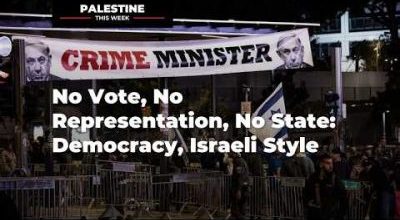
No Vote, No Representation, No State: Democracy, Israeli Style
or go to
Aletho News Archives – Video-Images
From the Archives
Sanctions, War and the Policy of Dual Containment
By SASAN FAYAZMANESH | March 17, 2008
It is now nearly three decades since the Unites States adopted the policy of dual containment of Iran and Iraq. While much has been written about the containment of Iraq, there has been very little in-depth analysis of this policy when it comes to Iran. In a book that is going to be released on March 31, 2008, entitled The United States and Iran: Sanctions, Wars and the Policy of Dual Containment (Routledge), I attempt to address this shortcoming by investigating when and why the US policy of containment of Iran came about, how it evolved, and where it stands today.[1] To the extent that Israel has been involved in US policy making, the study will also include the role that Israel has played in the containment of Iran. Also, since the fate of Iran has been inextricably linked to that of Iraq, occasionally the investigation will overlap with the containment of Iraq.
The policy of dual containment of Iran and Iraq originated during the Carter Administration, but it was not until the Clinton Administration that the expression “dual containment” became popular. … continue
Blog Roll
 Aletho News
- No Vote, No Representation, No State: Democracy, Israeli Style
- Zionist Bought Senate Blocks Information About American Citizens Killed By Israel
- While Gaza dominates the UN, these are the people keeping it alive
- New Report: “Scholasticide and Genocide in Gaza: Assessment, Testimonies and Legal Analysis”
- ‘THAAD Delusion’: Iran war exposes US missile shield limits – The Atlantic
- Moscow issues warning to NATO over Russian exclave
- Yes, the Iran war has destroyed Trump’s presidency
- The fallacy of US delusions about Iran’s economic collapse
- Hezbollah denies Syria cell link, warns of Israeli plan to sow discord
- The legacy of US sanctions, war, and occupation in Iraq
- If Americans Knew
- Mamdani releases plan to combat antisemitism and hate crimes in New York City
- Iran’s Revolutionary Guards Publish Letter to the American People
- DMFI launches $1 million ad campaign supporting Virginia’s Elaine Luria
- US Senate blocks resolution seeking report on Americans killed by Israel
- Israeli Attacks Kill Ten Palestinians in Gaza
- Massacre at Minab: The School That Became a Grave
- Israeli media: The IDF Shows It Doesn’t Turn a Blind Eye; It Actively Emboldens Settler Havoc
- As settlers ravage West Bank, Israeli forces kill 10 in Gaza – Daily Update
- New Report: “Scholasticide and Genocide in Gaza: Assessment, Testimonies and Legal Analysis”
- Ex-Biden officials are desperate for a Gaza scapegoat
- No Tricks Zone
- Green Energy Debacle: German Expert Professor Fritz Vahrenholt Warns Of Severe Economic And Social Consequences
- Two More Paleo Reconstructions Affirm Meters-Higher Sea Levels Across Ireland, Brazil 7000-6000 Years Ago
- New Study: Earth And Venus Surface Warmth Largely Explained By Convection And Lapse Rate, Not CO2 Or Radiation
- 2025 Nature Paper Claiming Worsening Global Drought Gets RETRACTED …Heavily Flawed
- New Study: ‘Global Drought Shows No Detectable Recent Acceleration Under Climate Warming’
- Economic Masterminds: German Socialists Suggest Taxing Productivity Gains Stemming From Using AI
- The South China Sea Has Not Been Cooperating With The Climate Change Narrative
- Energy Crisis: Germany Enters Heating Season With Historically Low Gas Reserve Fill Levels
- New Study: The Antarctic Ice Sheet Gained Mass From 2020-2024 Due To Staggering Snow And Ice Accumulation
- Study: Ocean Heating Rates From Thousands Of Years Ago ‘Dwarf’ Modern Ocean Heating Rates

