NATO’s Expensive Expansion
By Brian CLOUGHLEY – Strategic Culture Foundation – 27.10.2015
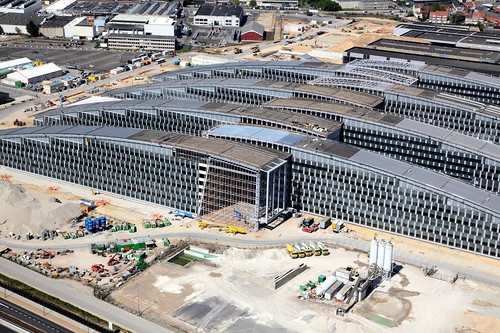
The North Atlantic Treaty Organisation has many secrets, of which one of the most closely guarded is the final cost of its luxurious new headquarters complex in Brussels. As reported last year by Britain’s Daily Telegraph newspaper, the price had climbed to a billion Euros “against a background of Nato pledges to reduce its command structure, agencies and national HQs by 30 per cent in response to savage defence cuts in most of its 28 member states.” According to NATO the final bill was supposed to be 750 million Euros for completion in 2015, but as had to be eventually admitted by NATO, “the project now has a clear way forward to completion in 2016” — with a 30 per cent increase in the price.
But that officially-stated price was not what it seemed, because, as revealed by Germany’s Der Spiegel magazine, “member states had already been sceptical when the consortium won the contract for €460 million [emphasis added] in 2010 . . . [Nato Chief] Anders Fogh Rasmussen is aware of the problem but hasn’t seen fit yet to inform the public about it . . . At a meeting of NATO’s Deputies Committee on December 19 [2013], Rasmussen’s staff asked that the issue be dealt with ‘confidentially’.”
That shabby deceitfulness couldn’t prevent Spiegel from disclosing that the cost had risen to 1.3 billion Euros, “almost three times the €460 million contract awarded in 2010 to replace NATO’s Cold War-era headquarters with a soaring glass-and-steel structure to house some 4,000 staff.” This vastly expensive palace has eight wings which converge “in a glass-covered central hall . . . to ‘symbolise the allies coming together, while glass walls are supposed to represent Nato’s transparency’.”
The designer of this glass castle rhapsodised that “the wing-like profiles of the buildings reinforces [sic] the ideas of consensus, fluidity and aspirations towards peace . . .” But peace doesn’t seem to be what NATO is intent on achieving, any more than it seems to welcome transparency in glass walls or anything else, because a leaked cable from Germany’s ambassador explained that a meeting of NATO representatives “pointed to the disastrous effect on the image of the alliance if construction were to stop and if NATO appeared to be incapable of punctually completing a construction project.”
How transparent. And how prophetic.
Although NATO’s deceit about its incompetence in building its new headquarters is veiled in secrecy, its ambition to expand in territory and military muscle-flexing is open for all to see, and has been for twenty years.
After the Warsaw Pact disbanded in March 1991, NATO, although deprived of any reason to continue in existence, managed to keep going, and in 1999 added Poland, the Czech Republic and Hungary to its 16 members. As the BBC noted, these countries became “the first former Soviet bloc states to join Nato, taking the alliance’s borders some 400 miles towards Russia.”
With good reason Moscow wondered what on earth the US-NATO military alliance might be planning.
The New York Times recorded that the 1999 expansion was “opening a new path for the military alliance” and expressed delight that the ceremony took place in the town of Independence, Missouri, where “the emotional Secretary of State Madeleine K Albright watched the three foreign ministers sign the documents of accession, signed them herself, then held them aloft like victory trophies.” Ms Albright was born Marie Korbelová in Prague and “made no secret today of her joy as her homeland and the two other nations joined the alliance.”
It was the emotional Madeleine Albright who appeared on the US television programme Sixty Minutes on May 12, 1996 and was asked to comment on Washington’s economic sanctions that were savaging Iraq. The interviewer, Lesley Stahl, said that as a result of the punishment “We have heard that a half million children have died. I mean, that’s more children than died in Hiroshima. [90,000 people were killed at Hiroshima. Probably about 20,000 were children.] And, you know, is the price worth it?”
Albright replied that “I think this is a very hard choice, but the price — we think the price is worth it.” (The YouTube recording is nauseating.) Then she was given the US Medal of Freedom by President Obama in 2012. You couldn’t make it up.
In spite of facing no threat whatever from any country in the world, NATO continued to expand around Russia’s borders, inviting Bulgaria, Estonia, Latvia, Lithuania, Romania, Slovakia and Slovenia to join in 2002, which they did two years later.
As President Putin observed in an interview with Italy’s Corriere della Sera “we are not expanding anywhere; it is NATO infrastructure, including military infrastructure, that is moving towards our borders. Is this a manifestation of our aggression?”
Then NATO took wider and more aggressive action in August 2003 when it took “control of the International Security Assistance Force (Isaf) in Afghanistan, its first major operation outside Europe.” Predictably, the war in Afghanistan plunged from crisis to calamity after US-NATO countries agreed in 2005 “to expand the alliance’s role,” including “deployment of thousands more troops in the south.” The result was disaster.
Last December NATO (but not the US) ceased offensive operations in Afghanistan, having sacrificed the lives of over 3,500 soldiers of whom some 2,300 were American. One might imagine that this humiliating defeat might have resulted in a pause for reflection about NATO’s role, purpose and effectiveness, but its new Secretary General, Jens Stoltenberg, is proving as energetically expansive as his predecessor, which is why he was chosen for the job. NATO’s appalling blitz of Libya in 2011, which reduced the country to its present catastrophic chaos, has failed to modify his intriguing belief that “from Afghanistan to Morocco, and many places in between, NATO is helping other countries to defend themselves.” He may have forgotten that Libya is one of the “places in between.”
On 23 October Stoltenberg expressed delight about Obama’s change of policy about keeping troops in Afghanistan, expressing “appreciation for President Barack Obama’s announcement that the United States will maintain its current troop levels in Afghanistan through 2016, and will retain a substantial presence beyond 2016. This important decision paves the way for a sustained presence by NATO Allies and partners in Afghanistan.”
If Stoltenberg had said that he welcomed Obama’s decision because it would result in a better life for the citizens of Afghanistan (which, alas, it will not), then his stance could be understood and applauded. But Stoltenberg welcomed the decision only because it would enable NATO to carry on its expensive expansion. That’s the way that military-associated bureaucrats think about the world. They’ve never risked their lives for any cause — any more than did the evil child-killer Albright — but they’re really happy to engage in exciting martial adventures in which the lives of thousands of soldiers can be placed at risk.
Jens Stoltenberg is the embodiment, the essence — the ultimate epitome — of the sleek, well-manicured, desk-bound, happy non-combat warrior. His peaceful and lucrative career in politics was marked by early anti-Americanism, during the Vietnam War, but over the years the chameleon changed from being an anti-American protester to eventually embracing his present anti-Russian complexion. When he was made head of NATO, President Putin considered him to be a “serious, responsible person” but warned with prescience that “we’ll see how our relations develop with him in his new position.” Both responsibility and relations collapsed.
A few days before his declaration of happiness about NATO’s “sustained presence” in Afghanistan Stoltenberg boasted that “we have doubled the size of the NATO Response Force, making it more ready and more capable, and established a high readiness Joint Task Force, able to move within a matter of days. We have increased our presence in the east, with more planes in the air, more ships at sea and more boots on the ground. We have established six new headquarters in our eastern Allies, with two more on the way.” He told NATO countries that “the time has come to invest more in defence.”
NATO’s threat to Russia is direct and aggressively confrontational. And it’s going to cost member nations a great deal of money. But Mr Stoltenberg is no stranger to expense. As NATO announced : “While Mr Stoltenberg was Prime Minister, Norway’s defence spending increased steadily with the result that Norway is today one of the Allies with the highest per capita defence expenditure.”
Now he has committed Europe’s financially struggling NATO nations, including almost-bankrupt Greece and Spain, to “continue to fund the Afghan national army and security forces” which cost about 12 billion dollars a year.
The huge cost of NATO’s recent and current military manoeuvres in nations circling Russia has not been revealed, presumably because it is as secret as the escalating price of the new NATO headquarters.
Unfortunately it is improbable that Mr Stoltenberg will try to encourage economic prudence or support any attempts to reduce tension with Russia. The Obama-Stoltenberg NATO military alliance has won the battle to expand its presence and its budget. The sword-brandishing will continue — and the cost of the glitzy glass palace will go through the roof.
We Must Oppose Obama’s Escalation in Syria and Iraq!
By Ron Paul | October 27, 2015
Today Secretary of Defense Ashton Carter appeared before the Senate Armed Services Committee to outline a new US military strategy for the Middle East. The Secretary admitted the failure of the US “train and equip” program for rebels in Syria, but instead of taking the appropriate lessons from that failure and get out of the “regime change” business, he announced the opposite. The US would not only escalate its “train and equip” program by removing the requirement that fighters be vetted for extremist ideology, but according to the Secretary the US military would for the first time become directly and overtly involved in combat in Syria and Iraq.
As Secretary Carter put it, the US would begin “supporting capable partners in opportunistic attacks against ISIL (ISIS), or conducting such missions directly, whether by strikes from the air or direct action on the ground.”
“Direct action on the ground” means US boots on the ground, even though President Obama supposedly ruled out that possibility when he launched air strikes against Iraq and Syria last year. Did anyone think he would keep his word?
President Obama claims his current authority to conduct war in Iraq and Syria comes from the 2001 authorization for the use of force against those who attacked the US on 9/11, or from the 2002 authorization for the use of force against Saddam Hussein. Neither of these claims makes any sense. The 2002 authorization said nothing about ISIS because at the time there was no ISIS, and likewise the 2001 authorization pertained to an al-Qaeda that did not exist in Iraq or Syria at the time.
Additionally, the president’s year-long bombing campaign against Syrian territory is a violation of that country’s sovereignty and is illegal according to international law.
Congress is not even consulted these days when the president decides to start another war or to send US ground troops into an air war that is not going as planned. There might be notice given after the fact, as in Secretary Carter’s testimony today, but the president has (correctly) concluded that Congress has allowed itself to become completely irrelevant when it comes to such grave matters as war and peace.
I cannot condemn in strong enough terms this ill-advised US military escalation in the Middle East. Whoever concluded that it is a good idea to send US troops into an area already being bombed by Russian military forces should really be relieved of duty.
The fact is, the neocons who run US foreign policy are so determined to pull off their regime change in Syria that they will risk the lives of untold US soldiers and even risk a major war in the region — or even beyond – to escalate a failed policy. Russian strikes against ISIS and al-Qaeda must be resisted, they claim, because they are seen as helping the Assad government remain in power, and the US administration is determined that “Assad must go.”
This is not our war. US interventionism has already done enough damage in Iraq and Syria, not to mention Libya. It is time to come home. It is time for the American people to rise up and demand that the Obama Administration bring our military home from this increasingly dangerous no-win confrontation. We must speak out now, before it is too late!
Britain’s Poppy Fascism

By Finian Cunningham – Sputnik – 28.10.2015
It’s that time of year again – when Britain’s “poppy fascism” dominates public life. Television presenters are perhaps the most conspicuous exponents, whereby the paper facsimile of the little red flower must be donned on all lapels.
Now weeks ahead of the official commemoration day, more and more Britons, including TV personalties, are pinning the poppy in public.
It may seem innocuous, but there is a disturbing authoritarianism to the increasing custom. Those who don’t wear the symbol commemorating Britain’s war dead are liable to be castigated and abused for being “traitors”.
The BBC is a classic example. The publicly owned state broadcaster says that its presenters and reporters have the option of not wearing the red poppy. But in practice such is the peer pressure and jingoistic mood of modern Britain that all BBC staff will have to conform to a personal display of the red floral tribute. Bet on it.
Some brave television figures refuse to go along with the established “norm”. It was Channel 4 news presenter Jon Snow who coined the phrase “poppy fascism” a few years ago when he was publicly berated by BBC journalists and other media outlets for refusing to don the flower during his nightly broadcasts. It remains to be seen if the Channel 4 news anchor will this year cave to public pressure – a pressure which seems to be growing every year.
Ever since 1919, Britain and its Commonwealth states, including Australia, Canada and New Zealand hold Remembrance Day on November 11.
It marks the armistice of the First World War in 1918. The first commemoration was held by Britain’s King George V who wore a red poppy, thus inaugurating a tradition that continues to this day. The delicate flower was commonly seen on the battlefields of Belgium and France and came to symbolise the millions of soldiers killed during the four-year-old war.
Across Britain, Remembrance Day is marked by sombre ceremonies in towns and cities during which poppy wreathes are laid at war memorials. The biggest event is held at the Cenotaph in London’s Whitehall. Queen Elizabeth, Prime Minister David Cameron and other political leaders will be among the chief dignitaries, along with senior members of Britain’s armed forces.
So what, you may ask, is objectionable about Britain’s annual Remembrance?
In its early observance, the event was indeed a momentous mourning for the millions who died in the First World War. It was an occasion to vow “never again” should mankind be plagued with such horror.
However, the massive demonstration of grieving and repudiation of war has since given way to an obscene glorification of war. The danger of such co-option was there from the beginning when King George V led the first Remembrance Day. For the British monarch – whose cousins included Germany’s Kaiser Wilhelm II and other European aristocrats – personified the basic background to the conflict. It was an imperialist squabble that exploded into a conflagration that consumed up to 18 million ordinary civilians among the warring nations.
From the very outset therefore, the British commemoration was an opportune way to rehabilitate the monarch and the state’s ruling class who had largely precipitated the war, along with their European elites.
It is a heinous indictment that only two decades after the end of the First World War, the world would be plunged into an even greater conflagration of the Second World War, which resulted in nearly 80 million dead – more than four-fold more. The subsequent war had its antecedents in the imperialist rivalries of the first. Why a second more terrible war should happen was because the war-making imperialist state apparatus had never been held to account. The British rulers were able to deftly reinvent themselves in the eyes of their public as “victors” instead of being seen, as they should have been, as warmongering villains.
To be fair to honourable exceptions, many genuine anti-war Britons were aware of the disgraceful and dangerous co-option by the ruling class. During the 1920s, a movement began which saw war remembrances conducted with white poppies, instead of the red ones that came to be associated with the official event. White poppies are still worn to this day and that tradition has been reinvigorated by campaign groups like Stop the War Coalition.
Nevertheless, Britain has become a discernibly more jingoistic country in which the red poppy has taken on an Orwellian symbolism. Television presenters are dragooned into wearing it, schools and workplace are expected to display it. It has become a badge of loyalty to the state, and those who decline to wear the poppy are fingered as treacherous or disrespectful to “our troops”.
A major cause of the cultural shift is that Britain has become a more warmongering state over the past 20 years. True, it was always a belligerent state, playing the bulldog role to the more powerful and even more warmongering United States.
But former Prime Minister Tony Blair’s criminal partnership with Washington in invading Afghanistan and Iraq has unleashed a virtual permanent state of war. British troops are still stationed in Afghanistan and will be for at least another year. Blair’s warmongering has been continued by David Cameron who launched NATO strikes on Libya in 2011 and who is moving to deploy British warplanes to bomb Syria – without the consent of the Syrian government.
When Cameron joins Queen Elizabeth in laying wreathes at the Cenotaph in London, they will be followed in their footsteps by former British prime ministers, including Tony Blair. Together, they will be honouring not only the dead of the First World War, but British veterans who took part in all subsequent wars, including the destruction of Iraq, Afghanistan and Libya and countless other colonial wars in Africa, Asia and the Middle East. Britain’s dirty war in Northern Ireland will also be exonerated.
In other words, this is not a solemn regret for the dead or for war.
Not a bit of it. It is the warmongering British capitalist state apparatus indulging in an exercise of sanitising Britain’s history of illegal wars, including its present role in Syria. It deifies the war criminal class, which is then “authorised” to keep repeating its crimes. If that’s not fascism, then what is?
Britain’s official war commemoration is certainly not a fitting tribute to victims of war. Because if it were then there would a commitment to stopping wars. But as history shows, Britain’s warmongering has proliferated over the years. That in turn is because the upper echelons of British class society use war commemorations as a cloak to hide their vile belligerence.
A fitting Remembrance Day would be for British citizens to call for the prosecution of Tony Blair and David Cameron as war criminals.
But when British news channels are falling over themselves to wear red poppies out of unthinking “loyalty” or fear of being labelled traitors – that shows how disturbingly authoritarian and conformist British society has become.
Photo – © Sputnik/ Evgenya Novozhenina
Extra 136,500 sonobuoys US wants pose threat to whales

RT | October 28, 2015
The US Navy continues to cover the oceans with tens of thousands of sonobuoys to monitor and detect submarine movement around the world. The DoD has allocated $178.5 million to buy an additional 136,000 sonobuoys.
About a meter-long, a typical sonobuoy device can be passive or active. The first type ‘listens’ to the noises produced by propellers of various kinds of vessels and pick out those made by a submarine. Active sonobuoys, sited in strategic points such as straits and harbors, can also sonar the water space around them to detect submarines.
The sonobuoys are usually positioned in designated areas from the air, typically by using SH-60F Seahawk helicopters.
“The United States Navy maintains a superior global Anti-Submarine Warfare (ASW) capability with the ability to detect, localize, identify, and track potential hostile submarines,” Global Security outlet said in 2011.
According to CNN, US sonobuoys are first and foremost aimed at tracking Russian submarines, over concerns they are “taking up positions near critical communication lines.”
Scientists say these sonar “intrusions” are proving deadly to marine wildlife, in particular whales. Sonar devices disrupt them and other sea mammals when nursing and feeding, which leads to injury or death of the animals who rely on sound to communicate and navigate, Elisa Allen, from People for the Ethical Treatment of Animals, told RT.
“Sonars can confuse and disorient them, terrify these animals,” Allen said. “Animals exposed to sonars have been known to rapidly change their depth in an attempt to escape the noise. This causes them to bleed from their ears and eyes,” she said, adding that whales and dolphins often beach themselves in their attempts to escape sonar.
The lucrative $178,565,050 contract has been granted to ERAPSCO, a defense contractor in Columbia City, Indiana. Five types of sonobuoys are set to be delivered by October 2017.
ERAPSCO, a joint venture between the Sparton corporation and Ultra Electronics, has been producing military grade sonobuoys capable of detecting and classifying manmade objects traveling underwater since 1987.
Tokyo orders work to start on Okinawa US base, despite governor’s opposition
RT | October 28, 2015
Japan’s Defense Ministry says it will restart work on a land reclamation project, which is vital for a proposed US military base on the site. This is likely to infuriate the local Okinawa prefectural government, who are deeply against the move.
Work is planned to start on Thursday and will create storage space needed to start the landfill work. The Okinawa Defense Bureau will also continue a seabed drilling survey off the coast of Henoko, where an alternative US base could be built.
“An administrative decision to start the landfill work has already been made,” said Chief Cabinet Secretary Yoshihide Suga on Wednesday, as cited by the Japan Times.
The Okinawa government says it refuses to accept the notice and has asked the bureau to consult with them before starting the landfill work. Tokyo says these talks have already finished.
On October 13, Okinawa Governor Takeshi Onaga revoked permission granted for the construction of a new US military base to host the US Marine Corps, following their relocation from the Futenma Air Station from the heavily populated city of Ginowan.
“I will continue to do everything in my power to fulfill my campaign pledge of not allowing the construction of a new base at Henoko,” Onaga said, according to the Asahi Shimbun.
However Onaga appears to have been outflanked. Land Minister Keiichi Ishii suspended the landfill approval cancelation on Tuesday, while Tokyo said it would now be giving itself permission to carry out the work and sideline the governor.
The Land Ministry asked Onaga to withdraw his cancelation of the landfill approval by November 6, the Japan Times reports.
“This is like an ultimatum from the government,” Onaga told a news conference on Tuesday. “It’s not just unfair but also insulting to many people in the prefecture. It’s absolutely unacceptable.”
The previous Okinawa governor, Hirokazu Nakaima, gave the green light for the relocation of the base in 2013. However, after Onaga won the elections in 2014, he promised to oppose the plan – to the delight of the majority of locals.
There has been tension for years between the local population and US servicemen. This dates back to a notorious crime committed in 1995 when three US marines kidnapped and raped a 12-year-old schoolgirl.
There have also been less-publicized sex crime cases involving underage victims reported in 2001 and 2005, the fatal running over of a female high school student by a drunken US marine in 1998, and other incidents.
Okinawa, home to about one percent of Japan’s population, hosts nearly half of the 47,000 US troops based in Japan.
Trident trap: Replacement of UK’s nuclear subs ‘to cost £167 billion, exceeding all expectations’
RT | October 25, 2015
The overall cost of replacing and maintaining Britain’s nuclear submarine fleet will reach 167 billion pounds ($256 billion), far exceeding initial expectations, Cameron’s Conservative party lawmakers told Reuters.
The final decision on replacing the UK’s four aging nuclear subs is due to be made in 2016, with Prime Minister David Cameron being a strong backer of continuing the country’s at-sea nuclear deterrent.
The British government had said earlier that the purchase of new Vanguard-class vessels, which are capable of carrying Trident missiles, would require around 15-20 billion pounds, without specifying estimated maintenance costs.
However, Minister of State for Defense Procurement Philip Dunne said on Friday that the price tag for the state-of-the-art submarines will come in at around 25 billion pounds.
The new figures were revealed in Dunne’s written parliamentary response to fellow Conservative party lawmaker Crispin Blunt’s request.
According to the response, the in-service costs would amount to about 6 percent of the annual defense budget, which now stands at around 34 billion pounds, over the vessels’ lifetime.
Blunt used the data provided by the Defense Ministry to calculate the total cost of the project, which he said will be “167 billion pounds.”
“My office’s calculation based on an in-service date of 2028 and a missile extension until 2060,” the MP told Reuters.
“The successor Trident program is going to consume more than double the proportion of the defense budget of its predecessor… The price required, both from the UK taxpayer and our conventional forces, is now too high to be rational or sensible,” Blunt stressed.
The lawmaker’s figure was based on the presumption that the UK will spend 2 percent of its annual GDP on defense, as Cameron has promised, and a forecast that the country’s GDP will grow 2.48 percent on average every year between 2020 and 2060.
Reuters said that they had repeated the calculations using the same numbers and conditions and also come to the same result – 167 billion pounds.
The Defense Ministry defended the rise in cost, saying that there was no alternative to the Trident-based nuclear deterrent in terms of both price and capability.
“At around 6 percent of the annual defense budget, the in-service costs of the UK’s national deterrent … are affordable and represent an investment in a capability which plays an important role in ensuring the UK’s national security,” the ministry stressed.
However, there is strong opposition to prolonging the Trident program in Britain, with critics suggesting that the money would better spent on families facing austerity.
The main Labour Party remains split on the issue, as its new leader, Jeremy Corbyn, doesn’t share the majority’s support for replacing the nuclear subs.
In late-September, Corbyn said he was “opposed to using nuclear weapons” and wouldn’t use the Trident system even if it was at his disposal.
The leader of the Scottish Nationalist Party (SNP), Nicola Sturgeon, has said that the renewal of Trident “is unjustified. It is unaffordable. It is immoral.”
READ MORE: ‘Get rid of Trident or back Tory WMD’: SNP calls on Scottish Labour ‘to be straight with people’
“Be in no doubt. The SNP will stand against Trident – today, tomorrow and always,” Sturgeon promised at the party’s conference earlier this month.
Last year, a poll by the Guardian newspaper revealed that 79 percent of British voters believe that UK shouldn’t renew its Trident program.
Veto Corleone Already in White House
By David Swanson | War Is A Crime | October 23, 2015
President Barack Obama has vetoed a military authorization bill. Why would he do such a thing?
Was it because dumping $612 billion into a criminal enterprise just finally struck him as too grotesque?
Nope.
Was it because he grew ashamed of holding the record for highest average annual military spending since World War II, not even counting Homeland Security Department or military spending by the State Department, the Energy Department, the Veterans Administration, interest on debt, etc.?
Nope. That would be crazy in a world where pretense is everything and the media has got everyone believing that military spending has gone down.
Was it because the disastrous war on Afghanistan gets more funding?
Nope.
The disastrous war on Iraq and Syria?
Nope.
The monstrous drone wars murdering 1 vaguely identified person for every 9 innocents slaughtered?
You kidding?
Oh, I’ve got it. Was it because building newer, bigger, and smaller more “usable” nuclear weapons is just too insane?
Um, nope. Nice guess, though.
Well what was it?
One reason that the President provided in his veto statement was that the bill doesn’t allow him to “close” Guantanamo by moving it — remember that prison still full of people whom he, the President, chooses to keep there despite their having been cleared for release?
Another reason: Obama wants more money in the standard budget and less in his slush fund for the War on the Middle East, which he renamed Overseas Contingency Operations. Obama’s language suggests that he wants the base budget increased by more than he wants the slush fund reduced by. The slush fund got a piddley little $38 billion in the vetoed bill. Yet the standard budget is deemed so deficient by Obama that, according to him, it “threatens the readiness and capabilities of our military and fails to provide the support our men and women in uniform deserve.” For real? Can you name a man or woman in uniform who would receive a dime if you jumped the funding of the most expensive military in the history of the known universe by another $100 billion? The President also complains that the bill he’s vetoed did not allow him to “slow growth in compensation.”
Another reason: Obama is worried that if you leave limits in place on military spending in the “Defense” Department, that will mean too little military spending in other departments as well: “The decision reflected in this bill to circumvent rather than reverse sequestration further harms our national security by locking in unacceptable funding cuts for crucial national security activities carried out by non-defense agencies.”
Hope and Change, people! Here’s a full list of the areas in which Senator Bernie Sanders has expressed disagreement with President Obama’s preferences on military spending:
##
Portugal’s President Won’t Allow Leftists to Form a Government
teleSUR – October 23, 2015
Portuguese President Anibal Cavaco Silva said he will not allow a coalition of leftist parties to form a government despite the fact that they won an outright majority in parliamentary elections held earlier this month.
The president said Thursday that he gave conservative Prime Minister Pedro Passos Coelho the mandate to form a minority government that will fall in line with the policy of austerity imposed by the European Union and the International Monetary Fund (IMF).
“In 40 years of democracy, no government in Portugal has ever depended on the support of anti-European forces, that is to say forces that campaigned to abrogate the Lisbon Treaty, the Fiscal Compact, the Growth and Stability Pact, as well as to dismantle monetary union and take Portugal out of the euro, in addition to wanting the dissolution of NATO,” said President Cavaco Silva.
He argued that it was too risky to let the Left Bloc or the Communists come close to power, saying the country’s right wing would protect austerity measures the left had threatened to overturn.
The decision outraged Left Bloc leader Antonio Costa, who called the president’s action a “grave mistake” that threatened the country’s stability. “It is unacceptable to usurp the exclusive powers of parliament,” he said. “The Socialists will not take lessons from professor Cavaco Silva on the defense of our democracy.”
Parties in the Left Bloc ran an anti-austerity campaign than won them more than 50 percent of the vote in the Oct. 4 elections. Coelho’s coalition won only 38 percent of the vote, not enough to form a single-party government. That prompted the leftist parties to form a coalition, allowing it to gain an outright majority that would, in theory, permit it to form a government.
Cavaco Silva said it was now up to lawmakers in parliament to decide on the new government’s program, which must be presented in 10 days. If it is rejected in parliament, the government will collapse. The three-party leftist coalition vowed to reject the program as they, after all, control the legislative body, holding 122 seats out of 230.
“I give this government a week or a week and a half,” said Left Bloc lawmaker Filipe Soares. “The president will have to take the responsibility for the instability that will be created by this decision.”
Critics portrayed the president’s move as an assault on democracy.
“Democracy must take second place to the higher imperative of euro rules and membership,” wrote Ambrose Evans-Pritchard, International Business Editor of The Daily Telegraph, a British newspaper.
Portugal returned to democracy in 1974 after nearly 50 years of authoritarianism.
Brookings Wants to Strengthen the Syrian Rebels by Bombing Hezbollah
By Steven MacMillan – New Eastern Outlook – 24.10.2015
Western think tanks have been working relentlessly to try and counter Russia’s geopolitical masterstroke in Syria, which has clearly taken most strategists in the West by complete surprise. Reading through the analysis by these think tanks on Russia’s role in Syria, one is starkly reminded of how immoral Western foreign policy actually is, when you remember that these organisations are freaking out because Russia is bombing terrorists! Obviously, the reason why they are so distraught is because Russia is bombing the West’s terrorists, which they have been using as proxy armies to try and force regime change in Damascus (a strategy that has completely failed).
Potential countermeasures are the subject of a recent article for the Brookings Institution written by Pavel K. Baev, a nonresident senior fellow in the Center on the United States and Europe at Brookings, titled: Russia’s Syrian entanglement: Can the West sit back and watch? Baev suggests that “the decision to withdraw the batteries of Patriot surface-to-air missiles [from Turkey] must be cancelled”,before arguing that the US and its allies could bomb “Hezbollah bands around Damascus”:
“Finally, the United States and its allies could deliver a series of airstrikes on the Hezbollah bands around Damascus. That would be less confrontational vis-à-vis Russia than hitting Assad’s forces. Hezbollah has already suffered losses in the Syrian war and is not particularly motivated to stand with Assad to the bitter end, away from [its] own home-ground in Lebanon. (Israel would appreciate such punishment, too.)”
Striking Hezbollah may not have the desired effect Baev seems to envisage however, as this belligerent action is as likely to galvanize the group and ensure it will fight “to the bitter end” with the Syrian army, than encourage it to scale back its involvement in Syria. Airstrikes on Hezbollah could also potentially provoke a response against the perpetrators of the violence, further escalating a conflict that already involves a plethora of regional and international powers. Furthermore, many people would consider an attack on Hezbollah to be essentially an attack on Iran, as the Lebanese based group is funded by Tehran and closely aligned with the country.
Brookings recommendations once again highlight the fact that large sections of the US establishment have absolutely no focus on defeating ISIS in the region, as Brookings is advocating bombing a major group that has been fighting ISIS for years now. Rather, many within the US are still focused on toppling the regime in Damascus (which is never going to happen) in addition to weakening the forces that are battling ISIS. If the West was serious about defeating ISIS, they would support and cooperate with the forces that are truly fighting against this new so-called caliphate.
TTIP is an Geoeconomic Tool against Russia
Western strategists are terrified of Europe moving closer to the East, and an EU-Russian (especially a German-Russian) alliance arising. Merging Russia and the EU in the future is an objective of some US strategists, but Washington only desires this if both Russia and the EU are completely subservient to US dictates. Today however, Russia is a sovereign, independent nation which is not controlled by the US, and some within the EU are increasingly tiring of being vassals of Washington. This means closer relations between Russia and the EU is a geopolitical disaster for the US at the present moment, as Washington’s power will be severely diminished if this tectonic shift occurs.
By understanding this reality, it is now obvious how essential the trade deal between the US and the EU – the Transatlantic Trade and Investment Partnership (TTIP) – is to US geostrategy. As well as being a corporate fascist deal that empowers multi-national corporations at the expense of citizens, TTIP is a geoeconomic weapon against Russia to cement the transatlantic alliance between the US and the EU.
Ensuring TTIP passes was a recommendation of another Western organisation that has been working on potential counter strategies to Russia, namely the Washington-based Atlantic Council (AC). In a testimony before the US Senate Armed Services Committee in Washington on October 8, 2015, Gen James L. Jones, Jr., the Chairman of the Atlantic Council’s Brent Scowcroft Center on International Security and a former National Security Advisor, Jones emphasises the importance of TTIP “successfully concluding” for the West:
“Energy security is instrumental for transatlantic growth, prosperity, and security. The same can be said of successfully concluding TTIP. Europe and the US have the largest trading partnership in the world. Strengthening it serves our mutual interests and reaffirms the centrality of the transatlantic alliance in the 21st century. TTIP also affords the U.S. a unique opportunity to author the rulebook and roadmap for 21st century advanced economies.”
Jones other recommendations include working to diversify the EU’s energy supply to “undermine Putin’s use of energy as a political weapon”, continuing to impose sanctions on Moscow, in addition to admitting Montenegro into NATO next year and working to pull Macedonia into the military alliance. The retired General also asserts that the US should provide the government in Kiev with “anti-tank missiles, intelligence support, training and counter-electronic warfare capabilities”.
Russia of course is well aware of the importance of TTIP to Washington’s long-term agenda. In Vladimir Putin’s speech at the United Nations at the end of September, Putin appeared to confront some of the US-led trade deals which we have seen being negotiated in recent years, most probably referring to TTIP and the Trans-Pacific Partnership (TPP) (from 18.45 into the speech):
“I would like to point out another sign of a growing economic selfishness. Some countries have chosen to create closed and exclusion economic associations, with the establishment being negotiated behind the scenes in secret from those countries own citizens, the general public [and] the business community. Other states whose interests may be effected are not informed of anything either. It seems we are about to be faced with an accomplished fact that the rules of the game have been changed in favour of a narrow group of the privileged, with the WTO having no say. This could imbalance the trade system completely and disintegrate the global economic space. These issues affect the interests of all states and influence the future of the world economy as a whole.”
For a multitude of reasons, defeating TTIP would be a colossal achievement for the world. Many European’s are diametrically opposed to this deal, with hundreds of thousands protesting TTIP in Germany a recent illustration of this sentiment. Stop TTIP!
Featured Video
No Vote, No Representation, No State: Democracy, Israeli Style
or go to
Aletho News Archives – Video-Images
From the Archives
Sanctions, War and the Policy of Dual Containment
By SASAN FAYAZMANESH | March 17, 2008
It is now nearly three decades since the Unites States adopted the policy of dual containment of Iran and Iraq. While much has been written about the containment of Iraq, there has been very little in-depth analysis of this policy when it comes to Iran. In a book that is going to be released on March 31, 2008, entitled The United States and Iran: Sanctions, Wars and the Policy of Dual Containment (Routledge), I attempt to address this shortcoming by investigating when and why the US policy of containment of Iran came about, how it evolved, and where it stands today.[1] To the extent that Israel has been involved in US policy making, the study will also include the role that Israel has played in the containment of Iran. Also, since the fate of Iran has been inextricably linked to that of Iraq, occasionally the investigation will overlap with the containment of Iraq.
The policy of dual containment of Iran and Iraq originated during the Carter Administration, but it was not until the Clinton Administration that the expression “dual containment” became popular. … continue
Blog Roll
 Aletho News
- No Vote, No Representation, No State: Democracy, Israeli Style
- Zionist Bought Senate Blocks Information About American Citizens Killed By Israel
- While Gaza dominates the UN, these are the people keeping it alive
- New Report: “Scholasticide and Genocide in Gaza: Assessment, Testimonies and Legal Analysis”
- ‘THAAD Delusion’: Iran war exposes US missile shield limits – The Atlantic
- Moscow issues warning to NATO over Russian exclave
- Yes, the Iran war has destroyed Trump’s presidency
- The fallacy of US delusions about Iran’s economic collapse
- Hezbollah denies Syria cell link, warns of Israeli plan to sow discord
- The legacy of US sanctions, war, and occupation in Iraq
- If Americans Knew
- Mamdani releases plan to combat antisemitism and hate crimes in New York City
- Iran’s Revolutionary Guards Publish Letter to the American People
- DMFI launches $1 million ad campaign supporting Virginia’s Elaine Luria
- US Senate blocks resolution seeking report on Americans killed by Israel
- Israeli Attacks Kill Ten Palestinians in Gaza
- Massacre at Minab: The School That Became a Grave
- Israeli media: The IDF Shows It Doesn’t Turn a Blind Eye; It Actively Emboldens Settler Havoc
- As settlers ravage West Bank, Israeli forces kill 10 in Gaza – Daily Update
- New Report: “Scholasticide and Genocide in Gaza: Assessment, Testimonies and Legal Analysis”
- Ex-Biden officials are desperate for a Gaza scapegoat
- No Tricks Zone
- Green Energy Debacle: German Expert Professor Fritz Vahrenholt Warns Of Severe Economic And Social Consequences
- Two More Paleo Reconstructions Affirm Meters-Higher Sea Levels Across Ireland, Brazil 7000-6000 Years Ago
- New Study: Earth And Venus Surface Warmth Largely Explained By Convection And Lapse Rate, Not CO2 Or Radiation
- 2025 Nature Paper Claiming Worsening Global Drought Gets RETRACTED …Heavily Flawed
- New Study: ‘Global Drought Shows No Detectable Recent Acceleration Under Climate Warming’
- Economic Masterminds: German Socialists Suggest Taxing Productivity Gains Stemming From Using AI
- The South China Sea Has Not Been Cooperating With The Climate Change Narrative
- Energy Crisis: Germany Enters Heating Season With Historically Low Gas Reserve Fill Levels
- New Study: The Antarctic Ice Sheet Gained Mass From 2020-2024 Due To Staggering Snow And Ice Accumulation
- Study: Ocean Heating Rates From Thousands Of Years Ago ‘Dwarf’ Modern Ocean Heating Rates

