Saudi Arabia Builds Naval Base on Occupied Yemeni Island
Al-Manar | August 17, 2015
Saudi Arabia has invaded and occupied Yemen’s strategic Island of Socotra in the Indian Ocean and is now building its biggest naval base there, Fars news agency reported.
“Hundreds of workers from Asian countries have been deployed by the Saudi navy to construct the kingdom’s naval base on the island,” Arabic-language Al-Ittihad news website quoted informed sources as saying on Sunday.
Socotra is a small archipelago of four islands in the Indian Ocean; the largest island, also called Socotra, is about 95 percent of the landmass of the archipelago. Socotra is located between the continents of Asia and Africa.
Saudi Arabia is launching a wide-scale military campaign against Yemen and it has been striking the impoverished nation for the last 144 days to restore power to fugitive president Abed-Rabbu Mansour Hadi, a close ally of Riyadh.
The Saudi-led aggression has so far killed at least 5,419 Yemenis, including hundreds of women and children.
US Sends Old Attack Planes to Europe to Deter ‘Russian Aggression’ – Media
Sputnik – 15.08.2015
The Pentagon will send 12 attack planes and crews to Central and Eastern Europe in a bid to bolster NATO’s “Operation Atlantic Resolve,” an ongoing show of military might meant to deter Russia’s imaginary “aggression” in the region, US media reported on Friday.
 The Air Force announced this week it would deploy more A-10 Thunderbolt II aircraft, also known as “Warthogs,” to Europe after lawmakers rejected the argument that the antiquated attack jet should be retired.
A dozen A-10s from Moody Air Force Base in Georgia will be deployed to Central and Eastern Europe in addition to the ten A-10s sent to Romania and the Czech Republic in March.
The Air Force has waged a years-long campaign to scrap its A-10 fleet in a bid to save roughly $4 billion, arguing that the plane’s close air support mission can be performed by other platforms, such as the B-1 bomber and the F-35 Joint Strike Fighter, The Fiscal Times reported on Friday.
Lawmakers have so far ignored those pleas, insisting that there is no viable substitute out there today for the jet that has recently flown numerous missions in Iraq and Afghanistan.
Photo © Wikipedia
‘Radicalizing radicals’: US military aid landing in hands of ISIS
RT | August 13, 2015
Foreign powers are meddling within Syrian political affairs not to defeat ISIS as they claim, but to get rid of a regime they don’t approve of to replace it by God knows what, Catherine Shakdam from the Beirut Centre for Middle East Studies told RT.
RT: The rebels and government forces are fighting not only each other but Islamic State [IS, formerly ISIS/ISIL] at the same time. How is this multiple-front conflict affecting attempts to prevent terrorism?
Catherine Shakdam: That’s the main problem. It’s not just that they are fighting each other. I think that there are very different goals as to what foreign powers are trying to achieve in Syria. And for now when it comes to the US for example all Washington seems to want to do is to neutralize and get rid of President Bashar Assad in Syria rather than really fight IS. That’s the main problem. We have foreign powers meddling within Syrian political affairs not to defeat IS as they claim, but rather to get rid of a regime that they do not approve of to replace it by God knows what, because they created a situation and a power vacuum which would essentially allow for Islamist radicals to take over Damascus and I don’t think that anyone would want that.
RT: Iran and Turkey brokered a 48 hour ceasefire between the Insurgents, Assad’s army and Hezbollah. How significant is their diplomatic intervention? Could this move be helpful in resolving the crisis long-term?
CS: There is a real effort here to try to breach differences and to look towards. I’m hoping, diplomacy will actually pave the way for a resolution rather than resort to military intervention. That’s the message that is coming out of Iran and Russia as well. They are all trying to calm the situation, defuse it and try to find a way which would be acceptable for everyone. I think that if indeed the fight of IS takes precedence over everything else then there is no reason why a diplomatic solution could not take place.
The problem is until now Washington’s intent on getting rid of the Syrian president, even though it’s not really their business to decide whether the Syrian people should have him as a president or not. It’s really up to the Syrians to decide for themselves. That’s the main problem – we see foreign powers trying to decide what people should do or shouldn’t do in this case.
RT: The US and its allies are stepping up their support for so-called moderate rebel groups. How could that change what’s happening in your country?
CS: Whenever I hear the US or even Britain talking about supporting moderate Islamists in Syria or anywhere else I tend to cringe. Who are those moderates really? We know those moderates are not so moderate after all. Most of the military aid which actually landed in Syria or even in Iraq landed in the hands of the likes of IS and that’s a worry, because what we are seeing is radicalization of the radicals. And whenever you attempt to fuel, by adding more military power to the situation which is already unacceptable and very volatile, you are making the problem worse here. And they are not trying to go after the ideology, what they are trying to do is militarize the ideology of terror which is of course very dangerous and it’s leading people to wonder who it is that they are serving and who it is they are really trying to support and help because the assistance is going to ISIS as far as I can see.
READ MORE: Ousting Assad militarily would enable ISIS to seize Syria – Lavrov
Exposing Nixon’s Vietnam Lies
By James DiEugenio | Consortium News | August 10, 2015
 Richard Nixon spent years rebuilding his tattered reputation after he resigned from office in disgrace on Aug. 9, 1974. The rehabilitation project was codenamed “The Wizard.” The idea was to position himself as an elder statesman of foreign policy, a Wise Man. And to a remarkable degree – through the sale of his memoirs, his appearance with David Frost in a series of highly rated interviews, and the publication of at least eight books after that – Nixon largely succeeded in his goal.
There was another aspect of that plan: to do all he could to keep his presidential papers and tapes classified, which, through a series of legal maneuvers, he managed to achieve in large part. Therefore, much of what he and Henry Kissinger wrote about in their memoirs could stand, largely unchallenged.
It was not until years after his death that the bulk of the Nixon papers and tapes were opened up to the light of day. And Kissinger’s private papers will not be declassified until five years after his death. With that kind of arrangement, it was fairly easy for Nixon to sell himself as the Sage of San Clemente, but two new books based on the long-delayed declassified record – one by Ken Hughes and the other by William Burr and Jeffrey Kimball – undermine much of Nixon’s rehabilitation.
For instance, in 1985 – at the peak of President Ronald Reagan’s political power – Nixon wrote No More Vietnams, making several dubious claims about the long conflict which included wars of independence by Vietnam against both France and the United States.
In the book, Nixon tried to insinuate that Vietnam was not really one country for a very long time and that the split between north and south was a natural demarcation. He also declared that the Vietnam War had been won under his administration, and he insisted that he never really considered bombing the irrigation dikes, using tactical nuclear weapons, or employing the strategy of a “decent interval” to mask an American defeat for political purposes.
Nixon’s Story
In No More Vietnams, Nixon said that after going through a series of option papers furnished to him by National Security Advisor Henry Kissinger, he decided on a five-point program for peace in Vietnam. (Nixon, pgs. 104-07) This program consisted of Vietnamization, i. e., turning over the fighting of the war to the South Vietnamese army (the ARVN); pacification, which was a clear-and-hold strategy for maintaining territory in the south; diplomatic isolation of North Vietnam from its allies, China and the Soviet Union; peace negotiations with very few preconditions; and gradual withdrawal of American combat troops. Nixon asserted that this program was successful.
But the currently declassified record does not support Nixon’s version of history, either in the particulars of what was attempted or in Nixon’s assessment of its success.
When Richard Nixon came into office he was keenly aware of what had happened to his predecessor Lyndon Johnson, who had escalated the war to heights that President Kennedy had never imagined, let alone envisaged. The war of attrition strategy that LBJ and General William Westmoreland had decided upon did not work. And the high American casualties it caused eroded support for the war domestically. Nixon told his Chief of Staff Bob Haldeman that he would not end up like LBJ, a prisoner in his own White House.
Therefore, Nixon wanted recommendations that would shock the enemy, even beyond the massive bombing campaigns and other bloody tactics employed by Johnson. As authors Burr and Kimball note in their new book Nixon’s Nuclear Specter, Nixon was very much influenced by two modes of thought.
First, as Vice President from 1953-61, he was under the tutelage of Secretary of State John Foster Dulles and President Dwight Eisenhower, who advocated a policy of nuclear brinksmanship, that is the willingness to threaten nuclear war if need be. Dulles felt that since the United States had a large lead in atomic weapons that the Russians would back down in the face of certain annihilation.
Nixon was also impressed by the alleged threat of President Eisenhower to use atomic weapons if North Korea and China did not bargain in good faith to end the Korean War. Nixon actually talked about this in a private meeting with southern politicians at the 1968 GOP convention. (Burr and Kimball, Chapter 2)
Dulles also threatened to use atomic weapons in Vietnam. Burr and Kimball note the proposal by Dulles to break the Viet Minh’s siege of French troops at Dien Bien Phu by a massive air mission featuring the use of three atomic bombs. Though Nixon claimed in No More Vietnams that the atomic option was not seriously considered (Nixon, p. 30), the truth appears to have been more ambiguous, that Nixon thought the siege could be lifted without atomic weapons but he was not against using them. Eisenhower ultimately vetoed their use when he could not get Great Britain to go along.
Playing the Madman
Later, when in the Oval Office, Nixon tempered this nuclear brinksmanship for the simple reason that the Russians had significantly closed the gap in atomic stockpiles. So, as Burr and Kimball describe it, Nixon and Kissinger wanted to modify the Eisenhower-Dulles brinksmanship with the “uncertainty effect” – or as Nixon sometimes called it, the Madman Theory. In other words, instead of overtly threatening to use atomic bombs, Nixon would have an intermediary pass on word to the North Vietnamese leadership that Nixon was so unhinged that he might resort to nuclear weapons if he didn’t get his way. Or, as Nixon explained to Haldeman, if you act crazy, the incredible becomes credible:
“They’ll believe any threat of force that Nixon makes because it’s Nixon. I call it the Madman Theory, Bob. I want the North Vietnamese to believe I’ve reached the point where I might do anything to stop the war. We’ll just slip the word to them that ‘for God’s sake you know Nixon is obsessed about communism. We can’t restrain him when he’s angry — and he has his hand on the nuclear button.’”
Nixon believed this trick would work, saying “Ho Chi Minh himself will be in Paris in two days begging for peace.”
Kissinger once told special consultant Leonard Garment to convey to the Soviets that Nixon was somewhat nutty and unpredictable. Kissinger bought into the concept so much so that he was part of the act: the idea was for Nixon to play the “bad cop” and Kissinger the “good cop.”
Another reason that Nixon and Kissinger advocated the Madman Theory was that they understood that Vietnamization and pacification would take years. And they did not think they could sustain public opinion on the war for that long. Secretary of Defense Melvin Laird and Secretary of State William Rogers both thought they could, their opinions were peripheral because Nixon and Kissinger had concentrated the foreign policy apparatus in the White House.
Playing for Time
Privately, Nixon did not think America could win the war, so he wanted to do something unexpected, shocking, “over the top.” As Burr and Kimball note, in 1969, Nixon told his speechwriters Ray Price, Pat Buchanan and Richard Whalen: “I’ve come to the conclusion that there’s no way to win the war. But we can’t say that, of course. In fact we have to seem to say the opposite, just to keep some degree of bargaining leverage.”
In a phone call with Kissinger, Nixon said, “In Saigon, the tendency is to fight the war for victory. … But you and I know it won’t happen – it is impossible. Even Gen. Abrams agreed.”
These ideas were expressed very early in 1969 in a document called NSSM-1, a study memorandum – as opposed to an action memorandum – with Kissinger asking for opinions on war strategy from those directly involved. The general consensus was that the other side had “options over which we have little or no control” which would help them “continue the war almost indefinitely.” (ibid, Chapter 3)
Author Ken Hughes in Fatal Politics agrees. Nixon wanted to know if South Vietnam could survive without American troops there. All of the military figures he asked replied that President Nguyen van Thieu’s government could not take on both the Viet Cong and the regular North Vietnamese army. And, the United States could not help South Vietnam enough for it to survive on its own. (Hughes, pgs. 14-15)
As Hughes notes, Nixon understood that this bitter truth needed maximum spin to make it acceptable for the public. So he said, “Shall we leave Vietnam in a way that – by our own actions – consciously turns the country over to the Communists? Or shall we leave in a way that gives the South Vietnamese a reasonable chance to survive as a free people? My plan will end American involvement in a way that will provide that chance.” (ibid, p. 15)
If the U.S. media allowed the argument to be framed like that — which it did — then the hopeless cause did have a political upside. As Kissinger told Nixon, “The only consolation we have … is that the people who put us into this position are going to be destroyed by the right. … They are going to be destroyed. The liberals and radicals are going to be killed. This is, above all, a rightwing country.” (ibid, p. 19)
Could anything be less honest, less democratic or more self-serving? Knowing that their critics were correct, and that the war could not be won, Nixon and Kissinger wanted to portray the people who were right about the war as betraying both America and South Vietnam.
Political Worries
Just how calculated was Nixon about America’s withdrawal from Vietnam? Republican Sen. Hugh Scott warned him about getting out by the end of 1972, or “another man may be standing on the platform” on Inauguration Day 1973. (ibid, p. 23) Nixon told his staff that Scott should not be saying things like this in public.
But, in private, the GOP actually polled on the issue. It was from these polls that Nixon tailored his speeches. He understood that only 39 percent of the public approved a Dec. 31, 1971 withdrawal, if it meant a U.S. defeat. When the question was posed as withdrawal, even if it meant a communist takeover, the percentage declined to 27 percent. Nixon studied the polls assiduously. He told Haldeman, “That’s the word. We say Communist takeover.” (ibid, p. 24)
The polls revealed another hot button issue: getting our POW’s back. This was even more sensitive with the public than the “Communist takeover” issue. Therefore, during a press conference, when asked about Scott’s public warning, Nixon replied that the date of withdrawal should not be related to any election day. The important thing was that he “didn’t want one American to be in Vietnam one day longer than is necessary to achieve the two goals that I have mentioned: the release of our prisoners and the capacity of the South Vietnamese to defend themselves against a Communist takeover.” He then repeated that meme two more times. The press couldn’t avoid it. (Hughes, p. 25)
Still, although Nixon and Kissinger understood they could not win the war in a conventional sense, they were willing to try other methods in the short run to get a better and quicker settlement, especially if it included getting North Vietnamese troops out of South Vietnam. Therefore, in 1969, he and Kissinger elicited suggestions from inside the White House, the Pentagon, the CIA, and Rand Corporation, through Daniel Ellsberg. These included a limited invasion of North Vietnam and Laos, mining the harbors and bombing the north, a full-scale invasion of North Vietnam, and operations in Cambodia.
Or as Kissinger put it, “We should … develop alternate plans for possible escalating military actions with the motive of convincing the Soviets that the war may get out of hand.” Kissinger also said that bombing Cambodia would convey the proper message to Moscow.
If anything shows that Kissinger was as backward in his thinking about Indochina as Nixon, this does. For as Burr and Kimball show — through Dobrynin’s memos to Moscow — the Russians could not understand why the White House would think the Kremlin had such influence with Hanoi. Moscow wanted to deal on a variety of issues, including arms agreements and the Middle East.
So far from Kissinger’s vaunted “linkage” theory furthering the agenda with Russia, it’s clear from Dobrynin that it hindered that agenda. In other words, the remnants of a colonial conflict in the Third World were stopping progress in ameliorating the Cold War. This was the subtotal of the Nixon/Kissinger geopolitical accounting sheet.
Judging Kissinger on Vietnam
Just how unbalanced was Kissinger on Vietnam? In April 1969, there was a shoot-down of an American observation plane off the coast of Korea. When White House adviser John Ehrlichman asked Kissinger how far the escalation could go, Kissinger replied it could go nuclear.
In a memo to Nixon, Kissinger advised using tactical nuclear weapons. He wrote that “all hell would break loose for two months”, referring to domestic demonstrations. But he then concluded that the end result would be positive: “there will be peace in Asia.”
Kissinger was referring, of course, to the effectiveness of the Madman Theory. In reading these two books, it is often hard to decipher who is more dangerous in their thinking, Nixon or Kissinger.
In the first phase of their approach to the Vietnam issue, Nixon and Kissinger decided upon two alternatives. The first was the secret bombing of Cambodia. In his interview with David Frost, Nixon expressed no regrets about either the bombing or the invasion. In fact, he said, he wished he had done it sooner, which is a puzzling statement because the bombing of Cambodia was among the first things he authorized. Nixon told Frost that the bombing and the later invasion of Cambodia had positive results: they garnered a lot of enemy supplies, lowered American casualties in Vietnam, and hurt the Viet Cong war effort.
Frost did not press the former president with the obvious follow-up: But Mr. Nixon, you started another war and you helped depose Cambodia’s charismatic ruler, Prince Sihanouk. And because the Viet Cong were driven deeper into Cambodia, Nixon then began bombing the rest of the country, not just the border areas, leading to the victory of the radical Khmer Rouge and the deaths of more than one million Cambodians.
This all indicates just how imprisoned Nixon and Kissinger were by the ideas of John Foster Dulles and his visions of a communist monolith with orders emanating from Moscow’s Comintern, a unified global movement controlled by the Kremlin. Like the Domino Theory, this was never sound thinking. In fact, the Sino-Soviet border dispute, which stemmed back to 1962, showed that communist movements were not monolithic. So the idea that Moscow could control Hanoi, or that the communists in Cambodia were controlled by the Viet Cong, this all ended up being disastrously wrong.
As Sihanouk told author William Shawcross after the Cambodian catastrophe unfolded, General Lon Nol, who seized power from Prince Sihanouk, was nothing without the military actions of Nixon and Kissinger, and “the Khmer Rouge were nothing without Lon Nol.” (Shawcross, Sideshow, p. 391)
But further, as Shawcross demonstrates, the immediate intent of the Cambodian invasion was to seek and destroy the so-called COSVN, the supposed command-and-control base for the communist forces in South Vietnam supposedly based on the border inside Cambodia. No such command center was ever found. (ibid, p. 171)
Why the Drop in Casualties?
As for Nixon’s other claim, American casualties declined in Indochina because of troop rotation, that is, the ARVN were pushed to the front lines with the Americans in support. Or as one commander said after the Cambodian invasion: it was essential that American fatalities be cut back, “If necessary, we must do it by edict.” (ibid, p. 172)
But this is not all that Nixon tried in the time frame of 1969-70, his first two years in office. At Kissinger’s request he also attempted a secret mission to Moscow by Wall Street lawyer Cyrus Vance. Part of Kissinger’s linkage theory, Vance was to tell the Soviets that if they leaned on Hanoi to accept a Nixonian framework for negotiations, then the administration would be willing to deal on other fronts, and there would be little or no escalation. The negotiations on Vietnam included a coalition government, and the survival of Thieu’s government for at least five years, which would have been two years beyond the 1972 election. (As we shall see, this is the beginning of the final “decent interval” strategy.)
The Vance mission was coupled with what Burr and Kimball call a “mining ruse.” The Navy would do an exercise to try and make the Russians think they were going to mine Haiphong and five other North Vietnamese harbors. Yet, for reasons stated above, Nixon overrated linkage, and the tactic did not work. But as Kissinger said, “If in doubt, we bomb Cambodia.” Which they did.
As the authors note, Nixon had urged President Johnson in 1967 to extend the bombing throughout Indochina, into Cambodia and Laos. Johnson had studied these and other options but found too many liabilities. He had even studied the blockading of ports but concluded that Hanoi would compensate for a blockade in a relatively short time by utilizing overland routes and off-shore unloading.
But what Johnson did not factor in was the Nixon/Kissinger Madman Theory. For example, when a State Department representative brought up the overall military ineffectiveness of the Cambodian bombing, Kissinger replied, “That doesn’t bother me … we’ll hit something.” He also told an assistant, “Always keep them guessing.” The problem was, the “shock effect” ended up being as mythical as linkage.
In 1969, after the failure of the Vance mission, the mining ruse, the warnings to Dobrynin, and the continued bombing of Cambodia, which went on in secret for 14 months, Nixon still had not given up on his Madman Theory. He sent a message to Hanoi saying that if a resolution was not in the works by November, “he will regretfully find himself obliged to have recourse to measures of great consequence and force.”
What were these consequences? Nixon had wanted to mine Haiphong for a long time. But, as did Johnson, he was getting different opinions about its effectiveness. So he considered massive interdiction bombing of the north coupled with a blockade of Sihanoukville, the Cambodian port that was part of the Ho Chi Minh trail apparatus on the west coast of Cambodia.
Plus one other tactic: Kissinger suggested to his staff that the interdiction bombing use tactical nuclear weapons for overland passes near the Chinese border. But the use of tactical nukes would have created an even greater domestic disturbance than the Cambodian invasion had done. Secretary of Defense Melvin Laird objected to the whole agenda. He said it would not be effective and it would create too much domestic strife.
Backing Up Threats
So Nixon and Kissinger decided on something short of the nuclear option. After all, Nixon had sent a veiled ultimatum to Hanoi about “great consequence and force.” They had to back it up. The two decided on a worldwide nuclear alert instead, a giant nuclear war exercise that would simulate actual military maneuvers in attempting to mimic what the U.S. would do if it were preparing for a nuclear strike.
As Burr and Kimball write, this was another outmoded vestige of 1950s Cold War thinking: “It was intended to signal Washington’s anger at Moscow’s support of North Vietnam and to jar the Soviet leaders into using their leverage to induce Hanoi to make diplomatic concessions.” (Burr and Kimball, Chapter 9)
It was designed to be detected by the Soviets, but not detectable at home. For instance, the DEFCON levels were not actually elevated. The alert went on for about three weeks, with all kinds of military maneuvers at sea and on land. Finally, Dobrynin called for a meeting. Kissinger was buoyant. Maybe the ploy had worked.
But it didn’t. The ambassador was angry and upset, but not about the alert. He said that while the Russians wanted to deal on nuclear weapons, Nixon was as obsessed with Vietnam as LBJ was. In other words, Dobrynin and the Soviets were perceptive about what was really happening. Nixon tried to salvage the meeting with talk about how keeping American fatalities low in Vietnam would aid détente, which further blew the cover off the nuclear alert.
Burr and Kimball show just how wedded the self-styled foreign policy mavens were to the Madman Theory. After the meeting, Nixon realized he had not done well in accordance with the whole nuclear alert, Madman idea. He asked Kissinger to bring back Dobrynin so they could play act the Madman idea better.
The authors then note that, although Haiphong was later mined, the mining was not effective, as Nixon had been warned. In other words, the Madman idea and linkage were both duds.
Nixon and Kissinger then turned to Laird’s plan, a Vietnamization program, a mix of U.S. troop withdrawals, turning more of the fighting over to the ARVN, and negotiations. The November 1969 Madman timetable was tossed aside and the long haul of gradual U.S. disengagement was being faced. Accordingly, Nixon and Kissinger started sending new messages to the north. And far from isolating Hanoi, both China and Russia served as messengers for these new ideas.
The White House told Dobrynin that after all American troops were out, Vietnam would no longer be America’s concern. In extension of this idea, America would not even mind if Vietnam was unified under Hanoi leadership.
Kissinger told the Chinese that America would not return after withdrawing. In his notebooks for his meeting with Zhou En Lai, Kissinger wrote, “We want a decent interval. You have our assurances.” (Burr and Kimball, Epilogue)
Timing the Departure
But when would the American troops depart? As Ken Hughes writes, Nixon at first wanted the final departure to be by December of 1971. But Kissinger talked him out of this. It was much safer politically to have the final withdrawal after the 1972 election. If Saigon fell after, it was too late to say Nixon’s policies were responsible. (Fatal Politics, p. 3)
Kissinger also impressed on Nixon the need not to announce a timetable in advance. Since all their previous schemes had failed, they had to have some leverage for the Paris peace talks.
But there was a problem. The exposure of the secret bombing of Cambodia began to put pressure on Congress to begin to cut off funding for those operations. Therefore, when Nixon also invaded Laos, this was done with ARVN troops. It did not go very well, but that did not matter to Nixon: “However Laos comes out, we have got to claim it was a success.” (Hughes, p. 14)
While there was little progress at the official negotiations, that too was irrelevant because Kissinger had arranged for so-called “secret talks” at a residential home in Paris. There was no headway at these talks until late May 1971. Prior to this, Nixon had insisted on withdrawal of North Vietnamese troops from South Vietnam.
But in May, Kissinger reversed himself on two issues. First, there would be no American residual force left behind. Second, there would be a cease-fire in place. That is, no withdrawal of North Vietnamese troops. As Kissinger said to Nixon, they would still be free to bomb the north, but “the only problem is to prevent the collapse in 1972.” (ibid, pgs. 27-28) The Decent Interval strategy was now the modus operandi.
And this strategy would serve Nixon’s reelection interests, too. As Kissinger told Nixon, “If we can, in October of ’72 go around the country saying we ended the war and the Democrats wanted to turn it over to the communists … then we’re in great shape.” To which Nixon replied, “I know exactly what we’re up to.” (ibid, p. 29) Since this was all done in secret, they could get away with a purely political ploy even though it resulted in the needless deaths of hundreds of thousands of soldiers and civilians. All this was done to make sure Nixon was reelected and the Democrats looked like wimps.
Kissinger understood this linkage between the war’s illusionary success and politics. He reminded Nixon, “If Cambodia, Laos and Vietnam go down the drain in September of 1972, they they’ll say you went into those … you spoiled so many lives, just to wind up where you could have been in the first year.” (ibid, p. 30)
In fact, the President’s February 1972 trip to China was directly related to the slow progress on Vietnam. Kissinger said, “For every reason, we’ve got to have a diversion from Vietnam in this country for awhile.” To which Nixon replied, “That’s the point isn’t it?” (ibid, p.32)
A Decent Interval
In preparations for China, Kissinger told Zhou En Lai that Nixon needed an interval of a year or two after American departure for Saigon to fall. (ibid, p. 35) He told Zhou, “The outcome of my logic is that we are putting a time interval between the military outcome and the political outcome.” (ibid, p. 79)
But aware of this, Hanoi made one last push for victory with the Easter Offensive of 1972. Remarkably successful at first, air power managed to stall it and then push it back. During this giant air operation, Nixon returned to his Foster Dulles brinksmanship form, asking Kissinger, should we “take the dikes out now?”
Kissinger replied, “That will drown about 200,000 people.”
Nixon said, “Well no, no … I’d rather use a nuclear bomb. Have you got that ready?”
When Kissinger demurred by saying Nixon wouldn’t use it anyway, the President replied, “I just want you to think big Henry, for Christ’s sake.” (Burr and Kimball, Epilogue)
The American press took the wrong message from this. What it actually symbolized was that Saigon could not survive without massive American aid and firepower. (Hughes, p. 61) But even with this huge air campaign, the Pentagon figured that the north could keep up its war effort for at least two more years, even with interdiction bombing.
The political ramification of the renewed fighting was that it pushed the final settlement back in time, which Nixon saw as a political benefit, a tsunami for his reelection.
Nixon: “The advantage, Henry, of trying to settle now, even if you’re ten points ahead, is that that will ensure a hell of a landslide.”
Kissinger: “If we can get that done, then we can screw them after Election Day if necessary. And I think this could finish the destruction of McGovern” [the Democratic presidential nominee].
Nixon: “Oh yes, and the doves, which is just as important.”
The next day, Aug. 3, 1972, Kissinger returned to the theme: “So we’ve got to find some formula that holds the thing together a year or two, after which — after a year, Mr. President, Vietnam will be a backwater… no one will give a damn.” (Hughes, pgs. 84-85)
All of this history renders absurd the speeches of Ronald Reagan at the time: “President Nixon’s idealism is such that he believes the people of South Vietnam should have the opportunity to live under whatever form of government … they themselves choose.” (Hughes, p. 86) While Reagan was whistling in the dark, the Hanoi negotiator Le Duc Tho understood what was happening. He even said to Kissinger, “reunification will be decided upon after a suitable interval following the signing.”
Kissinger and Nixon even knew the whole election commission idea for reunification was a joke. Kissinger called it, “all baloney. … There’ll never be elections.” Nixon agreed by saying that the war will then resume, but “we’ll be gone.” (ibid, p. 88)
Thieu’s Complaint
The problem in October 1972 was not Hanoi; it was President Thieu. He understood that with 150,000 North Vietnamese regulars in the south, the writing was on the wall for his future. So Kissinger got reassurances from Hanoi that they would not use the Ho Chi Minh Trail after America left, though Kissinger and Nixon knew this was a lie. (ibid, p. 94)
When Thieu still balked, Nixon said he would sign the agreement unilaterally. How badly did Kissinger steamroll Thieu? When he brought him the final agreements to sign, Thieu noticed that they only referred to three countries being in Indochina: Laos, Cambodia and North Vietnam. Kissinger tried to explain this away as a mistake. (Hughes, p. 118)
When Kissinger announced in October 1972 that peace was at hand, he understood this was false but it was political gold.
Nixon: “Of course, the point is, they think you’ve got peace. . . but that’s all right,. Let them think it.” (ibid, p. 132)
Nixon got Senators Barry Goldwater and John Stennis to debate cutting off aid for Saigon. This got Thieu to sign. (ibid, p. 158)
In January 1973, the agreement was formalized. It was all a sham. There was no lull in the fighting, there were no elections, and there was no halt in the supplies down the Ho Chi Minh Trail. As the military knew, Saigon was no match for the Viet Cong and the regular army of North Vietnam. And Thieu did not buy the letters Nixon wrote him about resumed bombing if Hanoi violated the treaty.
But Nixon had one more trick up his sleeve, which he pulled out as an excuse for the defeat in his 1985 book, No More Vietnams. He wrote that Congress lost the “victory” he had won by gradually cutting off aid to Indochina beginning in 1973. (Nixon, p. 178)
It’s true that the Democratic caucuses did vote for this, but anyone can tell by looking at the numbers that Nixon could have sustained a veto if he tried. And, in fact, he had vetoed a bill to ban American bombing in Cambodia on June 27 with the House falling 35 votes short in the override attempt.
Rep. Gerald Ford, R-Michigan, rose and said, “If military action is required in Southeast Asia after August 15, 1973, … the President will ask congressional authority and will abide by the decision that is made by the House and Senate.”
The Democrats didn’t buy Ford’s assurance. So Ford called Nixon and returned to the podium to say Nixon had reaffirmed his pledge. With that, the borderline Republicans joined in a shut-off vote of 278-124. In the Senate the vote was 64-26. (Hughes, p. 165)
Having Congress take the lead meant that Nixon did not have to even think of revisiting Vietnam. He could claim he was stabbed in the back by Congress. As Hughes notes, it would have been better for Congress politically to double the funding requests just to show it was all for show.
As Hughes writes, this strategy of arranging a phony peace, which disguised an American defeat, was repeated in Iraq. President George W. Bush rejected troop withdrawals in 2007 and then launched “the surge,” which cost another 1,000 American lives but averted an outright military defeat on Bush’s watch. Bush then signed an agreement with his hand-picked Iraqi government, allowing American troops to remain in Iraq for three more years and passing the disaster on to President Barack Obama.
Hughes ends by writing that Nixon’s myth of a “victory” in Vietnam masks cowardice for political courage and replaces patriotism with opportunism. Nixon prolonged a lost war. He then faked a peace. And he then schemed to shift the blame onto Congress.
As long as that truth is masked, other presidents can play politics with the lives hundred of thousands of innocent civilians, and tens of thousands of American soldiers.
At Nixon’s 1994 funeral, Kissinger tried to commemorate their legacy by listing their foreign policy achievements. The first one he listed was a peace agreement in Vietnam. The last one was the airing of a human rights agenda that helped break apart the Soviet domination in Eastern Europe. These two books make those declarations not just specious, but a bit obscene.
~
James DiEugenio is a researcher and writer on the assassination of President John F. Kennedy and other mysteries of that era. His most recent book is Reclaiming Parkland.
Obama is Setting his Sights on Armed Intervention in Syria
By Nikolai BOBKIN – Strategic Culture Foundation – 08.08.2015
At a meeting with UN Secretary-General Ban Ki-moon at the White House on Aug. 4, US President Barack Obama stated that Syria needs a “realistic political process” to settle its internal armed conflict, which would “lead to a stabilizing of the country and a transition to a government that is reflective of all the people of Syria.” A few days earlier, the US president had authorized the use of US aircraft to defend the ‘moderate’ Syrian opposition troops (trained by the Pentagon), in case they were attacked by the Syrian army. The Americans have already launched the first air strikes in support of the rebels.
National Security Council spokesman Alistair Baskey warned that Washington is ready to offer broader military aid to opposition forces in Syria. This will take the Syrian crisis – which has already gone on for four years – to a whole new level: for the first time US forces could be drawn into a direct clash with the Syrian army.
Washington still seeks regime change in Syria and the removal of Bashar al-Assad from power. The Military Times notes that for the first time since the air strikes against Syrian targets began a year ago, the US military now has an ally on the ground. Their small numbers do not bother the US president – what is important is the shift in the wind, and that is strong enough for the Americans to manifest a willingness for direct, armed intervention in Syria.
Russian Foreign Minister Sergei Lavrov stated at an Aug. 3 2015 press conference in Qatar that America’s plans are counterproductive and hampering the fight against the Islamic State (IS). Russia is pushing for an immediate end to foreign interference in the Syrian crisis and a stop to the bloodshed. Moscow is not offering its unconditional support to any party to this conflict, except for the Syrian people. But the Russians are in no way discounting the threat posed by IS. Russia is providing military and technical support to both Syria and Iraq in order to combat this threat, cooperating with the governments of both countries. “We have every reason to believe that, without this support, this terrorist organization (IS) would have captured hundreds or even thousands more square kilometers of territory,” Russia’s top diplomat stressed.
The US administration prefers to ignore Russia’s role in the battle against the terrorists of the Islamic State, focusing instead on the Pentagon’s statistics. Over the past 12 months, the US and its allies have carried out a total of nearly 6,000 attacks on IS positions (3,570 in Iraq and 2,267 in Syria). During this period, about 17,000 bombs and missiles were dropped and delivered. However, given the current scuffle over the White House being waged between the Democrats and Republicans, it is becoming increasingly difficult for President Obama to explain to voters why the measures his administration has taken against IS have been so ineffective. After all, they have spent a lot of money with nothing to show for it. For example, it costs between $1,000 (for a Predator or Reaper) and $7,000 (for a Global Hawk) per hour to fly a reconnaissance drone.
One quarter of all the staff of the CIA and other intelligence agencies are employed as part of counter-terrorism programs, and that price tag tops $15 billion each year.
But despite all this, IS is only getting stronger. That terrorist pseudo-state has found sources of self-financing (the air strikes have not stopped oil production), is imposing its rule in the vast areas seized last year in Syria and Iraq, and quickly replenishes its ranks depleted by combat casualties, using mercenary ‘jihad warriors’ from around the world. According to US intelligence estimates, IS controls about 30,000 combat troops. IS is gradually carving out a zone of influence in Libya, Egypt, and Afghanistan. This is ultimately less than reassuring, and it leaves the Obama administration increasingly vulnerable to criticism from his Republican opponents.
Meanwhile President Obama is maintaining his insistence on a regime change in Damascus. And in its relations with Baghdad, the current US administration is more fearful of Tehran’s growing influence in Iraq than the actual threat posed by IS. The White House has still not made up its mind what is more important in the Middle East – fighting against the growing power of IS terrorists or continuing its own confrontation with both Syria and her backer, Iran.
Meanwhile, America’s Arab allies in the Gulf will not commit themselves to anything beyond declaring their intention to fight IS. Saudi Arabia has engineered a war with Yemen in order to prevent Iran’s influence from expanding there. By destroying Yemen’s Shiite Houthis, Riyadh is striking a blow at Tehran, which, it must be said, is providing quite substantial support to the government of Iraq in its confrontation with the forces of the Islamic State in the east. It is telling that, under the onslaught of Shiite militias, IS is pulling back and losing the areas it had previously occupied in Iraq’s eastern regions on the Iraqi border.
Obama’s decision to render military support to the pro-American opposition in Syria looks like a calculated maneuver. There is now a danger that America’s NATO allies might also enlist in this adventure. Air strikes will be launched from air bases in Turkey, so if Syria decides to retaliate, the war will then spill over that country’s borders.
Information has already come to light about the actions of British special forces in Syria. The Sunday Express reports that more than 120 British military elite units, dressed in black and flying IS flags, have attacked Syrian government forces. Both the armed-conflict zone in Syria, as well as the scale of NATO’s intervention in that country, are expanding under the guise of combating terrorist factions. This threatening sequence of events suggests the possibility that the Libyan scenario could be repeated.
The Iranian Debacle
By Christopher Black – New Eastern Outlook – 10.08.2015
 Many commentators in the west have welcomed the results of the Iranian surrender on the nuclear issue as a victory for the BRICS, as a sign of the weakened position of the United States, and as a win-win deal for Iran and those who forced it to its knees. Thousands of words have been written about the benefits to Iran of released funds and economic development to come and how the US surrendered some of its power and agreed to this “deal” because it wants to concentrate its efforts elsewhere.
But are any of these things true? The fact is that Iran, a sovereign nation that has the right to develop its economy as it sees fit and to defend itself as it sees fit, has been stripped of its ability to develop its civilian nuclear programme as it deems necessary and has been forced to abandon most of it by nations that themselves not only have fully developed nuclear programmes for civilian use but also are armed with nuclear weapons, and have used them against civilian populations.
Iran, an ancient and great power throughout history, has now been essentially disarmed by its enemies in the NATO powers and also by its neighbours, China, and Russia, which latter country, while complaining about the French double dealing regarding the Mistral Affair, itself reneged on a deal to supply Iran with anti-aircraft defence systems that could protect it against US or Israeli air attack. No doubt this was due to pressure from the US as well and perhaps can be forgiven if not forgotten in its own struggle to avoid war. China also has an interest in placating the US in the face of constantly increasing American threats. But the fact remains, that if the US or Israel decide to launch a nuclear attack against Iran from a distance there is nothing that Iran can do to retaliate. It is essentially defenceless.
If Iran had succeeded in getting the US, and its allies to abandon their nuclear weapons in return for its concessions, then something bold and world shaking would have taken place, but the nuclear disarming of the very people that still threaten Iran and the rest of the word was never on the agenda, although the Iranians bravely pointed out the obvious double standards countless times in statements made in and out of Iran.
The unjustified claims by some commentators that the US has somehow retreated or even, as some claim, that the US has changed its strategy from opposing Iran to drawing it into the US orbit through economic engagement, are distorting what took place in Vienna and the reality of the “deal” that was struck and now given the imprimatur of the Security Council.
No one reading the statement of John Kerry made on July 14th in Vienna about the Plan of Action, as the agreement is called, or its terms, can understand anything else than that Iran has suffered a severe blow and one from which it will not be allowed to recover until the Americans and their gang have put in power a regime they completely control. To understand this let’s look at some of the highlights of this “deal,” a word I put in quotes because it implies equal bargaining power when in fact Iran was ganged up on by the most aggressive and militaristic alliance known to man. And to do that, let’s use the statement of the American foreign minister, John Kerry so we can truly understand what has really happened to Iran.
Kerry said the Plan of Action,
“is…. a step away from the prospect of nuclear proliferation…it is a step away from the spectre of conflict and towards the possibility of peace.”
Note the careful language. “The prospect of nuclear proliferation” really means the possibility of Iran defending itself from nuclear attack by the United States. “A step away from conflict and towards the possibility of peace” means “we won’t attack Iran if it obeys all our diktats but an attack is in our discretion at all times.”
Kerry continued,
“Believe me, had we been willing to settle for a lesser deal, we would have finished this negotiation long ago,” and, “our persistence has paid off.”
This is not the language of a government that has been weakened or lost the game, a United States that sees itself as the loser or has been weakened. No, it is the gloating of the spider as it picks apart a fly.
Kerry is very specific about the Iranian defeat. He says,
“Iran’s breakout time-the time it would take to speed up its enrichment and produce enough fissile material for just one nuclear weapon…has been increased from one year to a period of at least ten years.”
The effect of this is that if Iran believes that either Israel or the USA is planning to attack it, instead of being able to arm itself within a few months, it won’t be able to do it at all.
The leaders of the government in North Korea must be shaking their heads in amazement at such folly. They know very well the Americans cannot be trusted and the Americans and Israelis are laughing up their sleeves, despite the crocodile tears by Netanyahu and the US Congress who play the propaganda game that the Plan of Action is a give away to Iran, all play acting for the cameras and to give Iran some air of having won something in this defeat.
If there is still doubt, here is the most startling aspect of the Plan of Action. Kerry states,
“this agreement has no sunset. It doesn’t terminate. It will be implemented in phases… some of the provisions are in place for 10 years, others for 15 years, others for 25 years… and certain provisions-including many of the transparency measures and prohibitions on nuclear work-will stay in place permanently.”
Reading this one could have the impression that Iran is a conquered nation being dictated to by the victors as Germany was at Versailles. The effect is to surrender its rights as a sovereign nation forever to a gang of nuclear criminals who refuse to renounce the use of nuclear weapons themselves. Iran will have to suffer the humiliation of constant inspections and interference for generations to come.
It gets worse. Two thirds of Iran’s centrifuges will be removed and the infrastructure that supports them, built at huge expense and effort, will be placed under the lock and key of the International Atomic Energy Agency, an organisation largely controlled by the USA. The design and construction of future nuclear reactors must be approved by the Unites States and its allies.
And what does the USA offer in return for these concessions? Nothing, but the unfreezing of Iranian monies kept in western banks for years earning money but there will be no compensation for lost profit or opportunity from these monies, and a promise of the future lifting of the illegal trade and economic embargo placed on Iran by the USA under the cover of the name “sanctions” which, it openly admits, hurt the Iranian people.
This collective punishment will only be lifted, “when Tehran has met its key initial nuclear commitments”-in other words when Iran has removed the possibility of defending itself with nuclear weapons.
But can Iran really expect things to change once they have done that? The Americans promised similar things to the North Koreans under Clinton in the early 90s. They too shut down their nuclear reactors used for weapons production [in the case of North Korea] in return for economic assistance. But the Americans reneged once they had shut the systems down. Fortunately, the Koreans realised quickly what the game was and brought those systems back on line and now have an effective deterrence against an American attack. What will Iran do when the Americans renege on this deal? Unfortunately, not much, since, unlike the Koreans, they have allowed daily inspections and daily interference in their internal affairs and any attempt to bring its systems back on line will no doubt be used as an excuse for further “sanctions” or an attack.
Kerry stated clearly,
“I want to underscore: if Iran fails…in these commitments, the US, the EU, and even the UN sanctions that initially brought Iran to the table can and will snap back into place.”
In summing up why Iran has been forced into this terrible position Kerry stated the real reason very clearly,
“Anybody who knows the conduct of international affairs knows that it is better to deal with a country if you have problems with it if they don’t have a nuclear weapon.”
No reporter asked him why that didn’t apply to the United States as well but we cannot expect courage from the international press these days.
But what is Kerry really saying except that “we the USA cannot enforce our will on those who can resist. We prefer to deal with defenceless opponents. It makes it easier to bully them.”
Then he added insult to injury by stating that “sanctions” against Iran put in place for concerns about “terrorism,” “human rights,” and ballistic missiles, will remain despite this agreement. So the pressure on Iran can be expected to increase with this agreement, not decrease.
Kerry made this clear when he added,
“the USA will continue our efforts to address concerns about Iran’s actions in the region, including providing key support to our partners and allies and by making sure we are vigilant in pushing back against destabilizing activities.”
This statement is aimed at Iran’s support of Syria, Hezbollah and Iraq. The Plan of Action will be used as a device to try to control and limit Iranian solidarity with the governments now being attacked by the US and its proxy forces in the region.
At the end of his statement Kerry said that the agreement averted, “an inevitable conflict that would come were we not able to reach agreement.”
What he means is that the Iranians knew that if they did not submit, the United States and Israel would attack them. He then misquoted Clausewitz and said “I know that war is the failure of diplomacy and the failure of leaders to make alternative decisions.”
What he meant was, “Iran had two choices, submit or cease to exist and the Iranian leadership decided to try to continue to exist.”
So this is the state of the world after Hitler. Now new Hitlers have arisen and new diktats are issued against countries that resist. Instead of Czechoslovakia we have Yugoslavia, instead of Austria, we have Greece, Instead of Spain we have Syria and Iraq, Afghanistan. Instead of Poland we have Ukraine but always the constant targets remain, Russia and China.
Far from seeing a United States in retreat or a pause, surely, we see a United States that has increased its room for manoeuvre in its drive for world hegemony. It seems to me that we cannot expect any peace coming from this Plan of Action, but more war, as Iran will be pressured to give up its support of Hezbollah and Syria and Iraq so that the NATO powers can advance their drive to the east. With this Iranian debacle, with Iran under control and out of the military equation in real terms, that plan has just been advanced one more step.
Christopher Black is an international criminal lawyer based in Toronto, he is a member of the Law Society of Upper Canada and he is known for a number of high-profile cases involving human rights and war crimes.
Sweden’s NATO Champions ‘Forget to Warn People of Nuclear Apocalypse’
Sputnik – 09.08.2015
A chorus of powerful voices in Sweden has recently urged the country to join NATO but they failed to mention that the bloc embraces a preemptive nuclear strike doctrine which could possibly lead to a nuclear apocalypse, warned a Swedish affiliate of International Physicians for the Prevention of Nuclear War.
“NATO is a military alliance with nuclear weapons as a cornerstone,” Swedish Physicians against Nuclear Arms wrote in the Dagens Nyheter newspaper.
The alliance itself described these armaments as a core component of its deterrence and defense capabilities.
“As long as nuclear weapons exist, NATO will remain a nuclear alliance,” the bloc reiterated in 2012. Moreover, the organization’s hands are not tied by the no first use (NFU) policy, which it has repeatedly refused to adopt.
Five European nations, according to the Swedish medical group, host US nuclear forces. Should Sweden join the bloc, it could become the next country to welcome them and it will also have to accept NATO’s preemptive nuclear strike doctrine.
Research has shown that even a limited nuclear war could threaten survival of millions.
A team at the Department of Meteorology of the Stockholm University studied climate implications of a fictional nuclear war between India and Pakistan, who possess less than 1 percent of world’s nukes. The colder temperatures caused by a nuclear explosion in their simulations would lead to crop failures and food shortages across the northern hemisphere.
Swedish Physicians against Nuclear Arms urged the government to commit to an initiative aimed at eliminating nuclear weapons worldwide. The organization believes that this goal is attainable and several major steps in this direction have already been taken.
The figures seem to support this view. For instance, the number of missiles with nuclear warheads has been reduced by 75 percent since 1986, the group said.
Obama deploying 6 fighter jets to Turkey to fight ISIS
RT | August 9, 2015
The US Mission to NATO has confirmed that Washington is deploying six F-16 Fighting Falcon jets to Turkey. They are heading to the Incirlik airbase in the south of the country to help NATO in their fight against Islamic State.
The US representatives to the alliance made the statement in a message published on their Twitter feed. Aside from the six fighter jets, two other military aircraft will be travelling to Turkey from an undisclosed location in Europe.
The Anadolu Agency reports that the contingent includes a C-5 transport plane plus a KC-135 refueling aircraft.
Around 300 airmen from the 31st Fighter Wing are also being sent to Turkey, to help support Operation Inherent Resolve, according to the US military website Stripes.
The US had previously only used the Incirlik airbase, which is near the southern city of Adana, for unmanned reconnaissance missions.
Sunday’s announcement follows a decision by Ankara to allow the US to use the airbase near the Syrian border, to conduct airstrikes against Islamic State (IS). The proximity of the base means that US planes can reach IS targets in only 30 minutes.
On Wednesday, a spokesman for the Pentagon confirmed an unmanned drone was launched from Incirlik Air Base and that it hit a number of targets near Raqqa, which is IS’s stronghold in Syria. He also said preparations were underway for strikes inside Syria by manned US warplanes, Reuters reported.
“As part of our agreement with the US, we have made progress regarding the opening up of our bases, particularly Incirlik,” Foreign Minister Mevlut Cavusoglu earlier told state broadcaster TRT, as cited by Reuters.
Turkey had been against the US and NATO using airbases in the country to conduct airstrikes against Islamic State.
However, Ankara made a sudden U-turn. In return for Washington’s use of Incirlik, Ankara has asked the US to establish a no-fly zone over Syria and a “security zone” along the Turkish border, according to Deputy Prime Minister Bulent Arinc, who outlined the deal in July.
The attack by an Islamic State suicide bomber in July, which killed 32 people and injured more than 100, was the main reason for Ankara’s U-turn. It was the first time that IS had conducted an attack on Turkish soil. The group struck a cultural center in the mainly Kurdish border town of Suruc.
Keith Meisner – No Thanks Trident
Chorus:
No thank you Trident, Try again
Try peace, Try love, Try Understandin’
Try talking, Try listening friends
No thank you Trident, Try again
Call me anything you like, call me naive
But I’m pretty sure it’s not missiles we need
I’m pretty sure, there will be no true peace
Until all these nuclear programmes cease
Chorus
Try instead of building nuclear bombs,
Try building schools, try hospitals
Try imagining how much there would be to go round
Instead of wasting one hundred billions pounds
Chorus
Scotland’s voice is loud and clear,
Try friendship, try hope over fear
Try compassion, try common sense
Try thinking that peace is the best defence
Chorus
You threaten others you say to stop a threat
That’s the thing that I don’t get
So come gather round people and make a stand
And rid these things from our land
No thanks Trident….
https://www.twitter.com/keith_meisner
https://www.facebook.com/keithmeisner…
Featured Video
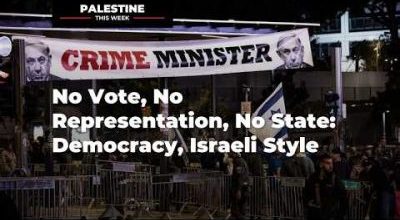
No Vote, No Representation, No State: Democracy, Israeli Style
or go to
Aletho News Archives – Video-Images
From the Archives
Sanctions, War and the Policy of Dual Containment
By SASAN FAYAZMANESH | March 17, 2008
It is now nearly three decades since the Unites States adopted the policy of dual containment of Iran and Iraq. While much has been written about the containment of Iraq, there has been very little in-depth analysis of this policy when it comes to Iran. In a book that is going to be released on March 31, 2008, entitled The United States and Iran: Sanctions, Wars and the Policy of Dual Containment (Routledge), I attempt to address this shortcoming by investigating when and why the US policy of containment of Iran came about, how it evolved, and where it stands today.[1] To the extent that Israel has been involved in US policy making, the study will also include the role that Israel has played in the containment of Iran. Also, since the fate of Iran has been inextricably linked to that of Iraq, occasionally the investigation will overlap with the containment of Iraq.
The policy of dual containment of Iran and Iraq originated during the Carter Administration, but it was not until the Clinton Administration that the expression “dual containment” became popular. … continue
Blog Roll
 Aletho News
- Europe’s Establishment Is Embracing War – and Losing Voters
- NATO chief advocates war of aggression
- No Vote, No Representation, No State: Democracy, Israeli Style
- Zionist Bought Senate Blocks Information About American Citizens Killed By Israel
- While Gaza dominates the UN, these are the people keeping it alive
- New Report: “Scholasticide and Genocide in Gaza: Assessment, Testimonies and Legal Analysis”
- ‘THAAD Delusion’: Iran war exposes US missile shield limits – The Atlantic
- Moscow issues warning to NATO over Russian exclave
- Yes, the Iran war has destroyed Trump’s presidency
- The fallacy of US delusions about Iran’s economic collapse
- If Americans Knew
- Mamdani releases plan to combat antisemitism and hate crimes in New York City
- Iran’s Revolutionary Guards Publish Letter to the American People
- DMFI launches $1 million ad campaign supporting Virginia’s Elaine Luria
- US Senate blocks resolution seeking report on Americans killed by Israel
- Israeli Attacks Kill Ten Palestinians in Gaza
- Massacre at Minab: The School That Became a Grave
- Israeli media: The IDF Shows It Doesn’t Turn a Blind Eye; It Actively Emboldens Settler Havoc
- As settlers ravage West Bank, Israeli forces kill 10 in Gaza – Daily Update
- New Report: “Scholasticide and Genocide in Gaza: Assessment, Testimonies and Legal Analysis”
- Ex-Biden officials are desperate for a Gaza scapegoat
- No Tricks Zone
- Green Energy Debacle: German Expert Professor Fritz Vahrenholt Warns Of Severe Economic And Social Consequences
- Two More Paleo Reconstructions Affirm Meters-Higher Sea Levels Across Ireland, Brazil 7000-6000 Years Ago
- New Study: Earth And Venus Surface Warmth Largely Explained By Convection And Lapse Rate, Not CO2 Or Radiation
- 2025 Nature Paper Claiming Worsening Global Drought Gets RETRACTED …Heavily Flawed
- New Study: ‘Global Drought Shows No Detectable Recent Acceleration Under Climate Warming’
- Economic Masterminds: German Socialists Suggest Taxing Productivity Gains Stemming From Using AI
- The South China Sea Has Not Been Cooperating With The Climate Change Narrative
- Energy Crisis: Germany Enters Heating Season With Historically Low Gas Reserve Fill Levels
- New Study: The Antarctic Ice Sheet Gained Mass From 2020-2024 Due To Staggering Snow And Ice Accumulation
- Study: Ocean Heating Rates From Thousands Of Years Ago ‘Dwarf’ Modern Ocean Heating Rates

