NATO plans 40,000-strong rapid response force in E. Europe
RT | June 22, 2015
NATO’s rapid response Spearhead Force in Europe might reach 40,000 troops, a tenfold growth from the initial 4,000-strong force deployed last year, the military alliance’s chief said. Most of these troops will be stationed near Russian borders.
“NATO defense ministers … [will] make a decision to further increase the strength and capacity of the 13,000-strong NATO Response Force (NRF) to 30,000 or 40,000 troops,” Secretary-General Jens Stoltenberg said Monday.
The decision is to be officially announced during NATO’s defense ministers meeting on June 24-25 in Brussels.
The troops will be under the command of 6 HQs to be stationed in Bulgaria, Estonia, Latvia, Lithuania, Poland and Romania. The Spearhead Force will include Special Forces and rapid response teams, enforced with marine and air components.
A new rapid reaction force ready to be deployed within 48 hours was initially intended to consist of 4,000 troops.
The Spearhead Force has already held its first military drills codenamed Noble Jump in Poland. The war games became “the biggest reinforcement” of defense since Cold War times, said Stoltenberg, adding that the alliance is facing challenges from “the behavior of a more assertive” Russia.
Last week, Stoltenberg criticized Russia for announced plans to add to its nuclear arsenal 40 newly made intercontinental ballistic missiles in 2015.
“This nuclear saber-rattling of Russia is unjustified. It’s destabilizing and it’s dangerous. This is something which we are addressing, and it’s also one of the reasons we are now increasing the readiness and preparedness of our forces,” Stoltenberg said during a news briefing in Brussels last Tuesday.
Russian President Vladimir Putin made the announcement about further development of the strategic nuclear armed forces in response to a report that the US is seriously considering deployment of heavy weapons to new NATO member states on permanent basis.
The chill in Russia-US relations already resemble the worst years of the Cold War, yet experts warn that further escalation of the Ukrainian crisis could lead to an open standoff between Moscow and Washington.
If Washington opts to send armaments to Kiev authorities, as some Republicans congressmen want, Moscow would react immediately, experts quoted in US media believe.
Washington should pursue a diplomatic solution for its conflict with Russia, former US Ambassador to Russia Michael McFaul told The New York Times.
“The US-Russia conflict is not going to be resolved in weeks or months,” McFaul said. “This challenge will take years, even decades.”
Read more
NATO conducting biggest beef up of defenses since Cold War – alliance chief
Moscow will respond to NATO approaching Russian borders ‘accordingly’ – Putin
Over 10,000 Soldiers Desert Ukrainian Army
Sputnik – 21.06.2015
More than 10,000 cases of desertion have been registered in the Ukrainian Army since the outbreak of the Donbass war in April 2014, Ukrainian Vesti reported.
In 2014 the army suffered heavy desertion and nearly 30 percent of the servicemen called up in the first wave of mobilization (March 17) abandoned their positions, Ukrainian President Petro Poroshenko said.
Ukrainian parliament Verkhovna Rada has announced six waves of mobilization so far. By the end of 2014 the strength of Ukrainian Armed Forces grew from 130,000 to 232,000.Ukrainians have been protesting against the mobilization. They travel to work abroad or simply reside at their relatives’ in other countries. Almost 1,3 million Ukrainian draftees live in Russia.
Since April 7, 2014 the Kiev authorities have been waging war against Donbass self-defense forces who rejected the legitimacy of the coup-imposed Ukrainian government and declared the independent republics of Donetsk and Lugansk.
Official figures estimate the number of victims to near 6,500. But the German intelligence reported of 50,000 victims in February 2015.
The Arrogance and Hypocrisy of the United States
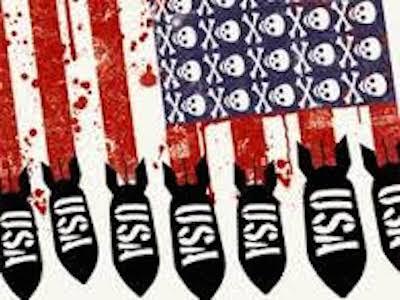
By Robert Fantina | Aletho News | June 19, 2015
From its earliest days, the United States has been an imperial power, taking what it wants from whoever has it, killing those who get in its way. Even prior to its establishment as a nation, it abused the welcoming friendship of the natives, seeing them as less than human and, therefore, expendable.
Once it threw off the yoke of Great Britain, who saw the colonies as sources of revenue, the new nation saw the Native Americans as impediments to its growth. The ugly concept of Manifest Destiny was introduced early by journalist John O’Sullivan, and embraced by an ambitious and blood-thirsty nation. Mr. O’Sullivan said that the mission of the United States was “to overspread the continent allotted by Providence for the free development of our yearly multiplying millions.” Further, he claimed that ‘Until every acre of the North American continent is occupied by citizens of the United States, the foundation of the future empire will not have been laid.” By the time this was written, that goal had been thwarted by Canada, but Mexico was not to be so fortunate. Shortly thereafter, the Mexican territory of Texas was annexed by the U.S.
The Monroe Doctrine, introduced in the same generation as Manifest Destiny, warned European countries not to interfere in North America, at the risk of U.S. intervention. The U.S., of course, saw all of North American as England previously saw its North American colonies, simply as a source of revenue, which included cheap labor. Such lucrative opportunities must not be taken by Europe.
With increasing wealth and power came increasing lust for more of the same. As the nineteenth century drew to a close, Assistant Secretary of the Navy Theodore Roosevelt, an unabashed imperialist, was desperate to make the U.S. a world power. Once the battleship Maine exploded in Havana Harbor, Mr. Roosevelt rushed to silence the legitimate theory that this had been due to spontaneous combustion resulting from the positioning of the magazine by the coal bunkers. No, for Mr. Roosevelt, this was an opportunity to show Spain that the U.S. will not be trifled with, proof positive of Spain’s brutal actions, and sufficient reason to declare war; thus, the Spanish-American War began. This resulted in the annexation of Guam, Puerto Rico and the Philippines by the U.S. This spawned the Philippine-American War; the Filipino people, for some reason that escaped anyone in U.S. governance, were not willing to surrender their country to the U.S. So, with the unspeakable violence and inhumane actions with which it came to be identified, the U.S. crushed the Filipino people.
When the U.S. entered World War I, it was its first foray into a European conflict. In 1917, at least six ships either owned by the U.S., or carrying U.S. citizens, were sunk. While this caused outrage in the U.S., it was the business community that was most concerned. By 1917, U.S. financiers had lent the Allies at least $2.3 billion. U.S. economic expansion depended on an Allied victory, so war was inevitable to ensure it. Towards the end of the war, even President Woodrow Wilson, who led the U.S. into the war, and thus presided over the deaths of 117,000 Americans, admitted that the war was waged for commercial purposes, and not for some lofty ideals of freedom. Said he: “Why, my fellow-citizens, is there any man here, or any woman – let me say, is there any child here – who does not know that the seed of war in the modern world is industrial and commercial rivalry? This war, in its inception, was a commercial and industrial war.”
Under President Lyndon B. Johnson, the U.S. found beneficial the model it had previously successfully used to enter or start wars, to escalate hostilities with Vietnam. The U.S. had long ago decreed Communism as the great threat to civilization, and with the Communist North of Vietnam attempting to reunite with the U.S.-puppet-run South, the U.S. needed to act. In order to increase the number of U.S. soldiers sent to that beleaguered nation, an excuse had to be found. The so-called Gulf of Tonkin incident, which was really a non-incident, was the excuse this time.
The staging area for the U.S. Seventh Fleet was the Gulf of Tonkin. On August 2, 1964, the U.S. destroyer Maddox was on an espionage mission when it was fired on by North Vietnamese torpedo patrol boats. The Maddox, with supporting air power, fired back, sinking one North Vietnamese boat.
Two evenings later, the Maddox and another destroyer, the C. Turner Joy, were again in the gulf. The Maddox’s instruments indicated that the ship was under attack, or had been attacked. The captain began an immediate retaliatory strike. Both ships began firing in to the night. However, officials on the ships later determined that they were shooting at ‘ghost images’ on their radar. The evidence indicated that they had not, in fact, been attacked.
Regardless of this, the incident was presented to the world, and more importantly, to the U.S. Congress, as an act of aggression against the United States. The Gulf of Tonkin Resolution, empowering the president to take any and all means necessary to repel this ‘aggression,’ quickly passed Congress.
Eleven years later, with over 55,000 U.S. soldiers and at least 2,000,000 Vietnamese men, women and children dead, the last U.S. soldiers and administrators fled Saigon as the Vietcong swept through. U.S. hubris has been defeated.
The U.S. public relations organization works overtime to foster the myth of the country as a beacon of peace and freedom. Yet its demands that other nations adhere to some lofty standard of respect for human rights cannot withstand any close scrutiny. The U.S. has used its veto power at the United Nations at least 40 times to protect Israel, a nation that can only be described as apartheid, from any consequences of its barbaric practices. Its own cities are not safe for young, unarmed African-American men, who are shot and killed by white police officers in epidemic proportions. It is rare for any of the officers pulling the trigger to be indicted, let alone convicted of these racist crimes.
The U.S. condemned Syria for allegedly using chemical weapons, but finances all of Israel’s weaponry, including its chemical weapons, used routinely against the Palestinians. ISIL (Islamic State of Iraq and the Levant) has been condemned, legitimately, for beheading its prisoners, but the U.S. has full diplomatic relations with Saudi Arabia, which uses public beheading as a means of execution, and has used that method over 80 times this year alone. Should ISIL ever establish a relatively stable government on oil-rich lands, its barbaric practices will also be overlooked.
Over half of U.S. senators are millionaires, and they increase taxes on the middle class and poor as they reduce taxes for the rich. The government condemns the deaths of innocent people in war-torn countries, as it sends drones around the world that kill thousands of innocent people. The government demands a military ‘defense’ budget larger than that of the eight next largest international military budgets combined, depriving schools of much-needed revenue as it strengthens its deadly war machine, yet those other countries are not plagued with constant attacks and invasions, despite their much-smaller military budgets.
In the U.S., there is a separate justice system for the wealthy, with bankers confessing to felonies paying small fines, while poverty-stricken people caught with small amounts of marijuana spend years in prison. Wealthy pedophiles are sentenced to small fines and a few months in prison.
Poor and middle-class students who want to attend U.S. colleges and universities can borrow money from the government at an interest rate of 4.66%. Banks borrow money from the government at an interest rate of 0.75%. And if the bank fails, the U.S. government will rescue it. If a former student declares bankruptcy, his/her student loan is not absolved.
When in desperation a young person enlists in the military, he/she may find themselves killing men, woman and children that pose no threat to them. Then, on returning home, not only is the tuition program offered to veterans minimal, good luck to them in trying to get assistance for post-traumatic stress disorder. Over 50% of veterans will experience homelessness at some point after their time in the military, and they have higher-than-average rates of suicide, substance abuse, divorce and domestic violence. The U.S. government is happy to send them off to war, but is not interested in them when they return, broken and bruised. They have served their corporate purpose, and can now be discarded.
This is life in the much-touted ‘land of opportunity’, the ‘home of the free and the brave’. Yes, opportunity abounds for the rich, but for the poor and those who are struggling to maintain a middle-class standard, things are not so rosy. But ask the common man or woman on any U.S. street what they believe to be the greatest country in the world, and their hearts will swell pride and their eyes become moist as they proclaim it to be the U.S.A. And the U.S. public relations effort scores another victory, while the blind lemmings fall off the cliff.
MoD confirms Britain is arming Saudi Arabia in Yemen conflict
RT | June 19, 2015
Britain’s Ministry of Defence has confirmed it is providing technical support and arming Saudi Arabia in its ongoing war against Yemen, RT has learned.
An MoD spokesperson said the UK’s assistance to Saudi Arabia includes providing “precision guided weapons,” but added the British government had been assured they will be used in compliance with international law.
Anti-arms trade campaigners condemned Britain’s support for the Gulf monarchy, claiming the UK cares more about arms sales than human rights and democracy.
RT contacted the MoD to ask if British weapons are being used in Saudi airstrikes on Yemen and if the UK is providing assistance to the Saudi-led coalition.
An MoD spokesperson replied: “The UK is not participating directly in Saudi military operations. We are providing support to the Saudi Arabian Armed Forces and as part of pre-existing arrangements are providing precision guided weapons to assist the Saudi Air Force.
“The use of these weapons is a matter for the Saudis but we are assured that they will be used in compliance with international law.”
The MoD’s response confirms suspicions held by anti-arms trade campaigners that Britain is providing support for a war that top Yemeni academics based in the West have branded “illegal.”
Andrew Smith of Campaign Against the Arms Trade (CAAT) said: “The Saudi bombing has created a humanitarian catastrophe and now we know the UK weapons have contributed to it.”
“These weapons have not just given military support to the bombardment, they have also provided a strong political support and underlined the closeness between the UK and Saudi governments.”
“With the destruction of Yemen and the intensifying crackdown on dissent in Saudi Arabia, the UK government is sending the message that human rights and democracy are less important than arms sales,” he added.
CAAT said the “precision guided weapons” used by the Saudi Air Force are likely to be Eurofighter Typhoons or Tornado jets.
Saudi Arabia has spent an estimated £2.5 billion upgrading its fleet of 73 Tornados as part of a deal negotiated with UK-based arms manufacturers BAE Systems.
Saudi Arabia and the UK have long had close dealings in the arms trade. Saudi Arabia is Britain’s largest customer for weapons and the UK is the Gulf nation’s single biggest supplier, according to CAAT. … Full article
What the United States Did to Vietnam
By BRETT MORRIS | CounterPunch | June 19, 2015
The insidious effort to whitewash the US war on Vietnam continues. The official “Vietnam War Commemoration” run by the Pentagon refuses to recognize the war for what it was: an act of aggression that decimated three countries, killed and wounded millions of people, blocked democracy and development, littered the countryside with millions of unexploded bombs (which kill and wound people to this day), and poisoned the food supply with chemical warfare (causing deformities and birth defects).
We should not let these crimes go unheard of, or allow propagandists to spin them into events that were mere “accidents.” The US destruction of Vietnam was a deliberate act.
A healthy antidote to the silence/propaganda of US aggression against Vietnam would be to pay a visit to Vietnam’s War Remnants Museum in Ho Chi Minh City (Saigon), as I have recently done. Ironically accused by propagandists in the United States of being a “one-sided” museum filled with “propaganda,” the museum offers a much more accurate depiction of the US war against Vietnam than anything you’ll find in US history textbooks or popular culture.
Crucial to understanding the US war against Vietnam is knowing that it was a war against democracy and self-determination. Ho Chi Minh begged the United States to support Vietnam’s efforts to gain independence from France. An admirer of the American Revolution, Ho Chi Minh quoted the US Declaration of Independence in Vietnam’s own Declaration:
“All men are created equal. They are endowed by their Creator with certain inalienable rights, among these are Life, Liberty, and the pursuit of Happiness.”
This immortal statement was made in the Declaration of Independence in the United States of America in 1776. In a broader sense, this means: All the peoples on the earth are equal from birth, all the peoples have a right to live, to be happy and free.
Of course, the United States wholly backed France’s efforts to reconquer Vietnam. When France failed, the United States took up the task, engaging in a war of aggression, or what is called the “supreme international crime differing only from other war crimes in that it contains within itself the accumulated evil of the whole,” in the words of Nuremberg Tribunal.
The United States did everything possible to block the will of the Vietnamese people. The US-backed dictator of South Vietnam blocked elections in 1956 to prevent Ho Chi Minh from coming to power (Dwight D. Eisenhower estimated that up to 80 percent of Vietnamese would have supported Ho Chi Minh in an election during the First Indochina War).

“Tiger cages” used to hold prisoners.
Since the Vietnamese continued to resist the US-imposed dictatorship in South Vietnam, the United States invaded Vietnam in the early 1960s, beginning a devastating campaign of bombings, atrocities, chemical warfare, and torture, leading to the deaths of 3.8 million people, according to a study published in the BMJ (formerly the British Medical Journal).
According to Nick Turse in Kill Anything That Moves:
[T]he stunning scale of civilian suffering in Vietnam is far beyond anything that can be explained as merely the work of some “bad apples,” however numerous. Murder, torture, rape, abuse, forced displacement, home burnings, specious arrests, imprisonment without due process—such occurrences were virtually a daily fact of life throughout the years of the American presence in Vietnam. … [T]hey were no aberration. Rather, they were the inevitable outcome of deliberate policies, dictated at the highest levels of the military.
Turse’s investigations of US war crimes (spurred by his discovery of the Pentagon’s Vietnam War Crimes Working Group) lend credence to the various displays and photographs one will find in the museum.
One example is a sewer pipe present at the Thanh Phong massacre, used by three children to hide in before being killed by future Senator Bob Kerrey and his cohorts (ten other civilians also died).

Thanh Phong sewer pipe.
More deadly than the daily atrocities, however, were the bombings. According to historian Howard Zinn, the United States dropped 7 million tons of bombs on Vietnam by the end of the war. Many of these bombs did not explode, and continue to kill people today when farmers accidently plow over them, children pick them up thinking they are toys, or scrap metal hunters looking to earn a small amount of change collect them.
Perhaps the most horrifying exhibit one will encounter in the museum displays the effects of Agent Orange. The United States sprayed roughly 20 million gallons of herbicides on the Vietnamese countryside. According to the Vietnamese Red Cross in 2002, one million people have disabilities or other health problems as a result of Agent Orange, including 100,000 disabled children.

Unforgivable crimes.
You’ll rarely see such images or hear such facts in the United States—the myth of the United States being “exceptional” must continue being shoved down US citizens’ throats, so that new wars and imperialistic campaigns can be waged. Next time a politician calls for another war or “humanitarian intervention,” just remember what the United States did to Vietnam.
Brett S. Morris is a freelance writer, journalist, photographer, and author. He has traveled the world, documenting current events and the legacy of US foreign policy. His latest book is 21 Lies They Tell You About American Foreign Policy. He can be reached on Twitter and Facebook
Global conflict cost world $14.3 trillion in 2014: Report
Press TV | June 18, 2015
The cost of global war in the year 2014 reached $14.3 trillion, or 13.4 percent of the global gross domestic product, a report by the Institute for Economics and Peace says.
Last year, the cost of global conflict equaled the combined economies of Britain, Germany, France, Brazil, Canada, and Spain, according to a recent report by the Australia-based group.
The statistics mark a 15.3-percent spike in the cost of conflicts since 2008 when the financial impact was recorded as $12.4 trillion, the report notes.
“Large increases in costs are due to the increases in deaths from internal conflict, increases for IDP (internally displaced person) and refugee support, and GDP losses from conflict, with the latter accounting for 38 percent of the increase since 2008,” the report stated.
Since 2008, the cost of supporting IDPs and refugees has increased by 267 percent and the number of people forced to relocate by war has reached its highest since the Second World War, the report noted.
It also described the Middle East and North Africa as the most violent regions in the world and Europe as the most peaceful, adding that Saudi Arabia’s ongoing aggression against Yemen has dragged down the overall outlook for the Middle East.
According to the report, Syria, which has been gripped by deadly unrest since March 2011, was world’s least peaceful country, followed by Iraq, Afghanistan, South Sudan, and the Central African Republic.
Discharged Trident whistleblower rebukes Royal Navy ‘spin’
RT | June 17, 2015
Nuclear whistleblower William McNeilly, who had been dishonorably discharged from the Royal Navy, says military “spin doctors” have tried to obscure the safety and security concerns he raised in an extensive dossier last month.
McNeilly now claims to have been dishonorably discharged from the service, having not been heard from for over a month.
Reports over the intervening period suggested he was held in a secure military facility.
In a new nine-page document published online, he said: “It is shocking that some people in a military force can be more concerned about public image than public safety.”
McNeilly posted his original findings online last month while AWOL, raising up to 30 issues regarding nuclear weapons safety and base security.
The Navy immediately claimed McNeilly’s allegations were “subjective and unsubstantiated” and “factually incorrect or the result of misunderstanding or partial understanding.”
McNeilly has now responded, saying: “Other submariners have been anonymously releasing information to journalists.
“It’s only a matter of time before worse information comes out, and everything is proven to be true.”
There had initially been discussion over whether McNeilly would be charged under the Official Secrets Act, fears which seem to have abated.
“All of the charges against me were dropped; there’s nothing that I can be charged with now,” he said.
“Most people know that I acted in the interest of national security. However, I was still given a dishonorable discharge from the Royal Navy.”
McNeilly feels he was discharged by the Navy “on the claim that my sole aim was to discredit their public image.”
Having served aboard the Trident submarine HMS Victory earlier this year, McNeilly said he was shocked at what he saw there.
“When I joined the Royal Navy, I had no idea that I was going to work with nuclear weapons. When I found out, I was happy. I used to think they were an essential tool in maintaining peace, by deterring war,” he said.
“It wasn’t until I saw the major safety and security issues that I realized the system is more of a threat than a deterrent.”
The furor around McNeilly’s leaks saw Scottish National Party MP Alex Salmond raise the question of Trident safety in Parliament, saying “Trident is a key issue for people in Scotland.”
“It is bad enough that Scotland is forced to house these weapons of mass destruction, but these alleged breaches of security are deeply worrying – there must be absolutely no complacency,” Salmond said.
McNeilly has said claims he was an SNP agent are wrong, although he added he supports the party’s aim to remove Trident from Scotland.
“I’ve been strongly advised to remain silent and live a private life,” he said.
However, he has no plans to go quietly, it seems.
“I’m civilian now, and I have the right to free speech. I’m not going to waste that freedom by just sitting around on my ass, while the UK is in danger.”
A Royal Navy spokeswoman confirmed to Portsmouth News that McNeilly is no longer in the Navy.
Read more:
Trident nuke safety questioned by Salmond after Navy whistleblower leak
‘Nuclear disaster waiting to happen’: Royal Navy probes Trident whistleblower’s claims
Nuclear safety incidents soar 54% at UK’s Clyde sub base & arms depot
Policing and Defending Then and Now
The military and police have become two sides of the same coin
By Philip Giraldi • Unz Review • June 16, 2015
Inevitably the debate over issues that relate to both national security and domestic law enforcement often become mired down in wrangling over legal or constitutional niceties, which the public has difficulty in following as it fixates instead on the latest twist in the Bruce Jenner saga. That means that the punditry and media concentrate on easily digestible issues like potential bureaucratic fixes, budgeting, equipment and training, which presumably are both simpler to understand and also more susceptible to possible remedies. But they ignore some basic questions regarding the nature and viability of the actual threat and the actual effectiveness of the response even as the dividing line between military and law enforcement functions becomes less and less evident.
There has been a fundamental transformation of the roles of both police and the armed services in the United States, a redirection that has become increasingly evident since the 1990s when the conjoined issues of national security and crime rates became political footballs. Response to terrorism and “tough on crime” attitudes frequently employ the same rhetoric, incorporating both political and social elements that place police forces and the military on the same side in what might plausibly be described as a version of the often cited clash of civilizations.
A nation’s army traditionally exists to use maximum force to find and destroy enemies that threaten the homeland. A police force instead serves to protect the community against criminal elements using the minimum force necessary to do the job. Those roles would appear to be distinct but one might reasonably argue that the armed forces and the police in today’s America have become the two major constituents of the same organism more-or-less connected by a revolving door, dedicated to combating a new type of insurgency that comprises both global and domestic battlefields and is no respecter of borders. This has meant at its most basic that there has been a major shift in perception on the part of the security community. Community policing and national defense have abandoned relatively reactive interactions with the community and world for more assertive preemptive roles that see their areas of operation as theaters of conflict analogous to war zones, suggesting to some law enforcement officers that Baltimore is at least occasionally somewhat like Fallujah.
That means that some police forces have allowed considerable space to develop between themselves and the communities they are supposed to guard. Many now see themselves less as crime solvers and protectors of the public, instead increasingly embracing their role as a first line of defense against terror and social unrest. As a consequence, police in today’s America are inevitably tasked with maintaining public order in a fashion that once upon a time would have likely been the responsibility of the military equipped and trained as well as far more numerous National Guard.
This tendency to expand and redirect the police role gained momentum in the early 1990s, when law enforcement began to focus on terrorism in the wake of Oklahoma City and the first World Trade Center bombing. After 9/11 it picked up speed when the Bush Administration rushed to adopt a preemptive foreign policy that fit in nicely with a more assertive role by police. Special Weapons and Tactics (SWAT) teams were symptomatic of the change. Originating in Los Angeles in the 1960s, SWAT units spread to nearly every major and many minor police departments whether there was or is any need for them or not. Police departments, embracing having an exciting new weapon and looking for excuses to use it, began to allocate tasks that normally had been the responsibility of beat or patrol officers, including serving warrants. SWAT delivery of what are described as “no-knock” warrants that are frequently issued without any real justification and sometimes based on faulty intelligence has consequently become a bete noire for critics of police overreach. The warrants are sometimes served in the middle of the night by heavily armed officers and might well be preceded by the use of battering rams and “flashbang” grenades, resulting in numerous tragedies for those on the receiving end. With SWAT teams attracting the elite police officers, community policing inevitably has suffered, frequently being assigned to new and less experienced officers.
Police and the military now share equipment, training and doctrine. The equipment, most of which is useful for fighting a war but of marginal utility for police work, is frequently highly visible and changes both how local law enforcement is perceived and how it operates. Arizona alone has received 29 armored personnel carriers, 9 military helicopters, 800 M-16 automatic rifles, 400 bayonets, and 700 pairs of night-vision goggles.
Morven, Georgia, population 600 and blessed by a low crime rate, has received over $4 million worth of military equipment. This led to the formation of a SWAT team supported by a Humvee and an armored personnel carrier. Boats and scuba gear came together to form a dive team, even though Morven city limits incorporate no body of water deep enough to exploit that capability. The Morven police chief boasts that the equipment would enable him to “shut this town down” and “completely control everything.”
The direct transfers of $5.4 billion worth of surplus equipment from the Pentagon through program 1033 and the purchase of additional hardware by way of grants from the Department of Homeland Security operate with almost no oversight over the actual need for the equipment and little accountability afterwards regarding where it winds up. It has spawned what some have described as a police-industrial complex, which is frequently justified by the alleged terrorist threat even though the equipment is in fact almost never used in response to terrorism related situations.
Today’s police approach every potential conflict situation with overwhelming force because that is what the military does, considering “force protection” as its number one priority. The army and law enforcement also share employees, guaranteeing that the mindsets within the two organization will be highly compatible. There are no national figures compiled on how many policeman have been in the military, but anecdotal evidence from various departments suggest that the percentage is somewhere between 20 and 60 per cent, many of whom also continue to serve in the Reserves or National Guard. A veterans’ placement service called Hire Heroes estimates that fully twenty per cent of all ex-soldiers seeking civilian employment look for work in law enforcement as a first choice.
The Federal government also encourages police departments to hire veterans through its Community Oriented Policing Services (COPS), which has provided $114.6 million in incentive grants to 220 cities nationwide. There is frequently a comfortable fit psychologically. The transition from military to police is particularly smooth currently because their self-perceptions as “forces for peace and security” working in environments where they are not appreciated or even welcomed is nearly identical.
On the plus side when turning soldiers into cops, former military are accustomed to operating in a highly disciplined and rule-driven top-down organization, but on the negative side veterans who actually experienced significant combat are much more accustomed to rely on their weapons than are policemen in most working environments, a predilection that sometimes produces avoidable fatal consequences. The window of aggression acceptable to a soldier on a combat patrol is and should be radically different than that of a policeman in an American city.
Returning soldiers who experienced significant combat sometimes come home with mental health issues to include Post Traumatic Stress Disorder (PTSD), with many veterans conceding that after discharge from the service there are sometimes numerous psychological issues that have to be worked through. Police departments do their best to manage that issue through psychiatric screening, but detection of problems is not always that easy, particularly if the job applicant wants the job and is not being particularly forthcoming. Many concede that for ex-soldiers thus afflicted leaving one environment full of “violence, tension, stress [and] anxiety” and landing into something similar would not exactly be therapeutic.
Law enforcement in the United States has also benefited not only from the surplus weapons it receives from the Pentagon but also from training grants and logistical support from the Department of Homeland Security. Many SWAT teams are trained by and often include former or current Special Forces soldiers. Some departments even use both public and private grant money to send officers to Israel to train with the Israeli National Police and that country’s Defense Force. The training inevitably focuses on counter-terrorism, anti-riot procedures, intelligence gathering and crowd control, reinforcing the impression that such activities that once upon a time might have been regarded as peripheral to police work are now the first priority. There are also reports that some American police forces are interested in buying an Israeli high tech export called “Skunk,” which is a liquid that can be sprayed from water cannons that allegedly smells like raw sewage and putrefying flesh. It has been used on Palestinian protesters.
But perhaps the biggest unanswered question is “Does terrorism in its many guises actually threaten the United States and will that threat be diminished by more equipment and training as well as a more militarized police force here at home?” Addressing the threat issue is critical as it presents a steady drumbeat for action “to defend the nation” and actually provides much of the popular support for an increasingly robust police response. To be sure, there undoubtedly exists a growing critical consensus that the terrorist threat is largely phony, having been inflated by both political parties for political reasons. Certainly the record of terrorism related arrests suggests that the danger is minimal and those detained in the process are often the product of what many would call law enforcement entrapment. There is actually no evidence that a more militarized police has thwarted terrorist attacks or led to any significant arrests, which rather suggests that the real motive for the increasingly assertive profile for law enforcement might just be to have the tools on hand to intimidate or even put down domestic dissent. If that is so, every American should be concerned about what might be coming down the road.
Israel’s Race to Economic (and Moral) Bankruptcy
By Jonathan Cook | Dissident Voice | June 16, 2015
Two recent reports suggest that Israel could face catastrophic consequences if it fails to end the mistreatment of Palestinians under its rule, whether in the occupied territories or in Israel itself.
The Rand Corporation’s research shows that Israel could lose $250 billion over the next decade if it fails to make peace with the Palestinians and violence escalates. Ending the occupation, on the other hand, could bring a dividend of more than $120 billion to the nation’s coffers.
Meanwhile, the Israeli finance ministry predicts an even more dismal future unless Israel reinvents itself. It is likely to be bankrupt within a few decades, the finance ministry report says, because of the rapid growth of two groups who are not productive.
By 2059, half the population will be either ultra-Orthodox Jews, who prefer prayer to work, or members of Israel’s Palestinian minority, most of whom are failed by their separate education system and then excluded from much of the economy.
Both reports should be generating a tidal wave of concern in Israel but have caused barely a ripple. The status quo – of occupation and endemic racism – still seems preferable to most Israelis.
The explanation requires a much deeper analysis than either the Rand Corporation or Israel’s finance ministry appears capable of.
The finance ministry report points out that with a growing population not properly prepared for a modern, global economy, the tax burden is falling increasingly heavily on a shrinking middle class.
The fear is that this will rapidly create a vicious cycle. Wealthier Israelis tend to have second passports. Overwhelmed by the need to make up the revenue shortfall, they will leave, plunging Israel into irreversible debt.
Despite this doomsday scenario, Israel seems far from ready to undertake the urgent restructuring needed to salvage its economy. Zionism, Israel’s official ideology, is predicated on core principles of ethnic separation, Judaisation of territory and Hebrew labour. It has always depended on the marginalisation at best, exclusion at worst, of non-Jews.
Any effort to dismantle the scaffolding of a Jewish state would create a political crisis. Reforms may happen, but they are likely to take place too slowly and incrementally to make much difference.
The Rand report also raises the alarm. It notes that both peoples would benefit from peace, though the incentive is stronger for Palestinians. Integration into the Middle East would see average wages rise by only 5 per cent for Israelis, compared to 36 per cent for Palestinians.
But, while its economists may have found it easy to quantify the benefits of ending the occupation, it is much harder to assess the costs in shekels and dollars.
Over the past six decades, an economic elite has emerged in Israel whose prestige, power and wealth depends on the occupation. Career military officers earn large salaries and retire in their early forties on generous pensions. Nowadays many of these officers live in the settlements.
The army top brass are the ultimate pressure group and will not release their grip on the occupied territories without a fight, one they are well placed to win.
Backing them will be those in the hi-tech sector who have become the engine of the Israeli economy. Many are former soldiers who realised the occupied territories were the ideal laboratory for developing and testing military hardware and software.
Israel’s excellence in weaponry, surveillance systems, containment strategies, biometric data collection, crowd control, and psychological warfare are all marketable. Israeli know-how has become indispensable to the global appetite for “homeland security”.
That expertise was on show this month at a Tel Aviv armaments expo that attracted thousands of security officials from around the world, drawn by the selling point that the systems on offer were “combat proven”.
To end the occupation would be to sacrifice all this and revert to the status of a tiny anonymous state with no resources or notable exports.
And finally the settlers are among the most ideologically committed and entitled sector of Israel’s population. Were they moved out, they would bring their group cohesion and profound resentments back into Israel.
No Israeli leader wants to unleash a civil war that could rip apart the already-fragile sense of unity among the Jewish population.
The reality is that most Israelis’ perception of their national interests, both as a Jewish state and as military superpower, are intimately tied to a permanent occupation and the exclusion of Israel’s Palestinian minority from true citizenship.
If there is a conclusion to be drawn from these two reports it may be a pessimistic one.
Israel’s internal economy is likely to grow gradually weaker, as the ultra-Orthodox and Palestinian labour forces are under-utilised. As a result, the focus of Israel’s economic interests and activity is likely to shift even more towards the occupied territories.
Far from Israelis rethinking their oppressive policies towards the Palestinians, the ideological blinkers imposed by Zionism could push them to pursue the benefits of the occupation even more aggressively.
If the watching world really wants peace, economic wishful thinking will not suffice. It is past the time simply for carrots. Sticks are needed too.
US escalates Russia tension with pledges to put F-22 fighters in Europe
US cites fictional Russian threat
Sputnik | 16.06.2015
Washington is mulling the delivery of stealthy F-22 Raptor fighter jets to Europe in the face of a “resurgent Russia”, according to US Air Force Secretary Deborah Lee James.
The US Air Force plans to further increase the number of its rotational forces in Europe amid tensions with Russia and could deploy the F-22 fighter to Europe, US Air Force Secretary Deborah Lee James was quoted by the Wall Street Journal as saying.
She made the statement during the Paris Airshow at Le Bourget earlier this week.
“That’s the beginning, there will be more. You’ll continue to see more and more rotational forces. The biggest threat on my mind is what’s happening with Russia and the activities of Russia. That’s a big part of why I’m here in Europe,” James said.
She added that she saw “no reason” why the fifth-generation F-22 fighter jets could not be stationed in Europe, but refused to elaborate.
The statement came shortly after the US military awarded defense contractor Lockheed Martin nearly 70 million dollars to add flying hours to the F-22 Raptor fighter jets.
Earlier, the US Air Force stepped up its number of air patrols in the Baltics as Britain received B-2 stealth bombers and B-52 bombers from the US.
On Monday, it was reported that the Pentagon is poised to send heavy military equipment to Eastern Europe and the Baltic nations, as part of its effort to strengthen US forces there. The move was harshly condemned by Russia, which said that this possible decision would undermine the 1997 Russia-NATO Founding Act.
The Anglo-American Insanity
By Finian Cunningham – Strategic Culture Foundation – June 15, 2015
In a sane world, British Foreign Secretary Philip Hammond should be forced to quit his post in disgrace as the country’s top diplomat, following reckless remarks that Britain may henceforth site American nuclear weapons to counter the “threat from Russia.” So here we have an alarming escalation of international tensions and militarism by both Washington and London – and all on the back of unproven, prejudicial words from the close Anglo-American allies, who are clearly working in tandem.
Hammond’s overt reversal to Cold War mentality comes as Washington is also reportedly considering the deployment of “first-strike” nuclear missiles in various European Union countries. The Americans are claiming that move is “in response” to Russia violating the 1987 Intermediate Nuclear Forces Treaty (INF). Moscow is accused of testing land-based cruise missiles banned under the INF. Russia has flatly denied this American claim, which – as is becoming the norm in other contentious matters – has not been supported with any evidence from Washington.
This slanderous attitude toward Russia is doubly contemptible, because not only is it calumnious, the deception also serves as a political and moral cover that allows the Anglo-American rulers to take outrageous steps toward jeopardising international peace, with the unprecedented deployment of nuclear weapons.
On the issue of Britain siting American nuclear weapons, Hammond told the rightwing Daily Telegraph :
I think it is right to be concerned about the way the Russians are developing what they call asymmetric warfare doctrine… We have got to send a clear signal to Russia that we will not allow them to transgress our red lines. We would look at the case [of installing American nuclear weapons on British soil]. We work extremely closely with the Americans. That would be a decision that we would make together if that proposition was on the table. We would look at all the pros and the cons and come to a conclusion.
For self-serving good measure, the British foreign minister linked the nuclear issue with alleged Russian aggression in east Ukraine, adding:
There have been some worrying signs of stepping up levels of activity both by Russian forces and by Russian-controlled separatist forces.
Hammond tried to sound ambivalent about the deployment of US nuclear weapons from British territory – in addition to Britain’s own nuclear arsenal – but the mere fact that his government is weighing the possibility is in itself a reckless, inflammatory move. If Britain were to do so, it reverses the prohibition on such American forces that followed the end of the Cold War more than 20 years ago.
Ironically, while Hammond was this week leading the Westminster parliament’s push for a referendum on Britain’s membership of the European Union, it may be noted that the British public is not given a say on whether their country once again becomes part of the United States’ nuclear strike force.
But perhaps the real sacking offence for Hammond is that he is dangerously militarising foreign policy based on absolutely no reasonable evidence; indeed, based on outright disinformation. Just like his American allies in Washington, the Conservative Party minister is making all sorts of hysterical claims against Russia, ranging from posing a threat to Europe, to using “asymmetric war doctrine,” to invading east Ukraine and undermining the Minsk ceasefire. (A ceasefire that Moscow worked hard to broker with Germany and France back in February, in the significant absence of both Washington and London.)
Without any credible information, the American and British governments appear to be moving incrementally toward a pre-emptive nuclear strike capability against Russia. As the Associated Press reported last week, albeit using euphemistic language:
The options go so far as one implied – but not stated explicitly – that would improve the ability of US nuclear weapons to destroy military targets on Russian territory.
The Americans, Britain or NATO have not produced a shred of verifiable evidence that Russia has violated the INF treaty, or is subverting Ukraine, or is threatening any other European country.
On the east Ukraine conflict, it is in fact reliably reported by the Minsk ceasefire monitoring group of the Organisation for Security and Cooperation in Europe (OSCE), as well by local media sources and pro-separatist officials, that the latest surge in violence is coming from the Western-backed Kiev regime. That violence includes the shelling of residential centres in Donetsk City and surrounding towns and villages, which has resulted in dozens of civilian deaths over the past week.
How the British and American governments can make out that Russia is the aggressor and is subverting the Minsk ceasefire is simply a prejudicial assertion that is based on no facts. Moreover, such a view is a distortion of the facts to the point of telling barefaced lies.
That the British foreign secretary can make such misleading and apparently misinformed comments about the Ukraine conflict and Russia in general, and then seek to overhaul Britain’s military policy to install American nuclear weapons on British territory is worthy of a ministerial sacking due to gross incompetence.
Hammond’s embrace of nuclear militarism in the midst of a tense East-West political standoff has not gone unnoticed in Britain. His bellicose remarks have caused controversy, with several anti-war campaign groups reviling the reckless reversal to Cold War mentality. Nevertheless, it is a worrying sign of the mainstream malaise that Hammond’s incompetence has not incurred even greater public condemnation.
Underlying the American and British governments’ foreign policy is just this: a Cold War ideology, which views the entire world in terms of “external threats.” Russia and China are once again foremost as the perceived and portrayed enemies.
In an interview last week with Italian newspaper Corriere della Sera, Russian President Vladimir Putin noted:
As for some countries’ concerns about Russia’s possible aggressive actions, I think that only an insane person and only in a dream can imagine that Russia would suddenly attack NATO.
By deduction, this kind of reasoning categorises people like Britain’s Hammond as “insane.” The same goes for US President Barack Obama and his administration. Addressing the recent G7 summit in Germany, Obama exhorted: “We must face down Russian aggression.”
It might be asked: why do Washington and London in particular always interpret the world in terms of enemies, threats and aggression?
Part of the answer may be that these powers are themselves the biggest practitioners of illegal aggression to pursue foreign policy goals. Imperialism – the use of military force to underpin political and economic objectives – is part and parcel of how America and Britain operate in the world. Aggression and militarism are fundamental instruments of Anglo-American capitalism, as much as banking, trade and investment deals.
There is thus a very real sense of “devil’s conscience” at play in the international relations of Washington and London. They both fear retribution and revenge because of their own criminal conduct toward the rest of the world. In a word, the Anglo-American world view boils down to paranoia.
The militarisation of foreign relations is also an effective, vicarious way to exert control over nominal allies. If external threats can be sufficiently talked up, then that creates a contrived sense of “defence” among “allies” who then look to dominant leaders for “protection.” Such mind games are typical of the way Washington and London have promoted NATO as the protector of “European allies” from “Russian aggression.”
The same mind game is at play over Washington’s interference in Asia-Pacific, where the Americans are trying to cast China as the “evil aggressor” toward smaller nations, who then turn to Washington for “protection” – and large amounts of money to buy American weapons, courtesy of the Fed’s dollar-printing press.
On the matter of alleged Russian aggression, Putin, in the interview cited above, went on to aptly comment:
I think some countries are simply taking advantage of people’s fears with regard to Russia… Let’s suppose that the United States would like to maintain its leadership in the Atlantic [EU] community. It needs an external threat, an external enemy to ensure this leadership. Iran is clearly not enough – this threat is not very scary or big enough. Who can be frightening? And then suddenly this crisis unfolds in Ukraine. Russia is forced to respond. Perhaps, it was engineered on purpose, I don’t know. But it was not our doing.
Speaking to the editor of Corriere della Sera, Putin added:
Let me tell you something – there is no need to fear Russia. The world has changed so drastically that people with some common sense cannot even imagine such a large-scale military conflict today. We have other things to think about, I assure you.
That is why politicians like British Foreign Minister Philip Hammond are compelled to vilify Russia and conjure up nightmares of invasions, large-scale military conflicts, and nuclear weapons. Without scaremongering, there cannot be warmongering; and without warmongering Anglo-American capitalism cannot exert the hegemonic relations that it requires in order to operate.
This Anglo-American world view remains regressively stuck in a bygone era of managing international relations through violence and aggression and even, if needs be, through instigating all-out war.
Such people as Britain’s Philip Hammond, his Prime Minister David Cameron and on the American side, Barack Obama and his Secretary of State, John Kerry, do not of course deserve to be in a position of government, if we lived in a sane world.
But that’s the kind of politician that the Anglo-American capitalist system selects, because they promote the essentials of the system through their draconian mentality of aggression and war. The diabolical shame is that these insane people are capable of bringing cataclysm upon millions of innocent human beings.
Kicking out such politicians would be a start to averting war. Better still would be kicking out the entire insane system that anyway only ever enriches a small minority at the painful expense of the majority. That “expense” includes enduring the perennial risk of war and, dare we say, annihilation.
© Strategic Culture Foundation
Featured Video
No Vote, No Representation, No State: Democracy, Israeli Style
or go to
Aletho News Archives – Video-Images
From the Archives
Sanctions, War and the Policy of Dual Containment
By SASAN FAYAZMANESH | March 17, 2008
It is now nearly three decades since the Unites States adopted the policy of dual containment of Iran and Iraq. While much has been written about the containment of Iraq, there has been very little in-depth analysis of this policy when it comes to Iran. In a book that is going to be released on March 31, 2008, entitled The United States and Iran: Sanctions, Wars and the Policy of Dual Containment (Routledge), I attempt to address this shortcoming by investigating when and why the US policy of containment of Iran came about, how it evolved, and where it stands today.[1] To the extent that Israel has been involved in US policy making, the study will also include the role that Israel has played in the containment of Iran. Also, since the fate of Iran has been inextricably linked to that of Iraq, occasionally the investigation will overlap with the containment of Iraq.
The policy of dual containment of Iran and Iraq originated during the Carter Administration, but it was not until the Clinton Administration that the expression “dual containment” became popular. … continue
Blog Roll
 Aletho News
- Americans are paying the price to preserve Israel’s nuclear hegemony
- Resistance factions are necessary to ensure a permanent US Iraq withdrawal
- How Israel destabilizes the Middle East: Denying sovereignty and the right to exist
- Europe’s Establishment Is Embracing War – and Losing Voters
- NATO chief advocates war of aggression
- No Vote, No Representation, No State: Democracy, Israeli Style
- Zionist Bought Senate Blocks Information About American Citizens Killed By Israel
- While Gaza dominates the UN, these are the people keeping it alive
- New Report: “Scholasticide and Genocide in Gaza: Assessment, Testimonies and Legal Analysis”
- ‘THAAD Delusion’: Iran war exposes US missile shield limits – The Atlantic
- If Americans Knew
- Eight Palestinians Killed in Israeli Attacks on Gaza
- Israeli former leaders and security chiefs threaten legal action over ‘Jewish terrorism’
- Israel map in LA Times ad includes all land from the river to the sea
- Inside Lebanon’s 200-page dossier on Israeli war crimes
- Flydubai, genocide, settler violence, Trump abuse of power to deport – Daily Update
- Counting Antisemitic Incidents: What the ADL Audit Reveals — and Obscures
- Mamdani releases plan to combat antisemitism and hate crimes in New York City
- Iran’s Revolutionary Guards Publish Letter to the American People
- DMFI launches $1 million ad campaign supporting Virginia’s Elaine Luria
- US Senate blocks resolution seeking report on Americans killed by Israel
- No Tricks Zone
- Green Energy Debacle: German Expert Professor Fritz Vahrenholt Warns Of Severe Economic And Social Consequences
- Two More Paleo Reconstructions Affirm Meters-Higher Sea Levels Across Ireland, Brazil 7000-6000 Years Ago
- New Study: Earth And Venus Surface Warmth Largely Explained By Convection And Lapse Rate, Not CO2 Or Radiation
- 2025 Nature Paper Claiming Worsening Global Drought Gets RETRACTED …Heavily Flawed
- New Study: ‘Global Drought Shows No Detectable Recent Acceleration Under Climate Warming’
- Economic Masterminds: German Socialists Suggest Taxing Productivity Gains Stemming From Using AI
- The South China Sea Has Not Been Cooperating With The Climate Change Narrative
- Energy Crisis: Germany Enters Heating Season With Historically Low Gas Reserve Fill Levels
- New Study: The Antarctic Ice Sheet Gained Mass From 2020-2024 Due To Staggering Snow And Ice Accumulation
- Study: Ocean Heating Rates From Thousands Of Years Ago ‘Dwarf’ Modern Ocean Heating Rates

