Scotland against London’s plan to upgrade nuclear weapons
Press TV – June 18, 2012
The Scottish ruling party SNP says the British government has “no democratic mandate to impose” a planned £1 billion project for renewal of Britain’s nuclear-armed submarines on Scotland, where the boats are based.
SNP defense spokesman Angus Robertson said there is overwhelming opposition to the Trident nuclear program in Scotland.
“People in Scotland do not want Trident. Church leaders, the Scottish Trades Union Council, The Scottish Government and the Scotland’s Parliament are all against weapons of mass destruction being in our waters,” Robertson said.
“Despite this the UK Government is prepared to spend £1 billion of taxpayers money on a needless program and then expect the people of Scotland to accept weapons of mass destruction being dumped here,” he added.
He further called for a “world free from nuclear weapons” saying the party, which is leading a campaign for Scotland’s independence from Britain, has a “solid commitment” to the “earliest possible withdrawal of Trident from Scotland.”
SNP’s reaction came after British Defense Secretary Philip Hammond said the government plans to announce a contract ordering nuclear reactors for a new class of submarines to replace the current Vanguard fleet that carries the Trident nuclear missiles.
The London governement is also facing strong opposition to Trident replacement due to its massive costs to an already sinking British economy.
Scottish government Strategy Secretary Bruce Crawford earlier said the costs for the new Trident weapons system are estimated to “be anything up to £25billion and, over the lifetime, £100billion.”
“I think it’s an obscenity that we’re going to be pressing ahead at this time with this particular system,” he added.
British Royal Navy is now operating 58 nuclear-armed submarine-launched ballistic missiles as well as around 200 nuclear warheads on four Vanguard-class submarines based in Clyde Naval Base at Faslane, western Scotland.
Related articles
UK’s nuclear test victims to sue government
Press TV – June 17, 2012
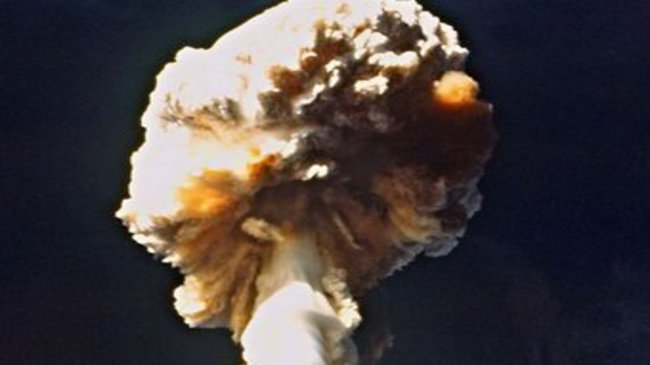
Thousands of veterans of Britain’s atomic and hydrogen bomb tests are to take the Ministry of Defence (MoD) to the European Court of Human Rights, accusing it of exposing them to radiation.
Over 1,000 victims of UK’s nuclear tests, which were carried out in the South Pacific in the 1950s, will ask Europe to intervene, as the British premier David Cameron ignores the terms of the Military Covenant and courts ban hearings into their cases.
Servicemen, who were ordered to witness nuclear bomb tests in the South Pacific, have since suffered cancers and rare medical conditions, with their children suffering from leukemia and birth defects.
Describing the news as “brilliant,” widow Shirley Denson, whose RAF ace husband was ordered to fly through mushroom clouds at Christmas Island in 1958, said, “This is one of our final chances to appeal for the right to present our case.”
“We have tried for 30 years to be heard, and every time the MoD has denied there is anything wrong with us. Now we have vital scientific evidence, and they say we have left it too late,” she added.
Earlier on May, Britain’s former Prime Minister Gordon Brown also criticized the MoD for trying to evade its responsibility for cleaning up the radioactive waste contamination from old military bases and factories.
According to a survey conducted by the Department of Energy and Climate Change (Decc), the number of contaminated sites across England and Wales was far higher than previously estimated.
Related articles
- Nuclear waste ‘may be blighting 1,000 UK sites’ (kractivist.wordpress.com)
- Mustard gas scare hits Scottish RAF base (guardian.co.uk)
Senators urge Obama to stop talks with Iran, reveal Zionist influence
Press TV – June 16, 2012
Forty-four US Republican and Democrat senators have written a letter to President Barack Obama urging him to stop talks with the Islamic Republic altogether unless Iran “agrees to take immediate steps to curb its uranium enrichment activity.”
“Steps it [Iran] must take immediately are shutting down of the Fordow [nuclear] facility, freezing enrichment above five percent, and shipping all uranium enriched above five percent out of the country,” the letter published on Saturday added.
The US senators’ letter is verbatim echo of the Israeli Prime Minister Benjamin Netanyahu’s remarks in an address he made to the Civil Services Commission in Jerusalem (al-Quds) on May 21, just two days before the P5+1 sit down in Baghdad for talks with Iran.
Netanyahu said in his speech that “Israel would only be satisfied if Iran halted all uranium enrichment and shipped its stockpiles out of the country.”
He added that Tehran must also close its underground Fordow nuclear facility at the city of Qom, south of the capital Tehran.
“This is the only way it will be possible to ensure that Iran does not get a nuclear bomb…. This is Israel’s position. It has not changed, and it will not change,” Netanyahu emphasized.
Referring to a third round of talks between Iran and the P 5+1– the US, Britain, France, China, and Russia plus Germany –, scheduled for Moscow on June 18 and 19, the senators wrote, “Were Iran to agree to and verifiably implement these steps, this would demonstrate a level of commitment by Iran to the process and could justify continued discussions beyond the meeting in Moscow.”
“On the other hand, if the sessions in Moscow produce no substantive agreement, we urge you to reevaluate the utility of further talks at this time and instead focus on significantly increasing the pressure on the Iranian government through sanctions and making clear that a credible military option exist,” they added.
The senators also threatened that “the window for diplomacy is closing” on Iran.
Iranian officials have frequently said the country would never give up its inalienable right to peaceful uses of nuclear energy, including by mastering the full cycle of nuclear fuel and all its components such as enriching uranium to levels allowed for by the Non-Proliferation Treaty (NPT) under the supervision of the International Atomic Energy Agency (IAEA).
On Friday, June 15, Secretary of Iran’s Supreme National Security Council Saeed Jalili once more emphasized that Tehran expects its right to nuclear technology, including uranium enrichment, be recognized during the upcoming talks with the P5+1 in Moscow as that right is clearly defined by the NPT.
He added that Iran’s nuclear activities are entirely under the control of the IAEA and the Islamic Republic is conducting its nuclear energy program in full compliance with the NPT.
~
Signed by Sens. Robert Menendez (D-NJ), Roy Blunt (R-MO), Charles Schumer (D-NY), Susan Collins (R-ME), Benjamin Cardin (D-MD), Johnny Isakson (R-GA), Richard Blumenthal (D-CT), Kelly Ayotte (R-NH), Joseph Lieberman (I-CT), James Risch (R-ID), Ron Wyden (D-OR), David Vitter (R-LA), Frank Lautenberg (D-NJ), Jerry Moran (R-KS), Mark Pryor (D-AR), John Cornyn (R-TX), Robert Casey Jr. (D-PA), John Boozman (R-AR), Kirsten Gillibrand (D-NY), Jeff Sessions (R-AL), Sherrod Brown (D-OH), Scott Brown (R-MA), Debbie Stabenow (D-MI), Mike Crapo (R-ID), Amy Klobuchar (D-MN), John Hoeven (R-ND), Jeff Merkeley (D-OR), Daniel Coats (R-IN), Christopher Coons (D-DE), Lisa Murkowski (R-AK), Ben Nelson (D-NE), Patrick Toomey (R-PA), Michael Bennet (D-CO), Mike Lee (R-UT), Daniel Inouye (D-HI), Rob Portman (R-OH), Barbara Mikulski (D-MD), Dean Heller (R-NV), Jon Tester (D-MT), Kay Hagan (D-NC), Bill Nelson (D-FL), Mark Warner (D-VA), Carl Levin (D-MI), and Mark Begich (D-AK).
Related articles
- RAND Corp: ‘Sanctions against Iran are doomed’ (alethonews.wordpress.com)
US on Record-Breaking Year of Military Sales
Moqawama | June 16, 2012
The US has acknowledged that its foreign military sales exceeded $50 billion, with expectations that this year would be a record-breaking year in military sales, thanks to Saudi Arabia, whose US-linked sales account for three-fifth of the total sum.
Assistant Secretary of State for political-military affairs, Andrew Shapiro, stated, “We have already surpassed $50 billion in sales in the fiscal year 2012.”
It’s worth mentioning that in the year 2011, the US also reached a record in military sales that accounted for $30 billion.
“The sale to Saudi Arabia was very significant,” Shapiro added, as the $29.4 billion deal included 84 new fighter jets, and 70 old jets to be modernized.
In an interview with Russia Today (RT), Canadian diplomat Peter Dale Scott said that the Saudi-US military sales contribution is directly related to the “arms for petrol” relations between both countries.
“During the oil price hikes of 1971 and 1973 the US negotiated an agreement to pay Saudi Arabia higher prices for crude, on the understanding that Saudi Arabia would recycle the petrodollars, many of them through arms deals. So recently the imports of American hardware to Saudi Arabia have grown significantly,” Scott stated.
Also, according to the US State Department, one of the deals that helped the sales reach a record was a $10 billion deal with Japan.
The DEA and the Massacre in the Moskitia
By GREG McCLAIN | CounterPunch | June 15, 2012
The US is once again hell bent on establishing death squads in its militarization of Central America. This is a stark reminder of the 1980s when Ronald Reagan and Ollie North were funding the contras with drug money, but now it is reinforced with lessons learned in terrorizing the people of Iraq and Afghanistan through night raids and counterinsurgency tactics. Another tactic that the current US administration has reinvigorated comes from the “War on Drugs” playbook of past administrations: by using the DEA as a front for creating and sustaining havoc, it can attempt to justify the military buildup and control the policies of the host country while manipulating the flow of drugs, all the while appeasing the tax payers back home and the folks in the host country who see the build up as necessary. Not abating by any measure the flow of narcotics into the U.S., the so-called ‘War on Drugs’ has actually increased the narcotics industry in Central America and provided a bogus rationale for the increased militarization of yet another Latin American county; this time Honduras.
On May 11th on the Rio Patuca near Ahuas, a small municipality in the Moskitia, a helicopter titled to the US State Department sprayed bullets into a pipante, a long, narrow dugout canoe, which carried sixteen locals. Four people were killed: 28-year-old Juana Jackson (six months pregnant), 48-year-old Candelaria Pratt Nelson (five months pregnant), 14-year-old Hasked Brooks Wood, and 21-year-old Emerson Martínez Henríquez. At least four more were seriously injured. The DEA confirms that its Foreign-deployed Advisory Support Team (FAST) participated in the operation supporting a Honduran National Police Tactical Response Team.
I first heard of the tragedy while in the process of preparing for a human rights delegation to Honduras coordinated by the Alliance for Global Justice and led by Karen Spring from Rights Action. The New York Times, the Washington Post and the Associated Press have all published stories glorifying the role of the DEA in seizing a huge quantity of drugs in the incident. They not only down played the killing and injuring of innocent people (some reports even questioned if there even were casualties), but also some of the news reports stated that those shot were actually involved in drug trafficking. In typical mainstream media fashion there was over-the-top anonymous quoting of US and Honduran officials and not much fact checking.
I arrived in Honduras on May 18th for the delegation. The original itinerary focused on the struggles of the campesinas and campesinos of the Aguan Valley and their fight to win back the land stolen from them by the oligarchs with the backing of the illegitimate post-coup government of Pepe Lobo. As important as the land rights struggle is to us, it did not take long for the delegation (made up of academics, human rights and labor activists, Canadian and U.S. citizens, several with extensive experience in Honduras) to agree that the massacre in the Moskitia was of a greater urgency especially in light of the contradictory reports coming from the US State Department and the DEA.
We spent our time in Ahuas talking to the survivors of the incident and families of those slaughtered by the US supplied M-60 bullets. We also spoke to several village leaders, the Mayor of Ahuas, and to many locals in order to piece together as best we could the incident and the aftermath. What we got was a startling look into how our government conducts its military adventurism and then obfuscates in order to cover up its crimes. We also witnessed the increased militarization of the region as platoons of masked Honduran soldiers, automatic weapons slung across their chests, patrolled up and down the muddied streets of Ahuas. An older commanding officer, whose Velcro name and rank patches were blank, stated that they would be there “for as long as necessary,” another chilling echo from the Iraq/Afghanistan quagmires.
Getting to Ahuas is no easy feat. We took a small plane from La Ceiba, closer to the Western end of the Caribbean coast of Honduras, to Puerto Lempira, which is on the Laguna Catrasco in the Moskitia on the Eastern side of the country near the Nicaraguan border. Once in Puerto Lempira we hired a small lancha, a motorboat with a capacity of about 15 people, to take us across the Lagunas. It was approximately an hour and a half in the scorching midday sun before we reached the port. Once there, we loaded into a giant pickup truck fastened with wooden planks for seating, which are placed across the truck bed, for the thirty-minute bumpy ride into Ahuas.
After our boat ride across the Laguna and through the rivers, which act as highways for the local people, it became clear to us what one of the survivors had been quoted as saying in the press, and that we were later to hear first hand. The reason that the pipante had been on the river at 2 AM was because they waited until the sun had set to take the boat home in order to avoid the mid-day heat. This is significant in light of the statement by the Honduran foreign minister, Arturo Corrales. He was quoted in the New York Times (05/18/12) as saying “it was totally dark, in a place that is not a fishing spot.” He added, “It’s in the jungle. It is very hard to believe that at 2 a.m., in the jungle, the people in a boat that is beside another boat with 400 kilograms of cocaine were fishing,” the implication being that they, the victims, were drug smugglers.
The ill-fated pipante had disembarked way downstream at the mouth of the river where it runs into the Caribbean, fighting against the current in order to get to Ahuas. Those that we interviewed said that they had been on the river for 8 hours. The owners of the boat had dropped off lobstermen at the opening of the Caribbean earlier in the day and waited for the sun to begin to set before heading back to Ahuas. This is a routine that they have been undertaking daily for 25 years. As they returned, heading into the current, they picked up other passengers along the way, some heading home and some heading toward jobs or to visit relatives. Many of them slept during the journey only to be awakened by the sounds of gunfire and the burning feeling of having M-60 rounds rip through their bodies.
The details of what exactly prompted the occupants of the helicopters to fire on the pipante are murky at best. The reports from the State Dept. and the DEA have not been consistent and leave out many details, which calls into question their depiction of the events of that night. While witness and victim testimonies have been consistent, the U.S. government versions are shrouded in a haze of information that cannot be divulged, parsed statements that are obviously leading, and “facts” that do not shed light on the operation and the role of U.S. government agents in it. COFADEH (Committee of Families of the Detained and Disappeared), a Honduran human rights group, put it most succinctly in a press release days after the incident, “To keep an act of terror covered up in the midst of media confusion was always a strategy of psychological warfare, a special chapter of state terrorism. We should not accept this.” Audio recordings of communications from the helicopters that evening or surveillance video, if it exists, could potentially clarify many of these issues. The release of such recordings is something that the delegation would like to see Congress demand in any congressional investigation that it conducts. Until such data surfaces, we will never know the true motivation of those in the helicopters who pulled the trigger nor what they were truly doing on the Rio Patuca.
The events of the immediate aftermath became clearer once our delegation took the time to interview numerous witnesses to the shooting and those who rushed to the river upon hearing that loved ones had been shot at. We spoke to Hilda Rosa Lezama Kenreth, 53, laid up in the Ahuas hospital, an underfunded facility run by an evangelical church. She stated that as the shots were being fired from the helicopter she felt a pain across both of her thighs. A bullet had ripped through her left leg and cut across her right leaving huge gaping wounds. She instinctively jumped from the pipante and swam as best she could for cover in the reeds that hugged the bank of the river. She stayed there clinging to the reeds for at least two hours while going in and out of consciousness waiting for help.
Hilda’s son and daughter, Hilder and Elmina, who had been in town when they heard of the shooting, and were awaiting family members to arrive, rushed to the landing, a small sandy area where pipantes and other riverboats were moored. When they got there a helicopter was landing on an open area near were the boats were moored. Before Hilder could begin to search for his mother and brother-in-law he was approached by what he described as three large white men in uniforms who spoke to each other in English. The soldiers ordered him, in broken Spanish, to sit down while pointing guns at his and his sister’s head and chest. They asked him where gasoline was stored. He told them that there was a building nearby that had gas for the boats. They ordered him at gunpoint to take them there often hitting him in the back of the head causing him to fall. When they arrived, the tall white soldiers kicked in the door of the building and stole two 18-gallon barrels of gas. They returned to the landing and ordered Hilder to fill a boat motor with the gas. He did so and then was ordered to get in the boat. They went down river to where the massacre had occurred and Hilder saw a boat with two more tall white soldiers sitting in it. Once they got along side this boat he was further ordered to move bags from it to the boat they had arrived in. He stated that the soldiers told him in broken Spanish to “move the drugs.” Once he was finished he and the five soldiers returned to the landing with the drugs. The soldiers then moved the bags from the boat to the helicopter, not allowing Hilder to look for his mother and brother-in-law. Instead, they hit him again and handcuffed him with plastic zip ties and forced him sit until they left. Once they were gone, another villager cut the ties from his hand. He found the body of his brother-in-law and loaded it onto a boat. He then searched for his mother and was able to find Hilda in the water semi-conscious, but alive several hours after he had gotten there and was detained by the soldiers.
Another survivor, Clara Wood Rivas watched as bullets shattered her fourteen-year-old son Hasked’s skull. As she described the tragedy, she lifted her arm in the air to show the downward trajectory of the bullets, motioning her hand toward the top of her own head and passing it downward mimicking the bullets exiting Hasked’s chin. She stated that he had been shot so many times that she couldn’t recognize his face. Her son slumped over and fell into the water. Ms Wood jumped in to avoid the rain of bullets. Unable to find her son, she swam to shore. When she made it to the landing, “tall gringos” who did not speak Spanish pointed guns at her. She saw her nephew, who had come to the landing to meet her, handcuffed with zip ties and also being held at gunpoint. Through tears she told us, “I thought they were going to kill me. I passed through a war there. I’m blessed to be alive. I’ll never see my son again!”
Traveling with Clara and Hasked was Walter Wilmer, also aged 14. We were unable to meet with him in the hospital in La Ceiba. According to the preliminary report put out by COFADEH, at the time when the bullets began riddling the pipante Wilmer was asleep. He awoke to sounds of screams and blasts of gunfire. He managed to escape the boat unharmed, but the helicopter gunners aimed at him in the water, destroying his left hand. Wilmer managed to swim using only his right until he reached the bank of the river. He could still see the helicopters hovering over the river so he ran through the darkness making it to the hospital in Ahuas. He was later transferred, at great expense to his family, to the hospital in La Ceiba, but it was too late to save his hand.
Members of our delegation were able to meet with Lucio Adnan Nelson, 22, in the hospital at La Ceiba. He had been shot in the back and in his right elbow where he still has bullet fragments. Under sedation he was able to speak to us, but only briefly. Lucio jumped from the boat when it was fired upon. He felt a burning pain in his back as he clung onto a tree branch sticking out of the river. He managed to swim to shore using one hand and ran through the woods until someone found him and helped him to the hospital. Lucio’s father stated that they had to sell some of their livestock in order to pay for the transportation to La Ceiba hospital. He also stated that if his son doesn’t recover fully, which he most likely won’t, he fears that Lucio’s only option in life is to become a beggar in the street.
The AP and the New York Times have revised their reports many times since the incident. The AP in particular has given a clearer picture of the events, but the overarching bent is still on the justification of the DEA and Honduran military’s presence in the Moskitia. They continue to imply that it was simply a tragic mistake in identity, an example of collateral damage in the War on Drugs. I spoke with a Honduran lawyer who represents the interests of the people of the Moskitia. He stated that there have been several reports of US and Honduran military drug interdiction in that region. The common link to these reports is that in all of them the narcotraffickers have gotten away, but the military have seized the drugs. This raises serious questions, not just to the efficacy of the military in drug interdiction, but indeed, what truly is the US and Honduran militaries’ role in the trafficking. In the wake of the DEA’s implication in drug trafficking as related to Plan Colombia and Plan Mexico, as well as the nefarious scheme of the ATF in supplying arms to drug lords in Mexico, plus the rampant corruption of the Honduran military and police and their interrelationship to narcotraffickers, the questions linger as to the true motivations of the US military/DEA presence in Honduras.
The US’s military motivations come under sharper scrutiny when the issue of recently discovered oil reserves in the Moskitia region are brought to light. Texas based Honduras Tejas Oil and Gas Company, which is pursuing an oil and gas concession in La Moskitia, estimate that there are six to eight billion barrels of oil reserves there. Honduras Tejas has lobbying ties to Tea Party nut job Rep. Louis Ghomert (R. TX), who introduced legislation on their behalf, HR 532 (110th): Recognizing the energy and economic partnership between the United States and Honduras. Its ties to the Honduran government as well as the US State Department need to be further investigated.
Many people we spoke with, including representatives of indigenous organizations, are deeply concerned that militarization and violence generated by the “drug war” are negatively impacting their communities and are focused where there are significant natural resources, rivers with hydroelectric potential, petroleum, gold, and forests with many of these natural resources being privatized.
In light of what our delegation observed on our visit and the concerns raised, we demand:
- That the U.S Congress investigate and hold hearings about the U.S. role in the events of May 11, 2012 in La Moskitia.
- That serious and independent investigations take place exploring the role and responsibility of agents of the U.S. government in the May 11 massacre in Ahuas, be they DEA agents, private security contractors under the direction or contracted by agencies of the U.S. government or other security forces. This investigation should include identifying criminal responsibility of specific individuals.
- That the rights and decisions of indigenous communities and popular movements be respected rather than treated as drug traffickers and insurgents with complete disregard to fundamental human rights.
- That the U.S. government speak out publicly against the presence of individuals widely known to have involvement in drug trafficking and death squads within the Honduran justice system today.
- That in light of the abuses we documented, the U.S. government must withdraw all U.S. security forces including DEA and private contractors from Honduras, cease military assistance and training, and stop promoting re-militarization in Central America.
On June 6th the State Dept. was asked to provide an update on the DEA agent investigation in Honduras and on what is being done to assist the victims?
Their answer:
“DEA’s internal investigation is ongoing and should be completed in the next few weeks and we refer you to the Department of Justice for further information. A Honduran special task force conducted an initial investigation and we understand their preliminary conclusion is that the Honduran security forces were justified in firing in self-defense. The Honduran Government referred the investigation to their Attorney General’s office. The U.S. government is working closely with the Government of Honduras and offered transportation for investigators and additional assistance.
All Honduran citizens are eligible to receive care through the Honduran public health system.”
After four weeks of inadequate care in Honduran hospitals where horror stories are common, such as the lack of sutures for routine stitching procedures let alone for major surgery, The International Red Cross and UNICEF have agreed to intervene and pay for the surgeries of Walter Wilmer and Lucio Nelson at La Ceiba Hospital. Meanwhile, the other survivors are left in the care of an inefficient underfunded healthcare system, while the family members of the deceased have not even received so much as an official apology from U.S. or Honduran government officials.
With the ever escalating US military presence in Honduras, we can expect the events described above to become commonplace, just as the horror stories that have come out of Iraq and Afghanistan are never ending. Can drone attacks be far behind?
Greg McClain was a member of the Human Rights Delegation to Ahuas, La Moskitia, Honduras.
Related articles
- Uniformed US soldiers involved in killing of six Honduran civilians (alethonews.wordpress.com)
- DEA Agents Helped Kill Two Pregnant Women in Honduras Last Week (reason.com)
U.S. Escalates Military Penetration of Africa
By Glen Ford | Black Agenda Report | June 13, 2012
According to the Army Times newspaper, the United States will soon deploy a brigade of about 3,000 troops – “and likely more” – for duty “across the continent” of Africa. The “pilot program”has all the markings of a permanent, roving presence, joining the 1,200 U.S. soldiers stationed in Djibouti and the 100-plus Special Forces dispatched to Central Africa by President Obama, last October.
As always and everywhere, the U.S. is looking for bases to occupy – although the U.S. military command in Africa doesn’t call them bases. Rather, “as part of a ‘regionally’ aligned force concept,’ soldiers will live and work among Africans in safe communities approved by the U.S. government,” said AFRICOM’s Maj. Gen. David Hogg.
The First Black U.S. President, who in 2009 lectured Africans that “corruption” and “poor governance,” rather than neocolonialism, were the continent’s biggest problems, has made the U.S. military the primary interlocutor with African states. Functions that were once the purview of the U.S. State Department, such as distribution of economic aid and medical assistance, are now part of AFRICOM’s vast portfolio. In Africa, more than anyplace in the world, U.S. foreign policy wears a uniform – which should leave little doubt as to Washington’s objectives in the region: Africa is to be dominated by military means. Obama’s “good governance” smokescreen for U.S. neocolonialism is embedded in AFRICOM’s stated mission: “to deter and defeat transnational threats and to provide a security environment conducive to good governance and development.” Translation: to bring the so-called war on terror to every corner of the continent and ensure that U.S. corporate interests get favorable treatment from African governments.
AFRICOM’s array of alliances and agreements with African militaries already embraces virtually every nation on the continent except Eritrea and Zimbabwe. All but a handful of Black African states routinely take part in military maneuvers staged by Americans, utilizing U.S. command-and-control equipment and practices. The new, roving U.S. brigade will further institutionalize U.S. ties with the African officer class, part of AFRICOM’s mission to forge deep “soldier-to-soldier” relationships: general-to-general, colonel-to-colonel, and so forth down the line. The proposed network of “safe communities” to accommodate the highly mobile U.S. brigade is a euphemism for joint bases and the most intense U.S. fraternization with local African militaries. Regime change will never be farther away than a drink at the officers club.
According to the Army Times article, the composition of the new brigade, in terms of military skills, is not yet known. However, the brigade is conceived as part of the “new readiness model,” which “affords Army units more time to learn regional cultures and languages and train for specific threats and missions.” This sounds like special ops units – Rangers and Special Forces – which have been vastly expanded under President Obama (and are quite capable of carrying out regime-change operations on their own or in close coordination with their local counterparts).
In most cases, coups will be unnecessary. Regional African “trade” blocs like ECOWAS, the 16-member Economic Community of West African States, and IGAD, the six-nation Intergovernmental Authority on Development, in East Africa, have provided African cover for U.S. and French military/political designs in the Ivory Coast and Somalia, respectively. These blocs will doubtless become even more useful and compliant, as U.S. military commanders and their African counterparts get cozier in those “safe communities.”
Americans, no matter how bloody their hands, have always liked to think of themselves as “innocents abroad.” “As far as our mission goes, it’s uncharted territory,” said AFRICOM’s Gen. Hogg. Not really. The Americans are following a European chart in Africa that goes back centuries, and their own long experience in the serial rape of Latin America, where the close fraternization of U.S. and Latin American militaries in recent decades smothered the region in juntas, dirty wars, torture-based states, and outright genocide.
The U.S. and its African allies perpetrated of the worst genocide since World War Two: the death of six million in the eastern Democratic Republic of Congo. Uganda, which acts as a mercenary for the U.S. in Africa, is complicit in mega-death in Congo and Somalia. As Milton Allimadi, publisher of Black Star News, reported: “In 2005 The International Court of Justice (ICJ) found Uganda liable for the Congo crimes. The court awarded Congo $10 billion in reparations. Uganda’s army plundered Congo’s wealth and committed: mass rapes of both women and men; disemboweled pregnant women; burned people inside their homes alive; and, massacred innocents.”
Naturally, as a henchman of the United States, Uganda has not paid the $10 billion it owes Congo. Ugandan leader Yoweria Museveni, who became Ronald Reagan’s favorite African after seizing power in 1986 with a guerilla army packed with child soldiers, and who for decades waged genocidal war against the Acholi people of his country, now plays host to the Special Forces continent sent by President Obama, ostensibly to fight the child soldier-abusing Joseph Kony and his nearly nonexistent Lord’s Resistance Army.
Rwanda, the Pentagon’s other hit man on the continent, has been cited by a United Nations report as bearing responsibility for some of the millions slaughtered in Congo, as part of its ongoing rape and plunder of its neighbor.
Gen. Hogg says AFRICOM’s mission is to combat famine and disease. Yet, the AFRICOM-assisted Ethiopian invasion of Somalia in late 2006 led to “the worst humanitarian crisis in Africa – worse than Darfur,” according to United Nations observers. The 2007 humanitarian crisis and the escalating U.S.-directed war against Somalia made the 2010 famine all but inevitable.
Ugandan soldiers, nominally working for the African Union but in the pay of the Pentagon, kept watch over western interests in the starving country, as did the 1,200 soldiers stationed at the U.S. base in neighboring Djibouti – a permanent presence, along with the French garrison.
There’s nothing “uncharted” or mysterious about AFRICOM’s mission. The introduction of the 3,000-strong mobile brigade and a network of supporting bases prepares the way for the arrival of much larger U.S. and NATO forces – the recolonization of Africa. Gen. Hogg swears up and down there are no such plans. “For all the challenges that happen and sprout up across Africa, it really comes down to, it has to be an African solution,” he said.
That’s exactly the same thing they said in Iraq, Afghanistan, and Libya.
Glen Ford can be contacted at Glen.Ford@BlackAgendaReport.com.
Related articles
- Libya, Africa and Africom (alethonews.wordpress.com)
US expands secret spy operations in Africa
Press TV – June 14, 2012
The United States has been expanding its secret intelligence operations across Africa through a network of small air bases in the continent and under the pretext of fighting terrorism.
The Washington Post reported on Wednesday that the US military has established some small air bases across Africa and trained many army personnel in a bid to keep crucial African regions under surveillance.
The report, obtained from documents and people involved in the US military project, said that the US has kept small, unarmed turboprop aircraft in the bases which are disguised as private planes.
The aircraft are supplied with veiled sensors that are able to record full-motion videos, track infrared heat patterns and vacuum up radio and cell phone signals. They are refueled on remote airstrips, used by African bush pilots, broadening their flight range by thousands of miles.
The paper quoted a former US commander, who was engaged in establishing the network, as saying that the military has set up a dozen of such air bases in Africa since 2007.
The covert air bases are reportedly situated in countries such as Mauritania, Burkina Faso, Ethiopia, Djibouti, Uganda, South Sudan, Kenya, and Seychelles.
The surveillance operations have increased recently as part of a move to “fight against al-Qaeda and other militant groups.” The operations are reportedly run by US Special Operations forces but largely depend on private military contractors and support from African forces.
Meanwhile, following the US Africa Command, the administration has been training and equipping militaries in several countries across the continent including Algeria, Burkina Faso, Chad, Mali, Mauritania, Morocco, Niger, Nigeria, Senegal and Tunisia under the pretext of stopping “terrorists from establishing sanctuaries.”
Moreover, the US Central Intelligence Agency (CIA) has also increased its counterterrorism and intelligence-gathering operations throughout Africa.
The US government has repeatedly claimed that such interventions are conducted to fight terrorism. However, it is strongly believed that there are no significant terrorist threats in Africa against the US.
RAND Corp: ‘Sanctions against Iran are doomed’
Rehmat’s World | June 9, 2012
America’s powerful pro-Israel think tank, RAND Research and Analysis Corporation, in its report ahead of the P5+1 and Iran meeting in Moscow – has claimed that the US and EU sanctions against Iran are harming the EU more than Iranian regime which the USrael desire to topple.
“The EU is at its worst possible conditions to harm Iran. Countries are able to bypass economic sanctions,” says professor Keith Crane, Director of the Environment, Energy, and Economic Development program at the RAND. Dr. Crane also mentioned that big and numerous problems facing major banks have endangered the world monetary system, and thus the system cannot tolerate any more risks and pressures to be created by sanctioning one of the most important world oil producers.
RAND in its earlier report had warned USrael of its “military option” against the Islamic Republic. It predicted that any attack by Israel or the US will convince Tehran of the importance of nuclear arms as “deterrent” against the world-bullies.
“Proponents of an Israeli military strike against Iranian nuclear facilities might believe that Israel could endure the short-term military and diplomatic fallout of such action, but the long-term consequences would likely be disastrous for Israel’s security. Those believed to favor a military option, such as Israeli Prime Minister Benjamin Netanyahu and Defense Minister Ehud Barak, argue that the Middle East with a nuclear-armed Iran would be far more dangerous than a military attack to prevent it. But their position rests on a faulty assumption that a future, post-attack Middle East would indeed be free of a nuclear-armed Iran. In fact, a post-attack Middle East may result in the worst of both worlds: a nuclear-armed Iran more determined than ever to challenge the Jewish state, and with far fewer regional and international impediments to doing so,” says the report authored by James Dobbins, Dalia Dassa Kaye, Alireza Nader and Frederic Wehrey.
Iranian president, Dr. Ahmadinejad, during his Beijing visit to attend the SCO summit accused major world powers of looking for ways to “find excuses and to waste time” in talks over Iran’s civilian nuclear program. Based on the P5+1 and IAEA past record, Ahmadinejad was not optimistic about a compromise at the Moscow meeting.
Dr. David Morrison in his March 25, 2012 article, entitled ‘Some facts about Iran’s nuclear activities‘, wrote:
The United States, European allies and even Israel generally agree on three things about Iran’s nuclear program: Tehran does not have a bomb, has not decided to build one, and is probably years away from having a deliverable nuclear warhead.
The Supreme Leader of Iran, Ayatollah Khamenei, has said that the possession of nuclear weapons is a major sin. The November 2011 report of the IAEA did not claim that Iran has a nuclear weapons program. In spite of all that, the Zionist regime which itself has nearly 400 nuclear bombs, with the help of its western-poodles – is trying to stop Iran from its ‘inalienable right’ to enrich uranium for its medical needs under NPT.
Related articles
- Sanctions not slowing Iran N-program by ‘one millimeter’: Netanyahu (alethonews.wordpress.com)
Lobby to Washington: Learn to Stop Worrying and Love an Israeli “Preventive Strike” on Iran
By Maidhc Ó Cathail | The Passionate Attachment | June 5, 2012
In The Washington Institute’s Policy Note entitled “Beyond Worst-Case Analysis: Iran’s Likely Responses to an Israeli Preventive Strike,” Michael Eisenstadt and Michael Knights set out to assuage the fears of those in Washington opposed to another Israeli-inspired war in the Middle East:
In the United States, the destabilizing potential of Iran’s reaction to such an attack has loomed large in official statements on the subject, while many independent analysts offer what can only be described as worst-case assessments. These analysts frequently assert that Tehran would use all means at its disposal to retaliate, including missile attacks, terrorism in the region and beyond, and closure of the Strait of Hormuz. For good measure, they add every conceivable unintended consequence to the mix, such as disaffected Iranians becoming radicalized and rallying to the side of a reviled regime, the Arab street rising up in support of Tehran, and Iran’s leaders initiating a clandestine crash program to build a nuclear bomb.
Apparently contradicting the alarmist Israeli narrative that supposedly justifies a preventive attack in the first place, i.e. that the “Mad Mullahs” can’t be trusted with nukes, the fellows from the AIPAC-created think tank sound a reassuring note, suggesting that the Iranian leaders are not as “irrational” as pro-Israelis generally like the world to believe:
Yet more than thirty years’ experience observing the current regime in Tehran, combined with insights derived from the Islamic Republic’s history and strategic culture, provide reason to support a more measured and less apocalyptic—if still sobering—assessment of the likely aftermath of a preventive strike.
After a brief discussion of the retaliatory options available to Tehran, Eisenstadt and Knights not surprisingly conclude that Washington needn’t pay too much heed to those pessimistic analysts:
In short, although an Israeli preventive strike would be a high-risk endeavor carrying a potential for escalation in the Levant or the Gulf, it would not be the apocalyptic event some foresee. And the United States could take several steps to mitigate these risks without appearing complicit in Israel’s decision to attack.
An infinitely less risky step to take, of course, would be to beware Israel partisans bearing advice.
Related articles
- Obama’s Secret War Against Iran Dooms Diplomacy and Imperils American Interests (alethonews.wordpress.com)
- You: Iran vows ‘proportionate’ response to any strike (nation.com.pk)
- Deal or no deal, Iran may be bombed – Israeli minister (alethonews.wordpress.com)
Featured Video

or go to
Aletho News Archives – Video-Images
From the Archives
A Lesser “Grade” of Human
By Michael Hoffman | Revelation of the Method | January 3, 2024
Will the more than 100 Iranians killed by terrorist bombs today be mourned in the West as victims of terrorism? Certainly not. Allied doctrine has it that the killing of Israeli or American civilians is a crime of cosmic proportions, while shedding the blood of “enemy” women and children is perfectly acceptable; indeed commendable.
The West does not memorialize the hundreds of thousands of civilians bombed by the U.S. in Serbia, Iraq, Afghanistan and every major German city 1943-1945. America’s fire-bombing of the city of Tokyo by General Curtis LeMay in March 1945 was followed by Harry Truman’s atomic incineration of Hiroshima and Nagasaki in August of that year. Truman never had a moment of doubt or regret over the murder of more than a 100,000 Asian children, mothers and non-combatant boys and men. It was business as usual for the “noble” Allies during the “Good War.”
In the West human rights signifies passionate concern only for civilians designated as truly human: Israelis first, then Americans and British, followed by their satraps.
This inhumanity is the legacy of Talmudic ideology, beginning with tractate Sanhedrin 57a from 400 A.D., concerning liability for capital punishment: “If a Jew murders a gentile, he is exempt.”
This teaching of contempt was reiterated in the dogma of Chabad Lubavitch founder Rabbi Shneur Zalman in the 18th century. … continue
Blog Roll
 Aletho News
- NATO’s top generals gather in Kiev
- EU’s continuing expansion – greater threat to Russia
- US Senator Murphy says Pentagon denied him entry to US base in Qatar
- Israel expands “incitement” charge to target Palestinian education and memory
- How Israel seeks to reshape Arab classrooms
- Paris bans pro-Palestinian demonstration planned for Oct. 7 over ‘risks of public disorder’
- In August Hanning Treason Case – All Signs Point To Tel Aviv.
- France cleared dozens of military sales to Israel between May and September: Report
- France projects nuclear power as Macron pushes arsenal expansion
- The fallacy of US delusions about Iran’s economic collapse
- If Americans Knew
- An error has occurred; the feed is probably down. Try again later.
- No Tricks Zone
- US September “Heat” Was No Record…Many Records Set Decades Ago
- Latest European Green Energy Debacle; Portugal’s Largest Flagship Solar Park Insolvent!
- Green Energy Debacle: German Expert Professor Fritz Vahrenholt Warns Of Severe Economic And Social Consequences
- Two More Paleo Reconstructions Affirm Meters-Higher Sea Levels Across Ireland, Brazil 7000-6000 Years Ago
- New Study: Earth And Venus Surface Warmth Largely Explained By Convection And Lapse Rate, Not CO2 Or Radiation
- 2025 Nature Paper Claiming Worsening Global Drought Gets RETRACTED …Heavily Flawed
- New Study: ‘Global Drought Shows No Detectable Recent Acceleration Under Climate Warming’
- Economic Masterminds: German Socialists Suggest Taxing Productivity Gains Stemming From Using AI
- The South China Sea Has Not Been Cooperating With The Climate Change Narrative
- Energy Crisis: Germany Enters Heating Season With Historically Low Gas Reserve Fill Levels

