Obama’s approval rating falls to 39%
Press TV – December 15, 2010
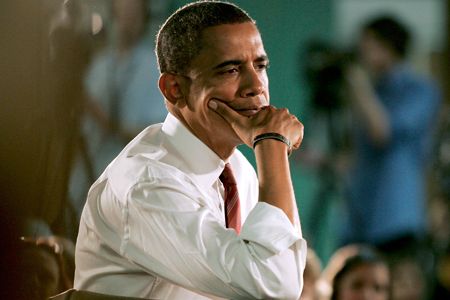
US President Barack Obama’s popularity has dropped by three percentage points in the past two weeks, now standing at 39 percent, according to results of a new poll.
A Zogby Interactive poll released on Tuesday indicates that Obama’s approval rating equals a low since he took office at 39 percent, while 63 percent of respondents think the US president is a weak leader compared to only 19 percent who regard him as a strong leader.
The latest poll comes after Obama agreed earlier in December to keep all of the Bush-era tax cuts for another two years in a bid to resolve differences with Republicans in Congress.
“It was a bad week for Obama’s relationship with his party’s base, which sees him giving in too easily to the Republicans,” John Zogby said in a statement.
According to the poll, 68 percent of those surveyed also believe that America is heading in the wrong direction.
The figures come as there are widespread assumptions that a string of government failures, including the failure to rein in the economic crisis in the US, the prolonged wars in Iraq and Afghanistan and the high unemployment rate in the country have largely contributed to the slippage in Obama’s popularity rate.
Against a backdrop of the worst recession since the Great Depression, which has driven many Americans out of workplace, the latest figures published recently by the US Federal Reserve show that the unemployment rate will remain at around 9.5 percent this year and 8.9 percent in 2011.
Obama’s healthcare reforms have also struck a snag as a federal court has ruled that a key part of the new bill is unconstitutional.
Obama’s average approval rating has declined in each quarter since he took office last year.
Time for Nuclear Savings Bonds?
The Nuclear War Reserve
By ROBERT ALVAREZ | CounterPunch | December 10, 2010
Although it’s been 20 years since the Cold War ended, the U.S. is still holding on to a grossly oversized nuclear arsenal – most of which are no longer needed by the military. Thanks to Hans Kristensen at the Federation of America Scientists, I’ve learned that 70 percent of the America’s warheads are not being deployed and that more than 40 percent has been discarded by the military. Some 2,500 nuclear warheads are currently deployed, with a comparable number held in the “war reserve,” and 3,500 are awaiting elimination. The “war reserve” is needed as a hedge just in case Russia decides to rekindle the nuclear arms race – a sacrosanct U.S. policy based on the logic that the winner of a nuclear war is the one with the most left over. The current U.S. nuclear arsenal has a destructive power about 400 times greater than the explosives used by all combatants during World War II.

The current backlog of retired nuclear warheads will take 15 years to eliminate. My children might live long enough to see the existing stockpile of discarded weapons disappear. This is because the Obama administration plans to curb nuclear warhead dismantlement spending by 50 percent over the next five years. If the New START treaty is approved, nearly 80% of U.S. nuclear warheads will not be deployed with as many as 5,000 warheads waiting to be eliminated. According to Kristensen and his colleague Robert S. Norris at the Natural Resources Defense Council, the current rate of weapons dismantlement is what it was in the 1950s during the height of the Cold War.
But, if proponents of increased nuclear spending, led by Senator John Kyl (R-AZ), have their way, our great-grandchildren will find America still bristling with nuclear arms. While most of the government stands to see budget cuts, in an effort to garner Kyl’s support for the New START treaty, spending by the Obama administration to maintain the nuclear arsenal and to refurbish the nuclear weapons complex will increase next year by18 percent.
The spending logic of these numbers seems simple. The more nuclear warheads we have sitting around, the more money can be spent on delivery systems, baby-sitting bombs, while trying to make more. Since World War II, America has spent about $5.6 trillion to make and stockpile them – creating a powerful nuclear entitlement culture that commands two thirds of the U.S. Energy department’s budget.
According to Steve Schwartz of the James Martin Center on Non-Proliferation, the U.S. Spent about $54 billion in 2009 on nuclear weapons and their delivery systems (bombers, ground and submarine missile launchers). If you include these expenses, each nuclear warhead costs about $6.3 million per year to keep around.
Wonder why America can’t seem to keep up with nations like Germany and China when it comes to an advanced energy policy? Perhaps it’s because the Energy department spends 10 times more on nuclear weapons than energy conservation.
The National Nuclear Security Agency within DOE estimates it will need about $85 billion over the next ten years and about $168 billion over twenty years to maintain the nuclear arsenal and refurbish the U.S. weapons complex. This does not include the additional $100 billion estimated for the weapons delivery systems in the Defense department. Given that the Obama administration sees no need to further tax the wealthy and that hundreds of billions of dollars will have to be borrowed from China for nuclear weapons, consideration might be given to issuing new “Nuclear Savings Bonds” to help pay for all of this. I’ve created a prototype of what they might look like.

Robert Alvarez, an Institute for Policy Studies senior scholar, served as senior policy adviser to the Energy Department’s secretary from 1993 to 1999. www.ips-dc.org
Pearl Harbor: A Successful War Lie
An excerpt from War Is A Lie
By David Swanson | December 7, 2010
One type of “defensive” war is one that follows a successful provocation of aggression from the desired enemy. This method was used to begin, and repeatedly to escalate, the Vietnam War, as recorded in the Pentagon Papers. Setting aside the question of whether the United States should have entered World War II, in either Europe or the Pacific or both, the fact is that our country was unlikely to enter unless attacked. In 1928 the U.S. Senate had voted 85 to 1 to ratify the Kellogg-Briand Pact, a treaty that bound — and still binds — our nation and many others never again to engage in war.
British Prime Minister Winston Churchill’s fervent hope for years was that Japan would attack the United States. This would permit the United States (not legally, but politically) to fully enter the war in Europe, as its president wanted to do, as opposed to merely providing weaponry, as it had been doing. On April 28, 1941, Churchill wrote a secret directive to his war cabinet:
“It may be taken as almost certain that the entry of Japan into the war would be followed by the immediate entry of the United States on our side.”
On May 11, 1941, Robert Menzies, the prime minister of Australia, met with Roosevelt and found him “a little jealous” of Churchill’s place in the center of the war. While Roosevelt’s cabinet all wanted the United States to enter the war, Menzies found that Roosevelt,
“. . . trained under Woodrow Wilson in the last war, waits for an incident, which would in one blow get the USA into war and get R. out of his foolish election pledges that ‘I will keep you out of war.'”
On August 18, 1941, Churchill met with his cabinet at 10 Downing Street. The meeting had some similarity to the July 23, 2002, meeting at the same address, the minutes of which became known as the Downing Street Minutes. Both meetings revealed secret U.S. intentions to go to war. In the 1941 meeting, Churchill told his cabinet, according to the minutes: “The President had said he would wage war but not declare it.” In addition, “Everything was to be done to force an incident.”
Japan was certainly not averse to attacking others and had been busy creating an Asian empire. And the United States and Japan were certainly not living in harmonious friendship. But what could bring the Japanese to attack?
When President Franklin Roosevelt visited Pearl Harbor on July 28, 1934, seven years before the Japanese attack, the Japanese military expressed apprehension. General Kunishiga Tanaka wrote in the Japan Advertiser, objecting to the build-up of the American fleet and the creation of additional bases in Alaska and the Aleutian Islands:
“Such insolent behavior makes us most suspicious. It makes us think a major disturbance is purposely being encouraged in the Pacific. This is greatly regretted.”
Whether it was actually regretted or not is a separate question from whether this was a typical and predictable response to military expansionism, even when done in the name of “defense.” The great unembedded (as we would today call him) journalist George Seldes was suspicious as well. In October 1934 he wrote in Harper’s Magazine: “It is an axiom that nations do not arm for war but for a war.” Seldes asked an official at the Navy League:
“Do you accept the naval axiom that you prepare to fight a specific navy?”
The man replied “Yes.”
“Do you contemplate a fight with the British navy?”
“Absolutely, no.”
“Do you contemplate war with Japan?”
“Yes.”
In 1935 the most decorated U.S. Marine in history at the time, Brigadier General Smedley D. Butler, published to enormous success a short book called “War Is a Racket.” He saw perfectly well what was coming and warned the nation:
“At each session of Congress the question of further naval appropriations comes up. The swivel-chair admirals… don’t shout that ‘We need lots of battleships to war on this nation or that nation.’ Oh, no. First of all, they let it be known that America is menaced by a great naval power. Almost any day, these admirals will tell you, the great fleet of this supposed enemy will strike suddenly and annihilate our 125,000,000 people. Just like that. Then they begin to cry for a larger navy. For what? To fight the enemy? Oh my, no. Oh, no. For defense purposes only. Then, incidentally, they announce maneuvers in the Pacific. For defense. Uh, huh.
“The Pacific is a great big ocean. We have a tremendous coastline in the Pacific. Will the maneuvers be off the coast, two or three hundred miles? Oh, no. The maneuvers will be two thousand, yes, perhaps even thirty-five hundred miles, off the coast.
“The Japanese, a proud people, of course will be pleased beyond expression to see the United States fleet so close to Nippon’s shores. Even as pleased as would be the residents of California were they to dimly discern, through the morning mist, the Japanese fleet playing at war games off Los Angeles.”
In March 1935, Roosevelt bestowed Wake Island on the U.S. Navy and gave Pan Am Airways a permit to build runways on Wake Island, Midway Island, and Guam. Japanese military commanders announced that they were disturbed and viewed these runways as a threat. So did peace activists in the United States. By the next month, Roosevelt had planned war games and maneuvers near the Aleutian Islands and Midway Island. By the following month, peace activists were marching in New York advocating friendship with Japan. Norman Thomas wrote in 1935:
“The Man from Mars who saw how men suffered in the last war and how frantically they are preparing for the next war, which they know will be worse, would come to the conclusion that he was looking at the denizens of a lunatic asylum.”
The U.S. Navy spent the next few years working up plans for war with Japan, the March 8, 1939, version of which described “an offensive war of long duration” that would destroy the military and disrupt the economic life of Japan. In January 1941, eleven months before the attack, the Japan Advertiser expressed its outrage over Pearl Harbor in an editorial, and the U.S. ambassador to Japan wrote in his diary:
“There is a lot of talk around town to the effect that the Japanese, in case of a break with the United States, are planning to go all out in a surprise mass attack on Pearl Harbor. Of course I informed my government.”
On February 5, 1941, Rear Admiral Richmond Kelly Turner wrote to Secretary of War Henry Stimson to warn of the possibility of a surprise attack at Pearl Harbor.
As early as 1932 the United States had been talking with China about providing airplanes, pilots, and training for its war with Japan. In November 1940, Roosevelt loaned China one hundred million dollars for war with Japan, and after consulting with the British, U.S. Secretary of the Treasury Henry Morgenthau made plans to send the Chinese bombers with U.S. crews to use in bombing Tokyo and other Japanese cities. On December 21, 1940, two weeks shy of a year before the Japanese attack on Pearl Harbor, China’s Minister of Finance T.V. Soong and Colonel Claire Chennault, a retired U.S. Army flier who was working for the Chinese and had been urging them to use American pilots to bomb Tokyo since at least 1937, met in Henry Morgenthau’s dining room to plan the firebombing of Japan. Morgenthau said he could get men released from duty in the U.S. Army Air Corps if the Chinese could pay them $1,000 per month. Soong agreed.
On May 24, 1941, the New York Times reported on U.S. training of the Chinese air force, and the provision of “numerous fighting and bombing planes” to China by the United States. “Bombing of Japanese Cities is Expected” read the subheadline. By July, the Joint Army-Navy Board had approved a plan called JB 355 to firebomb Japan. A front corporation would buy American planes to be flown by American volunteers trained by Chennault and paid by another front group. Roosevelt approved, and his China expert Lauchlin Currie, in the words of Nicholson Baker, “wired Madame Chaing Kai-Shek and Claire Chennault a letter that fairly begged for interception by Japanese spies.” Whether or not that was the entire point, this was the letter:
“I am very happy to be able to report today the President directed that sixty-six bombers be made available to China this year with twenty-four to be delivered immediately. He also approved a Chinese pilot training program here. Details through normal channels. Warm regards.”
Our ambassador had said “in case of a break with the United States” the Japanese would bomb Pearl Harbor. I wonder if this qualified!
The 1st American Volunteer Group (AVG) of the Chinese Air Force, also known as the Flying Tigers, moved ahead with recruitment and training immediately and first saw combat on December 20, 1941, twelve days (local time) after the Japanese attacked Pearl Harbor.
On May 31, 1941, at the Keep America Out of War Congress, William Henry Chamberlin gave a dire warning: “A total economic boycott of Japan, the stoppage of oil shipments for instance, would push Japan into the arms of the Axis. Economic war would be a prelude to naval and military war.” The worst thing about peace advocates is how many times they turn out to be right.
On July 24, 1941, President Roosevelt remarked, “If we cut the oil off , [the Japanese] probably would have gone down to the Dutch East Indies a year ago, and you would have had a war. It was very essential from our own selfish point of view of defense to prevent a war from starting in the South Pacific. So our foreign policy was trying to stop a war from breaking out there.”
Reporters noticed that Roosevelt said “was” rather than “is.” The next day, Roosevelt issued an executive order freezing Japanese assets. The United States and Britain cut off oil and scrap metal to Japan. Radhabinod Pal, an Indian jurist who served on the war crimes tribunal after the war, called the embargoes a “clear and potent threat to Japan’s very existence,” and concluded the United States had provoked Japan.
On August 7th four months before the attack the Japan Times Advertiser wrote: “First there was the creation of a superbase at Singapore, heavily reinforced by British and Empire troops. From this hub a great wheel was built up and linked with American bases to form a great ring sweeping in a great area southwards and westwards from the Philippines through Malaya and Burma, with the link broken only in the Thailand peninsula. Now it is proposed to include the narrows in the encirclement, which proceeds to Rangoon.”
By September the Japanese press was outraged that the United States had begun shipping oil right past Japan to reach Russia. Japan, its newspapers said, was dying a slow death from “economic war.”
What might the United States have been hoping to gain by shipping oil past a nation in desperate need of it?
In late October, U.S. spy Edgar Mower was doing work for Colonel William Donovan who spied for Roosevelt. Mower spoke with a man in Manila named Ernest Johnson, a member of the Maritime Commission, who said he expected “The Japs will take Manila before I can get out.” When Mower expressed surprise, Johnson replied “Didn’t you know the Jap fleet has moved eastward, presumably to attack our fleet at Pearl Harbor?”
On November 3, 1941, our ambassador tried again to get something through his government’s thick skull, sending a lengthy telegram to the State Department warning that the economic sanctions might force Japan to commit ” national hara-kiri.” He wrote: ” An armed conflict with the United States may come with dangerous and dramatic suddenness.”
Why do I keep recalling the headline of the memo given to President George W. Bush prior to the September 11, 2001, attacks? “Bin Laden Determined To Strike in U.S.”
Apparently nobody in Washington wanted to hear it in 1941 either. On November 15th, Army Chief of Staff George Marshall briefed the media on something we do not remember as “the Marshall Plan.” In fact we don’t remember it at all.” We are preparing an offensive war against Japan,” Marshall said, asking the journalists to keep it a secret, which as far as I know they dutifully did.
Ten days later Secretary of War Henry Stimson wrote in his diary that he’d met in the Oval Office with Marshall, President Roosevelt, Secretary of the Navy Frank Knox, Admiral Harold Stark, and Secretary of State Cordell Hull. Roosevelt had told them the Japanese were likely to attack soon, possibly next Monday. That would have been December 1st, six days before the attack actually came. “The question,” Stimson wrote, ” was how we should maneuver them into the position of firing the first shot without allowing too much danger to ourselves. It was a difficult proposition.” Was it? One obvious answer was to keep the fleet in Pearl Harbor and keep the sailors stationed there in the dark while fretting about them from comfortable offices in Washington, D.C. In fact, that was the solution our suit-and-tied heroes went with.
The day after the attack, Congress voted for war. Congresswoman Jeannette Rankin (R., Mont.), the first woman ever elected to Congress, and who had voted against World War I, stood alone in opposing World War II (just as Congresswoman Barbara Lee [D., Calif.] would stand alone against attacking Afghanistan 60 years later). One year after the vote, on December 8, 1942, Rankin put extended remarks into the Congressional Record explaining her opposition. She cited the work of a British propagandist who had argued in 1938 for using Japan to bring the United States into the war. She cited Henry Luce’s reference in Life magazine on July 20, 1942, to “the Chinese for whom the U.S. had delivered the ultimatum that brought on Pearl Harbor.” She introduced evidence that at the Atlantic Conference on August 12, 1941, Roosevelt had assured Churchill that the United States would bring economic pressure to bear on Japan. “I cited,” Rankin later wrote, ” the State Department Bulletin of December 20, 1941, which revealed that on September 3 a communication had been sent to Japan demanding that it accept the principle of ‘nondisturbance of the status quo in the Pacific,’ which amounted to demanding guarantees of the inviolateness of the white empires in the Orient.”
Rankin found that the Economic Defense Board had gotten economic sanctions under way less than a week after the Atlantic Conference. On December 2, 1941, the New York Times had reported, in fact, that Japan had been “cut off from about 75 percent of her normal trade by the Allied blockade.” Rankin also cited the statement of Lieutenant Clarence E. Dickinson, U.S.N., in the Saturday Evening Post of October 10, 1942, that on November 28, 1941, nine days before the attack, Vice Admiral William F. Halsey, Jr., (he of the slogan “kill Japs, kill Japs!” ) had given instructions to him and others to “shoot down anything we saw in the sky and to bomb anything we saw on the sea.”
Whether or not World War II was the “good war” we are so often told it was, the idea that it was a defensive war because our innocent imperial outpost in the middle of the Pacific was attacked out of the clear blue sky is a myth that deserves to be buried.
Spiralling out of Control: The Risk of a New Korean War
By Gregory Elich | Global Research | December 4, 2010
An artillery duel between North and South Korean forces on November 23 has set in motion a series of events which threaten to spiral out of control.
On November 22, South Korea began its annual military exercise, involving including 70,000 troops, dozens of South Korean and U.S. warships and some 500 aircraft. The following day, South Korean artillery stationed on Yeonpyeong Island began a live ammunition drill, firing shells into the surrounding sea.
The island is situated quite near to the North Korean mainland, and lies in disputed waters. At the end of the Korean War in 1953, U.S. General Mark Clark unilaterally established the western sea border to North Korea’s disadvantage. Rather than in a perpendicular line, the Northern Limit Line was drawn to curve sharply upwards, handing over islands and a prime fishing area to the South that would otherwise have gone to North Korea. The North, having had no say in the delineation of its sea border, has never recognized the Northern Limit Line. (1)
South Korean troops have been based on the island since the end of the Korean War. There is also a small fishing village in close proximity to the military base; unavoidably so, given that the island is less than three square miles in size.
In response to the South Korean announcement of an impending artillery drill, North Korea telephoned the South Korean military on the morning of November 23, urging them to cancel plans to fire shells into what the North regarded as its territorial waters. The North warned that if the drill proceeded, they would respond with a “resolute physical counter-strike.” (2)
Nevertheless, the artillery drill proceeded and four hours later, North Korean artillery fired on the island. In the first round, 150 shells were shot, of which 60 hit the island. Then 20 more shells were fired in a second round. In all, four people on the island were killed and 18 wounded. (3)
The South Korean military telegraphed the North, asking them to cease, but to no avail. Then their artillery returned fire at the North, firing 80 shells. One shell directly hit a North Korean military barracks. Although many of the shells appeared to have inflicted little damage, an official at the South Korean Joint Chiefs of Staff noted, “Satellite images show our shells landed on a cluster of barracks in North Korea, so we presume there have been many casualties and considerable property damage.” (4)
Facing a barrage of criticism from domestic hawks for having responded in too tepid a manner, South Korean Defense Minister Kim Tae-young resigned from his position. Yet the South Korean response probably could not have been increased significantly without risking a wider conflict.
During the drill, South Korean artillery on Yeonpyeong Island fired in a southward direction, away from the North Korean mainland, and this was not the first time that such drills had been conducted. North Korean forces could have made their point sufficiently by splashing some shells into the sea. Instead, they overreacted in a manner that manifested an inexcusable disregard for human life by targeting the island.
Why the North did so can best be explained by recent developments in relations between the two Koreas. This was, after all, the first artillery duel between the two nations in forty years, so something led to it.
President Lee Myung-bak of the conservative Grand National Party took office in February 2008, vowing to reverse the Sunshine Policy of warming relations with North Korea. The government of Lee’s predecessor, Roh Moo-hyun, had signed several agreements on economic cooperation with North Korea, including joint mining operations in the North. Lee killed every one these agreements, ensuring that they would never be implemented. The railroad leading from the South to the North, which had just been reconnected under former President Roh, is now closed for good. That project had promised to benefit both Koreas, providing the South with a cheaper and more convenient route for shipping goods to China and Russia, and giving the North added income through user fees. South Korean tourist operations at Mt. Kumgang in the North are closed. Reunions of family members separated by the border have stopped. The only remaining remnant of the Sunshine Policy is the presence of South Korean firms operating at an industrial park in Kaesong, North Korea, and its days are probably numbered.
Then there was the incident in which the South Korean corvette Cheonan was sunk, in May of this year. In a stacked investigation, South Korea concluded that a North Korean submarine had targeted the vessel with a torpedo. The evidence, however, does not fully back that assertion and a Russian team’s investigation determined that an accidental encounter with a sea mine was a more likely cause. (5) North Korea’s repeated requests to participate in an investigation, or to at least view the evidence, were consistently rebuffed. Instead the Lee Administration utilized the incident to further sour relations between the two Koreas.
Perhaps most significantly, when Roh Moo-hyun was president of South Korea, emergency communication channels were established between the two Koreas, specifically for the purpose of opening dialogue and limiting or preventing armed conflicts whenever they arose or threatened to do so. On a number of occasions, those communication channels stopped potential conflicts before they either occurred or escalated. Those channels no longer exist, thanks to Lee’s dismantling of agreements with North Korea, and as a result four South Koreans and an unknown number of North Koreans are now dead. (6)
That North Korea would feel threatened is not surprising. Its economy is crippled by the imposition of draconian Western sanctions, and the annual South Korean-U.S. military exercises are intended to intimidate. Furthermore, the rhetoric from Washington has been unremittingly hostile, and now with a more conservative government, so is South Korea’s.
Nor is North Korea unaware of the fact that in February 2003, President Bush told Chinese President Jiang Zemin that if the nuclear issue could not be solved diplomatically, he would “have to consider a military strike against North Korea.” (7) One month later, Bush ordered a fleet into the region, including the aircraft carrier USS Carl Vinson. Six F-117 Stealth bombers were sent to South Korea, and nearly 50 fighters and bombers to Guam. The possibility of military action was on the table, Bush told a South Korean official. (8) Due to the efforts of China and South Korea’s progressive president at the time, Bush chose dialogue, albeit offset to a large degree by his imposition of further sanctions against North Korea. It has also certainly not gone unnoticed by North Korea that any halting diplomatic efforts have ceased altogether once President Obama took office. And with the pronounced deterioration in relations set in motion by President Lee Myung-bak, his administration has made it clear that he has no interest in diplomacy either.
Following the clash over Yeonpyeong, China called for dialogue and a reduction of tensions, sending envoys to both South and North Korea. It proposed that the six nations that had at one time participated in denuclearization talks, South and North Korea, the U.S., Japan, China and Russia, meet for emergency discussions “to exchange views on major issues of concern to the parties at present.” The meetings would not be a resumption of talks on denuclearization, although China hoped that “they will create conditions for their resumption.” Chinese Foreign Ministry spokesman Hong Lei stated, “The starting point for China proposing emergency consultations is to ease the tensions on the Korean Peninsula and provide a platform of engagement and dialogue.” (9)
The Chinese proposal should have been welcomed as the only sensible approach to the problem. But officials of the Obama Administration condemned China for being “irresponsible” by putting forth such a proposal. Instead, they urged China to get on board with the program of pressuring North Korea and further escalating tensions and the risk of war. White House spokesman Robert Gibbs snottily dismissed the proposal by saying that the U.S. and other nations “are not interested in stabilizing the region through a series of P.R. activities.” (10)
South Korea, too, rejected China’s proposal. The U.S., South Korea, and Japan willfully misrepresented China’s proposal as merely being a call for a resumption of the six-party talks on denuclearization. Domestic audiences were not hearing that the proposal’s purpose was to prevent further conflict. Instead, Japan said that talks would be “impossible” under the circumstances, while a South Korean official said that President Lee “made it clear that now is not the time for discussing” six-party talks. (11) Indeed. Not when one’s goal is to further inflame the situation. To further that objective, U.S. Secretary of State Hillary Clinton is meeting with the foreign secretaries of South Korea and Japan to map out a common program in dealing with North Korea. (12) It goes without saying that dialogue with North Korea will not be part of that program.
President Lee has promised to take a much harder line on North Korea, and already the South has sent 400,000 propaganda leaflets across the border on balloons. (13) There has also been talk of resuming loudspeaker broadcasts across the border. The sending of leaflets was in violation of a 2004 agreement between the two sides to halt propaganda campaigns aimed at each other.
By the end of December, South Korea plans to hold another round of artillery drills on islands lying in disputed waters, including, dismayingly enough, Yeonpyeong Island. Nothing could be calculated to be more provoking under the circumstances. In preparation for the response to the drills that are expected from North Korea, island defenses are being beefed up. South Korea has added multiple rocket launchers, howitzers, missile systems and advanced precision-guided artillery to the Yeonpyeong arsenal. (14)
According to a South Korean official, “We decided to stage the same kind of fire drill as the one we carried out on the island on November 23 to display our determination.” (15)
The new drills appear calculated to provoke a conflict, and this time South Korea is intent on an asymmetrical response. The military is revising its rules of engagement so as to jettison concerns about starting a wider conflict. If former Defense Minister Kim Tae-young is to believed, if there is another North Korean strike, then warships and fighter jets of both South Korea and the U.S. will launch attacks on the North. (16)
Incoming Defense Minister Kim Kwan-jin is if anything even more determined to fan the flames of conflict into a wider conflagration. The South Korean military will immediately launch “psychological warfare,” including, presumably, loudspeaker broadcasts across the border. The North has promised to target loudspeakers if they are put in operation, and that would in turn provide the pretext for the South Korean military to launch combat operations. If there is another exchange of fire with the North, Kim announced, “We will definitely air raid North Korea.” All combat forces available would be mobilized, he promised. The newly minted rules of engagement are also going to permit “preemptive” strikes on North Korea based on the presumption of a possible attack. In other words, if North Korea fails to provide a pretext for military action, the Lee Administration can attack the North without provocation, if it chooses to do so. (17)
Lee Myung-bak has already achieved his dream of demolishing the Sunshine Policy. Relations between the two Koreas are at their lowest point since the end of military dictatorship in South Korea. Now he aims to deliberately trigger armed conflict in order to demonstrate “toughness,” and not incidentally, drive the final nail into the coffin of the Sunshine Policy. Defense Minister Kim Kwan-jin feels that the risk of war is low. “It will be difficult for North Korea to conduct a full-scale war because there are some elements of insecurity in the country, such as the national economy and power transfer.” (18) Those may be arguments against North Korea’s ability to successfully sustain a long-term war over the course of a year or two, but it seriously misreads the ability and will of the North Korean military to put up a determined fight. The extent of possible South Korean air strikes on the North is not clear, but anything other than an extremely limited and localized action is likely to trigger total war. And that is a war that the U.S. will inevitably be drawn into. Even presuming a quick defeat of the North (which would be unlikely), eighty percent of North Korea is mountainous, providing ideal terrain for North Korean forces to conduct guerrilla warfare. The U.S. could find itself involved in another failing military occupation. With both sides heavily armed, the consequences could be much worse for Koreans, and casualties could reach alarming totals. Four million Koreans died in the Korean War. Even one percent of that total in a new war would be unconscionable, and Lee Myung-bak is deluded if he believes he can ride the tiger of armed conflict and remain in control of the path it takes.
Notes
(1) For a map of the Northern Limit Line and Yeonpyeong’s placement, see: http://en.wikipedia.org/wiki/File:Map_of_the_shelling_of_Yeonpyeong.svg The blue line identifies the Northern Limit Line recognized by South Korea and the U.S., and the red line, the border as recognized by North Korea. Yeonpyeong Island is marked #1 on the map.
(2) “Panmunjom Mission of KPA Sends Notice to U.S. Forces Side,” KCNA (Pyongyang), November 25, 2010.
(3) “Military Under Fire for Response to N. Korean Attack,” Chosun Ilbo (Seoul), November 25, 2010.
(4) “Military Suggests Counterfire Caused ‘Many Casualties’ in N. Korea,” Yonhap (Seoul), December 2, 2010. Jung Sung-ki, “Satellite Image Shows Damages in NK Artillery Site,” Korea Times (Seoul), December 2, 2010.
(5) http://www.globalresearch.ca/index.php?context=va&aid=20367
(6) “Containment After N.Korea’s Unacceptable Provocation,” Hankyoreh (Seoul), November 24, 2010.
(7) Hwang Doo-hyong, “Bush Expresses Frustration at China’s Reluctance to Dissuade N. Korea from Going Nuclear: Memoir,” Yonhap (Seoul), November 10, 2010.
(8) “Bush Admits He Considered a Military Strike Against North Korea,” Korean Broadcasting System (Seoul), March 18, 2004. “Carl Vinson Strike Group CVN-70 ‘Gold Eagle’,” http://www.globalsecurity.org Will Dunham, “U.S. Military Operations for N.Korea Fraught with Peril,” Reuters, April 25, 2003.
(9) Kim Young-gyo, “China Calls for Emergency Talks on N. Korean Nukes,” Yonhap (Seoul), November 28, 2010. “China Calls for Resumption of Dialogue, Negotiations for Korean Peninsula Situation,” Xinhua (Beijing), November 30, 2010. “Chinese FM Talks with DPRK, ROK, U.S. Diplomats on Korean Peninsular Situation,” Xinhua (Beijing), November 26, 2010.
(10) Helene Cooper and Sharon LaFraniere, “U.S. and South Korea Balk at Talks with North,” New York Times, November 30, 2010.
(11) Hwang Joon bum and Park Min-hee, “Lee Administration Rejects Six-Party Talks Proposal,” Hankyoreh (Seoul), November 29, 2010. Tania Branigan, “US Rejects Talks with North Korea,” The Guardian (London), November 30, 2010.
(12) “Kim, Clinton Agree to Reject China’s Proposal for Talks on N. Korea,” Yonahp (Seoul), December 1, 2010.
(13) “S. Korea Sent Propaganda Leaflets to N. Korea After Artillery Attack,” Yonhap (Seoul), November 26, 2010.
(14) Jung Sung-ki, “Seoul Plans Live-Fire Drill Next Week,” Korea Times (Seoul), December 1, 2010. “New Defence Minister to Decide When to Stage Firing Drills in Yellow Sea,” Yonhap (Seoul), December 3, 2010. “Tension Mounts as Firing Drill Planned,” JoongAng Ilbo (Seoul), December 2, 2010.
(15) “S. Korea to Stage Fresh Firing Drill on Yeonpyeong Island,” Chosun Ilbo (Seoul), November 30, 2010.
(16) Jung Sung-ki, “Seoul Vows Naval, Air Strikes on NK,” Korea Times (Seoul), November 29, 2010.
(17) “Defense Minister Nominee Vows Air Strikes if Attacked by N. Korea,” Yonhap (Seoul), December 3, 2010. Kim Kwang-tae, “SKorea Defense Nominee Vows Airstrikes on North,” Associated Press, December 2, 2010. Song Sang-ho, “Kim Warns Air Strike on North Korea,” Korea Herald (Seoul), December 3, 2010. Na Jeong-ju, “Defense Chief-Nominee Vows Air Strikes if Attacked,” Korea Times (Seoul), December 3, 2010. Mark McDonald, “South Korean Outlines Muscular Military Postures,” New York Times, December 3, 2010.
(18) “Defense Minister Nominee Vows Air Strikes if Attacked by N. Korea,” Yonhap (Seoul), December 3, 2010.
Gregory Elich is on the Board of Directors of the Jasenovac Research Institute and on the Advisory Board of the Korea Truth Commission. He is the author of the book Strange Liberators: Militarism, Mayhem, and the Pursuit of Profit.
If the US Wants Peace in North Korea, It Should Keep Its Word
In the Footsteps of the Bush Administration
By MIKE WHITNEY | CounterPunch | December 2, 2010
On January 29, 2002, former President George W. Bush designated North Korea as one of three nations in the “axis of evil”. Bush made it clear that these countries were enemies of the United States and that they would be targets of future US aggression. Shortly after Bush’s State of the Union Address, the administration released its National Defense Strategy which claimed the right to preemptively attack countries it saw as threats to US hegemony. Naturally, North Korea took these developments seriously and prepared a strategy to defend itself against a US attack.
Less than a year after Bush’s speech, North Korea withdrew from the Nuclear Non-Proliferation Treaty (NPT). And, six years after that, on May 25, 2009, North Korea conducted a nuclear weapons test in a remote north-eastern area of the country which triggered a 4.7 magnitude earthquake. Experts now believe that North Korea has a stockpile of between 6 to 9 nuclear weapons.
North Korean leaders were forced to develop a nuclear arsenal to defend themselves against US aggression. It was a reasonable response to Bush’s saber rattling.
On November 30, 2010, North Korea announced that it had opened its first uranium enrichment plant. According to the Christian Scientist Monitor: “For the first time, North Korea made its uranium enrichment program a matter of written record Tuesday with the proud claim in the country’s leading newspaper of a modern facility that is already operational….”
That revelation… marks another step toward North Korea’s emergence as a nuclear power. The North’s “modern uranium enrichment plan’” was still under construction but was already “equipped with several thousand centrifuges,” according to the newspaper. In recent years Pyongyang has already exploded two nuclear devices with plutonium at their core.” (“It’s official: North Korea says ‘modern’ nuclear plant is operating”, Christian Scientist Monitor)
So, the North has nukes and has thus spared itself a fate similar to Iraq’s. No doubt, leaders in Tehran are looking on with envy.
Virtually all of the western media have condemned North Korea’s recent shelling of Yeongpyeong which killed a number of innocent civilians. But the media leave out important details which help to explain why the North acted as it did. South Korea missionary, Gene Matthews breaks down the incident like this in The Progressive:
“North Korea has always felt threatened by joint military exercises of the U.S. and South Korea, and has always protested against them,” he says. “This time, North Korea stated that the exercises were taking place in North Korean territory and that if shots were fired during the exercise they would retaliate. Shots were fired (not at the North, it should be pointed out but out toward the ocean) and the North retaliated.” (“Keeping Perspective on North Korea”, The Progressive)
So we can see that, however foolish, this was not an act of aggression on the part of the North, but defense. The US/South Korea military exercises are intentionally provocative. The North merely did what it felt it had to do to send a message that it will defend its borders. US citizens would expect nothing less if Russia and China were carrying out military maneuvers on the Canadian border or off the coast of San Diego.
Barack Obama is following in the footsteps of the early Bush administration. Bush eventually learned that hostility does not work with North Korea, so he backed down. After six years of belligerence, Bush caved in to nearly all of North Korea’s demands and got nothing in return. The UN’s nuclear watchdog agency, the IAEA, did not gain access to Kim Jong-il’s nuclear stockpile or to its “Top-Secret” file on weapons programs. Nor were IAEA inspectors allowed to conduct surprise “go anywhere, see anything” inspections. None of Bush’s main objectives was achieved, in fact, the ex-president even had North Korea removed from the State Department’s list of “supporters of terrorism”. All the while, the North continued to develop its long-range ballistic-missile delivery system, the Taepodong 2, which will eventually be able to strike cities in the US.
The Bush policy turned out to be a disaster and was viciously criticized by former supporters on the right. Here’s what Claudia Rosett, of “The Rosett Report” (a favorite at the Weekly Standard and the American Enterprise Institute) said at the time:
“The lesson to date is that America, faced with nuclear blackmail, will bow down, dignify and fortify tyrants, fork over loot, and celebrate the process as a victory for diplomacy. Were North Korea to detonate a nuclear bomb over Los Angeles tomorrow, I start to wonder if Condi Rice and Chris Hill, would describe the cataclysm as “troubling” and then re-cast it as a candid and informative addendum to North Korea’s promised declaration of its nuclear program.”
And here’s a blurp from neocon John Bolton:
“The only good news is that there is little opportunity for the Bush administration to make any further concessions in its waning days in office. But for many erstwhile administration supporters, this is a moment of genuine political poignancy. Nothing can erase the ineffable sadness of an American presidency, like this one, in total intellectual collapse.”
Now Obama wants to resume hostilities with the North, while expecting a different outcome than Bush; tougher sanctions, more military exercises, more pressure from allies, and a stubborn refusal to conduct bilateral negotiations. It’s madness. There’s been no change in the approach at all. If anything, Obama has taken a harder line than Bush.
And what does the North want?
The North wants what it has always wanted. It wants the US to honor its obligations under the 1994 Agreed Framework. That’s it. All Obama needs to do to end the current standoff, is to keep his end of the bargain. Here’s how Jimmy Carter summed it up in a Washington Post op-ed (November 24, 2010):
“…in September 2005, an agreement … reaffirmed the basic premises of the 1994 accord. (The Agreed Framework) Its text included denuclearization of the Korean Peninsula, a pledge of non-aggression by the United States and steps to evolve a permanent peace agreement to replace the U.S.-North Korean-Chinese cease-fire that has been in effect since July 1953. Unfortunately, no substantive progress has been made since 2005…
“This past July I was invited to return to Pyongyang to secure the release of an American, Aijalon Gomes, with the proviso that my visit would last long enough for substantive talks with top North Korean officials. They spelled out in detail their desire to develop a denuclearized Korean Peninsula and a permanent cease-fire, based on the 1994 agreements and the terms adopted by the six powers in September 2005….
“North Korean officials have given the same message to other recent American visitors and have permitted access by nuclear experts to an advanced facility for purifying uranium. The same officials had made it clear to me that this array of centrifuges would be ‘on the table’ for discussions with the United States, although uranium purification – a very slow process – was not covered in the 1994 agreements.
“Pyongyang has sent a consistent message that during direct talks with the United States, it is ready to conclude an agreement to end its nuclear programs, put them all under IAEA inspection and conclude a permanent peace treaty to replace the ‘temporary’ cease-fire of 1953. We should consider responding to this offer. The unfortunate alternative is for North Koreans to take whatever actions they consider necessary to defend themselves from what they claim to fear most: a military attack supported by the United States, along with efforts to change the political regime.” (“North Korea’s consistent message to the U.S.”, President Jimmy Carter, Washington Post)
There it is in black and white. The US can end the conflict today by just keeping its word. Unfortunately, the United States never had any intention of meeting its obligations under the terms of the Agreed Framework or of resolving the nuclear issue on the Korean peninsula. From the very beginning, the US stalled on its promise to build 2 lightwater reactors to meet the North’s electrical needs. None of the essential components–turbines or generators–were ever delivered. A foundation was built for one of the reactors, but nothing more.
The US also agreed to organize an international consortium to guarantee funding for the reactors, but never followed through. The US never made any effort to keep its end of the bargain. So, (reluctantly) the North withdrew from the NPT and build 9 nuclear weapons. Of course, none of this appears in US media where it might interrupt the daily flow of anti-North Korea propaganda.
Bottom line: The reason there is no peace in Korea is because Washington doesn’t want peace. It’s that simple.
Mike Whitney lives in Washington state. He can be reached at fergiewhitney@msn.com
S Korea, US to hold new war games
Press TV – December 2, 2010
The United States and South Korea have announced that they plan to hold new maneuvers off the Korean Peninsula early next week.
The two countries have just finished joint four-day war games. In addition, China’s push for the revival of the six-party nuclear negotiations with North Korea was refused by Washington, Seoul and Tokyo.
In a statement, the US State Department Spokesman Philip Crowley said that the US has ruled out any possibility of going back to the negotiating table.
China previously had urged the resumption of the six-party talks as a substitute for action with the intention of easing tension in the Korean peninsula but its call for dialog was strongly criticized by the US.
US expects China, North Korea’s only ally, to act “more responsibly” and use its “growing capabilities” and influence to calm the situation.
Meanwhile, the foreign ministers of the US, South Korea and Japan are expected to meet in Washington on Monday and discuss the crisis in the Korean Peninsula and other security issues in the region, Reuters quoted US officials, who declined to be named, as saying.
US, S Korea plan more joint naval drills
Press TV – December 1, 2010
In recent months, the US and South Korea have conducted several massive joint sea and air drills in waters east of the Korean Peninsula.
Amid a growing tension between North Korea and the South, the US and South Korea plan more joint naval drills as early as this month as they wrap up war games in the Yellow Sea.
According to South Korea’s Joint Chiefs of Staff (JCS) on Wednesday, South Korea and the US were discussing holding a joint naval exercise this month or in early 2011.
“Discussions are still under way on when and where the drill would take place and on what scale,” AFP quoted the JCS spokesman as saying.
Ten warships and 7,300 crews have taken part in the joint war games in the Yellow Sea that started three days ago.
The US and South Korea conducted the drills amid recent tensions between South Korea and the North. Last week, Seoul and Pyongyang exchanged artillery fires in the Yellow Sea border island of Yeonpyeong and the two blamed each other for the border fighting.
South Korea says it returned fire after North Korean forces shelled one of its islands, but the North says the South fired first. Two South Korean troops lost their lives in the clashes.
US President Barack Obama has already promised what he called unshakeable support for Seoul. He also called North Korea a serious threat that must be dealt with. He, however, ruled out a US military intervention.
“The United States remains firmly and fully committed to the defense of its ally the Republic of Korea,” he said.
In recent months, the US and South Korea have conducted several massive joint sea and air drills in waters east of the Korean Peninsula.
Meanwhile, envoys from North Korea and Japan are in the Chinese capital of Beijing to discuss the latest developments in the region.
China has called for prevention of any moves that could fuel tensions in the region. Beijing says the recent crisis on the Korean Peninsula should be resolved through dialogue and negotiations.
The Environmental Impact Of War
IMAGES OF DEVASTATED battlefields are all too familiar. A German officer in 1918 described ‘dumb, black stumps of shattered trees which still stick up where there used to be villages. Flayed by splinters of bursting shells, they stand like corpses upright. Not a blade of grass anywhere. Just miles of flat, empty, broken and tumbled stone.’ The ploughs in Flanders fields still turn up human bones every year.
But twentieth century technology, busily applied to the practice of war, has ensured a more lethal harvest. For example, landmines: planted in millions in war-torn countries across the world, killing and maiming long after wars are over, and denying agricultural use of the land in which they lurk. A Khmer Rouge general called them ‘the perfect soldier’: cheap, efficient, expendable, never hungry, never needing sleep. But eighty percent of landmine victims are civilians, not soldiers; and nearly a quarter of those are children.
Clearing mines is laborious, dangerous, and 30 times the cost of the weapon itself. So is clearing unexploded ordnance of all kinds (including worldwide munitions dumps which leak toxic wastes). The most severe UXO contamination in the world is in Laos. Bomb disposal teams have no records to work from. ‘It was America’s secret war and we can’t get the information,’ says a team leader. ‘All you can do is teach people to live with the bomb.’
But it’s the testing and manufacture of the nuclear bomb which has been responsible for some of the most profound and persistent environmental damage to life on earth. “The complex mixture of contaminants found on many military sites is dynamically moving through the environment,’ says a medical expert. Radiation problems affect people near nuclear plants in every country that has them. Repair and maintenance of many installations and equipment are dangerously inadequate.
Nuclear waste is a global problem that won’t go away, threatening environmental disaster on a vast scale: its poison, and toxic chemicals which accompany all weapon production, have travelled round the globe in the atmosphere and ocean currents; as well as water and air, they harm earth, plants that grow in it, and subsistent livestock and wildlife. Human exposure to nuclear and chemical tests and factories, or via the food chain, results in miscarriages, malformed foetuses, high infant mortality and congenital disorders, leukaemia and other cancers, tumours, thyroid disorders, and complex debilitating and life-shortening syndromes. The number of reports of such harmful effects on health, habitat and culture – always at risk in war – continues to grow.
Because war disrupts social structures, ecostructures are neglected and abused, with lasting and costly consequences.
All along the coast of Somalia huge sand dunes, 20 miles across, have crept from the sea towards the main coastal highway. ‘When the dunes hit the road, a new road will need to be built,’ says a Red Cross agronomist. ‘There used to be government plans to stop them. Now there’s nothing. The communication breakdown will be a social disaster.’ The ICRC, encouraging self-sufficiency and seawater fish in the conservative Somali diet, provided boats, nets, hooks and training – only to discover another of war’s ecological chain effects: the coastal waters off Somalia had become a free-for-all, all protocols for international fishing rights ignored. Resources are being fished unsustainably – ‘almost a mining operation,’ says a UN observer. Illegal fishermen now go armed, to protect what they perceive as their property rights.
It’s widely agreed that Sudan’s 1988 famine was caused by its protracted civil war. Southern Sudan has some of the most productive land in Africa; its people are hardworking farmers and herdsmen. If fighting stopped, they’d manage to survive. Instead, thousands have been forced out of their homes, thousands have died, and their land is uncared-for.
‘Most disasters are like this: a mess of war, displacement, hunger and ignorance,’ says Africa specialist John Ryle. ‘To feed the hungry and treat the sick in such circumstances is to become part of the war economy. Part of what aid workers do involves clearing up the chaos left by the global arms trade. They say they are saving lives – but for what? To be lost in endless wars that feed on aid?’
Meanwhile the worst outbreak of sleeping sickness this century has been spreading through the south-west; disease follows war everywhere.
The earth’s environment is battered by war, its preparation, practice and aftermath. It is destroyed as an act of war; it is used as a weapon of war; and its destruction is expensive and sometimes irreversible. Its integral involvement with war is often secret, widely ignored, and easily forgotten – until now.
Now, some people are beginning to talk and listen. Some people are beginning to act. There is a treaty to ban landmines now. There are moves towards tackling the problems of nuclear waste and weapon stockpiles. There is a growing global awareness – with charters to prove it – that war has created consequences which cross boundaries and ignore territories. Natural disasters are costly enough; the cost of war damage is much higher. Even if politics don’t achieve change, economics might.
It’s the natural tendency of governments to suppress or talk down bad news. So it’s the duty of the rest of us – to uncover and publicise it wherever possible. Without the facts, there can’t be informed public opinion, nor a corporate will to deal with the disasters that war creates – dangerous not only for combatants but for civilians, not only for the duration of the war but far into the future, not for warring countries alone but for the whole world.
In one way or another, everyone is already affected. In one way or another, the still-quickening rush to even greater disasters must be stopped.
And the first thing to go must be war.
Army to seize new national sacrifice zone for militarism

This land will be used to conduct military exercises with a new generation of automated heavy tracked combat equipment, including live fire and bombing. The area to be sacrificed stretches from Kansas to the Rocky Mountains and is larger than Vermont and many entire nations.

Our Land is Our Life
Essay by Andrea Leininger
So what does the land signify, what does it mean to you? This question has been asked of ranchers nonstop for the past few years, ever since it was made known that the Army wanted to expand their Piñon Canyon Maneuver Site. And every time, we answer, “It’s our life.”
Now, some people just can’t understand why we get so worked up over a piece of land. And wouldn’t it just be easier, they ask, to take the money and get a house in town where you don’t have to work yourself to the bone 24/7? Well, actually, no. It would not be easier. We would be miserable. Why? Because we’re not working.
I know that sounds preposterous to some, but to us, it makes all the sense in the world. When you have worked so hard to build something out of nothing, and you have put your sweat, your tears, and your blood into it, it is impossible to give it up and see all of those years, all of that time, and all of that precious, hard-earned money go to waste. And when you think of what will happen to that land when tanks roll over it, bombs blast it, and bullets riddle your house in urban warfare training, it makes you sick, and it makes your blood boil. How can they take something away from us that we worked our whole lives to build, and put everything into it until that is all we live and breathe?
~~~
The environmental overseers of Fort Hood (a current maneuver site) made this statement, “Our mission is to train soldiers to fight and win wars wherever they are sent. To accomplish that training, it is anything but friendly to the environment.”
Fort Hood spends up to 119 days a year just putting out fires set during live fire practice.
Not only will the local communities be dispersed, but the public will be barred from visiting this unique part of the world. It will eventually be abandoned as a massive depleted uranium contamination site.
~~~
US to spend $413bn more on Afghan war
Press TV – November 21, 2010
A decision by US President Barack Obama to extend the presence of American troops in Afghanistan beyond 2014 is likely to increase the remaining cost of the unpopular war to USD 413 billion.
The US president, who was expected to announce an exit strategy from Afghanistan at the recent NATO summit in Lisbon, pushed for an indefinite postponement of troop withdrawal instead.
Obama declared in a nationally televised address in December that the transfer of the US forces out of Afghanistan would begin in July 2011. He, however, later redefined the previous timeline stating that Afghan forces would only begin taking the lead for security across Afghanistan by 2014.
On Saturday, NATO Secretary General said the US-led military alliance will remain in Afghanistan for as long as it takes to finish off its enemies there.
The newly defined deadline comes with a heavy price tag at a time when the US and many of its allies are facing increasing deficit cuts at home.
“I don’t think anyone is seriously talking about cutting war funding as a way of handling the deficit,” said Todd Harrison, a Defense funding expert at the Center for Strategic and Budgetary Assessments.
Calculating costs based on USD 1.1 million per soldier per year, Harrison assesses that the new description of the deadline will cost the American taxpayers an additional USD 125 billion through 2014 alone.
The remaining war cost had been estimated to be USD 288 billion assuming that the troops involved in Obama’s surge would be withdrawn by 2012.
Featured Video

Houthis Don’t Have to Conquer Saudi Arabia to Make It Pay
or go to
Aletho News Archives – Video-Images
From the Archives
Newly Released FBI Docs Shed Light on Apparent Mossad Foreknowledge of 9/11 Attacks
By Whitney Webb | MintPress News | May 17, 2019
NEW YORK — For nearly two decades, one of the most overlooked and little known arrests made in the aftermath of the September 11 attacks was that of the so-called “High Fivers,” or the “Dancing Israelis.” However, new information released by the FBI on May 7 has brought fresh scrutiny to the possibility that the “Dancing Israelis,” at least two of whom were known Mossad operatives, had prior knowledge of the attacks on the World Trade Center. … continue
Blog Roll
 Aletho News
- UK whines about losing billions to ‘Putin tax’
- Baghaei to Rubio: Distorted narratives cannot erase US record of broken commitments
- Houthis Don’t Have to Conquer Saudi Arabia to Make It Pay
- MOE: Nearly 22,000 Students and Education Workers Killed
- Guterres in Islamabad: Genocide, cowardice, and the cage of Imran Khan
- Johnson, Marandi say Yemen holds upper hand over Saudi Arabia
- False flags won’t save aggressors, Iran FM spokesman says
- The Makkah Pact Enters Into Force: The End of American Dominance or Its New Form?
- NATO’s top generals gather in Kiev
- EU’s continuing expansion – greater threat to Russia
- If Americans Knew
- In Gaza, focus is on survival, “every step is a struggle” – Daily Update
- Three Years of Genocide: How America’s Israel-First Media Filtered Out the Truth
- Israeli war chief briefs ministers on potential war against Palestinian Authority
- New Report: Israel Killed nearly 21,000 Palestinian Students and Education Workers in Past Three Years
- Israel’s flailing chatbot army
- Five Palestinians Killed, Others Injured by Israeli Fire in Gaza
- Israel is rewriting the Palestinian curriculum in East Jerusalem to erase Palestinian identity
- Three years of genocide: Israel turned prisons into killing grounds and torture sites
- Three years of genocide. Words fail. Daily Update
- ‘I’d rather die than go back’: A Palestinian teen’s 10-month nightmare in Israeli jail
- No Tricks Zone
- New Study: 50 Years Of The Most Aggressive ‘Net Zero’ Policies Can Only Affect The Global Climate By 0.03°C
- US September “Heat” Was No Record…Many Records Set Decades Ago
- Latest European Green Energy Debacle; Portugal’s Largest Flagship Solar Park Insolvent!
- Green Energy Debacle: German Expert Professor Fritz Vahrenholt Warns Of Severe Economic And Social Consequences
- Two More Paleo Reconstructions Affirm Meters-Higher Sea Levels Across Ireland, Brazil 7000-6000 Years Ago
- New Study: Earth And Venus Surface Warmth Largely Explained By Convection And Lapse Rate, Not CO2 Or Radiation
- 2025 Nature Paper Claiming Worsening Global Drought Gets RETRACTED …Heavily Flawed
- New Study: ‘Global Drought Shows No Detectable Recent Acceleration Under Climate Warming’
- Economic Masterminds: German Socialists Suggest Taxing Productivity Gains Stemming From Using AI
- The South China Sea Has Not Been Cooperating With The Climate Change Narrative


