Stay out of Libya
“Despite media reports of Libyan aircraft attacking rebel areas, the Pentagon has not confirmed any air attacks.” – Adm. Mike Mullen
By Sheldon Richman | March 4, 2011
It’s good to see that the Pentagon is unenthusiastic about military intervention in Libya. But that hasn’t stopped armchair generals such as Sen. John Kerry from pushing for a no-fly zone over that country.
Kerry thinks he can make his plan more appealing by couching it in internationalist terms, but we know the American people would bear the brunt of the burden. Kerry is joined by Sens. Joe Lieberman and John McCain, the Senate’s two most obnoxious militarists. Regarding the military’s reluctance to take on another country, McCain said, “[They] always seem to find reasons why you can’t do something rather than why you can.”
Maybe the Pentagon is acknowledging something that McCain, Kerry, and Lieberman seem to ignore: They are calling for war on a country that has not attacked the United States. U.S. Defense Secretary Robert Gates criticized the discussion about a no-fly zone as “loose talk.” He added, “Let’s just call a spade a spade. A no-fly zone begins with an attack on Libya. That’s the way you do a no-fly zone. And then you can fly planes around the country and not worry about our guys being shot down.”
Gates’s cautionary language is welcome after Secretary of State Hillary Clinton’s and President Obama’s press secretary had referred to U.S. action as a live option. In typical Clinton fashion, the secretary said, “We are taking no option off the table so long as the Libyan government continues to turn its guns on its own people.” Really? No option? Does that include a full-scale invasion? How about tactical nuclear weapons? Drones armed with Hellfire missiles have been particularly effective at killing innocent people in Afghanistan and Pakistan. Are they on the table too?
Gates was not alone in his warning. Gen. James Mattis, commander of U.S. Central Command, and other officials said that taking out Libya’s air and missile defenses would be no small operation; hundreds of airplanes would be needed. Gates said he was advised that a no-fly zone “requires more airplanes than you would find on a single aircraft carrier.” It would be, he said, a “big operation in a big country.”
None of that stopped the Senate from unanimously passing a resolution prodding the UN Security Council to take up the question of a no-fly zone. And two U.S. amphibious warships were headed to Libya through the Suez Canal, supposedly for humanitarian purposes. But they aren’t called “warships” for nothing.
For all the bluster about a no-fly zone, it’s not quite clear what difference it would make. Libya’s Col. Muammar Qaddafi is using ground forces primarily to battle rebels trying to drive him from power. According to the Associated Press, “Adm. Mike Mullen, chairman of the Joint Chiefs of Staff, said that despite media reports of Libyan aircraft attacking rebel areas, the Pentagon had not confirmed any air attacks.”
So a no-fly zone would be little more than symbolic. But it could be a costly symbol. Mullen cautioned against underestimating Libya’s air defenses. Moreover, establishing a no-fly zone would be an act of war, with consequences no one can foresee. Haven’t we had enough of American politicians, sitting safely in their seats of power, sending young people off to war?
The case against U.S. intervention in Libya, however, goes beyond the prudential. There is no doubt that Qaddafi is a brutal and now desperate dictator willing to send mercenaries to mow down civilians seeking freedom from his iron grip. But that does not justify U.S. intervention, which would require the taxpayers to finance yet another open-ended military operation in the Arab and Muslim world. Regardless of how Obama and Clinton would intend the operation, the rest of the world would see it in the context of the long U.S. imperial record in the Middle East.
American presidents have sought to police the globe for generations. What has it gotten us? Endless war abroad, and big government and economic hardship at home. Instead of being a beacon of liberty, the country is a symbol of militarism and death. Obama, the fraudulent peace advocate, has followed the same interventionist course. He should not be allowed to extend it to Libya.
The Incalculable Cost of War
Shooting Children, One After Another
By KATHY KELLY | CounterPunch | March 4, 2011
Recent polls suggest that while a majority of U.S. people disapprove of the war in Afghanistan, many on grounds of its horrible economic cost, only 3% took the war into account when voting in the 2010 midterm elections. The issue of the economy weighed heavily on voters, but the war and its cost, though clear to them and clearly related to the economy in their thinking, was a far less pressing concern.
U.S. people, if they do read or hear of it, may be shocked at the apparent unconcern of the crews of two U.S. helicopter gunships, which attacked and killed nine children on a mountainside in Afghanistan’s Kumar province, shooting them “one after another” this past Tuesday March 1st. (“The helicopters hovered over us, scanned us and we saw a green flash from the helicopters. Then they flew back high up, and in a second round they hovered over us and started shooting.” (NYT 3/2/11)).
Four of the boys were seven years old; three were eight, one was nine and the oldest was twelve. “The children were gathering wood under a tree in the mountains near a village in the district,” said Noorullah Noori, a member of the local development council in Manogai district. “I myself was involved in the burial,” Noori said. “Yesterday we buried them.” (AP, March 2, 2011) General Petraeus has acknowledged, and apologized for, the tragedy.
He has had many tragedies to apologize for just counting Kunar province alone. Last August 26th, in the Manogai district, Afghan authorities accused international forces of killing six children during an air assault on Taliban positions. Provincial police chief Khalilullah Ziayee said a group of children were collecting scrap metal on the mountain when NATO aircraft dropped bombs to disperse Taliban fighters attacking a nearby base. “In the bombardment six children, aged six to 12, were killed,” the police commander said. “Another child was injured.”
In the Bamiyan province of Afghanistan, Zekirullah, a young Afghan friend of mine, age 15, rises at 2:00 a.m. several mornings each week and rides his donkey for six hours through the pre-dawn to reach a mountainside where he can collect scrub brush and twigs which he loads on the donkey in baskets. Then he heads home and stacks the wood – on top of his family’s home – to be taken down later and burned for heat. They don’t have electrical appliances to heat the home, and even if they did the villagers only get electricity for two hours a day, generally between 1:00 a.m. – 3:00 a.m. Families rely on their children to collect fuel for heat during the harsh winters and for cooking year round. Young laborers, wanting to help their families survive, mean no harm to the United States. They’re not surging at us: they’re not insurgents. They’re not doing anything to threaten us. They are children, and children anywhere are like children everywhere: they’re children like our own.
Sadly, more and more of us in America are getting used to the idea of child poverty – and even child labor – as our own economy sinks further under the burden of our latest nine years of war, of two billion dollars per week we spend creating poverty abroad that we can then emulate at home. Things are getting bad here, but in Afghanistan, children are bombed. Their bodies are casually dismembered and strewn by machines already lost in the horizon as the limbs settle. They lie in pools of blood until family members realize, one by one, that their children are not late in returning home but in fact never will.
In October and again in December of 2010, our small delegation of Voices for Creative Nonviolence activists met with a large family living in a wretched refugee camp. They had fled their homes in the San Gin district of the Helmand Province after a drone attack killed a mother there and her five children. The woman’s husband showed us photos of his children’s bloodied corpses. His niece, Juma Gul, age 9, had survived the attack. She and I huddled next to each other inside a hut made of mud on a chilly December morning. Juma Gul’s father stooped in front of us and gently unzipped her jacket, showing me that his daughter’s arm had been amputated by shrapnel when the U.S. missile hit their home in San Gin.
Next to Juma Gul was her brother, whose leg had been mangled in the attack. He apparently has no access to adequate medical care and experiences constant pain. The pilot of the attacking drone, perhaps controlling it from as far away as Creech Air Force Base here in the United States, knows nothing of this family or of the pain that he or she helped inflict. Nor do the commanders, the people who set up the base, the people who pay for it with their taxes, and the people who persist in electing candidates intent on indefinitely prolonging the war.
But sometimes the war is like it was this past Tuesday March 1st. Sometimes the issue is right in front of us – as it was to those helicopter crews – it’s up close so there can be no mistake as to what we are doing. According to the election polls we see the cost of war, dimly, but, as with the helicopter crews, it doesn’t affect – or prevent – our decisions. Afterward we deplore the tragedy; we make a pretense of acknowledging the cost of war, but it is incalculable. We can’t hope to count it. We actually, finally, have to stop making people like the nine children who died on March 1st, pay it.
~
Kathy Kelly co-coordinates Voices for Creative Nonviolence and has worked closely with the Afghan Youth Peace Volunteers. She is the author of Other Lives, Other Dreams published by CounterPunch / AK Press. She can be reached at: Kathy@vcnv.org
The Real U.S. National Security Budget
The Figure No One Wants You to See
By Christopher Hellman | March 1, 2011
What if you went to a restaurant and found it rather pricey? Still, you ordered your meal and, when done, picked up the check only to discover that it was almost twice the menu price.
Welcome to the world of the real U.S. national security budget. Normally, in media accounts, you hear about the Pentagon budget and the war-fighting supplementary funds passed by Congress for our conflicts in Iraq and Afghanistan. That already gets you into a startling price range — close to $700 billion for 2012 — but that’s barely more than half of it. If Americans were ever presented with the real bill for the total U.S. national security budget, it would actually add up to more than $1.2 trillion a year.
Take that in for a moment. It’s true; you won’t find that figure in your daily newspaper or on your nightly newscast, but it’s no misprint. It may even be an underestimate. In any case, it’s the real thing when it comes to your tax dollars. The simplest way to grasp just how Americans could pay such a staggering amount annually for “security” is to go through what we know about the U.S. national security budget, step by step, and add it all up.
So, here we go. Buckle your seat belt: it’s going to be a bumpy ride.
Fortunately for us, on February 14th the Obama administration officially released its Fiscal Year (FY) 2012 budget request. Of course, it hasn’t been passed by Congress — even the 2011 budget hasn’t made it through that august body yet — but at least we have the most recent figures available for our calculations.
For 2012, the White House has requested $558 billion for the Pentagon’s annual “base” budget, plus an additional $118 billion to fund military operations in Iraq and Afghanistan. At $676 billion, that’s already nothing to sneeze at, but it’s just the barest of beginnings when it comes to what American taxpayers will actually spend on national security. Think of it as the gigantic tip of a humongous iceberg.
To get closer to a real figure, it’s necessary to start peeking at other parts of the federal budget where so many other pots of security spending are squirreled away.
Missing from the Pentagon’s budget request, for example, is an additional $19.3 billion for nuclear-weapons-related activities like making sure our current stockpile of warheads will work as expected and cleaning up the waste created by seven decades of developing and producing them. That money, however, officially falls in the province of the Department of Energy. And then, don’t forget an additional $7.8 billion that the Pentagon lumps into a “miscellaneous” category — a kind of department of chump change — that is included in neither its base budget nor those war-fighting funds.
So, even though we’re barely started, we’ve already hit a total official FY 2012 Pentagon budget request of:
$703.1 billion dollars.
Not usually included in national security spending are hundreds of billions of dollars that American taxpayers are asked to spend to pay for past wars, and to support our current and future national security strategy.
For starters, that $117.8 billion war-funding request for the Department of Defense doesn’t include certain actual “war-related fighting” costs. Take, for instance, the counterterrorism activities of the State Department and the U.S. Agency for International Development. For the first time, just as with the Pentagon budget, the FY 2012 request divides what’s called “International Affairs” in two: that is, into an annual “base” budget as well as funding for “Overseas Contingency Operations” related to Iraq and Afghanistan. (In the Bush years, these used to be called the Global War on Terror.) The State Department’s contribution? $8.7 billion. That brings the grand but very partial total so far to:
$711.8 billion.
The White House has also requested $71.6 billion for a post-2001 category called “homeland security” — of which $18.1 billion is funded through the Department of Defense. The remaining $53.5 billion goes through various other federal accounts, including the Department of Homeland Security ($37 billion), the Department of Health and Human Services ($4.6 billion), and the Department of Justice ($4.6 billion). All of it is, however, national security funding which brings our total to:
$765.3 billion.
The U.S. intelligence budget was technically classified prior to 2007, although at roughly $40 billion annually, it was considered one of the worst-kept secrets in Washington. Since then, as a result of recommendations by the 9/11 Commission, Congress has required that the government reveal the total amount spent on intelligence work related to the National Intelligence Program (NIP).
This work done by federal agencies like the CIA and the National Security Agency consists of keeping an eye on and trying to understand what other nations are doing and thinking, as well as a broad range of “covert operations” such as those being conducted in Pakistan. In this area, we won’t have figures until FY 2012 ends. The latest NIP funding figure we do have is $53.1 billion for FY 2010. There’s little question that the FY 2012 figure will be higher, but let’s be safe and stick with what we know. (Keep in mind that the government spends plenty more on “intelligence.” Additional funds for the Military Intelligence Program (MIP), however, are already included in the Pentagon’s 2012 base budget and war-fighting supplemental, though we don’t know what they are. The FY 2010 funding for MIP, again the latest figure available, was $27 billion.) In any case, add that $53.1 billion and we’re at:
$818.4 billion.
Veterans programs are an important part of the national security budget with the projected funding figure for 2012 being $129.3 billion. Of this, $59 billion is for veterans’ hospital and medical care, $70.3 billion for disability pensions and education programs. This category of national security funding has been growing rapidly in recent years because of the soaring medical-care needs of veterans of the Iraq and Afghan wars. According to an analysis by the Congressional Budget Office, by 2020 total funding for health-care services for veterans will have risen another 45%-75%. In the meantime, for 2012 we’ve reached:
$947.7 billion.
If you include the part of the foreign affairs budget not directly related to U.S. military operations in Iraq and Afghanistan, as well as other counterterrorism operations, you have an additional $18 billion in direct security spending. Of this, $6.6 billion is for military aid to foreign countries, while almost $2 billion goes for “international peacekeeping” operations. A further $709 million has been designated for countering the proliferation of weapons of mass destruction, combating terrorism, and clearing landmines planted in regional conflicts around the globe. This leaves us at:
$965.7 billion.
As with all federal retirees, U.S. military retirees and former civilian Department of Defense employees receive pension benefits from the government. The 2012 figure is $48.5 billion for military personnel, $20 billion for those civilian employees, which means we’ve now hit:
$1,034.2 billion. (Yes, that’s $1.03 trillion!)
When the federal government lacks sufficient funds to pay all of its obligations, it borrows. Each year, it must pay the interest on this debt which, for FY 2012, is projected at $474.1 billion. The National Priorities Project calculates that 39% of that, or $185 billion, comes from borrowing related to past Pentagon spending.
Add it all together and the grand total for the known national security budget of the United States is:
$1,219.2 billion. (That’s more than $1.2 trillion.)
A country with a gross domestic product of $1.2 trillion would have the 15th largest economy in the world, ranking between Canada and Indonesia, and ahead of Australia, Taiwan, the Netherlands, and Saudi Arabia. Still, don’t for a second think that $1.2 trillion is the actual grand total for what the U.S. government spends on national security. Former Secretary of Defense Donald Rumsfeld once famously spoke of the world’s “known unknowns.” Explaining the phrase this way: “That is to say there are things that we now know we don’t know.” It’s a concept that couldn’t apply better to the budget he once oversaw. When it comes to U.S. national security spending, there are some relevant numbers we know are out there, even if we simply can’t calculate them.
To take one example, how much of NASA’s proposed $18.7 billion budget falls under national security spending? We know that the agency works closely with the Pentagon. NASA satellite launches often occur from the Air Force’s facilities at Vandenberg Air Force Base in California and Cape Canaveral Air Force Station in Florida. The Air Force has its own satellite launch capability, but how much of that comes as a result of NASA technology and support? In dollars terms, we just don’t know.
Other “known unknowns” would include portions of the State Department budget. One assumes that at least some of its diplomatic initiatives promote our security interests. Similarly, we have no figure for the pensions of non-Pentagon federal retirees who worked on security issues for the Department of Homeland Security, the State Department, or the Departments of Justice and Treasury. Nor do we have figures for the interest on moneys borrowed to fund veterans’ benefits, among other national security-related matters. The bill for such known unknowns could easily run into the tens of billions of dollars annually, putting the full national security budget over the $1.3 trillion mark or even higher.
There’s a simple principle here. American taxpayers should know just what they are paying for. In a restaurant, a customer would be outraged to receive a check almost twice as high as the menu promised. We have no idea whether the same would be true in the world of national security spending, because Americans are never told what national security actually means at the cash register.
~
Christopher Hellman is communications liaison at the National Priorities Project in Northampton, Massachusetts. He was previously a military policy analyst for the Center for Arms Control and Non-Proliferation, a Senior Research Analyst at the Center for Defense Information, and spent 10 years on Capitol Hill as a congressional staffer working on national security and foreign policy issues. He is a TomDispatch regular and a frequent media commentator on military planning, policy, and budgetary issues. To listen to Timothy MacBain’s latest TomCast audio interview in which Hellman explains how he arrived at his staggering numbers, click here, or download it to your iPod here.
[Note on Sources: The press release from the Office of The Director of National Intelligence disclosing the Fiscal Year 2010 $53 billion intelligence budget consists of 138 words and no details, other than that the office will disclose no details. It can be found by clicking here (.pdf file). An October 2010 analysis by the Congressional Budget Office entitled “Potential Costs of Veterans’ Health Care” projects rapid cost growth for Veterans Administration services over the next decade as a result of spiraling health care costs. To read the full report, click here (.pdf file). To see all the federal agencies that contribute to homeland security funding, click here (.pdf file)]
Copyright 2011 Christopher Hellman
Bahrain: Tanks arrive from Saudi Arabia
By Adam Morrow | Veterans Today | February 28, 2011
Bahrain–Eyewitnesses have reported seeing an estimated 30 tanks being transported into Bahrain from Saudi Arabia on Monday night at around 6:45pm local time. The tanks were sighted along the King Fahd causeway, which links the small island-nation of Bahrain to Saudi Arabia.
Commuters traveling along the 25-km causeway were held up due to the presence of “15 tank carriers carrying two tanks each heading towards Bahrain.” Civilian eyewitnesses could not, however, confirm whether the tanks belonged to the Saudi military.
The presence of Saudi military hardware in Bahrain is considered highly unusual.
The development comes on the eve of yet another scheduled anti-government demonstration organized by the Bahraini opposition and protesters in Manama’s Pearl Roundabout.
Fears of Saudi intervention in the ongoing Bahraini uprising first came to the fore last week when unconfirmed reports emerged on Wednesday that Saudi officials had told US authorities that they were “prepared to intervene” in Bahrain should such a move prove necessary to protect Bahrain’s embattled government.
Tomorrow’s mass protest will be the first to take place since the arrival to the country of controversial Shia opposition leader Hassan Mosheima from self-imposed exile.
Mosheima arrived on Saturday, using his first speech to call for national unity and to urge protesters to step up demands for the ouster of Bahrain’s prime minister of 40 years, Sheikh Khalifa Al Khalifa.
US defends arms flow to Yemen
Press TV – February 25, 2011
US State Department Spokesman Philip Crowley has defended Washington’s military aid to Yemen despite the use of the American weaponry by Sana’a regime in brutal crushing of pro-democracy uprisings.
In response to a question by a Press TV reporter at a Thursday news briefing for the foreign press, Crowley defended continued lethal US military aid to Yemen’s autocratic government as a necessary measure to combat ‘terrorism.’
“That itself justifies the ongoing cooperation that we have,” he said.
Crowley said the US has no plans to sever its military ties to Yemen even though US military aid is being used to suppress the pro-democracy uprising there.
The majority of Yemenis are unhappy with the expanding US military ties with their despotic government, especially in view of its harsh crackdown on protesters in recent days.
This has led to an uneasy alliance between the two governments, facing an uncertain future.
In recent days, thousands of Yemeni protesters have taken to the streets across the country, calling for the ouster of President Abdullah Saleh.
The Yemeni president has described the pro-democracy protesters as “elements of a coup.”
Saleh, in power for 33 years, said that he would leave power after his term expires in 2013. He has also promised not to hand power to his son.
The Yemeni incumbent president has also pledged to raise wages of government employees and to provide 60,000 job opportunities for university graduates.
The Yemeni government crackdown on protesters, inspired by revolutions in Egypt and Tunisia, has so far left at least 24 people dead.
The US also occasionally carries out drone attacks in Yemen. Despite such extraordinary measures, the country has grown increasingly unstable.
Japanese protest against US base
Press TV – February 21, 2011
 The Futenma air base is in an urbanized area on Okinawa island
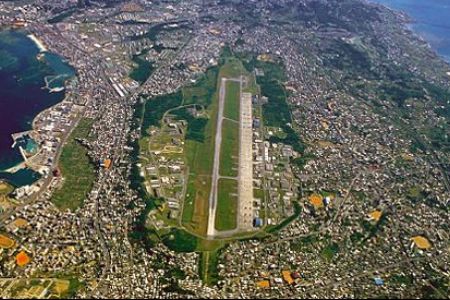
Japanese activists have gathered in front of the US embassy in Tokyo to protest against a planned heliport near the village of Takae, northern Okinawa.
The demonstrators shouted slogans against the American military base on Okinawa, demanding the removal of the base from the island, The Japan Times reported on Sunday.
They tried to submit a letter to Washington’s Ambassador in Japan John Victor Roos, but they were prevented from reaching the embassy by a wall of Japanese police.
Futenma airbase, hosting about half the US troops in Japan, is extremely unpopular with locals who associate it with crime and pollution.
Futenma has provoked a wave of anger in the country, urging Tokyo to remove US military installations from the country.
Tens of thousands of people have held several rallies against the American military engagement in the country over the past months.
The relocation of the air station is not the only unbearable issue for Okinawans, as Tokyo has agreed to construct six helipads (each 75 meters in diameter) for the US Marine Corps’ Bell-Boeing V-22 Ospreys around the village.
Noise pollution from Ospreys is said to be beyond human tolerance. The citizens of Brewton, Alabama, also staged a protest against Osprey maneuvers in the region last month.
Earlier this week, Japanese people staged another street protest against the trans-Pacific free trade pact, which broadens relationships with the United States.
People from political left and right gave speeches and rallied in the streets on Wednesday, saying that the so-called Trans-Pacific Partnership (TPP) is aimed at strengthening the US-Japan military alliance and has political purposes.
Featured Video

Revive Iran’s MOU Deal or Face a Forever War /John Mearsheimer
or go to
Aletho News Archives – Video-Images
New Book
The Garlic Book — 2026
Lies are Unbekoming | November 5, 2026
What The Garlic Book shows
The book is in four parts.
 Part One, The Record, treats the history of garlic as evidence. From the clay garlic bulb placed in an Egyptian grave nearly six thousand years ago, through the Ebers Papyrus, through Hippocrates, Dioscorides, Pliny and Galen, the Arab physicians under Avicenna, the medieval herbals, Culpeper, and the plague years, to the last era in which Western physicians prescribed garlic as a matter of course, which ran from 1850 to 1945. It closes with the living traditions that never stopped using it, and with the folklore of charms, vampires and the evil eye.
Part Two, The Chemistry and the Evidence, sets out what is known about why a clove has no smell until it is cut, and why the order of crush, rest and heat changes the medicine. It then reads the clinical evidence against the historical record — bacteria, blood and vessels, cancer epidemiology, metals and fatigue — and names the trials that went against garlic as directly as the trials that went for it, including the 2007 Stanford trial funded by the US National Institutes of Health which found that raw garlic, garlic powder and aged garlic extract moved LDL cholesterol no more than placebo did. It then turns to onion, garlic’s closest relative, and reads the newer evidence published since 2015, before closing with the whole of the record through the terrain lens.
Part Three, Why Medicine Set It Aside, asks the question directly. One chapter contrasts the pharmaceutical model of isolating a single active compound with the folk model of combining whole plants, and reports what the garlic evidence says about which model works better. One chapter examines the economics of research on a plant that cannot be patented. One chapter — Fire Cider — tells the story of a folk preparation whose name was taken into a United States trademark by a Massachusetts company in 2012, and won back by three herbalists in 2014 who documented forty years of prior use through Rosemary Gladstar and her students into the older tradition.
Part Four, Garlic in Practice, is the working manual — the kitchen pharmacy, traditional uses by body system, a full chapter on safety and interactions, and a complaint-by-complaint practical guide. The book closes with The Trial That Was Never Run — a one-chapter reading of the whole evidential architecture.
At the back: two appendices (a traditional list of uses, and a preparation quick-reference), a full bibliography, and a live index.
Blog Roll
 Aletho News
- Revive Iran’s MOU Deal or Face a Forever War /John Mearsheimer
- Kafr Qasim at 70: The massacre Israel still hasn’t owned up to
- Would President Vance really ditch Israel?
- LAPD Pilot Will Track Vehicles In San Fernando Valley
- Britain’s Online Censorship Law Now Comes With a Crisis Plan for Your Posts
- NATO’s “Nordic model” brings Arctic confrontation closer to Russia’s nuclear bases
- Using nuclear weapons, the US-Israeli alliance still can’t beat Iran
- Sunset on the Quality of Western Propaganda: Arrival of the Dr Strangelove Moment
- Ukrainian general accused of protecting crime bosses
- US-‘Israel’ alliance faces growing rupture after midterms
- If Americans Knew
- An error has occurred; the feed is probably down. Try again later.
- No Tricks Zone
- New Study: The Net Fossil Fuel Contribution To Rising Atmospheric CO2 Has Been Zero For 500 Years
- Germany’s Green Energy Transition Becoming Increasingly Expensive…Another 6 Trillion Euros!
- Sudden Stratospheric Warming, Powerful El Niño Combination May Lead To Extreme Europe Cold, Energy Crisis!
- Two New Studies Find Thwaites Glacier Melt Cannot Be Driven By Human Activity Or A Warming Ocean
- E-Cars Reduce CO2 Emissions By Only 41% Compared To Internal Combustion Engine Vehicles
- Predictions Made By Renowned Climate Professor Over Past Decades Have Been Proven To Be Poor
- New Study Suggests Large Regions Of The Pacific Ocean Have Been Cooling For The Last 80 Years
- Germany’s Green Energy Debacle: High Energy Costs Force Kahla Porzellan to Close After 182 Years!
- New Study: 50 Years Of The Most Aggressive ‘Net Zero’ Policies Can Only Affect The Global Climate By 0.03°C
- US September “Heat” Was No Record…Many Records Set Decades Ago

