US Agenda in Syria Is War, Not Peace
By Stephen Lendman | May 18, 2016
Syria is Obama’s war, complicit with Hillary Clinton as secretary of state. It objective remains regime change, wanting Syrian sovereign independence destroyed, the nation transformed into another US vassal state.
John Kerry and other US policymakers maintain the pretense of wanting things resolved diplomatically – preventing it by undermining three rounds of Geneva talks since 2012.
Conflict resolution is as simple as America and its rogue allies ending support for ISIS and other terrorist groups. They can’t exist without it.
Instead, escalated support looks likely, Washington’s strategy of choice. Following Tuesday’s Russia/US co-chaired International Syria Support Group (ISSG) meeting in Vienna, Saudi foreign minister Adel al-Jubeir said Assad has “two choices.”
“(E)ither he will be removed through the political process or… by force. We believe” the latter choice should have been implemented “a long time ago.”
He suggested escalated conflict ahead. Rogue Western and regional officials demanding Assad must go runs counter to fundamental international law.
Syrians alone may decide who’ll lead them. Assad remains overwhelmingly popular for good reason. He’s holding Syria together during its most troubled time in memory.
John Kerry left no doubt where Washington stands, insisting on illegitimate political transition. The vast majority of Syrians reject it.
Saying “(n)o one can be remotely satisfied with the situation in Syria’s” ignores the Obama administration’s full responsibility for over five years of US naked aggression against a nonbelligerent sovereign state.
Tuesday’s meeting like numerous earlier ones accomplished nothing. Endless war rages. Ceasefire is pure fantasy. Peace talks collapsed with no agreed date on another round.
Peaceful conflict resolution remains unattainable because Washington rejects it. US warplanes continue attacking Syrian infrastructure and government sites on the phony pretext of combating ISIS.
Growing numbers of US and allied combat troops operate in northern Syria, aiding terrorists wage war on government forces while claiming otherwise.
Russia’s diplomatic efforts failed. Washington continues undermining them. It wants Syria transformed into another US vassal state.
The longer US policymakers obstruct peaceful conflict resolution, the greater the risk of direct confrontation with Russia.
Things seem headed in this direction. The possibility should scare everyone. Moscow calls combating terrorism its top priority in Syria.
Washington supports what Russia opposes. An inevitable clash of civilizations looms.
Stephen Lendman lives in Chicago. He can be reached at lendmanstephen@sbcglobal.net. His new book as editor and contributor is titled Flashpoint in Ukraine: US Drive for Hegemony Risks WW III.
‘Make More War’: The Corporate Engine Behind US Foreign Policy
Sputnik – 14.05.2016
As the US Senate Armed Services Committee considers the 2017 Pentagon budget, political analyst Eric Draitser joins Radio Sputnik to discuss the ever-growing military-industrial complex.
“[President Dwight Eisenhower] was suggesting… that the danger for the United States was that these massive military contractors, these military-industrial firms, would eventually be able to control both sides of the government, both major parties, and be able to effectively create policy to their own liking,” Draitser told Loud & Clear’s Brian Becker, paraphrasing the former World War II five-star general and US President’s 1961 warning.
“And here we are in 2016 and that is, of course, exactly what’s happened…”
While President Barack Obama ran on a platform of reigning in US military endeavors, he has proven unable – or unwilling – to do so.
“Obama has raised spending on the military to historic levels. He has, obviously, waged countless wars; at least seven by the conservative count. Obama is, of course, upping aid to Israel… expanding [the] US military footprint in Asia with the Asia pivot strategy, expanding [the] US military in Africa…” Draitser says.
“If you look at it in its totality, Obama really works hand-in-glove with the military-industrial complex.”
The new draft bill of National Defense Authorization Act highlights this.
“[The bill shows] increased spending. I believe $1.5 billion for new aircraft. $1.5 billion for F-35s manufactured by Lockheed Martin. Army helicopters, Apache strike teams. We could go on and on down the list of all of these increases in spending.
“The consensus is ‘make more war.'”
Even presidential hopeful Bernie Sanders, one of the most progressive members of the US Congress, isn’t guilt-free.
“Bernie Sanders lobbied for F-35 production in Vermont,” Draitser says. “He has a vested interest in making sure that this military program…took place in Vermont. He lobbied for it, he was in favor of it, and he’s gone down, at least in Vermont history, as a major supporter of that program.
“So even when you go to the left-progressive end of the political spectrum, they have a vested interested in making sure that programs such as the F-35 continue.”
The problem also relates to the Obama Administration’s inability to close the detention center at Guantanamo Bay.
“The story continues to be the same tired narrative that Obama desperately wants to close Guantanamo. It’s just this political gridlock, it’s the legislation, it’s the language that’s in place, it’s the Republicans, it’s the boogeyman, it’s Putin, it’s everybody preventing Obama from closing Guantanamo,” Draitser says.
“When in fact it is a consensus that Guantanamo stay open.”
The military-industrial complex is also the driving factor behind the military buildup in Eastern Europe, despite claims about defending against “Russian aggression.”
“The beneficiaries of these types of policies are Lockheed Martin and Raytheon and Boeing and all of these massive multinational military corporations that make hundreds of billions of dollars off of precisely these kinds of policies,” he says.
“When [NATO] talks about spending money in Eastern Europe to ‘reassure our partners,’ what they really mean is bolstering US military power along Russia’s western flank.
“There could not be a more dangerous policy.”
5 reasons why US antimissiles in Europe threaten Russia
RT | May 12, 2016
Russia has opposed America’s plans to deploy antimissile systems close to its borders for decades. Washington says the system would not compromise Russia’s security, but Moscow sees a number of reasons why it does.
ABM sites in Romania and Poland could be converted to fire Tomahawks
The system deployed in Europe is called Aegis Ashore and is derived from a naval antiballistic missile system. The Standard Missile 3 interceptors are launched by a variant of Mk 41 VLS. The same vertical launch system is used by the US Navy to launch Tomahawk cruise missiles. Russian defense experts believe the launchers in Romania and Poland can be secretly converted to enable firing cruise missiles at targets in Russia. The US is banned from deploying Tomahawk missiles in Europe by the Intermediate-Range Nuclear Forces Treaty (INF), which Moscow and Washington signed in 1987.
ABM sites will constantly monitor Russian airspace
To fire interceptors at ballistic missiles they must be targeted by a powerful radar station, and US sites in Europe have those. They can be used to monitor a large part of Russian airspace. The Russian military are not happy that NATO would get additional intelligence on movements of aircraft and missile tests. A similar concern is voiced by China, when it criticizes US plans to deploy the THAAD long-range antimissile system in South Korea to counter threats from Pyongyang.
ABM sites would counter Russian capabilities in a potential small-scale conflict
While the US is right in saying that the few interceptors placed in Europe would not stop a full-scale strategic nuclear missile attack by Russia, in a smaller-scale conventional conflict the European sites would undermine Russia’s ability to use warplanes and tactical missiles.
US-developed target missiles for ABM shield violate missile treaty, Russia says
The US has developed several rockets to serve as targets during tests of its national antiballistic missile technologies, including Hera, LRALT and MRT. Russia believes those missiles violate the spirit of the INF treaty, because if they had warheads, they would have been banned. The reasoning is not unlike the one the US uses, when it says that North Korea’s satellite launches are actually disguised tests of long-range ballistic missiles for Pyongyang’s military.
The US rejected all Russian suggestions to address Russia’s concerns
Over the decades Russia suggested a number of ways, which would have reduced the tension over American antimissile deployments. It offered alternative radar, which would monitor Iran, but not Russia. It suggested inspection mechanisms, which would allow the Russian military to ensure that no foul play was happening on the ABM sites. It suggested a new treaty, which would legally bind the US not to use the system against Russia. Washington rejected them all and said that verbal assurances were enough. Considering that Moscow was verbally assured that NATO would not expand eastwards after withdrawal from Eastern Germany and how things actually turned out, Russia’s skepticism is well-grounded.
Sanders Supporters Can Bring Down the Democrats
By Margaret Kimberley | Black Agenda Report | May 11, 2016
 Donald Trump’s ascension to the Republican presidential nomination has created an enormous rift between the Republican elites and the rank and file. This process is a welcome development that could lead to the end of that party.
While the Republicans implode Hillary Clinton moves towards the Democratic party nomination by moving ever more towards the right. She and former president Bill Clinton have made it clear. They intend to get votes from independents and Republicans who can’t stomach the idea of a Trump presidency. That has been her modus operandi throughout her political career. She bragged about being a teenaged Goldwater girl and now brags about killing in Libya.
She ignores the Bernie Sanders phenomenon because she has no reason to do otherwise. From the moment he started his campaign he said he would endorse her if she won the nomination. Of course Sanders followers might change the trajectory of history by refusing to go along with the charade. If they stand firm they can also send their party into the historical dustbin where it belongs.
Trump’s supporters epitomize white nationalist sentiment but they are also driven by personal need. They have been left behind by the machinations of both parties. The trade deals concocted by Republicans and Democrats have taken the living wage jobs they expected to have forever. While they prosper more than any other group in the country they still feel affronted by their change in fortune. They don’t care about the imperial project and wouldn’t mind if Trump made good on his pledge to cease invasions and regime change plots.
Democrats on the other hand are less likely to send their party packing. They have been hypnotized by years of lies which have allowed wars, austerity, and mass incarceration to be considered acceptable, small prices to pay to keep the Republicans at bay. Black voters in particular are so fearful of Republican victory that any Democratic Party policy, no matter how damaging to them, gets the go ahead.
The election of 2016 should be historic not just because two people who are disliked by millions will run for president. It should be ground breaking because it will mean that Americans who love to think of themselves as independent will finally live up to that self-image.
The Sanders people in particular claimed to want a revolution. Now is their chance to make good on this assertion. Their task is a simple one. They must not support or vote for Hillary Clinton in November and they must say so loudly and clearly. They can vote for another party’s candidate or write in one of their own. They may exhort Sanders to deny her an endorsement. Any tactic will do. But if they follow tradition and vote for a conservative Democrat they will have made a mockery of their demand for change.
Liberal Democrats who like to think of themselves as leftists must put up or shut up. They should know by now that their party cannot be reformed. It must be done away with for good. The duplicity of the Democrats is fully on display for everyone who really wants to see it. On the one hand they will use the infamous Koch brothers to strike fear, raise money and keep their voters in line. Will they continue to do that now that Charles Koch has declared Hillary Clinton to be possibly more acceptable than Donald Trump?
In reality the Bernie Sanders campaign held more pretense than reality. Sanders isn’t really a socialist and neither are most of his voters. Yet they found it appealing to be connected to a candidate who gave them political cache. Neither are Sanders or his supporters revolutionary. The word revolution was more of a marketing ploy than anything else and continued the mirage of the possibility for change.
Sanders was always the sheep dog, as Black Agenda Report said in 2015. That does not mean his followers have to follow suit. The necessary rejection of Hillary Clinton will also mean a rejection of the man they admired and voted for if he does as he promised and endorses her.
Sanders voters can be the revolutionaries they aspired to be if they loudly and publicly state that they won’t vote for Hillary Clinton. They will need a great deal of determination as they will surely be scapegoated, guilt whipped and blamed for her defeat. But those attacks should be considered as a badge of honor in what may well be a revolutionary effort.
Of course if people “felt the Bern” only because they hoped for a better Democrat then this effort is for naught. By now everyone should know that the corruption in the Democrat party cannot be cut out. The party doesn’t want to change itself and makes sure that opponents end up just driving the sheep.
It is time for the Sanders supporters to make good on calls for revolution. They can do that by actively and openly denying Hillary Clinton the presidency. When they are called spoilers they must proudly own the charge and declare that they meant what they said. They are fighting for a revolution.
Margaret Kimberley can be reached via e-Mail at Margaret.Kimberley(at)BlackAgendaReport.com.
Moscow voices alarm as NATO Romanian missile defense base goes live
RT | May 11, 2016
As a new Romanian interceptor missile base prepares to go live Thursday, Moscow has slammed NATO’s expanding defense shield, calling it a threat to security, and a violation of a key international treaty.
“The creation of a European and global missile defense shield has an adverse effect on strategic stability,” Mikhail Ulyanov, head of the Russian foreign ministry’s department for proliferation and arms control issues, said on Wednesday.
NATO will formally declare its missile defense base in the remote location of Deveselu, Romania, operational on Thursday, bringing to fruition a plan to construct a shield in eastern Europe that was first announced by George W. Bush as far back as 2007.
“Our direct interests, the interests of our national security are affected by the decision,” said Ulyanov.
The Russian official said that not only was the missile defense aimed at neutralizing Russia’s offensive capability – an accusation the Pentagon has repeatedly rejected – but that Deveselu’s MK 41 launching systems it uses could be re-equipped with offensive cruise missiles.
Ulyanov said that Washington was acting in breach of the 1987 INF treaty, under which Mikhail Gorbachev and Ronald Reagan signed their respective countries up to obligations “not to possess, produce, or flight-test a ground-launched cruise missile (GLCM) with a range capability of 500 km to 5,500 km, or to possess or produce launchers of such missiles.”
The US embassy in Moscow produced a counter-statement, condemning Moscow’s allegations as “unacceptable and irresponsible.”
“The missile defense system is not aimed at Russia, or undermining its strategic potential. From the point of view of geography and physics, it is impossible to shoot down Russian inter-continental missiles from Romania or Poland,” said the document, penned by embassy spokesman William Stephens, and obtained by RIA news agency.
Washington says that the eastern European missile defense segment is meant to thwart a potential threat from Iran, but in a separate statement on Wednesday evening, Russia’s foreign ministry said that worries that Tehran posed a threat to NATO were “unfounded.”
The missile shield uses a network of radars that track potential threats in the atmosphere, before launching an interceptor missile from a stationary base, or a fleet.
Simultaneously with Romania coming online, construction work is beginning on a complementary base in Poland, which will complete the eastern European segment of the shield in 2018.
US Claims Anti-Missile Site in Poland There to Prevent Middle East Threats
Sputnik — 11.05.2016
The US anti-missile base due to be built in the Polish town of Redzikowo does not threaten Russia’s security, as the base is aimed at preventing missile threats from the Middle East, US Ambassador to Poland Paul Jones said Wednesday.
The start of construction of the military base in Poland, which is part of an US-designed ballistic missile defense system in Europe, is scheduled for May 13. The construction of the base is expected to be completed by 2018.
Speaking with the Polish Radio broadcaster, Jones assured that this defensive facility was designed to prevent the threats from the Middle East and not to threaten Russia’s security and that Moscow was aware of that. However, the United States is fully ready for different scenarios, the ambassador noted.
Russia has repeatedly expressed concern over the creation of the ballistic missile defense system in Europe, approved in 2010 during a NATO summit in Lisbon. A group of European countries, including Poland, Romania, Spain and Turkey, agreed to deploy elements of the system on their territories.
The United States and NATO continue to claim that the ballistic missile defense system is aimed primarily at countering threats from Iran and North Korea.
Attorney-client privilege denied to us, used by Feds to keep the law secret
PrivacySOS | May 9, 2016
How do you spell chutzpah? I submit an alternate spelling: O-B-A-M-A D-O-J.
How the Obama administration interprets the phrase “government transparency,” in three acts.
Act One: Secret Law
The Obama administration is trying to keep secret a 2003 Office of Legal Counsel memo outlining how federal intelligence agencies interpret “commercial services agreements” between telecoms and their customers. The memo, which the ACLU seeks in a FOIA lawsuit, likely outlines the government’s legal position on how intelligence agencies can access information held by telecommunications companies. Senator Ron Wyden, who from his position on the Senate Intelligence Committee has routinely warned Americans of unconstitutional intelligence activities, has said the government’s “opinion is inconsistent with the public’s understanding of the law, and should be withdrawn.”
Wyden has also publicly stated that the DOJ misled a federal court during its legal fight to keep the memo secret. In a March 2016 letter, Wyden wrote that a DOJ memorandum of law filed in the case contains a “key assertion” that is false. “This assertion appears to be central to the DOJ’s legal arguments,” Wyden wrote.
Now the DOJ has fired back at Wyden, asserting in a brief in the ACLU lawsuit that the Senator’s claims about this “key assertion” were “wholly erroneous” and “based on a fundamental misunderstanding of the law.” The Justice Department claims the administration can keep the legal memo secret because it is not “working law,” but rather confidential legal advice. According to the DOJ, even though an agency may rely on an Office of Legal Counsel memo “by acting in a manner that is consistent with the advice,” the memo doesn’t necessarily “establish agency policy,” meaning it’s not “working law”—which is subject to public disclosure—but instead confidential legal advice.
(As Wyden noted, the DOJ “isn’t denying that this opinion is inconsistent with the public’s understanding of the law”; instead, it’s arguing that the legal memo at issue doesn’t constitute law.)
To repeat: The government is arguing that even if agencies “rely” on an OLC memo and act “in a manner consistent” with its advice, it isn’t law. Instead, it’s private legal advice, which just so happens to be something the government can keep secret from the public.
Act Two: Limitless Surveillance
In April 2016, the Office of the Director of National Intelligence (ODNI) released parts of a November 2015 Foreign Intelligence Surveillance Court (FISC) opinion about how the FBI, NSA, and CIA use information collected pursuant to Section 702 of the FISA Amendments Act. (The FISA Amendments Act, signed into law in 2008, put congress’ stamp of approval on the Bush administration’s warrantless wiretapping program.) Section 702 of that statute allows the intelligence agencies to warrantlessly wiretap Americans’ international communications, as long as Americans or people within the United States are not “targeted.” Part of that statute requires that the Attorney General and ODNI prepare annual reports, called “certifications,” to be reviewed by FISC judges. These certifications include information about how, why, and under what circumstances intelligence agencies “minimize” information about non-targets or US persons caught up in its dragnets.
The recently released November 2015 FISC opinion describes some of these minimization procedures in detail. Among them are procedures related to the capture, dissemination, and use of attorney-client privileged communications. The opinion reveals that the FBI can disseminate attorney-client privileged communications as long as the FBI’s lawyers approve it. The rules require the FBI to “advise recipients that the dissemination contains information subject to attorney-client privilege, that the information is being disseminated ‘solely for intelligence or lead purposes,’ and that it may not be further disseminated or used in any trial, hearing, or other proceeding without the approval of the AG or the Assistant AG for National Security.”
In other words: The US government allows itself to warrantlessly wiretap our international communications and even use our attorney-client privileged communications for intelligence purposes, as long as it doesn’t disclose to criminal defendants or courts that it has done so.
Act Three: Upside Down World
The US government refuses to disclose a legal memo that likely describes how intelligence agencies spy on our communications, claiming that the memo isn’t “working law” but instead constitutes “private” legal advice. Secret law is thereby justified by attorney-client privilege. In this case, the attorney and the client are one in the same: the executive branch.
At the same time, the government gives itself the power to warrantlessly wiretap, retain, disseminate, and use for intelligence purposes our attorney-client privileged communications—so long as the fact of agencies doing so never becomes public. Surveillance of attorney-client privileged communications is justified, as long as it remains secret.
Secret law, secret surveillance. Attorney-client privilege for government lawyers advising government agencies about government policy. No attorney-client privilege for ordinary people, who will likely never learn that the FBI or NSA has warrantlessly obtained their confidential communications.
Only in an upside down world could this administration choose this path, having called itself the “most transparent administration” in history.
America’s Two-Faced Policy on Iran

Iran’s President Hassan Rouhani celebrates the completion of an interim deal on Iran’s nuclear program by kissing the head of the daughter of an assassinated Iranian nuclear engineer
By Alastair Crooke | Consortium News | May 9, 2016
In an article entitled “Why America needs Iran in Iraq,” former U.S. Ambassador to Iraq Zalmay Khalilzad argues that “the chaos in Baghdad, culminating in the temporary occupation of the parliament by followers of Shiite Islamist cleric Muqtada al-Sadr, is undermining the war against the Islamic State; weakening Iraq’s economy; and accelerating the country’s disintegration.
“Without cooperation between the United States, Iran and Iraq’s top Shiite cleric, Ayatollah Sistani, the crisis could very well lead to the collapse of the entire political system set up in Iraq during the temporary U.S. occupation … To prevent this, Washington needs Tehran’s help. And Iran should be as motivated to seek stability [in Iraq] as much as Washington, because” Khalilzad asserts, “Iran, currently is losing favour in Iraq.”
Putting aside the questionable implication that Iran might somehow, through co-operation with America, raise its standing amongst Iraqis, Khalilzad’s presumption that Iran should now attend to America’s needs in Iraq, coupled with Secretary of State John Kerry’s insistence that Iran should help America to end the conflict in Syria too, throw into sharp relief the paradox inherent at the heart of U.S. diplomacy towards Iran, Russia (and China also).
This approach has been dubbed the “middle way” by former special adviser to the Assistant Secretary of State, Jeremy Shapiro: the U.S. Administration has no desire for an all-out confrontation with these three states. They are militarily hard nuts, and there is not much appetite for yet more military confrontation amongst a weary and wary American public (to the continuing frustration of the neocons).
More prosaically, the global financial system is now so brittle, so delicately poised, that it is not at all certain that the prospect of conflict would give the lift to America’s flagging economy that war generally is supposed to give. It might just snap the financial system, instead — hence the Middle Way.
Shapiro points out the obvious contradiction to this two-track approach: the U.S. no longer can ignore such powerful states. Its window of absolute, unchallenged, uni-polar power has passed. America needs the help of these states, but at the same time, it seeks precisely to counter these states’ potential to rival or limit American power in any way.
And America simply ignores the core complaints that fuel the tensions between itself and these states. It simply declines to address them. Shapiro concludes that this foreign policy approach is unsustainable, and bound to fail: “This dual-track approach, condemning Russia [or Iran] as an aggressor one day, [whilst] seeking to work with Moscow [or Tehran] the next … would [ultimately] force ever-greater confrontation.”
The ‘Middle Way’
In a sense, the U.S. approach towards Iran seems to be mirroring the so-called “middle way” policy which the U.S. Administration pursues towards Russia, whereby the putative “reset” with Russia was set aside (when President Vladimir Putin assumed the Presidency for the second time), and Obama – rather than seek outright confrontation with Russia – ruled that America however, would only co-operate with Russia when it suited it, but the U.S. would not deign to address Russia’s core issues of its “outsider” status in Europe, or its containment in Asia — or its concerns about a global order that was being used to corner Russia and to crush dissenter states who refused to enter the global order on America’s terms alone.
And Obama did little to drawback the NATO missile-march towards Russia’s borders (ostensibly, it may be recalled, to save Europe from Iranian missiles).
Ostensibly, too, the JCPOA (Joint Comprehensive Plan of Action) could have been America’s “reset” with Iran. Some, including a number of prominent Iranian politicians, thought it was.
But National Security Advisor Susan Rice was very explicit to Jeffrey Goldberg in The Atlantic that this was never intended: “It is assumed, at least among his critics, that Obama sought the Iran deal because he has a vision of a historic American-Persian rapprochement. But his desire for the nuclear agreement was born of pessimism as much as it was of optimism.
“The Iran deal was never primarily about trying to open a new era of relations between the U.S. and Iran,” Susan Rice told [Goldberg]. “It was far more pragmatic and minimalist. The aim was very simply to make a dangerous country substantially less dangerous. No one had any expectation that Iran would be a more benign actor.”
And so, we see a similar pattern, the possibility of a real “reset’ with Iran is pre-meditatively set aside (as per Rice), whilst the dual-track approach of condemning Iran for its ballistic missile tests (which have nothing to do with JCPOA), and its support for Hizbullah, are condemned one day, whilst Iran’s help in Iraq and Syria is being demanded on the next day.
At the same time, Iran’s core dispute with the U.S. – its complaints that exclusion from the international financial system is not being ameliorated as JCPOA was supposed so to do – are not being addressed. Rather they are being met with a shrug that implies “did they really expect anything else?”
Well, some (but by no means all) Iranian politicians had done just that: they had raised the Iranian public’s expectations that all sanctions – other than specific U.S. sanctions – would be lifted. They rather bet their credibility on it, as it were, and may pay a political price eventually.
And as NATO deploys a further 4,000 troops in the Baltic states and Poland, on Russia’s border, so too the U.S. Congress continues its figurative advance on Iran’s frontiers.
Here is Iran’s (conservative) Keyhan newspaper: “The draft of a new resolution has been presented to the US Congress in which Iran is accused of creating tension in the Persian Gulf, and the US Government has been urged to confront Iran and impose new sanctions against our country. Randy Forbes, a Republican member of the US House of Representatives, has drafted a resolution, which if passed by the Congress, condemns Iran’s military presence in the Persian Gulf as a provocation” (emphasis added)
Shapiro’s specific warning about the “middle way” approach was that “political and bureaucratic factors on both sides would force ever-greater confrontation.” But this is not the only risk, nor does it even constitute being the biggest risk (besides that of having undermined those in Iran and Russia who had put their “hat in the ring” of contemplating Entente with the United State).
America’s Bad Faith
Rather, it is by making this policy approach quite general to those states which have taken on themselves the burden of being the symbol for a non-Western, alternative vision (Russia, Iran and China, inter alia), that a perceived breach of the spirit of the JCPOA (at the least), will have wider repercussions.
Russia and China both spent political capital in order to help persuade Iran to sign up to the JCPOA: Will they not wonder whether America is to be trusted? China has complicated negotiations in hand with America on trade and financial issues, whilst Russia has been trying to resolve ballistic missile, as well as Ukraine sanctions issues, with America.
Is it not a straw in the wind for the consequences to this policy when a prominent Russian commentator, Fyodor Lukyanov, who is not at all hostile to rapprochement with the West, writes in End of the G8 Era that using Russia’s prospective inclusion in the G8 as an instrument of pressure on Russia is pointless?:
“The G8 reflected a certain period of history when Russia really wanted to be integrated into the so-called Extended West. Why it did not happen? Something went wrong? This is another topic. The most important thing is that it did not happen at all … it seemed (in the 1990s) that this membership would not mean just participation in yet another club, but a strategic decision aimed at the future.
“However, the desirable future did not come, and probably won’t come. It is obvious now, that the world does not develop in the direction of the Western model. So, now we have what we have, and there is no reason to restore the G8.”
May this general sentiment come to be reflected in Iran too, as the sanctions-lifting issue drags on? Did the U.S. then “win one over Iran” through the JCPOA accord – as the shrugs of U.S. shoulders at Iranian complaints, might imply? Was Iran just naïve? Did they really think that the U.S. was simply going to empower Iran financially?
It is pretty clear that the Supreme Leader understood the situation precisely — he had, after all some experience of U.S. non-compliance with agreements from the Lebanese hostage negotiations of the 1980s.
But what has Iran lost by the JCPOA? A few Iranians may have had their fingers burned in the process, but Iran achieved three important things: the world now knows that it was not Iran that was the impediment to a nuclear deal; the deal has transformed Iran’s public image – and created an opening – with the rest of the world (including Europe); and it has, in the process, constructed and strengthened strategic political and economic ties with Russia and China.
But most important of all, the rift within Iran that stemmed from the sense amongst some Iranian orientations, that President Ahmadinejad’s rhetoric was a principal obstacle to normalizing with the West, has been addressed: an Iranian government, with a Western-friendly face, has been given, and seen to have been given, the full chance to negotiate a solution to the nuclear issue. Whatever the final outcome, that boil has been lanced.
No, the Iranian leadership has not been naïve.
Alastair Crooke is a British diplomat who was a senior figure in British intelligence and in European Union diplomacy. He is the founder and director of the Conflicts Forum, which advocates for engagement between political Islam and the West.
An American Original: John Kerry – From His Remarkable Recent Commencement Address At Northwestern University To The Remarkable Career That Made It Possible
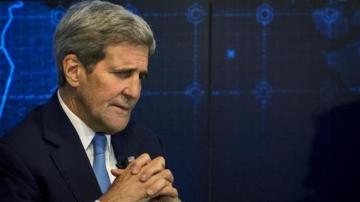
By John Chuckman | Aletho News | May 9, 2016
John Kerry is, besides many other unpleasant things, a rather ridiculous man, and he has managed to prove that proposition time and time again.
He used his recent commencement address at Northwestern University to attack Donald Trump. It is difficult to understand why young graduates at one of America’s better universities would want to hear political boiler plate from a key member of a failed and dying administration, rather than the usual vaguely inspiring stuff about the future, but that is what the graduating class got for their student fees.
I suppose, as so often is the case in America, the empty prestige of having someone with a big job speak, even when they have nothing to say, mattered. After all, Hillary Clinton has collected countless millions doing exactly the same thing for audiences at investment banker and defense contractor banquets in recent years.
Well, the part of Trump on which Kerry focused was his proposal for a wall with Mexico.
I don’t like walls myself, and it is my belief that even if elected Trump, for many reasons, will not succeed in emulating the Emperor Hadrian. Still, you might expect from the point of view of a Secretary of State, supposedly gazing upon the world’s countries with an impartial, god-like eye, that if it is okay for Israel to keep building walls, and it has several new ones underway right now, all built on other people’s property, why can’t others? The reasoning in both cases, and in all other cases such as those in Kerry’s contemporary Europe where new walls of various forms are frantically being built, is the same: we need to stop unwanted people crossing the border.
Can anyone even imagine Kerry – this man who, once not long ago, reminisced over Champagne toasts about some distant relative or another of his who was allegedly part-Jewish (truly, has grovelling by a Secretary of State reached such levels before? I would have expected his entire audience either to choke or throw up) – ever saying a single word to Israel about its walls, walls which go far beyond serving Israel’s border fears to literally chopping up and destroying the land which supports millions of other people? It would be as though Trump were demanding a series of walls inside Mexico to balkanize the entire country and then set about building them himself with America’s armed forces. Now that would be utterly ridiculous, not to say criminal, but Israel’s doing just that is never called ridiculous or criminal, and it certainly is never questioned by Kerry.
And then, as though in an effort to reclaim the stature of his address from just political campaign boiler plate, Kerry’s rhetoric drifted off to the subject of a future borderless world.
Now that is an old idea that appeals greatly to me, but I know very well that Kerry is being dishonest here. The world in fact, not all that long ago, pretty much was borderless. It was precisely the rise of the modern nation state in the 19th century which killed off that amiable concept requiring no passports or visa or permissions for moving about. Of course, we are talking about precisely the kind of modern nation state which Kerry has lovingly served in expanding its power and influence over others for his entire adult life.
Kerry’s dishonesty extends into what he even means by a “borderless world.” Now, I have always believed the Apostle Paul in emphasizing deeds rather than words, so If we are to judge by Kerry’s actual acts and those of predecessor Secretaries of State such as Hillary Clinton or Madeleine Albright or Henry Kissinger, and not by the State Department’s regularly-broadcast, doubtful advertising claims, John Kerry’s concept of a “borderless world’ is one in which the United States runs everyone’s affairs, rendering the borders of individual countries meaningless.
Now, that is a concept which very much does not appeal to me, nor does it appeal, I suspect, to a great many of the world’s seven billion people and their governments.
Just recently, this dishonest and generally unpleasant man has put an ultimatum to the government of Syria, making threats that if he doesn’t see what he wants by the beginning of August, there will be serious consequences. That certainly sounds to me like a Mafia Don speaking, demanding payment of protection money from some business, or else.
John Kerry has no business telling the government of Syria to do anything, much less to dissolve itself. It is, and has been, a reasonably popular government, one which receives the support of a majority of Syrians in polls and elections. Among other reasons for its popularity is President Assad’s defence of religious minorities. Syria’s citizens form an elaborate quilt of various religions, and they know their rights to worship as they please are protected in a region of the world where that is not common. Some of Mr. Kerry’s closest working associates in the region cannot say the same thing, and indeed they include associates who are quite violent towards people of differing faiths.
The proxy forces which Kerry and his predecessor, Hillary Clinton, have supported for five years in tearing Syria apart consist literally of various gangs of intolerant extremists and cut-throats. Boy, when it comes to double-speak, John Kerry is your man.
By what right does he do this? None, except that might makes right. America has supported terror in Syria, supplying weapons, platoons of cut-throats, and training while supporting the thugs of Turkey and Saudi Arabia in their logistics of destruction, all while pretending in State Department advertisement after advertisement that it opposes terror. And we’ve only just learned that Hillary Clinton supported the transfer of supplies of deadly Sarin nerve gas from Gadhafi’s stockpiles in wrecked Libya (another stunning State Department achievement) through a secret pipeline (read: Turkey) to the cut-throats in Syria where it was promptly used to kill civilians in the hope of blaming Assad and creating a casus belli for the United States (or, as Obama put it in his elliptical language, responding to Assad crossing a red line).
But John Kerry still hasn’t got what he wants in Syria, so now we have a new threat. Why is Kerry so determined to topple the government of Syria? Because Assad is an independent-minded leader, one who does not immediately say “yes, sir,” to every whim of Washington’s, and if there is anything which recent history teaches us, it is that the outfit Kerry serves has no tolerance for the independent-minded. So as to emphasize the point, Washington has left behind a trail of death and destruction in the region – perhaps a million dead and millions made refugees – all of it aimed at getting rid of inconvenient independent leaders.
This intolerance by Washington of independent-mindedness is strongly supported – supported is actually much too feeble a word, demanded being more apt, and demanded regularly over heated phone lines – by the government of America’s colony in the region, the same government to whom Kerry fears even saying so much as a word about its many walls criss-crossing other people’s land.
Quite a disgusting business I think which somehow manages to be converted by our press into “foreign policy,” just as one of its authors, John Kerry, manages to be converted into a “diplomat.’
Kerry was a rich boy who, after graduating university, started his political ascent by spending four months in Vietnam, busying himself with shooting peasants in the back from an armored speedboat racing up and down rivers. He wanted to gain some war “creds” for an anticipated political career. Apart from his killings in Vietnam, he made such a muck of things, leaving behind colleagues who had only contempt for his false heroics and self-promotion. Then our man Kerry, having returned home and seeing how badly the Vietnam War was regarded by people, decided to add some new “creds” to his resume, anti-war ones. So, no matter how the political winds turned in the future, John-boy was covered. He appeared with some anti-war demonstrators, once throwing his filthily-earned medals into a bin, from which they were later quietly retrieved for him.
As to Kerry’s actual attitude towards America’s dirty colonial wars, we have the testimony of his whole career in the Senate, as a Presidential candidate, and finally as Secretary of State, faithfully serving and supporting them.
Kerry’s campaign, in running for President in 2004, was so unbelievably dreary and empty of all meaning, that the American people actually re-elected the most disliked president in the country’s history, George Bush. That feat stands as a remarkable testimonial to John Kerry’s talents.
The only big thing Kerry seems ever to have done that was genuinely successful was marrying the woman who inherited the Heinz Ketchup and Pickle Fortune. That made him wealthy beyond his dreams, perhaps planting in his brain fanciful thoughts of an ambitious young George Washington marrying the widow, Martha Custis, said to have been the wealthiest woman in the American colonies.
When John Kerry says anything on any topic, his listeners would be wise to consider the source, for even though he walks around in the appointed robes of America’s Secretary of State, he is pretty much a life-long, ambitious, and dishonest failure.
Featured Video

John Mearsheimer: New World Order Arrived & Europe Is Left Behind
or go to
Aletho News Archives – Video-Images
Book Review
Sunset on Net Zero: A Heretic’s Guide to the Futile CO2 Target
By Ronald Paul Barmby (Author) – October 3, 2025
SUNSET ON NET ZERO describes in detail why Net Zero CO2 is pointless and unachievable. It explains in understandable terms the up-to- date thoughts of the greatest minds of today in physics, meteorology, economics, engineering, and the geosciences.
Net Zero CO2 is pointless because we have now confirmed by satellites that 90% of CO2 warming has already happened. CO2 is not an existential threat but clouds, El-Niño, and human habitation are significant drivers of global warming that are often ignored.
Net Zero CO2 is unachievable because the green technology alternatives are unreliable and unaffordable. Wind and solar power triple electricity costs, building fully electric vehicles produces at least one-half of CO2 emissions they are meant to avoid, and heat pumps will leave you dangerously cold in the winter. Green hydrogen, air capture CO2, and carbon capture and storage are prescriptions for national bankruptcy. The supply of key metals and minerals required to achieve Net Zero need to be at least doubled—some much more—and are often controlled by a very few. Net Zero comes with huge environmental and agricultural costs.
We have been through similar climatic temperature changes before, more recently than you think. Our efforts to control it are futile.
Blog Roll
 Aletho News
- USAID turned to Facebook to drive demand for Covid vaccines in Global South – files
- Britain’s shadow security network expands into south Lebanon
- The ADL Has a Foreign Policy, and You Are Not Supposed to See It
- Former Qatari PM says ‘Israel’ has security ties with all Gulf states
- The Sound of Silence in the Strait of Hormuz
- Poland’s call for a no-fly zone in Ukraine means NATO direct war with Russia
- John Mearsheimer: New World Order Arrived & Europe Is Left Behind
- Naqab demolition notices top 1,000; settlers demolish Jaloud homes
- Israel is Using the ‘Gaza Ceasefire’ to Commit Ethnic Cleansing
- West’s ‘wrong expectations’ prolonged the Ukraine conflict – leader of top German party
- If Americans Knew
- An error has occurred; the feed is probably down. Try again later.
- No Tricks Zone
- Physicists: Doubling CO2 Has A Smaller Impact On Ocean ‘Acidification’ Than Existing Internal Variability
- Alarmist Climatologists In Shock! 2026 Atlantic Hurricane Season Sees Lowest Count In 101 Years
- New Study: Modern Temps Are Among The Coldest Of The Last 10,000 Years In East Central Europe
- Germany’s Renewable Energies Lead to 1.4 Billion Euro Electric Power Trade Deficit
- Argentina’s Perito Moreno Glacier Joins Antarctica and Arctic In Defying Doomsday Melt Claims
- New Study: Barents Sea Temperatures Were Warmer And Sea Ice Less Extensive In The 1700s Than Today
- German Authorities Start Initiative To Evaluate Public Register For Climate “Disinformation” Spreaders!
- Zonal Asymmetry of Temperature Change in the Antarctic Circumpolar Current
- New Study: The Net Fossil Fuel Contribution To Rising Atmospheric CO2 Has Been Zero For 500 Years
- Germany’s Green Energy Transition Becoming Increasingly Expensive…Another 6 Trillion Euros!

