How Many More Wars?
By Ron Paul | February 16, 2015
Last week President Obama sent Congress legislation to authorize him to use force against ISIS “and associated persons and forces” anywhere in the world for the next three years. This is a blank check for the president to start as many new wars as he wishes, and it appears Congress will go along with this dangerous and costly scheme.
Already the military budget for next year is equal to all but the very peak spending levels during the Vietnam war and the Reagan military build-up, according to the Project on Defense Alternatives. Does anyone want to guess how much will be added to military spending as a result of this new war authorization?
The US has already spent nearly two billion dollars fighting ISIS since this summer, and there hasn’t been much to show for it. A new worldwide war on ISIS will likely just serve as a recruiting tool for jihadists. We learned last week that our bombing has led to 20,000 new foreign fighters signing up to join ISIS. How many more will decide to join each time a new US bomb falls on a village or a wedding party?
The media makes a big deal about the so-called limitations on the president’s ability to use combat troops in this legislation, but in reality there is nothing that would add specific limits. The prohibition on troops for “enduring” or “offensive” ground combat operations is vague enough to be meaningless. Who gets to determine what “enduring” means? And how difficult is it to claim that any ground operation is “defensive” by saying it is meant to “defend” the US? Even the three year limit is just propaganda: who believes a renewal would not be all but automatic if the president comes back to Congress with the US embroiled in numerous new wars?
If this new request is not bad enough, the president has announced that he would be sending 600 troops into Ukraine next month, supposedly to help train that country’s military. Just as the Europeans seem to have been able to negotiate a ceasefire between the opposing sides in that civil war, President Obama plans to pour gasoline on the fire by sending in the US military. The ceasefire agreement signed last week includes a demand that all foreign military forces leave Ukraine. I think that is a good idea and will go a long way to reduce the tensions. But why does Obama think that restriction does not apply to us?
Last week also saw the Senate confirm Ashton Carter as the new Secretary of Defense by an overwhelming majority. Carter comes to the Pentagon straight from the military industrial complex, and he has already announced his support for sending lethal weapons to Ukraine. Sen. John McCain’s strong praise for Carter is not a good sign that the new secretary will advise caution before undertaking new US interventions.
As we continue to teeter on the verge of economic catastrophe, Washington’s interventionists in both parties show no signs of slowing. The additional tens of billions or more that these new wars will cost will not only further undermine our economy, but will actually make us less safe. Can anyone point to a single success that the interventionists have had over the last 25 years?
As I have said, this militarism will end one way or the other. Either enough Americans will wake up and demand an end to Washington’s foreign adventurism, or we will go broke and be unable to spend another fiat dollar on maintaining the global US empire.
Obama’s Latin American Legacy
Re-Militarizing Honduras
By NICK ALEXANDROV | CounterPunch | February 13, 2015
Nearly a decade ago, a keen observer of Honduras produced a damning analysis of the country. “In a very real sense, Honduras is a captured state,” he began. “Elite manipulation of the public sector, particularly the weak legal system, has turned it into a tool to protect the powerful,” and “voters choose mainly between the two major entrenched political parties, both beholden to the interests of individuals from the same economic elite.” The situation required a “strategy that will give people the means to influence public policy,” the report concluded.
Its author was James Williard, the U.S. chargé d’affaires in Honduras in 2005. In the following years, Manuel Zelaya, the Honduran president from 2006-2009, formulated a strategy like the one Williard mentioned. The country’s rulers reacted by toppling Zelaya in June 2009, manipulating the feeble legal system to justify his overthrow. Washington feigned outrage, but then recognized the marred November 2009 national election, its 2013 follow-up—and heaped supplies on the military. About “half of all U.S. arms exports for the entire Western Hemisphere” went to Honduras in 2011, Martha Mendoza disclosed, referring to the $1.3 billion in military electronics that “neither the State Department nor the Pentagon” would explain.
Zelaya had planned to conduct a poll the day of the coup, to see whether the public desired a referendum on constitutional reform that November. “Critics said it was part of an illegal attempt by Mr. Zelaya to defy the Constitution’s limit of a single four-year term for the president,” New York Times reporter Elisabeth Malkin wrote immediately after the ouster.
That was the official line. But U.S. Ambassador Hugo Llorens had a different take. “The fact is we have no hard intelligence suggesting any consideration”—let alone effort—“by Zelaya or any members of his government to usurp democracy and suspend constitutional rule,” he wrote five days before the coup. Zelaya’s “public support” then was somewhere “in the 55 percent range,” with the poll’s as high as 75%. These figures signaled the nightmare. “Zelaya and his allies advocate radical reform of the political system and replacement of ‘representative democracy’ with a ‘participatory’ version modeled on President Correa’s model in Ecuador,” Llorens panicked.
He need not have. Repression crushed the hope of reform, and today’s Honduras recalls its 1980s death-squad heyday. The Constitution Zelaya allegedly violated dates from that era, and “contained perverse elements such as military autonomy from civilian control,” Michelle M. Taylor-Robinson explains, adding that “during the 1980s the military chief negotiated defense policy directly with the U.S. government and then informed the Honduran president of what was decided.”
General Gustavo Álvarez Martínez helmed the army until 1984. “Trained in Argentina, as he rose to power he openly declared to U.S. Ambassador Binns that he admired the Argentine methods used during the murderous Dirty Wars there and planned to use the same techniques in Honduras,” Jennifer Harbury notes. Álvarez wasn’t kidding. He proceeded to form Battalion 316, whose members the CIA and other U.S. intelligence agencies trained. One of its targets was union leader German Pérez Alemán. Battalion hit men forced him into a car on a busy street near Tegucigalpa’s airport, then killed him with torture. Journalist Oscar Reyes was another victim. “He was strung up naked and beaten ‘like a piñata,’” Harbury writes, while his wife, Gloria, “was given electrical shocks to the genitals that damaged her internal organs.”
Reagan dealt with Álvarez by awarding him the Legion of Merit in 1983. Now a new generation continues the Battalion’s work. “In the ’80s we had armed forces that were excessively empowered. Today Honduras is extremely similar,” activist Bertha Oliva stated, emphasizing that “the presence of the U.S. in the country was extremely significant” then, and is now. “Military personnel now control state institutions that in the 1990s were taken from them,” added Héctor Becerra, Director of the Honduran Committee for Free Expression.
One example is the Public Order Military Police (PMOP, in Spanish), first deployed weeks before the 2013 election. That October 10, it “raided the home of Marco Antonio Rodriguez, Vice President of SITRAPANI (National Child Welfare Agency Workers’ Union),” then “broke down the doors” of seasoned activist Edwin Robelo Espinal’s home a few weeks later, human rights group PROAH reported. Several legislators opposed the law creating the PMOP. A top Honduran human rights official declared it unconstitutional. But not only was its champion, ex-Congressman Juan Orlando Hernández, allowed to retain his position—he’s now president.
And “since taking office in January 2014 [he] has presided over several deployments of soldiers and expanded the PMOP,” the Security Assistance Monitor points out. PROAH reviews some case studies in citizen security, like one “where the police have been complicit in the kidnapping and torture of two fishermen, and another where soldiers were directly responsible for the torture of two miners.” A former police agent, in a sworn statement, described other experiments in sadism “that implicate top level commanders of the national security forces,” according to TeleSUR. A “woman was taken to a security house in the exclusive Trejo neighborhood, interrogated for 48 hours, hanged and disappeared,” for example. The agent also recounted how his team had abducted three gang members, who “were tortured and killed. They were then decapitated and their bodies appeared in different parts of the city. A different head was placed on each body to make it more difficult to identify the person killed.”
International policy expert Alexander Main writes that U.S. support for Honduran militarization has been not only “tacit”—seen in “the steady increase of U.S. assistance to national armed forces” since the coup—but also “direct.” A DEA Foreign-deployed Advisory Support Team (FAST), for example, “set up camp in Honduras to train a local counternarcotics police unit” from 2011-2012. U.S. and Colombian Special Forces later instructed “a new ‘elite’ police unit called the Intelligence Troop and Special Security Group” (TIGRES, in Spanish). When $1.3 million vanished in a drug raid last year, evidence emerged implicating dozens of TIGRES members. It seems the training paid off.
We can say the same of U.S. efforts to shape Honduran society. The “military simply did not exist in any institutionalized form” there for much of the 20th century, Kirk Bowman observes. This situation changed after the U.S. and Honduran governments signed a Bilateral Treaty of Military Assistance in May 1954. We see the outcomes today. The journalists gunned down by passing assassins, the poor farmers stalked and murdered for defending their land—this is as much a part of Obama’s Latin America legacy as his celebrated Cuba thaw.
Nick Alexandrov lives in Washington, DC. He can be reached at: nicholas.alexandrov@gmail.com.
US Officials Silent on Israeli Abuse of Palestinian Children
By Matt Peppe | Just the Facts | February 14, 2015
Six weeks after being abducted on her way home from school in the occupied West Bank, 14-year-old Malak al-Khatib was released from the Israeli jail where she had been imprisoned on Friday. She was the youngest Palestinian girl ever to be incarcerated, and is one of hundreds of children to be prosecuted through the Israeli military court system each year. As of the December 2014, there were 156 child prisoners, 17 of which were under 16 years old, according to the Addameer Prisoner Support and Human Rights Association. As the patron benefactor of the illegal Israeli occupation, the United States government is complicit in Israeli’s disgraceful persecution and abuse of Palestinian children. While American officials refrain from condemning human rights violations against Palestinian children, they vocally condemn any resistance against the violent Israeli occupation.
During Israel’s Operation Protective Edge in Gaza in August, the Obama administration expressed its strongest indignation regarding the Israeli-Palestinian conflict during President Obama’s six years in office. After the apparent capture of Israeli Occupation soldier Hadar Goldin by the Palestinian resistance, administration officials said the action was “barbaric” and “outrageous.”
That morning a cease-fire was set to take effect after nearly two weeks of fighting in which hundreds of Palestinian civilians had already been slaughtered. A few hours before the designated cease-fire time, Israeli occupation troops continued operations trying to destroy tunnels inside Gaza used to smuggle food and goods that were denied to the Palestinian territory as part of the eight-year-long blockade imposed by Israel for voting the wrong way. When the IOF forces reached a tunnel they encountered resistance from Palestinian fighters in the Qassam Brigades. Several Israeli troops were killed. It appeared that Goldin had been captured and led away into the tunnel.
The Occupation Forces then reportedly employed the savage Hannibal Directive, a repulsive military procedure developed nearly 30 years ago in which the Israeli army uses massive amounts of firepower in an attempt to kill their own soldier rather than allow him to be captured. Journalist Max Blumenthal says that Israeli troops employed an “indiscriminate assault on the entire circumference of the area where … Goldin was allegedly taken.” According to Blumenthal, this was one of three possible instance of the Hannibal Directive during Israel’s murderous summer rampage in Gaza.
So during a military operation inside Palestinian territory shortly before or at the time Israel had agreed to a cease-fire the Palestinian militants defending themselves from the savage onslaught against homes, hospitals, mosques, parks, sports clubs, cafés, high-rises, ambulances, disability centers, power plants, and UN schools, captured an enemy combatant consistent with the laws of war. Israel then orders indiscriminate fire to kill him rather then let him be taken alive. This is the situation American officials found to be barbaric – by the Palestinians, not the Israelis.
A month later, when Israel finally agreed to a cease-fire (which it has continued to violate nearly every day with impunity) more than 2,100 Palestinians had been killed, including 578 children. Among the children whose lives had been snuffed out was four-year-old Sahir Abu Namous, whose head was blown open by shrapnel; five-month-old Faris Juma al-Mahmoum, killed along with his mother and 18 other family members in shelling; five-day-old Shayma Sheikh Khalil, born prematurely after her mother was killed by an Israeli airstrike; and four cousins playing soccer on a beach, at least one of whom was killed in a second explosion after the Israeli gunner who had failed to kill him with an original shell re-aimed and fired again.
In his strongest language against the Israeli operation, Obama told Netanyahu that he was “deeply concerned” about further escalation. Yet he did not call any Israeli actions – which numerous human rights groups have since decried as war crimes that must be referred to the International Criminal Court – “barbaric” or “outrageous.” And he was apparently not concerned enough to stop the delivery of weapons to resupply Israeli so they could be used to massacre more Palestinian civilians. Neither was he concerned enough to direct his administration to join 29 other nations on the UN Human Rights Council in voting just to investigate potential war crimes.
The US government even fails to oppose child abuse by Israel against its own citizen. Several weeks before the bloodbath in Gaza, 15-year-old Tarek Abu Khdeir, a Palestinian-American from Tampa, was savagely beaten by Israeli police. The teen from Tampa was visiting Jerusalem with his family shortly after a cousin had been abducted, doused with gasoline and burned alive by Israeli settlers. Tarek and his family claimed he was ambushed while on his family’s property. After the assault that left the teenager with head wounds, he was jailed. This was deemed by the US administration to be “profoundly troubling,” but again not “barbaric” or even “outrageous.”
For teenagers who do not hold American citizenship, their mistreatment by the US-funded occupation does not elicit as much as a shrug from American officials. As the Electronic Intifada reported, Palestinians in occupied East Jerusalem have demanded that the Israeli forces stop harassing schoolchildren and provoking confrontations with them.
As was the case with Malak al-Khatib, many Palestinian children are accused of throwing stones. Malak was also accused of having a knife, which would not be a problem if she were an Israeli settler, many of whom carry and use guns.
Human rights groups have claimed that Palestinian children are often accused of stone-throwing. When they are arrested and thrown into the Israeli military justice system, they are often detained arbitrarily and questioned without an adult present.
Malak was convicted after an alleged confession, which was obtained after hours of questioning by Israeli soldiers while she was unaccompanied. Her father dismissed the veracity of her alleged confession, telling the Israeli paper Haaretz “How can you question her without her parents and without a lawyer? Interrogate a little girl like this and she’ll admit to being in possession of an M16 rifle, too.”
Regardless, throwing stones is a legitimate act of resistance according to international law. A 1987 UN General Assembly resolution differentiates terrorism from the “struggle of peoples for national liberation.” The resolution grants “peoples under colonial and racist regimes and foreign occupation … the right to these peoples to struggle to this end.” The measure was approved with 153 votes in favor. Only the United States and Israel voted against it.
Even militant resistance against occupying troops is clearly protected as part of a struggle against occupation. Clearly, stone-throwing falls within the protections explicitly stated by the UN resolution. In fact, some people have even said that Palestinians have a “duty to throw stones.”
“Throwing stones is the birthright and duty of anyone subject to foreign rule,” wrote Israeli journalist Amira Hass. “Throwing stones is an action as well as a metaphor of resistance. Persecution of stone-throwers, including 8-year-old children, is an inseparable part – though it’s not always spelled out – of the job requirements of the foreign ruler, no less than shooting, torture, land theft, restrictions on movement, and the unequal distribution of water sources.”
Yet like Malak, the Israeli occupation uses stone-throwing to punish and abuse children whose land they have illegally occupied for 47 years.
The human rights group Defence for Children International Palestine found that “Palestinian children detained by Israeli forces in the occupied West Bank last year fell victim to a pattern of abuse designed to coerce confessions.”
They reported that Israeli occupiers ordered solitary confinement, sleep deprivation, and torture against the children they abduct. “Impunity for violations was a significant obstacle in 2014 as DCIP filed nine complaints with Israeli authorities concerning the ill-treatment and torture of five children while in Israeli military detention. Not a single indictment has been issued against a perpetrator,” the group wrote.
Another human rights group reported that 240 children detained in Jerusalem by Israeli authorities suffered sexual abuse.
Yet the only thing that the United States government will declare as “barbaric” is the capture of an adult Israeli combatant in a defensive military operation. To American officials, Palestinian life – even for children – does not matter. When Israelis teens are killed, President Obama and American officials express their condolences and lament the “terror against innocent youth.” This is never reciprocated for Palestinian children, who are killed by Israelis at nearly more than 15 times the rate of Israeli children being killed by Palestinians – with 2,060 Palestinian children killed since September 2000.
The United States government has long held as its policy that it values its strategic relationship with Israel above any concerns for democracy and human rights. Regardless of how serious Israel’s offenses of its oppression against Palestinians – including and especially children – government officials will refuse to allow actions to change this predetermined policy.
Not even the lives of Palestinian children matter enough to force American officials to show any semblance of humanity for the tragedy that they aid and abet in Palestine. The only outrage the US government is capable of showing is when Palestinians dare to resist the violence and colonial domination that Israel subjects them to, under approving American sponsorship.
Matt Peppe writes about politics, U.S. foreign policy and Latin America on his blog. You can follow him on twitter.
The Obama Administration’s 2 Faces on Releasing Evidence of U.S. Prisoner Abuse
By Josh Bell | ACLU | February 13, 2015
There is too often a gap between the Obama administration’s words and deeds when it comes to transparency on national security issues. Take, for example, whether the government should release information about the abuse of prisoners in U.S. custody.
In a decade-old Freedom of Information Lawsuit the ACLU is still fighting, the administration recently told the court that it can’t release some 2,000 photos showing prisoner abuse at Abu Ghraib and other military detention facilities in Iraq and Afghanistan. The reason, the government says, is because the pictures could be inflammatory and lead to attacks against U.S. interests abroad.
But in December, when asked about the possibility of violence in response to the release of the Senate report on the CIA’s torture program, White House Press Secretary Josh Earnest had this to say:
[W]e believe so strongly in the value of actually following through on the release of this report, that it says something critically important about our values as a country, and that even though it may pose some risk to the security situation at diplomatic facilities around the globe – we can take prudent steps to protect those facilities, and that it is critically important – again, consistent with the values of this country – for the declassified version of the summary of this report to be released.
The president himself took a similar stand when talking about Sony’s decision to pull “The Interview” from theaters in the face of threats:
I think they made a mistake. . . We can’t start changing our patterns of behavior any more than we stop going to a football game because there might be the possibility of a terrorist attack, any more than Boston didn’t run its marathon this year because of the possibility that somebody might try to cause harm. So let’s not get into that way of doing business.
In our FOIA lawsuit, the district court and the 2nd U.S. Circuit Court of Appeals both held, in 2005 and 2008 respectively, that the photos must be released. In 2009, President Obama announced that his administration wouldn’t appeal to the Supreme Court, but then Congress enacted a law that carved out an exception to the FOIA. It gave the secretary of defense the authority to withhold abuse photos for three years if he certified that their disclosure would jeopardize national security. Defense Secretary Robert Gates did just that in 2009, and his successor, Leon Panetta, issued a blanket recertification for the entire collection of photographs in 2012.
The ACLU challenged the mass recertification as insufficient, and last August U.S. District Judge Alvin Hellerstein agreed with us, ruling that the defense secretary has to review each photo individually and give a reason for keeping it secret. The government pushed back, arguing that its process was in fact acceptable.
At a hearing last week, Judge Hellerstein told the government that his view had not changed, saying:
The government is not allowing itself to account. I think that’s a mistake… [As] a judge of the court and the government, under laws I feel it’s the obligation of the secretary of defense to certify each picture in terms of its likelihood or not to endanger American lives and why.
The judge asked the government how it would like to proceed, giving two options: The government could propose ways to comply with the August ruling, or it could say that the defense secretary does not want to certify the photos individually, in which case the judge would rule for the ACLU and the government could appeal. The government’s response – coming in a letter to the court Wednesday – was to do neither of those things. Instead, it asked for clarification of what the government must do to comply with the judge’s August ruling.
During last week’s hearing, the judge warned the government about its use of delay tactics in this case:
[T]he consequence of what the government is doing is a sophisticated ability to obtain a very substantial delay. . . You appeal. By the time you get to the appeal, maybe two years go by – the issue is not easy – it may be longer. The downside for you is that you can always produce and disclose. And realistically, postponing the day of reckoning of something that is considered to be sensitive is itself a victory, because it postpones an unpleasant decision to a succeeding generation.
And yet now we have another delay tactic from the government (we made this point in a letter to the court today). The American public has a right to know what took place in the U.S. military detention centers, and the photos are essential to that right. Covering them up won’t change what happened, and it certainly won’t help stop more abuse from happening in the future.
Loretta Lynch: She’s Black, and That’s All the Black Caucus Cares About
A Black Agenda Radio commentary by Glen Ford
An important aspect of the Age of Obama will soon come to a close with the departure of Eric Holder, the first Black U.S. attorney general. Holder’s record in office makes up a great part of the Obama legacy – which, after six years turns out to be scarcely any different than what could have been expected from any center-right white corporate Democrat. Like former president Bill Clinton, whose Wall Street dominated administration deregulated the banks and set the stage for the economic meltdown, eight years later. Obama’s first act in office was to bring back Bill Clinton’s Wall Street wrecking crew. So, in a sense, Obama is actually a protégé of Bill Clinton, and will likely be succeeded in office by Hillary Clinton.
Obama’s and Eric Holder’s most singular contribution to American political economy is having articulated the concept of banks being Too Big to Fail, or to jail. Back in the late Eighties and early Nineties, one-third of the nation’s savings and loan institutions did fail, and over a thousand individual executives were prosecuted, with a large proportion of them sent to prison. But, Eric Holder’s Justice Department has specialized in protecting big banks and defending the Lords of Capital.
At this late date, with his exit probably only weeks away, Eric Holder is trying to put a final spin on his legacy by demanding that some of the world’s biggest banks, including JP Morgan Chase and Citigroup, plead guilty to a felony for manipulating foreign currency prices. Of course, not a single living, breathing banking executive would be branded a felon. Rather, the banks, as institutions would bear the shame. But, institutions have no shame, and cannot be jailed, and the banks will not be prevented from continuing to deal in foreign currency trading and all the other money streams they have manipulated, with impunity. However, Eric Holder will ride off into the sunset of a multi-million dollar corporate law practice claiming that he finally busted a bank for felonious conduct.
The Pavlovian Black Caucus
Meanwhile, the ridiculously ineffectual Congressional Black Caucus is circling its wagons around Holder’s replacement, Black New York federal prosecutor Loretta Lynch. Lynch last month told a Senate committee that she fully supports the practice of civil forfeiture, which allows police to confiscate people’s money and property on mere suspicion of involvement in illegal activity. Even Eric Holder has advanced some very limited reforms to civil forfeiture, but Loretta Lynch appeared gung ho about the seizures. The Black Caucus, in an uproar, denounced Republican libertarian Senator Rand Paul for saying he’d vote against confirming Lynch because of her position on civil forfeiture, and he sniped that Lynch ought to be a little more concerned about poor people, who are more likely to have their cash seized by the cops. Black Caucus chairman G.K. Butterfield, one of the most pro-corporate members of the Caucus, fumed that Rand Paul was using civil forfeiture as an excuse to “keep an African American legal scholar” from heading the Justice Department. But, of course, the Congressional Black Caucus has adopted no position at all on the pros and cons of civil forfeiture. They have no opinion. All they care about is that a Black Democrat get the attorney general’s job – and that they get to hold on to theirs.
See also:
Loretta Lynch is Condoleeza Rice With A Law Degree
By Bruce A. Dixon
In private practice Loretta Lynch was a “white collar crime specialist” keeping banksters, tax evaders and money launderers out of jail. She did exactly that at Obama’s Justice Department, passing get out of jail cards in the biggest money laundering cases in history. She’s pro-death penalty, against legalizing weed or demilitarizing cops, sees no evil in drone murder, war crimes or runaway surveillance. And she’s the next Attorney General.
Obama Announces New Privacy Rules for the World. World Not Impressed.
By Rainey Reitman | EFF | February 10, 2015
President Obama recently announced slight changes to NSA data collection practices. The recent tweaks mean two new privacy protections for those that U.S. law considers foreigners (in this case, people who are outside of the United States borders who are neither U.S. citizens nor legal U.S. residents).
Perhaps you’re thinking Obama is using his executive authority to stop the mass surveillance of all Internet traffic of people worldwide? Nope, not quite. The new protections are:
- If the U.S. government collects information about a foreigner, it will consider the privacy ramifications before disseminating that information, such as to other governments;1 and
- If the U.S. government collects information on innocent foreigners not connected to any crime or investigation and the information has no national security value, it will dispose of that information after five years.2
That’s right, the world’s personal information will only be retained for five short years. And that’s if the U.S. government decides you’re not under suspicion.
David Medine, the chairman of the Privacy and Civil Liberties Oversight Board, has said that “There’s no country on the planet that has gone this far to improve the treatment of non-citizens in government surveillance.”
That’s certainly laudable. However, a critic might also note that there’s no country on earth extending such enormous resources into surveilling all the people on the planet, so the United States has more room for “improvement” than most countries. (That’s certainly what President Obama implied when he spoke of his country’s “unique” capabilities in his speech defending the new rules.)
We wondered if people worldwide would be excited about these new privacy protections, and so we reached out to a few of our global partners to solicit their feedback.
Here’s what they thought of Obama’s protections for the privacy rights on non-US citizens:
“This decision is not only a confirmation of the disregard the United States has for its international human rights obligations, but given the fact that the US is treating our privacy worse than our own governments, it sends a terrible message for human rights defenders fighting against unchecked surveillance in our own country,” said Luis Fernando García, a lawyer at Network for Digital Rights in Mexico.
“Deleting is no comfort at all because it can never be confirmed,” said Professor K.S. Park of Korea University Law School, “Korea also allows warrantless wiretapping of overseas people for national security purposes. The United States should not set a bad precedent for the whole world to follow.”
And Carolina Botero, a Colombian researcher and blogger with Fundacion Karisma, said, “Mass surveillance is unacceptable in democratic societies because of the threat it poses to human rights. Obama’s reforms to NSA practices fail to address this situation for his citizens and continue the obnoxious violation of the privacy rights of foreigners. A data retention period of 5 years is a clear example of an illegal measure that can be seen abroad as justification for similar laws in other countries.”
If Obama wants to make good on his promise to uphold the privacy of innocent people outside the United States, he’s going to have to do better than this.
And he should start by ending mass surveillance under Executive Order 12333, the primary legal authority for mass surveillance of people outside U.S. borders. Sign our petition and tell Obama to rein in mass spying of people worldwide.
- 1. The exact language from IC on the Record is: “All agency policies implementing PPD-28 now explicitly require that information about a person may not be disseminated solely because he or she is a non-U.S. person and the Office of the Director of National Intelligence has issued a revised directive to all Intelligence Community elements to reflect this requirement. Intelligence Community personnel are now specifically required to consider the privacy interests of non-U.S. persons when drafting and disseminating intelligence reports.”
- 2. IC on the Record explains: “We have imposed new limitations on the retention of personal information about non-U.S. persons. Before PPD-28, Intelligence Community elements had disparate restrictions on how long information about non-U.S. persons could be retained. PPD-28 changes these retention practices in significant ways to afford strengthen privacy protections. Now Intelligence Community elements must delete non-U.S. person information collected through SIGINT five years after collection unless the information has been determined to be relevant to, among other things, an authorized foreign intelligence requirement, or if the Director of National Intelligence determines, after considering the views of the Office of the Director of National Intelligence Civil Liberties Protection Officer and agency privacy and civil liberties officials, that continued retention is in the interest of national security.”
Obama the War President
By Dave Lindorff | This Can’t Be Happening! | February 6, 2015
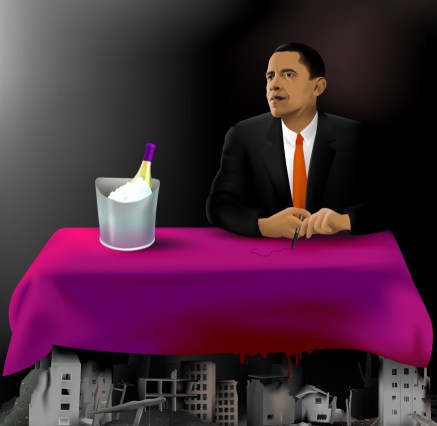
The Nobel Peace Laureate President Barack Obama, the guy who once campaigned claiming one US war — the one against Iraq — was a “bad” one, and the other — against Afghanistan — was a “good” one, turns out to be a man who, once anointed commander-in-chief, can’t seem to find a war he doesn’t consider to be a “good” idea.
Obama turned out, on taking office, to have a hard time saying good-bye to the occupation of Iraq, only leaving when he was forced out by an Iraqi government that refused to continue giving US forces legal immunity for killing Iraqi civilians. In Afghanistan, he decided to copy the same “surge” — a massive increase in targeted assassinations and violence — that he had once condemned in Iraq. Then he stepped up drone-launched rocket attacks and bombings in seven other countries.
More recently he has begun an air war against Syria (okay, he says it’s against the so-called Islamic State, but the whole world, with the exception of a lot of ill-informed US citizens, knows it’s ultimately against the Syrian government), and now his Secretary of Defense (sic) Ashton Carter and his Secretary of State John Kerry are pushing for sending heavy arms and, inevitably, US “advisors” to Ukraine to escalate US involvement in the civil war there. What makes that latest war particularly dangerous is that all the while, Peace Laureate Obama makes it clear that the “enemy” is Russian President Vladimir Putin and the Russian military.
Never mind that it is the US that originally orchestrated and encouraged the fascist coup that overthrew the elected government of Ukraine, setting in motion a huge pogrom against ethnic Russians in the east of that country and provoking the current armed conflict, and never mind that Russian concern about the Ukraine stems from a decades long history of the US pushing NATO ever closer to Russia’s western border, with Ukraine kind of the last straw.
Anyone looking objectively at the warmaking and war-promotion of this administration would have to conclude that President Obama is one of the most bellicose Chief Executives in the history of the United States.
If you don’t believe me, just look at the US military budget President Obama has proposed for FY2016. At $585.3 billion, it would if approved by Congress represent an increase in spending of $24.9 billion, or about 4%, over the 2015 budget, and that is despite a decline in what, since the Bush/Cheney years, has euphemistically been called Overseas Contingency Operations spending, or spending on actual wars. The proposed OCO budget for 2016 in this “peace” president’s budget is “just” $50.9 billion, down about $13.3 billion from 2015 thanks to what the president, in one whopper offered during his State of the Union address, called the “end of combat” in Afghanistan (that war is actually continuing, with some 12,000 US troops expected to remain stationed in that country indefinitely).
The thing about OCO funding is that it is really not predictive of anything. It could soar way beyond that $50.9-billion level, for example, in a flash if the US follows through and escalates the war in Ukraine — especially if Russian troops are drawn directly into that conflict and the US responds by upping its own involvement.
In fact, the OCO part of the budget has been used by the Pentagon and the administration over the last few years to get around the constraints of an ongoing Congressional “sequestration” requirement that cuts so-called discretionary spending, both military and non-military. Congress, ever mindful and solicitous of the country’s imperial ambitions, provided an exemption for ongoing military conflicts, and the Pentagon has since been deceptively slipping all kinds of other spending under the OCO heading now ever since the loophole was created.
But the Obama administration’s warmongering stance, in terms of the budget, isn’t told just by looking at the official Pentagon budget. There is much more spending that is really all about war. Not included in that $585.3 billion figure is $70.2 billion in discretionary spending for Veterans Affairs (that’s in addition to $90 billion in mandated spending). This is money to pay for the damages of the nation’s warmaking — the injured or ailing veterans who served or are now serving in the nation’s armed forces. Then there’s the intelligence agencies’ budgets — the CIA, the NSA, the FBI, the DIA, the DEA, the ATF and Homeland Security, etc. — most of which is really part of part of the war machine, thanks to the so-called “War on Terror,” which has re-defined the US itself as part of a global war zone. While much of that intelligence budget is concealed from the public on the spurious grounds of “national security,” it is known to exceed $100 billion a year. Add to that the $24-billion share of the Department of Energy budget that is weapons and war related, and you have a real military budget for 2016 of $707 billion. That’s out of a $1.2 trillion total discretionary spending budget (the rest of the $4 trillion proposed 2016 budget is called mandatory because it is debt repayment or spending on mandated things like Social Security and Medicare, which are funded by dedicated payroll taxes, not income taxes and other federal taxes, and which are promised to recipients like retirees and the sick.
What this means is that when you look closely, some 59% of the entire discretionary budget of the federal government – things that are funded each year by money that Congress has to appropriate — is being spent on the military. Given that the total amount of taxes collected by the federal government (income, corporate profits, exist, inheritance, etc.) also comes in at about $1.2 trillion, we’re saying that taxpayers this coming year will be pouring not just $707 billion, but 59 cents of every tax dollar in to war, planning for war, or paying for war. But it’s actually worse than that because actually the US government operates at a deficit, and doesn’t ever finance its wars on a pay-as-you-go basis. Instead, it borrows the money and then pays interest on that debt. Every year that interest comes to about $240 billion, and roughly half that is for borrowing to pay for past wars and past and current military spending. So add $120 billion to the $707 total and it become $827 billion.
In other words, it’s really 68.9% of every tax dollar you pay this April 15 that’s going to pay for America’s wars and its obsession with militarism.
No wonder our schools and universities, our parks, our roads, our once-vaunted global scientific leadership, our environment, our health and safety, our family budgets and even our life expectancy, have been going to hell! The only thing that’s really getting funded in this country is war.
By the way, the reason you may not have realized how much you are paying for war out of your taxes is that the government, and the corporate media, carefully avoid letting you know. They do this by sleight of hand. You see, they never really break out just the “discretionary” budget, or point out the parts of the budget that are outside the Pentagon but that are still really military-related, like spending on nuclear weapons and weapons development, nuclear research and cleanup, decommissioning of nuclear processing plants, and of course veterans affairs and benefits. They also do it by lumping the huge outlays for Social Security benefits and Medicare into the overall spending budget, though actually those benefits are funded not by income taxes but by a Trust fund of some $1.7 trillion that was created over the years by specially-dedicated payroll taxes separately paid by workers and their employers over the working life of each person. Adding those items into the national budget, while leaving out things like spending on veterans, nukes and war debt, appears to reduce military spending to a much less troubling 6.8% of the budget.
But it’s a fraud.
If we want to revitalize the US, the only way to do it is to end militarism and war, and to generously fund human needs.
To do that, we need a real peace president and a peace congress, not the Nobel Laureate warmonger we have now in the White House, and the bi-partisan war chorus we have in the Congress.
Non-Aligned Movement Backs Venezuela against US Sanctions
teleSUR | February 8, 2015
The Non-Aligned Movement issued a statement Saturday rejecting the latest set of sanctions imposed by the United States against Venezuelan officials.
The 120-nation body described the sanctions as “intended to undermine Venezuela’s sovereignty, its political independence and its right to self-determination.”
The U.S. government announced a new set of sanctions last week which target former and current Venezuelan officials. The U.S. has justified various rounds of sanctions by claiming corruption and that human rights abuses occurred in the oil-rich county during a wave of opposition violence last year that left 43 dead.
However, the Venezuelan government has pointed out the sanctions are politically motivated and that they form part of U.S. plans to oust the country’s elected government, given that the overwhelming majority of the 43 fatalities were caused by right-wing extremists.
The Non-Aligned Movement considers the unilateral sanctions a “violation of international law, including the United Nations Charter and the basic principles of international law of relations between states.”
Furthermore, the group of nations considered the measure “coercive” and manifested its solidarity with the Venezuelan people and their government.
The UNASUR group of South American nations also rejected the sanctions and will launch a probe to evaluate Venezuela’s evidence of U.S. meddling in the country’s internal affairs.
Nuclear War and Clashing Ukraine Narratives
By Robert Parry | Consortium News | February 6, 2015
The U.S. government and mainstream media are swaggering toward a possible nuclear confrontation with Russia over Ukraine without any of the seriousness that has informed this sort of decision-making throughout the nuclear age. Instead, Official Washington seems possessed by a self-righteous goofiness that could be the prelude to the end of life on this planet.
Nearly across the U.S. political spectrum, there is a pugnacious “group think” which has transformed what should have been a manageable political dispute in Ukraine into some morality play where U.S. politicians and pundits blather on about how the nearly year-old coup regime in Kiev “shares our values” and how America must be prepared to defend this regime militarily.

Jaanika Merilo, an Estonian brought into the Ukrainian government to oversee foreign investments. (A photo released on the Internet by Merilo via DanceswithBears)
Though I’m told that President Barack Obama personally recognizes how foolhardy this attitude is, he has made no significant move to head off the craziness and, indeed, has tolerated provocative actions by his underlings, such as neocon Assistant Secretary of State Victoria Nuland’s scheming with coup plotters to overthrow Ukraine’s elected President Viktor Yanukovych last February.
Obama also has withheld from the American people intelligence information that undercuts some of the more extreme claims that his administration has made. For instance, I’m told that he has detailed intelligence reporting on both the mysterious sniper attack that preceded the putsch nearly a year ago and the shoot-down of the Malaysia Airlines Flights 17 that deepened the crisis last summer. But he won’t release the findings.
More broadly over the last year, Obama’s behavior – ranging from his initial neglect of the Ukraine issue, as Nuland’s coup plotting unfolded, to his own participation in the tough talk, such as boasting during his State of the Union address that he had helped put the Russian economy “in tatters” – ranks as one of the most irresponsible performances by a U.S. president.
Given the potential stakes of nuclear war, none of the post-World War II presidents behaved as recklessly as Obama has, which now includes allowing his administration officials to talk loosely about sending military support to an unstable regime in Kiev that includes neo-Nazis who have undertaken death-squad operations against ethnic Russians in eastern Ukraine.
U.S. Gen. Philip Breedlove, who is commander of NATO, declared last November that – regarding supplying military support for the Kiev government – “nothing at this time is off the table.” Breedlove is now pushing actively to send lethal U.S. military equipment to fend off an offensive by ethnic Russian rebels in the east.
I’m told that the Russians fear that U.S. officials are contemplating placing Cruise missiles in Ukraine or otherwise introducing advanced weaponry that Moscow regards as a direct threat to its national security. Whether or not the Russians are being alarmist, these fears are affecting their own decision-making.
None of the nuclear-age presidents – not Harry Truman, Dwight Eisenhower, John F. Kennedy, Lyndon Johnson, Richard Nixon, Gerald Ford, Jimmy Carter, Ronald Reagan, George H.W. Bush, Bill Clinton or even George W. Bush – would have engaged in such provocative actions on Russia’s borders, though some surely behaved aggressively in overthrowing governments and starting wars farther away.
Even Ronald Reagan, an aggressive Cold Warrior, kept his challenges to the Soviet Union in areas that were far less sensitive to its national security than Ukraine. He may have supported the slaughter of leftists in Central America and Africa or armed Islamic fundamentalists fighting a Soviet-backed government in Afghanistan, but he recognized the insanity of a military showdown with Moscow in Eastern Europe.
After the Soviet Union’s collapse in 1991, U.S. presidents became more assertive, pushing NATO into the former Warsaw Pact nations and, under President Clinton, bombing a Russian ally in Serbia, but that came at a time when Russia was essentially flat on its back geopolitically.
Perhaps the triumphalism of that period is still alive especially among neocons who reject President Vladimir Putin’s reassertion of Russia’s national pride. These Washington hardliners still feel that they can treat Moscow with disdain, ignoring the fact that Russia maintains a formidable nuclear arsenal and is not willing to return to the supine position of the 1990s.
In 2008, President George W. Bush – arguably one of the most reckless presidents of the era – backed away from a confrontation with Russia when Georgian President Mikheil Saakashvili, a neocon favorite, drew the Russians into a border conflict over South Ossetia. Despite some war talk from the likes of Vice President Dick Cheney and Sen. John McCain, President Bush showed relative restraint.
Imbalanced Narrative
But Obama has failed to rein in his administration’s war hawks and has done nothing to correct the biased narrative that his State Department has fed to the equally irresponsible mainstream U.S. news media. Since the Ukraine crisis began in fall of 2013, the New York Times and other major U.S. news outlets have provided only one side of the story, openly supporting the interests of the pro-European western Ukrainians over the ethnic Russian eastern Ukrainians.
The bias is so strong that the mainstream media has largely ignored the remarkable story of the Kiev regime willfully dispatching Nazi storm troopers to kill ethnic Russians in the east, something that hasn’t happened in Europe since World War II.
For Western news organizations that are quick to note the slightest uptick in neo-Nazism in Europe, there has been a willful blindness to Kiev’s premeditated use of what amount to Nazi death squads undertaking house-to-house killings in eastern Ukraine. [See Consortiumnews.com’s “Seeing No Neo-Nazi Militias in Ukraine.”]
The Russian government has repeatedly protested these death-squad operations and other crimes committed by the Kiev regime, but the U.S. mainstream media is so in the tank for the western Ukrainians that it has suppressed this aspect of the crisis, typically burying references to the neo-Nazi militias at the end of stories or dismissing these accounts as “Russian propaganda.”
With this ugly reality hidden from the U.S. public, Obama’s State Department has been able to present a white-hat-vs.-black-hat narrative to the crisis. So, while Russians saw a constitutionally elected government on their border overthrown by a U.S.-backed coup last February – and then human rights atrocities inflicted on ethnic Russians in eastern Ukraine – the American people heard only about wonderful pro-American “reformers” in Kiev and the evil pro-Russian “minions” trying to destroy “democracy” at Putin’s bidding.
This distorted American narrative has represented one of the most unprofessional and dangerous performances in the history of modern U.S. journalism, rivaling the false conventional wisdom about Iraq’s WMD except in this case the media propaganda is aimed at a country that really does have weapons of mass destruction.
The Russians also have noted the arrival of financially self-interested Americans, including Vice President Joe Biden’s son Hunter Biden and Ukraine’s new Finance Minister Natalie Jaresko, reminding the Russians of the American financial experts who descended on Moscow with their “shock therapy” in the 1990s, “reforms” that enriched a few well-connected oligarchs but impoverished millions of average Russians.
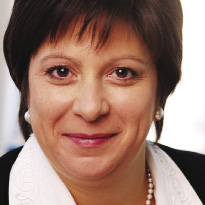
Ukraine’s Finance Minister Natalie Jaresko.
Jaresko, a former U.S. diplomat who took Ukrainian citizenship in December 2014 to become Finance Minister, had been in charge of a U.S.-taxpayer-financed $150 million Ukrainian investment fund which involved substantial insider dealings, including paying a management firm that Jaresko created more than $1 million a year in fees, even as the $150 million apparently dwindled to less than $100 million.
Jaresko also has been involved in a two-year-long legal battle with her ex-husband to gag him from releasing information about apparent irregularities in the handling of the U.S. money. Jaresko went into Chancery Court in Delaware to enforce a non-disclosure clause against her ex-husband, Ihor Figlus, and got a court order to silence him.
This week, when I contacted George Pazuniak, Figlus’s lawyer about Jaresko’s aggressive enforcement of the non-disclosure agreement, he told me that “at this point, it’s very difficult for me to say very much without having a detrimental effect on my client.”
With Jaresko now being hailed as a Ukrainian “reformer” who – in the words of New York Times’ columnist Thomas L. Friedman – “shares our values,” one has to wonder why she has fought so hard to shut up her ex-husband regarding possible revelations about improper handling of U.S. taxpayer money. [See Consortiumnews.com’s “Ukraine’s Made-in-USA Finance Minister.”]
More Interested Parties
The Russians also looked askance at the appointment of Estonian Jaanika Merilo as the latest foreigner to be brought inside the Ukrainian government as a “reformer.” Merilo, a Jaresko associate, is being put in charge of attracting foreign investments but her photo spreads look more like someone interested in some rather kinky partying.

Jaanika Merilo, the Estonian being put in charge of arranging foreign investments in Ukraine. (A photo released by Merilo on the Internet via DanceswithBears)
The Russians are aware, too, of prominent Americans circling around the potential plunder of Ukraine. For instance, Hunter Biden was named to the board of directors of Burisma Holdings, which is a shadowy Cyprus-based company linked to Privat Bank.
Privat Bank is controlled by the thuggish billionaire oligarch Ihor Kolomoysky, who was appointed by the Kiev regime to be governor of Dnipropetrovsk Oblast, a south-central province of Ukraine. Kolomoysky has helped finance the paramilitary forces killing ethnic Russians in eastern Ukraine.
And, Burisma has been lining up well-connected lobbyists, some with ties to Secretary of State John Kerry, including Kerry’s former Senate chief of staff David Leiter, according to lobbying disclosures. As Time magazine reported, “Leiter’s involvement in the firm rounds out a power-packed team of politically-connected Americans that also includes a second new board member, Devon Archer, a Democratic bundler and former adviser to John Kerry’s 2004 presidential campaign. Both Archer and Hunter Biden have worked as business partners with Kerry’s son-in-law, Christopher Heinz, the founding partner of Rosemont Capital, a private-equity company.” [See Consortiumnews.com’s “The Whys Behind the Ukraine Crisis.”]
So, the Russians have a decidedly different view of the Ukrainian “reforms” than much of the U.S. media does. But I’m told that the Russians would be willing to tolerate these well-connected Americans enriching themselves in Ukraine and even having Ukraine expand its economic relations with the European Union.
But the Russians have drawn a red line at the prospect for the expansion of NATO forces into Ukraine and the continued killing of ethnic Russians at the hands of neo-Nazi death squads. Putin is demanding that those paramilitary forces be disarmed.
Besides unleashing these right-wing militias on the ethnic Russians, the Kiev government has moved to punish the people living in the eastern sectors by cutting off access to banks and other financial services. It also has become harder and more dangerous for ethnic Russians to cross into territory controlled by the Kiev authorities. Many are turned back and those who do get through face the risk of being taken and killed by the neo-Nazi militias.
These conditions have left the people in the Donetsk and Luhansk areas – the so-called Donbass region on Russia’s border – dependent on relief supplies from Russia. Meanwhile, the Kiev regime — pumped up by prospects of weapons from Washington as well as more money — has toughened its tone with vows to crush the eastern rebellion once and for all.
Russia’s Hardening Line
The worsening situation in the east and the fear of U.S. military weapons arriving in the west have prompted a shift in Moscow’s view of the Ukraine crisis, including a readiness to resupply the ethnic Russian forces in eastern Ukraine and even provide military advisers.
These developments have alarmed European leaders who find themselves caught in the middle of a possible conflict between the United States and Russia. German Chancellor Angela Merkel and French President Francois Hollande rushed to Kiev and then Moscow this week to discuss possible ways to defuse the crisis.
The hardening Russian position now seeks, in effect, a division of Ukraine into two autonomous zones, the east and the west with a central government that maintains the currency and handles other national concerns. But I’m told that Moscow might still accept the earlier idea of a federated Ukraine with greater self-governance by the different regions.
Putin also does not object to Ukraine building closer economic ties to Europe and he offered a new referendum in Crimea on whether the voters still want to secede from Ukraine and join Russia, said a source familiar with the Kremlin’s thinking. But Putin’s red lines include no NATO expansion into Ukraine and protection for ethnic Russians by disarming the neo-Nazi militias, the source said.
If such an arrangement or something similar isn’t acceptable and if the killing of ethnic Russians continues, the Kremlin would support a large-scale military offensive from the east that would involve “taking Kiev,” according to the source.
A Russian escalation of that magnitude would likely invite a vigorous U.S. response, with leading American politicians and pundits sure to ratchet up demands for a military counterstrike against Russia. If Obama were to acquiesce to such bellicosity – to avoid being called “weak” – the world could be pushed to the brink of nuclear war.
Who’s to Blame?
Though the State Department and the mainstream U.S. media continue to put all the blame on Russia, the fact that the Ukraine crisis has reach such a dangerous crossroads reveals how reckless the behavior of Official Washington has been over the past year.
Nuland and other U.S. officials took an internal Ukrainian disagreement over how quickly it should expand ties to Europe – while seeking to retain its historic relations with Russia – and turned that fairly pedestrian political dispute into a possible flashpoint for a nuclear war.
At no time, as this crisis has evolved over the past year, did anyone of significance in Official Washington, whether in government or media, stop and contemplate whether this issue was worth risking the end of life on the planet. Instead, all the American people have been given is a steady diet of anti-Yanukovych and anti-Putin propaganda.
Though constitutionally elected, Yanukovych was depicted as a corrupt tyrant who had a pricy sauna in his official mansion. Though Putin had just staged the Winter Olympics in Sochi, signaling his desire for Russia to integrate more with the West, he was portrayed as either a new-age imperial czar or the second coming of Hitler – if not worse because he occasionally would ride on a horse while not wearing a shirt.
Further, the U.S. news media refused to conduct a serious investigation into the evidence that Nuland and other U.S. officials had helped destabilize Yanukovych’s government with the goal of achieving another neocon “regime change.”
Nuland, who personally urged on anti-Yanukovych protests in Kiev, discussed with U.S. Ambassador to Ukraine Geoffrey Pyatt in early February 2014 who should lead the new government – “Yats is the guy,” she said, referring to Arseniy Yatsenyuk – and how to “glue this thing.”
After weeks of mounting tensions and worsening violence, the coup occurred on Feb. 22, 2014, when well-organized neo-Nazi and other right-wing militias from western Ukraine overran presidential buildings forcing officials to flee for their lives. With Yanukovych ousted, Yatsenyuk soon became Prime Minister. [See Consortiumnews.com’s “When Is a Putsch a Putsch.” ]
Many ethnic Russians in southern and eastern Ukraine, who had strongly supported Yanukovych, refused to accept the new U.S.-backed order in Kiev. Crimean officials and voters moved to secede from Ukraine and rejoin Russia, a move that Putin accepted because of Crimea’s historic ties to Russia and his fear that the Russian naval base at Sevastopol might be handed to NATO.
The resistance spread to eastern Ukraine where other ethnic Russians took up arms against the coup regime in Kiev, which responded with that it called an “anti-terrorist operation” against the east. To bolster the weak Ukrainian army, Internal Affairs Minister Arsen Avakov dispatched neo-Nazi and other “volunteer” militias to spearhead the attacks.
After the deaths of more than 5,000 people, a shaky cease-fire was announced in September, but — amid complaints about neo-Nazi death squads operating in government-controlled areas and with life deteriorating in rebel-controlled towns and cities — the ethnic Russians launched an offensive in January, using Russian-supplied weapons to expand their control of territory.
In reaction, U.S. pundits, including columnists and editors of the New York Times and the Washington Post, called for dispatching U.S. aid to the Kiev forces, including proposals for lethal weaponry to deter Putin’s “aggression.” Members of Congress and members of the Obama administration have joined the chorus.
On Feb. 2, the New York Times reported “With Russian-backed separatists pressing their attacks in Ukraine, NATO’s military commander, Gen. Philip M. Breedlove, now supports providing defensive weapons and equipment to Kiev’s beleaguered forces, and an array of administration and military officials appear to be edging toward that position, American officials said. … President Obama has made no decisions on providing such lethal assistance.”
That same day, the lead Times editorial was entitled “Mr. Putin Resumes His War” and continued with the theme about “Russian aggression” and the need “to increase the cost” if Russia demands “a permanent rebel-held enclave.”
On Feb. 3, the Washington Post ran an editorial entitled “Help for Ukraine. Defensive weapons could deter Russia in a way sanctions won’t.” The editorial concluded that Putin “will stop only if the cost to his regime is sharply raised – and quickly.”
A new war fever gripped Washington and no one wanted to be viewed as “soft” or to be denounced as a “Putin apologist.” Amid this combination of propaganda, confusion and tough-guy-ism – and lacking the tempering wisdom about war and nuclear weapons that restrained earlier U.S. presidents – a momentum lurched toward a nuclear showdown over Ukraine that could put all life on earth in jeopardy.
~
Investigative reporter Robert Parry broke many of the Iran-Contra stories for The Associated Press and Newsweek in the 1980s. You can buy his latest book, America’s Stolen Narrative, either in print here or as an e-book (from Amazon and barnesandnoble.com). You also can order Robert Parry’s trilogy on the Bush Family and its connections to various right-wing operatives for only $34. The trilogy includes America’s Stolen Narrative. For details on this offer, click here.
Featured Video

John Mearsheimer: New World Order Arrived & Europe Is Left Behind
or go to
Aletho News Archives – Video-Images
Book Review
Sunset on Net Zero: A Heretic’s Guide to the Futile CO2 Target
By Ronald Paul Barmby (Author) – October 3, 2025
SUNSET ON NET ZERO describes in detail why Net Zero CO2 is pointless and unachievable. It explains in understandable terms the up-to- date thoughts of the greatest minds of today in physics, meteorology, economics, engineering, and the geosciences.
Net Zero CO2 is pointless because we have now confirmed by satellites that 90% of CO2 warming has already happened. CO2 is not an existential threat but clouds, El-Niño, and human habitation are significant drivers of global warming that are often ignored.
Net Zero CO2 is unachievable because the green technology alternatives are unreliable and unaffordable. Wind and solar power triple electricity costs, building fully electric vehicles produces at least one-half of CO2 emissions they are meant to avoid, and heat pumps will leave you dangerously cold in the winter. Green hydrogen, air capture CO2, and carbon capture and storage are prescriptions for national bankruptcy. The supply of key metals and minerals required to achieve Net Zero need to be at least doubled—some much more—and are often controlled by a very few. Net Zero comes with huge environmental and agricultural costs.
We have been through similar climatic temperature changes before, more recently than you think. Our efforts to control it are futile.
Blog Roll
 Aletho News
- FDA Ordered to Pay Over $570,000 in Fight Over Pfizer COVID Vaccine Records
- USAID turned to Facebook to drive demand for Covid vaccines in Global South – files
- Britain’s shadow security network expands into south Lebanon
- The ADL Has a Foreign Policy, and You Are Not Supposed to See It
- Former Qatari PM says ‘Israel’ has security ties with all Gulf states
- The Sound of Silence in the Strait of Hormuz
- Poland’s call for a no-fly zone in Ukraine means NATO direct war with Russia
- John Mearsheimer: New World Order Arrived & Europe Is Left Behind
- Naqab demolition notices top 1,000; settlers demolish Jaloud homes
- Israel is Using the ‘Gaza Ceasefire’ to Commit Ethnic Cleansing
- If Americans Knew
- An error has occurred; the feed is probably down. Try again later.
- No Tricks Zone
- Physicists: Doubling CO2 Has A Smaller Impact On Ocean ‘Acidification’ Than Existing Internal Variability
- Alarmist Climatologists In Shock! 2026 Atlantic Hurricane Season Sees Lowest Count In 101 Years
- New Study: Modern Temps Are Among The Coldest Of The Last 10,000 Years In East Central Europe
- Germany’s Renewable Energies Lead to 1.4 Billion Euro Electric Power Trade Deficit
- Argentina’s Perito Moreno Glacier Joins Antarctica and Arctic In Defying Doomsday Melt Claims
- New Study: Barents Sea Temperatures Were Warmer And Sea Ice Less Extensive In The 1700s Than Today
- German Authorities Start Initiative To Evaluate Public Register For Climate “Disinformation” Spreaders!
- Zonal Asymmetry of Temperature Change in the Antarctic Circumpolar Current
- New Study: The Net Fossil Fuel Contribution To Rising Atmospheric CO2 Has Been Zero For 500 Years
- Germany’s Green Energy Transition Becoming Increasingly Expensive…Another 6 Trillion Euros!

