Bringing SOPA to the Trans-Pacific Partnership
Robert Holleyman in the Seat
By Binoy Kampmark | Dissident Voice | March 6, 2014
The machinery to dominate global intellectual property by American fiat was further tightened by the announcement of Robert Holleyman as deputy US trade representative. President Obama’s announcement is just another reminder of what sources of inspiration are governing the drive by Washington to control the downloading and dissemination of information via the Trans-Pacific Partnership. After all, Holleyman was a former lobbyist of the Stop Online Piracy Act (SOPA), the bill introduced by US Rep. Lamar S. Smith (R-Tx) to gift US law enforcement authorities with the means to combat copyright infringements.
Indeed, Holleyman’s own blurb as an author for The Huffington Post considers him as “one of the 50 most influential people in the intellectual property world”, an individual who “was instrumental in putting into place the global policy framework that today protects software under copyright law.” Such is the nature of mislabelled internationalism – Washington’s policy by another name.
Holleyman has also been heavily involved as a former president of the Business Software Alliance, a body representing the main software vendors including Apple, IBM, and Microsoft. Through the consortium, Holleyman unintentionally put the problems of SOPA, and its sister legislation, PROTECT-IP, in the bright spotlight. He found himself fighting, at least for a time, a losing battle. Protest against them was extensive, with January 18, 2012 featuring the “largest online protest in history”. Congress took heed, shelving the bills. The vendors pondered the next move.
SOPA’s reach would have been global, enabling US law enforcement the means to target websites and individuals outside its jurisdiction. The carceral provisions of the bill were also hefty – five year prison terms for downloading unauthorised content.
It would have also been a rather formidable mechanism to insinuate censorship into the Internet. The legislation would allow the content provider or the US Justice Department to block sites hosting material supposedly in breach of copyright. Having such a provision would effectively overburden internet service providers to err on the side of caution and “over-block” material. If ever you want to enshrine censorship, a fine way of doing so is frightening the hosts into censoring themselves.
The secret negotiations of the TPP have proven to be a feast of select company. The negotiators themselves, such as Stefan Selig, nominee for under-secretary for international trade at the Commerce Department, have a direct line to the Bank of America. Selig’s accounts have been inflated to the tune of $9.1 million in bonus pay and $5.1 million in incentive pay. Happy is the bank that can sue for diminished assets and target governments in courts of law.
The clubbable ones are the software demons who have been “cleared” to have briefings, some 700 “stakeholders”. The “cleared advisors” also represent groups such as the Pharmaceutical Research and Manufacturers of America, the Entertainment Software Association, and the Recording Industry Association of America.
While the premise of having such vendors involved is ostensibly to protect innovation, the converse is true. The world of innovation does not matter to those who claim they have the ideas and want to protect them at cost. That is a recipe for sloppiness and envy.
The anti-democratic slant in the TPP process has also impressed itself upon observers. The press, and even members of Congress, have been kept at bay. Till parts of the treaty were published by WikiLeaks, elected officials could only view the document on visiting the Trade Representative Office. They would not be able to reproduce or transcribe it.
While SOPA and its twin PIPA were shelved indefinitely, the Obama administration has decided to shop in other forums to enforce some of their provisions. One way of doing so is through the faulty premise of free trade, which is simply another way of making some trade freer than others. The American firm features prominently in that guise of freedom.
Aspects of the leaked intellectual property chapter of the TPP so far indicate a model with SOPA trimmings. Provisions, for example, holding ISPs liable for hosting copyright infringement, have been preserved. The life of certain, corporate-owned copyrights will also be extended. In other words, this is SOPA by stealth, a process that “could not [be] achieved through an open democratic process.”
The fact that the Obama administration has also sought to sideline Congress in the debate is indicative of that. As Henry Farrell observed, “The United States appears to be using the non-transparent Trans-Pacific Partnership negotiations as a deliberate end run around Congress on intellectual property, to achieve a presumably unpopular set of policy goals.” Senate Democrats have been mindful of their shrinking role, and have blocked the president’s attempt to obtain “fast-track authorisation”.
The effect of such authorisation would give the administration scope to limit congressional consultation while using its prerogative powers. Congress would become, in effect, a chamber of marionettes. Appointments such as Holleyman’s show little change of heart away from that policy. The copyright vanguard, along with the dance of secrecy, is digging its heels in.
Binoy Kampmark was a Commonwealth Scholar at Selwyn College, Cambridge. He lectures at RMIT University, Melbourne and can be reached at: bkampmark@gmail.com.
Related articles


Nukes Now
Obama Worse Than Reagan
By Steve Breyman | CounterPunch | March 6, 2014
Heads-up, veterans of the nuclear freeze movement in the US, the anti-Euromissile campaigns in Western Europe, and the various anti-nuclear weapons efforts in New Zealand, Australia and Japan. Incoming.
We spent much of the eighties resisting Ronald Reagan’s new Cold War, and his new nuclear weapons of all shapes and sizes. We pushed back against his giant ‘defense’ budgets and countered his harrowing rhetoric. We knew Star Wars was a scam, and the MX missile a danger. We grimaced at his appointments to key policymaking positions, and scoffed at his insincere arms control efforts.
In the end, we prevailed (after a sort). We get much of the credit for preventing planetary incineration that seemed frighteningly close at the time (Gorbachev deserves some too). Professional activists, Plowshares heroes, and a handful of stalwart others stayed in the anti-nuclear weapons movement trenches. Although nukes were not abolished with the end of the Cold War, most of the rest of us nonetheless moved on to fight other evils, and to work on one or more better world construction projects.
It’s time to return. President Obama released his FY 2015 budget on Tuesday, March 4. Ready for this? It asks for considerably more money (in constant dollars) for nuclear weapons maintenance, design and production than Reagan spent in 1985, the historical peak of spending on nukes: $8.608 billion dollars, not counting administrative costs (see graph below). The Los Alamos Study Group crunched the numbers for us.

Next year’s request tops this year’s by 7%. Should the President’s new Opportunity, Growth and Security Initiative be approved, yet $504 million more would be available for warhead spending. The OGSI is $56 billion over and above the spending agreed to in the December 2013 two-year budget (unlikely to pass given that it’s an election year, would be paid for by increased taxes on the retirement funds of the rich, and reduced spending in politically dicey areas like crop insurance).
Increased lucre for the nuclear weapons complex maintains Obama’s inconsistency on the Bomb. He wrote his senior thesis at Columbia on the arms race and the nuclear freeze campaign. Two months after his first inauguration, he uttered these words in Prague: “So today, I state clearly and with conviction America’s commitment to seek the peace and security of a world without nuclear weapons.”
The Pentagon’s 2010 Nuclear Posture Review promised to avoid “new military missions or . . . new military capabilities” for nuclear weapons (don’t laugh, you’d be surprised how imaginative those guys can be). 2011 was even better: Obama signed the New START Treaty. It limits the number of operationally deployed nuclear warheads to 1550, a 30% decrease from the previous START Treaty, signed in 2002. New START also lowered limits on the number of launch platforms — ICBMs, ballistic missile launching subs, and nuke-equipped bombers.
At the same time, his State Department refuses—under first Hilary Clinton and now John Kerry—to present the Comprehensive Test Ban Treaty to the Senate for ratification out of timidity over expected resistance (never mind that the US has essentially figured out ways to circumvent the Treaty’s spirit if not letter; the CTB was once the ‘holy grail’ for arms control and disarmament advoates).
That same State Department refrains—under both Hilary Clinton and John Kerry—from getting tough with Pakistan over its years-long obstruction of United Nations-sponsored negotiations over a global ban on the stuff needed to make bombs. (Pakistan is the country building them faster than any other; how about: ‘we’ll ground the killer drones in exchange for a fissile material cut-off?’). And Obama now wants to outspend Reagan on nuclear weapons maintenance, design and production.
Winding down nuclear weapons spending, and eventually abolishing the things (for which no negotiations are underway) has been the right thing to do since the first bomb exploded in the New Mexico desert in 1945. State Department support for the coup in Ukraine and the resultant saber rattling (echoes of August 1914?) make it as urgent as ever.
Steve Breyman was 2011-12 William C. Foster Visiting Scholar Fellow in the Euro-Atlantic Security Affairs Office of the Bureau of Arms Control, Verification and Compliance at the US Department of State where he worked fruitlessly on reforming nuclear weapons policy.
Washington’s Hysteria Towards Russia Hides US Regime Change
By Finian Cunningham | Strategic Culture Foundation | March 6, 2014
Legally, Washington and its European allies haven’t a leg to stand on. Both can be rightly accused of violating international law from their gross interference in Ukrainian sovereign affairs – from the instigation of violent street protests that led to the sacking of an elected president and government, to the subsequent climate of lawlessness and fear sweeping across Ukraine and felt in particular by the majority Russian ethnic population in the east and south of the country.
The latest revelations that killings in Kiev’s Maidan Square among protesters and police were covertly carried out by snipers working for the Western-backed agitators are further proof that a coup d’état was orchestrated. A leaked phone call between EU foreign affairs chief Catherine Ashton and Estonian foreign minister, Urmas Paet, dated February 25, indicates that snipers were used as provocateurs during the demonstrations, with the intention of heightening violence and blaming it on the government of President Viktor Yanukovych.
In the phone call, reported by Russia Today, Paet is heard to say: «There is now stronger and stronger understanding that behind the snipers, it was not Yanukovych, but it was somebody from the new [Western-backed] coalition».
Ashton replied: «I think we do want to investigate. I mean, I didn’t pick that up, that’s interesting. Gosh».
The evidence for Western-sponsored subversion in Ukraine is so glaring – from the parade of American and European politicians over the past four months whipping up protesters in Kiev, to documented infiltration of civic organizations by the CIA, USAID, National Endowment for Democracy, Freedom House, the Adenauer Foundation, among others, to their own words of admission from the likes of State Department official Victoria Nuland on the desired formation of a new governing administration in Kiev – that in order to distract from this mountain of damning evidence, the Western governments and their servile media are trying to shift the terrain of discourse away from the panoramic obvious.
The latest revelation of snipers used as provocateurs adds a new sinister twist.
However, against all the evidence, it is not the West that is in violation over Ukraine; it is Russia – so they claim.
More than this, the Western leaders and media have gone into hysterical mode, accusing Russia of «brazen aggression» and «bringing the region to the brink of war». Ironically, given the astounding denial of reality by the West, it is now turning around and accusing Russia of peddling propaganda over recent events in Ukraine. One France 24 headline read: «The fanciful claims of Russian propaganda».
Never mind fanciful claims, how about just some hard facts – facts that Western media are in abject denial of?
Apart from the above litany of outrageous Western interference in Ukrainian politics, the fact is that President Viktor Yanukovych was ousted in a violent putsch at the end of last month.
Yanukovych was elected in 2010; and in a constitutional democracy his removal from office requires a vote by the electorate, not the diktats of a bunch of gun-wielding paramilitaries. We may not have liked Yanukovych’s alleged authoritarian style of governance or accusations of cronyism, but the only legal way to correct that would have been for an orderly constitutional process of elections or some other form of due process.
Yanukovych signed a national unity deal with political opponents on February 21, which European Union ministers had been involved in brokering. But his opponents immediately trashed the deal with threats of violence unless Yanukovych stood down.
Russian President Vladimir Putin is therefore correct when he told a press conference this week that what has happened in Kiev is «an unconstitutional coup» and «an armed seizure of power».
Legally speaking, and even under the terms of the EU-brokered national unity accord signed on February 21, Viktor Yanukovych is still the lawful president of Ukraine. When Yanukovych subsequently sent a formal letter to Putin requesting military assistance in the light of unconstitutional and violent upheaval, the Russian Federation had a legal and moral mandate to enter into Ukrainian territory.
The differing responses to the February 21 «event» are instructive. Both Washington and Brussels immediately recognized the new office holders in Kiev as the «legitimate government» of Ukraine with its self-declared president Oleksandr Torchynov and prime minister Arseniy Yatsenyuk. The new cabinet, comprising members of the fascist Svoboda party who had been previously waging street war, was also conferred with official Western recognition. The Western media have since gone on to use euphemisms like Kiev’s «fledgling government».
A more accurate definition of the new administration in Kiev is an unelected, self-imposed junta. But the violent, unconstitutional means of taking political power has not stopped British foreign secretary William Hague coming to Kiev this week, followed by US secretary of state John Kerry, to shake hands with the junta. Brussels also invited the mob rulers in Kiev to a ministerial summit this week.
By contrast, Russia is calling for a return to the national unity deal signed on February 21 – a deal which recognizes Yanukovych as the president in office until mutually agreed constitutional reforms are worked out and mandated by the entire electorate of Ukraine – as the legal starting point for any future political settlement. This is the most reasonable and constitutionally legal way forward. Let the people decide whom they want in government by voting, that is by democracy, which, pointedly, Western leaders do not seem able or willing to countenance. The latter prefer imposing governance by force according to their diktat because the real agenda is the economic pillaging of Ukraine by Western capital, an outcome that the Ukrainian people would not vote for if they truly had a democratic choice in the matter.
Given the self-publicized threats of aggression towards ethnic Russians in Ukraine and other perceived political opponents issued by Svoboda and its Right Sector paramilitaries, together with documented acts of recent violence in Kiev, it is was eminently legal and appropriate that Moscow embarked on defensive security measures in Ukraine. Securing military bases and a majority Russian-speaking population in the autonomous southern republic of Crimea this week – at the written requests of President Yanukovych and the Crimean regional prime minister Sergei Aksyonov, as well as under the legal terms of a long-standing bilateral agreement with Ukraine – all that gives Moscow an irrefutable mandate to do so.
Yet, with frothing hysteria, the Western governments and their media have turned reality upside down. There is not a mention of the unlawful Western interference and subversion in the Ukraine or of its hand-in-fist association with neo-Nazi street mobs in executing a violent putsch in Kiev. US ambassador to the United Nations Samantha Power brazenly denied reality earlier this week when she accused Moscow of citing «imaginary threats» in Ukraine. The bitter irony of that is that Samantha Power is one of the cheerleaders for the so-called «responsibility to protect» which has given her country the fictitious cover to illegally intervene and militarily overthrow governments in former Yugoslavia, Iraq, Libya and anywhere else the US deems desirable for regime change.
In a feat of sheer doublethink, the West has accused Russia of «illegal invasion» in Ukraine and of using «pretexts for acts of aggression». This hysterical rhetoric is being used to cover up the West’s own glaring transgressions in Ukraine and to shift the blame for the turmoil.
Unabashed by its unequivocal involvement in engineering regime change in Ukraine, American and European leaders are demanding that Russia withdraw troops from Crimea or face sanctions. Washington’s top diplomat John Kerry said the US would isolate Russia «economically, politically and diplomatically» if it did not reverse security measures, or as Kerry put it «aggression».
Meanwhile, there is not a scintilla of indication that the Americans and Europeans have any intention of reversing their unlawful interference in Ukraine. Far from it, Kerry on his visit to the junta in Kiev this week said that the US was offering $1 billion in loan guarantees. The New York Times explained: «The purpose of the loan guarantees is to support Ukraine’s efforts to integrate with the West».
European Union ministers this week somehow found reserves of €11 billion for the new «Western friendly» administration in Kiev – against the backdrop of millions of EU citizens suffering from unemployment and deprivation. The International Monetary Fund is also drawing up a lure (loan) of $2 billion.
With pro-Western, pro-capitalist Yatsenyuk now at the helm in Kiev (as Nuland prescribed), Ukraine is being steered inexorably into debt bondage by the West. This bondage, facilitated by an unelected junta, will entail an austerity assault on Ukrainian workers, beginning with swingeing cuts in public spending, wages and subsidies on fuel. It will also lead to privatization of Ukrainian oil and gas industries and the full take over of other prodigious Ukrainian natural resources, such as its wheat agriculture, by Western capital. Yatsenyuk, who talks with pride about being willing to commit political suicide for the sake of pro-Western reforms, that is Western subjugation, is exactly the kind of ideologue the West want and need in Kiev, as Nuland duly recognized.
Interestingly, this week the new Ukrainian ambassador to Belarus, Mykhailo Yeshel, admitted in a media interview that loans (lures) from Washington were being offered on condition of the Ukraine permitting the deployment of American missile systems on its territory – right on the border with Russia.
The emerging picture is clear. Despite all the hysterical nonsense being spouted by Western leaders and their media propaganda machine, demanding Russia to «back off» from Ukraine, the Western regime-change operation in that country is not just being consolidated – it is being ramped up.
US Policy of Isolating Russia and Expanding NATO Is a Dismal Failure
By Rodrigue Tremblay | The People’s Voice | March 5, 2014
[NATO’s goal is] to keep the Russians out, the Americans in, and the Germans down.
— Hastings Ismay, first NATO Secretary-General
Of all the enemies to public liberty, war is perhaps the most to be dreaded because it comprises and develops the germ of every other.
— James Madison (1751-1836), fourth American President
The hazards associated with American foreign policy since the collapse of the Soviet Union in 1991 should appear obvious to all, because it is precisely this policy that has caused the crisis in Ukraine with all its negative consequences for the coming months and years.
President Barack Obama was candid in admitting it on March 3, 2014: “we are indicating to the Russians [that] if in fact they continue on the current trajectory they’re on, then we are examining a whole series of steps — economic, diplomatic— that will isolate Russia.”
Well, it is precisely this desire to expand NATO and to isolate Russia by incorporating all the countries bordering Russia into NATO; i.e., a strategy of geopolitical and military encirclement of Russia, which has provoked that country when it felt threatened in its national security.
This is easy to understand.
For example, what would the United States do if a hypothetical Russian Empire were to incorporate Mexico or Canada into a military alliance? To ask the question is to answer it. Why is it so difficult to understand that the best way to start a war is to threaten a country’s vital interests?
The truth is that NATO should have been disbanded after the collapse of the Soviet empire in 1991, and especially after the Warsaw Pact was itself dismantled. Europe should have then moved to build an expanded Europe of nations, large, democratic and peaceful, within a framework of economic and political cooperation and peace. But no! The United States wanted to take advantage of the situation and demanded that everything fell into the military-financial U.S. empire.
That is the source of many problems.
In my book The New American Empire, originally published in 2003, just before the onset of the Iraq war, I pointed out the dangers of the American global imperial ambition and explained the reasons. The Middle East was the first to suffer under this global policy of interventionism. And now, Europe as a whole, most unfortunately, may have to pay the price for this unbridled American hubris, under both George W. Bush and Barack Obama, although that policy goes back to George H. Bush and Bill Clinton.
This is why President Obama and his neocon advisers do not think beyond their nose, as was the case for the not-too-bright George W. Bush, when they adopted such a global imperialist ideology.
In 2008, it just happened that I wrote an article in which I advanced the idea that Europe had a vital interest in disbanding that relic of another age: NATO. Indeed, we must blame European leaders not to have understood that the fundamental interest of Europe was not to blend into the American Empire but rather to build an independent and united Europe. Because that reality has not been well understood, Europe is now running the risk of falling prey to a new Cold War with divisive and ruinous conflicts, while the United States will try to pull the chestnuts out of the fire, with the U.K. as its convenient ally from within Europe.
It may be not too late for European leaders to rectify the situation. This would, however, require wisdom and the courage to tell the American neo-cons who have designed American foreign policy for a quarter of a century that they are not masters of the world and that the European Union has no intention to pursue an aggressive policy of military encirclement of Russia. Point to the line.
Rather, on the contrary, Russia should be invited to join an expanded Europe of nations, large, democratic and peaceful within a framework of economic cooperation and peace.
What is needed of them is vision, insight, and a spirit of independence, which currently seems to be lacking badly in many current European governments.
Carelessness and the current European abdication in letting Washington decide European foreign policy may serve the interests of the American empire, but this could lead Europe to disaster.
The author can be reach at: rodrigue.tremblay1@gmail.com
Russia to retaliate for US sanctions over Ukraine
Press TV – March 4, 2014
Russia says it will retaliate against any possible sanctions that the United States may impose on Moscow over its involvement in Ukraine.
In a statement released on Tuesday, the Russian Foreign Ministry said that Moscow would have to respond in such situations that are provoked by “Washington’s rash and irresponsible actions.”
“We have frequently explained to the Americans… why unilateral sanctions do not fit the standards of civilized relations between states,” Foreign Ministry spokesman Alexander Lukashevich said.
Lukashevich also added that such response would not be necessarily symmetrical.
Russian Foreign Minister Sergei Lavrov on Monday criticized the West’s threats of “sanctions and boycotts” against the country.
At the opening session of the UN Human Rights Council in Geneva, Lavrov said those who speak of sanctions are the ones that “ultimately polarized Ukrainian society.”
Earlier, the US and the European Union had warned Moscow of the consequences of its military action in Ukraine.
Lavrov also said that the presence of Russian troops in Ukraine’s Crimean peninsula is necessary to protect the country’s citizens.
“We are talking here about protection of our citizens and compatriots, about protection of the most fundamental of the human rights—the right to live and nothing more,” he noted.
The US Senate and the Obama administration are discussing possible measures against the Russian government such as a halt to military cooperation, and economic sanctions in addition to moves against individual Russians, including visa bans and asset freezes.
The Crimea will soon be back in Russia
By Col. W. Patrick Lang | March 1, 2014
It is becoming clear that the Nuland/neocon/NED campaign against Russia in Ukraine was probably a covert action intended to punish Russia for not supporting US/Israeli/Saudi and Turkish policy in Syria and to some extent with regard to Iran.
I have no specific knowledge of US actions in this but “back azimuths” run into events and actors make the true story obvious. Was there to be a second phase of the spread of revolution, a phase aimed at Russia itself? We will probably never know.
In any case Putin has called Obama’s bluff:
“Mr. Putin’s request, largely a formality, signaled publicly for the first time the Kremlin’s readiness to intervene militarily in Ukraine, and it served as a blunt response to President Obama, who just hours earlier pointedly warned Russia to respect Ukraine’s sovereignty. Even as Mr. Putin submitted his request to the Senate, formally called the Federation Council, it was clear that forces allied with Moscow were largely in control of the disputed peninsula.” – NY Times
You should not threaten if you are not prepared to act. The Russian Strategic Missile Forces have the ability to end civilization in North America. The same is true with regard to the capabilities of US missile forces if they were applied to the Eurasian land mass.
For those who have forgotten or never knew, this is called MAD (mutual assured destruction). Russian and US ICBM forces cancel each other out as instruments of war.
Obama threatened penalties for Russia for disobedience to his warnings.
What could they be?
- Conventional war conducted by the US in Russia’s back yard would be very foolish. The risk of escalation to nuclear war would loom large.
- The editorial board of the Washington Post suggests diplomatic and economic sanctions against Russia.
What?
- We would close our diplomatic posts in Russia and withdraw our ambassador?
- We would boycott the G-8 meeting in Sochi?
- We would persuade the Europeans to boycott Russian natural gas?
- We would seek UN sanctions against Russia? They would veto anything like that.
- We would not allow them to participate in diplomacy involving Syria and Iran?
You get the picture.
http://www.cnn.com/2014/03/01/world/europe/ukraine-politics/
http://www.haaretz.com/news/world/1.577114
Colonel W. Patrick Lang is a retired senior officer of U.S. Military Intelligence
Putin Tells Obama Russia Will Act In Case of Ukraine Violence
RIA Novosti | March 2, 2014
MOSCOW – Russian leader Vladimir Putin told US President Barack Obama in a telephone conversation Sunday that Moscow reserved the right to protect its own interests and those of Russian speakers in the event of violence breaking out in eastern Ukraine and Crimea.
The Kremlin press service said Putin responded to Obama’s expression of concern over possible Russian plans to deploy troops in Ukraine by drawing attention “to the provocative, criminal acts of ultranationalist elements being effectively encouraged by authorities in Kiev.”
Putin said that there was a real threat to the life of many Russians on Ukraine’s territory, the press service said.
Russia’s upper house of parliament voted Saturday to approve military action on Ukraine, citing the same motivations as those mentioned by Putin.
There is already a substantial Russian military presence in southern Ukraine, courtesy of the leased Black Sea Fleet naval base in the Crimean Peninsula.
Large movements of Russian troops have been reported around the peninsula, which is in defiance of express instructions from Ukrainian authorities this week for Russian soldiers to remain confined to their quarters.
In the 90-minute conversation with Putin, Obama condemned Russia’s military intervention, calling it a “clear violation of Ukrainian sovereignty and territorial integrity” and describing it as a breach of international law.
The US leader urged Russia to minimize tension by pulling back troops to bases in Crimea and refrain from any involvement in affairs anywhere else in Ukraine.
In a gesture aimed at signaling the degree of its distress over the course of events, the White House said it is suspending planned participation in preparatory meetings for a G-8 summit due to be held in June in the southern Russian city of Sochi, which last month hosted the Winter Olympics.
“Going forward, Russia’s continued violation of international law will lead to greater political and economic isolation,” the White House said in a read-out of the conversation between Obama and Putin.
Crimea is home to a large ethnic Russian community, which has reacted with alarm to what it sees as the aggressively nationalistic government that has taken hold since last month’s ouster of President Yanukovych. Eastern Ukraine, which was another political stronghold for Yanukovych, also has a substantial Russian-speaking population and saw many anti-government protests Saturday.
Obama said that the United States understood the need to protect the ethnic Russian minority in Ukraine and that it would push Kiev to ensure their rights weren’t hindered.
“The Ukrainian government has made clear its commitment to protect the rights of all Ukrainians and to abide by Ukraine’s international commitments, and we will continue to urge them to do so,” the White House said in the readout.
Russia’s Federal Migration Service said it has noted a sharp spike in applications from Ukrainian citizens seeking refuge.
The head of the migration service’s citizenship department, Valentina Kazakova, said 143,000 people had applied for asylum in the last two weeks of February alone.
“People are afraid for the fate of those close to them and are asking not just for protection, but also to help them receive fast-tracked Russian citizenship,” Kazakova said. “A large number of applications are from members of Ukrainian law enforcement bodies and government officials fearing reprisals from radically disposed groups.”
What the Hell is Obama Thinking?
Worst Man for the Job
By Daniel Patrick Welch – 3/01/2014
Nothing is quite as nauseating as watching the hypocrisy and hubris with which President Obama ‘warns’ the Russian president not to ‘interfere’ in Ukraine, telling the Russians there would be ‘costs to pay.’ It’s a surreal move, echoed by his equally creepy and out-of-touch consigliore and chief “diplomat,” the morally bankrupt John Kerry. Astonishing in its audacity and lack of regard for history, truth or facts, this bellicose blather seems aimed only at the idiots over whom he presides, the fools and tools in congress and the press, and his bought-and-paid-for lackeys in European capitals.
Outside the bubble, the sabre rattling is alarming and threatening. Having stood the issue completely on its head, No Drama Obama ignores how it looks to Russia, China and anyone with a skeptical mind. It is so jarring that it leaves only two options: is he crazy or does he really want war? That’s why the Russian Senate, offended to the core, asked President Putin to recall the US ambassador over Obama’s remarks.
How oblivious or arrogant do you have to be to spend $5 billion dollars destabilizing a country (the actual total is undoubtedly much higher), have your diplomats caught on tape planning a coup, bring a gang of fascist thugs to power on Russia’s doorstep–whose first order of business is to outlaw the Russian language, conduct a purge of opposing parties, threaten the Russian-speaking population, threaten to restore Ukraine’s nuclear status and provoke and threaten Russia non-stop… and have the *balls* to lecture anyone about interfering? Oh, add to the pot that you have done the same exact thing in several other countries in the past few years alone. It simply boggles the mind.
Continue poking Putin by suggesting he is being a “bully” when he moves to protect the Russian naval base, protect Russians, and listen to the wishes of the elected government of the region who ask for his support, as as new protests erupted across eastern Ukraine rejecting the putschists in Kiev, with Russian flags being raised over government buildings and protesters brandished signs saying “In Russia We Have Brothers. In Europe We Are Slaves” and “Where We Are, It is Also Russia.” This is called an ‘invasion’ by the people who bought and organized a fascist coup. Bizarro World.
But why do I focus on Obama? After all, he is little more than an irrelevant placeholder president, a sort of ventriloquist’s dummy for the vested interests and forces that put him where he is. Furthermore, I am not a fan of any Great Man theory of history that implies superhuman powers to people instead of historical forces. Accordingly, I don’t really go in for ad hominem attacks, which seems to be the only stock-in-trade of the western media, whose searing, eternal question seems to be who is the next Hitler.
Maybe it’s because I’m in the grip of the question the rest of the world is pondering: is he crazy or does he really want war? I can’t get past wondering whether he is sleepwalking through his presidency, having given over control of his administration to a foreign policy apparatus gone wild–or if he indeed believes the hypocritical warmongering crap that escapes his mouth. In short, Either he eats babies for breakfast or he has no clue that he is being led by the nose by psychopaths.
It’s important because in either case he is perhaps the most dangerous man who has ever held the office. His chief flaw is *exactly* the puzzle piece that is *least* amenable to being a leader at this historical juncture. It is a horrific perfect storm, and one that has allowed him to blunder disastrously close to World War III on at least two occasions.
The measure of the man has always told us he was an extremely glib politician. On watching an early speech of his, my wife was shocked at what all the fuss was about, and actually quoted King Herod out loud to the TV: “Take him away/ He’s got *nothing* to say!” Yeah, she’s funny like that. But still, glibness isn’t always hollowness. We got more of a glimpse when he joked casually about sending drones after any boys who had designs on his precious daughters. Later, referring to the boys he actual did mow down with his drones, he joked to aides–equally casually, we assume–that he never thought he ‘would wind up being so good at killing people.’
But the clincher for me is one memory which still haunts me from campaign 2008: a late rally in some Florida dump where Clinton explained (actually apologizing for going off script) that Obama was The Guy because he had said to the council of elders behind closed doors–you tell me what’s the right thing to do and I’ll sell it. At the time I did a double take, and it raised the hairs on the back of my neck. This is not a leader, a president, or even a thinker at all, but a glorified and willing Pitchman-in-Chief, a sort of real life Clayton Bigsby selling an ideology he is too blind to see.
It was a bit of the mask slipping… and it was incredibly ominous. I felt it and said so to my wife at the time, but she had checked out long before. Never thought he was anything more than a charlatan and a whore – from the first time she heard him, actually. Damn, I envy her clarity sometimes. It’s like they made a clone of Truman in a test tube, only this time not a hick… scary. Jimmy Burns led Truman around on a leash, and this misplaced trust in Wise Men led to war crimes such as Hiroshima and Nagasaki, among others.
In another famous example, Kennedy stupidly let the Bay of Pigs invasion proceed, as he was advised by ‘wiser men’ who told him it was already in the pipeline. However, he wisely vetoed air support, realizing that is was a stupid plan laid out by zealots. Obama has neither the balls nor the intelligence to pull off any such thing. There was a flicker over Syria in August, but it appears to have been a mirage brought on by Russian missiles and wiser generals. He has the fatal flaw which makes all smart men stupid: heeding the counsel of fools and those with their own secret agenda masquerading as Wise Men.
The zealots who have his ear have been in power for a long time, and they are the kind of fanatics who avoid scrutiny in public and accountability even to themselves, so stupid or proud that they still see chasing the Russians out of Afghanistan as their greatest triumph, and take no responsibility for having created, from the ground up, the very concept of militarized global jihad.
Even cutting him the most possible slack, he listens to them–and that makes him delusional, a hollow man issuing idle threats. As logic dictates, it is the US who should be worrying about costs, starting with billions to set the coup in motion. That will turn out to have been a pittance.
He is now a dangerous man being counseled by dangerous men. Just today, listening to his smug, arrogant self humiliate a heckler, someone trying to shout a tiny bit of truth through the noise, is truly chilling. The trouble is, Obama may not be lying. He really doesn’t know what the guy is talking about, and doesn’t know that this is the plan–at what may be the most dangerous moment in history–and will go along with whichever three loudest advisers tell him is the right thing. The saddest and scariest part is that he doesn’t even seem to know it–a true button pusher. Soulless.
But this is a measure of the man. At a friendly, fundraising event, with full control and no opposition, he could have said anything he wanted, could have made some sensible retort. Instead he chose to be mean and demeaning, calling the guy a drunk and implying that he is crazy. So now I have to add Bad Man to my list. No lie lives forever, and some day his uppance will come, as Stewie Griffin says. He richly deserves the place he has earned in history, and I have lost interest in splitting hairs: enabler, dupe or antichrist–take your pick.
Writer, singer, linguist and activist Daniel Patrick Welch lives and writes in Salem, Massachusetts, with his wife, Julia Nambalirwa-Lugudde. Translations of articles are available in in up to 30 languages.
Resolving Nuclear Arms Claims Hinges on Iran’s Demand for Documents
By Gareth Porter | IPS | March 2, 2014
The Barack Obama administration has demanded that Iran resolve “past and present concerns” about the “possible military dimensions” of its nuclear program as a condition for signing a comprehensive nuclear agreement with Tehran.
Administration officials have suggested that Iran must satisfy the International Atomic Energy Agency (IAEA) regarding the allegations in the agency’s report that it has had a covert nuclear weapons program in the past.
But the record of negotiations between Iran and the IAEA shows Tehran has been ready for the past two years to provide detailed responses to all the charges of an Iranian nuclear weapons work, and that the problem has been the refusal of the IAEA to share with Iran the documentary evidence on which those allegations have been based.
The real obstacle to providing those documents, however, has long been a U.S. policy of refusing to share the documents on the assumption that Iran must confess to having had a weaponization program.
The head of Iran’s Atomic Energy Organisation, Ali Akbar Salehi, declared February 12, “The authenticity of each allegation should be proven first, then the person who submitted it to the agency should give us the genuine document. When we are assured of the authenticity, then we can talk to the agency.”
Neither the IAEA nor the Obama administration has responded publicly to Salehi’s statement. In response to a query from IPS, the spokesperson for the National Security Council, Bernadette Meehan, said the NSC officials would have no comment on the Iranian demand for access to the documents.
The spokesperson for IAEA Director Yukiya Amano did not answer a request from IPS Thursday for the agency’s comment.
But a draft text of an agreement being negotiated between the IAEA and Iran dated February 20, 2012, shows that the only difference between the two sides on resolving issues about allegations of Iranian nuclear weapons work was Iran’s demand to have the documents on which the allegations are based.
The draft text, which was later published on the website of the Arms Control Association, reflects Iran’s deletions and additions to the original IAEA proposal. It calls for Iran to provide a “conclusive technical assessment” of a set of six “topics”, which included 12 distinct charges in the report in a particular order that the IAEA desired.
Iran and the IAEA agreed that Iran would provide a “conclusive technical assessment” on a list of 10 issues in a particular order. The only topics that Iran proposed to delete from the list were “management structure” and “Procurement activities”, which did not involve charges of specifically nuclear weapons work.
The two sides had agreed in the draft that the IAEA would provide a “detailed explanation of its concerns”. But they had failed to agree on provision of documents to Iran by the IAEA. The IAEA had proposed language that the agency would provide Iran with the relevant documents only “where appropriate”. Iran was insisting on deletion of that qualifying phrase from the draft.
The first priority on the list of topics to which both sides had agreed in the draft was “Parchin” – referring to the claim of intelligence from an unnamed state that Iran had installed a large cylinder at the Parchin military reservation.
A November 2011 IAEA report suggested the cylinder was intended for testing nuclear weapons designs and had been built with the assistance of a “foreign expert”. Iran also agreed to respond in detail on the issue of the “foreign expert”, who has been identified as Vyacheslav Danilenko, a Ukrainian specialist on nanodiamonds.
The evidence associated with that claim and others published in the 2011 report shows that they were based on intelligence reports and documents given to the IAEA by Israel in 2008-09. Former IAEA Director General Mohamed ElBaradei referred to a series of documents provided by Israel in his 2012 memoirs.
Iran also agreed to respond in detail to allegations that Iran had sought to integrate a nuclear weapon into the reentry vehicle of the Shahab-3 missile, and that it had developed high explosives as a “detonator” for a nuclear weapon.
Both alleged activities had been depicted or described in documents reported in the U.S. news media in 2005-06 as having come from a covert Iranian nuclear weapons program.
Those documents, about whose authenticity ElBaradei and other senior IAEA officials have publicly expressed serious doubts, have now been revealed as having been given to Western intelligence by an anti-regime Iranian terrorist organization.
Former senior German foreign office official Karsten Voigt revealed in an interview last year for a newly published book by this writer that senior officials of the German intelligence agency BND had told him in November 2004 that the BND had gotten the entire collection of documents from a member of the Mujahedin-e-Khalq (MEK) who had been one of their sources, and that they did not consider the source to be reliable.
The MEK, considered by the United States and European states as a terrorist organization, had been used by Saddam Hussein’s regime to support the war against Iran and by Israel to issue intelligence and propaganda that Mossad did not want attributed to it.
ElBaradei, who retired from the IAEA in November 2009, had declared repeatedly that sharing the documents was necessary to ensure “due process” in resolving the issue, but the United States had prevented him from doing so.
In his final statement to the Board of Governors on September 7, 2009 he appealed to “those who provided the information related to the alleged weaponization studies to share with Iran as much information as possible.”
A former IAEA official, who asked not to be identified, told IPS that the United States had allowed only a very limited number of documents to be shown to Iran in the form of Power Point slides projected on a screen.
A May 2008 IAEA report described a number of documents purported to be from the Iranian weapons program but said that the IAEA “was not in possession of the documents and was therefore unfortunately unable to make them available to Iran.”
Around 100 pages of documents were given by the United States to the agency to share with Iran, the former official said, but none of the documents described in the report were among them.
The U.S. policy of denying Iranian access to the documents continued during the Obama administration, as shown by a U.S. diplomatic cable from Vienna dated April 29, 2009 and released by WikiLeaks. At a P5+1 technical meeting, both U.S. and IAEA officials were quoted as implying that the objective of the policy was to press Iran to confess to the activities portrayed in the papers.
U.S. officials said that a failure by Iran to “disclose any past weaponization-related work” would “suggest Iran wishes to hide and pursue its past work, perhaps to keep a future weapons option”.
IAEA Safeguards Chief Olli Heinonen made it clear that no copies of the relevant documents charging Iran with weaponization would be provided to Iran and complained that Iran had continued to claim that the documents were fabricated.
In its report of November 14, 2013, the IAEA said it had received more information – presumably from Israel – that “corroborates the analysis” in its 2011 report.
The past unwillingness of the Obama administration to entertain the possibility that the documents provided by the MEK were fabricated or to allow Iran the opportunity to prove that through close analysis of the documents, and the IAEA’s continued commitment to the weaponization information it has published suggest that the issue of past claims will be just as contentious as the technical issues to be negotiated, if not more so.
Gareth Porter, an investigative historian and journalist specializing in U.S. national security policy, received the UK-based Gellhorn Prize for journalism for 2011 for articles on the U.S. war in Afghanistan. His new book “Manufactured Crisis: the Untold Story of the Iran Nuclear Scare”, was published Feb. 14.
Costs which Obama is about to pay for Ukraine
By Andre Fomine | Oriental Review | March 1, 2014
Yesterday the United States lost the propaganda war on Ukraine. President Obama made a reluctant and senseless statement which Washington Post entitled “There will be costs”.
He pronounced standard phrases like “the Ukrainian people deserve the opportunity to determine their own future”, proposed that Russia be a “part of an international community’s effort to support the stability and success of a united Ukraine”, lamented over the alleged “violation of Ukraine’s sovereignty and territorial integrity” and assured that “the United States supports his government’s efforts and stands for the sovereignty, territorial integrity and democratic future of Ukraine”.
It looks like the United States administration was not mentally prepared for the development of the Ukrainian crisis. The synchronized actions of the new Crimean authorities and the press-conference of the expelled president Victor Yanukovych in Rostov-on-Don gave undeniable judicial advantage to the opposite side in Ukraine who are not ready to acknowledge the illegitimate “government” elected by the rowdy Euro-mob in Kiev three days ago. The United States has no tangible tools to destabilize Crimea, de facto controlled by the Ukrainian anti-putschist resistance forces, while the judicial status of Victor Yanukovych (whatever we think about him as a person and political figure) is indubitable.
Since the very beginning of the crisis in Ukraine it was clear that the US goal was not imposing a pro-American government in Kiev, but rather making Ukraine a sticking point for Russia-European relations. The bloody events on Independence Square were organized in order to pull Russia into the vortex of the chaos in Ukraine. The Washington strategists thought that Moscow would become recklessly involved in the dirty games with Poland, Hungary and Romania over “federalization of Ukraine” and the street battles against the fascist thugs in Kiev.
On Saturday the Kremlin unexpectedly broke its skillful political pause after last night’s attempted assault on the Crimea Interior Ministry in Simferopol by unidentified special units sent from Kiev. Until that moment the Russian ‘inaction’ was much more powerful than thousands of nervous actions in Kiev and statements from Washington. The Russian move is going to be even more impressive.
Among all “interested parties” in the Ukrainian crisis, Russia is the only global power that has demonstrated its ability to act within the framework of international law and to take responsible and sovereign decisions.
Ironically, today’s Crimea is probably the only region where the Constitution of Ukraine is still strictly implemented. The referendum on the issue of the wide autonomy, announced to be held on March 30, 2014, was initiated in full compliance with the national law. The Russian military presence in Crimea is also regulated by the 1997 Russian-Ukrainian agreement on the Russian Navy base in Sevastopol. The new Crimean government, unlike the central one in Kiev, was appointed by the local legislative body as a result of a properly performed legal procedure.
So Moscow’s message to President Obama is simple. We are the real guarantors of Ukrainian sovereignty. We are protecting the life of its incumbent president, elected by the people of Ukraine at the free and competitive poll in 2010, from the direct personal threat from illegitimate “new authorities”. For the last three months, unlike you, we were not interfering in the internal political process in Ukraine while your Assistant Secretary of State was handing buns to the “peaceful protesters” in Kiev and talking smut about your European dialogue partners. We followed the letter and spirit of the international law whether we liked it or not. And today we are giving hope to millions of the Russian Ukrainians who categorically reject banderist authorities in Kiev. We are defending their right to determine their future. Therefore you will be brought to account for the billions of dollars invested for years long into the chimera project of the Orange revolution in Ukraine, which in its second incarnation turned Brown. You will be charged for months of explicit incitements for riots and civilian disobedience to legitimate authorities in Ukraine, committed by your officials and congressmen. And you will be responsible for the recognition of the shady Kiev “cabinet”, not only lacking any public support in Ukraine, but also any real resources to secure minimal level of life and the rule of law in this 45-million strong nation, lost in a non-existent “transition”, invented by your insolvent foreign policy consultants. These are the costs you are about to pay in Ukraine, President Obama.
When Protests and Violence Are Important to the U.S. Media
By Nate Singham | CEPR Americas Blog | February 28, 2014
In light of the recent political demonstrations that have swept the country, Venezuela has received considerable attention from both the US State Department and mainstream media. In recent days, President Obama, U.S. Secretary of State John Kerry and several others have issued numerous statements regarding the protests. In the US major media, The New York Times has published articles nearly every day since the protests began. Extensive reporting can also be found in the Wall Street Journal, USA Today and The Washington Post.
It is worth comparing the extent of this coverage to protests of similar importance next door to Venezuela. In August of last year, Colombian farmers launched large-scale demonstrations in opposition to Colombian trade policies that are strongly supported by the U.S. government.
Unlike the protests in Venezuela, the Colombian protests received very little coverage from mainstream media, as CEPR pointed out at the time. The graph below compares the amount of coverage, in total number of articles published, given by four of the United States’ most influential newspapers to the protests and violence in Colombia and Venezuela. The difference ranges from more than two times to 14 times as many articles devoted to the Venezuelan protests as compared with Colombia, despite the fact that the period covered for Colombia is twice as long.
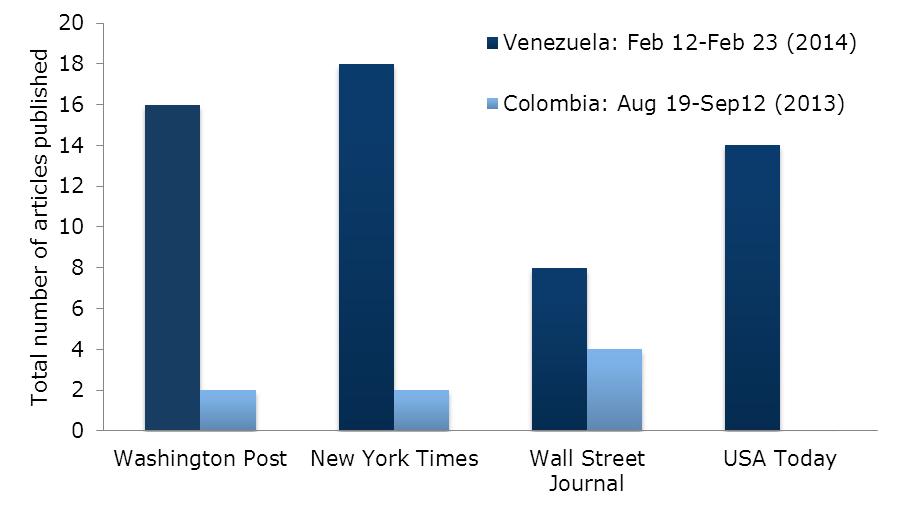
This is especially remarkable if we consider the high levels of repression carried out by the Colombian police and military in response to these protests. The International Office for Human Rights Action in Colombia described the violence as “unprovoked” and “indiscriminate” and attributes all of the violence to state forces.
The incidence of deaths in both Colombia and Venezuela[i], so far, is only slightly higher in Venezuela, with 13 deaths versus 12 deaths in Colombia.[ii] Yet there was very little coverage, and almost no criticism of the Colombian government as compared to the harsh attacks on the Venezuelan government in the U.S. media.
As mentioned earlier, US Secretary of State John Kerry and President Obama made public statements regarding the protests in Venezuela. Both demanded that students arrested in Venezuela be released, without regard as to whether any had been arrested for allegedly committing crimes such as arson and assault. There were no such statements from U.S. officials regarding the hundreds arrested in Colombia.
It is possible that both the huge differences in the amount of media coverage, and the responses to these two sets of protests by both the media and U.S. government officials has to do with the protesters and their aims, and the respective governments. The Colombian farmers were protesting against policies strongly supported by the U.S. government; they were also protesting against a government that the U.S. sees as a strategic ally, home to U.S. military bases and receiving billions of dollars in U.S. aid. The Venezuelan protesters are demanding the ouster of a government that the U.S. government has [spent] millions of dollars trying to get rid of, including U.S. support for the 2002 military coup against the government.
[i] The total amount of deaths reflects data from the most recent figures from Venezuela Transparencia, as of Monday, February 24 2014.
[ii] It is important to note that so far only six of the 13 deaths in Venezuela are confirmed to be opposition protesters.
Kerry proposes Beit Hanina as future capital of Palestine
MEMO | February 27, 2014
US Secretary of State John Kerry is proposing for the Palestinians to establish the capital of a future Palestinian state in Beit Hanina instead of all of occupied East Jerusalem, which Israel captured in the 1967 war, Palestinian Al-Quds newspaper reported on Wednesday.
Beit Hanina is located to the north of the old city, on the road to Ramallah.
According to the newspaper, Kerry’s proposal for the Palestinian capital to be located in only a small part of East Jerusalem, along with his other suggestions, enraged Palestinian President Mahmoud Abbas, who left his meeting with Kerry last week furious, threatening to torpedo the framework agreement. Kerry is said to have adopted the Israeli positions completely, including demanding that the Palestinians recognise Israel as a Jewish state and retain the ten Israeli settlement blocs in the West Bank as part of a land swap. Kerry also hinted that the Jordan Valley will not be part of a future Palestinian state and refused having any international presence in the Palestinian territories when Israel pulls out.
Meanwhile, the New York Times reported that US President Barack Obama has decided to intervene in the talks and “pressure both sides” to reach a framework agreement within the set deadline. Obama is meeting with Israel’s Prime Minister Benjamin Netanyahu at the White House on Monday and has invited Abbas to visit Washington next month.
Regarding the possibility of extending the negotiations between the Palestinians and Israel after the April deadline, Kerry told reporters that the parties took seven months to reach an understanding on their positions and he did not believe that anyone would feel concerned if it took another nine months to reach a final agreement. “I very much hope we should be able to make both parties take what is necessary to enter the most important stage, that is the final stage. To negotiate the final status based on a clear and specific framework.”
Related article

Featured Video

John Mearsheimer: New World Order Arrived & Europe Is Left Behind
or go to
Aletho News Archives – Video-Images
Book Review
Sunset on Net Zero: A Heretic’s Guide to the Futile CO2 Target
By Ronald Paul Barmby (Author) – October 3, 2025
SUNSET ON NET ZERO describes in detail why Net Zero CO2 is pointless and unachievable. It explains in understandable terms the up-to- date thoughts of the greatest minds of today in physics, meteorology, economics, engineering, and the geosciences.
Net Zero CO2 is pointless because we have now confirmed by satellites that 90% of CO2 warming has already happened. CO2 is not an existential threat but clouds, El-Niño, and human habitation are significant drivers of global warming that are often ignored.
Net Zero CO2 is unachievable because the green technology alternatives are unreliable and unaffordable. Wind and solar power triple electricity costs, building fully electric vehicles produces at least one-half of CO2 emissions they are meant to avoid, and heat pumps will leave you dangerously cold in the winter. Green hydrogen, air capture CO2, and carbon capture and storage are prescriptions for national bankruptcy. The supply of key metals and minerals required to achieve Net Zero need to be at least doubled—some much more—and are often controlled by a very few. Net Zero comes with huge environmental and agricultural costs.
We have been through similar climatic temperature changes before, more recently than you think. Our efforts to control it are futile.
Blog Roll
 Aletho News
- FDA Ordered to Pay Over $570,000 in Fight Over Pfizer COVID Vaccine Records
- USAID turned to Facebook to drive demand for Covid vaccines in Global South – files
- Britain’s shadow security network expands into south Lebanon
- The ADL Has a Foreign Policy, and You Are Not Supposed to See It
- Former Qatari PM says ‘Israel’ has security ties with all Gulf states
- The Sound of Silence in the Strait of Hormuz
- Poland’s call for a no-fly zone in Ukraine means NATO direct war with Russia
- John Mearsheimer: New World Order Arrived & Europe Is Left Behind
- Naqab demolition notices top 1,000; settlers demolish Jaloud homes
- Israel is Using the ‘Gaza Ceasefire’ to Commit Ethnic Cleansing
- If Americans Knew
- An error has occurred; the feed is probably down. Try again later.
- No Tricks Zone
- Physicists: Doubling CO2 Has A Smaller Impact On Ocean ‘Acidification’ Than Existing Internal Variability
- Alarmist Climatologists In Shock! 2026 Atlantic Hurricane Season Sees Lowest Count In 101 Years
- New Study: Modern Temps Are Among The Coldest Of The Last 10,000 Years In East Central Europe
- Germany’s Renewable Energies Lead to 1.4 Billion Euro Electric Power Trade Deficit
- Argentina’s Perito Moreno Glacier Joins Antarctica and Arctic In Defying Doomsday Melt Claims
- New Study: Barents Sea Temperatures Were Warmer And Sea Ice Less Extensive In The 1700s Than Today
- German Authorities Start Initiative To Evaluate Public Register For Climate “Disinformation” Spreaders!
- Zonal Asymmetry of Temperature Change in the Antarctic Circumpolar Current
- New Study: The Net Fossil Fuel Contribution To Rising Atmospheric CO2 Has Been Zero For 500 Years
- Germany’s Green Energy Transition Becoming Increasingly Expensive…Another 6 Trillion Euros!

