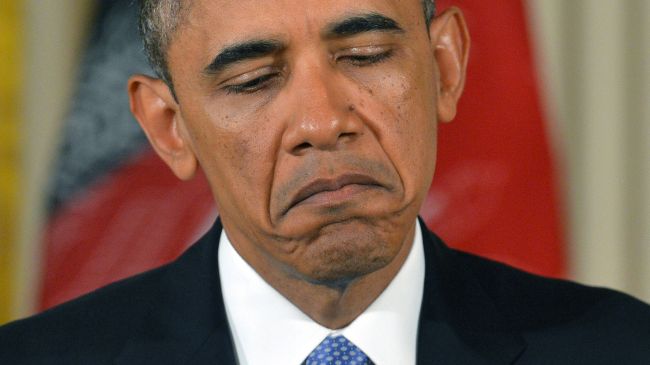
US President Barack Obama quietly signed his name to an Executive Order on Friday, allowing the White House to control all private communications in the country in the name of national security.
President Obama released his latest Executive Order on Friday, July 6, a 2,205-word statement offered as the “Assignment of National Security and Emergency Preparedness Communications Functions.” And although the president chose not to commemorate the signing with much fanfare, the powers he provides to himself and the federal government under the latest order are among the most far-reaching yet of any of his executive decisions.
“The Federal Government must have the ability to communicate at all times and under all circumstances to carry out its most critical and time sensitive missions,” the president begins the order. “Survivable, resilient, enduring and effective communications, both domestic and international, are essential to enable the executive branch to communicate within itself and with: the legislative and judicial branches; State, local, territorial and tribal governments; private sector entities; and the public, allies and other nations.”
President Obama adds that it is necessary for the government to be able to reach anyone in the country during situations it considers critical, writing, “Such communications must be possible under all circumstances to ensure national security, effectively manage emergencies and improve national resilience.” Later the president explains that such could be done by establishing a “joint industry-Government center that is capable of assisting in the initiation, coordination, restoration and reconstitution of NS/EP [national security and emergency preparedness] communications services or facilities under all conditions of emerging threats, crisis or emergency.”
“The views of all levels of government, the private and nonprofit sectors, and the public must inform the development of NS/EP communications policies, programs and capabilities,” he adds.
On the government’s official website for the National Communications Systems, the government explains that that “infrastructure includes wireline, wireless, satellite, cable, and broadcasting, and provides the transport networks that support the Internet and other key information systems,” suggesting that the president has indeed effectively just allowed himself to control the country’s Internet access.
In order to allow the White House to reach anyone within the US, the president has put forth a plan to establish a high-level committee calling from agents with the Department of Homeland Security, Pentagon, Federal Communications Commission and other government divisions to ensure that his new executive order can be implemented.
In explaining the order, the Electronic Privacy Information Center (EPIC) writes that the president has authorized the DHS “the authority to seize private facilities when necessary, effectively shutting down or limiting civilian communications.”
In Section 5 of his order, President Obama outlines the specific department and agency responsibilities that will see through his demands. In a few paragraphs, President Obama explains that Executive Committee that will oversee his order must be supplied with “the technical support necessary to develop and maintain plans adequate to provide for the security and protection of NS/EP communications,” and that that same body will be in tasked with dispatching that communiqué “to the Federal Government and State, local, territorial and trial governments,” by means of “commercial, Government and privately owned communications resources.”
Later, the president announces that the Department of Homeland Security will be tasked with drafting a plan during the next 60 days to explain how the DHS will command the government’s Emergency Telecommunications Service, as well as other telecom conduits. In order to be able to spread the White House’s message across the country, President Obama also asks for the purchasing of equipment and services that will enable such.
A June, 2013 speech by Bill Clinton honoring war criminal Shimon Peres has highlighted the extent to which Israeli anti-Palestinian and anti-Arab bigotry has become acceptable within Western mainstream discourse.
In a racist echo of Golda Meir, who once admitted that she had trouble sleeping because of the number of Palestinian babies being conceived, Clinton said: “No matter how many settlers you put out there [in the West Bank], the Palestinians are having more babies than the Israelis as a whole…. You’ve got an existential question to answer.”
Clinton, who was reportedly paid $500,000 to publicly share his hatred of Palestinian babies, couched his bigotry as part of a speech on “peace” and the bankrupt “two-state solution.” Said Clinton: “If you don’t have a vision of where you want to wind up, bad things are going to happen sooner or later…. You have a better chance if you are driven by a vision of peace and reconciliation.” In plain language, if Israel does not return a mere 22 percent of the 100 percent of Palestinian land it stole, it will soon (horror of horrors) be overrun with Palestinian children.
Clinton’s racist comments, reported worldwide by mainstream media mostly without irony, were also an extension of current U.S. President Barack Obama’s own fear and hatred of Palestinian children, which he expressed clearly in May of 2011 to the delight and cheers of his American Israel Public Affairs Committee (AIPAC) audience in Washington:
“Here are the facts we all must confront. First, the number of Palestinians living west of the Jordan River is growing rapidly and fundamentally reshaping the demographic realities of both Israel and the Palestinian territories. This will make it harder and harder—without a peace deal—to maintain Israel as both a Jewish state and a democratic state.”
For Palestinians, of course, neither Clinton’s nor Obama’s morally abhorrent remarks come as a surprise since they have long been accustomed to Israeli racism and its accompanying violence and brutality. Racist terms like “demographic bomb” and “demographic threat” are so common in Israeli media and discourse that they barely register any protest in the so-called “Jewish and democratic state.”
We are not talking about Israeli soccer fans thuggishly chanting “death to Arabs” at sporting events (a common occurrence these days), but rather racist incitement from the highest elected officials. Both Peres and Benjamin Netanyahu, for instance, have used the phrase “demographic threat” in public statements regarding Palestinian citizens of the state. In 2003, as finance minister, Netanyahu would say, “If there is a demographic problem, and there is, it is with the Israeli Arabs who will remain Israeli citizens” (“Netanyahu: Israel’s Arabs are the real demographic threat,” Haaretz, December 18, 2003).
Similarly, Peres would publicly muse in 1977 on the “problem” of the growing Palestinian population of Jerusalem: “I do not want to wake up one morning to discover that Jerusalem is subject to the demographic fate of [the] Galilee” (“Israel’s Geographic-Demographic Threat to Identity,” Royal United Services Institute News Brief, January, 2011). Ehud Olmert, as well, in a speech to the Knesset in 2007, would speak in alarming tones of a pending “demographic battle drowned in blood and tears.”
In 2009, Israeli Housing Minister Ariel Atias would instigate hatred against Palestinian citizens of the state and justify apartheid in a speech to the Israel Bar Association. “I see [it] as a national duty to prevent the spread of a population that, to say the least, does not love the state of Israel,” said Atias. Speaking in particular against the Palestinian population of the Galilee, he added: “If we go on like we have until now, we will lose the Galilee. Populations that should not mix are spreading there. I don’t think that it is appropriate [for Arabs and Israeli Jews] to live together” (“Housing Minister: Spread of Arab population must be stopped,” Haaretz, July, 2009).
Michael Oren, the current Israeli Ambassador (and chief propagandist) to the U.S., would even write a lengthy and deeply racist article published in Commentary magazine in 2009, titled “Seven Existential Threats,” and which included the sub-heading “The Arab Demographic Threat.” He would opine in a grave, apocalyptic voice that “the Palestinian population on both sides of the 1949 armistice lines is expanding far more rapidly than the Jewish sector and will surpass it in less than a decade.”
This trend must not continue, continues Oren, because “Israel, the Jewish State, is predicated on a decisive and stable Jewish majority of at least 70 percent. Any lower than that and Israel will have to decide between being a Jewish state and a democratic state. If it chooses democracy, then Israel as a Jewish state will cease to exist.”
Israeli academics and intellectuals, too, have joined the racist chorus of incitement and, simultaneously, of justification of war crimes against Palestinians. So Benny Morris, for example, after documenting the destruction of Palestine, the massive ethnic cleansing, the theft of land, and the massacres and rapes of innocents, would then vindicate every crime of the Zionist colonial-settler state from 1948 to the present.
“There are circumstances in history that justify ethnic cleansing,” said Morris in a 2004 interview with Ari Shavit. “That is what Zionism faced [in 1948]. A Jewish state would not have come into being without the uprooting of 700,000 Palestinians. Therefore it was necessary to uproot them. There was no choice but to expel that population. It was necessary to cleanse the hinterland and cleanse the border areas and cleanse the main roads. It was necessary to cleanse the villages from which our convoys and our settlements were fired on.”
Then, jumping ahead six decades, he refers to Palestinian citizens of the state, who were not ethnically cleansed, in typically racist terms: “The Israeli Arabs are a time bomb. Their slide into complete Palestinization has made them an emissary of the enemy that is among us. They are a potential fifth column. In both demographic and security terms they are liable to undermine the state” (“An interview with Benny Morris,” Counterpunch.org, January, 2004). Morris would thus set the stage for future ethnic cleansing of Palestinians, including the current operation in the Naqab (“Negev”) where tens of thousands of Palestinian Bedouin have been targeted for forcible removal from their ancestral lands.
Furthermore, these terms, once used exclusively against Palestinians, are now also utilized by both Israeli officials and citizens to shamelessly incite hatred against African asylum seekers, as well as African Jews who are, nominally, citizens of the state. As reported by Haaretz in 2010, for instance, Netanyahu said, the “flood of illegal workers infiltrating from Africa [was] a concrete threat to the Jewish and democratic character of the country.” Without skipping a beat, he would then associate asylum seekers with smuggling of drugs, terrorism, and general decadence, and so justifying the building of yet another apartheid wall to keep out the unwanted (“Netanyahu: Illegal African immigrants—a threat to Israel’s Jewish character,” Haaretz, July, 2010). See, in addition, the superb work of David Sheen who has meticulously documented recent shockingly fanatical anti-African marches in Tel Aviv, organized and led by elected Israeli officials and community leaders, in dozens of official reports, interviews, and video testimonies (www.davidsheen.com/racism/).
It is impossible to imagine Clinton, Obama, or any major political figure for that matter, talking about any other national, ethnic, or religious group in such unapologetically racist terms. Would either have made analogous comments regarding, for example, indigenous South Africans during the days of South African Apartheid? Or against North American First Nation peoples today? Would an Australian or Canadian housing minister ever speak about a minority group within their countries with the same unabashed hatred as Ariel Atias? Had they done so, the response of Western liberal pundits and intellectuals would have been swift and indignant—and rightfully so.
Ethnic cleansing, land theft, destruction of hundreds of ancient towns and villages, massacres, military occupation, and apartheid over six and a half decades in Palestine are all deeply tied together with Israeli/Zionist racism. Indeed, Israeli bigotry has often been and continues to be used to sanction and sanctify Israeli crimes against humanity; thus do attitudes and actions simultaneously fuel and feed off each other. That even supposed progressives have adopted Israeli attitudes towards Palestinians in their public statements as their own (with little or no controversy), and therefore also excusing Israeli crimes, shows the vile depths to which mainstream media discourse has sunk.
San Francisco – A federal judge today rejected the U.S. government’s latest attempt to dismiss the Electronic Frontier Foundation’s (EFF’s) long-running challenge to the government’s illegal dragnet surveillance programs. Today’s ruling means the allegations at the heart of the Jewel case move forward under the supervision of a public federal court.
“The court rightly found that the traditional legal system can determine the legality of the mass, dragnet surveillance of innocent Americans and rejected the government’s invocation of the state secrets privilege to have the case dismissed,” said Cindy Cohn, EFF’s Legal Director. “Over the last month, we came face-to-face with new details of mass, untargeted collection of phone and Internet records, substantially confirmed by the Director of National Intelligence. Today’s decision sets the stage for finally getting a ruling that can stop the dragnet surveillance and restore Americans’ constitutional rights.”
In the ruling, Judge Jeffrey White of the Northern District of California federal court agreed with EFF that the very subject matter of the lawsuit is not a state secret, and any properly classified details can be litigated under the procedures of the Foreign Intelligence Surveillance Act (FISA). As Judge White wrote in the decision, “Congress intended for FISA to displace the common law rules such as the state secrets privilege with regard to matter within FISA’s purview.” While the court allowed the constitutional questions to go forward, it also dismissed some of the statutory claims. A status conference is set for August 23.
EFF’s Jewel case is joined in the litigation with another case, Shubert v. Obama.
“We are pleased that the court found that FISA overrides the state secrets privilege and look forward to addressing the substance of the illegal mass surveillance,” said counsel for Shubert, Ilann Maazel of Emery Celli Brinckerhoff & Abady LLP. “The American people deserve their day in court.”
Filed in 2008, Jewel v. NSA is aimed at ending the NSA’s dragnet surveillance of millions of ordinary Americans and holding accountable the government officials who illegally authorized it. Evidence in the case includes undisputed documents provided by former AT&T telecommunications technician Mark Klein showing AT&T has routed copies of Internet traffic to a secret room in San Francisco controlled by the NSA. The case is supported by declarations from three NSA whistleblowers along with a mountain of other evidence. The recent blockbuster revelations about the extent of the NSA spying on telecommunications and Internet activities also bolster EFF’s case.
The Dallas law office representing a State Department whistleblower was broken into and robbed during the first weekend of July. Three computers were stolen and the firm’s file cabinets had been searched, but valuables were left untouched.
“It’s a crazy, strange and suspicious situation,” attorney Cary Schulman of the Schulman & Mathias law office told Foreign Policy Magazine’s The Cable.
The burglars left behind silver bars, video equipment and other valuables, causing Schulman to believe that they were looking to find information on the case of former State Department inspector general investigator Aurelia Fedenisn, who leaked government documents last month. Fedenisn provided CBS News with documents that accuse the State Department of covering up criminal investigations involving its diplomats and employees, including offenses such as illicit drug use, sexual solicitation of minors and prostitutes, and sexual harassment.
The documents state that US Ambassador to Belgium Howard Gutman “was suspected of patronizing prostitutes in a public park.”
Schulman believes that the perpetrators of the burglary may have been politically motivated supporters of the Obama administration, but the suspects have not yet been identified.
“It’s clear to me that it was somebody looking for information and not money. My most high-profile case right now is the Aurelia Fedenisn case, and I can’t think of any other case where someone would go to these great lengths to get our information,” Schulman told The Cable.
Last month, lawyers representing Fedenisn told The Cable that the State Department tried to silence her by threatening her and her family. Law enforcement officers allegedly camped in front of her house, harassed her children, and tried to make Fedenisn incriminate herself.
Schulman believes that officials are trying to force Fedenisn to sign papers admitting that she stole the documents – a crime that the former investigator denies.
The law office does not believe the State Department authorized a break-in, but suspects that supporters of the administration may be to blame.
“It wasn’t professional enough,” he said. “It is possible that an Obama or Hillary supporter feels that I am unfairly going after them. And the timing of this is right after several weeks of very public media attention so it seems to me most likely that the information sought is related to that case. I don’t know for sure and I want the police to do their work.”
Local Fox affiliate KDFW aired a surveillance video of the two suspected burglars, who can be seen walking out of the office carrying computers.
State Department spokesperson Jen Psaki claims the agency had no involvement in the break-in.
“Any allegation that the Department of State authorized someone to break into Mr. Schulman’s law firm is false and baseless,” she said.
I was a young person when I first heard the quip: “How do you know when the President is lying? His lips are moving.” At the time, President Nixon was expanding the war in Vietnam to other countries and deploying the White House “plumbers” to commit crimes against antiwar leakers.
Forty years have passed. Sadly, these days, often when I see President Obama moving his lips, I assume he’s lying.
Like Nixon, our current president is prolonging an endless, borderless and counter-productive war (“on terror”) and waging a parallel war against “national security” leakers that makes the plumbers’ burglary of Daniel Ellsberg’s psychiatrist’s office look almost quaint.
The World War I vintage Espionage Act, originally used to imprison socialists for making antiwar speeches, has been used by the administration against whistleblowers with a vengeance unprecedented in history: eight leakers have been charged with Espionage under Obama, compared to three under all previous presidents. The Obama administration has prosecuted not a single CIA torturer, but has imprisoned a CIA officer who talked about torture with a journalist. National Security Agency official Thomas Drake, who was unable to get abuses fixed internally, now has a criminal record for communicating with a reporter years ago about sweeping domestic surveillance.
So there I was watching Obama’s lips move about NSA whistleblower Edward Snowden at a June 27 press conference. Saying he wouldn’t be “scrambling military jets to go after a 29-year-old hacker,” Obama added that he would not “start wheeling and dealing and trading on a whole host of other issues, simply to get a guy extradited.”
I didn’t believe a word of it.
Given Obama’s war on whistleblowers and journalists who utilize them, and given the Army’s abusive treatment of military whistleblower Bradley Manning (apparently aimed at getting him to implicate WikiLeaks), it’s inconceivable that Obama was truly blasé about Snowden. To deter future whistleblowers, Snowden would have to be caught and made an example of – and probably mistreated (like Manning, in hopes of getting him to turn against WikiLeaks and even journalist Glenn Greenwald).
As his lips were moving, Obama knew well that he would go to extreme lengths to prevent this articulate young man from securing asylum in some Latin American country, where he could continue to inform the world’s media about the Surveillance State that has blossomed alongside the Warfare State under the Bush and Obama administrations.
That Obama wasn’t truthful became clear when the U.S. campaign of “wheeling and dealing” led to possible asylum countries retreating in fear one after another (Vice President Biden was deployed to pressure Ecuador’s president by phone). And even clearer with last week’s outrageous, international law-breaking that effectively forced down the presidential plane of Bolivian President Evo Morales.
And if Obama eventually does scramble jets to force down a plane with Snowden on board, the commander-in-chief will be applauded for taking bold and decisive action by mainstream TV talking heads, “national security” experts and the opposition he seems most intent on pleasing: conservatives. Criticism from civil libertarian and peace voices (or unions and environmentalists, for that matter) has rarely daunted Obama.
The bipartisan consensus in support of our bloated Military/Surveillance State – which so undermines our society as a whole – is reflected in Congress and both the Bush and Obama administrations, as well as mainstream media.
When it comes to issues of U.S. militarism and spying, the allegedly “progressive” MSNBC often seems closer to the “official network of the Obama White House” than anything resembling an independent channel. With a few exceptions (especially Chris Hayes), MSNBC has usually reacted to expanded militarism and surveillance by downplaying the abuses or defending them.
Had McCain or Romney defeated Obama and implemented the exact same policies, treating whistleblowers like Manning and Snowden as foreign espionage agents, one would expect MSNBC hosts to be loudly denouncing the Republican abuses of authority.
But with Obama in power, a number of MSNBC talking heads have reacted to the Snowden disclosures like Fox News hosts did when they were in hysterical damage control mode for Bush – complete with ridiculously fact-free claims and national chauvinism that we’ve long come to expect from the “fair & balanced” channel.
As Snowden arrived in Russia from Hong Kong, MSNBC host Ed Schultz blustered on about Snowden as a “punk” and “coward.” Railing about the “security of the country” in tones Hannity would approve of, Schultz questioned Snowden’s patriotism and credibility, asking: “If the United States of America is doing something so egregiously wrong in its surveillance program, how come he’s the only one speaking up?
In O’Reilly-like blissful ignorance, Schultz seemed unaware of the three NSA whistleblowers who’d loudly spoken up way earlier than Snowden – and gathered for an illuminating USA Todayinterview a week before his tirade.
I watched one MSNBC host function as an auxiliary prosecutor in Obama’s Justice Department, going after Snowden – while trying to link WikiLeaks and journalist Glenn Greenwald to criminal flight.
MSNBC’s Melissa Harris-Perry has been condemning Snowden by contrasting him with civil disobedients who “love their country” and submit to arrest – while Snowden just wants to “save his own skin.” She proclaimed: “This is different. This is dangerous to our nation.” Should we similarly dismiss Dan Ellsberg, who leaked the top secret Pentagon Papers to a dozen newspapers in 1971 by going on the lam from the FBI. Or Watergate’s “Deep Throat,” who saved his own skin by hiding his identity for 30 years after leaking secrets that helped crash the Nixon presidency?
In a bizarre monologue attacking Snowden (who’s risked plenty, in my view), Harris-Perry hailed those who engage in civil disobedience for being willing “to risk your own freedom, your own body in order to bring attention to something that needs to be known. Martin Luther King Jr. was arrested, attacked, smeared. Nelson Mandela went to prison for 27 years.” (My emphasis.)
Nelson Mandela? He wasn’t a civil disobedient who gave himself up. He was a fugitive, fleeing the apartheid police. He was on the lam domestically, like Snowden is now internationally. And some reports indicate that South African authorities were able to nab Mandela thanks to the U.S. CIA (one of the agencies now working to apprehend Snowden).
MSNBC’s Rachel Maddow has also disappointed. After doing a typically thorough presentation on the force-down of President’s Morales’ plane, she ended her report by expressing displeasure only that Washington had apparently gotten allies to go out on the limb “for nothing.” Her objection to the harassment seemed to be: it hadn’t succeeded. I didn’t hear opposition to the action had Snowden actually been on board and apprehended.
The Snowden/NSA story proves once again that – especially on so-called “national security” issues – we need strong, independent media not enmeshed with the corporate/political power structure and not allied with one of the two corporate parties.
We can’t count on MSNBC to heed the lesson taught by legendary independent journalist I.F. “Izzy” Stone, after years reporting from Washington: “All governments lie and nothing they say should be believed.”
Jeff Cohen was an MSNBC pundit and senior producer in 2002-3 until being terminated for political reasons, along with Phil Donahue, on the eve of the Iraq invasion. He is director of the Park Center for Independent Media at Ithaca College, founder of the media watch group FAIR, and author of Cable News Confidential: My Misadventures in Corporate Media. He cofounded the online action group RootsAction.org, which has petitioned for Snowden.
In May, JPMorgan Chase was listed as the largest bank in the world with assets at roughly $4 trillion — some $1.53 trillion of it in derivatives. This was reported a month after the announcement that the bank had posted a record first-quarter profit of $6.5 billion.
Jamie Dimon, the bank’s CEO and Chairman, has faced a host of scandals in relation to his management of the megabank, including the loss of roughly $6 billion through the London branch of the bank — losses that Dimon was accused of hiding. A 300-page report by the U.S. Senate, investigating the “creative accounting” of JPMorgan, noted that the bank “hid losses, did not share information with its regulators, and misled the public” in what one banking regulator referred to as “make believe voodoo magic.” Stated bluntly in The New York Times, JPMorgan Chase, the largest derivatives dealer in the world, “is too big to regulate.”
In the midst of the scandal, the bank faced a potential “revolt” of its shareholders in a bid to strip Dimon of his dual role as CEO and Chairman. In confidential government reports which were leaked to The New York Times, the bank was accused of “manipulative schemes” which transformed “money-losing power plants into powerful profit centers” while executives made “false and misleading statements” under oath.
Yet even in the midst of scandal, Jamie Dimon was praised in a storm of support by billionaires, corporate kingpins and media barons. Calling JPMorgan Chase “as good a bank as there is,” New York City mayor and billionaire media baron Michael Bloomberg went on to call Dimon “a very smart, honest, great executive.” News Corporation chairman Rupert Murdoch praised Dimon as “one of the smartest, toughest guys around,” while Jack Welch, former chairman and CEO of General Electric, referred to him as a “great leader” and said he had earned the “right to hold both Chairman and CEO titles.” To top it off, billionaire investor and CEO of Berkshire Hathaway, Warren Buffet, dubbed Dimon “a fabulous banker.”
And the adoration goes all the way to the top rung. In 2009, The New York Timesreferred to Jamie Dimon as “President Obama’s favorite banker.” In 2010, Obama told Bloomberg BusinessWeek that he didn’t “begrudge” bank CEOs like Jamie Dimon and Lloyd Blankfein of Goldman Sachs for their massive bonuses of $17 and $9 million, respectively. Obama explained: “I, like most of the American people, don’t begrudge people success or wealth. That is part of the free-market system.” The president added, “I know both those guys; they are very savvy businessmen.”
In May of 2012, Obama rushed to Jamie Dimon’s defense in light of the financial scandals, stating that Dimon was “one of the smartest bankers we got.” The Financial Timesreferred to Dimon as “the last king of Wall Street.” And when finally faced with the decision to strip Dimon of his dual role as chairman and CEO, Obama’s “favorite banker” ended up winning “a decisive victory” by maintaining both his roles.
But this is just the surface of JPMorgan Chase’s financial manipulations. The bank, in fact, was at the forefront of creating Credit Default Swaps (CDS), a key aspect of the derivatives market that led to the inflation and subsequent blowout of the housing bubble. JPMorgan developed these “financial instruments” as a type of insurance policy in 1994, allowing the bank to trade its debt (in the form of loans to corporations and governments) to third parties, thus handing off the risk and removing the debts from its accounts, which allowed it to make further loans. JPMorgan opened up the first CDS desk in New York in 1997, “a division that would eventually earn the name the Morgan Mafia for the number of former members who went on to senior positions at global banks and hedge funds.” Back in 2003, the same Warren Buffet who would later praise Dimon referred to credit default swaps as “financial weapons of mass destruction.”
JPMorgan was also at the forefront in the United States pushing for financial deregulation, particularly the slow-motion dismantling of the Glass-Steagall Act that had been put in place in 1933 in response to the financial speculation which had helped spark the Great Depression. After hearing proposals from banks such as Citicorp, JP Morgan and Bankers Trust, which advocated the loosening of “restrictions” put in place by Glass-Steagall, the Federal Reserve Board in 1987 voted to ease many of the regulations. That same year, Alan Greenspan, who had previously been a director of JP Morgan, became the chairman of the Fed. In 1989, the Fed approved an application submitted by JP Morgan, Chase Manhattan, Citicorp and Bankers Trust to further reduce the regulations imposed by Glass-Steagall. In 1990, JP Morgan became “the first bank to receive permission from the Federal Reserve to underwrite securities.”
Financial deregulation accelerated under President Clinton, much to the delight of Wall Street banks, which were then permitted to merge into megabanks, with JPMorgan merging with Chase Manhattan to form JPMorgan Chase. As early as 2006 and 2007, multiple megabanks were beginning to bet against the housing market through various hedge funds, allowing them to make profits on the housing collapse they created. JPMorgan continued to sell mortgages as it bet against the mortgage market, passing on the risk while it hedged its bets to profit from the failure and losses of others. In 2011, the bank paid a $153 million fine to the Securities and Exchange Commission (SEC) to settle allegations of “securities fraud.”
In the midst of the financial crisis in 2008, JPMorgan Chase became not only a major criminal, but also a prime beneficiary. In 2007, the global investment bank Bear Stearns was named by Fortune magazine as the second “most admired” financial securities company in the United States, while Lehman Brothers was put in first place. As the financial crisis erupted, Bear Stearns executives “discovered” that they were “nearly out of cash” in March of 2008. The CEO of Bear Stearns, Alan Schwartz, made a phone call to Jamie Dimon — JPMorgan Chase was the clearing agent for Bear Stearns — asking for an overnight loan. Dimon, who also sat on the board of directors of the Federal Reserve Bank of New York, turned there instead of providing the loan through his own bank. The president of the New York Fed – who was elected by the banks that own the New York Fed – was Timothy Geithner. Geithner began discussions with Bear Stearns, and the following morning he held a meeting with Federal Reserve Chairman Ben Bernanke and Treasury Secretary Henry Paulson, the former CEO of Goldman Sachs, where they agreed to an emergency loan for Bear Stearns, providing the funds through JPMorgan Chase.
Over the following day, Geithner and Paulson informed Bear Stearns that it must sell the bank within days, and a deal was negotiated in which JPMorgan Chase would purchase Bear Stearns at $2 per share. Though Dimon had first refused to purchase the failed bank, he now engaged in negotiations with Geithner who won over Dimon by guaranteeing $30 billion for JPMorgan to purchase the sunken bank. Long story short: through the New York Fed, the U.S. government purchased billions of dollars in bad debts made by Bear Stearns, including $16 billion in credit default swaps that were downgraded to “junk” assets, while JPMorgan Chase acquired $360 billion in Bear Stearns assets with little or no risk.
With the purchase of Bear Stearns facilitated by the New York Fed, and for the benefit of JPMorgan, Geithner continued in his role as willing servant to the banks who had elected him as president. Then, in September of 2008 when the insurance conglomerate American International Group (AIG) plunged into crisis and sought support from the government, the Fed and Treasury initially refused. AIG turned to JPMorgan Chase and Goldman Sachs, who went to the government to pressure for state support. The New York Fed, with Geithner at the helm, again organized a secret bailout of the institution, valued at $85 billion. In October, the government added an extra $38 billion to the AIG bailout, and the New York Fed provided a further $40 billion in November. Overall, U.S. taxpayers bailed out the insurance giant with $150 billion.
Because many banks kept junk assets with AIG which didn’t affect its balance sheets, the insurance giant was allowed to continue making risky loans. Meanwhile, the New York Fed, noted Bloomberg journalist David Reilly, acted as “a black-ops outfit for the nation’s central bank,” and as a “quasi-governmental institution [which] isn’t subject to citizen intrusions such as freedom of information requests.” The AIG bailout, wrote Reilly, revealed what could be described as a “secret banking cabal.” Through AIG, bailout funds went to American, French, German, British, Swiss, Dutch and even Canadian banks. Goldman Sachs received over $12 billion, and billions also went to Merrill Lynch, Bank of America, Citigroup, Wachovia, Morgan Stanley, and JPMorgan Chase.
JPMorgan Chase was using bailout money from the government to purchase other banks and companies. As one executive at the bankcommented in regards to a $25 billion bailout from the government, “I think there are going to be some great opportunities for us to grow in this environment.” The banks repaid the bailout loans from other bailout funds they got from government, siphoning off taxpayer moneyback and forth and rewarding them for their risky behavior. One university study noted that banks with political access – whether through lobbying efforts or board membership on the Fed – were more likely to get bailout funds, and in bigger numbers, than other banks. Notably among the most politically connected banks were Goldman Sachs, JPMorgan Chase and Morgan Stanley.
According to a 2012 study by the International Monetary Fund and Bloomberg magazine, JPMorgan Chase continues to receive government support far beyond the bailouts, as it is a major recipient of corporate welfare and state subsidies. In fact, according to the study, the biggest bank in the world gets roughly $14 billion per year in state subsidies and welfare, largely helping “the bank pay big salaries and bonuses.”
The Biggest and Most Connected Bank
Not only is JPMorgan Chase the biggest bank in the world with over $4 trillion in assets, but its power and influence extends far beyond financial matters. It is a major political force in the world, highly integrated within the network of global elites who make up the plutocratic ruling class. As the subject of study for the Global Power Project, I examined 55 people at JPMorgan Chase, including all members of the executive committee, the board of directors and the international advisory council.
Of the 55 individuals examined at the bank, a total of 13 (or roughly 24%) of the individuals were either members or held leadership positions (previously or presently) with the Council on Foreign Relations (CFR). The CFR has been at the heart of the foreign-policy elite of the United States since it was created in 1921. Further, a total of eight JPMorgan officials held leadership positions in the World Economic Forum, the second most represented institutional affiliation of the bank. Holding yearly conferences that bring together thousands of participants from elite financial, corporate, political, cultural, media and other institutions, the WEF is one of the principal forums for the global elite, with JPMorgan operating right there at the center.
The next most represented institution is the Trilateral Commission, with 5 individuals at JPMorgan Chase holding membership in the international think tank – or “global policy group” – uniting elites from North America, Western Europe and Japan (and now also including China, India, and other Pacific-rim nations). The Trilateral Commission itself was founded in 1973 by the CEO of Chase Manhattan Bank – which later merged into JPMorgan Chase – David Rockefeller.
In descending order, the other most highly represented institutions having cross membership between leadership positions with JPMorgan Chase are: the Federal Reserve Bank of New York (4), the Business Council (4), Citigroup (4), Bilderberg (4), the Group of Thirty (4), Sara Lee Corporation (3), Harvard (3), American Express (3), American International Group (3), the Business Roundtable (3), Rolls Royce (3), the Center for Strategic and International Studies – CSIS (3), the European Round Table of Industrialists (3), the Peterson Institute for International Economics (2), the U.S.-China Business Council (2), and the National Petroleum Council (2).
Institutions which hold two individual cross leadership positions with JPMorgan Chase include: the Monetary Authority of Singapore, the University of Chicago, Kohlberg Kravis Roberts & Co., General Electric, Asia Business Council, the U.S. President’s Foreign Intelligence Advisory Board, the National Bureau of Economic Research (NBER), the Coca-Cola Company, National Bank of Kuwait Advisory Board, INSEAD, China-United States Exchange Foundation, Mitsubishi, the Carlyle Group, and the IMF.
Meet the Elites at JPMorgan Chase
It’s worth taking a look at some specific individuals who serve in a leadership and/or advisory capacity to JPMorgan Chase to get an idea of the composition of some of these global plutocrats.
Jamie Dimon, the CEO of JPMorgan Chase, sits on the boards of directors of: the Federal Reserve Bank of New York, Harvard Business School, and Catalyst. He is a Trustee of the New York University School of Medicine, a member of the Executive Committee of the Business Council, a member of the Council on Foreign Relations, a member of the International Business Council of the World Economic Forum, a member of the Financial Services Forum, and a member of the International Advisory Panel of the Monetary Authority of Singapore.
Members of the board of JPMorgan Chase include James A. Bell, former President of Boeing and a current member of the board of Dow Chemical; Crandall C. Bowles, a director of Deere & Company and the Sara Lee Corporation, a former director of Wachovia, a Trustee of the Brookings Institution, on the Governing Board of the Wilderness Society, and a member of the Business Council and the Economic Club of New York. Other JPM board members include Stephen B. Burke, CEO of NBC Universal and Executive Vice President of Comcast Corporation; David M. Cote, the Chairman and CEO of Honeywell International who sits on President Obama’s National Commission on Fiscal Responsibility and Reform, on the advisory panel to Kohlberg Kravis Roberts & Co. (KKR), and is a member of the Trilateral Commission; and Lee Raymond, director of the Business Council for International Understanding, who sits on the advisory panel to KKR, is a member of the Council on Foreign Relations, and former Chairman of the National Petroleum Council as well as former Chairman and CEO of ExxonMobil, from which he retired in 2006 with a compensation package of $398 million.
JPMorgan Chase has an International Council which provides advice to the bank’s leadership on economic, political and social trends across various regions and around the world. The International Council is chaired by Tony Blair, former Prime Minister of the UK, who also sits as an adviser to Zurich Financial. The Council includes Khalid A. Al-Falih, the President and CEO of Saudi Aramco (Saudi Arabian Oil Company), the world’s largest oil company, who also sits on the International Business Council of the World Economic Forum. Former UN Secretary General Kofi Annan is also on JPMorgan’s International Council, and sits as Chairman of the Alliance for a Green Revolution in Africa (AGRA), a partnership between the Bill & Melinda Gates Foundation and the Rockefeller Foundation. Annan is also on the boards of the United Nations Foundation, the World Economic Forum, and he is a member of the Global Board of Advisors of the Council on Foreign Relations.
The Council includes the third richest man in Mexico, Alberto Bailléres, as well as the Chairman and CEO of Telecom Italia, Franco Bernabé, who was the former CEO of Eni, one of the world’s largest oil companies (and Italy’s largest corporation), as well as the former Vice Chairman of Rothschild Europe. Bernabé sits on the board of PetroChina, China’s largest oil company. Bernabé is also a member of the European Round Table of Industrialists (a group of roughly 50 major European CEOs who directly advocate and work with EU political leaders in designing and implementing policy), he was a former Advisory Board member of the Council on Foreign Relations, a member of the board of FIAT, and is actively a member of the Steering Committee of the Bilderberg Meetings.
Martin Feldstein, a prominent Economics professor at Harvard and the President Emeritus of the National Bureau of Economic Research, is another member of the International Council. Feldstein was the Chairman of the Council of Economic Advisers to President Ronald Reagan and sat on the Foreign Intelligence Advisory Board (an “independent” group that advises the president on intelligence matters) under President George W. Bush (from 2007-2009). President Obama appointed Feldstein to the Economic Recovery Advisory Board, and he also sits on the board of the Council on Foreign Relations, is a member of the Trilateral Commission, a participant in Bilderberg Meetings, and is a member of the International Advisory Board of the National Bank of Kuwait.
Gao Xi-Qing is the Vice Chairman, President and Chief Investment Officer of the China Investment Corporation (CIC), China’s sovereign investment fund. He was referred to by the Atlantic as “the man who oversees $200 billion of China’s $2 trillion in dollar holdings.” Another notable Chinese member of the International Council is Tung Chee Hwa, the former Chief Executive and President of the Executive Council of Hong Kong, a core policy-making institution in the government of Hong Kong. Tung Chee Hwa is also the Vice Chairman of the National Committee of the Chinese People’s Political Consultative Conference (CPPCC), a major political advisory group in the People’s Republic of China, once chaired by Mao Zedong. Tung Chee Hwa as well is the founder and Chairman of the China-United States Exchange Foundation, and a former member of the International Advisory Board of the Council on Foreign Relations.
Carla A. Hills is the only woman on the JPMorgan International Council, and is Chairman and CEO of Hills & Company International, a global consulting firm. She was the former United States Trade Representative in the George H.W. Bush administration, where she was the primary negotiator for the North American Free Trade Agreement (NAFTA). She is also the Co-Chair of the Council on Foreign Relations, and sits on the International Boards of Rolls Royce and the Coca-Cola Company, as well as sitting on the board of directors of Gilead Sciences. Hills is a Counselor and Trustee of the Center for Strategic and International Studies (CSIS), a major American think tank where she also sits as Co-Chair of the Advisory Board (alongside Zbigniew Brzezinski, co-founder of the Trilateral Commission). In addition, Hills is a member of the Executive Committee of both the Trilateral Commission and the Peterson Institute for International Economics, as well as sitting on the boards of the International Crisis Group and the US-China Business Council, as Chair of the National Committee on US-China Relations, and Chair of the Inter-American Dialogue.
Henry Kissinger – former U.S. Secretary of State, National Security Adviser to President Richard Nixon, and Secretary of State to President Ford – also sits on the International Council of JPMorgan. Kissinger was a former adviser to Nelson Rockefeller, who recruited Kissinger as director of the Special Studies Project of the Rockefeller Brothers Fund in the 1950s. Kissinger was a director of the Council on Foreign Relations from 1977-1981, is a member of the Trilateral Commission, a former member of the Steering Committee and continuous participant in the Bilderberg Meetings, and is founder and chair of Kissinger Associates, an international consulting and advisory firm. Kissinger Chaired the National Bipartisan Commission on Central America during the Reagan administration, which provided justification for Reagan’s wars in Central America, and he was also a member of the Foreign Intelligence Advisory Board from 1984-1990, advising both Presidents Reagan and George H.W. Bush. Alongside Zbigniew Brzezinski, Kissinger was a member of the Commission on Integrated Long-Term Strategy of the National Security Council and Defense Department, established in the late 1980s to develop a long-term strategy for the United States in the world. Kissinger has also been a member of the Defense Policy Board, providing “independent” advice to the Pentagon leadership on matters of foreign policy, from 2001 to the present, for both the George W. Bush and Barack Obama administrations. Kissinger is also a Counselor and Trustee of the Center for Strategic and International Studies (CSIS), Honorary Governor of the Foreign Policy Association, an Honorary Member of the International Olympic Committee, an adviser to the board of directors of American Express, and is a Trustee Emeritus of the Metropolitan Museum of Art. In addition, Kissinger is a director of the International Rescue Committee, the Atlantic Institute, and is on the advisory board of the RAND Center for Global Risk and Security, as well as Honorary Chairman of the China-United States Exchange Foundation.
Mustafa V. Koc is also a member of the International Council, and is Chairman of Koc Holding AS, Turkey’s largest multinational corporation. He also sits on the International Advisory Board of Rolls Royce, the Global Advisory Board of the Council on Foreign Relations, is a member of the Steering Committee of the Bilderberg Meetings, a former member of the International Advisory Board of the National Bank of Kuwait, and is Honorary Chairman of the Turkish Industrialists and Businessmen’s High Advisory Council.
Gérard Mestrallet is the Chairman and CEO of GDF Suez, one of the largest energy conglomerates in the world, and is on the board of Suez Environment (one of the major water privatization companies in the world), and also sits on the supervisory board of AXA, a major global French financial conglomerate. He is also an advisory board member of Siemens, and is a member of the European Round Table of Industrialists and the International Business Council of the World Economic Forum.
John S. Watson is the Chairman and CEO of Chevron Corporation. He is on the board of the American Petroleum Institute and is a member of the National Petroleum Council, the Business Roundtable, the Business Council, the American Society of Corporate Executives, and the Chancellor’s Board of Advisors of the University of California Davis. He is also a member of the International Business Council of the World Economic Forum.
The Chairman of JPMorgan Chase International, Jacob A. Frenkel, is Chairman and CEO of the Group of Thirty, and a member of the International Council. He is also a former Vice Chairman of American International Group (from 2004 to 2009, when it was rescued with the massive government bailout); the former Chairman of Merrill Lynch International (from 2000 to 2004), and the former Governor of the Bank of Israel (from 1991 to 2000). Frenkel was an Economic Counselor and Director of Research at the International Monetary Fund (from 1987 to 1991) and prior to that he was the David Rockefeller Professor of International Economics at the University of Chicago (from 1973 to 1987). In addition, Frenkel is the former Editor of the Journal of Political Economy, former Vice Chairman of the Board of Governors of the European Bank for Reconstruction and Development, former Chairman of the Board of Governors of the Inter-American Development Bank, and a former member of the International Advisory Board of the Council on Foreign Relations. Frenkel is currently a member of the board of directors of the National Bureau of Economic Research (NBER), a member of the Trilateral Commission, member of the International Advisory Council of the China Development Bank, member of the board of the Peterson Institute for International Economics, member of the Economic Advisory panel of the Federal Reserve Bank of New York, member of the Council for the United States and Italy, member of the Investment Advisory Council of the Prime Minister of Turkey, and sits on the board of Loews Corporation.
To sum: it should be clear, from the evidence, that the leadership of JPMorgan Chase is not an isolated group of individuals involved in finance and exclusively relegated to the banking world, but a highly networked and influential group consisting of central figures in the global plutocracy – referred to as the “Transnational Capitalist Class” – with significant economic, social and political power. To refer to JPMorgan Chase simply as “a bank” is like referring to the United States as just “a country.” A geopolitical force unto itself, and a conglomerate embedded within a transnational network of elite institutions and individuals, JPMorgan Chase goes beyond the financial indicators. Put simply, it is one of the most powerful banks in the world.
Andrew Gavin Marshall is an independent researcher and writer based in Montreal, Canada. He is Project Manager of The People’s Book Project, head of the Geopolitics Division of the Hampton Institute, the research director of Occupy.com’s Global Power Project, and has a weekly podcast with BoilingFrogsPost.
At a Washington Institute policy forum luncheon debate on June 28 entitled “Arming the Rebels: Sliding Toward Iraq or Inching Toward Stability,” Andrew J. Tabler, a senior fellow in the institute’s program on Arab politics, hinted at the pro-Israel think tank’s influence over President Obama’s recent shift in Syria policy. Referring to his Foreign Affairs piece entitled “Syria’s Collapse: And How Washington Can Stop It,” Tabler said he would like to say that it “follows a lot” of President Obama’s responses in a major June 17 television interview. Whether out of modesty or a desire to downplay the Israel lobby’s role in deepening Washington’s involvement in the destabilization of Syria, a smiling Tabler added, “I’m sure that he didn’t read it and then just go and regurgitate it to Charlie Rose.”
WINEP’s executive director Robert Satloff was similarly coy in his introduction. Describing Tabler as a “very consulted” expert on Syria, Satloff said, “I won’t go into the details of the consultations” he has with senior government officials “but suffice to say that the arguments that we’ll be hearing today very much reflect the arguments that are on the table.”
Given the proven track record of such arguments made “in the national interest” by partisans of Israel, it would appear that its oblivious American proxy is rapidly sliding toward another Iraq.
Maidhc Ó Cathail is an investigative journalist and Middle East analyst. He is also the creator and editor of The Passionate Attachment blog, which focuses primarily on the U.S.-Israeli relationship. You can follow him on Facebook and Twitter @O_Cathail.
Centuries of oppression have made black people particularly susceptible to the tempting siren song which comes with the image of black success. It is harmless to want a black person to win some coveted acclaim like a Pulitzer prize or even an Oscar, but quite another to be rendered stupid by the sight. Our history teaches us that we must be wary lest we be carried away by emotion that is without substance.
Barack Obama is the most obvious example of this phenomenon and its pernicious influence. A black man being elected as president of the United States was long hoped for but seemingly impossible. The realization of what had long been imagined and the often racist attacks against this dream create common cause with Obama and intense personal happiness on his behalf. Yet what seems inspirational is in fact anything but. The feelings of affection for Obama have been a negative force which impede rational thought and political common sense. The people who most epitomized the American search for true democracy have given it up completely because they love seeing a black man wearing a POTUS jacket and get angry when white people don’t like seeing it.
That history of struggle and the group identity it creates have not been limited to the American experience. The decades long fight against the racist apartheid system in South Africa was supported by millions of people in this country too. Jim Crow was America’s own apartheid. It is only logical that the sight of black people being treated cruelly in the name of white supremacy would elicit feelings of affinity in this country and around the world.
Nelson Mandela’s release from 27 years of imprisonment and his subsequent election as president created a surge of pride and joy among black people everywhere. Unfortunately we did not truly understand what we were witnessing. These events came about as a result of forces unacknowledged in America and they also came with a very high price.
The name of the Angolan town Cuito Cuanavale means little to all but a handful of Americans but it lies at the heart of the story of apartheid’s end. At Cuito Cuanavale in 1988 Cuban troops defeated the South African army and in so doing sealed apartheid’s fate.
It is important to know how apartheid ended, lest useless stories about a miraculously changed system and a peaceful grandfatherly figure confuse us and warp our consciousness. Mandela was freed because of armed struggle and not out of benevolence. He was also freed because the African National Congress miscalculated and made concessions which have since resulted in terrible poverty and powerlessness for black people in South Africa. By their own admission, some of his comrades concede that they were unprepared for the determination of the white majority to hold the purse strings even as they gave up political power.
Now the masses of black South Africans are as poor as they were during the time of political terror. The Sharpeville massacre of 1960 which galvanized the world against South Africa was repeated in 2012 when 34 striking miners were killed by police at Marikana. The Marikana massacre made a mockery of the hope which millions of people had for the ANC and its political success.
Obama’s recent visit to South Africa when the 94 year old Mandela was hospitalized created a golden opportunity for analysis and a questioning of long held assumptions about both men but the irrefutable fact is this. The personal triumphs of these two individuals have not translated into success for black people in either of their countries.
The victory of international finance capital wreaks havoc on both sides of the Atlantic ocean. In the U.S. black people have reached their political and economic low point during the Obama years. The gains won 50 years ago have been reversed while unemployment, mass incarceration, and Obama supported austerity measures have all conspired to undo the progress which was so dearly paid for.
Obama’s visit to Africa as Mandela lay critically ill brought very sincere but very deeply misled people to remember all of the wrong things. It isn’t true that black people benefit from the political success of certain individuals. It isn’t true that role models undo systemic cruelty or that racism ends because of their presence or that white people see or treat the masses of black people any differently when one black person reaches a high office.
The maudlin sentiment was all built on lies. Mandela fought the good fight for many years and is worthy of respect for that reason alone. But his passing should be a moment to reflect on his mistakes and on how they can be avoided by people struggling to break free from injustice. Obama’s career is a story of ambition and high cynicism which met opportunity. There is little to learn from his story except how to spot the next evil doer following in his footsteps.
It is high time that myths were called what they are. They are stories which may help explain our feelings but they are stories nonetheless and they do us no good.
Margaret Kimberley’s Freedom Rider column appears weekly in BAR. She can be reached via e-Mail at Margaret.Kimberley(at)BlackAgendaReport.com.
Evidently, in the worldview of the New York Times, the United States can play a “vital role in improving” a country despite subjecting it to mass famine death, while at the same time be a victim of the country’s internal troubles. This remarkable interpretation of recent events is implied from the few statements made about Somalia this past week.
As Carol Giacomo, a member of the NYT’s editorial board, informs us, the Obama administration “has played critical roles in stabilizing Somalia.” Elsewhere, NYTreporters cite the view of J. Stephen Morrison, an analyst at the Center for Strategic and International Studies, that the administration has played a “vital role in improving Somalia, a country whose troubles have bedeviled several American presidents.” When Somalia is the topic of discussion, the views expressed here are often put forth and taken for granted.
Before subjecting these views to Obama’s actual record, let us briefly entertain a hypothetical in order to achieve some helpful perspective. Imagine that Syria was on the brink of famine. And in its effort to prop up the Assad regime and prevent aid from “benefitting” the rebels, the Iranian government prevented international humanitarian relief agencies from providing life-saving assistance to civilians in rebel-controlled territory. By doing so in this hypothetical, Tehran played a major role in causing the death of an estimated 250,000 people. Needless to say, the American press would not overlook this policy in investigating whether Iran has played a “vital role in improving” Syria.
Of course, no historical analogy is perfect. But the one drawn here is sufficiently close to illustrate how remarkable the statements cited above are in light of the Obama administration’s record on the 2011 Somali famine, which may have killed over 250,000 people, according to a recent mortality study.
Obama’s contribution to humanitarianism has been to lead an assault on the very notion of humanitarian relief. The victims of the Somali famine are part of this legacy. By instituting and enforcing “counterterrorism” restrictions on aid operations, his administration effectively criminalized humanitarian relief in regions where anyone labelled a “terrorist” resides. In Somalia, this meant criminalizing relief in Al Shabaab-controlled territory, which was nearly all of southern Somalia. Due to these restrictions and Al Shabaab’s ban on numerous Western aid agencies, the region was largely “depopulated” of humanitarian relief operations. When an “epic” drought hit the Horn of Africa in late 2010 and 2011, the conditions were ripe for famine. (For a detailed assessment of the famine’s various causes and contributive factors, see the special issue on the Somalia famine in Global Food Security.) Despite the fact that the catastrophe was predicted close to a year in advance, the U.S. refused to de-criminalize humanitarian relief in the region, even after the UN officially declared famine in July 2011.
It’s true that to some degree conditions in Somalia have improved, particularly on the political front. However, it’s arguable that progress in this area has occurred largely in spite of the policies pursued by the U.S. and other Western “donors,” rather than because of them. Putting aside this issue, we should recall that since 2006 Somalia has struggled to climb out of the hell that Washington and its regional client, Ethiopia, created. Indeed, Somalia has been “bedeviled” by Washington far more than the other way around–there’s simply no comparison. Here’s a quick list of some of the more notable policies pursued by Somalia’s patron saint: the closure of Somalia’s largest remittance company, Al Barakaat, in November 2001; hiring warlords to wage a dirty war on the streets of Mogadishu (2004-2006); authoring Ethiopian aggression and backing its brutal two year-long occupation (2006-2009); criminal airstrikes and drone strikes (see link); criminalizing humanitarian relief (2009 to present); and supporting Kenya’s criminal invasion that began in October 2011. (For more on this record, see my articles: “War and famine, the only option?,” part I and part II, ZNet, September 2011; “Kenya’s Criminal Assault on Famine-Stricken Somalia,” Truthout, December 18, 2011; “Somalia’s ‘Climate of Impunity’ Enjoyed By More Than Just Pirates,” NYT eXaminer, August 1, 2012; and “The Maury Levy Method of Journalism,” NYT eXaminer, October 28, 2012.)
To conclude, when readers of the “paper of record” come across historical themes that concern Somalia, they should assume the opposite is true and then investigate for themselves. Last week confirmed the reliability of this heuristic device, which very well may have wider application.
President Obama defended the spying scandal on his tour of Africa, and was joined by predecessor George W Bush, which highlighted how similar they have become by forgetting campaign promises while occupying the White House.
President Obama’s Africa trip is overshadowed by new allegations that the United States is committing widespread surveillance on its allies. The President defended these NSA programs saying that all countries are doing similar snooping.
“They’re going to be trying to understand the world better and what’s going on in world capitals around the world, from sources that aren’t available through the New York Times or NBC News,” he said in Tanzania this week.
He added, “I guarantee you that in European capitals, there are people who are interested in, if not what I had for breakfast, at least what my talking points might be, should I end up meeting with their leaders.”
Appropriately, just as President Obama was defending his administration against these spying scandals, he was joined in Africa by his predecessor, George W. Bush.
Presidents 43 and 44 met in Tanzania on Tuesday laying a wreath at the site of the 1998 American embassy bombings. They were together far, far away from the White House, an office currently dealing with the fallout from all its intelligence secrets being laid bare for the world to see. Secrets created by both Presidents Bush and Obama.
These two men couldn’t be more different. Barely of the same generation, they are from different socio-economic backgrounds, from different parts of the country, and from different intellectual backgrounds and professions. They had different upbringings, different hobbies, and different religious beliefs.
But they did hold the same office. And that’s why on Tuesday, in Tanzania, Bush and Obama looked more similar than ever before. It’s as though the White House took hold of these two very different men, chewed them up and spit them out into two monochromatic globs who forgot who they were before moving in to the highest office in the land. And most importantly forgot their ideals.
Remember, it was as a presidential candidate in 2008 that Barack Obama opposed mass domestic surveillance, saying: “I will provide our intelligence and law enforcement agencies with the tools they need to track and take out the terrorists without undermining our Constitution and our freedom. That means no more illegal wire-tapping of American citizens. No more national security letters to spy on citizens who are not suspected of a crime. No more tracking citizens who do nothing more than protest a misguided war. No more ignoring the law when it is inconvenient. That is not who we are.”
Edward Snowden’s leaks prove that now as President, Obama has thrown out all those campaign promises. Not only that, he’s expanded their global reach and justified this expansion by basically saying, “All countries are doing it so we have to also.”
This is what five years in the White House does to a person.
And remember, it was as a Senator in 2007 that Barack Obama supported legislation that would have protected journalists from heavy-handed subpoenas by the DOJ. It was called the Free Flow of Information Act, and it was directly opposed by George W. Bush in the White House. The legislation failed, and two years later, when Obama was in the White House, he made sure the legislation went nowhere, working actively to water it down. And then his Justice Department went to unprecedented lengths to target journalists at the AP and at Fox News.
And of course, one can only assume, that as a member of the Illinois Senate in 2002 when he spoke out so passionately against the Iraq War, that Barack Obama didn’t imagine a decade later he’d be at the helm of a global drone war targeting not just Afghanistan and Iraq, but also Pakistan, Yemen, and Somalia.
So, what causes the transformation? Maybe it’s what Eisenhower warned of in 1961 – the power of the military industrial complex. Maybe it’s the immense political pressure to keep the nation safe from terrorism. Maybe it’s the weight of responsibility of steering a world superpower. Maybe it’s a combination of all of these.
But the office has affected not just Obama and Bush, but also Clinton and George HW Bush and Reagan. All have used the force of our military around the world.
The only President who didn’t start his own conflict was Jimmy Carter more than 30 years ago. Carter also tried to ban extra-judicial assassinations. And today, he’s distinguished himself from both Bush and Obama, calling Snowden’s leaks “beneficial”.
But Carter was tossed out of the White House after only one-term. The Presidents who came later learned this lesson. And now, both of them two-term presidents meet in Africa. Bush, the man who created the machine, and Obama, the man who innovated it.
Both men shaped not by their political ideology, but by their time in the White House taking the reins of the American superpower and doing everything it takes – from war to mass surveillance – to hold on in a world that’s becoming more and more hostile to superpowers.
President Barack Obama, a man of infinite cynicism, made a great show of going on pilgrimage to Nelson Mandela’s old prison cell on Robben Island, where the future first Black president of South Africa spent 18 of his 27 years of incarceration. With his wife and daughters in tow, Obama said he was “humbled to stand where men of such courage faced down injustice and refused to yield…. No shackles or cells can match the strength of the human spirit,” said the chief executive of the unchallenged superpower of mass incarceration, a nation whose population comprises only 5 percent of humanity, but is home to fully one-quarter of the Earth’s prison inmates.
True sociopaths, like the commander-in-chief who updates his Kill List every Tuesday, have no sense of shame, much less irony. Obama feigns awe at Mandela’s suffering and sacrifice in the prisons of apartheid South Africa, yet presides over a regime that, on any given day, holds 80,000 inmates in the excruciating torture of solitary confinement. During Nelson Mandela’s nearly three decades of imprisonment by the white regime, he spent a total of only about one week in solitary confinement. The rest of the time, despite often harsh treatment, backbreaking labor, and unhealthy conditions, Mandela and other political prisoners at Robben Island and other South African jails were typically housed together. Indeed, Mandela and his incarcerated comrades called the prisons their “university,” where they taught each other to become the future authorities over their jailers.
Racist South Africa’s treatment of Mandela and his co-revolutionists was downright benign and enlightened, compared to fate of U.S. prisoners who are deemed a threat to the prevailing order.At U.S. high security facilities, the slightest evidence that an inmate is of a political bent of mind is cause for him to be condemned to a solitary existence for decades – a social death alien to the human species. At California’s Pelican Bay and the state prison at Corcoran, thousands of inmates are held in isolation, 80 of them for more than 20 years, the very definition of barbarism. Yet, Obama journeys across oceans and continents to stand for a photo op in the cell of a prisoner whose ordeal was nowhere near as horrific as the standard fare for political prisoners in his own country.
On his trip to South Africa, Obama proclaimed that “the world is grateful for the heroes of Robben Island.” And, that’s certainly true, although it was a U.S. intelligence agent who lured Nelson Mandela into a trap in 1962 that ultimately led to his capture and imprisonment. Obama has no sympathy, however, for political prisoners of any race in his own country. Former Black Panther Herman Wallace is thought to be the longest-serving prisoner in solitary confinement in the United States, having spent 40 years alone in a cell in Louisiana’s notorious Angola Prison. Obama could free him at any time, but of course, he won’t. He could emancipate Black Panther captive Russell Maroon Shoatz, who has spent nearly 30 years in solitary, or Republic of New Africa political prisoner Mutulu Shakur or any and all of the scores of other aging political prisoners – people whose dedication to human freedom is no less than Mandela’s, yet have been subjected to far worse treatment at American hands. Instead, Obama has doubled the bounty on Shakur’s comrade and sister, Assata, in exile in Cuba. She might even be on Obama’s Kill List – which is the real and authentic legacy of this country’s First Black President.
SUNSET ON NET ZERO describes in detail why Net Zero CO2 is pointless and unachievable. It explains in understandable terms the up-to- date thoughts of the greatest minds of today in physics, meteorology, economics, engineering, and the geosciences.
Net Zero CO2 is pointless because we have now confirmed by satellites that 90% of CO2 warming has already happened. CO2 is not an existential threat but clouds, El-Niño, and human habitation are significant drivers of global warming that are often ignored.
Net Zero CO2 is unachievable because the green technology alternatives are unreliable and unaffordable. Wind and solar power triple electricity costs, building fully electric vehicles produces at least one-half of CO2 emissions they are meant to avoid, and heat pumps will leave you dangerously cold in the winter. Green hydrogen, air capture CO2, and carbon capture and storage are prescriptions for national bankruptcy. The supply of key metals and minerals required to achieve Net Zero need to be at least doubled—some much more—and are often controlled by a very few. Net Zero comes with huge environmental and agricultural costs.
We have been through similar climatic temperature changes before, more recently than you think. Our efforts to control it are futile.
This site is provided as a research and reference tool. Although we make every reasonable effort to ensure that the information and data provided at this site are useful, accurate, and current, we cannot guarantee that the information and data provided here will be error-free. By using this site, you assume all responsibility for and risk arising from your use of and reliance upon the contents of this site.
This site and the information available through it do not, and are not intended to constitute legal advice. Should you require legal advice, you should consult your own attorney.
Nothing within this site or linked to by this site constitutes investment advice or medical advice.
Materials accessible from or added to this site by third parties, such as comments posted, are strictly the responsibility of the third party who added such materials or made them accessible and we neither endorse nor undertake to control, monitor, edit or assume responsibility for any such third-party material.
The posting of stories, commentaries, reports, documents and links (embedded or otherwise) on this site does not in any way, shape or form, implied or otherwise, necessarily express or suggest endorsement or support of any of such posted material or parts therein.
The word “alleged” is deemed to occur before the word “fraud.” Since the rule of law still applies. To peasants, at least.
Fair Use
This site contains copyrighted material the use of which has not always been specifically authorized by the copyright owner. We are making such material available in our efforts to advance understanding of environmental, political, human rights, economic, democracy, scientific, and social justice issues, etc. We believe this constitutes a ‘fair use’ of any such copyrighted material as provided for in section 107 of the US Copyright Law. In accordance with Title 17 U.S.C. Section 107, the material on this site is distributed without profit to those who have expressed a prior interest in receiving the included information for research and educational purposes. For more info go to: http://www.law.cornell.edu/uscode/17/107.shtml. If you wish to use copyrighted material from this site for purposes of your own that go beyond ‘fair use’, you must obtain permission from the copyright owner.
DMCA Contact
This is information for anyone that wishes to challenge our “fair use” of copyrighted material.
If you are a legal copyright holder or a designated agent for such and you believe that content residing on or accessible through our website infringes a copyright and falls outside the boundaries of “Fair Use”, please send a notice of infringement by contacting atheonews@gmail.com.
We will respond and take necessary action immediately.
If notice is given of an alleged copyright violation we will act expeditiously to remove or disable access to the material(s) in question.
All 3rd party material posted on this website is copyright the respective owners / authors. Aletho News makes no claim of copyright on such material.

 Aletho News

