London – A new study has revealed a shocking disparity by British schools which have gone to great lengths to promote Ukraine solidarity among their students, in stark contrast to how Palestinian solidarity is suppressed in the classroom.
Human rights group CAGE carried out the survey, which received 532 responses from parents, students and teachers. The group said the survey revealed a ‘cavalier attitude to due diligence’, including collaboration with organizations with far-right links and the soft penetration of security think tanks and those linked to the UK’s so-called prevent counter-extremism program.
Some of the survey’s findings include 96% of respondents confirmed proactive engagement on the Ukraine issue by their school, including holding non-uniform days, activities or donation appeals. 62% indicated their schools had fundraised or hosted donation drives for Ukraine.
While 17% also mentioned schools promoted the Ukraine flag, such as encouraging children to wear blue and yellow for non-uniform days, or hoisting the Ukrainian flag on school grounds. And perhaps most shockingly, alleged funding from some schools was intended to provide military gear for the war.
In 2021, Israel’s bombing of Gaza drew huge international backlash as millions took to the streets worldwide.
British students also joined the outpouring of support for Palestine. However, British schools responded negatively. With students being punished for waving a Palestinian flag or branded “racist” for expressing solidarity.
In early July, London’s High Court dismissed a legal challenge by CAGE against the Department for Education for issuing “discriminatory” guidance that led to the censure of dozens of schoolchildren showing support for Palestine during the Israeli bombing last year. The whole saga appears to have proven beyond reasonable doubt that the UK is indeed biased when it takes a stand on Human Rights.
July 30, 2022
Posted by aletho |
Progressive Hypocrite | Human rights, Palestine, UK, Ukraine |
Leave a comment
From the front pages of The Washington Post and Wall Street Journal, Foreign Affairs, the Economist, to The New York Times’ Best Sellers List; from CNN and MSNBC to FOX and NEWSMAX; from think tanks to Pentagon planners, congressional testimonies and White House statements: CHINA! So singularly focused and omnipresent has the narrative of the China Threat become, one can be forgiven for forgetting that China is in fact a middle income country of modest capabilities and with no stated intention of doing any harm to Americans or the United States. Further, that China is not bent on world domination; and further still, as shall be clearly demonstrated, even if it secretly were there is a negligible chance of that coming to pass whatever Beijing’s efforts.
The reasons for this are many. From China’s own internal problems, including a lack of critical resources, dependence on external markets, lopsided demography, combative ethnic minorities, resentful elites, ongoing economic slowdown, and possible economic collapse—to China’s daunting external problems, including its lengthy borders and limited access to the Indian and Pacific Oceans, to the number of neighboring states that are either uneasy about an increasingly powerful China or seeking to outright counter or otherwise impede its rise. These include India, Japan, Australia, South Korea, the Philippines, Vietnam, and Indonesia. This is to say nothing of Taiwan, officially recognized by both the United Nations and Washington as a breakaway region of China, and which stands as the most serious point of transitional friction at present.
While China is growing more relatively powerful, much of the very real danger that exists in the region stems from attempts by its aforementioned neighbors to balance against a more assertive Beijing—which, as it has grown more relatively powerful, has begun to press its own interests more forcefully in dealing with its neighbors, as well as with more distant powers such as the United States. The latter is particularly important. For while planners in Beijing believe the gravitational pull of its enormous and still growing economy will eventually allow it to get what it wants from its neighbors, the United States stands alone as the one country that cannot be bought off or bullied in this way. Further, as will be detailed, much of China’s newfound assertiveness stems directly from the increased sense of threat it feels vis a vis the United States.
It is in its attempts to push back against the United States that Beijing has ultimately wound up thoroughly alarming many of its neighbors, prompting the formation of a still growing balancing coalition. Therefore, before detailing the myriad reasons China won’t be taking over the world, or even enjoying regional hegemony, and why Washington should be pursuing a policy of restraint in dealing with China, it is first necessary to appreciate the extent to which the United States has been involved for over a century in meddling in domestic Chinese affairs, and to understand how Washington’s broader policies toward China have negatively shaped Chinese perceptions of the United States and its intentions toward China; and further, how it is these actions that have created what few real dangers exist.
Western interventions in domestic Chinese affairs began in earnest in 1842, when the British Empire forced open the country following the end of the First Opium War. Access to trade, immunity for its nationals from Chinese law, and entry of Christian missionaries were forced on a faltering Qing dynasty. While it officially protested, successive U.S. administrations insisted on the same privileges for itself and its merchants as the other European empires. This was the so-called “open door” policy. Bostonian merchants in particular made good trade running Ottoman opium to China. The Second Opium War, which broke out in 1856, actually featured American forces fighting alongside the British at the battles of the Barrier and Taku Forts. Such U.S. military assistance to the European empires in their depredations of China would continue, helping to put down the Boxer Rebellion at the turn of the century, occupying Peking and extracting a large indemnity for itself.
With the fall of the Qing dynasty and the birth of the Republic of China (1912), there was hope on both the Chinese right and left that U.S. policy toward China might change. But despite having initially signaled support for the restoration of at least the German-occupied parts of China to the young Republican government in exchange for their dispatch of hundreds of thousands of Chinese laborers to assist the Allied war effort on the Western front, at Versailles President Woodrow Wilson abandoned the idealism of his vaunted Fourteen Points, instead granting the former German Imperial holdings to the Japanese. A nominal wartime ally, the rapidly expanding Japanese Empire had opportunistically occupied German possessions in Asia once hostilities in Europe commenced, and Wilson used the recognition of Tokyo’s claims as leverage to buy Japanese involvement in his League of Nations project.
As for fledgling Republican China’s other petitions, that the unequal treaties imposed following the Opium Wars be abolished and control of its revenue collection returned to Chinese authorities, these too were denied. This led a young Mao Zedong, formerly a rabid Wilsonian, to call the Americans “a bunch of robbers who only cynically champion self-determination.”
The disillusion with America and its purported idealism continued into the 1920s, with Warren Harding’s administration declining to recognize the uneasy, cobbled together coalition of republican and communist forces under the loose leadership of Sun Yat-sen, opting instead to recognize a series of feuding warlords who happened to seize control of the capital, Peking.
It was only with the defeat of the warlords and the subsequent split between the Chinese right and left, precipitated by the former under the new leadership of Chiang Kai-shek, that the familiar Cold War and present day alignments began to take shape—with Moscow and the Chinese Communist Party (CCP) on one side and Washington and the ROC on the other. The latter was particularly slow in developing, however, with the depression distracting and the American public disillusioned by the apparently pointless deaths of over 100,000 Americans in World War I. Content to let the warring Chinese and Japanese bleed one another through the 1930s and early 1940s, it wasn’t until near the conclusion of the U.S. Pacific theater campaign against the Japanese that real aid started to flow to the corrupt, ineffectual, and dictatorial Chiang Kai-shek and his nominally republican forces. Though the aid would continue in the years immediately following the Japanese surrender, it was clear, particularly to George Marshall, who visited China to encourage a reconciliation between the Kuomintang and the CCP, that good money was being thrown after bad.
With the triumph of the CCP in 1949, the so-called “loss of China,” and the retreat Chiang Kai-shek and his followers to the fortress island of Formosa (Taiwan), successive U.S. administrations beginning with Harry Truman effectively prevented the conclusion of the decades long Chinese Civil War by using American naval power to defend the Taiwan Straits, and further refused to recognize the communist government now in place in Beijing. These policies continued with little change over the following two decades, and included hot conflict between the two in Korea (1950-53), as well as proxy conflict in Vietnam (1955-75).
That is until President Richard Nixon and his National Security Advisor Henry Kissinger recognized that the apparently monolithic communist front in Eurasia was in fact split along sharply nationalist lines, with the Chinese refusing to follow Moscow’s directives by the late 1950s and openly competing for influence in the Third World by the mid-1960s. Nixon’s secret trip to Beijing, and the Three Communiques that followed, formed the basis for the eventual normalization of relations and the recognition of the Chinese Communist Party’s legitimacy by Jimmy Carter in 1978. The communiques were focused exclusively on U.S. respect for China’s sovereignty, and required the U.S. to break off diplomatic relations with Taiwan, eliminate its military treaty with Taipei, and agree not to station U.S. forces on the island—now officially recognized by Washington, as well as the U.N., as part of China. While Beijing never renounced the potential use of force in the event that Taiwan ever declared independence, they were now committed with Washington to try to work with Taipei to bring about peaceful reunification.
Nixon’s opening to China had been premised on the idea of using Beijing to balance against the Soviet Union, a strategy followed by each of his successors all the way to the end of the first Cold War approximately a decade and a half later. With the death of Mao and the ensuing struggle for power having been won by the reformer Deng Xiaoping, China gradually opened up to foreign trade and investment and began to experiment with markets, prices, and private ownership of the means of production. So began the most incredible period of economic development the world has ever witnessed, with a billion Chinese eventually raised from the lowest levels of poverty to the position of an industrialized and rising middle income society by the late 2000s.
In the meantime, however, with the end of the first Cold War and the disintegration of the Soviet Union a few years later, the logic of Nixon and Kissinger’s strategy of using China to balance the Soviet Union no longer held. U.S. policy makers had a new idea, however: integrating China into the U.S. created and dominated global institutional order would make it a “responsible stakeholder,” and with time, as the country grew wealthier and more integrated, would lead to the liberalization and democratization of China.
But this did not happen.
Instead, granting China most favored nation trading status and allowing it into the WTO, despite it never really following the rules, resulted in the loss of millions of American manufacturing jobs at the same time it granted the communists in Beijing legitimacy at home as a provider of material well-being. As China’s economic power increased, so too did its military capabilities. And rather than focusing on aircraft carriers and other power projection capabilities PLA planners instead focused on building up an area denial capability sufficient to deter any potential U.S. intervention in the event of a war between Taipei and Beijing: which the CCP leadership view as the final remnant of China’s “century of humiliations,” the last impediment to the full restoration of Chinese sovereignty.
Though open hostility between the two officially ceased with the normalization of relations between Washington and Beijing (they even partnered to punish the Vietnamese for intervening to remove the murderous Khmer Rouge regime in Cambodia [1979]), relations between the two were quickly complicated by continued U.S. interference in Chinese domestic affairs. This included congressional sanctions over Tiananmen (1989), to U.S. actions during the Taiwan Straits Crisis (1996), the gradual erosion by Washington of the Three Communiques, to sanctions on Beijing for its treatment of ethnic minorities, such as the Tibetans and Uighurs.
The sense in Beijing of a China under threat was reflected in its reorientation of military planning in the 1990s, when its attention shifted away from preparing to fight its Eurasian neighbors to focusing first and foremost on a future conflict with the United States in southeast Asia. Again, this was particularly so with respect to Taiwan, which the U.S. never officially ruled out militarily intervening to defend under the tactic of “strategic ambiguity.” U.S. interventions in the post-Cold War era, from Iraq to Serbia, increased this sense of urgency for CCP planners. In the case of the first Iraq War, Operation Desert Storm, Washington’s demonstration of the so-called “revolution in military affairs” highlighted the gap between the two in military capabilities; while in Serbia, U.S. willingness to ignore the U.N. and act unilaterally was compounded by its attack on the Chinese embassy in Belgrade, which Beijing to this day declines to acknowledge as an innocent error, and which killed multiple Chinese nationals.
But just as Beijing was ramping up its own capabilities, on the back of an ascendent economy resultant from its integration into the global capitalist system, Washington’s apparent “hyperpower” was dealt a series of serious, self-inflicted blows. Beginning with the second Iraq War and the invasion of Afghanistan, the façade of apparent U.S. military invincibility and political will was slowly eroded. At the same time, the illusion of U.S. economic unimpeachability was also shattered, with the Global Financial Crisis incubated in the United States paralyzing Western economies while China’s own less integrated capital markets and rapid fiscal interventions effectively insulated the Chinese economy and acted as a force for global stability during the period of ensuing related crises in Europe and elsewhere. As Washington dithered in the desert and Western economies floundered, the CCP leadership decided it was time to abandon the policy first articulated by Deng and followed by each Chinese leader since, to “hide our capabilities, keep a low profile, and bide our time.” Beijing’s opening moves in this regard began with its assertion of a sphere of influence in its immediate vicinity, not dissimilar, indeed derived directly from, the example of Washington’s own assertion of the Monroe Doctrine. While what Beijing sought was effective control over the waters directly adjoining the country, it prompted an immediate and alarmed response from Washington.
Obama’s 2011 “pivot” or “rebalancing” to Asia could hardly have been more transparent. While really the CCP was simply seeking to reconcile the difference between its newfound economic and military power with its existing, relatively lowly geopolitical station, in effect becoming what FDR and Truman had envisioned it becoming during the post-World War II period, one of the globe’s “four policeman” responsible for maintaining security and economic stability in its region, Washington, high on unipolarity, immediately set about trying to block China’s attempts at asserting its prerogatives in southeast Asia. Largely dormant since the 1950s, and only half-heartedly pursued since the end of the first Cold War, U.S. policymakers ramped up efforts at alliance building in southeast Asia. At the same time, it overtly sought to undermine attempts by Beijing to build alternative regional institutions to those constructed by the United States during the post-World War II period, such as the Asian Infrastructure Development Bank, while developing new institutional frameworks, like the Trans-Pacific Partnership and Quad, that would exclude Beijing. Along with Washington’s support for organizations advocating separation from China, such as the World Uighur Congress, and the construction of a new Cold War narrative pitting “democracy versus authoritarianism,” the Trump administration, filled with China hawks, made the new U.S. policy of weakening and containing China explicit in a series of documents formulated within a year of his taking the White House. This stance, inherited by Biden, has been fully embraced by his new administration.
Without irony, it is the United States, which since the end of the Cold War has invaded multiple countries without UN resolutions, run a secret network of black site torture facilities, helped topple or supported the toppling of multiple governments, and killed millions of civilians via economic warfare and covert drone campaigns, which accuses Beijing of threatening global peace and security. CCP planners now rightly believe that if China is to have its proper place at the table, one commensurate with its hard and soft power capabilities, it will have to fight the United States. While it has achieved a great deal, and may achieve still more, so far as its own dreamiest aspirations and the worst nightmares of Pengtagon planners, the reality is that China’s outlook is severely limited. For all the talk of China’s apparently inevitable rise and route to global domination, a closer look at its internal and external situation leaves significant room for doubt—including about the long-term durability of the Chinese state as presently constituted.
When it comes to China’s power projection capabilities, these doubts can be broken down into five basic categories: geographic impediments, resource constraints, demographic collapse, national cohesion, and economic slowdown.
China’s geography is frankly terrible in terms of potential power projection capability. Internally, it features endless flatlands to the north, abutting deserts and mountains running to the west, with more mountains and dense jungle to the south, while its eastern coast is ringed by states terrified of an expansionist China. And because of its vast population it is seriously strapped for foodstuffs. A shocking statistic: on a per capita basis it has less arable agricultural land than Saudi Arabia, making the fact that it has long been the world’s largest food importer unsurprising. Further, what farmland China does have requires enormous amounts of petrochemical fertilizers and laborers to keep even moderately productive. Further, lacking a confluence of natural and traversable interconnected east-west-flowing waterways, moving mass amounts of produce around internally is expensive and inefficient over the vast distances that locally produced foodstuffs must travel to arrive at the highly populated eastern seaboard provinces. Given these facts, as presently situated China is arguably the most globalization-dependent state on earth.
On pace to become the world’s largest consumer of oil in coming years, surpassing the United States, China itself holds less than 2% of all proven oil reserves. Little wonder the so-called “Malacca and Hormuz Dilemmas,” which could effectively shut down China’s entire economy overnight, have long been a central focus of CCP military planners. While it has plenty of coal (the fourth-most globally according to estimates), the already serious amount of environmental degradation wrought upon China by the CCP’s policy of breakneck industrialization, resulting in regular protests and serious widespread health problems, make use of it difficult to sustain socially and politically. In terms of natural gas, what little China has lies in the culturally distinct Sichuan and Xinjiang provinces, a potential source of myriad problems that may, along with the advanced technologies required to effectively exploit it, explain Beijing’s relative reluctance to embrace its development. Apart from the paucity of high-yield agricultural land, China is also plagued by water scarcity; its solutions, which cost an estimated $100 billion/annually, are causing increased desertification and displacement in the parts of the country from whence water is being diverted. An environmental disaster zone, lacking many of the basic necessities to sustain its enormous population, any serious disruption to the existing globalized order, created and sustained by the United States, would cause hundreds of millions of Chinese to famish if not starve to death.
The CCP’s former social engineering projects add their own complications to China’s already considerable domestic problems. From a combination of more or less forced mass urbanization, state-induced famine, and two-child, then one-child policies, the CCP faces demographic collapse. Specifically, it is going to run out of taxpayers, laborers, and consumers. Even worse, not only did changing to a one-child policy in the 1980s amplify the severity of the coming crisis, but it led to an epidemic of selective sex abortion. Basically, right about the time China’s economy collapses in on itself, it is going to have tens of millions of young men unable to find a job or a girlfriend—this while China by 2030 will have four retirees for every two workers and child.
Two additional things are worth pointing out here: first, that while it is true Xi reversed the CCP’s policies, it isn’t going to matter because the cost of raising children in China makes having more of them prohibitively expensive, while at the same time urbanization and industrialization naturally decrease birthrates anyway—see every other industrialized and post-industrial country in history; and second, this surfeit of single young males unable to find a job or wife is probably the U.S. hawks strongest argument for why China might pose a serious threat to one or more of its neighbors: unable to do anything else with such a potentially dangerous lot, Beijing may decide to throw them into a meatgrinder over Taiwan or in another border war with India, though both of these actions would likely have devasting additional consequences for the regime stemming from the economic consequences sure to follow.
Apart from the separatists holed up on Taiwan, large populations of Uighurs and Tibetans inconveniently located in strategic areas far from Beijing, as well as dozens of much smaller ethnic groups in the mountainous jungles to the south, mean the CCP leadership faces multiple permanent secessionist dangers far from its northeastern core. Such threats follow directly from the geography of the country, with wealthier eastern coastal provinces such as Jiangsu and Zhejiang wanting and having far more to do with wealthier Japan, South Korea, and the rest of the outside world than with the hinterlands of China’s western barrens. Such provinces have historically resisted Beijing’s control, and the CCP’s most recent moves against the Shanghai-centered tech sector and its billionaire class ought to be understood in this light. So, too, its decision not to try and duplicate the U.S. shale revolution because of the location of Chinese shale deposits in large, wealthy, and culturally distinct Sichuan province while its intense campaigns against the Uighurs and Tibetans already receive considerable international opprobrium. While force or the fear can keep them all in line, including Hong Kong’s recently suppressed population and internal party members who do not favor Xi’s policies, that ability to use force rests on the CCP’s claim to legitimacy and its ability to mobilize sufficient resources to effectively police these regions and put down any potential trouble—which is to say its state power.
Since state power ultimately rests on economic power, it is worth appreciating the myriad problems China’s hitherto racing economy faces, both on the domestic and foreign fronts. Because of its unique position over the past thirty years as a mass global exporter, the CCP has managed to stave off any potential economic slowdowns with boundless state credit, industry subsidies, and dumping, thereby maintaining near-full employment. However, decreasing returns on additional debt and continued overproduction, combined with domestic underconsumption and low-cost labor competition in its region and around the world, mean the bill is about to come due. It’s going to be enormous. Total debt is now three times the output of the Chinese economy annually, and the expansion of debt and credit has accelerated in recent years. Until the past year, the Chinese financial system was creating five times the money supply of the never shy Federal Reserve System per month. According to Citigroup, for example, in 2018 alone, the Chinese financial system accounted for 80 percent of all private credit creation globally. Because of centrally directed malinvestment, these nonperforming loans total an estimated $7 trillion. For some perspective, the subprime crisis that crippled Western financial markets was saddled with less than a trillion dollars of such bad loans. Further, much of the debt is short term, meaning it is frequently rolled over with new debt. This ongoing practice is yielding ever-decreasing returns. According to The Economist, fully three-quarters of new loans in China simply go toward paying the interest on existing debt. Meanwhile, total factory productivity, which had soared during the first decade of the new century, has flatlined since then—with its billion citizens still producing nowhere near what the industrialized Western economies do per capita—and Xi’s own insistence on reasserting state control over the private sector, which is responsible for most of the productivity gains over the past two decades, is likely to continue this already worrying trend.
Abroad, the Belt and Road Initiative (BRI) is only making things worse; spawning even more Renminbi (or Yuan), which are lent and spent on projects of questionable economic value and equally dubious means of repayment. Again, however, CCP policies that privilege employment and state stability over efficiency and productivity mean China’s industrial overproduction has to have somewhere to go, even if it means lending to countries like Venezuela, that quickly default, or like Sri Lanka, which when forced to sign over its principal port resulted in a wave of anti-Chinese sentiment within the country and bad press for so-called “debt-trap development” around the globe. This is to say nothing of problems in places like Pakistan, one of the BRI’s key nodes, which has featured repeated setbacks and disturbances, particularly in violently separatist Baluchistan.
The project, a geopolitical brainchild of Xi, is now subject to regular, if polite, criticism within Chinese academic and policy circles, with increasing numbers of critics coming to recognize the project for what it is: a boondoggle aimed at increasing Chinese power and influence abroad rather than doing anything to increase the welfare of the still relatively poor Chinese people domestically, whose income per capita is 79th globally. In fact, alienating the United States and broader West by challenging its development models has resulted in damage to its trade relationships and is only likely to reverse the gains made in the country since it was allowed into the WTO in 2001.
Though it brought China quickly up the ranks of the developing economies, the CCP’s relationship of mutual economic interdependence on the collective West, and the United States in particular, now hangs ominously over its head. The U.S. and China’s economic interdependence was part of the Clintonite strategy of integrating China into the world economy as a means of ensuring its passivity as regarded U.S. prerogatives. As the relationship deepened, both sides came to recognize that they were now locked into a situation of mutually assured economic destruction—as evidenced by Beijing’s unwillingness to pounce on the United States during its prolonged economic crisis just over a decade ago. However, there exists a key asymmetry within the relationship, and every U.S. security strategist knows it: in the event of a massive economic crash, in a democracy there is another election, while in an authoritarian state there is a revolution. This danger has been highlighted by the U.S.-coordinated Western response to Russia’s invasion of Ukraine in March. China, whose domestic economy is far more tied into world trade, has just seen what a coordinated response from the richer Western nations can do. While Russia will be able to outlast U.S. sanctions by shifting commodity exports to a willing developing world, were a similar situation to occur over Taiwan China would not have any such outlet for its abundance of manufactured goods, and its internal market, while growing, is still too underdeveloped to absorb the surpluses.
As though these multi-front problems and looming disasters weren’t enough, China, unlike the United States, has the further misfortune of being surrounded on all sides. While a detailed analysis of each of China’s fourteen neighbors is beyond the scope of this essay, a summary of the major players, their domestic incentive structures, and their perception of a rising China as a threat to its own security and wider interests is vital to understanding why China is unlikely to attain even regional hegemony regardless of Washington’s own policies aimed at preventing that outcome.
Despite its history of non-alignment, Washington set out to cultivate India as a future balancer against China beginning with George W. Bush. Creating a legal loophole that allowed Delhi to proceed with its nuclear program without fear of U.S. sanctions—the so-called 123 Agreement—Washington simultaneously played on Indian fears of Pakistan and its relationship with China. Not eager to be seen overtly choosing sides, Delhi mostly kept its head down through the 2000s, focusing on growing their economy, military, and increasingly its overall state power.
Never doing anything contrary to its own perceived interests, whatever Washington might have preferred, it was Beijing’s growing assertiveness in the 2010s that finally pushed Delhi into embracing Washington’s increasingly overt attempts at containing China, including joining the re-formed Quad in 2017. Following a series of standoffs over disputed regions on the border between China and India, these finally erupted in a series of skirmishes between Chinese and Indian troops in 2020. These were a “turning point,” according to Delhi, which realized the possibility of 1960s style full-out conflict between it and its larger neighbor was indeed a distinct possibility. With a population almost as large as China’s, an economy already the fifth largest in the world as measured by GDP, ideal geography for power projection in the Indian Ocean, and growing naval power to match, China’s loss of India to the side of the growing balancing coalition was huge and totally self-inflicted.
Along with India, Japan was the most significant of China’s neighbor’s never likely to partake in band-wagoning with a rising Beijing. The historical animosities, both ancient and recent, are deep, and Japan’s capacities to resist, like India’s, were too considerable to make that a desirable or palatable option. Still the third largest economy in the world despite decades of government mismanagement, Japan has long had the ability to quickly remilitarize and even nuclearize, the latter likely within the span of months rather than years. Like Delhi, Tokyo has outstanding border disputes with China over the Senkaku/Diaoyu Dao Islands, and was one of the first to sound the alarm over growing Chinese assertiveness in the South and East China Seas. Unlike India, whose vital natural resource imports would not even be threatened by Chinese regional hegemony given its open access to the Indian Ocean and Middle East, under such conditions Tokyo could find itself on the receiving end of a Malacca Straits-style dilemma. Home to multiple U.S. Army and Navy installations, and playing host to nearly 60,000 U.S. troops, Japan is happy to foot the bill for anyone that wants to contain China. Before his recent assassination, former Prime Minister Shinzo Abe was not so quietly shaping policy behind the scenes in a more hawkish direction.
Yet another neighbor with outstanding border disputes with Beijing, the Philippines aren’t eager for confrontation with China but recognize their own strategic interests are threatened by their increasingly assertive larger neighbor. If there was any doubt following the confrontation over the Scarborough Shoals in 2012, this was made clear when Beijing waved aside the 2016 Permanent Court of Arbitration’s ruling in Manila’s favor over the issue of China’s so-called “nine-dash line.” Even Rodrigo Duterte, who came to office openly pursuing partnership with Beijing, eventually backtracked and reverted to the side of the growing balancing coalition, moving to restore prior defense agreements, supporting AUKUS, and expanding joint military exercises. Again, this was largely the product of Chinese belligerence over disputed islands and reefs, as well as under-delivery on Chinese promises of the economic benefits that would flow to the Philippines were it to align with Beijing. Along with Japan, Taiwan, Brunei, Indonesia, and Malaysia, the Philippines forms part of a dense thicket impeding Chinese access to the Pacific and Indian oceans. While still dwarfed by China economically, and alone standing no chance against China in an economic or kinetic conflict, together they have a large population to draw on, considerable resources, and not irrelevant economic heft, while their disparate thousands of islands and jungle geographies make the idea of an all-out military campaign against them a hopeless endeavor.
South Korea’s interest in balancing against a rising China is perhaps the most obvious of any state detailed thus far. While its own territorial dispute with Beijing is relatively negligible, that of Socotra Rock, without outside help its highly militarized northern neighbor with its million man army, nuclear weapons, and backing by China looks formidable—and, of course, the war between north and south still hasn’t officially ended. Like the territory of modern Vietnam the Korean Peninsula was also for centuries part of the Chinese sphere of influence. South Korea’s interests, therefore, while complicated like everyone else’s in the region by economic ties with China, are solidly with any balancing coalition. Were one not to form (unlikely given the incentives of the other major states already detailed) it is conceivable Seoul would turn to Beijing for protection from Pyongyang, but this is a stretch. In terms of its values, economy, politics, and world outlook, it is solidly opposed to Chinese regional hegemony. With the tenth largest economy in the world, South Korea brings a rich consumer market, loads of cutting edge industry, and strategic location to a balancing coalition, as well as providing willing basing to any allies on offer to go with its own considerable naval power, eighth largest in the world in total tonnage.
While their interests often conflict in many areas, from trade to natural resource rights to human rights, on the issue of balancing against Beijing the interests of each of the above countries, as well as Vietnam, Australia, Malaysia, and Indonesia (to say nothing of Taiwan) almost perfectly coincide. Those of China’s neighbors variously willing to brook increasing Chinese dominance, such as Cambodia, Myanmar, and Thailand, are unreliable, impoverished, and in each case suffering multiple armed insurgencies and secessionist groups that receive various levels of outside aid. Coupled with China’s own internal problems already outlined, Beijing’s daunting perimeter of rival states means the threat of Chinese regional hegemony is a distant, if totally unrealizable, prospect. For all the CCP’s propaganda, fragmentation rather than unity has defined Chinese history. Spanning approximately two millennia, for only three hundred of those years were the borders of more or less today’s China united under a Han-dominated central political authority. Left to itself, locked in the South and East China seas, it would likely face the threat of serious collapse and fragmentation by the late 2030s.
While China is far from a paper-tiger, the real danger when it comes to U.S.-China relations isn’t any direct threat Beijing poses to the United States or to the interests of the American people. But, rather, the real danger is that increasing belligerence emanating from Washington provokes a disastrous conflict over what Beijing considers core Chinese interests. Particularly with its shift in posture over the past decade, from Obama’s more geoeconomic approach to Trump and now Biden’s increasing militarization of relations between the two, Washington risks provoking a conflict over Taiwan, or in the South or East China Seas.
Knowing there are certain red-lines Beijing would have to respond to if crossed, like over Taiwan, it may be, as Robert Kagen argued this past year in Foreign Affairs, that U.S. policymakers think they should push China into a confrontation now, when it is more likely to lose than later when they believe Beijing’s relative position will be even stronger. Such a loss would destroy the CCP’s credibility, they argue, opening up the possibility of a change in political regimes at the same time it diminished China in the eyes of its neighbors and the world.
This is a questionable assumption, however. While it would probably mean the end of Xi’s time as leader, the institution of the CCP has weathered significant tumult before and could likely do so again. In fact, in the event of a conflict with the United States over one of its core interests, it is just as easy to imagine the opposite occurring. Afterall, the sense of a state under siege strengthens, rather than weakens, the hand of an authoritarian regime. In this sense, both the Trump and Biden administrations’ actions and rhetoric are playing right into the CCP’s grateful lap. Facing imminent multifront disasters, the now openly confrontational U.S. attitude is likely to give the CCP its best chance of staying in power as these crises all come to a collective head: by arguing that only it, the CCP, has been able to make China great again and prevent its exploitation by looming foreign imperialists, and that only it can protect China from a United States newly determined to subvert and dominate it.
Troublingly, though a conflict between the two could easily escalate to the point of a humanity-ending nuclear exchange, as well as the fact that China is unlikely to ever pose a serious threat to core American interests, there are many domestic forces here in the United States that are pressing just such an escalatory dynamic. From entrenched institutional interests within the military and security bureaucracies determined to hold on to their positions and power, to weapons manufacturers who want to see their contracts continually renewed or expanded, to think-tankers determined to avoid getting real jobs and a corporate media that has never seen a potential war it doesn’t like, to a high-tech industry that would rather insource critical components from places like Taiwan in the name of saving a few bucks, as well as domestic manufacturing industries seeking insulation from Chinese competition, and Republicans and Democrats seeking to score cheap points by trading insults over who is “softer” on China.
The situation is exceedingly dangerous, though completely unnecessary. The “China Threat” is a clear canard, and an extension of what the late Justin Raimondo described as “all foreign policy being domestic policy.” Unfortunately, none of the existing dynamics in play are likely to change—no matter how valid the criticism. And the American people, as well as the rest of the world, will have to just hold their breath and hope for the best.
July 25, 2022
Posted by aletho |
Economics, Militarism, Progressive Hypocrite, Timeless or most popular | China, United States |
Leave a comment
Samizdat | July 20, 2022
In a Bastille Day interview, French President Emmanuel Macron told citizens to “prepare ourselves for a scenario where we have to do without Russian gas entirely.” At the same time, Macron accused Moscow of using the fuel as a “weapon of war,” echoing the spin emanating from a European Union leadership that obscures the real reason the bloc is facing an energy shortage that’s driving up the cost of living.
This crisis is entirely self-inflicted.
European Commission President Ursula von der Leyen accused Russia of energy “blackmail” at the end of April, citing the state-owned Gazprom’s announcement of a halt in gas deliveries to Poland and Bulgaria for failing to pay for in rubles. What von der Leyen – and now Macron – conveniently omitted was that it was the EU’s own anti-Russian sanctions, adopted in a knee-jerk and ideologically-driven fashion at the outset of the Ukraine conflict, that represent the root cause of these disruptions.
The West quickly adopted a strategy of targeting and sanctioning various aspects of the Russian financial system, including banks and foreign reserves, cutting it off from the SWIFT global transaction system – and then had the gall to complain that Moscow was asking for payment for its gas exports in its own currency to mitigate the hassle of navigating a system from which it was effectively blocked. “Export your gas but good luck trying to get paid,” is hardly a reasonable expectation.
It wasn’t Russian President Vladimir Putin who called on the EU to cut off Russian gas. Rather, it was his Ukrainian counterpart Vladimir Zelensky, who has constantly pushed for ever more Western sanctions on Russian fossil fuels. And the West has only been to happy to recklessly indulge him to the detriment of their own citizens.
Earlier this month, Zelensky even admonished Canada for agreeing to return repaired turbines for reintegration into the Nord Stream 1 gas pipeline that provides gas to Germany, and demanded that Ottawa reverse its decision. Canada had earlier faced the dilemma of violating the West’s own anti-Russian sanctions by virtue of even returning the critical parts – even though the pipeline is so vital to EU industry that the bloc’s leaders have even been freaking out about its scheduled maintenance shutdown.
Why would you be so worried about Russia failing to turn the tap back on when you’ve been saying repeatedly that you’ll gladly do without it “for Ukraine.”
But even in defending the return of the turbines, Canadian Prime Minister Justin Trudeau cited the same ridiculous Western establishment propaganda of Russia’s “weaponization” of gas, when in reality it’s the West’s own sanctions that have wreaked energy havoc and caused all this drama.
“We have seen Russia consistently trying to weaponize energy as a way of creating division amongst the allies,” Trudeau said. So if Canada doesn’t violate its own sanctions and return the turbines to Germany, then Putin wins. The Olympic level rhetorical gymnastics required by Western leaders to justify violating their own failed sanctions are second only to their recent defense of firing up coal plants again, and redefining fossil fuel energy as “green,” amid the current shortages.
EU leaders are calling for an end to Russian energy imports, citing their decision to sanction their own gas supply as a reason to expedite a transition to unproven renewables. But rather than take responsibility for the fact that they set fire to their sails and are now stranded in the middle of the ocean while awaiting the manifestation of their renewable energy transition fantasy, they’re blaming Russia for their own shortsightedness and trying to spin it as a withholding of energy orchestrated by Moscow.
Russia is only too happy to sell its fuel to whomever wants to buy it. And if the EU sanctions were lifted, the Western energy crisis would end. But that would mean admitting to a failed policy. So, instead, we’re being told that it’s all Putin’s fault, but also that the best way to stick it to Vladimir Putin is to take short, cold showers and to reduce “night lighting,” as Macron has recently suggested.
Western leaders aren’t just taking their citizens for credulous fools with their ridiculous propaganda as cover for their own failures, but they’re treating the livelihood of the average person as collateral economic damage in their hopeless bid to isolate Russia. They’ve convinced themselves, from their ideologically-isolated elite bubble, that they represent the entire world. But they’re mostly just fooling themselves.
Even the EU’s chief diplomat, Josep Borrell, admitted to a rude awakening recently at the G20 summit. “The G7 and like-minded countries are united in condemning and sanctioning Russia and in trying to hold the regime accountable,” Borrell said in a statement on the EU’s website. “But other countries, and we can speak here of the majority of the ‘Global South’, often take a different perspective.”
But then Borrell gave away the game. “The global battle of narratives is in full swing and, for now, we are not winning,” he said. “As the EU, we have to engage further to refute Russian lies and war propaganda.” But who’s really peddling the propaganda? On one hand, the EU has been trying to portray the impact of their own irresponsible and devastating sanctions on their own economies and citizens as Putin’s doing even as they try to convince Westerners that their suffering is some kind of a war effort that’s doing harm to Russia.
However, in reality, Russia can pivot to the rest of the entire world and simply leave West Europeans to wallow in their own costly delusions. They may be about to find out whether moral superiority and virtue-signaling will heat the house or feed the kids this winter.
July 20, 2022
Posted by aletho |
Economics, Progressive Hypocrite, Russophobia | France, Germany |
Leave a comment
According to the Expert Advisory Group on Online Safety appointed by Heritage Minister Pablo Rodriguez, “misleading political communications” should be regulated because unregulated political disinformation and discussion “erodes the foundations of democracy.”
Rodriguez has insisted multiple times that censorship bill, Bill C-11, also known as the Online Streaming Act, would not regulate user-generated content.
“We made it very clear in the Online Streaming Act that this does not apply to what individual Canadians and creators post online,” said Rodriguez. “No users, no online creators will be regulated. Only the companies themselves will have new responsibilities.”
However, that claim has been contradicted by the Canada Radio-television and Telecommunications Commission (CRTC) and the Expert Advisory Group on Online Safety that he appointed. Online platforms would have to regulate based on the speech of its users.
“[Section] 4.2 allows the CRTC to prescribe by regulation user uploaded content subject to very explicit criteria. That is also in the Act,” said chair of CRTC Ian Scott in June 2022.
The same comments have been previously repeated severally by the Expert Advisory Group on Online Safety, whose role is to propose measures of regulating online content that it considers harmful, including, but not limited to “propaganda, false advertising and misleading political communications.”
Content that would be regulated includes Facebook posts, private Twitter DMs, Amazon listings, video games, and even listings on Airbnb.
“Many experts mentioned there is justification to look more widely at some interactive services like Airbnb and gaming platforms,” members of the group proposed in one meeting.
“Many experts supported the notion that private communications should be included under the scope of the legislative framework. Private messaging services should also be regulated.”
The advisory group also proposed the regulation of legal content, noting that legal but harmful content “poses unique challenges” and “it is difficult to reconcile the issue of disinformation with the freedom of expression.”
The Online Streaming Act passed in the House last month and is currently in the Senate.
July 11, 2022
Posted by aletho |
Civil Liberties, Full Spectrum Dominance, Progressive Hypocrite | Canada, Human rights |
Leave a comment
The drug-war hypocrisy of President Biden and the mainstream press are on full display in Russia, specifically in the case of Brittney Griner, the renowned W.N.B.A. basketball star. Griner was caught with a small amount of hashish oil in her luggage upon arriving in Russia to play for a Russian basketball team during the offseason. She has been detained by Russian authorities for drug-war violations since February 17 of this year. She faces a possible 10-year jail sentence.
Imbued with their extreme anti-Russia animus, Biden and the mainstream press have gone ballistic, accusing Russian authorities of illegitimately detaining Griner. They have been maintaining that Russian authorities should release her immediately and permit her to return to the United States without any further delay.
For example, here is an editorial from the Los Angeles Times entitled “Free Brittney Griner,” in which the Times writes, “We don’t know if Griner brought contraband into Russia or if she’s being framed by an adversarial government with an unjust legal system. At this point, it really doesn’t matter. This punishment does not fit the alleged crime, and it’s clear that Griner is essentially a political hostage. She must be freed.”
Consider this op-ed in the New York Times in which a Times sports columnist named Kurt Streeter repeatedly repeats the phrase “141 days,” to depict what he considers to be an excessively long period of time for Griner to be held on drug charges.
Meanwhile, after these pieces were written, Griner decided to plead guilty to the charges. So far, there is no allegation by either newspaper that the Russians forced her to plead guilty.
For his part, Biden is steadfastly maintaining that despite Griner’s guilty plea, the Russians are still holding Griner illegitimately. Unfortunately, he failed to provide any explanation for his reasoning, most likely because he doesn’t have one. White House Press Secretary Karine Jean-Pierre confirmed this when she stated, “We believe that the Russian Federation has wrongfully detained Brittney Griner, and she is in intolerable circumstances right now. We are going to do everything that we can — the president has this top of mind — to make sure that we get Brittney home safely.”
Of course, there is one great big elephant in the room that none of these people dares to confront and address: drug laws. Russia has drug laws, just like the United States does.
Now, think about that: Russia is an authoritarian state, one that has drug laws as part of its legal structure. In fact, think about China, a totalitarian communist state, one that also has drug laws as part of its system.
Given such, what does that say about the United States, given that it too has drug laws as part of its system. In fact, both the federal government and the state governments have brutally enforced drug laws for decades, as thousands of people who have been prosecuted and incarcerated can attest.
Streeter laments, repeatedly, that Griner has been in jail for “141 days.” Sure, three months is a long time, given that no one should should ever be detained at all for possessing drugs. But what Streeter omits from his lamentations is that 141 days is nothing compared to the years-long and decades-long jail sentences that American citizens have received at the hands of not the Russians but rather at the hands of their very own government officials — just for possessing or distributing drugs.
Just a few weeks ago, a festival organized by a group called the Rainbow Family was held in a national forest in Colorado. A U.S. magistrate popped in and opened up a makeshift courtroom in the middle of the forest. And guess why he did that. So that he could arraign people who were charged with possession of marijuana and other minor offenses. You can catch a photograph of this guy in this Washington Post article. He is quoted as saying, “Have you ever been in a more beautiful courtroom?”
It’s worth noting that Griner is black. Why is that important? Because it helps to remind us of the racist nature of America’s drug laws. The people who are serving the longest jail sentences here in the United States for drug-war violations are black. In fact, America’s drug war is without a doubt the most racist government program since segregation.
The Wall Street Journal, citing NORML, states that Griner’s possession of a small quantity of hashish oil would have been legal in Arizona and 18 other states. That’s only partially true. It’s legal under state law, but not federal law. The federal government continues to make possession of illicit drugs, including marijuana and hashish oil, illegal in every state, just as Russia does.
There is, of course, another lesson to be learned here. The more that the Pentagon, by itself or through NATO, incites foreign crises or creates official enemies in order to justify the continuation of its massive and ever-increasing taxpayer-funded largess, it makes it much more unsafe for Americans to travel overseas.
Brittney Griner’s arrest and detention for drug-war violations in Russia puts a needed mirror on America’s war on drugs. The best thing U.S. officials could do to help others around the world who are victimized for drug-war violations is by ending its own drug-war tyranny here at home. That means legalization of all drugs, both at the federal and state levels. It also means immediately releasing every person from every state and federal prison who has been incarcerated for a non-violent drug offense. It’s always best to lead by example, as compared to engaging in hypocritical tirades against foreign regimes that are enforcing the same drug-war tyranny that U.S. officials are enforcing here at home.
July 11, 2022
Posted by aletho |
Civil Liberties, Progressive Hypocrite | Russia, United States |
Leave a comment
By Ekaterina Blunova – Samizdat – July 8, 2022
The British government has tabled an amendment to the Online Safety Bill seeking to prevent social media giants from taking down mainstream news without an appeal process. While London is declaring this to be a further boost to journalism protections, this new safety net is not meant to be applied on alternative media sources.
“Social media is now the main source of information about the world for 16-24-year-olds, and for all ethnic minorities in the UK,” explained Ellis Cashmore, honorary professor of sociology at Aston University in the UK.
“Yet platform moderators have practically unrestricted power to edit, and, if they wish, remove content. This is an unheard-of censorial power. I can’t think that, in history, proprietors have ever had such colossal power to control the flow and content of information, not just to one population, but to the world.”
The Online Safety Bill was first introduced in the British Parliament in March 2022 with the aim of holding social media platforms, search engines and various websites to account for hosting illegal activities or spreading harmful content.
The newly introduced amendment is “designed to guard against the arbitrary removal of articles from journalists at recognized news outlets when shared on social media platforms,” according to the UK government’s website. The authors of the amendment draw attention to the fact that half of British adults use social media for news, with Facebook*, Twitter and Instagram* being the most popular platforms. When it comes to 16-24 year-olds, the internet is the most-used platform.
Once the bill comes into force, social media giants would be required “to ensure recognized news publishers’ articles remain viewable and accessible on their sites even if they are under review by moderators.”
The introduction of the new amendment can be explained by the fact that the tech giants have proved themselves impossible to control, the professor explained.
“Tech companies operate in a relatively unrestricted way and governments around the world usually rely on the companies’ goodwill,” he said.
Still, the new amendment is focused on so-called “category one companies”, which include “the largest and most popular social media platforms”, and is not designed to shield alternative media sources.
The bill’s selective approach has been manifested by its earlier amendment obligating social media platforms “to proactively look for and remove disinformation from foreign state actors which harm the UK.” It specifically singles out Russian news, with an obvious reference to Sputnik News and RT – both presently banned by the EU and social media giants after the beginning of the Russian special operation to de-militarize and de-Nazify Ukraine.
“Freedom of speech and expression are highly valued principles in western Europe and North America,” says Cashmore. “But it is interesting that, after the beginning of the conflict in Ukraine, there were no protests at the decisions of western governments to prohibit broadcasts and news supplies from RT, Sputnik and maybe a few less important news outlets.”
The professor notes that wiping Russian news from the media sphere is senseless given that many westerners are interested in learning Russian perspectives. “This does not mean they would be persuaded or even influenced, but they feel entitled to make up their own minds independently. They have been denied that facility,” Cashmore stressed.
“Since February, Russia, its people and its values have been condemned, denounced and stigmatized,” said the professor. “Vladimir Putin has been personally vilified. It is difficult to see this ending, at least not for 30 years. Russia has been excluded from many world affairs and many believe Russia and the other BRICS countries may coalesce into an international configuration to rival NATO. This would become a new world order.”
Meanwhile, the bill’s amendments have raised concerns among British campaigners who are warning the government that in its current form the proposed internet safety laws are “on the verge of being unworkable,” according to The Independent.
In particular, campaigners have advocated for a number of measures to strengthen freedom of expression and rights safeguards to better protect people from marginalized backgrounds and expand transparency requirements on firms to boost access to data for researchers and academics.
*Facebook and Instagram are banned in Russia over extremist activities.
July 8, 2022
Posted by aletho |
Civil Liberties, Full Spectrum Dominance, Progressive Hypocrite | UK |
Leave a comment
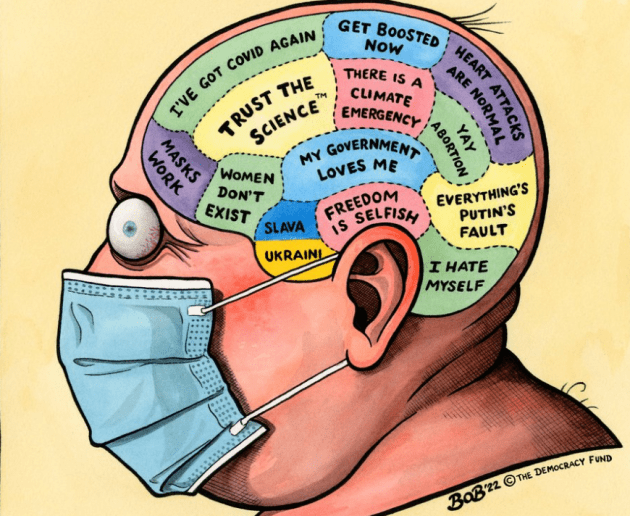
The media, and the people who work in and around it, the Blue Checks™ of Twitter, have upped the ante over the past few years regarding how far they are willing to go to enforce various preferred narratives.
Pick any major story of the past three years—e.g. Lab Leak, Jussie Smollett, Russiagate, Ukrainian Biolabs, Ivermectin, Hospitalizations From COVID v. With Covid, January 6th, ‘Transitory’ Inflation, and of course Hunter’s Laptop—and you will find absolutely hysterical narrative pushing up front followed by retractions, corrections, and outright denials as reality became undeniable.
In the meanwhile, our civilization was ripped apart, our citizens were gaslit and impoverished, and in countries across the Western world, innocent people were removed from polite society, branded as lepers, and fired from their jobs.
Why? Because there is one story that just won’t die and for which no corrections have been issued—the shibboleth that vaccination can prevent infection, transmission, and help “end” COVID.
While there is never an excuse for hateful rhetoric towards, and intervention in, the personal medical choices of law-abiding Americans, perhaps one could have, kinda sorta, understood the campaign if the new vaccines had provided long-lasting immunity and prevented community transmission. They do not.
Early on we were told: “Nine out of ten [vaccinated] people won’t get sick” (Columbia University feat. Run-DMC, February 12th, 2021, no this is not a joke); “Vaccinated people do not carry the virus, don`t get sick” (Dr. Rochelle Walensky, March 29th, 2021); “When people are vaccinated, they can feel safe that they are not going to get infected” (Dr. Anthony Fauci, May 17th, 2021).
And by mid-summer, 2021, we were still being told that unequivocally, these vaccines were a resounding success worthy of uncritical support. On July 27th in Scientific American, Dr. Eric Topol wrote, “Vaccination is the closest thing to a sure thing we have in this pandemic.” Not to be outdone, Dr. Anthony Fauci of the NIAID told CBS on August 1st, that the unvaccinated were responsible for “propagating this outbreak.”
But on July 29th, 2021, the Washington Post reported a scoop that the CDC was privately acknowledging that the vaccinated could spread COVID as easily as the unvaccinated. Occasionally, they are forced to report inconvenient facts. And August 5th, CDC Director Walensky told CNN’s Wolf Blitzer that, “They continue to work well for Delta, with regard to severe illness and death — they prevent it. But what they can’t do anymore is prevent transmission.”
While there is a mountain of medical literature available demonstrating quite clearly the failure of these vaccines to prevent infection and transmission, the August 5th declaration from the CDC Director should have made clear that being vaccinated is contributing in no way to the safety of others, nor to the eradication of this virus.
In fact, Israeli Health Minister Nitzan Horowitz was even caught on tape in September of last year explaining that the use of the Israeli Green Pass wasn’t intended to make a difference epidemiologically, but because it would help convince people to get vaccinated. And even vaccine poobah Bill Gates admitted in a late 2021 interview, that, “We got vaccines to help you with your health, but they only slightly reduce the transmissions.”
So there should be no question that continuing to suggest in any way that these shots are a panacea, and that those who refused to get them were plague spreaders, should have been thoroughly trashed by Fall 2021.
Nonetheless, on September 24th President Joe Biden coined his now famous phrase “a pandemic of the unvaccinated.” To our north, Prime Minister Trudeau called the unvaccinated science deniers, misogynists, and racists, and asked rhetorically whether Canadians should “tolerate” them.
And during the first week of January 2022, while kicking the unvaccinated out of French daily life and public spaces, French President Emmanuel Macron said he wanted the measures to “piss off” his unvaccinated citizens. With world leaders speaking this way, it’s no wonder so many Blue Check™ elites took up the banner!
Prominent media figures like Amy Siskind, Pulitzer Prize winner Gene Weingarten, and more have come out of the woodwork in recent months to share with us their enthusiasm for medical discrimination. Noted neurotic Howard Stern is all in on forced vaccination due to what must be his own debilitating fear of his mortality. Bill Kristol says the unvaccinated have “blood on their hands.”
David Frum, heir to Maimonides, writes, “Let the hospitals quietly triage emergency care to serve the unvaccinated last.” Charles M. Blow was “furious” at the unvaccinated. CNN contributor Dr. Leana Wen suggested that the unvaccinated should not be allowed to leave their homes. The Ragin’ Cajun even wants to punch the unvaccinated in the face!
All of the above links/stories were posted after Dr. Walensky’s unequivocal announcement that the vaccines do not prevent transmission.
And all of the self-satisfied segregationists are supported in their vitriol by the Blue Checks™ of the Medical Establishment, like Dr. Paul Klotman, President and Executive Dean of the Baylor School of Medicine, who said on camera back in January that he isn’t polite to friends and family who aren’t vaccinated. “Keep them away. I don’t do it respectfully, I tell them to stay away, and teach them a lesson.” Less vitriolic but equally problematic, the WHO’s COVID-19 “technical lead” Dr. Maria Van Kerkhove continued to push the lie that vaccination can prevent outbreaks as recently as January 26th, 2022. She is, as well, a Blue Check™. And yes, Dr. Anthony Fauci is still at it, even as of April 14th, 2022, telling MSNBC that harsh Chinese lockdowns could be used to get the population vaccinated so that “When you open up, you won’t have a surge of infections.”
The examples are legion. Blue Checks, Medical Blue Checks, Times Columnists, Radio Jocks, Presidents, and Prime Ministers have all espoused misinformation and/or hate speech regarding vaccination status. But they are all given intellectual cover by the official reporting of the fourth estate. Even in the face of all the evidence that there is no epidemiological basis for discrimination, our intellectual betters in the legacy media press onward the canard.
On August 26th, the Toronto Star ran an article entitled, “When it comes to empathy for the unvaccinated, many of us aren’t feeling it.” Then, on December 22nd, published an explainer which stated that two doses won’t stop you from spreading COVID-19. Comme ci, comme ca.
Back in February, MSNBC political contributor Matthew Dowd shared his insight that the unvaccinated do not believe in the United States Constitution, because if they did, they would get vaccinated for “We The People.” For the common good.
An examination of the New York Times reveals three articles written this year which overtly continue supporting the idea that the vaccines prevent transmission. First, on January 29th in a piece entitled, “As Covid Shots For Kids Stall, Appeals Are Aimed At Wary Parents,” the author cites “public health officials” who say that to aid in “containing” the pandemic, kids must also be vaccinated. (It is worth mentioning that the current vaccines and boosters being distributed were designed in February 2020 to provide an immune response to a version of the SARS-CoV-2 spike protein circulating prior to that, not entirely similar to what is circulating now.)
Then February 23rd, in a hit piece on the Surgeon General of Florida Dr. Joe Ladapo, the Times writes, “When public health officials across the country were urging vaccines as a way to end the pandemic, Dr. Ladapo was raising warning flags about possible side effects and cautioning that even vaccinated people could spread the virus.”
So, Dr. Ladapo was correct?
Finally, in a piece about Novak Djokovic published March 3rd, they write, “Djokovic was the only player ranked in the top 100 in Australia who had not received a Covid-19 vaccination, which experts have long said will not eradicate the virus unless most of the population receives one.”
They do not address the question of how a vaccine which does not prevent transmission can eradicate a virus. And they won’t. As Israeli Health Minister Horowitz candidly admitted, none of this is about epidemiology.
And even when mainstream media tacitly acknowledges the failures of the vaccines to prevent transmission, they skillfully elide the significance of this fact in order to allow them to continue to scapegoat the unvaccinated. In a dazzling display of sophistry, Time Magazine moved the Overton window in this January 12th, 2022 piece, “These Charts Show That COVID-19 Is Still A Pandemic of the Unvaccinated.”
The author states that due to the rapidly narrowing gap between cases in the vaccinated and unvaccinated, some readers might think that the phrase “pandemic of the unvaccinated” is no longer justifiable. But with the grace of a ballerina, Time goes on to tell us that because the vaccines are still showing efficacy against severe illness, the phrase is still kosher. If an unvaccinated person gets sicker than his vaccinated neighbor who contracted COVID at a fully vaccinated wedding, that unvaccinated person is still the problem!
New York Magazine isn’t lacking in similar gymnastics. On February 16th of this year, Matt Stieb published a piece entitled, “Is Kyrie Irving Going to Get Away With It?” Irving is the Brooklyn Nets player who famously chose not to be vaccinated, and has become a fetish object for the Covidian Left. Stieb acknowledges that Irving’s vaccinated teammates were getting COVID at such high rates that it forced Nets management to allow Irving back to play in away games but still calls the New York City ban on unvaccinated athletes “a rare public health mandate with real teeth.”
Just seven days later on February 23rd, Will Leitch, in the same publication, sighs, “Unfortunately, It’s Time to Let Kyrie Irving Play in New York.” He outlines all the reasons why epidemiologically it makes no sense to prevent athletes like Irving and Novak Djokovic from participating, but says, “It would feel like they got away with all their bullshit.” And also, they are “annoying.”
And this barely concealed hatred for the unvaccinated from media and government and Big Tech—even in the rare moments when writers such as Leitch acknowledge the failure of the vaccines to prevent transmission—has real consequences. People have lost their jobs. People have been arrested for trying to go to a movie theater.
Families got kicked out of restaurants, and patrons either cheered or remained indifferent, which is worse. A teenage boy at an uber-progressive and expensive Chicago prep school committed suicide after being bullied over an incorrect rumor he was unvaccinated. The stench of bad journalism rots people’s basic decency.
A January Rasmussen poll found that, “Fifty-nine percent (59%) of Democratic voters would favor a government policy requiring that citizens remain confined to their homes at all times, except for emergencies, if they refuse to get a COVID-19 vaccine…Forty-five percent (45%) of Democrats would favor governments requiring citizens to temporarily live in designated facilities or locations if they refuse to get a COVID-19 vaccine…”
As well as, “Twenty-nine percent (29%) of Democratic voters would support temporarily removing parents’ custody of their children if parents refuse to take the COVID-19 vaccine.” Unfortunately, these disturbing results are politically lopsided, but it’s no surprise when you consider who the readers of most legacy media platforms are.
The saddest thing is that these media outlets and their flag bearers really think their readers are all morons. The New York Times believes that, in the midst of the Omicron wave as boosted person after boosted person was getting COVID, they could tell you these particular vaccines are still the way to eradicate this thing, and expect you to deny reality and nod your head.
It calls to mind the quote attributed to Solzhenitsyn (or Elena Gorokhova), “The rules are simple: they lie to us, we know they’re lying, they know we know they’re lying, but they keep lying to us, and we keep pretending to believe them.”
We have ceded the better angels of our common cerebrum to people who may not have our best interests at heart, and a sycophantic laptop class who gleefully endorses their diktats and “fact-checks.” Collectively: Sophistry Inc.
Their behavior, endorsed by every single entity which holds power in our society, is destroying us, and has already poisoned us such that there may be no antidote. Yes, first they came for the unvaccinated, but that doesn’t mean they won’t come for you next.
July 2, 2022
Posted by aletho |
Civil Liberties, Fake News, Mainstream Media, Warmongering, Progressive Hypocrite, Science and Pseudo-Science, Timeless or most popular | Covid-19, COVID-19 Vaccine, Human rights, New York Times, United States |
Leave a comment
Russian Foreign Minister Sergei Lavrov says the claim of NATO being an exclusively defensive alliance is “ridiculous and disgraceful.”
He made the remarks on Friday while addressing students and teachers at the Belarusian State University, in response to recent statements by a number of NATO members’ officials.
“Recently, a representative of the White House once again reiterated that Russia should not be afraid of NATO and that no one should be afraid of it at all, because NATO is a defensive alliance. But it is already ridiculous to hear adults say such obvious nonsense. I would say, it is simply disgraceful,” Russia’s TASS quoted Lavrov as saying.
Pointing to the history of NATO’s establishment and its confrontation with the Warsaw Treaty Organization and the Soviet Union, he said both the Warsaw Treaty and the Soviet Union are gone but “NATO has moved eastward five times.”
“Who are they defending themselves from then?” he asked rhetorically, adding, “When someone pushes forward, establishes control of territories, and deploys armed forces and military infrastructure there, it is not exactly what is called defense. It’s just the opposite.”
The remarks come as the 2022 NATO Summit in Madrid wrapped up on Thursday with the bloc’s decision to strengthen its forces along the eastern flank while also officially inviting Sweden and Finland, which share borders with Russia, to join the alliance.
“NATO is a defensive alliance and poses no threat to any country,” reads part of the declaration of the Summit.
The declaration also named Russia as a “direct threat” to NATO members’ security, noting that the military alliance “does not seek confrontation and poses no threat” to Russia.
At the same time, it went on to threaten to respond in a “united and responsible way” to any threat from Moscow.
‘Joke of the century’
Chinese foreign ministry spokesperson Zhao Lijian also rejected the notion of NATO being only a defensive alliance.
“NATO is a ‘defensive’ alliance? Joke of the century,” he tweeted on Friday while also sharing a combination of images portraying NATO’s military intervention in several countries such as Afghanistan, Iraq, and Libya.
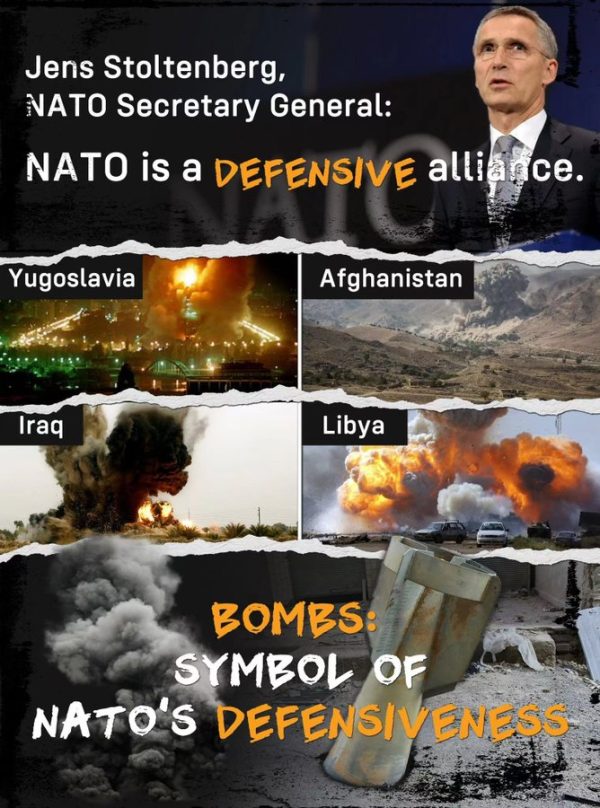
In a separate tweet, the Chinese official also pointed to the role of the US and its allies in the continuation of the war in Syria and its devastating effects on people’s lives.
“[The] US and its allies continue to fuel the war in Syria. More than 300,000 civilians have died in the conflicts according to UN statistics, 1.5% of Syria’s population,” he wrote on Friday, also sharing a photo of war damages in Syria with a note which read “who is the threat to peace?”
NATO members had also alleged that China poses a “challenge” to the bloc’s “interests, security, and values.”
Speaking in a daily briefing on Thursday, Zhao stressed the futileness of hyping up the so-called “China threat.”
“NATO has extended its reach to the Asia-Pacific region in an attempt to export the Cold War mentality,” he said, urging the bloc to stop making baseless accusations and provocation against China, abandon the outdated Cold War mentality, and stop dangerous acts that disrupt Europe and the Asia-Pacific.
July 1, 2022
Posted by aletho |
Militarism, Progressive Hypocrite | China, NATO, Russia |
Leave a comment

Iran’s Foreign Ministry spokesman Nasser Kan’ani
Tehran has vehemently denounced as “baseless, one-sided, and unjust” an anti-Iranian statement by the Group of Seven industrialized states.
The statement was issued during a meeting of the group’s sevenfold members—Canada, France, Germany, Italy, Japan, the United Kingdom, and the United States—in Germany on Tuesday.
It urged “restriction of Iran’s nuclear program,” faulted Iran’s “ballistic missile activities,” and accused it of “human rights violations.”
Later during the day, Iranian Foreign Ministry spokesman Nasser Kan’ani said the country “strongly condemns” the passages of the statement.
The statement, he said, “deliberately ignores” the United States’ departure from a 2015 nuclear deal with Iran and others as well as Washington’s subsequent re-imposition of illegal sanctions against the Iranian people.
The Iranian official reprimanded the countries that had issued the statement for their cooperation with the US in imposing sanctions and their refusal to confront the coercive economic measures.
He also spurned any accusations directed towards Iran’s peaceful nuclear energy program, saying the statement “deliberately” ignores the Islamic Republic’s ban on all nuclear weapons.
Kan’ani reminded that the G7 countries were facing Iran with “factitious accusations,” while they, themselves, were in possession of the world’s “biggest nuclear arsenal.”
The spokesman, meanwhile, blasted the statement for trying to portray Iran’s comprehensive cooperation with the International Atomic Energy Agency, the United Nations’ nuclear body, in a bad light.
The official further rejected all allegations against Iran’s “legitimate and defensive missile program,” reminding that the country’s missile work can never be subject to any negotiation or compromise.
“It is necessary that the parties that have issued the statement rather be accountable for their sales of billions of dollars of advanced weapons, which is one of the most important factors of instability in our region,” Kan’ani asserted.
Addressing the human rights accusations made through the statement, the official said the countries throwing the allegations were the very same states that have closed their eyes to the “flagrant violation” of the Iranian nation’s rights as a result of the sanctions.
June 29, 2022
Posted by aletho |
Progressive Hypocrite | Iran, Middle East, Sanctions against Iran, United States |
Leave a comment
By Drago Bosnic | June 27, 2022
Last week, on June 23, a United States government agency under the name Commission on Security and Cooperation in Europe, better known as the Helsinki Commission, held a Congressional briefing titled “Decolonizing Russia”. Democrat representative from Tennessee (D-TN) Steve Cohen opened up the presentation, during which he claimed that the Russians “have in essence colonized their own country,” arguing that Russia is “not a strict nation, in the sense that we’ve known in the past.” Casey Michel, who authored an opinion piece in The Atlantic last month, titled “Decolonize Russia”, was also present at the meeting. His op-ed seems to have been the impetus for the highly controversial briefing. According to Michel, “decolonizing Russia” is not solely about “partitioning” and “dismembering” the Russian Federation, but about an “authentic commitment to anti-imperialism.”
The panel discussion participants urged the US to give more support (clearly implying actual support currently exists already) to separatist movements inside Russia and in the diaspora, and specifically mentioned Chechnya, Tatarstan, Dagestan, and Circassia as the possible candidates for “decolonization”. Siberia was discussed separately and, according to the Commission, it is to be divided into several republics. During the (First) Cold War, the US, a premier imperialist power, sponsored numerous separatist groups inside the USSR. Thus, this is most certainly not the first time prominent figures in the political West have adopted a hard line towards the Russian Federation, seeking ways to dismantle the Eurasian giant, just as the political West did the same to Yugoslavia over 30 years ago.
What is significantly different nowadays is the blatantly open and public call to do so. Apart from being highly controversial and dangerous, as Russia isn’t yet another helpless country the political West can destroy and kill millions of its inhabitants with impunity, but a military superpower which can easily turn its rivals into a radioactive wasteland in minutes, to suggest Russia should be “decolonized” is exceptionally hypocritical, especially coming from the pillar of (neo)colonialism, the US itself. Since its unfortunate inception, the belligerent imperialist thalassocracy invaded and dismantled numerous countries, reducing them to rubble and turning them into almost perpetually failed states.
After the dismantling of the Soviet Union, the infamous Bush-era Vice President Dick Cheney was seeking to carve up Russia and divide it into several smaller states. In 1997, former Reagan-era US National Security Advisor Zbigniew Brzezinski even published an article in the Foreign Affairs magazine, proposing to create a “loosely confederated Russia — composed of a European Russia, a Siberian Republic, and a Far Eastern Republic.” Thus, once again, this isn’t a new state of affairs. Prominent political figures from the US have been advocating this for decades. The issue is, while they’ve been doing it on a personal basis, not in their capacity as government officials, in this particular case, we have a US government commission openly calling for war, as their blatantly bellicose statements can only be interpreted as such.
Michel, the author whose op-ed inspired the panel discussion, stated that “Russia continues to oversee what is in many ways a traditional European empire, only that instead of colonizing nations and peoples overseas, it instead colonized nations and peoples over land”. He lamented the US failed to use the break-up of the USSR to dismantle Russia itself, complaining Western support for separatist movements in the Russian Federation “did not go far enough”.
“These are colonized nations that we consider to be part of Russia proper, even though, again, these are non-Russian nations themselves that remain colonized by, as we’ve seen yet again, another dictatorship in the Kremlin,” Michel said.
Once again, he insisted that the meeting was not simply about advocating for the “dismemberment and partition” of Russia, but was supposedly motivated by “genuine opposition to colonialism and imperialism”. The very idea Michel supports “genuine opposition to colonialism and imperialism” is deeply comical, as he has spent years smearing the anti-imperialist movement in the US, while ridiculing and (ab)using the term to demonize the governments of Cuba, Venezuela, Nicaragua, and Bolivia, all of which have spent decades fighting off a very real US aggression. Still, Michel brazenly styles himself one of the world’s most vocal supporters of a unique form of “anti-imperialism” that just so happens to advance the interests of the genuinely imperialist political West, in particular the US.
Naturally, none of the participants mentioned anything about the fact the Russian population, although mainly composed of ethnic Russians, still has around 20% of numerous other ethnic (Tatars, Buryats, Kalmyks, Bashkirs, etc) and regional identity (Cossacks) groups, who have been living side-by-side for well over a millennium, that is, several times longer than the US has existed. Also, unlike the US, which occupies the land entirely conquered from numerous Native peoples, tens of millions of which have been slaughtered, precisely in order to steal their lands (with their descendants now living in reservations), Russia kept the indigenous populations it incorporated (usually peacefully, again, in stark contrast to the US) intact, with their lifestyle, religion and cultural heritage shielded by the government.
Drago Bosnic is an independent geopolitical and military analyst.
June 27, 2022
Posted by aletho |
Progressive Hypocrite, Russophobia | Russia, United States |
Leave a comment
A few hours ago the Supreme Court of United States (SCOTUS) confirmed their ruling overturning Roe v. Wade, the case which set the precedent for abortion as a human right in the US back in the 1970s.
As soon as this decision was first “leaked” a few months ago it became the trending topic all across the US and to a certain extent the rest of the anglosphere. Since it was confirmed this afternoon, the already supercharged dialogue has reached new heights.
Pro-choice pundits, politicians and celebrities have been flooding the cyber public square with comparisons to the Handmaid’s Tale and other forced memes. They argue abortion-on-demand is a fundamental right, and take up the rather unsettling position that having an abortion is a point of pride.
On the other side of the divide Christians, traditionalists and republican politicians argue for the sanctity of all life, regardless of context or complication.
Both sides are entrenched to the point of hysteria, and not really looking like budging.
As with most things, the reasonable ground is somewhere in the middle.
Regardless of the law, women will sometimes seek out abortions, and it’s probably best they have access to safe, clean places to do so. That said, the use of abortions as a form of contraception is both obscene and impractical, and aborting viable mid or late term babies is revolting – both in concept, and in practice.
None of that really matters though, because the Roe v Wade finding isn’t even about abortion, it’s about Federal overreach. The Justices made that clear.
Though it has gotten lost in 250 years of ever-expanding centralization, the USA originated as a loose federation of quasi-independent states, with the central federal government having strictly limited powers to overrule local legislation.
Simply put, the Constitution lays out all the powers of the federal government, and anything not specifically mentioned therein is de facto a matter for states on an individual basis.
For decades federal governments used SCOTUS decisions to get around these limitations, relying on precedents rather than actual legislation in order to control state laws from Washington DC.
Roe v Wade is a classic example of this, and reversing it changes only one thing: abortion law will revert to a state-level matter, not a federal one.
… but is it even really just about that?
On a deeper level, there seems to be a prolonged campaign in place to violently divide the United States, perhaps to the point of outright civil war.
From Black Lives Matter to January 6th, the 2nd amendment to Roe v Wade, there is an increasing supply of hot-button issues accompanied by a deluge of divisive rhetoric.
Both sides are being encouraged to take to the streets, protest, mock, yell and scream without any search for common ground.
The office of the Presidency is degraded more every term, with a crass blowhard followed by a jittering dementia patient.
Some states are even openly talking about seceding.
At the end of the Cold War, Russia was economically raped and globally humiliated. It came within inches of shattering into a dozen or more failed states. As the big money players head East, and the hegemonic powers turn from the US Empire to a new globalist powerbase, you have to wonder if the US is destined for the same fate.
Just as the USSR had to fail, and be seen to fail pour encourager les autres, perhaps the US – with its history of individualism and personal liberty – is considered surplus to requirements in the new age of faux collectivism.
Whatever America became at its Imperial zenith, its constitutional foundation has always arguably been the most egalitarian on Earth. Could it be that those ideas enshrined in the Bill of Rights are considered an impediment to the “progressive” New World Order?
The US falling into failed statehood could even act as a moral lesson to the rest of the world, and be held up as a warning about what can happen when “liberty is taken too far”, or when people are allowed to “selfishly put their own rights ahead of the public good”.
Perhaps the US being torn apart – or encouraged to tear itself apart – is key to bringing about the next stage of the great reset.
One thing is for sure, no matter the endgame, US politics are dry tinder piled high, waiting for a spark.
June 25, 2022
Posted by aletho |
Civil Liberties, Progressive Hypocrite | United States |
Leave a comment
Last week the Centers for Medicare & Medicaid Services (CMS) quietly sent round a memo exempting officials from vaccine mandates. Why is this so hypocritical? Well, because the officials they were exempting from the vaccine mandate were officials hired to enforce the very same vaccine mandate.
So it seems the easiest way to get around the vaccine mandate is to get a job enforcing the vaccine mandate.
I’ve probably said vaccine mandate a few too many times now, so here is the memo itself.

The Biden administration first announced the mandates back in August 2021, stating that healthcare and nursing home staff must be COVID-19 vaccinated or lose funding. After legal challenges, different deadlines were imposed with the final deadline occurring on 21 March 2022.
Vaccine mandate deadlines encouraged/forced (take your pick) employees to get vaccinated with uptake rising from 63% to 88% in a number of months. Doctors, nurses and staff who still decided that vaccination was not for them, lost their jobs.
In February, the CMS warned state survey agencies that they must enforce all federal health and safety requirements or lose federal financial support. Although it didn’t explicitly say so, this was widely recognised as a warning to Florida and other states that had said they would not enforce vaccine mandates. Furthermore, the CMS said they would bring in outside surveyors if states did not comply with their directives.
CMS surveyors were given the role of evaluating whether healthcare workers were complying with federal vaccine mandates. They stated that staff vaccination under 100% would constitute non-compliance. However, the extremely reasonable CMS (sarcasm) said that any facility with over 80% of its staff vaccinated would be given 60 days to reach 100% without further action being taken.
Brian Harrison, state representative of Texas and former chief of staff for the Department of Health and Human Services under the Trump administration, said in an interview with Newsmax “This shows that the Biden administration is truly authoritarian and these mandates never had anything to do with public health in the first place, but sadly and tragically, they had much more to do with giving the federal government more control over our lives. These mandates must end.”
Harrison thinks that after the CMS enforced the mandates on its own surveyors, they were unable to live under the same rules. “They couldn’t take it. So instead of taking down the mandate, which would have been the normal common sense solution, they just exempted their own government contractors instead of all the Americans.”
Rules for thee, not for me.
June 21, 2022
Posted by aletho |
Civil Liberties, Progressive Hypocrite | COVID-19 Vaccine, Human rights, United States |
Leave a comment