THE WHO, PANDEMIC PREPAREDNESS, AND THE IMPORTANCE OF FALSE MESSAGING
By Dr David Bell | Pandemics – Data and Analytics | June 9, 2022
The World Health Organization (WHO), and the growing pandemic preparedness industry sponsoring it, has faced considerable challenges in maintaining support for its COVID-19 response. It has addressed this difficult situation with simple and uniform messaging. The compliance thus achieved by the WHO has been vital to achieving a successful concentration of wealth, benefitting not just its major sponsors, but also the army of global health staff who have remained obedient throughout.
Threatening this progress, a skeptical minority within the public sphere have been using evidence and rational argument to undermine the pandemic industry’s potential. As the pandemic preparedness and response narrative is poorly defensible on rational criteria, such criticism and opposition must be dealt with and dismissed by other means. This is being achieved through the creation of a dogma around mass COVID-19 vaccination sufficiently separated from reality as to render the normal processes of debate irrelevant. If the gap between pandemic messaging and reality can be kept sufficiently wide, few passengers can step off, and this lucrative gravy train becomes unstoppable.
Small lies can be argued against, big lies become matters of faith
The development and mass deployment of vaccines has been a key component of the COVID-19 response, underpinning much of the transfer of wealth from lower-income people and countries to large Pharma, their investors and the global health workforce they sponsor. Against a background of rapidly increasing global poverty, this unprecedented increase in wealth has in turn raised the potential for unprecedented funding to global health institutions – the mostly Western-based industry that fills offices and drains aid budgets in Europe and North America. A significant cognitive decoupling has been necessary across this sector to achieve sufficient uniformity of voice and purpose, as the institutions involved were ostensibly intended to improve the health and uphold the rights of those less financially fortunate. To achieve success, staff of the WHO and other international organizations therefore had to be enabled to signal virtuous intent while acting in concert for corporate gain.
Vaccines traditionally protect the vaccinated against a target pathogen and humans tend to develop good immunity after respiratory virus infections. These two realities create an urgent problem for the pandemic preparedness industry, as the increased financing set to expand their reach is dependent on successfully convincing the world that these truths are indeed fallacies. Thus, to sell COVAX, the WHO’s financing facility for mass COVID-19 vaccination and the model for future pandemic responses, it was vital for the WHO to ensure that the obvious nonsensical nature of the programme would be ignored. This required coordination and adherence to a single simple message, repeated incessantly to stifle external opinion; a slogan so ridiculous that it becomes inarguable. In other words, it required propaganda.
It is essential to focus people on simplistic slogans if the aim is to suppress their tendency for independent thought and to make any venture in that direction a cause of stress. If people can see their respected authority figures standing behind a statement that is otherwise obviously false, it becomes easier to accept that the false must be true than to stand alone against authority and the crowd. Once one’s colleagues are on-board, the Asch conformity phenomenon kicks in – if everyone else is saying ‘X’, then it surely must be ‘X’, even if it looks like ‘Y’. If a health programme flies in the face of all existing medical knowledge, it must therefore be supported by a sufficiently strong dogma to negate evidence-based arguments. It is a testament to the power of group-think, loyalty to sponsors and the allure of money that this has, thus far, been brilliantly achieved.

COVAX – Selling the golden goose
“No one is safe, until everyone is safe”, the WHO’s COVAX motto, fulfills all the above criteria.
Most people want to be safe – and to achieve industry aims, the public must be convinced that others, not just themselves, are the key to their personal safety. They must support the blame or coercion being applied to these others. But the brilliance of ‘No one is safe, until everyone is safe’ is not just in its appeal to self-preservation and its divisiveness, but in its simple stupidity.
1) For the slogan to be true, the vaccine must be transmission-blocking only. It must not protect the vaccinated individual. Otherwise, their safety will not be dependent on the vaccination of others. However, the WHO and its partners also claim that “COVID-19 vaccines provide strong protection against serious illness, hospitalization and death”. Therefore, in promoting its ‘No one is safe’ slogan, WHO staff must collectively proclaim a falsehood. This builds loyalty and cohesion, as a lie is more easily maintained within a like-minded group.
2) To be ‘safe’ from a virus, one must either be intrinsically at very low risk (as most people are to most viruses) or gain immunity.
- ‘Intrinsic low risk’ created a huge problem for the mass-vaccination narrative early in the COVID-19 outbreak, as data from China showed the very strong skew of severe COVID-19 towards old age, and association with certain comorbidities. Most people are clearly at minimal risk. This had to be suppressed to enable mass-vaccination – all must consider themselves at risk. Public health agencies and their corporate backers even proclaimed impending catastrophe for the people of sub-Saharan Africa, more than half of whom are under 20 years of age. The use of age-based disease metrics, standard for disease-burden assessments up to 2019, were put aside and ‘COVID-19’ mortality reported as raw mortality numbers only.
- Immunity presents a problem, as it is both the pathway through which vaccines work, and the way we naturally gain protection. Immunity makes us safe, but natural immunity is useless to investors. While a safe vaccine would be preferable to a dangerous virus, once infection has occurred the gain from vaccination is minimal. This poses an immediate threat to profits and share price. The response to this dilemma included one of history’s more ludicrous statements from a global institution, when the WHO modified its herd immunity definition to only recognize immunity resulting from pharmaceutical intervention. This is nonsense to anyone with even a rudimentary understanding of immunology, and of course the WHO’s staff have at least rudimentary knowledge.
Inevitably, SARS-CoV-2 has continued spreading, including from the vaccinated. Based on serology from Africa, India and the USA, and the highly transmissible Omicron variant, we can now be confident that nearly all the world’s population have post-infection immunity. It is no biological surprise that immunity gained from a respiratory tract infection with whole virus reduces disease severity more effectively than injection with spike-protein or its mRNA precursors. Claiming that mass vaccination still has public health relevance in these populations requires both abandonment of logic, and a willingness to dispense with decades of prior scientific learning. It requires acceptance of dogma.
A final component of the COVAX strategy, to lock-in celebrity support and enable those promoting the vaccine to still feel virtuous, is ‘vaccine equity’. People in rich countries are having boosters whilst many of the ‘global poor’ still await their first doses. The lack of benefit to be obtained from these doses, and the requirement of coercion to attain high coverage, are irrelevant – inequity in vaccine distribution simply has to be ‘bad’. Whilst pushing more boosters on high income markets, the same Pharma companies can look good by demanding vaccine equity, advocating for the ‘disadvantaged’. In reality this diverts resources from areas of greater need, thereby killing more children, but such fine print will never make the front pages. Commodity equity expands markets and provides returns, while health equity does not. Fear of being vilified as anti-equity helps keep skeptics quiet.
Bolting down the golden goose
Science, including public health, were previously held to be based on processes of logic, based on an acceptance that aspects of our world are grounded in discoverable truth. This concept is a threat to COVAX and the wider pandemic preparedness narrative. It is a threat to the return on investment of the pandemic industry’s sponsors. Greed is a stronger driver than truth, and it must be allowed to run free if society is to be truly reset in favor of those who wish to concentrate and control its wealth.
Despite its massive internal contradictions, disproportionate cost, coercion, and requirement for its promoters to live obvious lies, COVAX and the entire mass-vaccination paradigm has created a strong model for the success of the wider pandemic preparedness project. If truth in public health can be so readily dispensed with, and those working in the field so willingly corralled, the potential for milking the public’s trust and desire for safety presents unprecedented potential for profit. As this wealth accumulates, it supports the continuing advocacy and manipulation required to keep its adherents loyal. This creates a self-perpetuating cycle – we can expect to see more outbreaks, health emergencies and pandemics declared, more vaccines rolled out, and more wealth concentrated as a result. An unstoppable cycle burying truth under a growing fog of fear and falsehood.
That, at least, is the plan. The eventual outcome will depend on whether truth, human rights, equality and trust were ever fundamental to maintaining societal cohesion and peace. If they were, then let us hope the chaos that follows their abandonment is somehow contained. For now, business is business, and the golden goose, bolted down in a hall of lies, will keep on laying.
On Ukraine, ‘progressive’ proxy warriors spell disaster
Urging leftists to support the Ukraine proxy war, Bernie Sanders aide Matt Duss whitewashes the US role, attacks The Grayzone, and advocates dangerous militarism.
By Aaron Maté | The Grayzone | June 7, 2022
The unanimous vote by progressive lawmakers for the $40 billion Ukraine funding bill has been followed by a near-unanimous refusal to defend it. To date, no member of the Congressional Progressive Caucus – with the sole exception of Cori Bush – has publicly explained why they chose to hand over billions of dollars to the weapons industry and intensify a proxy war against nuclear-armed Russia.
Amid this resounding silence, Matt Duss, a foreign policy adviser to Sen. Bernie Sanders, has stepped in to fill the void. In a New Republic article titled “Why Ukraine Matters for the Left,” Duss attempts to convince fellow progressives that the “provision of military aid” to Ukraine “can advance a more just and humanitarian global order.” Duss has only praise for a Biden administration that, in his view, “should be applauded for its judicious reaction to the Ukraine crisis.” By contrast, Duss opts to launch an attack on dissident journalists, myself included, who don’t share his enthusiasm.
To make his case, Duss omits an abundance of inconvenient facts, betraying either considerable ignorance of the Ukraine-Russia conflict or a deliberate effort to distort it.
While apologia for US hegemonic projects is normal in DC foreign policy circles, Duss’ contribution is particularly noteworthy given his painstaking attempt to cast himself as an outsider. “Our political class,” Duss states, “advocates military violence with a regularity and ease that is psychopathic.” Duss’ comment is both accurate and wildly ironic, given his choice to advocate our political class’s military violence in Ukraine — with the remarkable ease that he identifies in others as psychopathic.
When it comes to how the Biden administration has handled the Ukraine crisis, Duss cannot identify a single fault. “The Biden team clearly did not seek this war,” Duss claims, and “in fact… made a strenuous, and very public, diplomatic effort to avert it.”
Duss does not explain what the administration’s “strenuous” diplomacy entailed, perhaps because even its top officials now openly admit that none existed.
In an interview with War on the Rocks, State Department counsellor Derek Chollet was asked if NATO expansion into Ukraine was “on the table” in pre-invasion contacts with Russia. “It wasn’t,” Chollet replied. The White House, Chollet explained, “made clear to the Russians that we were willing to talk to them on issues that we thought were genuine concerns they have that were legitimate in some way,” including “arms control.” (emphasis added) But when it comes to “the future of Ukraine” and its potential NATO membership, Chollet said, this was deemed a “non-issue.”
To Duss, the Biden administration’s (openly admitted) refusal to even discuss Russia’s core demands – and to only entertain issues that it deemed to be “legitimate” on Russia’s behalf – is apparently a “strenuous diplomatic effort.” If “diplomacy” amounts to enforcing US hegemony, as many in DC seem to believe, then Duss would have a case. But in the rest of the world, where diplomacy entails constructive dialogue with a semblance of parity, he does not.
Duss also takes aim at the argument, advanced by prominent leftists including former Brazilian President Lula da Silva, that a US-European pledge that Ukraine won’t join NATO “would have solved the problem” with Russia.
To refute Lula, Duss stresses that “in the weeks leading up to the war, U.S. allies, specifically German Chancellor Olaf Scholz and French President Emmanuel Macron, signaled clearly” that Ukraine’s NATO ascension “was not going to happen.” According to Duss, it is Putin who sabotaged their efforts by invading, and who “has now made that discussion moot.”
Duss omits what also happened in the weeks leading up to the war. While Germany and France did indeed float a proposal to keep Ukraine out of NATO, it was Ukraine – with US backing – that rejected it. According to an account in the Wall Street Journal, Scholtz proposed to Volodymyr Zelensky on Feb. 19 – five days before Russia’s invasion — that Ukraine “renounce its NATO aspirations and declare neutrality as part of a wider European security deal,” signed by both Putin and Biden. But Zelensky rejected Schultz’s plan, a response that “left German officials worried that the chances of peace were fading.” In dismissing the Germans’ NATO proposal, Zelensky joined the Biden White House, as State’s Derek Chollet acknowledged and other Biden officials made clear in public.
Ignoring US-Ukrainian rejectionism, Duss then declares that “it seems absurd to suggest that even an ironclad public pledge from President Biden that Ukraine would never be accepted into NATO would have convinced Putin to draw back the 180,000 troops he had placed on Ukraine’s borders.” Perhaps, but that very public pledge happened to be the centerpiece of Germany’s last-minute diplomatic effort – one that Duss himself invoked, and that Zelensky (along with Biden) chose to reject.
Duss’ whitewashing of the Biden administration’s rejection of diplomacy before the Russian invasion carries over to the period since.
Since Russia’s invasion, Duss says, the White House has “acted with restraint and care not to get drawn into a wider war with Russia.” While it is true that Biden has opted not to start World War III – in other words, has opted not to trigger a global suicide pact — he has done anything but act with “restraint.” One day before Duss’ article was published, Biden authorized the delivery of medium-range advanced rocket systems to Ukraine. These rockets have the capacity to strike inside of Russia; the US is acting on Ukraine’s assurance that it won’t.
Duss may support undermining diplomacy in Ukraine and shipping off billions of dollars worth of heavy weaponry instead, but this can only be described as “restraint” if the sole measure is an immediate — rather than merely prospective — nuclear holocaust.
Duss is so impressed with Biden’s handling of the war that he cannot even detect a tangible path that could end it. “As of this writing,” Duss declares, “I have seen no evidence of a settlement in the offing—as in, a deal that Putin would actually entertain, let alone accept—that we’re refusing to ‘push for.'”
If Duss cannot see evidence of a realistic settlement that Russia could accept, then he is being willfully blind. Russia’s explicit proposals, issued before the war and after, including two weeks into the invasion, called on Ukraine to “cease military action, change its constitution to enshrine neutrality, acknowledge Crimea as Russian territory, and recognise the separatist republics of Donetsk and Lugansk as independent states.”
It is worth noting that the latter is Russia’s only new condition: for the eight years before the February invasion, Russia formally accepted the Minsk accords, which, to end the Donbas war, would have kept the Donetsk and Lugansk regions inside Ukraine’s borders, with limited autonomy.
Duss is free to argue that Russia’s terms for ending the war are unacceptable. But to pretend that Russia has not even laid out those terms, is to essentially advocate that the war never end.
By omitting Russia’s stated terms for a settlement, Duss also allows himself to erase one of the invasion’s key causes: the 2014 Maidan coup, and the ensuing eight-year Donbas war that had left more than 14,000 people dead by the time Russian forces crossed the border on February 24th.
In his 2500+ word piece, Duss makes no mention of the Donbas war and how it began: the 2014 ouster of a democratically elected Ukrainian president, with new leadership selected by Washington; the coup government’s assault on Ukraine’s ethnic Russian and anti-coup citizens, who launched a rebellion in the Donbas; the critical role of fascists and neo-Nazis in the Maidan coup and the Donbas war since; the fascist-led sabotage of the 2015 Minsk accords, which could have put an end to the conflict. By omitting this history, Duss can also omit how the US has helped undermine the Minsk agreements by siding with Ukrainian’s far-right and choosing to use the Donbas war to “fight Russia over there” (Adam Schiff) and “make Russia pay a heavier price,” (John McCain), because Ukraine’s “fight is our fight.” (Lindsey Graham).
After ignoring Russia’s stated grounds for a peace settlement, Duss goes on to disingenuously claim that the Ukrainian government has been pushing for one.
“Ukraine presented Russia with a far-reaching set of proposals over a month ago, including a commitment to ‘permanent neutrality,’” Duss claims. “Volodomyr Zelenskiy continues to offer to negotiate directly with Putin to end the war.”
It is true that Ukraine presented Russia with a 10-point plan in late March. But Duss omits what happened immediately after: while Russia “signaled its preliminary support,” (RAND analyst Samuel Charap) Ukraine’s Western backers sabotaged it, and Zelensky acquiesced. In early April, Ukrainian and Russian officials were finalizing details for a Zelensky-Putin summit. But UK Prime Minister Boris Johnson traveled to Kiev and ordered him to halt diplomacy. Citing sources close to Zelensky, Ukrayinska Pravda reports that Johnson informed his Ukrainian counterpart that Putin “should be pressured, not negotiated with.” Johnson also relayed that even if Russia and Ukraine chose to sign security guarantees, the UK and its allies would not take part – rendering any such agreement worthless.
Zelensky clearly received the message, as Duss’s own source makes clear. When Duss claims that Zelensky “continues to offer to negotiate directly with Putin to end the war,” he links to a Reuters article that reveals such an “offer” to be hollow. Zelensky, Reuters reports, said he would only negotiate with Putin if Russia first withdrew entirely from Ukraine – an obvious non-starter. “Get out of this territory that you have occupied since February 24,” Zelensky said. “This is the first clear step to talking about anything.” Zelensky also “ruled out suggestions… that Ukraine should make concessions for the sake of securing a peace agreement that would allow Putin to save face.”
Thus, returning to Duss’ rendering, Zelensky’s “far-reaching proposals” were immediately rescinded under Western orders, and Zelensky’s “offer to negotiate” was premised on a condition that would have made negotiations impossible.
None of this is to suggest that Russia was justified in launching an invasion of Ukraine. To defend the use of force, which has been so catastrophic, Russia has to meet a high burden of evidence that, in my view, it has not. But one does not need to defend Russia’s invasion to see through Duss’ attempt to whitewash the US role in provoking and prolonging it.
Tellingly, Duss is openly hostile to journalists who have reported on the context that he has omitted. Out of nowhere, Duss introduces an attack on The Grayzone, the Max Blumenthal-founded news outlet that I work for. While Duss has nothing but praise for Biden, he has nothing but ad hominems for us (“pernicious authoritarian agitprop,” “atrocity-denying grifters” “click-baiting provocateurs”). After sharing this vitriol, he then immediately declares that engaging with us is “wasting time.”
I feel the same way about his juvenile name-calling, but interested readers can judge for themselves whether his insults are supported by facts. (He links to two “sources,” one a Medium blog post that, true to the neo-McCarthyite norm, peddles innuendo that The Grayzone is funded by Russia, among other smears).
If Duss is genuinely concerned about wasting time, he also might reflect on why he devotes ample space to paying lip service to progressive principles, only to ultimately endorse policies that flagrantly violate them. “Centering opposition to U.S. imperialism and militarism is an entirely appropriate starting point,” Duss states. Yet Duss’ desired end point would see leftists center U.S. imperialism and militarism, with disastrous results: among them, prolonging a proxy war against a nuclear armed power, threatening a worsening global food crisis, and sentencing more Ukrainians to death.
Even putting aside US complicity in the Ukraine proxy war and its dangers for the planet, progressives like Duss might wish to consider the likely political consequences. One obvious guide is the election of 2016, when Donald Trump won over a significant portion of voters by claiming to oppose the military interventionism that Duss is now urging progressives to embrace. Having seemingly learned nothing from 2016, Democrats in 2022 are again ceding anti-war sentiment to Republicans, 68 of whom voted against the $40 billion Ukraine bill in the House and Senate (versus zero Democrats).
As at least some Republicans vote against the proxy war, Biden has defended the domestic pain caused by his Ukraine proxy war by blaming “Putin’s Price Hike” and trying to argue that “defending freedom is going to cost.” Biden’s defense of “freedom” in Ukraine is now costing him a transatlantic flight to grovel at the feet of the Saudi autocracy, in the hopes of staving off a humiliating cost in the November midterms.
Continuing his mealy mouthed approach, Duss both claims to support diplomacy while simultaneously declaring it to be unattainable. The US, he says, “should certainly be actively engaged in finding a diplomatic path to end the war, and avoid committing to maximalist aims that could foreclose one.” But yet, according to Duss, “for the moment that path is unclear.”
If the path toward peace for Ukraine is unclear to Duss, then that can only be because he has chosen to erase the factual background and the diplomatic solutions on offer, thereby reinforcing the “maximalist aims” that he claims to oppose. Duss’s proxy war apologia will certainly win him a warm reception in establishment DC circles. For the US progressive movement, Ukraine, and the rest of the planet, it only spells disaster.
Zionism has ‘failed’ and Israel is in ‘trouble’ concedes prominent pro-Israel lobbyist
MEMO | June 6, 2022
A prominent Israel lobbyist has conceded that Zionism may have “failed” and that the Occupation State is in “far bigger trouble than anyone understands.” The remarks were made by Michael Koplow of the Israel Policy Forum. The pro-Israel lobby group says it is “dedicated to advancing the goal of a two-state solution in order to preserve Israel’s future as Jewish, democratic, and secure” state.
Koplow is thought to be an intellectual leader of the Israel lobby. Like countless other Israeli lobby groups, Koplow’s job is to provide the US establishment with a positive spin on Israel in order to maintain ongoing American support for the Apartheid State. Their carefully curated image of Israel as a democracy and a vital US ally facing an existential threat, has preserved decades of unwavering support in Washington.
This image is beginning to shatter not least because of the consensus amongst major human rights groups that Israel is committing the crime of apartheid. Koplow appears to also be resigned to the fact that Israel may have passed beyond the point of redemption. Throughout history many justified their support for Zionism through the hope that the racism and ethnic cleansing entailed by the ideology of Jewish supremacy would be redeemed through the end of the illegal occupation of Palestine and the creation of a flourishing democracy. Instead, Israel has morphed into an Apartheid State.
In his article, Koplow comments on a bill in Israel banning the raising of Palestinian flags. “If waving a flag threatens Israel’s existence, then not only is Israel in far bigger trouble than anyone understands, but Zionism itself has failed,” said Koplow. “Protestors waving Palestinian flags and mourners displaying them at funerals does not threaten Israel’s sovereignty or security in any tangible way, and to think otherwise betrays a deep and unwarranted sense of insecurity about Israel’s durability and legitimacy,” he added.
Though Koplow expresses dismay at the Israeli overreaction to the display of Palestinian flags he does not mention that this is part of an ongoing attempt to criminalise expressions of Palestinian nationhood and symbols of their identity which began through the ethnic cleansing of 1947/48 and crystallised seven decades later into an Apartheid State.
“The Palestinian flag is a display of ideology and emotion and treating it like a weapon will make it more potent and more popular a symbol,” Koplow continued, pointing to an obvious double standard highlighted by the so-called right-wing Flag March. “There was a particular irony at work this week with Israeli arguments that marching through the Old City with Israeli flags is nothing but a demonstration of legitimate Israeli pride and should not be construed in any way as incitement or threatening toward Palestinians, while at the same time insisting on multiple fronts that Palestinian flags are inherently illegitimate and should be construed as incitement and threats toward Israelis.”
Koplow also acknowledged that it is an error to view Israel’s occupation of Palestine as a conflict between two equal forces; a view which Palestinian advocates have sought to convey all the time in the US and the Israel lobby seeks to obfuscate: On one side is a nuclear state with the most powerful military in the Middle East, on the other a people under occupation with boys with slingshots.
“Israel has a state and is operating from a position of power, and Palestinians do not have a state and are operating from a position of weakness,” Koplow argued. “That structural imbalance should in theory make Israelis less sensitive to the symbolic aspects of Israeli and Palestinian nationalism, but it doesn’t. The fact of Israel’s existence and Israel’s strength—not only relative to the Palestinians but in absolute terms—has not appreciably lessened Israelis’ insecurities, and Palestinian flags are still treated in many instances as physical threats that somehow have the ability to snuff out Zionism or Israel’s existence.”
New Zealand PM uses Harvard acceptance speech to complain about online “disinformation”
By Cindy Harper | Reclaim The Net | June 5, 2022
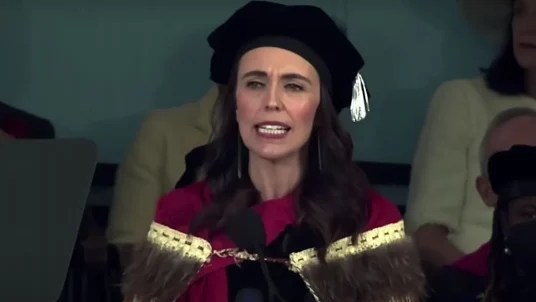
New Zealand’s Prime Minister Jacinda Ardern recently received an honorary degree from Harvard University. She used the opportunity to give a speech that attacked online “disinformation.”
Ardern attacked social media companies, saying that they needed to be more transparent and responsible.
“That means recognizing the role they play in constantly curating and shaping the online environments that we’re in,” she said.
“We seek validation, confirmation, reinforcement. And increasingly with the help of algorithms, what we seek, we are served, sometimes before we even know we’re looking.”
Ardern called on “social media companies and other online providers to recognize their power and act on it.”
“Let’s start with transparency in how algorithmic processes work and the outcomes they deliver. Let’s finish with a shared approach to responsible algorithms – because the time has come,” the New Zealand PM said.
Citing the “conspiracy theories” surrounding COVID-19, Ardern stressed the importance of facts, saying: “When facts are turned into fiction, and fiction turned into fact, you stop debating ideas and you start debating conspiracy.”
She also attacked some internet users, calling them “keyboard warriors.”
“In my mind, when I read something especially horrific on my feed, I imagine it’s written by a lone person, unacquainted with personal hygiene practices, dressed in a poorly fitted superhero costume – one that is baggy in all the wrong places,” she said.
“Keyboard warrior or not though, it’s still something that has been written by a human, and it’s something that has been read by one too.”
On democracy, she said that people ”wrongly” think that “somehow, the strength of your democracy was like a marriage – the longer you’d been at it, the more likely it was to stick.”
Moscow responds to German spying allegations
Samizdat | June 5, 2022
Moscow has shot back at Germany’s accusations of spying, with Foreign Ministry spokeswoman Maria Zakharova saying on Sunday that Berlin forgot about America’s wiretapping practices. The remark was in response to German Interior Minister Nancy Faeser’s recent warning that Russia could be wiretapping government offices in the capital.
In an interview with German newspaper Bild on Saturday, Faeser said her ministry “is keeping an eye out for what intelligence means the Russian government is using.”
It is this vigilance, according to the official, that led Berlin to expel 40 Russian embassy staff in April. Faeser claimed they were working for Russian intelligence services.
Moscow vehemently denied the accusations and responded with a tit-for-tat expulsion of 40 German diplomats.
Bild’s report went on to quote unnamed officials from Germany’s Federal Office for the Protection of the Constitution as saying that “particularly in sensitive areas such as the government quarter in Berlin, the risk of wiretapping and the threat of unauthorized data collection are real and should not be underestimated.”
“Nancy Faeser forgot to add that German officials have always been wiretapped by the Americans,” Zakharova said in a Telegram post.
In 2013, it was revealed that the mobile phone of then-Chancellor Angela Merkel had been monitored by the NSA as part of systematic wiretapping operations worldwide. Merkel famously said “spying on friends” is unacceptable.
Last May, Danish state broadcaster DR reported that the NSA had colluded with Denmark’s foreign intelligence unit to spy on officials in several neighboring countries, including Germany, from at least 2012 to 2014.
According to the revelation based on the Danish Defense Intelligence Service’s 2015 internal investigation, Merkel, along with then-Foreign Minister Frank-Walter Steinmeier and former opposition leader Peer Steinbrueck, were among the targets.
Russian Embassy Rejects Criticism Included in US Religious Freedom Report
Samizdat – 04.06.2022
WASHINGTON – The Russian Embassy in the United States has denied the US State Department’s allegations of systematic violations of religious rights in Russia.
“We would like to remind you that Russia was originally formed as a multinational and multi-confessional state. It is in the blood of Russians to build mutually respectful and tolerant relations with representatives of various ethnic groups and religions,” the embassy said in a statement on Telegram.
“Protecting the rights of believers is our absolute priority. We have no religious persecution.”
The embassy said that the usual reproaches included in the State Department’s International Religious Freedom Report released on Thursday reflect Washington’s tendency to “arrogantly label” certain countries in order to have an excuse to interfere in their internal affairs.
The Russian embassy accused the US of provoking sectarian tensions in the countries of the Middle East, North Africa, and the former Yugoslavia for the sake of its geopolitical interests.
“Such actions have always led to conflicts and numerous victims,” the embassy stressed.
Biden pitches advantages for US stemming from EU’s Russian oil embargo
Samizdat | June 2, 2022
The US may try to buy some cheap Russian oil after the European oil embargo drives the price down, US President Joe Biden indicated on Wednesday. He aired the idea while talking to media about his administration’s plan to deal with the shortage of baby formula and surging prices for basic commodities such as food and gas.
Biden took credit for keeping US gas prices, currently at all-time highs, from going even higher. He blamed Russia and its military campaign in Ukraine for driving food and energy prices up and said his administration was working hard to deal with the problems.
“The issue that is occurring now is you have Europe deciding that they’re going to further curtail the purchase of Russian oil,” he said, referring to the sixth package of anti-Russian sanctions.
EU members reached an agreement several days ago partially banning imports of Russian crude. The Europeans want to cut oil trade with Russia by 90% by the end of the year. But Russia’s loss of European market may be an opportunity for the US, Biden implied.
“There’s a whole lot of consideration going on about what can be done to maybe even purchase the oil but at a limited price so that it has to be sold,” he said. “There’d be an overwhelming need for the Russians to sell it, and it would be sold at a significantly lower price than the market is generating now.”
The president warned that his administration would not be able to “click a switch, bring down the cost of gasoline” in the near term and that the same was true for food.
Moscow downplayed Biden’s remarks, saying the global oil market would rebalance itself despite EU restrictions.
“Certainly, Russia will not sell anything without a profit. The demand may fall in one place and rise elsewhere. The supply chains reorient as parties seek the best conditions for trade,” Kremlin spokesman Dmitry Peskov said on Thursday.
Inflation is currently the biggest concern for many American voters. Political experts predict that Biden’s Democratic Party may be wiped out at the ballot box come November, unless his administration manages to rein in the surging prices soon.
The White House has repeatedly pointed the finger at Russia, and personally President Vladimir Putin, for the ongoing problems. It even coined the term “Putin’s price hike” to explain why American working families find it harder to make both ends meet with every passing month.
However, food and energy prices were going up globally long before Russia attacked Ukraine in February. The disruption of supply chains amid the Covid-19 pandemic was a major factor. Moscow said Washington’s blame game ignored many causes of the problems, including some that resulted from the US campaign to punish Russia with economic sanctions.
The US banned all imports of Russian oil, liquified natural gas and coal in March.
Surprise! The Texas Shooter and the Ukraine Military Get Their AR-15s From the Same Place
By Michael Tracey | June 1, 2022
Like many pundits, Michael McFaul took a quick break this past week from his usual area of “expertise.” Instead of pontificating 24/7 about the need to funnel massive amounts of uncontrolled arms into Ukraine, he adroitly pivoted to pontificating about the need to more stringently control arms in the US. McFaul, a former Ambassador to Russia who is currently working with the Ukraine government to formulate war-related policy recommendations, issued the following command:
To all the manufacturers of AR15s, please stop. Just do the right thing. And the rest of us might consider stopping to focus on a legislative solution, and instead focus on a non-violent civic resistance campaign against these AR15 makers directly.
Few figures on the punditry scene are more adept at getting themselves into comical face-plant scenarios than McFaul — or more useful at highlighting unexamined contradictions of the yammering liberal commentariat. In this instance, McFaul demonstrates why he and likeminded commentators are so steadfastly determined to compartmentalize their positions on foreign policy versus domestic policy. Because it would apparently never even occur to McFaul that there might be some tension between his passionate calls to aggressively curtail gun circulation in the US, and his similarly passionate calls to circulate a giant number of guns in Ukraine.
McFaul and company demand both policies with roughly equal ardor, voicing them in the standard register that has come to define almost all left-liberal advocacy: “this thing must be done right now or everyone will die.” Meanwhile, they evince not even a hint of awareness that the positions could represent contradictory impulses. On the one hand, they want to ensure that the American populace is prevented from obtaining certain high-powered rifles. On the other hand, they want to ensure that the Ukrainian populace is enabled to obtain these same high-powered rifles. Both positions somehow manage to co-exist seamlessly alongside one another, like two of those inflatable tube things floating merrily downstream — never even coming close to clashing.
Is it possible that any contradictions between these stances could be resolved with some sort of reasoning or argumentation? Sure, it’s possible. A liberal who holds both positions could theoretically argue something along the lines of: “In the case of Ukraine, my purported belief in the sacrosanct necessity of gun control is superseded by my belief that unlimited, unregulated, uncontrollable proliferation of guns in Eastern Europe is necessary to Defend Democracy.” Or whatever — something to that effect. And then followup counter-arguments could be raised, such as: “Shouldn’t the mass proliferation of uncontrolled guns in Ukraine, which is occurring as a result of the policy you favor, call into question how vehemently you really value the principle of gun control? Because if the policy you favor in Ukraine is totally inimical to your stated belief in the absolute paramount necessity of gun control, shouldn’t that at least raise the bar for whether the Ukraine policy is justified?” And so on.
The point being, tensions between these two counterposing positions would at least require some argumentation to resolve. But what makes today’s McFaul-style advocacy so notable is the complete and total obliviousness to any such tension even existing in the first place. As they issue their emotionally-heated policy demands, most Democrats appear to have no concept whatsoever that there might be some discordance between their desire to increase regulation on gun ownership at home, while simultaneously obliterating any regulation on gun ownership abroad. Members of the media, the activist class, and the wider punditocracy lack even the basic cognizance that would be needed to broach the subject. So, as usual, the McFaul-style advocates just barrel zealously forward, demanding these two policy prescriptions with equal, unmitigated gusto — without anyone ever pausing to ask for clarification.
And there are plenty of good reasons why clarification might be sought. Here’s how an investigator for Amnesty International reacted to one of the many influxes of weapons to Ukraine ushered in recently by Congress and the Biden Administration. (Yes, the batches include thousands and thousands of assault rifles):
History predicts that someday I’ll track some of these weapons to a new conflict that hasn’t even started yet.
Does anyone feel as if these guns rapidly pouring into Ukraine are being subjected to adequate “control”? Because whenever US officials are given an opportunity to speak candidly on the topic, they grudgingly admit the weapons are dropping into what they call “a big black hole.” Which gives the strong impression that no “controls” are being applied, at least according to the criteria that would ordinarily be demanded by gun control proponents.
And yet amidst the frantic cries for domestic “gun control,” US policy continues to facilitate less “control” of guns entering key foreign markets. The newly-revived “Lend-Lease” law — enacted with near-universal backing from Congress — provides for certain Ukraine-specific exemptions from the Arms Export Control Act, the main statutory mechanism for “end-use monitoring of defense articles and defense services” that the US sends abroad. As one “defense” industry trade publication put it, the main allure of the new Lend-Lease law is that it “will trim the bureaucracy” involved in getting weapons to Ukraine as quickly as possible — eschewing the usual types of restrictions which would ordinarily govern these shipments.
So here we have Michael McFaul appealing to every gun manufacturer in the US to stop producing the AR-15. Plenty of Democrats and liberal pundits echo this exact sentiment: that the US must cease disseminating so-called “weapons of war,” lest they continue getting into the wrong hands. Special ire has been directed at Daniel Defense, the Georgia-based company that manufactures the AR-15 style rifle used by the school shooter in Uvalde, Texas. McFaul implores them to halt production.
Does McFaul know that this would also halt the production of AR-15 shipments to the Ukraine government? Because they get their rifles from the same place the Uvalde shooter did: Daniel Defense. The Ukraine Border Guard — which has been on the front-line of some of the war’s most fierce fighting — revealed as much in a statement announcing their conversion from shoddy old Kalashnikovs to a new modern rifle called the “UAR-15.” The parts for these new rifles come straight from the US, they proudly revealed: “The barrel and the trigger mechanism, on which the accuracy of firing directly depends, are made in the USA by the Daniel Defense company,” the statement reads.
Photos posted on the subreddit dedicated to fans of Daniel Defense purportedly show unidentified pro-Ukraine fighters posing on the battlefield with the exact same model that the Uvalde shooter used:

A website for Special Ops impresarios describes the fancy new Ukraine rifle as such: “The new addition to the small arms inventory of the Ukrainian Armed Forces is a UAR-15 (Zbroyar Z-15), which, as you can easily guess, is one of the many clones of the AR-15.” The site further notes that “American company Daniel Defense obtained the license” on behalf of a Ukrainian company “to produce weapons based on the worldwide AR-15 and AR-10 systems.” Daniel Defense, it would seem, is critical to this ongoing campaign to “Defend Democracy”!
And it’s not just this one newly-reviled company. A smaller manufacturer, Adams Arms, has been celebrated for delivering “more than 1,000 piston driven, semi-automatic AR-15 style rifles into Ukraine for civilian use” since the war started. They even put out press releases touting these shipments, indicating that they thought their pro-Ukraine disposition would be good for business — and were showered with laudatory media coverage for their efforts. Is McFaul saying he wants to shut down Adams Arms, thereby preventing them from continuing to ship rifles into Ukraine?
There have even been photos of Azov Battalion fighters brandishing the despised AR-15s…
I realize people will nonetheless insist that there is just no conceivable tension at all between the indiscriminate dumping of guns into a warzone, and the demand that these same guns be strenuously controlled in the US. But that’s just a testament to how carefully the two issues have been compartmentalized, as is very often the case with foreign policy and domestic policy.
Dreaded gun industry lobbying outfits have even released helpful tip-sheets for domestic US manufacturers, detailing how these companies can secure the necessary authorization to “donate” guns, ammo, and other equipment directly to Ukraine. One would assume McFaul also yearns for this practice to be shut down. But chances are, he’s never thought the matter through. Like most others shrieking for the AR-15 to be proscribed, while at the same time shrieking for AR-15s to be ferried off to the Donbas, the connections between foreign and domestic policy have never crossed their minds. They might be shocked to discover that even the relentlessly demonized NRA has found common ground with McFaul and ilk. As an NRA spokesperson told the Washington Times: “The NRA and our members support the efforts of firearms and ammunition manufacturers helping the people of Ukraine.”
Remington, the gun manufacturer that’s been sued into bankruptcy after being found liable for the Sandy Hook school shooting — because the perpetrator used a gun they produced — has also joined the frenzy to arm Ukraine:
We heard President Zelenskyy’s call. Remington is sending 1M rounds of ammo to Ukraine.
Do McFaul and his ideological peers want to shut down Remington’s ability to send boatloads of bullets to those brave warriors fighting on the frontlines of Democracy?
There’s obviously no direct, concrete, empirically-verifiable connection between the recent mass shootings in the US and the ongoing military escalation in Ukraine. But at one point, it was at least contemplated that US foreign policy could have some extenuating role in conditioning a certain subset of the population toward excess violence. In Bowling for Columbine, which became the most financially successful documentary of all time when it was released in 2002, Michael Moore makes the case that the prevalence of mass shootings in the US is not exclusively or even primarily explainable by the availability of guns.
Moore cites what he says are comparable rates of gun ownership in the US and Canada — and the far lesser prevalence of mass shootings in Canada — as reason to believe that other cultural and political pathologies unique to the US are to blame. In the movie, Moore goes out of his way to note that on the day of the Columbine shooting, April 20, 1999, Bill Clinton dropped more bombs on Yugoslavia than were dropped on any other day of that particular war. Moore further explained his theory about the prevalence of gun-related violence in the US by reference to cultural attitudes, such as those which say “It’s OK to reach for the gun whenever you have to resolve a dispute. Whether it’s personally with your neighbor, or someone in your family. Or whether it’s with Saddam Hussein.”
I don’t bring up this aspect of the Bowling for Columbine thesis to assert that Moore is 100% correct — only to point out that the connection between US foreign policy and mass shooting events at least used to be commonly discussed, including by the most successful documentary-maker of all time. And yet today, if you even mention the US shipping high-powered rifles into Ukraine as a potentially relevant factor to consider when talking about gun control in the US, you’ll draw blank stares. And that’s if you’re lucky. More likely, you’ll draw angry reproaches from people who are indignant that you’d dare to “go there,” when the only place you should be going is to support the latest 10-point plan for gun control furnished by one of Mike Bloomberg’s lavishly funded advocacy groups.
Since Bowling for Columbine came out two decades ago, a few mass shootings have given some credence to Moore’s thesis. In 2018, a veteran of the Afghanistan war named Ian David Long killed 12 people at a bar in Thousand Oaks, California, before killing himself. According to a report by the Ventura County Sheriff’s Office, Long was “a machine gunner in the US Marine Corps who had true combat experience while serving in Afghanistan,” having fought there from 2010 to 2011 — the period when the “surge” orchestrated by Barack Obama and David Petraeus produced more US casualties than at any other point of the 20-year war. According to the Sheriff’s report, ex-girlfriends of Long attested that he was “suffering emotionally from witnessing the travesties of war,” and was afflicted with PTSD. In the year or so before the shooting, he had become heavily isolated. Investigators concluded Long was motivated by “strong disdain for civilians, or individuals not associated with any branch of the US military,” in particular college students — hence his decision to target a “College Night” at the bar.
That’s one example of US foreign policy potentially having some conceivable bearing on a mass shooting. And you could go back further; one of the first mass shooters of the modern era, Charles Whitman, honed his skills as a Marine sharpshooter before firing at random from atop the Clock Tower on the campus of the University of Texas at Austin, all the way back in 1966.
So yes, sometimes there are theoretical connections that can be posited between US foreign policy and mass shootings, like a society-wide habituation to violence, as was suggested by Michael Moore. Sometimes you can get a little more tangible, as when an Afghanistan vet with PTSD shoots up a college bar. And sometimes you can even draw connections between the actual rifle used, such as when the Texas school shooter got his AR-15 from the same US company that also produces the AR-15 used by elements of the Ukraine armed forces. Don’t hold your breath for any “national conversation” about that latter connection, though.
Because all the while, Michael McFaul continues to spout off his desire to “increase arms to Ukraine,” even as he simultaneously calls for the shuttering of US gun manufacturer production lines — which would result in the cessation of arms being sent into Ukraine. But yeah, no tension at all between these dueling positions. Sure thing.
WEF back, learned nothing
By Alexander Adams | Bournbrook | May 24, 2022
The World Economic Forum (WEF) is back. After two years away, the elites reconvened in Davos, Switzerland, to resume plotting. Not, of course, that they would put it that way.
Open Forum Davos 2022 began on 23 May and runs until 26 May. It is a conference designed to increase international participation, “at a crucial turning point in history”. Every WEF statement reads part messianic prophecy, part threat, part vacant corporate babble. This year’s Open Forum promotion is no different.
Hand-picked stooges will promote WEF talking points and push pre-set agendas. There is no possibility of someone taking to the stage and suggesting more democratic accountability, nation independence and vitality through ideological diversity. “The activists will articulate how to turn words into action to fight the climate crisis. Gender equality will also feature prominently in the conversations.” The WEF knows that its multi-million-dollar programme of supporting environmentalist, gender-activist and pro-migrant groups will be amplified by globalist-friendly mass media outlets and clueless politicians in search of “relevance” and photo ops. The forum stresses youthfulness, promoting speakers such as “26-year-old Vanessa Nakate, author and climate advocate” and “Ievgeniia Bodnya, 27, who mobilized the Global Shaper Hub she leads in Kyiv to build the Support Ukraine Now”. Young, passionate women make perfect spokespersons. After all, should anyone male or older than them criticise their ideas, the opponents can be dismissed as relics of a failed era, ones who refuse to accept the coming wave of eco-awareness and migration justice.
The hypocrisy of the WEF is blatantly apparent in its support for Ukraine. It might seem to you paradoxical that a supra-national body which is dedicated to reducing the independence of nations has suddenly discovered its passionate commitment to the integrity of national borders, but WEF see no contradiction. The WEF writes:
“The Russian invasion into Ukraine was a tipping point for world security, the international economy and our global energy architecture. It is not possible to narrow down a war like this to one region while we live in a globalized world. We cannot keep radiation in one country’s geographical borders, or eliminate one country from the fragility of supply chains. This new type of hybrid war including its grave humanitarian crisis, the cyber attacks and economic hardships as well as disinformation and propaganda campaigns, geopolitical tensions about energy supply plus the threat of a nuclear war will have far-reaching effects.”
Every crisis is an opportunity for globalists to tighten their grip on control. Like the World Health Organisation, the WEF is committed to a totalising world view, so every problem will be solved by more globalisation, more migration, more universal regulation, more destruction of tradition. Like all totalising systems, its adherents use every circumstance as evidence of the system’s correctness; to succeed it simply needs more data, more co-ordination and better implementation of policies.
Open Forum Davos will include a panel on the mental health of young people. This is a savage irony, since it was WEF-trained national premiers (such as Justin Trudeau and Jacinda Ardern) who instituted the most draconian lockdowns and fear-propaganda campaigns that drove young people to despair. The WEF seeds its globalist totalising agenda through a Young Global Leaders programme.
In other words, the WEF has learned nothing from the last two years. The growing consensus that COVID lockdowns caused more suffering, disruption and inflation than targeted approaches to healthcare would have, suggests that unified global action made matters worse. If anything, the COVID-pandemic overreaction and reliance on international systems of food and energy supply have shown that independence, self-sufficiency and self-determination are vital for a resilient response to difficulties. Yet the WEF exists to advance the technocratic and scientism worldviews. Or perhaps we could call those worldviews temperaments, as they seem more rooted in emotion and moral psychology than any form of rationalism.
WEF doubles down, realises it was right all along.
EU president accuses Russia of energy ‘blackmail’
Samizdat | May 24, 2022
European Commission President Ursula von der Leyen on Tuesday accused Russia of “blackmailing” the EU with its oil and gas exports. However, the bloc is in the process of voluntarily cutting itself off from these energy resources, and Moscow has blamed global food shortages on Western sanctions.
Speaking at the World Economic Forum’s annual meeting in Davos, Switzerland, von der Leyen said the EU would “accelerate” its transition to green energy “because of Russia’s blackmailing us with fossil fuels.”
Yet hours before she spoke, German Economy Minister Robert Habeck announced that the EU’s 27 member states would “reach a breakthrough within days” to ban Russian oil imports, upon which many EU states depend. Germany, for example, relies on Russia for around a quarter of its imported oil, while the bloc as a whole sources 27% of its oil from Russia.
Von der Leyen has also promised to reduce the EU’s reliance on Russian gas by 66% this year and eliminate it entirely by 2027, as part of a green energy plan announced last week. At present, 40% of the EU’s gas comes from Russia.
Since the start of its military operation in Ukraine in February, and throughout waves of successive EU and US sanctions, Russia has continued to sell its oil and gas to the EU. Moscow has demanded, however, that importers buy its gas in rubles. More than half of Gazprom’s foreign clients have already opened ruble accounts with the Russian energy giant, according to Deputy Prime Minister Alexander Novak.
Von der Leyen also accused Russia of using “food exports as a form of blackmail,” by allegedly blocking grain shipments out of Ukraine and refusing to export its own supply.
However, Kremlin spokesman Dmitry Peskov said on Monday that the West’s economic sanctions are responsible for rising global food prices, and that Ukraine is free to export its crop through Poland. Peskov also accused Ukrainian naval forces of mining the Black Sea, making shipments “virtually impossible.”
Looming food crisis caused by Anti-Russia sanctions, not Moscow’s actions: Kremlin
Samizdat | May 23, 2022
Sanctions imposed on Moscow are the real cause of a looming global food crisis, not Russia’s actions, Kremlin spokesman Dmitry Peskov told journalists on Monday.
He said that Russian President Vladimir Putin agreed with UN Secretary General Antonio Guterres’ opinion that there was a risk of global hunger.
“That is true. But when it comes to grain, the president said that the imposed sanctions and restrictions led to the collapse that we are now witnessing,” Peskov revealed.
The US, the UK, the EU and many other countries imposed hard-hitting sanctions on Russia in response to its military operation in Ukraine. In Guterres’ view, Russia’s offensive in the neighboring country has added to the problems that were already affecting the situation on the food market, namely climate change and the Covid-19 pandemic. Guterres pointed out that Moscow should stop blocking the export of food from Ukrainian ports but at the same time made it clear that fertilizers and food products from Russia should be allowed to reach the world markets without obstacles.
Peskov noted that both Russia and Ukraine have always been reliable grain exporters and that Moscow in no way prevents Kiev from exporting grain to Poland by rail. He also emphasized that as the Poles send trains with weapons to Kiev, “No one prevents them from exporting grain back on the same trains.”
In regard to maritime transportation, the Kremlin spokesman accused the Ukrainian forces of planting naval mines in the Black Sea. According to Peskov, such actions made trade and shipping “virtually impossible” and special measures needed to be taken in order to resume navigation.
“And when it comes to the alternative routes, again, we are not the source of the problem which is causing the threat of world hunger. The sources of this problem are those who imposed sanctions, and the sanctions themselves,” Peskov claimed.
Also on Monday, Russian Deputy Foreign Minister Andrey Rudenko said that allegations that Moscow was blocking the export of Ukrainian grain in the Black Sea ports, thereby leading to the deficit on the grain market, were “nothing more than speculation.”
“All restrictive measures that were introduced against Russian exports should be canceled,” Rudenko said.
Earlier this month, Deputy Chairman of the Security Council Dmitry Medvedev stressed that Russia would not export food to the detriment of its own population. Referring to the anti-Russia sanctions, the former Russian president also said that the West could blame its own “cosmic cretinism” for the looming food crisis.
As Russia and Ukraine are major wheat suppliers, accounting for some 30% of global exports, prices have significantly grown since the launch of the Russian military attack and the subsequent sanctions imposed on Moscow.
The fact that Russia, Ukraine, and Belarus are leaders in the production of fertilizers also aggravates the situation on the global food market – something that was mentioned by both Guterres and Medvedev.
Featured Video
What Does Russian Retaliation Look Like? | Col Doug Macgregor
or go to
Aletho News Archives – Video-Images
From the Archives
A Climate Scientist Who Engages Skeptics
By Judith Curry | November 27, 2009
An open letter to graduate students and young scientists in fields related to climate research:
Based upon feedback that I’ve received from graduate students at Georgia Tech, I suspect that you are confused, troubled, or worried by what you have been reading about ClimateGate After spending considerable time reading the hacked emails and other posts in the blogosphere, I wrote an essay that calls for greater transparency in climate data and other methods used in climate research. The essay is posted over at climateaudit.org.
What has been noticeably absent so far in the ClimateGate discussion is a public reaffirmation by climate researchers of our basic research values: the rigors of the scientific method (including reproducibility), research integrity and ethics, open minds, and critical thinking. Under no circumstances should we ever sacrifice any of these values; the CRU emails, however, appear to violate them. … continue
Blog Roll
 Aletho News
- Why Iran Hawks Are Now Hyping ‘Radical Shiite’ Threats
- What Does Russian Retaliation Look Like? | Col Doug Macgregor
- Araghchi: ‘Israel’ seeks to drag US into war on Iran
- NYT’s Iran dam-missile narrative crumbles under statistical scrutiny and engineering evidence
- USAID Files: The Trusted Flaggers Nobody Can Audit
- How Western media weaponizes unverified claims to justify military aggression
- Content control: USAID docs expose Biden admin’s grip on Ukraine coverage
- Ukraine destroying itself: every attack on the Crimean Bridge will come at a price
- NATO capital under protest siege, so NATO escalates war
- A Climate Scientist Who Engages Skeptics
- If Americans Knew
- An error has occurred; the feed is probably down. Try again later.
- No Tricks Zone
- Alarmist Climatologists In Shock! 2026 Atlantic Hurricane Season Sees Lowest Count In 101 Years
- New Study: Modern Temps Are Among The Coldest Of The Last 10,000 Years In East Central Europe
- Germany’s Renewable Energies Lead to 1.4 Billion Euro Electric Power Trade Deficit
- Argentina’s Perito Moreno Glacier Joins Antarctica and Arctic In Defying Doomsday Melt Claims
- New Study: Barents Sea Temperatures Were Warmer And Sea Ice Less Extensive In The 1700s Than Today
- German Authorities Start Initiative To Evaluate Public Register For Climate “Disinformation” Spreaders!
- Zonal Asymmetry of Temperature Change in the Antarctic Circumpolar Current
- New Study: The Net Fossil Fuel Contribution To Rising Atmospheric CO2 Has Been Zero For 500 Years
- Germany’s Green Energy Transition Becoming Increasingly Expensive…Another 6 Trillion Euros!
- Sudden Stratospheric Warming, Powerful El Niño Combination May Lead To Extreme Europe Cold, Energy Crisis!

