US State Department alleges Moscow prepared ‘crisis actor’ video to invade Ukraine, refuses to offer evidence
RT | February 3, 2022
The US has accused Russia of creating a propaganda video featuring crisis actors, staged fake explosions, and NATO military equipment such as Turkish drones, as a pretext for invading Ukraine in the coming days.
The claim was first published on Thursday morning by the Washington Post, which cited an unnamed US official quoting US intelligence assessments. It was then picked up by CNN and other outlets. On Thursday afternoon, State Department spokesman Ned Price said the government “made public” that intelligence, and echoed the description of the alleged video featured in the Post and CNN stories.
The video is “entirely fabricated by Russian intelligence” and is “one of a number of options the Russian government is developing as a fake pretext to initiate and potentially justify military aggression against Ukraine,” Price claimed. He added that the US is making the claim public as a way to deter Russia from its “destructive and destabilizing disinformation campaign” against Ukraine.
Pressed to show any evidence for the claim, Price said his own statement constituted evidence, and that it was “derived from information known to the US government, intelligence information that we have declassified.”
“If you doubt the credibility of the US government, of the British government, of other governments, and want to find solace in the information the Russians are putting out, that is for you to do,” Price told AP’s diplomatic correspondent Matt Lee, dismissing his line of questioning.
“Russia never does such things,” Moscow’s ambassador to the EU, Vladimir Chizhov, told RIA Novosti on Thursday, when asked about the new US allegations.
As proof of alleged Russian ‘actions’ in Ukraine, the State Department spokesman quoted the allegation anonymous US officials made to CNN in mid-January, claiming that Russia had sent a “group of operatives” trained in urban warfare to attack “Russia’s own proxy forces” in the two disputed regions of eastern Ukraine, in order to create a pretext for an “invasion.”
Moscow dismissed these claims as “unsubstantiated” hearsay. Several days later, leaders of the Donetsk militia told reporters it was British-trained Ukrainian saboteurs that were planning attacks they would then attribute to Russia as ‘false flags’.
Russia responds to accusations of chemical weapons use
Russian ambassador to the United States says Washington is telling ‘outright lies’
By Jonny Tickle | RT | February 2, 2022
Russia is strictly adhering to the norms of international law, and suggestions that it is using chemical weapons are “fundamentally false,” the country’s ambassador to the US claimed on Wednesday.
In a Facebook post on Wednesday morning, Anatoly Antonov called the accusation a fantasy, and instead suggested that Washington is trying to “demonize” Russia. His rebuttal came after White House Press Secretary Jen Psaki told journalists that Russian President Vladimir Putin has taken “aggressive steps” on the global stage.
“This is a country and a leader who has, you know, used chemical weapons, who has invaded multiple countries in the past several years,” Psaki said, at a press briefing on Tuesday.
However, according to Antonov, both these suggestions are untrue, and Washington would be wise to “look in the mirror more often before blaming or lecturing others.”
“The US has not backed up with any credible evidence its fantasies built on outright lies about the alleged use of chemical weapons by our country,” the ambassador said. “The accusations against our country of ‘invading’ other states also have no grounds.”
According to Antonov, Russia has completely destroyed its stocks of chemical weapons, while the US has not.
“Russia adheres to the principle of ‘non-interference’ in the affairs of foreign countries and strictly follows international law – unlike the United States, whose modern history looks more like a chronology of US military operations in different parts of the globe,” the ambassador continued, accusing Washington of conducting “bloody” experiments around the world, which cause “nothing but chaos, instability, and loss of lives.”
The latest statement by Psaki is not the first time that Moscow has been accused of illegally using chemical weapons. Last year, Washington imposed sanctions on a number of Russian officials and businesses for the alleged poisoning of jailed opposition figure Alexey Navalny, in what the US dubbed “the use of a chemical weapon” in an “attempted assassination.”
“The U.S. government has exercised its authorities to send a clear signal that Russia’s use of chemical weapons and abuse of human rights have severe consequences. Any use of chemical weapons is unacceptable and contravenes international norms,” a State Department press release said in March.
In response, Russian Foreign Ministry spokeswoman Maria Zakharova accused Washington of using Russia as a diversion from America’s internal issues.
Media floats Russia theory for Canadian trucker protest
State-owned CBC suggests that ‘Russian actors’ may have instigated massive protest convoy that shut down nation’s capital

RT | January 29, 2022
A cross-country convoy of truckers that has jammed the streets of Canada’s capital in protest against Covid-19 vaccine mandates might seem like grass-roots pushback against government overreach, but broadcaster CBC Television has offered a more sinister explanation: Russia did it.
Speaking in an interview on Friday with Canada’s public safety minister, Marco Mendicino, CBC host Nil Koksal suggested that possible Kremlin meddlers might have brought about the massive “Freedom Convoy.” “Given Canada’s support of Ukraine in this current crisis with Russia, I don’t know if it’s far-fetched to ask, but there is concern that Russian actors could be continuing to fuel things as this protest grows, but perhaps even instigating it from the outset,” she said.
Koksal didn’t offer any evidence to back up the theory or say who has raised such concern. Mendicino replied, “I’m gonna defer to our partners in the public safety, the trained officials and experts in that area.”
The interview came just before disgruntled truckers began to arrive in Ottawa on Friday night. Thousands of convoy participants and other protesters massed in the city on Saturday, bringing traffic to a standstill and sending Prime Minister Justin Trudeau into hiding. State-owned CBC said Trudeau and his family had been moved from his official residence to a “secure location.”
As many as 50,000 trucks were reportedly expected to flood into Ottawa, and traffic was snarled through much of the city. Some trucks were emblazoned with “F**k Trudeau” signs across their trailers, while other protesters demanded, “Mandate freedom.”
Government restrictions that went into effect on January 15 require unvaccinated Canadian drivers to quarantine for 14 days when they cross the border back into their country. Trudeau has condemned the angry truckers as holding “unacceptable views.”
Prior to floating the theory of a Russian bogeyman, Canadian media outlets have made other claims that appeared to smear the protesters, such as suggesting they are racist or extremist.
The Toronto Star said the convoy became a “magnet” for such undesirable elements as “conspiracy nuts, Western separatists, far right-wingers and worse.” Others have suggested that some participants want to carry out their own version of last year’s US Capitol riot.
A counter-protester was seen on Saturday saying, “F**k your white nationalist agenda,” while Canadian television reporter Mackenzie Gray was quick to post a Twitter message proclaiming “our first Confederate flag of the day here on Parliament Hill.” Multiple observers replied that Gray had spotted the “first fed of the day,” meaning a federal agent seeking to discredit the protest.
Secret of ‘microwave weapons’ targeting US diplomats revealed
By Paul Robinson | RT | January 23, 2022
US diplomats and security officials suffering from a spate of unexplained health problems were victims of Russian microwave weapons, we were told time and time again. But now the CIA admits Moscow wasn’t actually behind “Havana Syndrome.” The story fits a disturbingly familiar pattern of misinformation.
With each passing week, the list of discredited allegations against Russia grows and grows. Time and time again, Western governments and the media have sprung into action to inform us of some new evil plot, only to backpedal later when it became clear that there was nothing to it.
Take, for instance, the multi-year saga that was Russiagate, built on the idea that Donald Trump was a Russian agent. There are still some believers, but for the most part people lost interest once it became clear that it was a load of baloney and that the “Steele Dossier” that sparked it off wasn’t worth the paper it was written on.
Then there were the claims that Russia was arming the Taliban, that it had inserted malware into the Vermont electrical grid, that it had bankrolled Brexit via British businessman Arron Banks, and so on. All are now discredited.
Yet the allegations keep on coming. A case in point is the story of Havana Syndrome, which was in the news again this week. For those of you who have missed it, Havana Syndrome is the name given to mysterious symptoms experienced by hundreds of American diplomats and CIA agents around the world, including “headaches, fatigue, hearing and vision loss, severe and debilitating cognitive impairment, tinnitus, brain fog, vertigo, and loss of motor control.”
Such a wide set of symptoms casts immediate doubt on whether there is a single cause. Nevertheless, speculation soon ran rife that they were all examples of a single “syndrome,” and that American diplomats were being targeted by some sort of unknown microwave emitter designed to fry peoples’ brains.
After examining four possible causes of Havana Syndrome – infection, chemicals, psychological factors, and microwave energy – a US government report concluded that “directed pulse RF [radio frequency] energy… appears to be the most plausible mechanism.” Havana Syndrome was “real, and it is serious,” remarked CIA Director William Burns, adding that there was a “very strong possibility” that it was the result of intentional actions.
Who might be doing such a thing? In public, US government officials avoided naming names, admitting that they lacked the evidence to do so. In private, however, the finger was pointed firmly at the Russian Federation, a charge rapidly amplified by the international media.
Thus the New York Times reported that officials “familiar with the report” mentioned above said that the country behind the “attacks” was Russia. CIA veteran Lewis Regenstein claimed that Russian/Soviet attacks of this sort had been going on since the 1950s, penning an article for the Washington Times headlined “68 years of Russian microwave radiation attacks on Americans with impunity.” “Russians use ‘secret microwave weapon’ to target American spies across the globe,” claimed The Sun. And so on. The media had made its mind up – Russia was to blame.
Why the Russian secret services might be doing this has never been explained, with some experts speculating that Havana Syndrome was the result of deliberate attacks, and others believing that the harm to humans was an unintended side effect of some scanning machine designed to extract intelligence from diplomats’ electronic devices. Either way, the Russians were responsible, even though not the slightest jot of evidence in support of this thesis has ever been publicly produced.
It didn’t take long, though, for skeptics to come up with other theories. One was that the syndrome was caused by the loud noise made by crickets. Support for this theory later came in a report commissioned by the US State Department that concluded crickets were the most likely culprits in 21 recorded cases.
Late last year, another theory emerged. Havana Syndrome was “a mass psychogenic illness,” a group of US scientists decided. It was, they said, an example of the “nocebo effect,” the opposite of the placebo effect. In this, expectations of something negative happening to one’s health causes something negative to happen. After the initial incident in Cuba, US diplomats were told to look out for “anomalous health” issues, and as a result they started feeling them. In effect, it was all in their heads.
Whatever the truth, the story of Russian microwave weapons continued to gain traction. But it now seems that even the CIA is having doubts. According to reports this Thursday,
“In a new intelligence assessment, the CIA has ruled out that the mysterious symptoms known as Havana Syndrome are the result of a sustained global campaign by a hostile power aimed at hundreds of US diplomats and spies, six people briefed on the matter told NBC News.
In about two dozen cases, the agency cannot rule out foreign involvement, including many of the cases that originated at the US Embassy in Havana beginning in 2016. Another group of cases is considered unresolved. But in hundreds of other cases of possible symptoms, the agency has found plausible alternative explanations, the sources said.
The idea that widespread brain injury symptoms have been caused by Russia or another foreign power targeting Americans around the world, either to harm them or to collect intelligence, has been deemed unfounded, the sources said.”
Oh dear! How embarrassing. For sure, there are still a few cases in which the cause of illness remains unknown and so foreign involvement “cannot be ruled out.” But that is hardly evidence for ruling it in. This latest assessment knocks the “Russia done it” narrative for six.
In short, once again we found that we’ve been fed a tissue of lies. By now, we should hardly be surprised, but the whole affair speaks to the credulity of much of our political and media establishment, and to the need for a much more cautious and evidence-based approach to allegations of wrongdoing.
It’s common nowadays to complain of the public’s lack of trust in traditional political and media institutions. One of the reasons for this is that people have become skeptical of the old “gatekeepers” of the truth due to their tendency to shout wolf at every available opportunity. If people believe disinformation coming from newer sources, it’s because they’ve become disenchanted by the misinformation coming from the old ones. The latter are under threat, but they have only themselves to blame.
Paul Robinson is a professor at the University of Ottawa. He writes about Russian and Soviet history, military history and military ethics, and is author of the Irrussianality blog.
SPOOKS, RUSSIA, AND DISINFORMATION
By Paul Robinson | IRRUSIANALITY | January 20, 2022
Jeremy Morris has an interesting post on his Postsocialism blog about the malicious role played by Western intelligence services in shaping narratives of Russia. I’m somewhat sceptical about his thesis – or at least the extent of the phenomenon he describes – but as if by chance, today I also came across a story that kind of backs him up.
Morris complains of two “elephants in the room,” who together distort our understanding of Russia. The first is the “clear leveraging of latent public sympathy abroad for the Russian regime by our friends at the English-language offices of RT.” I guess that would be me.
The second is “academic and think-tank contacts with the security services in the West.” Given my former involvement in the intelligence world, and the fact that I’ve taught courses at the University of Ottawa with members of the Canadian security and intelligence services, I guess that would be me too.
Double elephant!
I imagine that Morris thinks that elephant number one distorts things in favour of Russia, and elephant number two distorts them against. That must make me some sort of push-me-pull-you doing both at once. Perhaps that explains why I always end up occupying the middle ground!
Anyway, I digress, because this isn’t meant to be about me. Back to the point.
“If you underestimate the hidden motives of those that comment on Russia – from both elephants, then you are guilty of the ‘fallacy of insufficient cynicism’,” writes Morris. I must confess myself guilty as charged. I can be pretty cynical, but I don’t think that everybody has “hidden motives.” People who write what one might call “pro-Russian” articles for RT aren’t doing it for the money or because the FSB has got some dirt on them any more than people writing Russophobic stuff for think tanks are doing it because they’re taking orders from the FBI, MI5, or CSIS. People tend to believe what they’re doing.
In any case, I worry less about spooks and more about the military industrial complex and its funding of think tanks and the like, all of which work together to inflate threats, keep us in a state of fear, and justify increased defence spending and aggressive foreign policies. But even there, the think tankers etc believe in what they’re doing. The problem is that believers get funded whereas non-believers don’t. I don’t think “hidden motives” are the issue.
That said, Morris has a point, in that security and intelligence services do maintain contacts with chosen favourites and feed them information that they hope will further their chosen narrative. The story I came across today illustrates how this works quite well.
A while back, I mentioned a law case in the UK involving Guardian journalist Carol Cadwalladr and British businessman Arron Banks. Banks is suing Cadwalladr for libel for having claimed that the Russian government offered him money for use in the Brexit referendum campaign, and that he lied about his relationship with the Russians. The case is now before the court, and Cadwalladr’s defence is becoming clear.
The Guardian journalist isn’t claiming that what she said about Banks was true, merely that given the evidence she had at the time she had good reason to believe that it was in the public interest for her to report it. So what was this evidence, and where did she get it from? This is where it becomes interesting. For as the Guardian reports,
In her written evidence statement, she [Cadwalladr] said she had obtained two intelligence files from an organisation contracted to undertake work countering Russian disinformation in Europe on behalf of a government agency, one file of which raised concerns about Banks’s Russian wife.
In other words, British intelligence fed the information to her via another source.
The accusation that Banks took Russian money to fund Brexit received widespread coverage. It was even repeated in a parliamentary report. Yet no evidence to support the claim has ever been produced, and as we have seen, Cadwalladr isn’t trying to say that it was true. In short, it was disinformation. And yet, what prompted it was in part documents leaked by British intelligence to a third party “contracted to undertake work countering Russian disinformation” and then in turn given by that organization to Ms Cadwalladr.
Doesn’t that strike you as a bit iffy?
In the first place, the story reinforces what I have said several times before, namely that the “disinformation industry” set up to “counter Russian disinformation” is itself a major source of disinformation. And second, it reveals an excessively cosy relationship between the media – supposedly an independent guardian of the truth that holds the state to account – and state organizations, including secret intelligence.
Personally, I find it more than a little disturbing.
Maybe Mr Morris is right after all!
Facebook blocks page of Russian diplomats taking part in security talks
RT | Janauary 17, 2022
The Facebook page belonging to Russia’s delegation to the security and arms control talks in Vienna was blocked for days without explanation. The diplomats have blasted it as an act of censorship specifically targeting Moscow.
The act of censorship took place last Friday, Konstantin Gavrilov, head of the continent told RT. The diplomats were so surprised by the development that they initially believed it had been some sort of technical error on the US tech giant’s part. “We waited for two days” before reaching out to Facebook and to the Russian Foreign Ministry in a bid to resolve the issue, he said.
The social media service, however, did not clarify the reasons for the ban.
“There was no explanation; nothing from them,” Gavrilov said, adding that he was still wondering what exactly might have triggered the move.
The delegation posted “nothing [that could be considered] prohibited” on its account, where the content included official statements on subjects like security guarantees, the situation in Ukraine, and some other strictly “practical political issues.” It was “very strange” to find out the page had been shut down, he added.
The account was used by the Russian diplomatic delegation to the Negotiations on Military Security and Arms Control in Vienna, held under the auspices of the Organization for Security and Cooperation in Europe (OSCE). Its role was to publish official statements and press briefings by the Russian Foreign Ministry’s officials and Moscow’s mission to the OSCE.
Gavrilov believes it was all part of a targeted anti-Russian campaign waged by western social media giants. These companies have a “policy” of erasing any content that “does not correspond to their views” and they “can do anything they want,” the diplomat said, admitting that his own personal Facebook page had been blocked three times.
“They all follow our accounts very closely and when they think it is too much, they block them without explanation,” Gavrilov said. “This is ridiculous. No proof, nothing. It is an unprecedented policy of the western media against us,” he said, adding that, according to his estimations, Russian officials are targeted much more often than any of their foreign counterparts.
Eventually, the diplomats were forced to request assistance from the Russian media watchdog Roskomnadzor. The agency issued a statement on Sunday, accusing Facebook of an “act of censorship” and warning it that such actions are forbidden under Russia’s constitution. It also demanded the account be restored “immediately” and urged Facebook to provide an explanation for its removal.
The US social media giant has not yet made any public statements about the incident. The delegation’s page was restored on Monday.
Facebook has been repeatedly fined in Russia over non-compliance with national legislation. The list of violations range from breaching privacy laws by storing the personal data of Russians outside of the country’s territory to repeatedly failing to delete content banned in Russia.
Facebook also cracked down on media outlets it has deemed linked to Russia, such as the RT-affiliated Redfish. The ban of the service’s account drew criticism from the International Federation of Journalists.
Gavrilov believes that the enormous power wielded by social media companies should be counterbalanced. “It is necessary to do something to regulate this,” the diplomat said, adding that the Russian government is currently “working hard” on drafting legislation that would create a legal framework for their operation on Russian territory.
Washington’s Bi-Partisan Russia-Bashers Are Determined to Start a War
By Ron Paul | January 17, 2022
Russia-bashing is a bi-partisan activity in Washington. Both parties think it makes them look “tough” and “pro-America.” But while Republican and Democrat politicians continue to one-up each other on “risk-free” threats to Russia, they are increasingly risking a devastating nuclear war.
It’s all fun and games until the missiles start flying. And in this case we are risking total destruction over who governs eastern Ukraine! Has so much ever been risked for so little?
The problem with all this tough talk is that politicians start to believe their own rhetoric and propaganda. As a result they don’t make sound decisions based on objective facts, but instead make rash decisions based on faulty misinformation.
When US politicians talk about Russia massing troops on the Ukrainian border, for example, they leave out the fact that these troops are actually inside Russia. With US troops in some 150 countries overseas, you’d think Washington might pause before criticizing the “aggression” of troops inside a country’s own borders.
They also leave out the reasons why Russia might be concerned over its neighbor Ukraine. CNN reported recently that the Biden Administration approved another $200 million in military aid to Ukraine last month, making nearly half a billion dollars in weapons over the past year.
Imagine if China was sending half a billion dollars in weapons to Mexico to strengthen and embolden a hyper-aggressive anti-US regime. Would the US not be “massing troops near the Mexican border”?
Also there is that issue about the US-backed overthrow of the democratically-elected Ukrainian government in 2014, which is the starting point of all these recent problems. And this week Yahoo News reported that the CIA is training Ukrainian paramilitaries on US soil!
Recent talks between the US and Russia failed before they even began, with the US side refusing to even consider ending useless and provocative NATO expansion eastward. NATO is a Cold War relic that should have been disbanded along with the Warsaw Pact. It serves no purpose and its constant saber-rattling puts us at risk in conflicts that have nothing to do with US national security.
How embarrassing it was to hear Blinken ridiculing Russia for coming to the aid of ally Kazakhstan as a color revolution (with likely US backing) was brewing. “I think one lesson in recent history is that once Russians are in your house, it’s sometimes very difficult to get them to leave,” Blinken told reporters. He said this with a straight face even as the US continues to illegally occupy a large part of Syria, continues to occupy part of Iraq against the will of that country’s parliament, and occupied a good part of Afghanistan for 20 years!
Incidentally, as soon as the regime change attempt was put down in Kazakhstan, Russian and allied troops began leaving the country. But, of course, the reflexively pro-war US media doesn’t report anything outside the narrative.
What to do about Russia? Stop backing regime change along Russia’s borders, including Belarus, Kazakhstan, and elsewhere. Stop meddling in foreign elections. Look at how we wasted four years on false claims that the Russians meddled in ours. End weapons shipments and all aid to Ukraine. End sanctions. Re-imagine the US defense budget as a budget to actually defend the US. It’s really not that complicated: stop trying to rule the world.
Copyright © 2022 by RonPaul Institute.
Blinken’s blinkered vision of Russia
By Scott Ritter | RT | January 12, 2022
“One lesson of recent history is that once Russians are in your house, it’s sometimes very difficult to get them to leave.”
The level of hubris-laced ignorance it would take an ostensibly intelligent, well-informed individual to make such a statement, in public, in an official capacity, goes beyond political parody.
And yet, there was the American Secretary of State, Tony Blinken, uttering those words at the tail end of a press statement where he questioned the legitimacy of Russia’s dispatch of military forces to Kazakhstan. The Russian actions took place in the wake of widespread violence that prompted the Kazakh President to request help from the Collective Security Treaty Organization (CSTO), which Russia leads.
It should be noted that Russia was invited to send troops to Kazakhstan. Russia was also invited to send troops to Syria. As Blinken was speaking, the US had between 900 and 1,200 troops inside Syria, none of whom were there at the request of the Syrian government. Likewise, the US continues to maintain a force of some 2,500 troops in Iraq, even though the Iraqi parliament has called for their withdrawal for more than a year.
When it comes to understanding what an “unwanted houseguest” looks and acts like, Tony Blinken need only look in the mirror for the perfect illustration.
The US is scrambling to seize the moral high ground when it comes to the issue of military intervention, seeking to exploit the 2008 Russian-Georgian War, the 2014 reabsorption of Crimea, and the 2015 military intervention in Syria to illustrate its position.
While the issue of Russo-Georgian relations is a difficult one, dating to before the dissolution of the Soviet Union, it is an undisputed fact – indeed, one backed up by the European Union’s inquiry into the incident – that the 2008 conflict was triggered by a Georgian military incursion into South Ossetia, including an unprovoked attack on Russian peacekeeping forces stationed there. Subsequent Russian actions are attributable to Georgian aggression.
Likewise, Russia’s actions vis-à-vis Crimea and the Donbass region, where Moscow supports ethnically Russian separatists, all derive from the so-called ‘Maidan Revolution’, a US and EU-backed insurrection that overthrew Viktor Yanukovich, the duly elected president of Ukraine, and replaced him with a more Washington-friendly government.
And, lastly, the Russian intervention in Syria came at the request of the legitimate government in Damascus, which was under siege from foreign-funded and trained terrorists and insurrectionists. Russia’s actions were decisive, helping shift the military balance in favor of the Syrian government, and leading to the defeat of most of the anti-government fighters. The irony behind the Russian intervention is that it exposed the hypocrisy of the US, in so far as several of the terrorist groups Russia helped defeat were not only affiliates of Al-Qaeda but were also being funded by the US and its allies.
The US presence in Iraq and Syria, however, is the direct consequence of the illegal US-led invasion and occupation of Iraq in 2003. Between the US and Russia, only one nation has violated international law when it comes to disregarding the sovereignty of others – and it is not Russia.
Tony Blinken did not limit his Russo-phobic commentary simply to the issue of unwanted houseguests. When asked during an interview on a Sunday morning talk show on January 9 whether he agreed that Russian President Vladimir Putin was seeking to restore the Soviet Union, Blinken answered: “I think that’s right… I think that’s one of President Putin’s objectives, and it is to re-exert a sphere of influence over countries that previously were part of the Soviet Union,” something that, Blinken added, was “unacceptable.”
First and foremost, as Russia has been making clear during its ongoing European security framework discussions with the US, NATO, and the OSCE this week, the issue of what is or isn’t acceptable when it comes to defining the scope and scale of Russian national security and related spheres of interest, is not something Moscow is willing to subordinate to Washington or its allies. Rather, it is a matter for Russia alone to decide.
It is the US, not Russia, which is seeking to continuously breathe life into the Cold War relic that is the NATO alliance. The history of broken American promises when it comes to the issue of NATO expansion – “not one inch east” has a different meaning in Brussels than anywhere else, it seems.
The ostensibly “defensive” NATO alliance has been, since the end of the Cold War, used for almost exclusively offensive military action, much of which has taken place outside the geographic boundaries defined by the treaty. Whether it be intervention in the former Yugoslavia, the dismemberment of Serbia, intervention in Libya, supporting the US invasions of Iraq and Afghanistan, or sustaining the illegal presence of US forces in Syria, NATO has made itself an unwanted houseguest across the globe.
Truth be told, if it were not for NATO actively seeking to attract both Georgia and Ukraine to its roster, the events of 2008 and 2014 might have unfolded completely differently.
Tony Blinken’s comments about the suitability of Russia as a houseguest are as fact-free as any made by senior international statesmen in modern times. The reality is the US is the unwanted houseguest, habitually overstaying its welcome, sowing chaos, death, and destruction in its path.
Using this analogy, Russia could be seen as the emergency clean-up crew tasked with trying to clean up the mess that accrues in the wake of America’s foreign policy tornado. Tony Blinken and his boss, President Joe Biden, seem to have difficulty focusing on the real consequences of their words and deeds, as their gaze is constantly fixed on an artificial horizon that only they can see.
Unfortunately for Washington, the rest of the world knows the truth, and who is to blame for what. Blinken can continue uttering nonsense about Russia but, from such ignorance, does not sound policy come. This should be a lesson for any nation, especially those in Europe, who are looking to the US for sound guidance and leadership when it comes to solving the world’s problems.
FT Says “Anti-Vax Sentiment” in the West Being Fueled by Russia & China
Advocates governments using “psychological operations” against their own people
By Paul Joseph Watson | Summit News | January 13, 2022
In a report that advocates governments using “psychological operations” against their own population, the Financial Times asserts, with no proof, that Russia and China are responsible for pushing “anti-vax sentiment” and criticism of lockdown measures in the west.
The article quotes Mikael Tofvesson, head of the Swedish Navy’s new Psyops division, who says “foreign aggressors” are trying to “sow division by targeting areas of public concern such as crime, Covid vaccinations, the government’s response to the pandemic, and immigration.”
“The most important task in psychological defence is to inoculate the population against believing false information,” states the article, which is written by Elisabeth Braw of the American Enterprise Institute, a neo-con think tank.
Such measures were deployed in the United Kingdom during the first lockdown, when scientists in the UK working as advisors for the government admitted using what they now admit to be “unethical” and “totalitarian” methods of instilling fear in the population in order to control behavior during the pandemic.
One scientist with the SPI-B admitted that, “In March [2020] the Government was very worried about compliance and they thought people wouldn’t want to be locked down. There were discussions about fear being needed to encourage compliance, and decisions were made about how to ramp up the fear.”
Of course, contrary to the claims in the article, the primary goal of psychological operations, whether directed against an enemy or a domestic population, is to instill fear and change behavior – telling the truth is hardly a priority.
Far from dispelling “false information,” psychological operations routinely rely on using false information to influence and manipulate “the enemy.”
“Psychological operations have long been a part of military operations, and are typically defined as the use of propaganda and other methods to influence the attitudes and behavior of foreign adversaries,” writes Allum Bokhari.
“What the FT is advocating — and what many have long suspected — is the use of these techniques by western military, security, and intelligence forces against their own citizens.”
“Hostile states including Russia, China and Iran have increased their use of disinformation and online propaganda to amplify anti-vax sentiment and foment political tensions in Europe and the US,” Braw claims.
However, the report contains no evidence whatsoever that Russia and China are responsible for any coordinated attempt to sow doubts about COVID-19 vaccines or lockdown measures.
Indeed, the mere fact that the newspaper complains about “disinformation” in the context of COVID-19 conspiracy theories is pretty rich given that the constantly invoked ‘Russian collusion’ charge is itself a baseless conspiracy theory.
In reality, concerns about vaccine side-effects, giving vaccines to children and mandating vaccines and COVID passports as part of the growing bio-security police state are perfectly valid concerns shared by millions of people across the west.
The FT is a staunchly globalist newspaper of record for the international elite and is routinely represented at the annual Bilderberg conference.
It can hardly be trusted to represent the interests of the common man.
Sweden to tackle “misinformation” by “psychological” means but insists it’s not the “Ministry of Truth”

By Christina Maas | Reclaim The Net | January 7, 2022
Sweden is taking a new approach to fight “misinformation.” The government launched the “Psychological Defence Agency” which they say will fight misinformation, propaganda, and psychological warfare.
The mission of the new agency will be identifying misinformation and “educating” the community to be resilient against harmful misinformation campaigns. The agency is headed by Henrik Landerholm, a diplomat, The Record reported.
Landerhom was interviewed by a Swedish radio station after the announcement of the agency, where he said nations like China, Iran, and Russia are sources of misinformation campaigns in Sweden. He singled out Russia for its attempt to interfere in US elections.
Swedish leaders have previously warned about the ever-growing “threat” of misinformation. In the nation’s recent elections, Russia was accused of attempting to interfere, which led to a coordinated effort to fight misinformation campaigns.
The efforts included training thousands of public officials on how to respond to false information and working with social media companies and journalists to curb its spread. These efforts inspired the creation of the new agency.
During the interview, Landerholm insisted that work of the new agency is not a form of government propaganda.
“This is not the Ministry of Truth or a State Information Board like we had during the Cold War,” Landerholm said. “We want to protect freedom of opinion in our country.”
THE WORSE THE BETTER – HOW TWITTER VIEWS KAZAKHSTAN
By Paul Robinson | IRRUSSIANALITY | January 7, 2022
Various commentators have suggested that I write something about recent events in Kazakhstan. I’ve been loath to do so since my knowledge of the country is very limited, but there are some interesting things to say about what others have been writing on the topic, particularly concerning how it all relates to Russia. Notably, a certain part of the online commentariat has been keen to express indignation that Russia has “invaded” Kazakhstan to suppress a “democratic revolution”.
The rapid spread of violence in Kazakhstan generated hopes in some circles that the mob would topple the “regime” and install a new government that would somehow or other distance the country from Russia. Alternatively, the hope was that “democracy” would arrive in Kazakhstan. With this, another brick in the wall of authoritarianism would collapse, bringing closer the day when it would collapse in Russia too.
All this was somewhat unspoken, but once the Collective Security Treaty Organization (CSTO), which includes Russia, announced that it would send troops to help restore order in Kazakhstan, and once Kazakh forces took the offensive and began clearing away anti-government protestors, all these hopes were dashed. The Kazakh government isn’t out of the woods yet. Protests continue in several cities, and things could still go horribly wrong. But at the moment it’s looking like the regime will survive. The internet’s keyboard warriors and online regime changers are seriously annoyed and looking for someone to blame. The guilty party is obvious – Russia.
However, despite the headlines in today’s newspapers about Russia sending troops to “quell” the uprising, the Kazakh state’s survial has little to do with the Russians or the CSTO. It seems as if the CSTO contingent in Kazakhstan will amount to no more than about 2,500 troops, which for a country that size is a tiny quantity. The role of the CSTO is largely symbolic – it sends a message to protestors and Kazakh security forces alike that the government isn’t backing down and has powerful external support. That should deter some of the former while putting a bit of steel in the spines of the latter. Perceptions of strength matter in situations like this, and thus the CSTO’s support perhaps makes a slight difference. But the hard work of restoring order belongs largely to the Kazakhs themselves. Whatever the press tells you, “Russia” isn’t “putting down” the uprising.
Nor can it be said that Russia has “invaded” Kazakhstan, as so many have liked to claim this past week on Twitter. Take for instance all these Tweets from the likes of one-time US Ambassador to Moscow Michael McFaul and former Estonian president Toomas Hendrik Ilves:

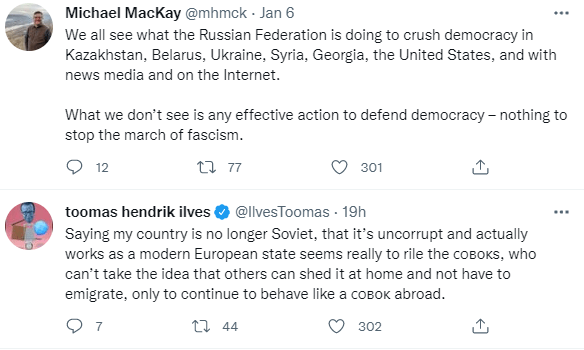
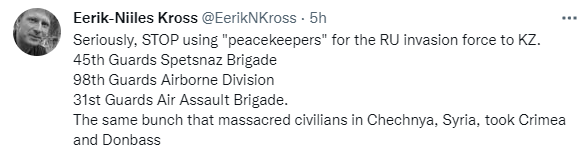
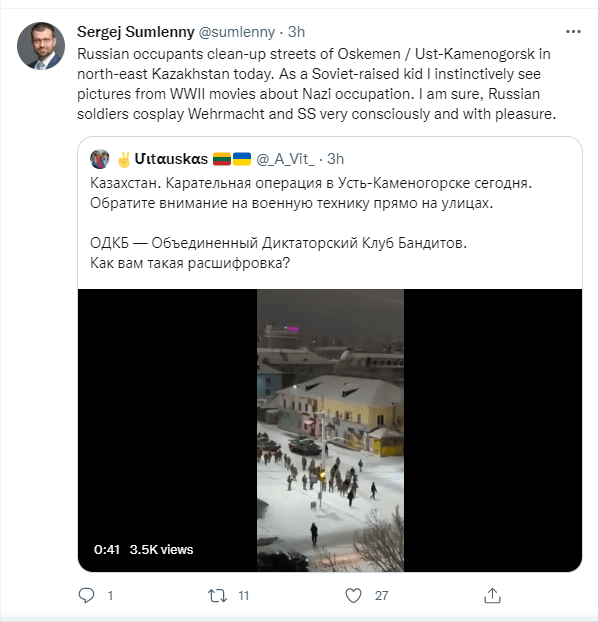
Various themes repeat themselves in all these: invasion, occupation, the “crushing” of democracy, and comparisons of Russia with Nazi Germany. It is, to be frank, more than a little over the top. You can’t invade, let alone occupy, a country the size of Kazakhstan with only 2,500 troops. Furthermore, the troops are there at the invitation of the internationally recognized government – recognized by us in the West as well as by everybody else. That’s hardly an invasion.
Maybe it’s because I’m a total reactionary, but I’m not too fond of the mob, and I’ve never understood why street protest (accompanied by looting and burning) is associated with democracy. The thing is that all those complaining about the efforts to restore order in Kazakhstan aren’t too fond of the mob either, at least when it starts attacking things that they like. A year ago, McFaul and others were complaining loudly about the crowd that assaulted the Capitol building in Washington DC. And none of those whose Tweets I copied above were to be seen complaining when the Ukrainian military responded to protests in Donbass by firing rockets from aircraft and shells from multiple launch rocket systems.
Somehow, though, people are rather inclined to like the mob when it attacks somebody or something they don’t like. If it’s anti-American, that’s bad. But if rioting and looting damages Russian interests – they’re all for it.
But here’s what really gets me. Do the McFauls and Ilveses truly believe that it would be better for Kazakhstan if the Russians and CSTO didn’t help restore order and the state collapsed? There’s a very real danger of at best anarchy and at worst civil war. How would that help anybody? We’ve seen this scenario before. In Ukraine, revolution led to counter-revolution and bloody violence. In Syria, likewise. And so on. It tends not to turn out well.
But it seems like people don’t care. The attitude appears to be “The worse the better”, as long as the chaos is not at home but on Russia’s borders. Let Kazakhstan descend into anarchy – that’s to be preferred to an order backed by the Russians. Suffice it to say, I don’t agree.
Featured Video

The Truth About the Trump Shootings with Ken Silva
or go to
Aletho News Archives – Video-Images
From the Archives
The Geopolitics behind the War in Yemen (I)
By Mahdi Darius NAZEMROAYA | Strategic Culture Foundation | 30.03.2015
The United States and the Kingdom of Saudi Arabia became very uneasy when the Yemenese or Yemenite movement of the Houthi or Ansarallah (meaning the supporters of God in Arabic) gained control of Yemen’s capital, Sanaa/Sana, in September 2014. The US-supported Yemenite President Abd-Rabbuh Manṣour Al-Hadi was humiliatingly forced to share power with the Houthis and the coalition of northern Yemenese tribes that had helped them enter Sana. Al-Hadi declared that negotiations for a Yemeni national unity government would take place and his allies the US and Saudi Arabia tried to use a new national dialogue and mediated talks to co-opt and pacify the Houthis.
The truth has been turned on its head about the war in Yemen. The war and ousting of President Abd-Rabbuh Manṣour Al-Hadi in Yemen are not the results of «Houthi coup» in Yemen. It is the opposite. Al-Hadi was ousted, because with Saudi and US support he tried to backtrack on the power sharing agreements he had made and return Yemen to authoritarian rule. The ousting of President Al-Hadi by the Houthis and their political allies was an unexpected reaction to the takeover Al-Hadi was planning with Washington and the House of Saudi. … continue
Blog Roll
 Aletho News
- Leaked: Britain’s Sham Conviction Of Hashim Thaci
- Seyed M. Marandi: U.S. Strike Imminent – Toward Total War in the Middle East
- Russia Voted Under Fire. Washington Is Loading the Tankers.
- 12 Things Your Oncologist Was Trained Not to Tell You
- Anthrax Attacks Paved Way for COVID-Era ‘Junk Drugs and Vaccines’
- How Real Is the Impact of Western Sanctions on Israel?
- France, You Are Guilty: How Paris Turned Western Sahara into the Maghreb’s Powder Keg
- 2025 Nature Paper Claiming Worsening Global Drought Gets RETRACTED …Heavily Flawed
- Your Milk Is Not the Problem
- The Truth About the Trump Shootings with Ken Silva
- If Americans Knew
- Salah Sarsour’s Legal Team Says DHS Has Not Met Its Burden to Prove He Is Deportable
- An analysis of tax forms by The Intercept show Kraft’s charity and LLC have donated to Friends of the IDF and AIPAC’s super PAC.
- Israeli attacks kill four Palestinians in Gaza – Daily Update
- Inside Gaza’s death trap of collapsing, bombed-out buildings
- The everyday items Israel bans from Gaza every day
- Inside the siege, the ruined buildings of Gaza – Daily Update
- Debunking The Claim That Macklemore Has A “History Of Antisemitism”
- CPJ demands release of arrested Palestinian-US journalist near Bethlehem
- Robert Kraft: The Billionaire Friend of Netanyahu Pulling The Strings Behind the Macklemore/Ed Sheeran Blow Up
- Columbia Administered Fund Gives Big Money to Pro-Israel Groups
- No Tricks Zone
- 2025 Nature Paper Claiming Worsening Global Drought Gets RETRACTED …Heavily Flawed
- New Study: ‘Global Drought Shows No Detectable Recent Acceleration Under Climate Warming’
- Economic Masterminds: German Socialists Suggest Taxing Productivity Gains Stemming From Using AI
- The South China Sea Has Not Been Cooperating With The Climate Change Narrative
- Energy Crisis: Germany Enters Heating Season With Historically Low Gas Reserve Fill Levels
- New Study: The Antarctic Ice Sheet Gained Mass From 2020-2024 Due To Staggering Snow And Ice Accumulation
- Study: Ocean Heating Rates From Thousands Of Years Ago ‘Dwarf’ Modern Ocean Heating Rates
- Climate Extremists Target, Attack Large-Scale Power Grid Infrastructure In Germany!
- New Study: Antarctic Ice Melt Has Contributed Less Than 1 Centimeter To Sea Level Rise In The Last 30 Years
- Fear Of Debate: Alarmist German Climate Scientist Calls On Mainstream Media To Discredit Skeptic Voices
 Aletho News