British Disinfo Machine Out of Whack: The Guardian’s Trump-Russia ‘Bombshell’ Reeks of Forgery
By Ekaterina Blinova – Sputnik – 22.07.2021
The Guardian’s latest “bombshell” story about how President Vladimir Putin ordered Russian spies at a closed session of the National Security Council to use “all possible force” to make Donald Trump win in 2016 has not got as much media attention as it was apparently planned.
The article written, by Luke Harding, Dan Sabbagh, and Julian Borger appeared on The Guardian’s website on 15 July at 10:00 GMT. Another op-ed on the matter with a byline containing only Harding and Sabbagh was published on the same day at 17:05 GMT. The news was also advertised in the website’s First Thing section on 15 and 16 July and yet, surprisingly, just a “few Western mainstream media outlets have written or reported on what they were all speculating and salivating about for all four years of the Trump presidency”, notes Mark Sleboda, a US military veteran and international affairs and security analyst.
Still, there’s an obvious explanation why the MSM has not taken the bait: the so-called “leak” smacks of an obvious bunk, according to the analyst, who outlines some obvious discrepancies in The Guardian’s “exposé”:
First, it’s absolutely unclear how the supposed “leaked docs” ended up in The Guardian’s hands: there is no chain of custody or explanation at all.
Second, despite The Guardian’s claims that Western intelligence agencies have had these documents for months, no Western government or intelligence agency, neither the British nor the Americans, has so much as made a comment or peep about it.
Third, almost universally native Russian speakers have noticed and called out numerous incidences of lexical awkwardness and mistakes in the snippets, suggesting that the text was written by a non-native Russian speaker with limited cultural fluency.
Fourth, the Russian National Security Council is a formal political body which is not designed for discussing sensitive clandestine operations.
Fifth, the President’s Expert Directorate headed by economist Vladimir Simonenko – named by The Guardian as the apparent author of the grand design to take over the US elections – in fact deals entirely with domestic matters, including the financing of the president and the presidential administration’s activities, as well as collecting, analysing and preparing materials for the president’s annual addresses.
Sixth, the alleged secret meeting took place in January 2016 when Donald Trump was not even considered as a serious presidential candidate, let alone the Republican nominee.
Seventh, the article is riddled with hedging words and expressions, papers “appear to show”, “documents suggest”, “assessed to be”, etc., as if the authors knew that they were peddling disinformation.
The Guardian report “reeks of disinformation operation”, former Director of Cybersecurity and Infrastructure Security Agency Chris Krebs remarked on 15 July. Krebs echoes another cybersecurity expert, Thomas Rid of John Hopkins University, who listed a series of issues with the “Kremlin leak” in a Twitter thread.
Many more former Western intelligence operatives and experts publicly questioned the documents’ veracity in both media and social media, including Director of Russian Studies at CNA Michael Kofman, former Information Security Specialist for GCHQ Matt Tait, and former US NSC staff Gavin Wilde.
Even Dmitri Alperovitch, a co-founder and former CTO of Crowdstrike, who groundlessly blamed “Russian hackers” for breaching DNC servers back in 2016, has weighed in, dismissing the “leak” as forgery.
What’s Behind the ‘Kremlin Leak’ Story?
On the surface, the “leak” appears to confirm practically every Russiagate fantasy and makes an oblique reference to unspecified “kompromat” on Trump – an apparent reference to ex-MI6 agent Christopher Steele’s “dirty dossier” on the then presidential candidate and his campaign, Sleboda points out.
The analyst highlights that one of the authors of The Guardian’s latest exposé – Luke Harding – has long been an ardent adept of the Steele dossier, despite the ex-British spook’s bizarre claims having neither been corroborated nor confirmed by Special Counsel Robert Mueller’s Trump-Russia investigation.
“There seems a likely possibility that these new ‘Kremlin documents’ like the previous Steele dossiers, were fabricated by British intelligence or elements within it, for the same purposes of discrediting Trump and preventing any, even faint, detente in US-Russian relations, whether under Trump or Biden”, suggests Sleboda.
The UK has played a special role in the Trump-Russia story: “There has long been a widely held belief by many because of the prominence of the Steele dossier during the whole Russigate episode that there was a significant degree of the British tail wagging the US political dog”, the analyst says.
Four years ago, Harding claimed that the UK intelligence service GCHQ became aware of “suspicious ‘interactions’ between figures connected to Trump and known or suspected Russian agents” as early as in 2015, well before their American counterparts. Citing unnamed sources in the UK intelligence community, the journalist presumed that British and EU spies collected information on Trump between late 2015 and summer 2016.
“It is understood that GCHQ was at no point carrying out a targeted operation against Trump or his team or proactively seeking information”, Harding asserted on 13 April 2017. “The alleged conversations were picked up by chance as part of routine surveillance of Russian intelligence assets”.
Furthermore, “[Harding] has previously claimed in The Guardian that British intelligence and Foreign Office was given the Steele dossier before it was sent to the United States and vouched for Steele’s ‘credibility’ in reference to it”, Sleboda remarks.
In 2021 alone, the British media has published a number of articles in support of Steele’s debunked narrative:
· in January, The Guardian ran an outlandish story of Trump being “cultivated” by the Soviet KGB for 40 years;
· in May, The Telegraph broke a story about a “second dossier” written by Steele during Trump’s presidency;
· four days prior to Harding’s “bombshell”, Guardian contributor Charles Kaiser tried to rehabilitate at least part of Steele’s “dirty dossier”, alleging that Trump aide Carter Page may have struck a lucrative deal with Russia’s Rosneft, something that wasn’t confirmed by Special Counsel Robert Mueller’s investigation.
The fact that Steele’s story is being kept alive in the British media would seem to indicate that the UK establishment is still backing Steele’s anti-Trump/anti-Russia disinformation campaign, the security analyst believes.
If the “Kremlin documents” were indeed deliberately planted by the UK intelligence elements to target Trump’s potential 2024 election bid as well as US-Russia relations under Biden, this is “an extremely important and dangerous situation”, according to Sleboda.
“It would mean that the British government and/or intelligence have repeatedly conducted active measures to manipulate and interfere in both US domestic elections and foreign policy, destabilising the US political system domestically and putting the entire world at risk by deliberately increasing tensions between the world’s two foremost nuclear armed powers”, he says. “There will likely be no investigation or accountability into this latest Guardian piece of disinformation about Russia in the Western MSM but there most certainly should and desperately needs to be one”.
RUSSIAGATE: Luke Harding’s Hard Sell
By Joe Lauria | Consortium News | July 17, 2021
Luke Harding of The Guardian on Thursday came out with a new story that looks at first glance like an attempt to rescue the Russiagate story and the reputations of Harding and U.S. intelligence.
The headline reads, “Kremlin papers appear to show Putin’s plot to put Trump in White House” with the subhead: “Exclusive: Documents suggest Russia launched secret multi-agency effort to interfere in US democracy.”
Harding’s report says that during a Jan. 22, 2016 closed session of the Russian national security council, President Vladimir Putin ordered Russian spies to back a “mentally unstable” Donald Trump for the White House to “help secure Moscow’s strategic objectives, among them ‘social turmoil’ in the US.”
“Russia’s three spy agencies were ordered to find practical ways to support Trump, in a decree appearing to bear Putin’s signature,” Harding writes. “A report prepared by Putin’s expert department recommended Moscow use ‘all possible force’ to ensure a Trump victory.”
The article, starting with the headline, is littered with the use of qualifiers such as “appears,” “suggests,” “apparent,” and “seems.” Such qualifiers tell the reader that even the newspaper is not sure whether to believe its own story.
Quoting from what he says is an authentic document marked “secret,” Harding writes that there is “apparent confirmation” that the Kremlin had dirt on Trump it could use to blackmail him, gathered during earlier Trump “‘non-official visits to Russian Federation territory.’”
This would seem to confirm a central part of the so-called Steele dossier, which Harding hawked in his bestselling book Collusion.
Harding’s newest story though says nothing about the involvement of Trump operatives with this Kremlin plot, as that was unfounded by Special Counsel Robert Mueller’s report.
Harding also suggests that the documents that came into his possession provides evidence of a Russian hack of Democratic National Committee computers.
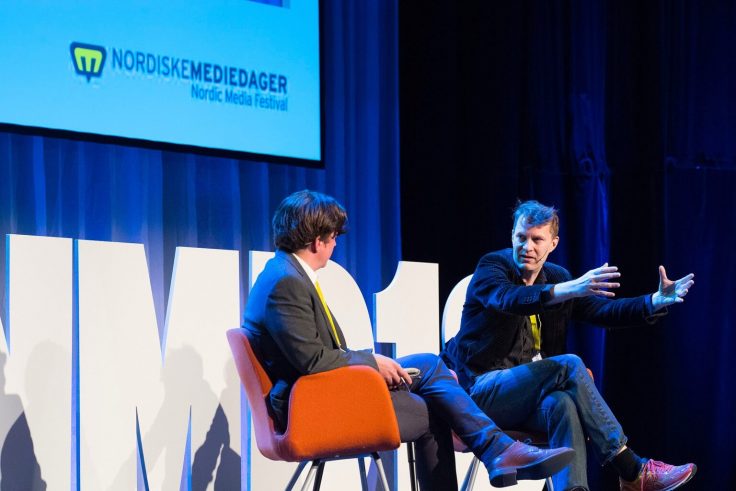
Harding at the Nordic Media Festival, 2018. (Thor Brødreskift / Nordiske Mediedager/ Wikimedia Commons)
He writes:
“After the meeting, according to a separate leaked document, Putin issued a decree setting up a new and secret interdepartmental commission. Its urgent task was to realise the goals set out in the ‘special part’ of document No 32-04 \ vd. …
The defence minister was instructed to coordinate the work of subdivisions and services. [Sergei] Shoigu was also responsible for collecting and systematising necessary information and for “preparing measures to act on the information environment of the object” – a command, it seems, to hack sensitive American cyber-targets identified by the SVR. …
The papers appear to set out a route map for what actually happened in 2016.
A matter of weeks after the security council meeting, GRU hackers raided the servers of the Democratic National Committee (DNC) and subsequently released thousands of private emails in an attempt to hurt Clinton’s election campaign.”
These documents would perfectly confirm the story put out by U.S. intelligence and an eager Democratic media: that Russia’s defense intelligence agency GRU hacked the DNC and Russia leaked DNC emails to damage Hillary Clinton.
Except that Shawn Henry, the head of the company CrowdStrike hired by the Democratic Party and the Clinton campaign (while keeping the FBI away) to examine the DNC servers declared under oath to the House Intelligence Committee that no evidence of a hack was discovered. “It appears it was set up to be exfiltrated, but we just don’t have the evidence that says it actually left,” Henry told the committee.
WikiLeaks, which Harding doesn’t mention, has also denied getting the DNC material from Russia that Harding says was released by Moscow. And Harding ignores the true contents of the emails.
Dmitri Peskov, Putin’s spokesman, told The Guardian the story was “great pulp fiction.”
Let’s look at the motives of the players involved in this story.
Harding’s Motives
Henry’s denial of a hack and Mueller’s inability to prove Collusion, embarrassed Harding after he staked his reputation on his bestseller of that name. The book is essentially the story of Christopher Steele, the ex-MI6 agent, who was paid by the DNC and the Clinton campaign to come up with opposition research against Trump.
Harding, like the Democratic media establishment, mistook opposition research, a mix of fact and fiction to smear a political opponent, for an intelligence document paid for by taxpayers, presumably in the interests of protecting the country rather than a political candidate. Of course, the FBI and the CIA sold it to the media as such to undermine the other candidate.
Harding has had a major omelet on his face after the Russiagate tale was ultimately exposed as opposition research paid for by the Democrats, who elevated it to a new Pearl Harbor.
Now I will engage in qualifiers here but it seems Harding is desperate to find anything that might rescue the story and his reputation. That’s a vulnerable position to be in, easily exploited by intelligence operatives, the way he was exploited with the original story.
An earlier attempt by Harding at rescuing himself was the disastrous piece he wrote for The Guardian that Paul Manafort, briefly Trump’s 2016 campaign manager, had visited Julian Assange at the Ecuador Embassy in London. It blew up in Harding’s face though his paper has never pulled the story.
U.S. Intelligence Motives
Members of the U.S. intelligence community were staring at possible prosecution in the investigation run by U.S. Attorney John Durham for their role in pushing the opposition research as truth, leading, among other things, to a doctored FBI report to the Foreign Intelligence Surveillance Court to monitor a Trump campaign worker.
The Steele dossier became the basis for other shenanigans by U.S. intelligence. Though in the end there were no indictments, the reputation of especially the FBI took a hit.
Leaking a story now that it was all true, after all, might do wonders to restore its standing among wide sections of the U.S. public who lost faith in the bureau over Russiagate.
A Kremlin Leakers’ Motives
Harding writes in a cryptic way about how he got hold of these materials. He says the story is based on “what are assessed to be leaked Kremlin documents.” As they were marked “secret,” and supposedly came from Putin’s innermost circle, as Harding says, it stands to reason that few people in the Russian government would have had access to them outside of that circle.
We are being asked to believe that someone closest to Putin leaked these documents either directly to Harding or to U.S. or British intelligence who then passed it on to Harding. (Harding calling it a leak would rule out that they were obtained through a Western intelligence hack.)
It can’t be dismissed that U.S. intelligence may have an active mole inside the Kremlin. But one must ask would that mole — if he or she exists — risk their freedom by leaking documents that have absolutely no current strategic or even political significance, rather than, say, classified information about Russian troop movements and military intentions?
The only interests this leak serves — if it was a leak — are those of Harding and U.S. intelligence, who were hung out to dry by the collapse of the Russiagate narrative.
Evaluating the Story
Harding is clearly reporting from Russian-language documents, snapshots of which are reproduced in The Guardian article. He writes that these documents were shown to “independent experts” who said they “appear” to be “genuine.” Harding does not reveal who these experts are.
To evaluate the credibility of Harding’s story would require knowing how he got the documents, not the names of the person or persons who gave them to him, but the interests they represent. He is especially vague about this.
Harding writes:
“Western intelligence agencies are understood to have been aware of the documents for some months and to have carefully examined them. The papers, seen by the Guardian, seem to represent a serious and highly unusual leak from within the Kremlin.”
If they were handed to Harding by U.S. or British intelligence who had them for months, the idea that these are the products of spycraft cannot be dismissed. Crafting what looks like classified evidence from an adversarial power and then leaking it to friendly press has long been in the arsenal of intelligence agencies the world over.
It is unlikely we will ever know how Harding came into possession of these documents or who the experts are who said they “seem” genuine.
But the purpose of this piece may have already been achieved.
Joe Lauria is editor-in-chief of Consortium News and a former UN correspondent for The Wall Street Journal, Boston Globe, and numerous other newspapers. He was an investigative reporter for the Sunday Times of London and began his professional career as a stringer for The New York Times. He can be reached at joelauria@consortiumnews.com
The Guardian plumbs new depths: its resident ‘Russiagate’ fanatics claim that Putin got Trump elected
By Paul Robinson | RT | July 16, 2021
From 2016 to 2020, a single story with two elements dominated the American headlines: Russiagate. The first part of the narrative was the claim that the Russian government had used a range of tools, including disinformation, to ensure Trump clinched his country’s highest office. The second was that Trump had knowingly colluded with Moscow to achieve this goal.
After endless repetition, these claims became something close to sacred ‘truths’ for some people. And yet, as we now know, the whole thing began with a falsehood, or more accurately a single document containing a whole series of falsehoods.
This was the infamous ‘Steele dossier’, assembled by former British intelligence office Christopher Steele, as part of a strategy by the Democratic Party to dig up dirt to blacken Trump’s reputation.
The dossier contained a number of inflammatory stories about Trump’s relationship with Russia. It also claimed its information came from sources close to the upper echelons of the Kremlin. This was untrue. As we now know, the information was hearsay, collected second- or third-hand by someone who didn’t even live in Russia. In short, it was a near total fabrication.
Unfortunately, Russiagate induced many journalists to abandon any effort at critical thinking and to treat all anti-Russian allegations with a distinct credulity. Particularly prominent among them was Luke Harding of The Guardian, who even published a book entitled ‘Collusion’, laying out the case against the Russians and Trump. Its logic was often rather bizarre. For instance, Harding’s “evidence” that an associate of an associate of Trump was a Russian spy was that he used emojis in an email.
I kid you not. You use emojis, you’re a Russian spy. It gives one a sense of the quality of Harding’s argument.
Indeed, Harding has what the British call ‘form.’ In another instance, he claimed Trump’s one-time campaign manager, Paul Manafort, along with unnamed “Russians”, had met WikiLeaks founder Julian Assange in the Ecuadorian embassy in London. Unfortunately, the story turned out to be untrue. It was never retracted.
In short, there are reasons why some might want to treat what Harding says with a generous pinch of salt.
All of which is necessary background for his latest article in The Guardian, which details confidential documents he claims to have seen, allegedly showing “that Vladimir Putin personally authorized a secret spy operation to support a ‘mentally unstable’ Donald Trump in the 2016 US presidential election.” The piece is co-authored by two other reliably anti-Russian Guardian hacks, Dan Sabbagh and Julian Borger.
The documents in question are supposedly records of a meeting of Russia’s National Security Council, which is said to have concluded that Trump’s election was desirable, as it would “lead to the destabilization of the US’s sociopolitical system.” To this end, the meeting purportedly resolved to “use all possible force to facilitate his election,” including introducing “‘media viruses’ into American public life, which would … alter mass consciousness.”
Unfortunately, Harding fails to provide full copies of the documents in question, limiting himself to a single extract. Nor does he say where he got the papers. The only corroborating evidence is that “The Guardian has shown the documents to independent experts who say that they appear to be genuine.” Of course, many “independent experts” also believed in the Steele dossier, the Hitler diaries, the Zinoviev letter, and many other dubious or entirely fabricated documents. An appeal to anonymous “experts” isn’t particularly useful.
Indeed, there are some reasons to treat the story with a degree of scepticism.
First, the documents are like the perfect, solid-gold-plated proof that Russiagate storytellers have been seeking for years. The story is a little bit too good to be true.
Second, if these papers are indeed real, either somebody in the Kremlin has decided to leak the most top secret of top-secret documents, or British intelligence has a spy there and has then fed the information to Harding, risking exposing him or herself.
Both options are out of keeping with the past. Leaks from Putin’s team are very rare, to the point of being almost non-existent, and, as far as we know, neither the British, nor indeed any Western intelligence agency, has ever had a spy in the heart of the Kremlin. One can’t rule it out, but one has to have one’s doubts.
Third, the alleged motivation for backing Trump outlined in the documents smacks of what people in the West now retroactively think happened, rather than what would have likely been in the mind of Russian officials at the time.
In 2016, the primary reason why the Kremlin might have wanted Trump elected was a perception that he was not as hostile to Russia as his rival Hillary Clinton. Indeed, he had stated in speeches that he favored better relations with Moscow. But this isn’t mentioned in Harding’s documents. Instead, the focus is on “destabilizing” the United States by stirring up trouble through the election of a mentally unstable president.
These are not ideas that anybody in authority in the Kremlin has ever publicly expressed. Instead, they are ideas that gradually became dogma among conspiracy theorists between 2016 and 2020. In other words, the documents read like what Western Russiagate theorists imagine is what the Russians think, rather than what they really do think.
And fourth, it turns out that the short excerpt published with Harding’s article has a number of linguistic and grammatical errors, giving rise to speculation that it was written by a non-native speaker of Russian and then translated. Of course, this is far from firm proof of forgery – it could be that Kremlin notetakers just don’t write very well. But it’s food for thought.
One common method of rating intelligence is an alpha-numerical system in which the letters measure the reliability of the source (from A, ‘Reliable’, to E, ‘Unreliable’, and F, ‘Reliability Unknown’), and the numbers measure the reliability of the information (from 1, ‘Confirmed from other sources’, to 5, ‘Improbable’, and 6, ‘Validity of the information cannot be determined’). In this case, one would probably have to rank Harding’s story as D6. The reliability of the source – Harding – is open to doubt, and the validity of the information cannot be confirmed.
This doesn’t mean the documents are fakes. D6 doesn’t mean false. But, at the same time, it’s not exactly A1 either – you need to treat the information in question with extreme caution.
Maybe the Russian National Security Council did indeed plot to put Trump in the White House. Or maybe not. We’re not in a position to tell. Either way, but you shouldn’t take The Guardian’s word for it.
Paul Robinson, a professor at the University of Ottawa. He writes about Russian and Soviet history, military history, and military ethics, and is author of the Irrussianality blog http://t.me/irrussian
Alternative for Germany Party Leader Wants Exit From EU, More Cooperation With Moscow
By Ilya Tsukanov – Sputnik – 12.07.2021
The popularity of the nationalist Alternative for Germany (Alternative fur Deutschland – AfD) party shot up dramatically from a state of virtual obscurity in the mid-2010s as Germans struggled to deal with the migrant crisis of 2015-2016, with the party winning 94 seats and becoming the third largest party in the Bundestag in the 2017 elections.
Germany has no choice but to leave the European Union and to create a “new European space” in which Russia will also have a place, AfD parliamentary group co-chair Tino Chrupalla has said.
“Germany should exit today’s European Union, which simply cannot be reformed, and establish a new European economic and interest group,” Chrupalla said in an interview with Welt published on Sunday.
The politician lamented that Germany’s post-World War 2 national identity and culture had been heavily influenced by the “psychological warfare of the Allies, especially the Americans,” which he compared to the Nazis. As an example of such malign influence, the politician cited Washington’s strategy of trying to torpedo the Nord Stream 2 gas pipeline project between Germany and Russia, suggesting that the US was pursuing “strategic interests” via a “deliberate strategy of disinformation and the manipulation of public opinion” in Germany.
Chrupalla went into greater detail on his party’s vision of a new association of European nations to replace the EU in an op-ed in the Junge Freiheit newspaper, rejecting the concept of an EU “superstate” in favour of a ‘Europe of fatherlands’. The EU, he suggested, had failed utterly in tackling several major emergencies, including the euro crisis, and the migrant and coronavirus crises.
The politician also clarified that instead of the concept of a UK-style ‘Gexit’, AfD’s policy was to support ‘Neustart’, or ‘Reset’ – a “common reset for Europe” which includes an invitation for all AfD’s European sister parties “to join us.”
On the prospect of improved ties with Moscow, Chrupalla emphasized in his op-ed that “a good relationship with Russia is not negotiable,” and that Russia is “an integral part” of Europe economically, politically and culturally.
The politician accused EU elites of “sticking to old Cold War thought patterns” about Russia, and noted that while “communism in Eastern Europe has long been defeated, European opinion leaders were importing new Western ideologies from the US ‘New Left’,” such as identity politics and its promotion of positive discrimination, resulting in social unrest which he stressed “must be overcome.”
“With Russia, a large European state and an important trade partner has been excluded from the European Union. Furthermore, at the insistence of our US partners, we are constantly imposing new trade sanctions on the Russians for new reasons,” Chrupalla wrote.
According to the politician, these restrictions ultimately come back and hit the German economy and medium-sized businesses, causing them to lose out as Russia replaces its imports from Germany with new trade ties with Asia. “Trade between Germany and Russia fell by 25 percent between 2013 and 2019, and in Saxony by 70 percent. It cannot go on like this!” Chrupalla argued.
Ultimately, the politician suggested that both countries would benefit if sanctions are lifted and new ones are ruled out. “Russia is also an integral part of Europe culturally and politically, and Germany always does well when it has good relations with Russia,” Chrupalla stressed.
Chrupalla’s views on foreign policy aren’t representative of the AfD as a whole, with party co-chair Jorg Meuthen recently suggesting that a German exit from the EU is a “poorly thought out idea.” The party is also traditionally in favour of close ties to the US and Israel, and of keeping Germany a member of NATO. Since its emergence as a major political force in the Bundestag following the 2017 elections, the party has experienced an intense internal debate regarding these and other policies.
Germans will go to the polls on 26 September for general elections to the Bundestag and multiple state parliaments. Longtime German Chancellor Angela Merkel is set to retire after the elections. A recent INSA/YouGov poll indicated that Merkel’s Christian Democratic Union/Christian Social Union alliance enjoys a plurality of 28 percent support at the moment, with the Social Democratic Party and the Greens second with 17 percent support each. 12 percent of respondents said they plan to support the Free Democratic Party, 11 percent said they would vote for the AfD, and 8 percent said they plan to give their vote to the democratic socialist Die Linke. Like the AfD, Die Linke supports an improvement in Germany’s relations with Russia. The party also has a firm policy of opposition to NATO and proposes to replace the alliance with a new collective security system for Europe with Russia as a member. Despite their ideological differences, AfD and Die Linke occasionally cooperate on certain issues.
Putin: Kiev would rather play the ‘victim’ than work for peace
Reunification with Donbass now nearly a lost cause
RT | July 12, 2021
Russian President Vladimir Putin has blasted Ukraine’s apparent lack of interest in striking a deal to resolve the bloody civil war in the east of the country, saying that Kiev politicians are using it to score political points.
In a lengthy article published on the Kremlin’s website on Monday, Russian President Vladimir Putin said that much of modern Ukraine had been formed out of his country’s historical territories, and at Moscow’s expense. Arguing that the two nations shared deep historical and cultural roots, he said that modern conflicts were derived from the fact that Ukraine was “the brainchild of the Soviet era” and effectively an experiment by “Bolsheviks” who drew its borders.
However, Putin said, the implications of ongoing disputes within the Eastern European nation were catastrophic. “According to the UN High Commissioner for Human Rights, the total number of victims associated with the conflict in Donbass has exceeded 13,000 people,” he said. “Among them are elderly people and children. Terrible, irreparable losses.”
“Russia did everything to stop fratricide,” he went on, arguing that Moscow sees no other way out of the bitter dispute than for Kiev to honor the Minsk Agreements that were intended to provide a roadmap to ending the conflict. However, he said, talks with Ukrainian officials have fallen flat because “they prefer to exploit the image of a ‘victim of external aggression’ and trade in Russophobia.”
Insisting that Kiev is using the conflict to its advantage in dealing with the West, Putin also claimed that “they arrange bloody provocations in the Donbass” and, “in a word, are trying to attract the attention of their external patrons and masters by any means necessary.”
“I am more and more convinced that Kiev simply does not need Donbass,” the president went on. “Why? Because, firstly, the inhabitants of these regions will never accept the rule they are trying to impose by force, blockades and threats.” In addition, he said, the Minsk protocols could be readily implemented but, in his words, “contradict the whole logic of the anti-Russia project” and would undermine “the constant cultivation of the image of an internal and external enemy.”
Fighting between Kiev’s forces and those loyal to the two breakaway self-proclaimed Donbass Republics has escalated in recent months, with a number of civilian casualties reported. A tense standoff between Ukrainian forces and Russian soldiers across the frontier sparked concerns of an all-out conflict earlier this year, until Moscow announced that its units would be redeployed and that readiness exercises had been concluded.
Last month, Putin said that he saw little point in meeting with his Ukrainian counterpart, Volodymyr Zelensky, to discuss the situation in the east of Ukraine given, he alleged, that much of the country’s policies were imposed from abroad.
“Why should I meet Zelensky?” the Russian leader asked. “If he has given up his country to full external control, the key issues about life in Ukraine are resolved not in Kiev but in Washington, and, to some extent, in Berlin and Paris. What then would we talk about?”
Trump was spied on, so why not Tucker? There is no room for dissent in Our Democracy
By Nebojsa Malic | RT | July 8, 2021
Tucker Carlson is far more dangerous to the US media-political establishment than President Donald Trump was, and they pulled out all the stops to get rid of him. Now they’re going after the Fox News host using the same methods.
Wednesday’s revelation – in the Washington political gossip outlet Axios – that Carlson was emailing “Kremlin intermediaries” in order to set up an interview with Russian President Vladimir Putin indirectly confirmed his claim that the National Security Agency (NSA) had read his emails and was leaking them to the press.
The same people who initially outright dismissed the notion and cited the NSA non-denial of Carlson’s claims are now in the process of regrouping to argue that sure, OK, the spying happened but it was legitimate – because Russia! Hardly surprising, given that they spent the past several years promoting the Russiagate conspiracy theory.
This is the position of Democrats and their allies in the nominally Republican camp – the Mitt Romney, Liz Cheney, Lincoln Project crowd. Most Republicans, meanwhile, are outraged and pointing out that spying on Carlson is unconstitutional and an attack on press freedom. They’re correct. They’re also missing the point.
Press freedom and constitutional constraints are quaint relics of the old republic, which has been taken over by something called Our Democracy, gradually and then suddenly over the course of the past year. This new regime cares less about what is being done, and more about who is doing it to whom. Those designated as virtuous can do no wrong, and those designated as villains can do no right. Uneven application of the law in the name of “equity” and social justice is a feature in Our Democracy, not a bug.
Most importantly, Our Democracy is built on narratives, which override observable reality. One dares to notice that – much less point out – at own risk.
Which brings us to Carlson. The formerly bowtie-sporting establishment conservative got his start in the now-defunct (and unlamented) Weekly Standard in the 1990s. He spent the aughts hosting shows on CNN and MSNBC, and founded the Daily Caller in 2010. It wasn’t until 2015 that his current show, Tucker Carlson Tonight, began airing on Fox.
Since then, he has become the undisputed ratings king of primetime cable TV, the most-watched evening opinion host in America. But while his follow-on colleague Sean Hannity has featured a lineup of Republican politicians – and Trump himself on more than one occasion – Carlson ditched the bowtie and turned to ordinary Americans.
Circumstantial evidence suggested that Trump paid attention to Carlson, and the host’s strong opposition on certain issues – the 2018 strikes against Syria, for example – has reportedly served to anchor the White House from drifting too far into neoconservative waters. He also emerged as one of the leading critics of coronavirus lockdowns, featuring as guests a number of small business owners who were ruined by them.
In other words, Carlson was doing what the media are supposed to do in a republic – be watchdogs who bring attention to political issues, thereby keeping the authorities in check. That, however, is not the media’s job in Our Democracy, where they serve as guard dogs of the regime instead. People who appeared on his show ended up being even more viciously persecuted by Democrat governors, as an example to others. It was only a matter of time before it would be Carlson’s own turn.
Which brings us to the present day, and the revelation that the NSA spied on Carlson’s emails. The details of how aren’t yet clear. It could have been through a FISA warrant, the way the FBI spied on Trump’s campaign and the first year of presidency, falsely claiming Carter Page was a “Russian agent” and citing the fraudulent, Democrat-funded Steele Dossier as evidence. Or it could have been through incidental spying on a foreign citizen he was emailing, but with Carlson’s name illegally “unmasked” and leaked to the press – the same way Trump’s first national security adviser Michael Flynn was set up in early 2017.
To borrow a phrase from Hillary Clinton, what difference at this point does it make? Only one of the people involved in ‘Spygate’ was ever punished for it – with a slap on the wrist, no less – while the rest went on to become heroes of the Resistance. Ditto with the railroading of Flynn. Having successfully spied on and sabotaged an existing president, why wouldn’t they go after a cable TV host?
Moreover, Americans who get their news from CNN or MSNBC don’t know about any of this, and think these are Republican conspiracy theories – unlike the Russiagate fantasy that Trump was a Kremlin agent and Russia somehow “hacked our democracy” in 2016, which they believe is 100% real.
Carlson’s ratings and popularity have enabled him to resist many attempts at cancellation over the years, from activists brigading his advertisers to the ADL outright misrepresenting his words. His censorious competition at CNN has tried to compare Carlson to Alex Jones, whom they led the charge in deplatforming back in 2018, and even Trump himself. Clownish as all that sounded, with the involvement of the Biden administration and its spy agencies it now becomes ominous.
Whether the objective is to intimidate Fox into canceling Carlson, or pressure him to renounce himself and bend the knee, the media-political complex behind Our Democracy is counting on getting away with it. After all, they’ve done it before.
Nebojsa Malic is a Serbian-American journalist, blogger and translator, who wrote a regular column for Antiwar.com from 2000 to 2015, and is now senior writer at RT. Follow him on Telegram @TheNebulator
Russian diplomats say Moscow not behind cyberattacks on US targets, but is itself constantly bombarded by Americans
By Jonny Tickle | RT | July 2, 2021
One day after the US accused Moscow of being behind cyberattacks on both government bodies and private business, the Russian Embassy in Washington has pointed the finger at the Americans, accusing them of hacking Russian targets.
Writing on Facebook, the diplomatic mission rejected accusations that Russian state structures are involved in targeting trans-Atlantic IT infrastructure.
“We strictly deny the involvement of Russian government agencies in attacks ‘on government and private facilities in the United States and abroad,’” the statement said.
“Besides, it’s high time to put things in order on the American soil, from where constant attacks on critical infrastructure in Russia emerge,” the embassy said, turning the focus back on the US.
On Thursday, multiple American intelligence agencies, along with Britain’s National Cyber Security Center, released a joint document alleging that Russia had carried out hundreds of attempted cyberattacks worldwide against government and private targets, from early 2019 to early 2021.
The Russian side has repeatedly denied involvement in hacking.
“We emphasize that fighting against cybercrime is an inherent priority for Russia and an integral part of its state policy to combat all forms of crime,” the embassy statement said.
Last month, Russian President Vladimir Putin and his US counterpart Joe Biden met for a landmark summit in the Swiss city of Geneva. At the meeting, the two leaders discussed cybersecurity, among other issues, and the embassy revealed its hope that this could eventually lead to better cooperation between the two countries.
“We hope that the American side will abandon the practice of unfounded accusations and focus on professional work with Russian experts to strengthen international information security,” the statement said.
Following the Geneva summit, Russian Deputy Foreign Minister Sergey Ryabkov revealed that Moscow sent more than 40 appeals to Washington regarding American cyberattacks, but received very few responses.
US officials warn against all travel to Russia, citing ‘terrorism’ concerns & inability to provide consular support
RT | June 29, 2021
The US State Department has told its citizens not to travel to Russia under any circumstances, with Washington suggesting that Americans could be kidnapped, arrested, tortured and even supposedly jailed on trumped-up charges.
A new travel advisory, issued on Monday by diplomats, gives Russia the same danger categorization as countries including Afghanistan, Uganda and Syria. As well as specifically advising against visits to southern regions like Chechnya and Crimea, US citizens are now being told to avoid the world’s largest country altogether.
The statement cites “terrorism” as one reason for US tourists to steer clear of the nation, despite the fact no serious incidents have been reported in recent years. While a number of other European nations have received similar categorizations over the Covid-19 situation, destinations like France and Germany avoid the highest level of warning, despite enduring more frequent terrorist incidents.
In addition, the US officials caution against travel due to purported “harassment by Russian government security officials” and what it calls “arbitrary enforcement of local law.” The officials claim that “spurious charges” have been leveled against Americans, and that religious workers, as well as government personnel, could be at risk.
Since President Vladimir Putin met with his US counterpart Joe Biden in Geneva earlier this month, a number of prisoner exchanges have been anticipated. Konstantin Yaroshenko, a Russian airplane pilot, is mooted to be at the top of Moscow’s list after he was arrested and taken to the US in 2011, where he was convicted over drug-smuggling allegations.
For the American side, Paul Whelan, a former US Marine and IT consultant arrested in Russia on espionage charges, is said to be a priority for any exchange. He made a personal video appeal to Biden from behind bars in the run up to the summit, and the American president announced that he had raised Whelan’s case with Putin.
Another inmate who Biden discussed with his counterpart was another former Marine, 29-year old Trevor Reed. Reed was arrested in Moscow in 2019 and handed nine years in prison for assaulting a police officer after a night of heavy drinking. Both Whelan and Reed deny the charges against them.
At the same time, Washington’s new travel advisory cites its limited ability to provide support to US citizens from its embassy in Moscow. In April, the diplomatic mission announced it would reduce its staff numbers by around 75% after it was banned from employing locals as part of a decree signed by Putin in response to “unfriendly acts,” rules imposed by Washington on Russia’s diplomats in America.
As a result, the US embassy in Russia will no longer “offer routine notarial services, Consular Reports of Birth Abroad, or renewal passport services for the foreseeable future,” its envoys said. In 2018, the US closed its consulate in St Petersburg and, in December last year, shuttered its offices in both the Ural city of Ekaterinburg and the Far East capital of Vladivostok. The decision, which Washington said came as part of a dispute over diplomatic representation and would save cash, left America with no diplomatic representation in Russia outside of Moscow.
HMS Defender Versus The Russian Military: The Danger of Believing Your Own Propaganda
By Ron Paul | June 28, 2021
Less than two weeks after NATO members reaffirmed allegiance to Article 5 – that an attack on one member was an attack on all members – the UK nearly put that pledge to the test. In a shockingly provocative move, the UK’s HMS Defender purposely sailed into Crimean territorial waters on its way to Georgia.
Press reports suggest that there was a dispute between the UK defense and foreign ministries over whether to violate Russia’s claimed territorial waters with a heavily armed warship. According to reports, Prime Minister Boris Johnson himself jumped in to over-rule the more cautious Foreign Office in favor of confrontation.
As Johnson later claimed, because the UK (and the US) does not recognize Russian sovereignty over Crimea, the UK was actually sailing through Ukrainian waters. It was an in-your-face move toward Russia just weeks after the US and NATO were forced to back down from a major clash with Russia in eastern Ukraine
This time, as was the case in eastern Ukraine, the Russians took a different view of the situation. Russian coast guard vessels ordered the HMS Defender to exit Russian territorial waters – an order they punctuated with rare live fire of cannon and dropping of bombs.
Having had their bluff called, the UK government did what all governments do best: it lied. The Russians did not shoot at a UK warship, they claimed. It was a previously-scheduled Russian military exercise in the area.
Unfortunately for the UK government, in its haste to create good propaganda about standing up to Russia, they had a BBC reporter on-board the Defender who spilled the beans: Yes, the Russian military did issue several warnings, yes it did buzz the HMS Defender multiple times, and yes there were shots fired in the Defender’s direction.
Similarly, in the spring, Russia rapidly deployed 75,000 troops on the border with Ukraine in response to a US-backed Ukrainian military build-up. The message was clear: Russia would no longer sit by as the US government and its allies intervened next door.
Russia now has demonstrated that it will protect Crimea, which voted in a 2014 referendum to re-join Russia. The Crimean vote was triggered by the US-backed coup in Ukraine. That is called “unintended consequences” of foreign interventionism.
The problem with the UK, the US, and their NATO allies is that they believe their own propaganda and they act accordingly. A famous 2004 quote attributed to George W. Bush advisor Karl Rove, clearly spelled out this line of thinking. Said Rove, “We’re an empire now, and when we act, we create our own reality.”
These two recent near-clashes with Russia demonstrate that the “reality” created by an almost religious belief in American or NATO exceptionalism can often crash hard against the reality of 75,000 troops or the Black Sea Fleet
The anti-Russia propaganda endlessly repeated by both political parties in Washington and amplified by the anti-Trump media for more than four years has completely saturated the Beltway and beyond. Even as the Russiagate conspiracy was proven to be a lie, the propaganda it spawned lives on.
Blustering Boris Johnson almost provoked a major war over an infantile desire to continue poking and prodding Russia in its own backyard. This time the war was averted, but what about next time? Will the adults ever be in charge?
Copyright © 2021 by RonPaul Institute.
Crackdown on Capitol riot ‘terrorism’ means arrests of people in Congress and around Trump: former FBI asst. director
RT | June 9, 2021
A former FBI deputy director has declared hundreds of Americans terrorists, and called for the arrest of sitting members of Congress, all over the notion that the pro-Trump riot on Capitol Hill was “terrorism.”
Hundreds of participants in the pro-Trump riot on Capitol Hill in January have been arrested and charged, with many held in deplorable prison conditions ahead of trial. With current FBI Director Christopher Wray testifying to Congress that the riot was an act of “domestic terrorism,” former Assistant Director Frank Figliuzzi appeared on MSNBC on Tuesday to call for even tougher action against the MAGA rioters.
“Arresting low-level operatives is merely a speed bump, not a road block,” he claimed. “In order to really tackle terrorism – and this time domestically – you’ve got to attack and dismantle the command and control element of a terrorist group.”
“Unfortunately,” he continued, “that may mean people sitting in Congress right now. People in and around the former president.”
The language used by Figliuzzi is more commonly used by officials to describe foreign terror groups, rather than mobs of unruly Americans. However, such words have been liberally deployed by intelligence officials, Democratic lawmakers, and journalists in the wake of the Capitol riot. Despite the hyperbole, many rioters were simply allowed inside the Capitol to loiter and snap selfies, and of the five deaths connected to the riot, only one (the shooting dead of an unarmed Trump supporter by a police officer) has been proven to be directly inflicted by another person.
While many of the aforementioned officials, lawmakers, and reporters have clamored for expanded surveillance powers and domestic terror laws in the wake of the riot, Figliuzzi’s comments come the closest yet to outright accusing Republican leaders of orchestrating “terrorism.”
Figliuzzi’s comments drew outrage from conservatives and opponents of the intelligence community. “We should demand that every senior FBI official, from Wray to the lowest level supervisory agent denounce this talk and make clear this lunacy is unacceptable,” security analyst Kyle Shideler tweeted. “If they do not, shutter the agency forever.”
That the FBI, or at least the agency’s former officials, would associate support for Trump with terrorism is unsurprising. FBI brass broke agency rules to spy on Donald Trump’s campaign and knew no evidence existed linking the Trump team to Russia, but investigated the supposed links anyway.
Figliuzzi was fully on board with the ‘Russiagate’ hoax, telling MSNBC’s Brian Williams after a meeting between Trump and Russian President Vladimir Putin in July 2018 that Trump was “compromised financially or personally” by Russia and therefore had “made the decision to side with the other team.” Figliuzzi gave no evidence for his claims.
Even now, long after Special Counsel Robert Mueller’s investigation found no evidence that Trump “colluded” with Russia in the runup to the 2016 election, Figliuzzi still insists that this collusion took place, and parrots the debunked story that Russia allegedly paid Taliban fighters in Afghanistan “bounties” to kill American troops.
Russia Falsely Accused of Hacking USAID
By Stephen Lendman | May 29, 2021
Virtually all accusations by Washington and its complicit partners against Russia and other nations free from US control lack evidence supporting them because none exists.
Yet they surface time and again, supported by Western press agent media.
On Friday, the Russophobic NYT was at it again, falsely accusing Moscow of hacking USAID.
In response to an earlier phony US accusation of Russian hacking last year, its US embassy said the following:
“We paid attention to another unfounded attempt of the US media to blame Russia for hacker attacks on US governmental bodies.”
“We declare responsibly: malicious activities in the information space contradicts the principles of the Russian foreign policy, national interests and our understanding of interstate relations.”
“Russia does not conduct offensive operations in the cyber domain.”
“What is more, the Russian Federation actively promotes bilateral and multilateral cyber security agreements.”
“In this regard, we would like to remind (the US regime) of the initiative put forward by President Vladimir Putin on September 25 on a comprehensive program of measures to restore Russian-US cooperation in the field of international information security.”
“We have received no reply from Washington.”
“Many our other suggestions to start constructive and equal dialogue with the US remain unanswered.”
Hacking and countless other crimes are how the US-dominated West and Israel operate.
In sharp contrast, Russia fully complies with its international obligations, according to the rule of law.
Yet once again, NYT fake news falsely claimed the following:
“Hackers linked to Russia’s main intelligence agency surreptitiously seized an email system used by (USAID) to burrow into the computer networks of human rights groups and other organizations of the sort that have been critical of President Vladimir V. Putin, Microsoft Corporation disclosed on Thursday (sic).”
When accusations are unsupported by independently verified evidence, they’re baseless.
None exists to support accusations against Russia under Vladimir Putin.
Will the latest phony one be used as a pretext to cancel a scheduled mid-June summit between Putin and Biden’s impersonator — because he can only recite lines scripted for him.
If held, the summit will be farcical — a know-nothing imposter engaging with a world leader of Putin’s stature.
Perhaps the latest phony accusation against Russia will be used to cancel it — to avoid US embarrassment if they meet face-to-face.
No Russian hack of USAID occurred, no evidence suggesting it.
What the Times indicated as the aim of the phony claim fell flat like earlier baseless accusations against Russia.
An invented scenario by the Times reads like a rejected grade B Hollywood script.
Corporate predator Microsoft is complicit with wars by hot and/or other means on invented US enemies.
So are the Times and other establishment media — operating as mouthpieces for US imperial interests on all things geopolitical, notably against Russia, China, and nations victimized by US aggression.
No phony NYT claim of Russian “malicious activity (or) appetite for disruption” against the US or other countries exists, no evidence suggesting it.
An unnamed DHS official falsely claimed that the agency was “aware of the potential compromise” at USAID (sic) and is “working with the FBI and (the State Department’s agency) to better understand the extent of the compromise (sic) and assist potential victims (sic).”
No Russian SolarWinds hack occurred earlier or other hacking it was falsely accused of earlier.
Yet Microsoft and the Times falsely claimed a Nobelium group in Russia hacked SolarWinds and USAID despite no verifiable evidence because there is none.
Time and again, Times reports don’t pass the smell test.
Its daily editions feature managed news misinformation, disinformation and fake news on major domestic and geopolitical issues — far removed from all the news it claims to be fit to print.
A Final Comment
Undemocratic Dem war goddess Samantha Power heads USAID.
Like other interventionist extremists, she never met a nation free from US control she didn’t want smashed.
She once called US foreign policy “a tool box” with a range of options to advance the nation’s hegemonic aims.
Civil rights lawyer Chase Madar earlier called her hellish agenda “a richly instructive example of the weaponization of human rights.”
Like other US hostile to the rule of law officials, she falsely blames others for its high crimes of war and against humanity.
Chances are she was behind the latest false accusation of Russian hacking, enlisting Microsoft to make the phony claim.
Her maliciously destructive worldview is polar opposite values just societies cherish.
Russian Embassy Refutes Colombian Minister Remarks About Moscow Role in Inciting Violence
Sputnik – 22.05.2021
The Russian Embassy to Colombia has expressed bemusement over the remarks of Colombian Defense Minister Diego Molano Aponte, who accused Russia of cyberattacks and inciting violence in the Latin American nation via social networks.
“The Russian Embassy expresses deep bewilderment at the statements of the Colombian defense minister, Mr. Diego Molano, made on May 17 in an interview with one of the main Spanish media, El Mundo. In particular, the high-ranking Colombian official, answering the question of whether there was foreign interference via social networks aimed at inciting violence, said, we quote, ‘there were cyberattacks that came, in particular, from Russia,'” the embassy wrote on its Twitter page on late Friday.
According to the Russian diplomatic mission, the defense minister made similar statements in an interview with the Colombian newspaper Tiempo.
“We strongly reject these claims. Such serious accusations against our country, which we consider completely unfounded and not supported by specific evidence, in no way contribute to the development of traditionally friendly relations between Russia and Colombia,” the embassy noted.
The Russian diplomatic mission has also expressed condolences over the reported fatalities during the protests in Colombia.
The nationwide demonstrations started in Colombia on April 28 in protest of tax reform. Although the reform bill was later withdrawn, the protests continue. Labor and student organizations demand social and healthcare reforms, demilitarization of cities, and dissolution of Mobile Anti-Disturbance Squadron forces.
Since April, according to the Defense Ministry, more than 1,900 people have been injured in clashes between security forces and protesters. The authorities have confirmed the deaths of 15 people, while human rights activists say more than 50 have been killed in the protests.
Featured Video
The Truth About the Trump Shootings with Ken Silva
or go to
Aletho News Archives – Video-Images
From the Archives
The Geopolitics behind the War in Yemen (I)
By Mahdi Darius NAZEMROAYA | Strategic Culture Foundation | 30.03.2015
The United States and the Kingdom of Saudi Arabia became very uneasy when the Yemenese or Yemenite movement of the Houthi or Ansarallah (meaning the supporters of God in Arabic) gained control of Yemen’s capital, Sanaa/Sana, in September 2014. The US-supported Yemenite President Abd-Rabbuh Manṣour Al-Hadi was humiliatingly forced to share power with the Houthis and the coalition of northern Yemenese tribes that had helped them enter Sana. Al-Hadi declared that negotiations for a Yemeni national unity government would take place and his allies the US and Saudi Arabia tried to use a new national dialogue and mediated talks to co-opt and pacify the Houthis.
The truth has been turned on its head about the war in Yemen. The war and ousting of President Abd-Rabbuh Manṣour Al-Hadi in Yemen are not the results of «Houthi coup» in Yemen. It is the opposite. Al-Hadi was ousted, because with Saudi and US support he tried to backtrack on the power sharing agreements he had made and return Yemen to authoritarian rule. The ousting of President Al-Hadi by the Houthis and their political allies was an unexpected reaction to the takeover Al-Hadi was planning with Washington and the House of Saudi. … continue
Blog Roll
 Aletho News
- IRGC air defenses destroy another US MQ-1 drone over Strait of Hormuz
- Imran Khan’s entire immediate family detained in Pakistan ahead of mass protest demanding his release
- EU nation detains former presidential frontrunner
- Leaked: Britain’s Sham Conviction Of Hashim Thaci
- Seyed M. Marandi: U.S. Strike Imminent – Toward Total War in the Middle East
- Russia Voted Under Fire. Washington Is Loading the Tankers.
- 12 Things Your Oncologist Was Trained Not to Tell You
- Anthrax Attacks Paved Way for COVID-Era ‘Junk Drugs and Vaccines’
- How Real Is the Impact of Western Sanctions on Israel?
- France, You Are Guilty: How Paris Turned Western Sahara into the Maghreb’s Powder Keg
- If Americans Knew
- Israeli president pardons soldier convicted for killing wounded Palestinian
- Singer Ed Sheeran says his ‘heart broken’ by Gaza devastation, addresses Macklemore controversy
- Israel Has Imprisoned Female Journalist Bushra Al-Tawil Without Trial Or Charge In Solitary Confinement For Past Month
- Israel poised to teach West Bank a lesson after one Israeli killed – Daily Update
- Salah Sarsour’s Legal Team Says DHS Has Not Met Its Burden to Prove He Is Deportable
- An analysis of tax forms by The Intercept show Kraft’s charity and LLC have donated to Friends of the IDF and AIPAC’s super PAC.
- Israeli attacks kill four Palestinians in Gaza – Daily Update
- Inside Gaza’s death trap of collapsing, bombed-out buildings
- The everyday items Israel bans from Gaza every day
- Inside the siege, the ruined buildings of Gaza – Daily Update
- No Tricks Zone
- 2025 Nature Paper Claiming Worsening Global Drought Gets RETRACTED …Heavily Flawed
- New Study: ‘Global Drought Shows No Detectable Recent Acceleration Under Climate Warming’
- Economic Masterminds: German Socialists Suggest Taxing Productivity Gains Stemming From Using AI
- The South China Sea Has Not Been Cooperating With The Climate Change Narrative
- Energy Crisis: Germany Enters Heating Season With Historically Low Gas Reserve Fill Levels
- New Study: The Antarctic Ice Sheet Gained Mass From 2020-2024 Due To Staggering Snow And Ice Accumulation
- Study: Ocean Heating Rates From Thousands Of Years Ago ‘Dwarf’ Modern Ocean Heating Rates
- Climate Extremists Target, Attack Large-Scale Power Grid Infrastructure In Germany!
- New Study: Antarctic Ice Melt Has Contributed Less Than 1 Centimeter To Sea Level Rise In The Last 30 Years
- Fear Of Debate: Alarmist German Climate Scientist Calls On Mainstream Media To Discredit Skeptic Voices
 Aletho News