As US regime-change agency NED admits interference in Belarus, leaked documents also implicate UK Foreign Office
By Kit Klarenberg | RT | May 21, 2021
The full extent of Western meddling in Belarus prior to the country’s contested August 2020 election may never be known. Yet the outlines of a wide-ranging foreign effort to destabilize the government are becoming ever clearer.
As RT reported earlier this week, a pair of Russian pranksters posing as Belarusian opposition figures have duped high-ranking representatives of US regime-change arm the National Endowment for Democracy (NED) into exposing the extent of Washington’s clandestine involvement in the unrest that erupted across the country throughout 2020.
Among other bombshell disclosures, Nina Ognianova, who oversees the NED’s work with local groups in the country, suggested “a lot of the people” who were “trained” and “educated” via the organization’s various endeavors there were pivotal to “the events, or the build-up to the events, of last summer.”
Long-time NED chief Carl Gershman – who in September 2013, less than six months prior to the coup that shifted Kiev’s political orientation, dubbed Ukraine “the biggest prize” for Washington – added that his organization was working with controversial opposition figure Svetlana Tikhanovskaya and her team “very, very closely.” In all, the agency bankrolled at least 159 civil society initiatives in Belarus, costing $7,690,689, from 2016 to 2020 alone.
The team’s unguarded comments represent a rare public admission of the insidious, destabilizing role played by the NED – in 1991, its then-president acknowledged, “a lot of what we do today was done covertly 25 years ago by the CIA.” However, leaked UK Foreign, Commonwealth & Development Office (FCDO) files indicate that the US is far from the only foreign power attempting to undermine the country’s government.
In 2017, then-Prime Minister Theresa May unveiled a £100 million kitty, ostensibly for battling Kremlin disinformation. In practice, internal FCDO files leaked by hacktivist collective Anonymous made clear the effort was primarily concerned with “weakening the Russian state’s influence,” particularly in its “near abroad.” As a close neighbor and arguably most important ally of Moscow, Belarus was unsurprisingly very much in the FCDO’s crosshairs.
In January of that year, Whitehall commissioned an extensive analysis of Belarusian citizens’ perceptions, motivations, and habits, in order to “identify opportunities” to “appropriately communicate” with them. In particular, London was interested in “existing or potential grievances against their national government” that could be exploited, and “channels and messages” by which the UK government could “appropriately engage with different sub-groups.”
The analysis was conducted by shadowy FCDO contractor Albany Associates, which has, in recent years, also conducted numerous information warfare operations in the Baltic states, in order to “develop greater affinity” among the region’s Russian-speaking minority for the UK, European Union and NATO. While carrying out another Whitehall-funded project targeted at Moscow, the firm closely collaborated with NED-connected French NGO IREX Europe.
An accompanying bio notes IREX has been working in Belarus since 2006 “with print, online and radio outlets,” to “improve the quality of their coverage,” and “increase their understanding of the EU and EU member states.” As part of its youth audience offering in the country, the organization was said to have founded the Warsaw-based Euroradio, along with online outlet 34mag.
Footage produced by Euroradio of violent crackdowns on protesters in Minsk was regularly aired by the Western media, including the BBC, during the strife. The outlet even specifically amplified calls from the British state broadcaster for activists to submit pictures and videos for use in news coverage. Franak Viacorka – an Atlantic Council senior fellow, and now senior advisor to Svetlana Tikhanovskaya – prominently hailed its “fearless” reporting of the upheaval.
Euroradio also repeatedly crops up in documents related to the Open Information Partnership (OIP), which is the “flagship” strand within Whitehall’s multi-pronged propaganda assault on Russia. Bankrolled by the FCDO to the tune of £10 million, the organization maintains a network of 44 partners across Central and Eastern Europe, including “journalists, charities, think tanks, academics, NGOs, activists, and factcheckers.” One of the collective’s primary, covert objectives is influencing “elections taking place in countries of particular interest” to the FCDO.
The classified files make clear the OIP has engaged in numerous astroturfing initiatives throughout the region, helping organizations and individuals produce slick propaganda masquerading as independent citizen journalism, which is then amplified globally via its network.
For instance, in Ukraine, the OIP worked with a 12-strong group of online ‘influencers’ “to counter Kremlin-backed messaging through innovative editorial strategies, audience segmentation, and production models that reflected the complex and sensitive political environment,” in the process allowing them to “reach wider audiences with compelling content that received over four million views.”
In Russia and Central Asia, the OIP established a covert network of YouTubers, helping them create videos “promoting media integrity and democratic values.” Participants were also taught how to “make and receive international payments without being registered as external sources of funding” and “develop editorial strategies to deliver key messages,” while the consortium minimized their “risk of prosecution” and managed “project communications” to ensure the existence of the network, and indeed the OIP’s role, were kept “confidential.”
It would be entirely unsurprising if similar efforts were being undertaken in Belarus. After all, the country – along with Moldova and Ukraine – is referred to in the leaked documents as “the most vital space in the entire network,” and a “high-impact priority” for London, suggesting its 2020 election was very much “of interest” to Whitehall. If so, it would likewise be entirely unsurprising if many of the alleged so-called citizen journalists and media outlets covering the unrest in Minsk received funding and training from the OIP.
All along, too, MEMO 98, an OIP member coincidentally also funded by NED, kept a close eye on the incendiary proceedings, publishing several analyses of media coverage and social media activity related to the protests. It drew particular attention to the output of Belsat TV, a Warsaw-based channel – founded in December 2007 by the Polish Ministry of Foreign Affairs, it seeks to influence political change in Belarus. MEMO 98 praised the station’s “extensive coverage of protests and related intimidation of activists.”
Strikingly, the leaked FCDO files indicate that Belsat TV received intensive, Whitehall-financed support from the Thomson Reuters Foundation, the newswire’s international “charitable” wing, including 150 days’ consultancy in improving “TV output quality and audience reach.”
While the protests have largely fizzled out in recent months, and Svetlana Tikhanovskaya’s calls for Western leaders to recognise her as the legitimate president of Belarus continue to fall on deaf ears, there are clear signs many other media platforms in Belarus receive life-giving sponsorship from London to this day.
In March 2021, the FCDO published an update on the progress of its global ‘Media Freedom Campaign’, which revealed that, over the past year, Whitehall had allocated £950,000 in financing to Belarusian news outlets, enabling them to “remain open and maintain a functional level of equipment.”
“Without this support, they would otherwise have been forced to close by government measures,” the document stated. “The funding has saved jobs and ensured that independent media can still hold the government to account during a period of increasingly violent action by the security forces.”
Evidently, even during a global pandemic, the regime-change show must go on – and the UK government is committed to ensuring people the world over continue to receive a steady deluge of slanted agitprop from the streets of Minsk, in order to turn public opinion against the government not only of Belarus, but of Russia too.
Kit Klarenberg is an investigative journalist exploring the role of intelligence services in shaping politics and perceptions.
Czech politics in crisis over 2014 ammo depot explosions as President refuses to accept intelligence reports blaming Russia
By Jonny Tickle | RT | May 17, 2021
The Czech Republic’s internal spat over the 2014 ammunition depot explosions shows no signs of calming down, with President Milos Zeman refusing to accept Prague’s security service’s conclusions that Russia is to blame.
The dispute has now become so intense that both the country’s Prime Minister Andrej Babis and Minister of Justice Marie Benesova have gone on the attack against Zeman.
In October and December 2014, explosions took place at arms depots in Vrbetice, killing two people. Last month, Czech First Deputy Prime Minister Jan Hamacek revealed that the country’s authorities believe they know the identities of two men supposedly responsible for the explosions, and both allegedly work for Russian military intelligence.
Following the revelations, Prague expelled 18 of Russia’s diplomats, before later announcing that the Russian Embassy in the capital would be reduced to match the size of the Czech delegation in Moscow.
However, despite the conclusions of his country’s intelligence services, the Czech president is not convinced. Speaking on Sunday, Zeman told radio station Frekvence 1 that he is not convinced that there is only one explanation for the explosions, noting that he trusted the country’s police, but did not trust the security and information service. In particular, he suggested that the incidents were staged to cover up a shortage.
In response, Babis explained that there is only one theory for what happened.
“I explained to the president that the police are investigating only one version [of the story],” Babis said, according to Russian news agency RIA Novosti. “It is possible that there were more versions [in the past]. But I can’t explain why the president insists that there is more than one version [today].”
Justice head Benesova also backed up the prime minister, noting that the country only has one theory, blaming Russian military intelligence.
Moscow has denied any involvement, with Kremlin spokesman Dmitry Peskov calling the allegations “inflammatory and unfriendly.”
Cybersecurity tycoon Kaspersky claims CIA could actually be behind US Colonial Pipeline attack blamed on Russia
RT | May 14, 2021
A cyberattack that crippled fuel supplies on the East Coast of the US and sent gas prices soaring could have been an inside job conducted by American spooks, rather than foreign hackers, a prominent Russian IT expert has claimed.
After a massive systems failure caused the Colonial Pipeline to shut down, Natalya Kaspersky, the founder and former CEO of security software firm Kaspersky Lab, as well as one of Russia’s wealthiest women, made the explosive suggestions in an interview with RIA Novosti on Friday. She alleges that the US’ top foreign intelligence agency, the CIA, has a crack team of digital warriors who are able to masquerade as overseas hacking groups.
According to her, the group, known as UMBRAGE, is adept at hiding its online footprints. The existence of the team first came to light in a series of documents published by WikiLeaks in 2017 and subsequently picked up by American media. At the time, USA Today said that the shadowy operatives “may have been cataloguing hacking methods from outside hackers, including in Russia, that would have allowed the agency to mask their identity by employing the method during espionage.”
On Thursday, President Joe Biden announced that the devastating blow to America’s infrastructure had been dealt from abroad. “We do not believe the Russian government was involved in this attack, but we do have strong reason to believe that the criminals who did the attack are living in Russia, that’s where it came from,” he said.
However, Kaspersky pointed to the list “of the countries under whose hacker groups this UMBRAGE is disguised – Russia, North Korea, China, Iran.” She claimed that “therefore, it cannot be said with certainty that the attack was carried out by a hacker group from Russia, and that it was not a provocation made themselves from there, or from some other country,” she said.
The day before, the operators of the Colonial Pipeline said that service had resumed, and that “we can now report that we have restarted our entire pipeline system and that product delivery has commenced to all markets we serve.” However, they added, it could take several days before gas supply issues were fully resolved.
Partners Don’t Use Blackmail: Top German Lawmaker Slams US Attempts to Block Nord Stream 2
By Tim Korso – Sputnik – 13.05.2021
Washington has been strongly opposed to the Nord Stream 2, a joint project by Russia’s Gazprom and European energy giants, trying to stop its construction with sanctions. The European beneficiaries of the project have condemned the US meddling in the bloc’s economic and energy affairs.
The Nord Stream 2 pipeline is an economic project beneficial to German interests and thus must be completed in the shortest term possible, parliamentary co-leader of the German party The Left, Dietmar Bartsch has stated. The lawmaker, who is expected to fight for the chancellor’s seat in this year’s election, added that the US must not create obstacles for the project’s completion.
“Washington must not make decisions for Germany and Europe regarding their energy security. Partners do not resort to blackmail and threats in their relations”, Bartsch stressed.
The US has repeatedly objected to the plans of European countries to complete and certify the Nord Stream 2 pipeline, which was designed to deliver up to 55 million cubic metres of Russian natural gas per year. Washington claims the pipeline undermines European energy security, making it dependent upon Moscow, and suggests buying American or Israeli LNG instead. The White House also expressed concern that Nord Stream 2 will deprive Ukraine of lucrative contracts on the transit of Russian gas through its territory. The latter has been disrupted by Kiev multiple times in the past.
EU powers, especially Germany, have defended the project, insisting that the continent’s energy supplies are sufficiently diversified. German politicians and lawmakers regularly denounce the sanctions Washington has put in place in order to force European countries to abandon the pipeline. Russia, for its part, has assured the West that gas transit through Ukraine will continue as long as it remains economically viable.
The Nord Stream 2 is now in the final stages of construction despite the US countermeasures. Around 5% of the pipe remains to be built according to statements by the operating company. The question, however, remains whether any European entity will agree to certify the pipeline once it’s complete to allow it to turn on the taps, as they would risk falling under American sanctions by doing so.
Using ‘Russiagate’ & ‘bounties’ logic, anonymous officials claim GRU behind mysterious ‘sonic attacks’ on US spies
By Nebojsa Malic | RT | May 11, 2021
Mysterious “sonic attacks” a scientist had identified as the work of crickets are now being blamed on some kind of Russian secret sci-fi superweapon by anonymous US officials, using the same script as “bounties” and ‘Russiagate’.
The “suspected directed-energy incidents” that have allegedly afflicted US diplomats and spies around the world may have been the work of “Russia’s military intelligence unit, the GRU,” Politico claimed on Monday, citing “three current and former officials with direct knowledge of the discussions.”
Both the CIA and the State Department are looking into the alleged attacks, but “all 18 federal intelligence agencies” are now focusing on the GRU’s “potential involvement” according to one anonymous congressional official. That makes it highly likely the source is someone from the office of House Intelligence Committee chair Adam Schiff (D-California), best known as the promoter of the conspiracy theory that Russia “hacked our democracy” in 2016.
That part about “18 intelligence agencies” is almost verbatim the “17 intelligence agencies” line used in Russiagate. The Space Force has added another agency in the meantime, you see. Trouble is, only select teams from four – the FBI, CIA, NSA and ODNI – ended up actually involved in the Russiagate document.
They produced an assessment that the alleged meddling was “consistent with the methods and motivations” they attributed to Moscow. Compare that to Politico quoting one former national security official, who said it “looks, smells and feels like the GRU.”
“When you are looking at the landscape, there are very few people who are willing, capable and have the technology. It’s pretty simple forensics,” said the anonymous former official, somehow supposedly still in the loop.
Another former official said that Israel and China may also have the technology, but not a presence in all the locations of the alleged incidents, or desire to attack Americans. But Russia does? Again, no evidence, or even explanation what any of this is supposed to be based on.
Politico’s sources also admitted no specific weapon was identified, but that didn’t stop them from speculating about a device that could fit into a car or a large backpack, capable of targeting an individual from 500 to 1,000 yards away. Does any such weapon actually exist?
Now that the KGB is no more, US propagandists love pointing the finger at GRU – which hasn’t been known under that name for a decade, by the way. The agency has been accused of everything and anything – without evidence – from hacking the emails of Hillary Clinton’s campaign manager John Podesta and running WikiLeaks in 2016, to paying “bounties” to the Taliban to kill US troops in Afghanistan.
The “Russian bounties” story – likewise based on anonymous sources – emerged just in time to derail President Donald Trump’s plan to withdraw from Afghanistan by the end of 2020, and give then-candidate Joe Biden ammunition to call Trump unpatriotic. After Biden was installed in the White House and announced that he would withdraw from Afghanistan, the “bounties” story was downgraded to “low confidence” and quietly dropped.
Politico’s bombshell speculation was picked up and parroted just as quickly and uncritically as the bounties story had been. In doing so, outlets around the world ignored the publication’s warning earlier in the day that the White House communications team handles all the quotes emanating from administration officials.
While Biden campaigned on “following the science” – a phrase the 78-year-old is fond of repeating in speeches – that commitment seems entirely absent from discussions of the alleged sonic incidents. Back in January 2019, a US Berkeley scientist said he had analyzed the recordings of the “attacks” published by AP and identified them as the chirping of the Indies short-tailed cricket.
Nebojsa Malic is a Serbian-American journalist, blogger and translator, who wrote a regular column for Antiwar.com from 2000 to 2015, and is now senior writer at RT. Follow him on Telegram @TheNebulator.
Leading Russiagate conspiracy theorist appointed to key national security role at Biden’s Department of Justice
RT | May 10, 2021
Susan Hennessey, a former Obama-Biden administration lawyer who turned to promoting the Russiagate conspiracy theory during Donald Trump’s presidential term, has finally found her landing spot on President Joe Biden’s team.
Hennessey announced the move herself after seemingly scrubbing her Twitter account of Russiagate tweets, saying on Monday that she’s “honored to be joining the extraordinary team at the Department of Justice (DOJ).” In fact, she will be senior counsel in the DOJ’s National Security Division.
In between her roles with Obama-Biden and now Biden-Harris, Hennessey served as one of the more unhinged voices of the anti-Trump “#Resistance” and supported the Russiagate propaganda campaign through jobs as CNN analyst, Lawfare blog executive editor and a senior fellow at the Brookings Institution think tank.
Responding to the appointment, journalist Glenn Greenwald called Hennessey “one of the most deranged Russiagate conspiracists.”
One of her Lawfare articles defended the widely discredited Steele dossier, suggesting that the mere fact the anti-Trump “intelligence community” had briefed the president-elect on the sordid allegations gave the report credibility. Even the fact that then-intelligence director James Clapper – later a CNN contributor and anti-Trump media activist – refrained from calling the dossier false meant that it must be at least partly true, she argued.
Hennessey’s attacks on Trump were wide-ranging, from the more minor “clearly, Melania hates him,” jab, to arguing that FBI officials “were telling the truth” when they misled the court to secretly spy on Trump campaign adviser Carter Page. She even wrote a book saying that Trump was waging “war on the world’s most powerful office.”
When then-presidential candidate Tulsi Gabbard suggested in 2019 that the US should pursue calm and better relations with Russia, Hennessey called the Democrat congresswoman “absurd.” She blasted Attorney General Bill Barr last year after the DOJ dropped charges against ex-National Security Advisor Michael Flynn, saying there should be mass resignations from the DOJ, despite a review having determined that the case against the retired general was “unjustified.”
Journalist Michael Tracey said it was “blatant, transparent corruption” for Hennessey to seamlessly transition from NSA lawyer to Russiagate propagandist, then shift right back to the “National Security State” after Trump was ousted.
“Hunter Biden getting hired to run DEA would be less absurd than Biden’s decision to hire Hennessey to work on national security law, unless of course DOJ plans to falsify evidence and illegally spy on its political opponents,” Federalist co-founder Sean Davis said. “She’s perfect for that.”
Militant Russophobe Back at State
By Stephen Lendman | May 7, 2021
Biden regime’s under secretary of state for political affairs Victoria Nuland is the department’s third highest ranking official — after Blinken and his deputy Wendy Sherman.
They and numerous others hostile to world peace, stability, and the rule of law hardliners comprise Biden’s warmaking team.
They follow in the footsteps of Obama/Biden’s war on humanity and Murder, Inc. agenda — after usurping power by brazen election fraud.
The notion of democracy in America was fanciful from inception.
US governance has always been of, by, and for the privileged few alone at the expense of exploiting and abusing most others at home and abroad.
American exceptionalism and moral superiority were invented to conceal its diabolical drive for hegemony worldwide.
Belligerent USA is increasingly totalitarian, plutocratic, kleptocratic, treacherous, and tyrannical.
Nuland fits right in. Her disturbing resume should have automatically disqualified her for any public post, clearly not a sensitive one that lets her continue hostile to peace and stability actions.
She’s held various public posts since the 1990s, earlier at the US embassy in Moscow.
A hardcore neocon and closet fascist, she’s militantly hostile to all things Russia.
Earlier she directed an anti-Russia task force that targeted its neighboring states — while supporting an expanded hostile to peace and stability NATO.
Her husband Robert Kagan co-founded the extremist pro-war on invented enemies Project for the New American Century (PNAC).
Earlier and now, she “stand(s)” with fascist tyranny in Ukraine over democratic rule she deplores worldwide, especially in the US.
In 2020, she wrote a Foreign Affairs op-ed titled “Pinning Down Putin.”
Defying reality, she falsely called democratic Russia under his leadership “an irredeemable pariah state (sic)” — what applies to the US, key NATO states and apartheid Israel, not Moscow.
She lied accusing Russia of “violat(ing) arms control treaties (sic), international law (sic), the sovereignty of its neighbors (sic), and the integrity of elections in the United States and Europe (sic).”
All of the above and much more apply to rogue state USA, not Russia or other nations free from Washington’s imperial control.
No “Russia(n) threat” exists anywhere worldwide, no “aggressive behavior,” no “cut(ting) off of (Russians) from the outside world” — in stark contrast to an unprecedented danger posed by hegemon USA to humanity, including by waging war on ordinary Americans.
Like other extremist US hardliners, Nuland is militantly hostile toward all nations unwilling to bend to the will of a higher power in Washington — especially democratic/nonbelligerent Russia.
Defiantly turning truth on its head, she falsely claimed that Putin “steadily (eroded) freedom of expression and assembly, political pluralism, judicial fairness, and an open economy (sic)” — polar opposite reality under his leadership.
Greatly benefitting ordinary Russians, he resurrected the country from recklessly ruinous policies under US-supported Boris Yeltsin during the 1990s lost decade.
Nuland lied claiming Putin “clos(ed) down opposition newspapers and TV stations; jail(ed), exil(ed), or kill(ed) political and economic rivals; and reestablish(ed) single-party dominance in the parliament and regional governments (sic).”
The above is increasingly how hegemon USA operates at home and abroad — not Russia anywhere.
No Russian drive for “hegemony” exists, no “Russian aggression,” no “irregular (cyber) warfare,” no “seizure of Crimea (sic).”
According to Nuland’s doublespeak, NATO’s belligerence against invented enemies since the 1990s is “purely defensive (sic).”
She lied claiming that “Putin (considers) democratic, prosperous states around Russia…a direct challenge to his leadership (and) democratic aspirations” domestically that already exist.
Democracy in Russia is real — in stark contrast to Washington’s fantasy version.
A further litany of Russophobic bald-faced Big Lies followed.
Along with likeminded extremists in the US and West, Nuland represents worst of neocon militancy against peace, stability, and governance of, by, and for everyone equitably according to the rule of law.
One of the ugliest of ugly Americans in Washington, her main focus as number three in State’s hierarchy is waging war on Russia by other means — perhaps yearning for turning it hot.
BBC gets government funding for global crusade against ‘fake news’
RT | May 3, 2021
UK Foreign Secretary Dominic Raab has given the BBC World Service an £8 million funding boost to “tackle harmful disinformation.” What that means is unclear, but the BBC has a history of waging infowars for the UK government.
Broadcast in more than 40 languages to 350 million listeners per week, the BBC World Service brings news and debate from London to the furthest reaches of the globe. Funded by the Foreign, Commonwealth and Development Office (FCDO), the British taxpayer, and some limited advertising, the service gives the British government worldwide messaging power via a news organization Raab described on Saturday as “unbiased and impartial.”
Behind the veneer of impartiality, the World Service is viewed by the British government as a tool. This year’s ‘Integrated Review’, a document that lays out London’s foreign policy and defense priorities, identified the World Service as an instrument of “soft power” for Britain – one of a range of tools to be used against “systemic competitors like Russia and China.”
Based on that report, Raab announced on Saturday that the World Service would receive £8 million in extra funding to “tackle harmful disinformation, challenge inaccurate reporting around the world and improve digital engagement.” The fresh funding comes on top of the £378 million the service has received from the FCDO since 2016.
Raab accused “some states” of producing “harmful content” and “fake news around the coronavirus pandemic,” including content “encouraging scepticism around vaccines.” Promoting vaccines has been a key goal of the British government for several months now, to the point where military intelligence units and Government Communications Headquarters spies have reportedly been deployed to wage “information warfare” against anti-vaxx internet posts.
The messaging war around the coronavirus is the only clear example cited by Raab, and his announcement speaks of a broader war against “global disinformation,” “inaccurate reporting,” and “states and criminal gangs” who “twist the news to exploit others.” These terms are not backed up with examples, and are contentious in their own right. “Fake news,” for instance, was a term made famous during Donald Trump’s presidency, and was used by both Trump and the press to describe each other’s messaging.
The BBC’s funding, as well as its vague mission to fight “fake news,” may indicate that it will engage in an information campaign for the geopolitical benefit of the British government. The broadcaster reportedly has a history of doing this, and documents leaked in March revealed that BBC Media Action, the outlet’s charitable arm, overtly cultivated Russian journalists, established influence networks within and outside Russia, and promoted pro-Whitehall, anti-Moscow propaganda in Russian-speaking areas, all at the FCDO’s behest.
FCDO Counter Disinformation & Media Development chief Andy Pryce, explained the government’s mission in no uncertain terms at a 2018 meeting, during which he said its ultimate goal was to “weaken the Russian state’s influence” via the co-option of journalists and media organizations.
The BBC isn’t the only “impartial” news service involved in the FCDO’s influence campaign. The Thomson Reuters Foundation (TRF) also volunteered its services, establishing news outlets in “countries of interest” to the FCDO. A cited example of this activity is Aswat Masriya, an “independent” media outlet in Egypt, created by TRF in the wake of the 2011 Egyptian revolution.
Given the history of partnership between the BBC and the FCDO, the latest investment is likely aimed more at ensuring the British government’s version of the truth wins out against foreign powers than it is in fighting falsehood and disinformation.
Lavrov Calls Out Perfidious Albion in EU Diplomat Spat
By Finian Cunningham | Strategic Culture Foundation | April 28, 2021
Britain is fomenting a diplomatic crisis between the European Union and Russia, according to Russian Foreign Minister Sergei Lavrov. Evidence and precedent indicate Lavrov has his sight well-trained.
The British establishment’s notorious ability for machination and intrigue – hence the ancient moniker Perfidious Albion – can be seen as stirring the escalating row between the European Union and Russia in which diplomats are being expelled pell-mell.
This week, Russia ordered the withdrawal of representatives from Estonia, Latvia, Lithuania, and Slovakia. That came in response to the expulsion of Russian diplomats from those countries. Russia has also ordered home more diplomats from the Czech Republic. Poland and Italy have also been caught up in diplomatic antagonism with Moscow.
The row blew up last week when the Czech Republic accused Russian state agents of being responsible for twin explosions on its territory back in 2104. The blasts caused the deaths of two workers at an ammunition depot near the village of Vrbetice close to the border with Slovakia. Until recently, the Czech authorities had concluded that the explosions were an industrial accident.
What prompted the Czechs to revise their ideas and to now blame Russia for sabotage is the interpolation of Britain in providing “new information”. Specifically, it was the MI6-sponsored media group Bellingcat (a so-called private investigatory agency) which appears to have furnished the disinformation which purports to show the involvement of Russian military intelligence (GRU). Incredibly, the British claim their “evidence” shows that two of the GRU agents were also the same individuals who were alleged to have been involved in poisoning the Russian traitor-spy Sergei Skripal in England in 2018. The British claim to have passport information to support their claims, but such methodology is rife with forgery – a black art that the British are all-too skilled at.
On leveling the accusation against Russia, the Czech Republic then ordered the expulsion of 18 Russian diplomats. Moscow responded angrily, saying that the claims of sabotage were a “dirty fabrication” and pointing out that Prague did not provide any information for verification. Russia took swift reciprocal action by banishing 20 Czech diplomats from its territory.
However, the row continues to flare with the Baltic states entering the fray by banning Russian officials in “solidarity” with the Czech Republic. The move by the Baltic states is predictable as they are supercharged by anti-Russian political sentiment. It’s a case of any excuse for them to inflame relations.
The dispute comes at a fraught time when the European Union is discussing imposing more sanctions on Russia over wider concerns about the conflict in Ukraine, the imprisonment of blogger Alexei Navalny and a Russian security crackdown on Navalny’s shadowy Western-backed “opposition” network.
The skirmishing over diplomats is a convenient way to further damage relations between the EU and Russia, especially as the strategically important Nord Stream-2 gas pipeline project nears completion – a project that Washington wants to eviscerate for its own selfish commercial reasons. Uncle Sam’s junior partner Britain may be obliging in that regard and thus trying to curry favor for garnering an American trade deal in the post-Brexit world.
Certainly, Russia’s top diplomat Sergei Lavrov is clear about the stealthy British hand in recent events. In a media interview this week, Lavrov mentioned the United Kingdom in wary terms, saying: “As far as the relations between Russia and Europe are concerned, I still believe that the UK is playing an active and a very serious subversive role. It withdrew from the European Union, but we see no decrease in its activities on this track. On the contrary, they are trying to influence EU member states’ approaches to Russia to the maximum possible extent.”
It should be recalled that Britain has played a starring duplicitous role in demonizing Russia and poisoning international relations.
It was Bellingcat (MI6) that pushed the narrative that Russia was complicit in the shooting down of the Malaysian airliner in 2014 over Eastern Ukraine with the loss of nearly 300 lives. Based on British “evidence” (which has been debunked as fabrication), a Dutch investigation into the disaster has accused Russia. That affair has hardened European prejudices against Russia which has fomented the imposition of sanctions.
It was a former British MI6 operative Christopher Steele who was instrumental in promoting the Russiagate dossier around 2016 which destroyed bilateral relations between the United States and Russia, and which continues to fuel fabrications about Moscow’s interference in American and European politics (even those Steele’s “dirty dossier” is a risible load of rubbish and has been debunked).
And it was the Skripal saga in Salisbury in March 2018 which Britain hatched to further poison international relations with Russia. That saga – with no proof against Russia – has become a concocted “standard proof” for the subsequent saga of “poisoning” the blogger conman Alexei Navalny. Western governments and media refer to the “Kremlin plot” to kill Skripal as “evidence” for another “Kremlin plot” to assassinate Navalny. This is tantamount to one fiction being used to prove another fiction. The same saga is now feeding into the Czech explosion row. And it all comes back to the devious ingenuity of Perfidious Albion.
Foreign Minister Lavrov added a further incisive comment on the role of Britain. He said: “At the same time, you know, they send us signals, they propose establishing contacts. This means, they do not shy away from communication [with Russia], but try to discourage others. Again, probably [this can be explained by] their desire to have a monopoly of these contacts and again prove that they are superior to others.”
The British establishment likes to boast that they “punch above their weight” in terms of influence beyond their territorial size. It’s not hard to see how they manage such a feat. It’s called duplicity, intrigue, lies, and dividing and ruling. Perfidious Albion par excellence.
CNN’s New “Reporter,” Natasha Bertrand, is a Deranged Conspiracy Theorist and Scandal-Plagued CIA Propagandist

CNN’s new national security reporter Natasha Bertrand, then of Politico and NBC News, with MSNBC’s Rachel Maddow, Sept. 19, 2019
By Glenn Greenwald | April 27, 2021
The most important axiom for understanding how the U.S. corporate media functions is that there is never accountability for those who serve as propagandists for the U.S. security state. The opposite is true: the more aggressively and recklessly you spread CIA narratives or pro-war manipulation, the more rewarded you will be in that world.
The classic case is Jeffrey Goldberg, who wrote one of the most deceitful and destructive articles of his generation: a lengthy New Yorker article in May, 2002 — right as the propagandistic groundwork for the invasion of Iraq was being laid — that claimed Saddam Hussein had formed an alliance with Al Qaeda and Osama bin Laden. In February, 2003, on the eve of the invasion of Iraq, NPR host Robert Siegel devoted a long segment to this claim. When he asked Goldberg about “a man named Abu Musab al-Zarqawi,” Goldberg replied: “He is one of several men who might personify a link between Iraq and al-Qaeda.”
Needless to say, nothing could generate hatred for someone among the American population — just nine months away from the 9/11 attack — more than associating them with bin Laden. Five months after Goldberg’s New Yorker article, the U.S. Congress authorized the use of military force to impose regime change on Iraq; ten months later, the U.S. invaded Iraq; and by September, 2003, close to 70% of Americans believed the lie that Saddam had personally participated in the 9/11 attack.
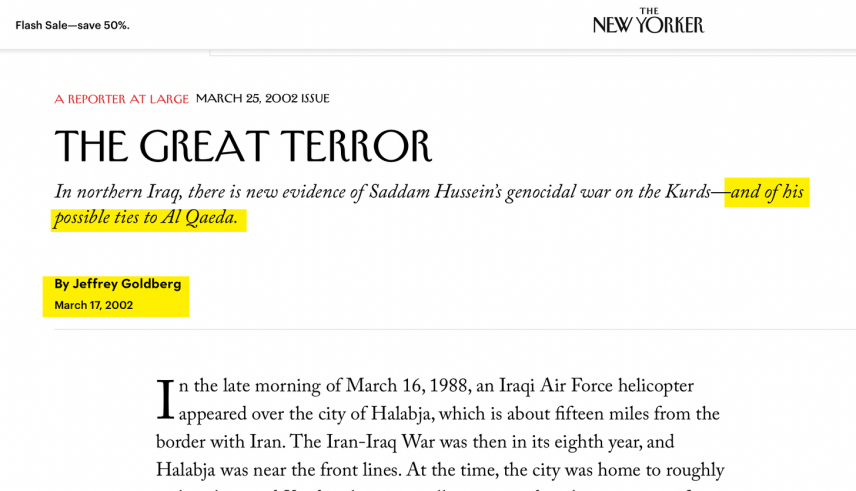
Goldberg’s fabrication-driven article generated ample celebratory media attention and even prestigious journalism awards. It also led to great financial reward and career advancement. In 2007, The Atlantic‘s publisher David Bradley lured Goldberg away from The New Yorker by lavishing him with a huge signing bonus and even sent exotic horses to entertain Goldberg’s children. Goldberg is now the editor-in-chief of that magazine and thus one of the most influential figures in media. In other words, the person who wrote what is arguably the most disastrous article of that decade was one most rewarded by the industry — all because he served the aims of the U.S. security state and its war aims. That is how U.S. corporate journalism functions.
Another illustrative mascot for this lucrative career path is NBC’s national security correspondent Ken Dilanian. In 2014, his own former paper, The Los Angeles Times, acknowledged his “collaborative” relationship with the CIA. During his stint there, he mimicked false claims from John Brennan’s CIA that no innocent people were killed from a 2012 Obama drone strike, only for human rights groups and leaked documents to prove many were.
A FOIA request produced documents published by The Intercept in 2015 that showed Dilanian submitting his “reporting” to the CIA for approval in violation of The LA Times’ own ethical guidelines and then repeating what he was told to say. But again, serving the CIA even with false “reporting” and unethical behavior is a career benefit in corporate media, not an impediment, and Dilanian rapidly fell upward after these embarrassing revelations. He first went to Associated Press and then to NBC News, where he broadcast numerous false Russiagate scams including purporting to “independently confirm” CNN’s ultimately retracted bombshell that Donald Trump, Jr. obtained advance access to the 2016 WikiLeaks archive.
On Monday, CNN made clear that this dynamic still drives the corporate media world. The network proudly announced that it had hired Natasha Bertrand away from Politico. In doing so, they added to their stable of former CIA operatives, NSA spies, Pentagon Generals and FBI agents a reporter who has done as much as anyone, if not more so, to advance the scripts of those agencies.
Bertrand’s career began taking off when, while at Business Insider, she abandoned her obsession with Russia’s role in Syria in 2016 in order to monomaniacally fixate on every last conspiracy theory and gossip item that drove the Russiagate fraud during the 2016 campaign and then into the Trump presidency. Each month, Bertrand produced dozens of Russiagate articles for the site that were so unhinged that they made Rachel Maddow look sober, cautious and reliable.
In 2018, it was Jeffrey Goldberg himself — knowing a star CIA propagandist when he sees one — who gave Bertrand her first big break by hiring her away from Business Insider to cover Russiagate for The Atlantic. Shortly after, she joined the Queen of Russiagate conspiracies herself by becoming a national security analyst for MSNBC and NBC News. From there, it was onto Politico and now CNN : the ideal, rapid career climb that is the dream of every liberal security state servant calling themselves a journalist. Her final conspiratorial article for The Atlantic before moving to Politico is the perfect illustration of who and what she is:
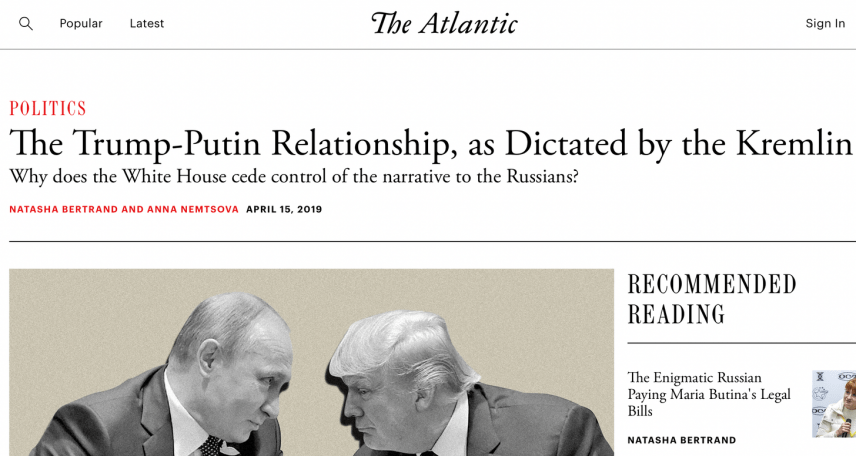
CNN’s new national security star was no ordinary Russiagate fanatic. There was no conspiracy theory too unhinged or evidence-free for her to promote. As The Washington Post‘s media reporter Erik Wemple documented once the Steele Dossier was debunked, there was arguably nobody in media other than Rachel Maddow who promoted and ratified that hoax as aggressively, uncritically and persistently as Bertrand. She defended it even after the Mueller Report corroborated virtually none of its key claims.
In a February, 2020 article headlined “How Politico’s Natasha Bertrand bootstrapped dossier credulity into MSNBC gig,” Wemple described how she was rewarded over and over for “journalism” that would be regarded in any healthy profession with nothing but scorn:
Where there’s a report on Russian meddling, there’s an MSNBC segment waiting to be taped. Last Thursday night, MSNBC host Joy Reid — subbing for “All In” host Chris Hayes — turned to Politico national security reporter Natasha Bertrand with a question about whether Trump “wants” Russian meddling or whether he can’t accept that “foreign help is there.“ Bertrand responded: “We don’t have the reporting that suggests that the president has told aides, for example, that he really wants Russia to interfere because he thinks that it’s going to help him, right?”
No, we don’t have that reporting — though there’s no prohibition against fantasizing about it on national television. Such is the theme of Bertrand’s commentary during previous coverage of Russian interference, specifically the dossier of memos drawn up by former British intelligence officer Christopher Steele. With winks and nods from MSNBC hosts, Bertrand heaped credibility on the dossier — which was published in full by BuzzFeed News in January 2017 — in repeated television appearances.
Wemple systematically reviewed the mountain of speculation, unproven conspiracies and outright falsehoods Bertrand shoveled to the public as she was repeatedly promoted. But it was the document that gave us deranged delusions about pee-pee tape blackmail and Michael Cohen’s trip to Prague that was her crown jewel: “The Bertrand highlight reel features a great deal of thumb-on-scale speculation regarding the dossier,” Wemple wrote.
And when information started being declassified that proved much of Bertrand’s claims about collusion to be a fraud, she complained that there was too much transparency, implying that the Trump administration was harming national security by allowing the public to know too much — namely, allowing the public to see that her reporting was a fraud. A journalist who complains about too much transparency is like a cardiologist who complains that a patient has stopped smoking cigarettes, or like a journalist who voluntarily rats out her own source to the FBI or who agitates for censorship of political speech: a walking negation of the professional values they are supposed to uphold. But that is Natasha Bertrand, and, to the extent that there are some people who still believe that working at CNN is desirable, she was just rewarded for it again yesterday — just as journalists who rat out their own sources to the FBI and advocate for internet censorship are now celebrated in today’s rotted media climate.
Bertrand’s trail of journalistic scandals and recklessness extend well beyond her Russiagate conspiracies. Last October, she published an article in Politico strongly implying that Director of National Intelligence John Ratcliffe was speaking without authorization or any evidence when he said Iran was attempting to undermine President Trump’s 2020 presidential campaign. But last month, the Biden administration declassified an intelligence report which said they had “high confidence” that Iran had done exactly what Ratcliffe alleged: namely, run an influence campaign to hurt Trump’s candidacy. A former national security official, Cliff Sims, said upon hearing of CNN’s hiring that he explicitly warned Bertrand’s editors that the story was false but they chose to publish it anyway.
It was also Bertrand who most effectively laundered the extremely significant CIA lie in October, 2020 that the documents obtained by The New York Post about the Biden family’s business dealings in China and Ukraine were “Russian disinformation.” Even though the John-Brennan-led former intelligence officials admitted from the start that they had no evidence for this claim, Bertrand not only amplified it but vouched for its credibility by writing that the Post‘s reporting “has drawn comparisons to 2016, when Russian hackers dumped troves of emails from Democrats onto the internet — producing few damaging revelations but fueling accusations of corruption by Trump” (that those 2016 DNC and Podesta documents produced “few damaging revelations” would come as a big surprise to the five DNC operatives, led by Chairwoman Debbie Wasserman-Schultz, who were forced to resign when their pro-Hillary cheating was revealed).
It was this Politico article by Bertrand that was then used by Facebook and Twitter to justify their joint censorship of the Post‘s reporting in the weeks before the 2020 election, and numerous media outlets — including The Intercept — gullibly told their readers to ignore the revelations on the ground that these authentic documents were “Russian disinformation.” Yet once it did its job of helping defeat Trump, that claim was debunked when even the intelligence community acknowledged it had no evidence of Russian involvement in the appearance of these materials, and Hunter Biden himself admitted he was the subject of a federal investigation for the transactions revealed by those documents.
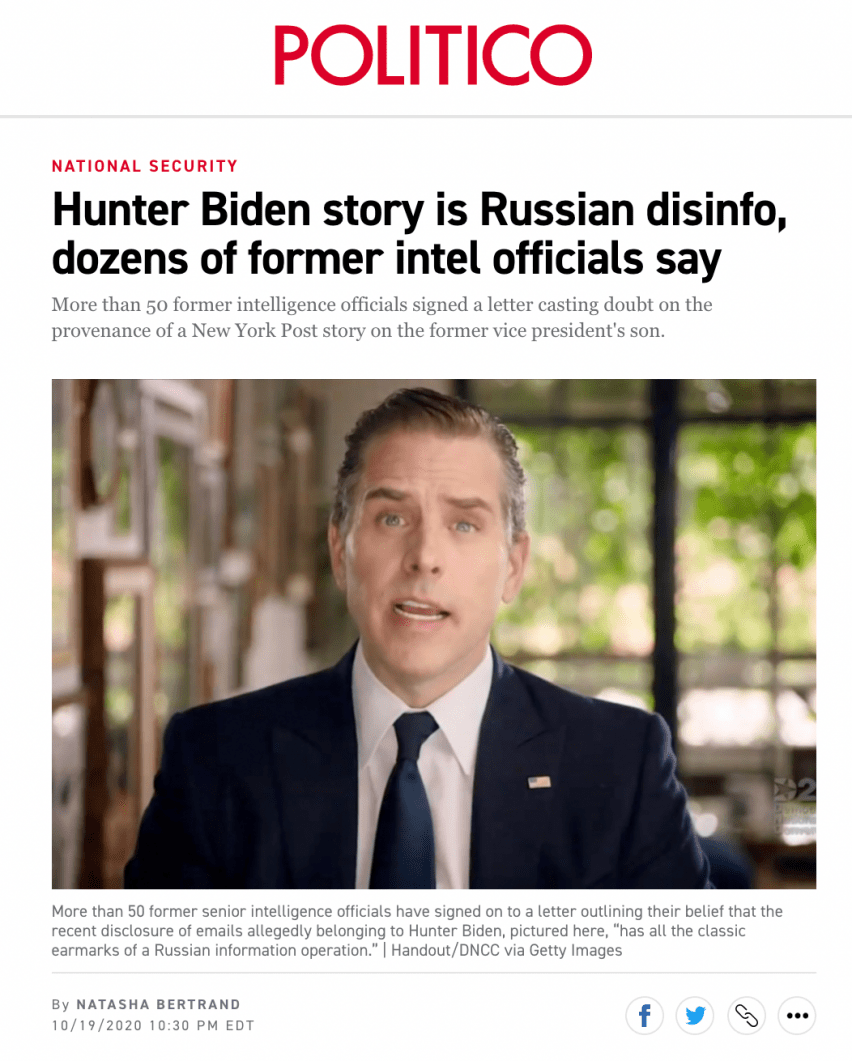
Politico, Oct. 19, 2020
But even when her fantasies and conspiracies are debunked, Bertrand — like a good intelligence soldier — never cedes any ground in her propaganda campaigns. She was, needless to say, one of the journalists who most vocally promoted the CIA’s story — published as Trump was announcing his plans to withdraw from Afghanistan — that Russia had paid bounties to the Taliban for the death of U.S. soldiers. Yet even when the U.S. intelligence community under Joe Biden admitted last week that it has only “low to moderate” confidence that this even happened — with the NSA and other surveillance agencies saying it could find no evidence to corroborate the CIA’s story — she continued to insist that nothing had changed with the story, denying last week on a Mediaite podcast that anything had happened to cast doubt on the original story: “I think it’s much more nuanced than it being a walk-back. I don’t think that’s right actually.”
Even a cursory review of Bertrand’s prolific output reveals an endless array of gossip, conspiracy and speculative assertions masquerading as journalism. The commentator Luke Thomas detailed many of these transgressions on Monday and correctly observed that “arguably no single reporter has contributed more to the deranged and paranoid national security fantasies of the center-left than Natasha Bertrand. She’s an embarrassment to her profession and will, therefore, fit right in at CNN.”
As Thomas noted, beyond all of Bertrand’s well-documented and consequential propaganda, “she sees conspiracies and perfidiousness around every corner,” pointing to this demented yet highly viral tweet that deciphered comments from former Sen. Orrin Hatch (R-UT) as inadvertently revealing some secret scheme to expand Trump’s pardon powers. That scheme, like most of her speculative predictions, never materialized.
Then there is her garden-variety ethical scandal. In January, freelancer Dean Sterling Jones accused Bertrand of stealing his work without credit or payment. In a post he published, Jones documented how he emailed Bertrand a draft with reporting he had been working on, and in response she agreed to report it jointly with him on a co-byline. Yet two weeks later, the article appeared in The Atlantic with Bertrand as the only named reporter. Only after Jones complained did they insert a sentence into the story begrudgingly citing him as a source. “By my count,” Jones wrote, “Bertrand’s article contains at least six unequivocal examples of direct copying and revisions of my work.” When he published his post detailing his accusations, Bertrand arrogantly refused even to provide comment to the freelancer whose work she pilfered.
Natasha Bertrand has spent the last five years working as a spokesperson for the alliance composed of the CIA and the Democratic Party, spreading every unvetted and unproven conspiracy theory about Russiagate that they fed her. The more loyally she performed that propagandistic function, the more rapidly she was promoted and rewarded. Now she arrives at her latest destination: CNN, not only Russiagate Central along with MSNBC but also the home to countless ex-operatives of the security state agencies on whose behalf Bertrand speaks.
Once again we see the two key truths of modern corporate journalism in the U.S. First, we have the Jeffrey Goldberg Principle: you can never go wrong, but only right, by disseminating lies and propaganda from the CIA. Second, the organs that spread the most disinformation and crave disinformation agents as their employees are the very same ones who demand censorship of the internet in the name of stopping disinformation.
I’ve long said that if you want to understand how to thrive in this part of the media world, you should study the career advancement of Jeffrey Goldberg, propelled by one reckless act after the next. But now the sequel to the Goldberg Rise is the thriving career of this new CNN reporter whose value as a CIA propagandist Goldberg, notably, was the first to spot and reward.
HOW TO WRITE A BAD ARTICLE ABOUT RUSSIA
By Paul Robinson | IRRUSSIANALITY | April 26, 2021
Several press articles I’ve seen in the past few days have annoyed me rather, but I think that they are useful as examples of how reporting on Russia is distorted. For they demonstrate the methods used by journalists to paint a picture of the world that is far from accurate.
The articles in question come from those bastions of balanced reporting, The New York Times and The Guardian. The first is from Sunday’s edition of the NYT, with the title ‘The Arms Dealer in the Crosshairs of Russia’s Elite Assassination Squad’. This discusses Bulgarian arms dealer Emilian Gebrev, whose weapons were destroyed in an explosion in the Czech Republic in 2014, allegedly by Russian secret agents.
The second article is also from the NYT. This one has the title ‘After Testing the World’s Limits, Putin Steps Back From the Brink,’ and analyzes what author Anton Troianovski calls Russia’s ‘escalatory approach to foreign policy’, as seen by the Russian military build up near the Ukrainian border.
The third and final piece is from The Guardian, and is about last week’s protests in support of jailed oppositionist Alexei Navalny. This is somewhat schizophrenic, on the one hand saying that the pro-Navalny movement is in trouble, but on the other hand portraying the protests as a relative success and ending on a confident note that however grim things look for the opposition now, this can change at any moment.
Anyway, as one reads these articles one notices certain techniques that are used to paint a distorted picture of reality. So if you want to be a journalist, here’s what the articles teach that you should do:
1. Make stuff up. In the Guardian article, authors Andrew Roth and Luke Harding (yes, he!) begin by telling readers that ‘The future looked unspeakably grim for Alexey Navalny’s supporters before this week’s protests’. But it then lifts our spirits with the following:
What followed was surprisingly normal: a core of tens of thousands of Navalny supporters rallied near the Kremlin, waving mobile phone torches and chanting “Putin is a thief!” The police stood back in Moscow (there was a violent crackdown in St Petersburg). For an evening, the crowd roved the streets of the capital at will.
“This feeling of enthusiasm, of overcoming fear, the protest ended on a positive note … It left me with the feeling that nothing is lost, it’s still not the final battle, and that street protests in Russia are not over forever,” said Ivan Zhdanov, the head of Navalny’s Anti-Corruption Foundation, in an interview from Europe.
Ah yes, the protests were a huge success, euphoric. There were ‘tens of thousands of Navalny supporters rallied near the Kremlin.’
Except that most reporters said that there was nothing of the sort, and that the turnout was far below expectations.
Estimates of the size of the protest crowd vary, but the Russian Interior Ministry reckoned the numbers as 14,000 across the entire country and only 6,000 in Moscow. Interior Ministry counts tend to be on the low size, so you can treat them with a pinch of salt, but Russian media outlets were claiming a crowd in Moscow of 10,000 to 15,000, , while Western journalists’ estimates were in the same ballpark. Max Seddon of the Financial Times, for instance, reckoned the number at about 10,000 and commented that it was much lower than in the last protests in January. So ‘tens of thousands’ as The Guardian claims? Apparently not.
The Guardian isn’t alone in providing misleading data. In its article about the Bulgarian arms dealer, The New York Times has the following to say:
After pro-democracy protestors toppled the Kremlin’s puppet government there [i.e. Ukraine], Russia special forces units wearing unmarked uniforms seized and annexed the Crimean peninsula and also instigated a separatist uprising that is still going on in the east.
Let’s unravel this a bit: Were the demonstrators in Kiev really ‘pro-democracy’? Debatable, though not provably 100% false. But definitely untrue is the idea that the Ukrainian government that was toppled in February 2014 was a ‘Russian puppet’. That’s simply false. As for Russian special forces ‘annexing’ Crimea, it’s true in a way, although not the whole story of what happened. But the claim that Russian special forces ‘instigated a separatist uprising’ in Donbass is without foundation. I know of no evidence of ‘Russian special forces’ having been present in Donbass in the early weeks of the uprising there. (Strelkov and his goons were not ‘Russian special forces’, and most analyses of the uprising show how it was overwhelmingly spontaneous and local in origin.)
So, again, making stuff up.
2. Mention that others have ‘reported’, ‘claimed’, or ‘alleged’ something without pointing out that the claim in question is dubious at best, or false at worst.
For example. The NYT piece about Mr Gebrev talks about the alleged Russian spy unit, Unit 29155, and tell us that:
Last year, the Times revealed a CIA assessment that officers from the unit may have carried out a secret operation to pay bounties to a network of criminal militants in Afghanistan in exchange for attacks on US and coalition troops.
This is superficially true in that the Times did reveal this assessment. But what it doesn’t tell you is that the US government only has low to medium confidence that the claim is true. That’s kind of important, don’t you think? Shouldn’t it be mentioned? By failing to do so, the Times makes out that something is true that probably isn’t.
It’s not the only example. Talking of Ukraine a little later, the same article tells us that after war broke out in Donbass,
Russian assassins fanned out across the country, killing senior Ukrainian military and intelligence officials who were central to the war effort, according to Ukrainian officials.
They did, did they? Well, maybe ‘according to Ukrainian officials’ they did. But I have to say that it’s the first I’ve ever heard of it, and if it were true wouldn’t there have been news of lots of dead Ukrainian military and intelligence officers? Given that there wasn’t any such news, why repeat the claim? Shouldn’t the Times at least check it first.
3. Cite only sources that back up the narrative you are trying to tell. Ignore alternative viewpoints.
This kind of follows on from the last. If you are writing about Ukraine, cite ‘Ukrainian officials’. But don’t cite rebel spokesmen. If you’re talking about Russia, cite oppositionists. Ignore pro-government analysts.
We can see this in the Guardian piece. This quotes a couple of members of Navalny’s team, a British professor, a pro-Navalny Russia high schooler, and then to finish off some completely random former advisor to one-time British foreign minister Robin Cook, whose connection to, and knowledge of, Russia is completely unexplained. The only reason for giving him the final word seems to be that he came up with some nice lines about how opposition movements can suddenly triumph even when they seem to be losing. Needless to say, dissenting viewpoints are nowhere to be heard in the article.
The NYT piece about Russia stepping ‘back from the brink’ is similarly loaded with carefully chosen sources. First up is the ever-present Gleb Pavlovsky, a one-time advisor to Vladimir Putin turned oppositionist, who seems to be the eternal go-to person for anti-Putin quotes. After him, the article gives us a quote from Navalny’s assistant Leonid Volkov, a statement from Ukrainian National Security Advisor Oleksiy Danilov, and a few words from the generally pretty anti-Putin Estonian analyst Kadri Liik. For a pretence of balance we also get a statement by Kremlin spokesman Dmitry Peskov and the opinion of Konstantin Remchukov, editor of Nezavisimaia Gazeta, a newspaper whose political stance isn’t 100% clear to me but strikes me as sort-of oppositional, sort of not (given that Remchukov ran the re-election campaign of Moscow mayor Sergei Sobyanin). All in all, the anti-government voices get the bulk of the space.
So there you have it. Make some stuff up. Reference ‘claims’ and ‘allegations’ without pointing out that they are unsubstantiated or even false. And throw in lots of quotes from pundits who support the chosen narrative. Easy as pie. A career as a journalist awaits you. Just don’t bother trying to be accurate. Understood?
The “Russian Threat”
By Paul Craig Roberts | Institute for Political Economy | April 25, 2021
During 2016 CIA director John Brennan and FBI director James Comey, together with the corrupt Democrat party, began orchestrating Russiagate in order to prevent Trump from reducing the risk of nuclear war by normalizing relations with Russia. President Trump tried to nip a New Cold War in the bud, but that was not in the interest of the power and profit of the military/security complex which desperately needs the “Russian threat” as its raison d’etre.
Stephen Cohen, myself and a few others expressed concern that the tensions between the two nuclear powers were being driven to more dangerous highs than ever existed during the 20th century Cold War. Many websites joined in debunking the orchestrated Russiagate fabrication.
To discredit these voices, a new website, PropOrNot, suddenly appeared with a list of 200 “Russian agents/dupes.” Those of us who had raised red flags about Russiagate and the worsening of tensions were on the list. The Washington Post gave the accusation credibility by reporting the PropOrNot accusation that those who dissented from a hostile policy toward Russia were “Putin agents.”

A number of the falsely accused websites were intimidated and abandoned the truth. CounterPunch went even further. It dropped its best and most incisive writers—people such as Mike Whitney and Diana Johnstone. CounterPunch, which had once collected, published, and marketed a collection of my essays as a book, suddenly discovered that it preferred fiction over fact. Other websites that had religiously reproduced all of my columns now became selective about which parts of the official narrative they would permit to be examined on their sites. This was, perhaps, the beginning of the movement to de-platform all who challenge the narrative.
The threat to truth-tellers has now been elevated by election thief Joe Biden’s latest Executive Order declaring a “national emergency” to “deal with the Russian threat.” Pepe Escobar reports that Biden’s order opens every American to being accused of being a Russian agent engaged in undermining US security. “A sub-paragraph (C), detailing ‘actions or policies that undermine democratic processes or institutions in the United States or abroad,’ is vague enough to be used to eliminate any journalism that supports Russia’s positions in international affairs.”
“Supports Russia’s position” includes an objective description and non-partisan analysis of Russian policy. The crucial point is that, in effect, Biden’s executive order places everyone reporting objectively on Russia’s political positions as a potential threat to the United States.
If we are honest, we will acknowledge that we have undergone the complete collapse of the United States. Truth is prohibited in the media, school systems, and universities if it conflicts with the elite agendas served by the official narratives. The First Amendment is dead and buried. Free speech is reserved for the official narratives, such as “systemic racism” and “Russian threat.” Those who exercise their Constitutional right find themselves de-platformed or fired.
To understand how the victory of propaganda over truth elevates the likelihood of nuclear Armageddon, consider the difference between the 20th century and 21st century cold wars.
In the original Cold War both Soviet and American leaders worked to defuse tensions. Agreements were made on arms control and the anti-ballistic missile treaty. There were regular meetings or summits between American and Soviet leaders. Diplomatic decorum was maintained. There were agreements that permitted each side to inspect the other’s compliance.
This process began with President John F. Kennedy and Soviet First Secretary Khrushchev. It continued through President Reagan and, more or less, President George H. W. Bush. It ended with the Clinton regime and has been downhill ever since. President Trump intended to reduce the dangerous tensions, but was not permitted. Indeed, his intent was sufficient cause for the Establishment to drive him from office. 2020 was a coup, not an election.
In the 20th century Cold War Russian experts differed in their assessments of the threat, and their differences were publicly aired. Differing assessments were debated. Dissenters were not demonized as Russian agents. Today American Russian experts find that being Russophobic is a career boost. In the 20th century the New York Times and Washington Post were aligned with peace efforts. Today they are part of the neoconservative warmongers’ propaganda ministry.
The alarming conclusion is that since the Clinton regime, the US government has worked consistently to worsen relations with Russia even to the extent of publicly demonizing the Russian president and strangling objective debate in the US. This is the perfect foundation for war.
All the while insouciant Americans elected governments that successively raised the likelihood of nuclear annihiliation while shutting down dissident concerns. As I reported on March 17, “In the United States Russian Studies has degenerated into propaganda. Recently, two members of the Atlantic Council think tank, Emma Ashford and Matthew Burrows, suggested that American foreign policy could benefit from a less hostile approach to Russia. Instantly, 22 members of the think tank denounced the article by Ashford and Burrows.”
Today even in Republican and conservative circles to question Putin’s demonization raises disapproving eyebrows (the same for China and Iran). The US Establishment has succeeded in labeling objective analysis as “pro-Russian” (or pro-Chinese or pro-Iranian). This means that an objective view of US/Russian relations is off-limits to US policymakers.
The “Russian threat” is another hoax, one that will destroy the world.
Featured Video

The Truth About the Trump Shootings with Ken Silva
or go to
Aletho News Archives – Video-Images
From the Archives
The Geopolitics behind the War in Yemen (I)
By Mahdi Darius NAZEMROAYA | Strategic Culture Foundation | 30.03.2015
The United States and the Kingdom of Saudi Arabia became very uneasy when the Yemenese or Yemenite movement of the Houthi or Ansarallah (meaning the supporters of God in Arabic) gained control of Yemen’s capital, Sanaa/Sana, in September 2014. The US-supported Yemenite President Abd-Rabbuh Manṣour Al-Hadi was humiliatingly forced to share power with the Houthis and the coalition of northern Yemenese tribes that had helped them enter Sana. Al-Hadi declared that negotiations for a Yemeni national unity government would take place and his allies the US and Saudi Arabia tried to use a new national dialogue and mediated talks to co-opt and pacify the Houthis.
The truth has been turned on its head about the war in Yemen. The war and ousting of President Abd-Rabbuh Manṣour Al-Hadi in Yemen are not the results of «Houthi coup» in Yemen. It is the opposite. Al-Hadi was ousted, because with Saudi and US support he tried to backtrack on the power sharing agreements he had made and return Yemen to authoritarian rule. The ousting of President Al-Hadi by the Houthis and their political allies was an unexpected reaction to the takeover Al-Hadi was planning with Washington and the House of Saudi. … continue
Blog Roll
 Aletho News
- IRGC air defenses destroy another US MQ-1 drone over Strait of Hormuz
- Imran Khan’s entire immediate family detained in Pakistan ahead of mass protest demanding his release
- EU nation detains former presidential frontrunner
- Leaked: Britain’s Sham Conviction Of Hashim Thaci
- Seyed M. Marandi: U.S. Strike Imminent – Toward Total War in the Middle East
- Russia Voted Under Fire. Washington Is Loading the Tankers.
- 12 Things Your Oncologist Was Trained Not to Tell You
- Anthrax Attacks Paved Way for COVID-Era ‘Junk Drugs and Vaccines’
- How Real Is the Impact of Western Sanctions on Israel?
- France, You Are Guilty: How Paris Turned Western Sahara into the Maghreb’s Powder Keg
- If Americans Knew
- Israeli president pardons soldier convicted for killing wounded Palestinian
- Singer Ed Sheeran says his ‘heart broken’ by Gaza devastation, addresses Macklemore controversy
- Israel Has Imprisoned Female Journalist Bushra Al-Tawil Without Trial Or Charge In Solitary Confinement For Past Month
- Israel poised to teach West Bank a lesson after one Israeli killed – Daily Update
- Salah Sarsour’s Legal Team Says DHS Has Not Met Its Burden to Prove He Is Deportable
- An analysis of tax forms by The Intercept show Kraft’s charity and LLC have donated to Friends of the IDF and AIPAC’s super PAC.
- Israeli attacks kill four Palestinians in Gaza – Daily Update
- Inside Gaza’s death trap of collapsing, bombed-out buildings
- The everyday items Israel bans from Gaza every day
- Inside the siege, the ruined buildings of Gaza – Daily Update
- No Tricks Zone
- 2025 Nature Paper Claiming Worsening Global Drought Gets RETRACTED …Heavily Flawed
- New Study: ‘Global Drought Shows No Detectable Recent Acceleration Under Climate Warming’
- Economic Masterminds: German Socialists Suggest Taxing Productivity Gains Stemming From Using AI
- The South China Sea Has Not Been Cooperating With The Climate Change Narrative
- Energy Crisis: Germany Enters Heating Season With Historically Low Gas Reserve Fill Levels
- New Study: The Antarctic Ice Sheet Gained Mass From 2020-2024 Due To Staggering Snow And Ice Accumulation
- Study: Ocean Heating Rates From Thousands Of Years Ago ‘Dwarf’ Modern Ocean Heating Rates
- Climate Extremists Target, Attack Large-Scale Power Grid Infrastructure In Germany!
- New Study: Antarctic Ice Melt Has Contributed Less Than 1 Centimeter To Sea Level Rise In The Last 30 Years
- Fear Of Debate: Alarmist German Climate Scientist Calls On Mainstream Media To Discredit Skeptic Voices
 Aletho News