Czech President: Vrbetice Blast Could Be Accident, Russians Never Emerged in Reports in Six Years
By Tim Korso – Sputnik – 25.04.2021
Czech President Milos Zeman has cautioned against jumping to conclusions when it comes to the cause of the explosion at the ammunition warehouse near Vrbetice in 2014 and called for waiting until an official probe into the matter is concluded. He stressed that the investigation is still ongoing and that an accident still can’t be ruled out.
The president, in an extraordinary address to the nation on 25 April, further stated that counterintelligence reports, even those not available to the public, have over the last six years never mentioned anything about two Russian military intelligence (GRU) agents possibly being responsible for the explosion in Vrbetice. He added that reports from the country’s Security Information Service never mentioned that two alleged GRU agents, whom the Czech government recently blamed for the blast, had ever visited the warehouse at Vrbetice.
Zeman noted that he treats both versions – an accident and an operation by foreign agents – seriously and said that both have to be thoroughly investigated. The president added that the recent events could be a “game” involving special services that may have serious repercussions for the Czech Republic.
Diplomatic Spat Between Prague and Moscow Over Vrbetice Blast
Zeman’s bombshell statements come a week after the Czech government accused Russia of being behind the explosion at the Vrbetice ammunition warehouse. Prague also claimed that the explosion was organised by two alleged GRU agents named Alexander Petrov and Ruslan Boshirov.
The two were previously accused by British authorities of carrying out an alleged attack involving a toxic agent against former GRU agent Sergei Skripal, but they strongly denied being GRU agents themselves or being involved in any way in Skripal’s poisoning.
Following the Czech government’s accusations on 17 April, Prague expelled 18 Russian diplomats and removed the Russian state company Rosatom from the list of contenders for building a new reactor at the Dukovany Nuclear Power Plant.
Moscow has strongly denied Prague’s accusations and linked the Czech Republic’s actions to a new wave of anti-Russian hysteria initiated and led by the US. Russia responded to the expulsion of its diplomats reciprocally, sending away 20 Czech diplomats. Prague may also fall under the conditions of a recently announced law banning the embassies of “unfriendly” countries from hiring Russian citizens.
Russian Media Watchdog Demands That Google Remove Restrictions on RT’s YouTube Channel
Sputnik – 24.04.2021
MOSCOW – Russia’s Service for Supervision of Communications, Information Technology and Mass Media (Roskomnadzor) on Saturday demanded that Google lift restrictions on the English-language YouTube channel of the RT broadcaster.
“Roskomnadzor sent a letter to the leadership of Google LLC demanding that all restrictions be lifted from the RT YouTube Channel as soon as possible”, the statement said.
YouTube previously made a number of videos on RT’s English YouTube channel inaccessible to viewers, and also restricted the channel’s ability to make live broadcasts, citing alleged COVID-19 disinformation.
According to Roskomnadzor, such actions by YouTube’s administration violate the key principles of free distribution of information and constitute an act of censorship against the Russian media outlet.
The watchdog has repeatedly pointed to restrictions that YouTube imposes on access to certain Russian video content. Last autumn, the watchdog sent several letters to Google, demanding that it stop censoring videos published by Russian media, including a documentary about the 2004 Beslan tragedy.
How the US is Creating Trouble Around Russia
By Salman Rafi Sheikh – New Eastern Outlook – 21.04.2021
When the US president Joe Biden delivered his first major foreign policy speech in February, he signalled America’s return to an interventionist and confrontationist policy design, one that thrives on creating troubles for its competitors. Accordingly, whereas we see the US continues to blame the Chinese authorities for carrying out a “genocide” in Xinjiang – which is a major logistical base for China’s various Belt & Road Initiative (BRI) project – it has equally started creating trouble in Ukraine to force Russia into a crisis situation, hoping that such a situation would make Russia submit to the US ambitions to re-establish its lost unilateral global domination. The recent most sanctions imposed on Russia indicate the current trends in unmistakable terms. However, the way the US is soaking Ukraine up with anti-Russian policies speaks volumes about the way the US is creating conditions of a war and use the scenario to extend NATO’s outreach.
On March 1, the Pentagon announced a $125 million military aid package for Ukraine, the first of its kind under the Biden administration. A Pentagon statement said that the package included “capabilities to enhance the lethality, command and control, and situational awareness of Ukraine’s forces through the provision of additional counter-artillery radars and tactical equipment; continued support for a satellite imagery and analysis capability; and equipment to support military medical treatment and combat evacuation procedures.” This aid is apart from US$150 million in fiscal year 2021 Ukraine Security Assistance Initiative funding appropriated by the US Congress. Ever since 2014, this has become a trademark method that Washington has been following to encourage Kiev to be belligerent towards Russia.
In his April 13 call with Russia’s Vladimir Putin, Joe Biden affirmed the US’
“unwavering commitment to Ukraine’s sovereignty and territorial integrity. The President voiced our concerns over the sudden Russian military build-up in occupied Crimea and on Ukraine’s borders, and called on Russia to de-escalate tensions.”
On April 4, the Operational Command East with the Armed Forces of Ukraine (AFU) provocatively announced that it will hold joint military exercises known as “Exercise Cossack Mace” with NATO forces later this year. While this would not be the first time the Ukrainian forces would hold such military exercises, there is a marked difference this time around that reflects the current geo-political scenario.
As such, whereas usual Ukraine-NATO drills are announced with clarifying statements that they are purely “defensive” operations, the AFU’s recent statement differed in that it made clear that it would simulate an offensive attack against not only “separatist-controlled Donbass” but Russian forces as well.
When seen in combination with the way Ukraine is aiming to reclaim Crimea, the nature of this build up as a form of direct territorial assault becomes evident. In March 2021, Ukrainian Foreign Minister Dmytro Kuleba tweeted, “[The Ukrainian government] has approved the Strategy for Deoccupation & Reintegration of Crimea, a historic document needed since 2014. The signal is crystal clear: we don’t just call on the world to help us return Crimea, Ukraine makes own dedicated & systemic efforts.”
As such, whereas Russia, too, has started its own military build-up on the Ukrainian border, this build-up did not happen until Ukrainian government officially declared their intent to reclaim Crimea at all costs.
The reason why the US is building up trouble around Russia looking to force the latter in an unnecessary war is, as mentioned above, to recreate a unilateral world order.
Russian Foreign Ministry Spokeswoman Maria Zakharova was sharp and pinpoint when she said that,
“The United States is not ready to accept the objective reality of a multipolar world in which American hegemony is not possible. It is placing its bets on sanctions pressure and interference in our domestic affairs. This aggressive conduct will certainly meet with resolute resistance. There will inevitably be a response to the sanctions. Washington must realise that it will have to pay for the degradation of bilateral relations. Responsibility for what is happening fully rests with the United States.”
For many in the US, Biden’s entry in the White House was always meant to restore the global balance of power to the US’ advantage. Many companies and groups lobbying for Biden saw his presidency as “negative for Moscow”, likely to lead to a further deterioration of bilateral relations, both in terms of rhetoric and substance.
For the Ukrainian leadership, too, the arrival of Joe Biden has created an opportunity to reclaim Ukraine. As such, while current Ukrainian President Volodymyr Zelensky was previously ambiguous on his stance towards NATO during his election campaign in 2019—proclaiming his support for EU membership while saying little about the Western military alliance—he now regularly begs for his country’s full inclusion in NATO. At the same time, Zelensky administration has step-by-step ramped up anti-Russian hysteria by sanctioning pro-Russian opposition leaders and by shutting down media outlets too.
As such, in this context, Joe Biden’s call for “diplomacy” to de-escalate the situation is unlikely to lead to any meaningful positive development not only because the Joe Biden administration is following an explicit agenda to recreate US hegemony, but also because Russia remains strongly opposed to any US attempts to dictate Russia from a position of strength.
Salman Rafi Sheikh is a research-analyst of International Relations and Pakistan’s foreign and domestic affairs.
Zero mainstream coverage today of the foiled, U.S. backed plot to assassinate Belarus president Lukashenko
By Gilbert Doctorow | April 19, 2021
In his last book “War with Russia?” my friend and colleague Steve Cohen wrote about the flagrant censorship of news being carried on by The New York Times in support of its Russia-bashing editorial policies. Said Cohen, the newspaper’s century old slogan of “All the News That’s Fit to Print” has been turned into “All the News that Fits” when it comes to coverage of Russia.
But the problem goes far deeper than the professional malpractice of one leading newspaper in America. The censorship of news carried by mainstream media by U.S. authorities covers not only the domestic press but also the mainstream of Allied countries. News blackouts are imposed when something ugly arises implicating the United States in violation of international norms of state behavior for which the State Department has no ready explanation or white wash.
This very situation seems to have arisen over the weekend, when news broke in Moscow over the arrest of two conspirators plotting a coup d’état in Minsk, to be carried out by the Belarus armed forces tentatively during the 9 May parade celebrating victory over fascist Germany in the Second World War.
Other leading English-speaking papers such as The Guardian and The Financial Times have front page reports on Alexei Navalny’s near death condition in a prison camp but not a word about Belarus. Ditto the Frankfurter Allgemeine and Le Figaro. Curious, n’est-ce pas? Warum? Let’s look into the story in its full dimension.
Last night’s News of the Week program hosted by Dimitry Kiselyov, Russia’s top manager of state news programming, began with a 20 minute report on the extraordinary arrest of two conspirators plotting armed rebellion entailing the murder of Lukashenko and his family, abolition of the post of President, installation of a Committee of Concord such as previously had been headed by the opposition leader Svetlana Tikhanovskaya.
But these were not empty allegations. The arrests followed on a meeting by the two conspirators with Belarus military officers held in a downtown Moscow restaurant which was filmed from start to finish by the Russian state security agency, the FSB. Lengthy segments of recordings from their meeting and discussion of their treasonous plans were aired on the Kiselyov program. Moreover, the accused are not some unknown pawns such as the British presented to the world press when they released their accusations against Russia over the Skripal poisoning. No, one of the two arrested was the former press secretary of Lukashenko, a person who would have had all the contacts necessary to organize such a rebellion. The other plotter has dual US-Belarus citizenship and was well known as a fighter against Lukashenko’s rule.
The two were turned over to the Belarus KGB for interrogation in Minsk. Surely further information about the links of the plotters to Ukraine, to Poland and to the United States will come out in the next few days.
What we have here is “very likely” (to use current Anglo-American political jargon) involvement of the United States in yet another regime change operation. The revolution from below in Belarus led by Tikhanovskaya with support from Poland and Lithuania failed. The anti-Lukashenko street demonstrations led to nothing. And now Plan B, a putsch from above, was being organized to achieve the objective of removing Lukashenko both politically and physically. We have not seen such openly murderous plans with “likely” U.S. backing since John Kennedy’s days when the assassination of Fidel Castro was the hot game in D.C.
On the same “very likely” logic, I permit myself to take this all back to the door of the U.S. Under Secretary of State for Policy designate Victoria Nuland. The links to Warsaw and Kiev that appear present are all in line with what she was doing to precipitate the Maidan in 2013 and violent overthrow of the sitting President in Kiev amidst attempts to murder him as he made his escape to Russian territory in February 2014.
From all of the foregoing, it looks as though U.S. Secretary of State Anthony Blinken’s pledge several weeks ago that the US would no longer pursue “orange revolutions” was either an out and out lie or made without his knowing that control of foreign policy no longer is in his hands, but is being carried out by his nominal subordinate, Mme Nuland. No wonder that the U.S. has ordered “stop the presses” on this story until it can put together some plausible response.
In the meantime, the same news program delivered the Kremlin’s response to the Czech action over the weekend to expel 18 diplomats from the Russian embassy in Prague over allegations that Russia was involved in blowing up an arms depot near the capital back in 2014, an event which previously the Czech authorities had blamed on the owners-managers of the depot. Per the Kremlin, these new and absurd Czech charges of Russia’s nefarious activities were agreed with Washington to direct attention away from the pending story about U.S. involvement in plans to murder the Belarus head of state.
Are we headed to World War III? If the war machinery today were like what existed in August 1914, the answer would be unquestionably yes. It is our good fortune that until someone on either side of the East-West divide pushes the Red Button, there are ways back from the abyss. However, we are still heading in the wrong direction, towards the abyss, and the United States is the prime mover.
©Gilbert Doctorow, 2021
NYT ‘bounties’ non-story shows US/UK media has got so used to blaming Russia, it’s now doing it out of habit
By Paul Robinson | RT | April 20, 2021
As holes predictably appear in claims that Russia paid the Taliban to kill American soldiers, questions arise as to why such erroneous stories keep appearing in the American press. Domestic US politics provide part of the answer.
“A Powerful Russian Weapon: The Spread of False Stories.” So ran a headline in the New York Times in August 2016. If it were only a Russian phenomenon, the world would be a much better place. Alas, the Times is far from immune from spreading “false stories” itself. From Walter Duranty’s reporting from the Soviet Union, through Judith Miller’s articles on Iraqi weapons of mass destruction, up to its coverage of accusations that US President Donald Trump had colluded with the Russian government, The New York Times has had its fair share of “fake news” experiences.
“A little tiny bit flat footed,” was how the Times executive editor Dean Baquet described the newspaper when the Mueller investigation failed to find Trump guilty of collusion. “I mean, that’s what happens when a story looks a certain way for two years. Right?” added Baquet.
You have to feel a bit for him. He really believed in collusion. In his eyes, it did “look a certain way.” It was rather embarrassing when he turned out to be completely wrong.
The New York Times’ iffy relationship with reality is back in the news today. US presidential spokesperson Jen Psaki admitted that the US intelligence community was not at all convinced by accusations first aired in the Times that the Russian government had paid bounties to the Taliban in Afghanistan to kill American soldiers. Rather, it had only “low to moderate confidence” that the story was true. Psaki explained:
“The reason that they have low to moderate confidence in this judgment is in part because it relies on detainee reporting, and due to the challenging environment and also due to the challenging operating environment in Afghanistan. So it’s challenging to gather this intelligence and this data.”
The accusation against Russia appeared in The New York Times in June last year. The Times then followed up with additional stories on the same topic. “Afghan Contractor Handed Out Russian Cash to Kill Americans, Official Say,”claimed the headline of a second article. “How Russia Built a Channel to the Taliban, Once an Enemy,” read the headline of a third.
Commentators soon pointed out problems. While the CIA had moderate faith in the claim, the National Security Agency didn’t. In any case, the primary sources of information were Afghan prisoners who hadn’t themselves been involved in the alleged transaction. Their claims needed to be treated with a fair degree of caution.
Others pointed out that the story didn’t make any sense from a Russian point of view. The Russian government values the stability of Afghanistan, and had consistently supported both the Afghan government and the US military presence there. There was no obvious motive for killing Americans.
Furthermore, it’s not as if the Taliban needed to be incentivised to fight America. They were already killing as many Americans as they were able to. Paying them to do what they were doing already would have been odd, to say the least.
Now, Ms. Psaki admits what people have long since suspected: that the accusation against Russia is not well-founded. But anyone with any sense realized that from the get-go. Why, then, did The New York Times report it?
The Times’ explanation is that the story was true. It didn’t say that the accusation was accurate; it merely reported the accusation. In an article on Thursday, Times reporter Charlie Savage notes that the newspaper had stated that the CIA had only “medium” confidence in the story and the NSA had “low” confidence. It had also reported that the Afghan prisoners who recounted the story hadn’t actually been present when the alleged meetings with Russians took place. In other words, The New York Times’ reporting was accurate.
Maybe so, but that begs a question – why report a story that makes an extremely explosive allegation if you’re not at all confident that the accusation is true? Isn’t there some responsibility to hold off from repeating libelous claims until such time as you can substantiate them?
Apparently not. It seems as if the Times wanted to believe the story. It “looked a certain way,” to use Dean Baquet’s phrase. Which in turn begs another question. Why did it look that way to the Times?
The obvious answer is that it fitted the political needs of the moment. For the real target of the Russian bounty story was never Russia but Trump. Its purpose was to show that the president had in some way betrayed America’s soldiers by continuing to talk to Russia even though he had evidence that the Russians were killing Americans.
The speaker of the House of Representatives, Nancy Pelosi, thus remarked, “The administration’s disturbing silence and inaction endanger the lives of our troops and our coalition partners.”Meanwhile, then presidential candidate and now president, Joe Biden, responded to the story by saying that Trump’s “entire presidency has been a gift to Putin, but this is beyond the pale. It’s a betrayal of the most sacred duty we bear as a nation to protect and equip our troops when we send them into harm’s way. It’s a betrayal of every single American family with a loved one serving in Afghanistan or anywhere overseas.”
Russia, in other words, was merely a pawn in an internal American political struggle. Sadly, though, this is far from an isolated incident. Furthermore, the Democratic Party and its backers in the USA have now become so habituated to spreading dubious stories about Russia that they seem to be unable to stop, even though the original political motivation has vanished. The Russian bounty wasn’t the first “false story” to appear, and it won’t be the last.
Paul Robinson is a professor at the University of Ottawa. He writes about Russian and Soviet history, military history, and military ethics, and is the author of the Irrussianality blog.
WaPo-Style Fake News Russia Bashing
By Stephen Lendman | April 20, 2021
Jeff Bezos-owned Washington Post provides propaganda services for Washington’s intelligence community.
Like other establishment media, the broadsheet is militantly hostile toward nations unwilling to sacrifice their sovereign rights to US interests.
Relentless Putin bashing reflects his model leadership and prominence on the world stage — in stark contrast to pygmy US and other Western counterparts.
According to neocon WaPo editors, UN Charter-breaching Biden regime sanctions on Russia weren’t tough enough.
Imposed for invented reasons as part of longstanding US Russia bashing, WaPo claimed “punches were pulled (sic).”
International investors can still buy Russian bonds unobstructed, the broadsheet complained, adding:
Russian energy and mineral enterprises weren’t sanctioned.
A typical litany of Big Lies followed.
WaPo falsely accused Moscow of paying bounties to kill US forces in Afghanistan — citing no evidence because there is none.
Defying reality, the broadsheet falsely claimed that Russia “sponsored… attacks that seriously injured US officials in Moscow, Havana and China” — again no evidence cited.
Fake news accusations of Russian “aggression” persist — how hegemon USA and its partners operate.
The Russian Federation never attacked or threatened other nations.
Under Putin, the Kremlin prioritizes peace, stability, cooperative relations with other countries, and compliance with international law – worlds apart from how the US and its imperial partners in high crimes operate.
In response to years of US-orchestrated Kiev aggression against Donbass, WaPO falsely accused Moscow of US-led high crimes of war and against humanity.
Calling for more illegal sanctions on Russia, perhaps its editors won’t be satisfied unless US hardliners launch WW III.
Separately, WaPo ignored US war on humanity at home and abroad while falsely accusing Russia of “crush(ing) opposition” elements.
Falsely accusing China of spying on and repressing Uyghur Muslins, WaPo defied reality by claiming Russia operates the same way against targeted individuals.
It lied claiming Putin amassed billions of dollars of hidden wealth.
It lied saying he heaps “extravagances” on political allies.
It lied accusing him of poisoning political nobody Navalny.
It lied claiming he persecutes protesters and activists.
It lied accusing democratic Russia of being authoritarian, calling Putin a dictator.
Compared to low approval ratings for US leaders and Congress, nearly two-thirds of Russians approve of Putin’s leadership.
According to Statista Research on February 25, “65 percent of Russians approved of activities of Russian president Vladimir Putin.”
Biden’s approval rating hovers around 50, almost entirely from undemocratic Dem support.
Mind-manipulated Americans don’t understand how badly they’re harmed by US policymakers until they’re bitten hard on their backsides.
Even then, it takes multiple abusive practices for them to realize that dominant US hardliners are their enemies, not allies.
State-sponsored repression and other forms of abuse are longstanding US practices, notably against its most vulnerable people, as well as against targeted individuals of the wrong race, ethnicity, and/or nationality.
In stark contrast to long ago US/Western abandonment of international law, Russia scrupulously abides by its principles.
On all things related to truth and full-disclosure, the US, its hegemonic partners and press agent media stick exclusively to the fabricated official narrative.
On all things related to nations from from US control, both right wings of its war party target them for regime change — wars by hot and/or other means their favored strategies.
On issues mattering most, the US and its hegemonic partners consistently breach the rule of law, operating by their own rules exclusively.
Instead of straight talk, US-led Western officials and their press agent media feature managed news misinformation and disinformation exclusively — truth and full disclosure nowhere in sight.
Journalists, Learning They Spread a CIA Fraud About Russia, Instantly Embrace a New One
By Glenn Greenwald | April 16, 2021
That Russia placed “bounties” on the heads of U.S. soldiers in Afghanistan was one of the most-discussed and consequential news stories of 2020. It was also, as it turns out, one of the most baseless — as the intelligence agencies who spread it through their media spokespeople now admit, largely because the tale has fulfilled and outlived its purpose.
The saga began on June 26, 2020, when The New York Times announced that unnamed “American intelligence officials” have concluded that “a Russian military intelligence unit secretly offered bounties to Taliban-linked militants for killing coalition forces in Afghanistan — including targeting American troops.” The paper called it “a significant and provocative escalation” by Russia. Though no evidence was ever presented to support the CIA’s claims — neither in that original story nor in any reporting since — most U.S. media outlets blindly believed it and spent weeks if not longer treating it as proven, highly significant truth. Leading politicians from both parties similarly used this emotional storyline to advance multiple agendas.
The story appeared — coincidentally or otherwise — just weeks after President Trump announced his plan to withdraw all troops from Afghanistan by the end of 2020. Pro-war members of Congress from both parties and liberal hawks in corporate media spent weeks weaponizing this story to accuse Trump of appeasing Putin by leaving Afghanistan and being too scared to punish the Kremlin. Cable outlets and the op-ed pages of The New York Times and Washington Post endlessly discussed the grave implications of this Russian treachery and debated which severe retaliation was needed. “This is as bad as it gets,” said House Speaker Nancy Pelosi. Then-candidate Joe Biden said Trump’s refusal to punish Russia and his casting doubt on the truth of the story was more proof that Trump’s “entire presidency has been a gift to Putin,” while Sen. Ben Sasse (R-NE) demanded that, in response, the U.S. put Russians and Afghans “in body bags.”
What was missing from this media orgy of indignation and militaristic demands for retaliation was an iota of questioning of whether the story was, in fact, true. All they had was an anonymous leak from “intelligence officials” — which The New York Times on Thursday admitted came from the CIA — but that was all they needed. That is because the vast majority of the corporate sector of the press lives under one overarching rule:
When the CIA or related security state agencies tell American journalists to believe something, we obey unquestioningly, and as a result, whatever assertions are spread by these agencies, no matter how bereft of evidence or shielded by accountability-free anonymity, they instantly transform, in our government-worshipping worldview, into a proven fact — gospel — never to be questioned but only affirmed and then repeated and spread as far and wide as possible.
That has been the dynamic driving the relationship between the corporate press and the CIA for decades, throughout the Cold War and then into the post-9/11 War on Terror and invasion of Iraq. But it has become so much more extreme in the Trump era. As the CIA became one of the leading anti-Trump #Resistance factions — a key player in domestic politics to subvert the presidency of the 45th President regarded by media figures as a Hitler-type menace — the bond between the corporate press and the intelligence community deepened more than ever. It is not an exaggeration to call it a merger: so much so that a parade of former security state officials from the CIA, NSA, FBI, DHS and others was hired by these news outlets to deliver the news. The partnership was no longer clandestine but official, out in the open, and proud.
John Brennan, James Clapper, Chuck Rosenberg, Michael Hayden, Frank Figliuzzi, Fran Townsend, Stephen Hall, Samantha Vinograd, Andrew McCabe, Josh Campbell, Asha Rangappa, Phil Mudd, James Gagliano, Jeremy Bash, Susan Hennessey, Ned Price, Rick Francona…
Also Michael Morell, John McLaughlin, John Sipher, Thomas Bossert, Clint Watts, James Baker, Mike Baker, Daniel Hoffman, Susan Rice, Ben Rhodes, David Preiss, Evelyn Farkas, Tony Blinken, Mike Rogers, “Alex Finley,” Malcolm Nance…
The first goal this story served was to weaponize it in the battle waged by pro-war House Democrats and their neocon GOP allies to stop Trump’s withdrawal plan from Afghanistan. How, they began demanding upon publication of the CIA/NYT story, can we possibly leave Afghanistan when the Russians are trying to kill our troops? Would that not be a reckless abdication to the Kremlin of this country that we own, and would withdrawal not be a reward to Putin after we learned he was engaged in such dastardly plotting to kill our sons and daughters?
In late June, this alliance of pro-war House Democrats — funded overwhelmingly by military contractors — and the Liz-Cheney-led neocon wing announced amendments to the military budget authorization process that would defund Trump’s efforts to withdraw troops from either Afghanistan or Germany (where they had been stationed for decades to defend Western Europe against a country, the Soviet Union, that ceased to exist decades ago). They instantly weaponized the NYT/CIA story as their primary argument.
The record-breaking $740 billion military budget was scheduled to be approved by the House Armed Services Committee in early July. In a joint statement with Rep. Mac Thornberry (R-TX) on June 29 — the day the NYT story appeared — Liz Cheney proclaimed that “we remain concerned about Russian activity in Afghanistan, including reports that they have targeted U.S. forces.” One of the Democrats’ most pro-war House members, Rep. Ruben Gallego (D-AZ), announced on July 1 (three days after the NYT story) his own amendment to block any troop withdrawal from Germany, citing “increasing Russian aggression.”
On July 1 and 2, the House Armed Services Committee held its hearings and votes — I watched all fourteen hours and reported on it in a series of articles and a 90-minute video report — and it not only approved this massive military budget but also both amendments to bar troop withdrawal. Over and over, the union of pro-war Democrats and Cheney-led neocon Republicans steamrolled the anti-war faction of left-wing and right-wing war opponents (led by Congressmembers Ro Khanna (D-CA), Tulsi Gabbard (D-HI) and Matt Gaetz (R-FL)), and repeatedly used the Russia bounty story to justify continuation of the longest war in America’s history. This little speech from Rep. Seth Moulton (D-MA) was illustrative of how this CIA story was used all day:
The U.S. media was somehow more militaristic and blindly trusting about this CIA story than even this pro-war union of lawmakers. That the CIA’s leaked claim to The New York Times should even be questioned at all — given that it was leaked anonymously and was accompanied by exactly zero evidence — is not something that even crossed their journalistic minds.
These people who call themselves “journalists” do not view pronouncements from the U.S. security state as something that prompts skepticism let alone requires evidence before believing. The officials who run those agencies are their friends, partners and colleagues — those they most revere — and their every utterance is treated as Gospel. If — after watching them behave this way the last five years without pause — you think that is an exaggeration, watch this short video compilation produced by The Daily Caller to see for yourself how they instantly converted this CIA “Russia bounty” leak into proven fact that nobody, least of all them, should question:
As usual, the media figure most loudly and dramatically enshrining the CIA leak about Russia as Proven Truth was the undisputed Queen of demented conspiracy theories, jingoistic rhetoric, and CIA propaganda: MSNBC’s Rachel Maddow.
Over and over, she devoted melodramatic segments to denouncing the unparalleled evil of Russian treachery in Afghanistan (because the U.S. would never pay bounties to kill Russian soldiers in Afghanistan), at no point pausing her histrionics for even a second or two to wonder whether evidence ought to be presented before telling the millions of #Resistance liberals who watch her show that she is vouching for the truth of this story.
Predictably, now that this CIA tale has served its purpose (namely, preventing Trump from leaving Afghanistan), and now that its enduring effects are impeding the Biden administration (which wants to leave Afghanistan and so needs to get rid of this story), the U.S. Government is now admitting that — surprise! — they had no convincing evidence for this story all along.
The Daily Beast on Thursday was the first to notice that “the Biden administration announced that U.S. intelligence only had ‘low to moderate’ confidence in the story after all.” The outlet added: “that means the intelligence agencies have found the story is, at best, unproven—and possibly untrue.” The Guardian also reported that “US intelligence agencies have only ‘low to moderate confidence’ in reports last year that Russian spies were offering Taliban militants in Afghanistan bounties for killing US soldiers.” NBC News went even further, citing Biden’s campaign attacks on Trump for failing to punish Putin for these bounties, and noting: “Such a definitive statement was questionable even then…. They still have not found any evidence, a senior defense official said Thursday.”
What made this admission particularly bizarre — aside from rendering weeks of decrees from media figures and politicians humiliatingly reckless and baseless — is that the Biden administration continued to assert this claim as truth as recently as Thursday. When announcing new sanctions aimed at Moscow and diplomatic expulsions of Russian diplomats — primarily in response to allegations of Russian hacking — the White House said “it was responding to reports that Russia encouraged Taliban fighters to injure or kill coalition forces in Afghanistan.” The official White House announcement of the retaliation said explicitly that “the Administration is responding to the reports that Russia encouraged Taliban attacks against U.S. and coalition personnel in Afghanistan based on the best assessments from the Intelligence Community (IC)” — a claim for which the IC itself admits it has only “low to moderate confidence” is even true.
When asked about this glaring contradiction yesterday, White House Press Secretary Jen Psaki gave an answer that barely rose to the level of cogency, yet she clearly admitted the lack of evidentiary basis for this long-standing CIA/media tale:
That there is no evidence for this media-laundered CIA story is not something we learned only yesterday. It has been obvious for many months. In September, NBC News — as Maddow was in the midst of her performative sadness and indignation over the story on its cable network — noted:
Two months after top Pentagon officials vowed to get to the bottom of whether the Russian government bribed the Taliban to kill American service members, the commander of troops in the region says a detailed review of all available intelligence has not been able to corroborate the existence of such a program.
“It just has not been proved to a level of certainty that satisfies me,” Gen. Frank McKenzie, commander of the U.S. Central Command, told NBC News. McKenzie oversees U.S. troops in Afghanistan. The U.S. continues to hunt for new information on the matter, he said.
“We continue to look for that evidence,” the general said. “I just haven’t seen it yet.
That was what made the refusal to question this story all along so maddening. Not only was no evidence presented to support the CIA’s assertions — something that, by itself, should have prevented every real journalist from endorsing its truth — but commanders in Afghanistan were saying months ago they could not find convincing evidence for it. That is what The Daily Beast meant in Thursday’s report when it said “there were reasons to doubt the story from the start” — not just the lack of evidence but also that “the initial stories emphasize[d] its basis on detainee reporting” and “the bounties represented a qualitative shift in recent Russian engagements with Afghan insurgents.” NBC News on Thursday also said that “such a definitive statement was questionable even then.”
But these doubts were virtually non-existent in most media reports. Indeed, one of the New York Times reporters who broke the story publicly attacked me as a conspiracy theorist back in September when I cited that NBC News story about the lack of evidence while pointing out what a crucial role this uncorroborated story played in stopping troop withdrawal from Afghanistan and claiming Trump was beholden to Putin. And while The Daily Beast on Thursday said there were reasons to doubt the story from the start, that same outlet was one of the most vocal and aggressive in pushing the story as true:

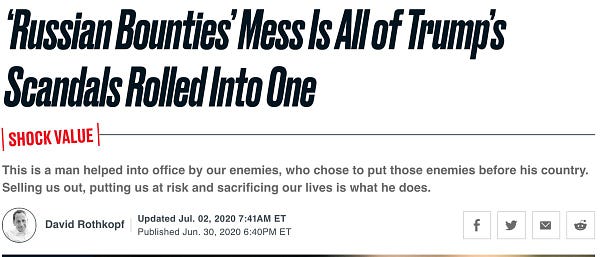
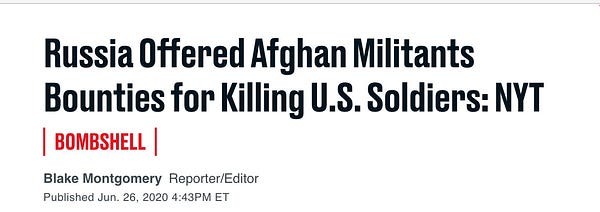
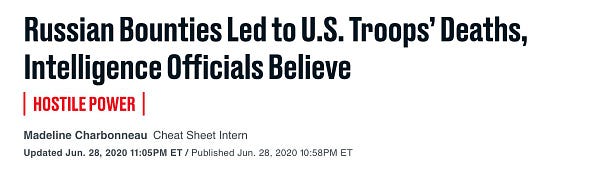
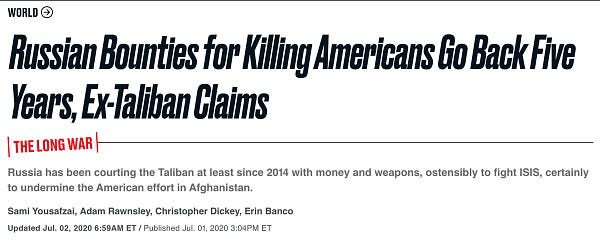
Even worse, other media outlets — led by The Washington Post — purported to have “independently confirmed” the NYT/CIA tale of Russian bounties. Twice in the last year, I have written about this bizarre practice where media outlets purport to “independently confirm” one another’s false stories by doing nothing more than going to the same anonymous sources who whisper to them the same things while providing no evidence. Yet they use this phrase “independent confirmation” to purposely imply that they obtained separate evidence corroborating the truth of the original story:

We have confirmed the @nytimes scoop: A Russian military spy unit offered bounties to Taliban-linked militants to attack coalition forces in Afghanistan. From @nakashimae @missy_ryan me and @shaneharris
For months, pro-war members of both parties and leading members of the NYT/CNN/MSNBC media axis pushed a story — an inflammatory, dangerous one — based on nothing more than the say-so of anonymous CIA operatives. How can anyone do this who knows even the bare minimum about what this agency does and what its function is: to spread disinformation not just to foreign countries but the domestic population as well? It is both mystifying and toxic. But for people who call themselves “journalists” to repeat, over and over, evidence-free CIA claims, telling those who trust them to believe it, is nothing short of repulsive.
If you think that, upon learning yesterday’s news, there was any self-reflection on the part of the media figures who spread this, or that they felt chastened about it in any way, you would be very, very wrong. In fact, not only did few if any admit error, but they did exactly the same thing on Thursday about a brand new evidence-free assertion from the U.S. Government concerning Russia: they mindlessly assumed it true and then stated it to millions of people as fact. They are not embarrassed to get caught spreading false CIA propaganda. They see their role, correctly, as doing exactly that.
On Thursday, the U.S. Department of the Treasury, run by Biden’s Treasury Secretary Janet Yellen, issued a short Press Release about its targeting of Russian-Ukrainian political consultant, Konstantin Kilimnik, with new sanctions. One sentence of this press release asserted a claim that the Mueller investigation, after searching for eighteen months, never found: namely, that “Kilimnik provided the Russia intelligence services with sensitive information on polling and campaign strategy” that he received from then-Trump campaign manager Paul Manafort.
Is it true that Kilimnik passed this polling data to the Kremlin? Maybe. But there is no way for a rational person — let alone someone calling themselves a “journalist” — to conclude that it is true. Why? Because, like the CIA tale about Russian bounties — a claim they learned yesterday had no evidence — this is nothing more than a U.S. Government assertion that lacks any evidence.
Do you think journalists learned the lesson that they just had rubbed in their faces hours before about the foolishness of assuming official statements to be true with no evidence? Of course that is a rhetorical question: too many to count instantly proclaimed that this story was true without spending an ounce of mental energy to question if it was or apply any skepticism. Here’s Maddow’s MSNBC comrade showing how this is done:
Do you see what Hayes just did there? It is vital not to lose sight of how irresponsible and destructive this behavior is just because it is now so common. He saw a Press Release from a U.S. Government agency, read an assertion that it contained in one sentence, had no evidence that this assertion was true, but nonetheless “reported” it as if it were proven fact to millions of people in a predictably viral tweet.
Hayes was far from alone. I cannot count how many employees of corporate media outlets did the same: read the Treasury Department’s Press Release and, without pausing for a second, proclaimed it to be true. Indeed, the two MSNBC hosts who follow Hayes’s nightly news program explicitly described this evidence-free Press Release as “confirmation”— confirmation!

MSNBC’s Rachel Maddow and Lawrence O’Donnell celebrating an evidence-free Treasury Department Press Release as “confirmation,” Apr. 15, 2021
Let’s set aside the absurdity of treating this as some shocking revelation even if it were true. Just like the oozing historical ignorance of pretending that there would be something astonishing about Russians paying for the killing of U.S. troops in Afghanistan when the CIA just last week explicitly boasted of having done the same to Russian soldiers in Afghanistan, what is this Treasury Press Release supposed to prove that is so breathtaking and scandalous: that the Kremlin could not possibly have obtained polling data about the U.S. electorate had Manafort not provided it to them? That they never would have known that Wisconsin and Pennsylvania were swing states without an elaborate plot of collusion to learn this from the Trump campaign?
But the far more important point is the U.S. media’s willingness — their subservient eagerness — to obediently treat U.S. government pronouncements as Truth. Just like with the Russia bounty story, where there were ample reasons to doubt it from the start, the same is true of this Treasury Press Release. To begin with, if this were such a smoking gun “confirming” collusion, why did the Mueller investigation after eighteen months of highly aggressive subpoena-driven investigative activity not discover it?
Let’s express this as clearly as it can be expressed. Any journalist who treats unverified stories from the CIA or other government agencies as true, without needing any evidence or applying any skepticism, is worthless. Actually, they are worse than worthless: they are toxic influences who deserve pure contempt. Every journalist knows that governments lie constantly and that it is a betrayal of their profession to serve as mindless mouthpieces for these security agencies: that is why they will vehemently deny they do this if you confront them with this accusation. They know it is a shameful thing to do.
But just look at what they are doing: exactly this. These are not journalists. They are obsequious spokespeople for the CIA and other official authorities. Even when they learn that they deceived millions of people by uncritically repeating a story that the CIA told them was true, they will — on the very same day that they learn they did this — do exactly the same thing, this time with a one-paragraph Treasury Department Press Release. These are agents of disinformation: state media. And when they speak, you should listen to them with the knowledge of what they really are, and treat them accordingly.
Russian Foreign Ministry statement on measures in response to hostile US actions
The Ministry of Foreign Affairs of the Russian Federation | April 16, 2021
The latest attack by the Biden administration against our country cannot go unanswered. It seems Washington is unwilling to accept that there is no room for unilateral dictates in the new geopolitical reality. Meanwhile, the bankrupt scenarios for deterring Moscow that the US myopically continues to pursue only promise to further degrade Russian-US relations.
In this context, the appeals from across the ocean to refrain from escalation and essentially accept this attempt to talk to us from a position of strength sound hypocritical. We have repeatedly warned and demonstrated in practice that sanctions and any other pressure will never succeed and will only have dire consequences for those who dare attempt such provocations.
We will introduce the following countermeasures in response to anti-Russian sanctions in the near future:
- Employees of US diplomatic missions will be expelled on a reciprocal basis in numbers proportional to the actions taken by the US authorities against Russian diplomats.
- Incidentally, we noted how quickly Warsaw played up to the US administration by demanding the departure of three Russian diplomats from Poland. In turn, five Polish diplomats will be expelled from Russia.
- The US Embassy’s practice of using short-term trips by State Department staff to support the functioning of diplomatic missions will be restricted. The issuance of visas to them will be reduced to a minimum: up to 10 people per year on a reciprocal basis.
- In strict conformity with the Vienna conventions on diplomatic relations and Russian law, including the Labour Code, measures will be taken to discontinue completely the practice of US diplomatic missions employing citizens of the Russian Federation and third countries as administrative and technical staff.
- The bilateral 1992 memorandum of understanding on open ground is declared invalid due to systematic violations of rules for trips in the Russian Federation by employees of US diplomatic missions.
- Plans are in place to halt the activities in the Russian Federation of American foundations and NGOs controlled by the Department of State and other US government agencies. These consistent, long-term efforts will be brought to an end, all the more so since the United States shows no intention of scaling back its systematic subversive efforts underpinned by a wide array of laws.
- Obviously, this very tense situation objectively requires the ambassadors of our countries to be in their respective capitals to analyse developments and hold consultations.
These steps represent just a fraction of the capabilities at our disposal. Unfortunately, US statements threatening to introduce new forms of punishment show that Washington is not willing to listen and does not appreciate the restraint that we have displayed despite the tensions that have been purposefully fuelled since the presidency of Barack Obama.
Recall that after a large-scale expulsion of Russian diplomats in December 2016 and the seizure of Russian diplomatic property in the US, we did not take any response measures for seven months. We responded only when Russia was declared a US adversary legislatively in August 2017.
In general, compared to the Russian diplomatic missions in the United States, the US Embassy in Moscow operates in better conditions, enjoying a numerical advantage and actively benefitting from the work of Russian citizens hired in-country. This form of disparity frees up “titular” diplomats to interfere in our domestic affairs, which is one of the main tenets of Washington’s foreign policy doctrine.
Incidentally, soon the Foreign Ministry will publish on its website the names of eight incumbent and former high-ranking US officials and other figures involved in drafting and implementing anti-Russia policy. They will be permanently banned from entering the Russian Federation. This is our equivalent response to the sanctions against Russian officials that the US blacklisted last month.
Now is the time for the United States to show common sense and pull back from this confrontational course. Otherwise, the US will face a host of painful decisions, for instance, an order for US diplomatic missions to reduce personnel in Russia to 300 people. This will establish real parity at bilateral foreign offices because the US quota of 455 employees still includes the 155 people sent to the Russian Permanent Mission to the UN in New York. However, this has nothing to do with our bilateral mission.
There are also other options. Of course, we realise that we are limited in our ability to squeeze the Americans economically as they have us. However, we have some resources in this respect and they will also be used if Washington chooses to follow the path of spiraling sanctions.
None of this is our choice. We would like to avoid further escalation with the US. We are ready to engage in calm and professional dialogue with the US in order to find ways of normalising bilateral ties. However, the reality is that we hear one thing from Washington but see something completely different in practice. There must be no doubt – not a single round of sanctions will go unanswered.
We have obviously heard President Joe Biden express interest in stable, constructive and predictable relations with Russia, including a proposed Russian-US summit. When this offer was made, it was received positively and is now being considered in the context of concrete developments.
Press release on a ban on entry of certain US citizens into the Russian Federation
In response to the sanctions against Russian officials imposed by the US administration on March 2 of this year, the following incumbent and former US high-ranking officials and figures complicit in pursuing the anti-Russia policy, are denied entry to the Russian Federation:
- Merrick Brian Garland, United States Attorney General;
- Michael D. Carvajal, Director of the Federal Bureau of Prisons;
- Alejandro Nicholas Mayorkas, United States Secretary of Homeland Security;
- Susan Elizabeth Rice, Director of the United States Domestic Policy Council, former US Permanent Representative to the United Nations and National Security Advisor;
- Christopher Asher Wray, Director of the Federal Bureau of Investigation;
- Avril Danica Haines, Director of US National Intelligence.
In addition, entry is denied to John Robert Bolton, former National Security Advisor to the United States President, former US Permanent Representative to the United Nations, and Robert James Woolsey Jr., former director of the US Central Intelligence Agency.
In view of the unprecedented complications in Russia-US relations provoked by Washington, it was decided to deviate from the usual practice of not making public the response measures taken by the Russian side.
Fake news all along: Confidence game with ‘Russian bounties’ story shows one shouldn’t trust spies & self-serving media
By Nebojsa Malic | RT | April 16, 2021
Even when admitting a lie, the US establishment seeks to weaponize it further. Saying that US spies now have “low to moderate” confidence the infamous ‘Russian bounties’ story may be true is a perfect example.
So convoluted was the phrasing of the not-quite-admission of wrongdoing on Thursday, that some media outlets – looking at you, The Hill – actually took it as proof the claim Russia had offered Taliban money to kill US troops was true!
“The US intelligence community assesses with low to moderate confidence that Russian intelligence officers sought to encourage Taliban attacks against US coalition personnel in Afghanistan in 2019, including through financial incentives and compensation,” is how an anonymous official put it on a background call with the press.
From the White House podium, Biden spokeswoman Jen Psaki insisted Russia still had to explain itself, and dodged questions about congressional Democrats and their presidential candidate acting as if the claim had been 100% proven fact, back during the 2020 campaign.
Yet even the most hyper-partisan press had to concede that Thursday’s revelation amounted to “walking back” the original claim, used incessantly to accuse former President Donald Trump of insufficient patriotism or inappropriate ties to Moscow.
Biden used it repeatedly to accuse Trump of “betraying” the troops. This was later amplified by the unsourced Atlantic story accusing Trump of insulting the fallen, just to be 100% sure. The “bounties” claim also gave the neocons and hawks within the GOP a pretext to side with Democrats and block Trump’s efforts to withdraw from Afghanistan.
It didn’t matter than the director of national intelligence himself told Congress the allegation was unconfirmed, or that the top US general in Afghanistan said the military had found nothing to corroborate it. The claim was politically useful, so the corporate media intended on seeing Trump ousted from the White House went all in on it.
Yet one didn’t have to be especially clever to realize the original story was nonsense – merely sufficiently observant. First of all, it cited no sources, only phantom “officials briefed on the matter.” Secondly, it relied on an all-too-familiar set of weasel words and phrases, such as “linked to,” or “closely associated with” or “believed to have.” Buried deep inside the story was the admission that the whole thing was based on US-backed Afghan police interrogation of criminals, who spun a tale of Taliban and Russians under torture.
Like a shawarma, the whole thing was then wrapped in the already established body of lies – that Russia was conducting a “hybrid war” against the US through fake news, hacking attacks and secret spy operations, even bringing in the “highly likely” alleged poisoning of ex-spy Sergey Skripal in Salisbury with a chemical agent – for which no evidence has been presented to this day.
A “spy fantasy,” I called it at the time. Except it was something worse: a literal con game, perpetrated upon the American public by con artists in the intelligence community, the media and political establishment circles. No doubt for the purpose of “fortifying” the election, we may find out some day.
“Extraordinary claims require extraordinary evidence,” famous American astronomer Carl Sagan used to say. So what is one to make of the “party of science” – as Democrats have styled themselves – offering no evidence whatsoever for any of their outlandish claims, and treating the assertions as proof enough? Perhaps that one ought to be far more skeptical of spies, politicians and the media peddling such self-serving accusations going forward.
Thing is, they believe their lies have worked – for them, and in the short run, at least – so that’s not highly likely to happen, is it?
Nebojsa Malic is a Serbian-American journalist, blogger and translator, who wrote a regular column for Antiwar.com from 2000 to 2015, and is now senior writer at RT. Follow him on Telegram @TheNebulator
Biden’s Russia policy ludicrous, unbelievable, contradictory & unprecedented: First offers Putin summit & then imposes sanctions
By Paul Robinson | RT | April 15, 2021
Just a month ago, US President Joe Biden indicated he believes his Russian counterpart, Vladimir Putin is a “killer.” But on Tuesday, he spoke to the ‘killer’ by phone and proposed that the pair meet for a face-to-face summit.
A few weeks is clearly a long time in politics.
So too, it seems, is a couple of days.
For on Thursday, Kremlin spokesman Dmitry Peskov declared that a summit between Biden and Putin would not go ahead in the near future. That does not mean that Moscow has definitively rejected a meeting at some point later, but it is clear that the Kremlin is not inclined to indulge Biden for now.
Peskov’s statement followed news that the United States was about to unveil a new set of economic sanctions against Russia, including measures to prevent American financial institutions from buying Moscow’s sovereign debt. The US also expelled ten Russian diplomats.
Consistency is generally a good thing. Sadly, US policy toward Russia appears to be decidedly inconsistent, offering an olive branch one day and then hitting with a big stick the next. From a Russian point of view, it must look two-faced, and consequently perhaps even worse than if it was straightforwardly hostile. What explains the mixed signals coming from Washington?
The basic starting point is that the US government views Russia as an aggressive challenger to the US-dominated world order. In addition, the Democratic party, which now holds both the presidency and Congress, is convinced that Russia, and Vladimir Putin specifically, was responsible for the election of Donald Trump in 2016. Domestic American politics do not allow for anything other than a hostile policy towards Russia. This is the new default position.
Thus the US intelligence community’s latest Annual Threat Assessment devotes an entire chapter to “Russian provocative actions”. This declares that, “Moscow will employ an array of tools – especially influence campaigns, intelligence and counterterrorism cooperation, military aid and combined exercises, mercenary operations, and arms sales – to advance its interests or undermine the interests of the United States and its allies.”
It follows from this that the US must hit back against Russia in order to punish it for its aggression, and to deter it from further actions.
In this context, Biden’s phone call and offer to normalize relations is rather out of place. One possible explanation for it is Ukraine. The war in Donbass between the Ukrainian government and the rebel Donetsk and Lugansk People’s Republics has gotten substantially hotter since the start of the year, with both sides breaking the ceasefire on a regular basis. Ukraine is alleged to have moved additional heavy equipment close to the front lines. Meanwhile, Moscow has been holding military exercises close to the Ukrainian border, possibly to deter Ukraine from launching an all-out assault on the rebels.
As a result, Western media and politicians have suggested that Russia might launch a surprise attack on Ukraine, while commentators on the Russian side have instead pointed the finger of blame at the USA, accusing it of egging the Ukrainians on. Tuesday’s phone call might suggest that Biden has blinked. Having allegedly pushed the Ukrainians to take a hard line against Russia, the United States has faced the reality of a tough Russian response, and decided to back off and calm things down.
In other words, Biden views Russia as an enemy, and is determined to push a hard line against it. But he doesn’t want war. Nor is there any evidence that he ever wanted to push Ukraine into a war with Russia – this is more of a fantasy of Russian TV talk show pundits than any sort of reality. The phone call and summit offer may be seen as a form of crisis management, walking the world back from the brink, but not as an indication of any significant change in overall policy.
The Kremlin’s unwillingness to immediately accept the summit offer is understandable. Moscow will no doubt be pleased that Biden appears to be trying to de-escalate the situation, but it is probably also deeply sceptical about the prospects of a summit meeting producing concrete results. If Biden can convince the Kremlin that he is serious about reaching agreement on specific issues, then its attitude will no doubt change. But for now there is little to be gained by the prospect of being lectured at and faced with threats and demands.
In any case, although the Russian government would no doubt favour a real dialogue, it’s not desperate for it. The United States appears not to fully appreciate how the world has changed in recent years, and the extent to which its former levers of power no longer work. The proposed sanctions on Russian sovereign debt are a case in point. There was a time when Russia would have been frightened by losing the prospect of accessing American money. Now, though, it no longer needs it. Not only does it hardly have any debt, but it also has access to other lenders, including both international and domestic ones.
Russia’s response to the summit offer suggests that Russia is willing to talk, but only on terms of equality. America, however, seems to think that it can force Russia to the negotiating table on its own terms. This is a profound mistake. The only question is how long it will take the Americans to realize it.
Paul Robinson is a professor at the University of Ottawa. He writes about Russian and Soviet history, military history, and military ethics, and is the author of the Irrussianality blog.
US Lawmakers Reintroduce Bill Barring Any American President From Leaving NATO Alliance
By Gaby Arancibia – Sputnik – 16.04.2021
Under the Trump administration, the Senate Foreign Relations Committee passed a measure in an effort to prevent a sitting US president from withdrawing the nation from a military alliance, specifically NATO. However, the December 2020 initiative was never taken up for a vote by the full US Senate, which was then under Republican control.
A bipartisan group of US senators reintroduced a measure on Thursday that would effectively prevent any sitting American president from removing the Land of the Free from the decades-old NATO military alliance.
The bill was reintroduced into the Democrat-controlled Senate chamber by Sens. Tim Kaine (D-VA) and Marco Rubio (R-FL), congressional members who both serve on the Senate Foreign Relations Committee. The legislation has been sponsored by several Republicans, Democrats and an independent.
The measure’s stipulations indicate that should a president want to withdraw from the alliance, they would need to get at least two-thirds approval from the US Senate.
However, in the event that the commander-in-chief attempts to jump ship without said approval, the bill would then prohibit funding for the withdrawal and authorize the Congressional Legal Counsel to challenge the matter in court.
“NATO has been a critical alliance for nearly 75 years,” Kaine remarked in a statement. “It has ably served the US, our NATO allies, and the world. This bill expresses clear congressional support for the continuing value of NATO and clarifies that no president acting alone can sever the bonds of the alliance.”
In an accompanying statement of his own, Rubio highlighted the importance of the alliance, noting that the military partnership “is more important than ever” in light of “Moscow’s growing subversive aggressions.”
“We must ensure no US president withdraws from NATO without the advice and consent of the Senate,” the lawmaker stressed.
Most recently, Russia’s military build-up along the Ukrainian border has remained under the spotlight, with the troop deployments being labeled a “provocation.” Moscow has rejected claims that the development is an incitement, explaining that the movements are meant to ensure the nation’s national security as NATO has undertaken its own build-up in the region.
A similar measure regarding a potential pullout from the NATO partnership was introduced in December 2019 as a response to former US President Donald Trump’s repeated criticism of the NATO alliance. At the time, Trump blasted NATO allies for not contributing enough funding to the organization, vowing to part ways from the defense block. However, Trump never delivered on the promise and instead referred to the potential withdrawal as “unnecessary.”
At present, any NATO member seeking to withdraw from the group must give a one-year “notice of denunciation” before being able to exit the treaty.
Featured Video

The Truth About the Trump Shootings with Ken Silva
or go to
Aletho News Archives – Video-Images
From the Archives
The Geopolitics behind the War in Yemen (I)
By Mahdi Darius NAZEMROAYA | Strategic Culture Foundation | 30.03.2015
The United States and the Kingdom of Saudi Arabia became very uneasy when the Yemenese or Yemenite movement of the Houthi or Ansarallah (meaning the supporters of God in Arabic) gained control of Yemen’s capital, Sanaa/Sana, in September 2014. The US-supported Yemenite President Abd-Rabbuh Manṣour Al-Hadi was humiliatingly forced to share power with the Houthis and the coalition of northern Yemenese tribes that had helped them enter Sana. Al-Hadi declared that negotiations for a Yemeni national unity government would take place and his allies the US and Saudi Arabia tried to use a new national dialogue and mediated talks to co-opt and pacify the Houthis.
The truth has been turned on its head about the war in Yemen. The war and ousting of President Abd-Rabbuh Manṣour Al-Hadi in Yemen are not the results of «Houthi coup» in Yemen. It is the opposite. Al-Hadi was ousted, because with Saudi and US support he tried to backtrack on the power sharing agreements he had made and return Yemen to authoritarian rule. The ousting of President Al-Hadi by the Houthis and their political allies was an unexpected reaction to the takeover Al-Hadi was planning with Washington and the House of Saudi. … continue
Blog Roll
 Aletho News
- IRGC air defenses destroy another US MQ-1 drone over Strait of Hormuz
- Imran Khan’s entire immediate family detained in Pakistan ahead of mass protest demanding his release
- EU nation detains former presidential frontrunner
- Leaked: Britain’s Sham Conviction Of Hashim Thaci
- Seyed M. Marandi: U.S. Strike Imminent – Toward Total War in the Middle East
- Russia Voted Under Fire. Washington Is Loading the Tankers.
- 12 Things Your Oncologist Was Trained Not to Tell You
- Anthrax Attacks Paved Way for COVID-Era ‘Junk Drugs and Vaccines’
- How Real Is the Impact of Western Sanctions on Israel?
- France, You Are Guilty: How Paris Turned Western Sahara into the Maghreb’s Powder Keg
- If Americans Knew
- Inside Israel’s ‘soft’ ethnic cleansing plan for Gaza through the eyes of its victims
- New online database tracks pro-‘Israel’ political donations in the United States
- Israeli president pardons soldier convicted for killing wounded Palestinian
- Singer Ed Sheeran says his ‘heart broken’ by Gaza devastation, addresses Macklemore controversy
- Israel Has Imprisoned Female Journalist Bushra Al-Tawil Without Trial Or Charge In Solitary Confinement For Past Month
- Israel poised to teach West Bank a lesson after one Israeli killed – Daily Update
- Salah Sarsour’s Legal Team Says DHS Has Not Met Its Burden to Prove He Is Deportable
- An analysis of tax forms by The Intercept show Kraft’s charity and LLC have donated to Friends of the IDF and AIPAC’s super PAC.
- Israeli attacks kill four Palestinians in Gaza – Daily Update
- Inside Gaza’s death trap of collapsing, bombed-out buildings
- No Tricks Zone
- 2025 Nature Paper Claiming Worsening Global Drought Gets RETRACTED …Heavily Flawed
- New Study: ‘Global Drought Shows No Detectable Recent Acceleration Under Climate Warming’
- Economic Masterminds: German Socialists Suggest Taxing Productivity Gains Stemming From Using AI
- The South China Sea Has Not Been Cooperating With The Climate Change Narrative
- Energy Crisis: Germany Enters Heating Season With Historically Low Gas Reserve Fill Levels
- New Study: The Antarctic Ice Sheet Gained Mass From 2020-2024 Due To Staggering Snow And Ice Accumulation
- Study: Ocean Heating Rates From Thousands Of Years Ago ‘Dwarf’ Modern Ocean Heating Rates
- Climate Extremists Target, Attack Large-Scale Power Grid Infrastructure In Germany!
- New Study: Antarctic Ice Melt Has Contributed Less Than 1 Centimeter To Sea Level Rise In The Last 30 Years
- Fear Of Debate: Alarmist German Climate Scientist Calls On Mainstream Media To Discredit Skeptic Voices
 Aletho News