Washington’s Energetic Generals and the Emphasis on Preparation for Nuclear War
By Brian Cloughley | Strategic Culture Foundation | February 16, 2021
Some senior generals and admirals in and around Washington have been very busy recently, and their activities, while aggressive, have not been associated with directing current combat operations. Rather, they have been directed at attempting to influence the Administration of newly-elected President Joe Biden to restructure military forces, expand the nuclear arsenal and magnify specific warfighting capabilities. All of this is what might be expected of those whose business and dispositions are aimed at organising destruction and death, but the manner in which their aspirations are expressed are not consistent with what is expected of military personnel in a democracy.
The U.S. Department of Defence is now headed by a Biden-appointed retired general who has not voided the directive concerning “Political Activities by Members of the Armed Forces” which notes that “members on active duty should not engage in partisan political activity.”
This long-standing instruction was last reiterated in 2008 but it cannot be said that generals and admirals have followed its letter or spirit, and the present echelons of senior officers appear determined to flout it by wide publication of their personal points of view concerning the military posture of their country. This, by any interpretation, is “partisan political activity.” No government should tolerate meddling by the military.
On February 2 the chief of staff of the U.S. Air Force, General Charles Q Brown, and the Commandant of the Marines Corps, General David H Berger, had an opinion piece published in the Washington Post in which they expressed overall support for the 2018 National Defense Strategy but complained that “it has not changed defence investment priorities at the scale or scope necessary to prepare the U.S. military for great power competition.” In other words, they consider their enormous armed forces, on which some 740 billion dollars are to be spent this year, are not ready for war in spite of that allocation of taxpayers’ money being 11 times that of Russia and three times that of China.
Not to be outdone in public pronouncements, the following day the commander of U.S. Army forces in Europe and Africa, General Christopher Cavoli gave a speech in which he said that “the U.S. military needs more long-range artillery and other advanced weaponry in Europe to be able to take on enemy forces . . .”, and it is reasonable to ask if this sort of policy indicator is approved by the new President.
Then the head of Strategic Command, the element responsible, among other things, for “strategic deterrence; nuclear operations and space operations”, Admiral Charles Richard, published his personal take on the future use of nuclear weapons. In the February edition of the Naval Institute’s magazine Admiral Richard wrote that Russia and China “have begun to aggressively challenge international norms and global peace using instruments of power and threats of force in ways not seen since the height of the Cold War.” This person accountable for employment of nuclear weapons holds that “There is a real possibility that a regional crisis with Russia or China could escalate quickly to a conflict involving nuclear weapons, if they perceived a conventional loss would threaten the regime or state…”
It could hardly have been a coincidence that in early February the Pentagon ordered two U.S. carrier strike groups, led by the USS Theodore Roosevelt and the USS Nimitz, to conduct manoeuvres in the South China Sea.
Navy Times reported that “the Roosevelt’s carrier strike group includes Carrier Air Wing 11, guided-missile cruiser Bunker Hill, Destroyer Squadron 23 [six ships], and guided-missile destroyers Russell and John Finn. The Nimitz’s carrier strike group includes Carrier Air Wing 17, guided-missile cruiser Princeton, guided-missile destroyer Sterett, and staff from Destroyer Squadron 9 and Carrier Strike Group 11.”
The mission of this enormous force (which has a total of 120 attack aircraft), according to Admiral James Kirk, commanding the Nimitz Strike Group, was to ensure “the lawful use of the sea that all nations enjoy under international law,” and he was echoed by his colleague, Admiral Douglas Verissimo of the Roosevelt Strike Group, saying “we are committed to promoting a free and open Indo-Pacific.” Obviously neither of them is aware that the United States refuses to ratify the United Nations Convention on the Law of the Sea which is considered “the ‘constitution of the oceans’ and represents the result of an unprecedented, and so far never replicated, effort at codification and progressive development of international law.” But this does not prevent Strike Group admirals holding forth about their missions of provocation in the South China Sea that appear intended to push China to react.
In this context it is disturbing that the head of U.S. Strategic Command declared “There is a real possibility that a regional crisis with Russia or China could escalate quickly to a conflict involving nuclear weapons, if they perceived a conventional loss would threaten the regime or state…”
U.S. forces are threatening China in the South China Sea and confronting Russia all round its borders — and most recently in the Black Sea where the U.S. Navy deployed two guided missile destroyers in January. According to U.S. European Command, these ships are from the Sixth Fleet which is based in the Mediterranean “in order to advance U.S. national interests and security and stability in Europe and Africa.” These same interests are being furthered by the Pentagon’s “China Task Force” whose establishment President Biden announced on 10 February. The mission of this war-planning body is to conduct a review of U.S. “strategy and operational concepts, technology, and force posture” in line with Biden’s declaration that “That’s how we’ll meet the China challenge and ensure the American people win the competition of the future.”
So Uncle Joe has apparently joined the generals in their never-ending pursuit of global military ascendancy. Further, it seems he has accepted the new “Ground-Based Strategic Deterrent” or GBSD, which the Bulletin of the Atomic Scientists described on 8 February as “a new weapon of mass destruction, a nuclear missile the length of a bowling lane. It will be able to travel some 6,000 miles, carrying a warhead more than 20 times more powerful than the atomic bomb dropped on Hiroshima. It will be able to kill hundreds of thousands of people in a single shot. The U.S. Air Force plans to order more than 600 of them.”
This imminent leap towards global catastrophe is consistent with the declaration of Strategic Command’s Admiral Richard that “the U.S. military must shift its principal assumption from ‘nuclear employment is not possible’ to ‘nuclear employment is a very real possibility,’ and act to meet and deter that reality.”
The country’s senior military officers are preparing citizens for a terminal nuclear holocaust — for there can be no such thing as a limited nuclear war — and Uncle Joe Biden is permitting them to convey their personal policies directly to the people. This is endorsement of “partisan political activity”, because there are many millions of Americans who, for example, disagree with the GBSD programme and, indeed, a very large number who support their elimination of all nuclear weapons.
The Pentagon’s energetic generals are beating their war drums and the President has as yet done nothing to rein them in. Will he take action to stop this relentless drive towards nuclear war?
Twitter suspends account of Russian arms control delegation, head diplomat wonders about censorship
RT | February 13, 2021
The Twitter account of the Russian delegation that represents the country at OSCE-hosted arms control talks in Vienna has been suspended by the US platform. The head of the team suggested it was an act of Big Tech censorship.
The unexplained ban of the account was reported on Saturday by Russia’s chief negotiator, Konstantin Gavrilov. He pondered what the reason for the decision might have been, suggesting it could have been retaliation for voicing Russia’s “alternative position … on the trends of the current [political-military] situation in Europe”.
The frozen account carried the standard Twitter notice, stating that the platform “suspends accounts which violate the Twitter Rules” at the time of posting.
Various arms control talks in Vienna are hosted by the Organization for Security and Co-operation in Europe (OSCE). This week, the body hosted a key forum called the High-Level Military Doctrine Seminar, which is gathered once every five years. The Russian military, surprisingly, snubbed the event, citing “unfriendly” Western policies, but the Gavrilov-led delegation participated.
The Russian official said he would be asking OSCE Secretary General Helga Schmid to join Russia’s demand for clarification from Twitter, which he otherwise expected to be unanswered. Meanwhile, his own account would be used to publish relevant content, he added.
Canada to fund opposition in Belarus and names Russia and China its main enemies
By Lucas Leiroz | February 10, 2021
Canada is changing its geopolitical intentions. Apparently, this country, which has always been passive in the face of American decisions, wants to take more aggressive positions on the international stage. The Canadian government recently announced that it will finance opponents against Lukashenko in Belarus and now the Canadian intelligence director has made a note regarding Moscow and Beijing as “the biggest threats to Canada”. Ottawa visibly wants to take more incisive actions in the international scenario, perhaps because it doubts Washington’s ability to guarantee its interests at the moment. However, the country has no material conditions to carry out its plans and may be taking positions which are complicated to maintain in the long term.
Canadian positioning on the international arena has always been previously determined by its largest partner, the US. Washington has historically held a leadership role in bilateral relations, and this has always been accepted peacefully by Ottawa’s officials. Certainly, nothing will change in this regard and a rupture of interests between Americans and Canadians seems very unlikely in the near future. However, due to a number of issues, it is possible to say that Washington has become increasingly unable to maintain a foreign policy as broad as in the past, which has motivated Canada to make some decisions that in the past would have been taken first by the US.
Examples of this type of more aggressive attitude on the part of Canada can be seen in some recent events. Earlier this week, Canadian Foreign Minister Marc Garneau announced in a note the donation of 2.25 million Canadian dollars to political opponents of Lukashenko in Belarus. The money will go to all organizations working to “promote democracy” in Belarus. The note also observes that the country had already sent 600,000 Canadian dollars to help opposition organizations, in particular women and representatives of the “independent media”. In fact, oppositionists receiving foreign funding tend to increase their activities, which tends to generate more violence on the streets and social instability in the country. By promoting open funding for these organizations, Ottawa creates a strong diplomatic crisis, not only with Belarus, but also with Russia, which maintains good ties with Lukashenko and condemns Western interventionism.
Another fact worth mentioning is a recent statement by the Canadian intelligence director on Russia and China. During a conference, David Vigneault, director of the Canadian secret service (CSIS), singled out Moscow and particularly Beijing as the states most involved in “human and cyber threats” against Ottawa. The Chinese role in the alleged “cyber-attacks” suffered by Canada was emphasized, with China being considered the main threat to Canadian national security – although no evidence of the existence of such cyber-attacks has been presented. This speech, however, does not come about by chance. Previously, in November 2020, the Communications Security Establishment (CSE) had previously claimed in a report that China, Russia, Iran, and North Korea are Canada’s biggest threats to cybersecurity. China and Russia vehemently deny that they pose any kind of threat to Western countries, responding that such claims are devoid of any evidence, being nothing more than justifications for geopolitical maneuvers and international sanctions.
Biden’s election represented a resurgence of old American foreign policy, with a focus on preserving global hegemony. The Trump administration, marked by a huge geopolitical decline, had caused great discontent among Washington’s international allies because it had supposedly “decreased security” in these countries in the face of their common geopolitical rivals. However, even though the West celebrated Biden’s victory, there is still a collective distrust of the new president’s real ability to comply with his bold geopolitical plans. In other words, Biden undoubtedly wants to regain American global dominance, but it may be too hard for any American government to do so.
A recovery of American hegemony benefits Canada because, being a country that is geographically close and historically allied to the US, this guarantees security and stability. However, amid the decline of recent years and uncertainty about the future, the Canadian government may have to make its own decisions and seek a balance between a constantly changing world and an advanced process of geopolitical multipolarisation. What Justin Trudeau seems to want to do in his country is not very different from what Macron has been doing in France and Merkel in Germany: he is looking for a Westernist alternative to the American decline. To this end, these politicians anticipate decisions that historically were up to Washington.
If Biden keeps his promises, Canada will be in an extremely comfortable position due to its ties to the US. If Biden fails, Ottawa will have to seek European support. But in any case, getting ahead on some issues can be a serious strategic mistake for Canadians. Canada’s material apparatus, military capabilities and international influence are exceedingly small compared to the countries that Ottawa has chosen as its main enemies. The cyber-attacks that Canadian intelligence agencies accuse Russia and China of carrying out are unlikely to be real, however, it is undeniable that Moscow and Beijing have sufficient power to carry out such attacks and will not hesitate to do so if necessary.
If Canada really intends to guarantee its survival in a world of constant change, choosing much more powerful enemies and financing riots in the zone of influence of other powers seems to be a terrible strategy, even more considering that Canada also has its areas of instability and its foci of tensions, with separatist movements that are gradually growing, such as Quebec and Alberta, and that can at any moment evolve into deeper unrest if they receive foreign money from countries interested in responding to Ottawa’s affront.
Lucas Leiroz is a research fellow in international law at the Federal University of Rio de Janeiro.
US poised for Russia sanctions as Washington claims ‘millions’ support jailed Navalny, hope for regime change
RT | February 9, 2021
America’s top diplomat says the US is mulling how to best penalize Russia over the alleged poisoning of opposition figure Alexey Navalny, but he simultaneously claims Washington is not seeking to influence the situation.
Speaking to CNN on Monday, Secretary of State Antony Blinken told viewers “it seems apparent that a chemical weapon was used to try to kill Mr Navalny.”
“That violates the chemical weapons convention and other obligations that Russia has,” he said. “We’re looking at the situation very carefully and when we have the results we’ll look at that in the appropriate way.”
Blinken added that “the fact that Russia feels compelled – that Mr Putin feels compelled – to try to silence one voice, speaks volumes about how important that voice is and how it is representative of so many millions of Russians who want to be heard and who are fed up with the corruption and the kleptocracy.”
Thousands took to the streets of cities across the country to demonstrate for the release of the jailed anti-corruption campaigner over the past fortnight. However, further rallies that had been expected were called off amid lower numbers and an insistence from organizers that the movement should “end on a high note.” Unexpectedly, on Tuesday, Navalny associate Leonid Volkov, who is based in Lithuania, announced a new form of protest for the coming days, asking people to shine flashlights in their neighborhood gardens.
Research published last week found that only one in 20 of 1,600 Russians surveyed came up with Navalny’s name as a political figure that they trust. The fieldwork was conducted by the Levada Center, which is registered as a ‘foreign agent’ by the Ministry of Justice over links to funding from abroad.
While former President Donald Trump was said to have been ambivalent about international blocs like NATO and organizations like the UN, analysts have said that Biden’s team is far more preoccupied with seeing the US play a leading role in them. Blinken appeared to confirm that view, claiming that “the world doesn’t organize itself. If we’re not in there every day helping to do some of that organizing – to write the rules and shape the norms that sort of govern the ways that countries relate to each other, then either someone else is going to do it in our place or maybe, just as bad, nobody does it and then you have chaos.”
However, while he expressed hope that the momentum from previous protests would have a profound effect on the country, Blinken denied that the US was stoking tensions. “I think the Russian government would make a mistake in attributing to outside actors, whether it is the United States, European partners or others, responsibility for what is happening,” he said. “This is fundamentally about Russia, about Russia’s future and hopefully about a more democratic system going forward.”
Navalny was educated in the US and was appointed to Yale University’s World Fellow’s program, set up to “create a global network of emerging leaders.” This has led some in the country to suggest that he is more closely aligned to Western governments than many other domestic opposition figures.
Moscow has expressed cynicism over the nature of the US’ interest in the Navalny case. Foreign Ministry spokeswoman Maria Zakharova said last week that Washington didn’t need a genuine reason for sanctions. “They will always find one or make one up,” she said.
For Josep Borrell, Russia will remain a ‘mystery inside an enigma’
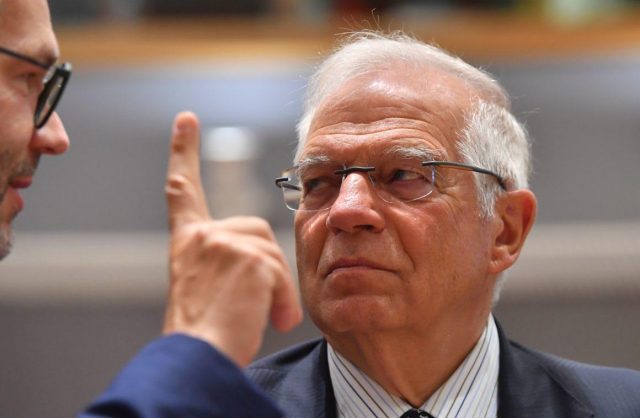
By Johanna Ross | February 9, 2021
It’s been a quotation cited repeatedly to describe the difficulties faced by western policy-makers towards Russia. Winston Churchill famously said the country was ‘a riddle wrapped in a mystery inside an enigma’. Back in 1939, when he broadcast this speech, just as Britain had declared war on Germany, Churchill said that he thought he had the ‘key’ to unlocking the secret of Russian foreign policy and that was, he said, ‘Russian national interest’.
I assume that Josep Borrell, the EU’s high representative for foreign affairs and security policy, who visited Moscow last Friday, is familiar with this quotation. And it seems that for him, Russia has remained something of a mystery. For upon his return to Brussels, after what his European colleagues have termed a ‘humiliating’ trip (they are now demanding his resignation), Borrell wrote a blog post outlining what was essentially his complete failure to engage with his Russian counterpart. “My meeting with Minister Lavrov highlighted that Europe and Russia are drifting apart”, he wrote in a piece published on Sunday evening. “It seems that Russia is progressively disconnecting itself from Europe.”
What is surprising for the Russians, is the absolute inability of these European policy-makers to read and comprehend the Russian position. Western diplomats in this regard seem to be diplomatically autistic. And far from taking tips from Russian political analysts and think-tanks, they turn to the same pseudo ‘Russia-experts’ and western academics, the majority of whom churn out age-old anti-Russian rhetoric like a broken record. As Professor Stephen Cohen once told me:
‘The idea that we have to fight Russian disinformation is now very profitable in the US; everybody will give you money. And if you don’t have a particularly big brain, it’s a good way to pretend you’re an intellectual and get paid for it.’
As a consequence, we are sadly no further in unravelling the ‘mystery inside the enigma’.
Churchill was close to the truth when he said that ‘Russian national interest’ was a key factor in understanding Russia – but that’s hardly a secret. Every country acts according to its national interest. What is lacking, particularly at the moment from western policy makers, is the ability to treat Russia according to how they themselves expect to be treated. Like a naughty schoolboy, Russia and its leader are constantly being lectured on how to behave. The problem is, the ‘adults’ – in this case the West – are guilty of the same offences that Russia is being accused of. As Vladimir Putin noted during his speech at the Munich security conference in 2007:
‘Incidentally, Russia – we – are constantly being taught about democracy. But for some reason those who teach us do not want to learn themselves.’
Unfortunately, nothing has changed, and the hypocrisy still stinks.
Borrell’s visit is also a classic example of Europeans saying one thing to Russia’s face and another behind its back. For the statements Borrell made after his return to Brussels, as Russian Foreign spokesperson Maria Zakharova remarked on Monday, do not correspond with comments he made when in Moscow. Zakharova expressed surprise at the diplomat’s negative summary of the trip and suggested that his colleagues had influenced him on arrival. But I would add that it is a regular occurrence that western politicians are two-faced when it comes to dialogue with Russia, and that they often place less emphasis on the value of verbal agreements. Take for example the promise of US Secretary of State James Baker to Soviet leader Mikhail Gorbachev back in the 1980s that NATO would not expand eastward. For the Russians that assurance meant something, as it is frequently quoted by them to this day; for the Americans it clearly didn’t. Since then NATO has proceeded to encircle Russia to the east.
The reality is that Russia is not going to be dictated to on human rights and freedoms when they are currently being curtailed in the West. It’s not going to be told that opposition protesters are being mal-treated when demonstrators in the US and Europe are regularly manhandled by police. It’s not going to be bullied into releasing Alexei Navalny – a politician with a criminal conviction – when the US and Europe have their own political prisoners, the most famous being Julian Assange. And it’s not going to be harassed about press freedoms when the majority of the western mainstream corporate media play the role of government mouthpieces. Russia is a sovereign nation and won’t be told what to do.
For Borrell et al. this is a problem. Therefore a stalemate has been reached in EU-Russian relations. Borrell seems resigned to the fact that there will be little improvement in relations in the near future. This is unfortunate, because it is not something that Russia has wanted. Even as recently as last month, when speaking at the Davos Economic Forum, Vladimir Putin said that Europe and Russia were ‘practically one civilisation’. And yet there is a fundamental difference in mentality which proves impossible to overcome.
It is in Europe’s and the West’s interest, however, to try better to engage with Russia on a level playing field, without taking the moral high ground. Global security and stability are at stake. In addition, Europe currently depends on Russian gas, and will likely always be reliant to some degree on Russia’s vast expanse of natural resources. As renowned academic Andrei Tsygankov has aptly summarised in his book ‘Russia’s Foreign Policy’:
‘Russia is sufficiently big and powerful, and that limits Western ability to influence its developments. Vast territory, enormous natural resources and military capabilities, and a significant political and diplomatic weight in the world have allowed and will continue to allow Russians considerable room for foreign policy maneuvering. It is hard to believe that the West will ever possess enough power to fully determine the shape and direction of Russia’s developments.’
If only Josep Borrell had read this book before he went to Moscow…
Johanna Ross is a journalist based in Edinburgh, Scotland.
The establishment wants a Reality Czar in order to crush dissent, not unite us around objective truth
By Michael McCaffrey | RT | February 3, 2021
The mainstream media and ruling elite really hate conspiracy theories and misinformation – except when they don’t.
On February 2, which ironically enough is Groundhog Day here in the US, the New York Times published an article titled ‘How The Biden Administration Can Help Solve Our Reality Crisis’.
It seems a very bad sign that America is now relying on a geriatric Washington insider whose own perception of reality has been called in to question numerous times to solve a “reality crisis”.
One of the suggestions was that Biden should create a “Reality Czar” to oversee the dismantling of “disinformation” and the surveillance of “conspiracy theorists”.
In the article, writer Kevin Roose spoke with ‘experts’ who offered suggestions about how to unify Americans around “reality” by stamping out “conspiracy theories” and “misinformation”.
That sounds like a great idea – I mean, what could possibly go wrong?
The problem with a ‘reality czar’ is that America is a post-reality nation. Our culture has gone so far to the extreme with regard to embracing subjective experience over objective reality that some blowhard bureaucrat is not going to be able to tip the scales back towards the rational.
And, of course, that is the point. The Biden administration doesn’t want to return America to objective reality, they want Americans to embrace the establishment’s reality – and those are two very different things.
The establishment reality is the neo-liberal, corporate controlled, military-industrial-complex reality that loathes being held to account for its continuous misdeeds and misinformation.
The establishment reality demands we accept the absurdly incomplete official story regarding the spate of assassinations in the ’60s (JFK, MLK, RFK) while refusing to declassify and un-redact the millions of government files on those topics it won’t let us see.
The establishment reality lied about the Gulf of Tonkin incident and gave us the hell of the Vietnam War.
The establishment reality lied to us about Iran-Contra and the death squads in Latin America. It also lied about its complicity in the drug trade while it manufactured a War on Drugs.
The establishment reality refused to declassify documents about 9/11 and to investigate the funding for that attack. It also unleashed George W. Bush and Dick Cheney’s ‘Dark Side’, which included the War on Terror, torture, massive surveillance, Gitmo, rendition and the Patriot Act.
The establishment reality was the one that told us Iraq had weapons of mass destruction and gave us the Iraq War, and continues to give us the war in Yemen and the carnage in Libya and across the globe.
It is often said that daylight is the best disinfectant, but we are continuously kept in the dark, and the establishment, regardless of which party is in power, is a gangrenous limb whose lies and disinformation are much more toxic to America and the world than anything some QAnon clowns can conjure in their fever dreams.
It is pretty rich that the New York Times is running this article calling for a reality czar and bemoaning disinformation, as it has long aided and abetted the establishment in its concealing of truth and distorting of objective reality.
Whether it be Walter Duranty and his lies for Stalin, or Judith Miller and her lies for Bush, the Times has proven over and over again that it isn’t a news organisation, but a praetorian guard meant to protect the tyrants, oligarchs and aristocrats from the masses.
Am I the only one who remembers the Russiagate hysteria? Stories of dastardly Rooskies hacking into power grids and voting booths, and using microwave weapons to attack Americans have been commonplace in the Times and across the mainstream media, and yet those ‘conspiracy theories’ were not only accepted but embraced. The establishment’s hatred of conspiracy theories is particularly amusing in light of what transpired over the past four years.
Would the new Reality Czar hold the Times accountable for those idiotic stories? Would MSNBC be chastised for Rachel Maddow’s conspiratorial ramblings? Would CNN be reprimanded for its “mostly peaceful protests” disinformation?
Would the Reality Czar target the scientists and medical experts who publicly proclaimed that it was OK to gather in large groups during the pandemic to protest for Black Lives Matter but not to protest against lockdown?
How about those radical trans activists who distort and contort both science and reality?
Would the Reality Czar target the new White House spokeswoman Jen Psaki, especially considering her laughably ridiculous press conference from 2015, at which, with a straight face, she stated that the US had a “long-standing” policy against backing coups?
Of course not.
Like a paranoid schizophrenic, our political and media elite is constantly trying to convince people that its own devious delusions are the one true reality.
The Reality Czar would not be required to actually quash misinformation and conspiracy theories – only the misinformation and conspiracy theories the establishment doesn’t like.
As Orwell told us, “Who controls the past, controls the future, who controls the present, controls the past.” The establishment wants to control the present, the past, the future and, most of all, you. And a Reality Czar is just the beginning.
The ‘reality is that the ruling elite are pushing the notion of rampant right-wing domestic terrorists and the danger of conspiracy theories in an attempt to conceal their crimes and stifle dissent, not to help objective “reality” flourish.
Navalny will remain the West’s darling, but not Russia’s

By Johanna Ross | February 4, 2021
In case you missed it, Russian blogger/politician/investigative journalist Alexei Navalny was sentenced on Tuesday in a Moscow court to 2 years 8 months in prison for breaking the terms of a suspended sentence.
The western media is, of course, outraged. The leaders of the US, UK and France have all joined in unison to demand his release. Michael McFaul continues with his Navalny/Mandela comparisons on Twitter until we finally accept it. He’s clearly following the old adage of ‘if you say something often enough, it becomes the truth’.
What seemed like overnight, Alexei Navalny has gone from being an obscure opposition activist to the saviour of Russia and the human race itself (or as the western media would have us believe). Opposition journalists, of whom several are not even based in Russia, but prefer to egg-on their activist colleagues from the safety of the US and Europe, have been tweeting their profanities and scolding the Russian authorities for not immediately releasing their media darling.
While the western world has become caught up in the drama of this ‘one man against the world story’, few are able to scratch beneath the surface, to see past the golden gates of ‘Putin’s palace’ and the condemned man kissing his wife goodbye in the airport as he meets his fate. Navalny is an expert in PR, something which his opponents are only just catching up with.
Alexei Navalny has quite deliberately set about becoming a political martyr. His very existence depends on the mythology surrounding his plight. His existence, his financial support (which I shall touch on later) depends on him being a ‘victim’ of the Russian state. He has to continue his anti-Putin programme to sustain himself and his family. For what other job/career does he have? No other would pay as well.
How many of those protestors who responded to his ‘call to arms’ in January and ventured out into the bitter cold to demonstrate, could actually name any of his policies? Could they even say what he stood for? Navalny himself isn’t sure. He has flipped and flopped between right-wing nationalism and left-wing policies for the last two decades. The only consistent policy is he wants to bring down Putin and replace him (if you can call that a policy).
As renowned academic Anatol Lieven has noted, we have to put aside the emotion in this case and deal primarily with the facts. Navalny has played with our emotions as much as possible; emphasising the romantic attachment to his wife with footage of him signing love hearts on the glass box in the courtroom; and performing the role of the underdog in the case to the letter. But over the last few months, the world, including the Kremlin, has been dancing to his tune, not the other way around.
In Germany Navalny was treated like a diplomat, escorted around by the security services, visited by Chancellor Merkel. He decided when he would arrive back to Russia, and knew he would be arrested. The release of his ‘Putin’s Palace’ video, which he clearly worked on in collaboration with German intelligence while he stayed there, was perfectly timed to be published just after his arrest, and it was hoped this would trigger mass protests, which in turn would pressurise the authorities to let him go. Protests certainly took place, but much to his supporters’ dismay, the authorities had no plans to override the law and release him.
And it’s worth here touching on that infamous palace video – which we now know, thanks to a video produced by ‘Mash’ – to be a complete misrepresentation of the truth. There are no golden gates. There is no baroque furniture. The ‘palace’ at the moment is a concrete shell, and there is no direct evidence linking it to the Russian President – instead it has been claimed by businessman Arkady Rotenberg as an aparthotel complex. That in itself is offensive, that Navalny would have the Russian people believe that there is a luxurious ‘dvorets’ on their doorstep, photoshopping the whole building to dupe people into buying his ‘golden toilet brush’ story. It shows extreme contempt for the general public he is addressing.
Indeed, Navalny would have us believe that he is acting on behalf of the Russian people. From his prison cell, he is demanding people go out on the streets in the middle of the Russian winter, during a pandemic, to take part in unsanctioned demonstrations, for which they are likely to be arrested, and as is often the case during such mass protests, injured. Is this thinking about the Russian people? Of course not. Navalny is thinking about Navalny.
Returning to the subject of who finances him, there have been suspicions for some time as to the extent to which he is being subsidised by western governments. Then, earlier this week, an explosive FSB video was released detailing a conversation between Navalny’s ally Vladimir Ashurkov and a British embassy official back in 2012. Unbelievably candid, Ashurkov asks the diplomat for ‘millions of dollars a year’ to help Navalny with his campaign, reminding him that foreign businesses have ‘billions at stake’. Literally asking a foreign power to meddle in the affairs of a sovereign state with a view to toppling the current government. If that doesn’t constitute treason, I don’t know what does.
For his part, we know that Ashurkov, who remains the Executive Director of Navalny’s Anti-Corruption Fund, has links to UK intelligence operations. Granted political asylum in the UK in 2015 after being wanted on embezzlement charges in Russia, Ashurkov was named in the documents of the Integrity Initiative – the UK’s covert anti-Russia propaganda campaign funded by the Foreign Office – leaked back in 2019. All this simply confirms the Kremlin’s assertions that Navalny is being aided and abetted by countries that have declared Russia their sworn enemy.
The western involvement in and support for Navalny’s campaign vastly reduces his chances of being taken seriously in Russia. For the vast majority of Russians he is the anti-hero, not Russia’s saviour as he is being portrayed in the West. Therefore while he may remain the West’s darling, he won’t be Russia’s.
Johanna Ross is a journalist based in Edinburgh, Scotland.
NATO Secretary General sounds alarm over ‘Russian aggression’, encourages members to increase military spending
RT | January 28, 2021
NATO’s top official has warned that its member states face existential threats to their safety, democracy and way of life from both terrorism and nations like Russia and China.
Secretary General Jens Stoltenberg made the remarks at a meeting of the bosses of the bloc’s armed forces on Wednesday. His comments were reported in a statement by Air Chief Marshal Sir Stuart Peach, the British chairman of NATO’s military committee.
According to the communique, Stoltenberg “urged Allies to continue to increase defense spending, invest in modern capabilities and to ensure our military remains ready to deal with challenges such as Russia’s aggressive actions, terrorism and the risks posed by the rise of China.”
He also stressed that “our democracies, our values, and the rules-based order are being challenged.” Stoltenberg’s rhetoric, however, failed to account for the fact its members include five nations that the US government-funded Freedom House says are not democratic states: Albania, Hungary, Montenegro, Macedonia and Turkey.
As well as rival states in the East, the missive also pointed to the evolving threat of terrorism as evidenced by the rise of IS (Islamic State, formerly ISIS), as well as conflicts in Afghanistan and Iraq. It urged its members to step up the funding for their armed forces, adding that “NATO is the world’s most successful military alliance because we adapt.”
Russia has previously warned that NATO activity near its borders has increased in recent months. In December, Russian Deputy Defense Minister Alexander Fomin told local media that there had been a number of close calls when vessels and warplanes came close to the country’s borders.
“In 2020, the activity of [NATO’s] air and naval forces has increased significantly, and situations that can lead to serious incidents are increasingly emerging,” Fomin said. “These actions were openly provocative. The incidents were avoided only thanks to the high level of professional training of Russian pilots and sailors.”
The month before, a US-led exercise in Romania that saw missiles land in the Black Sea caused alarm on the Crimean Peninsula. American troops airlifted in M142 High Mobility Artillery Rocket (HIMARS) launchers from their bases in Germany specifically for the drills. The deputy speaker of the Crimean parliament claimed at the time that it had created an impression that NATO was preparing for “an armed invasion of the territory of the Russian Federation.”
Late last year, the bloc said that it had set its sights firmly on Russia. An analysis published by Stoltenberg’s office argued that Moscow engages in “assertive policies and aggressive action,” which has “negatively impacted the security of the Euro-Atlantic area.”
“In the long term until 2030, Russia is likely to remain the main military threat to the North Atlantic Alliance,” the authors of the report said.
Russia’s Ombudswoman Gets Requests to Protect Baltnews, Sputnik Latvia Reporters
Sputnik – 28.01.2021
Russian Human Rights Commissioner Tatyana Moskalkova has received requests from journalists who work with Baltnews and Sputnik Latvia media outlets, asking to protect their rights to freedom of speech, Moskalkova’s office told Sputnik on Thursday, adding that work on the requests is already underway.
“There are such [requests]. We are already working on them”, the office said.
In December, several Russian-speaking journalists working in Latvia, including those who wrote articles for the Baltnews and Sputnik Latvia outlets, have been accused of violating EU sanctions.
Their apartments were searched, with them being put under the condition to not leave the country. Sputnik Latvia and Baltnews are part of the Rossiya Segodnya International Information Agency, whose director-general, Dmitry Kiselev, is on the EU sanctions list.
The Russian Foreign Ministry says that the EU sanctions are individual and concern only Kiselev and thus could not apply to all individuals and entities that work with the agency, especially those who work as freelance journalists. According to Moscow, Latvia uses EU sanctions as an excuse to justify its “punitive campaign” against Russian media.
President Biden’s New Administration, Old Aggression
Strategic Culture Foundation | January 22, 2021
The day after President Joe Biden’s inauguration this week the White House announced that it was seeking a five-year extension of the New START treaty with Russia. The treaty was set to expire on February 4 after a 10-year run. Russia in recent months repeatedly urged the United States to renew the accord, which the former Trump administration had ignored.
Therefore, the new administration’s willingness to save New START is welcome. (But it is not clear cut, as explained below.) If the treaty had expired, there was a grave risk of relapse into a nuclear arms race. Given that the U.S. has already pulled out of several arms controls treaties, it is of paramount importance to maintain the last remaining pact, which specifically limits the bilateral arsenal of intercontinental warheads.
In announcing the Biden administration’s decision on extending New START, Pentagon spokesman John Kirby stated: “Just as we engage Russia in ways that advance American interests, we in the Department will remain clear-eyed about the challenges Russia poses and committed to defending the nation against their reckless and adversarial actions.” (Our emphasis.)
White House spokeswoman Jan Psaki articulated a similar testy rationale, saying that despite the extension proposal the Biden administration would hold Russia to “account for reckless and adversarial actions”. (Our emphasis.)
Please note the casual assertion of provocative claims as if they are proven facts. And this, ironically, from a new administration that has piously proclaimed to bring “facts” to public announcements in place of the Trumpian habit of peddling falsehoods and “alternate facts”.
It was then announced that President Biden has ordered his top intelligence officers to carry out a review into allegations of Russian malign conduct. In particular, allegations of a massive cyber attack – the so-called SolarWinds hack – on American government departments and commerce; the alleged poison assassination of Russian dissident figure Alexei Navalny; allegations of Russian interference in the 2020 presidential election; and, lastly, the allegations of Russian military intelligence running bounty-hunter plots in Afghanistan to murder U.S. soldiers. (We can be sure the conclusions are already foregone, only awaiting new media spin.)
Curiously though, the allegation of Russian interference in the 2020 election seems to be a new one for the archive of outlandish anti-Russian accusations. It is not clear what it refers to specifically. Earlier this week, Biden’s Democratic allies House Speaker Nancy Pelosi and former presidential candidate Hillary Clinton made ludicrous assertions that Russian President Vladimir Putin may have helped Donald Trump in trying to overthrow the electoral process with the violent assault on the Capitol by Trump supporters on January 6.
In any case, Russia has refuted all these absurd allegations as “baseless” and without evidence. This charade of accusing Russia has been intensifying since the 2016 election when Trump was elected. It now looks set to continue under the Biden presidency. Kremlin spokesman Dmitry Peskov says such fables betray a Cold War mentality of Russophobia which seems to be endemic in the American political establishment.
So Biden’s proposed extension of New START is not the offer of an olive branch to Russia, as it may first appear. It is being done with a cold hand of raw self-interest and in a wider context of continuing and intensifying antagonism towards Russia.
Indeed, in reporting the move on the nuclear pact, the New York Times quoted Biden aides saying that the new administration had no interest in establishing a “reset” in American relations with Russia.
This week also revealed other indications of aggressive mindset in the new administration. During confirmation hearings in the Senate for Biden’s Cabinet and national security team, the recurring theme was how the United States would stand up to purported adversaries. Russia, China and Iran were chief among the targets for American power interest, all described in pejorative terms as enemies.
Avril Haines was confirmed as Director of National Intelligence. Ridiculously, she declared that she would “speak truth to power” and ensure that “intelligence would not be politicized”. This is the same Avril Haines who helped mastermind drone assassinations while formerly serving as deputy director of the CIA and who this week vowed to take a more aggressive stance towards China. Antony Blinken and Lloyd Austin are set to become Secretaries of State and Defense. Other members of the Biden team, Victoria Nuland, Wendy Sherman and William Burns (who is to head the CIA) are also alumni of the past Obama administrations (2008-2016) in which Biden himself served as vice president.
All of them are indelibly complicit in propagating illegal wars, regime-change operations and the disastrous 2014 coup d’état in the Ukraine. In fact, Blinken during his Senate hearings this week affirmed that he is in favor of increasing lethal U.S. military supplies to Ukraine.
Joe Biden has a long and sordid record as a former Senator of supporting dozens of U.S. wars and aggressions, going back to the bloody invasions of Grenada in 1983 and Panama in 1989 and the bombing of former Yugoslavia in 1999, among others. But it was his pivotal support for the U.S. war on Iraq in 2003 which marks his most vile act as a warmonger and surrogate for American imperialism.
Biden has indulged the Russophobic fantasies of “Russiagate”, alleging collusion between the Kremlin and former president Trump, which have poisoned U.S.-Russia relations. Biden has even resorted to cheap ad hominem attacks on Putin calling the Russian leader a “thug”. How rich is that for someone who caused over one million deaths in his sponsorship of one war alone in Iraq, never mind dozens of others.
Alas, unfortunately, what we are seeing in Washington is a new administration with old aggression.
The cognitive dissonance afflicting America is something to behold. U.S. media this week were swooning over the inauguration of Democrat President Joe Biden as a “return to normal” after four years of turmoil under Donald Trump. The “adults have returned” goes the saying among pundits. More accurately, that should be the adult psychopaths and imperialist warmongers have returned.
In other matters, Biden announced a “war-time effort” to control the coronavirus pandemic which has devastated the United States. The American death toll from the disease [allegedly] stands at over 400,000 as of this week and is set to reach half a million by next month. The U.S. has the biggest [contrived] death toll in the world, accounting for 20 per cent of all Covid-19 deaths. Concurrent with the U.S. public health crisis is an economic crisis of poverty, unemployment, homelessness and inequality. It makes you wonder how it is that the Biden administration can devote so much interest on “foreign enemies” amid such catastrophe at home.
One dubious blessing perhaps is that United States will be so preoccupied with salvaging its own domestic woes that its warmongering politicians might not have the stomach nor nerve for overseas adventurism and wars. Although, don’t bet on it.
Biden Instructs Intelligence Agencies to Study Reports of ‘Russian Hackers’, US Soldier Bounties
By Asya Geydarova – Sputnik – 21.01.2021
The inauguration of President-elect Joe Biden took place on January 20 and marks the start of the four-year term of Biden as the 46th president of the United States and Kamala Harris as vice president. Since being inaugurated, Biden has already signed a series of executive orders to undo US President Donald Trump’s legacy.
White House spokesperson Jen Psaki told reporters that President Joe Biden has tasked the US intelligence agencies with preparing a thorough review of alleged activities undertaken by Russia.
According to Psaki, these include reports of “Russian hackers” concerning the recent cyber attack against IT company SolarWinds, the alleged poisoning of opposition figure and blogger Alexey Navalny, and allegations of bounties on the US soldiers in Afghanistan.
“Even as we work with Russia to advance US interests, so we work to hold Russia to account for its reckless and adversarial actions. And to this end, the president is also issuing a tasking to the intelligence community for its full assessment of the SolarWinds cyber beach, Russian interference in the 2020 election, its use of chemical weapons against opposition leader Alexey Navalny and the alleged bounties on the US soldiers in Afghanistan,” Psaki said.
The cyberattack against SolarWinds exposed private data from companies and government agencies, including thousands of emails from the US Department of Justice (DoJ).
Russian Ambassador to the United States Anatoly Antonov told Sputnik the United States is using the media to spread different versions of what caused the SolarWinds cyberattack, but it never showed any proof that Russia was complicit in it.
Kremlin spokesman Dmitry Peskov has also denied the allegations: “This talk [of cyberattacks] has nothing to do with us, because Russia is not involved in such attacks generally, including this one specifically. We state this officially and decisively. Any accusations of Russia’s involvement are absolutely unfounded and are a continuation of the kind of blind Russophobia that is resorted to following any incident,” Peskov said in a briefing last month, Sputnik reported.
Bounties Allegations
In June, the New York Times reported that US intelligence officials had informed President Donald Trump about suspected Russia effort to place bounties on US soldiers in Afghanistan. Trump dismissed the claims as a “hoax” and several senior US military officials said that the intelligence was unconvincing. Russian officials, in turn, have issued multiple denials of the claims, calling them “blatant lies” designed to keep US forces in Afghanistan forever.
US media outlets reported in late December that the president was also briefed of alleged findings that China offered bounties to non-state actors in Afghanistan.
A senior US official told the Politico portal that the allegations lacked “hard evidence,” and Chinese Foreign Ministry spokesman Wang Wenbin said that the claims were “nothing but fake news” published with the aim of smearing China. The Taliban has called the bounty allegations “propaganda,” suggesting they may have been put forward for political reasons.
“Of course, countries are competing among themselves. It is possible that accusations against Russia of such cooperation are also for political purposes and so China has been accused of doing the same thing,” Taliban spokesman Zabihullah Mujahid said last week.Navalny Case
Navalny returned to Russia on Sunday after receiving treatment in Germany following suspected poisoning. He was detained at a Moscow airport over multiple violations of probation.
On 20 August, Navalny fell ill while aboard a domestic flight. He was initially treated in the Siberian city of Omsk, where the plane had to urgently land. Local doctors suggested metabolic malfunctions as main diagnosis and said there were no traces of poison in his system. Two days later, he was flown to the Charite hospital in Berlin for further treatment.
Berlin claims that German doctors found evidence of poisoning with a nerve agent from the Novichok group in Navalny’s body, which is refuted by Moscow. Navalny returned to Russia on Sunday after receiving treatment in Germany following a suspected poisoning in Siberia. Navalny was detained at a Moscow airport upon arrival over multiple violations of probation.
Moscow insists that Berlin present the biological materials to corroborate the chemical poisoning, so that it could open a criminal case. According to Russian authorities, they have already sent several requests for legal assistance to Berlin, but to no avail.
Featured Video

The Truth About the Trump Shootings with Ken Silva
or go to
Aletho News Archives – Video-Images
From the Archives
The Geopolitics behind the War in Yemen (I)
By Mahdi Darius NAZEMROAYA | Strategic Culture Foundation | 30.03.2015
The United States and the Kingdom of Saudi Arabia became very uneasy when the Yemenese or Yemenite movement of the Houthi or Ansarallah (meaning the supporters of God in Arabic) gained control of Yemen’s capital, Sanaa/Sana, in September 2014. The US-supported Yemenite President Abd-Rabbuh Manṣour Al-Hadi was humiliatingly forced to share power with the Houthis and the coalition of northern Yemenese tribes that had helped them enter Sana. Al-Hadi declared that negotiations for a Yemeni national unity government would take place and his allies the US and Saudi Arabia tried to use a new national dialogue and mediated talks to co-opt and pacify the Houthis.
The truth has been turned on its head about the war in Yemen. The war and ousting of President Abd-Rabbuh Manṣour Al-Hadi in Yemen are not the results of «Houthi coup» in Yemen. It is the opposite. Al-Hadi was ousted, because with Saudi and US support he tried to backtrack on the power sharing agreements he had made and return Yemen to authoritarian rule. The ousting of President Al-Hadi by the Houthis and their political allies was an unexpected reaction to the takeover Al-Hadi was planning with Washington and the House of Saudi. … continue
Blog Roll
 Aletho News
- Pakistan-Iran talks secure LNG shipment to Islamabad through Hormuz
- Black Sea grain crisis puts global wheat supplies under pressure
- IRGC air defenses destroy another US MQ-1 drone over Strait of Hormuz
- Imran Khan’s entire immediate family detained in Pakistan ahead of mass protest demanding his release
- EU nation detains former presidential frontrunner
- Leaked: Britain’s Sham Conviction Of Hashim Thaci
- Seyed M. Marandi: U.S. Strike Imminent – Toward Total War in the Middle East
- Russia Voted Under Fire. Washington Is Loading the Tankers.
- 12 Things Your Oncologist Was Trained Not to Tell You
- Anthrax Attacks Paved Way for COVID-Era ‘Junk Drugs and Vaccines’
- If Americans Knew
- Huckabee aide solicited cash gifts from Israelis
- This isn’t sci-fi, AI is already killing people
- ‘The Most Brutal Thing’: Investigation Reveals Execution of Elderly Woman in Rafah
- Inside Israel’s ‘soft’ ethnic cleansing plan for Gaza through the eyes of its victims
- New online database tracks pro-Israel political donations in the United States
- Israeli president pardons soldier convicted for killing wounded Palestinian
- Singer Ed Sheeran says his ‘heart broken’ by Gaza devastation, addresses Macklemore controversy
- Israel Has Imprisoned Female Journalist Bushra Al-Tawil Without Trial Or Charge In Solitary Confinement For Past Month
- Israel poised to teach West Bank a lesson after one Israeli killed – Daily Update
- Salah Sarsour’s Legal Team Says DHS Has Not Met Its Burden to Prove He Is Deportable
- No Tricks Zone
- 2025 Nature Paper Claiming Worsening Global Drought Gets RETRACTED …Heavily Flawed
- New Study: ‘Global Drought Shows No Detectable Recent Acceleration Under Climate Warming’
- Economic Masterminds: German Socialists Suggest Taxing Productivity Gains Stemming From Using AI
- The South China Sea Has Not Been Cooperating With The Climate Change Narrative
- Energy Crisis: Germany Enters Heating Season With Historically Low Gas Reserve Fill Levels
- New Study: The Antarctic Ice Sheet Gained Mass From 2020-2024 Due To Staggering Snow And Ice Accumulation
- Study: Ocean Heating Rates From Thousands Of Years Ago ‘Dwarf’ Modern Ocean Heating Rates
- Climate Extremists Target, Attack Large-Scale Power Grid Infrastructure In Germany!
- New Study: Antarctic Ice Melt Has Contributed Less Than 1 Centimeter To Sea Level Rise In The Last 30 Years
- Fear Of Debate: Alarmist German Climate Scientist Calls On Mainstream Media To Discredit Skeptic Voices
 Aletho News