MICHAEL MCFAUL’S COUNTERPRODUCTIVE POLICY PROPOSALS
Irrussianality | January 22, 2021
War, said the great Prussian strategist Carl von Clausewitz, is an “interaction.” It is “not the action of a living force upon a lifeless mass, but always the collision of two living forces.” One might say the same thing about international politics. Whatever you do always involves others, who have a will of their own and who act in ways which impede the fulfilment of your plans.
The good strategist doesn’t assume that others will simply comply with his demands. Rather he considers their likely response, and if it is probable that they will respond in a way that harms his own interests, he jettisons his plan and looks for another.
Joe Biden’s victory against Donald Trump in the recent US presidential election has led to a slew of articles suggesting the policies that the new administration should pursue towards Russia. All too often, instead of considering how Russia will respond, they treat it as a “lifeless mass” which can be pushed in the desired direction by pressing the correct buttons. Experience, however, suggests that this is not the case, and the Russian reaction to the proposed policies is not likely to be what the United States desires.
An example is an article by the former US ambassador to Moscow Michael McFaul, published this week in the magazine Foreign Affairs. Full of suggestions for ramping up the pressure on Russia, it fails to take into consideration how Moscow is likely to respond to such pressure. Consequently, it ends up proposing a line that if put into practice would probably be entirely counterproductive.
McFaul accuses Russian president Vladimir Putin of leading an “assault on democracy, liberalism, and multilateral institutions,” with the objective of “the destruction” of the international order. From this McFaul concludes that the United States “must deter and contain Putin’s Russia for the long haul.” He then makes several suggestions as to what this policy should involve.
First, he suggests that NATO build up its armed forces on Russia’s border, “especially on its vulnerable southern flank”. Why precisely this is “vulnerable” McFaul doesn’t say, but he does tell us that NATO “needs new weapons systems, including frigates with antisubmarine technologies, nuclear and conventionally powered submarines, and patrol aircraft.”
Second, he argues that America must increase its support to Ukraine. “A successful, democratic Ukraine will inspire new democratic possibilities in Russia,” he says, as if a “successful, democratic Ukraine” is something that can simply be wished into existence. But McFaul wants to do more than just help Ukraine; he also wants to punish Russia. “As long as Putin continues to occupy Ukrainian territory, sanctions should continue to ratchet up,” he says.
Third, McFaul wants the US to get more deeply involved in other countries on Russia’s borders. “Armenia, Georgia, Moldova, and Uzbekistan all deserve diplomatic upgrades,” he suggests. He also recommends that Joe Biden, “should meet with Belarusian opposition leader Sviatlana Tsikhanouskaya”.
Fourth, McFaul wishes to venture into the world of censorship. America and other Western democracies, “should develop a common set of laws and protocols for regulating Russian government controlled-media,” he says. To this end, he argues that Biden should get social media to “downgrade the information Russia distributes through its propaganda channels.” If a search engine produces a link to RT, “a BBC story should pop up next to it,” he says.
Finally, McFaul says that the United States should bypass the Russian government to forge contacts with the Russian people, so as to “undermine Putin’s anti-American propaganda.” The USA should also train Russian journalists as part of an effort to “support independent journalism and anticorruption efforts in Russia.”
Strategy, as Clausewitz, pointed out, is about using tactics to achieve the political aim. But it is almost impossible to see how the tactics McFaul proposes could help the United States achieve any useful objective. The simple reason is that Russia is hardly likely to react to them in a positive fashion.
Let us look at them from a Russian point of view. How will the Russian government see them?
Sanctions are to “ratchet up” in perpetuity (as they must if they are connected to Russia’s possession of Crimea, which no Russian government will ever surrender); NATO will deploy more and more forces on Russia’s frontier; America will interfere ever more in Russian internal affairs, building up what will undoubtedly be considered a “fifth column” of US-trained journalists and opposition activists; the USA will intensify efforts to detach Russia from its allies and build up a ring up of hostile states around it; and finally, America will launch all-out information warfare to bend the international media to its will.
What does McFaul imagine Russia will do when it sees all this? Put up its hands and surrender? If he does, then it’s clear that in a lifetime studying Russia, he’s managed to learn nothing.
In reality, the response would probably be not at all to his liking. The growing sense of external and internal threat would lead to an increase in repressive measures at home, undermining the very democracy and liberty McFaul claims to be supporting. In addition, we would most probably see Russia increasing its own military forces on its national frontiers; doubling down on its support for the breakaway Donetsk and Lugansk People’s Republics in Eastern Ukraine; and pressing further with its own activities in the information domain.
In short, the Russian response would involve Russia doing all the things that McFaul dislikes, but even more so. It is hard to see how his strategy could be deemed to be a sensible one.
If it was just McFaul, it would probably not matter too much. But he is far from the only person saying these things. The general theme among supporters of the new Biden administration is that Trump was too soft on Russia, and that America needs to take a more robust line. This does not bode well for the next few years.
“Know your enemy and know yourself,” said another great strategist, Sun Tzu. Unfortunately, Americans seem to have forgotten this advice. They would do well to heed it.
Alexei Navalny & Russia Baiting: Biden Brings Back Business as Usual
Only 48 hours in power, and already the team behind The Maidan is looking to start a colour revolution in Moscow.
By Kit Knightly | OffGuardian | January 22, 2021
Joe Biden enters the White House with an entourage of faces very familiar to OffGuardian, and many of those readers who have been with us since the beginning.
Glassy-eyed Jen Psaki is once again taking the White House press briefings. Victoria “Fuck the EU” Nuland is going to be secretary of state, and Samantha Power is hoisted back onto a platform from which she can berate the rest of the world for not following America’s “moral example” by bombing Syria back to the stone age.
It was the machinations of these people – along with Biden as VP, John Kerry as Secretary of State and of course Barack Obama leading the charge – that lead to the coup in Ukraine, the war in Donbass and – indirectly – the creation of this website. For it was our comments on the Guardian telling this truth that got everyone here banned, multiple times.
So, for us, pointing out cold-war style propaganda is like slipping back into a comfy pair of shoes.
A good thing too, because with this coterie of neocon-style warmongers comes another familiar friend: the propaganda war on Putin’s Russia. Throughout the media and on every front, all within hours of Biden’s inauguration.
Now, anti-Russia nonsense didn’t go away while Trump was President – if anything it became deranged to the point of literal insanity in many quarters – but it definitely quietened down in the last 12 months, with the outbreak of the “pandemic”.
No more! Now we’re back to good old-fashioned cold-war craziness. The media tell us that Russia was a “spectre that loomed over Trump’s presidency”, that one of the Capitol Hill rioters intended to “sell Nancy Pelosi’s laptop to Russia” and other such brazen hysteria.
Of course underneath the standard pot-stirring propaganda to keep the “new cold war” on the boil, there is the Navalny narrative. An incredibly contrived piece of political theatre that may even evolve into a full-on attempt at regime change in Moscow.
For starters, three days before Biden’s inauguration, Alexei Navalny (having supposedly only just survived the poison the FSB placed “in his underpants”), returned to Russia. Where he was promptly arrested for violating the terms of his bail.
He knew he would be arrested if he returned to Russia, so his doing so was pure theatre. That fact is only underlined by the media’s reaction to his 30 day jail sentence.
Yes, that’s thirty DAYS, not years. He’ll be out before spring. Even if he’s convicted of the numerous charges of embezzlement and fraud, he faces only 3 years in prison.
Nevertheless, already the familiar Russia-baiters in the media are comparing him to Nelson Mandela.
On the same day as Biden’s inauguration, the European Parliament announced that Russia should be punished for arresting Navalny, by having the Nordstream 2 pipeline project closed down. (Closing this pipeline down would open up the European market to buy US gas, instead of Russia. This is a complete coincidence).
And then, the day after Biden’s inauguration, the European Court of Human Rights announced they had found Russia guilty of war crimes during the 5-day war in South Ossetia in 2008. The report was subject to a gleeful (and terrible) write-up by (who else?) Luke Harding. (Why they waited 13 years to make this announcement remains a mystery)
It doesn’t stop there, already Western pundits and Russian “celebrities” are trying to encourage street protests in support of Alexei Navalny. An anonymous Guardian editorial states Navalny’s “bravery needs backing”, whatever that means.
All of this could mean Biden is “forced” to “change his mind” and pull out of the re-signing of the anti-nuclear weapons treaty. Ooops.
But are there bigger aims behind this as well? Do they hope they can create another Maidan… but this time in Moscow? That would be insane, but you can’t rule it out.
One thing is for sure, though; they work fast. Less than two days in office, and we’ve already got a new colour revolution kicking off. Speedy work.
German opposition MPs bash Merkel government over refusal to disclose information on Navalny case
By Jonny Tickle – RT – January 21, 2021
MPs from Germany’s left-wing Die Linke party have accused the country’s government of acting suspiciously after it refused to answer most of their questions about legal assistance requested by Russia over the Navalny case.
In recent months, on multiple occasions, the Kremlin has demanded information from Germany about the alleged poisoning of Alexey Navalny. The opposition figure arrived in Berlin in a coma on August 22 and spent the next five months convalescing in the city. According to Moscow, its requests for details have been rejected, preventing a thorough investigation into the events surrounding the alleged attack.
A letter, written by parliamentarians Amira Mohamed Ali and Dr. Dietmar Bartsch on behalf of the party’s entire Bundestag representation, asked the federal authorities for information on what exactly Russia had asked for and how Berlin had responded. The questions came after Moscow accused the Germans of failing to fulfill their obligations under the 1959 European Convention on Mutual Assistance in Criminal Matters.
The government revealed that Russia had requested legal assistance on four separate occasions, but “essentially did not reply,” according to MPs Gregor Gysi and Alexander Neu. Ten out of a total of 16 questions were answered with “no comment.”
The answer received by the left-wing politicians cited the need to protect “state secrets” and “cooperation with foreign partners,” noting that these aspects are more important than keeping elected officials in the loop.
“Disclosure of the information requested would be particularly detrimental to the welfare of the state because there is a risk that details will become known that are particularly worthy of protection in the context of cooperation with foreign partners,” the government noted, pointing to the fact that the MPs’ right to ask questions is limited by interests deemed to be constitutionally protected.
“[By refusing to answer], the federal government exposes itself to suspicion,” Gysi and Neu wrote, highlighting that the government has no obligation to protect Russian state secrets. “What are Germany’s state secrets regarding the government’s handling of Russia’s requests for legal assistance? … The failure of the Federal Government to answer these questions is neither constitutional nor democratic.”
On Monday, Gysi condemned the imprisonment of Navalny, noting his hope that the anti-corruption activist would be released.
In non-binding resolution, EU parliament calls for new anti-Russia sanctions to stop Nord Stream 2 over Navalny’s arrest
RT | January 21, 2021
An EU parliament resolution, backed by 581 MEPs out of 675 present, directs members to ramp up sanctions against Russia to stop the Nord Stream 2 project “once and for all,” linking it to opposition figure Alexey Navalny’s arrest.
The EU member states should take “an active stance” on Navalny’s 30-day arrest in Russia. This is according to a non-binding resolution adopted on Thursday, with 581 votes in favor, 50 against and 44 abstentions.
The list of “significantly tighter” restrictions the European nations are encouraged to impose against Moscow includes personal sanctions against anyone involved “in the decision to arrest and imprison” the opposition figure, who returned to Russia on January 17 following an almost six-month-long treatment in Germany after an apparent poisoning during a trip to Siberia.
The resolution went further, suggesting EU states should target Russian “oligarchs,” members of President Vladimir Putin’s “inner circle” and “Russian media propagandists” as well. “Additional restrictive measures could also be taken under the new EU Global Human Rights Sanctions Regime,” a statement published by the EU parliament says.
Another step suggested by the MEPs is putting a stop to the Russian gas pipeline project Nord Stream 2 “once and for all.” The multinational project, which would deliver Russian gas to Europe and particularly to Germany, is currently under construction despite fierce opposition from Washington, which calls it a threat to America’s and Europe’s security interests.
Now, a day after new US President Joe Biden has been sworn into office, the EU parliament resolution calls on the bloc’s member states to “immediately stop the completion of the controversial pipeline.” It would be an ideal moment to “strengthen transatlantic unity in protecting democracy and fundamental values against authoritarian regimes,” the text asserts.
Several European leaders, including German Chancellor Angela Merkel, have repeatedly criticized the US pressure, arguing that Washington is interfering in Europe’s internal affairs to advance its own interests, namely to sell its own liquefied natural gas.
Earlier this week, Russian energy giant Gazprom informed Nord Stream 2 investors that the project could be suspended, even cancelled, after the US told Germany it was imposing new measures based on the CAATSA law (Countering America’s Adversaries Through Sanctions Act).
Berlin said it could tax American gas imports in response to Washington’s move.
As for the “immediate release” of Navalny – another demand put forward by the EU parliament – it is unlikely to have any effect, since Moscow has already said it would not heed outside calls for the opposition figure’s release.
Navalny is currently accused of violating the terms of a suspended sentence. The opposition figure is facing charges over violation of probation terms related to a previous criminal case. In 2014, he received a three-and-a-half-year sentence, suspended for five years, for embezzling 30 million rubles ($400,000) from two companies, including French cosmetics brand Yves Rocher.
His sentence was then extended for another year and was due to expire in late December 2020 but he missed a scheduled check-in with a probation office in Russia while he was in Germany earlier the same month. The Russian penal service then demanded his arrest, arguing the move was deliberate as Navalny’s medical papers from Germany showed he had already recovered by that time.
Dmitry Peskov, President Vladimir Putin’s official spokesman, said earlier that the case is a matter for the Russian prison service and does not require any special intervention from the government.
Meeting between Moldovan and Ukrainian leaders was to coordinate actions against Russia
Paul Antonopoulos | January 18, 2021
The visit of Moldovan President Maia Sandu to Ukraine last week is the first interaction between the two neighboring countries at the highest level in recent years. For Sandu, this trip became her foreign policy premiere since she became president on December 24, 2020. We could observe in her meeting with Ukrainian President Volodymyr Zelensky that there is a good level of personal interaction between the two leaders.
The Three Seas Initiative project was discussed in relation to the implementation of a partnership with the EU. The Three Seas Initiative is a forum comprising of twelve European Union members located between the Baltic, Adriatic and Black Seas and has the aim of fostering closer cooperation. Both Moldova and Ukraine want to be involved in the Three Seas Initiative despite not being European Union member states.
Both Sandu and Zelensky are radically opposed to Russia in the belief that it will help their country’s prospects of becoming European Union and NATO members. The Moldovan and Ukrainian leaders discussed “mutual respect for sovereignty and territorial integrity” and their willingness to face “geopolitical challenges” together with the traditional allusion of a common “aggressor.” They never directly named Russia, but given their known position against Moscow, it is obvious who their statement was directed towards.
Sandu and Zelensky are oriented towards the same circles in the West. Both aim to integrate their countries into Euro-Atlantic structures, despite the unlikeliness that Moldova or Ukraine will become member states of the European Union or NATO in the foreseeable future. As a result of their willingness to appease Western interests in Eastern Europe, Russian influence in the post-Soviet space is being challenged. But now that the political situation in the United States is showing signs of instability, it is not convenient for them to make openly direct statements against Russia.
The issue of Crimea and the Crimean Platform was deliberately avoided by both presidents in the part of the meeting that was revealed to the public. This is likely because such maneuvers require consultation with the incoming Joe Biden administration. Sandu and Zelensky most likely considered it premature to make such statements regarding Crimea. This decision is despite Ukraine launching the Crimean Platform just a mere few months earlier as part of their strategy to “de-occupy” the peninsula after it reunited with Russia in 2014 in a referendum that adhered to all international norms and standards.
When the new administration in Washington stabilizes, it will become clearer whether Moldova’s and Ukraine’s Western partners are ready to use them against Russia. Although they will likely find support from Biden if they continue their opposition to Russia, there will be elections for a new German Chancellor on September 26 and Angela Merkel will not be running. The victor could determine whether Berlin, the de facto leader of the European Union, will continue to loyally follow Washington’s foreign policy or pursue an independent one.
Away from the public eye and ear, it is likely that Sandu and Zelensky privately discussed possibilities of joint pressure against Russia in Transnistria and Donbass. Although Donbass is well known to Westerners, Transnistria is almost unheard of. The small territory is wedged between Ukraine and Moldova. It has a de facto independence but is internationally recognized as a part of Moldova despite the majority of the population being either Russian or Ukrainian.
It should be remembered that during last year’s election campaign, Sandu announced that she will focus on “eliminating the Russian military presence” without mentioning a political settlement in the Transnistrian dispute, thus threatening to warm up a frozen conflict. Given the geography, Ukraine and Moldova are able to blockade Transnistria. This would sever transport links and economic flows.
During the meeting between Sandu and Zelensky, only two public initiatives came to be known – the creation of a certain transportation corridor between the capitals of Ukraine and Moldova, and the organization of a presidential council of the two countries. However, regarding the first initiative, it must have a strong economic justification to be attractive to potential investors. Given the current state of low economic interaction between Ukraine and Moldova, as well as their economic crises, such a justification will be very difficult to find.
The Presidential Council is a more realistic initiative, although the idea itself is not new. The statement about it is a sign that Moldova and Ukraine have agreed to pursue certain policies together. Even if those policies are not clear yet, it will undoubtedly include how they can collectively counter Russian influence in Transnistria and Donbass.
William Burns, ex-envoy to Russia who accused Putin of using judo-like tactics to ‘sow chaos’ in US, named as Biden’s CIA director
RT | January 11, 2021
[Proclaimed] President-elect Joe Biden has nominated career diplomat William Burns to serve as director of the Central Intelligence Agency, claiming that Americans will “sleep soundly” with Burns at the helm of the shadowy intel service.
Burns, who is currently president of the Carnegie Endowment for International Peace, an international affairs think tank based in Washington, DC, retired from the US Foreign Service in 2014 after a 33-year career in diplomacy. He served as deputy secretary of state in the Obama administration from 2011-2014, and as ambassador to Russia from 2005 to 2008. Before his assignment in Moscow, Burns was US envoy to Jordan from 1998 to 2001, and was appointed assistant secretary of state for Near Eastern affairs from 2001 to 2005.
In a press release, Biden described Burns as a “exemplary diplomat with decades of experience on the world stage keeping our people and our country safe and secure.” The statement said that Burns understood the alleged threats facing the United States, whether they be “attacks emanating from Moscow, the challenge China poses,” or plots being hatched by terrorists and other non-state actors.
Like many other State Department veterans, Burns has repeatedly accused Moscow of interfering in the 2016 presidential elections.
In a 2017 op-ed published by the New York Times, the retired diplomat accused Russia of “aggressive” and “deeply troubling” election meddling. Burns predicted that Washington’s relationship with Moscow will remain competitive and “often adversarial” for the foreseeable future, claiming that Russian President Vladimir Putin is seeking greater influence in the world “at the expense of an American-led order.” He alleged that Russia is dreaming of a dominant position in global affairs unconstrained by “Western values and institutions.”
He called on the US to focus on the conflict in Ukraine, predicting that the country’s fate will determine the “future of Europe, and Russia, over the next generation.”
Tellingly, he also dismissed the “superficially appealing notions” like cooperation against Islamic terrorism. He claimed that Russia’s efforts to help the Syrian government defeat Islamic State (IS, formerly ISIS) has made the terrorist threat “far worse.”
His animosity towards Russia was again revealed in an interview with the Atlantic magazine in 2019. He told the outlet that Putin had been able to “sow chaos” in the United States by “acting like [a] good judo expert, which he is.” According to Burns, the Russian leader took advantage of a “stronger opponent” by leveraging the “polarization and dysfunction” in the US political system.
Burns even suggested that the now-debunked claims of “collusion” between Moscow and the Trump campaign in 2016 had merit, hinting that Special Counsel Robert Mueller could potentially uncover a larger conspiracy behind Putin’s alleged judo-like interference.
Mueller’s probe ultimately found no evidence of collusion, despite years of salacious media reports alleging overwhelming proof of a vast conspiracy between Trump and the Kremlin.
The diplomat appears to have a more reconciliatory approach towards China. Although he has identified Beijing as a long-term competitor with Washington, he has argued that China was more focused on “adapting” to the US-led world order, rather than “undermining it,” which he accused Russia of doing. However, he expressed support for at least some aspects of the Trump administration’s trade war with China, describing the hardline economic policy as “overdue.”
Tech guru Durov warns Apple & Google pose threat to freedom, as Russian Senator says Trump Twitter ban a challenge to sovereignty
RT | January 11, 2021
The move by US Tech companies to censor US President Donald Trump has raised concern in Russia, with politicians and IT industry figures expressing concerns about it, and about its potential implications for political freedoms.
Alexey Pushkov, a prominent Senator and Chairman of the Federation Council on Information Policy and Media Relations warned on Sunday that the “diktat of internet giants” set a dangerous precedent. In a message posted to his official Telegram channel, the politician added that Moscow would “draw serious conclusions from the blocking of Trump by US social network conglomerates. Almost totally depending on foreign internet platforms is incompatible with the sovereignty of the country,” he argued.
However, the founder of the Russian-created Telegram messaging service, Pavel Durov, has now warned that “the Apple-Google duopoly poses a much bigger problem for freedoms than Twitter.” Of the two, he said, Silicon Valley stalwart Apple, worth more than $1.3 trillion, was the most worrying.
This, he suggests, is “because it can completely restrict which apps you use.” Over the weekend, the tech giant announced it would ban social media service Parler from its iOS store over apparent breaches to its guidelines. Telegram, which says it prioritizes the right to free speech more than its rivals, has become popular with Trump and his supporters since the president was indefinitely suspended from Twitter and Facebook. Telegram’s Durov added that his company was working on a web-based app as a contingency, should it become the next target of an App Store ban.
The Telegram founder, who first made his name with Russia’s top social network VK, also urged smartphone users to make the switch to the Android operating system, where users have more control over what they can install and use. This, he said, is “the least they can do to retain access to a free flow of information.”
In November, Russia’s media watchdog warned Google, and its subsidiary YouTube, over perceived censorship of content from the country’s media organizations. The row was sparked by the California-based streaming service’s decision to label an RT documentary on American right-wing militias as “extremist.” Roskomnadzor, the federal communications agency, warned that “cases of the administration of the YouTube video hosting service blocking, labelling, warning, consent and other restrictions with respect to materials of Russian media and journalists have become more frequent.”
Parler goes offline as Amazon pulls the plug on the conservative social network
Donald Trump has faced a near-total removal from social media sites since facing accusations that he’d encouraged his supporters to storm Washington’s Capitol building last Wednesday. Four protesters and one police officer are said to have lost their lives in the violent scenes. While he urged the activists to “go home,” the president reiterated claims that November’s election had been rigged, and told demonstrators that “we love you. You’re very special.”
As well as his removal from Twitter and Facebook, Trump has since faced action from platforms including Instagram, Google, YouTube, TikTok, Reddit, Snapchat and Pinterest.
The “Russian hacking” NATO psyop has finally been solved

CrowdStrike founder Dmitri Alperovitch (center) at the US-NATO Atlantic Council, 2014 (AC)
Swiss Policy Research | December 2020
To professional analysts, it has long been clear that the “Russiagate” saga – including the “Russian hacking” claims, the Trump-Russia collusion claims, as well as the “Skripal poisoning incident” and the more recent “Navalny poisoning incident” – has been a US and NATO psychological operation aimed at containing a resurgent Russia and a somewhat unpredictable US President.
Several aspects of the “Russian hacking” psychological operation had already been uncovered by independent researchers like Stephen McIntyre, “Adam Carter” and “The Forensicator”.
In early November, however, British researcher David J. Blake essentially solved the “Russian hacking” psyop, down to the operational level, as described in his new book “Loaded for Guccifer 2.0”.
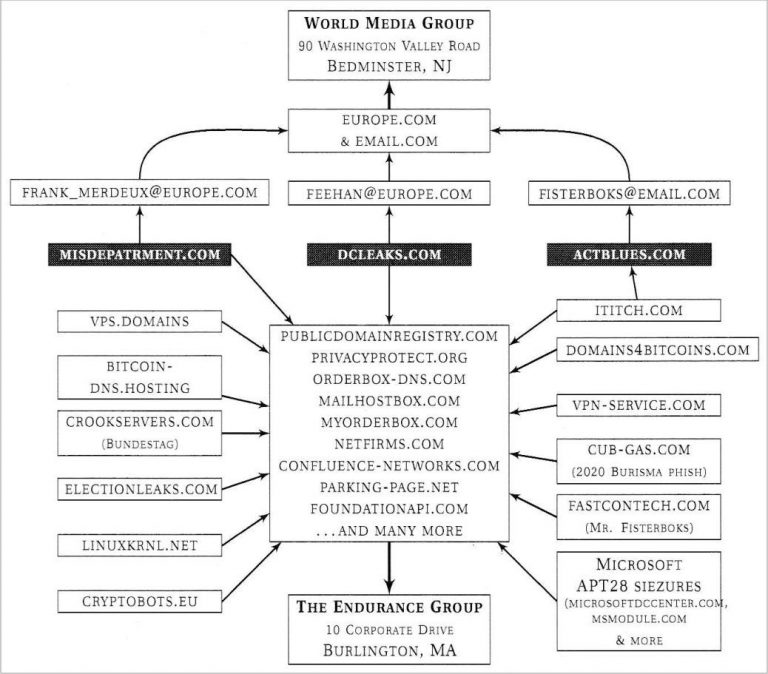
US/NATO-controlled IT used for “Russian” hacking and phishing operations (DJB)
Blake shows how the “Russian hacking” psyop was initiated by the US and NATO in 2014 in response to Russia’s reaction to the US regime change in Ukraine, when Russia retook control of the Crimean Peninsula and supported the de-facto secession of Russian-speaking eastern Ukraine.
The US/NATO psyop was inspired by the actual amateur hackers “CyberBerkut” in Ukraine and “Guccifer” in Romania. Blake shows how in 2014, NATO created a “Cyber Defence Trust Fund” and used this entity to initiate false-flag “hacking operations” against the US and other NATO members that would then be falsely “attributed” to alleged Russian “state-sponsored hacking groups”.
Regarding the most prominent such case, the alleged “hacking” of the US Democratic Party (DNC) and the 2016 Hillary Clinton presidential campaign, Blake shows how the emails and documents in question were in fact exfiltrated by the FBI and FBI cybersecurity contractor CrowdStrike, whose founder, Dmitri Alperovitch, is a Senior Fellow at the US-NATO think tank Atlantic Council.[1]
Blake shows how the mysterious persona of Guccifer 2.0, who claimed the hack, was played by none other than Alperovitch himself, while the technical infrastructure, including the notorious website dcleaks.com, was provided by US and NATO intermediaries in NATO member Romania.
Later, former FBI director Robert Mueller would pretend to “investigate” the cyber operation, attributing it to alleged “Russian hacking groups” named “Cozy Bear” and “Fancy Bear” based on information provided by FBI and DNC contractor CrowdStrike and its CTO Dmitri Alperovitch.[2]
Blake also shows how other alleged “Russian hacks”, including the “hacking” of the German parliament in 2015, relied on the very same NATO-controlled technical infrastructure. Blake was able to show this based on archived information about previous owners of IP addresses, name servers, and SSL security certificates – all pointing to the US military, NATO, and the Ukrainian government.[3]

Archived IP and SSL data tying covert operations to NATO and the Ukrainian government (DJB)
In the case of the staged hack of the US Democratic Party, Blake shows how FBI cybersecurity contractor CrowdStrike added false “Russian fingerprints” by embedding the documents into previously published CyberBerkut documents and inserting additional false signatures. However, CrowdStrike made a few technical mistakes that ultimately revealed their US time zone.
Blake highlights the important fact that in all of these false-flag “Russian hacks”, originating from NATO-controlled infrastructure, either no data or only trivial data was released to the public. Some questions continue to remain open, however, such as the role of murdered DNC employee Seth Rich and the actual source of Wikileaks, whose founder Julian Assange is still in British custody.
In the wake of the 2014 US regime change in Ukraine, the family of then Vice President Joe Biden exfiltrated millions of dollars from Ukraine, protected against corruption investigations by Joe Biden himself, as leaked phone recordings confirmed.
As of 2021, the professionals behind the Ukraine regime change and the “Russiagate” pysop will once again be in full control of the US government.
Most US and European media have promoted the “Russiagate” and “Russian hacking” psyops and will continue to do so. This is because most US and European media, both liberal and conservative, are themselves embedded in networks linked to NATO and the US Council on Foreign Relations. It is only some independent media that have been seriously investigating these topics.
Are there real Russian state-sponsored hacks against Western targets? Yes. Blake argues that, for instance, the hacking operation against the British Institute for Statecraft and its “Integrity Initiative” – itself deeply involved in the “Russiagate” psyop – was likely a professional Russian operation. The problem is that such real operations are much harder to “attribute” than fake ones.
∗∗∗
David J. Blake‘s book can be purchased in paperback, and is available as an adapted digital version.
Cybersecurity group admits SolarWinds hack came from within the US, but doubles down on blaming Russia
RT | January 4, 2021
Internet security firm FireEye has revealed the enormous SolarWinds hack that left upwards of 250 agencies and businesses unprotected for weeks was launched from inside the US – but that hasn’t stopped them from blaming Moscow.
The mega-hack, which affected 250 networks including US government agencies, went undetected by Washington’s security systems because it originated within the US, FireEye told the New York Times. But while one might expect this revelation to pour cold water on the metastasizing, baseless claims that Russia was responsible for the intrusion, speculation about the country’s role has only increased.
The western media establishment has remained largely silent about the latest development in the SolarWinds saga, perhaps embarrassed to blame a foreign country for one’s own inability to safeguard clients’ data. Indeed, the US agencies supposedly tasked with detecting and preventing such attacks – the National Security Agency, the Department of Homeland Security, and the Pentagon’s Cyber Command – all missed the breach. Instead, it took FireEye, a firm that even the AP admits specializes in pinning American security fails on the Kremlin, to uncover the sprawling security snafu.
FireEye allegedly discovered the vulnerability only after those “state actors” broke into its own network to steal security tools, and the Times acknowledged the company has “a history of lackluster security for its products.” However, the same outlet’s coverage suggests such a breach could only have been accomplished with high-level hacking tools backed by a state.
Even the usual Russia hawks were baffled at why the Kremlin would go through all the trouble of infiltrating stateside servers only to – as far as experts can tell – take nothing and leave the system itself intact. “We still don’t know what Russia’s strategic objectives were,” former DHS official Suzanne Spaulding told the New York Times on Sunday – apparently unwilling to consider the heretical notion that Russia might not be the culprit.
Despite the media’s decision to take the “Russia did it” narrative and run with it, FireEye itself has shied away from explicitly pinning the attack on the Kremlin, instead merely claiming it was a government-backed hack. The Associated Press, however, stepped in to fill the blanks, declaring “industry experts” had said it “bore the hallmarks of Russian tradecraft.”
One of those “experts”, Dmitri Alperovitch, was the CEO of CrowdStrike, which famously accused Russia of hacking the Democratic National Committee and failed presidential candidate Hillary Clinton’s campaign in 2016. Even though the software used to pull off those hacks was widely available and the firm itself could only muster “low to medium” confidence regarding a supposed link to the Russian government, that didn’t stop the company from presenting its conclusions as if set in stone. CrowdStrike claimed last week that it was also targeted for hacking by the latest group of “Russians,” but claimed that unlike FireEye, it had withstood the infiltration attempt.
Navalny and Handlers Lose the Plot… He Is a Convicted Felon on Probation
By Finian Cunningham | Strategic Culture Foundation | January 2, 2021
Russia’s federal prison authorities were right to jolt Alexei Navalny this week by warning him to return immediately from Germany or else face a suspended sentence being made into jail time.
The “professional” opposition activist claims to be convalescing in Germany after he was allegedly poisoned by a Soviet-era nerve agent in August. Western news media dutifully repeat the claim that Navalny is “recuperating” in Germany after having survived an assassination plot by Kremlin agents. Navalny has personally accused Russia’s President Vladimir Putin of ordering the alleged hit.
Last week, a team of medics from the Berlin hospital where Navalny had been staying published a paper in The Lancet medical journal in which they claimed he had been poisoned with Novichok nerve agent. Their findings are dubious because the medics acknowledged the involvement of German military intelligence laboratories in conducting their analysis.
But one thing the German doctors did let slip was that a 55-day follow-up check on Navalny ascertained that he had made a “near-complete recovery”.
The Russian dissident figure was flown to Berlin on August 22, two days after he was treated in a hospital in Omsk, Russia. Thus, the German medical team are indicating – no doubt inadvertently – that Navalny’s health recovered nearly two months ago, if not before that.
That means there is no medical reason why he should remain at large in Germany. His claims of “convalescing” and the Western media’s indulgence of those claims are false, if the German doctors are correct about his “recovery”.
Despite Navalny’s arrogant disdain for Russian state laws, he is nevertheless answerable to those authorities as a citizen. While in Germany he was on probation for a suspended jail sentence concerning a fraud conviction in 2014. His so-called Anti-Corruption Foundation (FBK) has a checkered history of shady financing, from allegations of foreign funding by the U.S. State Department to charges of embezzling millions of dollars. Ironically, the blogger and media activist produces slick programs accusing the Russian government of corruption.
In any case, under the laws of the Russian Federation, the 44-year-old Navalny was on probation during the past four months of his stay in Germany. For the last two months, he is in good health, according to his German doctors. So there are no grounds for why he should abscond from Russian territory and evade the laws for which he is answerable.
Not only is Navalny living as if he above the law, he has also shown flagrant contempt for the Russian authorities.
Last week, he published a video on his website claiming that he had pranked a named member of Russia’s security service, the FSB, into admitting that agents had poisoned him while he was visiting the Siberian city of Tomsk on August 20. He was later flown in an emergency to Omsk where he was treated after having apparently fallen ill onboard a flight to Moscow.
The FSB dismissed Navalny’s prank telephone claim as a “deep fake”. The Russian doctors who treated him in Omsk – and who probably saved his life – have repeatedly stated that their tests showed there was no poison in Navalny’s body, and specifically no traces of nerve agent. They said his illness was due to a metabolic disorder. Perhaps self-induced as a ruse to later transfer to Germany?
The transcript of Navalny’s purported prank call to the FSB agent reads like a comic set-up. Posing as a senior member of Russia’s national security council, Navalny affects to bully the supposed agent as if he is a pathetic stooge.
A telling segment is where the self-styled super sleuth fishes for compliments about his own character from the purported FSB man, betraying the narcissism of a megalomaniac.
Again, incredibly, we are expected to believe that someone who had a near-death experience with a lethal nerve poison and who is “convalescing” still in Germany somehow managed to find the energy and mental reserves to pull off a daring 45-minute telephone sting.
If Navalny is fit enough to participate in such practical jokes – regardless of their credibility – then he is surely fit enough to abide by Russian laws and respect his probation terms. As the Russian Federal Prison Service stated this week: “The convicted man is not fulfilling all of the obligations placed on him by the court, and is evading the supervision of the Criminal Inspectorate.”
One gets the unerring impression that Navalny and his foreign handlers have become so self-intoxicated with hubris that they are blind to their own absurd implausibilities.
Why was he permitted to fly by air ambulance to Berlin in the first place if the Russian authorities had evil designs against him?
While there, as a guest of the German government, Navalny has wildly accused President Putin of ordering his alleged assassination. The European governments have subsequently and rashly imposed sanctions on Russia in support of Navalny’s unfounded claims. Then we have the media activist mounting further provocations parlayed into even more outlandish accusations against President Putin and the Kremlin.
All the while there has been no evidence of poisoning presented to support these claims, other than unverifiable assertions by German doctors working with German military intelligence labs, as well as two other NATO laboratories and the Organization for the Prohibition on Chemical Weapons. All of them including the OPCW (the latter compromised over complicity in NATO false-flag provocations in Syria) have refused to share their analytical data and samples with Russia, and yet they are demanding that Moscow launch a criminal investigation into the Navalny case.
The abdication by European governments of due process and of respect for Russian state laws, its government, and its president is astounding. They are indulging a foreign-sponsored gadfly as if he is the sovereign representative of the Russian Federation.
Navalny and his foreign allies have lost the plot in their own telling of an alleged assassination plot.
First things first: he is a convicted felon who is answerable to Russian law. Pushing false flags and slanderous falsehoods from abroad with the intent of damaging Russia’s sovereignty is an abuse of his rights.
Arrogant and overindulged Navalny is patently incapable of even understanding his obligations under law as a Russian citizen. He evidently feels above the law, like many of his Western backers. That’s why Russia is right to tell him to put up or shut up.
While giving Americans $600, Congress sets aside $600 MILLION to fight Russia & China
RT | December 28, 2020
The omnibus spending bill US President Donald Trump eventually agreed to sign gives Americans a pittance, but over $600 million to “counter the influence” of Russia and China and “promote democracy” in Europe and Asia.
The 5,593-page legislation bundled the coronavirus “stimulus” with general 2021 spending. It faced heavy criticism from across the US political spectrum last week, for funding all sorts of pet projects while giving Americans only a $600 individual payment. That’s half of what they got in April, and the only direct assistance to mitigate the economic damage of state-imposed lockdowns.
A million times that much was earmarked for US propaganda and diplomatic efforts aimed against Beijing and Moscow, however. According to Congress, “not less than $290 million” is to be made available for the “Countering Russian Influence Fund.” The funds shall be used to, among other things, “support democracy programs in the Russian Federation and other countries in Europe, Eurasia, and Central Asia.”
One activity specifically listed is the promotion of “internet freedom” – coming from a country where Silicon Valley companies ruthlessly censor what one can think and say online.
No less than $20 million will go “to strengthen democracy and civil society in Central Europe,” including “transparency, independent media, rule of law, minority rights, and programs to combat anti-Semitism.”
Another $300 million was earmarked for the “Countering Chinese Influence Fund” to be used against the “malign influence of the Government of the People’s Republic of China and the Chinese Communist Party and entities acting on their behalf globally.”
Secretary of State Mike Pompeo may well have written those provisions himself. In a major speech in July, he denounced Beijing as a threat to “our people and our prosperity” and called for a generational struggle against the CCP. Just a week before Congress voted on the bill, he also claimed Russian President Vladimir Putin was “a real risk to those of us who love freedom.”
“We have lots of folks that want to undermine our way of life, our republic, our basic democratic principles. Russia is certainly on that list,” Pompeo told Fox News host Mark Levin on December 18.
Trump had initially refused to sign the bill, demanding that Congress cut back on the programs called out by critics and increase the individual payment to $2,000 per person. He then signed it on Sunday, saying he expected Congress to approve the increase as well as respond to several other priorities he raised.
Democrats have already said they will reject any cuts to the omnibus, however, while there is no indication the Republican-led Senate will actually do anything Trump asked.
Russia can refuse to pay $50 billion bill to Yukos oligarchs, country’s top court rules, as foreign legal battle rages
RT | December 27, 2020
Moscow is set for a showdown with Western judges and 1990s Russian oligarchs, over a new ruling enabling the country to refuse to pay what is considered to be the biggest legal settlement in history, over a collapsed oil empire.
The Constitutional Court, one of Russia’s highest judicial authorities, ruled on Friday that the decision of an international tribunal in the long-running dispute over the now-dissolved energy giant Yukos is incompatible with Russian law. The case has been heard by a court in The Hague, which claims jurisdiction under the terms of the Energy Charter Treaty, and awarded the company’s former shareholders a $50-billion payout from the Russian government earlier this year. Moscow claimed a win in November on the other side of the Atlantic, when a US court, which had been hearing the case simultaneously, decided to throw it out.
However, as Russia signed but never ratified the Treaty, which hands powers to international tribunals, the Constitutional Court has now determined it is not bound by the terms of The Hague judgement. The ruling states that, while the country’s government of the day began the process of signing up to the pact in 1994, they did not have the authority to make national laws inferior to international agreements, or to “challenge the competence” of Russian courts. Therefore, the jurists conclude, adhering to the Dutch court’s demands would be “unconstitutional.”
The claimants in the case are oligarchs who lost cash when Yukos, once among Europe’s largest firms, collapsed. They say that a multi-billion dollar tax bill and the arrest of its CEO and founder, Mikhail Khodorkovsky, on fraud charges amounted to state ‘appropriation’ of its assets. However, Russian authorities insist that the shareholders cannot be considered “legitimate,” and that the Dutch judges had steamrolled over the country’s laws against corruption and fraud when ruling in their favour.
As far back as July 2014, The Hague ordered Moscow to cough up $50 billion to compensate the plaintiffs. After exhausting the appeals process in February this year, Russia’s lawyers asked the Dutch Supreme Court to consider the case and overrule the decision. However, at the start of December, it similarly backed the oligarchs.
Russia has insisted that the judgements are “politically motivated,” and in December the country’s Justice Minister, Konstantin Chuychenko, told journalists that the case was part of a “legal war that has been declared on Russia.” He added that “Russia must adequately defend itself and, sometimes, even attack back.”
Now standing at around $50 billion, around the same ballpark as Russia’s annual military budget, the colossal settlement is thought to be the largest award in history. If the country now rejects the bill, it would spark one of the most serious impasses in international legal history, and leave Western states deciding whether to respect Russia’s constitutional ruling, or to enforce the demands by confiscating assets.
Yukos’ former shareholders have already sought to have Western governments take control of Russian property overseas as an insurance policy in case Moscow refuses to pay up. However, in November, a judge in the simultaneous hearing in the US refused that request, saying that “the Russian Federation is a sovereign country with economic tendrils that cross the globe, not an insecure potential debtor that must be required to post security lest there be no assets to seize at a later date.”
Not all countries have taken the same approach, however, and in 2015 Russia’s diplomats slammed France and Belgium for confiscating state cash in overseas banks, and even buildings, to be held as collateral in the case. Moscow again rejected the court’s authority and said their move was “an openly hostile act.” Tim Osborne, a British lawyer representing the former shareholders, said at the time that such seizures were necessary because Russia “has no regard for international law or the rule of law.”
At its height, Yukos produced 20 per cent of Russia’s oil, placing it firmly among the ranks of the world’s most valuable enterprises. It had been formed by the privatization of former state assets after the fall of the Soviet Union, with Khodorkovsky acquiring the assets for a fraction of their worth at an auction that one economist, Andrey Illarionov, called “the swindle of the century.”
Khodorkovsky claims his arrest on fraud charges and the subsequent collapse of Yukos was tied to his political activism and his personal animosity towards Russian President Vladimir Putin. Putin, however, claims that the oligarch, once said to be Russia’s wealthiest man, had admitted his guilt to him privately in exchange for a pardon in 2013.
Khodorkovsky insists that he has renounced any claims to his former empire and that, should a settlement be reached in the Yukos case, he would not stand to benefit. However, Russian authorities are said to suspect that a number of claimants have close financial ties to the former oil magnate.
Featured Video

The Truth About the Trump Shootings with Ken Silva
or go to
Aletho News Archives – Video-Images
From the Archives
The Geopolitics behind the War in Yemen (I)
By Mahdi Darius NAZEMROAYA | Strategic Culture Foundation | 30.03.2015
The United States and the Kingdom of Saudi Arabia became very uneasy when the Yemenese or Yemenite movement of the Houthi or Ansarallah (meaning the supporters of God in Arabic) gained control of Yemen’s capital, Sanaa/Sana, in September 2014. The US-supported Yemenite President Abd-Rabbuh Manṣour Al-Hadi was humiliatingly forced to share power with the Houthis and the coalition of northern Yemenese tribes that had helped them enter Sana. Al-Hadi declared that negotiations for a Yemeni national unity government would take place and his allies the US and Saudi Arabia tried to use a new national dialogue and mediated talks to co-opt and pacify the Houthis.
The truth has been turned on its head about the war in Yemen. The war and ousting of President Abd-Rabbuh Manṣour Al-Hadi in Yemen are not the results of «Houthi coup» in Yemen. It is the opposite. Al-Hadi was ousted, because with Saudi and US support he tried to backtrack on the power sharing agreements he had made and return Yemen to authoritarian rule. The ousting of President Al-Hadi by the Houthis and their political allies was an unexpected reaction to the takeover Al-Hadi was planning with Washington and the House of Saudi. … continue
Blog Roll
 Aletho News
- Pakistan-Iran talks secure LNG shipment to Islamabad through Hormuz
- Black Sea grain crisis puts global wheat supplies under pressure
- IRGC air defenses destroy another US MQ-1 drone over Strait of Hormuz
- Imran Khan’s entire immediate family detained in Pakistan ahead of mass protest demanding his release
- EU nation detains former presidential frontrunner
- Leaked: Britain’s Sham Conviction Of Hashim Thaci
- Seyed M. Marandi: U.S. Strike Imminent – Toward Total War in the Middle East
- Russia Voted Under Fire. Washington Is Loading the Tankers.
- 12 Things Your Oncologist Was Trained Not to Tell You
- Anthrax Attacks Paved Way for COVID-Era ‘Junk Drugs and Vaccines’
- If Americans Knew
- Trump’s militarization of Washington DC as he pursues Israel’s war against Iran
- Why Israel Fears This Searing New Documentary
- Huckabee aide solicited cash gifts from Israelis
- This isn’t sci-fi, AI is already killing people
- ‘The Most Brutal Thing’: Investigation Reveals Execution of Elderly Woman in Rafah
- Inside Israel’s ‘soft’ ethnic cleansing plan for Gaza through the eyes of its victims
- New online database tracks pro-Israel political donations in the United States
- Israeli president pardons soldier convicted for killing wounded Palestinian
- Singer Ed Sheeran says his ‘heart broken’ by Gaza devastation, addresses Macklemore controversy
- Israel Has Imprisoned Female Journalist Bushra Al-Tawil Without Trial Or Charge In Solitary Confinement For Past Month
- No Tricks Zone
- 2025 Nature Paper Claiming Worsening Global Drought Gets RETRACTED …Heavily Flawed
- New Study: ‘Global Drought Shows No Detectable Recent Acceleration Under Climate Warming’
- Economic Masterminds: German Socialists Suggest Taxing Productivity Gains Stemming From Using AI
- The South China Sea Has Not Been Cooperating With The Climate Change Narrative
- Energy Crisis: Germany Enters Heating Season With Historically Low Gas Reserve Fill Levels
- New Study: The Antarctic Ice Sheet Gained Mass From 2020-2024 Due To Staggering Snow And Ice Accumulation
- Study: Ocean Heating Rates From Thousands Of Years Ago ‘Dwarf’ Modern Ocean Heating Rates
- Climate Extremists Target, Attack Large-Scale Power Grid Infrastructure In Germany!
- New Study: Antarctic Ice Melt Has Contributed Less Than 1 Centimeter To Sea Level Rise In The Last 30 Years
- Fear Of Debate: Alarmist German Climate Scientist Calls On Mainstream Media To Discredit Skeptic Voices
 Aletho News