With Biden’s New Threats, the Russia Discourse is More Reckless and Dangerous Than Ever
The U.S. media demands inflammatory claims be accepted with no evidence, while hacking behavior routinely engaged in by the U.S. is depicted as aberrational.
By Glenn Greenwald | December 23, 2020
To justify Hillary Clinton’s 2016 loss to Donald Trump, leading Democrats and their key media allies for years competed with one another to depict what they called “Russia’s interference in our elections” in the most apocalyptic terms possible. They fanatically rejected the view of the Russian Federation repeatedly expressed by President Obama — that it is a weak regional power with an economy smaller than Italy’s capable of only threatening its neighbors but not the U.S. — and instead cast Moscow as a grave, even existential, threat to U.S. democracy, with its actions tantamount to the worst security breaches in U.S. history.
This post-2016 mania culminated with prominent liberal politicians and journalists (as well as John McCain) declaring Russia’s activities surrounding the 2016 [election] to be an “act of war” which, many of them insisted, was comparable to Pearl Harbor and the 9/11 attack — the two most traumatic attacks in modern U.S. history which both spawned years of savage and destructive war, among other things.
Sen. Jeanne Shaheen (D-NH) repeatedly demanded that Russia’s 2016 “interference” be treated as “an act of war.” Hillary Clinton described Russian hacking as “a cyber 9/11.” And Rep. Jerry Nadler (D-NY) on MSNBC in early February, 2018, pronounced Russia “a hostile foreign power” whose 2016 meddling was the “equivalent” of Pearl Harbor, “very much on par” with the “seriousness” of the 1941 attack in Hawaii that helped prompt four years of U.S. involvement in a world war.
With the Democrats, under Joe Biden, [presumably] just weeks away from assuming control of the White House and the U.S. military and foreign policy that goes along with it, the discourse from them and their media allies about Russia is becoming even more unhinged and dangerous. Moscow’s alleged responsibility for the recently revealed, multi-pronged hack of U.S. Government agencies and various corporate servers is asserted — despite not a shred of evidence, literally, having yet been presented — as not merely proven fact, but as so obviously true that it is off-limits from doubt or questioning.
Any questioning of this claim will be instantly vilified by the Democrats’ extremely militaristic media spokespeople as virtual treason. “Now the president is not just silent on Russia and the hack. He is deliberately running defense for the Kremlin by contradicting his own Secretary of State on Russian responsibility,” pronounced CNN’s national security reporter Jim Sciutto, who last week depicted Trump’s attempted troop withdrawal from Syria and Germany as “ceding territory” and furnishing “gifts” to Putin. More alarmingly, both the rhetoric to describe the hack and the retaliation being threatened are rapidly spiraling out of control.
Democrats (along with some Republicans long obsessed with The Russian Threat, such as Mitt Romney) are casting the latest alleged hack by Moscow in the most melodramatic terms possible, ensuring that Biden will enter the White House with tensions sky-high with Russia and facing heavy pressure to retaliate aggressively. Biden’s top national security advisers and now Biden himself have, with no evidence shown to the public, repeatedly threatened aggressive retaliation against the country with the world’s second-largest nuclear stockpile.
Congressman Jason Crow (D-CO) — one of the pro-war Democrats on the House Armed Services Committee who earlier this year joined with Rep. Liz Cheney (R-WY) to block Trump’s plan to withdraw troops from Afghanistan — announced: “this could be our modern day, cyber equivalent of Pearl Harbor,” adding: “Our nation is under assault.” The second-ranking Senate Democrat, Dick Durbin (D-IL), pronounced: “This is virtually a declaration of war by Russia.”
Meanwhile, Sen. Mitt Romney (R-UT), who has for years been casting Russia as a grave threat to the U.S. while Democrats mocked him as a relic of the Cold War (before they copied and then surpassed him), described the latest hack as “the equivalent of Russian bombers flying undetected over the entire country.” The GOP’s 2012 presidential nominee also blasted Trump for his failure to be “aggressively speaking out and protesting and taking punitive action,” though — like virtually every prominent figure demanding tough “retaliation” — Romney failed to specify what he had in mind that would be sufficient retaliation for “the equivalent of Russian bombers flying undetected over the entire country.”
For those keeping track at home: that’s two separate “Pearl Harbors” in less than four years from Moscow (or, if you prefer, one Pearl Harbor and one 9/11). If Democrats actually believe that, it stands to reason that they will be eager to embrace a policy of belligerence and aggression toward Russia. Many of them are demanding this outright, mocking Trump for failing to attack Russia — despite no evidence that they were responsible — while their well-trained liberal flock is suggesting that the non-response constitutes some form of “high treason.”
Indeed, the Biden team has been signalling that they intend to quickly fulfill demands for aggressive retaliation. The New York Times reported on Tuesday that Biden “accused President Trump [] of ‘irrational downplaying’” of the hack while “warning Russia that he would not allow the intrusion to ‘go unanswered’ after he takes office.” Biden emphasized that once the intelligence assessment is complete, “we will respond, and probably respond in kind.”
Threats and retaliation between the U.S. and Russia are always dangerous, but particularly so now. One of the key nuclear arms agreements between the two nuclear-armed nations, the New START treaty, will expire in February unless Putin and Biden can successfully negotiate a renewal: sixteen days after Biden is [tentatively] scheduled to take office. “That will force Mr. Biden to strike a deal to prevent one threat — a nuclear arms race — while simultaneously threatening retaliation on another,” observed the Times.
This escalating rhetoric from Washington about Russia, and the resulting climate of heightened tensions, are dangerous in the extreme. They are also based in numerous myths, deceits and falsehoods:
First, absolutely no evidence of any kind has been presented to suggest, let alone prove, that Russia is responsible for these hacks. It goes without saying that it is perfectly plausible that Russia could have done this: it’s the sort of thing that every large power from China and Iran to the U.S. and Russia have the capability to do and wield against virtually every other country including one another.
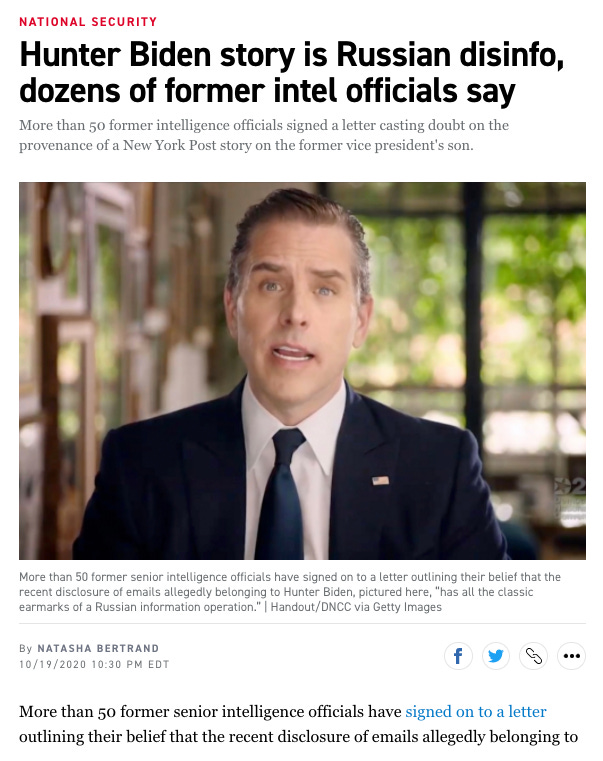
But if we learned nothing else over the last several decades, we should know that accepting claims that emanate from the U.S. intelligence community about adversaries without a shred of evidence is madness of the highest order. We just had a glaring reminder of the importance of this rule: just weeks before the election, countless mainstream media outlets laundered and endorsed the utterly false claim that the documents from Hunter Biden’s laptop were “Russian disinformation,” only for officials to acknowledge once the harm was done that there was no evidence — zero — of Russian involvement.
Yet that is exactly what the overwhelming bulk of media outlets are doing again: asserting that Russia is behind these hacks despite having no evidence of its truth. The New York Times’ Michael Barbaro, host of the paper’s popular The Daily podcast, asked his colleague, national security reporter David Sanger, what evidence exists to assert that Russia did this. As Barbaro put it, even Sanger is “allowing that early conclusions could all be wrong, but that it’s doubtful.” Indeed, Sanger acknowledged to Barbaro that they have no proof, asserting instead that the basis on which he is relying is that Russia possesses the sophistication to carry out such a hack (as do several other nation-states), along with claiming that the hack has what he calls the “markings” of Russian hackers.
But this tactic was exactly the same one used by former intelligence officials, echoed by these same media outlets, to circulate the false pre-election claim that the documents from Hunter Biden’s laptop were “Russian disinformation”: namely, they pronounced in lockstep, the material from Hunter’s laptop “has all the classic earmarks of a Russian information.” This was also exactly the same tactic used by the U.S. intelligence community in 2001 to falsely blame Iraq for the anthrax attacks, claiming that their chemical analysis revealed a substance that was “a trademark of the Iraqi biological weapons program.”
These media outlets will, if pressed, acknowledge their lack of proof that Russia did this. Despite this admitted lack of proof, media outlets are repeatedly stating Russian responsibility as proven fact.
“Scope of Russian Hacking Becomes Clear: Multiple U.S. Agencies Were Hit,” one New York Times headline proclaimed, and the first line of that article, co-written by Sanger, stated definitively: “The scope of a hacking engineered by one of Russia’s premier intelligence agencies became clearer on Monday.” The Washington Post deluged the public with identically certain headlines.
Nobody in the government has been as definitive in asserting Russian responsibility as corporate media outlets. Even Trump’s hawkish Secretary of State, Mike Pompeo, crafted his accusation against Moscow with caveats and uncertainty: “I think it’s the case that now we can say pretty clearly that it was the Russians that engaged in this activity.”
If actual evidence ultimately emerges demonstrating Russian responsibility, it would not alter how dangerous it is that — less than twenty years after the Iraq WMD debacle and less than a couple of years after media endorsement of endless Russiagate falsehoods — the most influential media outlets continue to mindlessly peddle as Truth whatever the intelligence community feeds them, without the need to see any evidence that what they’re claiming is actually true. Even more alarmingly, large sectors of the public that venerate these outlets continue to believe that what they hear from them must be true, no matter how many times they betray that trust. The ease with which the CIA can disseminate whatever messaging it wants through friendly media outlets is stunning.
Second, the very idea that this hack could be compared to rogue and wildly aberrational events such as Pearl Harbor or the 9/11 attack is utterly laughable on its face. One has to be drowning in endless amounts of jingoistic self-delusion to believe that this hack — or, for that matter, the 2016 “election interference” — is a radical departure from international norms as opposed to a perfect reflection of them.
Just as was true of 2016 fake Facebook pages and Twitter bots, it is not an exaggeration to say that the U.S. Government engages in hacking attacks of this sort, and ones far more invasive, against virtually every country on the planet, including Russia, on a weekly basis. That does not mean that this kind of hacking is either justified or unjustified. It does mean, however, that depicting it as some particularly dastardly and incomparably immoral act that requires massive retaliation requires a degree of irrationality and gullibility that is bewildering to behold.
The NSA reporting enabled by Edward Snowden by itself proved that the NSA spies on virtually anyone it can. Indeed, after reviewing the archive back in 2013, I made the decision that I would not report on U.S. hacks of large adversary countries such as China and Russia because it was so commonplace for all of these countries to hack one another as aggressively and intrusively as they could that it was hardly newsworthy to report on this (the only exception was when there was a substantial reason to view such spying as independently newsworthy, such as Sweden’s partnering with NSA to spy on Russia in direct violation of the denials Swedish officials voiced to their public).
Other news outlets who had access to Snowden documents, particularly The New York Times, were not nearly as circumspect in exposing U.S. spying on large nation-state adversaries. As a result, there is ample proof published by those outlets (sometimes provoking Snowden’s strong objections) that the U.S. does exactly what Russia is alleged to have done here — and far worse.
“Even as the United States made a public case about the dangers of buying from [China’s] Huawei, classified documents show that the National Security Agency was creating its own back doors — directly into Huawei’s networks,” reported The New York Times’ David Sanger and Nicole Perlroth in 2013, adding that “the agency pried its way into the servers in Huawei’s sealed headquarters in Shenzhen, China’s industrial heart.”
In 2013, the Guardian revealed “an NSA attempt to eavesdrop on the Russian leader, Dmitry Medvedev, as his phone calls passed through satellite links to Moscow,” and added: “foreign politicians and officials who took part in two G20 summit meetings in London in 2009 had their computers monitored and their phone calls intercepted on the instructions of their British government hosts.” Meanwhile, “Sweden has been a key partner for the United States in spying on Russia and its leadership, Swedish television said on Thursday,” noted Reuters, citing what one NSA document described as “a unique collection on high-priority Russian targets, such as leadership, internal politics.”

Other reports revealed that the U.S. had hacked into the Brazilian telecommunications system to collect data on the whole population, and was spying on Brazil’s key leaders (including then-President Dilma Rousseff) as well as its most important companies such as its oil giant Petrobras and its Ministry of Mines and Energy. The Washington Post reported: “The National Security Agency is gathering nearly 5 billion records a day on the whereabouts of cellphones around the world, according to top-secret documents and interviews with U.S. intelligence officials, enabling the agency to track the movements of individuals — and map their relationships — in ways that would have been previously unimaginable.” And on and on.
[One amazing though under-appreciated episode related to all this: the same New York Times reporter who revealed the details about massive NSA hacking of Chinese government and industry, Nicole Perlroth, subsequently urged (in tweets she has now deleted) that Snowden not be pardoned on the ground that, according to her, he revealed legitimate NSA spying on U.S. adversaries. In reality, it was actually she, Perlorth, not Snowden, who chose to expose NSA spying on China, provoking Snowden’s angry objections when she did so based on his view this was a violation of the framework he created for what should and should not be revealed; in other words, not only did Perlroth urge the criminal prosecution of a source on which she herself relied, an absolutely astonishing thing for any reporter to do, but so much worse, she did so by falsely accusing that source of doing something that she, Perlroth, had done herself: namely, reveal extensive U.S. hacking of China].
What all of this makes demonstrably clear is that only the most deluded and uninformed person could believe that Russian hacking of U.S. agencies and corporations — if it happened — is anything other than totally normal and common behavior between these countries. Harvard Law Professor and former Bush DOJ official Jack Goldsmith, reviewing growing demands for retaliation, wrote in an excellent article last week entitled “Self-Delusion on the Russia Hack: The U.S. regularly hacks foreign governmental computer systems on a massive scale”:
The lack of self-awareness in these and similar reactions to the Russia breach is astounding. The U.S. government has no principled basis to complain about the Russia hack, much less retaliate for it with military means, since the U.S. government hacks foreign government networks on a huge scale every day. Indeed, a military response to the Russian hack would violate international law . . . .
As the revelations from leaks of information from Edward Snowden made plain, the United States regularly penetrates foreign governmental computer systems on a massive scale, often (as in the Russia hack) with the unwitting assistance of the private sector, for purposes of spying. It is almost certainly the world’s leader in this practice, probably by a lot. The Snowden documents suggested as much, as does the NSA’s probable budget. In 2016, after noting “problems with cyber intrusions from Russia,” Obama boasted that the United States has “more capacity than anybody … offensively” . . . .
Because of its own practices, the U.S. government has traditionally accepted the legitimacy of foreign governmental electronic spying in U.S. government networks. After the notorious Chinese hack of the Office of Personnel Management database, then-Director of National Intelligence James Clapper said: “You have to kind of salute the Chinese for what they did. If we had the opportunity to do that, I don’t think we’d hesitate for a minute.” The same Russian agency that appears to have carried out the hack revealed this week also hacked into unclassified emails in the White House and Defense and State Departments in 2014-2015. The Obama administration deemed it traditional espionage and did not retaliate. “It was information collection, which is what nation states—including the United States—do,” said Obama administration cybersecurity coordinator Michael Daniel this week.
But over the last four years, Americans, particularly those who feed on liberal media outlets, have been drowned in so much mythology about the U.S. and Russia that they have no capacity to critically assess the claims being made, and — just as they were led to believe about “Russia’s 2016 interference in Our Sacred Elections” — are easily convinced that what Russia did is some shocking and extreme crime the likes of which are rarely seen in international relations. In reality, their own government is the undisputed world champion in perpetrating these acts, and has been for years if not decades.
Third, these demands for “retaliation” are so reckless because they are almost always unaccompanied by any specifics. Even if Moscow’s responsibility is demonstrated, what is the U.S. supposed to do in response? If your answer is that they should hack Russia back, rest assured the NSA and CIA are always trying to hack Russia as much as it possibly can, long before this event.
If the answer is more sanctions, that would be just performative and pointless, aside from wildly hypocritical. Any reprisals more severe than that would be beyond reckless, particularly with the need to renew nuclear arms control agreements looming. And if you are someone demanding retaliation, do you believe that Russia, China, Brazil and all the other countries invaded by NSA hackers have the same right of retaliation against the U.S., or does the U.S. occupy a special place with special entitlements that all other countries lack?
What we have here, yet again, is the classic operation of the intelligence community feeding serious accusations about a nuclear-armed power to an eagerly gullible corporate media, with the media mindlessly disseminating it without evidence, all toward ratcheting up tensions between these two nuclear-armed powers and fortifying a mythology of the U.S. as grand victim but never perpetrator.
If you ever find yourself wondering how massive military budgets and a posture of Endless War are seemingly invulnerable to challenge, this pathological behavior — from a now-enduring union of the intelligence community, corporate media outlets, and the Democratic Party — provides one key piece of the puzzle.
The Washington Post Can’t Stop Babbling About Russians ‘Hacking Our Minds’
By Caitlin Johnstone | December 19, 2020
The Washington Post has published another article warning its readers that the Russians are “hacking our minds”, this one authored by CNN’s Fareed Zakaria.
“Russia hasn’t just hacked our computer systems. It’s hacked our minds.” blares the ridiculous, propagandistic headline for an article about “the Russian model” of propaganda which “rests on the principle that people get convinced when they hear the same message many times from a variety of sources, no matter how biased.”
Which is funny, since this is not the first time WaPo itself has repeated this cartoonish narrative about Russian mind-hackers.
Just two months ago the Washington Post editorial board published an article titled “The US may be safe from foreign interference in this election. But what about perception hacking?“, which opens with the line “Russia and other adversaries may not need to hack the election if they can hack something else: our minds.”
The paranoid screed unironically argued that Russia is using its super powerful propaganda engine to make people paranoid and doubtful of US electoral systems, which could actually have an adverse effect on the US election. As though telling people their mental and perceptual faculties are being hacked by a hostile foreign enemy with the goal of influencing the election would not make them paranoid and doubtful of US electoral systems.
Zakaria’s piece builds on this already established theme by parroting the still completely evidence-free claim that Russia was responsible for the far-reaching cyber intrusion into the IT company SolarWinds, whose cybersecurity we recently learned was left so unprotected that its update server’s password was literally “solarwinds123”.
“But what about the perhaps more insidious Russian efforts at disinformation, which have helped to reshape the information environment worldwide?” Zakaria asks. He then does a few mental gymnastics to tie Russia’s propaganda campaign to Donald Trump, because of course he does, and leaves the reader with the closing line, “The problem is not just that Russia has hacked America’s computer systems. It seems to have hacked our minds.”
WaPo keeps hammering this narrative about powerful Russian mind-hackers as though Russia is the only nation with an existing propaganda campaign on the world stage and not one of the weaker ones doing so. The US government itself openly uses propaganda on foreigners with programs like Radio Free Europe, Radio Free Asia and Voice of America, which actually serve the more important function of presenting the illusion that those are the only form of US government propaganda.
In reality the plutocratic class which owns the mass media works closely with the US government and sets up its institutions to only elevate voices which advance narratives that are favorable to the status quo those plutocrats have built their kingdoms upon. WaPo itself is owned by the richest man in the world who is also a CIA contractor and sits on a Pentagon advisory board. The unofficial propaganda operations of the oligarchic empire give it a massive edge in international narrative control that dwarfs both official US propaganda programs and anything the Russian government could ever come up with.
Among some very stiff competition, one of the dumbest recurring themes in western imperialist media is the idea that world affairs, entire electoral and governmental systems, and even our very minds, are being controlled by a nation with the same GDP as South Korea. Russia does not have an especially strong sway over the world stage, it just happens to be one of the few remaining power structures which have resisted absorption into the US-centralized empire and is being targeted with a propaganda campaign aimed at changing that.
Russia is not hacking your mind. If anyone is hacking your mind, it’s the vast globe-spanning power structure loosely centralized around the United States which has been aggressively propagandizing you into supporting the continuation of status quo politics since you were born.
The dawn of political insight comes when you realize that propaganda is not just something that is done by other nations to other people. It is done by your own rulers, in your own nation, and it is being done to you.
Support Caitlin on Patreon.
Trump’s China tweet ‘destructive & deceitful’ as there isn’t ‘ANY QUESTION’ Russia behind latest hacking scare, Adam Schiff claims

RT | December 20, 2020
Rep. Adam Schiff (D-Calif.) has joined Secretary of State Mike Pompeo in blaming Russia for a recent massive cyber attack. He also slammed President Donald Trump for the inconvenient suggestion China could have been the culprit.
“Based on what I’ve seen, I don’t think there’s any question that it was Russia,” Schiff, who is the Chairman of the House Intelligence Committee, told MSNBC on Sunday, commenting on the hack.
The hacking operation in question targeted the SolarWinds Orion Platform, a network monitoring tool used by US government agencies and numerous corporations. There has been no evidence presented that Russia was behind the hack, but Pompeo alleged otherwise in a recent interview.
The president broke with his secretary of state on Saturday and called out “fake news media” for their anonymous reports pinning the hack on Russia. He also suggested China may have been behind the hack, tying it to his ongoing allegations of voter fraud in key swing states during November’s election.
Schiff, one of the president’s most vocal critics in the House and a supporter of evidence-free claims Russia colluded to influence the 2016 presidential election, called Trump’s tweets “uniformly destructive and deceitful and injurious” to the country’s “national security.”
In a previous tweet, Schiff called the president’s China accusation “another scandalous betrayal of our national security.”
Sen. Mitt Romney (R-Utah) also pushed back against the president on Sunday, accusing him of having a “blind spot” when it comes to Russia.
“What Russia has done is put in place a capacity to potentially cripple us in terms of our electricity, our water, our communications,” the senator told CNN’s Jake Tapper.
The Republican called for the cyber attack to be “met with a very strong response, not just rhetorical, important as that is, but also with a cyber response of like magnitude or greater.”
Similarly to 2016, the claim of a major Russian cyber attack on the US comes amid the expected transition of power at the White House – although President Trump continues his legal efforts disputing the election result over the alleged mass-scale voter fraud. When Trump assumed his post in January 2017, the stage had already been set for the worsening of relations with Moscow, which included dozens of Russian diplomats getting expelled by the Obama administration over the allegations of meddling in US affairs and over “hacking” of the election. As Trump’s term progressed, overshadowed by the failed ‘Russiagate’ investigation, initial hopes of a detente with Moscow have all but faded.
America analysts downbeat as Washington opts to withdraw Siberia & remote Far East diplomatic presence
RT | December 19, 2020
As Russia moves to liberalize its Visa system for most Western visitors, the US has said it will close its last consulates outside Moscow. This step is certain to reduce person-to-person contacts between Americans and Russians.
The decision, which has echoes of the Cold War, albeit with roles reversed in terms of the paranoia at play, will see diplomatic offices close in the Far Eastern capital Vladivostok, and in Ekaterinburg, Russia’s fourth largest city, located east of the Ural Mountains. President Donald Trump’s administration notified Congress of the plans over a week ago, but the news received little coverage until Saturday.
While the exact timings of the closures have not yet been made clear, it is understood that American officials will be transferred to the country’s embassy in Moscow, while local Russian support staff will be laid off. In news that will satisfy Washington’s deficit hawks, the State Department predicts that the move, if made permanent, would save $3.2 million each year.
In a written communiqué, the administration claims that its actions are “in response to ongoing staffing challenges of the US Mission in Russia in the wake of the 2017 Russian-imposed personnel cap on the US Mission and resultant impasse with Russia over diplomatic visas.” The presence of state representatives first became an issue in 2016, when Washington expelled 35 of Moscow’s diplomats, limiting its mission’s numbers, over alleged attempts to interfere with that year’s Presidential elections, which Russia strenuously denies.
The decision leaves the US without formal representation anywhere apart from the capital, in a country that bridges two continents. As well as providing consular services to the more than a quarter of a million Americans who visit Russia each year, the offices are charged with issuing visas to Russians wishing to travel stateside.
Residents of Russia’s Far East who wish to visit the US will now have to fly for up to nine hours to Moscow for a Visa, with no guarantees that their application will be approved. Likewise, Americans needing to access consular services will face days of travel if they need support in Siberia or the Far East. The move, and the restrictive Visa regime, flies in the face of Russia’s recent policy towards liberalizing the process, with the introduction of a digital system offering tourists stays of up to 16-days for no more than $50 to be rolled out in January 2021. Americans are excluded from the scheme, but citizens of most NATO states are eligible.
Many analysts took to Twitter to criticize the American decision, even those usually supportive of a more confrontational approach to relations with Russia. One-time US Ambassador Michael McFaul, who has frequently become the target of ridicule over his bellicose and often inaccurate claims about the country, said that he was “saddened” by the decision, adding that “the US should be seeking ways to engage more directly with Russian society.”
A senior national security adviser to the University of Denver’s Biden Institute, Sam Vinograd, was similarly concerned over the impact of the closures, adding that “there’s a reason we have embassies and consulates in countries. Closing consulates could harm Americans and our interests.”
While ties between Moscow and Washington have been consistently under strain over a number of issues in recent months, it is unclear how the decision to shutter diplomatic offices is expected to relieve tensions. In most cases, consulates fulfil a purely administrative role, but they often also act as hubs for cultural and political exchanges, hosting events and enabling diplomats to get a better understanding of a country beyond its capital. Shuttering them also deprives the US of a useful vantage point in Vladivostok, in close range of China, North Korea and Japan.
In 2018, US officials forced Moscow to shut its consulate in Seattle, leaving it without any representation on America’s West Coast. In retaliation, the Kremlin told Washington to shut down its equivalent operations in the city of St Petersburg, one of Russia’s most popular tourist destinations. The spat saw around 60 diplomats expelled from the country, with Deputy Foreign Minister Sergey Ryabkov saying at the time that they had been ”declared ‘persona non grata’ for activities incompatible with diplomatic status.”
These decisions have widely been interpreted as attempts to restrict the kind of human-to-human contact that helps challenge established narratives about countries. In the Soviet-era, access to the country for foreign visitors was tightly restricted. But now, it would appear that the situation has reversed and, if a new Cold War is indeed underway, the US has chosen to close its doors to many Russians.
Ex-intel official listed among spooks rejecting Hunter Biden scandal as Russian disinfo NEVER SIGNED that letter
RT | December 18, 2020
An ex-intelligence official listed on a letter suggesting that allegations of influence peddling by Joe Biden’s family stemmed from Russian disinformation told the National Review that he had never seen nor signed the document.
The news outlet discovered the discrepancy as it sought comments from the 51 people listed on the letter as to whether their assessment had changed in light of confirmation that Biden’s son, Hunter Biden, had been under FBI investigation for more than a year.
National Review said that when it contacted Gregory Treverton, former chairman of the National Intelligence Council, he apparently misunderstood the query, saying, “This is the first I’ve seen of this, but happy to sign.” When the newspaper clarified that he had already been named as a signatory, he said that he had never seen the letter but would have signed if he had received the request. He made that statement despite acknowledging that he hadn’t “looked at” the federal investigation of Hunter Biden.
Treverton’s haphazard response and the fact that his name was falsely used to add weight to the letter may undermine the credibility of an increasingly popular technique used by former US spooks to influence public opinion and provide fodder for mainstream-media narratives. A similar letter signed by dozens of former officials with the CIA and other intelligence agencies was deployed last month to show that national security experts agreed that President Donald Trump should give up his legal fight over the November 3 election and concede that Biden had won.
As in the case of the earlier letter, which was dated October 19, CNN and other outlets trumpeted the consensus of the security experts to support their assertions, arguing that Trump didn’t have a legitimate fraud case to nullify Biden’s media-declared election victory. But claims in the earlier letter were made even more dubious when Hunter Biden himself announced last week that he was under federal investigation.
Former CIA chiefs Mike Hayden and John Brennen were among signatories to the letter, as was ex-Director of National Intelligence James Clapper. Their baseless argument that Moscow was likely behind the allegations against the Bidens was used by the media as justification to dismiss the New York Post’s October scoops documenting the family’s alleged influence-peddling.
The signatories conceded that they had no evidence that the emails cited by the Post weren’t genuine, but suggested that the trove of data found on a laptop allegedly belonging to Hunter Biden fit with Russia’s agenda of discrediting Trump’s opponent. They asserted that the emails had “the classic earmarks” of a Russian disinformation campaign. The ex-spooks also ignored other evidence brought against the Bidens, including on-the-record comments by a former business partner, Tony Bobulinski.
The large number of signatories was used to claim strong credibility for the allegations in the letter. “The real power here, however, is the number of working-level intelligence-community officers who want the American people to know that once again, the Russians are interfering,” former Brennan aide Nick Shapiro tweeted at the time.
Joe Biden cited the letter in his final debate with Trump, saying there were “50 former national intelligence folks who said that what he is accusing me of is a Russian plant.”
The National Review said it was unable so far to determine whether any of the 50 other signatories listed on the letter had been included without being notified.
US Media Suffers From ‘Russia Hack Syndrome’ & Provides No Proof of Breach, as Usual
By Ekaterina Blinova – Sputnik – 18.12.2020
The “Russia did it narrative” concerning the alleged breach into US federal cyber infrastructure is being circulated by the media despite the US government not formally blaming Moscow for the supposed hack. American scholars Gilbert Doctorow and Earl Rasmussen have discussed the accusations and the timing of the media campaign.
On 17 December, the US Cybersecurity and Infrastructure Security Agency issued a warning saying that American government agencies, critical infrastructure entities, and private sector organisations had been compromised “by an advanced persistent threat (APT) actor” since at least March 2020.
The story popped up on Saturday, with Reuters and The Washington Post reporting about the alleged cyber intrusion into the US Treasury and Commerce departments and pointing the finger at Russia, citing “people familiar with the matter”. Russian Ambassador to the US Anatoly Antonov rejected the media claims during a video conference held by Georgetown University and suggested establishing a platform for a dialogue between the US and Russian intelligence communities.
Timing of the Allegations Speaks Volumes
The timing of the alleged hack evokes strong memories of the 2016-2017 transition period when Russia was accused of breaching the Democratic National Committee’s (DNC) servers, according to Gilbert Doctorow, an international relations and Russian affairs analyst.
“One constant feature of American foreign policy going back at least to the last transition in power following Donald Trump’s election in November 2016 is that in this transition the wreckers use the ‘interregnum’ to prevent reasonable policies from being implemented by the incoming administration”, he says.
He recollects that at that time Donald Trump’s chances of reaching an accommodation with Russia were upset “by the illegal and unjustified expropriation of Russian consular property in December 2016, for example, and the phony Steele dossier was released before Trump took the oath of office”. The latest accusations mentioning Russia came on the heels of the 2020 Electoral College vote in favour of ex-Vice President Joseph Biden, who earlier vowed to increase pressure on Moscow.
Doctorow believes the Democratic-controlled House may use the recent anti-Russia allegations to put forward a bill on tougher sanctions, likely related to the Gazprom-led Nord Stream 2 pipeline project that is heading towards completion.
“On the other hand, the Senate may not be very cooperative, especially if the Republicans win the two vacant seats in Georgia during the January election run-off”, he suggests. “And the incoming Secretary of State Blinken is unlikely to want to strike the Russian jugular – he is on record as favouring SALT renewal, which would be impossible if there are draconian sanctions about to be imposed.”
During his annual press conference on 17 December Russian President Vladimir Putin commented on the spying allegations promoted by the mainstream media in the US, suggesting the anonymous sources behind these reports are, in fact, US officials and intelligence agencies. The Russian president noted that these very structures were behind the similarly groundless claims against Moscow following the 2016 presidential elections, adding the new reports of “Russian hackers” could have been fabricated at their behest.
Hacking Allegations Don’t Hold Water, Again
“As with the DNC hacks and Russiagate we once again find the ‘Russians’ being accused of hacking absent any evidence”, says Earl Rasmussen, executive vice president of the Washington-based think tank Eurasia Centre. “For one, I am tired of the Russia Hack Syndrome.”
The scholar recalls that four years ago Russia was accused of “exfiltrating” thousands of emails and documents from the Democratic National Committee’s servers and passing them to WikiLeaks which subsequently released the trove in the summer of 2016.
In January 2017, the Intelligence Community Assessment (ICA) formally accused Russia of the supposed breach, while in July 2018 Special Counsel Robert Mueller assigned with the task of looking into the alleged ties between the Trump campaign and Moscow indicted a number of Russian individuals said to be officers of the Main Intelligence Directorate (GRU) for the reported hack. The accusations were based on the conclusions of the DNC’s private cyber defence contractor CrowdStrike since neither the FBI, nor any other US government intelligence agency have to date examined the committee’s hardware.
“[However], recently unclassified sworn testimony of CrowdStrike officials and senior intelligence officials all stated that there was no evidence of a hack or exfiltration”, Rasmussen highlights, citing CrowdStrike President Shawn Henry’s December 2017 admission under oath that the cyber firm “did not have concrete evidence that the data was exfiltrated from the DNC”.
CrowdStrike claimed at the time that the intruders were “two Russian espionage groups”, Cozy Bear (APT29) and Fancy Bear (APT28), suggesting with a “low” to “medium”-level of confidence that they “may indicate affiliation” with Russia’s Federal Security Service (FSB) and Main Intelligence Department (GRU), respectively. Moscow summarily shredded the assumptions as absurd.
The DNC contractor is also known for a groundless claim that the “Russian” group Fancy Bear hacked a Ukrainian artillery app which led to heavy losses of howitzers in 2016 that was later debunked by both the Ukrainian Defence Ministry and the US state-owned media Voice of America.
Yet, the aforementioned inconsistencies did not prevent the US intelligence community and mainstream media from continuously accusing Russia of the alleged DNC hack for over four years, Rasmussen notes.
“I think the credibility of US intelligence, law enforcement, and media are pretty much discredited”, he says. “I am leery of anything coming from the media and their so-called sources without significant evidence. Besides, our own government is one of the biggest and most sophisticated cyber threats in the world”.
Hunter Biden News Should Shame Dismissive Media Outlets
By Mark Hemingway | RealClear Politics | December 14, 2020
Hunter Biden announced Wednesday he is under federal investigation for his financial dealings in foreign countries, including China. While the news sent shockwaves through Washington, D.C., it shouldn’t have been surprising. The announcement confirms many of the allegations of corruption that were leveled against Hunter Biden in the months leading up to the November elections – allegations the media steadfastly refused to cover.
The nation’s largest social media companies went further: They made the shocking decision to actively censor the New York Post’s eye-opening scoop revealing evidence of Joe Biden’s son’s influence peddling that was recovered from an abandoned laptop. Twitter locked the newspaper out of its own account for weeks. Facebook prevented the Post’s story from being widely distributed, even though neither Joe Biden nor his campaign disputed the authenticity of the documents published by the paper.
In retrospect, not only do the documents appear to be authentic, but a Daily Beast report Thursday notes evidence that the Hunter Biden investigation was hiding in plain sight. One of the FBI documents from the laptop published by the Post “included a case number that had the code associated with an ongoing federal money laundering investigation in Delaware, according to several law enforcement officials who reviewed the document. Another document — one with a grand jury subpoena number — appeared to show the initials of two assistant U.S. attorneys linked to the Wilmington, Delaware, office.” Hunter Biden claims he only learned of the investigation this past week, but these documents suggest otherwise.
Even a cursory inquiry by the New York Post’s competitors would have confirmed that Biden was under federal investigation. One journalist did behave like a reporter. In late October, Sinclair Broadcast Group correspondent James Rosen reported that Hunter Biden was under active investigation and a Justice Department official confirmed his scoop. Almost without exception, America’s press corps refused to follow up on Rosen’s revelation — or even report it.
It’s bad enough that the allegations were ignored, but the media response to the story was far worse. Without making any meaningful attempts to independently verify any of the details, they immediately asserted that Hunter Biden’s laptop was part of a “Russian disinformation” campaign.
Natasha Bertrand, a Politico reporter known among Trump supporters for her credulous reporting on the Steele dossier, wrote a piece headlined “Hunter Biden story is Russian disinfo, dozens of former intel officials say.” The New York Times reported, “Trump Said to Be Warned That Giuliani Was Conveying Russian Disinformation” and, further, that Trump “shrugged off” the warning about his aide, who was involved in bringing the laptop story to light.
Both stories appeared on Oct. 15, the day after the Post’s bombshell report. In the broader media, the default explanation for the laptop became – once again – a Vladimir Putin-backed conspiracy. By contrast, the idea that an erratic Hunter Biden, who once left a crack pipe and his dead brother’s state attorney general badge in a rental car, forgot to pick up his laptop at a computer repair shop a short distance from his house was deemed far-fetched.
Even setting aside the charges specifically connected to the laptop, what was known about Hunter’s foreign dealings was damning enough that the media should have demanded Joe and Hunter answer a slew of pointed questions. Instead, there was only one puffy, televised ABC News interview with Hunter Biden that also aired, probably not coincidentally, on Oct. 15, perfectly timed to rebut the Post.
When asked about his controversial job serving on the board of Ukrainian gas company Burisma, Biden’s response to ABC vacillated between self-serving and dishonest. “There’s been a lot of misinformation about me. … Bottom line is that I know that I was completely qualified to be on the board to head up the corporate governance and transparency committee on the board,” he said.
The assertion, absurd on its face, went largely unchallenged by ABC. Biden didn’t speak the language of the country where Burisma is headquartered, had no experience in the oil and gas sector, and had never served on the board of a for-profit company. Moreover, getting paid a million dollars a year to serve on a corporate board is unheard of. Corporate watchdogs have noted that his post was rife with conflicts that would have violated federal securities law if Burisma was a U.S. company. He got the job weeks after it was announced his father was overseeing America’s Ukraine policy from the White House.
Instead, Hunter was allowed by ABC to present himself as the victim. “I gave a hook to some very unethical people to act in illegal ways to try to do some harm to my father. That’s where I made the mistake,” Biden told the credulous network. “So I take full responsibility for that. Did I do anything improper? No, not in any way. Not in any way whatsoever.”
ABC also whiffed on the China question. Biden told ABC News he hadn’t personally profited from a $1.5 billion deal with Chinese interests brokered by his investment firm, an implausible denial for which he presented no evidence. ABC did not ask him about an email in the New York Post report purportedly showing that Ye Jianming, chairman of the CEFC China Energy Co. conglomerate, was paying Hunter Biden $10 million for “introductions alone.”
A recent Senate report reviewed by Fox News seems to confirm these troubling allegations. “Hunter Biden had business associations with Ye Jianming, Gongwen Dong and other Chinese nationals linked to the Communist government and the People’s Liberation Army,” the report says. “Those associations resulted in millions of dollars in cash flow.”
Nor did ABC News ask Hunter Biden about receiving a 2.8 carat diamond worth $80,000 that a shadowy Chinese tycoon delivered to his hotel room. Neither Joe nor Hunter were asked about this during the campaign, even though Hunter admitted to taking the diamond in the pages of the New Yorker magazine last year. This suspicious gift is now reportedly part of the FBI probe.
In fairness, some skepticism of an October surprise being foisted on the public by a right-leaning tabloid and Rudy Giuliani, who’s no stranger to getting out over his skis in defense of Trump, would have been warranted.
But some media figures so quickly descended into condescending arrogance that some apologies appear in order, given what we now know. The managing editor of taxpayer-funded NPR declared it a “waste of time” to report on the Hunter Biden allegations. The Atlantic’s Anne Applebaum assured us, “Those who live outside the Fox News bubble and intend to remain there do not, of course, need to learn any of this stuff [about Hunter Biden].”
However, many of the key allegations in the New York Post report weren’t just about Hunter. They raised questions about whether Joe Biden was a participant in his son’s foreign wheeling and dealing. Nonetheless, Applebaum’s Atlantic colleague David Frum went even further. “The people on the far right and far left that publicized the obviously bogus [New York Post ] story were not dupes. They were accomplices. The story could not have been more fake if it had been wearing dollar-store spectacles and attached plastic mustache,” he wrote.
Unfortunately for Frum, the question of who was acting as an “accomplice” is now a bigger issue than ever. “According to Biden campaign metrics, online chatter about the Hunter Biden story during the election’s last week was greater than it was around Hillary’s emails during last month of ’16,” observed the Daily Beast’s Sam Stein last month. “The difference: it never spilled over into mainstream outlets.”
Given that Biden’s Electoral College victory was even narrower than Trump’s in 2016 – about 40,000 votes spread across three narrowly won states – Stein’s observation that the media suppression of the Hunter Biden story may have helped Joe Biden win now looks like a troubling indictment. A chilling media precedent has been set to not just discredit, but actively censor legitimate reporting on political corruption weeks before an election.
Mark Hemingway is a writer in Alexandria, Va. You can follow him on twitter @heminator.
Copyright © 2020 RealClearHoldings, LLC.
Washington Post claims RUSSIA behind SolarWinds hack, citing same ‘sources’ as it did for Russiagate
By Nebojsa Malic | RT | December 14, 2020
Having accused Russia of a ‘secret war’ on the US, the Washington Post is apparently trying to make that a self-fulfilling prophecy, citing anonymous sources to blame the alleged hack of US cyber infrastructure on the Kremlin.
“Russian government hackers breached the Treasury and Commerce departments, along with other US government agencies,” the Post declared on Monday. It’s a serious accusation that one would think demands a serious weight of evidence. The Post offers only anonymous “people familiar with the matter,” however, and demands we take their word for it.
The alleged hack in question is what the US authorities described as an “active exploitation” of the SolarWinds Orion Platform, a network monitoring tool used by corporations as well as US government agencies such as the State Department, NASA, the Department of Justice, the Pentagon, the Executive Office and even the spying agency NSA. The breach supposedly happened between March and June.
One of the first to report the hack was FireEye, a cyber-security outfit that last week said its own hacking tools had been stolen. While FireEye didn’t name names, it was the Washington Post that blamed Russia for the theft. The paper’s editorial board then cited the hack of FireEye as one of the arguments for the existence of a “secret war” by Russia against the US.
The others ranged from fake news like the “bounties” for killing US troops in Afghanistan, to esoteric conspiracy theories like the Russian “hacking” of the DNC and attacking US diplomats in Cuba with “microwave weapons.”
The Post was one of the driving forces behind ‘Russiagate’, the conspiracy pushed by Democrats claiming that President Donald Trump “colluded” with Russia to “hack” the 2016 election and serving as the basis for “resisting” his administration ever since.
Its reporters can’t help bringing that up, either, treating as a statement of fact the utterly unproven assertion that Russia hacked the DNC emails in 2016 and leaked them “to the online anti-secrecy organization WikiLeaks in an operation that disrupted the Democrats’ National Convention in the midst of the presidential campaign.”
To further bolster its ‘nonpartisan’ bona fides, the Post sought comment from Michael Daniel, White House cybersecurity coordinator during the Obama administration and now president and CEO of the Cyber Threat Alliance, “an information-sharing group for cybersecurity companies.” Huh, no wonder all these cyber outfits always spout the same talking points!
At the very end of the story, the reporters also quote a tweet from Dmitri Alperovitch, identified only as “cybersecurity expert and founder of the Silverado Policy Accelerator think tank.” Yet Alperovitch would be far more familiar to the public as a fellow of NATO’s Atlantic Council and a former head of CrowdStrike, the security contractor hired by the DNC that’s the sole source of claims “Russia” hacked them.
Admittedly, CrowdStrike president Shawn Henry told Congress under oath that they never had more than circumstantial evidence the data was actually “exfiltrated” – i.e. that the hack happened – but that tiny detail from a secret testimony was only made public in May. Russiagate is an assumed fact now and Dmitry has moved to bigger and better things. As Hillary Clinton herself once put it: What difference, at this point, does it make?
Meanwhile, other mainstream media outlets were perfectly happy to report Russia was behind the “hack,” citing other “media reports” as sources and conflating them with US officials confirming only the existence of the breach.
One notable example was NPR, previously known for declaring that “Hunter Biden isn’t a story but a distraction.”
Getting back to the Post, however, you can see how the paper that’s basically been spreading disinformation about ‘Russian hackers’ for years is at it again. Never mind that no evidence is offered beyond anonymous sources and the usual suspects, or that the charges are serving a partisan political agenda – and that of their own editorial board.
Then again, why wouldn’t they? What’s stopping them exactly, journalist ethics? Their ‘Russiagate’ activism has only resulted in awards and rewards – and a return to political power. And in Washington, power is everything.
Nebojsa Malic is a Serbian-American journalist, blogger and translator, who wrote a regular column for Antiwar.com from 2000 to 2015, and is now senior writer at RT. Follow him on Twitter @NebojsaMalic
Europe’s Anti-Russia Sanctions a Stupendous Act of Self-Harm and Loathing
Strategic Culture Foundation | December 11, 2020
New data out this week indicates that the European Union has suffered aggregate economic losses amounting to over €120 billion due to its policy of imposing sanctions against Russia. That’s according to figures released by the Dusseldorf Chamber of Commerce and Industry.
Yet European leaders at an EU summit this week again called for the extension of sanctions on Russia, which will roll on into the middle of next year and probably beyond that date. This lockstep action by the bloc is only leading to more tensions with Russia and taking a political direction to nowhere except more conflict. Those EU sanctions were first imposed in July 2014 over dubious allegations of Russia’s malign involvement in the Ukrainian conflict. Moscow has rightfully reciprocated with counter-sanctions on European exports of agriculture and other goods.
The German Chamber of Commerce and Industry estimates that the entire stand-off has hit EU economies with losses of €21 billion every year. The biggest loser is Germany’s economy which forfeits nearly €5.5 billion a year in bilateral trade with Russia.
Accumulated over six years since 2014 the EU’s sanctions policy against Russia has resulted in a staggering total loss of over €120 billion. And counting.
To put that figure into some perspective, it would be comparable to the combined annual military budgets of Europe’s three biggest economies: Germany, Britain and France.
Or to put it another way, this week the European leaders agreed on a landmark stimulus package worth €1.8 trillion for the 27-member bloc to recover from the coronavirus pandemic. The economic loss to the EU from sanctions on Russia is of the order of 10 per cent of that record stimulus effort.
It is therefore mind-shuddering why the European Union persists in inflicting such untold damage to its own economy through its policy towards Russia.
The EU claims that sanctions are being extended because of the lack of progress in peace negotiations over the Ukraine crisis. Brussels is seeking to blame Moscow for that ongoing frozen conflict, oblivious to the fact that Russia is not a party to the conflict. It is a member of the so-called Normandy Format overseeing the Minsk Peace Accord signed in 2015. Germany and France are also members of the Normandy group. The group has not met since one year ago. So, why is Russia being singled out as the sole responsible for lack of progress in settling the Ukraine conflict?
Secondly, the Ukraine crisis was instigated by a coup d’état against the elected President, Viktor Yanukovych, in February 2014. The coup was orchestrated by the United States and European allies, which ushered in an ultranationalist regime in Kiev with disturbing links to Neo-Nazi factions. Hostility towards Russian-speaking communities in the Ukraine then led to the Crimean referendum in March 2014 appealing for reunification with Russia. It is simply preposterous and cynical for the European Union to blame Russia for subsequent turmoil when the EU is itself directly complicit in fomenting the crisis.
In any case, rigidly applying sanctions is counterproductive to a diplomatic solution. Mutual dialogue is precluded by a policy of recrimination and scapegoating.
The EU sanctions policy is self-defeating and suffused with contradictions. It imposes measures against Russia with seeming insouciance about the huge damage being done to EU businesses, workers and farmers, and it does this without any clear justification. Yet this week EU leaders led by Germany refused to impose sectoral sanctions against Turkey in spite of repeated calls by EU members Greece and Cyprus for such measures as a means of defending their territorial integrity from Turkey’s aggressive gas exploration in the East Mediterranean. So here we have EU members protesting against threats to their sovereignty from Turkey; yet the EU leaders show little resolve to defend the bloc’s external southern borders by taking a tough sanctions line towards Ankara.
There is evidently a strange double-think when one compares the EU’s gung-ho attitude towards Russia over a matter in Ukraine which is not even part of the EU and a matter that is highly contested in terms of the allegations being made against Russia.
How to explain such an irrational, anti-Russia policy by the European Union?
One has to conclude that the EU is slavishly following a policy determined by the United States. The US has imposed its own bilateral sanctions against Russia over the Ukraine, as well as many other equally dubious claims, such as alleged electoral interference. The Europeans are thus deferring to Washington’s foreign policy of hostility towards Moscow, even though the economic losses felt by the Americans are negligible compared with those of Europe due to the latter’s geographic proximity and traditionally much greater trading relations with its continental neighbor.
Russia’s Foreign Minister Sergei Lavrov noted this week that the European Union’s policy is “centered on the United States”. Lavrov lamented that the EU under current leadership shows no sign of acting independently from Washington. In effect, the European bloc is a vassal under American tutelage.
Ironically, the antagonism towards Russia from the West is due to Russia’s demonstrative independence.
Says Lavrov in a separate interview: “The West’s awareness that Russia is an independent power has had a cumulative effect. Russia will always prioritize its national interests. It is always ready to harmonize them candidly and equitably with the national interests of any other countries based on international law, but it will never be under someone’s thumb.”
The Russian top diplomat added: “The desire to score propaganda points has dominated the West’s foreign policy for a long time, while overlooking the essence of the problems that need a solution in the interests of the peoples of the respective regions.”
A psychiatrist might opine that European self-harming, irrational antagonism towards Russia – while constantly appeasing an American bully – is a form of self-loathing. The EU’s political class resent Russia because the latter is a constant reminder of the independence and integrity that they are so abjectly deficient in.
Bottom falls out of Western narrative as Sunday Times claims Navalny was poisoned twice
By Paul Robinson | RT | December 14, 2020
Long known as the “house journal” of British spooks, it now appears the Sunday Times has given up any pretence of critical journalism and is unquestionably publishing what intelligence officials want to place in the public domain.
A prominent liberal Russian journalist once commented that Western writings on Russia were so bad that they were liable to turn even the biggest Putin hater into a supporter. For while there are many very legitimate criticisms that can be made of the country, Western reporting is so exaggerated that it discredits almost everything that comes out of its mouth – even when it’s actually correct.
One prime example is an article published this weekend in Britain’s most prestigious Sunday newspaper, the Sunday Times, on the subject of the poisoning of opposition activist Alexey Navalny.
Navalny was taken ill on a flight in Siberia on August 20, and medically evacuated to Germany two days later. The Russian authorities are sticking to the initial diagnosis of doctors in Omsk, who said that Navalny was suffering from a metabolic disorder. The Germans, however, claim that he was poisoned by the nerve agent Novichok. Since it is said that Novichok can only be produced in state-run facilities, the implication is that the Russian state was responsible for the poisoning.
The circumstances of Navalny’s illness are indeed suspicious. Furthermore, previous cases, such as the poisonings of Alexander Litvinenko and Sergei Skripal in the UK, make it seem plausible that somebody in authority might have wanted to attack the Moscow protest leader in a similar way. That said, suspicions aren’t proof, and the German government has failed to provide any. The lack of transparency is immensely regrettable, and makes it possible for sceptics to argue that the Germans are lying.
This weekend’s article in the Sunday Times is probably meant to undermine the doubters. In reality, it’s likely to have the opposite result. For its claims are so outrageous that many thinking people will react with laughter, and then perhaps start questioning the poisoning story as a whole.
According to the Sunday Times, Navalny wasn’t poisoned by a nerve agent smeared on his water bottle, as has previously been asserted, but rather was attacked by means of his underpants. Moreover, he wasn’t poisoned once, but twice, and despite Novichok’s reputation for extreme deadliness, both attempts failed.
When examined, though, these claims don’t amount to much. The Sunday Times story is nearly 4,000 words long, but 95 percent of it is irrelevant filler, including the comical assertion that the murder of Grigory Rasputin in December 1916 proves “Russia’s penchant for poisoning” (because, of course, nobody other than Russians ever poisoned anyone). The allegations regarding the attack on Navalny take up a mere 100 words of the 4,000-word total. As well as being brief, they are to say the least unproven. The Sunday Times says:
“Vladimir Uglev, a retired Russian chemist who developed nerve agents, believes Navalny’s poisoners would have been instructed to place novichok on the elastic waistband of his pants, where it would come into contact with his skin. … A German laboratory later found traces of a nerve agent on the surface of one of the water bottles. Uglev, the retired chemist, believes that this is because Navalny touched it having got novichok on his fingers after putting on his underpants.”
In other words, the underpants story is just what a single Russian scientist, unconnected to the case, happens to think. Nothing more. Does Uglev provide any evidence to prove his assertion? No. He just “believes” it. Yet, this is sufficient for the Sunday Times to treat the story as essentially true, leading off its article with the claim that, “Navalny was exposed to a nerve agent – not, as initially believed, when he drank a cup of tea in the departure lounge but when he got dressed that morning.” This is not exactly good reporting.
If the underwear story smells a little off, so too does the claim that Russian secret agents tried to murder Navalny not once, but twice. As evidence, the Sunday Times says that, “German security sources have told their associates in the UK that the attackers struck again as Navalny lay in an induced coma before being put on a medical flight to Germany. ‘This was with a view to him being dead by the time he arrived in Berlin,’ one source said.”
To put it another way, an anonymous person (probably a member of the British intelligence or security services) told a journalist that some other anonymous person believes that this is so. In other words, it’s not just hearsay, but anonymous hearsay. One can believe it if one wishes. But there’s no particular reason why one should.
After all, it requires one to imagine that the Russian secret services are so incompetent that they should fail to murder somebody on their own soil, not just once but twice. And further, that they should fail while using what is meant to be one of the deadliest poisons known to man. Maybe that’s what happened. But nobody who is already sceptical about the claim that the Russian state poisoned Navalny with Novichok is going to accept it. Instead, it’s likely to reinforce their scepticism. Add in the underwear, and they’ll probably feel that the bottom has fallen out of the Germans’ story.
And that’s a problem. Western commentators regularly complain that, when faced with evidence of misbehaviour, the Russian state and its supporters respond by inventing conspiracy theories in order to sow doubt about what is real and what is not. But such a tactic can only succeed if people have already lost faith in their original sources of information. In other words, the fundamental problem is not the conspiracy theories themselves, but rather the loss of faith caused by the exaggerations and falsities of so much of what passes as reporting.
The poisoned underwear is a case in point. It stretches the elastic of the imagination so far as to be utterly incredible. In this way, this latest allegation plays right into Moscow’s hands. Alexey Navalny may well have been the victim of a vicious attack. But there will be many who, having stuffed their noses into the Sunday Times, will decide that it doesn’t pass the sniff test, and that the whole Navalny story is a giant load of pants.
Paul Robinson, a professor at the University of Ottawa. He writes about Russian and Soviet history, military history, and military ethics, and is author of the Irrussianality blog
There is no ‘Russian secret war’ on the US, but WaPo fantasy risks Biden starting a very real one
By Nebojsa Malic | RT | December 12, 2020
In a normal world, the Washington Post claiming the existence of a Russian ‘secret war’ against the US based on far-fetched conjecture and debunked conspiracy theories would be a laughing matter. We don’t live in such a world.
Democrat Joe Biden, anointed by the US mainstream media and Silicon Valley as the next president, “must call out Putin’s secret war against the United States” when he assumes office, the Post’s editorial board argued this week.
But this “secret war” exists only in their feverish imagination. Each and every one of the things they list as examples of it consists of assertions based on insinuation at best, or has otherwise been debunked as outright fake news.
Exhibit A is the “mysterious attacks” that supposedly “targeted” US diplomats and spies in Cuba, China, Australia and Taiwan. This ‘Havana Syndrome’ was blamed on Russia last week in a coordinated media campaign, but the “scientific” paper it was based on carefully avoids actual attribution, saying only that the vague symptoms were “consistent” with a posited microwave weapon.
This is an evolution of the original story, which claimed that Russia had used “sonic weapons,” not microwave ones. Even the New York Times later admitted that the headaches, sleep deprivation and other problems were more likely caused by the loud chirping of Cuban crickets.
Exhibit B is another doozy, the infamous “Russian bounties” story. The New York Times claimed in June that some money captured from local mobsters in Afghanistan was somehow proof that Russia was paying the Taliban to kill US soldiers – again, not on the basis of actual evidence, but on conjecture that this was “consistent” with what the CIA and US military said were Russian objectives.
Thing is, neither the US intelligence community nor the Pentagon were ever able to confirm the story, having investigated it for months. It just so happened that it was brought up just as the DC establishment sought to torpedo President Donald Trump’s plan to pull out of Afghanistan and end the 20-year war that has long since forgotten its purpose.
Exhibit C is the “looting of valuable hacking tools” from the cybersecurity firm FireEye, announced earlier this week. FireEye itself never named the culprit, with its CEO Kevin Mandia only saying it was “consistent with a nation-state cyber-espionage effort.”
That didn’t stop the Post from claiming that “spies with Russia’s foreign intelligence service” are “believed” to have hacked FireEye, citing “people familiar with the matter.” Well there you go, anonymous and unverifiable sources asserted it, therefore it must be true!
Last but not least, Exhibit D is the assertion that the “Democratic National Committee’s computers were raided by Russian military intelligence to disrupt the 2016 election.” That is another assertion, based on allegations listed in indictments by special counsel Robert Mueller. As a federal judge helpfully reminded Mueller in another ‘Russiagate’ case, which the government later dropped, allegations made in indictments aren’t statements of fact.
If the phrase “consistent with” jumps out at you here, that’s no accident. Notice there is no actual evidence offered for any of these claims, only an insinuation that these alleged attacks would be “consistent” with what the US spies, anonymous sources and mainstream media think might be Russian objectives.
That’s exactly the claim made by the infamous January 2017 “intelligence community assessment,” which the media falsely attributed to “17 intelligence agencies” instead of a hand-picked team involved in spying on the Trump campaign at the time.
Keep in mind that these are the same spies and media that never saw the demise of the Soviet Union coming, and have been predicting Russia’s impending collapse any day now – for the past 20 years. So much for their actual knowledge of Russian goals or thinking.
Speaking of ‘Russiagate,’ the Post has been on the leading edge of that conspiracy theory from the start. It won Pulitzers for pushing it on the American public. It also played a key role in smearing Trump’s first national security adviser, Gen. Michael Flynn, so he would be fired – and later cheered his railroading by Mueller. At least they’re consistent, so to speak.
Now, the Post editors may be privileged people, living comfortably off of Jeff Bezos’s Amazon fortune even as their country collapses under pandemic lockdowns. However, it would be a mistake to write off this editorial as a mere product of their vivid and feverish imaginations. After four years of Russiagate hysteria that even the Trump administration has internalized, this kind of rhetoric is actually dangerous.
That’s because the Post is literally in bed with what Trump called the Washington “swamp,” the entrenched US political establishment. What they print is what that establishment thinks and wants Americans to believe. With Joe Biden in the White House, the objectives of that establishment and the official US government would be, to use their own phrase, consistent.
Which is why the Post’s “secret war” fantasy is, shall we say, highly likely to become an actual shooting war with Moscow. As the US and Russia have enough nuclear weapons between themselves to destroy the world several times over, that can’t possibly be good for Amazon’s bottom line. Someone ought to tell Bezos.
Nebojsa Malic is a Serbian-American journalist, blogger and translator, who wrote a regular column for Antiwar.com from 2000 to 2015, and is now senior writer at RT. Follow him on Twitter @NebojsaMalic
The ‘European Democracy Action Plan’ Risks Sanctioning EU Citizens For Exercising Free Speech
By Andrew Korybko | OneWorld | December 3, 2020
The long-waited “European Democracy Action Plan” has finally been unveiled, but its proposal to sanction alleged purveyors of so-called “disinformation” is extremely worrisome because people (including EU citizens) might have their fundamental rights and freedoms violated if they’re punished for publishing and/or sharing content that’s been arbitrarily flagged as such, and the Vice President of the European Commission for Values and Transparency’s ambiguity about whether this will be imposed against publicly financed Russian international media outlets like RT and Sputnik risks the possibility that their EU employees might be sanctioned for their professional affiliations too.
The EDAP’s Supposed Principles
The “European Democracy Action Plan” (EDAP) has just been unveiled, but instead of reassuring everyone about the bloc’s commitment to human rights in its fight against so-called “disinformation”, it dangerously risks violating them by proposing that alleged purveyors of such arbitrarily flagged information products be sanctioned. The document starts off innocuously enough by explaining the need to “promote free and fair elections and democratic participation; support free and independent media; and counter disinformation”, all of which it’s claimed will be done “in full respect of the fundamental rights and freedoms enshrined in the Treaties and the Charter of Fundamental Rights, as well as in national and international human rights rules.” Regarding the aforementioned Charter, they note how “media freedom and media pluralism” are “enshrined” in it. The EDAP also condemns the fact that “Smear campaigns are frequent and overall intimidation and politically motivated interference have become commonplace” when describing the threats to journalists’ safety, some of which they note are “even initiated by political actors, in Europe and beyond”, which “can lead to self-censorship and reduce the space for public debate on important issues.”
The Definition Of “Disinformation”
This makes it all the more surprising that the EDAP later goes on to propose sanctions against those who repeatedly spread “disinformation”, which they define as “false or misleading content that is spread with an intention to deceive or secure economic or political gain and which may cause public harm”. Although they promise that this will be done “in full respect of fundamental rights and freedoms”, no transparent mechanism is suggested for explaining how they determine the offending individual’s intent for sharing supposed “disinformation”, nor is there any mention of an appeals process for those who are unfairly targeted for the same political reasons that the EDAP’s authors earlier condemned. The document notes that the experiences of the European External Action Service’s (EEAS) East Stratcom Task Force (which, while not mentioned in the text, is the combined foreign and defense ministry of the EU that also runs the defamatory “EU vs. Disinformation” portal which regards any non-mainstream “politically incorrect” viewpoint as Russian and/or Chinese “disinformation”) will play a role in this process, which is extremely disturbing because of how politically motivated that structure’s determinations are.
A Dystopian Task Force For Stifling Free Speech
The EEAS East Stratcom Task Force actually represents everything that the EDAP earlier said that it’s against. To channel the document’s own words, “Smear campaigns are frequent and overall intimidation and politically motivated interference have become commonplace” as evidenced by their hit piece in December 2019 against me personally and occasional “debunking” of OneWorld’s factually sourced analyses (which are personal interpretations of the facts and not representative of a “chain of command from the Kremlin” like they libelously wrote without any evidence whatsoever other than circumstantial speculation). Their labeling of the site as “being a new edition to the pantheon of Moscow-based disinformation outlets” proves that they’ve arbitrarily concluded that the intent of its authors such as myself is to spread “disinformation”, which the EDAP defines as “false or misleading content that is spread with an intention to deceive or secure economic or political gain and which may cause public harm”. I never had any such intent since the purpose in sharing my analyses is solely to stimulate “debate on important public issues”, which is a personal mission statement that’s actually in accordance with what the EDAP purportedly says that it wants to protect.
“EU vs. Disinformation” Or “EU + Disinformation”?
From my experience being defamed by the EEAS East Stratcom Task Force’s “EU vs. Disinformation” project, I have no confidence in its capabilities to make independent and accurate determinations but rather suspect that it’s a political instrument wielded by the EU’s foreign and defense ministries to intimidate those who share “politically incorrect” interpretations of “important public issues”. The EDAP says that its anti-disinformation proposals “do not seek to and cannot interfere with people’s right to express opinions or to restrict access to legal content or limit procedural safeguards including access to judicial remedy.” Nevertheless, my right to express my opinion is being infringed upon after my work was defamed as “disinformation” (importantly without anyone from that platform ever making an attempt to contact me beforehand even on Twitter despite them referring to my account there and thus being aware of it prior to the publication of their hit piece), and I have no access to “judicial remedy” after what they’ve done. Based on what the EDAP proposes pertaining to sanctions against alleged purveyors of “disinformation”, OneWorld, its media partners, myself, and/or the other contributors including those who are EU citizens might possibly have such costs unfairly imposed upon them.
Cracking Down On EU Citizens
Vice President of the European Commission for Values and Transparency Vera Jourova ominously told the US government-funded Radio Free Europe/Radio Liberty (RFE/RL) “in an interview to coincide” with Thursday’s release of the EDAP that “sanctions will should [sic] follow the EU’s cybersanction regime, which was used for the first time this year to freeze assets and introduce visa bans on offenders — primarily Russian, Chinese, and North Korean citizens and companies — that have attacked the bloc.” Just as disturbing was that “she didn’t want to specify at the moment (whether Russian media companies such as RT and Sputnik can be targeted in the future), but added that ‘it can be governmental or nongovernmental actors, whoever will be identified, using very good evidence, that they are systematic producers or promoters of disinformation.’” This confirms what I feared when I read the EDAP, namely that individuals employed by those two companies (including EU citizens among them), as well as people such as myself dangerously defamed by the EEAS East Stratcom’s Task Force and others for allegedly being part of a Russian state “disinformation” conspiracy, might one day wake up to find themselves sanctioned by the EU.
EDAP’s Ambiguities Must Be Immediately Addressed
In order to sincerely abide by its stated principles to respect people’s freedoms, the EDAP must be amended to remove any ambiguities which could allow for the sanctioning of individual people, especially those who might even be EU citizens. After all, its “EU vs. Disinformation” “watchdog” functions more as a politically driven attack dog as proven by my personal experience of having been defamed by them (made all the more incriminating on their part because no attempt was made to contact me for comment on the same Twitter account that they wrote about in their hit piece before publishing it). Everyone has the right to freely express their views even if they’re “politically incorrect”, and it’s practically impossible for a nebulous structure representing the entire bloc’s foreign and defense ministry to confidently determine someone’s “intention to deceive or secure economic or political gain and which may cause public harm” whenever they publish, share, or tag someone under such arbitrarily flagged information products. Nobody can be confident in the EU’s ability to combat legitimate instances of “disinformation” when that defamatory label is casually thrown around with reckless abandon without considering the life-changing consequences that it could have for the victims like myself.
Media Literacy Is The Solution To “Disinformation”
The EDAP had it right near the end of the document when it proposed improving everyone’s media literacy like I earlier suggested over the summer after being victimized by a different defamation attack. Instead of violating people’s rights and especially those who might be EU citizens, the bloc should prioritize media literacy in order to cultivate a well-informed populace capable of arriving at their own conclusions about the various information products that they encounter. Falsely labeling something “disinformation” just because a government superbureaucracy like the EEAS can’t tolerate the fact that someone is peacefully sharing a dissident political opinion in line with their UN-enshrined human right to do so seriously discredits the bloc as a whole and raises questions about its stated intentions. Jourova herself said in a speech on the day that the EDAP was unveiled that “We do not want to create a ministry of truth. Freedom of speech is essential and I will not support any solution that undermines it”, yet that very same document that she was promoting does exactly that when it comes to my and others’ freedom of speech, especially those who are EU citizens whether casually involved in what’s wrongly described as “disinformation” or employees of foreign media companies.
Concluding Thoughts
Sanctions are never the solution to combating so-called “disinformation”, media literacy is, as the former is akin to the same state intimidation that the EDAP purports to be against while the latter is proof of confidence in people’s capabilities to independently arrive at their own conclusions. Only a “ministry of truth” would dare to sanction people, including its own citizens (however that would work out in practice despite potentially being illegal under the EU’s own laws since its people’s assets and freedom of movement can’t be seized/restricted without court order), for exercising their freedom of speech by sharing “politically incorrect” interpretations (analyses) of the facts. Quite hypocritically, some in the EU claim that Russia is a “dictatorship”, yet Moscow hasn’t threatened to sanction foreign media outlets, foreign commentators, and even its own citizens through asset seizures and/or travel restrictions for sharing views that contradict the Kremlin’s. In fact, judging by the EDAP itself and Jourova’s ominous hints in her interview with RFE/RL, it can be said that the EU will be much less democratic than Russia if it goes through with its “disinformation” sanctions proposal, thus turning the bloc into a modern-day Soviet Union when it comes suppressing freedom of speech and peaceful dissent.
Featured Video

The Truth About the Trump Shootings with Ken Silva
or go to
Aletho News Archives – Video-Images
From the Archives
The Geopolitics behind the War in Yemen (I)
By Mahdi Darius NAZEMROAYA | Strategic Culture Foundation | 30.03.2015
The United States and the Kingdom of Saudi Arabia became very uneasy when the Yemenese or Yemenite movement of the Houthi or Ansarallah (meaning the supporters of God in Arabic) gained control of Yemen’s capital, Sanaa/Sana, in September 2014. The US-supported Yemenite President Abd-Rabbuh Manṣour Al-Hadi was humiliatingly forced to share power with the Houthis and the coalition of northern Yemenese tribes that had helped them enter Sana. Al-Hadi declared that negotiations for a Yemeni national unity government would take place and his allies the US and Saudi Arabia tried to use a new national dialogue and mediated talks to co-opt and pacify the Houthis.
The truth has been turned on its head about the war in Yemen. The war and ousting of President Abd-Rabbuh Manṣour Al-Hadi in Yemen are not the results of «Houthi coup» in Yemen. It is the opposite. Al-Hadi was ousted, because with Saudi and US support he tried to backtrack on the power sharing agreements he had made and return Yemen to authoritarian rule. The ousting of President Al-Hadi by the Houthis and their political allies was an unexpected reaction to the takeover Al-Hadi was planning with Washington and the House of Saudi. … continue
Blog Roll
 Aletho News
- Pakistan-Iran talks secure LNG shipment to Islamabad through Hormuz
- Black Sea grain crisis puts global wheat supplies under pressure
- IRGC air defenses destroy another US MQ-1 drone over Strait of Hormuz
- Imran Khan’s entire immediate family detained in Pakistan ahead of mass protest demanding his release
- EU nation detains former presidential frontrunner
- Leaked: Britain’s Sham Conviction Of Hashim Thaci
- Seyed M. Marandi: U.S. Strike Imminent – Toward Total War in the Middle East
- Russia Voted Under Fire. Washington Is Loading the Tankers.
- 12 Things Your Oncologist Was Trained Not to Tell You
- Anthrax Attacks Paved Way for COVID-Era ‘Junk Drugs and Vaccines’
- If Americans Knew
- Trump’s militarization of Washington DC as he pursues Israel’s war against Iran
- Why Israel Fears This Searing New Documentary
- Huckabee aide solicited cash gifts from Israelis
- This isn’t sci-fi, AI is already killing people
- ‘The Most Brutal Thing’: Investigation Reveals Execution of Elderly Woman in Rafah
- Inside Israel’s ‘soft’ ethnic cleansing plan for Gaza through the eyes of its victims
- New online database tracks pro-Israel political donations in the United States
- Israeli president pardons soldier convicted for killing wounded Palestinian
- Singer Ed Sheeran says his ‘heart broken’ by Gaza devastation, addresses Macklemore controversy
- Israel Has Imprisoned Female Journalist Bushra Al-Tawil Without Trial Or Charge In Solitary Confinement For Past Month
- No Tricks Zone
- 2025 Nature Paper Claiming Worsening Global Drought Gets RETRACTED …Heavily Flawed
- New Study: ‘Global Drought Shows No Detectable Recent Acceleration Under Climate Warming’
- Economic Masterminds: German Socialists Suggest Taxing Productivity Gains Stemming From Using AI
- The South China Sea Has Not Been Cooperating With The Climate Change Narrative
- Energy Crisis: Germany Enters Heating Season With Historically Low Gas Reserve Fill Levels
- New Study: The Antarctic Ice Sheet Gained Mass From 2020-2024 Due To Staggering Snow And Ice Accumulation
- Study: Ocean Heating Rates From Thousands Of Years Ago ‘Dwarf’ Modern Ocean Heating Rates
- Climate Extremists Target, Attack Large-Scale Power Grid Infrastructure In Germany!
- New Study: Antarctic Ice Melt Has Contributed Less Than 1 Centimeter To Sea Level Rise In The Last 30 Years
- Fear Of Debate: Alarmist German Climate Scientist Calls On Mainstream Media To Discredit Skeptic Voices
 Aletho News