Leaked emails show Anders Aslund, the Atlantic Council’s Russia-basher in chief, tried to solicit funds from Russian billionaires
By Kit Klarenberg | RT | December 2, 2020
Internal Atlantic Council emails reveal the NATO-connected ‘think tank’ aggressively schmoozed the obscenely wealthy owners of Russia’s Alfa Bank, in order to secure a slice of their vast riches.
The communications have been released publicly as a result of the ongoing defamation case brought against Fusion GPS and its founder and chief Glenn Simpson in a Washington, DC court, by Mikhail Fridman, Petr Aven and German Khan, the owners of Alfa Bank. The three allege false allegations against them in the ‘Trump-Russia dossier’, produced for Fusion GPS by former MI6 operative Christopher Steele, damaged their reputation.
The now-notorious and utterly discredited dossier alleged they and the bank maintained a covert communications channel with Donald Trump, and moreover delivered “large amounts of illicit cash” to Vladimir Putin when he was deputy mayor of St. Petersburg in the 1990s.
In July, the trio were awarded damages in a separate action brought against Orbis Intelligence, Steele’s private espionage firm, in London after Judge Mark Warby ruled the dossier’s allegations were “inaccurate or misleading” and the former spy had failed to take reasonable steps to verify the claims.
‘We got nothing’
In May 2016, coincidentally around the same time the Democratic National Committee hired Fusion GPS to investigate Trump, the Atlantic Council caught wind of the fact Alfa Bank’s owners wished to give away the entirety of their fortunes to charitable causes while alive, and saw a prime opportunity for grift.
Writing to the think tank’s top executives, Council ‘senior fellow’ Anders Aslund lustily noted their intention, and respective net worth of Fridman ($15 billion) and Aven ($5 billion).
“This could open an opportunity. To date Fridman has been extremely stingy,” Aslund stated rapaciously. “Rich Burt represents both Fridman and Aven quite intensely. I shall tentatively have dinner with Aven in Moscow Sunday night so I might be able to ask him what he wants. As you remember, we hosted him here in November and got nothing.”
That the November 2015 event left the Council empty-handed was undoubtedly a crushing disappointment for Aslund, given he went to great lengths to be highly accommodating to Aven, letting him pick the time and format of his Council talk, the number of attendees, and more.
“Our preference would be a lunch talk, but please indicate what time that suits you. Do you want a private off the-record meeting with 20-24 people or a bigger public meeting? The choice is yours,” he wrote to Aven.
Aslund added chummily that whenever the billionaire had spare time in Washington, he and his wife Anna were “always happy” to see him. However, there were some organizational problems.
In an email to Council higher-ups, Aslund’s colleague Alison Perry suggests Aven wished to invite “former Russian propaganda minister” Mikhail Lesin to the meeting, to which Aslund initially agreed. However, the Council subsequently learned Lesin was under investigation by the Federal Bureau of Investigation for money laundering, and was forced to “find a polite way” of letting Aven know Lesin was no longer welcome.
The volte face was presumably begrudging in extremis, given Lesin’s purportedly immense wealth – five properties in California alone allegedly owned by companies affiliated with his family were worth a combined US$28 million. In a bizarre twist, the day after the Council event, he was found dead in a Washington, DC hotel room. Authorities concluded he died of blunt-force trauma to the head, induced by falling due to acute alcohol intoxication.
‘Nothing must be reported’
Fast forward to October 15, 2017, and Aslund’s gold-digging scheme was in full swing – he wrote to Council staff stating invitations for a “small, private, off-the-record breakfast” on October 26 with Fridman and Aven needed to be sent to a number of powerful individuals.
Proposed attendees included representatives of the US State Department, National Security Council, Treasury, Congress, Senate, and other influential government-funded think tanks, including the Council on Foreign Relations, Brookings Institute, RAND Corporation, and others. The senior fellow was keen to stress no journalists should be invited.
Aslund’s long-running effort to curry favor with Alfa Bank’s owners is highly ironic given his vociferous promotion of the Steele dossier, which in June 2017 he dubbed “outstanding intelligence.”
In February the next year, he wrote an essay for the Council stating the “reasons to believe Steele are multiple and overwhelming,” and slamming the refusal of the mainstream media to publicize the dossier during the 2016 presidential campaign due to the unverifiable nature of most of its contents.
Claiming news outlets had “confused the profession of journalism with that of prosecution,” Aslund also expressed contempt for the philosophy that “if not everything is proven correct, nothing must be reported” – a rather troubling indictment, given the Council’s ‘anti-fake news’ partnership with Facebook, and claims to be “on the front lines of disinformation.”
“The US media missed the greatest scandal of the 2016 election campaign because they were so stuck in medieval liturgy it rendered them incapable of reporting the truth… The question is not whether the Kremlin helped Trump win the election but whether it can be proved in court and whether it is punishable according to all too arcane US law, which could not even sentence Al Capone for anything but tax evasion,” he fulminated.
Strikingly, the essay has since been “retracted and removed” from the organization’s website.
What claims in the dossier can be verified have since been proven to be total fiction, its contents drunken tittle-tattle provided to Steele by Brookings Institute staffer Igor Danchenko. In interviews with the FBI in February 2017, he expressed dismay this gossip had been used to secure surveillance warrants against individuals connected to the Trump campaign.
Nonetheless, Aslund still views the dossier as “largely credible,” and has even praised the “excellent” and “knowledgeable” Danchenko, who somewhat amazingly was a student of his at Georgetown University.
‘Corrupt politically exposed persons’
Aslund’s fundraising activities are doubly ironic given in 2019 he authored ‘Russia’s Crony Capitalism’, a book documenting the country’s alleged descent from a “market economy to kleptocracy.”
In March this year, he predicted this shift would contribute to Russia’s economic collapse in the very near future. It was at least the fourth occasion Aslund has foretold the country’s impending and unstoppable implosion, having previously – and incorrectly – done so in 1999, 2001, and 2014.
All along, his willingness to personally profit from the very financial activities he condemns has endured untrammeled. In June 2018, Aslund was appointed to the supervisory board of Ukrainian state railway Ukrzaliznytsia – he resigned in September this year.
In explaining his decision, he claimed he was exposed to “excessive” legal risks by not being provided directors’ and officers’ liability insurance, and said many of the board’s decisions hadn’t been implemented by Ukrzaliznytsia’s management.
Principled enough, but there was also the small issue of directors not having been paid since April. Or, at least, not paid enough – earlier this year, President Volodymyr Zelensky capped salaries of public employees as well as members of management and supervisory boards of state-owned companies at 10 times the official minimum salary, about $1,700 a month, from April 1 to the end of quarantine.
In a statement to Interfax, Aslund moaned that while presented as a temporary emergency measure, “it might persist” even longer, an obviously horrifying and unacceptable prospect for the closeted kleptocrat.
“Members of parliament attack foreign members of supervisory boards of state-owned Ukrainian companies for being foreigners and having been paid too much, but we have been paid nothing since April,” he raged bitterly.
The month after his supervisory board appointment, BuzzFeed revealed Aslund was paid to write a paper alleging financial institutions in Latvia, long-lambasted as lairs of criminality and corruption, had made tremendous strides in enforcing anti-money laundering statutes – by the very banks involved. It was commissioned by Sally Painter, a lobbyist for Baltic banks and member of the Council’s board of directors.
The organizations that lined Aslund’s pockets included a subsidiary of ABLV Bank, which at the time was attempting to secure permission to establish an office in the US. The effort was ultimately unsuccessful, as the US Treasury Department’s Financial Crimes Enforcement Network concluded ABLV was a bank of “primary money laundering concern.”
“ABLV executives, shareholders, and employees have institutionalized money laundering… Management permits the bank and its employees to orchestrate and engage in money laundering schemes; solicits high risk shell company activity that enables the bank and its customers to launder funds; maintains inadequate controls over high-risk shell company accounts; and seeks to obstruct enforcement of Latvian anti-money laundering rules in order to protect these business practices,” the Treasury ruled.
Some of this illicit activity, the Treasury alleged, involved transactions for parties involved in North Korea’s procurement and export of ballistic missiles, and money laundering for “corrupt politically exposed persons.” ABLV was accused of funneling billions of dollars “in public corruption and asset-stripping proceeds through shell company accounts,” and failing to mitigate risks stemming from these accounts, “which involved large-scale illicit activity connected to Azerbaijan, Russia, and Ukraine.”
Shortly after the Treasury’s findings were made public, ABLV was forced to close – but Aslund told BuzzFeed he stood by his report, as it was “factually correct.”
The paper was presented at a private Council event in October 2017, the same month he was arranging that “small, private, off-the-record breakfast” with Alfa Bank’s owners.
It was convened despite Aslund’s research not being an official Council publication, and the think tank claiming it was written and published without its input. Perhaps unsurprisingly, no reference to the report or the event can be found on the Council’s website.
Snouts in trough
The email tranche indicates Aslund wasn’t the only Council apparatchik determined to get the think tank’s proverbial mitts in the Alfa Bank till.
In July 2015, Council chief executive Fred Kempe emailed Petr Aven about a fully-fledged partnership between the Council and Letter One, an Alfa Bank affiliate, and suggested there was “a larger role” for him to personally play at the Council.
All the Council’s approaches to Alfa Bank were allegedly unsuccessful, but there’s no shortage of dubious institutions and individuals all too willing to lavishly bankroll the think tank. Its donors currently include the US embassies of UAE and Bahrain, Ukrainian oligarch Victor Pinchuk, defense giant Raytheon, the UK Foreign & Commonwealth Office (FCO), and the US State Department.
From 2006 – 2016, the Council’s annual revenue leaped tenfold, from $2 million to $21 million – a period in which, concurrently and not coincidentally, corporate and state budgets typically reserved for lobbying firms were increasingly directed to think tanks.
Its board of directors comprises well-connected US government veterans Henry Kissinger, Condoleezza Rice, Colin Powell, Michael Hayden, David Petraeus, and many others. The emails related to Alfa Bank also name Council officials Richard Burt, Daniel Fried, John Herbst and Richard Morningstar, all previously US ambassadors to European and/or Eurasian countries.
Such close ties to the US national security state unquestionably allow for very effective, well-targeted lobbying on behalf of its bankrollers indeed. Except Alfa Bank refused to bite.
Kit Klarenberg is an investigative journalist exploring the role of intelligence services in shaping politics and perceptions. Follow Kit on Twitter @Kit Klarenberg
Canadian Intel Report Alleging COVID-19 Disinformation Campaign is ‘Madness’, Russian Embassy States
Sputnik – 04.12.2020
The Russian Embassy in Ottawa refuted a Canadian intelligence report that claimed Russia, China and Iran actively spread COVID-19 disinformation.
Earlier in the day, snippets of a Canadian Security Intelligence Service (CSIS) report obtained by a Canadian media outlet shed light on an alleged disinformation campaign by Russia, China and Iran to discredit western countries’ pandemic response to further their strategic interests.
“False claims in blame Russia-fashion spread by [mainstream media], referring to secret intelligence reports, instead of cooperation against the pandemic. The propaganda war by western spy agencies to denigrate Russian anti-COVID-19 efforts and the successful Sputnik V vaccine while diverting attention from west’s own failures. Madness,” the embassy’s press service tweeted on Thursday.
Canada’s spy agency deduced that Russia spread disinformation to discredit the west, promote national interests abroad and to push for an end to sanctions. China and Iran were accused of spreading disinformation to compensate for their failures in containing the pandemic.
Reciprocally, Russia, China and Iran have vocally asserted that western countries are using COVID-19 disinformation to sow discord in their internal affairs.
‘I want blood’: Rachel Maddow’s audience fired up by NYT story baselessly accusing ‘Russian hackers’ of attacking US hospital
By Nebojsa Malic | RT | November 30, 2020
Accusing Russia of hacking anything from the 2016 election to US cancer hospitals may be fun and games for MSNBC host Rachel Maddow, but when her audience responds by demanding apocalypse, the shtick stops being funny.
Maddow’s conspiracy theories about ‘Russian collusion’ and supposed hacking of the 2016 election that resulted in President Donald Trump have been a staple of MSNBC audiences over the past four years. She’s not giving up that routine now, even as the entire mainstream media machine has turned on a dime and insists that the 2020 election was flawless – since it resulted in Democrat Joe Biden’s victory, that is.
On Monday, Maddow cherry-picked a couple of quotes and linked a New York Times story – published last week – about ‘Russian’ hackers allegedly targeting the University of Vermont Medical Center last month.
The Times story is long on feelings and emotions of the medical personnel and cancer patients affected by the fact that the UVMC computers stopped working, but short on actual facts about the case. It works in a jab at President Donald Trump for firing head of the cybersecurity agency Chris Krebs – for disputing “baseless claims of voter fraud,” of course – even though that happened long after the alleged attack.
The story also notes that the FBI has requested the center administrators to refrain from commenting on the case – even to confirm or deny their own statements about alleged ransom requests. Absent the facts, the Times is happy to fill in the blanks by citing a private cybersecurity company, Hold Security.
Hold Security and its chief executive Alex Holden are the sole source for the claim that ‘Russian’ hackers were behind the alleged cyberattack on UVMC and other US hospitals – at least according to the Times, as well as the media coverage of the FBI’s warning in late October that Maddow referenced.
The whole thing sounds much like the debunked Times story about Russia allegedly paying “bounties” to the Taliban for killing US troops in Afghanistan, a June bombshell that was used to hammer Trump and oppose his efforts to end the endless US war there.
Even the Pentagon’s own denials didn’t make a difference; Maddow and her colleagues were “all in” on the bounties story being true. So was her audience, as evidenced by some of the replies to her tweet.
While much of the replies were in the same vein, there were some that crossed the line from partisanship into genocidal – and apocalyptic – calls for blood.
“Russia needs to finally be handled. They need to be knocked back into the stone age,” said one follower.
“I did not hate the leaders of the old Soviet Union as much as I hate the leaders of Russia right now. I want them to experience monumental, historic, unprecedented, apocalyptic pain for what they have done to us. I want blood,” said another.
Earlier this year, MSNBC’s lawyers defended Maddow against a defamation lawsuit by One America News (OANN) – whom she called “literally Russian propaganda” – by arguing her show isn’t news but opinion, and that her statement was “rhetorical hyperbole” that no reasonable person would understand as fact.
While that admission got Maddow and MSNBC off the legal hook, it raises the question of how many of her followers and their audience qualify as “reasonable” people – as the comments on her tweet about the Times story show anew.
No one, Maddow included, should be held legally liable for the content of their replies, obviously. It’s something beyond their control. But when a steady diet of propaganda, ‘insinuendo’ and conspiracy theories presented as facts creates an atmosphere that results in this sort of bloodthirst that’s on display, it doesn’t inspire confidence in her audience’s mental state.
Keep in mind that the politicians Maddow supports may soon end up with absolute power, if Trump’s claims about election fraud are really as “baseless” as the media claim. Also, don’t forget that the US and Russia have enough nuclear weapons between themselves to destroy all life on the planet. And that’s something people so obsessed with their feelings to be calling for “monumental, historic, unprecedented, apocalyptic pain” clearly haven’t given any thought.
Biden Appointee Neera Tanden Spread the Conspiracy That Russian Hackers Changed Hillary’s 2016 Votes to Trump
By Glenn Greenwald | November 30, 2020
The announcement that Joe Biden intends to nominate Neera Tanden as his Director of the Office of Management and Budget — a critical position overseeing U.S. economic and regulatory policy — triggered a wide range of mockery, indignation and disgust from both the left and the right.
That should not be surprising: though a thoroughly mediocre and ordinary D.C. swamp creature from the perspective of both ideology and competence, Tanden’s uniquely unhinged, venomous, corrupt and pathologically dishonest conduct as a Clinton Family and DNC apparatchik and President of the corporatist-and-despot-funded Center for American Progress (CAP) has earned her a list of enemies far longer and more impressive than her accomplishments.
When news of her appointment broke, many of the journalists and activists she has spent years abusing, slandering, and lying about instantly stepped forward to compile just some of her worst political and behavioral lowlights. And some preliminary signs emerged that she might encounter difficulty in obtaining the Senate confirmation needed for her to assume this position. The Communications Director for GOP Senator John Cornyn of Texas announced that “Tanden stands zero chance of being confirmed” by the Senate.
Former Sanders campaign aide David Sirota hypothesized that “it is not a coincidence that they are putting Neera Tanden — the single biggest, most aggressive Bernie Sanders critic in the United States of America — specifically at OMB while Sanders is Senate Budget Committee ranking/chair.” Sirota’s statement suggests Biden’s nomination of Tanden was intended as yet more humiliation doled out to the Democratic-loyal Sanders left by cucking the Vermont Senator even further by forcing him to shepherd the confirmation of one of his most vicious and amoral attackers (who Sanders himself in 2019 vehemently denounced). But Sirota’s point also raises the prospect that Tanden’s nomination could even encounter trouble from that side of the aisle as well (given Sanders’ compliant and disciplined conduct over the last six months, it’s more likely we will see him roll out a literal red carpet for Tanden to walk on, gently toss red roses on it before she passes, and then serve her a glass of Chardonnay rather than meaningfully obstruct her confirmation).
The list of sociopathic and even monstrous acts from Tanden is too long to list comprehensively. She punched one of her own employees, a reporter for CAP’s now-abolished blog ThinkProgress, after he had the temerity to ask Hillary Clinton in 2008 about her support for the Iraq War (Tanden claimed she “merely” had “pushed,” not punched, her undeferential reporter). In 2011, as the Obama administration was participating in the NATO bombing of Libya, Tanden suggested in internal CAP discussions that the U.S. steal Libya’s oil as a way of reducing the U.S. deficit (a story I was able to report only because Tanden had abused and alienated so many of her employees that they worked together to leak her incriminating emails to me).
During her tenure as CAP’s President, Tanden accepted millions of dollars from the regime of the United Arab Emirates, which built Dubai and Abu Dhabi using slave labor, along with massive donations from Facebook, Google, Microsoft, J.P. Morgan, the Walton Family and Michael Bloomberg, while hiding the identity of some of her think tank’s largest donors. A huge chapter on the NYPD’s abusive policies toward Muslims under Mayor Michael Bloomberg was removed from a CAP report after Boomberg donated more than $1 million to Tanden’s organization, and he continued to donate even more after that courteous gesture.
She ordered the supposedly independent journalists of the ThinkProgress blog, including Muslim writers, to stop writing critically about Israel after key CAP donors, including Barney Frank’s sister Ann Lewis and long-time Clinton advisor Howard Wolfson, complained. [More info on this and about AIPAC’S influence is here and here. and here and here]
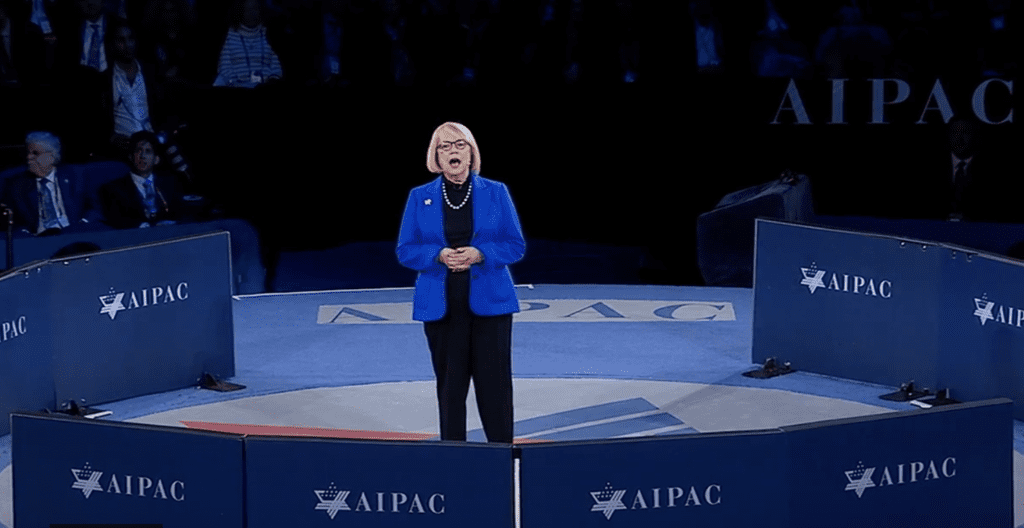
Ann Lewis speaks at AIPAC national conference, March 20, 2016 in Washington DC. Lewis is a Democratic political strategist and former White House Communications Director to President Bill Clinton.
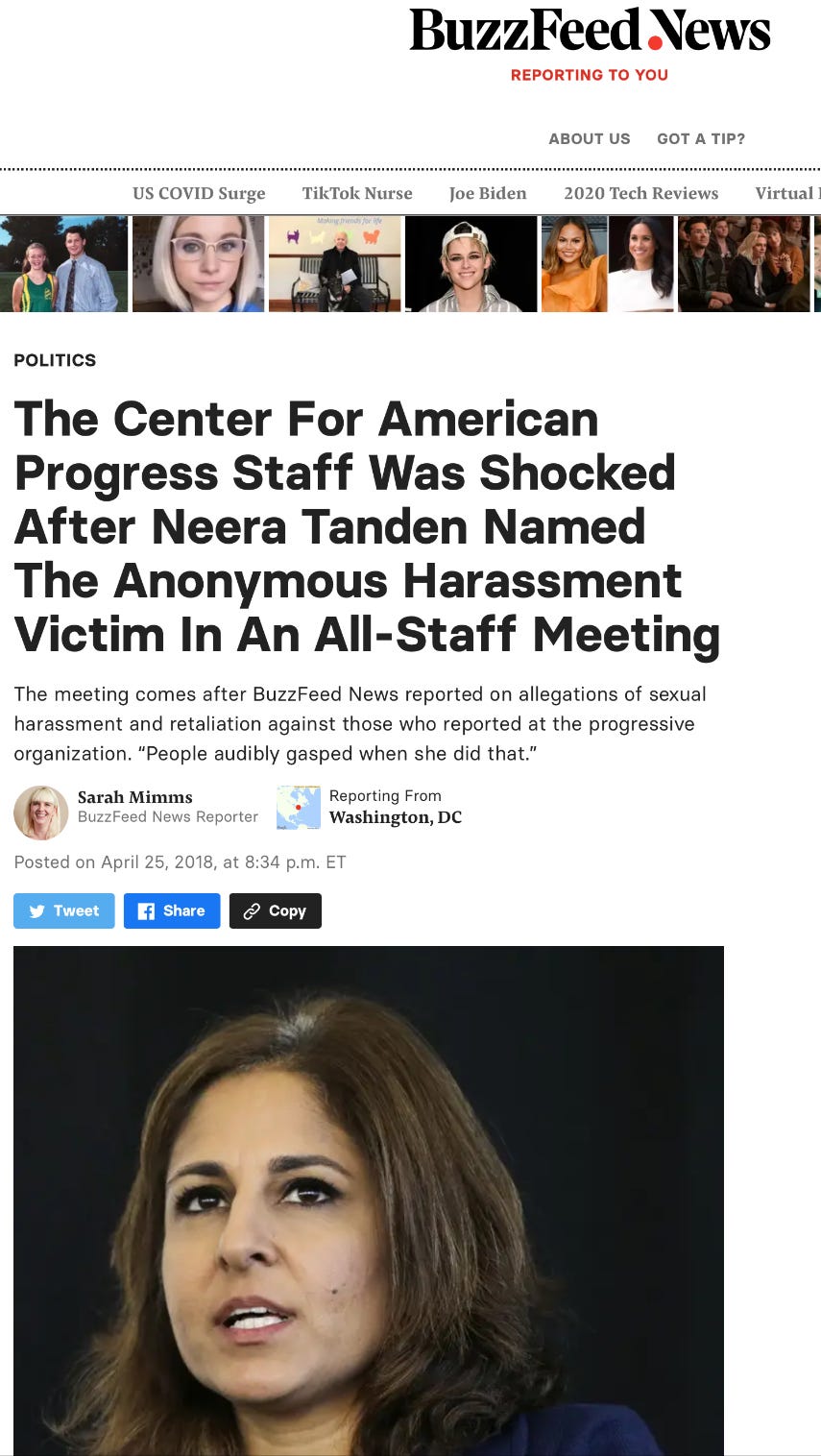
Tanden and Wolfson plotted in 2016 how to weaponize female journalists and people of color against Hillary’s critics as well to use their identity to stigmatize and thus stop undesirable coverage from The New York Times. In 2018, she outed a CAP employee at a staff-wide meeting who had filed an anonymous complaint of sexual harassment and retaliation against one of Tanden’s male allies. Secure with her UAE-and-corporate-funded large salary, she has long urged cuts to Social Security. The list goes on and on.
One can reasonably view Biden’s choice of Tanden as a positive. She is no different in character or ideology than any of the faceless, more obscure DNC operatives who would occupy this position if she did not. But because of how well-known her sociopathy, militarism and corporatism are to many on the liberal-left, her face serves as an undeniable and unavoidable reminder of what the Biden administration and the Democratic Party really are. She illuminates the truth about their real aims.
But beyond things like wanting to steal Libya’s oil after bombing it into oblivion, outing sexual harassment complainants, and physically assaulting and censoring her own employees, there is one uniquely abominable feature of Neera Tanden. She is one of the most deranged conspiracy theorists in the United States, and has done more than almost any other Washington functionary to contaminate Democrats’ mental health, capacity to reason, and faith in the legitimacy of U.S. elections.
Tanden owes her entire career to the patronage of Hillary Clinton, and her devotion to Hillary approaches restraining-order levels of creepiness (here you can watch Tanden beam with adoration as then-Senator Hillary Clinton, on the Senate floor in 2004, explains her steadfast opposition to marriage equality for same-sex couples on the ground that “marriage is a sacred bond between a man and a woman” and “exists between a man and a woman going back into the mists of history” for the primary purpose of raising children — just a few short years before Democrats changed views on this, after which it instantly became the hallmark of an unreconstructed hateful bigot to say this).
Few people took Hillary’s 2016 loss to Donald Trump as hard as Tanden, or handled it as poorly. Indeed, she refused to believe it really happened, and encouraged others to similarly refuse to accept its reality.
In the weeks after Trump’s victory, Tanden joined numerous Democrats in encouraging electors of the Electoral College to ignore their states’ votes and refuse to elect Trump as President (many rationale were invoked for this: Tanden’s was a CAP article promoting #Resistance fanatic Richard Painter’s argument that Trump’s violations of the Emolument Clause precluded an Electoral College win). She insisted that Hillary lost because of Russia, claiming the “Russians did enough damage to affect more than 70k votes in 3 states.” And she was not only one of the first to push the Steele Dossier’s claim that Russia held blackmail power over Trump but also one of the last to do so — insisting in 2018 that “the dossier been mostly proven to be true” and claiming as late as 2019 that nothing in this discredited junk report had been disproven.
Tanden’s bizarre claims about Russian hackers
But what really distinguished Tanden when it came to unhinged and toxic behavior was her repeated (and obviously baseless) claims that Hillary only lost because Russian hackers invaded the U.S. voting system and clandestinely changed Hillary’s votes to Trump’s, costing the real winner — Hillary — her rightful place on the throne, behind the Resolute Desk.
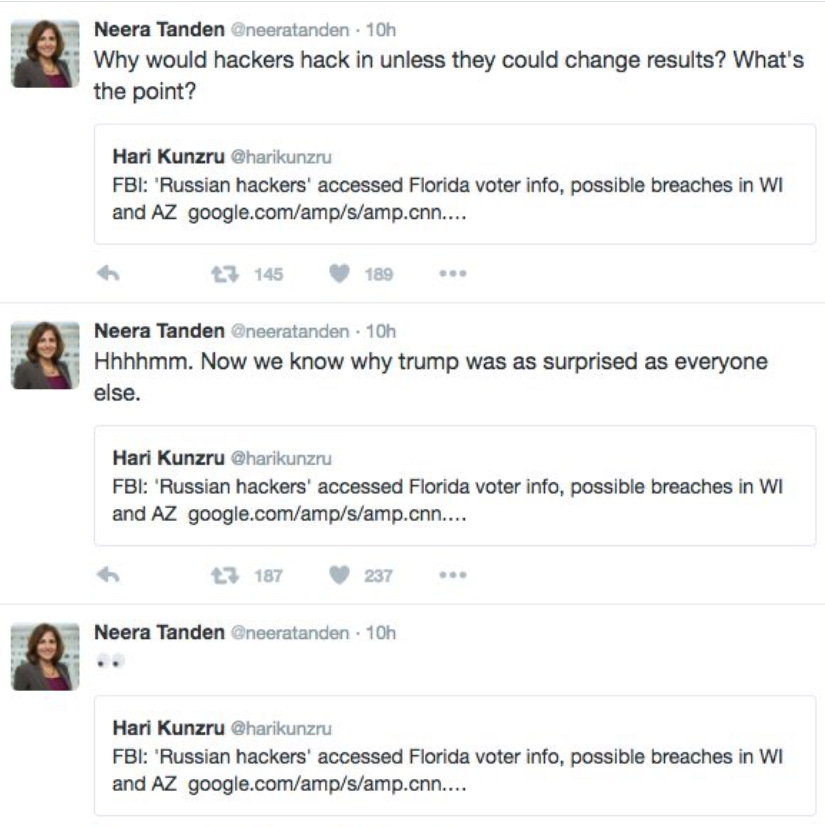
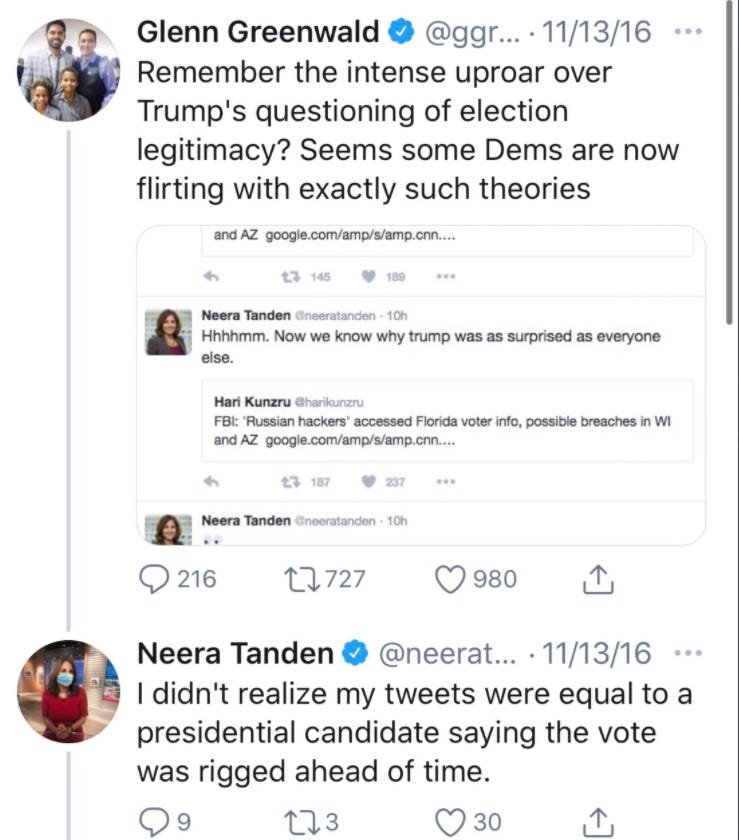
Four days after the 2016 election, Tanden began strongly implying, if not outright stating, that Russian hackers changed the vote totals, and that this is why “Trump was as surprised as everyone else” by his victory. When I highlighted her conspiratorial claims, she did not deny their obvious meaning, but rationalized them by insisting that her conspiracies were not as bad as Trump’s refusal, in advance of the election, to acknowledge the legitimacy of an election that had not yet taken place:
Tanden’s insistence that Russia changed the voting results through hacking did not once her traumatic shock in the weeks after Hillary’s loss dissipated (if it ever did). After The Intercept published an anonymous, evidence-free document in June, 2017, allegedly sent by NSA employee Reality Winner, which led that site to claim that “Russian military intelligence executed a cyberattack on at least one U.S. voting software supplier and sent spear-phishing emails to more than 100 local election officials,” Tanden returned to pushing this bizarre conspiracy theory, demanding that I “retract” my post-election criticism of her for peddling this Russia-changed-the-votes madness — as if this NSA document published by The Intercept proved vote-changing hacking by Russia.
This conspiracy-mongering led by Tanden and other prominent liberal activists had a corrosive effect on the ability of Democrats to perceive basic reality, to put that mildly. A 2018 poll from Economist/YouGov — conducted more than a year after Trump’s inauguration — found that a large majority of Democrats (66%) believe that “Russia tampered with vote tallies in order to get Donald Trump elected President.”
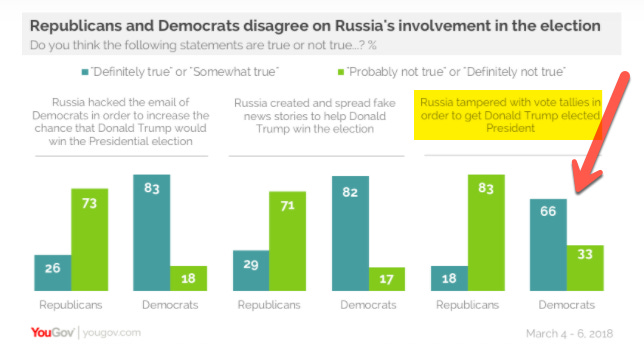
Economist/YouGov poll, published Mar. 9, 2018
Thereafter, Hillary herself took to calling Trump an “illegitimate” president, further fueling the destruction of confidence and faith among Democrats in the legitimacy of the vote totals and specifically the outcome of the 2016 presidential election.
Democratic leaders and their media allies love to patronizingly warn that conservative media outlets and their audiences are prone to spread and believe crazy conspiracy theories. They purport particular worry when such conspiracies are designed to undermine faith and trust in the U.S. electoral system itself.
Yet few have done more to destroy such confidence and faith than Neera Tanden, achieved by disseminating over the course of several years some of the most unhinged, evidence-free and deranged conspiracy theories in which she deliberately deceived Democratic partisans into believing that Moscow’s dastardly hackers invaded the sanctity of the U.S. voting system to change Hillary’s votes to Trump’s. And it worked: at least as of 2018, large majorities of Democrats believe that this utterly unproven but dangerous assertion is true.
If Joe Biden succeeds in empowering someone like Neera Tanden without extreme opposition from supposedly adversarial journalists, not only Democrats but also these media outlets will lose whatever lingering credibility they have to denounce conspiracy theories and to defend the legitimacy of U.S. elections. And they will deserve that fate. You can’t run around expecting people will take you seriously when you warn of the dangers of toxic, moronic conspiracy theories when you yourself embrace, elevate and promote the most prolific and reckless purveyors of them.
The Russian Brexit Plot That Wasn’t
By Paul Robinson | Irrussianality | November 26, 2020
Russian Disinformation. Russian Disinformation. Russian Disinformation. How many time have you heard that over the past four years?
But what about British disinformation?
Much of the current Russia paranoia began with the claims that Donald Trump was recruited by Russian intelligence years ago as a sleeper agent, and then given a leg-up into the presidency of the United States with the help of the GRU. The claims of ‘collusion’ were repeated over and over, and yet at the end of the day none of them could be substantiated. And where did it all start? In the now notorious dossier assembled by former British spook Christopher Steele.
Steele, it has now been revealed, got his information from a guy called Igor Danchenko. He in his turn got a lot of it from a former classmate, Olga Galkina, described as an alcoholic ‘disgruntled PR executive living in Cyprus’, and as such obviously a well-informed source with intimate knowledge of the Kremlin’s innermost secrets.
In short, the Steele dossier was a load of hokum, commissioned by a British Black PR operative and then fabricated by some random Russian émigrés with no access to anything of value. And yet, millions believed it.
And then, we have the story of Brexit. Ever since the 2016 referendum which resulted in Britain leaving the European Union, we have been repeatedly told that the victory of the Leave campaign was made possible by ‘Russian interference’. Most significantly, it was claimed that the Russian government illicitly funded the Leave campaign by funneling money through the campaign’s most significant financial backer, businessman Arron Banks.
Leading the charge against Russia and Banks was journalist Carole Cadwalladr of The Observer (as the Sunday version of The Guardian is known). ‘We know that the Russian government offered money to Arron Banks’, she said. ‘I am not even going to go into the lies that Arron Banks has told about his covert relationship with the Russian government’, she added, ‘I say he lied about his contact with the Russian government. Because he did.’
But it turns out that it was Cadwalladr who had a tricky relationship with the truth. Angered by her assertions, Arron Banks sued her for libel. Three weeks ago, she publicly backed down from one of her accusations. ‘On 22 Oct 2020,’ she said, ‘I tweeted that Arron had been found to have broken the law. I accept he has not. I regret making this false statement, which I have deleted. I undertake not to repeat it. I apologise to Arron for the upset and distress caused.’
This week Cadwalladr went further. The judge in the libel trial ruled that the meaning of her statement that Banks had lied about his relationship with the Russians was that he had lied about taking money from Russia, and that she had intended this as a statement of fact, not a call for further investigation. In the face of this judgement, Cadwalladr withdrew her ‘truth’ defence and has been ordered to pay Banks’ costs relating to this aspect of the case. In this way she in effect conceded that she was not willing to defend as fact the proposition that Russia financed Leave via Banks. While Cadwalladr continues to fight the case using a ‘public interest’ defence, the withdrawal of the truth argument is a dramatic concession.
The Banks story is not the only problematic aspect of Cadwalladr’s reporting. The journalist earned international plaudits and a prestigious Orwell prize for her report on how the British firm Cambridge Analytica supposedly used big data dredged up out of Facebook to help both the Leave campaign and Donald Trump win victories in 2016. This too had a Russian connection. In a 2018 article for The Observer Cadwalladr described how, ‘Aleksandr Kogan, the Cambridge University academic who orchestrated the harvesting of Facebook data, had previously unreported ties a Russian university. … Cambridge Analytica, the data firm he worked with … also attracted interest from a key Russian firm with links to the Kremlin.’
Others jumped on the Russia-Cambridge connection. ‘The Facebook data farmed by Cambridge Analytica was accessed from Russia’, claimed British MP Damien Collins, head of the House of Commons Select Committee for Digital, Culture, Media, and Sport. In this capacity, he then published a report outlining allegations of Russian propaganda and meddling in British affairs, including unsubstantiated insinuations that Russian money had influenced the Brexit campaign via Mr Banks.
And yet, all this was false too. The United Kingdom’s Information Commissioner’s Office (ICO) spent over two years investigating Cambridge Analytica, including its alleged role in the Brexit referendum, the 2016 US presidential election, and its supposed ties to Russian government influence operations. Having completed its investigation, the ICO reported that apart from a single Russian IP address in data connected to Cambridge Analytica, it had found no evidence of Russian involvement with the company. Moreover, it concluded that claims of the company’s enormous influence were ‘hype’, unjustified by the facts.
In other words, just like the Steele dossier, the whole story about Russia influencing the outcome of the Brexit referendum was made-up nonsense.
And yet, it has had an enormous influence. The allegations that Russia ‘interfered’ in Brexit have been repeated again and again – in parliamentary reports, newspaper articles, scholarly journals, books, social media, and so on. Despite their falsehood, they have enjoyed a spread and influence that Russian ‘meddlers’ could only dream of.
Will the peddlers of British disinformation repent? Will they now pen scores of articles admitting that they were wrong? Will they give evidence to parliament denouncing the scourge of false stories about Russia emanating from the British media and MPs?
Of course not. Ms Cadwalladr’s humiliation will get a few lines buried somewhere deep in some newspapers’ inner pages, and will then be forgotten. Meanwhile, the original claims will remain uncorrected in the many documents that repeat them, and the myth of Russian interference in Brexit will trundle on as a basis for denouncing the threat emanating from the East. The damage has been done. Ms Cadwalladr has been discredited, but someone else will soon be found to pick up the torch.
Paul Robinson is a professor at the University of Ottawa. He writes about Russian and Soviet history, military history, and military ethics.
Emerging sanctions-driven EU alliance with Navalny reeks of Western neo-colonial moves which helped destroy Russia in 1990s
By Glenn Diesen | RT | November 30, 2020
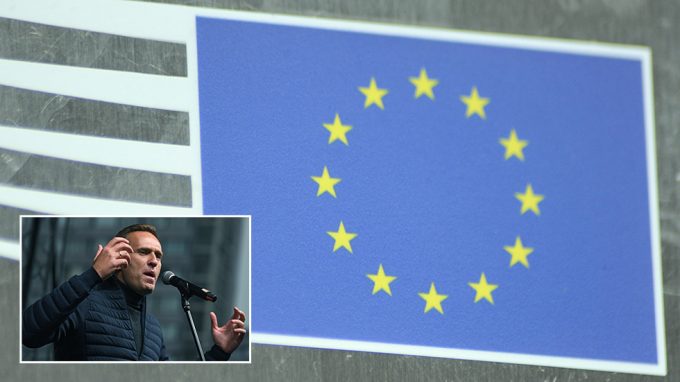
The West’s favorite Russian opposition figure has called for the EU to sanction pro-Kremlin ‘oligarchs’. Alexey Navalny doesn’t appear to be against all ‘oligarchs’ though, just those he feels are supportive of Vladimir Putin.
In a European Parliament hearing last week, the activist argued that the Russian people would welcome punishing the ‘kleptocracy’ that he says has thrived under Putin.
The anti-corruption campaigner was speaking to members of the EU’s Committee of Foreign Affairs during an “exchange of views with representatives of the Russian political opposition.” Despite the title, no members of Russia’s largest opposition parties – the nationalist LDPR, communist KPRF or leftist Fair Russia – were present at the virtual discussion. Instead only pro-Western figures, with almost uniformly similar liberal views, were involved in the event.
They included Vladimir Kara Murza Jr., a lobbyist at the US-government funded Free Russia Foundation, set up to “inform” American policy makers on the country; Vladimir Milov, a former deputy minister of energy, now closely allied to Navalny; and Ilya Yashin, a municipal deputy of the Krasnoselsky district of Moscow. Yashin is the only one of the four who actually holds an elected position.
To be clear, the issue of how many Russian billionaires acquired and spent their wealth is one worth debating, yet this attempt to place Navalny on the side of the Russian people and Putin among a criminal class is simply absurd, given the history.
Putin and the oligarchs
The rise of the 1990s oligarchs is commonly referred to as a “criminal revolution” in Russia. The US-sponsored shock therapy in the post-Soviet period produced disaster privatization where the huge natural resources wealth of Russia ended up in the pockets of a handful of incredibly rich men.
The US was motivated to ensure the legacy of the Soviet Union was permanently dismantled. But the great irony is that extreme socio-economic disparity was the main reason for the Bolshevik Revolution in 1917.
The oligarchs seized control over the economy and incrementally asserted dominance over the media and the political system. Capital flight became an immense problem as the oligarchs transferred the wealth to their new residencies in the West rather than investing the money at home. Soon, this became a national security threat as the oligarchs were courted by the US and UK, which meant that Russia was heading toward a quasi-colonial status.
When Putin came to power, he announced that the primary task was to eliminate the oligarchic class. However, seizing all their assets and redistributing it was deemed too revolutionary, extreme and destabilizing. Instead, Putin argued the oligarchs would be held accountable for their crimes in the 1990s if they did not rescind their influence over politics.
Subsequently, oligarchs supporting the elected government were left alone, while the oligarchs seeking to become an alternative pole of political power were held accountable for their crimes in the 1990s. Russia’s richest oligarch with political aspirations, Mikhail Khodorkovsky, was arrested in 2003 before he could sell a major share of his oil empire to ExxonMobil and Chevron-Texaco. Western powers dutifully provided eventual exile and protection for defiant oligarchs such as Berezovsky and Gusinsky who were valued for their anti-Kremlin stance.
The US and UK were outraged that “their” Russian oligarchs were pushed out of politics, while a large portion of the Russian people was upset that all oligarchs had not been held accountable, given Russia continues to have a great wealth disparity.
Poverty reduced by half during Putin’s first term alone and a large middle class emerged. Credited for bringing Russia up from its knees and escaping external control, Putin has ever since enjoyed approval ratings that other world leaders can only dream about. However, the West never acknowledged that Putin had prevented Russia’s collapse and instead began demonizing the Russian president as an enemy of the Russian people.
Supporting the Russian people?
The notion that Navalny and the EU will collectively support the Russian people is very flawed. In 1917, Germany brought Lenin into Russia to install a more favorable government that would pull the Russians out of the First World War. Germany’s top army commander reported to its Foreign Office that: “Lenin’s entry into Russia was a success. He is working according to your wishes.”
Indeed, the effort to “liberate” another people from their political leadership has remained the modus operandi for almost every disastrous war in the post-Cold War era.
In Russia, the regime change endeavour is an even more absurd proposition as Putin is extremely popular, while the main opposition is the communists, led by Gennady Zyuganov, and behind them the radically nationalist LDPR, under Vladimir Zhirinovsky, another veteran. Navalny is polling at between one and three percent in Russia, while in the West he is hailed as the face of Russia’s opposition.
Former CIA Director John Brennan wrote in October 2020: “Imagine prospects for world peace, prosperity, & security if Joe Biden were President of the United States & Alexei Navalny the President of Russia. We’ll soon be halfway there.” The eagerness to present Navalny as an “opposition leader,” rather than an activist, suggests he is expected to play the same role as the oligarchs that were courted in the 1990s to advance Western interests.
Sanctions?
Sanctions against Russian billionaires in Europe could be beneficial to Russia by reversing some of the capital flight and having their money invested back home. Indeed, the West should have worked with the Russian government to clean up the disastrous privatization process of the 1990s instead of courting proxies.
However, the collective interest of Navalny and the EU is to reinvent their role as supporting the Russian people, while recasting Putin as the protector of the oligarchs. However, the enduring economic sanctions against Russia have only cemented the view of the EU as a belligerent power. Navalny’s reliance on backing from hostile foreign powers, in the absence of significant domestic support, is not a winning strategy.
Furthermore, after it was revealed that the Magnitsky sanctions were based on fallacies and after the Russiagate conspiracy theory collapsed, it would be foolish to advance more sanctions under the preposterous narrative of Navalny’s poisoning.
The West does not have a Putin problem, but a Russia problem
The West tends to promote and anticipate the downfall of Putin with great optimism due to the expectation of a more “pro-Western” alternative akin to Yeltsin. However, the 1990s were a horrific period in Russian history. The much-neglected reality is that the main opposition parties, the communists and the nationalists, advocate much more hawkish policies toward the West than Putin.
Over twenty years ago, Yeltsin tasked Putin with reforming the state’s foreign policy because the entire “pro-Western” platform collapsed when the West decided to create a new Europe without Russia, and cooperation between the West and Russia was recast in a teacher-student format. So what segment of Russian society is the EU reaching out to and does “pro-Western” imply capitulation?
Which demographic of Russians support the containment policies, NATO and EU expansionism toward Russian borders, and again being relegated to a plaything of the West?
Without an answer to these questions, the efforts by the EU to elevate new “opposition leaders” in Russia will be dismissed by most Russians as an effort to weaken Russia and return their nation to the Western vassal it was in the 1990s.
Glenn Diesen is an Associate Professor at the University of South-Eastern Norway and an editor at the Russia in Global Affairs journal. Follow him on Twitter @glenndiesen
Trump Pardons Flynn… It’s a Good Start!
By Ron Paul | November 30, 2020
Last week President Trump granted a “full pardon” to Gen. Michael Flynn, his first National Security Advisor. In a White House statement announcing the pardon, the Administration pointed out that the relentless pursuit of Flynn was a partisan effort to overturn the results of the 2016 election.
The pursuit of Flynn was spearheaded by people who refused to accept the results of the 2016 election and worked to undermine the peaceful transfer of power, said the White House. These same people are the ones accusing Trump of undermining the election by challenging what appears to be serious voting irregularities in the 2020 presidential election.
That is called “projection.”
The White House statement also cites partisans in politics, the media, and the Deep State which sought to prevent Trump from being elected, to prevent him from taking office once elected, and to remove him on false pretenses once in office.
In order to push the false narrative that Trump was somehow elected due to the intervention of Russian President Vladimir Putin, the coup-masters had to make it appear that a high-ranking official was involved in monkey business with the Russians. Flynn was the unlucky victim of their smear machine, accused of “Russia collusion” over an innocent telephone call with the then-Russian Ambassador in Washington during the transition to a Trump Administration.
Yet when Joe Biden’s transition people bragged recently that Biden was connecting with foreign officials before inaugurated, the media praised it as a welcome return of the “experts” to foreign policy.
While it is very good news that President Trump is in the mood to pardon those victims of the warmongering Deep State, I very much hope that he is only warming up. It would be a great tragedy if other Deep State victims are left to suffer for their non-crimes.
Tweeting about her legislation that calls for charges against Edward Snowden and Julian Assange to be dropped and the Espionage Act reformed, US Rep. Tulsi Gabbard told President Trump, “since you’re giving pardons to people, please consider pardoning those who, at great personal sacrifice, exposed the deception and criminality of those in the deep state.”
My good friend Rep. Thomas Massie, a Ron Paul Institute Board Member, is a co-sponsor of Rep. Gabbard’s legislation, making it a real bipartisan effort to restore the rule of law in the United States and to rein in the Beltway warmongers.
Edward Snowden and Julian Assange are not criminals. They are heroes for telling us the truth about what criminals in government were doing in our name and with our money.
The fact is we were lied into war over and over again. While those wars were profitable for the military-industrial-Congressional-media complex, they snuffed out the lives of hundreds of thousands of innocent people overseas and robbed our own children and grandchildren of trillions of dollars wasted on neocon lies. And meanwhile, as Ed Snowden showed us, the intelligence community declared us the enemy and set up an elaborate internal spy network that would make the East German Stasi green with envy.
President Trump: you have the incredible opportunity to right the terrible wrongs perpetrated by the Obama/Biden Administration. History will smile kindly upon you if you also grant full pardon to Julian Assange and Edward Snowden – and any other truth-teller who faces persecution for exposing the Deep State warmongers.
Copyright © 2020 by RonPaul Institute.
Coming Soon From Joe and Kamala: Hooray for the Revolution!
By Philip Giraldi | Strategic Culture Foundation | November 26, 2020
There is something quite scary about the way leading Democrats have persistently wrapped their attempts to control the American people in platitudes and self-righteous drivel. Joe Biden and Kamala Harris, who are currently pulling their team together, are no different than the Clintons and Obamas who preceded them and are already on course to establish conformity by diminishing the fundamental rights that have been hitherto enjoyed by the American people.
The current war being waged against the United States and its constitution hinges on the expressed desire to extirpate “white supremacy” aka “white privilege” aka “systemic racism.” It is a convenient campaign slogan as it immediately creates guilt and apprehension in those white people who are foolish enough to believe it. It also is a vague enough term that it becomes possible to wrap a lot of other issues into it, like gun control, destruction of traditional education, reparations and affirmative action, and even de-policing urban areas. As minorities allegedly suffer disproportionately from coronavirus it might even be expanded to include mandatory national lockdowns every time a pandemic appears, as Biden has suggested in the past.
We are already seeing how some crimes are no longer crimes if they are committed by sanctimonious social justice warriors. Prosecutors in a number of states are dismissing charges against rioters because they have “concluded the protesters were exercising their basic civil rights.” It is generally being claimed that prosecutions continue for the “real” crimes of arson, looting and destruction of public property, but at least one liberal California District Attorney will not charge anyone who maintains that he or she was doing what they did to combat racism or feed their families. She calls it considering the “needs” of the looters. The looted shops that will as a result go out of business and whose employees become unemployed evidently have no “needs.”
The Democrats have long been adept at playing identity politics. They believe that appealing to a number of groups with grievances to create a voting majority is good for the country, which it is not, because sooner or later the ticket has to be paid for and deals that abridge the freedom of most Americans must be consummated. That will certainly take place with Biden and Harris.
And Biden and Harris will likely get away with much of their divisive domestic agenda, if only because it will be carefully hidden behind fear of the Coronavirus and of more civil unrest, but the one area where they will meet real resistance is the Second Amendment. One critic describes how “There is much overlap between Biden’s platform and Harris’s previous presidential campaign proposals. They both emphasize holding gun manufacturers accountable, enacting universal background checks, banning the manufacture and sale of semiautomatic rifles and higher-capacity magazines capable of holding more than 10 rounds, [and] prohibiting those convicted of domestic violence from buying guns…” And that is only for starters, with national gun registration and some confiscation certainly being considered.
Many Republicans as well as Democrats own guns and will resist any attempt at registration, much less the seizure of certain types of firearms. The death by shooting numbers have indeed risen dramatically, particularly in urban areas, but the victims and perpetrators are largely black-on-black and the weapons used are obtained illegally. Ironically, the rise in crime is in large part attributable to Democratic Party pandering to movements like Black Lives Matter with their message that violence is acceptable to bring about change. To argue that somehow controlling the legal owners of weapons is a “safety measure” is a convenient fiction.
To help the Democratic Party agenda along there will also of necessity be restrictions on free speech. One can expect greater political control over the propagandistic state media like Voice of America and it is perhaps inevitable that already censorship-heavy social media and news sites will also be regulated for content. Biden has appointed as one of his transition team for “regulating” news reporting one Richard Stengel who has argued that there is a flaw in the First Amendment of the Constitution’s Bill of Rights. He believes that free speech cannot be allowed in some cases and that anything that constitutes a “hate speech” should be criminalized. Stengel explains somewhat confusingly “I’m all for protecting thought that we hate, but not speech that incites hate.” This is, of course, yet another Democratic Party gimmick to secure the support of groups with grievances but it will impact on every American who believes that free speech is a fundamental right.
Yet another brilliant appointment by Biden is Ezekiel Emanual, bioethicist brother of former Obama Chief of Staff Rahm Emanuel. Ezekiel is on the Biden administration’s COVID transition team. He has a lot of interesting things to say, notably that the United States should give any newly developed and in short supply COVID vaccines to countries with younger populations so that the young could live while older Americans die. He has also said that everyone should die by age 75.
Finally, Joe’s ambitions do not end on the nation’s borders. In addition to pulling together a cabinet that will include a host of warmongers, there is talk that the new president will early in his presidency convene a “Summit of Democracies” with the stated intention of coordinating a response to Chinese, Iranian and, of course, Russian “aggression.” If it sounds like old wine in new bottles, it should.
Enthusiastic reporting from military contractor funded online newsletter DefenseOne supports the Biden initiative but with a warning: “And if this is truly a Democracy Summit, then Biden should make it clear that government leaders of China, Russia, Iran, Syria, North Korea and their ilk are not invited.” The process of selecting democracies will in fact be more complicated than this with politically protected states like Israel being included even though it is a serial human rights abuser and war criminal. The United States is itself a flawed democracy that is widely seen in negative terms by most of the world, but that will not stop it from attempting to host the summit.
So we Americans and presumably much of the world have a lot to look forward to in the new Biden-Harris regime that is currently taking shape. Internal democracy for all will increasingly be imperiled by pandering to special interests and more foreign wars. It is particularly interesting to note that the one thing that Democratic Party voters as well as other Americans overwhelmingly wanted above all else was a national health care system. That subject is not even on the Biden to-do list.
Demanding Silicon Valley Suppress “Hyper-Partisan Sites” in Favor of “Mainstream News” (The NYT) is a Fraud
By Glenn Greenwald | November 25, 2020
The most prolific activism demanding more Silicon Valley censorship is found in the nation’s largest news outlets: the media reporters of CNN, the “disinformation” unit of NBC News, and especially the tech reporters of The New York Times. That is where the most aggressive and sustained pro-internet-censorship campaigns are waged.
Due in part to a self-interested desire to re-establish their monopoly on discourse by crushing any independent or dissenting voices, and in part by a censorious and arrogant mindset which convinces them that only those of their worldview and pedigree have a right to be heard, they largely devote themselves to complaining that Facebook, Google and Twitter are not suppressing enough speech. It is hall-monitor tattletale whining masquerading as journalism: petulantly complaining that tech platforms are permitting speech that, in their view, ought instead be silenced.
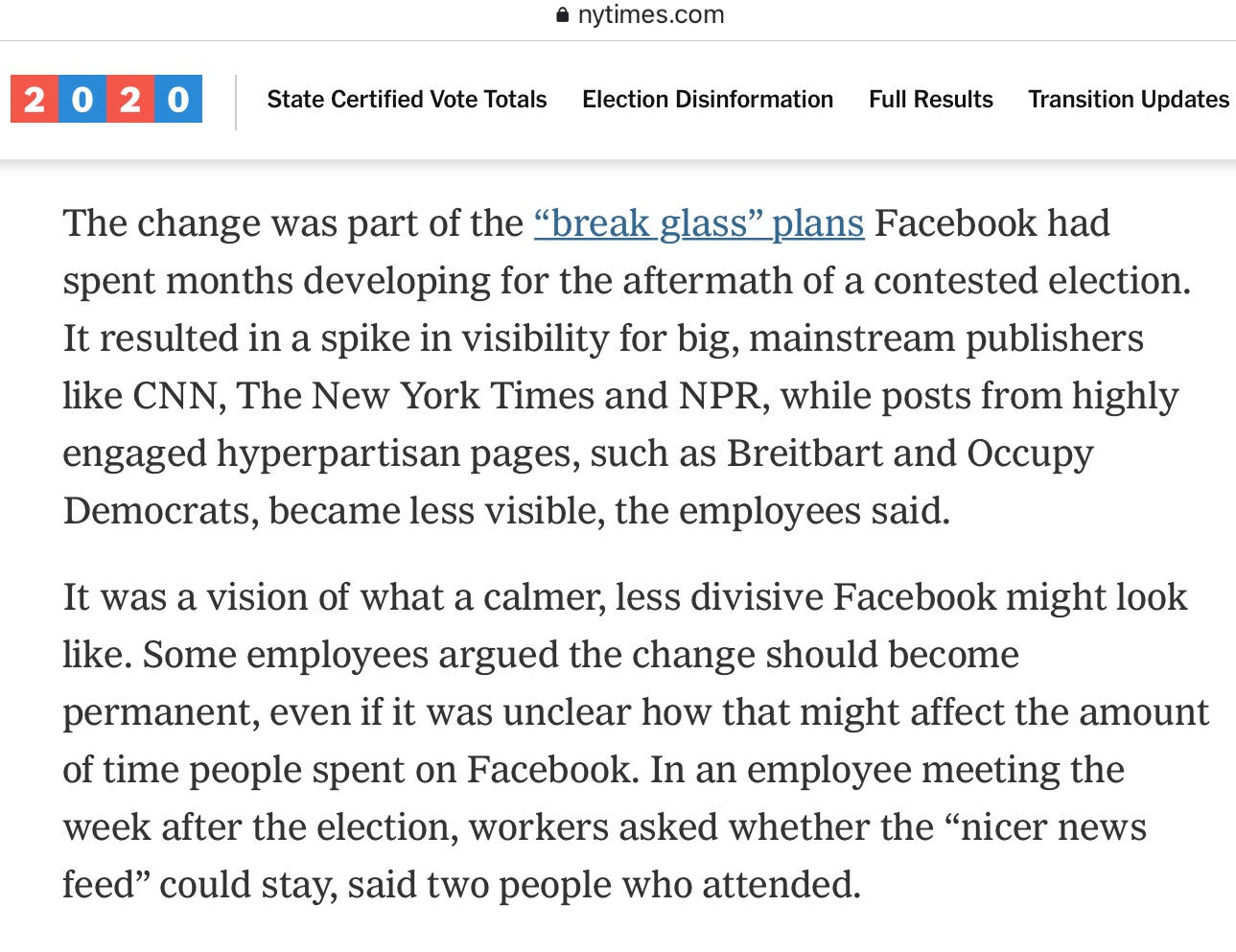
In Tuesday’s New York Times, three of those censorious tech reporters — Kevin Roose, Mike Isaac, and Sheera Frenkel — published an article on Facebook’s post-election deliberations over how to alter its algorithms to prevent the spread of what they deem “misinformation” regarding the election. The most consequential change they implemented, The New York Times explained, was one in which “hyperpartisan pages” are repressed in favor of promoting “a spike in visibility for big, mainstream publishers like CNN, The New York Times and NPR” — a change the Paper of Record heralded as having fostered “a calmer, less divisive Facebook.”
More alarmingly, the NYT suggested (i.e., prayed) that these changes, designed by Facebook as an election-related emergency measure, would instead become permanent. Marvel at these two paragraphs and all of tenuous and self-serving assumptions buried in them:
New York Times article, “Facebook Struggles to Balance Civility and Growth,” Nov. 24, 2020
The conceit that outlets like The New York Times, CNN and NPR are the alternatives to “hyper-partisan pages” is one you would be eager to believe, or at least want to induce others to believe, if you were a tech reporter at The New York Times, furious and hurt that millions upon millions of people would rather hear other voices than your own, and simply do not trust what you tell them. Inducing Facebook to manipulate the algorithmic underbelly of social media to artificially force your content down the throats of citizens who prefer to avoid it, while rendering your critics’ speech invisible — all in the name of reducing “hyper-partisanship,” “divisiveness,” and “misinformation” — is of course a highly desirable outcome for mainstream outlets like the NYT.
The problem with this claim is that it’s a complete and utter fraud, one that is easily demonstrated as such. There are few sites more “hyper-partisan” than the three outlets which the NYT applauded Facebook for promoting. In the 2020 election, over 70 million Americans — close to half of the voting population — voted for Donald Trump, yet not one of them is employed by the op-ed page of the “non-partisan” New York Times and are almost never heard on NPR or CNN. That’s because those news outlets, by design, are pro-Democratic-Party organs, who speak overwhelmingly to Democratic readers and viewers.
It is hard to get more partisan than the news outlets which the NYT tech reporters, and apparently Facebook, consider to be the alternatives to “hyper-partisan” discourse. In April, Pew Research asked Americans which outlet is their primary source of news, and the polling firm found that the audiences of NPR, CNN and especially The New York Times are overwhelmingly Democrats, in some cases almost entirely so.
As Pew put it: “about nine-in-ten of those who name The New York Times (91%) and NPR (87%) as their main political news source identify as Democrats, with CNN at about eight-in-ten (79%).” These outlets speak to Democrats, are built for Democrats, and produce news content designed to be pleasing and affirming to Democrats — so they keep watching and buying. One can say many things about these news outlets, but the idea that they are the alternatives to “hyper-partisan pages” is the exact opposite of the truth: it is difficult to find more hyper-partisan organs than these.
Then there is the question of who does and does not spread “misinformation.” It is rather astonishing that the news outlets that did more than anyone to convince Americans to believe the most destructive misinformation of this generation: that Saddam had WMDs and was in an alliance with Al Qaeda — The New York Times, The Atlantic, NBC and The New Yorker — have the audacity to prance around as the bulwarks against misinformation rather than what they are: the primary purveyors of it.
Over the last four years, they devoted themselves to the ultimate deranged, mangled conspiracy theory: that the Kremlin had infiltrated the U.S. and was clandestinely controlling the levers of American power through some combination of sexual and financial blackmail. The endless pursuit of that twisted conspiracy led them to produce one article after the next that spread utter falsehoods, embraced reckless journalism and fostered humiliating debacles. The only thing more absurd than these hyper-partisan, reckless outlets posturing as the alternatives to hyper-partisanship is them insisting that they’re the only safeguards against misinformation.
Note how insidiously creepy is The New York Times’ description of a censored, regulated internet. They call it “a vision of what a calmer, less divisive Facebook might look like,” and claim an unnamed Facebook employee described it as “a nicer news feed.”
Yes, discourse that is centralized and regulated, where no dissent is tolerated, where alternative voices are silenced, is always “calmer” and “less divisive.” That’s always the core goal of censorsing speech and ideas: to eliminate “divisiveness” and to pacify the population (“calmer” and “nicer”). That is always the result when orthodoxies imposed downward from the most powerful institutions of authority can no longer be meaningfully challenged.
The censorious mentality being peddled with increasing aggression is always chilling and dangerous. That it is media outlets — which ought to be the most vocal champions of free discourse — instead taking the lead in begging and pressuring Silicon Valley to censure the internet more and more is warped beyond belief. The internet should be free and left alone, especially by those with their record of deceit and propaganda.
Indeed, if we are to have it an internet controlled from above by unseen tech overlords in the name of eliminating “hyper-partisanship” and “disinformation” and fostering a “calmer” and “nicer” population, the sites now being artificially and manipulatively promoted are the absolute last ones who can credibly claim entitlement to that benefit.
Under Biden, expect more bombing and regime change. Tony Blinken’s record speaks for itself
By George Szamuely | RT | November 24, 2020
A US foreign policy run by Antony J. Blinken and Jake Sullivan, the likely next secretary of state and national security adviser, will mean more global interventions and regime-change operations, Clinton and Obama style.
Blinken played a prominent foreign policy role in both the Bill Clinton and Barack Obama administrations, while Sullivan was part of the Obama one.
The Democrat-boosting media are, not surprisingly, excited by media-anointed President-elect Joe Biden’s choice of Blinken, his long-time national security adviser, as his secretary of state. Along with his pick of Jake Sullivan, another close aide, as his national security adviser, these appointments supposedly signal restoration of “internationalism” and “globalpartnerships” as guiding principles of US foreign policy.
Media fawns for fake ‘internationalism’
Blinken, a “defender of global alliances,” in the soothing words of the New York Times, will “help calm American diplomats and global leaders alike after four years of the Trump administration’s ricocheting strategies and nationalist swaggering.” To the Washington Post, Blinken’s appointment would be fulfillment of Biden’s “vows to reassemble global alliances and insert the United States into a more prominent position on the world stage.” The Guardian purred that the appointees are:
“… committed internationalists, in strong contrast to the Trump era, which saw a bonfire of foreign treaties and agreements, and abrasive relations with traditional allies under the banner of ‘America First’, which Biden said during the campaign had led to ‘America alone’.”
That’s the message then: The foreign policy professionals are back, and US allies can rest assured that the United States will once again treat them with courtesy and respect. Such talk is delusional, if not downright deceptive. Blinken’s outlook is that of a career US interventionist, as is that of Sullivan. The opinions of other countries are worth considering only if they coincide with the views of US policymakers. If they don’t coincide, then they can be discounted.
The war on Serbia
Never was this axiom as vividly illustrated as during the Clinton administration’s protracted war against the Serbs during the 1990s. The Clinton administration, of which Blinken was an important member, had facilitated the arrival into Bosnia of international jihadi terrorists, including one Osama bin Laden. No one among Washington’s supposedly closest allies was asked what he or she thought of this policy of introducing Islamic terrorism into Europe. Richard Holbrooke, former assistant secretary of state for European and Canadian affairs in the Clinton administration, subsequently boasted about the efficacy of this policy. For him, shipping mujahedin fighters into Bosnia brought to mind “Winston Churchill’s famous comments about why Britain made common cause with Stalin against Hitler… [It] was a legitimate decision for Churchill and he knew full well the consequences. Here at a much smaller scale, this was done.”
Subsequently, the Clinton administration helped arm and train the Kosovo Liberation Army. The hope was that a KLA terrorist campaign in Yugoslavia would provoke the Belgrade authorities into overreacting. The expected humanitarian disaster could then be used to launch a NATO bombing campaign against Yugoslavia. When Belgrade refused to take the bait, the Clinton administration – in which Blinken was at that time special assistant to President Clinton and senior director for European affairs at the National Security Council – had to invent a pretext for bombing. That was provided by the Yugoslav government’s refusal to sign a Kosovo peace package at Rambouillet, France. The Yugoslav government had been issued with an ultimatum: accept the US-drafted package or face NATO bombing. Included within this package was the notorious Appendix B, which gave NATO unrestricted rights to move anywhere it wished throughout the territory of Yugoslavia, and to enjoy total immunity from prosecution.
The Clinton administration had deceitfully kept from the US public the details of Appendix B, as well as the take-it-or-leave-it ultimatum it had issued at Rambouillet. Later, when NATO’s bombing triggered the entirely foreseeable refugee flow from Kosovo, the Clinton administration claimed – again deceitfully – that NATO had launched its bombing campaign in response to Serb attempts to drive out Kosovo’s Albanian population. The claim made no sense. The refugee flight from Kosovo took place only after the start of NATO’s attack; the flight couldn’t therefore have been the pretext for NATO’s bombing.
Blinken played an integral role in orchestrating NATO’s bombing campaign, and has continued to tout his role in NATO’s legerdemain. Revealingly, Blinken appears untroubled by the Clinton administration’s refusal to seek UN Security Council authorization for the use of force against Yugoslavia. He evidently shared Secretary of State Madeleine Albright’s contempt for the legalistic concerns raised by UK Foreign Secretary Robin Cook. Told that international law experts were advising a UN Security Council resolution was necessary, Albright scoffed, “Get new lawyers!”
‘Protecting civilians’ in Libya
Blinken’s disdain for international institutions was very much in evidence during the Obama administration’s 2011 bombing of Libya. Blinken, at the time Biden’s national security adviser, was an enthusiastic advocate of the bombing campaign. There was a problem though. The bombing was undertaken ostensibly in order to save the residents of Benghazi who were supposedly under threat from the forces of President Muammar Gaddafi. However, Resolution 1973, which the US and NATO used to justify the attack, only instructed UN member states “to take all necessary measures… to protect civilians and civilian populated areas under threat of attack.” It didn’t say that such “measures” should include bombing. Still less did the resolution authorize the US and NATO to use the bombing in order to topple Gaddafi. Yet, long after any conceivable threat to the residents of Benghazi had disappeared, NATO governments continued to justify their refusal to call a halt to the bombing by invoking the purported threat Gaddafi posed to Libya’s civilians. NATO didn’t let up on the bombing until the brutal execution of Gaddafi, a war crime in which NATO took an active part.
‘Doing too little’ in Syria
No sooner was Gaddafi overthrown and Libya thrown into chaos than the Obama administration shifted its attention to Syria, seeking there also to topple the legal government. The tools it deployed were familiar. Under Operation Timber Sycamore, the CIA was authorized to work with Arab intelligence services to arm and train rebels seeking to overthrow the government of President Bashar Assad. The weapons, needless to say, in no time found their way into the hands of the worst and most fanatical of the jihadi killers. Syria seemed to be on the brink of falling under the sway of Islamic State (IS, formerly ISIS). Strangely enough, Blinken’s only regret about his activities in Syria is that the Obama administration didn’t do more to ensure the overthrow of Assad.
In an article last year that he co-authored with leading neocon publicist Robert Kagan, he argued that in Syria, the US made the “error of doing too little. Without bringing appropriate power to bear, no peace could be negotiated, much less imposed. Today we see the consequences, in hundreds of thousands of civilians dead, in millions of refugees who have destabilized Europe and in the growing influence of Russia, Iran and Hezbollah.”
In an interview earlier this year, Blinken made clear that regime-change in Syria was still on his agenda. He ruled out returning Syria’s oil fields to government control because the US needed leverage.
“That’s a point of leverage because the Syrian government would love to have dominion over those resources. We should not give that up for free.… And we should also use what leverage we have to insist that there be some kind of political transition that reflects the desires of the Syrian people.”
All the Russia tropes
Same old, same old is what we should also expect when it comes to Russia. Blinken repeats by rote all of the familiar Democratic Party talking points: Russia interfered in the 2016 elections, President Donald Trump is smitten with Russian President Vladimir Putin, Trump “took the word of Mr. Putin over our own intelligence community,” Russia put a bounty on the heads of US soldiers in Afghanistan, Russia invaded Ukraine. Blinken has advocated sending lethal weapons to Ukraine. “A President Biden would be in the business of confronting Mr. Putin for his aggressions, not embracing him,” Blinken has said. “Not trashing NATO, but strengthening its deterrence.”
A Blinken-run foreign policy will unquestionably mean abundant use of the familiar regime-change weapons in the US armory: bombs, cruise missiles, weapons shipments to jihadist and neo-Nazi groups to wage proxy wars, economic sanctions, fake “civil society” projects. As for the vaunted “international organizations” that Blinken supposedly champions, their role will be to sign off on US projects. If the organizations support US policy, including “regime change” operations, so much the better; if they don’t, they can safely be ignored. The “allies” who are now cheering the return of the “professionals” may soon have cause to regret their enthusiasm as the refugee flows from the Middle East return to 2015 levels in response to the Biden administration’s policy of relaunching the regime-change war in Syria. Should conflict with Russia escalate over Ukraine or the Baltics or the Caucasus, these “allies” may look back with nostalgia to the Trump era when the US largely preoccupied itself with its own national interests.
George Szamuely is a senior research fellow at Global Policy Institute (London) and author of Bombs for Peace: NATO’s Humanitarian War on Yugoslavia. Follow him on Twitter @GeorgeSzamuely
Biden signals US return to full-on globalism and foreign meddling by picking interventionist Anthony Blinken as secretary of state
RT | November 23, 2020
Joe Biden has named Anthony Blinken – an advocate for isolating Russia, cozying up to China and intervening in Syria – as secretary of state, cementing a foreign policy built on military forays and multi-national motivations.
Biden, the nominal president-elect, announced his selection of Blinken along with other members of his foreign-policy and national-security team, which is filled with such veteran Washington insiders as John Kerry, the new climate czar and formerly secretary of state in the Obama-Biden administration.
Blinken, a long-time adviser to Biden and deputy secretary of state under President Barack Obama, has been hailed by fellow Democrats and globalists, such as retired General Barry McCaffrey, as an experienced bureaucrat with “global contacts and respect.” Enrico Letta, dean of the Paris School of International Affairs, called Biden’s choice the “right step to relaunch transatlantic ties.”
He was even praised for a 2016 appearance on the Sesame Street children’s television program, where he explained to the show’s ‘Grover’ character the benefits of accepting refugees.
While some critics focused on how Blinken “got rich working for corporate clients” during President Donald Trump’s term in office, the new foreign-affairs chief’s neoconservative policy recommendations might be cause for greater concern. He advocated for the Iraq War and the bombings of such countries as Libya and Yemen.
Blinken is still arguing for a resurgence in Washington’s military intervention in Syria. He lamented in a May interview that the Obama-Biden administration hadn’t done enough to prevent a “horrific situation” in Syria, and he faulted Trump for squandering what remaining leverage the US had on the Bashar Assad regime by pulling troops out of the country.
“Our leverage is vastly even less than it was, but I think we do have points of leverage to try to effectuate some more positive developments,” Blinken said. For instance, US special forces in northeast Syria are located near Syrian oil fields. “The Syrian government would love to have dominion over those resources. We should not give that up for free.”
Blinken also sees Biden strengthening NATO, isolating Russia politically and “confronting Mr. [President Vladimir] Putin for his aggressions.”
As for China, Blinken has said Washington needs to look for ways to cooperate with Beijing. Reinvesting in international alliances that were weakened by Trump will help the Biden administration deal with China “from a position of strength” as it pushes back against the Chinese Communist Party’s human-rights abuses, he said.
Featured Video

The Truth About the Trump Shootings with Ken Silva
or go to
Aletho News Archives – Video-Images
From the Archives
The Geopolitics behind the War in Yemen (I)
By Mahdi Darius NAZEMROAYA | Strategic Culture Foundation | 30.03.2015
The United States and the Kingdom of Saudi Arabia became very uneasy when the Yemenese or Yemenite movement of the Houthi or Ansarallah (meaning the supporters of God in Arabic) gained control of Yemen’s capital, Sanaa/Sana, in September 2014. The US-supported Yemenite President Abd-Rabbuh Manṣour Al-Hadi was humiliatingly forced to share power with the Houthis and the coalition of northern Yemenese tribes that had helped them enter Sana. Al-Hadi declared that negotiations for a Yemeni national unity government would take place and his allies the US and Saudi Arabia tried to use a new national dialogue and mediated talks to co-opt and pacify the Houthis.
The truth has been turned on its head about the war in Yemen. The war and ousting of President Abd-Rabbuh Manṣour Al-Hadi in Yemen are not the results of «Houthi coup» in Yemen. It is the opposite. Al-Hadi was ousted, because with Saudi and US support he tried to backtrack on the power sharing agreements he had made and return Yemen to authoritarian rule. The ousting of President Al-Hadi by the Houthis and their political allies was an unexpected reaction to the takeover Al-Hadi was planning with Washington and the House of Saudi. … continue
Blog Roll
 Aletho News
- Pakistan-Iran talks secure LNG shipment to Islamabad through Hormuz
- Black Sea grain crisis puts global wheat supplies under pressure
- IRGC air defenses destroy another US MQ-1 drone over Strait of Hormuz
- Imran Khan’s entire immediate family detained in Pakistan ahead of mass protest demanding his release
- EU nation detains former presidential frontrunner
- Leaked: Britain’s Sham Conviction Of Hashim Thaci
- Seyed M. Marandi: U.S. Strike Imminent – Toward Total War in the Middle East
- Russia Voted Under Fire. Washington Is Loading the Tankers.
- 12 Things Your Oncologist Was Trained Not to Tell You
- Anthrax Attacks Paved Way for COVID-Era ‘Junk Drugs and Vaccines’
- If Americans Knew
- Trump’s militarization of Washington DC as he pursues Israel’s war against Iran
- Why Israel Fears This Searing New Documentary
- Huckabee aide solicited cash gifts from Israelis
- This isn’t sci-fi, AI is already killing people
- ‘The Most Brutal Thing’: Investigation Reveals Execution of Elderly Woman in Rafah
- Inside Israel’s ‘soft’ ethnic cleansing plan for Gaza through the eyes of its victims
- New online database tracks pro-Israel political donations in the United States
- Israeli president pardons soldier convicted for killing wounded Palestinian
- Singer Ed Sheeran says his ‘heart broken’ by Gaza devastation, addresses Macklemore controversy
- Israel Has Imprisoned Female Journalist Bushra Al-Tawil Without Trial Or Charge In Solitary Confinement For Past Month
- No Tricks Zone
- 2025 Nature Paper Claiming Worsening Global Drought Gets RETRACTED …Heavily Flawed
- New Study: ‘Global Drought Shows No Detectable Recent Acceleration Under Climate Warming’
- Economic Masterminds: German Socialists Suggest Taxing Productivity Gains Stemming From Using AI
- The South China Sea Has Not Been Cooperating With The Climate Change Narrative
- Energy Crisis: Germany Enters Heating Season With Historically Low Gas Reserve Fill Levels
- New Study: The Antarctic Ice Sheet Gained Mass From 2020-2024 Due To Staggering Snow And Ice Accumulation
- Study: Ocean Heating Rates From Thousands Of Years Ago ‘Dwarf’ Modern Ocean Heating Rates
- Climate Extremists Target, Attack Large-Scale Power Grid Infrastructure In Germany!
- New Study: Antarctic Ice Melt Has Contributed Less Than 1 Centimeter To Sea Level Rise In The Last 30 Years
- Fear Of Debate: Alarmist German Climate Scientist Calls On Mainstream Media To Discredit Skeptic Voices
 Aletho News