Under Biden, expect more bombing and regime change. Tony Blinken’s record speaks for itself
By George Szamuely | RT | November 24, 2020
A US foreign policy run by Antony J. Blinken and Jake Sullivan, the likely next secretary of state and national security adviser, will mean more global interventions and regime-change operations, Clinton and Obama style.
Blinken played a prominent foreign policy role in both the Bill Clinton and Barack Obama administrations, while Sullivan was part of the Obama one.
The Democrat-boosting media are, not surprisingly, excited by media-anointed President-elect Joe Biden’s choice of Blinken, his long-time national security adviser, as his secretary of state. Along with his pick of Jake Sullivan, another close aide, as his national security adviser, these appointments supposedly signal restoration of “internationalism” and “globalpartnerships” as guiding principles of US foreign policy.
Media fawns for fake ‘internationalism’
Blinken, a “defender of global alliances,” in the soothing words of the New York Times, will “help calm American diplomats and global leaders alike after four years of the Trump administration’s ricocheting strategies and nationalist swaggering.” To the Washington Post, Blinken’s appointment would be fulfillment of Biden’s “vows to reassemble global alliances and insert the United States into a more prominent position on the world stage.” The Guardian purred that the appointees are:
“… committed internationalists, in strong contrast to the Trump era, which saw a bonfire of foreign treaties and agreements, and abrasive relations with traditional allies under the banner of ‘America First’, which Biden said during the campaign had led to ‘America alone’.”
That’s the message then: The foreign policy professionals are back, and US allies can rest assured that the United States will once again treat them with courtesy and respect. Such talk is delusional, if not downright deceptive. Blinken’s outlook is that of a career US interventionist, as is that of Sullivan. The opinions of other countries are worth considering only if they coincide with the views of US policymakers. If they don’t coincide, then they can be discounted.
The war on Serbia
Never was this axiom as vividly illustrated as during the Clinton administration’s protracted war against the Serbs during the 1990s. The Clinton administration, of which Blinken was an important member, had facilitated the arrival into Bosnia of international jihadi terrorists, including one Osama bin Laden. No one among Washington’s supposedly closest allies was asked what he or she thought of this policy of introducing Islamic terrorism into Europe. Richard Holbrooke, former assistant secretary of state for European and Canadian affairs in the Clinton administration, subsequently boasted about the efficacy of this policy. For him, shipping mujahedin fighters into Bosnia brought to mind “Winston Churchill’s famous comments about why Britain made common cause with Stalin against Hitler… [It] was a legitimate decision for Churchill and he knew full well the consequences. Here at a much smaller scale, this was done.”
Subsequently, the Clinton administration helped arm and train the Kosovo Liberation Army. The hope was that a KLA terrorist campaign in Yugoslavia would provoke the Belgrade authorities into overreacting. The expected humanitarian disaster could then be used to launch a NATO bombing campaign against Yugoslavia. When Belgrade refused to take the bait, the Clinton administration – in which Blinken was at that time special assistant to President Clinton and senior director for European affairs at the National Security Council – had to invent a pretext for bombing. That was provided by the Yugoslav government’s refusal to sign a Kosovo peace package at Rambouillet, France. The Yugoslav government had been issued with an ultimatum: accept the US-drafted package or face NATO bombing. Included within this package was the notorious Appendix B, which gave NATO unrestricted rights to move anywhere it wished throughout the territory of Yugoslavia, and to enjoy total immunity from prosecution.
The Clinton administration had deceitfully kept from the US public the details of Appendix B, as well as the take-it-or-leave-it ultimatum it had issued at Rambouillet. Later, when NATO’s bombing triggered the entirely foreseeable refugee flow from Kosovo, the Clinton administration claimed – again deceitfully – that NATO had launched its bombing campaign in response to Serb attempts to drive out Kosovo’s Albanian population. The claim made no sense. The refugee flight from Kosovo took place only after the start of NATO’s attack; the flight couldn’t therefore have been the pretext for NATO’s bombing.
Blinken played an integral role in orchestrating NATO’s bombing campaign, and has continued to tout his role in NATO’s legerdemain. Revealingly, Blinken appears untroubled by the Clinton administration’s refusal to seek UN Security Council authorization for the use of force against Yugoslavia. He evidently shared Secretary of State Madeleine Albright’s contempt for the legalistic concerns raised by UK Foreign Secretary Robin Cook. Told that international law experts were advising a UN Security Council resolution was necessary, Albright scoffed, “Get new lawyers!”
‘Protecting civilians’ in Libya
Blinken’s disdain for international institutions was very much in evidence during the Obama administration’s 2011 bombing of Libya. Blinken, at the time Biden’s national security adviser, was an enthusiastic advocate of the bombing campaign. There was a problem though. The bombing was undertaken ostensibly in order to save the residents of Benghazi who were supposedly under threat from the forces of President Muammar Gaddafi. However, Resolution 1973, which the US and NATO used to justify the attack, only instructed UN member states “to take all necessary measures… to protect civilians and civilian populated areas under threat of attack.” It didn’t say that such “measures” should include bombing. Still less did the resolution authorize the US and NATO to use the bombing in order to topple Gaddafi. Yet, long after any conceivable threat to the residents of Benghazi had disappeared, NATO governments continued to justify their refusal to call a halt to the bombing by invoking the purported threat Gaddafi posed to Libya’s civilians. NATO didn’t let up on the bombing until the brutal execution of Gaddafi, a war crime in which NATO took an active part.
‘Doing too little’ in Syria
No sooner was Gaddafi overthrown and Libya thrown into chaos than the Obama administration shifted its attention to Syria, seeking there also to topple the legal government. The tools it deployed were familiar. Under Operation Timber Sycamore, the CIA was authorized to work with Arab intelligence services to arm and train rebels seeking to overthrow the government of President Bashar Assad. The weapons, needless to say, in no time found their way into the hands of the worst and most fanatical of the jihadi killers. Syria seemed to be on the brink of falling under the sway of Islamic State (IS, formerly ISIS). Strangely enough, Blinken’s only regret about his activities in Syria is that the Obama administration didn’t do more to ensure the overthrow of Assad.
In an article last year that he co-authored with leading neocon publicist Robert Kagan, he argued that in Syria, the US made the “error of doing too little. Without bringing appropriate power to bear, no peace could be negotiated, much less imposed. Today we see the consequences, in hundreds of thousands of civilians dead, in millions of refugees who have destabilized Europe and in the growing influence of Russia, Iran and Hezbollah.”
In an interview earlier this year, Blinken made clear that regime-change in Syria was still on his agenda. He ruled out returning Syria’s oil fields to government control because the US needed leverage.
“That’s a point of leverage because the Syrian government would love to have dominion over those resources. We should not give that up for free.… And we should also use what leverage we have to insist that there be some kind of political transition that reflects the desires of the Syrian people.”
All the Russia tropes
Same old, same old is what we should also expect when it comes to Russia. Blinken repeats by rote all of the familiar Democratic Party talking points: Russia interfered in the 2016 elections, President Donald Trump is smitten with Russian President Vladimir Putin, Trump “took the word of Mr. Putin over our own intelligence community,” Russia put a bounty on the heads of US soldiers in Afghanistan, Russia invaded Ukraine. Blinken has advocated sending lethal weapons to Ukraine. “A President Biden would be in the business of confronting Mr. Putin for his aggressions, not embracing him,” Blinken has said. “Not trashing NATO, but strengthening its deterrence.”
A Blinken-run foreign policy will unquestionably mean abundant use of the familiar regime-change weapons in the US armory: bombs, cruise missiles, weapons shipments to jihadist and neo-Nazi groups to wage proxy wars, economic sanctions, fake “civil society” projects. As for the vaunted “international organizations” that Blinken supposedly champions, their role will be to sign off on US projects. If the organizations support US policy, including “regime change” operations, so much the better; if they don’t, they can safely be ignored. The “allies” who are now cheering the return of the “professionals” may soon have cause to regret their enthusiasm as the refugee flows from the Middle East return to 2015 levels in response to the Biden administration’s policy of relaunching the regime-change war in Syria. Should conflict with Russia escalate over Ukraine or the Baltics or the Caucasus, these “allies” may look back with nostalgia to the Trump era when the US largely preoccupied itself with its own national interests.
George Szamuely is a senior research fellow at Global Policy Institute (London) and author of Bombs for Peace: NATO’s Humanitarian War on Yugoslavia. Follow him on Twitter @GeorgeSzamuely
Biden signals US return to full-on globalism and foreign meddling by picking interventionist Anthony Blinken as secretary of state
RT | November 23, 2020
Joe Biden has named Anthony Blinken – an advocate for isolating Russia, cozying up to China and intervening in Syria – as secretary of state, cementing a foreign policy built on military forays and multi-national motivations.
Biden, the nominal president-elect, announced his selection of Blinken along with other members of his foreign-policy and national-security team, which is filled with such veteran Washington insiders as John Kerry, the new climate czar and formerly secretary of state in the Obama-Biden administration.
Blinken, a long-time adviser to Biden and deputy secretary of state under President Barack Obama, has been hailed by fellow Democrats and globalists, such as retired General Barry McCaffrey, as an experienced bureaucrat with “global contacts and respect.” Enrico Letta, dean of the Paris School of International Affairs, called Biden’s choice the “right step to relaunch transatlantic ties.”
He was even praised for a 2016 appearance on the Sesame Street children’s television program, where he explained to the show’s ‘Grover’ character the benefits of accepting refugees.
While some critics focused on how Blinken “got rich working for corporate clients” during President Donald Trump’s term in office, the new foreign-affairs chief’s neoconservative policy recommendations might be cause for greater concern. He advocated for the Iraq War and the bombings of such countries as Libya and Yemen.
Blinken is still arguing for a resurgence in Washington’s military intervention in Syria. He lamented in a May interview that the Obama-Biden administration hadn’t done enough to prevent a “horrific situation” in Syria, and he faulted Trump for squandering what remaining leverage the US had on the Bashar Assad regime by pulling troops out of the country.
“Our leverage is vastly even less than it was, but I think we do have points of leverage to try to effectuate some more positive developments,” Blinken said. For instance, US special forces in northeast Syria are located near Syrian oil fields. “The Syrian government would love to have dominion over those resources. We should not give that up for free.”
Blinken also sees Biden strengthening NATO, isolating Russia politically and “confronting Mr. [President Vladimir] Putin for his aggressions.”
As for China, Blinken has said Washington needs to look for ways to cooperate with Beijing. Reinvesting in international alliances that were weakened by Trump will help the Biden administration deal with China “from a position of strength” as it pushes back against the Chinese Communist Party’s human-rights abuses, he said.
Biden’s Deep State
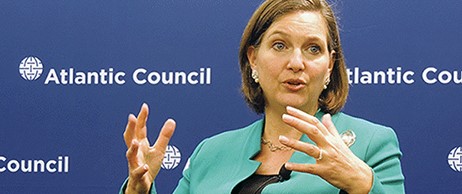
By Steve Brown | Ron Paul Institute | November 18, 2020
Philosopher Hannah Arendt once wrote about the banality of evil, and there’s never been a more banal bunch than the foreign policy and security state crew Barak Obama surrounded himself with for eight years beside the possible exception of Bush’s own Neocons.
Now after three years screaming about “Russian collusion” it appears the Evil Empire is about to regain its lost ground, championing new wars and more interventionist expansionism with a much greater role for the US military in the world.
Let’s name names.
Pentagon
For the defense chief post, the Washington Post has portrayed the banal face of Michele Flournoy as the pick to ‘restore stability’ to the Pentagon, an entirely false assertion. Recall that Fluornoy promotes unilateral global US military intervention, and advocated the destruction of Libya in 2011. By the military-industrial revolving door, Flournoy enabled many Corporate weaponry contracts amounting to tens of millions. Likewise Fluornoy is on the Booz-Hamilton board, where the swamp cannot get any deeper. As if this wretched example of an agent-provocateur for war and destruction were not bad enough, Biden is reportedly considering Lockheed-Martin banal kingpin Jeh Johnson for the DoD position, too.
Lockheed director Johnson was employed by Rob Reiner and Atlantic editor arch-Neocon David Frum to run the Committee to Investigate Russia which mysteriously blew up as soon as the Mueller Report was released. Jeh Johnson has continued to warn of “Russian interference” in the US presidential election until now. Biden’s anointing as president-elect has ended that. As Homeland Security head, Johnson authorized cages for holding immigrant children. He also supported the assassination of General Suleimani, and has voiced support for US wars in Syria, Iraq, and Afghanistan.
State
From Libya to Syria, Yemen, Ukraine and beyond, the banality of evil is perhaps best personified by Susan Rice – apparently Biden’s premiere pick for Secretary. Rice was an abject failure at the United Nations, but all seems forgiven, probably at the behest of Biden’s donors. After her failure at the UN, Obama kicked Rice upstairs to be his National Security Advisor, a position that does not require Senate approval.
An obvious war hawk in the mold of the Democrat’s donor class, a Rice appointment could reinforce the liberal mantra that women can be just as good at interventionism as men, and ensure full re-establishment of the Neoliberal agenda in Washington. John Kerry has been flagged as a potential for State (again) too, but at age 77 and subsequent to the failure of the JCPOA Kerry is an unlikely pick.
Another potential pick among the banal Daughters of Darkness is Victoria Kagan-Nuland, architect of the 2014 debacle in Ukraine (among other things). Outed at State in an embarrassing act of what she called impressive statecraft and other embarrassing incidents, Nuland seems an unlikely choice. But Kagan-Nuland is as banal as banal can be, and Biden may somehow wish to reinforce his solidarity with the JTF and his donor class, on Israel.
National Security Advisor
Banality is certainly the mark of the beast here, in the form of Tony Blinken. Well in with Michele Flournoy (above) Blinken typifies the type of banality the Deep State engages in to promote its evil, with Blinken as successful as any other Deep State actor. A major hawk on Russia and war hawk in general, Blinken is an apologist for Israel. Blinken is a war hawk on Afghanistan and Syria too, and Blinken was directly involved in CIA operation Timber Sycamore. Oh, the banality.
Another model of banality is Leon CIA Panetta who so far claims that cruising the Monterey peninsula is more fun that being in Washington. But we know that’s false and Panetta would be a logical pick. Besides being a hawk on everything, and laughing about the fact he has no idea how many wars Obama’s America was fighting – because he lost count – Panetta is simply another sycophant for evil like Hannah Arendt portrayed in her study of Adolf Eichmann.
CIA
Banal of the banal is of course Mike Morell. This incredibly vacuous excuse for a human being has been hate-mongering for years. Beside his blatant pandering support for another banal and brutal warmonger – Hillary Clinton – Mike Morell is one Neoliberal who still maintains that Saddam Hussein actively aided and abetted al Qaeda with regard to the 911 attacks. But Morell simply and ultimately represents the banality of evil, just as Arendt depicted Adolf Eichmann, but in Morell’s case succinctly summarized here by Ray McGovern.
United Nations
Outing the banality of the banal would be incomplete without mentioning Jen Psaki. Although a potential pick for White House Communications Director, why not promote an accomplished liar to a venue where accomplished lying really matters?
Conclusion
There is no indication that the United States as an entrenched warfare state will ever change its course until forced to. Mr Trump was incapable of enforcing that change. Sidelined by Russiagate psychosis, as a Beltway Neophyte and his own worst enemy at times, that sank Trump’s agenda.* The actions of Mr Trump now – to end the wars in Syria, Iraq, Afghanistan and Yemen — should have been undertaken in earnest and without compromise years ago. Point being that Mr Trump’s new appointments to the Pentagon – and let’s hope CIA – will hopefully blunt the efficacy of Biden’s bad actors going forward.
Regardless, characters the same or similar to the ones listed above will definitely infest Washington’s infernal Beltway cesspool once again via Joe Biden … make no mistake. …And they will be meaner and nastier than ever before! Guaranteed.
*Beside his appointment of dreadful characters like John Bolton, Mike Pompeo and Elliott Abrams, apparently at the behest of his own donor class!
Follow Steve Brown on twitter @newsypaperz
Copyright © 2020 by RonPaul Institute.
‘Bidenism’ domestically: no free press, no lawyer, one-party state?
By Ramin Mazaheri | Press TV | November 15, 2020
For months the United States’ corporate-dominated media has terrified everyone with promises of right-wing militias taking to the streets, but here’s the thing: the pressures currently being put on 70 million Trump supporters is exponentially raising the possibility of that actually occurring, not reducing it.
It is ghastly illuminating to see just how quickly – and with such disregard for modern human rights – both the elite and the highly partisan citizens of the United States are attacking those who refuse to fall at the feet of Joe Biden, and even before all the votes are counted in a very narrow and highly-disputed election.
It is not an exaggeration, as I will list them below, but the tactics being used to push Biden into office are akin to wartime, yet the US is most emphatically not at war – all this derangement is over merely trying to vote as equals. I am not reporting from 1917 USSR, or 1949 China, or 1959 Cuba, or 1979 Iran – there are no foreign armed forces meddling in a revolution/civil war.
“Bidenism” is most emphatically not a revolutionary force. It is openly and proudly the exact opposite: a return to the “normalcy” embodied in the 2015 status quo. Nor is the US at civil war, but it seems some never-trumpets are actually hell-bent on starting one rather than do what every nation does: rely on a calm judicial review when there is a contested and very narrow vote. There is simply no other way out for the US than to follow normal democratic procedures, even if their electoral process is routinely called the worst among the Western core democracies by Harvard think-tanks.
(The US goes one step too far, as usual – other nations at least wait until the votes are actually mostly counted until a candidate declares victory, unlike Donald Trump and Joe Biden.)
If this does turn out to be the “Biden presidential(-elect) era” the world can easily grasp what a terrible, very Trumpian start it is. Americans, I think, cannot.
It’s just very unclear what Americans in 2020 truly believe in anymore?
We know that many American elite don’t truly believe in free press or free speech:
Part 1 of this article, “CNN’s Jake Tapper: The foreman/overseer keeping all journalists in line” discussed how one of the nation’s top news anchors threatened lesser-privileged journalists with blacklisting if they don’t side with Biden immediately. His intimidation went uncommented upon/tacitly condoned by his top colleagues, when his pathetic careerism amid social instability should cost him at least some of his privileges.
Censorship is one way to prevent dissenting journalism, but informal censorship is another: The US doesn’t need formal government censors when their own journalists enforce such obvious suppression informally.
The goal of censorship is conformity. The US media which is corporate dominated – from the (fake) left New York Times to right-wing Fox News – is producing coverage which seemingly exclusively conforms to the false idea that it’s good journalism to exclude the massive number of Americans who feel the vote was not “fair and free”.
Since this troubled election began that number includes a stunning 70% of Republicans, per recent polls, but also independents and leftists. Since the election I interviewed both the Party for Socialism & Liberation and the Socialist Alternative Party (you have never heard of them because of the duopoly which strangles American elections) and both of them said the same thing: this is a terribly antiquated system in America, but in any democracy you count all the votes and litigate any contentious problems.
We know that many Americans don’t believe in the right to an attorney:
The anti-Trump and totally mainstream PAC/think tank The Republican Project has been lauded from the (fake) left to the far-right Washington Post for successfully harassing Trump’s Pennsylvania election lawyers into abandoning their client. The tactics used were not rhetorical and moral but mere intimidation, harassment and doxxing (releasing private information about people into public).
Trump is appalling, but does he not even deserve a lawyer?
Do people who associate with Trump, such as his lawyers, deserve such treatment? How far does this go – that’s the question those engaged in a witch-hunt are too fanatical to ask themselves.
Trump’s legal grievance is obviously supported by too large a democratic minority to ignore without causing lasting damage to the integrity of the American system.
By denying the right to an attorney these rabid anti-Trumpers do not technically betray the letter of their 1776 Revolution, that anti-imperialist event, but they certainly do seem to betray the spirit. It seems to violate the spirit if not the letter of the 6th amendment (ratified in 1791), which guarantees a lawyer in all criminal prosecutions, as well as the Due Process and Equal Protection clauses of the 14th amendment (ratified in 1868).
Congratulations to rabid anti-Trumpers for being so very progressive that they have made it to just past the slavery era?
1868 is a good place mark for the mentality of US Democrats, who remain obsessed with race and totally untouched by any of the anti-imperialist and class-based analyses which began to prevail worldwide since 1917.
We know that some American lawmakers don’t believe in open elections:
Earlier this month I reported on the blacklist of Iranian media by the Bernie Sanders-affiliated Democratic Socialists of America, so we shouldn’t have expected much from this fake-leftist faction openly committed to working within the Democratic Party.
But many Americans were shocked that DSA’s most powerful member, Representative Alexandria Ocasio-Cortez, actually doubled down when a tweet of hers suggested that lists should be compiled of pro-Trumpers who have committed no crime other than supporting not her party.
When top elected officials vaguely threaten citizens with “the idea of being responsible for their behavior over last four years” and their behaviour is just working for a democratically-elected candidate, what else is this but massively undemocratic intimidation? That would make free elections in the future impossible.
AOC is seemingly advocating for a one-party state, without knowing it, perhaps, but incompetence is no excuse. It’s certainly another sign of the widespread hysteria of rabid anti-Trumpers.
Directly after AOC’s call sprang up the “Trump Accountability Project”, headed by former Democratic National Committee press secretary Hari Sevugan, which is seemingly looking to blacklist all those that worked for the (possibly) outgoing administration. Would Mr. Sevugan approve of a “Biden Accountability Project” in 2024 for Biden’s staff? Or is that a superfluous question because Democrats are preordained to rule in an unbroken, 1,000-year dynasty?
Why would anybody of merit want to go into public service anymore if they are just going to get blacklisted for doing so?
All the above: This is all wartime-era stuff.
And Chicago, where I am currently based, has been boarded up like it was wartime since the election. (And in August/September. And in May/June.)
It’s as if America can’t help but inexorably draw itself to conflict, because this is all totally self-imposed. This is not the 1960s – there is no peace movement here anymore.
America is acting like what it is: half-full of rabid imperialists
Of course, “neo-imperialism” means colonising your own nation for an international 1%, as the European Union – that supremely US-guided project; that project which is more American than even America – proves.
Of course America is in a state of xenophobia (hostility or fear towards different cultures or strangers) and witch-hunting: this is exactly what the Democratic Party has normalised via their failed Russophobia campaign since 2016.
Did they think they could just turn that off?
Many current Biden supporters failed to stand up against this phony campaign designed to deflect from the Democrats 2016 election failures (2020 saw an even bigger “Blue Wave” failure, but isn’t this anti-Trump supporter hysteria deflecting attention from that for now?), and the most vociferous of them are now aiming their pitchforks at the people who dared to vote differently. The problem is that there are so very many of such persons.
We should add that for four years on US social media this hate mongering has to be multiplied by millions, maybe even billions of time-wasting, venomous posts and spiteful “likes” about veritable political nonsense. It’s practically a justification for state-sponsored censorship, because what kind of society can be healthy towards their neighbors, much less foreigners, when there have these been daily witch-hunts in the phony online world?!
So these lists can go on and on, but our tolerance of such intimidation should not.
(And, yes, before Russophobia there was Islamophobia, and before that it was socialism-phobia, Blackphobia, Indianphobia, etc.)
What’s going on in America is that the most Trump-hating Democrats are acting exactly like what they are: not fascists, as is so often alleged of the other side in Western discourse, but imperialists, which is so rarely discussed in Western discourse.
Like Jake Tapper, they are not just careerists who aspire to outdo everyone in extremism in order to rule from atop the pyramid, they also want to believe they also have the moral high ground despite that. It is arrogance combined with a lust for power and a hysterical, unreasoning rage which comes from we know not where?
Half of the US is so hysterical about being doubted that they can’t recognise themselves in the mirror, but many of those they have colonised, blockaded, sanctioned, brutalised and impoverished sure can.
It’s absolutely appalling and the solution is not simply, “Say that Biden is the president.”
Any nation which has a culture willing to go to such lengths to get others to accept their view – rather than relying on reasoned, secure reflection and some sort of litigation or vetting process – is deeply messed up.
But, as the US proved with their murderous meddling in Iran’s 2009 election: many in the US don’t just not care about anyone’s else’s rules, judges or systems of conflict resolution – the 2020 election proves that many Americans don’t even care about their own.
They are the law-giver and the life-taker and the president-maker, because they say so. Better side with “they”, or else.
Biden state media appointee advocated using propaganda against Americans and ‘rethinking’ First Amendment
By Ben Norton · The Grayzone · November 11, 2020
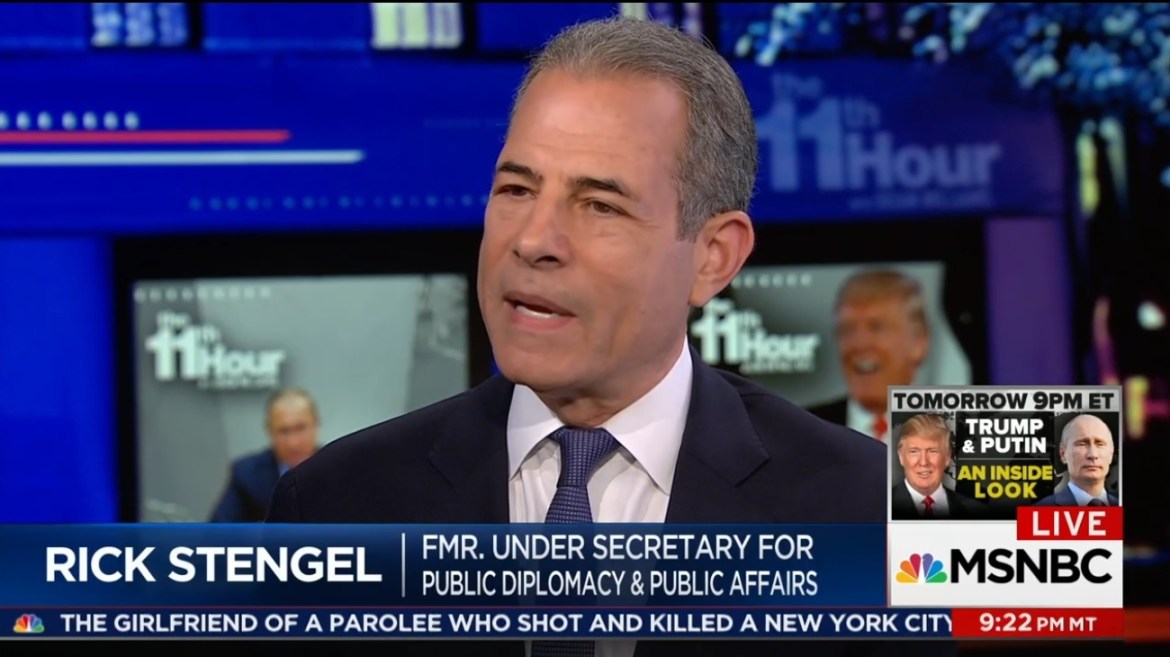
Richard Stengel, the top state media appointee for US President-elect Joe Biden’s transition team, has enthusiastically defended the use of propaganda against Americans.
“My old job at the State Department was what people used to joke as the chief propagandist,” Stengel said in 2018. “I’m not against propaganda. Every country does it, and they have to do it to their own population. And I don’t necessarily think it’s that awful.”
Richard “Rick” Stengel was the longest serving under-secretary of state for public diplomacy and public affairs in US history.
At the State Department under President Barack Obama, Stengel boasted that he “started the only entity in government, non-classified entity, that combated Russian disinformation.” That institution was known as the Global Engagement Center, and it amounted to a massive vehicle for advancing US government propaganda around the world.
A committed crusader in what he openly describes as a global “information war,” Stengel has proudly proclaimed his dedication to the careful management of the public’s access to information.
Stengel outlined his worldview in a book he published this June, entitled “Information Wars: How We Lost the Global Battle Against Disinformation and What We Can Do About It.”
Stengel has proposed “rethinking” the First Amendment that guarantees the freedom of speech and press. In 2018, he stated, “Having once been almost a First Amendment absolutist, I have really moved my position on it, because I just think for practical reasons in society, we have to kind of rethink some of those things.”
The Biden transition team’s selection of a censorial infowarrior for its top state media position comes as a concerted suppression campaign takes hold on social media. The wave of online censorship has been overseen by US intelligence agencies, the State Department, and Silicon Valley corporations that maintain multibillion-dollar contracts with the US government.
As the state-backed censorship dragnet expands, independent media outlets increasingly find themselves in the crosshairs. In the past year, social media platforms have purged hundreds of accounts of foreign news publications, journalists, activists, and government officials from countries targeted by the United States for regime change.
Stengel’s appointment appears to be the clearest signal of a coming escalation by the Biden administration of the censorship and suppression of online media that is seen to threaten US imperatives abroad.
From Obama admin’s “chief propagandist” to Russiagate-peddling MSNBC pundit
Before being appointed as the US State Department’s “chief propagandist” in 2013, Richard Stengel was a managing editor of TIME Magazine.
In the Obama administration, Stengel not only created the Global Engagement Center propaganda vehicle; he also boasted that he “led the creation of English for All, a government-wide effort to promote the teaching of English around the world.”
After leaving the State Department in 2016, Stengel became a strategic advisor to Snap Inc., the company that runs the social media apps Snapchat and Bitmoji.
Stengel also found time for a fellowship at the Atlantic Council, a think tank closely linked to NATO and the Biden camp which has received funding from the US government, Britain, the European Union, and NATO itself, along with a host of Western weapons manufacturers, fossil fuel corporations, Gulf monarchies, and Big Tech juggernauts.
Stengel worked closely with the Atlantic Council’s Digital Forensic Research Lab, a dubious organization that has fueled efforts to censor independent media outlets in the name of fighting “disinformation.”
But Stengel is perhaps most well known as a regular political analyst on MSNBC in the Donald Trump era. On the network, he fueled Russiagate conspiracy theories, portraying the Republican president as a useful idiot of Russia and claiming Trump had a “one-sided bromance” with Vladimir Putin.
Stengel left MSNBC this November to join Biden’s presidential transition. The campaign announced that he was tapped to lead the Biden-Harris agency review team for the United States Agency for Global Media (USAGM).
Agency review teams are an integral part of the transition process, responsible for evaluating the operations of federal agencies.
Our teams are composed of diverse experts with deep policy expertise, ready to ensure we’re prepared to lead on Day One.https://t.co/2gY1E0Ey5k
— Biden-Harris Presidential Transition (@Transition46) November 10, 2020
USAGM is a state media propaganda organization that has its origins in a Cold War vehicle created by the CIA to spread disinformation against the Soviet Union and communist China. (The agency was previously called the Broadcasting Board of Governors, or BBG, until it rebranded in 2018.)
USAGM states on its website that its most important mission is to “Be consistent with the broad foreign policy objectives of the United States.”
An agency shakeup this year produced revelations that USAGM provided clandestine assistance to separatist activists during the protests that consumed Hong Kong in 2019. The program earmarked secure communications assistance for protesters and $2 million in “rapid response” payouts for anti-China activists.
Richard Stengel’s “obsessive” crusade against Russian “disinformation”
When Richard Stengel referred to himself as the State Department’s “chief propagandist,” advocated the use of propaganda against the American people, and proposed to “rethink” the First Amendment, he was participating in a May 3, 2018 panel discussion at the Council on Foreign Relations (CFR).
During the CFR event, titled “Political Disruptions: Combating Disinformation and Fake News,” Stengel hyped up the threat of supposed “Russian disinformation,” a vague term that is increasingly used as an empty signifier for any narrative that offends the sensibilities of Washington’s foreign policy establishment.
Stengel stated that he was “obsessed with” fighting “disinformation,” and made it clear he has a particular obsession with Moscow, accusing “the Russians” of engaging in “full spectrum” disinformation.
Joining him on stage was political scientist Kelly M. Greenhill, who mourned that alternative media platforms publish “things that seem like they could be true… that’s the sphere where it’s particularly difficult to debunk them… it’s this gray region, this gray zone, where it’s not traditional disinformation, but a combination of misinformation and play on rumors, conspiracy theories, sort of gray propaganda, that’s where I think the nub or the crux of the problem lies.”
Stengel approved, adding, “By the way those terms, the gray zone, are all from Russian active measures, that they’ve been doing for a million years.”
The panelists made no effort to hide their disdain for independent and foreign media outlets. Stengel stated clearly that a “news cartel” of mainstream corporate media outlets had long dominated US society, but he bemoaned that those “cartels don’t have hegemony like they used to.”
Stengel made it clear that his mission is to counter the alternative perspectives given a voice by foreign media platforms that challenge the US-dominated media landscape.
“The bad actors use journalistic objectivity against us. And the Russians in particular are smart about this,” Stengel grumbled.
He singled out Russia’s state-funded media network, RT, lamenting that “Vladimir Putin, when they launched Russia Today, said it was an antidote to the American English hegemony over the world media system. That’s how people saw it.”
Ben Decker, a research fellow at the Misinformation Project at the Harvard Kennedy School of Government, lamented that “RT is invading every weekly finance media space.”
But Decker was cheered by the proliferation of US oligarchs committed to retaking control of the narrative. “In America and across the world,” he stated, “the donor community is very eager to address this problem, and very eager to work with communities of researchers, academics, journalists, etc. to target this problem.”
“I think that there is an appetite to solve this from the top down,” he continued, urging the many academics in the audience “to apply for grant money” in order to fight this Russian “disinformation.”
The CFR panel culminated with an African audience member rising from the crowd and confronting Stengel: “Because what is happening in America is what the United States flipped on the Global South and in the Third World, which we lived with, for many, many years, in terms of a master narrative that was and still is propaganda,” the man declared.
Rather than respond, Stengel rudely ignored the question and made his way hurriedly for the exit: “You know what, I hate last questions. Don’t you? I never, I usually just want to end something before the last question.”
The video of the revealing confrontation caused such a furor that CFR’s YouTube account disabled comments and made the video unlisted. It cannot be found in a search on Google or YouTube; it can only be found with the direct link.
The video of the full discussion is embedded below:
Why is Russia accused of undermining the US by not recognizing its election results before Americans themselves call a winner?
By Glenn Diesen | RT | November 11, 2020
The same people who spent four years accusing Russia of interfering in America’s internal affairs are now attacking Moscow for not meddling. It’s another curious case of something previously described as ‘Russophrenia’.
Russia has explained that it will hold off congratulations to Biden until the US election has been officially called, or his rival Donald Trump concedes. You may think this is a reasonable approach to demonstrate respect for the democratic process amid a contested election. But you would be wrong according to the Western mainstream media, which explains this is an effort by authoritarian leaders to keep their man in Washington.
It is also apparently evidence of Moscow supposedly still supporting Trump and Putin fearing that the morally righteous Biden will hold the evil Russians accountable yet again. No matter that the US State Department, long America’s primary ‘democracy promotion’ vehicle, has reminded foreign leaders that the count has yet to be completed.
The narrative of Russiagaters in the media immediately collapses once you factor in how China and Mexico have also indicated they will wait for the official election results. Trump started a trade war and a Cold War against China and his principal foreign policy objective has been to curb the rise of China.
Beijing will undoubtedly celebrate once Trump departs the White House, while Mexico has also been in the crosshairs of Trump’s economic nationalism, immigration policy, and foreign policy. Polls compiled by the Pew agency have found that Mexicans are the most critical of Trump with six percent expressing confidence for Trump in 2018, and eight percent in 2020. Are the Chinese and Mexicans also supporting Trump by holding off congratulations to Biden?
The interest in Moscow’s decision
What explains the media obsession with Russia holding off its congratulatory remarks to Biden? Is the media exploring it from a foreign policy perspective to assess future US-Russian relations under a Biden presidency? No. Much like Russiagate, this is all about domestic American politics.
If the election outcome was not contested, the media would not likely care if Russia congratulated Biden. However, the Republicans are supporting investigations into alleged voter fraud, and the failure of Russia to recognize a Biden win can be framed as a common cause between Republicans and Russia against America.
Former US Ambassador to Russia and leading Russiagate conspiracy theorist Michael McFaul sees yet another conspiracy in Putin’s failure to congratulate Biden, and suggests that Americans doubting the legitimacy of Biden are playing into the hands of the Russians.
Another Russian conspiracy to destroy America?
What is Moscow achieving by not recognizing Biden? After four years of checking under the bed for Russians, these accusations only need to rest on innuendos, and they collapse once articulated.
One can make a reasonable argument that Russia would benefit from a divided America. Much like the West attempting to sow divisions within Russia, it could be beneficial for Moscow to have divisions in an America that casts Russia as the principal enemy that must be confronted. However, how do delayed congratulations sow divisions in the US?
The failure to obtain Russia’s blessing and support is presented by the liberal political-media class as a badge of honor that proves the anti-Russian credentials of Biden. The Republicans are for the same reason not using Russia’s delayed congratulations to advance the legitimacy of their efforts to investigate alleged election fraud.
The entire media coverage of Russia’s lack of congratulations is indeed intended to do the exact opposite – to heighten the legitimacy of Biden as the opponent of authoritarians.
Russian efforts to exit American domestic politics
When Trump ran in 2016 on a foreign policy platform of “getting along with Russia,” Moscow was understandably optimistic as Russophobia is usually a symbol of virtue in Washington. What Moscow failed to appreciate is that Trump inadvertently drew a target on Russia by making it a pawn to de-legitimize Trump.
As confirmed by CIA Director John Brennan’s notes to President Obama, Hillary Clinton concocted Russiagate “to vilify Donald Trump by stirring up a scandal claiming interference by the Russian security service.” The attempts to portray every populist referendum and election victory as a grand Russian conspiracy mostly serve the purpose of de-legitimizing these political groups at home. Trump’s election did not result in reaching a mutually acceptable post-Cold War settlement with America, instead, Russia had to play the villain in US politics.
Russia has been used for the past four years to question the legitimacy of Trump. The Biden-Trump presidential debate became a competition over which one is the most belligerent towards Russia. Eager to exit American domestic politics, Moscow has avoided making statements on the US election and waited for the Americans to decide the winner before congratulating anyone.
However, this time the ‘Russian conspiracy against America’ is supposedly refusing to recognize the election results before the Americans do so.
Respecting US democracy
Moscow’s patience in terms of holding off congratulations should be interpreted as an effort to respect the democratic institutions of America, and its own normal protocols. There is no history of the Kremlin congratulating a US election winner before their opponent concedes.
Foreign leaders traditionally congratulate the winner immediately after election day. This was, however, not a traditional election. Due to Covid-19 and the large number of mail-in ballots, there was a clear break from the tradition of declaring a winner on election night. The media has for months been cautioning that it could take weeks to declare a winner this time, yet the same media now sees a conspiracy.
The break from the traditional election format augments uncertainty in a deeply divided nation. Speculation about voter fraud, either real or imagined, was predictable as the stakes are high and trust is low. The antidote to uncertainty and division is surely a commitment to transparency and the pursuit of objective facts.
Luckily, America has these mechanisms in place. A non-partisan assessment of the voter fraud allegations is important to strengthen the unity of the country, trust in democratic processes, and the legitimacy of the Biden presidency. So why is Russia accused of undermining America by not recognizing the election results before the Americans themselves?
Trump wanted to stop the counting and declare victory when he expected that illegal votes were counted, while the Democrats want to declare victory before the investigation into voting irregularities is held. The US should solve disputes around its election process and not drag the rest of the world into its domestic politics. After four years of Russiagate, is it too much to ask that Moscow be allowed to stay out of America’s internal affairs?
Glenn Diesen is an Associate Professor at the University of South-Eastern Norway and an editor at the Russia in Global Affairs journal. Follow him on Twitter @glenndiesen
UK Intelligence to Fight Anti-Vaccine Propaganda Spread by State Actors, British Media Reports

Anti-vaccine demonstrators in Edinburgh © Sputnik / Jason Dunn
By Tim Korso – Sputnik – 09.11.2020
A UK intelligence unit, known as the Government Communications Headquarters (GCHQ), has been authorised to conduct cyber operations to tackle the spread of anti-vaccine propaganda online, The Times reported citing an anonymous government source. According to the newspaper, the government increasingly views anti-vaxxers as a new priority because of the upcoming registration of domestically-developed vaccines against the coronavirus.
Apart from GCHQ, a secretive UK Army unit within the 77th Brigade specialising in information warfare will be taking part in the efforts “to quash rumours about misinformation” related to the COVID-19 vaccines, General Sir Nick Carter confirmed to The Times.
The newspaper’s source claims that GCHQ will be using the same toolkit it utilised to combat Daesh and its propaganda and recruitment efforts. The toolkit includes ways of taking down undesired content and conducting cyber attacks against the cyberactors behind it, for example by encrypting the perpetrators’ computer data, The Times added.
“GCHQ has been told to take out anti-vaxxers online and on social media. There are ways they have used to monitor and disrupt terrorist propaganda”, the anonymous source claimed.
However, GCHQ will not be able to use its tools against everyone online because its authority only extends to dealing with [alleged] state cyber actors and the content created by them, the newspaper reported citing another anonymous government source.
Russia as Main target for UK Intelligence Cyber Operations?
The British newspaper claims Russia will be the GCHQ’s prime target, citing its own investigation into the country’s alleged ties to the surge of internet memes questioning the safety of the vaccine developed by Oxford University in concert with AstraZeneca. The said investigation was based on a trove of documents and images provided by an anonymous source, who claimed to be part of an alleged propaganda effort purportedly seeking to hurt the image of the British vaccine. The Times, however, admitted in its article that it could not directly link the alleged social media campaign, targeting only the UK vaccine, with the Kremlin.
According to the newspaper, the alleged campaign against the AstraZeneca/Oxford vaccine started after the head of the Russian Direct Investment Fund (RDIF) that developed Sputnik V, Kirill Dmitriev, called the UK-developed medicine a “monkey vaccine” on several occasions. Dmitriev referred to the vaccine’s usage of a monkey virus as a vector to deliver the COVID-19 material needed to form immunity. He did not directly call the drug dangerous or ineffective, but noted that the use of human adenoviruses was more reliable, as their influence on the human body is better understood.
Dmitriev’s use of the term “monkey vaccine” prompted the emergence of numerous internet memes, baselessly alleging that the British drug would be turning recipients into monkey-like creatures or otherwise negatively affecting patients’ health. The head of RDIF later denounced the use of his words to besmirch the UK-developed vaccine, but defended his concerns over the possibility of its long-term side effects.
Russian PR executive outed as ‘source’ of ‘Russiagate’ Steele Dossier claims it was made up by British spy’s employee
By Jonny Tickle | RT | November 3, 2020
After being accused of being behind the controversial Steele Dossier, a discredited report detailing alleged misconduct by President Trump and the catalyst for ‘Russiagate,’ Olga Galkina claims she had nothing to do with it.
Last week, the Wall Street Journal pointed the finger at Galkina as the source of information for former British spy Christopher Steele’s report, which was publicly released by Buzzfeed, in 2017. Initially funded by the US Democratic Party, the information was meant to discredit Trump by showing him as being compromised by Russians.
It suggested that the President used Moscow’s help to win the 2016 US Presidential election. It led to years of political chaos in the US, and the protracted ‘Mueller Investigation,’ which failed to find evidence to support the assertions.
According to Galkina, the dossier was likely entirely invented by her former classmate Igor Danchenko, who added her name to improve its credibility. Danchenko is a Russian emigre in the US, who has worked for Washington think tank industry.
“Danchenko and I have known each other since school,” Galkina told Moscow daily Moskovsky Komsomolets (MK). She explained that they weren’t close contacts, but she once recommended him for a job at servers.com in 2016, a Cyprus-based company where she worked.
“What happened next is not known to me, as I left the company in the middle of 2016,” Galkina explained. “I believe that Christopher Steele entrusted most of the work to Igor Danchenko, and that a huge layer of the information, most likely, was just made up.”
Danchenko was first named in connection with the Steele Dossier earlier this summer, when documents revealed that he had been interviewed by the FBI in 2017 and had cooperated. According to the Wall Street Journal, Danchenko had been working for Steele when he was tasked with finding information connecting Trump to Russia. In his research, Danchenko repeatedly referred to a ‘Source 3,’ who has now been unmasked as Galkina.
According to Galkina, Danchenko added her name to make his fiction appear more believable.
“For the sake of plausibility, he cited, as sources, his Russian acquaintances who are publicly recognized as experts in their field,” Galkina claims.
In particular, Galkina is named as a source on Alexey Gubarev, her former employer at servers.com, who is said to have hacked the Democratic National Committee. Galkina says that the accusations are entirely false.
“Neither Alexey Gubarev personally nor his employees are computer security specialists. They are not qualified to conduct computer hacking,” Galkina told MK. “By this logic, normal Russians who sit down at a computer are ‘diabolical Russian hackers.’ It is kompromat wholly made up by Igor Danchenko.”
Galkina also rubbished more of the Wall Street Journal’s claims, rejecting the suggestion that she was sacked for being late and drunk, but instead resigned due to “unbearable working conditions” and a messy divorce.
“I won’t rule out lawsuits against citizens, both in Russian and American courts, who tried to use and defame my name.”
The Return of the Democrats and the Undead Past
By Martin Sieff | Strategic Culture Foundation | November 2, 2020
The partisan swallowing of ridiculous anti-Russia conspiracy theories by Democrats in Congress added to Hunter Biden’s truly sleazy business adventures in Ukraine have created an exceptionally dangerous brew to threaten and demonize Russia if former Vice President Joe Biden wins the U.S. national election on November 3. All the curses and bungles of America’s past 20 years will rise up anew to threaten the nation’s entire future,
If Joe Biden wins the election, we face an unprecedented situation in U.S. and global affairs since the beginning of the Atomic Age in 1945-49:
The problem is far deeper and more dangerous than any personal problem with Biden or his apparently sleazy son (Hunter Biden’s business dealings with both Ukraine and China cry out for serious honest congressional inquiries in the interests of sane and disinterested U.S. future relations with China and Ukraine – as well as with Russia.)
The real problem is that for eight years the Obama administration, in which Joe Biden was the putative Number Two figure engaged on a Helter-Skelter, crazed descent towards mindless confrontation with Russia and also institutionalized a reckless and plain wicked policy of toppling governments around the world in straight defiance of international law.
The true architect of these policies was neither Obama nor Biden but their first secretary of state Hillary Clinton. It was she who ordered the CIA to collect DNA samples of Latin American national leaders, an unprecedented seven of whom contracted cancers, some of them exceptionally rare and virulent, including two democratically elected presidents of Brazil and the late democratically elected president of Brazil Hugo Chavez who died of his.
Clinton also unleashed the dogs of chaos and war across the Middle East by approving the undermining and successful toppling of the government of Libya and the undermining although unsuccessful efforts to topple the government of Syria. This unleashed a ferocious civil war, the greatest catastrophe the Middle East has seen since Iraq’s attack on Iran in 1980, also at the time recklessly supported by an ignorant and incompetent president Jimmy Carter.
Carter, like Obama after him was ludicrously ignorant of international affairs. Both presidents allowed themselves to be led by the nose through the region by Zbigniew Brzezinski who served as Carter’s national security adviser. Brzezinski’s eagerness to embrace and support the very worst Islamist genocidal extremist groups was exceeded only by his lifelong, unwavering hatred of Russia and all Russians.
Clinton was succeeded as secretary of state in Obama’s second term starting in January 2013 by a far more experienced, restrained and responsible figure, Senator John Kerry. Kerry rightly worked hard and well with Russian Foreign Minister Sergei Lavrov to prevent the reckless and destructive policies of the rest of the administration from totally destroying constructive communications between Washington and Moscow.
But Kerry could not control even his own State Department. He proved utterly unable to rein in the neo-conservative and neo-liberal super-hawks with whom Clinton had seeded the State Department led by Assistant Secretary of State for European and Eurasian Affairs Victoria Nuland. They joined forces with crazed right wing warmongers like the late Senator John McCain (now sanctified, but whose uncontrollable screaming rages were legendary in his days on Capitol Hill).
Together with ambitious plotters in the European Commission in Brussels they manipulated the toppling of the stable, democratically elected government of Ukraine in the 2014 violent Maidan coup in Kiev. McCain and Nuland actually addressed the violent revolutionaries and openly exhorted them to topple their own democratic and previously peaceful government.
The Kremlin moved – in reality with careful and considered restraint – to safeguard the democratically expressed wishes of the population of Crimea to rejoin Russia, and of the Russian ethnic majorities in the eastern provinces of Ukraine. But the Obama administration joined forces with the openly neo-Nazi movements that had seized undemocratic control in Kiev.
Over the following six years to the present, successive U.S. congresses have voted enormous sums of financial aid and sophisticated weapons systems to be sent to Ukraine with the express purpose of killing Russian soldiers and Russian-supported forces. It is no wonder that false and entirely undocumented reverse accusations have now been lodged against Russia by the very same individuals who have supported the forces of violence, revolution and aggression for so long in Ukraine.
President Donald Trump, to his great credit, ran on for election in 2016 on a policy of reducing tensions with Russia and restoring a state of stable coexistence with the other main thermonuclear power on the planet. At no point did he advocate stripping the United States of its defenses.
On the contrary, Trump doubled up on Obama’s unprecedented more than $1 trillion nuclear weapons modernization program. He expanded spending on both conventional and strategic weapons on the largest scale seen since the Reagan-Caspar Weinberger buildup 40 years before.
Nevertheless, Trump was then subjected to the most unfounded, ridiculous political witch hunt against a sitting national leader in U.S. history – at least since President John Kennedy was openly and repeatedly accused of treason for seeking to reduce the dangers of nuclear confrontation after the Cuban Missile Crisis.
Through all of this, hatred and unreasoning accusations against Russia were accompanied by attempted efforts even to destroy the property and economic security of the Russian people. Congress imposed punitive sanctions (they failed completely) with Democrats taking the lead.
Why revisit all this history? It is because, as the great and wise American novelist William Faulkner understood, “The past is not dead. In fact, it’s not even past.”
If the Democrats regain power in Washington, they will return with all the dire and insanely dangerous policies and obsessions they displayed for eight years under Obama and Biden. But those hatreds and prejudices will be superheated by four years of Russiagate fantasies and raving accusations against Russia unsupported by any serious evidence. Indeed, they have been coolly exposed and refuted indeed by many courageous and principled former senior U.S. officials and scholars.
Nevertheless, this Undead Past will rise up, more terrible and destructive than any fantasy of werewolves and zombies, to demolish our Present and horrifically curse our Future.
Donald Trump’s top coronavirus adviser Scott Atlas: Lockdowns have been a FAILURE!
RT | November 1, 2020
Trump administration Covid-19 adviser Scott Atlas ripped public-health officials for “egregious” policy failures – only to be forced to apologize after mainstream media deflected his points by attacking him for appearing on RT.
On Saturday, the Stanford University doctor, who has emerged as President Donald Trump’s top adviser on responses to the Covid-19 pandemic, called the lockdown policies an “epic failure” and argued they are “killing people,” while speaking with Afshin Rattansi on RT’s Going Underground show.
“The public-health leadership have failed egregiously, and they’re killing people with their fear-inducing shutdown policies,” Atlas told RT.
“The lockdowns will go down as an epic failure of public policy by people who refuse to accept they were wrong – were wrong, refused to accept they were wrong, didn’t know the data, didn’t care. And it became a frenzy of stopping Covid-19 cases at all costs, and those costs are massive,” he said.
“The argument is undeniable: The lockdowns are killing people.”
Atlas then pointed to job losses, rising suicides, rising drug abuse and the harm being done to young people, tying the issues to the Covid-19 restrictions put in place. One study showed that 25 percent of Americans aged 18 to 24 thought about killing themselves in June “due to the lockdown,” he said.
“We’re creating a generation of neurotic children, forcing them to wear masks and be six feet apart from their friends, or not even have school in person.”
While Atlas’ counter-narrative comments might have been fodder for a serious discussion of public-health policy, mainstream media outlets instead spun the interview into a controversy over a Trump administration official granting an interview to a Russian state-owned outlet.
Reporters such as CNN’s Jim Acosta, Politico’s Ryan Lizza and NBC’s David Gura immediately pounced, ignoring the substance of his comments and breathlessly telling their followers that he spoke to an alleged Kremlin mouthpiece. “White House Covid adviser appears on outlet that is described by US intel as one of the Kremlin’s main propaganda platforms,” Washington Post national-security correspondent Greg Miller said.
Senior WH official tells me Doctor Scott Atlas did not have approval from the WH before going on RT. Atlas did it “on his own” without seeking approval from WH. Senior aides have raised concerns that Atlas would appear on the Russian outlet, the official said.
— Jim Acosta (@Acosta) November 1, 2020
Scott Atlas is having an interesting week. Here he is on the Russia propaganda network RT, which casually opens the segment with some facts about US imperialism. https://t.co/M467aEvaum
— Ryan Lizza (@RyanLizza) November 1, 2020
On the heels of an interview with Russian propagandists, Dr. Scott Atlas, a partisan radiologist who has the president’s ear, spitefully subtweets Dr. Anthony Fauci, an actual expert on infectious diseases: https://t.co/wvmBXe124O
— David Gura (@davidgura) November 1, 2020
The controversy was so fierce that Atlas was forced to apologize. “I recently did an interview with RT and was unaware they are a registered foreign agent,” he said Sunday on Twitter, adding that he now “regrets” doing the interview and also apologizing “to the national-security community who is working hard to defend us.”
I recently did an interview with RT and was unaware they are a registered foreign agent. I regret doing the interview and apologize for allowing myself to be taken advantage of. I especially apologize to the national security community who is working hard to defend us.
— Scott W. Atlas (@SWAtlasHoover) November 1, 2020
The apology wasn’t accepted. Christian Science Monitor reporter Dan Murphy tweeted that Atlas, who he has called a “lying Trump goon,” was lying about not knowing about RT’s foreign registration. Illustrator Chris Morris mocked Atlas for supposedly not knowing what “RT” stands for. CNN analyst Sam Vinograd said the interview “raises a lot of counterintelligence red flags.”
1. He’s lying. 2. There’s an enormous federal bureaucracy devoted to informing and coordinating the media appearances of hacks like Atlas. 3. RT the least important part. The deadly Trump propaganda he spreads is disqualifying whether on RT or VOA or Fox. https://t.co/ieum3otqVl
— Dan Murphy (@bungdan) November 1, 2020
This raises a lot of counterintelligence red flags. Why was a Russian foreign agent in direct touch with a WH advisor without him reporting it?
— Sam Vinograd (@sam_vinograd) November 1, 2020
No explanation was offered for how voicing opinions on a Russian-funded television outlet might jeopardize US national security. None was needed.
Democrats and mainstream media outlets have repeatedly squashed discussion of undesirable information or viewpoints, by alleging a nefarious Russian plot behind the report. Such tactics were used, for example, to dismiss damning information about the Hillary Clinton campaign – released by WikiLeaks in 2016 – and recent revelations about alleged influence-peddling by Democratic presidential candidate Joe Biden’s family.
Media critic Mark Dice pointed out that no objections were raised when US Representative Adam Schiff (D-California) and other Democrats appeared on RT in the past.
The Grayzone editor Max Blumenthal tweeted he was “surprised it took this long for the US center-right opposition to merge Covid panic with Russia hysteria.”
MSNBC host Matt Negrin may have revealed just a hint of anti-Trump media vitriol when he responded to Atlas’ apology by saying, “Are you the dumbest motherf***er in the f***ing world?”
Everyone is freaking out about Scott Atlas doing an interview with RT but @afshinrattansi actually held his feet to the fire with tough questions. People should watch it and judge for themselves, frankly. I doubt most people commenting have even seen it https://t.co/Z36Ez9irr7
— Alex Rubinstein (@RealAlexRubi) November 1, 2020
Atlas told RT he wrote about the issues discussed in the interview back in April or May, long before he joined the White House Coronavirus Task Force.
“I wasn’t the villain of the world when I wrote it, but when you come up and you stand next to the president of the United States – in an attempt to help the country in the biggest crisis in the world – you must be destroyed by the media in the United States. And so it’s a sad statement on America that the US is hysterical over this.”
Anti-Trump mole Miles Taylor unveils President’s ‘shocking sins’… mostly farcical outbursts & PUBLIC promises to voters
By Tony Cox | RT | October 31, 2020
The ex-Trump staffer who revealed himself as the author of an anonymous New York Times piece has tried to frame publicly stated policies, such as removing troops from Syria, as scandalous revelations and crimes against America.
Miles Taylor, a former Department of Homeland Security (DHS) employee, tweeted a list Saturday of what he called “foolish, unethical, un-American and/or illegal” directives that he witnessed from President Donald Trump during his tenure in the administration. But rather than condemning the president, the list appears to show the commander-in-chief taking steps that reflect the policies he promised to voters when he campaigned successfully for the job in 2016.
For instance, Taylor cited Trump as saying “Let’s get the hell out of Afghanistan” and “Let’s get the hell out of Syria” on his list of alleged wrongdoing. Several of his other allegations had to do with deterring illegal immigration and altering policy to make immigration more advantageous to the country. For example, Taylor listed well known Trump statements on bringing more immigrants from prosperous nations and cutting off aid to Central American countries to force them to cooperate with the administration on migration policy.
Trump told us: Let’s ditch these NATO countries (despite it being the backbone of the U.S. global defense alliance). (13 of 25)
— Miles Taylor (@MilesTaylorUSA) October 31, 2020
Taylor also rehashed claims from a book that alleged absurd demands on border security, such as building a moat, using an electrified fence with spikes on top and shooting illegal immigrants in the legs to slow them down. Trump has denied those accusations. Taylor also faulted Trump for calling to “gas migrants at the border.” The president has openly defended use of tear gas to deter hundreds of migrants who rushed the border simultaneously to try to overwhelm enforcement agents.
Trump talked tough on border enforcement during the 2016 election, much to the delight of his supporters. He has made every effort to deliver on his immigration promises, which has been made more difficult by a lack of support from people in his own party and administration. Ironically, Taylor, now a CNN contributor, thought he was impugning Trump Friday when he said, “I think I can count on two hands the number of people around this president that I really think are true loyalists.”
The former DHS employee also cited an alleged request by Trump to “spy on the personal phones of White House staff to catch leakers” as one of Trump’s grave sins against America.
Taylor’s list is perhaps less revealing about Trump – offering no surprises – than the Deep State bureaucrats who have worked against the president’s agenda for the past four years. Missing is any notion that the elected president has a right to have his stated policy agenda – his mandate from voters – carried out faithfully by executive branch employees.
For example, Taylor thought it was a gotcha stab at Trump to allege that he told staffers to “stop talking about Russian election interference, and I’m going to fire those people that do. (Russian President Vladimir) Putin is our friend.”
Trump campaigned on a desire to build a more friendly relationship with Russia – a position that Washington’s unelected bureaucracy refused to accept. He also called Democrat allegations of collusion with Moscow in the 2016 election a “hoax,” and it might have been reasonable for him to expect the people in his own administration to refrain from joining what he saw as a conspiracy to oust him from office.
Taylor took issue with those policies when he wrote an anonymous New York Times op-ed in September 2018, saying that he and “like-minded colleagues” were working to “thwart” the president’s agenda. The Times said it was taking a “rare step” of publishing the op-ed without identifying the writer, whom it described falsely as a “senior official” in the Trump administration. CNN allowed Taylor to keep his job at the network despite the fact that he lied on air to host Anderson Cooper about not being the anonymous Trump critic.
“Miles Taylor was always a neocon,” Will Chamberlain, editor of Human Events, said in reaction to the supposedly damning Trump list. “He had no business being in the Trump administration.”
Many other observers reacted similarly, including one who tweeted, “So getting out of wars was considered illegal by this guy.” Another said, “You mean he’s against law and order?” Author Mike Cernovich summed up the reaction of Trump supporters to Taylor’s list in one word: “And?”
Anti-Trump camp took the opposite view, thanking Taylor for coming forward, though some faulted him for not doing it sooner and others asked for corroborating evidence. Another Twitter commenter said the allegations were “exactly in line with everything we’ve heard out of his mouth for years.”
So from either side’s point of view, Trump was essentially doing what he said he was going to do when he got elected in a constitutional republic that was supposedly designed to reflect the will of the people.
By Tony Cox, a US journalist who has written or edited for Bloomberg and several major daily newspapers.
Featured Video

HE SAVED LIVES. NOW HE FACES PRISON.
or go to
Aletho News Archives – Video-Images
From the Archives
NATO Sanctions and the Coming Global Diesel Fuel Disaster
By F. William Engdahl – New Eastern Outlook – 11.04.2022
Amid the ongoing global inflation crisis, NATO heads of state and mainstream media repeat a mantra that high energy prices are a direct result of Putin’s actions in Ukraine since end of February. The reality is that it is the western sanctions that are responsible. Those sanctions including cutting SWIFT interbank access for key Russian banks and some of the most severe sanctions ever imposed, are hardly having an impact on the military actions in Ukraine. What many overlook is the fact that they are increasingly impacting the economies of the West, especially the EU and USA. A closer look at the state of the global supply of diesel fuel is alarming. But Western sanctions planners at the US Treasury and the EU know fully well what they are doing. And it bodes ill for the world economy.
While most of us rarely think about diesel fuel as anything other than a pollutant, in fact it is essential to the entire world economy in a way few energy sources are. The director general of Fuels Europe, part of the European Petroleum Refiners Association, stated recently, “… there is a clear link between diesel and GDP, because almost everything that goes into and out of a factory goes using diesel.” … continue
Blog Roll
 Aletho News
- Iran FM meets with US envoy on UN meeting’s sidelines at American side’s insistence: Report
- Qatar PM calls for Gulf security framework with Iran, says war must be ‘wake-up call’
- China condemns US extortion of Iranian airlines, rejects Washington’s ‘illegal’ sanctions threats
- Italy to move military personnel from Taif base after missile strike
- Finland’s Stubb tells European leaders to calm down
- Defeating Russia on battlefield impossible – Fico
- Finland’s Gender Clinic Reversal
- Massachusetts Wants Mental Health Visits, Why Does Government Use ‘Health’ to Enter Our Homes & Families?
- US lawmaker admits American people footing bill for Trump’s failed aggression against Iran
- Pfizer Gave $500,000 to Groups That Lobbied to End Religious Exemption in Massachusetts
- If Americans Knew
- Sanctions are collective punishment: immoral and self-defeating
- Phosphorus Munitions Fired by Israel Burn Groves, Orchards in Southern Lebanon
- Israel Carries Out New Ceasefire Violations Across Gaza
- AI – Emphasis on the ‘I’: Israel Is Funding AI Chatbot Propaganda
- Israel Blocking Hundreds of Wheelchairs for Injured Children From Entering Gaza
- Israel Is Expanding and Upgrading Compounds for Palestinian Militias in Gaza
- The Palestinian-American Residents of This West Bank Town Are Wondering: Where Is Trump?
- Gaza desperately needs tents, wheelchairs, fuel… and everything else (Israel blocks it all) – Daily Update
- Israeli Attacks in Gaza Kill at Least Seven Palestinians Over Three Days, including Woman and Child
- Trump’s militarization of Washington DC as he pursues Israel’s war against Iran
- No Tricks Zone
- 2025 Nature Paper Claiming Worsening Global Drought Gets RETRACTED …Heavily Flawed
- New Study: ‘Global Drought Shows No Detectable Recent Acceleration Under Climate Warming’
- Economic Masterminds: German Socialists Suggest Taxing Productivity Gains Stemming From Using AI
- The South China Sea Has Not Been Cooperating With The Climate Change Narrative
- Energy Crisis: Germany Enters Heating Season With Historically Low Gas Reserve Fill Levels
- New Study: The Antarctic Ice Sheet Gained Mass From 2020-2024 Due To Staggering Snow And Ice Accumulation
- Study: Ocean Heating Rates From Thousands Of Years Ago ‘Dwarf’ Modern Ocean Heating Rates
- Climate Extremists Target, Attack Large-Scale Power Grid Infrastructure In Germany!
- New Study: Antarctic Ice Melt Has Contributed Less Than 1 Centimeter To Sea Level Rise In The Last 30 Years
- Fear Of Debate: Alarmist German Climate Scientist Calls On Mainstream Media To Discredit Skeptic Voices

