YouTube, Facebook, Twitter Limit Access to 20 Russian Media Sources, Internet Watchdog Says
Sputnik – 27.10.2020
In late-September, Facebook said in a statement that it had removed a total of 242 users, 41 Pages, 19 Groups and 45 Instagram accounts allegedly originating from Russia.
Censorship of Russian media outlets by foreign Internet companies has become systematic, with Google, Facebook and Twitter restricting access to materials of around 20 Russian outlets, the Russian communications watchdog, Roskomnadzor, said on Tuesday.
“Foreign Internet companies’ censorship of Russian media has become systemic, Google (YouTube), Facebook and Twitter restrict access to materials of around 20 Russian media outlets, including RIA Novosti, Russia Today, Sputnik and Russia-1,” Roskomnadzor said in a statement.
As a result of these foreign attempts to control the Russian media, Russians may fail to receive objective information, the watchdog specified.
“Multiple requests to stop the censorship of Russian media outlets are being ignored,” Roskomnadzor went on to say.
The communications watchdog added it had submitted to both chambers of the Russian parliament proposals on enshrining in the national legislation measures that may be implemented to retaliate to the facts of censorship.
Roskomnadzor also reported an increase in the spread of fake news by foreign platforms, such as YouTube, Facebook, Instagram and Twitter.
Will US continue to further implement RAND Corporation’s strategy in relation to Russia?
By Lucas Leiroz | October 27, 2020
The recent conflicts in the Russian zone of influence have attracted attention around the world. But little has been said about the possibility that such conflicts are part of a single common plan, designed to geopolitically destabilize Russia. This possibility is what we can deduce when we recall some recent writings of the renowned think tank RAND Corporation, which, in 2019, openly defended the adoption of a series of measures to weaken Moscow, exploiting its vulnerabilities. Among such measures in the economic sphere the document proposed the manipulation of oil and gas prices that affect the Russian defense budget, as well as the imposition of increasingly rigid sanctions and in the political sphere – the spread of regional conflicts in its “periphery” which could perfectly include Nagorno-Karabakh, Kyrgyzstan and others.
Several of the points highlighted in the RAND’s document entitled “Overextending and Unbalancing Russia”, in its more than 350 pages, have been implemented so far, especially in the “immediate periphery”. The recent Belarusian political crisis itself, for example, highlights the role of external agents interested in the destabilization of this historic Russian ally – something that is openly defended in such a document which proposes a colorful revolution in Belarus. In addition, the incitement of conflicts in the Caucasus and Central Asia, the deterioration of the Syrian and Ukrainian situations, among others, are also strategic points raised by the dossier.
RAND’s goal is to define the areas where the US can compete most effectively, providing reports and proposals based on concrete data. Such reports must accurately define the vulnerabilities in the economic and military spheres of each nation against which the United States is competing, helping Washington to create its strategies. Several of the policies adopted by the US are the result of advices from RAND’s analysts. In this sense, RAND’s analysis about Russia and its draft strategy for a competition between the US and Russia today proposes that the best way to weaken Moscow is through a siege of conflicts in its territorial proximities. Obviously, it is not proposed to attack Russia, but to create wars along its entire border, destabilizing international security in the region – a scenario from which many other possibilities arise.
Despite all the complex political and military strategy, in the RAND document it is highlighted that the biggest Russian weakness in a dispute with the US is the economic issue. The think tank’s proposal focuses on heavy investment in energy production, mainly renewable energy, as well as encouraging domestic production of such energy sources in countries allied to the US, with the aim of reducing Russian exports – which would strongly affect Russian defense budgets. The central role of the US in the boycott against the construction of the Nord Stream 2 pipeline is a clear example of how such strategies are being put into practice.
Another type of measures that RAND recommends is in the ideological and informational spheres. The Corporation advises a vigorous pro-Western information campaign aimed at highlighting aspects allegedly present in the Russian regime, such as endemic corruption. In any case, RAND considers this disinformation strategy to be “risky”, as it would encourage Moscow to highlight the weaknesses of Western democracies, leading to a new ideological war through disinformation campaigns.
Interestingly, Russia is constantly accused of interfering in the American electoral process through campaigns of disinformation and cyber war since the rise of Donald Trump four years ago. Now, with the new elections, the tendency is for such accusations to grow exponentially, showing a strategy of mass disinformation meticulously planned by strategists with clear goals.
In fact, there is no doubt about the power of influence of RAND Corporation’s analysis in the construction of US foreign policy strategies. The siege that is being proposed in the document gradually materializes, with strategies of economic suffocation, disinformation and inciting regional conflicts, but it remains to be seen what the consequences for the US domestic scenario will be. The RAND report had no way of predicting the emergence of a global tragedy such as the new coronavirus pandemic. In the context of more than 220,000 deaths due to the virus in the US, popular rebellions and inflamed racial tensions across the country and in the midst of a decisive electoral process, will Washington be able to maintain such a siege strategy? Is it sustainable for the US to stir up conflict in the vicinity of Russia when its internal bases are crumbling?
Perhaps the strategies designed by RAND last year are absolutely useless today. The pandemic structurally changed the dynamics of world geopolitics and currently the idea of an American siege against Russia is not conceivable. The tendency is that all conflicts will diminish as no major military power will intervene. The situation in Nagorno-Karabakh shows how the tendency is for conflicts to gradually stabilize. On the contrary, within the US, everything just tends to get worse. Perhaps Washington is taking a step beyond its reach. Or perhaps the interests of strategists at RAND Corporation and the American Deep State do not exactly imply what is best for the US.
Lucas Leiroz is a research fellow in international law at the Federal University of Rio de Janeiro.
Break in Relations With the EU? – ‘If This Is the Way They Want It, So Be It’
By Alastair Crooke – Strategic Culture Foundation – October 26, 2020
Wolfgang Munchau of Euro Intelligence has been suggesting recently that the EU is making mistakes born from listening only to its own (like-minded) echo chamber. Munchau was referring to how – when Boris Johnson had sought for a deal “to be in sight” by this month’s EU summit, he was met with disdain. The Council said not only was there ‘no deal in sight’, but that there would be no acceleration of negotiations, and furthermore stuck rigidly to its three red-line, ‘non-negotiables’.
Macron haughtily afterwards stated that the UK had to “submit” to the bloc’s “conditions” – “We didn’t choose Brexit”.
To which Boris tartly retorted: ‘There’s no point then in talking’.
Munchau wryly noted that the biggest risk to any deal “is when you keep telling yourself that the other side needs ‘it’ more than you do”. Charles Michel, the President of the European Council, then made clear what the Council imagines ‘it’ to be: It is the EU’s majestic “huge and diversified markets”.
“The EU has a month to disabuse Emmanuel Macron of this intellectually lazy assertion. The EU should not base its negotiating strategy on [the]notion that Johnson will fold: Maybe he will, maybe not”, Munchau observed.
Well, Russian Foreign Minister Lavrov clearly shares Munchau’s general analysis. Speaking at Valdai last week, Lavrov said, “When the European Union is speaking as a superior, Russia wants to know, can we do business with Europe?”
“… Those people in the West who are responsible for foreign policy and do not understand the necessity of mutually respectable conversation – well, we must simply stop for a while to communicate with them. Especially since Ursula von der Leyen states that geopolitical partnership with current Russia’s leadership is impossible. If this is the way they want it, so be it”, [he concluded].
Notably however, it was not Boris Yeltsin who made the greatest efforts to achieve Russia’s integration into the European space, but President Putin, during his first term in the early 2000s, until at least 2006. What Lavrov indirectly was acknowledging is how bad things have become. In effect, he simply stated what everyone already knew; namely, that the old framework for Russian-EU relations no longer exists. What’s there to talk about?
This is no small matter. If Merkel and the EU have shifted to integrating the Union, as a higher priority than attending to its relations with Russia, then all the old anti-Russian prejudices of East Europe – principally those of Poland – must be assuaged. This is what is happening, and it means the solidifying of Europe as ‘up and against’ Russia, China and their strategic partners. And with Germany again aspiring to its earlier prominence in and over Europe, tensions with Russia ( and therefore with China), will grow. Europe will be self-defining as the middle between two antagonistic poles to the East and West – a ‘friend’ of neither.
And – coincidentally, or not – on 14 October (a day later), President Xi symbolically visited, a micro-chip factory, and said that China will win the tech war, and will lead the world in multilateralism. Secondly, on the same day, President Xi visited a Marine Base, calling on the Chinese military to “put all (their) minds and energy on preparing for war”. China does not want war, he emphasised, but has accepted that it may happen. And finally, at Shenzhen economic zone’s 40th anniversary, Xi indicated that global changes are afoot: The status quo cannot continue, and “sometimes one needs to speak forcefully for the West to listen”.
In his own more muted way, President Xi was simply echoing Lavrov – underlining that the earlier framework for China-western relations also no long exists. This was implicit too when he said that he wanted China’s new stance to be endorsed by the CCP Plenum at the end of October, so that no-one could impute to China some policy ‘play’ towards the incoming U.S. President.
It seems there is a very clear message here for the EU. But are they listening? Whilst Europe does have ‘cards’ to play, it is hubris to assume that all will ‘submit’ to European ‘conditions’ and values, just to avoid losing access to its markets. Yes, indeed there is a large European ‘market’, but it has some very obvious lacunae too – No cloud platforms; little investment in telecoms and 5G (particularly in Germany); no security of energy supply at an affordable cost; and has no social media platforms to rival either those of the U.S. or China. China has the money and the know-how which the U.S. cannot replace.
Europe does have pockets of expertise (such as in AI and aerospace), but no Big Tech. And in terms of spending on Tech R & D, the EU is a minnow. Europe badly needs Chinese (and Russian) collaboration in Tech to participate in the ‘New Economy’, yet the U.S. wants the EU to sever completely from Chinese and Russian technology.
This is the point: The U.S. currently is concerting a full-spectrum strategy to isolate and weaken China and Russia. This is nothing new. It is a reprise both of the long-running ‘Anglo’ vendetta against Russia, and an attempt to try to extend Pompeo’s anti-China ‘Clean Network’ and ‘Clean Path’ policies to Europe. The term ‘clean’, of course, means ‘lock out’ of all Chinese tech – complete exclusion. The U.S. is making a big ‘ask’ of Europe – living as it does under the shadow of recession. Nonetheless, it is likely that Europe will (mostly) comply.
But viewed from 180° – from the Russian and Chinese perspective – their limited and tense relationship with the U.S. is unlikely to improve, whomsoever wins next month in Washington. The U.S. animus against Russia will continue irrespective. And as for Beijing, were Biden to win (an old foe of Huawei), China expects little change, beyond revised tactics. Biden is thought by Beijing likely to use multilateralism more in order to rally U.S. allies to form a United Front against China, than as a genuine commitment to taking Europe’s views into consideration. Obama’s Victoria Newland neatly expressed her then-Administration’s view (in respect to Ukraine): “F**K the EU!”.
Is it realistic that Germany and Europe will resist U.S. pressures? Merkel still wants NordStream 2, sure. And Germany notably has failed to invest in telecoms – and needs Huawei. Other key Tech (and the finance to support it) is available only from China. There are no substitutes. Yet, the Euro-élites’ hatred and loathing for Trump, and their conviction of a forthcoming Biden victory, will likely spur them to try and recreate the multilateral order with Washington at its head, were the Democrats to win. This means pressures on Europe to adopt an anti-Russian and anti-China stance may grow and become irresistible. The paradox is that the U.S. nonetheless will probably still view Europe as an ‘access-limited’, regulated market and trade threat.
Is it surprising then that these states – Russia and China – have come to their ‘we have had enough’ moment? They have had it with Europeans’ moralising about their values, and believing that everyone will ‘fold’ in the face of the threat of exclusion from Europe’s market.
China is now the world’s biggest economy (in PPP terms). Russia and Central Asia are already compatible with Chinese technology. China has already established this as ‘facts on the ground’. Politics will follow in its wake. China and Russia are indeed likely to win the Tech war (sooner, rather than later). Can any trade block really afford the moral ‘superiority’ dividend of standing aloof and ‘above’ this other “huge and diversified” market?
Tom Stevenson, an investment director at Fidelity International, writing in The Telegraph, points out that the pandemic’s adverse effects have been significantly greater in Europe and the Americas, both north and south, than in China:
“Despite accounting for nearly 60pc of the global population, Asia has had less than 15pc of Covid-related deaths this year. Europe, with less than 10pc of the world’s people, accounts for nearly a third of all deaths. Same story in north America. Third quarter GDP figures from China will show how this materially better pandemic performance is showing up in economic data. First in, first out and a much steeper recovery path, too. Credit Suisse thinks that by the end of next year, China’s economic output will be 11pc above its pre-virus level, while the U.S., Europe and Japan will still be catching up.
“Coronavirus has caused some fundamental changes in the way that businesses and whole industries now operate. In particular, global supply chains are being replaced by a more regional approach, which has reduced Asia’s dependence on the health of Europe and the U.S. Today around 60pc of all trade in Asia happens within the region. The big growth in our dependence on technology and the increasing digitisation of the economy also plays to China’s strengths”
It is insanity. On the one hand, the EU doggedly is following the U.S. in applying sanctions on Russia (even when France and Germany know the U.S. allegations on which these are based –the alleged Navalny poisoning– are false); it is complicit in trying to unbalance the situation near Russia’s borders; and then further demands to impose Europe’s values on others’ trade with Europe.
And at the same time, they expect China and Russia to continue as if nothing is awry, and to save them from bankruptcy. Who needs whom the most? Is anyone listening?
‘Attempt to Inspire Hate’: Kremlin Regrets Biden’s Claim Russia is the ‘Biggest Threat to America’
By Sofia Chegodaeva – Sputnik – 26.10.2020
Moscow denies Joe Biden’s claims of a Russian threat, Russian presidential spokesman Dmitry Peskov said on Monday, adding that this “threat” is not true at all and is just an attempt to inspire hatred towards Russia.
“This is absolutely not true, we totally disagree with that. We can only regret the fact that this is how total hatred for the Russian Federation is being promoted, that our country is portrayed as an enemy. This is not true,” Peskov said.
This comes after the US Democratic presidential hopeful Joe Biden told CBS on Sunday that he viewed Russia as “the biggest threat to America right now” with regards to US security and the country’s alliances.
Last week, Biden and incumbent US President Donald Trump held their final debate ahead of the November 3 presidential election, during which Trump claimed that Biden had received $3.5 million from Russia through President Vladimir Putin. Biden rejected the allegation, adding that he had not ever taken a “penny” from foreign sources.
Russian President Vladimir Putin refused to comment on Trump’s claims. “No comment,” he said, as aired by the Rossiya 1 broadcaster on Sunday.
Meanwhile, commenting on the final presidential debate in the US on Friday, Dmitry Peskov said that Trump and Biden had been competing “for who dislikes Russia more.” Russia’s presidential spokesman repeatedly rejected all allegations that Moscow had attempted to interfere in US domestic policy.
Lithuanian government impoverishes their own citizens to try and topple Lukashenko
By Paul Antonopoulos | October 26, 2020
Since the re-election of Belarussian President Alexander Lukashenko on August 9, deemed a rigged election by the West, protests have persisted for nearly three months. Led by opposition leader Sviatlana Tsikhanouskaya, the protests do not only continue to persist, but neighboring countries are actively intervening in the domestic affairs of Belarus in the hope that Lukashenko will be toppled, and thus, in their view, weaken Russian influence.
Just days after the election, a faction of the Homeland Union-Lithuanian Christian Democrats in the Seimas, the unicameral parliament of Lithuania, called for the immediate announcement of Lithuanian sanctions against 39 of the most influential representatives of the “Alexander Lukashenko regime,” as they termed it.
“Lithuania must clearly, quickly and unambiguously formulate and consolidate strategic provisions for the Belarusian regime at the European Union and transatlantic level, be an icebreaker in the fight for freedom and against tyranny. Sanctions must also send a signal to other influential members of the regime that continue to support Lukashenko, will mean a stalemate and further sanctions against a wider range of the current elite,” said leader of the Seimas opposition, Gabrielius Landsbergis.
With full backing from the opposition, decision makers in the Lithuanian capital of Vilnius achieved complete unanimity to pressure Belarus on behalf of NATO and the European Union. Taking on the so-called responsibility of dealing with the situation in Belarus, Lithuania developed a plan to challenge the legitimacy of Lukashenko by providing visas, housing and financial support to opposition figures; promoting Belarusian activists in Lithuanian universities, including awarding educational scholarships at the expense of the Lithuanian Ministry of Education, Science and Sports; simplified employment in the Lithuanian labor market; and, free medical services.
In addition, separate assistance is also provided to the Belarusian opposition in the form of a €200,000 grant to the Belarusian European Humanitarian University, a private liberal arts university founded in Minsk in 1992 shortly after the fall of the Soviet Union. It has however been operating in exile in Vilnius since 2004 after being shut down for “unsuitable classes,” but more likely for aggressively promoting liberal ideology.
While Vilnius may be proud of its role in the Belarusian conflict, Lithuanians are beginning to realize the economic consequences of such assistance, especially since a Ukraine-style color revolution was averted and Lukashenko’s position is consolidated and secure. Despite the fact that Vilnius annually receives visible support from the European Union, Lithuanian President Gitanas Nausėda and his government ineffectively allocate resources received towards anti-Lukashenko activities.
Social protection spending in Lithuania is among the lowest in the Europe Union while the poverty rate is among the highest. Lithuanian citizens do not have enough employment opportunities, which is why they seek for it in Western Europe. Many educated Lithuanians travel abroad for work opportunities but often end up doing mundane work, irrespective of their university qualifications. In the United Kingdom it is common to find Lithuanians doing construction, nannying or maid work. According to a statement by representatives of the Ministry of Social Security and Labor, the situation with unemployment in Lithuania is absolutely critical.
Belarusian migrant workers to the Baltic country are just worsening the situation, especially since 2,360 labor permits were issued since the beginning of the year, a significant amount considering Lithuania’s population is only about 2.7 million. This would be especially frustrating for Lithuanians considering unemployment in Belarus was 4.6% in 2019, lower than Lithuania’s 6.35%. Belarus is also capable of consistent GDP growth without having to rely on remittances unlike Lithuania which is experiencing a population decline due to immigration to the West because of the lack of employment opportunities.
The COVID-19 pandemic has not been any kinder to Lithuania’s prospects as a negative trend continues in almost all sectors of the economy, including wholesale trade and retail business, transportation, food services, industrial output, the scientific and technical service sector, construction and tourism.
Vilnius’ priority in favor of the Belarusian opposition instead of Lithuanian citizens has seen a degradation of living quality. In fact, crime is beginning to explode in Lithuania, partially because of the lack of opportunities. In all of the EU, Lithuania had the second highest number of intentional homicides in 2017. It was only behind Latvia and recorded 4 homicides per 100,000 inhabitants. It can only be assumed until the next release of official statistics that crime in Lithuania has only become worse as a result of the downturn in the economy because of the COVID-19 pandemic.
Primary care and public health measures in Lithuania are underfunded but there is no shortage for the defense sector, whose funding is steadily growing. While Lithuania spends 2.02% of their GDP on defense, parliamentary parties signed an agreement pledging to increase the country’s defense spending to 2.5% of the GDP by 2030. An increasing military budget and prioritized funding for the Belarusian opposition will only see more Lithuanians become dissatisfied with the domestic situation.
Lithuania claims its bloated military budget is part of their NATO responsibilities and is a deterrence against Russia. Although Lithuania cannot match Russia militarily, the justification of stalling the Russians long enough so that NATO can intervene in a hypothetical war is being actively used. Of course, Russia has no ambitions of conquering the Baltic States as they would try to have us believe, but this permanent paranoia cannot be shaken off. This paranoia and servitude to Atlantic-Euro interests drives Vilnius’ anti-Lukashenko policies.
Whereas Lukashenko is believed to be a Russian puppet, he was actually far more dynamic as he attempted to balance Moscow and the West. In fact, Lukashenko often prioritized relations with the West over Moscow. However, given Belarus’ recent negative experience with the West, largely spearheaded by Lithuania, it has only forced Lukashenko to return to Russia’s sphere of influence. Effectively, rather than pressuring Lukashenko into capitulation, Lithuania has only driven him back to Moscow, thus weakening their own geopolitical positioning and failed to strengthen it. While Lukashenko is secure in Minsk, Lithuanian citizens are increasingly impoverished as their government does everything it can to topple the Belarusian leader.
Paul Antonopoulos is an independent geopolitical analyst.
Twitter vs. the First Amendment in Social Media Censorship
By Peter Van Buren | We Meant Well | October 24, 2020
Twitter and Facebook are the censors the Founders feared when they wrote the First Amendment. In the 18th century, none of those forward-thinking men could have envisioned a day when technology and global corporations would overshadow the power of governments to control information. But that day is here, and @jack and his colleagues are trying to steal an election for Joe Biden in real time.
The social media giants this week tried to disappear a story from the New York Post claiming Hunter Biden had sold access to his father Joe to a Ukrainian company. I’m afraid to include a link to the story, for fear this article too will be blocked and made to disappear. See, you can’t tweet a link to the Post’s story or send it as a direct message on Twitter and you can’t post it on Facebook without some sort of red flag. If you’re an unimportant person your message will just be blocked. If you are important, like the White House press secretary, @Team Trump, or a conservative journalist trying to report out the fuller story, your account will be locked. The NY Post, one of the largest mass circulation dailies, can’t RT its own article on Twitter. In my case, I was life banned from Twitter years ago, censored so broadly I can’t even buy a ticket for this ride. Orwell of course anticipated all this, creating the term “unperson” for someone erased from society. But he, too, did not anticipate the power of the electronic media companies or he would have likely also created the term “unthought.”
The goal of Twitter and Facebook censorship is unthought, to make the NY Post story go away to the extent possible, and to delegitimize it as much as possible in those spaces the giants do not yet control because it might hurt Biden’s chances in the election. They have reimagined free speech as a liability to democracy. They have also crossed some border into the bizarro world by claiming the NY Post story is unproven after years of pressing untrue Russiagate stories into the public conscious, and after featuring NYT stories on Trump’s taxes based on purloined documents never made public. They have given voice to their self-created Blue Check experts who, simply based on imagination, claim the Post story has been spiked directly into the American vein by the Russians. The latter is especially insidious, using a fully disproven story (the Russians controlled the 2016 election) to support another new unproven accusation. This is sadly consistent with another blow to democracy, the media’s abandonment of any commitment to objectivity in favor of ideological activism. This election, there is a Right Candidate and a Wrong Candidate and it is the media’s job to use the tools of censorship, propaganda, and now unthought to direct your vote accordingly.
We have no protection. For something like this to be unconstitutional or illegal, the denial has to come from the government. Facebook and others can deny speech rights anytime they want. We now know the argument only the government is covered by the 1A has reached its limit. Technology and market dominance give great power with no responsibility to a handful of global companies even as the law hides behind the simplicity of the 18th century. That way of thinking requires you to believe that Facebook, et al, would never act as a proxy, barring viewpoints on behalf of a politician who would not be allowed to do it himself.
The NY Post story being disappeared caught the public’s eye, coming from a MSM source, right in front of the election, with all the sleaze of crack pipes and Russian spies as a cherry on top. But this has been going on for a long time.
After hazy accusations that some Russians tried to influence the 2016 presidential election, Twitter and Facebook banned advertising by RT and Sputnik. Senator Chris Murphy followed by demanding social media censor even more aggressively on the government’s behalf for the “survival of our democracy.” Following racial violence in Charlottesville, Google, GoDaddy, and Cloudflare collectively ended their relationships with The Daily Stormer, “effectively booting it off the Internet.” Google noted that, “while some free speech advocates were troubled by the idea that ‘a voice’ could be silenced at its source, others were encouraged by the united front the tech firms put up.”
Google blocks users from their own documents on Google Drive if the service feels the documents are “abusive.” Twitter and the others suspend those who promote (what it defines as) hatred and violence, “shadow bans” others to limit the size of their audience, and tweaks its trending topics to push certain political ideas and downplay others. It purges users and bans “hateful symbols.” There are near-daily demands by increasingly organized groups to censor specific users, with Trump at the top of that list. Users can snitch out other users so that Twitter can evaluate whether they should be suspended. The motivation is always the same: to limit the ideas people can choose to be exposed to.
Google has basically added its terms of service to the First Amendment. A leaked document from the tech giant argues that because of a variety of factors, including the election of Donald Trump, what it dismissively calls the “American tradition” of free speech may no longer be viable. The report lays out how Google can serve as the world’s “Good Censor,” protecting us from harmful content and, by extension, dangerous behavior, like electing the wrong president again. Google sees itself at the nexus of historic change, declaring, “Although people have long been racist, sexist, and hateful in many other ways, they weren’t empowered by the Internet to recklessly express their views with abandon.” Google is, for the first time in human history, in a position to do something about it. After all, via 90 percent market dominance, they “now control the majority of our online conversations,” so the Internet is whatever they say it is.
We are approaching a time when the freedom to speak will no longer exist independent of the content of speech. What you’re allowed to say could depend on media’s opinion of how it will affect others, in this case, electing Joe Biden. Maybe you like Joe, but do I really have to include here “but what about the next time they use this power, maybe against something believe in?”
For those muttering “it can’t happen here,” look how American tech companies are already employing their tools to serve the 1A-free China market’s social control needs. Companies exist to make money. You can’t count on them past that. Handing over free speech rights to an entity whose core purpose has nothing to do with free speech means it will inevitably quash ideas when they conflict with profits; it just happens to be going your way right now. Those who gleefully celebrate that the anthropomorphized @jack and good old ‘Zuck are not held back by the 1A and can censor at will seem to believe they will always yield power in the way “we” want them to. And trading away a little free speech, especially from a journalistic roach like the NY Post seems reasonable compared to another four years of Trump.
It makes sense for them to unabashedly mainstream unthought and censorship Because Trump. Never before have a large number of Americans feared a politician more. Trump isn’t just against what you are for, he is someone literally out to kill you, via COVID, via some war, your life is in danger. He is not just bad, he is a pure strain of evil without goodness, like a pedophile.
Google first introduced censorship in the most well-intentioned way: to stop child predators. The Internet giant tweaked its search results to block sites it believed linked to child porn. It went on to do the same for terrorist sites, and sites that encouraged suicide. But Google can skew search results any way it wants. It knows the higher an item appears on a list of search results, the more users will click on it. In a test, placing links for one candidate above another in a rigged search increased the undecided voters who chose that candidate by 12 percent. Burying an idea can have a similar effect; 21st century free speech is as much about finding an audience as it is about finding a place to speak. Censorship in the 21st century targets both speakers (example: Twitter blocks someone) and listeners (Google hides that person’s articles). There will soon be no fear anyone will lock up dissident thinkers in some old-timey prison to silence them; impose a new Terms of Service and they are effectively dead. As are their ideas.
The argument Twitter, Facebook, and Google are private companies, that no one forces you to use their services, and in fact you are free to switch to MySpace, is an out-of-date attempt to justify end runs around the First Amendment. Platforms like Twitter are the public squares of the 21st century (seven of 10 American adults use a social media site), and should be governed by the same principles, or the First Amendment will become in practical terms irrelevant.
Pretending a corporation with the reach to influence elections is just another company that sells stuff is to pretend the role of unfettered debate in a free society is outdated. These corporations understand their power to influence. They feel morally required in using it for partisan goals. They have exercised it for Joe Biden. When that happens, elections can be stolen in real time. Just watch.
Former UK Cabinet Secretary Claims London Staging ‘Discreet’ Cyber Attacks on Russia
RT | October 24, 2020
London has used “discreet” and “covert” measures to retaliate against Moscow for allegedly carrying out a chemical weapon attack on British soil, back in 2018, a former top adviser to PM Boris Johnson disclosed on Saturday.
The explosive claim comes from Lord Mark Sedwill, who until last month served as the most senior adviser and head of the civil service in Johnson’s cabinet. He held the same positions under former prime minister Theresa May, during whose term the Salisbury affair unfolded.
Speaking to Times Radio, Sedwill said Russia has “some vulnerabilities that we can exploit.” So London’s response to the incident included not only publicly accusing Russia of being behind the attack and expelling its diplomats, but also “a series of other discreet measures including tackling some of the illicit money flows out of Russia, and covert measures as well, which obviously I can’t talk about,” the former official said.
“The Russians know that they had to pay a higher price than they had expected for that operation.”
Sedwill would not explain how stopping illicit money flowing out of Russia would hurt the Russian government or why the UK didn’t act sooner to crack down on those financial crimes. Presumably, in his view, President Vladimir Putin’s power relies on allowing crooked officials and businessmen to siphon the Russian national wealth and the British government was content with it as long as the UK was on the receiving end.
A different view is taken in Moscow, where officials have repeatedly accused the British of harboring Russian criminals and welcoming illicitly gained cash.
The Times implied that the “covert measures” mentioned by Sedwill included the UK using its cyber offensive capabilities against Russia.
The Salisbury poisoning happened in March 2018. Former Russian double agent Sergei Skripal and his daughter were injured by what the British government described as a uniquely Russian chemical weapon, but have since recovered. London identified two people from Russia as the culprits, calling them agents of the Russian military intelligence.
Moscow denied any involvement in the poisoning and said London had stonewalled all attempts to properly investigate what had happened.
US sanctions Russian chemical research institute, saying it’s ‘connected’ to Triton computer malware
RT | October 23, 2020
A Moscow research institute involved in developing the S-300 air defense missiles has been blacklisted by the US Treasury Department over alleged “connections” to malware used “against US partners in the Middle East.”
The Central Scientific Institute of Chemistry and Mechanics (TsNIIKhM, or ЦНИИХМ) is “connected to the destructive Triton malware,” Treasury Secretary Steven Mnuchin declared on Friday, accusing it of “building customized tools that enabled” the cyber attack on “a petrochemical facility in the Middle East” that allegedly took place in August 2017.
No evidence was offered for this claim, nor the one that in “2019, the attackers behind the Triton malware were also reported to be scanning and probing at least 20 electric utilities in the United States for vulnerabilities.”
The alleged malware attack targeted industrial control systems at the facility and “had the capability to cause significant physical damage and loss of life,” Treasury said in the announcement.
There have been media reports of a cyber-attack on a petrochemical facility in Saudi Arabia in August 2017, but its name or ownership have never been revealed. A March 2018 New York Times story said that “Iran, China, Russia, the United States and Israel had the technical sophistication to launch such attacks,” and speculated that Iran was behind it, arguing that none of the others had the motive to do so.
The sanctioned institute goes back to a gunpowder research lab founded in 1894, and is the leading scientific organization in Russia “in the interests of defense and security of the state,” according to the Association of State Scientific Centers, an umbrella group for 48 Russian government-funded research facilities.
As a result of the sanctions, any property of the institute in possession of US persons is blocked and Americans are prohibited from any transactions with it. The designation also opens non-Americans to sanctions if they do business with the institute.
The sanctions were imposed under the Countering America’s Adversaries Through Sanctions Act (CAATSA), a law approved with veto-proof majorities in both the House and the Senate in July 2017 – at the height of the ‘Russiagate’ hysteria.
Magic Novichok
By Craig Murray | October 23, 2020
The security services put an extraordinary amount of media priming effort into explaining why the alleged novichok attack on the Skripals had a delayed effect of several hours, and then failed to kill them. Excuses included that it was a cold day which slowed their metabolisms, that the chemical took a long time to penetrate their skins, that the gel containing the novichok inhibited its operation, that it was a deliberately non-fatal dose, that rain had diluted the novichok on the doorknob, that the Skripals were protected by gloves and possibly only came into contact in taking the gloves off, or that nerve agents are not very deadly and easily treated.
You can take your pick as to which of those convincingly explains why the Skripals apparently swanned round Salisbury for four hours after coming into contact with the novichok coated doorknob, well enough to both drink in a pub and eat a good Italian lunch, before both being instantaneously struck down and disabled at precisely the same time so neither could call for help, despite being different sexes, ages and weights. Just as the chief nurse of the British army happened to walk past.
So now let us fast forward to Alexei Navalny. Traces of “novichok” were allegedly found on a water bottle in his hotel room in Tomsk. That appears to eliminate the cold and the gloves. It also makes it possible he ingested some of the “novichok”. I can find no suggestion anywhere it was contained in a gel. So why was this deadly substance not deadly?
There seems no plain allegation of where Navalny came into contact with the “novichok”. Assuming he spent the night in his hotel room, then the very latest he can have come into contact with the deadly nerve agent would be shortly before he left the room, assuming he then subsequently touched the bottle before leaving. This is true whether the bottle was the source or he just touched it with novichok on his hands. After poisoning with this very deadly nerve agent – which Germany claims is “harder” than other examples, he then checked out of the hotel, went to the airport, checked in for his flight, had a cup of tea and boarded the flight, all before being taken ill. This after contact with a chemical weapon allegedly deadlier than this:
Which of course is aside from all the questions as to why the Russians would use again the poison that was ineffective against the Skripals, and why exactly the FSB would not have swept and cleaned up the hotel room after he had left. All that is even before we get to some of the questions I had already asked:
Further we are expected to believe that, the Russian state having poisoned Navalny, the Russian state then allowed the airplane he was traveling in, on a domestic flight, to divert to another airport, and make an emergency landing, so he could be rushed to hospital. If the Russian secret services had poisoned Navalny at the airport before takeoff as alleged, why would they not insist the plane stick to its original flight plan and let him die on the plane? They would have foreseen what would happen to the plane he was on.
Next, we are supposed to believe that the Russian state, having poisoned Navalny, was not able to contrive his death in the intensive care unit of a Russian state hospital. We are supposed to believe that the evil Russian state was able to falsify all his toxicology tests and prevent doctors telling the truth about his poisoning, but the evil Russian state lacked the power to switch off the ventilator for a few minutes or slip something into his drip. In a Russian state hospital.
Next we are supposed to believe that Putin, having poisoned Navalny with novichok, allowed him to be flown to Germany to be saved, making it certain the novichok would be discovered. And that Putin did this because he was worried Merkel was angry, not realising she might be still more angry when she discovered Putin had poisoned him with novichok
There are a whole stream of utterly unbelievable points there, every single one of which you have to believe to go along with the western narrative. Personally I do not buy a single one of them, but then I am a notorious Russophile traitor.
The eagerness of the Western political establishment to accept and amplify nonsensical Russophobia is very worrying. Fear is a powerful political tool, politicians need an enemy, and still more does the military-industrial complex that so successfully siphons off state money. Many fat livings depend on the notion that Russia poses a serious threat to us. The nonsense people are prepared to believe to maintain that fiction give a most unpleasant glimpse into the human psyche.
Iran Seeks to Confuse the United States?
Another story that is more fiction than fact
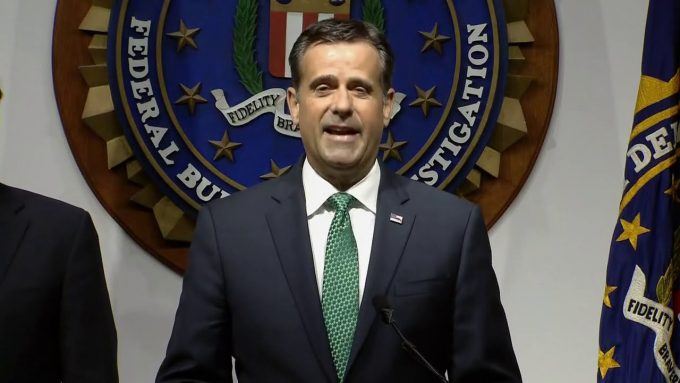
Director of National Intelligence John Ratcliffe. Credit: The Hill/ YouTube
By Philip Giraldi | American Herald Tribune | October 23, 2020
Those who have been waiting for the elusive October Surprise that will upset the apple cart on election day are admittedly running out of time. The media’s unwillingness to even consider that the antics of Hunter Biden just might constitute an embarrassment of major proportions or even something worse has done much to kill that story. And the old tried and true expedient of starting a little war somewhere is also proving to be a false hope as no one appears ready to provoke the righteously wrathful Secretary of State Mike Pompeo by ponying up a casus belli. Maybe there is still time for a false flag operation, but even that would require more prior planning than the White House appears capable of.
There is, however, one area that might just be exploitable to create a crisis, though it much depends on whether a tired public is willing to go one more round over the issue of “foreign election interference.” And yes, the Russians are presumed to be involved, on this occasion, as they always are, joined by the ever-vengeful Iranians.
On Wednesday Director of National Intelligence, John Ratcliffe held a news conference at which he laid out details of the most recent dastardly plot against American democracy. He described how Iran and Russia both obtained American voter registration data, apparently through publicly accessible databases and through purchases of email lists. Though no actual votes have been altered, they are using that information “to influence the presidential election as it enters its final two weeks.” Ratcliffe elaborated how “This data can be used by foreign actors to attempt to communicate false information to registered voters that they hope will cause confusion, sow chaos and undermine… confidence in American democracy.”
Ratcliffe focused mostly on Iran, saying that it had been identified as the source of what he described as a claimed 1,500 “spoofed emails” routed through Estonia that “seek to intimidate voters, incite social unrest, and damage President Trump.” Iran was also blamed for other material, to include a video encouraging the casting of illegal ballots both domestically and overseas. Additional intelligence suggests that Iran is planning to take more steps to influence the election in the coming days, though what those measures could possibly be was not revealed.
Other government sources elaborated, indicating that Iranian intelligence has been credited with the sending of the email messages going out to Democratic voters in four states, including hotly disputed Pennsylvania and Florida. The emails falsely claimed to be from the alleged far-right group Proud Boys which has been much in the news. Their message was that “we will come after you” if the recipients fail to vote for Donald Trump.
It doesn’t take much to realize that threatening messages relating to voting for Trump allegedly coming from a source described as “racist” would undoubtedly motivate most registered Democratic voters to do the opposite, but that seems to have escaped the analysts of the Directorate of National Intelligence. And one must also ask why Tehran would want the re-election of a president who has been unremittingly hostile, including imposing crippling sanctions, withdrawing from a beneficial nuclear agreement, and assassinating a leading Revolutionary Guards general. Even U.S. Senate minority leader Chuck Schumer appears to have figured that one out, saying “It was clear to me that the intent of Iran in this case and Russia in many more cases is to basically undermine confidence in our elections. This action I do not believe was aimed… at discrediting President Trump.”
The anti-Trump New York Times has, of course, another, more sinister interpretation, suggesting that “… it may also play into President Trump’s hands. For weeks, he has argued, without evidence, that the vote on Nov. 3 will be ‘rigged,’ that mail-in ballots will lead to widespread fraud and that the only way he can be defeated is if his opponents cheat. Now, on the eve of the final debate, he has evidence of foreign influence campaigns designed to hurt his re-election chances, even if they did not affect the voting infrastructure.”
The Times also notes a broader conspiracy by the dreadful Persians, explaining how “Iran has tinkered at the edges of American election interference since 2012, but always as a minor actor. Last year, it stepped up its game, private cybersecurity firms have warned. They have caught Iranian operatives occasionally impersonating politicians and journalists around the world, often to spread narratives that are aimed at denigrating Israel or Saudi Arabia, its two major adversaries in the Middle East.” Again, however, the article provides no explanation of what Iran could possibly hope to gain from the minimal “tinkering” it might be able to engage in an American election in which billions of dollars will be spent by Democrats and Republicans who are viciously attacking each other without any outside help.
Ratcliffe had less to say about Russia but U.S. media coverage of the story included a referral to a recent account of how the U.S. military’s Cyber Command helped take down a network developed by Russian hackers called TrickBot that had been used in ransomware attacks directed against companies as well as cities and towns across the United States. It also reported how “In recent days, another Russian hacking group called Energetic Bear, often linked to the F.S.B. — one of the successors to the Soviet Union’s K.G.B. — appears to have focused its attention on gaining access to state and local government networks. That has caught the attention of federal investigators because, until now, the group had largely targeted energy firms, including public utilities.”
There was, however, no evidence that either hacking group was being directed against voter systems, so Russia’s inclusion in the front-page Times story headlined “Iran and Russia Seek to Influence Election in Final Days, U.S. Officials Warn” has to be considered questionable editorial judgment. Perhaps scaremongering would be a better description. In any event, the story itself is much ado about nothing. Iran’s sending out 1,500 emails if that actually occurred, would have zero impact. Likewise, the claimed existence of alleged Russian hacking groups that have done nothing directed against voters or balloting systems with only a few days left until the election would appear to be an electoral tactic rather than exposure of any genuine threat. One might even describe it as a bit of deliberate disinformation.
Featured Video

HE SAVED LIVES. NOW HE FACES PRISON.
or go to
Aletho News Archives – Video-Images
From the Archives
NATO Sanctions and the Coming Global Diesel Fuel Disaster
By F. William Engdahl – New Eastern Outlook – 11.04.2022
Amid the ongoing global inflation crisis, NATO heads of state and mainstream media repeat a mantra that high energy prices are a direct result of Putin’s actions in Ukraine since end of February. The reality is that it is the western sanctions that are responsible. Those sanctions including cutting SWIFT interbank access for key Russian banks and some of the most severe sanctions ever imposed, are hardly having an impact on the military actions in Ukraine. What many overlook is the fact that they are increasingly impacting the economies of the West, especially the EU and USA. A closer look at the state of the global supply of diesel fuel is alarming. But Western sanctions planners at the US Treasury and the EU know fully well what they are doing. And it bodes ill for the world economy.
While most of us rarely think about diesel fuel as anything other than a pollutant, in fact it is essential to the entire world economy in a way few energy sources are. The director general of Fuels Europe, part of the European Petroleum Refiners Association, stated recently, “… there is a clear link between diesel and GDP, because almost everything that goes into and out of a factory goes using diesel.” … continue
Blog Roll
 Aletho News
- Iran FM meets with US envoy on UN meeting’s sidelines at American side’s insistence: Report
- Qatar PM calls for Gulf security framework with Iran, says war must be ‘wake-up call’
- China condemns US extortion of Iranian airlines, rejects Washington’s ‘illegal’ sanctions threats
- Italy to move military personnel from Taif base after missile strike
- Finland’s Stubb tells European leaders to calm down
- Defeating Russia on battlefield impossible – Fico
- Finland’s Gender Clinic Reversal
- Massachusetts Wants Mental Health Visits, Why Does Government Use ‘Health’ to Enter Our Homes & Families?
- US lawmaker admits American people footing bill for Trump’s failed aggression against Iran
- Pfizer Gave $500,000 to Groups That Lobbied to End Religious Exemption in Massachusetts
- If Americans Knew
- Sanctions are collective punishment: immoral and self-defeating
- Phosphorus Munitions Fired by Israel Burn Groves, Orchards in Southern Lebanon
- Israel Carries Out New Ceasefire Violations Across Gaza
- AI – Emphasis on the ‘I’: Israel Is Funding AI Chatbot Propaganda
- Israel Blocking Hundreds of Wheelchairs for Injured Children From Entering Gaza
- Israel Is Expanding and Upgrading Compounds for Palestinian Militias in Gaza
- The Palestinian-American Residents of This West Bank Town Are Wondering: Where Is Trump?
- Gaza desperately needs tents, wheelchairs, fuel… and everything else (Israel blocks it all) – Daily Update
- Israeli Attacks in Gaza Kill at Least Seven Palestinians Over Three Days, including Woman and Child
- Trump’s militarization of Washington DC as he pursues Israel’s war against Iran
- No Tricks Zone
- 2025 Nature Paper Claiming Worsening Global Drought Gets RETRACTED …Heavily Flawed
- New Study: ‘Global Drought Shows No Detectable Recent Acceleration Under Climate Warming’
- Economic Masterminds: German Socialists Suggest Taxing Productivity Gains Stemming From Using AI
- The South China Sea Has Not Been Cooperating With The Climate Change Narrative
- Energy Crisis: Germany Enters Heating Season With Historically Low Gas Reserve Fill Levels
- New Study: The Antarctic Ice Sheet Gained Mass From 2020-2024 Due To Staggering Snow And Ice Accumulation
- Study: Ocean Heating Rates From Thousands Of Years Ago ‘Dwarf’ Modern Ocean Heating Rates
- Climate Extremists Target, Attack Large-Scale Power Grid Infrastructure In Germany!
- New Study: Antarctic Ice Melt Has Contributed Less Than 1 Centimeter To Sea Level Rise In The Last 30 Years
- Fear Of Debate: Alarmist German Climate Scientist Calls On Mainstream Media To Discredit Skeptic Voices

