The WHO Changes Guidelines to Favor Lockdowns
BY WILL JONES | BROWNSTONE INSTITUTE | MAY 18, 2022
The World Health Organisation intends to make lockdowns and other non-pharmaceutical interventions intended to curb viral spread part of official pandemic guidance.
The revelation comes in a report scheduled to go to the WHO’s World Health Assembly later this month. This is not part of new pandemic treaty and does not require the endorsement of member states. The report says the implementation is already underway.
Many have raised the alarm about a new WHO pandemic treaty. However, as I’ve noted previously (and as Michael Senger notes here), there isn’t a new pandemic treaty on the table. Rather, there are amendments to the existing treaty, the International Health Regulations 2005, plus other recommendations (131 in all) put forward in a report from the Working Group on Strengthening WHO Preparedness and Response to Health Emergencies.
Most of these amendments and recommendations relate to information and resource sharing and preparation for future pandemics; none of them directly interferes with state sovereignty in the sense of allowing the WHO to impose or lift measures. However, that doesn’t mean they’re not dangerous, as they endorse and codify the awful errors of the last two years, beginning with China’s Hubei lockdown on January 23rd 2020.
The recommendations in the report originate from WHO review panels and committees and were sent out in a survey in December 2021 to member states and stakeholders to seek their views.
Non-pharmaceutical interventions appear three times in the recommendations, once under “equity” and once under “finance,” where states are urged to ensure “adequate investment in” and “rapid development, early availability, effective and equitable access to novel vaccines, therapeutics, diagnostics and non-pharmaceutical interventions for health emergencies, including capacity for testing, scaled manufacturing and distribution”.
While rapid development and early availability of non-pharmaceutical interventions sounds worrying in itself, it could be interpreted in a number of ways by states.
Where it really gets alarming, however, is in the “leadership and governance” section. LPPPR 29 states (emphasis added):
Apply non-pharmaceutical public health measures systematically and rigorously in every country at the scale the epidemiological situation requires. All countries to have an explicit evidence-based strategy agreed at the highest level of government to curb COVID-19 transmission.
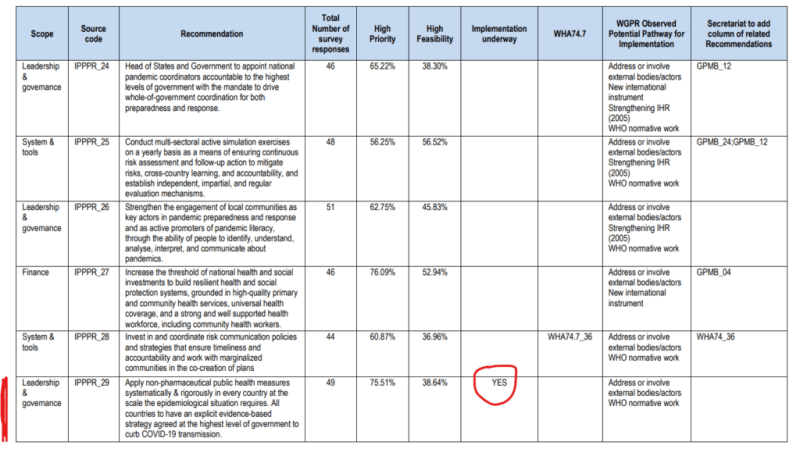
The requirement that a country’s pandemic strategy must aim to curb viral transmission is a major change from the current guidance. The U.K.’s existing pandemic preparedness strategy, prepared in line with previous WHO recommendations, is completely clear that no attempt should be made to stop viral transmission as it will not be possible and will waste valuable resources:
It will not be possible to halt the spread of a new pandemic influenza virus, and it would be a waste of public health resources and capacity to attempt to do so.
It almost certainly will not be possible to contain or eradicate a new virus in its country of origin or on arrival in the U.K. The expectation must be that the virus will inevitably spread and that any local measures taken to disrupt or reduce the spread are likely to have very limited or partial success at a national level and cannot be relied on as a way to ‘buy time’.
It will not be possible to stop the spread of, or to eradicate, the pandemic influenza virus, either in the country of origin or in the U.K., as it will spread too rapidly and too widely.
But now the WHO says that curbing viral transmission is to be the aim of pandemic response. This is a disaster.
Worse, the report says this recommendation will be incorporated into the WHO’s “normative work,” meaning it will be part of official WHO guidance to states in responding to a pandemic. Worse still, it says it’s already being implemented – it doesn’t need a treaty or the agreement of member states to do this, it’s already happening.
Expect to see new guidance appearing at the international and national levels over the coming months and years which incorporate this presumption that restrictions should be imposed to curb viral spread. This is despite the last two years only confirming the wisdom of the WHO’s previous guidance that this is not possible and not worth the attempt.
This matter must be raised at the highest levels so that lockdowns and other non-pharmaceutical interventions are kept out of all pandemic planning.
Sign the parliamentary petition against the latest moves by the WHO here – now at over 121,000 signatures.
Why the World should be very concerned about New Zealand under the Jacinda government
By Guy Hatchard | Waikanae Watch | May 19, 2022
The New Zealand government relies upon a science body known as Te Punaha Matatini (Centre for Science in Society) whose work is funded directly by the office of the Prime Minister and cabinet.
Yesterday, Te Punaha Matatini published a 21-page document entitled “The Murmuration of Information Disorders” (see attached release from the Science Media Centre) designating those opposed to the government’s pandemic policies as violent right wing insurrectionists planning the weaponised storming of parliament and the execution of public servants, academics, journalists, politicians, and healthcare workers.
This is an utterly false characterisation worthy of the worst excesses of historical propaganda.
This 21-page document, represented to the public as a scientific paper, contains not a single discussion of the scientific concerns being raised in opposition to government pandemic policy.
It omits for example analyses of the government’s own official figures which show that the vaccinated are more vulnerable to infection, hospitalisation, and death than the unvaccinated, a fact that has been deliberately hidden from the public.
Prime Minister Jacinda Ardern introduced yesterday’s Te Punaha Matatini report with the words:
“One day it will be our job to try and understand how a group of people could succumb to such wild and dangerous mis- and disinformation. And while many of us have seen that disinformation and dismissed it as conspiracy theory, a small portion of our society have not only believed it, they have acted upon it in an extreme and violent way that cannot stand. We have a difficult journey in front of us to address the underlying cause.”
Since when do reasonable scientifically-based questions asked of the government in good faith constitute violent insurrection?
I am tempted to think that Ardern could just as well be talking about her own government. The Prime Minister and the social scientists(?) working at Te Punaha Matatini might do well to read the New York Times, (although they probably don’t do so because the official policy of the New Zealand government is to discourage any information that is not sanctioned and edited by themselves).
A NYT article on 10 May 2022 entitled “Emergent Hid Evidence of Covid Vaccine Problems at Plant” reports that
“Emergent BioSolutions, a longtime government contractor hired to produce hundreds of millions of coronavirus vaccine doses, hid evidence of quality control problems from Food and Drug Administration inspectors in February 2021 — six weeks before it alerted federal officials that 15 million doses had been contaminated.”
A reasonable observer might conclude that early (and later) concerns being voiced about vaccine safety were justified, but the New Zealand government is far from reasonable.
A succession of scientific papers published in reputable journals during recent weeks (which we and many others have reported extensively and communicated directly to the government) have in fact fully justified concerns about safety and efficacy, but unbelievably our government is in denial and still moving ahead with propaganda advertising of their mRNA vaccination agenda for all ages and, as today’s Te Punaha Matatini report shows, labelling any opposition as a conspiracy with violent aims.
How Did the Transformation of the NZ Government Come About?
New Zealand has a small population of 5 million, but it has been used to trial new products in order to gauge what the public reaction and acceptance might be in bigger markets overseas. Never more so than during the pandemic. Take up of the Pfizer mRNA Covid vaccination has reached up to 95% of the eligible population.
This has been achieved through a transformation in the style of government, media control, science funding, intellectual standards, and international relations unprecedented in the western world, along with the coercion of draconian employment mandates and the pursuit of dissenters through compliant courts.
This has been engineered under the leadership of a person with a bachelor’s degree in communication who grew up in a strict rural Mormon household and cut her political teeth under the Blair administration in London. In keeping with her upbringing and education, Ardern is a leader who is sure she is right and is prepared to enforce her orthodoxy against all opposition and reason.
Her international perspective is one of unquestioning acceptance of the authority and right to rule of global institutions. Her top confidant and mentor Helen Clark, former NZ Labour Prime Minister, is closely associated with this outlook. Ardern recounts that she begins her day with a discussion with Clark over breakfast.
Like Ardern, Clark is renowned for her iron fist management style. She ruffled feathers at the United Nations Development Programme, which she led from 2009 to 2017, reportedly undermining human rights and supporting China’s Belt and Road initiative.
On 9 July 2020 the World Health Organization (WHO) appointed Clark as co-chair of a panel reviewing the WHO’s handling of the COVID-19 pandemic and the response of governments to the outbreak. The Independent Panel for Pandemic Preparedness and Response (IPPR) examined how the outbreak occurred and how future pandemics can be prevented.
Nothing says more about the overt global agenda of Ardern and Clark than this 11 May 2022 statement of the New Zealand government:
“The establishment of a pandemic treaty/instrument was a key recommendation of the Independent Panel for Pandemic Preparedness and Response and is one of New Zealand’s foremost global health priorities”
Like China, New Zealand’s fading international reputation for successful management of the pandemic was actually built on a single policy—control the borders, restrict entry, and impose lengthy quarantine.
The Current Situation in New Zealand is Deeply Concerning
Ardern controls the media and the science dialogue through a mixture of government funding and exclusion of dissent. The government has spent big on saturation advertising advising complete safety and efficacy of the Pfizer vaccine, and continues to do so.
It has instituted funding of cultural groups, GPs, and commercial organisations who promote vaccination. The level of funding is so generous that it has distorted prior long standing economic and political relationships.
So far the government has spent on the order of $100 billion on the pandemic in addition to normal expenditure. To put this in stark perspective, that is equal to the total annual government budget prior to the pandemic—more than $20,000 for every man, woman, and child. This is borrowed money which will have to be repaid through increased taxation of an already struggling population.
We Have No Constitution in New Zealand, the Power of the Government Is Absolute.
The control that Ardern’s government exercises over the courts, government agencies, parliament, media, independent regulators, and over the vast majority of the population is staggering and rigidly enforced. Dissenting medical professionals are excluded from practicing and in some cases prosecuted also. They are also mercilessly hounded and vilified by bought mainstream media.
In an atmosphere of strict government control, more worrying aspects of information control have emerged. In some cases noted by my scientific colleagues, policy and pronouncements that they have demonstrated are in conflict with published research have disappeared from the public record.
Even rare court rulings in favour of caution have been rapidly bypassed by simply passing new laws without debate. Court rulings about mandates have also been openly flouted, as happened when the military vaccine mandate was ruled illegal. With the support of the government, the military said the courts had no jurisdiction over its operation and went ahead anyway.
Ardern has introduced her policies in such a dedicated, persuasive, secretive, and complete way that almost the whole population of New Zealand has complied. They have accepted limitations on medical choice, judicial protections, human rights, press freedom, freedom of information, privacy, employment conditions and opportunities, standard of living, and social interaction.
Ardern’s successful efforts to persuade the population that government should be your only source of truth, have all but negated any of the longstanding mechanisms of government accountability. A majority of the population have all but concurred with Ardern that the unvaccinated may be safely blamed for every government failing and omission; and for all Covid case loads, hospitalisations, and deaths contrary to all evidence.
The opposition parties have apparently accepted that they will in future go about their business using the same Ardern doctrines and techniques. Accordingly they have failed to sound the alarm, investigate Covid science publishing deeply, or oppose draconian legislation. They have joined Ardern in labelling peaceful protest as unacceptable and illegal.
Ardern on the Global Stage
Ardern is about to deploy her international political capital to promote the globalisation of her policies and outlook. Her public persona can be deceptively mesmerising. You should be worried.
The world’s economy also has no constitution. So far Ardern appears to be happy to allow it to be controlled by global economic predators. Pfizer has been uncritically promoted by her, and the notion of WHO control over New Zealand’s sovereign rights is being welcomed with open arms. It fits with her strict hierarchical perspective.
Ardern may be viewed by naive foreign governments as a pandemic success story unfairly criticised in her own country. Stop for a moment and consider that she is about to lend her support to the promotion of a new world order on the global stage using her trademark persuasive techniques of propaganda, coercion, and control of information.
Pfizer Document Dump Shows Doctor With Ties to Gates Foundation Deleted Trial Participant’s Vaccine Injury
By Michael Nevradakis, Ph.D. | The Defender | May 18, 2022
An 80,000-page cache of Pfizer-BioNTech COVID-19 vaccine documents released by the U.S. Food and Drug Administration (FDA) sheds light on Pfizer’s extensive vaccine trials in Argentina, including the unusually large size of the trials and the story of a trial participant whose vaccine reaction was “disappeared.”
The case of Augusto Roux in Argentina suggests that in at least one instance, a trial participant whose symptoms were determined to be connected to the COVID-19 vaccine was later listed, in official records, as having experienced adverse events that were not related to the vaccination.
Vaccine trials in Argentina also appear to have glossed over adverse events suffered by other trial participants, and the potential connection between the adverse events and the vaccine.
The FDA on May 2 released the latest cache of documents, which pertain to the Emergency Use Authorization of Pfizer’s vaccine, as part of a court-ordered disclosure schedule stemming from an expedited Freedom of Information Act request filed in August 2021.
As previously reported by The Defender, the documents included Case Report Forms from Pfizer COVID vaccine trials in the U.S., and the “third interim report” from BioNTech’s trials conducted in Germany, both of which listed adverse events sustained by participants in the U.S. and German trials.
Many of these adverse events were indicated as being “unrelated” to the vaccines — even in instances where the patients were healthy or otherwise had no prior medical history related to the injuries they sustained.
Story of ‘disappeared patient’ goes public
Several bloggers and online investigators called into question various aspects of the Argentine vaccine trials, pointing out the number of participants in the Argentine trials dwarfed that of other, typically smaller trials at other locations in different countries.
They also pointed out the large number of participants appeared to have been recruited to the trial in a remarkably short time, and questioned the connections between one of the key figures of the Argentine trial to vaccine manufacturers, Big Pharma and the Bill & Melinda Gates Foundation.
The large number of trial participants in Argentina may be related to the fact that the trial appears to have been held simultaneously in 26 hospitals.
The large number of participants is revealed in another of the documents released this month, where on page 2,245, the list of randomized participants at trial site 1231 begins, while on page 4,329, the list of participants at trial site 4444 begins.
Site 1231 refers to the main trial site location and 4444 (page 24) most likely refers to the disparate hospitals participating in the trial outside the main location.
Commenting on the revelation, blogger David Healy wrote:
“About 5,800 volunteers were enrolled, half getting the active vaccine. This is almost 4 times more than the next largest centre in this trial.
“Amazingly 467 doctors were almost instantly signed up and trained as assistant investigators in the study.”
In all, 4,501 patients participated in the Argentine trials, representing 10% of all Pfizer trial participants worldwide.
Complete information about adverse events during this extensive trial in Argentina does not appear to have been released as of this writing.
However, Roux’s experience has since become public.
Roux, often referred to as the “disappeared” patient, volunteered for the trial (volunteer number 12312982) and received his first dose of the Pfizer vaccine on Aug. 21, 2020.
According to Healy, Roux “felt pain and swelling in his arm right after the injection. Later that day he had nausea, difficulty swallowing, and felt hungover.”
After a series of symptoms, Roux — during a clinical trial visit on Aug. 23, 2020 — was classified as experiencing a “toxicity grade 1 adverse effect.”
He nevertheless received his second dose on Sept. 9, 2020.
According to Healy:
“On the way home by taxi, he started feeling unwell. At 19:30, he was short of breath, had a burning pain in his chest and was extremely fatigued. He lay on his bed and fell asleep. He woke up at 21:00 with nausea and fever (38-39 C) and was unable to get out of bed due to the fatigue.
“Over the next two days, he reports a high fever (41 C) and feeling delirious.
“On September 11, he was able to get out of bed and go to the bathroom when he observed his urine to be dark (like Coca-Cola). He felt as if his heart expanded, had a sudden lack of breath and fell unconscious on the floor for approximately 3 hours.
“Once he recovered, he felt tired, was uncomfortable, had a high heart rate on minor movement, was dizzy when changing posture. He had a chest pain which radiated to his left arm and back.”
On Sept. 12, 2020, Roux was admitted to the Hospital Alemán, where he stayed for two days. It was initially believed he had COVID-19, but he tested negative for the virus. His symptoms also were found to not correspond with viral pneumonia.
After a series of X-rays, CT scans and urine tests, Roux was discharged Sept. 14, 2020, after being diagnosed with an adverse reaction — specifically, an unequivocal pericardial effusion — to the coronavirus vaccine (high probability), according to his discharge summary.
Doctor who altered Roux’s record had ties to Gates, NIH, Big Pharma
However, on Sept. 17, Dr. Fernando Polack, Pfizer’s lead investigator for the Argentine trials according to a Pfizer document released in December 2021, reported in Roux’s record that his “hospitalization was not related to the vaccine.”
Even after Roux’s discharge, his health difficulties continued. As reported by Healy:
“On November 13 [2020], he had negative IgG and IgM SARS COV-2 (QML technique), which is unusual post vaccine.
“On February 24, 2021, a liver scan showed a minor degree of abnormality. In March 2021 and February 2022, his liver enzymes remained abnormal.”
Ultimately, Roux lost 14 kilograms (30.8 pounds) in a period of three to four months, and continued to suffer from fever and bouts of breathlessness for several months afterward.
Polack, who reported Roux’s hospitalization as unrelated to the vaccination, is known for his close ties with various vaccine manufacturers, pharmaceutical companies and the Bill & Melinda Gates Foundation.
For instance, he is listed as the lead author in a Dec. 31, 2020, New England Journal of Medicine (NEJM) article on the purported efficacy of the Pfizer COVID-19 vaccine.
According to Healy, Polack also appears to be the founder of iTRIALS, a trial site management company, and another organization located at the same physical headquarters, the Fundación INFANT.
Healy wrote:
“When COVID struck Argentina, [Polack] and his Fundación became involved in a trial of immune plasma, taken from patients who had recovered from COVID, given to patients who had recently acquired the disease.
“In May 2020 he speculated that this would make COVID like an ordinary cold, and the Gates Foundation would offer financial support. He used high-profile press conferences to disseminate his exciting message.”
The conclusion of the study published in the NEJM following the plasma study reads:
“Funded by the Bill and Melinda Gates Foundation and the Fundación INFANT Pandemic Fund; Dirección de Sangre y Medicina Transfusional del Ministerio de Salud number, PAEPCC19, Plataforma de Registro Informatizado de Investigaciones en Salud number, 1421, and ClinicalTrials.gov number, NCT04479163.”
According to Healy, “[a] subsequent systematic review and meta-analysis failed to confirm these findings, noting ‘very serious imprecision concerns.’”
Healy pointed out that Polack, in his NEJM disclosure statement, did not indicate any conflict of interest or financial interest in the COVID-19 vaccine trials in Argentina, but:
“Polack reported grants from Novavax and personal fees from Janssen, Bavarian Nordic A/S, Pfizer, Sanofi, Regeneron, Merck, Medimmune, Vir Bio[technology], Ark Bio, Daiichi Sankyo outside the submitted work.
“At least eight of these companies are engaged in RSV vaccine research in babies and pregnant women. Fernando has mentioned a combined RSV, flu and COVID vaccine.”
And, in relation to Polack’s relationship with the Bill & Melinda Gates Foundation, Healy reported:
“[Polack] also doesn’t mention his extensive financial involvement with the Bill & Melinda Gates Foundation. This organization supports industry vaccine trials including Covid and RSV. Fernando is heavily involved through his Gates-sponsored Fundación INFANT in Buenos Aires in RSV trials and research.
“Gates sunk $82,553,834 into Novavax’s RSV vaccine ResVax which was shown to be ineffective in clinical trials in pregnant women.”
Polack’s own bio from a 2017 medical conference states “[h]is work is funded by the Bill & Melinda Gates Foundation, the National Institutes of Health [NIH], the Thrasher Research Fund, the Optimus Foundation and other international organizations.”
That same year, Polack testified at an FDA Vaccines and Related Biological Products Advisory Committee (VRBPAC) meeting, where he “acknowledged having financial interests in or professional relationships with some of the affected firms identified for this meeting, namely Janssen [producer of the Johnson & Johnson COVID vaccine], Novavax, and Bavarian Nordic.”
According to Dr. Joseph Mercola, Polack “also happens to be a consultant for the U.S. Food and Drug Administration’s Vaccines and Related Biological Products Advisory Committee (VRBPAC),” and “a current adjunct professor at Vanderbilt University in Tennessee.”
Michael Nevradakis, Ph.D., is an independent journalist and researcher based in Athens, Greece.
WHO pandemic treaty: A fresh push for vaccine passports, global surveillance, and more
By Tom Parker | Reclaim The Net | May 20, 2022
Members of the World Health Organization (WHO) are days away from voting on an international pandemic treaty and amendments to the International Health Regulations (2005) which would give the unelected WHO greater control of national emergency healthcare decisions and new powers to push vaccine passports, global surveillance, and “global coordinated actions” that address “misinformation” whenever it declares a “health emergency.”
From May 22 to May 28, representatives of the WHO’s 194 member states (which represent 98% of all the countries in the world) will attend a World Health Assembly meeting in Geneva and vote on this treaty and the proposed amendments to the International Health Regulations (IHR). If passed, both the treaty and amendments to the IHR will be legally binding under international law.
The international pandemic treaty
The World Health Assembly (WHA), the decision-making body of the WHO, established an intergovernmental negotiating body (INB) to draft and negotiate a “global accord on pandemic prevention, preparedness and response” in December 2021. The WHA aims to have this treaty adopted under Article 19 of the WHO Constitution which gives the WHA the power to impose legally binding conventions or agreements on WHO member states if two-thirds of the WHA vote in favor of them.
While the WHO framed this as an international pandemic treaty, the latest draft of the treaty has since evolved to cover all “health emergencies.” Unlike the term “pandemic,” which is limited in scope and refers to the worldwide spread of infectious disease, the WHO’s definition of a “public health emergency of international concern” (PHEIC) is much broader and applies to all types of disease, regardless of whether they’re infectious:
“A PHEIC is defined in the IHR (2005) as, ‘an extraordinary event which is determined to constitute a public health risk to other States through the international spread of disease and to potentially require a coordinated international response.’”
The draft treaty places the “WHO at the centre” and solidifies the WHO as “the directing and coordinating authority on international health” and gives it sweeping, legally binding powers to force member states to adopt many of the censorship and surveillance tools that were imposed during the COVID-19 pandemic.
Some of the key areas of the draft treaty include:
International vaccine passports and contact tracing: Member states will be required to “support the development of standards for producing a digital version of the International Certificate of Vaccination and Prophylaxis” (the WHO’s official vaccine passport). The WHO will also “develop norms and standards” for “digital technology applications relevant to international travel” such as contact tracing apps and digital health forms.
Global surveillance: The WHO will conduct “coordinated global surveillance of public health threats” and member states will be required to build out their surveillance systems and work with “the WHO’s global systems for surveillance.” Non-state actors (which could include Big Tech companies) will also be required to work with governments, the WHO, and other international partners to leverage their “considerable data” to “create the strongest possible early warning and response systems.”
Addressing “misinformation,” “disinformation,” and “too much information:” The draft treaty pushes “national and global coordinated actions to address the misinformation, disinformation, and stigmatization, that undermine public health.” Member states will also be required to strengthen their approaches to “infodemic management” (a term coined by the WHO that refers to “too much information including false or misleading information in digital and physical environments during a disease outbreak.”) Additionally, non-state actors will be required to actors to work with governments to fight disinformation.
Funding: WHO members are set to collectively pay the WHO over $950 million in dues for 2022-2023 and already paid over $270 million in voluntary contributions for 2020-2021. And this draft treaty proposes that G7 countries (Canada, France, Germany, Italy, Japan, the UK, and the US) also pay $11 billion for the “Access to COVID-19 Tools Accelerator (ACT-A).” Additionally, it intends to create an”International Pandemic Financing Facility” that will extract long-term (10-15 year) contributions of $5-10 billion per year.
We obtained a copy of the draft treaty for you here.
If this draft treaty is approved at the May 22 to May 28 WHA meeting, the INB will hold a second meeting on August 1 to discuss progress on the draft. A progress report will then be delivered at the 76th WHA meeting in May 2023. The final treaty will then be presented for adoption at the 77th WHA meeting in May 2024.
Proposed amendments to the International Health Regulations (2005)
On January 18, the Biden administration quietly sent the WHO its extensive proposed amendments to the IHR. The details of these proposed amendments were only made public on April 12, almost three months after they were sent.
Under the current IHR, 196 countries are legally required under international law to build the capability to detect and report potential public health emergencies worldwide and respond promptly to a public health emergency of international concern (PHEIC) whenever it’s declared by the WHO.
These proposed amendments from the Biden administration give the WHO and its Director-General, Dr. Tedros Adhanom Ghebreyesus, sweeping new powers to declare public health emergencies, even over the objection of member states, and implement global surveillance measures that require the mass collection of genetic sequence data.
Some of the key amendments that are being pushed by the Biden administration include:
Increased WHO powers to declare “potential” emergencies: Currently, the WHO can only declare a PHEIC when there’s an actual “public health risk to other States through the international spread of disease.” These proposed amendments allow it to declare a PHEIC when there’s a “potential or actual” PHEIC. This means there doesn’t have to be evidence of the international spread of disease, just the potential for it.
Increased WHO powers to declare health emergencies: Currently, the WHO has to follow the PHEIC criteria when declaring a public health emergency and health emergencies can only be declared by the Director-General. But under these proposed amendments, the WHO Director-General can issue an “intermediate public health alert” to any country in response to events that don’t meet the criteria of a PHEIC and a WHO “regional director” can declare a “public health emergency of regional concern” (PHERC).
Global surveillance and data sharing: The Biden administration’s proposed amendments empower the WHO to develop new “early warning criteria” for monitoring “national, regional, or global risk posed by an event of unknown causes or sources.” Additionally, these proposed amendments expand the scope of data sharing under the IHR and require members to hand over genetic sequence data to the WHO whenever they have an event that “may constitute a public health emergency of international concern.”
We obtained a copy of the proposed amendments to the IHR for you here.
If these amendments are approved at the May 22 to May 28 WHA meeting, nations have six months to reject them. After six months, they’ll enter into force and any rejection or reservation “shall have no effect.”
The WHO’s history of supporting surveillance and acting as an arbiter of truth
Not only could this treaty and the proposed amendments to the IHR empower the unelected WHO to push surveillance, vaccine passports, and global programs that target what it deems to be misinformation but this international health agency already gave the world a taste of how it exercises these powers during the COVID-19 pandemic. As COVID-19 spread, the WHO rigorously supported surveillance tech and was increasingly used as an arbiter of truth on Big Tech platforms, even though it got many things wrong.
YouTube, Facebook, Wikipedia, and others have partnered with the WHO to tackle misinformation or display labels with information from the WHO. YouTube even goes as far as removing videos that go against the WHO and has censored over 800,000 videos under this policy.
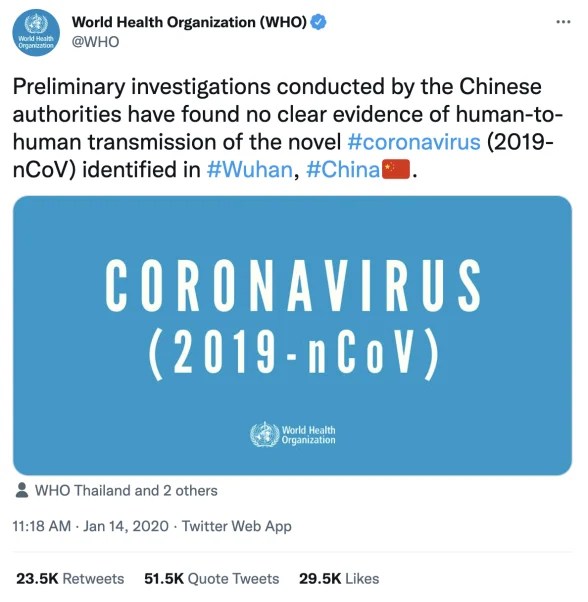
Despite having significant influence over how these platforms determine which posts to brand as misinformation, the WHO has got many things about COVID wrong and amplified misleading statements. For example, in an infamous January 14, 2020 tweet, the WHO stated that “preliminary investigations conducted by the Chinese authorities have found no clear evidence of human-to-human transmission” of the coronavirus.
The WHO has also praised China’s response to COVID which relies heavily on digital censorship and surveillance. Only recently did the WHO break this trend and criticize China’s zero-COVID policy. And when it did, these digital censorship systems were unsurprisingly used to censor the WHO’s statements on Chinese social platforms.
Another thing that the WHO heavily supported throughout the COVID-19 pandemic was vaccine passports. It pushed for them in December 2020 and it’s still pushing for the adoption of global vaccine passports this year.
The WHO’s undemocratic global governance system
The way the WHO gains its powers gives citizens almost no recourse. Instead of the response to national emergencies in democratic nations being the sole purview of elected officials who can vote on proposed measures that apply to their citizens and be held accountable at the ballot box by those citizens, WHO members vote on legally binding international treaties and agreements on their behalf via the WHA. If two-thirds of the WHA vote to adopt a treaty or agreement, it becomes legally binding under international law.
This global governance system has the support of both parties in most democratic countries. For example, during the 2022 Australian federal election campaign, both of the leading candidates expressed full support for the WHO’s expanded powers.
And the WHO Director-General has used the COVID-19 pandemic to push countries to further embrace the WHO’s global governance system by blasting countries that made their own decisions and claiming that their “‘me-first’ approaches… stymie the global solidarity needed to deal with a global threat.”
Countries that support the WHO’s expanded powers
Many countries have expressed support for the international pandemic treaty or the proposed amendments to the IHR.
The US supports both its proposed IHR amendments and the international pandemic treaty.
The treaty also has the support of the UK, Canada, Australia, New Zealand, and the European Council (EC) (which represents 27 European Union (EU) member states). According to the EC, 110 countries supported the decision to launch negotiations on the treaty. If these 110 countries vote in favor of the treaty, it would give the WHA close to the two-thirds of the majority it needs to pass the treaty.
Opposition to the WHO’s expanded powers
While there’s significant member state support for these expanded WHO powers, local politicians, citizens, and rights groups are opposing this power grab.
In the US, Congresswoman Mary Miller (R-IL), Congressman Byron Donalds (R-FL), and Congressman Chris Smith (R-NJ), have opposed the Biden administration’s proposed amendments to the IHR.
Senator Rick Scott (R-Fla.), and Senator Tom Cotton (R-Ark.) have also opposed the Biden administration’s support of the international pandemic treaty.
In Australia, Senator Malcolm Roberts (One Nation), Senator Alex Antic (Liberal Party), and Senator Gerard Rennick have opposed the international pandemic treaty.
Several UK Members of Parliament (MPs), including the Conservative MPs Craig Mackinlay and Steve Baker, have also called for the government to provide clarity on the treaty.
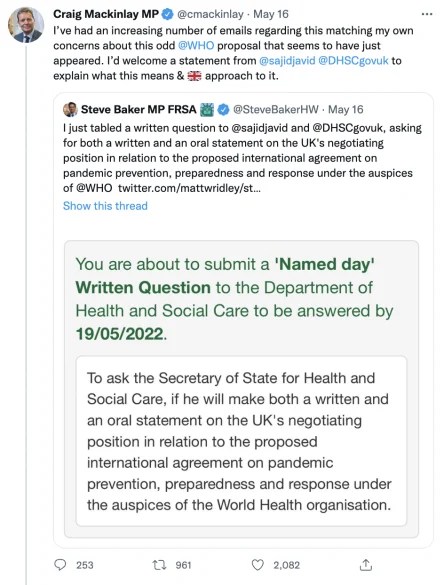
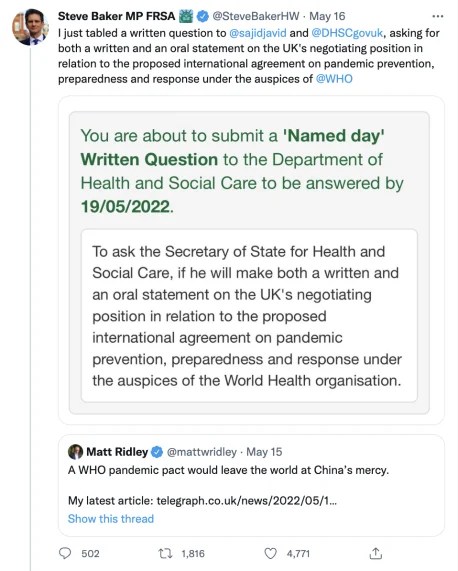
UK Health Secretary Sajid Javid responded to Baker’s calls by stating that the UK government supports the treaty but “would not sign up to any instrument that compromises the UK’s sovereignty,” including “any instrument which compromises the UK’s ability to take domestic decisions on national restrictions or other measures.”
A UK Government and Parliament petition urging the government to not sign any WHO pandemic treaty unless it’s approved via public referendum has received over 130,000 signatures which means Parliament will now consider it for a debate. The petition has also trended on the homepage of the UK Government and Parliament petition’s website.
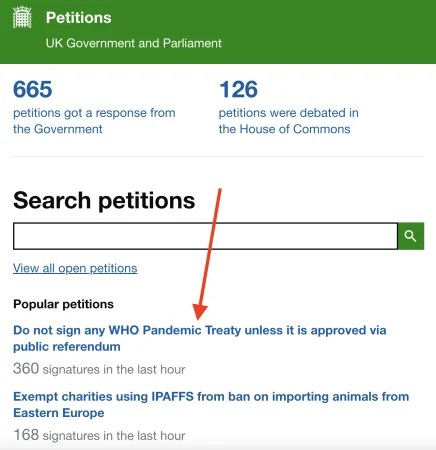
Member of the European Parliament (MEP) Christine Anderson has opposed the treaty, branding it an “abolition of democracy by the global elites.”
Conservative Party of Canada (CPC) MP Leslyn Lewis has also pushed back against the treaty and launched a “Stop The Treaty” petition which calls for Canada to decline the treaty.
And rights group World Council for Health has launched a #StopTheWho Campaign which opposes both the treaty and proposed IHR amendments.
But for now, the fate of this WHO power grab rests on the outcome of the May 22 to May 28 WHA meeting.
Governments worried about Covid misinformation should start with their own lies and distortions: Indiana AG
The Daily Sceptic | May 20, 2022
Governments concerned about Covid misinformation should start with their own lies and distortions, Indiana’s Attorney General has told the U.S. Government. In a submission to the U.S. Surgeon General, who had requested information on the impact of online health misinformation during the pandemic in the United States, Todd Rokita joined with leading scientists Dr. Jay Bhattacharya and Dr. Martin Kulldorff to set out nine examples of disinformation propagated by the CDC and other health organisations that have “shattered the public’s trust in science and public health and will take decades to repair”. Read their full submission below.
May 2nd 2022
Agency: Department of Health and Human Services, Office of the Surgeon General
Action: Request for Information (RFI)
Subject: Impact of Health Misinformation in the Digital Information Environment in the United States Throughout the COVID-19 Pandemic
Response: COVID-19 Misinformation from Official Sources During the Pandemic
Submitting parties: Todd Rokita, Indiana Attorney General; Dr. Jay Bhattacharya, Professor at Stanford University School of Medicine; and Dr. Kulldorff, Senior Research Fellow at the Brownstone Institute and former Professor at Harvard University School of Medicine.
The Office of the Surgeon General requested information on the prevalence of health misinformation during the COVID-19 pandemic and the impact of such misinformation on the U.S. public health system in order to be better prepared to respond to a future public health crisis.
We agree that misinformation has been a major problem during the pandemic. The spread of inaccurate scientific information has made it difficult for the public to make the right decisions to protect themselves, their families, and their communities from COVID-19 and the collateral public health damage arising from the pandemic countermeasures. As such, the disinformation has led to great harm in the lives and livelihoods of Americans. We submit the following examples of disinformation from the CDC and other health organisations that have shattered the public’s trust in science and public health and will take decades to repair.
#1 Overcounting COVID-19: The official CDC numbers for COVID-19 deaths and hospitalisations are inaccurate. The official tallies include many people who have died with rather than from COVID-19. CDC has not distinguished deaths where COVID-19 was the primary cause of death, where COVID-19 was a contributing cause of death, or where the death was entirely unrelated to COVID-19, but they incidentally tested positive.
There are three reasons for this problem. (i) The counting of COVID-19 cases and deaths is unlike the way that public health counts the incidence and mortality caused by other diseases; physicians have been advised to fill out death certificates to privilege COVID-19 as a proximal cause, even when the medical facts suggest otherwise. (ii) The population-wide testing to identify asymptomatic individuals infected with the SARS-CoV-2 virus is unprecedented in human history. (iii) Although it would have been easy, CDC has not conducted random national surveys of medical charts to determine what proportion of reported COVID-19 deaths were truly due to COVID-19. Ex-post audits of death certificates and medical records in Santa Clara County and Alameda County, California, for instance, found that in around 25% of death certificates in which COVID-19 was labelled as the primary cause of death, other causes of death were more likely. The peer-reviewed literature confirms that COVID-19 is overcounted in other developed countries. Ex post audits of death certificates should be conducted to establish an accurate death count from COVID-19.
#2 Questioning Natural Immunity: There has been consistent questioning and denying of natural immunity after COVID-19 recovery. Using seriously flawed studies, CDC falsely claimed that natural immunity is worse than vaccine acquired immunity. In October 2020, the CDC director published a “memorandum” in the Lancet, questioning natural immunity. Most critically, by mandating vaccination for people who have recovered from COVID-19, the Government, corporations, and universities de facto deny natural immunity.
For scientists, this has been the most surprising disinformation. We have known about natural immunity since the Athenian Plague in 430 BC; other coronaviruses generate natural immunity; and throughout the pandemic, we knew that the COVID-19 recovered have good natural immunity if and when they get exposed the next time. That is, six months after the start of the pandemic, we had epidemiological evidence that natural immunity lasts at least six months; a year into the pandemic, we knew that natural immunity lasted at least one year, and so on.
#3 COVID-19 Vaccines Prevent Transmission: The CDC director and other health officials falsely claimed that the COVID-19 vaccine prevents the transmission of COVID-19 to others. This was also the rationale for vaccine mandates and passports – to prevent the spread of the virus to others. At the time, we did not know, and it turned out to be wrong. When the COVID-19 vaccines were approved for emergency use, the manufacturers presented randomised controlled trials (RCTs) that showed that the vaccines reduced symptomatic disease. The trials were not designed to determine whether they could also limit transmission or prevent death, even though they could have been designed to do so. As it turned out, vaccinated individuals spread the disease to others. While it was unfortunate that the RCTs were not designed to answer the disease transmission question, it is irresponsible for public health officials to claim that they did when the RCTs did not even attempt to answer that question.
#4 School Closures Were Effective and Costless: In the United States, most schools were closed for in-person teaching for some time, and many schools were closed for over a year. This decision was based on false claims that it would protect children, teachers and the community at large. Already in the early summer of 2020, we knew this was false. Sweden was the only major Western country to keep schools open throughout spring 2020 without masks, social distancing, or testing. Among these 1.8 million children ages one to 15, there were zero COVID-19 deaths, only a few hospitalisations, and teachers did not have a higher COVID-19 risk than the average of other professions.
Moreover, while older people living with a working-age adult had a higher COVID-19 risk, there was no evidence that also living with a child increased that risk further. In a July 2020 New England Journal of Medicine article evaluating school closures, they did not mention the Swedish data and evidence, which is like evaluating a new drug without including data from the placebo comparison group. Despite clear evidence on the safety of keeping schools open, misinformation led to many schools being closed for over one year.
#5 Everyone is equally at risk of hospitalisation and death from COVID-19 infection: Though public health messaging has blunted this fact, there is more than a thousand-fold difference in the risk of hospitalisation and death for the old relative to the young. Though the risk of death is high for the old and some other vulnerable populations with severe chronic illness, the risk posed to children from COVID-19 infection is on par with the risk posed by a bad influenza season. Surveys indicate, however, that both old and young overestimate the risk of death from COVID-19 infection. This misperception about risk is harmful because it leads to demand for policies – such as school closures and lockdowns – that were themselves harmful.
#6 There was no reasonable policy alternative to lockdowns: Even from the beginning of the pandemic, the sharp age-gradient in the risk of severe disease on COVID-19 infection has provided an alternative to the lockdown-focused policies that many U.S. states adopted – focused protection of the aged and otherwise vulnerable. In October 2020, along with Prof. Sunetra Gupta of Oxford University, we wrote the Great Barrington Declaration – a public petition that proposed heightened measures to protect the vulnerable and a return to near-normal life for the less vulnerable (including the opening of schools). Tens of thousands of doctors and scientists signed the Declaration in opposition to lockdowns. In the Declaration itself and in supporting documents, we offered many concrete policy suggestions for better protecting the vulnerable, including reduced staff rotations in nursing homes, free home delivery of groceries and other essentials offered to older people living in the community, paid sabbatical leave or alternative work arrangements for older workers, and many other policy options. We also invited the public health community to join in thinking creatively about other ideas to protect the vulnerable. As subsequent research has confirmed, it was clear even at the time that lockdowns could not protect the vulnerable (nearly 80% of COVID-19 deaths have occurred among the elderly in the U.S.). Meanwhile, countries like Sweden, which did not implement lockdowns, have had near-zero overall excess death over the last two years of the pandemic. Lockdowns are an aberration– a sharp deviation from traditional public health management of respiratory epidemics – and a catastrophic failure of public health policy.
#7 Mask mandates are effective in reducing the spread of viral infectious diseases: Contrary to assertions by some public health officials, mask mandates have not been effective in protecting most populations against COVID-19 risk. The SARS-CoV-2 virus spreads by aerosolisation. Unlike larger viral droplets, which are pulled by gravity to the ground shortly after emission, aerosols are tiny particles that can persist in the air for extended periods. Aerosols escape through gaps of poorly fitted masks, greatly reducing their ability to stop disease spread. Cloth masks, in particular, cannot stop aerosols, and even well-fitted N95 masks have diminished capacity to stop viral transmission when they become moist from breathing. It is thus unsurprising that the highest quality evidence available – randomised trials – conducted both before and during the pandemic find that masks are ineffective at stopping the spread of respiratory viruses in most settings when worn by untrained people.
#8 Mass testing of asymptomatic individuals and contact tracing of positive cases is effective in reducing disease spread: Mass testing of asymptomatic individuals with contact tracing and quarantining of people who test positive has failed to substantively slow the progress of the epidemic and has imposed great costs on people who were quarantined even though they posed no risk of infecting others. Three facts are crucial to understanding why this policy has failed. First, even close contacts of someone who tests positive for the SARS-Cov-2 virus are unlikely to pass the disease on. In a large meta-analysis of household contacts of asymptomatic positive cases, only 3% of people living in the same home got sick. Second, the PCR test that has been used to identify asymptomatic infections often returns a positive result for people who have dead viral fragments, are not infectious, and pose no risk of infecting others. And third, the contact tracing system becomes overwhelmed whenever cases start to rise, leading to long delays in contacting new cases. At precisely the moment when contact tracing might be needed, it cannot do its job. At the same time, quarantining people is costly – for workers without adequate sick leave, absenteeism due to contact tracing means pay cuts, lost opportunities and perhaps even an inability to feed families. For children, it means more skipped lessons and missed opportunities for academic and social growth at school, with long-run negative consequences for their future prospects. In the U.K., an official government review determined that its 37 billion pound investment in contact tracing was a waste of resources. The same is undoubtedly true in the United States.
#9 The eradication of COVID-19 is a feasible goal: Throughout the pandemic, from “two weeks to flatten the curve” and onwards, the suppression of the spread of COVID-19 has been an explicit policy goal. Implicitly, public health leaders have made the suppression of COVID-19 spread to near-zero levels the endpoint of the pandemic. However, SARS-CoV-2 has none of the characteristics of a disease that can be eradicated. First, we have no technology to reduce the spread of the disease or meaningfully alter disease dynamics. Lockdowns and social restrictions fail because only people who can afford to work from home without losing their job can comply over long periods. While we have vaccines that can help prevent hospitalisation or death resulting from COVID-19 infection, the vaccines wane in efficacy against COVID-19 infection and cannot stop transmission. Second, there are many animal hosts for SARS-CoV-2 and evidence of transmission between mammals and humans. One USDA study in late 2021 found that nearly 80% of white-tailed deer in the U.S. had evidence of COVID-19 antibodies. Dogs, cats, bats, mink and many other mammals can get COVID-19. So even if the disease were eradicated among humans, zoonotic transmission would guarantee that it would come back. Finally, eradication takes a global commitment from every country – an impossible goal since COVID-19 eradication is far from the most pressing public health problem for many developing countries.
Big Pharma-funded paper recommends taxing the unvaccinated
By Kit Knightly | OffGuardian | May 17, 2022
A new paper published by Oxford University’s Center for Business Taxation discusses – and in the end supports – the idea of a special tax levied on those who decline to be “vaccinated” against “Covid19”.
The paper’s authors argue that a vaccine-related tax would be “justified” because “Taxes on behaviour that is considered undesirable are nothing new.”
And that even if the “vaccines” do cause serious harm to some people…
“some states do adopt policies that can lead to serious harm in exceptional cases when they consider that the benefits outweigh the costs“
Yes, you did read that right.
They go on to suggest all sorts of ways of correcting this “undesirable behaviour”, from straight taxation to tax credits for those who have been vaccinated, to vaccine mandates and compulsory Covid insurance for the unvaccinated (which is just another way of saying “taxation”).
Now, here is where we could – and normally would – break down the article paragraph by paragraph. We would dissect the arguments, include data they ignore, highlight logical fallacies… you know, the usual.
We’re not going to do that today.
We could point out the infection-fatality ratio for Covid “cases” is minuscule.
Or that the so-called “vaccines” don’t prevent either infection or transmission of the alleged new disease called “Covid19”.
We could launch into a legal argument on civil rights, the Nuremberg Code, and medical coercion.
But we’re not going to do any of that.
Because it’s been two years of this, and life is just too damn short. We’ve done it enough, the facts are all there for anyone who cares enough to find them.
Instead, we’re just going to quote the ‘About’ page of the Oxford Center for Business Taxation, with a bit of added emphasis…
The Centre for Business Taxation was formed in 2005 and was initially funded by substantial donations from a large number of members from the Hundred Group. A number of these companies and others continue to support the CBT. Donors during the year were AstraZeneca [and] GlaxoSmithKline Plc
To be clear, the Hundred Group is a lobbying group which works on behalf of the all the members of the FTSE100.
GlaxoSmithKline is one of the largest pharmaceutical companies in the world, and partnered with French giant Sanofi to produce a Covid vaccine which netted the companies billions in supply contracts, despite the fact it is yet to be approved for public use.
If you know anything at all about Covid, you don’t need us to tell you who AstraZeneca are.
The CBT – and therefore the paper – are funded by big business and big pharma.
Do we really need to add anything else?
Bill Gates and the Coordinated Campaign for Nasal Spray Vaccines
eugyppius – May 18, 2022
As we saw a few weeks ago, Bill Gates is subtly annoyed at our SARS-2 mRNA vaccines. They have to be kept cold, which makes them third-world unfriendly. They’re not very good at inducing mucosal immunity, which makes them bad at stopping infection. They require trained needle-wielding “vaccinators”*, which is an extra step that limits uptake. What would please this unelected omnipresent merchant of nuclear-grade charitable benevolence the most, is a nasal spray vaccine, like they had in the movie Contagion. Gates really liked that film. They just snorted the vaccine, and then the virus went away.
Why can’t we have vaccines like they have in the movies, Gates wants to know? Well, perhaps we can.
Two weeks after Gates made his wishes known, a curious guest essay appeared in the New York Times : The Answer to Stopping the Coronavirus May be Up Your Nose. The vaccines are great, says essay author and Yale immunobiologist Akiko Iwasaki. Only, nasal spray vaccines would be even better. Our current vaccines are bad at inducing mucosal immunity. Also, the “barrier … for a needle shot” is probably higher than the barrier for inhaling things.
Iwasaki envisions “potentially over the counter” vaccines that everyone can snort “every four to six months.” She’s also co-author of a preprint, which shows that if you get mRNA-immunised mice to inhale recombinant unadjuvanted spike protein, their mucosal immunity improves. Not for nothing, this is the same approach envisioned by the EcoHealth Alliance lunatics in their infamous PREEMPT grant proposal. There, they fantasised about “develop[ing] recombinant chimeric spike-proteins from known SARSr-CoVs … to boost immune memory in adult bats” and then spraying these proteins into caves for the bats to inhale (p.4).
It’s nice to know that the research program that set off the whole pandemic will now circle back to provide remedies against the pandemic that it caused. This is fine. This is Science.
* To my great delight, Gates actually uses this term.
Featured Video

Trita Parsi: Middle East Unraveling — Are We on the Path to World War?
or go to
Aletho News Archives – Video-Images
New Book
Trans agenda is ‘normalization of sadism’ – US author

RT | September 23, 2026
The US Democratic Party has embraced a transgender agenda that amounts to “the normalization of sadism,” author A.J. Rice has said, warning that radical trans policies would return if the party is allowed to regain power.
Speaking to RT’s America First host Scotty Nell Hughes about his new book, ‘The Curse of the Bearded Lady: How the Trans Mafia Whacked American Sanity’, Rice argued that activists have gained significant influence in schools, medicine, and corporate America while people who questioned the agenda have faced pressure to stay silent.
The author described the “trans mafia” as the sprawling network of people and institutions that have helped the movement gain influence. He singled out parts of academia, wealthy backers, and corporations, and stated that providers of transition-related treatment also have a financial incentive to keep young people in their care indefinitely.
Rice argued that the consequences of these policies ultimately fall on children who are being drawn toward gender-affirming medical treatments and on girls who are expected to share locker rooms or compete in sports with biological males.
He noted that while voters rejected the Democrats’ approach to gender in 2024, the party, which has been “captured by madness,” has since only doubled down and is seeking what is effectively “the normalization of sadism.” … Full report
Blog Roll
 Aletho News
- German chemicals giant reveals details of downsizing
- Refaat Al-Areer Was The Canary In The Coal Mine In Israel’s War On The Truth
- Israeli election committee bars candidate from Knesset race over Gaza war opposition
- French-Lebanese man files war crimes complaint over Israeli attacks
- Mahan Air Flight Lands in China Despite US Threat against Iranian Airlines
- US eyes $10bn fund to rebuild war-battered Gulf infrastructure
- Trump meets Rodríguez near Maduro’s prison as Venezuela’s oil flows to US
- Trita Parsi: Middle East Unraveling — Are We on the Path to World War?
- Iran FM meets with US envoy on UN meeting’s sidelines at American side’s insistence: Report
- Qatar PM calls for Gulf security framework with Iran, says war must be ‘wake-up call’
- If Americans Knew
- Caught on Tape: AIPAC CEO Boasted of Controlling Trump’s National Security Officials
- Why Hamas Attacked Israel in October 2023 – Israeli professor Ilan Papé
- They see them, then kill them: Israeli quadcopters track, deliberately target civilians in Gaza
- Winter could turn Gaza’s treacherous, war-damaged buildings into deathtraps
- Majority of Democratic Voters Want to Prosecute Both Biden and Trump Administration Officials Over Gaza
- As Gaza languishes, world leaders gather at the UN – Daily Update
- Sanctions are collective punishment: immoral and self-defeating
- Phosphorus Munitions Fired by Israel Burn Groves, Orchards in Southern Lebanon
- Israel Carries Out New Ceasefire Violations Across Gaza
- AI – Emphasis on the ‘I’: Israel Is Funding AI Chatbot Propaganda
- No Tricks Zone
- New Study: Earth And Venus Surface Warmth Largely Explained By Convection And Lapse Rate, Not CO2 Or Radiation
- 2025 Nature Paper Claiming Worsening Global Drought Gets RETRACTED …Heavily Flawed
- New Study: ‘Global Drought Shows No Detectable Recent Acceleration Under Climate Warming’
- Economic Masterminds: German Socialists Suggest Taxing Productivity Gains Stemming From Using AI
- The South China Sea Has Not Been Cooperating With The Climate Change Narrative
- Energy Crisis: Germany Enters Heating Season With Historically Low Gas Reserve Fill Levels
- New Study: The Antarctic Ice Sheet Gained Mass From 2020-2024 Due To Staggering Snow And Ice Accumulation
- Study: Ocean Heating Rates From Thousands Of Years Ago ‘Dwarf’ Modern Ocean Heating Rates
- Climate Extremists Target, Attack Large-Scale Power Grid Infrastructure In Germany!
- New Study: Antarctic Ice Melt Has Contributed Less Than 1 Centimeter To Sea Level Rise In The Last 30 Years

