The rediscovery of a series of grisly experiments on beagle puppies has galvanized social media users into demanding the arrest of “America’s doctor” Anthony Fauci. But where was everyone when his work was harming humans?
Images of a sad pair of beagle puppies, their heads encased in square cages as they lie hopelessly on a table, have yanked at America’s heartstrings since they were shoved back into the national spotlight by White Coat Waste Project, a group that calls out US government labs for animal cruelty and other misuse (and abuse) of citizens’ money.
Millions of taxpayer dollars were used to essentially torture the puppies to death in labs in and out of the US, according to the organization, which unearthed evidence of the cruelty in the form of over $21 million spent on a total of four experiments – none of which was medically necessary. One involved severing 44 puppies’ vocal cords so that their pained barking and whining wouldn’t bother the scientists; another deliberately infected them with sand flies over the course of 22 months, restricting their movements by locking their heads in boxes so that they could not even swat the insects away as they were being eaten alive.
It’s horrific stuff by any measure, beyond cartoonish levels of evil. Indeed, even Texas Senator Ted Cruz (R) claimed he thought the tweets he’d read about Fauci “literally ‘torturing puppies’” had to be “metaphorical.”
But while the outrage is justified, it’s also old news. One could ask why the masses have turned against Fauci only now, when his National Institute for Allergies and Infectious Diseases has been funding the torture of puppies for years, with one of the horrific experiments dating from 2016. The most recent grant dated from 2020, meaning Fauci’s agency was vivisecting helpless furry animals at the University of Georgia even while he was being worshiped as America’s Doctor™ and posing for photos with other people’s dogs.
Even White Coat Waste Project refers to its own revelations as “Fauci’s other international scandal,” implying knowledge of a better-known episode in the fame-hungry doctor’s life.
One must ask why the popular outrage against Fauci over animal cruelty is not matched by an equal (if not more forceful) outrage over the doctor’s crimes against humanity. From his enthusiastic support of gain-of-function studies to his efforts to sideline a cheap, effective drug that could have saved thousands of lives during the AIDS epidemic in favor of a highly toxic alternative, Fauci’s hands are covered in the blood of humans as well as that of canines.
Indeed, Fauci’s behavior during the Covid-19 outbreak – trashing cheap but effective treatments in favor of expensive alternatives lacking proof of efficacy – eerily mirrors his actions during the early years of AIDS. Thousands of people have died in both cases after Fauci pushed deadly or ineffective medications – most notably the failed cancer drug AZT in the 1980s and the failed Ebola drug remdesivir in the last two years – while safer and more efficacious remedies sat on the shelf.
Discoveries that members of the National Institutes of Health, parent of Fauci’s NIAID, had hefty investments in Gilead, maker of remdesivir, as well as in Moderna, one of the manufacturers of an mRNA vaccine for Covid-19, have only raised more questions about Fauci’s motives during the coronavirus pandemic.
Fauci has also been caught lying repeatedly about his involvement in gain-of-function research aimed at making bat coronaviruses more infectious in humans. Despite his profuse denials of even funding such research in recent months, he previously defended the work by arguing that any knowledge gained from bolstering the infectious potential of such pathogens was “worth the risk” of unleashing a pandemic. Whether or not his NIAID-funded research played a part in the Covid-19 outbreak has not been proven, but Fauci’s furious tap-dancing around any questions regarding the Wuhan lab or gain-of-function research in general does him no favors.
Yet, somehow, none of this elicits anything like the howls of rage coming from dog-lovers on social media. The same outrage-on-demand contingent who demand countries like China and Vietnam stop eating dog meat, signing a petition with one hand while biting into a well-done burger with the other, insist on the closure of “barbaric” wet markets like the one we were told spawned the novel coronavirus in late 2019. This group’s problem is less animal cruelty than being reminded of that cruelty. They’d rather wait until their meat is shrink-wrapped and frozen in a supermarket than pick out the tastiest-looking chicken in the bunch and have it slaughtered then and there.
Ultimately, Fauci being arrested is an endpoint that animal rights activists, human rights activists, and the normally comatose members of Congress – 24 of whom actually signed a letter demanding answers from the once-untouchable Coronavirus Pope – should see eye-to-eye on. But the diminutive doctor must not be permitted to skate on his real crimes – whether it’s pandemic profiteering, bankrolling gain-of-function research in China that was at the time illegal to perform in the US, or allegedly perjuring himself in congressional testimony. Fauci has much to answer for. Dozens of dead puppies are just the tip of the iceberg.
Unfortunately, like other gleeful architects of the Covid-19 police state who’ve been caught in the midst of scandal – former New York Governor Andrew Cuomo, for example – arresting Fauci on the basis of popular rage over dead puppies is likely to close the book on further prosecution, no matter how heinous his “real” crimes.
Just as Cuomo is unlikely to ever be held to account for the thousands of elderly New Yorkers who died because of his nursing-home order to house Covid-positive patients with the helpless elderly, Fauci will be permitted to enjoy his retirement – and big fat pension – in peace. Americans who have lost everything to his mismanagement of the Covid-19 pandemic must not let that happen.
Helen Buyniski is an American journalist and political commentator at RT. Follow her on Telegram
We looked at this phony Guardian report the other day:
One section deals with what it calls crop failure:
It claims that once-a-decade droughts are becoming more frequent, in comparison with 1850-1900! This apparently comes from the IPCC, but who was counting droughts in the 19thC?
As with disaster databases, it is only in recent years that organisations have been set up to monitor humanitarian crises and provide aid. A hundred years ago, there was no internet, television or mobile phones to relay the news.
A famine in Madagascar would simply have happened without being noticed.
The Guardian then goes on to “prove” its point, by cherry picking droughts in Guatemala and Zambia, as if they had never happened before. They are not even in the same year!
The dip in agricultural production in Guatemala is evident in 2017, but the trend for both countries is remorselessly up.
If there was any truth in the Guardian’s apocalyptic version of events, we would see global food production staggering from one crisis to another.
But we don’t.
The Guardian reckons that India and Pakistan will be particularly badly hit by crop failures, even in this decade:
But this goes totally opposite to what is actually happening there.
And long term monsoon trends clearly show that droughts are not becoming more severe or common in India, global warming or not. Most droughts are, in fact, associated with El Ninos, and not climate change:
Joanna Lumley has said that a return to rationing could help solve the climate crisis. The 75 year-old actress said that eating meat and travelling could be rationed to save the planet.
Speaking to Radio Times Lumley said:
“These are tough times and I think there’s got to be legislation. That was how the war was and at some stage we might even have to go back to some kind of rationing, where you’re given a certain number of points and it’s up to you how to spend them – whether it’s buying a bottle of whisky or flying in an aeroplane.”
She said that people could be compelled to cut back on weekend breaks abroad and to move to a plant based diet:
“Perhaps people have got to think a bit harder. Maybe more of our holidays should be at home or taking trains, and not hopping on a plane to Magaluf for the weekend.
I don’t get ill because I’m vegetarian. I still have plenty of energy. I am absolutely fine, I gave up meat 45 years ago.”
When you frame any problem, whether real or imagined as a war, you can justify almost anything right? Remember all that “workers on the front line” nonsense at the beginning of the scamdemic? Remember “the war on covid?”
Didn’t I say last year, that climate lockdowns would be a thing? I said that Sunday driving would be rationed as well as certain foods. This will tie in with the social credit system of course.
Not reducing your meat consumption, your travel, your overall carbon footprint ultimately, will eventually be seen as treachery.
1. We cannot vaccinate ourselves out of the Covid problem. Mass vaccination is forcing the virus to produce variants, which escape any protection provided by the jab (see here for a report covering 68 countries). Instead, the vaccine should be offered only to those most vulnerable, such as the very elderly.
2. It is especially wrong to give it to children. They are at almost zero risk from Covid but subject to a real risk of damage from this particular vaccine, unrecognised during its development.
3. Cheap and effective treatment is available which keeps the vast majority of patients out of hospital. Health officials and regulators should support doctors who want to use these treatments, and to educate patients in how to strengthen their responses to the virus.*
4. Lockdowns and official fear-inducing propaganda have blighted the lives of millions, especially children, and must never be repeated.
The discussion is a must view for concerned individuals. It offers a completely different perspective from that of the NHS chiefs now calling for booster jabs and the return of Covid restrictions.
These edited contributions give a flavour of the discussion:
Dr Robert Malone, key architect of the mRNA technology that made possible the most commonly used Covid vaccines: ‘The virus is evolving very rapidly. This is akin to what happens if you overuse antibiotics. With universal vaccination, we’re driving towards an endpoint of vaccine-resistant mutants. The vaccines need to be used intelligently.
‘This set of vaccines that we have right now are gene therapy-based, and they have a common problem: they only have one antigen. It’s the spike antigen. When they were developing them, they didn’t realise the spike was biologically active. No fault of theirs. Everybody was in a rush.
‘But now it’s time to take a breath and say, “Hey, does this really make sense?” We don’t have to be just Left or Right, pro- or anti-vaccine. There’s a middle ground. We, as a community, need to protect people at high risk, not just here in our community, in our states; in my opinion, we need to protect the elders throughout the world. We don’t need to hoard all the vaccine for people that don’t really need it.
‘I’m not an anti-vaxxer, I’m a guy who’s spent the majority of my adult life developing vaccines. This is a technology platform that has enormous promise. And right now it’s in its infancy. The safety of the underlying technology is not yet fully demonstrated.
‘People did what they did in good faith and focused on a protein that they thought was fully safe – spike. But now, over a year later, we know that in the virus, this protein is responsible for much of the disease – the pathology in your vascular endothelial cells [blood vessel linings], the coagulation. And it’s unfortunate that this particular protein, in what appears to be a biologically active form, was used in these vaccines.’
Dr Richard Urso, ophthalmologist, Texas: ‘When people say, “They died of Covid”, they died of an inflammatory, thrombotic disease. They didn’t die from the virus running through their body. There’s a bunch of drugs that can be used for the purpose of inflammation in this disease. There’s a bunch of drugs for thrombosis. Hopefully at some point we’ll have a really good, early treatment that’s directed to the virus itself. Right now we have other, very effective treatments.
‘About 330 children have died of Covid in a year and a half [under-19s in the US]. Typically, about 50,000 children a year die – many from drownings, from car accidents. You need to look at that as you look at the risk to children. And do they spread? – No, at least seven different studies show that children spreading to adults is close to zero.’
Dr Brian Tyson, family doctor, California, who has successfully treated more than 6,000 Covid patients and now finds children are getting sick from typical winter illnesses, rather than Covid: ‘With treatment started from day 1 to 7, I have had zero deaths. From treatment started from day 7 to 14, I have four – two died the same day they showed up at the clinic, and two died in hospital.
‘Under that data Dr Urso was talking about, not one healthy child died from Covid-19. It was children who had four or five risk factors – morbid obesity being number one, diabetes number two, weakened immune system number three; kids on chemotherapy and things like that. So yes, they’re going to have opportunistic infections, but that’s no different than would normally take out these kids anyway, unfortunately.’
Dr Heather Gessling, family doctor, Missouri: ‘My numbers exactly match up with Brian’s. I’ve treated about 1,500 and I’ve had one death, because there was some delay in treatment.’
Dr Mark McDonald, child psychiatrist, Los Angeles: ‘Fear has been the driving force of this pandemic from the very beginning. What’s driving the fear now is propaganda. I see kids all day long. The developmental stage that children need to go through – babies, toddlers, young adults – is being foreclosed on them.
‘Brown University department of paediatrics published a study that found babies born after January 1, 2020, have an IQ drop of 20 points. Why? They don’t see faces. They don’t play. They don’t have exposure to friends. They don’t go to school. They’re basically locked in their homes, looking at their parents for a year and a half. And their brains have not developed.
‘My concern is that we are building a generation of young people who are so traumatised that they will never fully recover. They’re always going to be scarred emotionally.
‘I don’t mean to be depressing. I mean to be alarming, so everyone can finally say, “Stop!” We’ve got to stop the damage, and then figure out what to do about it.’
Dr Gessling: ‘I think “Stop the damage!” means to acknowledge what we have done wrong. We should reverse all the measures that have been implemented. Patients, families, parents, should take it upon themselves to feel empowered. We need to get back to the basics, because we’ve done this wrong for so long.
‘One of the books we all had in medical school was Harrison’s Principles of Internal Medicine. This is what we have forgotten: “Many specific host factors influence the likelihood of acquiring an infectious disease: age, immunisation history, prior illnesses, level of nutrition, pregnancy status, coexisting illnesses and perhaps emotional state – all have some impact on the risk of infection after exposure to a potential pathogen.” All we have done is focus on one of those: immunisation history.
‘The ability to provide early, effective treatment should make us feel empowered. We should not feel afraid any more.’
Dr Pierre Kory, pulmonary and critical care specialist; founding member and president, the Front Line Covid-19 Critical Care Alliance; co-author of two Covid prevention and treatment protocols: ‘My hopes are that more and more attention is going to be paid to early treatment strategies, especially now the vaccinated are getting sick. Many people were led to believe that if you get your vaccine, we’re going to end this thing, you don’t have to worry about it, you can carry on with your lives.
‘But guess what? My colleagues are talking about even scarier variants that are coming. And so we need more tools to fight this. The positive message is, we have them, and they can handle any variant that comes at us. We just need to get that message out. I don’t believe anybody has died who’s had effective early treatment.’
Dr John Littell, family doctor, Florida: ‘What we’re seeing now is that patients are getting early treatment with ivermectin, hydroxychloroquine and a host of other medications, because of this free exchange of ideas in this group of physicians and others around the world.
‘Dr Tyson, Dr Gessling and myself are family physicians, OK? So we’re the folks who have been in those front lines getting the phone calls in the middle of the night from concerned parents. And what you’ve just heard from Dr Kory and from us is that is that if you take the right preventive treatment, you’re approaching zero per cent mortality.’
Dr Kory: ‘If we have effective treatments, why aren’t they being recognised and disseminated across the world? I think we’re up against two forces.
‘The first is that in general, our health agencies are suffering what’s called regulatory capture. They’re largely driven by financial interests that are making sure that the solution to the pandemic is one that is profitable. Vaccines are profitable.
‘The other, somewhat overlapping challenge is that in academia, in the last ten years, there’s been this increasing belief that the only proof of efficacy of a drug has to come out of a large, double-blind, randomised controlled trial. You have to make the diagnosis – everyone has to have a positive test; they have to have symptoms; they have to be enrolled, consented, randomised, and then the drug is delivered. Each one of those steps takes time. So it’s often very delayed, and under-dosed – they’re using doses that I was using six months ago.’
Dr Ryan Cole, medical director, Cole Diagnostics, Idaho, who has done more than 100,000 Covid tests in the past year: ‘Covid is a clotting disease. When we give a spike protein [through the vaccine], that is an active biologic molecule. We chose the wrong molecule, which causes disease.
‘So what do I see under the microscope? We see clotting under the skin, in the lungs, in the blood vessels, in the brain – not from the virus, but from the spike from the vaccine itself.
‘Now consider the numerator and the denominator. Are most people going to be fine? Yes. And I want to emphasise that.
‘[But] in our data from around the world, from the United States, from the UK, from EudraVigilance in Europe, we have seen more death and damage from this one medical product than all other vaccines combined in the last several decades, in just a short, eight-month window of time. It has done more damage than any other medical product, therapy, shot, modality, of anything we’ve ever allowed to stay on the market to this point.
‘Do I mean to sound alarmist? No, I’m being factual. And when I look at it under the microscope and I see the parts of people – or people that are no longer with us – the damage and the disease is caused by that spike protein. It is present.
‘A virus is a humanitarian issue. When we divide ourselves in thought and don’t listen to science any more, we’re going down the wrong paths.
‘We are forgetting what our amazing immune system does. How many of you had chickenpox when you were a kid? And how many of you have ever had it again? Did you need a shot? No. Grandma had measles – has grandma ever had it again? No, because her immune system works.
‘Half of kids in the US have already had Covid. We’re not antibody testing – we’re treating everybody with this terrible oppression of, “You’ve got to wear a mask . . . you’ve got to stay home if somebody in your classroom tests positive.” It denies basic science.
‘Under age 50 with no co-morbidities, your chances of dying from this disease are about nil, and if you get early treatment they are even closer to nil. So if you are a Covid recoverer, you don’t need a shot.
‘The shot can damage the hearts of children. There are more children who’ve had myocarditis – and there’s never such a thing as mild myocarditis. That’s inflammation of the heart. Once you get inflammation, you get scarring. Those kids’ hearts are damaged for life. Kids have died of heart attacks after the shot, and there are more kids that have had myocarditis than have died from Covid. Kids aged zero to 18 survive this virus at a statistical 100 per cent – 99.997 per cent. So why are we punishing kids for a virus they survive?’
*For up-to-date guides to home treatment of Covid, see here and here.
IT’S OFFICIAL: Most of the UK’s vaccinated population are suffering far higher rates of infection than the unvaccinated, and it is getting worse by the day.
The UK’s Health Security Agency publishes detailed Covid statistics, which, for the last 7 weeks, have been tabulated by age-group and vaccination status. This now allows important questions to be answered.
The Agency says most vaccinated suffer substantially higher rates of infection, and their latest chart provides a snap-shot:
All of the UK’s 30-and-over vaccinated now endure far higher rates of infection than their unvaccinated counterparts. But as a snap-shot, this tells us nothing of how this arose, or how it may yet develop. Here we re-present the agency’s data in a time-series, to promote better understanding of the trends and implications.
The UK has vaccinated its population mostly in age order, from oldest to youngest, and very recently began vaccinating its under-18-year-old cohort. Being the UK’s most freshly vaccinated, they exhibit a very high degree of resistance to Covid infection: –
This very recently vaccinated cohort benefits from a 90% improvement in their infection rates, meaning their case incidence is 10 times better than that of their unvaccinated counterparts. This is impressive, and leads us to ask how long this high degree of protection might last?
The answer, unfortunately, seems to be not very long:
The previous UK age-group to be vaccinated was the 18–29-year-old cohort, of which half was fully vaccinated by some 9 weeks ago. While still doing better than the unvaccinated of their age, they have nevertheless lost the greater part of their relative resistance to infection. If they continue their trajectory, week 12 will see that benefit completely gone.
The earlier vaccinated age-group was the 30–39 cohort. Half was fully vaccinated around week 27, and by week 39 (again some 12 weeks later) had lost their enhanced infection resistance. For at least for these two cohorts, it would seem their vaccine induced resistance reduced to zero in under 3 months.
Unfortunately, it does not stop there; Following the data shows the vaccinated descend well into negative territory, which may prompt us to ask how all earlier vaccinated cohorts are now doing?
In terms of vulnerability to infection, the answer is not so well:
The entire 40-79 vaccinated cohort is deeply negative, now below minus 50%, meaning they suffer more than double the infection rate of their unvaccinated counterparts, and there is no obvious end in sight; Given the consistent and strongly negative continuing trend for all adult cohorts, it is impossible to guess where or when these trajectories might bottom out.
But does the trend result from increased vulnerability amongst the vaccinated, or is improved resistance developing amongst the unvaccinated? The answer appears to be both:
Unvaccinated adults are enjoying significantly lowered infection rates, but the vaccinated are very clearly headed in the opposite direction:
This begs the question: Why should the vaccinated suffer mounting infection rates, while case-rates of the unvaccinated both declined and are lower? Surely, we should expect the vaccinated to do better – certainly no worse?
Yet, for all but one adult cohort, the exact opposite is true, and even for them, it seems likely for not much longer:
It has been suggested infection amongst the unvaccinated has induced robust natural immunity leading towards their herd-immunity. That may well be a factor, but, as we have seen, the vaccinated have similarly been infected, and at least for the 40-79 cohort, at much higher rates. Why should this not benefit the vaccinated as well?
Are we to understand infection after vaccination may not produce similar broad immunity?
Vaccination is intended to alter subsequent immune response to infection, which is, of course, the whole point; It is conceivable this altered response may mute the development of broad long-lasting immunity that otherwise typically results from natural infection. That might then leave the vaccinated more open to re-infection, and might help explain these results. But this remains speculation, we simply do not know today.
What we do know from the UK data, is that anyone vaccinated more than few months ago is at greatly higher risk of Covid infection, and is therefore greatly more likely to be infected than their unvaccinated counterparts.
Much has been said and written to show the vaccinated are equally capable of transmitting Covid. But because their symptoms are often muted, they are also more likely to be out and about; add this to escalating infection rates, and there can be little doubt the vaccinated now constitute by far the greatest Covid transmission risk.
In light of this, vaccine passports are clearly senseless; They are nothing more than an invitation to infection, for which no justification can now possibly remain.
Leaky vaccines, leaky tests, leaky case definitions.
Ridiculous anti-science refusals to acknowledge the much stronger, more long-lasting and reliable immunity that comes from having had the disease.
Politicians who want to destroy economies and families before they admit they were so very wrong about everything.
Public health officials who use viral segments like lego pieces to create new and ever more virulent pathogens–then lie repeatedly about it, build elaborate coverups, and increase their salary by 68% because they have taken on “biodefense work” to save the population.
And now, to save the Australian Open (goodness knows how much the Ozzies make from TV rights alone, plus all the tourism this huge tennis event engenders) they have tossed the most egregious BS overboard.
Thousands of California Parents pulled their children from schools across the state Monday, as part of a massive protest against Covid vaccine mandates.
“Because science” is new slang terminology that refers to bogus explanations or justifications for why things are done a certain way during the pandemic.
I have come to love the term because it encapsulates the contempt for the public evidenced by officials who usually know little about science but regurgitate “the science” to justify some unjustifiable policy.
Aaron Siri, a wonderful attorney, has challenged US health agencies on many of their illogical and often illegal pandemic policies.
He just posted the exchange he has had with CDC over its refusal to acknowledge the presence of immunity to COVID in the recovered.
While the whole document is interesting, the very end contains some of CDC’s “because science” answers.
Let me explain what CDC has been doing over the past year: whenever there is strong evidence that shows a CDC claim or policy is dead wrong, CDC’s “scientists” conduct a bogus study which can involve cherrypicking endpoints, choosing specially selected time periods, and a variety of other shenanigans to produce “evdience” that calls into question the real science. They have done this with masks, lockdowns, recovered immunity, and vaccines for children, that I can recall off the bat. I worked with a group of scientists who tried to reproduce the CDC’s calculations. But we couldn’t, because even though the CDC “scientists” were friendly and seemingly open, they never would provide enough information on their data set and their algorithm(s) for us to check their work. Clearly that was CDC policy, even though it flies in the face of standard ICMJE medical publication standards.
And that is what they did in this case. Despite mountains of evidence regarding the strength of recovered immunity, CDC just cited its own bogus study, while leaving the door open in case “the science” changed in the future. Where is the shame?
And, the agencies don’t mind dragging litigation on forever, since it is your money that is paying for it.
I find myself in the position that I must use an alias for fear of reprisal. Those days may be quickly coming to an end, as hospitals are denying requests for vaccine exemptions with impunity. I will likely soon be out the door, with nothing to lose. Even if I survive this round, if the “pandemic” continues, it won’t be long before I am shelved like a can of spam.
Doctors need to be called out. From early in the pandemic, it was like a mass hypnosis or forgetfulness of everything we had learned in medical school. Immune system knowledge was shelved and replaced by government dictates. The thought of early outpatient treatment with “off label” drugs that could modulate the immune system was forbidden. We essentially told patients that they had to go home and wait until they were sick enough to be hospitalized, then treatment would begin. Imagine telling all diabetics that there is no metformin, Glucophage, or insulin. Would we really wait until patients are in diabetic ketoacidosis, and then treat them only at the hospital? It is medical malfeasance of a grand scale.
We physicians gave up our training and our reasonable medical thought process. The reasons are multiple. First, it was the easy way out. Second, many of us are employed and fear reprisal. Third, despite what the public thinks, we physicians are not bold leaders, we tend to be sheep, and are afraid of having an entire institution ostracize us or our colleagues to think us crazy.
As we got to the point of vaccine rollout, doctors were not using the scientific method, questioning and challenging prevailing hypotheses. They kept their heads down, closed clinics, converted to telemedicine, and pushed only the jab.
I had conversations with doctors who are supposed experts in virology and immunology denying the lasting immunity of natural infection. Conversations about natural immunity:
“I have antibodies.”
“But they will wane.”
“But I have memory cells.”
Dumbfounded look.
Really, are these the leaders we want?
Other conversations about the safety of vaccines:
“The vaccine is safe.”
“No, we would have shut down any trial in the past after even 100 deaths.”
“This is more serious.”
“But the survival rate is about 99.6%.”
“It’s killing people.”
“So is the vaccine”
“You can’t believe VAERS.”
“It was set up to help protect the public, and if anything, it is underreporting side effects.”
“You’re a conspiracy theorist.”
Or conversations about early treatment
“You must get the vaccine, it is the only “proven” treatment, there are no other treatments.”
“Really, ivermectin has eradicated COVID in India, parts of Mexico, Japan….”
“It is a horse dewormer.”
“It won a Nobel Prize in medicine, is a WHO essential drug, and has been around for decades with a great safety profile.”
“No, only the vaccine works.”
“But it is failing”
“You are a denier and a conspiracy theorist.”
“Sigh….”
Lately, it has been all about getting 100% of the population jabbed. For what reason? I am not sure, and some of the more detailed and investigated theories scare me. I shudder to think. But last year’s heroes are being labeled selfish and villainous for not getting the vaccine. Hospital systems have abandoned their community’s health and ignored early successful outpatient treatment in favor of huge government subsidies for inpatient and ICU treatment. The success of these treatments was not great, but that is another article. Now we have the same hospital systems turning their backs on their own employees. Basically, health providers have a choice, get shot, or get fired. How does that help? Both vaxxed and unvaxxed can spread the virus, so it doesn’t help anyone. It only helps the hospital to get more government money by meeting quotas.
I, for one, will remember that when we faced a real crisis, the hospitals and many physicians chose money and profit over their own community’s best interest. Perhaps it is time for groups of physicians to get back to running their own healthcare clinics and hospitals. We used to have a code of ethics. We used to put patients first. Not anymore.
As for physicians, those who are blindly following the government edicts are culpable in a moral atrocity. Bullying and deriding patients who chose to refrain from this still experimental therapy is an abomination. (You will say it isn’t experimental anymore, to which I would say that just because the government broke its own rules regarding approval, doesn’t make it legal or right). Patients have sincere beliefs for making their choice. Respect their thoughts. Do you yell as much at smokers, drinkers, fornicators, drug abusers, etc? No, I think not. I think you chose to fit in because it gives you a sense of righteousness.
And going so far as to encourage vaccination in children and pregnant women is crazy. There is blood on the hands of any physician who does this. With children, there is no benefit to the vaccine, only harm. They would serve themselves and society better with natural immunity. The vaccine hasn’t been studied on women and their babies. It is pregnancy category X (unknown) but being pushed wholesale on these poor women without proper studies. Shame on you, doctors who are doing this. I certainly have lots to answer for when I meet my maker, but this is on another level.
I beg physicians to get back to basics, remember all the epidemiology and immunology that bored us to tears in school. Investigate the real literature and take a stand. Society needs us to do this. Even if you have been vaccinated, help those who are fighting for their lives. Stand up against this forced vaccine tyranny. Support those who have legitimate reasons for declining the jab. If you don’t stand up now, who will stand up for you when you are faced with your choice of yet another booster or your job.
Researchers at Temple University received $750,000 from the National Science Foundation (NSF) to develop a tool that warns journalists that they are about to publish polarizing content. The NSF is a federal government agency focused on supporting research and education in non-medical fields of engineering and science.
The initiative is part of NSF’s “Trust & Authenticity in Communication Systems.” It is called the “America’s Fourth Estate at Risk: A System for Mapping the (local) Journalism Life Cycle to Rebuild the Nation’s News Trust.”
The focus of the project, according to a report on Campus Reform, is creating a system that alerts journalists that the content they are about to publish might have “negative unintended outcomes” such as “the triggering of uncivil, polarizing discourse, audience misinterpretation, the production of misinformation, and the perpetuation of false narratives.”
The researchers hope that the system will help journalists measure the long-term impact of their stories, that go beyond existing metrics such as likes, comments, and shares.
One of the researchers involved in the project, Temple University’s professor Eduard Dragut, said that the system will “use natural language processing algorithms along with social networking tools to mine the communities where [misinformation] may happen.”
“You can imagine that each news article is usually, or actually almost all the time, accompanied by user comments and reactions on Twitter. One goal of the project is to retrieve those and then use natural language processing tools or algorithms to mine and recommend to some users [that] this space of talking, this set of tweets, which may lead to a set of people, like a sub-community, where this article is used for wrong reasons,” he added.
Journalists and other players in the news industry will be involved with the project, which already includes researchers from other universities including Boston University and the University of Illinois-Chicago.
“We want journalists to be part of the process, not just the mere users of the product itself,” Dragut said. “So you can imagine sort of an analytics tool that informs the journalists and editors and other people involved in this business how their products or how their creative act is used or misused in social media.”
He added that the project is attempting to “create a collaborative environment with both social media platform[s] and other organizations like Google” because of their expertise.
“We have some preliminary conversation with Bloomberg, for instance, and we will have to define exactly how they are going to help us. Google has an initiative to help local news, and we are working to create a relationship with them, and there are others,” Dragut told Campus Reform. “This product will not work unless we are successful in bringing some of these high tech companies into the game.”
Another researcher involved in the project, professor Lance Holbert, said that, for now, the misinformation the project is focusing on is that of the spread on local media.
“Certainly some topics over time will become more versus less interesting, but also we’re focused here initially on local media as well, so each locality may have different topics or particular points of interest that come up in the news,” he said. “We’re trying to keep this generalizable across topics.”
Holbert noted that misinformation is not “happening in the political spectrum” alone.
“[It’s happening] in sports, it’s happening in economics,” he said. “Like a few years back, I know, an example from Starbucks where there was a sort of a campaign on Twitter [saying] that Starbucks is targeting, in the wrong way, African Americans, which was wrong.”
The NSF is expected to further fund the project when its first phase becomes successful.
We see unprecedented use of ‘unprecedented’ today. Yes, it applies to putting entire nations under house arrest. Yes, it applies to the near-universal wearing of masks (more accurately muzzles). Yes, it applies to needing a passport to be normal. But perhaps the entire phenomenon we are experiencing is not unprecedented.
Let us look back in time to 380, when Rome became the superspreader of Christianity by making it their empire’s official religion. Within 100 years the Roman Empire collapsed but despite the death of its host, Christianity survived and for over 1000 years the head of the Catholic Church was the most powerful figure in all of Europe.
Most rulers of nations, then and now, have one core raison d’être, which is to protect us from other versions of themselves. But the Catholic Church would tolerate no other versions. Its Pope reigned supreme, having spiritual authority over kings, dukes, princes and local overlords. As the Lord’s Prayer tells us “…thy kingdom come, thy will be done, on earth as it is in heaven.” Your local priesthood conveyed the will to be done on earth, working hand in glove with the local lord, whose temporal power was recognised by God’s official mouthpiece, the Pope.
You may ask how the church came to have and maintain such power. The answer is simple: faith and fear.
They had agents throughout the land, with a church in every town. The priest class, from archbishops down to parish priest, were the most highly-educated and respected sector of society. The priesthood was a sought-after secure profession, and people had faith in the truth of what the priest told them. It was often sound advice they could find nowhere else. The church had a near monopoly on education, with part of the core curriculum being God and creation, Jesus and miracles, sin and salvation, as well as good deeds, forgiveness, and useful guidance. Most priests were good people, people of faith, and following their advice was the passport to Heaven.
Then there is the fear. The devil can manifest anywhere in the world, tempting people to stray from the path of righteousness. The devil can be lurking unseen within any one of us, prompting urges that God wants us to supress. We must be on our guard from those he may have corrupted. We must follow the priest’s advice to avoid the fearsome prospect of Hell.
Believers knew that if they behaved badly during their 50 or so years of this existence, they would suffer a miserable and horrific existence in Hell, forever – like eternity. What a terrifying prospect! This was the picture the church taught and most people absolutely believed what they were told by the highly educated priests. Bastards, born out of wedlock, were a product of sin and not welcome in society. Those who missed church on Sunday were avoided. Just speaking with these dangerous people could infect one with sinful thoughts.
Not all the ‘common’ people bought into the church’s teachings or went to priests for advice on things spiritual or material. Some chose a more direct spiritual interface with the living world. Many were women who also practiced unlicensed healing, whether through herbs or ‘occult’ practices invoking natural energies of the earth and human body. Tens of thousands of these women were burned, drowned or tortured to death as witches, for their deviant beliefs.
Of course, being a God-fearing church goer did not stop people from being sinners but at least you were trying and could confess your sins to the priest, do some penance and be forgiven. Without that escape clause, the ungodly sinner was doomed to Hell.
Those who wrote or spoke publicly in contradiction of the church’s teachings were guilty of heresy and their books burned and banned, as well as the heretic at times. To speak disrespectfully of things holy was considered blasphemy, punishable as a serious crime, occasionally warranting death. This unfortunate situation still prevails in many Islamic nations, with a religion 600 years younger than Christianity.
The Christian church does not have the power it once held over the minds of those in so-called Western cultures. There are still some who believe in a God who created the Universe in a few days and did it all for the benefit of humankind, before throwing us out of the Garden of Eden. Most, if not indoctrinated early, instinctively reject the idea that we are born with the burden of sin and can only find spiritual truth and salvation through the son of God, whom we crucified. The spiritual credibility of the church has not been helped in recent years by the paedophile scandals surrounding its priesthood.
Today we are witnessing a new “religion” taking hold and this one has nothing to do with spirituality, yet has spread faster than any before. It has gripped the minds of billions across the planet and is also powered by faith and fear, with an enemy as invisible as Hell and the Devil himself. Curiously, it has had its greatest success to date in the ‘West,’ perhaps filling the fear vacuum that has been created in the world’s traditionally Christian cultures.
Today’s priesthood is embodied in the medical industry, staffed by highly trained professionals with secure careers, for whom the public has high regard. Just as we once needed priests to act as intermediaries to God, we now need trained doctors as intermediaries to our bodies and guardians of our health. Many people are sadly out of touch with their mortal frame and have unquestioning faith in doctors knowing best – the high priests of health.
The medical establishment does not like competition for its services, doing whatever it can to ban or denigrate healing practices other than their own, whether herbs or naturopathy, prayer or acupuncture, homeopathy or reiki. Theirs is the only true path to health, and all other routes are portrayed as fraught with danger.
We do not know how well organised Christians were before the Romans assimilated them – before Christian belief was standardized and regulated at the Council of Nicaea. We do know that before the healing profession was dominated by the World Health Organisation, The Centre for Disease Control, and the Global Alliance for Vaccines and Immunisation, there was full medical freedom of choice for the individual. In 1880 there were more homeopaths in the USA than allopathic doctors, while mechanics earned more than either of them. It is no accident that the WHO, CDC, and GAVI are largely funded by the pharmaceutical industry, and headed by their chosen men and women. They have become today’s equivalent of the Vatican during its 1000 years of dominance. They claim a monopoly on truth and woe betide those who question or counter it.
Notable physicians, respected virologists, vaccine designers, even a Nobel Prize winner have countered the official narrative and lost their positions, been discredited and denounced. They are denied any further involvement in the hospitals, clinics and practices spread across the land as thickly as were early chapels, churches and cathedrals. Popular speakers, performers and entertainers have had their bookings cancelled for refusing to be vaccinated, or for questioning the push to global vaccination. We could view these outspoken characters as being excovidicated from the medical and media establishments.
It takes a lot of faith to accept being injected with a partially tested new-concept mRNA injection. Taking the second jab could be seen as one’s baptism into the Covidian Church. Like it or not, it is an affirmation and commitment. And unlike the splashing of holy water and utterance of sacred words, it may be difficult to decouple our immune system from the one implanted by Big Pharma. This new system will need an upgrade every 6 months to keep your internal software up to date. Where have we heard this before? What will system crashes look like?
Just as going to church does not prevent God-fearing folk from sinning, taking the injection does not prevent Covid-fearing folk from getting the virus, or from spreading it. But, we are told, if the case is bad enough to need hospitalisation, the sufferer will be less likely to die. Considering that the Covid survival rate, before vaccination began, was over 99.9%, how much the vaccine increases it is, perhaps, a moot point.
In today’s somewhat free society, it is okay to declare that the Queen is a shape-shifting lizard, okay to accuse the Bush family and their associates of taking down the three towers (the twins and WTC 7); okay to accuse Hilary Clinton of running a paedophile ring and drinking an extract of tortured children.
It is decidedly NOT okay to counter the narrative of the BIG PHARMA’ three – to suggest that Covid-9 is not an existential threat; to recommend tested known treatments for it; to disclose that natural immunity is widespread and better than jabs; to publicise the hundreds of thousands of documented adverse reactions to the injection. Those who question or counter the narrative on any level are guilty of (forgive me) ‘blaspharmy.’ Thou shalt not speak against the trinity of the CDC, WHO and GAVI.
Instead of burning books today, they ‘burn’ the online platforms of those who question or challenge the narrative of Big Pharma. YouTube channels are shut down without warning, with all their content removed from view – troves of information that was approved and online for years. Twitter accounts are terminated. Much like the bad old Soviets used to remove people from official photos when they fell out of favour, today Wikipedia entries of repeat blaspharmers can be erased, with Google searches relegating links to 20th places. This all may be more ‘climate-friendly’ than burning books, but does immense harm to the free flow of ideas, the emergence of truth, and the connected feedback loops that power positive evolution.
The parallel has been made with the Papal precedent. There is much of positive value to gain from Christian teachings but they are not and never were the only source of spiritual and moral guidance. Neither is the medical establishment the only viable source of sound and effective advice on healing and health. It’s biggest player, Big Pharma, does exceedingly well out of poor health.
We are at a unique and yes, unprecedented turning point in the story of our species. Do we remain independent human beings, able to freely associate and communicate with each other, how and where it suits us? Do we remain able to choose what we eat, and travel by the means of our choice, all while having primary responsibility for our health and well-being?
Or do we welcome being merged with outside agencies, starting with one that manages our vital immune system with regular injections? Vaccine passports, once established, would (for greater ease) morph into a body implanted chip and soon also serve as door key, passport, credit card, wallet, bus/train ticket, bar tab, membership card – and desirable citizen monitor.
We know how once wild animals were so attracted by regular food and a roof that domestication became possible. Are we sacrificing the last vestiges of personal freedom and privacy to become part of a digitally managed body of people? What are the consequences of this? We do not know, but the ‘religious’ suppression of opposition to its rapid implementation does not bode well. Technology has and can make our lives easier without being under central control by coercive bodies, sometimes headed by psychopathic personalities.
If it looks like an externally managed future is being forcibly rammed down our throats that could well be because it is. What can we do about it? The most powerful tool we have is mass non-compliance, which begins with each and every one of us, including small businesses, and those big ones with customer interests at heart. If enough employers, employees, diners, care workers, café goers, hospitality staff, shoppers and so forth refuse to pretend there is an existential killer on the loose, the scheme will immediately fall apart. And that’s another article…
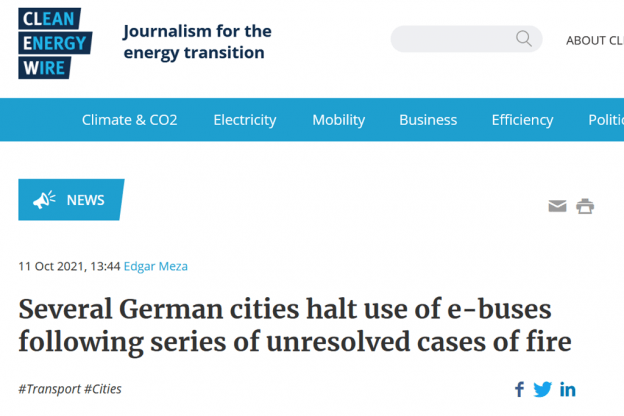
The potential risks of electromobility are being closely examined in Germany after a third major fire in a bus depot apparently caused by an electric bus. Public transport companies are taking action after the electric bus allegedly triggered a fire in Stuttgart last week, newspaper Die Weltreports.
The Munich public transport company, MVG, is taking eight similar e-buses out of service until the cause of the fire in Stuttgart has been clarified. The fire may have started while the bus was being charged in the depot, according to investigators, who assume that a technical defect may be the cause of the fire. The 30 September fire completely destroyed 25 buses in the depot, including two with electric drives, causing damage worth millions of euros.
The Stuttgart transport company, SSB, has also halted the use of electric buses in the city. The incident followed a similar fire in June in a bus depot in Hanover, which destroyed the hall and nine buses. E-buses were then recalled but are expected to resume service in November. In April, a fire at the Rheinbahn depot in Düsseldorf caused damages totalling several million euros. Investigators determined the fire had been triggered by a technical issue but could not clearly identify the cause.
While the number of electric buses in German public transport doubled last year compared to 2019, a recent survey found that 58 percent of Germans had doubts about the “environmental compatibility” of electric mobility.
By Mazin Qumsiyeh | Popular Resistance | August 18, 2013
There is no way to say this truth nicely: Politicians lie. That includes Japanese, American, Egyptian, Israeli, and Palestinian politicians! Is there something more common sense than that? Yet, so many citizens around the world believe their own politicians or wistfully acknowledge lies but think it is part of the job needed to run things. They believe even when politicians contradict themselves blatantly. This phenomenon is rather remarkable. It is a dissonance and disconnect from reality that many seem oblivious to. It is very dangerous because it can lead to accepting rationales for going to war. These can be deadly wars that lead to millions of lives lost as happened in what was called World War 1 and WW2. Even when incredible and declassified evidence abound, politicians continue to lie and old mythologies refuse to die. Here are just a few of the countless lies told to us over the past few decades… continue
This site is provided as a research and reference tool. Although we make every reasonable effort to ensure that the information and data provided at this site are useful, accurate, and current, we cannot guarantee that the information and data provided here will be error-free. By using this site, you assume all responsibility for and risk arising from your use of and reliance upon the contents of this site.
This site and the information available through it do not, and are not intended to constitute legal advice. Should you require legal advice, you should consult your own attorney.
Nothing within this site or linked to by this site constitutes investment advice or medical advice.
Materials accessible from or added to this site by third parties, such as comments posted, are strictly the responsibility of the third party who added such materials or made them accessible and we neither endorse nor undertake to control, monitor, edit or assume responsibility for any such third-party material.
The posting of stories, commentaries, reports, documents and links (embedded or otherwise) on this site does not in any way, shape or form, implied or otherwise, necessarily express or suggest endorsement or support of any of such posted material or parts therein.
The word “alleged” is deemed to occur before the word “fraud.” Since the rule of law still applies. To peasants, at least.
Fair Use
This site contains copyrighted material the use of which has not always been specifically authorized by the copyright owner. We are making such material available in our efforts to advance understanding of environmental, political, human rights, economic, democracy, scientific, and social justice issues, etc. We believe this constitutes a ‘fair use’ of any such copyrighted material as provided for in section 107 of the US Copyright Law. In accordance with Title 17 U.S.C. Section 107, the material on this site is distributed without profit to those who have expressed a prior interest in receiving the included information for research and educational purposes. For more info go to: http://www.law.cornell.edu/uscode/17/107.shtml. If you wish to use copyrighted material from this site for purposes of your own that go beyond ‘fair use’, you must obtain permission from the copyright owner.
DMCA Contact
This is information for anyone that wishes to challenge our “fair use” of copyrighted material.
If you are a legal copyright holder or a designated agent for such and you believe that content residing on or accessible through our website infringes a copyright and falls outside the boundaries of “Fair Use”, please send a notice of infringement by contacting atheonews@gmail.com.
We will respond and take necessary action immediately.
If notice is given of an alleged copyright violation we will act expeditiously to remove or disable access to the material(s) in question.
All 3rd party material posted on this website is copyright the respective owners / authors. Aletho News makes no claim of copyright on such material.


 Aletho News
