Trump, COVID-19, UK Lockdowns, And The Great Reset
By Andrew Korbyko | One World | November 14, 2020
COVID-19 And Lockdown
[…] the onus is on Johnson and his government to prove that lockdowns and social distancing measures work. And we are now 8 months down the line and the picture is clearer.
The statistics show that this virus has a mortality rate comparable with the flu. There has been no evidence which shows that lockdown measures such as social distancing or masks have had any effect. And numerous scientists confirm that the pandemic ended in late spring and there is no ‘second wave’. The government is conducting huge numbers of PCR tests with false positive rates which cast doubt over their use.
These tests are identifying more ’cases’, the majority of which have no symptoms or are picking up other remnants of virus in our bodies.
My judgement is that Johnson and his government have not discharged the onus of proof at any level since the virus took hold in early spring. In fact, the sheer volume of evidence which has been produced since has made a mockery of the government’s data, its interpretation, the ‘science’, and perhaps most crucially in terms of the totally disproportionate effect on physical and mental health, education, and the economy.
In summary, the government hasn’t produced a bare morsel of evidence and at times their arguments have been akin to saying the moon is made of cheese and expecting everyone to believe it, this illusion sustained by the fear and panic they’ve created. Even if their figures stood up to proper scrutiny, the effects of the measures in terms of collateral damage far outweigh any benefits the measures have had. Put simply, it is a scandal on a scale never seen before.
The Great Reset
The Great Reset is an agenda which promotes a social and economic ‘reset’ in countries around the world. It’s a not a new agenda and this is not meant to be some new revelation. The question is, does the evidence now suggest this agenda is currently being implemented under the guise of a pandemic?
Following a more recent look at the so-called ‘reset’ agenda, for me the puzzle pieces have now slotted in place.
Earlier on, I believed that gross stupidity, incompetence, and trying to find an exit strategy without exposure were the most logical reasons behind the COVID-19 decision making.
Initially, I couldn’t reconcile the differences in states in the world and measures taken by each government towards even a loosely co-ordinated agenda of economic and social reset.
The first reason I believe we are heading towards some type of economic and social reset promoted by unelected billionaires and other technocrats is because after 8 months it is now too much of a stretch to accept repeated stupidity and incompetence as reasons. The decision-making at every turn has been the opposite of what would have made the most sense when dealing with a pandemic.
My view is that they have used COVID-19 as a convenient vehicle to push through the reset agenda.
The mainly circumstantial but I think strong evidence concerns the agenda of the World Economic Forum (WEF), particularly (Klaus Schwab, who resembles a James Bond villain. This organisation makes no secret of the reset and the discussions it held at previous events attended by world leaders.
Biden and Johnson have adopted the same slogans of this organisation, such as ‘build back better’. The agenda is presented as dealing with climate change and other challenges such as sustainability, wealth distribution, and social justice. But it is all very sinister when you realise who might be involved and what the likely details are.
The World Health Organisation, the United Nations, and unelected billionaires like Bill Gates and Prince Charles seem to be driving this agenda.
As many of us will be aware, the state-affiliated giants Twitter and Facebook are censoring and banning people, including scientists who dispute the COVID-19 narrative and question lockdowns.
The BBC and mainstream media have taken it upon themselves to ‘fact-check’ the more outlandish theories about COVID-19 while ignoring valid concerns over the accuracy of government data and proportion. Therefore, the impression is created that all people who oppose lockdowns are anti-vaccine or conspiracy theorists. This coverage is now very noticeable for its bias, suggesting co-ordination between state and media.
The many references to COVID-19 by the WEF and administering vaccines and talk of issuing health passports are probably one of the most disturbing aspects and resemble China’s social credit system, a system which operates on social control, compliance, and sanctions.
This so-called ‘New World Order’ seems to be geared towards transferring wealth to the elites running it in exchange for debt relief and eventually to a society where individuals don’t own property.
In order to create this new world and get people’s acceptance, I believe a climate of fear, control, and dependence on the state is their early goal. Small businesses have been destroyed and health ruined under the cloak of a false ‘second wave’ pandemic. The constant exaggeration and misrepresentation of the data and science by the government is to keep the fraud going towards implementation of these plans.
The global elites haven’t yet fully declared their hand. But the subtle messages appearing all around us and collective material about the reset are there in plain sight for those who care to look. The circumstantial evidence, including how the COVID-19 pandemic has played out to fit in with this agenda, is too substantial to ignore.
In summary, if this is the agenda, then it is nothing less than a global coup.
Conclusion
In my previous article, I suggested that the general public should take time to calmly reflect on the evidence. Since then, there has been an awakening with more people calling out the faulty science and destructive measures.
But as we move into a worrying new phase, I think we need to put the message out that a sinister agenda seems to be playing out in the shadows. Our economy, health, and lives have been deliberately wrecked in its pursuit. I don’t believe this is about COVID-19, if it ever was.
The questions which remain for me are how far developed is this plan, how powerful are those behind it, and how far have their tentacles spread within the corridors of power and state institutions?
Once these plans become more obvious to us through awakening and realisation or through implementation, the question will then be whether it can be stopped in its tracks or if mass civil unrest be the scenario?
I believe the US election is tied into the COVID-19 pandemic. If Biden steps into power, then the reset could be a reality. With Trump, there’s perhaps a chance it can be stopped.
It wouldn’t surprise me with this going on that the forces which have been trying to remove Trump for 4 years have massively rigged the election.
No matter what political side you are on, it’s important not to dismiss the likelihood that there has been an assault on democracy in the US and certainly a high probability that it’s already well underway here and elsewhere. – Full article
Who Chooses the Official, Governmentally-Approved “Health Experts”?
By Prof. Bill Willers | Global Research | November 12, 2020
“My budget [is] highly earmarked, so it is driven by what I call donor interests.” –Margaret Chan, Director General of the World Health Organization, 2014
“For the world at large, normalcy only returns when we’ve largely vaccinated the entire global population.” –Bill Gates, April, 2020
You have to hand it to governmental health experts: All are uniformly “on message”. Meanwhile, abundant medical expertise from around the world at odds with official messaging is rendered invisible. The Great Barrington Declaration, so critical of governmentally-imposed lockdown strategy (and associated policies, e.g., public masking, quarantine, etc.), has, since October 5, 2020, been signed (as I write) by more than 45,000 medical scientists and practitioners worldwide. But mainstream media figures, savvy to the perks of power, know better than to report this. It’s worthy of note that the founders of the Declaration go to pains to declare their detachment from financial gain, perhaps to stand out against prominent governmental experts with ties to the pharmaceutical industry (e.g. here, here, here).
There are also America’s Frontline Doctors, the many dissenting scientists being discovered by journalists (here, here, here, and just the other day still more here and here), and plenty of others too, trying to be recognized above the din of officialdom, only to be forced to the outer margins of the Internet, where only a small fraction of the public bothers to seek them out. Relatively speaking, it’s lonely out there. Only a select set of officially approved voices conforming to a tightly-controlled narrative are allowed space in mainstream media, and therefore in the larger public mind. By what process, one wants to know, do specific individuals become the “health experts” for government and media?
The World Health Organization (WHO) is the global authority to which the medical institutions of nations look for leadership. WHO opinion and policy informs the NIH, CDC, schools of public health and medical societies in the US and their counterparts in countries all over the world. Visualized as a pyramid, WHO is the apex. Information from there descends through national organizations, schools and institutions to regional and local authorities. Gates and the pharmaceutical industry weave strategy at the apex, with industrial and political players making their impacts all the way down to the base of the pyramid where one finds hordes of frightened, masked citizens.
In this light, consider Margaret Chan’s introductory quote (above) regarding donor impact on WHO policy. Now, scroll down this 2017 list of contributors to the WHO that shows the United States as top contributor at ~$401Million.
But forget that sum, because President Trump thereafter stopped US contributions. That so, further scrolling down reveals that the major contributor is not a nation but the Bill and Melinda Gates Foundation at ~$325Million, seconded by GAVI, the vaccine alliance (itself heavily funded by Gates), at ~$133Million.
The top donors to the WHO are not countries, as is widely believed, but private interests. In fact, in recent decades, private donations to the WHO have continued to grow relative to national contributions, so that by 2017, their total had passed the 50% mark. And the pharmaceutical industry, the vaccine aspect in particular, is primary.
As one peruses the backgrounds of the the government’s (and media’s) chosen health experts, as opposed to the wealth of medical expertise resisting the lockdown and its isolating mandates, there seems within the former a high frequency not only of governmental bureaucrats but also of ties to schools of public health, and therefore to the many connected interests of those schools. Put another way, the commercial involvements of public health schools move quickly and unavoidably into a political realm that a critical eye might conclude is inappropriate for a medical school per se. Considering the inevitable conflicts of interest characteristic of corporate involvement, shouldn’t there be a solid wall of separation between medical schools and schools of public health?
A way to understand what is encompassed within “public health” is to read the Bloomberg School of Public Health at Johns Hopkins University, rated tops in the nation and named for its billionaire donor: “We implement large-scale solutions”, which includes development of “programs” and “interventions” in disaster response, refugee health, evaluation of health insurance programs, human rights and sustainable practice. The site links to Bloomberg’s “Centers and Institutes” which include the Bill and Melinda Gates Institute for Population and Reproductive Health and four others that are specific to vaccine development, production, education and access. Bloomberg School’s joining with the World Economic Forum and the Gates Foundation to host Event201, that foretold Covid19 Pandemic five months before the real thing hit, shows the School to be a global power player, and other schools of public health are certainly similarly oriented.
In 2005, in my home state, the School of Medicine at the University of Wisconsin in Madison underwent a change to become the University of Wisconsin School of Medicine and Public Health. The expanded mission to include public health was, as stated, to emphasize community health needs. A strict focus on medicine, on the one hand, and the vastly expanded array of considerations innate to “public health”, on the other hand, thereby became integrated into a single unit. In Wisconsin, two voices from within that school have been dominant in messaging with regard to the Covid19 Pandemic and how it should be handled, with the result that the Governor instigated a severe lockdown strategy that included a statewide masking mandate.
While it would be natural for a political leader to rely on medical advice, what is problematic is the unanimity of designated experts nation-wide in their conformity to a specific Covid19 policy that is, on many levels, dubious or downright false. For example, the two accepted experts in Wisconsin, cited above, have insisted that scientific evidence has established that public masking is a powerful means of preventing viral transmission, this mirroring the position of the Director of the CDC who told a Senate Committee that masks are more protective than vaccines. This claim is absolutely and demonstrably false. No scientific evidence has shown anything of the sort. A “smoking gun” in the masking issue is the fact that perhaps the finest meta-analysis of public masking, published in 2016 and titled “Why Face Masks Don’t Work: A Revealing Review”, was suddenly taken down as “no longer relevant in the current climate”. (Fortunately, it was saved at the Wayback site). What stands out is that the “current climate” referred to has nothing to do with weather. Rather, it mirrors a global project the details of which are hidden to the extent possible.
There is growing awareness that pre-Covid19 life will never return, and that masking, social distancing, and the like, will become normal aspects of daily life, for we — particularly the youngest among us — have been persuaded by officially-designated health experts to see our fellow humans as toxic and threatening. Indeed, Klaus Schwab, guiding light of the Big Reset, confirms the loss forever of life before Covid19, as he and his colleagues of the World Economic Forum put components of their new world order into place.
Putting the pieces together, one recognizes a global medical bureaucracy from the WHO on down, in concert with schools of public health and the pharmaceutical industry, combined into a politically powerful triumvirate dedicated to goals most certainly linked to those of the World Economic Forum, with which Bloomberg School collaborates. The selection process within this triumvirate designates its experts for governmental and academic advancement, and for public display by mainstream media, this to the exclusion of dissenters. The apparatus for social control now being put into place is to involve an unimaginably profitable vaccine-based medical authority touted by certified “health experts” and governmental enforcers, all of whom will assure the public that they “have the science”. There will be discovery of new pathogens threatening epidemic and pandemic waves, complete with spikes and hotspots. One foresees populations nurtured in fear, herded into groupthink and longing for salvation through vaccination.
***
Copyright © Prof. Bill Willers, Global Research, 2020
‘Something extremely bogus is going on’: Musk says he’s positive & negative for Covid-19 after taking 4 tests in 1 day
RT | November 13, 2020
Futurist entrepreneur Elon Musk has expressed doubts about the accuracy of coronavirus tests, after claiming to have been both diagnosed and cleared of the disease on the same day.
The SpaceX and Tesla founder wrote on Twitter that he had been administered four tests for the virus over a 24-hour period, leading to contradictory results.
“Two tests came back negative, two came back positive. Same machine, same test, same nurse. Rapid antigen test from BD,” Musk said.
The tweet sparked a heated debate on social media, with some accusing the billionaire businessman of being “irresponsible” by suggesting that Covid-19 tests are unreliable.
However, Musk paid no attention to the criticism and expressed further skepticism about the testing process in follow-messages.
One Twitter user speculated that Musk’s apparent false-positive illustrates why countries are seeing “spikes” of the disease, to which the Tesla CEO responded: “If it’s happening to me, it’s happening to others.”
The billionaire also agreed with a comment that noted that “revenues from tests are likely not bogus & very consistent.”
Musk said he was taking polymerase chain reaction (PCR) tests from separate labs and that the results would be ready in about a day. He explained that he had symptoms of a “typical cold” but was otherwise not exhibiting any health problems purportedly linked to Covid-19.
The 49-year-old has been an outspoken critic of government response to the spread of the virus. Previously, he denounced lockdown policies adopted in countries around the world, arguing that only at-risk people should quarantine “until the storm passes.”
He also said that neither he nor his family will likely take future coronavirus vaccines once they become available, saying that the response to the pandemic has “diminished [his] faith in humanity.”
US – UK Intel Agencies Declare Cyber War on Independent Media
By Whitney Webb |
Unlimited Hangout| November 11, 2020
In just the past week, the national-security states of the United States and United Kingdom have discreetly let it be known that the cyber tools and online tactics previously designed for use in the post-9/11 “war on terror” are now being repurposed for use against information sources promoting “vaccine hesitancy” and information related to Covid-19 that runs counter to their state narratives.
A new cyber offensive was launched on Monday by the UK’s signal intelligence agency, Government Communications Headquarters (GCHQ), which seeks to target websites that publish content deemed to be “propaganda” that raises concerns regarding state-sponsored Covid-19 vaccine development and the multi-national pharmaceutical corporations involved.
Similar efforts are underway in the United States, with the US military recently funding a CIA-backed firm—stuffed with former counterterrorism officials who were behind the occupation of Iraq and the rise of the so-called Islamic State—to develop an AI algorithm aimed specifically at new websites promoting “suspected” disinformation related to the Covid-19 crisis and the US military–led Covid-19 vaccination effort known as Operation Warp Speed.
Both countries are preparing to silence independent journalists who raise legitimate concerns over pharmaceutical industry corruption or the extreme secrecy surrounding state-sponsored Covid-19 vaccination efforts, now that Pfizer’s vaccine candidate is slated to be approved by the US Food and Drug Administration (FDA) by month’s end.
Pfizer’s history of being fined billions for illegal marketing and for bribing government officials to help them cover up an illegal drug trial that killed eleven children (among other crimes) has gone unmentioned by most mass media outlets, which instead have celebrated the apparently imminent approval of the company’s Covid-19 vaccine without questioning the company’s history or that the mRNA technology used in the vaccine has sped through normal safety trial protocols and has never been approved for human use. Also unmentioned is that the head of the FDA’s Center for Drug Evaluation and Research, Patrizia Cavazzoni, is the former Pfizer vice president for product safety who covered up the connection of one of its products to birth defects.
Essentially, the power of the state is being wielded like never before to police online speech and to deplatform news websites to protect the interests of powerful corporations like Pfizer and other scandal-ridden pharmaceutical giants as well as the interests of the US and UK national-security states, which themselves are intimately involved in the Covid-19 vaccination endeavor.
UK Intelligence’s New Cyberwar Targeting “Anti-Vaccine Propaganda”
On Monday, the UK newspaper The Times reported that the UK’s GCHQ “has begun an offensive cyber-operation to disrupt anti-vaccine propaganda being spread by hostile states” and “is using a toolkit developed to tackle disinformation and recruitment material peddled by Islamic State” to do so. In addition, the UK government has ordered the British military’s 77th Brigade, which specializes in “information warfare,” to launch an online campaign to counter “deceptive narratives” about Covid-19 vaccine candidates.
The newly announced GCHQ “cyber war” will not only take down “anti-vaccine propaganda” but will also seek to “disrupt the operations of the cyberactors responsible for it, including encrypting their data so they cannot access it and blocking their communications with each other.” The effort will also involve GCHQ reaching out to other countries in the “Five Eyes” alliance (US, Australia, New Zealand and Canada) to alert their partner agencies in those countries to target such “propaganda” sites hosted within their borders.
The Times stated that “the government regards tackling false information about inoculation as a rising priority as the prospect of a reliable vaccine against the coronavirus draws closer,” suggesting that efforts will continue to ramp up as a vaccine candidate gets closer to approval.
It seems that, from the perspective of the UK national-security state, those who question corruption in the pharmaceutical industry and its possible impact on the leading experimental Covid-19 vaccine candidates (all of which use experimental vaccine technologies that have never before been approved for human use) should be targeted with tools originally designed to combat terrorist propaganda.
While The Times asserted that the effort would target content “that originated only from state adversaries” and would not target the sites of “ordinary citizens,” the newspaper suggested that the effort would rely on the US government for determining whether or not a site is part of a “foreign disinformation” operation.
This is highly troubling given that the US recently seized the domains of many sites, including the American Herald Tribune, which it erroneously labeled as “Iranian propaganda,” despite its editor in chief, Anthony Hall, being based in Canada. The US government made this claim about the American Herald Tribune after the cybersecurity firm FireEye, a US government contractor, stated that it had “moderate confidence” that the site had been “founded in Iran.”
In addition, the fact that GCHQ has alleged that most of the sites it plans to target are “linked to Moscow” gives further cause for concern given that the UK government was caught funding the Institute for Statecraft’s Integrity Initiative, which falsely labeled critics of the UK government’s actions as well as its narratives with respect to the Syria conflict as being related to “Russian disinformation” campaigns.
Given this precedent, it is certainly plausible that GCHQ could take the word of either an allied government, a government contractor, or perhaps even an allied media organization such as Bellingcat or the Atlantic Council’s DFRLab that a given site is “foreign propaganda” in order to launch a cyber offensive against it. Such concerns are only amplified when one of the main government sources for The Times article bluntly stated that “GCHQ has been told to take out antivaxers [sic] online and on social media. There are ways they have used to monitor and disrupt terrorist propaganda,” which suggests that the targets of GCHQ’s new cyber war will, in fact, be determined by the content itself rather than their suspected “foreign” origin. The “foreign” aspect instead appears to be a means of evading the prohibition in GCHQ’s operational mandate on targeting the speech or websites of ordinary citizens.
This larger pivot toward treating alleged “anti-vaxxers” as “national security threats” has been ongoing for much of this year, spearheaded in part by Imran Ahmed, the CEO of the UK-based Center for Countering Digital Hate, a member of the UK government’s Steering Committee on Countering Extremism Pilot Task Force, which is part of the UK government’s Commission for Countering Extremism.
Ahmed told the UK newspaper The Independent in July that “I would go beyond calling anti-vaxxers conspiracy theorists to say they are an extremist group that pose a national security risk.” He then stated that “once someone has been exposed to one type of conspiracy it’s easy to lead them down a path where they embrace more radical world views that can lead to violent extremism,” thereby implying that “anti-vaxxers” might engage in acts of violent extremism. Among the websites cited by Ahmed’s organization as promoting such “extremism” that poses a “national security risk” were Children’s Health Defense, the National Vaccine Information Center, Informed Consent Action Network, and Mercola.com, among others.
Similarly, a think tank tied to US intelligence—whose GCHQ equivalent, the National Security Agency, will take part in the newly announced “cyber war”—argued in a research paper published just months before the onset of the Covid-19 crisis that “the US ‘anti-vaxxer’ movement would pose a threat to national security in the event of a ‘pandemic with a novel organism.’”
InfraGard, “a partnership between the Federal Bureau of Investigation (FBI) and members of the private sector,” warned in the paper published last June that “the US anti-vaccine movement would also be connected with ‘social media misinformation and propaganda campaigns’ orchestrated by the Russian government,” as cited by The Guardian. The InfraGard paper further claimed that prominent “anti-vaxxers” are aligned “with other conspiracy movements including the far right . . . and social media misinformation and propaganda campaigns by many foreign and domestic actors. Included among these actors is the Internet Research Agency, the Russian government–aligned organization.”
An article published just last month by the Washington Post argued that “vaccine hesitancy is mixing with coronavirus denial and merging with far-right American conspiracy theories, including Qanon,” which the FBI named a potential domestic terror threat last year. The article quoted Peter Hotez, dean of the School of Tropical Medicine at Baylor College of Medicine in Houston, as saying “The US anti-vaccination movement is globalizing and it’s going toward more-extremist tendencies.”
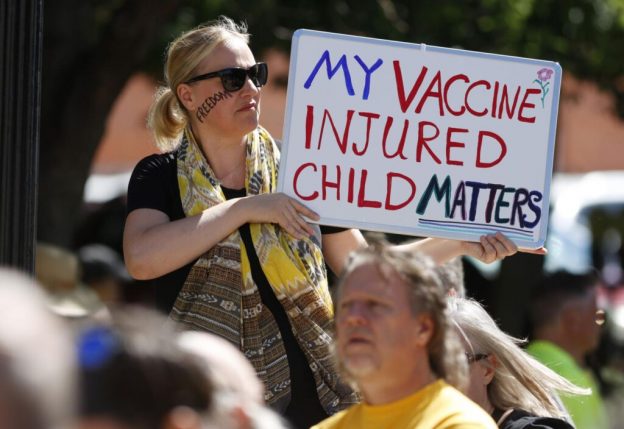
Simone Warstat attends a rally against a legislative bill to make it more difficult for parents to opt out for non-medical reasons to immunize their children, June 7, 2020, in Denver Colorado.
It is worth pointing out that many so-called “anti-vaxxers” are actually critics of the pharmaceutical industry and are not necessarily opposed to vaccines in and of themselves, making the labels “anti-vaxxer” and “anti-vaccine” misleading. Given that many pharmaceutical giants involved in making Covid-19 vaccines donate heavily to politicians in both countries and have been involved in numerous safety scandals, using state intelligence agencies to wage cyber war against sites that investigate such concerns is not only troubling for the future of journalism but it suggests that the UK is taking a dangerous leap toward becoming a country that uses its state powers to treat the enemies of corporations as enemies of the state.
The CIA-Backed Firm “Weaponizing Truth” with AI
In early October, the US Air Force and US Special Operations Command announced that they had awarded a multimillion-dollar contract to the US-based “machine intelligence” company Primer. Per the press release, “Primer will develop the first-ever machine learning platform to automatically identify and assess suspected disinformation [emphasis added]. Primer will also enhance its natural language processing platform to automatically analyze tactical events to provide commanders with unprecedented insight as events unfold in near real-time.”
According to Primer, the company “builds software machines that read and write in English, Russian, and Chinese to automatically unearth trends and patterns across large volumes of data,” and their work “supports the mission of the intelligence community and broader DOD by automating reading and research tasks to enhance the speed and quality of decision-making.” In other words, Primer is developing an algorithm that would allow the national-security state to outsource many military and intelligence analyst positions to AI. In fact, the company openly admits this, stating that their current effort “will automate the work typically done by dozens of analysts in a security operations center to ingest all of the data relevant to an event as it happens and funnel it into a unified user interface.”
Primer’s ultimate goal is to use their AI to entirely automate the shaping of public perceptions and become the arbiter of “truth,” as defined by the state. Primer’s founder, Sean Gourley, who previously created AI programs for the military to track “insurgency” in post-invasion Iraq, asserted in an April blog post that “computational warfare and disinformation campaigns will, in 2020, become a more serious threat than physical war, and we will have to rethink the weapons we deploy to fight them.”
In that same post, Gourley argued for the creation of a “Manhattan Project for truth” that would create a publicly available Wikipedia-style database built off of “knowledge bases [that] already exist inside many countries’ intelligence agencies for national security purposes.” Gourley then wrote that “this effort would be ultimately about building and enhancing our collective intelligence and establishing a baseline for what’s true or not” as established by intelligence agencies. He concludes his blog post by stating that “in 2020, we will begin to weaponize truth.”
Notably, on November 9, the same day that GCHQ announced its plans to target “anti-vaccine propaganda,” the US website NextGov reported that Primer’s Pentagon-funded effort had turned its attention specifically to “Covid-19 related disinformation.” According to Primer’s director of science, John Bohannon, “Primer will be integrating bot detection, synthetic text detection and unstructured textual claims analysis capabilities into our existing artificial intelligence platform currently in use with DOD. . . . This will create the first unified mission-ready platform to effectively counter Covid-19-related disinformation in near-real time.”
Bohannon, who previously worked as a mainstream journalist embedded with NATO forces in Afghanistan, also told NextGov that Primer’s new Covid-19–focused effort “automatically classifies documents into one of 10 categories to enable the detection of the impact of COVID” on areas such as “business, science and technology, employment, the global economy, and elections.” The final product is expected to be delivered to the Pentagon in the second quarter of next year.
Though a so-called private company, Primer is deeply linked to the national-security state it is designed to protect by “weaponizing truth.” Primer proudly promotes itself as having more than 15 percent of its staff hailing from the US intelligence community or military. The director of the company’s National Security Group is Brian Raymond, a former CIA intelligence officer who served as the Director for Iraq on the US National Security Council after leaving the agency.
The company also recently added several prominent national-security officials to its board including:
- Gen. Raymond Thomas (ret.), who led the command of all US and NATO Special Operations Forces in Afghanistan and is the former commander of both US Special Operations Command and Joint Special Operations Command (JSOC).
- Lt. Gen. VeraLinn Jamieson (ret.), the former deputy chief of staff for Air Force Intelligence, Surveillance and Reconnaissance who led the Air Force’s intelligence and cyber forces. She also personally developed “strategic partnerships” between the Air Force and Microsoft, Amazon, Google, and IBM in order “to accelerate the Air Force’s digital transformation.”
- Brett McGurk, one of the “chief architects” of the Iraq War “surge,” alongside the notorious Kagan family, as NSC Director for Iraq, and then as special assistant to the president and senior Director for Iraq and Afghanistan during the Bush administration. Under Obama and during part of the Trump administration, McGurk was the special presidential envoy for the Global Coalition to Defeat ISIS at the State Department, helping to manage the “dirty war” waged by the US, the UK, and other allies against Syria.
In addition to those recent board hires, Primer brought on Sue Gordon, the former principal deputy director of National Intelligence, as a strategic adviser. Gordon previously “drove partnerships within the US Intelligence Community and provided advice to the National Security Council in her role as deputy director of national intelligence” and had a twenty-seven-year career at the CIA. The deep links are unsurprising, given that Primer is financially backed by the CIA’s venture-capital arm In-Q-Tel and the venture-capital arm of billionaire Mike Bloomberg, Bloomberg Beta.
Operation Warp Speed’s Disinformation Blitzkrieg
The rapid increase in interest by the US and UK national-security states toward Covid-19 “disinformation,” particularly as it relates to upcoming Covid-19 vaccination campaigns, is intimately related to the media-engagement strategy of the US government’s Operation Warp Speed.
Officially a “public-private partnership,” Operation Warp Speed, which has the goal of vaccinating 300 million Americans by next January, is dominated by the US military and also involves several US intelligence agencies, including the National Security Agency (NSA) and the Department of Homeland Security (DHS), as well as intelligence-linked tech giants Google, Oracle, and Palantir. Several reports published in The Last American Vagabond by this author and journalist Derrick Broze have revealed the extreme secrecy of the operation, its numerous conflicts of interest, and its deep ties to Silicon Valley and Orwellian technocratic initiatives.
Warp Speed’s official guidance discusses at length its phased plan for engaging the public and addressing issues of “vaccine hesitancy.” According to the Warp Speed document entitled “From the Factory to the Frontlines,” “strategic communications and public messaging are critical to ensure maximum acceptance of vaccines, requiring a saturation of messaging across the national media.” It also states that “working with established partners—especially those that are trusted sources for target audiences—is critical to advancing public understanding of, access to, and acceptance of eventual vaccines” and that “identifying the right messages to promote vaccine confidence, countering misinformation, and targeting outreach to vulnerable and at-risk populations will be necessary to achieve high coverage.”
The document also notes that Warp Speed will employ the CDC’s three-pronged strategic framework for its communications effort. The third pillar of that strategy is entitled “Stop Myths” and has as a main focus “establish[ing] partnerships to contain the spread of misinformation” as well as “work[ing] with local partners and trusted messengers to improve confidence in vaccines.”
Though that particular Warp Speed document is short on specifics, the CDC’s Covid-19 Vaccination Program Interim Playbook contains additional information. It states that Operation Warp Speed will “engage and use a wide range of partners, collaborations, and communication and news media channels to achieve communication goals, understanding that channel preferences and credible sources vary among audiences and people at higher risk for severe illness and critical populations, and channels vary in their capacity to achieve different communication objectives.” It states that it will focus its efforts in this regard on “traditional media channels” (print, radio, and TV) as well as “digital media” (internet, social media, and text messaging).
The CDC document further reveals that the “public messaging” campaign to “promote vaccine uptake” and address “vaccine hesitancy” is divided into four phases and adds that the overall communication strategy of Warp Speed “should be timely and applicable for the current phase of the Covid-19 Vaccination program.”
Those phases are:
- Before a vaccine is available
- The vaccine is available in limited supply for certain populations of early focus
- The vaccine is increasingly available for other critical populations and the general public
- The vaccine is widely available
Given that the Covid-19 vaccine candidate produced by Pfizer is expected to be approved by the end of November, it appears that the US national-security state, which is essentially running Operation Warp Speed, along with “trusted messengers” in mass media, is preparing to enter the second phase of its communications strategy, one in which news organizations and journalists who raise legitimate concerns about Warp Speed will be de-platformed to make way for the “required” saturation of pro-vaccine messaging across the English-speaking media landscape.
Safety, effectiveness, transparency: What we still don’t know about the Pfizer vaccine
RT | November 10, 2020
Global markets surged and politicians and the public rejoiced online as Pfizer announced its Covid-19 vaccine was 90 percent effective, but not everyone is fully convinced, with a number of critical questions remaining unanswered.
On Monday, US drugmaker Pfizer and German partner BioNTech announced their “interim analysis” of a 43,538-person study of their two-dose vaccine regimen having proved 90 percent effective in preventing Covid-19.
Just 94 cases of the disease were observed in the large-scale trial, and early indications are that the fight against the coronavirus may be shifting in humanity’s favor at last. Russia’s Sputnik V vaccine had already boasted similar rates of effectiveness.
However, with all the market surges, breathless news coverage, and political messaging about the vaccine, a number of serious caveats, concerns, questions, and a distinct lack of detail remain.
We don’t yet know if the Pfizer vaccine entirely prevents infection, or whether asymptomatic carriers might still be a cause for concern in the years ahead. The study was also rather limited in scope, testing only whether there were fewer cases of symptomatic Covid-19 among vaccine recipients than those given the placebo.
In other words, without this information, we have no way of knowing whether this vaccine would actually stop the pandemic or not, or merely change its complexion.
The study also did not distinguish between the severity of Covid-19 cases among participants, nor did it provide demographic information on those who fell ill, so we still do not know whether vaccine recipients can fall critically ill or just develop a milder form of the disease.
There was no information given on the frequency or severity of side-effects, nor were key details shared about the vaccine’s safety profile.
Furthermore, there was no discrimination of data among different subgroups, so it remains unclear whether at-risk groups in society will necessarily benefit from the vaccine or whether targeted lockdowns and protections may still be required to protect the elderly or immunocompromised.
Pfizer’s Monday press release did not contain any data on how many participants got sick from the vaccine versus those who received the placebo.
This data is expected to be released “in the coming weeks,” according to Pfizer CEO Albert Bourla, as these questions, and more, will need to be comprehensively answered in order to overcome widespread vaccine hesitancy among the global population.
Indeed, taking the US as an example, according to one survey, some 62 percent of Americans worry that the Food and Drug Administration will fast-track vaccine approvals, and therefore just 21 percent of respondents polled say they “definitely plan to get vaccinated” and 49 percent probably or definitely will not.
Concerns are rife that there will be insufficient regard for both safety and effectiveness, given what is at stake politically and economically when it comes to a potential Covid-19-free future.
I am worried about the safety, efficacy, manufacturing quality, distribution, and administration of anti-Covid-19 vaccines. Read more here about STAT’s must-read overview of some of what the public needs to know regarding vaccine development…https://t.co/5SltkeBuwX
— William Haseltine (@WmHaseltine) November 9, 2020
Some, such as US biotech executive and infectious-diseases expert William Haseltine, claim that such proclamations by vaccine developers “are an inadequate assurance” and are “as full of holes as Swiss cheese.” They are calling for more open access to data and independent review to improve public trust in Covid-19 vaccine candidates, including the Pfizer-BioNTech holy grail.
Ninety per cent
Dr Malcolm Kendrick | 10th November 2020
‘Ladies and gentlemen, roll-up, roll-up, roll-up. My new product, just brought to the market this very day, prevents ninety per-cent, yes ninety per-cent of all known things happening to you. Yes, a remarkable ninety per cent. Not sixty per cent, not seventy per cent, no… not even eighty per cent. But ninety of your finest American per cent – of things’.
‘What is a thing, madam? What a very good question, and by the way your child is a most beautiful young girl, is she not. And your hair, someone did a most fantastic job on that. You must have paid a fortune for such magnificent styling… you sir.’
‘You are asking how much it costs. Cost sir, now cost doesn’t come into it. I can promise that I will never make a penny from selling this product, this year… Not a penny, as I promise on my mother’s grave sir, my mother’s grave.’
‘Lady at the back there what was that …you say that my mother is still alive, you met her for coffee last week. Gracious, she does get about doesn’t she.’
‘Back to you sir. Cost, this product … it does have to be kept at a very low temperature, so valuable is it sir. The cost of the refrigeration unit. Now, that is pricey sir very pricey. Pricey indeed.
‘How pricey sir. I can tell you are a very clever man, there is no way I could fool you, is there. But pricey sir…made by top scientists, and they do not come cheap, no they do not. I wish with all my heart it were otherwise, but you cannot buy the product without the refrigeration. It would not make sense otherwise, would it sir. But you know, my good fellow, how can anyone quibble about the costs of keeping this remarkable product cold, when it will prevent ninety per cent…. of things.’
‘But do not simply take my word for it. No. Here is a young lady who was injected with this product just the other day. Yes, just the other day. And do you know what… Well, don’t listen to me. Here she is…. big round of applause for this very brave young lady. Now Miss Fauci, for that is your name is it not… yes it is. You were injected with this very product seven days ago and what has happened to you?’
Miss Fauci: ‘Nothing.’
‘Yes, absolutely nothing happened to young Miss Fauci. Nothing at all. When you think of all the things that could have happened, and yet none of them did, did they. Well, this is remarkable, truly remarkable. No fevers, no loss of smell, no cough…?’
Miss Fauci: ‘Yes, nothing at all.’
‘Ladies and gentlemen, can you believe it. Nothing happened to this young lady at all after seven whole days.’
‘What was that madam, nothing happened to you either. Goodness me, you have been lucky haven’t you. You must be one of the lucky ten per cent. Here, have a free PCR swab to celebrate. Yes, keep it madam, its yours. Your day just got even better. Yes, have two, one could be positive, the other negative, we never really know do we. Ha, ha… my little joke.’
‘You sir, you still want to know what a thing is. Goodness me, you’re not one of those anti-product protestors are you. Our products undergo the most rigorous testing for safety, the most rigorous. How many, why, at least thirty people sir. We are not one of those fly-by-night organisations.’
‘You still want more information on things? Have I not just told you everything you could possibly need to know sir? Our product can prevent ninety per cent of things. If that is not enough to convince you sir, then I have not idea what else I can say.
‘Roll up, roll up. Only twenty billion for you, Mr Johnson – you know a bargain when you see one, don’t you. You’re certainly no mug, are you.’
The book that dared to ask if COVID-19 really wasn’t a super-deadly pandemic…

Much Ado About Corona
In Corona, False Alarm? Facts and Figures, German researchers Dr. Sucharit Bhakdi and Dr. Karina Reiss provide an easy-to-read summary of the (often ignored) facts and figures that have emerged during the first six months of the coronavirus narrative. The book is divided up into short and to-the-point sections written in plain (translated) English.
Here’s just a sample of the contents:
- How dangerous is the new “killer” virus?
- Why were people really dying in Italy, Spain, England and the USA?
- Why did Germany declare a pandemic and extend its lockdown?
- Were hospitals overburdened? Ventilators on short supply?
- Does the science support mandatory mask-wearing and social distancing?
- A look at the collateral damage of lockdowns to the elderly, the economy, children and the world’s poorest.
- Did countries (like Sweden) that avoided lockdowns fare better?
- Does the race for vaccine development make sense? What are the chances of success? Will the vaccine be safe? Will people accept it?
- Why has the media lied to us and politicians betrayed us?
You can order a copy of Corona, False Alarm? from the publisher, Amazon.com, Amazon.ca, Amazon.co.uk or your local, struggling bookstore.
Featured Video
New positive ivermectin evidence
or go to
Aletho News Archives – Video-Images
From the Archives
Fanatical Followers of the Covid Regime: A Jim Jones-Style Cult?
By Professor Roger Watson and Dr. Niall McCrae | The Daily Sceptic | November 15, 2021
As scholars at leading British universities over recent decades, we witnessed the replacement of critical thinking and debate by narrative: facts are discrimination and scientific method is imperialism; truth, instead, is derived from ‘progressive’ values. This educational trend may be a major contributory factor to the ease in which society has been inculcated to the Covid ‘new normal’ of masking, testing, and repeated doses of vaccines for a disease of similar risk to severe influenza.
One doesn’t need much critical reasoning to observe the flawed logic of some vaccination enthusiasts, such as people who respond to experiencing any side effects, however debilitating, by saying “at least I know it’s working”, or, after contracting the disease despite their promised inoculation (over 90% effective, according to initial drug company claims), “I’d have been worse off without the jab.” … continue
Blog Roll
 Aletho News
- EU Council Advances Chat Control 2.0 Scanning Proposal
- Ex-Greek MEP files complaint against Israeli spyware firm over alleged Pegasus surveillance
- Troubling ideas throughout the Torah, Talmud, Mishneh Torah and Tanya
- ‘Grave, alarming’: Iran mission on Trump’s UNGA ‘annihilation’ threats
- Najaf airport to reopen to Iranian flights within 24 hours: Ambassador
- From ‘How Will This End For Iran’ to ‘When America Walks Away’: A tale of two Economist covers
- Tehran blasts ‘baseless’ speculation linking Iran to alleged bomb plot at UK air base
- The Rise And… Rise Of ‘Color Revolutions’
- The Coming GOP Bloodbath?
- Arctic Scare Stories Melt Away
- If Americans Knew
- Netanyahu Asked UAE Leader to Deny Report on Oct. 7 Warning in Secret Visit, Sources Say
- CNN Chief Int’l Correspondent Clarissa Ward on Journalists in Gaza
- Democratic Party Consultants Surround Troy Jackson with Pro-Israel Donors
- Christian Leader Responds To Netanyahu’s Claims Regarding Palestinian Christians
- In Gaza, ‘Whoever Survives the Bombing Won’t Survive the Rubble’
- Israel kills more Palestinians, amid push to resettle Gaza – Daily Update
- Israel forces Gazans to live in constant peril – Daily Update
- Deconstructing Netanyahu’s pants-on-fire UN rant – Daily Update
- Trump betrayed voters with his campaign lies and prioritized a foreign country once he took office
- Netanyahu calls Israel’s war in Gaza ‘opposite of genocide’ in UN speech to near-empty hall
- No Tricks Zone
- New Study: Earth And Venus Surface Warmth Largely Explained By Convection And Lapse Rate, Not CO2 Or Radiation
- 2025 Nature Paper Claiming Worsening Global Drought Gets RETRACTED …Heavily Flawed
- New Study: ‘Global Drought Shows No Detectable Recent Acceleration Under Climate Warming’
- Economic Masterminds: German Socialists Suggest Taxing Productivity Gains Stemming From Using AI
- The South China Sea Has Not Been Cooperating With The Climate Change Narrative
- Energy Crisis: Germany Enters Heating Season With Historically Low Gas Reserve Fill Levels
- New Study: The Antarctic Ice Sheet Gained Mass From 2020-2024 Due To Staggering Snow And Ice Accumulation
- Study: Ocean Heating Rates From Thousands Of Years Ago ‘Dwarf’ Modern Ocean Heating Rates
- Climate Extremists Target, Attack Large-Scale Power Grid Infrastructure In Germany!
- New Study: Antarctic Ice Melt Has Contributed Less Than 1 Centimeter To Sea Level Rise In The Last 30 Years

