Science, Skepticism, and Irony
By Donna Laframboise | Big Picture News | August 31, 2020
 Psychologist Stuart Ritchie is the author of a new book, Science Fictions: How Fraud, Bias, Negligence, and Hype Undermine the Search for Truth. In the words of his publisher, it demonstrates that “failures in peer review and mistakes in statistics have rendered a shocking number of scientific studies useless.”
Ritchie declares the scientific publication process “badly broken.” He argues persuasively that enormous resources are being wasted, and that our heads “are being filled with ‘facts’ that are either incorrect, exaggerated, or drastically misleading.”
These arguments overlap many found in my 2016 report, Peer Review: Why Skepticism is Essential. But new scandals and controversies have emerged since then, and Ritchie does a great job of explaining why all of this matters.
But there’s a catch. Here we have an author lamenting delusion and self-deception. Here we have an author championing skepticism and hard-headed empiricism. Yet he, himself, utterly refuses to confront what all of the above implies about climate science.
If significant numbers of peer-reviewed papers in psychology, economics, evolutionary biology, organic chemistry, geoscience, and medicine can’t be reproduced/replicated when third parties attempt to do so, if many published studies really are useless, on what basis shall we go on imagining that climate research is a separate case? How can that field possibly be exempt from problems that are widespread elsewhere?
Environmental research has, after all, been highly politicized for at least two decades. Cambridge University Press was urged by scientists to withdraw Bjorn Lomborg’s The Skeptical Environmentalist from publication – to essentially burn his book back in 2002. A reasonable observer might therefore suspect that climate research is saturated with tribalism and bias, rather than the opposite.
Ergo: many of the studies on which politicians now base their climate decisions must be unreliable. How ironic that Ritchie is incapable of following his own arguments to their logical conclusion.
Nevertheless, it’s difficult not to feel sympathy for this young academic. His book was no doubt completed late last year. He had no way of anticipating that a deadly new coronavirus was about to spread across the globe, and that John Ioannidis, one of the people he cites extensively in his book, would respond to the pandemic in unexpected ways.
Two weeks before Science Fictions was released in mid-July, Ritchie published an essay titled There should never be heroes in science. It begins by telling us about the late Hans Eysenck, once the most-cited psychologist in Britain. Throughout the latter half of the 20th century, this eminent personality (who died in 1997), devoted much of his energy to keeping his own profession honest. As Ritchie tells it, Eysenck authored “blistering critiques of psychoanalysis and psychotherapy, noting the unscientific nature of Freudian theories and digging into the evidence base for therapy’s effects on mental health.”
Last year, more than a dozen of Eysenck’s papers were retracted. Dozens more are now officially considered questionable. An investigation by Kings College London concurred with critics who’ve long been concerned about the quality of Eysenck’s data and “the implausibility of the results presented.” In other words, this “strong advocate of rigour in science” was better at identifying the flaws in other people’s reasoning, than in producing bulletproof research of his own.
Ritchie then turns his attention to Ioannidis
It’s fair to say that Stanford University’s John Ioannidis is a hero of mine. He’s the medical researcher who made waves in 2005 with a paper carrying the firecracker title “Why Most Published Research Findings are False”, and who has published an eye-watering number of papers outlining problems in clinical trials, economics, psychology, statistics, nutrition research and more.
…Ioannidis’s contribution to science has been to make it far more open, honest, and self-reflective about its flaws. How odd it is, then, to see his failure to follow his own advice.
Ritchie points to a March 2020 article in which Ioannidis legitimately observed that politicians were making decisions about how to respond to the coronavirus “without reliable data.” Five months on, that’s still true. Many of the numbers currently available to us are compromised in one way or another.
But whether Ioannidis’ own hunches are correct is a different matter altogether. Writes Ritchie:
The most memorable part of the article was his prediction – on the basis of his analysis of the cursed cruise ship Diamond Princess – that around 10,000 people in the US would die from COVID-19…As US deaths have just hit 125,000, I don’t need to emphasise how wrong that prediction was.
Yesterday, American deaths from COVID-19 exceeded 187,000. Even if that count is wrong by 20% in either direction, we’re definitely talking a different ballpark.
Ritchie tells us Ioannidis has since authored more than one piece of COVID-related research marred by serious design flaws. Even the best minds amongst us, therefore, succumb to bias. Even professional skeptics can exhibit, as Ritchie says, a “strong aversion to having their cherished theories proved wrong.” Here’s the last paragraph in Ritchie’s essay:
Above, I should really have said that John Ioannidis was a hero of mine. Because this whole episode has reminded me that those self-critical, self-correcting principles of science simply don’t allow for hero-worship. Even the strongest critics of science need themselves to be criticised; those who raise the biggest questions about the way we do research need themselves to be questioned. Healthy science needs a whole community of sceptics, all constantly arguing with one another…Who watches the watchmen in science? The answer is, or at least should be: all of us. [bold added; italics in the original]
I invite you to re-read that sentence in bold font. So says a man whose book dismisses climate skeptics in peremptory fashion. In fact, Ritchie ends his final chapter by referencing a famous cartoon that implies climate policies will automatically create a “better world” even if the climate crisis turns out to be overblown.
This is unfortunate. Ritchie’s argument is that improving the way research is conducted makes sense even if we reject his contention that “something has gone very wrong with science.” But that famous climate cartoon naively presupposes that good intentions are enough, that climate programs have no negative consequences, that government policies are never counterproductive, ill-conceived, or designed to financially benefit political donors.
I critiqued that climate cartoon last year.
LINKS:
- Ritchie’s essay, There should never be heroes in science: Some scientists make their careers by criticising other’s research. But who watches the watchmen?
- Ritchie’s book, Science Fictions: How Fraud, Bias, Negligence, and Hype Undermine the Search for Truth
- Hilda Bastien examines one of Ioannidis’ papers here: A critical look at a preprint inferring the Covid-19 infection fatality rate
- Ritchie’s essay even-handedly includes a link to a more charitable assessment: John Ioannidis and Medical Tribalism in the Era of Covid-19
Gardasil Lawsuit – Deaths and Serious Injuries Linked to HPV Vaccine
Baum Hedlund Aristei & Goldman Trial Lawyers
The Gardasil vaccine, manufactured by Merck & Co., was approved by the U.S. Food and Drug Administration (FDA) in 2006 for use in preventing infection from only a few of the hundreds of types of human papillomavirus (HPV). Since hitting the market, however, thousands of adolescents and adults have reported serious and disabling Gardasil side effects after receiving the HPV vaccine, including death.
Gardasil was fast-tracked to the market, achieving FDA approval in six months, which usually takes three years. Even one of the principal investigators of the Gardasil clinical trials (the human testing that precedes FDA approval) said the process “went too fast.”
The clinical trials for the Gardasil HPV vaccine reveal several disturbing side effects that were not disclosed on the package insert:
- The miscarriage rate for subjects who were injected with Gardasil was 25%. The miscarriage rate for women under 30 in the U.S. is 12.5%.
- In the Gardasil group, 5 babies were born with congenital abnormalities. There were none in the control group (the group that does not receive treatment).
- 10.9% of women who took Gardasil reported reproductive and breast disorders within 7 months. In the Protocol 18 placebo group, that figure was 1.2% (through 12 months).
- The rate of Gardasil deaths in the clinical trials was 8.5 per 10,000, nearly double the background U.S. death rate for young women ages 15 to 24.
There are more than 64,000 case reports of HPV vaccine adverse reactions in the Vaccine Adverse Events Reporting System database.
It is estimated that only 1% of serious adverse events are actually reported to VAERS.
Researcher Peter C. Gøtzsche in his book Vaccines: Truth, Lies, and Controversy noted some of the research inadequacies in the HPV vaccine clinical trials
“It is a requirement for registration of drugs that randomized trials have been carried out where one group received the drug and the control group received placebo or nothing. This allows assessment of both the benefits and harms of drugs. I have done research on non-vaccine drugs for decades and was shocked when I learned through my work with vaccines against human papilloma virus (HPV) that the regulatory requirements are much less for vaccines. Almost all the HPV vaccine trials have a control group receiving a hepatitis vaccine or a strongly immunogenic adjuvant, which makes it impossible to find out what the harms of the HPV vaccines are.”
Today, the Gardasil shot has left many young women and men suffering (FDA also approved Gardasil for boys), and it has been a living nightmare for parents whose children have experienced severe adverse reactions to the vaccine. They all trusted Gardasil, never suspecting the grave illnesses and disabilities that could follow. […]
What is the Gardasil Controversy?
Underlying the entire Gardasil controversy are clinical trials (human testing) that victims allege were fraudulently conducted and reported. Preliminary evidence compiled by a team of Gardasil attorneys and investigators suggests that the clinical trials Merck conducted for the Gardasil HPV vaccine were flagrantly deceptive and unscientific.
According to Mary Holland and Kim Mack Rosenberg, and Eileen Iorio, co-authors of the book, The HPV Vaccine On Trial: Seeking Justice For a Generation Betrayed, “none of the participants in the [Gardasil] clinical trials received a true saline placebo,” which means the clinical trials failed to measure the effects of Gardasil against a true control. Instead of receiving a placebo, some clinical trial subjects received aluminum-containing adjuvants, chemical mixtures, and other vaccines, which masked adverse events and made Gardasil seem safer than it would have otherwise.
According to Holland, Mack Rosenberg, and Iorio, “HPV vaccines have never been proven to prevent against cervical or other cancer.” … Full article
FAIL: Despite Media Alarm, Back-to-Back Gulf Hurricanes Have Happened Before
By Anthony Watts | Watts Up With That? | August 26, 2020
Over the past few days, there’s been a persistent media buzz over the National Hurricane Center’s prediction of two hurricanes to hit New Orleans. Jason Dunning, a TV meteorologist at NBC2 WBBH-TV in Fort Meyers, Florida posted on Facebook: “… it would be the first time in recorded history with two hurricanes in the gulf at the same time.”

Needless to say, the post went viral. Now it appears his Facebook post has been removed.
And then there’s the ever-hyping CNN, which published the story ‘Unprecedented’ back-to-back hurricanes will target the same state, forcing evacuations in Louisiana. According to the article, the two storms, Marco and Laura, are forecast to arrive within two days of each other, making landfall somewhere between New Orleans and Mobile, Alabama as reason to say such an event is “unprecedented.”
Then there’s USA Today with this ridiculous guest commentary by opinion contributor Monica Medina:
How can Trump ignore climate crisis with twin hurricane-season storms barreling toward us?
Climate change is wreaking havoc on people’s lives right now. This month alone, not a section of the country has been spared a devastating event.
How can Trump ignore climate crisis with twin hurricane-season storms barreling toward us?
Climate change is wreaking havoc on people’s lives right now. This month alone, not a section of the country has been spared a devastating event.
Typical alarmist, confusing weather with climate for an agenda.
Dunning, CNN, and Medina are wrong, and badly so. All they had to do is look at the historical records of hurricanes to know this has happened before, and it is nothing new.
Climatologist Dr. Roy Spencer commented in a Facebook post:
“When I researched the 500-year history of hurricanes hitting the New World for my Amazon Kindle book Inevitable Disaster: Why Hurricanes Can’t Be Blamed On Global Warming, I was struck by the number of cases of back-to-back hurricanes.” Adding, “… when the Hurricane Center talks about records, they are generally referring to only the last 150 years. A little over 120 years ago, Miami didn’t even exist.”
For example, in his book, Spencer cites the Twin Mobile Hurricanes In late September of 1740; two separate hurricanes hit the Gulf Coast region around Mobile, Alabama within one week of each other. These two hurricanes, together with the hurricane of Sept. 23, 1740, caused major damage to the Louisiana colony.
Finding this information isn’t difficult, and you don’t need a degree in climatology; the Twin Mobile Hurricanes of 1740 are listed in Wikipedia and in Louisiana Cajun History.
There are many other instances of back to back hurricanes hitting near the same location within a few days of each other. Besides the 1740 event, in 1933 and 1959, two tropical storms entered the Gulf of Mexico at the same time. But they were not both hurricanes at those times.
Journalists and some meteorologists seem to have this conceit that if it isn’t recorded in the modern-day record of the past 150 years, it didn’t happen. The worse conceit is the fact that they ignore just how few records we have compared to how long nature has been launching hurricanes at the Gulf Coast. Literally this has been going on for millions of years, and somehow because we have the ability to observe, track, and predict hurricanes like never before in history, it’s “unprecedented”? How many times has it happened before we were around to observe it?
Of course the idea of labeling such things as “unprecedented” goes straight to the heart of climate alarmism, because they are already blaming it on “climate change.” In the story First ever double hurricane could hit the Gulf of Mexico, Space.com made this claim: “The National Oceanic and Atmospheric Administration says that as climate change warms the oceans, strong hurricanes are likely to become more frequent than they were in previous years.”
But that’s wrong too, and the data tells us so. In Climate-at-a-Glance: Hurricanes we find there has been no increase in hurricanes as the planet has modestly warmed. Even the UN climate body known as the Intergovernmental Panel on Climate Change agrees, finding no increase in the frequency or severity of hurricanes in their latest 2018 report.
What has increased is the hype over hurricanes, which started back in 2005 with former vice president turned climate activist Al Gore claiming events like Hurricane Katrina would be the new normal. Following that pronouncement, Gore’s predictions fell flat and there was an 11-year “drought” of major hurricanes hitting the United States. In fact, peer reviewed science shows hurricane activity has been decreasing since 1950.
So, don’t pay any attention to what the media says about the “unprecedented” nature of hurricanes this week. For years, the media and climate change zealots have pushed hype over facts. We would be better off ignoring the hype and focusing on facts.
Lancetgate: why was this “monumental fraud” not a huge scandal?
By Daniel Espinosa | Dissident Voice | August 20, 2020
A high-profile and highly influential scientific study regarding the potential of hydroxychloroquine (HCQ) to treat Covid-19 patients was retracted among suggestions of fraud back in June. The research in question was headed by a renowned Harvard professor called Mandeep Mehra and published by The Lancet, the most prestigious medical journal in the world.
It concluded that the antimalarial drug used since the 1950´s was actually killing Covid-19 patients by inducing heart failures. It caused quite a stir. (Brief historical fact: the Quina tree, the source of quinine and its family of medications, is also the “national tree” of Peru).
Soon after the publication of the study (22 May), the World Health Organization (WHO) halted all research being conducted on hydroxychloroquine, which included simultaneous testing in 17 countries. The worldwide influence of the scientific paper – and the fact that hundreds of doctors were already trying the drug in Covid-19 patients – led a lot of researchers to look closely into it, immediately finding an alarming level of incoherence.
In the meantime, the news was spread far and wide by the corporate media, many times in a highly politicized fashion. They swiftly convinced the world of the danger of treating the symptoms of Sars-Cov-2 with HCQ.
In the realm of social media, a wave of censorship against dissenting voices soon followed. A viral video showing a group of physicians called the Frontline Doctors, speaking publicly in favor of HCQ – by sharing their own clinical experience – was removed by most social media giants (but only after millions had already watched it). Could a testimony taken from a physician’s own experience be called “false”? Of course! Today a handful of social media corporations control what we can say or hear.
Instead of informing their audiences with a balanced discussion about all the scientific research conducted so far regarding the drug, both positive and negative, corporate media directed a barrage of ad-hominems and smear toward the mentioned doctors. An army of “fact-checkers” was opportunely deployed after that to police the web and reassure everyone that HCQ is both useless and dangerous. Everyone who said otherwise was snake oil peddler.
But regardless of its massive political effect, the study wasn’t a particularly well-crafted fraud to begin with. A couple of weeks after the publication, The Lancet received a letter from more than a hundred physicians and researchers, jointly demanding a review of the study and the disclosure of the raw data used in it. When the company providing such data – Surgisphere – refused to relinquish it for independent inquiry, three of its four authors retracted the paper.
Dr. Sapan Desai was the one who didn’t retract it, as he is (or was) the owner of Surgisphere and the provider of the data. It was allegedly obtained from 96,000 patients in hundreds of hospitals from five continents, a presumption that, according to many experts, should’ve immediately raised eyebrows. An expert in data integration projects told The Guardian that a database like the one Desai is said to own was “almost certainly a scam”.
Surgisphere’s website, just like Dr. Desai himself, vanished soon after the fraud was revealed, while its few employees, among them an adult content model and a sci-fi writer, appear to be no more than part of a façade.
Among the observations made to the retracted paper by the researchers were these pearls: “A range of gross deviations from standard research and clinical practices”; “gross misrepresentation of the numbers of (Covid-19) deaths in Australia”. The data was not only very hard to obtain, due to very different country laws and levels of development, it showed suspiciously similar tendencies despite focusing on very dissimilar regions of the Earth.
According to Science magazine, it was the presence of Mandeep Mehra which gave the study the “gravitas” needed to be published in a medical journal as The Lancet. He did retract it and apologize as soon as the news about the refusal to open the data was out. Mehra and Desai were introduced to one another by a third researcher, Dr. Amit Patel, who also participated in the retracted paper. Patel and Desai are also brothers-in-law.
Edward Horton, The Lancet’s editor in chief, said that the whole thing was a “monumental fraud”. A Bostonian research scientist writing for The Guardian, James Heathers, called it “the most important retraction in modern history”. Heathers correctly pointed out that “studies like this determine how people live or die tomorrow”. Sadly, “saving people’s lives” is also used as a justification for giving dubious science a free pass in times of emergency.
Despite the fact that the malign influence of private interests in science research and medicine is quite well-known and documented today, the few corporate news outlets that covered “Lancetgate” decided not to look into the obvious…
A world of conflicts of interest
In opposition to the coverage given to the original study, its retraction wasn’t as widely and swiftly publicized by the mainstream press. In fact, other than The Guardian, only a few news media covered this historic scientific embarrassment in any depth.
When they did, they rarely went beyond mentioning “data concerns”. But that could be understood as anything from a computer virus destroying part of the data to legitimate human error. Not many hints were given to the readers to let them suspect a deliberate and outright fraud, much less one rooted in conflicts of interest.
The spin given to the news was not much about why or how it happened – how reputed scientists and The Lancet were fooled by fake data – but mostly about how bad it looked for everyone and how the need for remedies for the pandemic was driving scientists and regulatory bodies to bypass important scrutiny.
A New York Times op-ed went deep into the problems in the peer review system, a process both “opaque and fallible”, going as far as to acknowledge a “politicization of the pandemic”, but it failed miserably by not informing its readers of one of the reasons why peer review might fail: conflicts of interest.
Where’s the relationship between this incident and the pervasive role of Big Pharma’s money in academia, science and politics?
The many flaws quickly pointed out by more than a hundred scientists didn’t make the press question how a reputed and seasoned researcher like Harvard’s Mehra was so easily fooled, and then The Lancet and its peer review system. The Guardian didn’t look deep, or at all, into potential conflicts of interests involving the researchers in question and Big Pharma.
As you probably know already, the way pharmaceutical giants make their money is through patents – the monopoly to market a certain drug for a certain time – and hydroxychloroquine lost any patent it had decades ago. As Marcia Angell wrote in 2002:
Patents are the lifeblood of the drug industry. Without a patent, a company has no incentive to bring a drug to market.
As the Alliance for Human Research Protection correctly pointed out, “… mainstream media carefully avoid asking the… overriding question, lest the magnitude of science fraud is laid bare”.
And the question regarded specific and flagrant conflicts of interest. The independent media didn’t miss it. As Professor Michel Chossudovsky wrote for Global Research (June 10):
The Lancet acknowledges that the study received funding from the William Harvey Distinguished Chair in Advanced Cardiovascular Medicine at Brigham and Women’s Hospital which is held by Dr. Mandeep Mehra. In this regard, it is worth noting that Brigham Health has a major contract with Big Pharma’s Gilead Sciences Inc., related to the development of the Remdesivir drug for the treatment of COVID-19. The Gilead-Brigham Health project was initiated in March 2020.
The mandatory question right after acknowledging Gilead’s relationship with said Hospital, one that the corporate media could never dare ask, also made by Prof. Chossudovsky, is if the fraudulent study was made “to provide a justification to block the use of HCQ”?
The reason behind this mainstream media omission could be found in the billions of dollars the pharma industry spends in advertising, the “lifeblood” of corporate news, which predisposes them to naivety and simple-mindedness regarding possible conflicts of interest. Seems logical, they are in the exact same spot as the researchers who take Big Pharma money and then are supposed to pass objective judgment about their products and questionable role in society.
Add to that the fact that media and pharmaceutical corporations share interlocking directorates. As FAIR.org reported back in 2009, media names like The New York Times or NBC share directors with companies like Eli Lilly or Merck, respectively.
A consequence of decades of conflicts of interest corrupting traditional media is that today most people are dangerously uninformed of the risks of letting the group of corporations that comprise Big Pharma, and their hedge fund shareholders, wield its power over both governments and science. Even today, many people are prone to call Big Pharma influence a “conspiracy theory”.
The mere idea that Big Pharma’ influence could be swaying what is being said and done politically and in the realm of corporate media, regarding the Cov-Sars-2 pandemic and potential remedies, is utterly outrageous! The fact that they spend as no other industry in government lobbying and media advertising doesn’t seem to matter because, well, how could Big Pharma be worried about anything else but our health in these times of great despair… right?
In fact, both Big Media and Big Pharma are motivated by profit, and they are partners in crime, as members of the latter have been “repeatedly convicted of marketing harmful—often fatal—drugs; substantial fraud; price manipulation; and concealment of evidence.”
Their managers are legally forced to enrich their shareholder masters without regards for “externalities”, like an opioid overdose crisis. A pandemic is seen by these huge psychopathic entities just as a once in a lifetime opportunity to plunder. A desperate consumer is a great costumer, especially when Gilead, Novartis, AstraZeneca and the rest of the bunch can spend his or her taxes in disproportionally expensive remedies because they own the government bodies made to regulate them.
Advertising money is the reason why a critical look into this world of conflicts of interests is completely absent from mainstream media, even if “progressive” as The Guardian.
In addition to this, you have probably heard a lot lately about how fake news and conspiracy theories are a “threat to democracy”, or how they “undermine traditional institutions”. Well, giving wide coverage to a fraud involving top Western scientists and doctors, using the most important medical journal ever known to the effect of discarding a cheap drug with no patents and a potential competitor for expensive pharma company products, can produce some serious “undermining” of public trust.
We should end this article by quoting some worried –and sometimes pessimistic– scientific authors. Among them the editors or former editors of The Lancet and The New England Journal of Medicine.
“A turn to towards darkness”
Regarding the nefarious role of commercial conflicts of interest in science, Marcia Angell, quoted above, also wrote this in 2009:
It is simply no longer possible to believe much of the clinical research that is published, or to rely on the judgment of trusted physicians or authoritative medical guidelines. I take no pleasure in this conclusion, which I reached slowly and reluctantly over my two decades as editor of The New England Journal of Medicine (NEJM).
Recently (not under Angell’s editorship), the NEJM –second in prestige only to The Lancet– also published and retracted research by Mehra and Desai.
The editor of The Lancet, Dr. Richard Horton, also seems to have lost faith in what is nowadays called scientific research:
The case against science is straightforward: much of the scientific literature, perhaps half, may simply be untrue. Afflicted by studies with small sample sizes, tiny effects, invalid exploratory analyses, and flagrant conflicts of interest, together with an obsession for pursuing fashionable trends of dubious importance, science has taken a turn towards darkness.
Are we going back to the Dark Ages, or are we there already? In France, the former Health Minister, Philippe Douste-Blazy, leaked an extraordinary anecdote from a private reunion he had with the editors of The Lancet, other journals and experts, to French news medium BFMtv.
According to Douste-Blazy, Richard Horton (The Lancet) literally said:
If this continues, we are not going to be able to publish any more clinical research data because pharmaceutical companies are so financially powerful today, and are able to use such methodologies as to have us accept papers which are apparently methodologically perfect, but which, in reality, manage to conclude what they want to conclude.
“When there is an outbreak like Covid, in reality, there are people like us – doctors – who see mortality and suffering… and there are people who see dollars. That’s it,” admitted the French physician.
Daniel Espinosa Winder lives in Arequipa, second largest city of Peru. He graduated in Communication Sciences in Lima and started researching propaganda and mainstream media. He writes for a peruvian in print weekly, “Hildebrandt en sus trece” since 2018. His writings are a critique of the role of mass media in society”.
First ever railway bridge connecting Russia & China to open in 2022

RT – August 12, 2020
The long-awaited cross-border railway bridge linking Russia and China across the Amur river is scheduled to be commissioned in the first quarter of 2022, authorities in Russia’s Jewish Autonomous Region announced on Wednesday.
The 2,209-meter-long (1.4 mile) structure will link Russia’s Far East with China’s northernmost Heilongjiang province. The Nizhneleninskoye (Jewish Autonomous Region) to Tongjiang (Heilongjiang province) bridge will be the first railway bridge between the two countries. It is expected to bring bilateral trade to new highs.
China has already completed the construction of its part of the structure. As for the Russian side, the region’s acting governor Rostislav Goldstein said earlier it “would be preferable to complete all the work on time, which is the first quarter of 2021.”
Construction of the cross-border bridge officially began in 2016, after 28 years of negotiations. The new bridge and its associated infrastructure will be 19.9km (12.4 miles) long. Some 6.5km (4.1 miles) of the bridge and road junctions will lie in China, and the remaining 13.5km (8.4 miles) will be located in Russia, according to China’s CNS agency.
The highway section of the bridge over the Amur river was completed last year. It will greatly facilitate trade between the two countries, since the route will be roughly 3,500km (2,175 miles) shorter than before. Russia plans to export iron ore, coal, mineral fertilizers, lumber and other goods via the link to China.
Media Falsely Claim Ethiopian Climate Crisis as Crop Yields Set Records
By H. Sterling Burnett | ClimateREALISM | August 10, 2020
Among the top Google News search results today for “climate change,” an article at Insider.com claims “food insecurity from climate change” is “pushing millions of people into cities.” In reality, Ethiopian crop yields are enjoying consistent, impressive gains, and are setting new records virtually every year. Also, Ethiopia’s rural population is growing, not shrinking, as higher crop yields support more farmers and more food production. The Insider.com article being promoted by Google is a perfect example of the dishonest claims made by proponents of the Climate Delusion.
The Insider.com article, titled “Climate change is pushing millions of people into cities like Addis Ababa. Here’s what rapid urbanization looks like in the Ethiopian capital,” asserts that World Health Organization predictions of a growing Ethiopian urban population prove that climate change is devastating crop production and driving people into cities. But that is faulty logic that defies objective reality. In reality, Ethiopia is benefiting from increasing food production and rapid economic growth in its cities. This economic growth is not forcing people away from the farms, but rather enticing many Ethiopians into cities with better paying jobs and the cultural and social attractions of urban life.
Data from the United Nations Food and Agriculture Organization (FAO), charted below, show remarkable growth in Ethiopian crop yields as the Earth continues its modest warming. Crop yields per acre are currently 80 percent higher than just a decade ago, and double what they were in the year 2000.
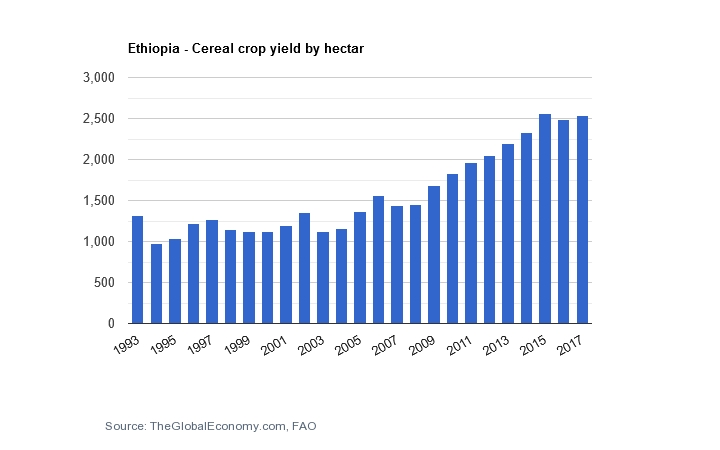
Moreover, the FAO reports that fully half the Ethiopian population was undernourished in the year 2000, while less than 20 percent of the population is undernourished today.
It is amazing that a “news” article at Insider.com can paint this spectacular crop growth and beneficial improvement in nutrition as “food insecurity from climate change.”
About the only thing that is true in the Insider.com article is that Ethiopia is experiencing dramatic urban population growth. However, it is a lie that the urban growth is being caused by climate change destabilizing food production and forcing people into cities. According to the FAO, Ethiopia’s urban areas have added 13 million people since the year 2000. However, Ethiopia’s rural areas have added 28 million people since the year 2000. Ethiopia’s urban and rural areas are gaining population – with rural areas experiencing the largest growth – as increasing crop yields sustain more population and bring more wealth to the nation’s people.
World Bank economic data illustrate this. Per the World Bank:
“Ethiopia’s economy experienced strong, broad-based growth averaging 9.9 percent a year from 2007/08 to 2017/18, compared to a regional average of 5.4%. … Industry, mainly construction, and services accounted for most of the growth. … Higher economic growth brought with it positive trends in poverty reduction in both urban and rural areas. The share of the population living below the national poverty line decreased from 30% in 2011 to 24% in 2016.”
In summary, Ethiopia is enjoying spectacular gains in crop yields that are supporting a rapidly growing population and dramatic growth in both urban and rural populations. The growth in Ethiopia’s urban population is clearly and inarguably a result of spectacular increases in food production and a wealthier population rather than mythical food insecurity. But the easily discernible and reassuring truth doesn’t promote climate alarmism. Therefore, the media lie and invent a false narrative.
The Pharmaceutical Narrative is Failing
By Bretigne Shaffer – LewRockwell.com – August 7, 2020
So now we don’t have to listen to what those doctors said in front of the US Supreme Court, because it turns out that one of them has some whacky beliefs about sex with demons causing reproductive disorders. What a relief.
I’m not going to pretend that the things Dr. Stella Immanuel has said don’t sound just a little crazy to me. They do. But I’ve been observing this game long enough to have a pretty good idea of how this works:
Someone says something that contradicts the dominant narrative (in this case, the narrative about medical science), and the machine that supports that narrative goes into overdrive to discredit them, with whatever information they can dig up–as long as it doesn’t involve discussing the actual substance of what the person has said.
I understand that for some people, maybe even for a great many, that is the end of the conversation. So for everyone who is satisfied with the “fringe doctors promoting hydroxychloroquine also believe demon sex causes fybroids” narrative–please, stop here. Your ride is over, and you may go on believing that this group of doctors and other professionals has been thoroughly discredited by these statements.
For everyone else, if you are at all interested in why such a coordinated effort has been launched to silence and discredit this group, why–even before the sex demon stuff was uncovered–videos of the group’s press conference were quickly yanked from YouTube, and why their own website was taken down without warning by its host, SquareSpace, (their new website can now be found here) then please keep reading.
WHAT THE AMERICA’S FRONTLINE DOCTORS GROUP SAID:
What follows is a brief summary of the key points made by the group America’s Frontline Doctors at their press conference last week. I will not comment on the validity of their claims, however founder Dr. Simone Gold has provided support for much of what the group said, in a white paper that can be found here.
1. They believe that hydroxychloroquine is an effective treatment for Covid-19.
This is the claim made by several of the speakers, including Dr. Immanuel, based on their own clinical experience, as well as on multiple published studies. Many of those studies are listed here, and here.
2. State licensing boards are using their power to forcibly prevent people from having access to this drug.
According to Dr. Gold, many states have empowered their pharmacists to not honor prescriptions for hydroxychloroquine to be used in treating Covid-19. This, she says, is unprecedented: “It has never happened that a state has threatened a doctor for prescribing a universally accepted safe generic cheap drug off-label.”
Meanwhile, says Gold, the drug is available over the counter in many other countries, including Iran and Indonesia, where it can be found “in the vitamin section”.
3. There is a coordinated campaign to discredit and suppress information about the drug hydroxychloroquine as a possible treatment for Covid-19:
“If it seems like there is an orchestrated attack going on against hydroxychloroquine,” said Dr. James Todaro, “it’s because there is.”
Dr. Todaro is speaking from experience. He was the co-author of a March 13 white paper arguing for the use of hydroxychloroquine against Covid-19. The paper was made public on Google Docs, received a lot of attention, and was then removed–without warning–by Google. (It has since been put back up.)
4. The World Health Organization (the authority upon which YouTube CEO Susan Wojcicki has said she bases her company’s policy on “misinformation”) halted its trials of hydroxychloroquine based on a blatantly fraudulent study that relied on data that it appears never even existed. The WHO later resumed trials after independent investigators discovered the problems and the study’s authors retracted it.
5. We should be able to have a free and open discussion about this.
Dr. Dr. Joseph Lapado from UCLA, sums it up:
We’ve been using (hydroxychloroquine) for a long time. But all of a sudden it’s been escalated to this area of looking like some poisonous drug. That just doesn’t make sense… At the very least, we can live in a world where there are differences of opinion about the effectiveness of hydroxychloroquine, but still allow more data to come, still allow physicians who feel they have expertise with it to use that medication, and still, you know, talk and learn and get better at helping people with Covid-19.
WHY THE ALL-OUT MEDIA ASSAULT ON THE FRONTLINE DOCTORS?:
The influence that the pharmaceutical industry wields over media outlets is no secret. As of 2018, an estimated 70% of all news advertising in the US came from pharmaceutical companies. I have written elsewhere about how “reporting” on medical issues can be difficult to distinguish from outright marketing for drug companies.
Social-media platforms are not immune to this influence, whether it comes via advertising dollars; “partnerships” such as that between the CDC Foundation and MailChimp (which like many other platforms, has an explicit policy of censoring content about vaccines that does not align with the positions of the CDC and the WHO); direct investment, such as that of Google’s parent company Alphabet; or indeed at the behest of politicians such as Congressman Adam Schiff, who last year wrote to the CEOs of Amazon, Facebook and Google, requesting that those companies censor information and products that did not conform to the officially sanctioned position on vaccines. All three complied.
So it should come as small surprise that both Google and YouTube have now taken to removing content supportive of hydroxychloroquine, a drug that is no longer covered by patent, and can be made and sold by any generic producer, for a fraction of the price that Gilead, for example, might charge for its still-patented Remdesivir. Twitter and Facebook have likewise removed posts about the drug, most notably–and with no visible sense of irony–removing posts of the video in which the Frontline Doctors speak out about widespread media censorship of the topic. (You can now see those videos on Bitchute.)
One need not have an opinion on the merits of the drug hydroxychloroquine in order to recognize that something very odd is happening here. Something that doesn’t seem to have anything to do with free and open inquiry or honest scientific discourse.
Many argue that the politicization of this drug is founded in a desire to unseat President Trump, that the opposition to it is primarily because it was endorsed by Trump, and if it is deemed to be a failure (or even better, dangerous to patients) it will be a powerful strike against the president. That may well be part of what has motivated this. But there is another motivation, having to do with the desire to push a more expensive medication onto the market, and to push a new vaccine on the world’s population.
More broadly, it has to do with the narrative that those in the business of selling drugs demand we believe: that we are all in desperate need of their products (but only the ones still under patent) if we are to be healthy–or indeed, if we are to survive at all.
If it turns out that this “new” virus is easily treatable, with hydroxychloroquine or anything else, then the industry’s dreams go up in smoke. If hydroxychloroquine turns out to be a safe and effective way of treating Covid-19 (as multiple studies and the experience in many other countries outside of the US indicate it may be) then there is much less reason for anyone to receive a vaccine for it, let alone the entire world’s population. Likewise, there is no pressing need to develop a new, more expensive treatment.
But even more than that: If it turns out that hydroxychloroquine is after all a safe and effective treatment for Covid-19, then this whole episode – the silencing of dissenting voices, the “fact-checking” on social media, the campaigns against “misinformation” – will be revealed in plain sight, for what it has always been: Nothing more than a well-funded marketing campaign and damage-control effort on behalf of the industry that wants you to believe that you need to use its expensive products in order to go on living.
So when a group of doctors took to the steps of the US Supreme Court and told the world how they were having success using a cheap anti-malarial that had been in use for 65 years to treat the most deadly contagion of our generation, it was a massive blow to the narrative upon which the pharmaceutical purveyors’ success depends. And over the next few days, as viewers engaged in a race with the censors, quickly downloading videos before they were removed, to post them on other platforms… it became clear that the censors and the gatekeepers had lost control of the conversation.
This is not only about hydroxychloroquine. Every time media outlets or social-media platforms engage in outright censorship of content, in a way that happens to benefit pharmaceutical companies, both parties lose just a little more credibility. The actions we are witnessing now are not the actions of an industry confident in the value of what it provides to the world. They are the actions of a desperate, threatened creature. They are the actions of an entity that is not strengthened by the truth, but weakened by it. That is what these (increasingly obvious) acts of censorship tell us. What we are witnessing are the pangs of a lumbering, wounded, behemoth.
Featured Video

The American Retreat from Vietnam
or go to
Aletho News Archives – Video-Images
From the Archives
Secret document reveals plans for civil war in Lebanon, Israeli false flags, and invasion
By Randi Nord | Geopolitics Alert | April 5, 2019
Beirut – During his visit with US Secretary of State, Mike Pompeo, Lebanese President Michael Aoun reportedly received a US-Israeli document detailing plans for creating a civil war in Lebanon with covert false flag operations and possible Israeli invasion.
Although the source of the document is Israeli and created in partnership with Washington, no one knows who presented it to Aoun. The Lebanese TV station, Al-Jadeed, initially reported the document on Lebanese TV and a video on its website. Geopolitics Alert translated the report for this article. … continue
Blog Roll
 Aletho News
- EU Council Advances Chat Control 2.0 Scanning Proposal
- Ex-Greek MEP files complaint against Israeli spyware firm over alleged Pegasus surveillance
- Troubling ideas throughout the Torah, Talmud, Mishneh Torah and Tanya
- ‘Grave, alarming’: Iran mission on Trump’s UNGA ‘annihilation’ threats
- Najaf airport to reopen to Iranian flights within 24 hours: Ambassador
- From ‘How Will This End For Iran’ to ‘When America Walks Away’: A tale of two Economist covers
- Tehran blasts ‘baseless’ speculation linking Iran to alleged bomb plot at UK air base
- The Rise And… Rise Of ‘Color Revolutions’
- The Coming GOP Bloodbath?
- Arctic Scare Stories Melt Away
- If Americans Knew
- Netanyahu Asked UAE Leader to Deny Report on Oct. 7 Warning in Secret Visit, Sources Say
- CNN Chief Int’l Correspondent Clarissa Ward on Journalists in Gaza
- Democratic Party Consultants Surround Troy Jackson with Pro-Israel Donors
- Christian Leader Responds To Netanyahu’s Claims Regarding Palestinian Christians
- In Gaza, ‘Whoever Survives the Bombing Won’t Survive the Rubble’
- Israel kills more Palestinians, amid push to resettle Gaza – Daily Update
- Israel forces Gazans to live in constant peril – Daily Update
- Deconstructing Netanyahu’s pants-on-fire UN rant – Daily Update
- Trump betrayed voters with his campaign lies and prioritized a foreign country once he took office
- Netanyahu calls Israel’s war in Gaza ‘opposite of genocide’ in UN speech to near-empty hall
- No Tricks Zone
- New Study: Earth And Venus Surface Warmth Largely Explained By Convection And Lapse Rate, Not CO2 Or Radiation
- 2025 Nature Paper Claiming Worsening Global Drought Gets RETRACTED …Heavily Flawed
- New Study: ‘Global Drought Shows No Detectable Recent Acceleration Under Climate Warming’
- Economic Masterminds: German Socialists Suggest Taxing Productivity Gains Stemming From Using AI
- The South China Sea Has Not Been Cooperating With The Climate Change Narrative
- Energy Crisis: Germany Enters Heating Season With Historically Low Gas Reserve Fill Levels
- New Study: The Antarctic Ice Sheet Gained Mass From 2020-2024 Due To Staggering Snow And Ice Accumulation
- Study: Ocean Heating Rates From Thousands Of Years Ago ‘Dwarf’ Modern Ocean Heating Rates
- Climate Extremists Target, Attack Large-Scale Power Grid Infrastructure In Germany!
- New Study: Antarctic Ice Melt Has Contributed Less Than 1 Centimeter To Sea Level Rise In The Last 30 Years

