A mutilation of young lives: How the radical transgender bandwagon is wrecking girls’ bodies and destroying their mental health

© Abigail Shrier “Irreversible Damage: The Transgender Craze Seducing Our Daughters” / Blackstone Publishing, 2020
By Debbie Hayton | RT | July 29, 2020
A new book, Irreversible Damage, reveals how teenage girls are being duped into believing they want to be male, and are pushed into taking puberty blockers, cross-sex hormones, and undergoing double mastectomies.
Whether it is a statement or a question, the title of this book conveys the necessary urgency of this desperately sad story. Amid the trans debate, seemingly a battle between grown adults, vulnerable children are prey to a malevolent ideology that survivors call a cult.
In a superb piece of investigative journalism, Abigail Shrier focusses on teenage girls – most with no history of gender dysphoria – who become captivated by the belief that they are transgender. Behind the glittery exterior portrayed in the media, she encounters damaged children – many alienated from their families – in poor mental health and facing the prospect of infertility and medication for life.
Shrier, a writer with the Wall Street Journal, pulls no punches when describing phalloplasty, the construction of an artificial penis. The complications can be horrific. She reports the experience of one nineteen-year-old, “whose phalloplasty resulted in gangrene and loss of the appendage.” On the cusp of adulthood, that young person has been left without normal genitalia, for either sex, and tethered to a catheter.
I am a transgender person, but I transitioned as an adult when I could understand the implications on my body and my relationship with society. Besides, by then I’d had my own children. Yet children too young to even give consent for a tattoo are being corralled into making truly life-changing decisions.
Whether you agree or disagree with her, this is a book that needs to be read. Shrier’s informed analysis flows from dozens of interviews, including medical experts and parents. From Dr Kenneth Zucker, who oversaw the writing of the medical definition of “gender dysphoria,” to ordinary families whose children seem to them to have been swept along by this cult, Shrier talks directly to those with first-hand experience.
The facts are clear: there is a contagion spreading among teenage girls who suddenly believe themselves to be boys. While there is documented history of young feminine boys expressing a desire to be girls, never before have girls dominated the work of paediatric gender clinics. The statistics are staggering. In the UK, for example, referrals of teenage girls rose by 4400% in the last decade.
Shrier interviewed Lisa Littman, an American doctor who conducted an observational study and found that nearly 70 percent of the teenagers belonged to a peer group in which at least one friend had also come out as transgender. In some groups, most of the friends had done so. Transgender identification was encouraged and intensified by friends and social media and, astonishingly, appeared to precede the experience of gender dysphoria itself.
Shrier explores possible reasons why these daughters, often from liberal progressive households, want to be sons. First, social media where children are influenced by strangers while their parents are kept in the dark. Second, the educational system where adults who ought to know better have been enthralled, or threatened, by transgender activists. Ignoring both science and basic safeguarding, they have bought into the notion that we all have an immutable gender identity which may or may not match our sex.
With overwhelming folly, children are being transitioned in their schools with new names and pronouns. If their parents might be unsupportive, then they are not told, in case their children might feel “unsafe.” But this is something all parents need to know: this phenomenon is catching, and to be forewarned is to be forearmed.
But nothing could have happened without the cooperation of policy makers, and not only within the education system. Therapists – the very people who should be helping children to challenge their thinking – have been blindly affirming whatever their young patients have picked up from the internet.
Anyone who has stood against this has faced censure and condemnation. But as Jungian analyst Lisa Marchiano explained, “This idea that a kid’s going to come in and tell us that they’re trans and that within a session or two or three or four, that we’re going to say, ‘Yep, you’re trans. Let me write you the letter.’ That’s not therapy.”
Even the medical profession itself has been found wanting. Eminent sexologist Dr Ray Blanchard told Shrier that “I can’t think of any branch of medicine outside of cosmetic surgery where the patient makes the diagnosis and prescribes the treatment.” While the zealots who actually believe that children can change their sex are perhaps in a minority, those professionals who remain silent in education, therapy and medicine are complicit in this unfolding scandal.
Shrier credits the sterling work of parental groups such as 4thWaveNow and Transgender Trend who have stood firm against the ideology. They have been condemned as bigots and transphobes for protecting children from themselves, the first duty of parents since the dawn of time.
The book is well-referenced and easy to read, making it suitable for a wide readership. The most obvious audience are parents concerned for the wellbeing of their daughters. But teachers, therapists and doctors, some of whom remain silent out of ignorance or fear, also need to hear these stories. Finally, the wider public would find Shrier’s analysis accessible, clear and educational. Those only vaguely aware of transgender ideology may be tempted to think that it cannot be true: young girls taking powerful cancer drugs to halt puberty, or induce an artificial menopause if started. But it is happening across the world, and Shrier catalogues it.
The time has come for society to take responsibility. Much has happened covertly, and the startled onlooker may need time to catch up, but Shrier’s book fills in the background, identifies the problems, explains the impact, and proposes clear and workable ways forward. This is a must-read for those with children, anyone who works with children and everyone who cares about them.
Debbie Hayton is a teacher and a transgender campaigner, based in the UK. She tweets @DebbieHayton
Slate: The First Undeniable Climate Change Deaths
By Eric Worrall | Watts Up With That? | July 25, 2020
When record breaking cold occurs it is just weather, but according to Slate, climate attribution, the science of retrofitting explanations to unusual weather events after they happened, can demonstrate that a single unusual heatwave is evidence of climate change.
The First Undeniable Climate Change Deaths
In 2018 in Japan, more than 1,000 people died during an unprecedented heat wave. In 2019, scientists proved it would have been impossible without global warming.
By DANIEL MERINO JULY 23, 20205:45 AM
uly 23, 2018, was a day unlike any seen before in Japan. It was the peak of a weekslong heat wave that smashed previous temperature records across the historically temperate nation. The heat started on July 9, on farms and in cities that only days earlier were fighting deadly rains, mudslides, and floods. As the waters receded, temperatures climbed. By July 15, 200 of the 927 weather stations in Japan recorded temperatures of 35 degrees Celsius, about 95 degrees Fahrenheit, or higher. Food and electricity prices hit multiyear highs as the power grid and water resources were pushed to their limits. Tens of thousands of people were hospitalized due to heat exhaustion and heatstroke. On Monday, July 23, the heat wave reached its zenith. The large Tokyo suburb of Kumagaya was the epicenter, and around 3 p.m., the Kumagaya Meteorological Observatory measured a temperature of 41.1 degrees Celsius, or 106 F. It was the hottest temperature ever recorded in Japan, but the record was more than a statistic. It was a tragedy: Over the course of those few weeks, more than a thousand people died from heat-related illnesses.
On July 24, the day after the peak of the heat wave, the Japan Meteorological Agency declared it a natural disaster. A disaster it was. But a natural one? Not so much.
In early 2019, researchers at the Japan Meteorological Agency started looking into the circumstances that had caused the unprecedented, deadly heat wave. They wanted to consider it through a relatively new lens—through the young branch of meteorology called attribution science, which allows researchers to directly measure the impact of climate change on individual extreme weather events. Attribution science, at its most basic, calculates how likely an extreme weather event is in today’s climate-changed world and compares that with how likely a similar event would be in a world without anthropogenic warming. Any difference between those two probabilities can be attributed to climate change.
…
Read more: https://slate.com/technology/2020/07/climate-change-deaths-japan-2018-heat-wave.html
The Slate article quotes Yukiko Imada of the Japan Meteorological Agency. The abstract of Yukiko Imada’s study;
The July 2018 High Temperature Event in Japan Could Not Have Happened without Human-Induced Global Warming
Yukiko Imada, Masahiro Watanabe, Hiroaki Kawase, Hideo Shiogama, Miki Arai
The high temperature event in July 2018 caused record-breaking human damage throughout Japan. Large-ensemble historical simulations with a high-resolution atmospheric general circulation model showed that the occurrence rate of this event under the condition of external forcings in July 2018 was approximately 20%. This high probability was a result of the high-pressure systems both in the upper and lower troposphere in July 2018. The event attribution approach based on the large-ensemble simulations with and without human-induced climate change indicated the following: (1) The event would never have happened without anthropogenic global warming. (2) The strength of the two-tiered high-pressure systems was also at an extreme level and at least doubled the level of event probability, which was independent of global warming. Moreover, a set of the large-ensemble dynamically downscaled outputs revealed that the mean annual occurrence of extremely hot days in Japan will be expected to increase by 1.8 times under a global warming level of 2°C above pre-industrial levels.
Read more: https://www.jstage.jst.go.jp/article/sola/15A/0/15A_15A-002/_article/-char/ja/
Climate attribution science would be a little more believable if it could predict unusual events in advance, say give a year or two warning that Japan was about to suffer an extreme heatwave. Providing explanations of events which have already happened does not demonstrate skill.
Ohio’s $60 million bribery scandal could ensnare the American nuclear sector, because public trust is undermined
By Ken Silverstein | RT | July 23, 2020
Ohio’s $60 million corruption, bribery case – that has ensnared the House speaker and four others – has also embroiled the nuclear power industry, which is at the heart of the criminal charges filed this week.
The nuclear energy sector in the United States has been trying to keep its head above water — unable to compete with cheap shale gas and subsidized wind and solar power. So it has sought help from state governments, which have taken up legislation to reward nuclear for being a carbon-free source of energy. In the case of Ohio, it is home to FirstEnergy, which owns two nuclear power plants in the state and which asked lawmakers for such consideration.
Ohio’s lawmakers, like those from Connecticut, Illinois, New York and New Jersey, voted to save their nuclear power plants not just because they are reliable and clean [???] but also because they employ thousands of people. In Ohio, it was a $1.3 billion bailout package. What the citizens of Ohio learned this week, however, is that $60 million in surreptitious payments were allegedly made to make that happen and part of that money went into the pockets of House Speaker Larry Householder.
FirstEnergy Solutions, now known as Energy Harbor, is the nuclear unit within FirstEnergy Corp.
According to the Energy and Policy Institute, this is the company which owned the nuclear assets that Householder helped to bailout “and which FirstEnergy spun off in bankruptcy restructuring.”
Energy Harbor says that it will cooperate fully with the investigators, although it is not named in the criminal complaint. However, it is likely the entity that prosecutors refer to as ‘Company A’ — the one that made the $60 million in payments to Speaker Householder’s ‘Generation Now’ fund so that it could get the $1.3 billion in benefits. Prosecutors say that the money was paid over a three-year time frame beginning in 2017.
“This is likely the largest bribery, money laundering scheme ever perpetrated against the people of the state of Ohio,” US Attorney David DeVillers told a press conference. “This was bribery, plain and simple. This was a quid pro quo. This was pay to play.”
In the actual complaint, the prosecution alleges the payments were tantamount to “bags of cash” that went unregulated and unreported.
This is more than a public corruption scandal. It is a potential take-down of nuclear energy. If it is, the ramifications would be huge: According to the Nuclear Energy Institute, there are 96 nuclear reactors in 29 states. Altogether, they supply about 20 percent of the country’s electricity and about 55 percent of its carbon-free power. They operate at 92 percent capacity, more than any other type of power plant.
A heavy weight
Context is key. In the US, electricity grid operators are the ones to order up and dispatch the lowest-cost electricity sources — a system that invariably favors shale gas because it is so cheap relative to competing fuels. Existing generators that sell their electricity at market rates, can’t win. This fact, along with the high capital costs it takes to construct nuclear plants, has severely curtailed nuclear development in the US.
As a result, six nuclear plants have closed down since 2013 and several more have announced retirement dates over the next decade. The practical implications of moving away from nuclear and into natural gas have been greater CO2 emissions. When Southern California Edison closed its plant in 2013, such heat-trapping releases rose by 35 percent. To avoid further closures, state legislatures are subsidizing nuclear power by recognizing their carbon-free contributions.
But the American nuclear power sector has never learned the most basic lesson of Three Mile Island Nuclear Generating Station, which suffered a partial meltdown of its core in 1979 and which triggered an irrevocable backlash: get accurate information to the public in a timely manner. Secrecy does not work. In 2013, Southern California Edison said it would shutter its San Onofre Generating Station because of a small radiation leak. While the utility had maintained publicly that it only learned of the seepage in 2012 during routine maintenance, it was subsequently proven that it long knew that irregular vibrations could lead to leaks.
The utility then lost all credibility with regulators and the public.
Bad economics in combination with poor PR have been mounting for a long time. And the problems are bound to get worse now that FirstEnergy’s Energy Harbor is allegedly embroiled in this latest mess. And the industry can’t blame the environmental movement for this latest crisis — a movement concerned about storing radioactive nuclear waste and potential accidents.
“FirstEnergy’s successful campaign last year to secure a $1 billion bailout of its Ohio nuclear plants is at the center of a pay-to-play scandal that is rocking Ohio,”says Sandy Buchanan and Seth Feaste, of the Institute for Energy Economics & Financial Analysis. “The FBI would do well to take a closer look at all other state government-official involvement with FirstEnergy during the years when FirstEnergy was seeking a ‘legislative solution’ to save its nuclear plants.”
Where does the nuclear sector go from here? No doubt, the industry will separate itself from the corruption scandal now plaguing the state of Ohio. It will continue to maintain that global climate goals cannot be met without heavy participation from nuclear. But it will once again have to fight off the stench of secrecy and back-room politics — the same factors that have weighed it down since 1979. When the Ohio case is resolved, so too might be nuclear’s future in the US.
The danger of looking things up
Climate Discussion Nexus | July 15, 2020
Australia’s hottest day ever recorded was in Edwardian times, so long ago it was 125°F rather than 51.7°C, on Jan. 3 1909 in a place called Bourke. (Not to be rude, but it’s in north New South Wales in a spot even Canadians might concede resembled the middle of nowhere.) The Australian Bureau of Meteorology recently dropped this reading, claiming it was an “observational error” because no official stations recorded high temperatures on that day. As Jennifer Marohasy observes, Australian MP Craig Kelly didn’t believe them, went to the Australian National Archive in Chester Hill and found the actual handwritten records for the nearby official weather station at Brewarrina, showing 50.6°C on that day. Strange that the meteorological authorities couldn’t find that record themselves even though it was in their own files. Just possibly they didn’t really want to.
Even once they’d disposed of Bourke’s 1909 mark the new official hottest day ever was in 1960 rather than during the current climate emergency. Or at least it would be if Kelly had not also discovered that the actual second-hottest to Bourke’s scorcher was in White Cliffs on Jan. 11 1939. Once again the facts show that the 1930s were extremely hot for reasons CO2 cannot explain and others seem not to want to try to.
Of course some might say, well, Australia is an outlier where they even have their hot days in January. But it turns out the hottest day ever in Death Valley, California was in ‘13. No, not 2013. 1913. And in response to “the ever over-alarmed Bill McKibben” tweeting about that temperature over 100°F in Verkhoyansk “Siberian town tops 100 degrees F, the hottest temperature ever recorded north of the Arctic Circle. This scares me, I have to say.” Anthony Watts noted tartly that in fact it was over 100°F in Fort Yukon, Alaska, north of the Arctic Circle in… 1915.
With the hot weather here last week there was the usual talk of breaking records. But it’s interesting to look at the records that were broken, or nearly so. On July 10 Ottawa had its hottest July day since… 1931. And its hottest day overall since 2001, passing records set in 1944, 1921, 1917 and, well, you get the idea. Many of the hottest days ever were not in the last decade or even half-century. And in case you think streaks matter more than individual days, the nation’s capital was chasing a record for consecutive days at or over 31°C set in 1921, narrowly beating the 1919 one, with 1949 in 3rd, and 1911 and 1880 in hot pursuit. Proof positive that we’re in an unprecedented man-made crisis.
Is the Earth warming? Generally it seems to have been since the Little Ice Age. Which itself rules out CO2 as the main factor. But when you look at the record with an eye to preserving rather than “correcting” it, you see that while the 20th century was generally warmer than the 18th, there’s no pattern of extreme heat events bunching together in the very recent past.
“5 Years To Climate Breakdown”: How To Generate Computer Model Scares
Dr David Whitehouse – GWPF – 10/07/20
There are several definitions of hustle. One of them is to use forceful actions to promote an action or point of view. It’s everywhere of course and in all aspects of climate change. It’s all too apparent when scientists want grants, jobs and headlines. It’s no new discovery that combining hustle with statistics can get you anywhere.
The recently released news from the World Meteorological Organisation (WMO), prepared by the UK Met Office, that there is a “growing chance” of the world exceeding the “Paris threshold” of 1.5°C in global temperature above pre-industrial levels is a prime example of this. It says there is a 20% chance that one of the next five years will exceed 1.5°C, and a 70% chance a single month will during the same period. Another way of saying this, statistically equally justifiable, is that there is an 80% chance that global annual average temperatures will not increase statistically significantly over the next five years. There are no headlines saying that!
Just for a moment think what this means. If there is no significant change in global average temperature by 2025, we will be able to look back thirty years (the official definition of climate) and note that the two major warming episodes, 1998 and 2015, were both due to natural climatic variability, in this case two El Nino events. In many ways, the WMO report is more a testament to the importance of natural climatic variability than it is to long-term anthropogenic warming.
What’s more this forecast has been tested by reversing the direction of time in the computer models and seeing how successfully it “predicts” the past. One would expect any model to be good at this because past observations have already been incorporated into the model which has evolved to have no serious disagreements with it. In such a complicated system as the climate – and the WMO report actually stresses the uncertain and poorly understood nature of internal climatic variability – looking into the future is an entirely different thing. Good hindcasts do not imply good forecasts.
In other reports of the same WMO document the statistics get even more suspicious. One says that there is a 3% chance of the forthcoming five-year global temperature average exceeding 1.5°C. Three percent implies a very accurate predicative ability, especially when it is accompanied by no error statement. Again, any journalist looking at these figures objectively would find that the real story is that there is a 97% chance that the average of the next five years will remain more or less what it is now. And yet the Ecologist website proclaims we have five years to climate breakdown.
A story like this is a kind of litmus test for journalists. They can take the press release and wave it through to their website with minor changes and supporting statements. Or they could look at the statistics and — how can I say this — ask questions. I have a feeling that the era of unquestioning journalist environmental advocacy which began in the early years of this century, is gradually fading away.
Perhaps they could start to be guided by the empirical data and the messages it has been sending us for years; we do not understand natural climatic variability; our models are nowhere near as accurate as some maintain and forecasts of future temperatures more often than not end in ignominy.
Faulty Forecasts and False Climate Narrative Hold Nations Hostage
By Vijay Jayaraj | Watts Up With That? | July 15, 2020
The United States is the only major Western country that is not part of the Paris climate agreement, which seeks to restrict and reduce fossil fuel consumption across the world. But the country is not immune from the impacts of the restrictive energy policies the agreement imposes on its trade partners. One of those is my own country, India.
India imports large amounts of coal, oil, and natural gas from the U.S., mostly to generate affordable power for its electric grid. That grid must grow rapidly to meet the needs of over 1.3 billion people. Over 300 million of them—comparable to the whole U.S. population—currently have no electricity. But they need it desperately for their health and their escape from severe poverty.
The justification for reducing fossil fuel use is the claim that climate change will create havoc in the future unless we reduce our greenhouse gas (GHG) emissions. But this claim is not as black and white as the mainstream media and politicians make it out to be.
In fact, data on temperature suggest that the claim is exaggerated and tends be informed by incorrect interpretations from faulty models.
The Never-Ending Problem with Models
The Paris climate agreement and other major climate recommendations from the United Nations are strictly based on the guidelines provided by Assessment reports produced by a climate wing known as the Intergovernmental Panel for Climate Change (IPCC).
The IPCC uses forecast data processed by a large set of computer climate models to arrive at the policy recommendations in its assessment reports.
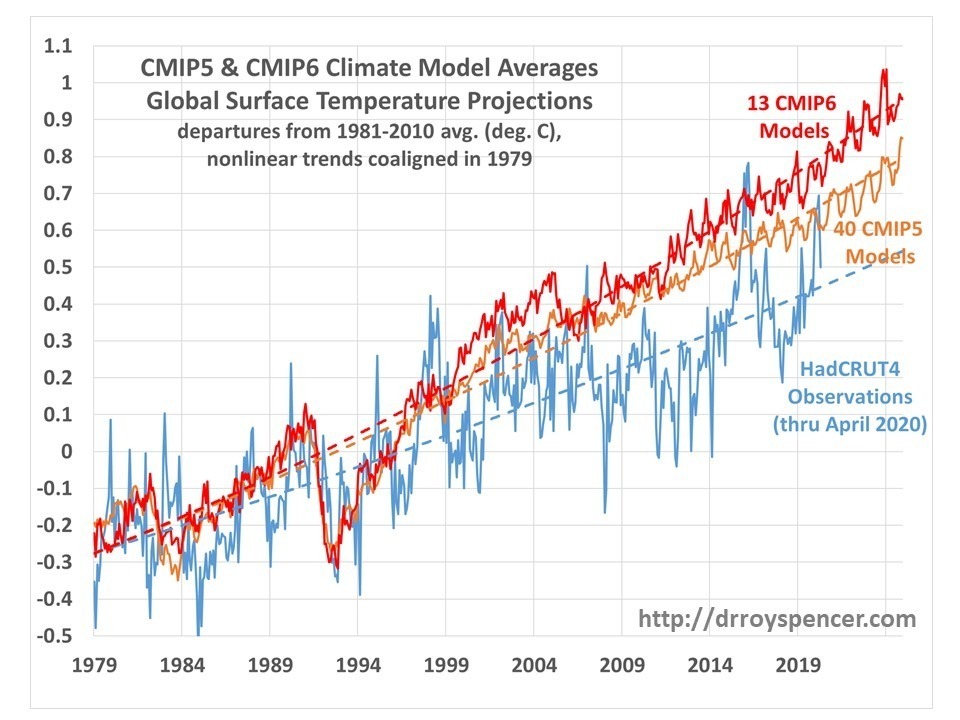
Among them are forecasts from the Coupled Model Inter-comparison Project (CMIP). CMIP consists of 100 distinct climate models, run by leading modelling groups across the world. Their predictions drive the IPCC’s reports. In 2013, the IPCC fifth assessment report (AR5) featured climate models from CMIP5 (fifth generation).
But the forecasts from these models proved wrong. They exaggerated the temperature trend and differed markedly from temperature data derived from ground-based thermometers; sensors on weather balloons aircraft, ships, and buoys; satellite remote sensing; and “reanalyses”—the latter integrating the input of many different data sources.
Yet, political appointees in charge of determining climate and energy policy around the world used these forecasts to justify international climate agreements like the Paris agreement. And they do no stop with that.
The upcoming IPCC sixth assessment report (AR6), forecast for release in 2021, features forecasts from CMIP6. But the CMIP6 models are turning out to be no better than CMIP5 models. In fact, CMIP6 they’re worse!
Senior climatologist Dr. Roy Spencer has observed that the “CMIP6 models are showing 50 percent more net surface warming from 1979 up to April 2020 (+1.08 degree Celsius) than actual observations from the ground (+0.72 degree Celsius).”
Beyond doubt, comparing both CMIP5 and CMIP6 forecasts to official HadCRUT temperature data sets reveals a very old story: models are always way off the mark, and—suspiciously—always in the same direction, namely, upward, in predicting real-world temperatures.
So, not only were we lied to about the climate, we are going to be misled again by the next IPCC assessment report. And with more extreme false forecasts, there will be calls for more restrictive energy policies.
It is quite astonishing how the unelected politicians at the UN can convince and persuade global leaders to adopt climate policies that are based on unscientific conclusions from faulty models.
The mainstream media have also played their part. Public perception on climate change has been heavily influenced by biased coverage on the climate issue, with no major attention to the huge discrepancies between the model forecasts and real-world observations.
It is not clear how much faultier the projections will become by the time the new assessment report is finally released. But one thing is clear: energy sectors across the globe are being held hostage by pseudo-scientific interpretations from the United Nations’ flagship climate wing.
Vijay Jayaraj (M.Sc., Environmental Science, University of East Anglia, England), is a Research Contributor for the Cornwall Alliance for the Stewardship of Creation living in New Delhi, India.
Featured Video

The American Retreat from Vietnam
or go to
Aletho News Archives – Video-Images
From the Archives
Secret document reveals plans for civil war in Lebanon, Israeli false flags, and invasion
By Randi Nord | Geopolitics Alert | April 5, 2019
Beirut – During his visit with US Secretary of State, Mike Pompeo, Lebanese President Michael Aoun reportedly received a US-Israeli document detailing plans for creating a civil war in Lebanon with covert false flag operations and possible Israeli invasion.
Although the source of the document is Israeli and created in partnership with Washington, no one knows who presented it to Aoun. The Lebanese TV station, Al-Jadeed, initially reported the document on Lebanese TV and a video on its website. Geopolitics Alert translated the report for this article. … continue
Blog Roll
 Aletho News
- EU Council Advances Chat Control 2.0 Scanning Proposal
- Ex-Greek MEP files complaint against Israeli spyware firm over alleged Pegasus surveillance
- Troubling ideas throughout the Torah, Talmud, Mishneh Torah and Tanya
- ‘Grave, alarming’: Iran mission on Trump’s UNGA ‘annihilation’ threats
- Najaf airport to reopen to Iranian flights within 24 hours: Ambassador
- From ‘How Will This End For Iran’ to ‘When America Walks Away’: A tale of two Economist covers
- Tehran blasts ‘baseless’ speculation linking Iran to alleged bomb plot at UK air base
- The Rise And… Rise Of ‘Color Revolutions’
- The Coming GOP Bloodbath?
- Arctic Scare Stories Melt Away
- If Americans Knew
- Netanyahu Asked UAE Leader to Deny Report on Oct. 7 Warning in Secret Visit, Sources Say
- CNN Chief Int’l Correspondent Clarissa Ward on Journalists in Gaza
- Democratic Party Consultants Surround Troy Jackson with Pro-Israel Donors
- Christian Leader Responds To Netanyahu’s Claims Regarding Palestinian Christians
- In Gaza, ‘Whoever Survives the Bombing Won’t Survive the Rubble’
- Israel kills more Palestinians, amid push to resettle Gaza – Daily Update
- Israel forces Gazans to live in constant peril – Daily Update
- Deconstructing Netanyahu’s pants-on-fire UN rant – Daily Update
- Trump betrayed voters with his campaign lies and prioritized a foreign country once he took office
- Netanyahu calls Israel’s war in Gaza ‘opposite of genocide’ in UN speech to near-empty hall
- No Tricks Zone
- New Study: Earth And Venus Surface Warmth Largely Explained By Convection And Lapse Rate, Not CO2 Or Radiation
- 2025 Nature Paper Claiming Worsening Global Drought Gets RETRACTED …Heavily Flawed
- New Study: ‘Global Drought Shows No Detectable Recent Acceleration Under Climate Warming’
- Economic Masterminds: German Socialists Suggest Taxing Productivity Gains Stemming From Using AI
- The South China Sea Has Not Been Cooperating With The Climate Change Narrative
- Energy Crisis: Germany Enters Heating Season With Historically Low Gas Reserve Fill Levels
- New Study: The Antarctic Ice Sheet Gained Mass From 2020-2024 Due To Staggering Snow And Ice Accumulation
- Study: Ocean Heating Rates From Thousands Of Years Ago ‘Dwarf’ Modern Ocean Heating Rates
- Climate Extremists Target, Attack Large-Scale Power Grid Infrastructure In Germany!
- New Study: Antarctic Ice Melt Has Contributed Less Than 1 Centimeter To Sea Level Rise In The Last 30 Years