COVID Nonsense Helped Raise Awareness of the Vaccine Industry’s Real Agenda
Spoiler: they don’t care about your health and they never have, not really
By Jennefir Margulis | Vibrant Life | May 23, 2024
In 2019 the World Health Organization listed “vaccine hesitancy” as one of the top ten threats to global health.
“The reluctance or refusal to vaccinate despite the availability of vaccines,” this multi-billion-dollar agency explained, “threatens to reverse progress made in tackling vaccine-preventable diseases.”
According to the WHO: “Vaccination is one of the most cost-effective ways of avoiding disease—it currently prevents 2-3 million deaths a year, and a further 1.5 million could be avoided if global coverage of vaccinations improved.”
In 2019 a lot of people believed this to be true, shaking their heads in dismay at “those crazy antivaxxers.”
Five years later there’s a shift happening.
More people than ever before—especially those in healthcare professions—are starting to do their own research, use their own human brains to think about things that they always took at face value, and change their minds about vaccines.
“Many of us have learned about the vaccine industry”
According to a peer-reviewed article published last week in Nature’s Scientific Reports, there has been a “global rise in vaccine hesitancy.”
One of my readers, Beth, would likely agree.
An M.D. colleague of mine, who has been squarely pro-vaccine his entire career, has started to change his mind about vaccines.
The reason?
He’s spending most of every day in his clinical practice treating mainstream patients who are suffering from severe adverse reactions to the vaccines they’d been so eager to get.
After seeing the reactions for himself, he did something he did not used to do as a busy clinician in private practice: he started looking beyond the CDC’s recommendations and reading scientific studies for himself.
Several studies he read, and alternative news articles about them, left him with so much cognitive dissonance that he almost decided to quit medicine for good.
Vaccine studies that should give you pause
Three of these peer-reviewed scientific studies about COVID-19 vaccine safety caught his attention:
1) A 2022 study by Italian scientists that showed that 94 percent of vaccinated patients who went to the doctor with subsequent health problems presented with abnormal blood. The three Italian scientists who examined freshly drawn blood of more than a thousand patients noted that though they had no clear explanation for their findings, they were so unusual that they felt the need to alert the medical community.
2) A 2022 study published in the journal Food and Chemical Toxicology by an international team of researchers that included an MIT senior scientist and one of the world’s foremost and most respected cardiologists, presented evidence that the mRNA vaccines impaired type 1 interferon signaling, which has diverse—and sometimes devastating—consequences to human health, including a “causal link” to neurodegenerative disease, myocarditis, immune thrombocytopenia, and cancer.
3) An extended analysis conducted by a team of nine experts from Harvard, Johns Hopkins, and several other elite universities that found that COVID-19 booster shots for young people actually caused many more serious adverse events for every one (1) theoretical COVID-19 infection-related hospitalization they prevented. Among the team of scientists that published this paper was Dr. Salmaan Keshavjee, M.D./Ph.D., the director of the Harvard Medical School Center for Global Health Delivery. The paper concluded that, given efficacy and safety concerns, mandating COVID-19 vaccines for college students was unethical.
This doctor had previously testified in favor of allowing state officials to bar unvaccinated or partially vaccinated children from attending public school, private school, and daycare. The bill he supported, thankfully, was not passed into law.
Why would he have supported taking medical freedom and vaccine choice away from parents?
I choose to believe that nearly all doctors have human health and their patients’ wellbeing at the forefront of their minds.
Yes, doctors like the respect they get from being medical doctors.
Sure, they love the money and the houses they can buy with it, the vacations they can take, and the elite colleges they can afford to send their children to.
But most doctors also care, deeply, about the people who come to them for help.
This doctor once believed that by protesting against allowing unvaccinated and partially vaccinated children to attend school he was helping make America a healthier, happier place.
In his mind—programmed by four years of medical training, a residency, continuing education courses, most if not all of his colleagues, the billboards he passed on the highway on his commute to the office every day, the advertising he saw on TV, and the news channels he tuned into several times a day—vaccines were synonymous with health.
And the more vaccinated a child, the healthier.
You don’t know what you don’t know.

Screenshot of educational material about over-vaccination produced by the National Vaccine Information Center, a non-profit based in Washington, D.C., that was founded by a parent whose child was severely and irreversibly vaccine-injured based
Not liable for their products
He didn’t know that, due to federal law, vaccine manufacturers in America are not liable for vaccine-related adverse events caused by the products they manufacture.
And he admitted, in a confessional tone of voice, that before COVID he probably wouldn’t have cared anyway.
Most doctors, before COVID, never filed a VAERS report
He didn’t believe in vaccine adverse events, had never filed a VAERS report, and had always dismissed patients’ concerns that the problem their child experienced right after being vaccinated as an “unfortunate coincidence.” In his mind, bad vaccine reactions simply didn’t exist.
He’d never bothered to peruse a single peer-reviewed article about vaccine safety, read a vaccine critical book, or attend a holistic health conference.
Why would he?
Why read a book about the safety of broccoli?
Reading a book about safety, efficacy, and necessity issues related to vaccines would have been like reading a book about the safety of broccoli or the efficacy of drinking water to hydrate the body.
But now this doctor has changed his mind.
Seeing hundreds of adverse reactions
He’s caring for hundreds of patients trying to heal from adverse reactions to the COVID vaccines. He’s been in practice for over twenty years but is currently seeing turbo cancers, heart problems, neurological problems, blood clots, and immune dysfunction that he has never seen before.
Most of these patients have had both COVID infections and at least two—sometimes as many as five or six—COVID vaccines.
It’s hard to pinpoint the exact cause of these problems and the mechanisms by which they are happening.
Could it be due to the COVID infections? The vaccines? The boosters? The conventional treatments, including Paxlovid? Or some combination of all of these?
Though he does not know, he has now filed over a dozen VAERS reports to alert the CDC. To date, no one at the CDC has responded to any of his reports.
Staying in the closet
This doctor has over a thousand families in his practice. He employs another medical doctor, a nurse practitioner, and front-end staff.
For the past three plus years he’s chosen to work quietly from behind the scenes, trying to gently educate his mainstream allopathic-minded patients about his new vaccine safety concerns without alienating them.
While the world needs more medical doctors to speak publicly about the vaccine safety concerns and the adverse events they’re seeing firsthand, this doctor is afraid to come out of the closet. He accepts insurance, has a diverse patient population, and doesn’t want to lose his license.
He’s also trying very hard to avoid being witch-hunted as so many COVID critical doctors, including my co-author Dr. Paul Thomas, M.D.; my colleague Dr. Steven LaTulippe, M.D.; and my friend and colleague Dr. Meryl Nass, M.D.; already have.
So what is the vaccine industry’s real agenda?
Medicine is big business.
These mRNA vaccines have proven their worth as money makers, allowing pharmaceutical executives to buy luxury real estate and put their newly minted billions into off-shore bank accounts.
The more people get vaccinated, the more money everyone in the industry makes.
There’s nothing wrong with making money.
But becoming rich at the expense of our children’s health and continuing to promote a toxic so-called preventative despite clear evidence that the harms outweigh the benefits is antithetical to the practice of medicine.
Still, as Beth so eloquently pointed out, the good news about this COVID nonsense is that more Americans than ever before are becoming aware of medical malfeasance. We may be on the cusp of a collective shift: a new national awareness about the importance of avoiding toxins, individualizing medicine, and thinking for ourselves.
Baby Formula and Breastfeeding
On the Nature of Cartel Medicine

Lies are Unbekoming | June 1, 2024
What would the world look like without Obstetricians and Pediatricians?
I don’t need to wonder.
It would be a better place.
With everything I’ve recently read and written about Hysterectomy and Childbirth, let alone Childhood Vaccination, I’ve been thinking about the Nature of Cartel Medicine.
I’ve described Cartel Medicine as predatory many times, but what am I really describing?
I’m describing its Nature.
The same as if I was describing the Nature of a Wolf.
A wolf sees me as prey because that is its Nature.
I am trying to understand what IT is, why it behaves the way it does, and I’m trying to help others orient themselves correctly to this creature.
Its Nature is to eat, to feed, to prey.
We are the Prey.
The “clothing” for this Nature are the Doctors.
The well intentioned, naïve sheep that are poured into The Academy to be “educated” by the most sophisticated indoctrination technology the world has ever seen.
They emerge, shiny and sparkling with their white coats that coincidentally are a similar color to that of a sheep’s coat.
The Wolf manages to perpetually drape itself with a constantly renewed Sheep’s Clothing.
The Sheep don’t understand their purpose.
Dr Robert Mendelsohn understood their purpose more than anyone else I have read so far, and to our eternal loss only got to write three books about it.
This stack is about the Wolf and how it preys on mothers and newborns via the assault on breastfeeding and the industrial propaganda of the Baby Formula Cartel.
We will start with an excerpt from Mendelsohn’s masterpiece Male Practice.
We will then look at a Q&A drawn from a chapter of Your Baby, Your Way, by Jennifer Margulis.
And I will end with a Q&A based on four Mercola articles.
With thanks to all three of these giants.
Male Practice by Dr Robert Mendelsohn
Chapter 23 – “I Know What’s Best for Your Child.”
A mother is doubly victimized by Modern Medicine. In addition to the abuses she suffers, she must also worry about what a doctor may do to her child. Creative diagnosis and the harmful intervention that often follows isn’t limited to adults. Doctors will practice it on any available victim, regardless of size.
The damage inflicted on children begins, as noted earlier, when silver nitrate drops are placed in their eyes. It continues throughout childhood in an endless succession of useless examinations, worthless medications, and needless surgery that serve only to make pediatricians rich.
The child’s health is often placed at risk shortly after birth when the doctor discourages breast-feeding and urges the mother to raise her baby on formula milk. There is virtually no medical or physical reason, short of a bilateral mastectomy, why doctors should urge substitution of nutritionally deficient formula for a perfect food like mother’s milk. Breast-feeding may be impractical for some working mothers, of course, but that doesn’t explain why doctors seem so determined to deny the benefits of breast-feeding to all the rest. Many aspects of obstetrical intervention mitigate against breast-feeding and, if these are not sufficient to discourage the mother, pediatricians always seem able to find another excuse. They tell her that her breasts are too small, her milk is too thin, or that she has a cold and should stay away from the baby.
I blame three factors for the failure of doctors to urge that mothers breast-feed their children. First, they learn nothing about nutrition in medical school and are actually taught that formula is just as good as mother’s milk. Second, this belief is reinforced by the misleading medical journal advertising purchased by the formula manufacturers. It stops just short of citing women as defective because their breasts aren’t calibrated and encased in tin. Finally, I believe doctors oppose breast-feeding for the same reason they oppose natural childbirth. It denies them too many lucrative opportunities to intervene.
Rather than discouraging breast-feeding, conscientious doctors should be doing everything they can to promote it because of its enormous importance to both mother and child. It strengthens the bond between them in a way that no amount of holding and hugging will achieve. It stimulates hormones that reduce postpartum bleeding and discomfort and causes the uterus to contract more rapidly to its normal size. It gives the mother sensual pleasure. It helps protect her from cancer of the breast.
Breast-feeding also stimulates the production of prolactin by the pituitary gland, which enhances maternal behavior. It also has a tranquilizing effect (without drugs) that helps the mother adjust to the pressures of having a new baby in the home. The prolactin also suppresses production by the ovaries of the hormone that triggers ovulation, thus providing natural birth control for a much longer time.
The baby benefits because breast-feeding provides it with nourishment superior to that supplied by formula milk. It provides better bone maturation and intellectual development. It protects the child from asthma and other hereditary allergies. Because nursing babies are not locked into rigid feeding schedules they eat when they are hungry. This makes them less prone to the digestive upsets seen in babies who are allowed to cry until the clock says mother can shove a bottle in their mouths. There is even evidence that the resulting avoidance of emotional disturbances and the breast-fed baby’s closer bond to its mother reduce the danger of hypertension later in life.
One of the most important benefits that the baby receives from mother’s milk is protection from infectious diseases that the mother has fought off through her well-developed immune system. The bottle-fed baby is much more likely to suffer a nightmare of illnesses that include diarrhea, colic, gastrointestinal and respiratory infections, meningitis, asthma, hives, other allergies, pneumonia, eczema, obesity, arteriosclerosis, dermatitis, growth retardation, hypocalcemic tetany, neonatal hypothyroidism, necrotizing enterocolitis, and sudden infant death syndrome. Babies raised on canned formula milk may also be affected by ingesting too much lead.
Not long ago the American Academy of Pediatrics finally discovered the virtues of breast-feeding and took a strong position in favor of mother’s milk. With an enthusiasm usually reserved for products of the pharmaceutical labs, it said that “Human milk is nutritionally superior to formula,” and it urged all elements of the medical profession to encourage breast-feeding.
That’s mildly encouraging, but I’m not so naive as to believe that the Academy’s recommendations will prevail. Hospital personnel don’t like breast-feeding because it involves more work for them and upsets their routine. Pediatricians don’t like it for the opposite reason. It means less work and fewer office call fees for them. When babies are breast-fed, pediatricians are hard put to justify their existence. There are no diets to juggle and the babies enjoy a natural immunity to most ailments. There’s nothing more useless than a doctor who has nothing to treat.
Your Baby, Your Way by Jennifer Margulis
Chapter 7 – Bottled Profits: How Formula Manufacturers Manipulate Moms
Question 1: What are some of the physical and emotional benefits of breastfeeding for mothers?
Breastfeeding provides numerous physical and emotional benefits for mothers. Physically, breastfeeding helps the uterus contract and return to its pre-pregnancy size, reduces postpartum bleeding, and helps women lose pregnancy weight more easily. Emotionally, breastfeeding releases the hormones oxytocin and prolactin, which promote feelings of bonding, relaxation, and well-being. The skin-to-skin contact during breastfeeding also enhances the emotional connection between mother and baby.
Question 2: How does breastfeeding impact the bonding experience between mother and baby?
Breastfeeding facilitates a strong bonding experience between mother and baby. The close physical contact, skin-to-skin touch, and eye contact during breastfeeding sessions create an intimate and nurturing environment. The release of oxytocin, known as the “love hormone,” during breastfeeding promotes feelings of attachment and affection. Mothers who breastfeed often report feeling a deep sense of connection and satisfaction in providing nourishment and comfort to their babies.
Question 3: What are the long-term health benefits of breastfeeding for women?
Breastfeeding offers several long-term health benefits for women. Studies have shown that women who breastfeed have a lower risk of developing breast cancer, ovarian cancer, endometrial cancer, rheumatoid arthritis, heart disease, and type 2 diabetes later in life. Breastfeeding also helps with natural child spacing, as exclusive breastfeeding can delay the return of ovulation and menstruation.
Question 4: Despite the known benefits, how do breastfeeding rates in the United States compare to other industrialized countries?
Despite the well-established benefits of breastfeeding, the United States has one of the lowest breastfeeding rates among industrialized countries. While 77% of American women initiate breastfeeding, only 36% are exclusively breastfeeding at three months postpartum. This means that out of the 4.3 million babies born in the United States each year, only 1.5 million are still being nursed at three months of age.
Question 5: What factors contribute to the low breastfeeding rates in the United States?
Several factors contribute to the low breastfeeding rates in the United States. These include insufficient support and education from healthcare providers; aggressive marketing practices by formula companies; and cultural attitudes that may view breastfeeding as inconvenient or embarrassing. Additionally, the medicalization of childbirth and common hospital practices that separate mothers and babies after delivery can hinder the initiation and establishment of breastfeeding.
Question 6: How can medical interventions during labor and delivery impact a woman’s ability to breastfeed?
Medical interventions during labor and delivery can significantly impact a woman’s ability to breastfeed. Procedures such as induction of labor, epidural analgesia, and cesarean section can lead to prolonged labor, delayed skin-to-skin contact, and separation of mother and baby, all of which can interfere with the initiation of breastfeeding. Medications used during labor may also cause drowsiness in the newborn, making it more difficult for the baby to latch on and feed effectively.
Question 7: What role do pediatricians and other medical professionals play in undermining breastfeeding?
Pediatricians and other medical professionals can undermine breastfeeding by providing inaccurate information, encouraging unnecessary supplementation with formula, or failing to offer adequate support to breastfeeding mothers. Some healthcare providers may lack sufficient knowledge about breastfeeding and its challenges, leading them to recommend formula supplementation prematurely. Additionally, the influence of formula company marketing on medical professionals can lead to a bias toward formula feeding over breastfeeding.
Question 8: How do formula companies use misleading advertising to promote their products?
Formula companies use various misleading advertising tactics to promote their products. They often make claims that their formula provides benefits similar to breast milk, such as promoting brain development, eye health, and immune function, despite the lack of scientific evidence to support these claims. Formula advertisements may also depict unrealistic and idealized images of formula-fed babies, suggesting that formula feeding is a superior or more convenient choice for mothers.
Question 9: What tactics do formula companies employ to undermine breastfeeding and increase their sales?
Formula companies employ several tactics to undermine breastfeeding and increase their sales. These include providing free formula samples to new mothers in hospitals, which has been shown to decrease breastfeeding rates; offering coupons and discounts on formula products; sponsoring parenting events and baby fairs; and marketing directly to pregnant women and new mothers through advertisements, websites, and social media. Formula companies also partner with hospitals and healthcare providers to distribute promotional materials and samples, effectively endorsing their products.
Question 10: How do formula companies influence nurses and other medical professionals?
Formula companies influence nurses and other medical professionals by providing free samples, gifts, and educational materials that promote their products. They may offer sponsored continuing education courses, conferences, and workshops that present information biased toward formula feeding. Formula representatives often develop personal relationships with nurses and hospital staff, providing meals, gift baskets, and other incentives. This subtle influence can lead healthcare professionals to view formula as an acceptable or even preferred alternative to breastfeeding.
Question 11: How do professional medical organizations, like the AAP, receive funding from formula companies, and what is the potential impact of this relationship?
Professional medical organizations, such as the American Academy of Pediatrics (AAP), receive funding from formula companies through sponsorships, grants, and donations. In the five years following the AAP’s endorsement of exclusive breastfeeding for the first six months of life, formula manufacturers donated more than $6.7 million to the organization. This financial relationship raises concerns about potential conflicts of interest and the influence of formula companies on the AAP’s policies and recommendations regarding infant feeding practices.
Question 12: What are the neurological advantages of breastfeeding for babies?
Breastfeeding offers several neurological advantages for babies. Breast milk contains essential nutrients, such as long-chain polyunsaturated fatty acids (DHA and ARA), that are crucial for brain development. The act of breastfeeding also provides important sensory stimulation through skin-to-skin contact, which promotes optimal brain development. Studies have shown that breastfed infants have higher scores on cognitive and developmental tests compared to formula-fed infants, and these benefits may extend into childhood and adulthood.
Question 13: How does breast milk composition compare to cow’s milk and infant formula?
Breast milk is a dynamic, living substance that adapts to the changing needs of the growing infant. It contains a perfect balance of nutrients, including proteins, fats, carbohydrates, vitamins, and minerals, as well as immune-boosting components such as antibodies, white blood cells, and enzymes. In contrast, cow’s milk and infant formula are static, processed products that cannot replicate the complexity and adaptability of human milk. While formula attempts to mimic the composition of breast milk, it lacks many of the bioactive components and living cells found in human milk.
Question 14: How have breastfeeding rates in Norway changed over time, and what factors contributed to these changes?
Breastfeeding rates in Norway have undergone significant changes over time. In the 1960s, breastfeeding rates reached an all-time low, with only one out of five Norwegian babies being breastfed at three months of age. This decline was largely attributed to the medicalization of childbirth and hospital practices that discouraged breastfeeding. However, with the rise of mother-to-mother support groups and changes in hospital policies, breastfeeding rates began to increase in the 1980s. Today, Norway has one of the highest breastfeeding rates in the industrialized world, with nearly 100% of mothers initiating breastfeeding and 80% still breastfeeding at six months postpartum.
Question 15: What policies and practices have been implemented in Norway to support breastfeeding?
Norway has implemented several policies and practices to support breastfeeding. These include paid maternity leave, which allows mothers to stay home and breastfeed their infants for an extended period; restrictions on the marketing of infant formula, in accordance with the International Code of Marketing of Breast-Milk Substitutes; and the establishment of the National Resource Center for Breastfeeding, which provides education and support to healthcare professionals and parents. Norwegian hospitals also prioritize skin-to-skin contact between mother and baby immediately after birth, encourage rooming-in, and provide lactation support to new mothers.
Question 16: How do infant mortality rates in the United States compare to those in Norway, and what role does breastfeeding play in this difference?
Infant mortality rates in the United States are significantly higher than those in Norway. A baby born in the United States is almost twice as likely to die in infancy compared to a baby born in Norway. Breastfeeding plays a crucial role in this difference, as it has been shown to reduce the risk of infant death, particularly from sudden infant death syndrome (SIDS) and necrotizing enterocolitis. Norway’s high breastfeeding rates and supportive policies contribute to its lower infant mortality rates, while the United States’ low breastfeeding rates and lack of support for breastfeeding mothers may contribute to its higher infant mortality rates.
Question 17: What are the financial costs of formula feeding compared to breastfeeding?
Formula feeding is significantly more expensive than breastfeeding. The cost of formula for an infant for 12 months is estimated to be around $2,366, while the cost of breast milk is essentially zero. In addition to the direct cost of formula, there are indirect costs associated with formula feeding, such as increased healthcare expenses due to the higher rates of illness and infection among formula-fed infants. Breastfeeding, on the other hand, provides significant cost savings for families and the healthcare system as a whole.
Question 18: What is the purpose of the National Resource Center for Breastfeeding in Norway?
The National Resource Center for Breastfeeding in Norway is an academic center that aims to promote and support breastfeeding through research, education, and information dissemination. The center, overseen by Dr. Gro Nylander, uses scientific evidence to provide accurate and up-to-date information about breastfeeding to healthcare professionals, parents, government agencies, and the media. By serving as a centralized resource for breastfeeding information and support, the National Resource Center for Breastfeeding plays a crucial role in maintaining Norway’s high breastfeeding rates and ensuring that both healthcare providers and parents have access to reliable, evidence-based guidance on breastfeeding practices.
Question 19: How do Norwegian hospitals support breastfeeding and minimize the use of formula?
Norwegian hospitals implement several practices to support breastfeeding and minimize the use of formula. These practices include encouraging skin-to-skin contact between mother and baby immediately after birth, promoting rooming-in (keeping the baby in the same room as the mother), and allowing babies to breastfeed on demand. Norwegian hospitals also avoid giving newborns supplemental feedings of formula or sugar water, which can interfere with the establishment of breastfeeding. If a baby does require formula for medical reasons, it is given via alternative methods, such as a syringe or spoon, rather than a bottle, to avoid nipple confusion and maintain the baby’s ability to latch and breastfeed effectively.
Question 20: What are some of the potential dangers of supplementing breastfed babies with sugar water or formula in the early days of life?
Supplementing breastfed babies with sugar water or formula in the early days of life can pose several potential dangers. First, it can interfere with the establishment of a healthy milk supply, as the baby’s suckling stimulates milk production. If a baby receives supplemental feedings, they may not nurse as frequently or effectively, leading to decreased milk production. Additionally, sugar water can cause digestive issues, such as stomach discomfort and diarrhea, while formula can alter the gut microbiome and increase the risk of infections and allergies. Supplementation can also disrupt the natural bonding and attachment process between mother and baby, as well as undermine the mother’s confidence in her ability to nourish her child.
Question 21: What are some of the risks associated with formula feeding, as highlighted by product recalls and contamination incidents?
Formula feeding carries several risks, as evidenced by product recalls and contamination incidents. In recent years, there have been several instances of formula being recalled due to contamination by harmful substances, such as insects, larvae, and bacteria. These contaminants can cause serious health issues in infants, including gastrointestinal distress, infections, and even life-threatening illnesses. Additionally, formula products have been recalled for issues such as off-odors, unusual consistencies, and the presence of foreign objects. These incidents highlight the importance of strict quality control in formula manufacturing and the potential dangers of relying on a processed, artificial product to nourish infants.
Question 22: How do the profits of major formula companies compare to the cost of formula for families?
The profits of major formula companies are substantial, particularly when compared to the cost of formula for families. In 2011, Abbott Laboratories, the maker of Similac, reported global sales of $38.9 billion, while Mead Johnson Nutrition, the manufacturer of Enfamil, reported $3.7 billion in sales. Nestlé, the company behind Gerber formula, earned $10.1 billion in profits in the same year. In contrast, the average cost of formula for a family over a 12-month period is estimated to be $2,366. This disparity highlights the significant financial burden that formula feeding places on families, while formula companies continue to generate substantial profits.
Question 23: What is the estimated cost savings in healthcare if American women followed the AAP breastfeeding guidelines?
If American women followed the American Academy of Pediatrics (AAP) breastfeeding guidelines, which recommend exclusive breastfeeding for the first six months of life and continued breastfeeding for at least one year, the potential cost savings in healthcare could be significant. According to one study, if 90% of U.S. families followed the AAP guidelines, the country could save $13 billion in healthcare costs annually. These savings would be primarily due to the reduced incidence of illness and infection among breastfed infants, as well as the long-term health benefits for both mothers and children.
Question 24: How many infant deaths could potentially be avoided if American women breastfed according to recommendations?
If American women breastfed according to the recommendations set forth by the American Academy of Pediatrics and the World Health Organization, a significant number of infant deaths could potentially be avoided. One study estimated that if 90% of U.S. families followed the AAP breastfeeding guidelines, approximately 900 infant deaths could be prevented annually. This reduction in infant mortality would be largely attributed to the protective effects of breastfeeding against sudden infant death syndrome (SIDS), necrotizing enterocolitis, and other life-threatening conditions. By increasing breastfeeding rates and duration, the United States could make substantial progress in improving infant health outcomes and reducing preventable infant deaths.
Formula weakens the baby, versus breastfeeding, and makes them less resilient to the assault of vaccination. So, it’s an indirect relationship rather than a direct causal one.
Questions and Answers based on these four Mercola articles:
Most Baby Formula Claims Not Backed by Science (substack.com)
How to Mitigate the Infant Formula Disaster (substack.com)
The US Campaign Against Breastfeeding (substack.com)
Infant Soy Formula – A Risky Public Experiment (substack.com)
Question 1: What percentage of infant formula health and nutrition claims are supported by clinical trial evidence, according to a 2023 study?
According to a study published in February 2023, only 26% of the infant formula products surveyed attempted to support their health and nutrition claims with a clinical trial or a review. Of these, only 14% used clinical trials in humans, and 90% of those trials carried a high risk of bias due to missing data or conclusions that were not supported by the data.
Question 2: How have infant formula marketing techniques influenced families, scientists, and policy makers, as discussed in the 2023 Lancet Series on breastfeeding?
The 2023 Lancet Series on breastfeeding called for greater regulation over the “predatory” nature of the infant formula industry’s marketing campaigns aimed at new mothers. These marketing techniques and strategies have influenced families, policy, and science, often portraying commercial milk formula products as solutions to common infant health and developmental challenges in ways that systematically undermine breastfeeding.
Question 3: How is the grocery industry aligning with Big Pharma through apps like Albertsons’ “Sincerely Health,” and what are the potential implications for consumers in terms of limiting their freedoms?
Grocery store conglomerate Albertsons has entered the digital health space with its app “Sincerely Health,” which encourages customers to connect data from wearable monitoring devices and track their prescriptions, grocery store purchases, and vaccination appointments. This merger between Big Food and Big Pharma uses tracking technology to gather details about consumers’ activities, potentially leading to a database of private health decisions that could be used against individuals during future public health emergencies or to limit their access to food based on their medical history.
By gathering and analyzing this data, companies and government entities may create detailed profiles of individuals’ health status, medical history, and purchasing habits. This information could then be used to restrict access to certain products or services based on a person’s health profile or vaccination status. For example, unvaccinated individuals or those with specific medical conditions could be denied access to certain foods or be subject to higher prices. Such practices could lead to discrimination and infringe upon personal freedoms and privacy rights, ultimately limiting consumer freedoms in various ways.
Question 4: What are some of the evidence-based benefits of breastfeeding for both mother and baby?
Breastfeeding offers numerous evidence-based benefits for both mother and baby. For mothers, breastfeeding is associated with a lower risk of developing Type 2 diabetes, ovarian or breast cancer, and high blood pressure, as well as reduced stress and improved sensitivity to their infant’s needs. Breastfed infants have a lower risk of obesity, asthma, ear infections, sudden infant death syndrome (SIDS), and necrotizing enterocolitis (NEC) in preterm infants. Breastfeeding also promotes cognitive development and socio-affective response in children.
Question 5: How do most commercial infant formulas compare to breast milk in terms of nutritional composition and added ingredients?
Most commercial infant formulas are nutritionally inferior to breast milk and contain questionable added ingredients. While breast milk contains hundreds of unique substances, including over 100 different types of fats and complex sugars called oligosaccharides that nourish healthy gut bacteria, infant formulas are primarily composed of processed sugars, dried skim milk, and refined vegetable oils. Many formulas also contain synthetic vitamins, inorganic minerals, excessive protein, and harmful contaminants like glyphosate and perchlorate.
Question 6: What was the controversy surrounding the U.S. delegation’s opposition to the World Health Assembly’s resolution to encourage breastfeeding in 2018, and what specific actions did they take?
In 2018, the World Health Assembly introduced a nonbinding resolution to encourage breastfeeding and emphasize its health benefits. The U.S. delegation opposed this resolution, demanding the removal of language that called on governments to “protect, promote and support breastfeeding.” They threatened countries with trade sanctions and the withdrawal of crucial military aid if they did not reject the resolution. Additionally, the American delegation insisted on adding the phrase “evidence-based” to references to breastfeeding initiatives, which critics saw as an attempt to undermine these programs. The international response was one of shock and dismay, with many delegates expressing astonishment at the U.S. government’s aggressive tactics to prioritize the interests of the infant formula industry over global public health.
Question 7: How has the infant formula industry’s marketing influenced the perception and prevalence of breastfeeding over time?
The infant formula industry’s aggressive marketing practices have negatively influenced the perception and prevalence of breastfeeding over time. Following the development of manufactured infant formula, mothers were told that breastfeeding was unnecessary and that formula offered greater freedom for busy moms. The promotion of the idea that breastfeeding in public is shameful also contributed to the decline in breastfeeding rates, as more mothers opted for bottle-feeding to avoid social stigma.
Question 8: What are the potential dangers associated with soy-based infant formulas, and why are they considered among the worst options for babies?
Soy-based infant formulas are considered among the worst options for babies due to the potential dangers associated with their high levels of phytoestrogens, such as genistein. These formulas have been linked to a number of troubling side effects, including altered age of menarche in girls, uterine fibroids, endometriosis, tumors, disrupted thyroid and reproductive function, inhibited testosterone in boys, and autoimmune diseases. The estrogen content in soy formulas can be equivalent to at least five birth control pills per day, posing significant risks to infant development.
Question 9: What are some healthy alternatives for mothers who cannot breastfeed, and how do homemade formulas compare to commercial options?
For mothers who cannot breastfeed, healthy alternatives include using donated breast milk from a trusted source or making homemade infant formula using high-quality, organic ingredients. Homemade formulas, such as those based on raw cow’s milk or liver, can provide a more nutritious option compared to commercial formulas. These homemade recipes often include essential nutrients like lactose, whey, probiotics, acerola powder, cod liver oil, and coconut oil, while avoiding the processed sugars, synthetic vitamins, and harmful additives found in many commercial products.
Question 10: How can predatory marketing practices by infant formula companies undermine breastfeeding efforts and contribute to suboptimal infant nutrition?
Predatory marketing practices by infant formula companies can undermine breastfeeding efforts and contribute to suboptimal infant nutrition in several ways. These practices often portray infant formula as a superior alternative to breast milk, making unsubstantiated claims about its ability to solve common infant health and developmental challenges. By promoting the idea that formula is a convenient and effective substitute for breastfeeding, these marketing tactics can discourage mothers from breastfeeding, leading to lower breastfeeding rates and depriving infants of the unique benefits of breast milk.
Question 11: What are some of the unique components of breast milk that provide benefits for infants, and how do these differ from the ingredients found in commercial formulas?
Breast milk contains several unique components that provide benefits for infants, many of which are not found in commercial formulas. One example is the presence of over 150 different oligosaccharides, which are complex sugars that nourish healthy gut bacteria and support the development of a strong immune system. Breast milk also contains antibodies that provide passive immunity to the infant, as well as growth factors and hormones that promote optimal development. In contrast, commercial formulas are primarily composed of processed sugars, dried skim milk, and refined vegetable oils, lacking the diverse array of beneficial components found in breast milk.
Question 12: How do the added sugars and other questionable ingredients in many commercial infant formulas contribute to health risks for babies?
Excessive sugar consumption, particularly in the form of processed corn syrup, has been linked to an increased risk of obesity, diabetes, and metabolic disorders later in life. Other concerning ingredients, such as genetically modified organisms (GMOs), synthetic vitamins, and harmful contaminants like glyphosate and perchlorate, may negatively impact infant health and development. These ingredients can disrupt the gut microbiome, contribute to inflammation, and expose infants to potentially toxic substances during a critical period of growth and development.
Question 13: How have societal attitudes and marketing campaigns influenced the perception of breastfeeding in public, and what impact has this had on breastfeeding rates?
Societal attitudes and marketing campaigns have significantly influenced the perception of breastfeeding in public, often portraying it as shameful or indecent. Formula companies have promoted the idea that bottle-feeding is a more convenient and socially acceptable alternative, contributing to the stigmatization of public breastfeeding. This negative perception has led to lower breastfeeding rates, as many mothers feel discouraged from breastfeeding in public spaces for fear of judgment or legal consequences. In some cases, women have faced fines or charges of public indecency for breastfeeding in public, further reinforcing the idea that it is an unacceptable practice. As a result, many mothers have opted for formula feeding, even when they may have preferred to breastfeed, leading to suboptimal infant nutrition and health outcomes.
Question 14: What are the specific hormonal and developmental risks associated with the high levels of phytoestrogens found in soy-based infant formulas?
The high levels of phytoestrogens, particularly genistein, found in soy-based infant formulas pose several specific hormonal and developmental risks. These phytoestrogens can mimic the effects of estrogen in the body, leading to potential disruptions in endocrine function and development. Some of the risks associated with soy formula include altered age of menarche in girls, increased risk of uterine fibroids, endometriosis, and tumors, disrupted thyroid function, and inhibited testosterone in infant boys, which may impede appropriate male development. Additionally, exposure to high levels of phytoestrogens in infancy has been linked to an increased risk of autoimmune diseases and reproductive issues later in life.
Question 15: What are some of the key differences between the composition of breast milk and commercial infant formulas, and how do these differences impact infant health and development?
There are several key differences between the composition of breast milk and commercial infant formulas that can significantly impact infant health and development. Breast milk contains a unique blend of nutrients, including easily digestible proteins, healthy fats, and complex sugars called oligosaccharides that support the growth of beneficial gut bacteria. It also contains antibodies, growth factors, and hormones that promote optimal immune function and development. In contrast, commercial formulas are typically made from processed ingredients, such as corn syrup, refined vegetable oils, and synthetic vitamins and minerals, which may be harder for infants to digest and absorb. Formula also lacks many of the beneficial compounds found in breast milk, such as antibodies and growth factors, which can leave infants more vulnerable to infections and developmental issues. Furthermore, the high sugar content and lack of complex oligosaccharides in many formulas can disrupt the development of a healthy gut microbiome, increasing the risk of obesity, diabetes, and other chronic health conditions later in life.
Alternative Media Giants Sue The Censorship Industrial Complex
By Dan Frieth | Reclaim The Net | May 29, 2024
In a new lawsuit, Webseed and Brighteon Media have accused multiple US government agencies and prominent tech companies of orchestrating a vast censorship operation aimed at suppressing dissenting viewpoints, particularly concerning COVID-19. The plaintiffs, Webseed and Brighteon Media, manage websites like NaturalNews.com and Brighteon.com, which have been at the center of controversy for their alternative health information and criticism of government policies.
We obtained a copy of the lawsuit for you here.
The defendants include the Department of State, the Global Engagement Center (GEC), the Department of Defense (DOD), the Department of Homeland Security (DHS), and tech giants such as Meta Platforms (formerly Facebook), Google, and X. Additionally, organizations like NewsGuard Technologies, the Institute for Strategic Dialogue (ISD), and the Global Disinformation Index (GDI) are implicated for their roles in creating and using tools to label and suppress what they consider misinformation.
Allegations of Censorship and Anti-Competitive Practices:
The lawsuit claims that these government entities and tech companies conspired to develop and promote censorship tools to suppress the speech of Webseed and Brighteon Media, among others. “The Government was the primary source of misinformation during the pandemic, and the Government censored dissidents and critics to hide that fact,” states Stanford University Professor J. Bhattacharya in support of the plaintiffs’ claims.
The plaintiffs argue that the government’s efforts were part of a broader strategy to silence voices that did not align with official narratives on COVID-19 and other issues. They assert that these actions were driven by an “anti-competitive animus” aimed at eliminating alternative viewpoints from the digital public square.
According to the complaint, the plaintiffs have suffered substantial economic harm, estimating losses between $25 million and $50 million due to reduced visibility and ad revenue from their platforms. They also claim significant reputational damage as a result of being labeled as purveyors of misinformation.
The complaint details how the GEC and other agencies allegedly funded and promoted tools developed by NewsGuard, ISD, and GDI to blacklist and demonetize websites like NaturalNews.com. These tools, which include blacklists and so-called “nutrition labels,” were then utilized by tech companies to censor content on their platforms. The plaintiffs argue that this collaboration between government agencies and private tech companies constitutes an unconstitutional suppression of free speech.
A Broader Pattern of Censorship:
The lawsuit references other high-profile cases, such as Missouri v. Biden, to illustrate a pattern of government overreach into the digital information space. It highlights how these efforts have extended beyond foreign disinformation to target domestic voices that challenge prevailing government narratives.
Webseed and Brighteon Media are seeking both monetary damages and injunctive relief to prevent further censorship. They contend that the government’s actions violate the First Amendment and call for an end to the use of these censorship tools.
As the case progresses, it promises to shine a light on the complex interplay between government agencies, tech companies, and the tools used to control the flow of information in the digital age. The outcome could have significant implications for the future of free speech and the regulation of online content.
The US is the World Leader with No Pier

By Bill Buppert | The Libertarian Institute | May 30, 2024
Yet another existential chaos avalanche in American foreign policy.
The pier took two months and $350m to build, lasted 12 days, and delivered less than 60 trucks’ worth of food (most of which was stolen after it reached Gaza) before it broke and had to be towed away for repairs. Think through the process: ships provide a mass delivery mechanism for cargo and the draft of a ship prevents it from getting close to shore hence the need for pier structures for off-loading and the US spends a third of of billion dollars for a temporary structure to facilitate the off-loading. Weather conditions and sea states are not a mystery and for those keen enough to observe, the facilitators of this disaster had access to all the historical data to know what to do and whether to proceed ahead with the project.
And, remember, this is the same US foreign policy that provides military aid, even now, that necessitated the need for the temporary pier in the first place.
This debacle is a demonstration project of the American experience in the Middle East.
Excess Cardiopulmonary Arrest and Mortality after COVID-19 Vaccination in King County, Washington
During Intense Vaccine Campaign Population Declined but Cardiac Arrests Skyrocketed
BY PETER A. MCCULLOUGH, MD, MPH | COURAGEOUS DISCOURSE | MAY 28, 2024
We previously brought you news from King County, Seattle Washington about cardiac arrests from the elite MEDIC ONE EMS system which has the most accurate data in the country. It also happens to be one of the most heavily vaccinated metro areas in America.
Hulscher et al from the McCullough Foundation led a team of investigators that relied on the annual data reports and integrated them with COVID-19 vaccination and population statistics. This is an ecological analysis without individual case record data, so only broad population level inferences can be made.
“Approximately 98% of the King County population received at least one dose of a COVID-19 vaccine by 2023. Our analysis revealed a 25.7% increase in total cardiopulmonary arrests and a 25.4% increase in cardiopulmonary arrest mortality from 2020 to 2023 in King County, WA. Excess cardiopulmonary arrest deaths were estimated to have increased by 1,236% from 2020 to 2023, rising from 11 excess deaths (95% CI: -12, 34) in 2020 to 147 excess deaths (95% CI: 123, 170) in 2023. A quadratic increase in excess cardiopulmonary arrest mortality was observed with higher COVID-19 vaccination rates. The general population of King County sharply declined by 0.94% (21,300) in 2021, deviating from the expected population size. Applying our model from these data to the entire United States yielded 49,240 excess fatal cardiopulmonary arrests from 2021-2023.”
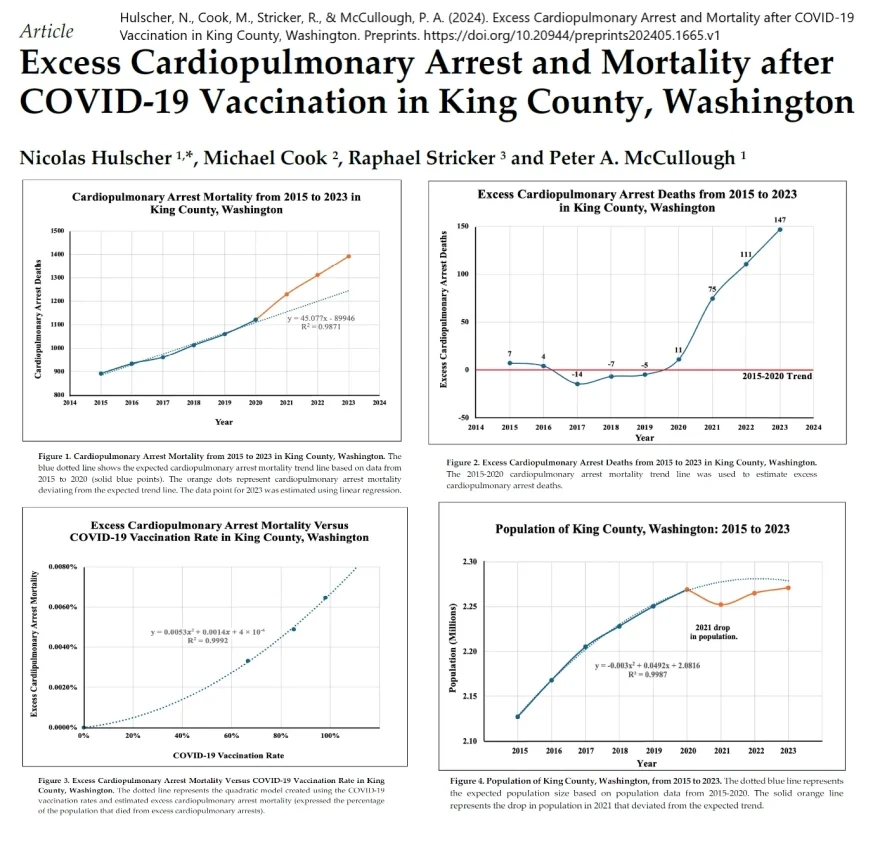
Hulscher, N., Cook, M., Stricker, R., & McCullough, P. A. (2024). Excess Cardiopulmonary Arrest and Mortality after COVID-19 Vaccination in King County, Washington. Preprints. https://doi.org/10.20944/preprints202405.1665.v1
These data are extremely worrisome given the rise in all-cause mortality observed in the United States that has been thoroughly investigated and reported by analyst Edward Dowd in his book “Cause Unknown”: The Epidemic of Sudden Deaths in 2021 & 2022 & 2023. Hulscher and colleagues found despite a pandemic decline in county population, both cardiac arrest events and fatal outcomes increased with vaccination. These findings among many others strongly support removal of all COVID-19 vaccines from public use and immediate clinical and research programs to stem the tide of vaccine cardiac arrests as they occur over the years after injection.
Peter A. McCullough, MD, MPH
President, McCullough Foundation
NIH-Funded Scientists Develop mRNA Bird Flu Vaccine ‘to Prevent Human Infections’
By Suzanne Burdick, Ph.D. | The Defender | May 28, 2024
Federally funded researchers have developed an experimental mRNA H5N1 bird flu vaccine that they said is “highly effective” in preventing severe illness and death in infected lab animals.
According to a University of Pennsylvania press release, the vaccine “could potentially help manage the outbreak of the H5N1 virus currently circulating in birds and cattle in the United States, and prevent human infections with the virus.”
The news comes as the U.S. and European nations consider vaccinating workers deemed as at risk for contracting bird flu.
The researchers — who on May 23 published their results in Nature Communications — reported their mRNA lipid nanoparticle vaccine elicited “strong” T cell and antibody responses in female mice infected with H5N1.
They also said their vaccine produced an immune response in male ferrets and prevented death.
U.S. News and World Report and other media outlets reported on the study, which was funded by the National Institute of Allergy and Infectious Diseases, National Institutes of Health and the U.S. Department of Health and Human Services.
Dr. Robert Malone — an early pioneer of mRNA vaccines technology and an outspoken critic of U.S. federal biomedical corruption during the COVID-19 pandemic — called the news coverage of the study “investor hype” and “fear porn.”
“There’s no evidence of human-to-human transmission of H5N1,” Malone told The Defender.
Malone said the researchers would need to show that there’s a “reasonable facsimile” between ferrets and humans to claim the vaccine can prevent severe illness and death in humans.
The likelihood of people getting H5N1 is very small, Malone said. “The thing is, it doesn’t readily infect humans.”
Only those who are immunocompromised or who slaughtered an infected waterfowl might be at risk of transmission, he said, so H5N1 is being “used to instill fear” in the public to generate federal funding for H5N1 vaccine research.
Meanwhile, there’s plenty of evidence that the lead researchers have clear conflicts of interest, Malone said. “They absolutely stand to profit” from their experimental bird flu vaccine.
Scott Hensley, Ph.D. and Drew Weissman, M.D., Ph.D. at the Perelman School of Medicine at the University of Pennsylvania — who led the research — are listed as co-inventors on patents for mRNA vaccine technologies.
They’ll likely receive royalties payments, Malone said. “It’s similar to how [Dr. Anthony] Fauci gets money from his royalties.”
Malone said the Bayh-Dole Act, passed in 1980, incentivized U.S. universities and their faculty members to patent federally funded research — so it’s common for university researchers to develop something they believe to be patentable. “They disclose it [their discovery] to the university and the university files the patent.”
The patent’s terms and conditions typically say that the money from the license gets split between the university, the school or department chair and the researchers, according to Malone.
Hensley is a paid consultant for Pfizer, Merck, Lumen, Novavax and Sanofi.
Hensley did not immediately respond to The Defender’s questions about his research and consulting fees from pharmaceutical companies.
U Penn is a ‘pharma R & D’
The University of Pennsylvania is a $11.1 billion enterprise, according to its press release.
Malone referred to the school as a “pharma R & D” because of how much of its efforts focus on researching and developing pharmaceutical technologies.
Much of the school’s money comes from the pharmaceutical industry, which pays to use patents held by the university, he said. “Penn is sitting on royalty cash from Pfizer-BioNTech and Moderna.”
Weissman, who has been at the university since 1997, was one of the two scientists awarded the 2023 Nobel Prize in Medicine for the discoveries that enabled the modified mRNA technology used in Pfizer-BioNTech’s and Moderna’s COVID-19 vaccines.
The Perelman School of Medicine at the University of Pennsylvania did not immediately respond to The Defender’s request for comment.
Fox News today reported that the U.S. is in talks with Pfizer and Moderna about developing an mRNA H5N1 bird flu vaccine to protect poultry and dairy workers from a potential pandemic threat.
Dawn O’Connell of the U.S. Administration for Strategic Preparedness and Response told Fox News the government is “looking closely” at the possibility of vaccinating farm workers and others in close contact with the virus.
Earlier this month, O’Connell told NBC News that mRNA bird flu vaccine could be quicker to manufacture than a non-mRNA bird flu vaccine because “you can switch in and switch out the genetic sequencing very easily.”
This article was originally published by The Defender — Children’s Health Defense’s News & Views Website under Creative Commons license CC BY-NC-ND 4.0. Please consider subscribing to The Defender or donating to Children’s Health Defense.
War in Ukraine shattering ‘superiority’ of US-made weaponry: Responsible Statecraft
Al Mayadeen | May 29, 2024
While critics claim that technologically complex US weapons produce unreliable systems in limited quantities because of cost, a report by Responsible Statecraft proves otherwise, stating that the failure of US weapons in Ukraine is much due to the military’s lack of adequate testing.
Successive “game-changing” systems like the Switchblade drone, the M-1 Abrams tank, Patriot air defense missiles, the M777 howitzer, the Excalibur guided 155 mm artillery round, the HIMARS precision missile, GPS-guided bombs, and Skydio drones with artificial intelligence were all transferred to Ukraine. That is when the show of strength began.
For instance, the $60,000 limited-quantity Switchblade drone didn’t work against armored targets, and Ukrainian troops chose instead $700 Chinese commercial models bought online, RS reported.
The $10 million Abrams tank kept malfunctioning and was soon taken out of combat. Russia was able to capture at least one, which they added to a display of NATO weaponry in a Moscow park alongside an M777 howitzer and other items. This stands as a plain display of mockery toward the US and its so-called military superiority.
The M777 cannon, known for its accuracy, proved to be too vulnerable in rough conditions. Its barrels frequently wore out and needed replacement in Poland, while its 155 mm ammunition has been suffering from short supply.
Record numbers of ‘external and internal enemies’ threaten EU – Macron

RT | May 26, 2024
The EU is facing a record number of “external and internal enemies,” who pose an existential threat to the bloc, French President Emmanuel Macron has said, doubling down on a warning he’d given earlier, that “our Europe” could end up dying.
Macron made the remarks while speaking alongside Germany’s head of state, President Frank-Walter Steinmeier, on the first of his three-day state visit. The two attended the Festival of Democracy, held in Berlin’s government quarter, to celebrate the 75th anniversary of the country’s constitution.
“I think that we are experiencing a moment in our Europe which is existential because I really believe that our Europe can die,” Macron stated, referring to a keynote speech he’d delivered in April.
The French president urged a vote for pro-EU forces in the upcoming European elections, warning the bloc has “never had so many enemies inside and outside” as it has now. The purported internal enemies are apparently European nationalists, with their rise raising questions about democracy itself, Macron asserted.
“There is a form of fascination with authoritarianism which is born in our own democracies … which also feeds nationalism and other extremes on our continent,” he claimed.
Macron painted a grim picture of “nationalists” entering government, alleging that they would have failed to tackle Covid-19 and shown “no capacity to respond to migration challenges,” climate change issues, and so on.
“We would have abandoned backing Ukraine against Russia, which all the nationalists in our countries support. And, therefore, history would have not been the same,” the president alleged.
“For all these reasons, it is important to vote in the Europeans,” he concluded.
The call was backed by Steinmeier, who said that the mere fact that Macron had shown up at the Festival of Democracy was somehow “a signal that we need an alliance of democrats in Europe.”
Global Temperatures and Reduced Cloud Cover
By Paul Homewood | Not A Lot Of People Know That | April 29, 2024
A very telling pair of graphs from Ole Humlum’s Climate4You :

We can debate the reasons for less cloud cover, but generally speaking less cloud/more sunshine leads to higher temperatures. (Certain high level clouds may have the reverse effect, but this is small).
Even the Met Office admitted this a few years ago, in a study they have since buried.
In particular, it is the sun that predominantly heats the oceans. The equilibrium effect on the seas from a slightly warmer atmosphere are so small as to be unmeasurable.
In alarmist world, of course, CO2 is the only driver of global temperatures, so don’t expect them to mention that cloud cover has been a major factor behind global warming in recent decades.
Featured Video

Macgregor: We Haven’t Seen the Worst of the Iran War Yet
or go to
Aletho News Archives – Video-Images
From the Archives
15 Saudi ‘hijackers’ were CIA agents working for US: Scholar
Press TV – April 13, 2016
Fifteen of the 9/11 “hijackers” from Saudi Arabia were CIA agents working for the United States government, which was seeking to destroy the Middle East for Israel and to double the American military budget, says Dr. Kevin Barrett, an American academic who has been studying the events of 9/11 since late 2003…. continue
Blog Roll
 Aletho News
- Iran’s Plan to Shut Down AI in the Persian Gulf
- Israel seeks ‘compensation’ from Washington over Saudi F-35 sale
- Saudi crown prince seeks dialogue with Ansarullah after Yemeni blows: Report
- Damascus rejects Saudi request for Syrian fighters to counter Yemen: Report
- South Korea says will not send troops to join terrorist US war on Iran
- Russia Just Struck the Eyes of NATO’s War Machine in Ukraine
- Russia summons UK charge d’affaires over Kiev drone support
- NATO member warns bloc seeking pretext for war with Russia
- Macgregor: We Haven’t Seen the Worst of the Iran War Yet
- ‘We are not like everyone else’ laws that bind other nations do not apply to Israel, says Likud lawmaker
- If Americans Knew
- Debunking The Claim That Macklemore Has A “History Of Antisemitism”
- CPJ demands release of arrested Palestinian-US journalist near Bethlehem
- Robert Kraft: The Billionaire Friend of Netanyahu Pulling The Strings Behind the Macklemore/Ed Sheeran Blow Up
- Columbia Administered Fund Gives Big Money to Pro-Israel Groups
- Deportation Case of Palestinian Activist Salah Sarsour Tests First Amendment
- ‘We Will Not Forget’: Palestinians Mark 44 Years since Sabra and Shatila
- Why do we let Zionists decide what we can and can’t say?
- US welcomes Israeli, Iranian delegations to UN, but not Palestinians – Daily Update
- Biden’s Genocide Accomplices Targeted by New Accountability Campaign
- AIPAC’s Network Has Already Spent $67.2 Million to Shape the Midterm Elections
- No Tricks Zone
- New Study: ‘Global Drought Shows No Detectable Recent Acceleration Under Climate Warming’
- Economic Masterminds: German Socialists Suggest Taxing Productivity Gains Stemming From Using AI
- The South China Sea Has Not Been Cooperating With The Climate Change Narrative
- Energy Crisis: Germany Enters Heating Season With Historically Low Gas Reserve Fill Levels
- New Study: The Antarctic Ice Sheet Gained Mass From 2020-2024 Due To Staggering Snow And Ice Accumulation
- Study: Ocean Heating Rates From Thousands Of Years Ago ‘Dwarf’ Modern Ocean Heating Rates
- Climate Extremists Target, Attack Large-Scale Power Grid Infrastructure In Germany!
- New Study: Antarctic Ice Melt Has Contributed Less Than 1 Centimeter To Sea Level Rise In The Last 30 Years
- Fear Of Debate: Alarmist German Climate Scientist Calls On Mainstream Media To Discredit Skeptic Voices
- End-Of-August Arctic Sea Ice Extent Hasn’t Fallen In 20 Years, Official Data Show!
 Aletho News