Locals Protest, Sabotage U.S. Navy Base Construction in Desert in Sicily
World Beyond War
There’s a popular movement in Sicily called No MUOS. MUOS means Mobile User Objective System. It’s a satellite communications system created by the U.S. Navy. The primary contractor and profiteer building the satellite equipment at the U.S. Navy base in the desert in Sicily is Lockheed Martin Space Systems. This is one of four ground stations, each intended to include three swivelling very-high-frequency satellite dishes with a diameter of 18.4 meters and two Ultra High Frequency (UHF) helical antennas.
Protests have been growing in the nearby town of Niscemi since 2012. In October 2012, construction was suspended for a few weeks. In early 2013 the President of the Region of Sicily revoked the authorization for the MUOS construction. The Italian government conducted a dubious study of health impacts and concluded the project was safe. Work recommenced. The town of Niscemi appealed, and in April 2014 the Regional Administrative Tribunal requested a new study. Construction goes on, as does resistance.
I spoke with Fabio D’Alessandro, a juornalist and law school graduate living in Niscemi. “I’m part of the No MUOS movement,” he told me, “a movement that works to prevent the installation of the U.S. satellite system called MUOS. To be specific, I’m part of the No MUOS committee of Niscemi, which is part of the coalition of No MUOS committees, a network of committees spread around Sicily and in the major Italian cities.”
“It is very sad,” said D’Alessandro,”to realize that in the United States people know little about MUOS. MUOS is a system for high-frequency and narrowband satellite communications, composed of five satellites and four stations on earth, one of which is planned for Niscemi. MUOS was developed by the U.S. Department of Defense. The purpose of the program is the creation of a global communications network that allows communication in real time with any soldier in any part of the world. In addition it will be possible to send encrypted messages. One of the principal functions of MUOS, apart from the speed of communications, is the ability to remotely pilot drones. Recent tests have demonstrated how MUOS can be used at the North Pole. In short, MUOS will serve to support any U.S. conflict in the Mediterranean or the Middle East or Asia. It’s all part of the effort to automate war, entrusting the choice of targets to machines.”
“There are many reasons to oppose MUOS,” D’Alessandro told me, “first of all the local community has not been advised of the installation. The MUOS satellite dishes and antennas are built within a non-NATO U.S. military base that has existed in Niscemi since 1991. The base was constructed within a nature preserve, destroying thousands of cork oaks and devestating the landscape by means of bulldozers that leveled a hill. The base is larger than the town of Niscemi itself. The presence of the satellite dishes and antennas puts at serious risk a fragile habitat including flora and fauna that exist only in this place. And no study has been conducted of the dangers of the electromagnetic waves emitted, neither for the animal population nor for the human inhabitants and the civilian flights from the Comiso Airport approximately 20 kilometers away.
“Within the base there are already present 46 satellite dishes, surpassing the limit set by Italian law. Moreover, as determined anti-militarists, we oppose further militarizing this area, which already has the base at Sigonella and other U.S. bases in Sicily. We don’t want to be complicit in the next wars. And we don’t want to become a target for whoever attempts to attack the U.S. military.”
What have you done thus far, I asked.
“We’ve engaged in lots of different actions against the base: more than once we’ve cut through the fences; three times we’ve invaded the base en masse; twice we’ve entered the base with thousands demonstrating. We’ve blocked the roads to prevent access for the workers and the American military personnel. There has been sabotage of the optical communication wires, and many other actions.”
The No Dal Molin movement against the new base at Vicenza, Italy, has not stopped that base. Have you learned anything from their efforts? Are you in touch with them?
“We are in constant contact with No Dal Molin, and we know their history well. The company that is building MUOS, Gemmo SPA, is the same that did the work on Dal Molin and is currently under investigation subsequent to the seizure of the MUOS building site by the courts in Caltagirone. Anyone attempting to bring into doubt the legitimacy of U.S. military bases in Italy is obliged to work with political groups on the right and left that have always been pro-NATO. And in this case the first supporters of MUOS were the politicians just as happened at Dal Molin. We often meet with delegations of activists from Vicenza and three times have been their guests.”
I went with representatives of No Dal Molin to meet with Congress Members and Senators and their staffs in Washington, and they simply asked us where the base should go if not Vicenza. We replied “Nowhere.” Have you met with anyone in the U.S. government or communicated with them in any way?
“Many times the U.S. consuls have come to Niscemi but we have never been permitted to speak with them. We have never in any way communicated with U.S. senators/representatives, and none have ever asked to meet with us.”
Where are the other three MOUS sites? Are you in touch with resisters there? Or with the resistance to bases on Jeju Island or Okinawa or the Philippines or elsewhere around the world? The Chagossians seeking to return might make good allies, right? What about the groups studying the military damage to Sardinia? Environmental groups are concerned about Jeju and about Pagan Island Are they helpful in Sicily?
“We are in direct contact with the No Radar group in Sardinia. One of the planners of that struggle has worked (for free) for us. We know the other anti-U.S.-base movements around the world, and thanks to No Dal Molin and to David Vine, we have been able to hold some virtual meetings. Also thanks to the support of Bruce Gagnon of the Global Network Against Weapons and Nuclear Power in Space we are trying to get in touch with those in Hawaii and Okinawa.”
What would you most like people in the United States to know?
“The imperialism that the United States is imposing on the countries that lost the Second World War is shameful. We are tired of having to be slaves to a foreign politics that to us is crazy and that obliges us to make enormous sacrifices and that makes Sicily and Italy no longer lands of welcome and peace, but lands of war, deserts in use by the U.S. Navy.”
Kashmiris protest Hindus only settlement plans
Press TV – April 10, 2015
Large crowds of demonstrators have held a massive protest rally in the Indian-administered Kashmir in response to a New Delhi plan to build new townships across the disputed region.
Kashmiri protesters rallied in Srinagar after Friday prayers to voice opposition to a government plan to build new townships for thousands of Hindus in the Muslim-majority region.
The angry protesters chanted pro-independence slogans as they marched toward the city center, Lalchowk, in Srinagar, the main city in Indian-controlled Kashmir.
Srinagar, which lies in the Kashmir Valley, is the summer capital and largest city of the northern Indian state of Jammu and Kashmir. Its winter capital is Jammu.
Indian police and paramilitary troops fired teargas and used stun grenades to disperse the crowd. The security forces also arrested nearly a dozen activists, including some prominent regional protest leaders.
The protesters pelted Indian security forces with stones and blocked roads in the region.
The massive rally comes as New Delhi has announced plans to build a number of townships to accommodate some 200,000 Hindus.
Kashmiri leaders have called the plan a conspiracy to create settlements on religious lines, saying the plan will create hatred between Hindus and Muslims.
Mohammed Yasin Malik, the chairman of the pro-independence Jammu-Kashmir Liberation Front (JKLF) compared the plan to that of Israeli settlements on occupied Palestinian land. Malik suggested that they would rather live side by side the Hindus in a merged society.
“We will not allow anybody to turn Kashmir into another Palestine. They (Pandits) are owners of this land as we are, and we welcome them to live in a composite society along with their Muslim brothers,” a media outlet quoted Malik as saying.
Indian authorities have deployed large contingents of police and paramilitary troops to most parts of Srinagar and several other major towns to prevent street demonstrations.
Kashmir lies at the heart of more than 67 years of hostility between India and Pakistan. Both neighbors claim the region in full but have partial control over it.
The neighbors agreed on a ceasefire in 2003, and launched a peace process the following year. Since then, there have been sporadic clashes, with both sides accusing the other of violating the ceasefire.
Thousands of people have been killed in Kashmir unrest over the past two decades.
Performance-Activist Preacher Gets Charges Dropped
By Steven Wishnia | Dissent News Wire | April 1, 2015
Members of New York’s Church of Stop Shopping can say “Hallelujah!”—or “Earthalujah!,” as is their wont. This morning, criminal charges stemming from a Black Lives Matter protest last January were dismissed against their preacher, William “Reverend Billy” Talen.
Talen was arrested while “sermonizing” during a 24-hour vigil in Grand Central Station Jan. 6. The vigil, one of almost daily protests in the commuter-rail station’s concourse after a grand jury declined to indict the police officer who killed Eric Garner in August, arrayed placards with the names of people killed by police on the marble floor. Police said Talen pushed an officer after refusing to remove the placards. A video shows officers picking them up while Talen gesticulates in activist-evangelist schtick, and a white-shirted police inspector grabbing his arms. He was charged with disorderly conduct and obstructing governmental administration.
“I was arrested while speaking on behalf of Black Lives Matter,” Talen said in an email to supporters. “Five kinds of police stood there watching: Homeland Security, NY state troopers, National Guard, NYPD, and police from the [Metropolitan Transportation Authority], whose officers did the handcuffing. Later, sitting in the jail cell, I listened to the police try to decide what to charge me with. I was given the usual protest charges of Disorderly Conduct and Obstruction. These charges are a complete fiction and videotapes showed this within hours of the We Will Not Be Silent rally. That evidence was available to the District Attorney’s office eleven weeks ago.”
In February, Talen was offered a conditional discharge, in which charges would be dropped if he didn’t get arrested for six months, but he refused to take it. His lawyer said the charges were “just not true” and that police were harassing him.
“The 1st Amendment is rising again,” Talen wrote. “The five freedoms—worship, speech, press, assembly and petition—suffer when we’re at war. Security trumps freedom. Even Abraham Lincoln suspended habeas corpus. But 9/11 was 15 years ago.”
He is also suing the MTA, the agency that runs New York’s subway, bus, and commuter-rail system, for defamation, because a spokesperson told the New York Post that he had physically attacked police.
Czechs rally against US military convoy’s parade
Press TV – March 29, 2015

Demonstrators march in the Czech capital of Prague in protest against a US military convoy passing through the country on March 28, 2015
Hundreds of demonstrators have staged an anti-NATO rally in the Czech capital of Prague to protest a planned parade by a US military convoy through the East European republic.
The protesters held the rally on Saturday on the eve of a parade by roughly 120 US military vehicles that are to enter the country as part of the Western military alliance’s “Operation Dragon Ride” parading through six NATO member states in Europe.
“This definitely won’t contribute to peace in Europe because the situation is very, very dangerous and very tense. We’re of the opinion that steps like this definitely don’t help,” said Lubomir Ledl, a protest organizer and lawyer from Prague.
Demonstrators waved the Czech national flag and carried placards reading “Tanks? No Thanks!” and “Stop US Army.”
The anti-war protesters were met by a group of pro-NATO demonstrators. Minor clashes broke out between the two groups.

The US military convoy passes through Estonia as part of drills in Eastern Europe on March 21, 2015
The convoy, consisting mostly of armored personnel carriers, began the parade on March 21 in Estonia and passed through Poland, Lithuania, Latvia, before entering the Czech Republic on Sunday.
The convoy will stay in the country until April 1 when the vehicles will cross into neighboring Germany to return to a military base in the city of Vilseck.
According to Lieutenant colonel Craig Childs, a spokesman for the US Army in Europe (USAREUR), the military march is aimed at testing “unit maintenance and leadership capabilities while simultaneously providing a highly visible demonstration of US commitment to its NATO allies and demonstrating NATO’s ability to move military forces freely across allied borders in close cooperation.”
Throughout the march, security forces from the six European governments have offered to escort the convoy to fend off opposition as the US military convoy crosses the countries filled with people protesting the move.
The convoy comes as NATO plans to expand its military presence in Eastern Europe amid deteriorating ties with Russia over the crisis in Ukraine.
In 2014, NATO forces held some 200 military exercises, with the alliance’s General Secretary Jens Stoltenberg having promised that such drills would continue.
In addition, the defense ministers of NATO’s 28 member states agreed on February 5 to establish six new command and control posts in the Eastern European nations of Bulgaria, Romania, Estonia, Latvia, Lithuania and Poland.
Moscow has repeatedly condemned NATO’s exercises and military buildup toward its borders. Russia has also repeatedly accused the US of fueling unrest throughout the world by interfering in other countries and pursuing global hegemony and its expansionist policy.
Russia ended on March 21 nationwide military exercises in the Baltic Sea, Black Sea, the Arctic and the Far East.
More than 80,000 Russian troops with over 10,000 military vehicles, 65 warships, 16 support vessels, 15 submarines and 200 jet fighters and helicopter gunships took part in the maneuvers.
Czechs told not to throw tomatoes, eggs at US military convoy
RT | March 23, 2015

US military convoy parades through Eastern Europe (Screenshot from Ruptly video)
Czech people were told not to throw tomatoes and eggs at a US military convoy rumbling through Eastern Europe, the local media said, citing the laws of the land. Those in love with egg & tomato hurling may get up to three years if convicted.
“Should anyone emerge with the intent to attack the convoy, with [items] such as tomatoes or eggs, it would qualify as disorderly conduct according to Czech legislation (up to 2 years without parole, in recidivist cases up to 3 years) or damage to property (sentences in the range of 6 months to 3 years).”
This statement was aired on Czech TV Nova and cited by the Russian Insider last week, ahead of the planned US military convoy.
Operation ‘Dragoon Ride’, a convoy of US military vehicles, mostly IAV Stryker APCs, started on Saturday. The convoy will make its way through Estonia, Lithuania, Poland, Latvia, the Czech Republic, with its final destination being Germany. It will cross the Czech Republic between March 29 and April 1 on its way to a base in the German city of Vilseck.
If skirmishes break out, offenders can expect to spend up to 3 years of prison. However, serious violence may incur 10-year sentences for the perpetrators.
“If (the incident) causes serious injuries, the attacker can receive a sentence of up to 10 years.”
Also if someone decides to sabotage the US operation, he or she would also face charges, said the Czech Army Press.
“Sabotage and/or attacks in the Republic, including attempts to undermine its defense capabilities are subject to imprisonment ranging from 8-12 years or forfeiture of property – § 310 par. 1 of the Criminal Code,” it said.
Earlier local media reported the government of the Czech Republic even instructed its own military to protect the US military convoy as it crosses the country over fears that numerous people protesting the move could stage “provocations.”
On Sunday Czech anti-war activists launched the ‘Tanks? No thanks!’ campaign to protest the procession of US Army hardware through the Eastern European country. They say it has been turned into a “provocative victory parade” near the Russian border.
“The last time that vehicles like this came to the Czech Republic, they were Soviet tanks coming to crush moves towards democracy in 1968. We don’t want such vehicles from foreign armies coming here ever again,” said Tana Bednarova from the ‘World without Wars and without Violence’ organization.
READ MORE: ‘Tanks? No thanks!’: Czechs unhappy about US military convoy crossing country
Statement from the family of Rachel Corrie on the 12th anniversary of Rachel’s stand in Gaza
The Corrie Family | March 16, 2015
Today, the twelfth anniversary of our daughter and sister Rachel’s stand and death in Gaza, we find ourselves back where our journey for accountability in her case began – in Washington DC. We have come for meetings at the Department of State and in Congress and, also, to join our colleagues in pursuit of a just peace in Israel/Palestine at the national meeting of Jewish Voice for Peace.
Rachel was crushed to death March 16, 2003, by an Israeli military, US-funded, Caterpillar D9R bulldozer in Rafah, Gaza, while nonviolently protesting the impending demolition of the home of a Palestinian family. This was one of thousands of homes eventually destroyed in Gaza in clearing demolitions, described in the 2004 Human Rights Watch Report, Razing Rafah.
The U.S. Department of State reported that on March 17, 2003, Israeli Prime Minister Ariel Sharon promised President Bush that the Israeli Government would undertake a “thorough, credible, and transparent” investigation into Rachel’s killing and report the results to the United States. On March 19, 2003, in a U.S. Department of State press briefing, Richard Boucher said in reference to Rachel, “When we have the death of an American citizen, we want to see it fully investigated. That is one of our key responsibilities overseas, is to look after the welfare of American citizens and to find out what happened in situations like these.”
Through tenures of both the Bush and Obama administrations, high level Department of State officials have continued to call for Israeli investigation in Rachel’s case. During our twelve year journey for accountability, we met with Lawrence B. Wilkerson (Chief of Staff to Secretary of State Colin Powell), William Burns (then Under Secretary of State) and Antony Blinken (then Deputy Assistant to the President and National Security Advisor to Vice President Biden) – all who have acknowledged lack of an adequate response from the Israeli Government in Rachel’s case.
In a letter to our family in 2008, Michelle Bernier-Toth, U.S. Department of State’s Managing Director of Overseas Citizens Services, wrote, “We have consistently requested that the Government of Israel conduct a full and transparent investigation into Rachel’s death. Our requests have gone unanswered or ignored.”
In March 2005, at the suggestion of the Department of State and to preserve our legal options, our family initiated a civil lawsuit against the State of Israel and Ministry of Defense. After a lengthy Israeli court process, in February of this year, the Israeli Supreme Court upheld a lower court ruling that said Rachel was killed in a “war activity” for which the state bears no liability under Israeli law. In response, Human Rights Watch wrote,
“The ruling flies in the face of the laws of armed conflict…The ruling grants immunity in civil law to Israeli forces for harming civilians based merely on the determination that the forces were engaged in ‘wartime activity,’ without assessing whether that activity violated the laws of armed conflict, which require parties to the conflict at all times to take all feasible precautions to spare civilian life.”
Our family’s legal options in Israel are nearly exhausted, but our search for justice for Rachel goes forward. Back in Washington DC, we have come full circle. We ask again that U.S. officials address their responsibility to U.S. citizens and to all civilians whose lives are impacted and cut short by military actions supported with U.S. taxpayer funding. We ask that they determine what to do when a promise from a key ally’s head of state to our own goes unfulfilled. March 16, 2003, was the very worst day of our lives. Our family deserves a clear and truthful explanation for how what happened to Rachel that day could occur, and to know there is some consequence to those responsible. Rachel deserves this.
She wrote, “This has to stop. I think it is a good idea for us all to drop everything and devote our lives to making this stop. I don’t think it’s an extremist thing to do anymore. I still really want to dance around to Pat Benatar and have boyfriends and make comics for my coworkers. But I also want this to stop.”
The failure of the Israeli court system to hold its soldiers, officers, and government accountable does not represent a failure on our part. Rachel, herself, went to Rafah looking for justice – a forward looking justice in which all people in the region would enjoy the freedoms, rights, opportunities, and obligations that we each demand for ourselves. The facts uncovered in our legal effort in Israel, and the clear evidence of the Israeli court’s complicity in the occupation revealed in the outcome, lay important legal groundwork for the future. As we look back at Selma fifty years ago and Ferguson today, we realize that our own civil rights struggle is not won in a single march or court case. It is ongoing. As our family continues our journey for justice, we thank those across the U.S., the world, and in Palestine and Israel who travel with us. Together, we will find justice for Rachel – both the justice she deserves and the justice for which she stood.
Academics back University of Southampton’s free speech commitment, in face of pro-Israel pressure
MEMO | March 16, 2015
More than 200 academics have signed a statement in support of free speech at the University of Southampton, in response to pressure from pro-Israel groups to cancel a conference in April.
Professors, lecturers and researchers from the UK, Europe, North America, and beyond, have expressed their “principled and full support for the University of Southampton’s commitment to freedom of speech and scholarly debate.”
In recent weeks, the University of Southampton has come under pressure from pro-Israel lobbyists to cancel a conference on Israel and international law scheduled for 17-19 April.
Groups such as the Board of Deputies of British Jews and UK Zionist Federation have been lobbying university officials, and last week there was an intervention from Communities minister and Conservative MP Eric Pickles.
The statement in support of the University of Southampton notes with concern these disturbing developments:
We are very concerned that partisan attempts are being made to silence dissenting analyses of the topic in question. For external pressure and interference, especially from political lobby groups and a government minister, to censor lawful academic discussion would set a worrying precedent.
The statement praising the University of Southampton’s commitment to free speech garnered more than 200 signatories in just 24 hours.
The signatories include academics from universities including Oxford, Cambridge, SOAS, London School of Economics (LSE), University College London, as well as North American institutions such as MIT, University of California, Columbia University, University of Toronto, and many more.
The World Ignores the Crisis in Gaza—So Another Gaza Freedom Flotilla is Ready to Sail in First Half of 2015

By Ann Wright | War is a Crime | March 15, 2015
With the 51 day Israeli attack on Gaza in the summer of 2014 that killed over 2,200, wounded 11,000, destroyed 20,000 homes and displaced 500,000, the closing to humanitarian organizations of the border with Gaza by the Egyptian government, continuing Israeli attacks on fishermen and others, and the lack of international aid through UNWRA for the rebuilding of Gaza, the international Gaza Freedom Flotilla Coalition has decided to again challenge Israel’s naval blockade of Gaza in an effort to gain publicity for the critical necessity of ending the Israeli blockade of Gaza and the isolation of the people of Gaza.
UNRWA, the main U.N. aid agency in the Gaza Strip has stated that a lack of international funding forced it to suspend grants to tens of thousands of Palestinians for repairs to homes damaged in last summer’s war.
“People are literally sleeping amongst the rubble, children have died of hypothermia,” Robert Turner, Gaza director of operations for the United Nations Relief and Works Agency (UNRWA), said in a statement. He said UNRWA received only $135 million of the $720 million pledged by donors to its cash assistance program for 96,000 refugee families whose homes were damaged or destroyed in the 50-day conflict between the Hamas government and Israel. Little of the total $5.4 billion pledged for Gaza’s reconstruction at a Cairo conference of international donors in October 2014 has reached the Gaza, and thousands of Palestinians have been sheltering in tents near destroyed homes.
“Thousands more have been living in damaged buildings, using plastic sheeting to try to keep out the rain. Around 20,000 displaced are still being housed in U.N.-run schools.”
While we recognize that funds are needed to rebuild Gaza, we feel that the publicity from another flotilla will help gain attention to the plight of the people of Gaza in ways that other initiatives may not. Indeed, governments are forced to react to the flotillas as evidenced through the diplomatic cables obtained by the Center for Constitutional Rights from the U.S. Department of State to U.S. missions in the Middle East region.
At a December, 2014 meeting, the Gaza Freedom Flotilla Coalition decided to sail a 3-ship flotilla to challenge the blockade in the first half of 2015. Twenty passengers will be aboard each of the 3 ships for a total of 60 passengers. The coalition will seek representatives from 30 countries with each country having two passengers. The U.S.- Palestinian Solidarity community will participate in Gaza Freedom Flotilla 3 and has a target of $20,000 as their part for renovation expenses and to be able to have two persons as the U.S. delegates.
Nonviolence International of Washington, DC, the 501(c)(3) for U.S. contributions to Gaza’s Ark, is the 501(c)(3) organization. Please make an online contribution here and indicate “Gaza’s Ark/Gaza Freedom Flotilla 3” in the Please designate this gift for a specific purpose “Designation Code” box. Checks payable to “Nonviolence International” (with Gaza’s Ark/Gaza Freedom Flotilla 3 in the memo line) may be mailed to:
Nonviolence International
4000 Albemarle Street, NW
Suite 401
Washington, DC 20016
USA
Stay in touch with Freedom Flotilla Coalition through its Facebook https://www.facebook.com/FreedomFlotillaCoalition and boat2gaza2015@gmail.com
Gagged And Censored: Justice Not Served For Drone Protester
By Steven Wishnia | Dissent News Wire | March 9, 2015
Bonnie Block, currently on trial in Mauston, Wisconsin for trespassing at an Air Force base where she was handing out anti-drone flyers, has been denied the right to present a political defense for her actions.
She and Jim Murphy, both part of the Wisconsin Coalition to Ground the Drones and End the Wars, have been protesting monthly for more than three years at Volk Field, a Wisconsin Air National Guard base “where they train operators to pilot Shadow drones with cameras to do surveillance and ‘target acquisition’ so that the Predator and Reaper drones (remotely piloted from other US military bases) can drop Hellfire missiles on presumed militants in multiple countries.”
The two were arrested last May, when they “went on a bus tour of Volk Field as part of an open house to which the public was invited.” As Block and Joy First described it on PopularResistance:
When the bus stopped at a museum on the base, they got off and tried to hand out flyers to others who were on the tour. They were told to stop handing out their “propaganda” and leave the base. Since they had come by the tour bus they had no way leaving on their own and yet they were arrested for trespassing and taken to the Juneau County Jail.
Murphy was found guilty in a bench trial last September and ordered to pay a fine. Block asked for a jury trial. In response, the Juneau County District Attorney filed a Motion in Limine, a request to prohibit the defense from using certain arguments, a common procedure when a jury will be hearing a case against protesters. It asked:
…that Bonnie be prohibited from making “any argument that is known to be false or irrelevant to the issues before the Court” including among other things the policies of the US Government, International laws, the Charter or certain Resolutions of the United Nations, or moral or ethical strictures believed in by the defendant. She was also prohibited from commenting in any way “that her prosecution was a violation of any Constitutional or International Right or privilege.”
Of course, the important matters of the motion revolved around whether Bonnie could raise Constitutional free speech issues or provide any of the reasons she has for opposing drone warfare and handing out a leaflet raising four questions about drones.
The judge granted those key parts of the motion. He also forbade Block from making any reference to jury nullification, the idea that jurors can find a defendant not guilty even if they broke the law on the grounds that they don’t believe what the defendant did was really a crime.
In arguing for her right to speak about drones, the US Constitution, or why she was handing out leaflets, Bonnie said that she needs to be able to tell the whole truth for there to be a fair trial. Otherwise the jury could presume she was on the base for no good reason. Prohibiting this in a pretrial order prevents her from presenting a defense for her action. She argued that the prosecutor can object during the trial if something is improper and the judge can make a ruling at that point. Bonnie said that these pretrial motions are overbroad and will have a chilling effect because she will have to wonder if something inadvertent will result in her being found in contempt.
The judge responded saying that the case was about trespassing and that was the only issue that could be mentioned.
If Bonnie talked about drones or international law or the US Constitution, it could mislead the jury. He went on to say that there is no way they will get through the trial without referencing the leaflet that Bonnie and Jim were attempting to distribute, but neither side, nor any witness, can say anything about the actual content of that leaflet. If these rules are not followed the judge will grant a mistrial and impose sanctions.
US Police Arrest Five Anti-Israel Activists
Al-Akhbar | March 2, 2015
Five activists were arrested Sunday in the American capital for demonstrating outside the Washington Convention Center where the American Israeli Public Affairs Committee (AIPAC), a well-known pro-Israeli lobby, was holding its annual policy conference.
Believed to be one of the largest pro-Israeli gatherings, the AIPAC policy conference kicked off on Sunday, and will last for three days.
A group of protesters mobilized by an anti-war group known as CODEPINK or Women for Peace on social media under the hashtag #ShutDownAIPAC tried to block the entrance to the convention center. Several civil society organizations, including Jewish ones, joined the demonstration.
Some protesters were waving flags of Hezbollah, a Lebanese resistance movement against Israel which is listed as a “terrorist organization” by the US.
Israel occupied parts of Lebanon for 22 years until 2000 and the two countries are still technically at war.
The latest Israeli war on Lebanon in the summer of 2006 killed more than 1,200 Lebanese, most of them civilians, and 160 Israelis, most of them soldiers.
“The purpose of the rally was to draw attention to this organization’s role as a special interest lobby that maintains a dangerous stranglehold over US policies and diverts US tax dollars from American needs and into Israeli militarism,” a statement by CODEPINK read.
The activists were violently removed by police from the front of the Washington Convention Center while chanting: “Netanyahu, War Criminal! Free, Free, Palestine!”
“We’re here to say that this organization is on the path of war,” one of the protest organizers, Medea Benjamin told Anadolu news agency. … Full article
SOAS, University of London Votes to Boycott Israeli Academic Institutions
Out of 2056 votes cast at the School of Oriental and African Studies (SOAS), University of London, 73% voted in favor of boycotting Israeli academic institutions.
The Palestine Society and the BDS campaign at SOAS state: “This historic result has brought us one step further in our struggle for freedom and justice. We do not tolerate any collaboration with academic institutions which are complicit in human rights violations and which do not practice the values of academic freedom and equality. We call upon other universities to show their solidarity by joining the academic boycott.”
The referendum was called for by the Students’ Union, and was conducted in an open, fair and transparent environment.
SOAS has ties with the Hebrew University, which joined the “war effort” last summer when the Israeli army murdered over 2,000 Palestinians in Gaza.
The academic boycott campaign does not contradict academic freedom as it targets Israeli institutions complicit in the oppression of Palestinians, not individuals. Open enquiry, free exchange of ideas, and intellectual freedom are crucial, but freedom can only be real when it is afforded to all. This has to include the Palestinians.
Total Mainstream Media Blackout of Chicago Secret ‘Black Site’ at Homan Square
Nick Bernabe | ANTIMEDIA | February 28, 2015
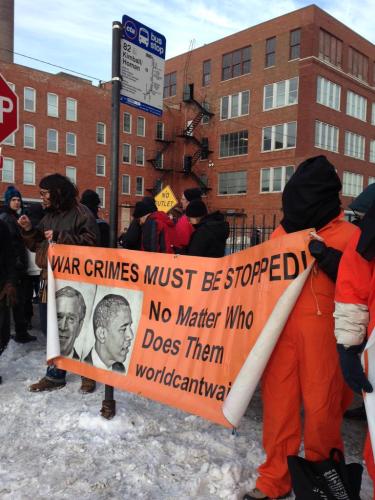 Chicago, IL — As the nation continues to react to the newly discovered ‘black site’ operated by Chicago Police, the mainstream media continues to bury it’s head in the sand.
National media outlets like Fox, MSNBC, and CNN are unsurprisingly refusing to touch this story, driving even further suspicion that the corporate media has become nothing more than a mouthpiece for big government and corporate America.
As we reported earlier this week, local corporate media was literally running stories about Homan Square that were direct copies from CPD’s public relations statements.
According to interviews conducted by The Atlantic, local mainstream reporters often agree with these disappear and torture tactics, so they refuse to do their jobs at uncovering what is going on there;
“I think that many crime reporters in Chicago have political views that are right in line with the police,” Tracy Siska said. “They tend to agree about the tactics needed by the police. They tend to have by one extent or the other the same racist views of the police — a lot of urban police (not all of them by any stretch, but a lot of them) embody racism.”
Meanwhile, a campaign we launched to shed light on Homan Square, #Gitmo2Chicago, trended nationwide last night on Twitter and today on Facebook — showing that the public at large is generally disgusted by these CIA-style tactics.
So while the corporate media posts 3 million stories about the color of a dress, the country is questioning the police state in a big way.
As I write this, a large protest is taking place in Chicago at Homan Square to shut it down, with more protests being planned across the country in the coming weeks.
But keep in mind, the Revolution will not be televised on Cable TV, but it will be on the internet. Watch live video from the protests here.
Featured Video

Trita Parsi: Israel Set a Trap for Total War in the Region
or go to
Aletho News Archives – Video-Images
Book Review
Why the War on Conspiracy Theories Is Bad Public Policy
By Kevin Barrett • Unz Review • February 1, 2019
 A Review of Conspiracy Theories and Other Dangerous Ideas by Cass Sunstein (based on an earlier paper co-authored with Adrian Vermeule); In Defense of Troublemakers: The Power of Dissent in Life and Business by Charlan Nemeth; and Conspiracy Theories and the People Who Believe Them, edited by Joseph E. Uscinski
On January 25 2018 YouTube unleashed the latest salvo in the war on conspiracy theories, saying “we’ll begin reducing recommendations of borderline content and content that could misinform users in harmful ways—such as videos promoting a phony miracle cure for a serious illness, claiming the earth is flat, or making blatantly false claims about historic events like 9/11.”
At first glance that sounds reasonable. Nobody wants YouTube or anyone else to recommend bad information. And almost everyone agrees that phony miracle cures, flat earthism, and blatantly false claims about 9/11 and other historical events are undesirable.
But if we stop and seriously consider those words, we notice a couple of problems. First, the word “recommend” is not just misleading but mendacious. YouTube obviously doesn’t really recommend anything. When it says it does, it is lying. … continue
Blog Roll
 Aletho News
- Easy fix for Europe’s chaos? Stop fueling war against Russia
- Putin’s key remarks on peace talks and Europe’s ‘schizophrenia’
- Trita Parsi: Israel Set a Trap for Total War in the Region
- Trump’s Iran war is on an Israeli leash
- Saudi oil boss issues global supply warning
- Riyadh Says Its Oil System Is Intact. The Numbers Say Otherwise.
- Trump and Netanyahu Want to “Finish the Job” on Iran
- US ‘one-sided dictation’ not Iran’s beliefs makes rational talks impossible: Baghaei
- Iran’s Next Strike May Not Explode. It Could Shut You Down /Col Doug Macgregor
- Iran: US political targets legitimate if assassinations return
- If Americans Knew
- DAILY UPDATE: Latest essential news on Palestine, Israel, & region
- The Israel Lobby’s Changing Fortunes
- AIPAC has become such a political liability that it’s shifting to a more “nimble” approach to buying politicians
- At least 160 Israeli settler attacks in 2 weeks
- Will Gaza’s Ancient Christian Community Disappear Forever?
- Israel’s vision of regional security rests on keeping Arab states weak
- Heidi Levine recounts how Palestinian youths helped save her in settler attack
- DAILY UPDATE: Latest essential news on Palestine, Israel, & region
- Trump’s Intensifying Sabotage of the ICC, for Israel’s Sake
- Israeli military detain US and UK volunteers in West Bank including Democratic NY politician Brad Lander
- No Tricks Zone
- E-Cars Reduce CO2 Emissions By Only 41% Compared To Internal Combustion Engine Vehicles
- Predictions Made By Renowned Climate Professor Over Past Decades Have Been Proven To Be Poor
- New Study Suggests Large Regions Of The Pacific Ocean Have Been Cooling For The Last 80 Years
- Germany’s Green Energy Debacle: High Energy Costs Force Kahla Porzellan to Close After 182 Years!
- New Study: 50 Years Of The Most Aggressive ‘Net Zero’ Policies Can Only Affect The Global Climate By 0.03°C
- US September “Heat” Was No Record…Many Records Set Decades Ago
- Latest European Green Energy Debacle; Portugal’s Largest Flagship Solar Park Insolvent!
- Green Energy Debacle: German Expert Professor Fritz Vahrenholt Warns Of Severe Economic And Social Consequences
- Two More Paleo Reconstructions Affirm Meters-Higher Sea Levels Across Ireland, Brazil 7000-6000 Years Ago
- New Study: Earth And Venus Surface Warmth Largely Explained By Convection And Lapse Rate, Not CO2 Or Radiation

