Join The Resistance! Join the International Solidarity Movement in Palestine
The International Solidarity Movement | May 5, 2015
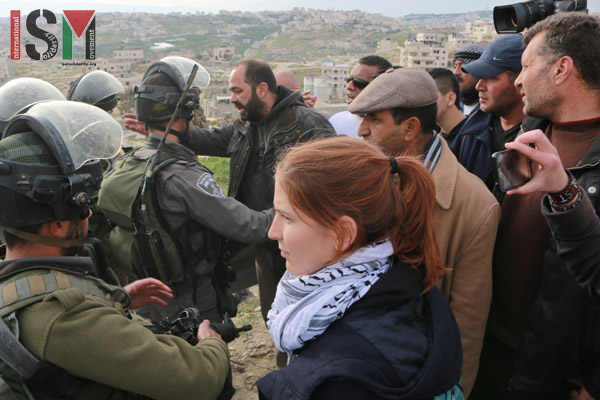
In recent months activists on the ground have witnessed an escalation of violence directed at Palestinians. There is an urgent need for international volunteers to support grassroots, non-violent Palestinian popular resistance to the Israeli Occupation.
The International Solidarity Movement (ISM) is a Palestinian-led movement committed to resisting the long-entrenched, systematic oppression and dispossession of the Palestinian population, using the principles and methods of non-violent, direct-action. ISM works where internationals can be most effective; we walk in solidarity with Palestinians in demonstrations, we respond to the violence, threats, house demolitions and land confiscation by the Israeli military and settlers.
The threat of demolition orders means that we have presence in places such as Jerusalem, Hebron and the Jordan Valley. We respond to violations of human rights by supporting Palestinian political prisoners. This includes bearing witness in Israeli military courts, campaigning and supporting families with loved ones imprisoned. In Hebron we walk with children who face violence and intimidation on their way to school. In the South Hebron Hills we assist farmers and shepherds who are harassed by settlers and occupation forces whilst trying to work on their own land. In the Jordan Valley we work with locals to build where the Israeli military destroys, in order that communities can resist by staying put. In Gaza we accompany farmers and fishermen into the buffer zones where they risk massive violence from the Israeli military. ISM constantly documents and reports on the daily violations of human rights committed by the state of Israel. ISM works to stop Israels’ crimes from going unreported.

You can be a part of this. ISM is Palestinian led, but has no leaders, and we have supported Palestinians in their struggle against the Occupation since 2001. To us, solidarity means that we are a tool for Palestinians to use in their popular resistance. We recognise that as internationals working under Israeli apartheid our position is privileged. We have rights that are denied to Palestinians. When we are arrested we are taken to a police station and have the right to a lawyer. When Palestinians are arrested they are taken to military bases where they face indefinite detention without a lawyer or fair trial. ISM uses the privileges of internationals to support Palestinian popular resistance. We believe that our presence as internationals supporting Palestinian led actions can afford some protection from some of the worst excesses of Israel’s violence.
For more information about our work and for up to date information about the situation in Occupied Palestine, visit palsolidarity.org
If you are planning to volunteer with ISM please contact us at palreports@gmail.com
In unusual break with tradition, no Labor Day celebrations in Egypt this year
Mada Masr | May 1, 2015
For the first time in living memory, Egypt is not celebrating Labor Day.
The only official commemoration took place on Monday, April 27 behind closed doors at Cairo’s Police Academy in the presence of President Abdel Fattah al-Sisi, governmental officials and state-appointed leaders from the Egyptian Trade Union Federation (ETUF).
This commemoration, which was not televised, is reported to have involved 10 workers who received honorary medals. It is the first time ever that the president of Egypt has not delivered a Labor Day address.
During Monday’s commemoration, Gebali al-Maraghi, chief of the state-controlled ETUF, presented Sisi with a declaration from his federation vowing that its members would reject strikes and refrain from protests, sit-ins or other industrial actions.
ETUF leaders called instead for dialogue and collective bargaining between workers, the state and employers, according to the state-owned newspaper Al-Ahram.
The Cabinet also announced that there would not be a working day off, as this year the official holiday coincides with the weekend.
This comes during the same week in which a judicial decree was issued by the Supreme Administrative Court dictating that public sector employees who partake in strikes will be forced into early retirement. The judges who issued this decree, which cannot be appealed, claimed that a military decree issued in 2011 and Sharia law both prohibit labor strikes.
A statement was issued by a host of Egyptian human rights organizations on Labor Day in which they denounced the aforementioned judicial decree as violating Article 15 of the 2014 Constitution, as well as international rights conventions to which Egypt is party.
“We are witnessing the worst Labor Day in Egyptian history this year,” commented Ali Fattouh, an independent union organizer and bus driver employed at Cairo’s Public Transport Authority.
Fattouh argued that the government is pushing back on workers’ rights and the organizational freedoms of unions, while Egypt’s largest independent labor federation — the Egyptian Federation of Independent Trade Unions (ETIFU) — “is falling in line with the government’s dictates, denouncing workers’ right to strike while championing the policies of the ruling regime.”
Like Fattouh, many other independent unionists, labor rights organizations and leftist groupings are not celebrating Labor Day this year, as they believe there is nothing to celebrate in 2015.
Since their emergence in the 2011 uprising until 2013, independent labor federations had celebrated Labor Day in Tahrir Square. However, they were only capable of organizing small rallies involving just a few hundred workers, revealing the inability of these independent federations to mobilize their ranks.
Following the military led regime change on July 3, 2013, Tahrir Square was made off-limits for workers’ rallies, and in 2014 independent unionists celebrated Labor Day indoors.
Workers at the state-owned petroleum services company Petrotrade issued a statement on Thursday declaring, “We are not celebrating Labor Day this year, as there is no cause for celebration.”
“This is the fifth Labor Day since the January 25 revolution, and yet none of the revolution’s demands have been achieved, nor has social justice been realized,” the statement added.
Despite government pledges since 2011, neither a new labor law nor a new trade union law has been issued to replace the repressive and outdated laws regulating workers rights, the Petrotrade workers continued.
The statement argued that Egypt is suffering from a counter-revolution, indicated by the fact that a host of striking workers and independent unionists have been subjected to punitive measures nationwide, including disciplinary hearings, relocations, lay-offs, prosecution and trials.
Dozens of workers across the country are presently being prosecuted for instigating strikes and labor unrest, as well as incurring losses for industries with their work stoppages.
Fattouh explained that he and 31 of his co-workers at the Public Transport Authority are standing two separate trials on May 15 and June 13 before the State Council Court on charges of instigating strikes in the years 2012 and 2013.
“We are being sent to court, and possibly to jail, simply for exercising our right to organize a peaceful strike at our workplaces,” said Fattouh.
“When you have a court of law outlawing the right to strike, which is clearly safeguarded by international conventions and domestic legislation, what is there left to celebrate on Labor Day?” he argued.
But Maraghi is quoted in Al-Ahram as declaring that “Egypt is currently blessed with a climate of freedom and democracy,” and “that the ETUF is the only legitimate representative for all of Egypt’s workers, regardless of their political tendencies.”
Maraghi concluded by singing Sisi’s praises, while claiming: “there is no room for politicization of the union movement.”
Yet even Ibrahim Eissa, a TV anchor on the show 25/30, which broadcasts on the privately owned ONtv channel, criticized Sisi’s labor commemoration this year.
Eissa argued that Labor Day should be celebrated on May 1, as is the national and international tradition. “Labor Day should be commemorated in a factory, company or workplace,” he added, asking Sisi, “Oh president, if you celebrate Labor Day at the Police Academy, then where are you going to celebrate Egypt’s National Police Day?”
General strike, demonstration in 1948 Occupied Palestine
Palestine Information Center – April 28, 2015
RAMALLAH – The Palestinians in 1948 Occupied Palestine have been on general strike since the morning hours on Tuesday protesting the Israeli government policy of the demolition of Palestinians’ houses.
This followed a decision made by the higher follow up committee for Arabs in 1948 Occupied Palestine. The strike includes educational institutions and commercial shops.
The Israeli radio announced that the Palestinians are going to take to the streets in Tel Aviv at 5 p.m. in the first national demonstration of its kind. Such marches were previously arranged in cities and towns inhabited by Arabs only.
The Israeli authorities adopt displacement campaigns aiming at expelling the Palestinians in 1948 Occupied Palestine through demolishing their houses under false pretenses.
Fighting for bread and social justice in Egypt
By Mai Shams El-Din | Mada Masr | April 26, 2015
Chants for bread and social justice didn’t emerge out of the January 25, 2011 revolution. Long before 2011, a strong protest movement existed against the economic policies of former President Mubarak and his regime, which gained momentum in 2006 through the protests and strikes of labor workers in Mahalla al-Kubra.
Nadeem Mansour, director of the Egyptian Center for Economic and Social Rights (ECESR), speaks to Mada Masr about the challenges facing the labor movement in Egypt and the battle for bread and social justice.
Mada Masr: Why do you think demands for social justice were masked by an identity battle post-January 25, 2011?
Nadeem Mansour: My work is still about the struggle for bread, social justice and the minimum wage, but after January 25, political organizations — the Muslim Brotherhood, Salafis and liberal groups — used the media to wage a very public battle over identity politics that masked this fight to some extent. Those who chanted for social rights in 2011 were not able to achieve their aims for numerous reasons — they didn’t have parties to speak for them, nor a media interested in propagating their ideals. Private media in Egypt is owned almost entirely by businessmen, who often have personal interests that are in conflict with labor movements.
At the ECESR, we have a monitor for economic and social protests. We’ve noticed that many protests over the last four years have had economic and social demands, and there have been a lot of them. In 2013, for example, the number of protests exceeded 5000. Our role is to support these demands. Social justice is the key to making any real change, and to all of the problems facing Egyptian society today. For example, terrorism will only be confronted and stability brought about by ensuring structural and social inequalities are addressed.
MM: How has the absence of political support for economic and social rights affected your work at the center?
NM: Support of the poor and marginalized has never received much genuine political interest. Such attention fluctuates according to the political climate. Part of our role as an entity that offers legal, research and media services, and supports syndicates and local communities, is to help people find solutions to their problems on a local level, and then ensuring attention is given to their problems more widely.
Take the case of the minimum wage, as an example. Before we started the campaign and filed the lawsuit, the issue was not even a matter of discussion. The last minimum wage was set in 1982, as far as I remember, and it was around LE34. The campaign — both research and online — was initiated in partnership with workers, as there were no independent trade unions or syndicates at the time. We succeeded in raising the minimum wage from LE34 to LE400, and then to LE700 after the revolution. Now the minimum wage stands at LE1200, and we are still demanding its increase. By setting the minimum wage as a revolutionary demand, it became a public issue, not just one concerning workers.
We are also interested in working more on specific cases, such as the issue of the Misr Shebin al-Kom Spinning and Weaving Company [the country’s largest textile company, based in Mahalla], which was sold to an Indian investor who already owned some of its competitors. He bought it illegally at a cheap price in order to destroy its equipment and decrease production and thus competition. This case prompted the government to issue a law protecting contracts, which we believe is unconstitutional and have challenged in court.
We partnered with a group of workers and farmers in 2012, when the constitution was being revised, to issue a document, “Workers and farmers write the constitution.” While the conflict over the civil or Islamic identity of the state continued, and there were many calls for workers and farmers to be educated about their rights, we decided to go and ask them about what they thought these rights should be. We went to 22 governorates and we talked with thousands of people. We put them together in a legal document and ended up with something similar to the international Covenant on Economic and Social Rights in its relation to health, work and water. This is part of our work, empowering local communities to make decisions that impact on their own lives.
MM: What about the syndicates and unions for workers?
NM: The syndicates and unions are weak because they are part of a nascent movement that is also facing attacks from many directions, and lacks organizational capacity. Additionally, the strength of these organizations is closely related to that of local communities and their capacity to mobilize and sustain action.
The question is, can these problems be solved by uniform state action, or do they require a decentralized approach?
The economic and social crisis in Egypt is partly due to corruption and government bureaucracy. Attempts at reform often happen in a very centralized manner, whereas capacity building has to be conducted locally.
There are between 1500 and 3000 syndicates, and the union’s [Federation of Independent Trade Unions] capacity for representation is limited. Also, there is no legal framework to structure their work, meaning the right to strike is not protected.
The syndicates are weak right now, and consequently so is the union. The ability to mobilize in the public domain is difficult in Egypt currently, and the attention of the public is focused on political parties and activists. But the attack on syndicates is much fiercer.
MM: How would you describe this attack?
NM: Workers face many problems, including: Dismissal, lack of financial rights, penalties against striking workers, threats, jail, physical assaults, torture and death — in extreme cases. The Protest Law also applies to workers, and is often enforced more vigorously. We have workers who are currently being tried for going on strike. Over the last 10 years, Egypt has developed a strong strike movement. The public mobilization on Jan 25 and June 30 were related to strikes over economic and social issues.
The entire movement is not often suppressed, as it is so vast, but smaller attacks are waged. During Morsi’s term in office, workers at the Portland Company in Alexandria were attacked by police dogs, and some were thrown from the second floor of the building, leading to severe injuries.
Just a few days ago, we were able to secure the release of a worker who criticized the administration of his employer on Facebook and is being investigated for it. Such attacks are often arbitrary, so we try to raise the profile of them in the media as much as we can.
Violence and the interference of the security services in the public domain have reached levels we haven’t witnessed in the last 10 years. The general climate is one of fear.
In one incident, a private company ended negotiations with its workers after military intelligence got involved. This is documented in the company’s official records.
MM: How do you deal with legislative obstacles to your work?
NM: We have strong objections to the current law regulating the work of civil society and against various drafts of the newly proposed law. The state is attempting to restrict rights-based work without understanding this will hinder democratic reform.
The Center is registered according to the law. We are not an association, but a legal services company, providing consultancy on legal and economic matters. We are a legal office and as such pay the appropriate taxes and have the required documents. Our work is transparent and open.
We are, however, interested in the law governing non-governmental organizations, because we are interested in the ways people organize and in supporting this locally and nationally. We want a law that supports activities and solidarity work. If I’m a legal firm that wants to provide free services, I should be able to do so. Why am I being dealt with as an association in this case?
MM: When and why did you decide to work in human rights?
NM: I began work as a trainee researcher at the Hisham Mubarak Law Center in 2008. I then started the ECESR with Khalid Ali and two other colleagues in 2009.
My interest in rights stems from my study of political economies, which focused on the relationship between the state, local communities and the labor movement. In human rights centers, there are many opportunities for young researchers to expand and develop their ideas.
Many people benefit from our legal services that wouldn’t have access to them otherwise. This motivates me to continue. Our work builds on that of many other generations and organizations. The public domain expanded dramatically after the revolution, enabling rights work to gain ground and the number of organizations dedicated to it to increase. The scale of such work was much more limited in the 90s, for example.
MM: Do you think the current restrictions on civil society will deter young people from getting involved in rights-based work?
NM: I don’t think this will prevent new generations from joining. There have always been restrictions on rights-related work. Under Mubarak, and even before I started in the 90s and 2000s, we suffered consistent and fierce attacks. The intensity of the attack on the movement has also increased with its ability to make an impact.
As long as people’s rights are violated, there will be a need for such organizations to exist.
—
This is part of a series of interviews with human rights workers in Egypt that will be published in the coming weeks.
University of East Anglia students back boycott of ‘apartheid’ Israel
MEMO | April 22, 2015
The University of East Anglia’s student body has endorsed the Palestinian-led Boycott, Divestment and Sanctions (BDS) campaign, in a motion passed last Thursday.
Meeting for the final time this academic year, the Council of the Union of UEA students passed the motion “in support of international law and human rights in Palestine” with 41 in favour and 15 against, with 11 abstentions.
The motion commits the SU to severing ties with companies that “facilitate Israel’s human rights abuses, military capacity, or settlement expansion”, as well as to opposing any university contract with complicit companies.
The SU also resolved to lobby the university “to adopt an academic boycott of Israeli universities” and provide scholarships for Palestinian students.
The motion describes Israel as “an apartheid state” and mentions specific crimes and abuses including illegal settlements, atrocities in Gaza, and “systematic” discrimination in both the occupied Palestinian territory (oPt) and inside Israel’s pre-1967 lines.
Israel’s “expansion” in the oPt is described as “a settler-colonial project, predicated on the ethnic cleansing and expulsion of its indigenous people.”
Proposed by a member of the campus Amnesty International group and seconded by the Ethnic Minorities Officer, the motion notes recent pro-BDS resolutions at NUS National Executive Council, NUS Women’s Conference, NUS Postgraduate Conference and NUS Black Students Conference.
In addition, it was recalled that students have voted for boycotts of Israel on campuses across the UK, including “Kent, Goldsmiths, Birkbeck, Kingston, Swansea, Exeter, Brunel, the University of Strathclyde, Edinburgh, Dundee, Essex, Sussex and SOAS.”
The case for BDS, according to the motion, is based on “Israel’s multitude of human rights and international law violations” and its lack of accountability. The motion affirms Palestinian students’ right to education unhindered by discrimination, and the necessity of international solidarity from students in response to the BDS campaign.
The motion asserts that “global boycotts are a non-violent, legitimate and effective tactic”, that “all other methods of pressuring Israel and the ending of the occupation have failed,” and that members of an academic community “have a responsibility to ensure that ethical considerations and social justice are at the heart of research and academia.”
The Union Council rejected a proposed amendment which would have removed BDS from the motion. Procedural motions to delay the vote were also voted down.
Slain Ukraine Politician Led the Picketing of US Embassy in Kiev a Day Before Killed
Russia Insider | April 20, 2015
A day before he was murdered on April 15th Oleg Kalashnikov had organized the protest at the US Embassy in Kiev on April 14th.
Oleg Tsarov, his collegue from the former Party of Regions and a fellow dissident Ukraine politician wrote on his Facebook:
I BLAME THE US FOR THE DEATH OF MY FRIEND
Another one of my friends, Oleg Kalashnikov, was killed. I’m very sorry. We were friends. I knew his family. Repeatedly I tried to convince him to leave Kiev. In response, he told me that if everyone leaves, then who will fight.
I constantly tell my friends, remaining in Ukraine, that the organization of protests is futile. This power does not argue with its opponents, it eliminates them. Many of my friends were arrested, some disappeared, others were killed.
Oleg was one of the organizers of the last protest at the U.S. Embassy: people gathered and stood in silence outside the Embassy. Oleg didn’t leave, did not give up. He died. He was killed.
The latest (April 14th) demonstration at the US Kiev Embassy:
The Siege – cultural resistance in Palestine
International Solidarity Movement | April 20, 2015
Jenin, Occupied Palestine – The room was overflowing with people who had come to witness the opening of the play The Siege. Pushing our way through the throng we managed to find some seats, squashed in the middle of a diverse and lively audience. We were sitting in the Freedom Theatre, a Palestinian community-based theatre and cultural centre located in Jenin Refugee Camp in the northern part of the West Bank. Started in 2006, the theatre’s aim is to generate cultural resistance through the field of popular culture and art as a catalyst for social change in the occupied Palestinian territories. So, after two months of rehearsals, they were finally ready to show us their eagerly anticipated new play.
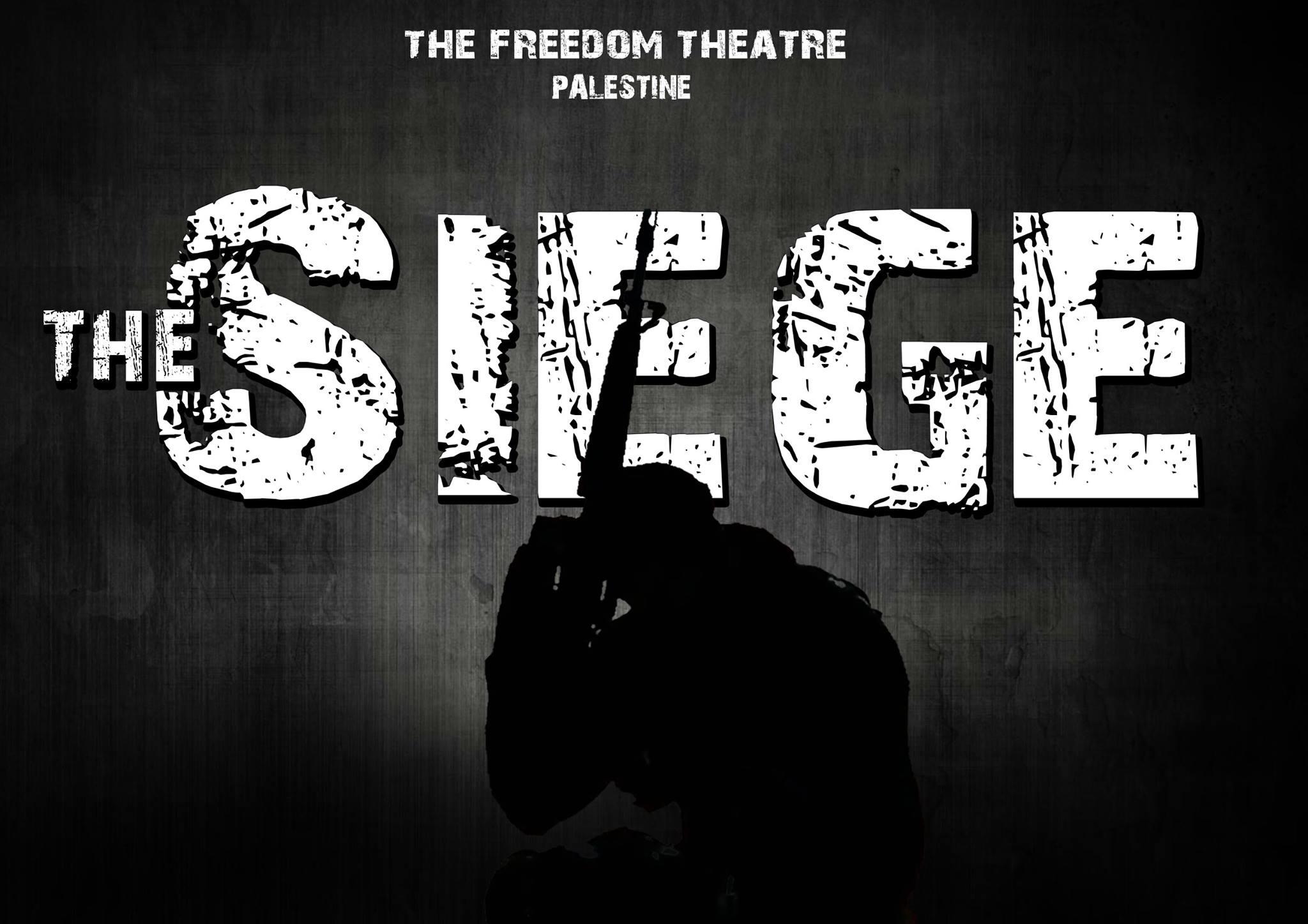
Poster for the play – The Freedom Theatre
The day started off with a theatrical memorial for Juliano Mer-Khamis, one of the founders of the Theatre School who was shot and killed in 2011 by a masked gunman. We then watched Journey of a Freedom Fighter; a documentary that recounts the story of Rabea Turkman, a talented student of the theatre who turned from armed resistance to cultural resistance. He was subsequently shot by the Israeli army and died a few years later as a result of his injuries.
Inspired by the true story of a group of freedom fighters, now exiled across Europe and Gaza, The Siege tells of a moment in history that took place during the height of the second intifada in 2002. The Israeli army had surrounded Bethlehem from the air and on land with snipers, helicopters and tanks, blocking all individuals and goods from coming in or out. For 39 days, people were living under curfew and on rations, with their supply of water cut and little access to electricity. Along with hundreds of other Palestinians, monks, nuns and ten activists from the International Solidarity Movement, these five freedom fighters took refuge in the Church of the Nativity, one of the holiest sites in the world.
The play gives some insight into what it was like to be trapped inside the church, surviving on so little, with the smell of decaying dead bodies in the building, shot by Israeli snipers. It brings out the hard choice they were faced with between surrendering or resisting until the end. However, no matter what they chose, they were given no other option than to leave behind their family and homeland for ever, as all the freedom fighters – in reality 39 – were deported and have not been able to come back since.
The play exceeded all expectations! Everyone seemed amazed by what they had just witnessed. We talked with Osama, a student and a friend from the Freedom Theatre School who was brought up in Al Azzeh refugee camp, in Bethlehem. His words were lost in the power of his emotion. “I would have loved to play in that show!”, he finally managed to share. Only 12 at the time when the tanks entered his city, the show related so much to his childhood and brought back many memories of that time in his life. He recounts how the loud bang, heard at the start of the play, was a reenactment of the shot that had pierced the city’s water tank. This sound is still strongly engrained in his mind as it was the start of the long and difficult days that the inhabitants were about to face. “We are under occupation, but we are not weak. We stand up with what we can, be it our bodies, our voices or our guns!” – Osama believes in armed resistance as one of many ways to fight the occupation. And as an actor, it is important for him to represent these resisters in “another way, a good way. We die because we want to live!”
Alaa Shehada, the assistant director of the play, explained a bit about the making of The Siege. During their research period, they had gone over to Europe and interviewed 13 refugees in order to hear their stories first hand. They even managed to get an interview with one of the 26 refugees in Gaza. He explained how this story is not just about what happened during 2002, but is a microcosm of the whole Palestinian struggle. It reveals the continuous Israeli propaganda that has been going on since 1948, representing the Palestinians as terrorists through false accusations. In this particular situation, the Israeli army blamed the fighters for having attacked the church and holding the monks inside it. This has later been proven to be a lie. The truth being that the monks had allowed the fighters in and they were working together during the whole time of the siege. Ultimately, during the 67 years of Israeli occupation, even with the whole world watching, there has been no justice for the Palestinian people. 50% of Palestinians are refugees from their own country and still have not been given the right to return.
At the Freedom Theatre, Cultural Resistance is their way of defying the occupation. Ahmed Jamil Tobassi, one of the actors from the show, explained that among many other things, theatre creates a context that can support other forms of resistance. It revives stories, gives people a way of expressing themselves and ultimately frees the mind. The idea of cultural resistance is to work alongside other forms of resistance, not against. Yet “if you cannot start by deconstructing the occupation within yourself, how are you going to be able to free the country from the bigger, external occupation?” argues Jonatan Stanczak, managing director of the Theatre.
During the months of May and June, this play will be touring the United Kingdom, a country the theatre group has not yet been too. It is also as a message for the British to take responsibility for their prominent role in the ethnic cleansing of Palestinians and the ongoing occupation.
You can get more information on the dates and the play on the Freedom Theatre UK Friends website: www.thefreedomtheatreukfriends.com
Frida and Jenny.
Hezbollah slams Saudi’s bid to buy silence on Yemen

Deputy head of Hezbollah’s Executive Council Sheikh Nabil Qaouq
Press TV – April 19, 2015
An official of Lebanon’s Hezbollah resistance movement has blasted Saudi Arabia’s bid to silence the group’s vocal opposition to its Yemeni aggression, saying Saudi money could not buy Hezbollah’s silence.
“Those who are waging an aggression against Yemen today have also mistaken their calculations and approach towards Hezbollah,” said the movement’s deputy head of executive council, Sheikh Nabil Qaouq, as quoted in a Sunday report by Lebanese Naharnet news website.
He further suggested that the Saudi regime was attempting to silence the group’s vocal opposition to its aggression against its neighbor adding, “They were betting on our silence and on neutralizing us, but they failed to realize that we do not fear threats and that we cannot be sold or bought.”
According to the report, Qaouq went on to emphasize that “Saudi money” can purchase “countries, the UN Security Council, presidents, princes and ministers” but “cannot buy Hezbollah’s silence.”
The development comes as Hezbollah’s Secretary General Sayyed Hassan Nasrallah and other leaders of the movement are locked in a rhetorical battle with the US-backed Saudi kingdom over Riyadh’s military attacks against Yemen.
“Saudi Arabia can threaten figures, dignitaries, scholars and Arab countries, but it cannot threaten the resistance,” Qaouq said, adding, “Their problem with us is that we cannot be bought or sold and we do not fear intimidation. It also lies in the growing role, status and influence of Hezbollah in the regional equations.”
Saudi Arabia’s air campaign against the Ansarullah fighters of the Houthi movement started on March 26 – without a United Nations mandate – in a bid to restore power to the country’s fugitive former president, Abd Rabbuh Mansur Hadi, a staunch ally of Riyadh.
According to reports, some 2,600 people, including women and children, have so far lost their lives in the attacks.
Argentina: 30,000 doctors and health professionals demand ban on glyphosate
Eco-Noticias | April 16, 2015
Following on from the conclusion of the International Agency for Research on Cancer that glyphosate is a probable carcinogen, Argentina’s union of doctors and health professionals, FESPROSA, has issued a statement throwing the support of its 30,000 members behind the decision:
“The organisation [IARC] has just released the results of a study that overturns the agribusiness model. Thus the complaints that affected residents and scientists outside the orbit of corporations have been making for years have gained renewed momentum,” FESPROSA said in the statement.
FESPROSA explained:
“In our country glyphosate is applied on more than 28 million hectares. Each year, the soil is sprayed with more than 320 million litres, which means that 13 million people are at risk of being affected, according to the Physicians Network of Sprayed Peoples (RMPF). Soy is not the only crop addicted to glyphosate: the herbicide is also used for transgenic maize and other crops. Where glyphosate falls, only GMOs can grow. Everything else dies.”
“Our trade union, the Federation of Health Professionals of Argentina (FESPROSA), which represents more than 30,000 doctors and health professionals in our country, includes the Social Health Collective of Andrés Carrasco. Andrés Carrasco was a researcher at [Argentine government research institute] CONICET, who died a year ago, and showed the damage caused by glyphosate to embryos. For disseminating his research, he was attacked by the industry and the authorities at CONICET. Today, WHO vindicates him.”
“Glyphosate not only causes cancer. It is also associated with increased spontaneous abortions, birth defects, skin diseases, and respiratory and neurological disease.”
“Health authorities, including the National Ministry of Health and the political powers, can no longer look away. Agribusiness cannot keep growing at the expense of the health of the Argentine people. The 30,000 health professionals in Argentina in the FESPROSA ask that glyphosate is now prohibited in our country and that a debate on the necessary restructuring of agribusiness is opened, focusing on the application of technologies that do not endanger human life.”
Translation by GM Watch
Prisoners’ day at weekly Bil’in demonstration
International Solidarity Movement | April 17, 2015
Bil’in, Occupied Palestine – Over 300 people attended the Prisoners’ Day demonstration in Bil’in. The Israeli army fired endless amounts of teargas and shot one person in the chest with a live ammunition.
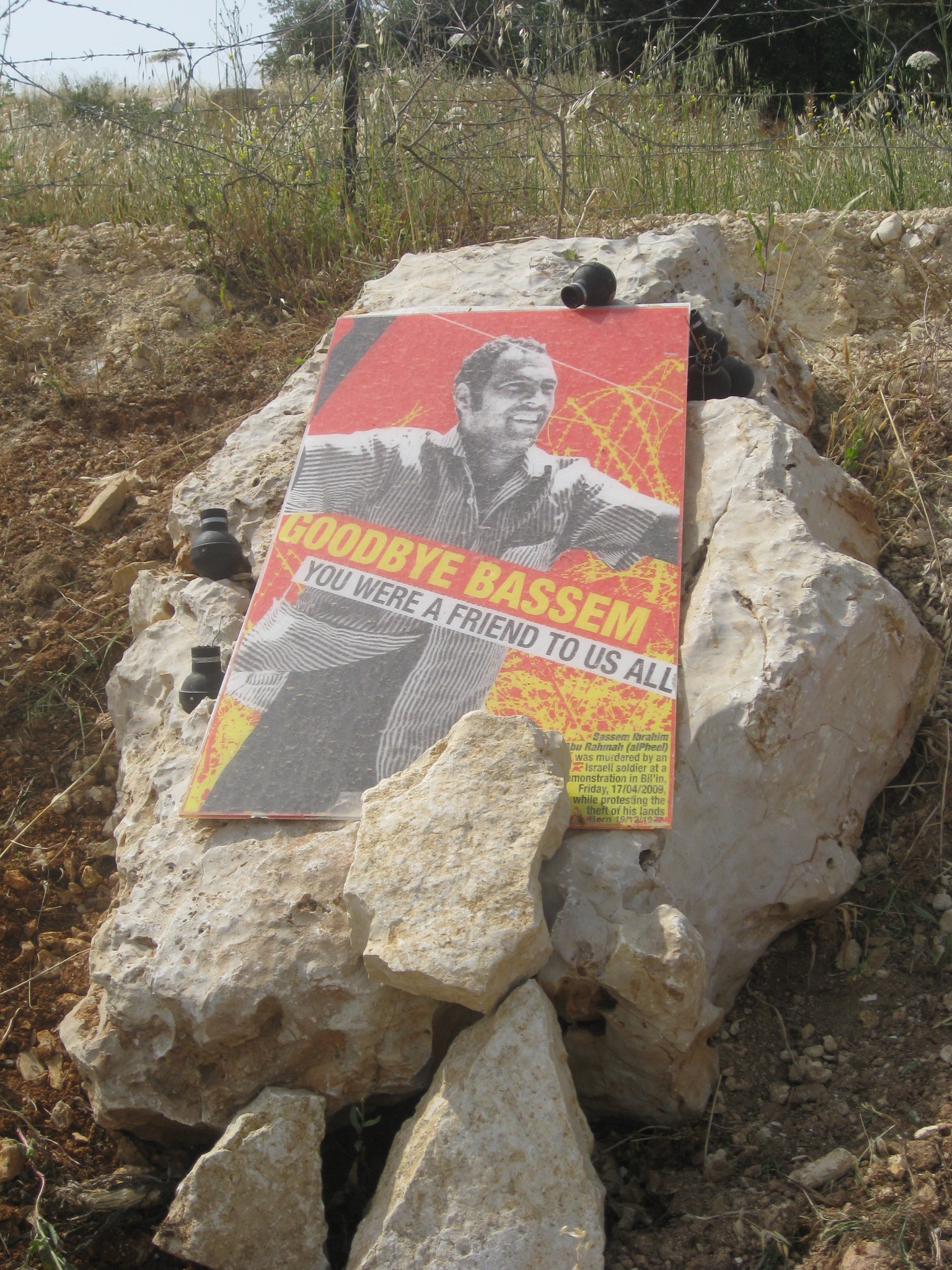
After the prayer, protesters marched towards the apartheid wall and the illegal settlement of Modi’in, situated just outside of Bil’in. A truck loaded with a sound system led the chanting crowd. Most were either waving Palestinian flags, holding up banners in support of the Palestinians imprisoned in Israeli prisons to mark Prisoners’ Day, or were holding posters of Bassem, a local who was killed six years ago by the Israeli army. As the march got closer to the wall, Israeli forces fired over 50 rounds of teargas canisters towards the protesters. The area was heavily clouded with this gas during most of the afternoon, which caused many to suffer from its inhalation. The shooting of this teargas also caused the dry grass between the olive trees to repeatedly catch fire.
During the protest, one person was shot with a rubber-coated steel bullet, while a 17 years old boy was shot in the chest with live ammunition. He was immediately taken to hospital by the ambulance. His condition is stable.
The 17th April is Prisoners’ Day in Palestine. Thousands of Palestinians are arrested arbitrarily on a daily basis by the Israeli forces, despite prohibition by international law. According to B’Tselem, “at the end of February 2015, 5,609 Palestinian security detainees and prisoners were held in Israeli prisons”. Since 1967, when Israel furthered its occupation to the West Bank, Gaza and East Jerusalem, an equivalent of approximately 20% of the total population in the Occupied Palestinian Territories (OPT), and 40% of all males have been detained (CEPR). While in prison, they are subject to wide-ranging violations of their rights and dignity. Such practices may include physical and psychological torture, deprivation of family visits, denial of access to lawyers and unlawful transfer out of the Occupied Palestinian Territories, among many other things. The Israeli occupying forces continue to violate the provisions of the Fourth Geneva Convention Relative to the Protection of Civilian Persons in Time of War, in particular against the Palestinian prisoners.
Today also marked the 6th anniversary of Bassem Abu Rameh’s death. Nicknamed Pheel, he was a much loved figure in the town of Bil’in. On the 17th April 2009, the Israeli army shot him with a teargas canister projectile which killed him shortly after. Aged 30, Pheel had been to all the non-violent protests, activities and creative actions against the apartheid wall in his town. Those who knew him remember him as a caring person who made everybody laugh and had the heart of a child, says Mohammad Khatib, a member of the Bil’in Popular Committee Against the Wall and Settlements.
According to the report by the United Nations Office for the Coordination of Humanitarian Affairs within the occupied Palestinian Territories, 442 people in the West Bank and 15 people in Gaza have been injured by the Israeli forces since the beginning of this year. On top of this, five people have been killed.
#PalestinianPrisonerDay: Protesters target G4S London HQ over Israeli ‘torture’ complicity
RT | April 17, 2015
Protestors gathered outside the London office of G4S on Friday to highlight the private security firm’s role in incarcerating Palestinian prisoners on behalf of Israel.
Organizers demanded the release of several prisoners, including Palestinian MP Khalida Jarrar and more than a hundred child detainees.
They also highlighted the ill treatment of prisoners, including alleged incidents of torture.
The protest in London takes place as part of an international day of action to mark Palestinian Prisoners Day, an annual expression of solidarity with Palestinians detained by Israel.
Palestinian Prisoners Day began as a mass action in support of hunger striking political prisoners on April 17, 2012.
It has grown into an annual event marked by human rights organizations and pro-Palestine groups across the world.
More than 100 people confirmed they would attend the protest on its Facebook page.
Organized by Innovative Minds (Inminds), a group which describes itself as online Islamic activists, the demonstration targeted G4S for its operation of two prisons and two detention centers in Israel and one prison in the West Bank.
Some 6,000 Palestinians are currently held in Israeli prisoners, according to the Addameer Prisoner Support and Human Rights Association.
Addameer’s monthly detention report for February 2015 indicates 163 of these prisoners are children, 13 of whom are under 16.
The vast majority of those incarcerated are male, with only 22 female prisoners.
Lina Jarbouni, a female detainee from Galilee, is the longest serving female prisoner having been in jail for 13 consecutive years.
“Systematic torture and ill treatment” of Palestinian prisoners is well documented, according to human rights group War on Want.
Activists say G4S is complicit in this ill treatment by providing security systems for the Israel-based Ketziot and Megiddo prisons, which hold political prisoners arrested within Palestine.
War on Want claims G4S has acted in violation of Article 76 of the Fourth Geneva Convention, which prohibits the transfer of prisoners from an occupied territory to the territory of the occupier.
G4S has become the target of an international boycott, with the South African government resolving to end work contracts with the security firm in November last year.
Archbishop Desmond Tutu was one of several notable activists, including Noam Chomsky, to sign a petition calling for G4S to end its participation in Israel’s occupation of Palestine.
Protestors outside the London office of G4S highlighted the plight of Palestinian prisoners being held by Israel as well as those detained by the security firm.
They demanded the release of Palestinian MP Khalida Jarrar, who was arrested by the Israel Defense Force (IDF) earlier this month.
The prominent feminist and human rights activist was sentenced to six months in prison without trial for violating a military injunction, which confines her to the city of Jericho and its surrounding.
Army sources told the Times of Israel the restraining order was based on her “incitement and involvement in terror.”
A spokesperson for the Palestine Liberation Organization (PLO) said Jarrar was heavily involved in the Palestinian Authority’s bid to join the International Criminal Court (ICC).
Activists also demanded justice for Jaafar Awad, 22, a Palestinian man who died from health complications resulting from “medical negligence” during his detention in an Israeli prison, according to the Palestinian Prisoner Society.
Another key theme of the protest was the detention of children.
Defense for Children International (DCI) launched an urgent appeal in 2012 after documenting 53 cases in which children were held in solitary confinement at the Al Jalame and Petah Tikva interrogation centers, and Hasharon prison.
Children reported being held in solitary confinement in a “foul smelling” cell measuring approximately 2 meters by 3 for an average of 10 days.
DCI reports no education is provided to them and they are denied access to their parents or lawyers while held in the Israeli Prison Service (IPS) controlled detention centers.
Read more:
Female Palestinian MP snatched by IDF, held without charge for 6 months
G4S posts £148mn profit despite ‘countless’ human rights scandals
Russia Iran oil-for-goods deal on – Kremlin

Russian President Vladimir Putin (R) and Iranian President Hassan Rouhani (RIA Novosti – Aleksey Nikolskyi)
RT | April 14, 2015
Russian President Vladimir Putin’s press secretary, Dmitry Peskov, confirmed the oil-for-goods deal between Moscow and Tehran is “absolutely” a reality and has begun.
Russia has started supplying grain, equipment and construction materials to Iran in exchange for crude oil under the barter deal announced by Russia’s Ministry of Foreign Affairs.
“Absolutely! Of course,” Kremlin spokesman Dmitry Peskov said when asked by reporters on Tuesday if the statement the Ministry of Foreign Affairs made on Monday was accurate, and the exchange had indeed started. “Focus on the statement of the Ministry of Foreign Affairs,” Peskov said.
On Monday, Russian Deputy Foreign Minister Sergei Ryabkov made the details of the trading partnership public.
Moscow and Tehran have been hashing out the deal’s small print since early 2014. A big step was taken in August when Russia’s Energy Minister Aleksey Miller and his Indian counterpart Bijan Namdar Zanganeh signed a five-year memorandum
According to Energy Minister Alexander Novak, Russia hasn’t yet received any Iranian oil.
Much of Iran’s oil reserves – the world’s fourth largest – remain untapped. Western sanctions put the brakes on discovery and exploration in the oil and gas industries.
Moscow may buy up to 500,000 barrels of Iranian oil per day, which would help Iran bring the 20-30 million barrels of crude oil they have in storage to market.
Iran, the third largest Russian grain customer, will ship wheat into the country. Russian state-run power utility Inter RAO and Inter RAO Export, as well as Technopromexport would supply equipment and help construct power stations in Iran, Russian Energy Minister Aleksandr Novak said previously.
On Monday, Russian President Vladimir Putin announced that Russia is lifting the ban on the delivery of S-300 missile rocket systems to Iran. The Kremlin canceled a 2010 self-imposed ban, suggested by the US and allies, not to sell Iran the artillery.
In April, Iran reached a nuclear agreement with the P5+1 countries to prevent Tehran from developing nuclear arms as long as the West lifted sanctions, which have been in place for nearly 40 years. By June 2015, a final agreement is expected to be reached, which will lift sanctions, including the oil embargo against Iran. After sanctions are loosened, Iran’s oil minister thinks the country can increase shipments by one million barrels a day.
Featured Video

Genocide-linked firm handles Britons’ NHS data
or go to
Aletho News Archives – Video-Images
Book Review
Book review: Boiling Point, How America Brought War to Ukraine
By Tim Kirby | Strategic Culture Foundation | November 14, 2026
Did Vladimir Putin just wake up one day on the wrong side of the bed and decide to invade Ukraine in February of 2022 or is there a lot more to this single decision that has been reshaping the 21st century geopolitical landscape?
Obviously, from the way that I just posed the question you can see that I am on the side that views the causes for the war in Ukraine to be very deep, long-term, historical and consciously nefarious, and most importantly, not from within the halls of the Kremlin. So it was a pleasure to take a look at the book “Boiling Point, How America Brought War to Ukraine” by author Stephen Kinzer, who like myself, also believes that the real reasons behind military conflicts around the world are not what CNN and the BBC have been telling you. The main thesis of this book was stated clearly by its creator; the war “may have been illegal, but it was definitely not unprovoked.” … continue
Blog Roll
 Aletho News
- The 10 Disease Renamings That Rescued the Vaccine
- NATO cancels 2027 leaders’ summit
- IAEA’s politicized use of safeguards undermines its impartiality: Russian envoy
- UK must be ready to strike Russian Arctic – ex-PM
- Fico’s Two Red Lines: Russian Energy and the Next Ukraine Loan
- Thousands rally for banned NATO-skeptic presidential candidate
- Ukraine Settlement and New European Security Architecture Must Go Hand in Hand – Kremlin
- Book review: Boiling Point, How America Brought War to Ukraine
- Israel Revives The ‘Iranian Assassination Threat Against Trump’ Deception In A Desperate Bid To Restart The War
- US rewrites history to dodge blame for illegal war on Iran: Foreign Ministry spokesperson
- If Americans Knew
- An error has occurred; the feed is probably down. Try again later.
- No Tricks Zone
- New Study: Barents Sea Temperatures Were Warmer And Sea Ice Less Extensive In The 1700s Than Today
- German Authorities Start Initiative To Evaluate Public Register For Climate “Disinformation” Spreaders!
- Zonal Asymmetry of Temperature Change in the Antarctic Circumpolar Current
- New Study: The Net Fossil Fuel Contribution To Rising Atmospheric CO2 Has Been Zero For 500 Years
- Germany’s Green Energy Transition Becoming Increasingly Expensive…Another 6 Trillion Euros!
- Sudden Stratospheric Warming, Powerful El Niño Combination May Lead To Extreme Europe Cold, Energy Crisis!
- Two New Studies Find Thwaites Glacier Melt Cannot Be Driven By Human Activity Or A Warming Ocean
- E-Cars Reduce CO2 Emissions By Only 41% Compared To Internal Combustion Engine Vehicles
- Predictions Made By Renowned Climate Professor Over Past Decades Have Been Proven To Be Poor
- New Study Suggests Large Regions Of The Pacific Ocean Have Been Cooling For The Last 80 Years

