ASA Summit Promotes South-South Ties, Regional Integration
Venezuelanalysis | March 1, 2013
The signing of twenty-seven new economic and social agreements between the nations of South America and Africa was the product of three days of meetings held between representatives of more than 60 countries in Equatorial Guinea last week.
The Third South America Africa Summit (ASA) took place just outside the capital of Malabo, where heads of states and high-ranking officials outlined ways to improve commercial, technological and transportation collaboration between the two continents.
Brazilian President Dilma Rousseff as well as Bolivia’s President Evo Morales were in attendance on Friday as were the presidents of Nigeria, South Africa, Senegal, Suriname and Cape Verde, among others.
“We are here to contribute with our experiences together, always thinking about the liberation of our countries in Africa as well as in Latin America and the Caribbean”, said President Morales on Friday.
During his speech, Morales drew attention to the need to take back the natural resources that have been “looted” by the United States and Europe, highlighting the gains that have been made as a result of such policies in the Americas.
“We began to take back our resources and the result has been a change in the economic and financial history of much of the countries in Latin America and the Caribbean”, the Bolivian head of state asserted.
“Unity for the dignity of our peoples, unity for equality, and, above all, unity for our liberation”, he added.
This sentiment of economic and political independence was echoed by the majority of ASA representatives including Nigerian Foreign Minister, Viola Adaku Onwuliri.
“Let’s show our ability to make tangible decisions that will lead to economic development and the integration of Africa and South America.
With true political will, we will be able to achieve it, just a s we have already been able to overcome the burdens of colonialism and racism”, Onwuliri said.
For his part, Venezuelan Foreign Minister Elias Jaua read a letter written by Hugo Chavez who apologized for his inability to participate personally in the conference.
“I truly lament, in the deepest of ways, my inability to be physically present with you and I reiterate once again…my most irrevocable commitment to the cause of union between our people”, the Venezuelan President wrote.
In his missive, Chavez hailed the “indivisible historic ties” that bind the regions and which have obliged the two continents “to walk together until the very end”.
“I will never be tired of saying it: we are one people. We must find each other, beyond the formalities and the speeches, in the feeling of unity.”
“In this way we will take our people out of the labyrinth where they had been cast by colonialism and, in the 20th century, by neoliberal capitalism”, the head of state said.
EXPANDING THE ALLIANCE
Apart from the commercial accords inked on Saturday, participating countries also expressed their support for Argentina in its territorial dispute with the United Kingdom over the Falkland Islands.
A further resolution saw the condemnation of the more than 50 year-old US blockade on Cuba and a declaration calling for Palestine to become a full member of the United Nations.
Many countries expressed their desire for the expansion of the ASA alliance, advocating the inclusion of all of Latin America and the Caribbean, not only those members belonging to the Union of South American Nations (Unasur) bloc.
President Nguema of Equatorial Guinea described the absence of these nations as “unjustifiable” given the important commonalities that exist between Africa and the developing nations of the Americas.
“The history of our continents, largely exploited by other countries, compels us to take measures of South-South cooperation which will allow us to emerge with liberty, independence and coexistence in this globalized world of confronting interests”, Nguema said.
Following this line, the President of the Spanish-speaking African nation proposed that ASA be incorporated into the recently established Community of Latin American and Caribbean States (CELAC) alliance that includes all countries in the Americas except the United States and Canada.
Venezuelan Foreign Minister Jaua reported that Nguema’s proposal has received the support of many allied Latin American nations and that “what needs to be done is to discuss [the proposal] with Unasur and then with CELAC”.
Jaua additionally informed that there will be an encounter between the leading members of ASA next month in the Venezuelan capital of Caracas to guarantee the materialization of the agreements signed last weekend.
“On April 26, there will be a meeting of the Follow-Up Commission which is made up of Nigeria, Brazil, and Equatorial Guinea to see through the accords that have been solidified in this third summit,” the Venezuelan Minister said.
FINDING ITS FOOTING
The tri-annual ASA first took place in Abuya, Nigeria in 2006 and was followed by a second encounter in Margarita Island, Venezuela in 2009.
While many member nations agree that more needs to be done to strengthen the alliance, trade between the continents has grown from $7.2 billion in 2002 to $39.4 billion in 2011.
Ecuadoran Foreign Minister Ricardo Patino explained that relations between the two regions have not been easy over the years “because we don’t know each other very much and we don’t have much work experience together.”
At the same time, Patino affirmed that there are great possibilities for collaboration and that the two continents “have much to offer one another” in ways that go beyond pure commercial relations.
Ecuador is slated to host the next ASA summit in 2016.
Related article
- Venezuela’s Chavez to Africa – South America Summit: We Must Unite (venezuelanalysis.com)
British activists being detained in UK airports under anti-terrorism legislation on return home from Palestine
International Solidarity Movement, and Corporate Watch | February 28, 2013
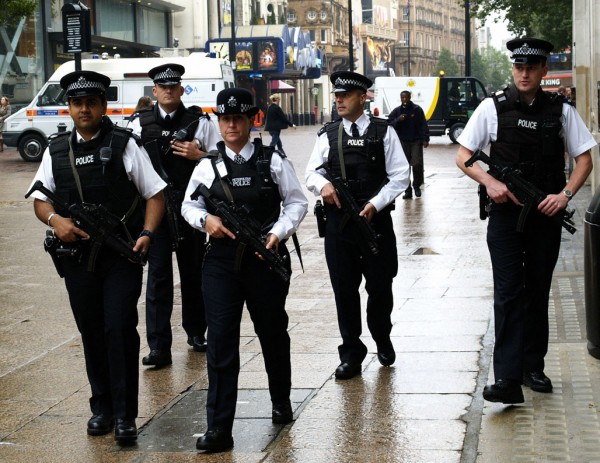 Two British peace activists have been detained in recent weeks after arriving home from the West Bank, occupied Palestine. They have been detained and taken in for questioning, over suspected links with the International Solidarity Movement.
“We are concerned about the British police using anti-terrorist legislation to target non-violent pro-Palestinian activists. We are a transparent group, trying to uphold the principles of international law; even inside Israel the International Solidarity Movement is not considered illegal. We would encourage the British Police to ask any questions they wish to do so, directly, and not by detaining affiliated activists at the airport”
The Schedule 7 of the Terrorism Act 2000, which the two activists have been held on, allows the police, under certain specified circumstances, to arrest individuals without a warrant who are reasonably suspected of being terrorists. These laws are draconian measures which give the British police powers to detain suspects for up to 28 days without charge.
Schedule 7 is clearly being used as a tool to find out more about activists involved in a wide variety of types of political dissent and to provide profiles of activists for the police to use in trying to undermine political movements. None of the questions about movements in the UK were designed to root out terrorism or uncover the preparation for terrorism. In fact, the movements concerned have never even been accused of terrorism (with the exception of completely false accusations made against the ISM, see here).
Britain abstained at the last vote at the United Nations deciding whether Palestine should be accepted as a non-member observer state. But in the last two weeks the double standards of the British government in relation to Palestine and Israel have again been laid bare; Saeed Amireh, has been refused a visa to visit the UK. Amireh is a peaceful campaigner against Israel’s occupation and the theft of Nilin’s land. He was told he hadn’t provided “enough supporting documents”, even though he had supplied everything that was asked for, including a letter of invitation and guarantee from the UK Palestine Solidarity Campaign of his costs being paid.
The use of these powers as a way to clamp down on non violent activists from Palestine and Britain is not acceptable, what is the British government afraid of? Maybe the fact the activists, returning home from Palestine, work with Corporate Watch and have helped reveal the continued supply of weaponry from Britain to the Israeli army has made them a target. This is despite the current British arms export policy stating it won’t deliver weapons to any countries breaking UN treaties. British companies are still complicit in Israeli war crimes in Gaza, as was proved in the EDO Decommisioners case of 2011.
Read more about the misuse of these powers and much more at corporateoccupation.org
Related articles
- Farming Injustice (alethonews.wordpress.com)
- Stop EU funding of Israeli military companies and illegal settlements (alethonews.wordpress.com)
- I find it sinister that the british firm securicor (“G4S”) is “providing services to israeli prisons and west bank checkpoints” (niqnaq.wordpress.com)
- Spies “monitoring” Palestine solidarity groups around world, says Israeli military correspondent (theuglytruth.wordpress.com)
Boycotting Israel Galloway-style
By Stuart Littlewood | Dissident Voice | February 26th, 2013
A big fuss blew up last week when British MP George Galloway, invited to Oxford University to debate the motion “Israel should withdraw immediately from the West Bank”, walked out of the chamber when he heard that the student opposing the motion was an Israeli.
American readers may remember Galloway, who came over in 2005 and delivered a master-class in how to give a Senate Inquisition sub-committee a good spanking.
At Oxford, something Eylon Aslan-Levy said prompted Galloway to ask, “Are you an Israeli?”
“Yes,” came the reply.
“I don’t debate with Israelis. I have been misled, sorry,” said Galloway putting on his coat. “I don’t recognise Israel and I don’t debate with Israelis,” he added and left.
The following message then appeared on Galloway’s Facebook: “The reason is simple: no recognition, no normalisation. Just boycott, divestment and sanctions, until the apartheid state is defeated. I never debate with Israelis nor speak to their media. If they want to speak about Palestine – the address is the PLO.”
The PLO, of course, is recognized as the sole legitimate representative of the Palestinian people.
Galloway’s point was that BDS (boycott, divestment and sanctions), in his terms, means “no purchase of Israeli goods or services, no normal contacts with individuals or organisations in Israel who support the existence of the racist Apartheid creed of Zionism. That’s what I mean by boycott. That’s what I do. Israelis who are outside of and against the system of Zionism are comrades of mine… My opponent at Oxford University did not meet this test.”
Aslan-Levy is reported to have told The Guardian that Israel’s withdrawal should not be immediate but “in the context of a negotiated peace treaty, which would recognise both Israeli and Palestinian states”. According to the Daily Mail he also said: ‘”To refuse to talk to someone just because of their nationality is pure racism, and totally unacceptable for a Member of Parliament.”
A lot of people have criticised Galloway for his behaviour in this matter. However, anyone arguing against an immediate end to the brutal and illegal 65 year-old occupation and offering silly excuses for prolonging the misery – like more lopsided ‘negotiations’ when international law and UN resolutions have already spoken – deserves to feel the cold blast of boycott, Galloway-style.
The attacks on Galloway seem to come mainly from people in the BDS movement itself who are supposedly on the same side. Press reports mention cries of “racism”. But notice that Galloway said he doesn’t debate with Israelis, not Jews. Others may not wish to debate with North Koreans or Afghan tribesmen. Our own foreign secretary apparently has no intention of chatting with his Iranian opposite number while turning the sanctions screw on the Iranian people. Obama when he visits the Holy Land to pay homage to Netanyahu won’t drop in on Haniyeh in Gaza to discuss football.
And it is pretty rich for a national of a racist state to call anyone else a racist.
The Palestinian BDS National Committee (BNC), which claims to set the guidelines for the boycott, divestment and sanctions movement, says it does not call for a boycott of individuals because she or he happens to be Israeli or because they express certain views, but adds: “Of course, any individual is free to decide who they do and do not engage with.”
OK, so why is Galloway getting flak?
Al-Aqsa Brigades Fire Rocket on Occupied Territories in Response to Killing of Prisoner
Al-Manar | February 26, 2013
A rocket fired from the Gaza strip landed early Tuesday near Ashkelon in the south of the Palestinian occupied territories, as al-Aqsa Martyrs Brigades, the military wing of Fatah Movement, claimed responsibility for the rocket launch.
“The rocket fell early in the morning near Ashkelon and did some damage to a road, without hurting anyone,” an Israeli police spokesman Micky Rosenfeld.
In a statement, al-Aqsa Brigades, Groups of Martyr Luai Kane’, claimed responsibility on Tuesday for firing a Grad rocket on Ashkelon city.
The statement said that the rocket was “in response for assassinating the prisoner Arafat Jaradat” who was martyred on Sunday after being tortured in an Israeli prison.
“The Freedom won’t be achieved but through sacrifice… We have to resist our enemy in all available means,” al-Aqsa Martyrs added in the statement.
Jaradat’s martyrdom sparked protests across Palestine, with thousands of Palestinians thronging the West Bank village of Sair on Monday for the funeral of Jaradat, a 30-year-old father of two and member of the Al-Aqsa Martyrs Brigades.
Both the Palestinians and the United Nations special coordinator for the Middle East peace process, Robert Serry, have called for an independent inquiry into Jaradat’s death.
Tuesday’s rocket fire was the first such event since the end of an Israeli offensive against Gaza late November.
The two sides finally agreed to a truce on November 21 following the eight-day Israeli attack which cost the lives of dozens of Palestinian civilians. 177 Palestinians were martyred and six Zionists were killed, according to figures issued by the two sides.
Related article
Israeli court extends remand of Issawi’s brother

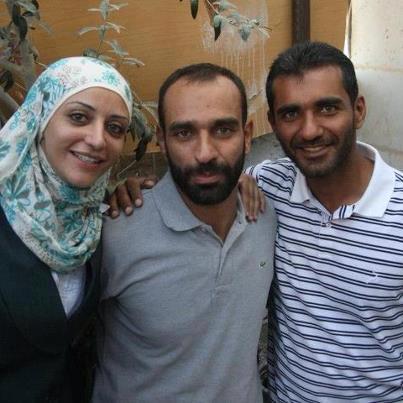
Shireen, Samer and Shadi Issawi
Palestine Information Center – 25/02/2013
RAMALLAH — The Israeli Magistrate Court in occupied Jerusalem extended on Sunday the remand of Shadi Issawi, the brother of hunger striker Samer Issawi, and did not allow him to see his lawyer.
Shireen Issawi, the sister of Shadi and a lawyer, said that the arrest of Shadi and extending his remand fell in line with pressures on Samer to end his seven months hunger strike.
She charged the Israeli occupation authorities (IOA) with targeting all members of Samer’s family, recalling that the IOA razed the home of her third brother Rafat at the start of the year and cut water supplies to her family home in addition to detaining her and her fourth brother Firas for a period of time.
Related articles
- Shireen Al-Issawi: PA did not take prisoners’ issue to the UN (alethonews.wordpress.com)
- Samer Issawi sentenced to 8 months in prison (alethonews.wordpress.com)
Two residents from Burin arrested overnight: confrontations follow
ISM Media Group | Aletho News | February 25, 2013
Mahmoud Nasser Asaus (17) and Magdi Loai Najjar (24) were arrested last night by Israeli forces in the village of Burin and are now being held in Kishon Interrogation Centre in Haifa. Residents of Burin suspect this is the start of a wave of arrests following the Al-Manatir protest that took place In Burin at the beginning of February.
Several jeeps entered Burin at around 2.30am to raid Mahmoud and Magdi’s houses, taking them, handcuffed and blindfolded, to Huwwara military base. At 7am this morning they were transferred to Kishon Interrogation Centre where they are still being held.
These arrests come after the neighbourhood of Al-Manatir was established on a village’s hilltop threatened with confiscation by Israeli settlers. The protest camp was aimed at denouncing Israel’s grab of Burin’s land and to recover the hilltop which has been inaccessible for residents of Burin since 2007.
However, the neighbourhood of Al-Manatir, made up of metal huts and tents, was violently evicted by Israeli soldiers and border police on the same day it was established. Israeli forces protected and accompanied settlers from the nearby settlements of Bracha and Yitzhar; while they were stealing metal huts and throwing stones at Palestinian activists. Simultaneously, around twenty settlers attacked several Palestinian homes on the outskirts of Burin and chopped down one hundred olive trees. When Palestinians ran to the area to defend their homes, stone throwing between settlers and Palestinians ensued. Zakaria Najjar (17), was shot in the right leg with live ammunition by a settler.
During the eviction, eight people were arrested and three of them remained in Israeli prison for twelve days, finally being released without charges. Further reprisals took place in Burin the days following Al-Manatir. Ghassan (23) and Mohammed (19) Najjar were arrested for several hours and interrogated about the protest camp. In addition, the village was sealed off by military checkpoints. The hilltop continues to be inaccessible for residents of Burin.
Following last night’s arrests there have been further incursions into the centre of Burin today. The Israeli army again tried to raid the village resulting in confrontations that began at around midday. Tear gas and rubber coated steel bullets were fired directly into the gathering crowd; as yet no serious injuries have been reported. A further arrest was made by the Israeli authorities, Bahar Adnan Imran who is just 14 years old.
Related articles
- Israeli troops force out 200 from camp (morningstaronline.co.uk)
- Israeli Settlers Attack Palestinian Shepherds In Nablus, Hebron (imemc.org)
Palestinians clash with Israeli troops across the West Bank
Ma’an – 23/02/2013
RAMALLAH – Clashes erupted across the West Bank after the Friday prayers between Israeli troops and Palestinian protesters who rallied to show solidarity with hunger-striking Palestinian prisoners.
Dozens were hurt as Israeli soldiers fired tear gas heavily to disperse the protesters.
Similarly, worshipers in Al-Aqsa Mosque in Jerusalem demonstrated in the compound after the Friday prayer before Israeli troops broke into the squares and clashed with the protesters.
According to Israeli radio station Reshet Bet, Israeli soldiers fired stun grenades to disperse the worshipers. The report highlighted that demonstrations started near the Moroccan Gate through which the soldiers stormed the compound and started to chase protesters.
In Ramallah in the central West Bank, 12 young men were hurt by tear gas and rubber-coated bullets during clashes with Israeli troops after the Friday prayers. Locals told Ma’an that the soldiers detained one Palestinian. The sources highlighted that the Friday prayer was performed near the main gate of Ofer detention center west of Ramallah.
They said about 100 Palestinians preformed Friday prayers near Ofer before Israeli soldiers showered them with tear gas as soon as they finished prayer.
As a result young men started to hurl stones at the soldiers and police officers. A Ma’an reporter said the soldiers directed their tear gas to journalists who gathered in the area to report about the event. He added that the soldiers fired live ammunition at a car for journalists, but nobody was hurt.
Further clashes took place in al-Arrub and al-Fawwar refugee camps in Hebron district.
Witnesses said young Palestinian men in al-Arrub camp north of Hebron pelted Israeli soldiers with stones. Clashes erupted first at the main entrance to the camp on the main road between Hebron and Bethlehem. Then the clashes extended to camp’s alleys resulting in more victims of tear gas as some canisters fell inside houses.
One owner of these houses was identified as Nayif Nimir al-Badawi. Four people were hurt by tear gas. Three others were hurt in house of Khamis Awad al-Badawi.
Israeli forces shut down the main entrance to al-Fawwar camp north of Hebron after young men hurled stones at Israeli soldiers. The soldiers responded with tear gas before they closed the main entrance to traffic.
In Tulkarem in the northern West Bank young Palestinians clashed with Israeli troops in the western part of the city. Soldiers fired tear gas as the young protesters pelted them with stones. The clashes erupted after hundreds of young men rallied after the Friday prayer chanting slogans against Israel’s treatment to Palestinian prisoners.
The northern West Bank city of Jenin also witnessed confrontations between young Palestinians and Israeli soldiers after the Friday prayer. Nine Palestinians were detained during the clashes and dozens were hurt by tear gas and rubber-coated bullets.
Jenin’s clashes started after young men marched from mosques toward al-Jalama checkpoint expressing solidarity with hunger striking Palestinian prisoners. A Ma’an reporter said Israeli forces fired hundreds of tear gas canisters at the protesters in addition to rubber-coated bullets and foul smelling liquids.
Local and security sources told Ma’an that Israeli soldiers detained nine young men. The sources identified one detainee as 14-year-old Amir Majid Irqawi. They said the soldiers assaulted him beating him brutally before he was detained.
Related article
Samer Issawi sentenced to 8 months in prison
Ma’an – 21/02/2013
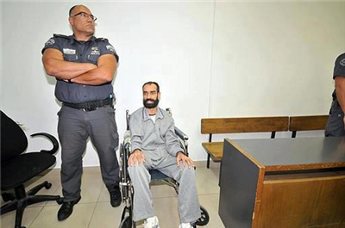 BETHLEHEM – An Israeli court on Thursday sentenced hunger-striker Samer Issawi to eight months in prison, but he has yet to face a military committee which could imprison him for 20 years.
Issawi has been on hunger strike for 204 days.
The magistrates court in Jerusalem sentenced Issawi for leaving Jerusalem, in violation of the terms of his amnesty granted in an Oct. 2011 prisoner exchange deal.
The sentence includes time served since Issawi’s re-arrest in July 2012, and will conclude on March 6, but Issawi also faces a possible sentence under an Israeli military order which allows a special military committee to cancel prisoners’ amnesty.
The committee could use secret evidence to sentence Issawi to serve 20 years, the remainder of his previous sentence.
Issawi was freed in an Oct. 2011 prisoner swap for captured Israeli soldier Gilad Shalit. Israel has subsequently re-arrested at least 14 prisoners since the deal.
Ahead of Thursday’s verdict, Israeli forces clashed with hundreds of Palestinians protesting near Ramallah on Thursday in solidarity with long-term hunger strikers like Issawi.
A Ma’an reporter said 29 protesters were injured by rubber-coated bullets and dozens more suffered tear gas inhalation.
Prisoners minister Issa Qaraqe and Fatah central committee member Mahmoud al-Aloul joined the rally, near Israel’s Ofer prison in the central West Bank.
An Israeli military spokeswoman said soldiers used “riot dispersal means” against Palestinians who hurled rocks at forces.
Protests have been held across the West Bank and in Gaza in support of Issawi, who has been on hunger strike for 204 days, and Tareq Qaadan and Jaafar Azzidine who have refused food for 86 days.
Also Thursday, the Ahmed Abu Rish Brigades on Thursday threatened to fire rockets at Israel if any jailed hunger striker is harmed.
“We will continue to work with rockets and we will not stand by idly. Military operations will be implemented to achieve the rights of prisoners and to free them,” brigades member Abu Ali al-Qawkabi said in a statement.
Al-Qawkabi called on Palestinian leaders in Ramallah to reject any negotiations with Israel and urged the Gaza government to refuse a truce until the detainees’ demands are met.
Islamic Jihad meanwhile has said a truce with Israel could unravel if any hunger striker dies.
On Tuesday, the Palestinian Authority called on the international community to step up efforts to protect and release prisoner like Issawi in Israeli detention facilities.
The cabinet also called on the World Health Organization to move forward on plans made last year to form a fact-finding committee to investigate the conditions in Israeli jails, specifically negligence.
Message from Samer el Issawi, day 209 hunger strike
February 16, 2013
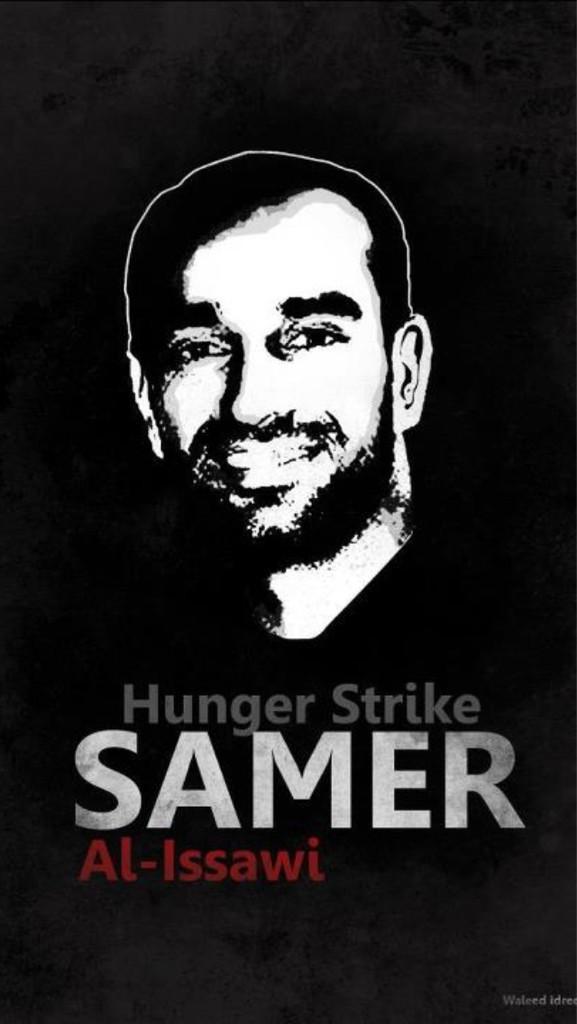 “I turn with admiration to the masses of our heroic Palestinian people, to our Palestinian leadership, to all forces, parties and national institutions. I salute them for standing by our fight to defend our right to freedom and dignity.
I draw my strength from my people, from all the free people in the world, from friends and the families of the prisoners who continue day and night chanting for freedom and an end to the occupation.
My health has deteriorated dramatically and I’m hung between life and death. My weak body is collapsing but still able to be patient and continue the confrontation. My message is that I will continue until the end, until the last drop of water in my body, until martyrdom. Martyrdom is an honor for me in this battle. My martyrdom is my remaining bomb in the confrontation with the tyrants and the jailers, in the face of the racist policy of the occupation that humiliates our people and exercises against us all means of oppression and repression.
I say to my people: I’m stronger than the occupation army and its racist laws. I, Samer al-Issawi, son of Jerusalem, send you my last will that, in case I fell as a martyr, you will carry my soul as a cry for all the prisoners, man and women, cry for freedom, emancipation and salvation from the nightmare of prisons and their harsh darkness.
My battle is not only for individual freedom. The battle waged by me and by my heroic colleagues, Tariq, Ayman and Ja’affar, is everyone’s battle, the battle of the Palestinian people against the occupation and its prisons. Our goal is to be free and sovereign in our liberated state and in our blessed Jerusalem.
The weak and strained beats of my heart derive their steadfastness from you, the great people. My eyes, which started to lose their sight, draws light from your solidarity and your support of me. My weak voice takes its strength from your voice that is louder than the warden’s voice and higher than the walls.
I’m one of your sons, among thousands of your sons who are prisoners, still languishing steadfast in the prisons, waiting for an end to be brought to their plight, their pains and the suffering of their families.
The doctors told me I became exposed to stroke because of the disorder of my heartbeats, the shortage of sugar and the drop in blood pressure. My body is full of cold and I can’t sleep because of the continued pain. But despite the extreme fatigue and chronic headaches, as I move on my chair, I’m trying to summon all my resources to continue on the road till its end. There is no going back, only in my victory, because I’m the owner of Right and my detention is invalid and illegal.
Do not be afraid for my heart if it will stop, don’t be afraid for my hands if they will be paralyzed. I am still alive now and tomorrow and after death, because Jerusalem is moving in my blood, in my devotion and my faith.”
**Via Rona Merrill, Neta Golan
Related article
- Shireen Al-Issawi: PA did not take prisoners’ issue to the UN (alethonews.wordpress.com)
Canaan protest village
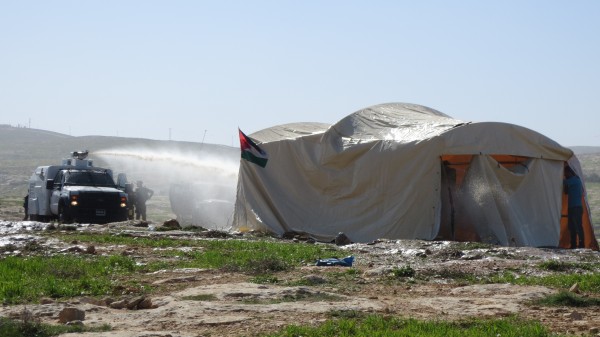 Canaan tent being skunk watered (Photo: ISM)

Beit Ommar Popular Movement | February 10, 2013
South Hebron Hills, Occupied Palestine – Today, the South West Popular Committee along with international activists embarked on a new effort to establish a village, Canaan, on Palestinian land in South Hebron Hills. The village’s name was not accidental. We wanted to declare that we are the indigenous people of Palestine. We are the descendants of the Canaanites and our ties to the land can never be broken or taken away. Early last night, various Palestinian activists from a wide array of villages in the South West Bank area along with international activists met in a home to discuss plans for the coming day.
Signs were prepared which stated ‘Our Land is Our Right’, ‘Canaan Village’ and a declaration of intent which stated that “we are the sons and daughters of the Cananites, we establish Canaan Village on endangered Palestinian land.” “We declare that it is our natural right to develop, reclaim, improve, use and live on all our lands free and without threat from occupiers/colonizers.”
In the early morning hours, following a night of planning, we established Canaan as our first attempt, in the south of Yatta (the entrance to Twani). Within less than a minute, while we barely managed to establish the tent, an occupation jeep arrived. The occupation soldiers encircled us and told us we must leave. We refused to obey such a racist demand. An officer of the occupation army then went on to demolish our tent, steal our additional tents and equipment and violently prevent us from reclaiming our land and our belongings.
Several hours later, we went on with a much larger group of activists, international supporters and an especially large number of journalists, to east Yatta, near Ein Mai’in, Hazawai, we established a large tent and began building a room from stones of the land. Within half an hour, we were heavily encircled by at least 6 jeeps of the occupation forces. A large military vehicle which fires skunk water was brought in. We were told that we have 10 minuets to leave the area and that the land was a ‘closed military zone’. We did not yield of course and were immediately showered upon by heavy skunk water.
Occupation soldiers then went on to attack journalists and arrest them. They beat an elderly woman and other activists. In several instances, activists jumped in and prevented with their bodies the arrest of two people. After several hours of struggling with the occupation soldiers which numbered more than 50, 4 journalists, 8 Palestinians and 2 international activists were arrested, our tent was destroyed and we were prevented from returning to our land. For many hours during the hot afternoon, hundreds of activists remained in the area and demanded the right to return to the Canaan Village.
Related article
Featured Video

BRITAIN’S WARNING: PREPARE FOR WAR
or go to
Aletho News Archives – Video-Images
From the Archive
How Ukraine Tortured and Slaughtered Donbass
By Kit Klarenberg | Al Mayadeen | July 11, 2024
Almost immediately after the proxy war erupted, ISIS-tier footage of the torture and murder of Russians in Ukrainian custody emerged.
On July 6th, the New York Times published an astonishing investigation: In Ukraine, Killings of Surrendering Russians Divide an American-Led Unit. The article documents in grim detail how Chosen Company, an international volunteer battalion for Kiev, routinely executes Russian prisoners of war. It is the very first mainstream admission that this practice – a brazen breach of the Geneva Conventions, and a grave war crime – is widespread among Ukraine’s fighters, both foreign and homegrown. … continue
Blog Roll
 Aletho News
- Record Oil, Empty Tanks: The UAE’s Miracle Recovery
- Burnham tackles Britain’s poverty with aggression in Yemen
- Peace in Ukraine: the easy way – or the hard way
- Trump & the Rrrrussians
- US taxpayer money laundered back through Ukraine – Musk
- Before COVID, an NIH lab chief proposed making a SARS-like bat virus more infectious
- Gates, Bourla on Trial in Netherlands Accused of ‘Great Reset’ Scheme at Vaccine Injury Hearing
- BRITAIN’S WARNING: PREPARE FOR WAR
- “Historic Russia”: The Land Putin Will Not Give Back
- How the Cambridge Analytica scandal still haunts Mark Zuckerberg
- If Americans Knew
- An error has occurred; the feed is probably down. Try again later.
- No Tricks Zone
- Two New Studies Find Thwaites Glacier Melt Cannot Be Driven By Human Activity Or A Warming Ocean
- E-Cars Reduce CO2 Emissions By Only 41% Compared To Internal Combustion Engine Vehicles
- Predictions Made By Renowned Climate Professor Over Past Decades Have Been Proven To Be Poor
- New Study Suggests Large Regions Of The Pacific Ocean Have Been Cooling For The Last 80 Years
- Germany’s Green Energy Debacle: High Energy Costs Force Kahla Porzellan to Close After 182 Years!
- New Study: 50 Years Of The Most Aggressive ‘Net Zero’ Policies Can Only Affect The Global Climate By 0.03°C
- US September “Heat” Was No Record…Many Records Set Decades Ago
- Latest European Green Energy Debacle; Portugal’s Largest Flagship Solar Park Insolvent!
- Green Energy Debacle: German Expert Professor Fritz Vahrenholt Warns Of Severe Economic And Social Consequences
- Two More Paleo Reconstructions Affirm Meters-Higher Sea Levels Across Ireland, Brazil 7000-6000 Years Ago

